Chapter XXI · THE HEIGHT AND DECLINE OF THE BOURBON MONARCHY (continued 2)
Reading edition
The court was struck with consternation on learning of this second defeat, of which the details were for a long time unknown. No courier arrived, so that Louis was obliged to despatch Chamillart himself, his minister, to Flanders. Villeroi was distracted, and had lost all self-possession; everyone condemned a general whose imprudence had placed the kingdom “within two fingers of its ruin.” Still Louis was generous to his unfortunate general, and wrote him to give in his resignation, in order to avoid the harshness of deprival. The duke de Vendôme was recalled from Italy to take the command in Flanders; and the duke of Orleans, the king’s nephew, succeeded Vendôme. This last appointment surprised the court, which was aware of the extreme repugnance felt by Louis to employ any of the princes of the blood; but so unfortunate had proved his choice of late that the monarch resolved at last to trust the defence of the kingdom to the zeal of his family.f
[1706-1707 A.D.]
Orleans found the army in Italy in great disorder, the generals divided and insubordinate; Turin was besieged according to the plans of La Feuillade [the most frivolous and incompetent of the favourites of Louis], contrary to the advice of Vauban; the prince in irritation turned over his powers to Marshal de Marchin. Prince Eugene, who had effected his junction with Victor Amadeus, encountered the French army between the Dora and Stura rivers. Orleans was seriously wounded at the battle of Turin, September 7th, 1706; Marchin was killed and discouragement seized the generals and the troops. The siege of Turin was raised and before the end of the year almost all the places were lost and Dauphiné threatened. Victor Amadeus refused to agree to a special peace and in March, 1707, the prince of Vaudemont, governor of the Milanese for the king of Spain, signed a capitulation at Mantua and sent back to France the troops that still remained there. The imperials were masters of Naples. Spain possessed nothing more in Italy.
Philip V had been threatened with the loss of Spain as of Italy. In the past two years the archduke Charles of Austria under the name of Charles III, with the support of England and Portugal, disputed the crown with the young king. Philip V had lost Catalonia and had just failed in an attempt to retake Barcelona, which had surrendered to Lord Peterborough. The road to Madrid was cut off; the army was obliged to pass through Roussillon and Béarn to resume the campaign. The king shut himself up in the capital whither he was conducted by Marshal Berwick, a natural son of James II; but Philip could not remain in Madrid, threatened by the enemy. He betook himself to Burgos. The English entered the capital and proclaimed Charles III.
But this was too much. The Spaniards could not allow an Austrian king to be imposed upon them by heretics and the Portuguese. The cities arose; a handful of cavalry was sufficient to enable Berwick to regain possession of Madrid, and the king returned on the 4th of October amid the acclamations of the people. Charles III now held only Aragon and Catalonia in Spain. The French garrison, unoccupied since the evacuation of Italy, came to the assistance of the Spaniards.
Louis XIV had made his grandson understand that a great sacrifice would be necessary to obtain the peace he believed would soon be due to their peoples. The Dutch refused their mediation. The campaign of 1707 was signalled in Spain by the victory of Almansa, won on the 15th of April by Marshal Berwick over the Anglo-Portuguese army and by the taking of Lerida which surrendered on November 11th to the duke of Orleans. In Germany Villars drove the enemy from the banks of the Rhine,[146] advanced into Swabia, and ravaged the Palatinate, levying contributions on the country of which he openly kept a part for himself.
[1707-1708 A.D.]
The inexhaustible elasticity and marvellous resources of France had somewhat revived hopes in 1707. An invasion of Provence by Victor Amadeus and Prince Eugene, a check before Toulon and their retreat, precipitated by a rising of the peasants, had irritated the allies. Attempts at negotiation at the Hague undertaken by the king remained without result.i
But the emperor made a treaty of neutrality for Italy, and that brought to the Rhine frontier the soldiers in Italy.a The allies hoped to reduce the king lower; and certainly the prospects of France were never more gloomy. The finances were in the greatest disorder. Chamillart had the management of both war and finance departments: the exertion, united with ill success, was too much; it was killing him. He wrote a piteous letter to this effect, tendering his resignation to the king: Louis read it, and writing on the margin of the letter, “Well, we will perish together,” sent it back to the minister. One active genius, nevertheless, was employed at this time to provide a remedy for the poverty of the government, and a reform in the financial system: this was Vauban, the celebrated engineer. The product of his labours was a plan for abolishing the numerous and intricate branches of taxation, and substituting in its place one uniform tax on property. He proposed to take a tenth of its yearly value, which he called a dîme royale. This simple mode would have proved the ruin of the financiers, the farmers of the revenue, and the pensioners, that were paid out of divers intricate receipts ere they reached the treasury. The scheme of Vauban was set aside; and paper money now made its appearance in France for the first time.f The use of credit was not understood, however, in France as it was being learned in England. The establishment of the Bank of England, which enabled the small kingdom to use all her resources without undue strain or present exhaustion, had no parallel in France, where finances were managed in secret councils of the king, and the nearest approach to national banking was to anticipate future revenues to the utmost limit. To meet or guarantee these anticipations, more imposts must be levied; more distress and suffering resulted. In England the war furnished people with a safe and new means of investment. In France the absence of a regular institution of credit prevented that use of its resources which was to be the astounding achievement of the Bank of France two centuries and a half later.a
Despite his distresses, Louis was not inactive. He fitted out an expedition for the pretender to Scotland, which failed. Funds were wanting to supply the armies. Desmarets, who had succeeded Chamillart, told the monarch that it was impossible to obtain money, except from Samuel Bernard the banker. Louis saw Bernard, asked him to Marly, and showed him the wonders of the place with a condescension that made the courtiers stare. Bernard was so set beside himself by the honour, that he declared he would rather see himself ruined than the empire of so gracious a monarch in want; and the loan was instantly effected.
Villars commanded with his usual activity and success on the Rhine in 1708, whilst the duke of Burgundy, grandson to Louis, aided by Vendôme, commanded against Marlborough in Flanders. The allies had not troops sufficient to garrison the numerous towns which they had taken in Flanders, and which were far more inclined to French rule than to the Dutch and English. Ghent and Bruges were, owing to these causes, surprised. Emboldened by success, the French pushed across the Schelde towards Brussels with rather uncertain intentions. Hearing that Marlborough was approaching, they retired, and invested Oudenarde, which intercepted the passage on the Schelde betwixt the French towns and Ghent. They hoped to take it ere Marlborough could arrive. But that general making forced marches, the French at his approach decamped from before Oudenarde to retire to Ghent. The duke reached them on their retreat, and a partial action took place, in which the French were routed, and driven, with great loss, back to Ghent. The dukes of Vendôme and Burgundy had a serious difference and quarrel on the field. Whilst the commanders were squabbling, their army was beaten. The prince Eugene then invested Lille, a bulwark not yet reduced. Lille surrendered in October, 1708: with it fell Ghent and Bruges; and, with the exception of one or two towns, the frontier of France lay completely open. [This was the darkest hour for Louis XIV. Even the capital seemed no longer safe.]
[1708-1709 A.D.]
The year 1709 commenced by one of the most rigorous winters ever known. The populace began to clamour under present sufferings, and with the prospects of still greater. Seeing the disastrous and disturbed state of the population, the parliament thought proper to assemble in the great chamber, to consider the state of things. It was proposed to appoint deputies to visit the provinces, buy corn, and watch over the public peace. It was a bold attempt under Louis XIV. He reprimanded the parliament, and told them that they had as little to do with corn as with taxation. The magistrates obeyed, and were silent.
In such a state of threatened famine, aggravated by the oppression of war, commerce remained at a stand: money was no longer forthcoming. Bernard, the great banker, became a bankrupt. Even the insufficient revenue could not be collected; and an adulteration of the coin was had recourse to as the only expedient. Louis despatched the president Rouillé to Holland to sue for peace; and soon after the marquis de Torcy, minister, he might be called, of foreign affairs, was sent on the same humiliating errand. The states of Holland, or their agents, here repaid the French king all his past insults and pride. His envoys and his offers were slighted, yet these last were sufficiently ample. Louis consented to abandon his grandson the king of Spain, reserving for him merely Naples. The states refused even Naples. Torcy offered them towns to form a barrier in the Netherlands. In this nothing less than Lille and Tournay would content them. They demanded Strasburg and Landau, tantamount to Alsace, and the demolition of Dunkirk. Louis consented to demolish the port of Dunkirk, as also the fortifications of Strasburg. In short, the demands of the allies went not only to reduce France to what it was at the accession of Louis, but prince Eugene claimed to keep possession of his conquests in Dauphiné. Moreover, the allies insisted not only upon the French king’s abandoning his grandson, but upon his aiding to dethrone him. “If I am to continue warring,” replied Louis, “I had rather fight my enemies than my children.”
The negotiations were thus broken off. The monarch gained much by them. He showed his sincere desire for peace; and now making known, in a printed appeal to his subjects, the terms that he had offered and that had been rejected, the national feeling was roused to indignation. The rich sent their plate to the mint, the king and royal family not excepted; the poor hurried to the armies; and Louis was in a condition to face his inveterate foes. The obduracy of Marlborough, of Prince Eugene, and of the Dutch was certainly impolitic; for Spain might in one campaign have been reduced, the French remaining neutral. France, herself, offered to make every fair concession; and the commanders, in refusing, might well incur the reproach of being actuated by selfish views, if the state of distress in France had not warranted any hopes or pretensions on their part. A great portion of the court of Versailles itself was for abandoning Philip V, and withdrawing the troops from Spain; a measure which did take place in part, owing, however, to a quarrel betwixt Madame de Maintenon and the princess Orsini.
Meantime the allies had entered the field, well supplied from the copious magazines of Holland. The French army, in a state of starvation and nudity, opposed them. Its commander was the marshal de Villars. He was indignant at the arrogance of the confederates, and the despondency of the court: it was he who roused the drooping spirits of Louis and of his ministers, and who alone preserved a confidence in the French soldiery and in the fate of arms. Villars appears to be one of the truest and finest specimens of the French soldier: he was ardent, bold, and valiant; qualities which he enhanced by an air and habit of boasting. Full of resources, he never lost confidence in himself, firmly believing that neither Marlborough nor any other general could contend with him. At the same time he was blunt and rude; could not brook to be commanded; too independent to be a courtier, all ministers hated him and the butterflies of the court joined them. “I am going to fight your enemies,” said he to the monarch, as he was departing for a campaign; “I leave you amongst mine.”
The Battle of Malplaquet (1709 A.D.)
The duke of Marlborough and Prince Eugene had taken Tournay, and now menaced Mons. Villars advanced by the road from Valenciennes to succour it, and posted himself to the right of the road, in an interval betwixt two woods, near Malplaquet. By advancing, he might have routed Prince Eugene, who was at first inferior in numbers; but Marlborough coming up, the two generals determined to attack Villars, who on his side, anxious to measure himself with them and secure an advantage, had covered his strong position by entrenchments and abatis, or trees felled and thrown with their branches towards the enemy. The envoys of the Dutch states dissuaded Marlborough from fighting; and they were right. Mons was in the rear of the allied army, and Villars was in no condition to disturb its siege, without at least quitting his entrenchments. Marlborough, however, accustomed to conquer, somewhat undervalued his enemies, and resolved on the attack.
The battle of Malplaquet was fought on the 11th of September. Each wing of the French was in a wood, covered and entrenched, whilst the centre, occupying the interval, had taken scarcely less care to cover itself. Opposite the French centre, however, was a farm and a little wood, which Prince Eugene occupied, and filled with troops that did not appear. The action began on the wings, Marlborough charging Villars and driving him back after a struggle. To support himself, Villars drew reinforcements from the centre, and was making fresh head against the English, when a ball struck his knee, and incapacitated him from commanding. Prince Eugene, watching his opportunity, seized the moment that Villars had weakened his centre, and, leading his infantry from the farm and wood, rushed on the centre, and broke it, carrying their entrenchments. This was victory. In the meantime, the Dutch attack on the other wing, where Boufflers commanded, was defeated. Despite the valour of the young prince of Orange, he could not establish himself in the wood or within the entrenchment; and he was driven back.
[1709-1711 A.D.]
But the success of Boufflers was to no purpose. The French left and centre were broken; and all that its victorious right could accomplish was to cover the retreat, and prevent Malplaquet from being converted into the same rout as Ramillies. The allies lost a prodigious number of men in the attack of the woods and entrenchments. The number of French slain was much less. Villars, in consequence, was as proud as if he had gained the battle. “If God should grant us another such defeat, our enemies would be destroyed,” wrote he to Louis. He afterwards boasted that but for his wound he would have won the victory: Voltaire, who was present, remarks that few believed the boast. Mons surrendered immediately. This was the last victory of Marlborough.
In the next campaign, indeed, he showed his decided military superiority to Villars, by breaking through lines that the marshal had declared impregnable, and this without losing a man. But whilst France, with the languor of an exhausted but still valiant combatant, was warding off these blows, which the Dutch, in their anxiety for capturing towns and forming a barrier, prevented from being straightforward and vital, fortune was pleased to prostrate Marlborough, and rescue Louis from ruin by the means of a canting clergyman and an obscure woman, who rose to court favour. Sacheverell and Mrs. Masham effected what all the warriors and statesmen of Versailles despaired to do. Marlborough was overthrown, and with him England’s inveteracy and force.
Previous to affairs taking this unexpected turn, the situation of Louis was desperate. Again he sent envoys to sue for peace, and they were treated with the same contempt. Sympathy is here excited for the monarch, struggling bravely not for his conquests but for his crown and country. Louis on this occasion showed a spirit that more entitled him to the name of Great, than all his early triumphs. What were his intentions, in case of the war’s continuing, and of Marlborough’s invading France? He has himself recorded them in a letter to Villars: “I reckoned,” said he, “on going to Péronne or St. Quentin, gathering there every disposable troop, wherewith to make a last effort with you, that we might perish together; for never could I remain a witness of the enemy’s approaching my capital.” This, indeed, breathes the pride of Louis XIV, but at the same time his magnanimity and heroism. The battle of Villaviciosa, gained by the French over the Austrian party in Spain, revived his hopes; the disgrace of Marlborough, and the blunted hostilities of England, restored him to security and confidence.
[1711-1712 A.D.]
Whilst the clouds in the political sky were thus clearing up for Louis, a mass of private misfortune, almost unexampled, fell upon him. His pride had been brought low. He was now stricken in his nearest affections: his only son, the dauphin, died of the smallpox, April 14th, 1711. The son of this prince became, in consequence, heir-apparent to the crown. The greatest hopes were entertained of this youth. He had been the pupil of Fénelon. Though naturally most violent and extreme in his passions and temper, a sense of religion had worked a reformation in him, and he became forbearing, pious, just. His reign promised to be a golden one for France. Such was the young duke of Burgundy. His duchess [Marie Adelaide of Savoy] was of a character as rare. With the most buoyant spirits and the aptest wit, she was the delight of her royal grandfather, who could not take a journey without her; and with him she took all kinds of liberties. It was she who remarked, on hearing him speak of the triumphs of Queen Anne’s reign, that “queens reigned more prosperously than kings; because under a queen men governed, and women under a king.”
This prince and princess were both carried off suddenly by some unknown disease [the former on February 18th, the latter on February 12th, 1712]; possibly by the smallpox, which was then universally prevalent and fatal: but none of the external marks of that malady appeared on them. The title of dauphin fell, within a very short time, upon a third head [the duke of Brittany]; and it too was carried to the grave on March 8th. The second child of the late duke of Burgundy, the duke of Anjou, was then at nurse, and about two years old. The same malady seized it; and it was saved, probably, by its superintendent, who would not permit either bleeding or emetic to be employed—the favourite remedies of the time for every ailment. This infant lived, and soon after became Louis XV.
Popular belief could not assign so many deaths of such important personages to the cause of nature or disease. They were attributed to poison; and the physicians, either through alarm and ignorance, or to excuse their want of skill, corroborated, all save one blunt man, the same opinion. Who could be guilty of such crimes? All eyes turned towards the duke of Orleans, nephew of Louis. His life was profligate, his character reckless, and his pride seemed to be to brave public opinion. The king, with his wonted jealousy, had kept the prince from all high or martial employ, except on one or two occasions. In Italy he had shown courage. In Spain, contemning the dullness of Philip V, who at that time had meditated retiring to the Indies, he had intrigued, it was averred, to take his place. This put him in disgrace at court.
Even his studies gave handle to calumny. Chemistry was what he most delighted in, and in this pursuit he was said to be actuated by an unholy curiosity to read and influence his future destinies. Of a sarcastic spirit, that despised and mocked humanity, the duke perhaps encouraged these opinions of him in order to cater to his own amusement. The cry of suspicion was now serious. The court entertained it. The people clamoured about the Palais Royal, and were only prevented by the police from breaking in and tearing the “poisoner” in pieces. To such accusers the duke scorned to justify himself. He sought, however, an interview with the king, who, worn with sorrow and tormented with suspicion, granted it. Orleans demanded to be sent to the Bastille, confronted with witnesses, and tried. Louis for answer could but shrug his shoulders. The monarch’s mind was paralysed with his misfortune. The duke’s teacher of chemistry was arrested, and there the matter ended. Posterity seems to have acquitted Orleans of the crime; but his contemporaries, more credulous, were far from resigning themselves to the same opinion. Some indeed accused the house of Austria; and the absurdity of this supposition, upheld by many creditable persons, has the effect of invalidating the other. But none at that time dared to doubt the agency of poison.
Battle of Denain (1712 A.D.)
[1712-1714 A.D.]
Conferences for peace had opened at Utrecht in the commencement of 1712. It was no longer Marlborough but the duke of Ormonde, who now commanded in Flanders. He concluded a suspension of hostilities with the French; and Villars, delivered from the English, undertook to strike a blow against the prince Eugene. That commander besieged Landrecies, communicating with his magazines through the entrenched camp of Denain. Villars, pretending to assault the besieging army round Landrecies, made a side march suddenly, broke into the fortified lines, called arrogantly by the imperials the road to Paris, and advanced upon Denain. His officers cried for fascines to fill up the ditch. “Eugene will not allow you time,” cried Villars, “the bodies of the first slain must be our fascines.” They advanced, stormed the camp, which was commanded by Lord Albemarle, a Dutch general, and carried it ere the prince could arrive. This gallant action roused the spirits and fortunes of the French, and gave weight to their efforts at Utrecht. By their own writers Denain is almost swelled into comparison with Ramillies; its success is said to have saved the kingdom. The defection of the English, under their tory minister, from the grand alliance was, however, the true and only cause of their safety. Without it Villars could not have won the day of Denain, nor Louis made peace at Utrecht on any terms less than the abandonment of the crown of Spain by the house of Bourbon.
TREATIES OF UTRECHT AND RASTATT (1713-1714 A.D.)
In April, 1713, the plenipotentiaries of France signed the Treaties of Utrecht with England, Holland, and Savoy. The former country was gratified by the demolition of the port of Dunkirk, the cession of Gibraltar and Minorca, together with Newfoundland, Hudson Bay, and the island of St. Christopher’s. Spain remained to Philip V on his renouncing forever all right of succession to the crown of France. The English ministry endeavoured to render this unwelcome part of the treaty palatable to the parliament by a number of advantages stipulated in favour of British commerce, which, however, as savouring of free trade, and inimical to the connection with Portugal, failed of being well received. The duke of Savoy, in addition to his paternal dominions already recovered by him, had Sicily thrown into his lot.
The treaty with Holland was but provisional till the following year.f The emperor and the empire alone remained outside the general peace. War was resumed in Germany and on the Rhine. Villars seized Speier and Kaiserslautern, and laid siege to Landau. Landau capitulated August 20th, and on September 30th Villars entered Freiburg; the citadel surrendered November 13th. The imperials now began to make pacific overtures; Villars and Prince Eugene were charged with the negotiations. The peace was finally signed at Rastatt March 6th, 1714.i The Rhine was here acknowledged the frontier line on the side of Alsace. The elector of Bavaria was restored to his dominions. The emperor, in lieu of Spain, received Naples, Milan, and Sardinia, together with Spanish Flanders, in which, however, the Dutch retained the right of garrisoning the principal towns, forming, as it was called, the barrier against France. Namur, Tournay, Menin, and Ypres were amongst these. Lille and French Flanders remained to Louis. He retained this important conquest, as well as Alsace; advantages which the triumphs of Villars materially tended to gain. The title of the king of Prussia was acknowledged, and a certain accession of territory procured to him. The Protestant succession to the throne of England was also guaranteed by France.
One of the principal difficulties of the treaty was to procure from the kings of France and Spain a valid renunciation of their mutual rights to either crown, so as to obviate the possibility of their being united upon one head. The verbal renunciation, or even the oath of the monarch, was found insufficient, and not without reason, seeing how lightly the declaration of Louis XIV on his marriage had been set aside. The English required the guarantee of a national assembly corresponding to their parliament, that, in short, of a states-general. Louis was, however, more indignant and hurt at this suggestion than at the most arrogant demands of the allies. He represented the nullity of the states, and his own omnipotence. Still his sovereign word was not sufficient. Different modes were suggested. Saint-Simon advised the calling of an assembly of dukes to affix their signatures. Others proposed the entire peerage: but Louis was as jealous of noble as plebeian, and could not tolerate the aristocracy except in the garb and in the submissive office of a courtier. All the guarantee he could give was the solemn registry of the renunciation in his parliament or assembly of legists; and even to this he took care to invite the peers with less than the ordinary form and solemnity.f The treaties of Utrecht and Rastatt mark a distinct epoch in European history. The age of the Habsburg supremacy, which had ended in the great Peace of Westphalia, was succeeded by that of Bourbon predominance; and Utrecht and Rastatt mark its fall as decisively as the Peace of 1648 had ended the dreams of Habsburg ambition. For a while the French monarchy still stands erect, and by the splendour of its show it still imposes upon the eye. But its tottering structure is doomed when the first great shock of revolution is felt. From now till 1789 the main interest in the history of France is the trend toward the new era which was to replace the old, worn, battered, and ruined edifice of the absolute monarchy with a reconstructed society.a
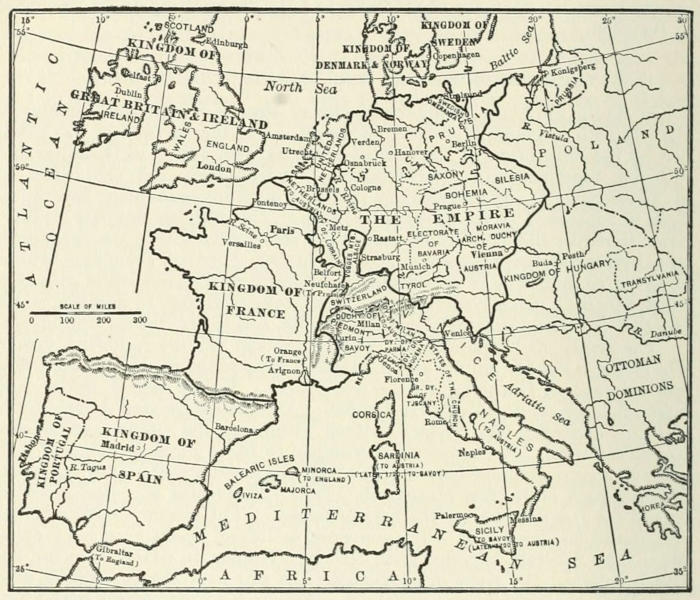
Europe after the Treaties of Utrecht and Rastatt
(1713-1714)
Louis now began to feel his health seriously decay. The hour of his dissolution could not be distant. The future fate of his family and kingdom occupied his thoughts. Of his legitimate descendants but one feeble infant remained, with the exception of the king of Spain, who by his renunciation was set aside from inheriting the crown of France. The duke of Orleans thus filled the place of heir presumptive, and from his station aspired to the regency. Louis dreaded to trust the infant Louis XV to the keeping of this prince, who bore the worst of characters. Though unconvicted, suspicion still rested upon him of having poisoned his relatives. Louis did him more justice in calling him a fanfaron de crimes, a braggard of crimes. But still the objection in the royal breast was not removed. Actuated by these motives, as well as by tenderness for the children born to him of Madame de Montespan, Louis issued a decree, giving to the illegitimate princes the full rights of the legitimate blood, calling them in succession to the throne immediately after the young dauphin. Nothing marks the extreme submissiveness of the parliament more than their registry of this decree. But this obsequiousness was evidently owing to the inutility of disturbing the last moments of the monarch. Louis completed this attempt in favour of his illegitimate children by a testament which gave to the duke du Maine, the eldest of these princes, the command of the household troops and the chief power during the minority.f
DEATH OF LOUIS XIV
[1714-1715 A.D.]
Since the summer of 1714 Louis XIV, already cruelly shaken in health in 1712, had been gradually failing. His chief physician, Fagon, himself enfeebled by age, did not perceive in time the slow fever which was undermining the king’s health and did not take advantage of the resources still offered by that powerful constitution. After the 11th of August, 1715, Louis XIV did not again leave the château of Versailles. The fever increased, sleep vanished. On the 24th one of the king’s legs which had been causing him acute pain showed marks of gangrene. The next day Louis received the sacrament with calm and firmness. He manifested some scruples respecting what he had been made to do in regard to the bull Unigenitus.[147] He would have liked to see his archbishop, Noailles, once more, and to be reconciled to him; means were found to prevent this. On the 26th he bade farewell in moving terms to the principal personages of his court. He also took leave of the prince and princesses, addressed kindly words to the duke of Orleans as though to banish evil designs from his heart if he should have conceived any, and then sent for the dauphin, a beautiful child of five years of age, sole relic of all his legitimate line in France.
“My child,” he said to him, “you will soon be the king of a great realm. Never forget your obligations towards God; remember that you owe him all that you are. Try to preserve peace with your neighbours. I have been too fond of war. Do not imitate me in that, nor in the too great expenditure which I have made. Lighten the burdens of your people as soon as you can and do that which I have had the misfortune not to do myself.”
Touching, but vain words! The successor of Louis XIV was not reserved for a work of reparation but for a work of dissolution and ruin. On the morning of the 28th the king said to Madame de Maintenon that in leaving her he was consoled by the hope that they would soon meet again. She did not respond to this idea of meeting in eternity and appeared to see in this sign of affection only a token of egoism. Thinking the end was near, she set out that very evening for St. Cyr; the next day Louis, being still fully conscious, asked for her; she returned, but only to leave again finally on the evening of the 30th, thus abandoning on his death-bed the man who had so constantly loved her. Her excuse was in her extreme weariness of the existence which Louis had imposed on her. He had overwhelmed her with his absorbing personality; for more than thirty years she had not had a single day to herself; the necessity of perpetually finding new resources to occupy and interest this active but infertile mind, accustomed to live, so to speak, on the substance of others, had exhausted and crushed her.
Louis was now only conscious at moments. The day of the 31st of August passed in this manner: the gangrene was gaining on him. In the night Louis revived to recite with the clergy the prayers for the dying. He repeated several times in a firm voice: “Nunc et in hora mortis—Mon Dieu, aidez moi!” then he entered on a long death-agony. On the 1st of September, at a quarter past eight in the morning, the king drew his last breath. He had lived seventy-seven years, reigned seventy-two, governed fifty-four. It was the longest as well as the greatest reign in the history of France. It was not one man, it was a world that was ended.
Before descending, in the train of feudalism, into that night of the past in which one after another the perishable forms of eternal society are plunged, the monarchy, that symbolic form of national unity, had been manifested in a supreme personification which will remain forever engraved in the memory of peoples. Louis XIV is, and will remain, the king, the royal type, for foreign nations as well as for France. All that monarchy, after having brought under one yoke the divergent elements of the multiplex world of the Middle Ages, succeeded in producing in the fullness of her power, she produced in Louis the Great. Flourishing in her prime with the Great King, she grew old with him. The signs of decay multiplied; the gangrene was manifested in her as in him and, if monarchy did not die the same day as the monarch, the silent work of decomposition was no longer to be arrested in her organs. We are about to watch the dissolution of that vast frame until the day in which the real unity, the sovereign nation, shall for the first time break through the worn-out covering in its own true essence, without figure and without symbol.
France prospered under Louis XIV so long as he continued in the ideas of Richelieu; she suffered, then declined, when she became unfaithful to them. He himself condemned the excess of his wars and expenditure; his expenditure on luxury and art, though doubtless very considerable, has been much exaggerated by tradition; as to his wars, they were, some justifiable, others excusable in their principle, but not in the inhuman character which he allowed to be imprinted on them, nor, at times, in the fashion in which they were conducted politically. France desired her natural completion, and, in the respective condition of the nations, the action of France to achieve her retransformation into the larger territory of Gaul was enough to overthrow the equilibrium of Europe and to provoke coalitions. Louis XIV committed the error of claiming to be able to do still more, and, above all, of making the claim believed. The two gravest charges which he merited are not those on which he condemned himself; they were: in economics, that of having wrought harm and rejected the remedy, ruined the finances and refused the radical reform which might have restored them; in religion, that of having destroyed the great work of Henry IV which Richelieu had continued. But the responsibility of the revocation may well be divided: the revocation of the Edict of Nantes was the logical consequence of monarchy according to Bossuet, and this great crime against the state condemns the monarchy still more than the monarch. The more we blame the monarchical theory as contrary to the true ends of man and of the citizen, the more we are disposed to indulgence towards the prince who was carried away by this theory as by an almost irresistible fatality.
When the New Era, which opened amid the tempests [of the eighteenth century], shall have found its shape and position; when society, free and democratic, shall be definitely founded and recognised; when parties cease to seek weapons in history, the name of Louis XIV will no longer excite the anger of the French people, as the expression of a hostile principle; and his statue, alternately adored and broken, will finally repose amid the great images of the national Pantheon. If the French people do not forget the culpable and fatal errors of Louis, they will also remember that Louis has deserved to be identified with the most brilliant century yet seen in modern civilisation. France pardons willingly, too willingly perhaps, all those who have loved her, even with a selfish and tyrannical love—all those who have made her glorious, even at the expense of her happiness; she is only implacable towards the memory of those leaders who have degraded her.e
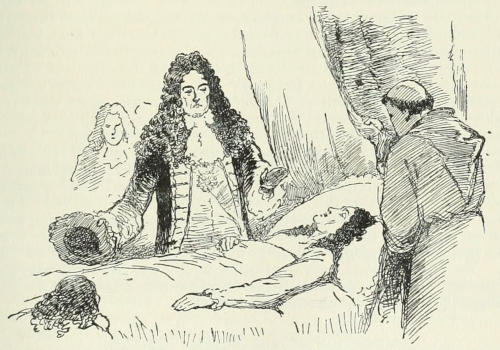
Louis XIV at the Death-bed of James II
FOOTNOTES