Chapter XXI · THE HEIGHT AND DECLINE OF THE BOURBON MONARCHY
Reading edition
Louis had many royal qualities—a noble presence; manners full of grace and dignity; an elocution at once majestic and seductive; unwearied assiduity in business; a luminous understanding; an instinctive taste for whatever is magnificent in thought or action; and a genuine zeal for the welfare of his people. But for the high office of moulding and conducting the policy of the greatest of the nations of the civilised world, he wanted three indispensable gifts—an education so liberal as to have revealed to him the real interests and resources of his kingdom; the faculty by which a true statesman, in the silence of all established precedents, originates measures adapted to the innovations, whether progressive or immediate, of his times; and that dominion over passion and appetite which is the one essential condition of all true mental independence. Without such knowledge, such invention, and such self-control, Louis could not really think, and therefore could not really act for himself.—Stephen.j
[1679-1715 A.D.]
After Nimeguen, Louis XIV was at the climax of his fortunes. He had no equal among the other sovereigns of Europe. If he had not realised all his ambitions, if he had made political mistakes and military mistakes he had none the less shown a vigour, a spirit of continuity, a power of calculation and often a rectitude of judgment which placed him far above contemporary princes. He was served by great men, and he had always known how to direct them and appropriate their work to himself, although he had sometimes conceded too much to Louvois, and yielded too much to the desire to display in war the brilliance of his court. He continually saw everything and did everything himself in order to train himself by work, and, as he said, by this means to complete his ideas.
[1679-1680 A.D.]
In 1679 France, instead of returning to her ancient peace footing, preserved an effective force of 140,000 men, part of which was so organised as to be able to take the field immediately. The maintenance of this armament had for its object the support of certain pretensions relative to the regulation of the frontiers. At Nimeguen the territories ceded on either side had not been delimited in a definite manner. Louis XIV and Louvois calculated on profiting by this circumstance to make new acquisitions. Louvois was ambitious of deriving as much advantage from peace as from war.
Louvois no longer directed military affairs alone. For a long time he had been encroaching on the office of the secretary of state for foreign affairs. Pomponne, who complained of this and who lacked the authority and energy necessary to resist him, was disgraced. His successor was Colbert’s own brother, Colbert de Croissy, formerly ambassador to London and plenipotentiary to the congress of Aix-la-Chapelle and Nimeguen; but Louvois’ influence in diplomacy remained none the less preponderant.
ACQUISITION OF FRONTIER PLACES (1679-1681 A.D.)
The regulation of the frontiers on the side of the Spanish Netherlands was debated in a conference which was opened at Courtrai in the month of December, 1679. During the long discussions which occupied it Louvois’ ambition was particularly directed towards the eastern frontier, where he could proceed by other means than diplomatic arguments. As early as 1679 he occupied Homburg and Bitche, dependencies of Lorraine which had been pledged by Duke Charles IV to the electors of Treves and Mainz. He made the parliament of Besançon pronounce two decrees, the one of September 8th, 1679, which declared the reunion to Franche-Comté of the castellanies of Clermont, Châtelet, and Blamont—that is to say, more than eighty villages, forming part of the principality of Montbéliard, the property of the dukes of Würtemberg; the other, dated the 31st of August, 1680, declared the reunion of the principality itself.
At the parliament of Metz Louis instituted a chambre de réunion, intended to search out all the dependencies of the Three Bishoprics, that is to say, the territories which might be claimed as their fiefs by any title whatsoever. This question of dependencies had been the subject of old disputes between France and the empire. Louvois resolved to settle them finally by simple judiciary decrees and without beginning vexatious lawsuits with the empire and the German princes. He drew up himself, or caused to be drawn up under his own eyes, detailed instructions for the king’s procureur of the chambre de réunion at Metz. The result of this inquiry was to reunite to France about eighty fiefs. The county of Zweibrücken was vacant and several competitors were disputing for it; Louvois seized it in virtue of a very ancient feudal right found in the title deeds of the bishopric of Metz. The king of Sweden, Charles XI, one of the principal claimants, protested; he was offered a sum of money to indemnify him. He refused to sell his rights and abandoned France, whose ally he had been in the late wars, to throw himself on the side of her enemies.
Another dispute—less old, since it dated only from the Treaty of Westphalia, but not less important—had for object the empire’s jurisdiction in Alsace and the territories of ten towns reunited to France in 1648. Louis XIV had never recognised this jurisdiction; he had imposed oaths on the towns of Alsace which reserved his own rights and had taken little account of their privileges when these inconvenienced his armies. He had contented himself with conceding them, after the war, certain abatements of taxes under the name of compensation. In 1680 the sovereign council of Alsace, instituted by Mazarin at Ensisheim and afterwards transferred to Breisach, decreed the suppression of all imperial jurisdictions in the province and proceeded to reunions of territories, similar to those of the Three Bishoprics.
The reunion of Strasburg which was the most considerable was accomplished in another fashion. Strasburg, a free imperial city, had given good grounds for complaint, inasmuch as she had observed her neutrality but ill during the last war; she had on several occasions delivered the bridge over the Rhine to the imperial troops. Louvois began by withdrawing certain neighbouring territories from the jurisdiction of Strasburg; then, eluding the vigilance of the imperial troops, he sent into Alsace 35,000 men, whom he scattered, but in such a manner as to be able to assemble them again at a given point. He watched for a favourable opportunity. The arrival in the city of an officer of the emperor having furnished him with the pretext he was seeking, he caused the approaches and the passage of the Rhine to be suddenly occupied by his troops during the night of the 27-28th of September, 1681. The inhabitants, taken by surprise, demanded explanations. The French resident knew nothing; the officer who led the troops referred them to Montclar, the military commandant of Alsace. The latter informed them that he had orders to obtain their recognition of the sovereignty of France; but that otherwise their municipal, religious, and other privileges would be preserved.
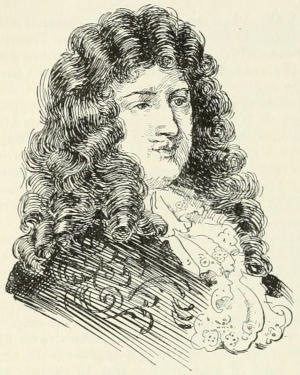
François Michel le Tellier, Marquis de Louvois
(1641-1691)
[1680-1681 A.D.]
The magistrates wrote to the diet and to the emperor to notify them of the extremity to which they found themselves reduced; their letters were intercepted. As they were not in a position to offer the least resistance they demanded to be allowed to consult the people. This consultation could be only a matter of form; acquiescence was a matter of necessity. On the 30th the city capitulated. Louvois’ first act was to restore the cathedral to the Catholic clergy, whilst guaranteeing religious liberty to the Protestants. Without loss of time the construction of a citadel, barracks, and entrenched cantonments was taken in hand, less for security against the inhabitants than to oppose a powerful bulwark to the empire. On the 24th of October Louis XIV came to make a triumphal entry into his new acquisition.
On the 30th of September, 1681, the day of the entry of a French corps into Strasburg, another entered Casale. Louvois had long aimed at dominating Piedmont and through Piedmont Italy. Casale, added to Pinerolo, should furnish him the means. Casale was a possession of the duke of Mantua. This duke was a debauched and prodigal prince, in pressing need of money.
On the 8th of July, 1681, a treaty was secretly signed at Mantua, between the duke and a French agent who had no official character, the abbé Morel. Some troops had been collected in Dauphiné and at Pinerolo. A passage for these troops was requested of the duchess of Savoy [widow of Charles Emmanuel and regent for the infant duke], with the threat that it would be insisted on. Finally, on the 30th of September, Catinat, who had been at Pinerolo incognito for several months, took possession not only of the citadel but of the castle and town of Casale in the name of Louis XIV.
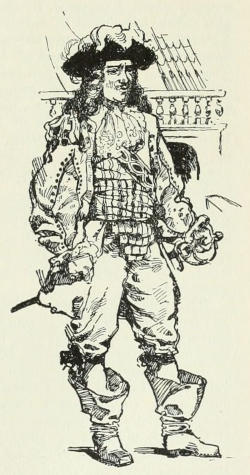
Marquis Abraham Duquesne
(1610-1688)
Henceforth Piedmont was shut in between two French fortresses and Louvois assumed towards her the tone of a master. But the regent of Savoy resisted with extreme vigour; it was almost necessary to employ violence to obtain from her a free passage for the French troops passing from Pinerolo to Montferrat. Finally, in order to save the independence of Savoy, she accepted the condition of marrying her son to Mademoiselle d’Orléans, Monsieur’s daughter (in 1684). Louis XIV thought that this marriage would complete the deliverance into his hands of Piedmont and secure him the entrance into Italy. He believed that the other Italian states were now condemned to submit to his dictation. The contrary was the case. Italy kept silence; but as soon as Victor Amadeus found an opportunity of escaping from France, which he detested, he had no difficulty in raising the peninsula against her.
The reunions declared in the Three Bishoprics and Alsace, and the occupation of Strasburg and Casale, did not make Louvois forget the conferences of Courtrai. The Spaniards showed in these conferences as much ill-will as weakness and sought to prolong them. They had pledged themselves to hand over Charlemont in exchange for Dinant, which was to be restored to them. They did not do so until 1681 after an infinite amount of chicanery. Louvois profited by these delays; he had the address to negotiate with the bishop of Liège, to whom Dinant belonged, a direct cession of that town to France and made use of this cession as an authority for not surrendering it to Spain. Almost immediately afterwards he occupied the little county of Chiny in Luxemburg, in virtue of an ancient title of the bishopric of Metz. He sent troops thither to make what was called a “pacific execution”; the country was reunited to the crown, and the work of hunting up his dependencies was taken in hand.
At last, on the 4th of August, 1681, Louis XIV notified the conference of Courtrai of his claims. They comprehended the castellany of Alost, the towns of Grammont, Ninove, Lessines, and various territories. He offered, it is true, to exchange those towns and territories which might be necessary for the defence of Brussels, in return for “equivalents.” The Spaniards protesting against these pretensions, Louvois increased the French troops of the county of Chiny, established a sort of blockade round Luxemburg, seized the first difficulty which arose in consequence as a casus belli, pressed the blockade still closer during the winter, and made every preparation to make himself master of the place in the spring.
Nothing was more popular in France than this policy of aggrandisement. Men took little trouble to find out whether it were just or safe. It was enough that it should flatter national feeling and the military passions then greatly over-excited.
PREPARATIONS FOR A SECOND COALITION (1681-1682 A.D.)
[1681-1682 A.D.]
But if France thus made herself the accomplice of the enterprises and the ambition of the king, it was not possible for Europe to content herself with being a passive spectator. Whilst Spain was discussing and protesting at Courtrai, Germany was discussing and protesting at Ratisbon and Frankfort. Sweden was irritated, Italy discontented, Holland embarrassed. All the powers showed themselves attentive and anxious. None was strong enough to struggle alone; the question was whether, after a coalition dissolved at Nimeguen they would succeed in again drawing together and coming to an understanding.
Louis XIV had reason to fear it. Therefore, in spite of the disdainful majesty of his diplomacy, he endeavoured to make some of them advances of a nature calculated to flatter. The year which followed the Treaty of Nimeguen he married the eldest of his nieces, a very young girl, the eldest daughter of Monsieur and of Henrietta of England, to the king of Spain, Charles II. The young princess Marie Louise was the victim of policy and obliged to accept a union repugnant to her. The same year the dauphin, aged scarcely eighteen years, married a princess of Bavaria. The king was eager to secure the elector of Bavaria, who had been faithful to him since 1670; he hoped to strengthen himself in Germany by this alliance. The marriage of Monsieur’s second daughter to the duke of Savoy, Victor Amadeus, which was concluded soon after, in 1684, had for object the extension of French influence in Italy.
Dutch patriotism had been on the watch against the ambition of Louis XIV. William had no difficulty in seizing the weapons the king gave him. He denounced French policy to Europe in a host of pamphlets which circulated everywhere. The answers which Louis XIV in his turn circulated, the language which he dictated to his envoys, did not bring reassurance.
The prince of Orange believed that in order to form another stronger and more solid coalition it was needful to provide a centre and a head. The centre should be Holland; the head himself. He began by joining with the king of Sweden, Charles XI, who, despoiled of his pretensions to the duchy of Zweibrücken, was the more irritated against France because he had been her ally. Sweden and Holland signed a treaty at the Hague, September 30th, 1681, to guarantee those of Westphalia and Nimeguen. The two princes solicited adhesions everywhere; they obtained that of the emperor on the 28th of February, 1682. Louis XIV did not choose to wait till the coalition should have grown or till William had succoured Luxemburg. In March he gave his troops the order to withdraw from the positions they occupied before the town and abandoned his claims. That the coalition was formidable is proved by the fact that Spain entered into it on the second of May and that this example was followed in the course of the year by an infinity of German princes, even by the elector of Bavaria.
In 1682 Louis XIV had stopped his progress before Luxemburg and had submitted his claims to the arbitration of the king of England who had already been mediator at Nimeguen. He had recoiled before the threat of a coalition and the indignation of the Germans, although in this direction he had secured the alliance of the elector of Brandenburg and of the king of Denmark, both recently his enemies but disposed to serve him since he was on bad terms with Sweden. In spite of the generosity he affected he seized an opportunity which presented itself to make the prince of Orange feel his vengeance. William had a lawsuit with the duchess de Nemours; the king gave the order to occupy his principality. The town of Orange was dismantled and its sovereignty declared to have devolved on the crown (August, 1682).[139] The prince sent Heinsius (the grand pensionary) to make complaint at Paris; he could obtain nothing and preserved keen resentment in consequence.
[1682-1684 A.D.]
The empire through the diet at Ratisbon and the congress of Frankfort claimed various restitutions from France. However, Germany being then greatly threatened by the Turks, the majority of the princes restrained their irritation; they had even tried to obtain the king’s support and assistance. Louis XIV held out hopes to them, but solely for the purpose of resuming in the empire the influence which he had had there at the time of the league of the Rhine, and in order to play the part of saviour.
In 1683 Louis organised practice camps in Flanders, on the Saar, in Alsace, and on the Saône. On the 1st of September, just as Vienna was thought to be on the point of succumbing [to the Turks], 35,000 men entered Belgium. The Spaniards protested, retaliated by occupying French territories in their turn, and on the 26th of October launched a declaration of war. The French invested Courtrai which was dismantled, entered both it and Dixmude without difficulty and bombarded Luxemburg. In March, 1684, Humières bombarded Oudenarde. In April Créqui, accompanied by Vauban, besieged Luxemburg which, strong in natural fortifications, was also heroically defended; but the genius of Vauban and the great resources of which he disposed triumphed over these difficulties and this resistance. On the 4th of June the garrison surrendered. Créqui then marched on Treves and filled up the town moats, in defiance of the elector’s protest. At the same time Schomberg assisted the elector of Cologne, an ally of France, to restore his authority at Liège, which had shaken it off. Finally a French division under the command of Marshal de Bellefonds was sent into Catalonia.
Meantime Spain, in no condition to continue the war alone, was asking the Dutch and the emperor for their support or mediation. The struggle which the Germans were continuing in Hungary against the Turks compelled the powers to postpone their plans for a coalition. The Dutch assumed the character of mediators. Louis XIV again assumed an attitude of generosity and accepted their proposals on condition that they should recall a body of troops furnished by them to the governor of the Spanish Netherlands. A twenty years’ truce was signed at Ratisbon—with Spain on the 11th of August, with the empire on the 15th. France kept Luxemburg, Beaumont, Bouvines, and Chimay, on consideration of restoring Courtrai and Dixmude. The empire recognised all the reunions effected, even that of Strasburg and of Kehl, on the sole condition that Louis XIV should abandon Tökely and the Hungarian rebels.[140]
RELATIONS WITH TURKS AND BERBERS
[1681-1685 A.D.]
During this time the Turks were again beginning to threaten Europe. Led by the Köprilis, viziers who were also great men, they had fallen on Poland, whose divisions seemed to deliver her up to them as a prey; and as they were suzerains of Transylvania they incessantly fomented revolts in Hungary against Austria. Louis XIV, in order to keep the empire’s forces in check, took care to constantly favour the disturbances in Hungary and to maintain good relations with the porte.
The Turks were too proud and too distrustful; commercial privileges, annulled or evaded by the hostility of the pashas, were nothing but a cause of perpetual dispute. The piracies committed by the Berbers, tributaries of the grand seignior, were another. In 1681 some corsairs of Tripoli, pursued by Duquesne, took refuge under the protection of the pasha of Chios. Duquesne required that they should be delivered up to him and on the pasha’s refusal cannonaded the town. The sultan sent his fleet to Chios; the French ambassador, Guilleragues, only succeeded in appeasing him by considerable presents. The following year Louis XIV, displeased with the divan, gave orders to Duquesne to punish the pirates of Algiers.
A shipbuilder of Bayonne, Renau, had just conceived the idea of a new form of vessel for use in bombardments. Duquesne made trial of it at Algiers and the trial was a complete success. The town was bombarded a first time August 30th, 1682, then twice more in June and August, 1683. The Algerians by way of reprisals set the European prisoners at the mouth of their cannons; the dey, who would have yielded, was put to death and replaced by one of his officers. The lack of ammunition, for these maritime bombardments were extremely costly, compelled Duquesne to retire before he had brought the enemy to terms. However, the Algerians ended by negotiating. Tourville, whom the admiral had left to cruise about with a squadron in sight of their port, signed the peace April 25th, 1684. The Algerians made reparation, restored the merchandise and captives they had carried off, engaged not to countenance other pirates, and gave all the guarantees required of them. Morocco had not expected to be attacked. In 1682 it had granted all the stipulations desirable, renewed the treaty of 1631, and consented to the institution or reorganisation of French consulates.b
Meanwhile a Christian city had been treated as though it were a den of pirates. The Genoese had sold arms and powder to the Algerians, and had built in their shipyards four war vessels for Spain, which had none of her own. Louis XIV forbade the Genoese to equip these ships; and, on their refusal, Duquesne and Seignelay in a few days threw 14,000 shells into the city, destroying a number of the palaces of Genoa la Superba (May, 1684). The doge had to come to Versailles to implore the king’s pardon, in spite of an ancient law requiring the chief magistrate never to absent himself from the city. He was asked what was the strangest thing he saw at Versailles: “To see myself there,” he replied.c
The significance of this humbling of Genoa is that this power was forced to abandon Spain, with which it had so long been in alliance, and become dependent upon France. Such a turn of affairs on the Mediterranean, added to the aggressions already made on the frontier, made war inevitable; but the old ally of Francis I, the Turk, was again the friend of the most Christian king. The emperor was too busy on his eastern frontier to pay attention to the west; and the accession of James II in England made William of Orange hesitate to act. In another year, however, the situation had changed.a
SECOND COALITION: THE LEAGUE OF AUGSBURG (1686 A.D.)
[1686-1689 A.D.]
In the first months of 1686 various treaties were signed between Holland and Sweden, Sweden and Brandenburg, Brandenburg and the empire. All these states pledged themselves to guarantee the treaties of Westphalia, of Nimeguen, and of Ratisbon, and protested against the reunions effected by Louis XIV. On the 9th of July the emperor, Spain, and Sweden as members of the empire, the elector of Bavaria, the circles of Bavaria and of Franconia, the princes of Saxony and others besides, formed at Augsburg a secret league, ostensibly for the preservation of the twenty years’ truce, in reality to put an army of 60,000 men into the field against France. The league was to last for three years unless it were prorogued, and the command was to be given to the elector of Bavaria. The reason or pretext was the claim brought forward by Louis XIV to some territories which he maintained should belong to Madame as the heritage from her father, the elector palatine, who had died the preceding year.
William of Orange was again the soul of this coalition, although for the moment he affected to remain outside it; the king of Sweden was its principal promoter. The league was soon completed by the adhesion of Victor Amadeus and the other princes of Italy, though this was secret. The league in spite of very heterogeneous elements acquired a cohesive force which was quite new and held itself in readiness to take the offensive as soon as required.
Louis had flattered himself on converting the twenty years’ truce into a definite peace, but the diet of Ratisbon formally refused this in January, 1687. He felt that he could not take a step without unchaining the tempest. Nevertheless he braved the pope and picked a quarrel with him.b
The Catholic ambassadors at Rome had stretched the right of asylum and immunity assumed from all time, and with reason, for their residences to the quarter in which they lived. Innocent XI wished to abolish this abuse which turned half the city into a den of criminals. He obtained without difficulty the consent of the other kings, but Louis, irritated against the pontiff on account of the régal (see chapter XIX) replied with haughtiness, that he had never acted on the example of others, and that it was for him to serve as an example. He sent the marquis de Lavardin with 800 armed gentilshommes to maintain himself in the possession of this unjust privilege. The pope excommunicated the ambassador; the king seized Avignon.
The matter was straightened out under Innocent XI’s successor, but this pontiff conceived an intense dislike for him that was not without influence in the war of 1688. The occasion of this war was indeed the pope’s opposition to France’s candidate for the archiepiscopal see of Cologne, the cardinal von Fürstenberg who had thrown open the gates of Strasburg. He was elected by a majority of the chapter, fifteen votes against nine for his opponent, Clement of Bavaria. Nevertheless Innocent gave the latter the investiture.c Louis XIV had the papal nuncio put in prison and the Venaissin occupied by one of his officers, La Trousse, who expelled the vice-legate.
War was now begun against Europe and against the pope. Louis resolved to occupy Kaiserslautern and the cities of the Rhine. The dauphin, then twenty-six years old, was put at the head of the army of Germany. To assist him he was given Marshal de Duras, nephew of Turenne, and as lieutenant-generals Catinat, Montclar, Vauban, and Chamlay. “In sending you to command my army,” Louis XIV said to him, “I give you opportunities of exhibiting your merit; go and show it to all Europe, so that when I come to die it may not be noticed that the king is dead.”
Open preparations had been avoided, but the dispositions had been so well taken that a few days sufficed to collect the troops before Philippsburg. The necessary artillery was drawn from Strasburg and Breisach, and the siege began the 27th of September; whilst Humières occupied the district of Liège with a first division, Bouffiers with a second invaded the Cis-Rhenish Palatinate and seized Kaiserslautern, and finally Huxelles entered Speier with a third. Philippsburg was defended by the graf von Starhemberg. Vauban pressed the siege with his usual prudence and vigour in spite of the difficulties offered by the marshes which formed a girdle round the place. These difficulties were still further augmented by continual rains and a disastrous season.
Louvois requested the electors of Mainz and Treves to allow him to occupy Mainz and Coblenz. He had no idea of using moderation. The elector of Mainz admitted a French garrison into the capital. The markgraf of Baden-Durlach surrendered Durlach and Pforzheim. Heilbronn and Heidelberg opened their gates. But the elector of Treves refused to allow Coblenz to be occupied. The town was bombarded by Bouffiers under Louvois’ orders; the elector persisted in his refusal. Philippsburg capitulated on the 29th of October. The siege was murderous, especially for the engineers whom Vauban calls the “martyrs of the infantry.” The siege of Mannheim was proceeded to without delay and occupied only a few days; the ill-paid soldiers of the elector palatine forced the governor to deliver up the town and citadel. Frankenthal surrendered in less than forty-eight hours and the French beheld themselves complete masters of the Palatinate.
Hitherto the French had had only inadequate garrisons to contend with. The only hostile force which had appeared was a corps of 3,000 men from Brandenburg which had entered Cologne under the orders of Schomberg, one of the refugee French Protestants. But Louvois permitted himself no illusions: all Germany was to be agitated in the ensuing campaign and if William of Orange, the soul of the league of Augsburg, had not taken the field, it was because he was at that very moment (November, 1688) taking possession of the throne of England. On the 26th of November war was declared between France and Holland. It did in fact exist between France and the emperor and the empire, although the official declaration of the diet of Ratisbon did not take place till somewhat later, the 24th of January, 1689.
THE REVOLUTION IN ENGLAND (1688 A.D.)
The English Revolution gave the greatest hopes to the league of Augsburg and the European coalition. Charles II had died in 1685. James II (the duke of York), who succeeded him, joined to the courage of a tried soldier more pride and decision of character. But his mediocrity, which afterwards impressed everyone in France, was early pointed out by the French envoys to the court of London. He resumed the projects formed before the Treaty of Dover—that is to say, he aimed at restoring Catholicism in his dominions, giving himself a permanent army, and suppressing the laws, such as that of habeas corpus, which seemed to encroach on his prerogative. These plans obliged him to seek the alliance of Louis XIV.
Now this alliance harmed more than it served him. The revocation of the Edict of Nantes alarmed the English Protestants, who believed, or affected to believe, that with a Catholic sovereign allied to Louis XIV their faith was in peril. James II addressed to all the foreign courts, as well as to his own subjects, declarations in which he blamed the persecution of the Huguenots; nowhere did he obtain credence.b
[1689-1690 A.D.]
The Revolution which overthrew this “tyranny,” and gave William III the throne of James II, was more than a mere substitution of royal personages. It changed royalty by divine right into royalty by consent, and founded the English constitutional or parliamentary monarchy. A new right, that of peoples, now arose in modern society, in the face of the absolute right of kings, which for two centuries had ruled them, and which was now finding in France its most glorious personification. There was nothing astonishing in the fearful struggle which now broke out between France and England. There was something more than two opposing interests; there were two different political ideas. In the sixteenth century, France had defended Protestantism and the liberties of Europe. In the seventeenth she threatened the conscience of the people and the independence of the states.
The rôle which France abandoned England now took up; she was to be the centre of all the coalitions against the house of Bourbon, as France had been the centre of resistance to the house of Austria. This political change upset all the conditions of war. While Louis was keeping England neutral by pensioning her kings, France had no one to fear on the continent, for, protected by the Pyrenees, the Alps, and the sea, she could face the Rhine and fight with both hands, without having to look behind. England now openly joined the league (1689). It was now necessary, not only to have armies on the Schelde, the Rhine, and in the Alps, but also fleets on the ocean, and in the most distant seas. It was the double effort that exhausted France.c
WAR OF THE LEAGUE OF AUGSBURG (1688-1697 A.D.)
War was declared on France by the diet of the empire, in the month of January, 1689; by England and Holland, in March; in April, by the elector of Brandenburg, and in May by Spain.b
Louis had, to oppose the coalition, 350,000 soldiers and 264 vessels or frigates. Single-handed against these princes, badly united among themselves, and obeying each other but badly, he mapped out a plan at the same time simple and bold. To overthrow William III would end the war at one stroke. Louis XIV intrusted a fleet to James II to aid him to remount his throne. Spain and Savoy were the two most feeble states of the league; the king turned against them the majority of his forces. On this side he attacked; on the Rhine, the whole of whose left bank almost to Coblenz he was occupying, he assumed the defensive, calculating that the Turks, whom he had just succeeded in inducing to break off negotiations with the emperor, would give that prince so much occupation on the lower Danube that France would have no fear of his sending a large force to the Rhine. Turenne, Condé, and Duquesne were dead; but Louis found able leaders to replace them—Luxemburg, Catinat, Boufflers, Lorges, and Tourville.
Attempts to restore James II (1689-1692 A.D.)
The war in favour of James II was fortunate at first. A squadron of thirteen large vessels carried the prince in May, 1689, to Ireland, Catholic like himself, and always groaning under the yoke of England. Convoys of troops, arms, and munitions left Le Havre, Brest, and Rochefort, protected by Château Renaud, D’Estrées, and Tourville. The English and Dutch attempted to head them off. Château Renaud defeated one of these fleets in Bantry Bay; Tourville with 78 sail attacked their fleet off Beachy Head on the Sussex coast. Sixteen of the enemies’ ships were sunk or burned on the shore, July 10th, 1690. This brilliant victory gave the empire of the ocean to Louis XIV for some time. But James II did not know how to follow it up. He had lost precious time at the siege of Londonderry, and William III attacked him on the Boyne, July 11th, 1690. The Irish, with their king, fled at the first attack; the French alone made some resistance. A regiment of Calvinist refugees under Marshal de Schomberg were especially prominent in routing the French. James II returned to France.
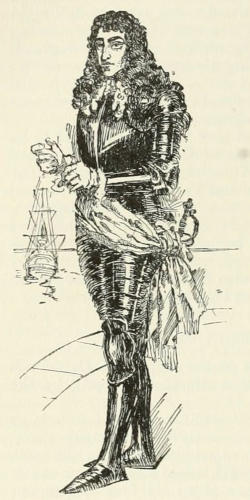
Anne Hilarion de Cotentin, Comte de Tourville
(1642-1701)
[1690-1692 A.D.]
Louis XIV now prepared a descent on England itself; 20,000 men were assembled between Cherbourg and La Hogue; 300 transports were made ready at Brest. Tourville was to escort them with the 44 vessels he commanded and 30 others which D’Estrées was bringing him from Toulon. But the wind changed, and the Mediterranean fleet could not arrive in time. Louis XIV, accustomed to force a victory, and reckoning that a number of the English captains would pass to him, ordered his admiral to go seek the enemy, 99 sail strong. This was the battle of La Hogue, May 29th, 1692. Although there was no defection, Tourville held his own victoriously, for ten hours, against the Anglo-Dutch, who in spite of their numbers were more badly battered than the French. But it was impossible the next day to renew this heroic temerity: Tourville would at least have made a glorious retreat if he had had a port behind him; the breakwater at Cherbourg was not built at that time. He gave the signal to retire to Brest and St. Malo. Seven of his vessels gained the former port; the rest of the fleet entered the navigable channel off the Cotentin shore; twenty-two passed through the race at Blanchard and arrived at St. Malo, but the tide reached low ebb, and the rest were prevented from following. Three stopped in front of Cherbourg and their captains, unable to defend them, set them on fire. Twelve took refuge in the harbour of La Hogue, which was no better prepared to offer shelter.
Tourville landed his guns, his stores, and his fittings, and on the approach of the English applied the torch to the hulls of his ships. The enemy could not boast of having taken a single one. This was the first blow dealt to the French navy, but it is not true, as has often been said, that it was its tomb, for the next year France was able to oppose equal if not superior fleets to the English and the Dutch. At any rate the re-establishment of the Stuarts in England was becoming an impossibility and the most important part of Louis XIV’s plan had fallen through.c
DEVASTATION OF THE PALATINATE (1688-1689 A.D.)
[1688-1689 A.D.]
The attention of Louis XIV and Louvois was especially directed to the side of Germany where France would have to face the coalition. Philippsburg and the Palatinate having been occupied, Louvois wished to remain on the defensive. France was already secured by a girdle of towns, of which the principal were Hüningen, Belfort, Landau, Philippsburg, and Mont-Royal, an important position on the Moselle which had been occupied and fortified after having been taken under various pretexts from the elector of Treves. Louvois resolved to demolish all the towns beyond it and to ravage the country for a great distance so as to oppose a desert to the enemy.
Louvois according to his custom kept his plan a profound secret. He began by giving Montclar orders to blow up the walls of Heilbronn and ravage Würtemberg as far as the Danube (November and December, 1688). This order being executed he gave one to destroy the castle and town of Heidelberg; 432 houses, delivered over to the flames, were demolished or suffered enormous damage. Mannheim was likewise razed.
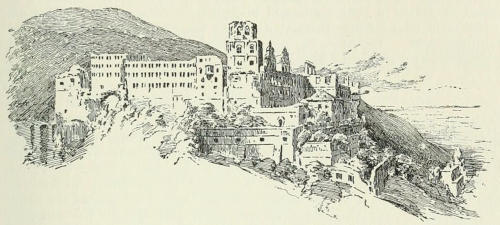
Ruins of Heidelberg Castle
(Destroyed by order of Louvois)
Devastation, savage and systematic, such as had not been seen even in the Thirty Years’ War, was spread over the Palatinate and the territories of the three ecclesiastical electors. The sinister glow of conflagrations lighted the passage of the French troops. Trees and vines were cut down; palaces, temples, convents, and hospitals were destroyed. At Heidelberg the castle of the elector palatine, was destroyed like the rest. At Mannheim the very stones of the ruins were thrown into the Rhine. A crowd of unfortunates dying of cold and hunger and reduced to expatriating themselves streamed along the snow-covered roads. The greater part, refusing the shelter offered to them in Alsace or Lorraine, went to beg from the enemies of France and still further to raise their indignation against her. This treatment was meted out to the elector palatine without any scruple.
There was at first some hesitation to sacrifice Speier and Worms, but Duras and Chamlay represented that it was important not to spare them. In consequence Worms and Oppenheim were burned on the 31st of May, 1689, and Speier on the 1st of June. Bingen also had its turn. The fire spared neither churches nor palaces. All, say the memoirs of the times, was burned and reburned. The cathedral of Speier contained the tombs of eight emperors; the tombs were burned and the ashes they enclosed thrown to the winds. Treves had been condemned; Louis XIV withdrew the order as though frightened at the general cry called forth by this work of destruction. A concert of recriminations rose against him. Whilst he accused the Catholic princes of supporting the Protestant states, Europe reproached him for allying himself with the Turks and carrying on a war more cruel and more barbarous than the Turks themselves. English caricatures called him the Most Christian Turk.b
The king’s discontent with these actions might have been the prelude of a disgrace had not Louvois died of apoplexy in July, 1691. He was replaced by his son, Barbezieux, who, with many more deficiencies, had none of his good qualities. The duke de Lorges, Turenne’s nephew, and successor to Marshal de Duras in 1691, contented himself with covering Alsace against the imperials, who finding themselves as in a desert in the Palatinate could not subsist there. Therefore the war remained defensive on the Rhine, and the great blows were struck elsewhere.
The War in Savoy and Piedmont (1689-1693 A.D.)
[1689-1693 A.D.]
Catinat was now commanding in Italy. This general, without birth, had raised himself by force of merit. Like Vauban, whose friend he was, he joined civic virtues to military qualities and by his wise and methodic tactics resembled, although slightly, Turenne. He was opposed by Victor Amadeus, duke of Savoy. In order to bring his adversary to decisive action before the arrival of the German troops, Catinat devastated the fields of Piedmont, cut the trees, tore up the vines, and burned the villages. Victor Amadeus could not contain himself in the face of these ravages, and gave battle at Staffarda near Saluzzo on August 18th, 1690. He lost 4,000 men while the French numbered scarcely 500 killed. Savoy, Nice, and the greater part of Piedmont found themselves in the power of the French. But a relative of the duke, Prince Eugene, whose services Louis XIV had refused and who then had offered them to Austria, arrived with strong reinforcements. The French returned to France, whither the Piedmontese followed them. Dauphiné suffered a cruel retaliation for the burning of the Palatinate and the ravages in Piedmont (1692). Catinat, however, recrossed the Alps and a second battle took place near Marsaglia, a few leagues from Staffarda, on October 4th, 1693. It was as disastrous for Victor Amadeus as the first had been. Nothing now remained to him but Turin, and Catinat would have taken this also if the ministry had not reduced his forces. All that he could do was to keep his conquests.
The War in the Netherlands (1690-1692 A.D.)
Luxemburg, posthumous son of that count de Bouteville whom Richelieu had had decapitated, began his military career under the Great Condé, whom he resembled in boldness and accuracy of prompt decision. In 1690, he found himself near Fleurus in front of the prince of Waldeck. By a bold and skilful manœuvre he carried his right wing across a small stream which covered the hostile army. The prince suddenly attacked in his flank, made a backward movement. Luxemburg took advantage of this, came upon him suddenly in the midst of a disorderly march, killed 6,000 of his men, captured 100 flags, his guns, his baggage, and 8,000 prisoners. This was the first French victory of Fleurus, July 1st, 1690. Master of the region, Luxemburg invested Mons, the capital of Hainault. Louis XIV assisted at the siege.
William III, rid of James II, hastened thither with 80,000 men, but was unable to prevent the capitulation of the city in April, 1691, after nine days of entrenchment. The following year Luxemburg besieged Namur, the strongest place in the Netherlands and at the confluence of the Sambre and the Maas, and took it, again under the eyes of Louis XIV and the army of the enemy (June, 1692). This was one of the great sieges of the seventeenth century. Vauban’s rival, Coehoorn, defended the place, a part of whose fortifications he had built. But William, always beaten, never gave in. On August 3rd, 1692, he surprised Luxemburg at Steenkerke (Steinkirk) in Hainault.c
Steenkerke and Neerwinden (1692-1693 A.D.)
A spy whom the French general had in William’s ranks was discovered; he was forced, before being put to death, to write a false despatch to Marshal de Luxemburg.d The latter was thrown off his guard, persuaded by the false despatch that William had a totally different plan than to take the offensive on that day.e
The sleeping army was attacked at daybreak, and a brigade was already in flight before the general knew what was happening. Without an excess of diligence and bravery all would have been lost. Luxemburg was lying ill—a fatal circumstance at a moment demanding strong activity: but the danger gave him strength; prodigies were necessary to be kept from being beaten, and he performed them. To change his position, to give a battle-field to the army which had none, to re-form the right wing where all was confusion, to rally the troops three times, to charge three times at the head of the household cavalry, was the work of less than ten hours. Luxemburg had in his army Philip, duke de Chartres, the future duke of Orleans and regent, who was just eighteen years of age. He could not be useful in striking a decisive blow, but it was a great thing to spur the soldiers on that a grandson of France should be charging with the king’s household troops, be wounded in the fight, and return again to the charge in spite of his wound.
A grandson and a grand-nephew of the Great Condé were both serving as lieutenant-generals—the one, Louis de Bourbon, commonly addressed as Monsieur le Duc, and the other François Louis, prince of Conti, his rival in courage, spirit, ambition, and reputation. The prince of Conti was the first to restore order, rallying some of the brigades and making others advance. M. le Duc accomplished the same manœuvre without need of emulation. The duke de Vendôme, grandson of Henry IV, was also lieutenant-general in the army, where he had been serving since the age of twelve, and although he was forty he had never been given a leading command. It was necessary for all these princes, with the duke de Choiseul, to put themselves at the head of the household troops, to drive off a body of English who were holding an advantageous position upon the possession of which the success of the battle depended.
The household troops and the English were the finest soldiers in the world and the carnage was great. The French, encouraged by the number of princes and young nobles who fought around their general, finally carried the position. The Champagne regiment routed King William’s English guards, and when the English were beaten the rest had to give in. Boufflers, afterwards marshal of France, rushed up at this moment from another part of the battle-field with the dragoons and completed the victory. King William, having lost about 7,000 men retreated in as fine order as he had attacked; and always beaten, though always to be feared, still kept up the campaign. The victory due to the valour of the young princes and the finest scions of the nobility created an effect at the court, in Paris, and in the provinces which no victory had ever done before.
[1693-1695 A.D.]
M. le Duc, the prince of Conti, Vendôme, and their friends found, on returning, the roads lined with people; the acclamations and joy mounted to frenzy; all the women were eager to attract their glance. The men were wearing at that time lace cravats which were arranged at the expense of much time and trouble; but the princes, who had jumped into their clothes for the battle, twisted their cravats carelessly around their necks. Women now wore ornaments in imitation of this; they were called Stein Kerques. All novelties of ornament were à la steinkerque.d
The following year Louis XIV had a fine opportunity to conquer, perhaps, the Netherlands and make peace. William ventured close to Louvain with only 50,000 men. Louis was in the neighbourhood with more than 100,000. The whole army believed that a great blow would be struck; but it was represented to the king that he could not commit his person to the hazards of a battle, and in spite of Luxemburg, who, it is said, threw himself on his knees, he declared the campaign at an end and returned to Versailles. From that day he never appeared with the army. His reputation suffered much from this abroad; biting satires paraphrased Boileau’s famous verses:
Louis, les animant du feu de son courage, Se plaint de sa grandeur qui l’attache au rivage.
Nevertheless it was not personal courage that was wanting. His conduct in camp was perfectly conventional—no particular recklessness, but no timidity. He exposed himself sufficiently. At the siege of Namur, if Dangeau is to be believed, men behind him were wounded. The victories of Namur and Steenkerke had delivered Hainault and the province of Namur into Luxemburg’s hands; he penetrated into southern Brabant but found William, strongly entrenched in the village of Neerwinden between Liège and Louvain opposing him, July 29th, 1693. Few days were more murderous; Neerwinden was carried in two assaults by the infantry which, the first time, made a stout bayonet charge, an example which Catinat’s regiments followed two months later at Marsaglia. For four hours the French cavalry were under the deluging fire of 80 pieces of cannon; and William, who observed them waver only to close up their ranks as the rows were mowed down, exclaimed in admiration and vexation, “Oh the insolent nation!”
There were about 20,000 dead, of which 12,000 were on the side of the allies. After this success it might have been possible to march upon Brussels and dictate terms of peace, but the French were content to besiege and take Charleroi. It is true that by doing this they held the important line of the Sambre, whence an army might dominate the Netherlands and make most perilous any attempt of the enemy against Flanders or Artois.
Last Years of the War; Treaty with Savoy (1693-1696 A.D.)
The victory of Neerwinden was the last triumph of Luxemburg, “the upholsterer of Notre Dame,” as he was called by the prince of Conti on account of the many banners with which he had decorated that cathedral. The following campaign was uneventful, and he died in the month of January, 1695. His successor, the duke de Villeroi, did not accomplish very much, in spite of an army of 80,000 men; he did not even prevent the prince of Orange from retaking Namur (August, 1695). But in Spain Vendôme entered Barcelona (August, 1695), after a memorable siege and a victory over the army of relief. The year 1695 passed without any military events. The allies destroyed the French stores gathered together at Givet, and the two armies of the Netherlands had enough to do to exist, without thinking of attacking.
[1695-1696 A.D.]
On the sea Tourville had avenged in 1693 the disaster of La Hogue, by a victory in the bay of Lagos near Cape St. Vincent. During the following years the great armaments were suspended, because Seignelay was dead; but the corsairs, Jean Bart, Duguay-Trouin, Pointis, Nesmond, destroyed the commerce of the English and the Dutch, who to revenge themselves attempted to land on the French coasts, and trained engines of war against St. Malo, Le Havre, Dieppe, Calais, and Dunkirk—vain and ruinous threats which terminated “in breaking windows with guineas.” Dieppe alone suffered from them. In America the count de Frontenac bravely defended Canada, by taking the offensive always, although the province had not above eleven or twelve thousand inhabitants and the English colonies had ten times as many. Hudson’s Bay, and nearly the whole of Newfoundland were conquered.
Meanwhile the war languished; everybody was exhausted. An attempted assassination of William, which would have been followed by a French invasion, having failed, Louis proposed peace. Charles II of Spain was near death, this time in real earnest; he was leaving no child, and the question of the Spanish succession began to be raised. It was important to the king that the European coalition should be dissolved before this great event. He showed an unaccustomed moderation; in the first place detaching from the league the duke of Savoy (1696), he gave back to him all his towns, not excepting Pinerolo, and proposed to him the marriage of his daughter with the young duke of Burgundy, son of the Grand Dauphin. In return the duke had to promise the neutrality of Italy, and in case of need to join his forces with those of France.c
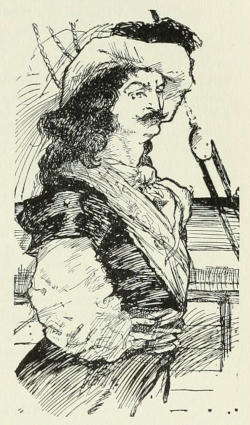
Jean Bart
(1651-1702)
After the treaty with Savoy Louis XIV made the concessions which had hitherto been most repugnant to his pride. He consented to accept the treaties of Westphalia and Nimeguen as bases of the negotiations, taking into consideration certain reservations with regard to Luxemburg and Strasburg, and to recognise William III as king of England. Henceforth the war had no further object. Commerce between France and Holland was re-established October 1st, 1696. Preliminary pourparlers between France and the maritime powers took place at the Hague. Sweden obtained acceptance of the mediation she had proposed several years before and a congress was agreed upon which was to be held at Ryswick, a country house belonging to William and situated between the Hague and Delft. Caillères, Crécy, and Harlay were designated to represent France.
[1696-1697 A.D.]
The king intended to bring pressure to bear on the deliberations of the congress of Ryswick, to render the empire and Spain more tractable and to bring the maritime powers to abandon them or force their hands. He counted the more on this since William III, a mark for the recriminations of his allies, was already replying to them with acrimony and a deserved haughtiness.
France made for the campaign of 1697 the same preparations as in other years. One hundred and fifty thousand men, forming three armies under the orders of Villeroi, Bouffiers, and Catinat, entered Belgium, whilst two other armies under Choiseul and Vendôme were carrying on campaigns in Germany and Catalonia. All that was done in the Netherlands reduced itself to the taking of Ath which Catinat and Vauban forced to capitulate on June 7th; a demonstration was made against Brussels but William hurried up and covered the town. In Germany, the opposing armies contented themselves with watching one another. It was otherwise in Catalonia. Louis XIV had long meditated the taking of Barcelona but he could only execute this project on condition of being master of the sea. He took advantage of the circumstance that this year the Anglo-Dutch fleet did not appear in the Mediterranean. The Toulon squadron, commanded by Vice-admiral D’Estrées and the bailli de Noailles, surrounded the harbour. Vendôme, who had 30,000 men, repulsed a relieving army and forced Barcelona to surrender, August 10th, fifty-two days after the trenches had been opened and after two assaults.
Shortly before, a squadron composed of ships belonging to the state but equipped at the expense of private persons and commanded by an experienced sailor, Pointis, had made a successful and brilliant cruise in America. Pointis attacked Cartagena de las Indias, in New Granada, the principal entrepôt of the trade of Spain with Peru. He took possession of the town and carried thence bullion to the value of nine millions, besides rich merchandise. He had the address to escape the enemy’s fleets which set out in pursuit of him and to return safely to France with his prize.
THE TREATY OF RYSWICK (1697 A.D.)
The congress which had begun at Ryswick May 9th, 1697, proceeded with the usual slowness. On the 10th of September three treaties were signed with Holland, England, and Spain. By the first two France on the one side, Holland and England on the other mutually restored all that they had taken on the continent, on the seas, and in the colonies. The most important of these restitutions were that of Pondicherry, which the English had taken from France in 1693, and that of Orange which was surrendered to William. Liberty of trade was completely re-established. Louis XIV recognised William as king of England. A reciprocal amnesty was granted to the French and English who had borne arms against their own country, but Louis XIV refused to recall the banished Calvinists to France; he maintained that questions of religion were questions of the internal government of each state and he would not allow even a discussion of this point.
By the treaty with Spain France restored her conquests in Catalonia, the town and duchy of Luxemburg, with the county of Chiny, Charleroi, Mons, Ath, Courtrai, with their dependencies, and the dependencies of Namur. She surrendered Dinant to the bishop of Liège. She retained only a small number of towns or villages dependent on Charlemont and Maubeuge.
On the 30th of October a fourth treaty was signed between France and the empire and the emperor. Louis XIV surrendered all that he had occupied in Germany except Strasburg, which was ceded to him in full sovereignty. Kehl, Hüningen, and the forts of the Rhine were to be razed so as to secure the free navigation of the river which had now become a frontier from Hüningen to Landau. It was the same with Trarbach and Mont-Royal on the Moselle. Louis XIV restored Lorraine to Duke Leopold on the terms of the treaty of 1670, that is to say, while retaining Marsal and a right of passage, besides Longwy and Saarlouis. It was agreed that the duke should marry a daughter of Monsieur. Prince Clement of Bavaria remained in possession of the electorate of Cologne; but Cardinal von Fürstenberg recovered his titles and his confiscated property. The claims of Madame, duchess of Orleans, on the heritage of her father, the former elector palatine, were compounded for in money. The official gazettes and the panegyrics still vaunted the glory acquired by ten years of struggle against Europe in coalition, the brilliance of the captures of cities, and that of victories. But if these are noble subjects of pride or rather of consolation, the majesty with which Louis XIV effected to give peace rather than to submit to it created no more illusion in France than in the rest of Europe. No one could believe in his moderation or his generosity. Those most disposed to admire his policy imagined that he had had a deep laid scheme and a secret design.
In reality Louis XIV had been obliged to go back to the year 1679 or at least to 1681. The necessity for making restitutions had always been admitted but there was no idea that they would have to be so complete. On the whole, if the Peace of Ryswick saved the honour of the country, it was impossible not to see in it the final check and condemnation of the policy pursued since Nimeguen.b
LOUIS XIV AND THE POLISH THRONE (1697 A.D.)
While Louis was arranging the Peace of Ryswick, the throne of Poland became vacant. This was the only one in the world which at that time was elective—citizens and even foreigners might aspire to it.
The abbé de Polignac, afterwards cardinal, had the ability to incline the suffrage in favour of that prince of Conti, known for his valourous actions at Steenkerke and at Neerwinden. He balanced with eloquence and promises the money which Augustus, elector of Saxony, lavished for the same purpose.
The prince of Conti was elected king by a majority, June 27th, 1697, and proclaimed by the primate of the realm. Augustus was elected two hours later by a much smaller vote, but he was a sovereign and powerful prince, and had troops ready on the Polish frontier. The prince of Conti was absent, without money, without troops, and without power; he had nothing in his favour but his name and Polignac. It was necessary that Louis XIV should either prevent Conti from accepting the throne or provide him the means of taking it from his rival. The French ministry took the stand that they had already done too much in sending the prince of Conti, and too little in giving him only a feeble squadron and a few letters of credit with which he arrived in the harbour of Dantzic. The prince was not only not received at Dantzic, but his letters of credit were protested. The intrigues of the pope, those of the emperor, the money and troops of Saxony already assured the crown to his rival. Conti returned with the glory of having been elected. France had the mortification of letting it be seen that she had not enough strength to create a king of Poland.d
THE QUESTION OF THE SPANISH SUCCESSION (1697-1700 A.D.)
[1697-1700 A.D.]
Immediately the Peace of Ryswick was signed, the attention of the powers became fastened on the uncertainties of the Spanish succession. Charles II had, since his infancy, gone entirely against all the unfavourable prophecies inspired by his frail and sickly constitution. He had grown to manhood and even married. Louis XIV had made him, in 1679, wed, as we have seen, a daughter of the duke of Orleans in the hope of fortifying French influence at Madrid and circumventing the designs of Austria; for the emperor was leaving nothing undone to assure to himself the alliance of Spain for the present and the succession for the future. The indefinite treaty of partition, signed in 1669 between the courts of Versailles and Vienna, had been entirely abandoned. Leopold, uneasy at the thought of the influence a French queen might acquire, insisted that one of his own sons, the archduke Charles, be accorded the title of heir presumptive at Madrid as long as Charles II had no children; but France succeeded in preventing this.
Marie Louise of Orleans, queen of Spain, succumbed in 1689, like her mother, to a sudden illness and at the same age. Charles II remarried—this time a German princess, Maria Anna of Neuburg, the empress’ sister. The new queen, vain, pretentious, and extremely hostile to France, never ceased to favour the wishes and schemes of Austria at Madrid.
Two things were very necessary to Spain—that the heir to the crown should be designated in advance, and that the already enfeebled monarchy should not be dismembered. Charles II adopted the electoral prince of Bavaria and by will declared him his heir.
It is necessary to enumerate here the claimants and give an idea of their relationship. Philip III had two daughters—Anne of Austria married to Louis XIII, and Maria Anna married to the emperor Ferdinand III. Philip IV had married his two daughters in the same fashion—Maria Theresa to Louis XIV and Margarita Theresa to the emperor Leopold. The Spanish princesses married in France were the elder in their generations, but had renounced the succession. The question was whether these renunciations were valid. Louis XIV claimed that they were not, at least as regards Maria Theresa. In this case the closest heirs to the Spanish crown were the dauphin and his three sons, the dukes of Burgundy, Anjou, and Berri. If, on the contrary, the French branch was outlawed, the succession passed to the German line. Leopold had had a single daughter by his marriage with Margarita Theresa, Maria Antonia-Josepha, the wife of the Bavarian elector; who in turn had one son, still a child, whom Charles II designated his heir.
But Leopold, although maternal grandfather of the young Bavarian prince, raised another claim. On marrying his daughter he had imposed a renunciation upon her, and henceforth he claimed that he himself was the nearest heir through his mother Maria Anna, daughter of Philip III; and his scheme was to transmit his personal rights to the sons of his second marriage with Elizabeth of Neuburg. As the elder of these princes, Joseph, elected king of the Romans in 1690, would succeed him in the empire, Leopold aspired to make the second, the archduke Charles, king of Spain—a combination which, without confounding the empire and Spain, would perpetuate the rule of both branches of the Austrian house in these two countries and recommence the work of Charles V.
Count von Harrach, Leopold’s envoy at Madrid, obtained with the queen’s aid the annulment of the will in favour of the Bavarian prince. But he wanted more, and insisted that the archduke Charles be declared heir presumptive. The unfortunate king, worn out with these insistances, and believing at moments that he had a new hold on life, announced that he would await the day when the viaticum should be brought him before again appointing his successor.
Louis XIV sent the marquis d’Harcourt to Madrid in the month of December, 1697, with instructions to keep watch on Charles’ court and to obstruct the emperor’s plots; but knowing that he would obtain nothing directly from the court of Madrid, he thought the surest and wisest plan was to negotiate the bases of a partition with England and Holland, which would be a means of proving his pacific disposition to Europe and would also bear upon the emperor and the empire. Consequently Pomponne, whom he had recalled to the head of foreign affairs, and Torcy, son of Colbert de Croissy, invested with the office of secretary of state since 1689, in March, 1699, made overtures to Lord Portland (Bentinck), English ambassador at Paris. Tallard was sent to London to come to an agreement with William III directly.
The negotiations, embarrassed by conflicting claims, lasted six months. Finally a first treaty of partition was signed at the Hague on October 11th by Tallard and Briord, ambassadors of France to England and Holland. It was agreed that the dauphin should have Naples, Sicily, the Spanish towns on the coasts of Tuscany, the marquisate of Finale and Guipuzcoa, that the archduke should have the Milanese, and that the electoral prince of Bavaria should reign over Spain, the Indies, and the Netherlands. As this last prince was only four years old and might die, it was decided that in that event the elector, his father, should succeed him.
Charles II was not long in hearing that the succession had been regulated without consulting him. He therefore convened an extraordinary council, and to prevent the dismemberment of his state he constituted the prince of Bavaria his sole heir (November, 1698) in spite of the fact that the elector, father of the young prince, had consented to the treaty of partition. This decision, in cutting short the dispute, was of a nature to satisfy neither France nor Austria, and the death of the young prince of Bavaria, which occurred unexpectedly at Brussels, on the 8th of February, 1699, reopened the question. It annulled not only the will of the king of Spain, but also the signed treaty of partition between France and the maritime powers.
Louis XIV immediately undertook negotiations for a second treaty with the powers, only more secretly, in order to be considerate of the last days of Charles II and not to wound the susceptibilities of the Spaniards. Tallard demanded that the Milanese should be added to the dauphin’s portion, in consideration of which he offered to let the archduke rule over Spain and the Indies, and to allow England and Holland the choice of a sovereign for the Netherlands. Louis XIV hoped to attain with the help of the maritime power the adherence of the emperor, if necessary, by force, if Leopold made war.
Villars had left for Vienna in June, 1699, with the title of envoy extraordinary and a suite of unusual splendour. But to his vague overtures he received even more vague replies. Leopold had a rather undecided character, and he was convinced that he would obtain from Charles II a will in favour of the archduke Charles. He contested the fundamental principles of the arrangement proposed by France, and finally formally declined the acceptance of any treaty whatever (October, 1699).
Louis XIV then resolved to go further, and a second treaty was signed in London and at the Hague, the 13th and 25th of May, 1700. It was agreed that the dauphin should have all that had been assigned to him in the partition treaty of 1698, plus the duchy of Lorraine; that the duke of Lorraine should have the duchy of Milan, and that the remainder of the Spanish monarchy, comprising Spain, the Indies, and the Netherlands, should pass to the archduke Charles. Three months were given to the emperor to accept this arrangement; if at the close of that time he had not consented, another prince was to be substituted for the archduke.
[1700-1701 A.D.]
Rarely had Louis XIV shown himself as wise, as prudent, and as able, as in forming these last combinations. He restored Lorraine to the crown, with one stroke of the pen and without striking one blow—an important province, and one which had been French for a long time. As for Naples and Sicily, he offered them to Victor Amadeus in exchange for Nice and Savoy, which would procure for France the natural barrier of the Alps and repair the set-back of Ryswick.
In spite of the precautions which ought to have assured its secrecy, the second treaty of partition was known in Madrid as quickly as the first had been, and produced the same effect there. The king was much affected, the queen became so enraged that, according to one story, she broke the furniture of her apartment. The nation, wounded that the treaty should have been concluded without consulting it, burst into recriminations against the maritime powers; the thought only of dismemberment aroused its pride.
The unhappy king then resolved to make a new will, the third. He consulted jurists, theologians, the pope himself—to quiet his conscience, alarmed by the thought of disinheriting the house of Austria. Restrained by his scruples, he again feared that Louis XIV would not accept a will made in favour of a French prince, and would prefer to hold to the treaty of partition. Finally, feeling the approach of death, he signed his third last will and testament, on the second of October. He could not have put it off much longer, for he died on the first of November.
The will was at once made public; Charles II declared the Spanish monarchy to be indivisible. Recognising the rights of Maria Theresa and her children, he designated as his successor the second of the grandsons of Louis XIV, the duke of Anjou; and pending the arrival of the young prince he confided the government to a junta, or council of regency, presided over by the queen his widow. In case of non-acceptance of the duke of Anjou, he substituted for him his brother the duke de Berri, third son of the dauphin, and the duke of Savoy successively.b
The only doubt now remaining was whether Louis XIV would accept the will of the late king of Spain in favour of his grandson, or whether he would adhere to the treaty of partition. There was a long debate respecting this in his council, which council consisted of but three ministers, the chancellor Pontchartrain, the duke de Beauvilliers, and Torcy. They were divided in opinion; but the dauphin, “drowned as he habitually was in apathy and fat,” says Saint-Simon,h gathered warmth and energy on this occasion, and spoke eloquently in behalf of his son’s rights. Madame de Maintenon, who had also a voice in this council, adopted the same views; and Louis decided.f
ACCESSION OF THE BOURBONS IN SPAIN
The duke of Anjou took the title of Philip V and left on the 4th of December to live among his new subjects. Louis XIV wished that the departure of his grandson should take place amid extraordinary solemnity. It is at this time the celebrated phrase, “There are no more Pyrenees,” is attributed to him.[141] The young prince travelled with the customary pomp and slowness of royal cortèges. On the 21st of April, 1701, he was received at Madrid, by the noisy acclamation of the Spaniards, who flattered themselves with having saved the integrity of their monarchy.
In the whole of Europe the surprise was the same. Holland and England believed that they had been duped, that Louis XIV had had an understanding with Charles II, and that for the last two years he had been playing a continuous comedy. However, they contained themselves and made no manifestations. William contented himself with saying to Tailard, “It is well. I recognise the loyalty of your master.” In Austria, where until the last moment there was hope of a will in favour of the archduke, there was both despondency and irritation. The emperor protested against the will of Charles II, against its acceptance by France, and sent his agents in hot haste to the different courts in order to resuscitate the coalition; at the same time making preparations for a war of which he resolutely counted the duration and extent.b
France had two great interests. The first was that Spain should be her friend, to assure peace on the southern frontier; the second that the northeastern frontier should be as far as possible from Paris and that the Netherlands should at least be her ally. The first point seemed gained by the advent to the throne of Charles V, of a Bourbon whom the people received with enthusiasm, and whom the other states recognised. The emperor protested and armed, but alone he could do nothing.
The second end was more difficult to attain, for neither England nor Holland was willing to see the French at the mouth of the Schelde. To get there much tact and prudence was necessary. The king unfortunately unmasked his plans too quickly and braved Europe as if it was his pleasure to do so. In spite of the formal clauses of Charles II’s will, Louis did not exact from Philip V a renunciation of the French throne, and by letters patent issued in December, 1700, preserved to him his hereditary rank between the duke of Burgundy and the duke de Berri. This would make possible a union of the two monarchies and show an alarmed world France and Spain one day governed by the same king, which would not have been a good thing for either country, and still less so for Europe. A little later Louis drove the Dutch from the places they occupied in the Netherlands by virtue of the Treaty of Ryswick, and replaced them with French garrisons.[142] Finally on the death of James II he acknowledged the prince of Wales, his son, as king of England, Ireland, and Scotland, in spite of the advice of all his ministers. This insult to the English people and to William III made war inevitable.
THE GRAND ALLIANCE OR THIRD COALITION AGAINST FRANCE (1701 A.D.)
[1701-1702 A.D.]
A third coalition was formed in September, 1701. This was the grand league of the Hague into which England, Holland, Austria, and the empire entered, and a little later Portugal, which became an enemy of France[143] since a French prince was king of Spain, and especially since French ports had been closed to her products. No allies in the whole of Europe remained to Louis but the elector of Bavaria,[144] to whom the Netherlands were secretly promised, and the dukes of Modena and of Savoy, who were however soon to change sides. Spain was with him, but having no soldiers or money or ships was, as Torcy said, “A body without a soul whom France must nourish and sustain at her own expense.”
William III scarcely saw the opening of the war. He died in the month of March, 1702, but his policy survived him because it was a national one. Three men, famous for their hatred of France, Heinsius, Marlborough, and Prince Eugene, replaced in close union the leader of the league. Heinsius was grand pensionary of Holland, and he directed the republic with the authority of a monarch when the stadholdership was abolished on the death of William.
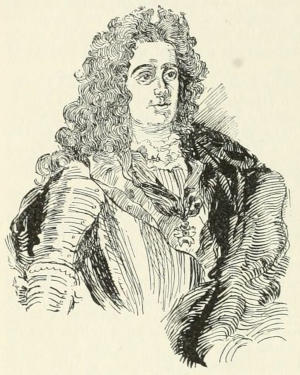
Claude Louis Hector, Duc de Villars
(1653-1734)
Churchill, duke of Marlborough, received his first taste of war under Turenne. He governed Queen Anne through his wife, parliament through his friends, the ministry through his son-in-law Sunderland, secretary of state for war, and through the great treasurer Godolphin, father-in-law of one of his daughters. Prince Eugene, born in France about 1663, of the count de Soissons and a niece of Mazarin, that Olympe Mancini whom Louis had for one moment favoured, belonged to the house of Savoy. Destined to an ecclesiastical career he preferred the profession of arms, and, at the age of nineteen, demanded a regiment of Louis XIV, who refused to make a colonel of the “Savoyard abbé.”c Disappointed in his hopes of obtaining a command in the armies of France, he turned to the Empire and became its greatest protector against the ambition of his former sovereign. During one campaign of 1692 he had foiled Catinat in Italy and by a bold raid from Piedmont into France had spread alarm far into the kingdom.a After the Peace of Ryswick he resisted the Turks who had invaded Hungary and won at Zenta, in 1697, a signal victory which placed him in the opinion of his contemporaries by the side of Sobieski, the saviour of Vienna. Now appointed president of the council of war and planning as a minister the expeditions which he was to carry out as a general, he had a decisive influence on the events which were to follow. By his good understanding with Marlborough he was about to give the European coalition that thing which it had always lacked—union.
To triumph over such adversaries France would have had to have the great men of the preceding generation. But Louis had used them up. However, some of the leaders that France still had, Villars, Catinat, Boufflers, and Vendôme, deserved confidence and freedom. It is true that such as Villeroi, Tailard, Marchin, and La Feuillade had every need of good counsel and guidance, but it was not by holding these generals by the leash that they were prevented from inflicting irreparable disaster upon the French arms.
To Louis XIV’s idea the war should be defensive at all points except in Germany, whither the elector of Bavaria summoned the French. Boufflers was sent to the Netherlands to oppose Marlborough, who commanded the Anglo-Batavian army; Catinat to Italy to shut the entrance to the Milanese upon Prince Eugene and the imperials; Villars to Germany to join the elector and march upon Vienna.[145]
WAR OF THE SPANISH SUCCESSION: THE FRENCH VICTORIES (1701-1704 A.D.)
For three years (1701-1704) the successes balanced each other. However, Marlborough penetrated, in 1702 into the Netherlands in spite of Boufflers, who with two armies on his hands did not know how to manœuvre between them and abandoned without combat the places on the Maas as far as Namur; at least he saved Antwerp the following year by the victory of Eeckeren over the Dutch. In 1701 Prince Eugene descended into Lombardy in spite of Catinat, who had a superior force, but who, badly obeyed and perhaps betrayed by some Spanish officers, did not prevent him swooping down from the Tyrol. Eugene threatened the whole line of the Adige, and crossed that river without resistance at Castelbaldo on the plain, while Catinat was waiting for him at Rivoli in the mountains. He forced the passage of the Blanc canal in a fight at Carpi, July 9th, when Catinat might again have stopped him; but the marshal, confused by manœuvres as bold as they were able, retired behind the Mincio and further still behind the Oglio which opened the Milanese to the enemy. The court degraded him and gave his army to Villeroi.
This protégé of Madame de Maintenon was a good courtier but a bad general. From the very first he wanted to take the offensive. He recrossed the Oglio hoping to surprise Eugene at Chiari, but the duke of Savoy kept the imperials informed of all his movements, and Villeroi, surprised himself, was beaten in 1701.
However, the enemy could advance no farther, so long as it did not have the stronghold of Mantua. Villeroi let the count de Tessé make a brilliant defence there and took up winter quarters in Cremona. Once while he was sleeping in supposed security he was awakened by sudden firing. He dressed in haste, rushed from his lodging, and fell among an Austrian squadron. It was Eugene, who was making a sudden attack on Cremona. He would have succeeded had it not been for a regiment which since four o’clock in the morning had been assembled for review by the colonel. The enemy, arrived in the centre of the town, were driven back through the gates; but they took the marshal with them (February, 1702). [Ballads were sung in the streets of Paris to celebrate the double stroke of fortune,—Cremona saved and Villeroi captured.] Vendôme replaced him and for two years carried on a successful warfare against the imperials. At first he forced them to retreat beyond the Mincio, which delivered Mantua, then by a rapid march he went to seize their stores at Luzzara, on the right bank of the Po (1702), so that he might approach the Tyrol. At this moment the concealed treasons of the duke of Savoy changed to open defection, the Bourbons having refused, very stupidly, to cede him the Milanese in exchange for Savoy (1703). It was necessary for Vendôme to turn against him to assure communication with France. He seized the greater part of Piedmont and threatened Turin, but he no longer threatened Austria.
[1702-1703 A.D.]
The same success in Germany. Catinat, called to the Rhine, did not re-establish the reputation he compromised in Italy. He had allowed the prince of Baden to cross the river and take Landau, Weissenburg, and Haguenau. A diversion of the elector of Bavaria recalled the imperials to Germany. Catinat, urged to follow them, dare not do so; but one of his lieutenants, Villars, did. He attacked the prince of Baden in the Black Forest near Friedlingen, and won his marshal’s baton on the field of battle (October, 1702).c The victory was as absurd as that of Charles the Bold at Montchery. The French infantry drove back the German and then broke and fled in a panic. Villars was swept back with his men, and was in utter despair when an officer rode up to say that the cavalry had saved the day. It was not much to be proud of, for the German troops were still in good order as they withdrew, but it gave the court its chance to honour its favourite.a
The most decisive blow was struck at sea. Sir George Rooke and the duke of Ormond made amends for an unsuccessful attack upon Cadiz, by forcing the port of Vigo, and capturing and destroying the fleet of the enemy, together with the galleons containing the treasures from South America.
The year 1703 passed in Flanders without any action of importance. Marlborough took Bonn and Luxemburg, and manœuvred with a view to capture Antwerp and Ostend, without success. More important movements were taking place on the Rhine, where Villars commanded. The object of the French king’s pushing the war into Germany, contrary to his usual practice, was to succour his ally, the elector of Bavaria, who was so sorely pressed by the imperialists that it was feared he would be obliged to abandon the alliance of France. Villars employed the winter months advantageously in making himself master of Kehl, opposite Strasburg. In the spring he succeeded fully in breaking through the imperialist lines, and joining the elector of Bavaria at Ratisbon; thus transferring the seat of war from the Rhine to the Danube. If we are to credit Villars himself, he conceived the idea of marching by Passau upon Vienna. The elector, of a more sober school of tactics, could not share the French general’s ardour. A difference of opinion, and subsequent coolness, sprang up betwixt them. Even the more sage advice of Villars, to pass the Danube and attack the imperialists before they could be joined by an approaching army, was but reluctantly followed. The marshal was obliged to shame his ally by threatening to make the attack alone. It took place near Donauwörth, between Höchstädt and Blenheim (September, 1703), and the French were here victorious on a field which was destined to be so fatal to them in the ensuing year. Unable to bring the elector into his designs, Villars agreed to a plan to invade the Tyrol, and open a communication through that country with the duke de Vendôme, who commanded in Italy. The scheme was unsuccessful. Vendôme was kept in check, not only by Prince Eugene, but by the duke of Savoy himself, and the Tyrolese drove the elector from their valley. He made loud complaints against Villars, and that able general in disgust threw up his command.f
[1703-1704 A.D.]
In November, 1703, the imperialists suffered a bloody defeat near Speier, which gave Landau back to France. The victor was Tallard. He wrote to the king, “Sire: Your army has taken more standards and flags than it has lost common soldiers.”
THE CAMISARDS
This victory put an end to France’s success. Louis XIV sent Villars against the revolting Protestants of the Cévennes, the camisards. These unfortunate people had just seen Pope Clement XI renew the preaching of a crusade against them (the bull of May 1st, 1703). Bewildered with terror they accepted the help of England and the duke of Savoy, who were anxious to foster civil war in the heart of France; and as they had been cruelly treated, they revenged themselves in turn with similar cruelties.
Villars had it at heart to save the province and bring back these exasperated men. “They are,” he said, “Frenchmen, very brave and very strong—three qualities to be considered.” He used force against those who persisted in fighting and was indulgent to those who put faith in his word. He won over one of their leaders, Cavalier, and one campaign was almost sufficient to re-establish peace in these provinces; but 100,000 men had perished in this horrible war.c
WAR OF THE SPANISH SUCCESSION—FRENCH REVERSES (1704-1713 A.D.)
The elector of Bavaria, however, remained master of the whole course of the Danube as far as Passau. The small army of 20,000 men brought by Villars, but now commanded by Marshal de Marchin [Marsin], swelled his force, whilst Marshal Tallard, with 40,000 men on the Rhine, was ready to march in the spring of 1704 and join Marchin and the elector. These prospects made the court of Vienna tremble. That government was at the same time pressed by the Hungarian insurgents, so that even the recall of Prince Eugene from Italy with all the troops that could be spared from keeping the duke of Vendôme in check, might not prove sufficient for defending the Austrian capital—to such distress was the emperor reduced in the spring of the year 1704.
It was then that Marlborough conceived the bold and generous design of abandoning Flanders, that beaten field, so known and trodden by commanders, so thickly sown with fortresses and cut with lines of defence as to render decisive actions impracticable, and of marching on the Danube, to the relief of the empire. Concealing his intentions, the duke crossed the Rhine at Bonn, the Main near Frankfort, and marched towards Bavaria.f At Mondelsheim near Heilbronn he had a conference with Eugene and together they agreed upon the plan of campaign which was to bring the victory of Blenheim and one of the greatest epochs in English military history. The plan was Marlborough’s; he had laid it before William III before his death and it had been rejected by the great Dutchman. Now he staked all upon it and executed it in the face of the opposition of England and Holland. From this time on, the greatest triumvirate of Marlborough, Eugene and Heinsius direct the fortunes of the allies.a
The French had in the meantime mustered another army on the Rhine under Villeroi. Him Prince Eugene undertook to observe, whilst Marlborough, seconded by the prince of Baden, undertook to pass the Danube, penetrate into Bavaria, and either force the elector to abandon the French alliance, or punish him for his hostility to the empire. Marlborough lost no time in manœuvring or counter-marches, but advanced straight against the French and Bavarians, who were entrenched at Schellenberg, before Donauwörth, a town that commands a bridge on the Danube. Marlborough’s attack was decisive. The entrenchments were forced, the enemy were defeated and fled, leaving many thousand men and several generals on the field, as well as the passage of the Danube free. The English and imperialists instantly poured over the river, crossed the Lech, and, whilst the elector took refuge in Augsburg, until Marshal de Tallard could reinforce him, Marlborough overran Bavaria to the gates of Munich, ravaging and punishing the country for the hostilities of its chief. This wretched and cruel system of warfare did not bring the elector to terms. It irritated him, however, and drove his temper to seek vengeance in a general engagement.
Unable to subsist south of the Danube in a country which he could not occupy, and which he purposely ravaged, Marlborough withdrew to the north of that river. Hoping to draw the enemy after him, he caused the prince of Baden to lay siege to Ingolstadt. What he sought, took place. The elector of Bavaria, anxious for revenge, and Tallard, who had joined him, sharing his ardour, they passed the Danube, and posted themselves at Höchstädt, on the very spot where Villars and the elector had in the last year been victorious. Prince Eugene at the same time contrived to deceive Villeroi, quitting his position, in front of that general, so as himself to arrive with his army in time to join in the action, whilst Villeroi remained perplexed or engaged in uncertain and tedious pursuit.
The Battle of Blenheim
On the morning of the 13th of August, 1704, the French and Bavarians drew up before their camp. Their armies did not mingle, but remained separate, that of Tallard on the right touching the Danube, that of Marchin and the elector in continuance of the line on the left. Before the front of Tallard was the village of Blenheim, on a rising ground, occupied by his infantry. At some distance in advance of the French and Bavarians ran a rivulet with marshy banks, on the other side of which were drawn up the imperials, the Dutch and English; Marlborough commanding the latter next the Danube, Prince Eugene the former. The elector committed a capital fault in not posting his army near to the rivulet, so as either to dispute its passage or to attack the enemy when they had partially crossed it. But he did not suspect an intention to fight on the part of Marlborough. Eugene began the action by attacking the elector and Marchin, from whom he met with a stubborn resistance. Marlborough in the meantime crossed the rivulet, and formed a strong body of infantry opposite the centre of his antagonists. This centre was composed of cavalry; for Tallard and the elector, remaining separate, had each drawn up his army, according to rule, with its horse upon the wings.
But these wings, united, formed the centre of the combined army. And thus a body of cavalry, destined by its nature to act offensively, was posted in the principal, the central, the fixed position of the army. Tallard no doubt reckoned that Marlborough would attack Blenheim, and, as Condé would have done, spend a world of lives and heroic efforts to master the position. Tallard knew this would cost hours; and he accordingly rode off to the left to see how the elector was faring, whilst his antagonists were drawing up, after having crossed the rivulet. Marlborough in the meantime did despatch troops to attack Blenheim, with the view of distracting Tallard from the principal movement. This was his advance upon the centre, the weak, divided centre of cavalry. In fact it made no resistance. Marlborough rushed in betwixt the elector and Tallard, cutting the French and Bavarian line in two. This manœuvre decided the victory. The elector with Marchin, taken in flank, gave up the advantage they had gained over Eugene, wavered, retreated, fled; whilst Tallard, hemmed betwixt the English and the Danube, ended by laying down their arms and surrendering. As for the marshal himself, he was taken whilst endeavouring to return from the elector’s division of the army to his own. The entire glory of this victory was Marlborough’s; and he enhanced it by that modesty and those attentions towards the vanquished which had so redounded to the fame of the Black Prince after Poitiers. From French writers we learn that Marlborough first set the example of treating prisoners not only with clemency but with the politeness due to misfortune; a trait that redeems those ravages in Bavaria which the custom of war had unjustly sanctioned. The battle of Blenheim, in which about 60,000 French and Bavarians against 52,000 of the allies were engaged, cost to the vanquished 12,000 men killed, besides a greater number made prisoners. The quantity of cannon, colours, and other trophies, was immense. But its effects were greater than all. The French armies were obliged to evacuate Germany altogether, abandon Bavaria, and retire behind the Rhine. Marlborough proved to Vienna another Sobieski. His victory re-established the imperial throne; nor was the house of Austria ungrateful. [It created him a prince of the empire, while Queen Anne made him a duke.]
[1704-1706 A.D.]
War was in the meantime raging in the Spanish peninsula. The archduke Charles had been enabled by England to land with a respectable force in that country, which he continued to dispute against Philip, the grandson of Louis. Portugal had been won over to the side of England and the archduke, and her aid proved of the greatest importance. It was singular to observe in this campaign the armies of France and Spain commanded by an Englishman, the duke of Berwick, while Ruvigny, created earl of Galway, a native of France and a Huguenot émigré, commanded the English forces. Sir George Rooke took Gibraltar in the same year in which the victory of Blenheim was won.
Marlborough had delivered Germany from the French, and driven them beyond the Rhine: he then turned his attention to the north, and aimed at expelling them from those provinces of Spanish Flanders which they had taken possession of in the beginning of the war. During the entire campaign of 1705, the duke manœuvred in vain to attain this object by bringing the French to action. A signal victory could alone enable him to reduce a host of strong towns by a single blow; long watching for this opportunity, it did not offer till the spring of the year 1706. Marshal de Villeroi took the command in Flanders, and with orders to give battle. Louis was weary of the tedious war, so many enemies besetting him; the mere expense of resisting on every side being sufficient to crush the monarchy. He was no longer in a condition to await the effect of Louvois’ preparations, or Turenne’s manœuvres. Experience, sagacity, skill no longer presided over either his councils or his armies: Louis cried out for something decisive—for battle; like the gamester, whom prudence has deserted, and who is anxious to stake all in a decisive throw, which may relieve or ruin him. He bade Villeroi, therefore, give battle. Had he even selected Villars for the important task! But Villars was an indifferent courtier, being rude, independent, and proud. The “short-geniused and superb Villeroi” was preferred, and despatched on the difficult errand of giving battle to Marlborough.
The Battle of Ramillies, 1706
The French army, of about 80,000 men, reached the banks of the Mehaigne near Ramillies, about half distance betwixt Namur and Tirlemont, on the 23rd of May, 1706. Despite the king’s order and his own ardour to fight, it was Marlborough who marched to the attack. Villeroi was waiting to be joined by Marchin; but, knowing himself to have a force stronger than the English general, he resolved to await the attack, drawing up his army in the position that chance had placed it, at an acute angle with the Mehaigne. The French right wing was near this river, with the village of Ramillies on a rising ground in front of it, precisely as Blenheim had been with respect to the French army in the action called by that name. Villeroi’s left was here covered by a little marshy river called the Gheete, which rendered it unassailable indeed, but also rendered it useless unless as supporting his right.
Marlborough did not arrive with his army till it was already past noon; he reconnoitred, drew up in line corresponding to the French, and the cannonade began. The duke in an instant had perceived that the Gheete covering the enemy’s left rendered engagement on that side impossible; he therefore drew all his force from that side, and drafting it in the most concealed manner possible behind the troops about to attack Ramillies and the French right, he concentrated his force on this point. This manœuvre took a long time to execute, and yet Villeroi took no step to defeat it. When Marlborough advanced, the French household cavalry charged him with such impetuosity and valour as to break the attacking battalions, and to endanger the duke himself; but the English, rallying in front, and allowing these rash enemies to pass to the rear, where there was force enough to deal with them, pushed on both upon Ramillies and upon the French line behind it. The English, being in much superior numbers on this point, owing to the inactivity of the French right, formed in one unbroken line and charged, numbers breaking in between the intervals of the French, who were drawn up in separate battalions, and taking them in flank. Their rearguard failed to support those in front: the baggage, it was said, impeded them: at all events the battle, though begun late, proved ere sunset a decisive victory on one side and rout on the other. The pursuit lasted the whole night, the fugitives suffering greatly in their passage through the defile of Judoigne, which was blocked with cannon and wagons. Here the day of Blenheim was renewed, the loss of the French in killed and captive not being, however, so great. The consequences were not less important; being the loss to France of all the Spanish Netherlands, including Antwerp, Ghent, Bruges, Ostend, Brussels, Mechlin, and Louvain. The fortresses of Menin and Dendermonde surrendered also. Namur and Mons remained, the only towns unconquered.