Chapter XIV · HENRY OF NAVARRE, FIRST OF THE BOURBONS
Reading edition
It is my wish that every peasant may have meat for dinner every day of the week, and a fowl in his pot on Sundays.—Henry IV.
HENRY’S STRUGGLE FOR THE CROWN
[1589-1610 A.D.]
Jacques Clément in killing Henry III, whom he found not Catholic enough, opened to a Huguenot the road to the throne. This was Henry, king of Navarre, to be known in future as Henry IV of France.b
Henry IV has been compared to Francis I. His face has, in fact, the same large outlines, the same sensual mouth and brilliant eye, the same smile full of an attraction that is sometimes deceptive, the same expression of countenance whose openness is not always that of sincerity. But we must not be misled. This quick, ardent eye sometimes looks within to depths unattainable to Francis I; and above these projecting eyebrows, a sign, as with the Valois, of quickness of perception, rises instead of the low forehead of Francis I the vast brow of genius. Though Henry too pushed voluptuousness to the point of license, he nevertheless had tenderness if not constancy of heart. Though his language has too much of the unstable levity with which his Gascon race is reproached, though the confinement of his youth in the most depraved of courts and later the infinite difficulties of his position changed the cordial spontaneity of his nature, he nevertheless has a reserve of true and strong feeling that Francis I never knew. Apparently selfish, he was able in reality to associate his interests and his glory with the idea of the welfare of France and the interest of humanity. Infinitely superior in essential things to the Valois and the Guises, he is their inferior in elegance, in external dignity. Compared with the other two Henrys he has the air of a soldier of fortune before princes, but he redeems this inferiority of manners by a singular charm; he attracts the imagination and the heart by an irresistible mixture of shrewdness and good nature, of tenderness and sharp raillery, of ardour and calculation, of gaiety and heroism, of authority and the comradeship of the soldier. After two centuries and a half he is still irresistible when we see him act and hear him speak in history, when we follow him almost day by day in the truly unique monument of his prodigious correspondence. The most severe, whether historians or moralists, after many and too often deserved reproaches, almost always end, if they are French, by extending their hands to the most French of the kings of France.
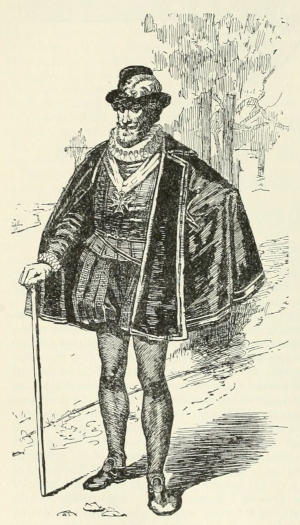
Henry IV
We shall witness the stubborn struggle in which he fought for his throne; after the struggle we shall see what his work was as re-organiser of domestic peace and founder of foreign politics. The immediate effects of the death of the last Valois in the rebellious capital and in the besieging army announced only too forcibly to the first of the Bourbons the immense tasks and the immense perils that confronted him. The news of the death of Henry III was spread in Paris after the morning of the 2nd of August; all doubts were dissipated when the duchesses de Nemours and de Montpensier were seen driving through the city in their coaches and crying out on all the squares: “Good news, my friends—good news! The tyrant is dead! There is no more a Henry of Valois in France!” The mother of the Guises, mad with joy and vengeance, mounted the steps of the high altar of the church of the Cordeliers to harangue the crowd. Her daughter distributed everywhere scarfs of green, the colour of hope and joy, instead of black scarfs. In a few moments the multitude passed from consternation to frenzy. There was nothing but “laughter and singing,” tables set in the streets, feasts in the open air. In the evening bonfires burned on all the squares. Everywhere resounded the praises of the “new martyr” who had given his life for the good of the people. The blessed Jacques Clément was honoured in the pulpits, sung in the streets, invoked as a saint. Images of him, painted and sculptured, were set in the place of honour in private houses, in public places, in churches, and even on the altars! His old mother was brought to Paris, loaded with presents and shown to the people “as a wonder,” who had borne in her bosom the liberator of the church.c
[1589-1590 A.D.]
When the intelligence reached Rome, the rejoicings were still more revolting. Sixtus pronounced the assassin’s praises in full consistory, and compared his achievement in usefulness and self-sacrifice to the incarnation and crucifixion. In Germany and England the deed was differently viewed. Elizabeth got ready troops to be landed in Normandy in aid of the new king. Lutherans and Swiss came pouring into France. Yet Henry’s position was dangerous and undefined. The nobles who commanded his armies were Catholics as zealous as the enemy. Before the corpse of the late king was cold, they proposed to his successor a retraction of his Huguenot errors, and conformity to the church. “You don’t know what you ask,” replied Henry. “You require a change which would argue no sincerity either in one faith or the other. If you think to terrify me to so sudden an alteration, you know neither my courage nor my conscience.” “Sire,” cried the gallant Givry, and kneeled at his feet, “you are the true king of the brave, and none but a coward would desert you.”
The others, however, hung back. The spirit and principles of the league remained unbroken. The cardinal De Bourbon was even proclaimed by Mayenne under the name of Charles X. All the victories which made Henry’s name distinguished had been gained over Catholic foes. If full powers were conveyed to him, would his policy of depressing the leaguers not be continued? Henry came to an agreement. He consented to accept a conditional allegiance, binding himself to study the doctrines of the Catholic faith; to summon a states-general at Tours; to restore to the churches the goods of which they had been despoiled; and to limit the privileges of the reformers to the places in which they at present existed. These things were all to be done within six months. In reliance on these terms, he was recognised sole sovereign of France, and entitled to the obedience of all.
But Paris still resisted, and riots and massacres were continually renewed under pretence of religious fears, till Mayenne himself was glad to leave that city of contention and misrule, and take the field against the Man of Béarn, as he was insultingly called. The quality and composition of the contending forces had greatly changed. Mayenne, at the head of preponderating numbers, besieged Henry in Arques, and was only repelled by the union, which his great rival displayed, of the courage of despair and the calmness of military skill. With a mixed army of English, French, Germans, and Swiss, he found it difficult to keep them together, as his purse was low, and the diversity of tongues and nations prevented the unity of the force. To fight was the only way to combine those discordant elements; and on the 13th of March, 1590, the battle of Ivry took place.d
The Battle of Ivry
The plain on which the king desired to offer battle to the leaguers extends to the west of the river Eure, between Anet and Ivry; neither bank, hedge, nor any natural obstacle intersects it, but in the middle the ground slopes almost imperceptibly, so that the royal army, protected on the one side by the village of St. André, and on the other by that of Turcanville, could not be reached by the enemy’s artillery. Henry IV, having seen to the rest and refreshment of his forces, occupied this position on Tuesday, March 13th; his cavalry, which was almost entirely composed of nobles, and upon which he consequently placed most reliance as being more dependable in point of honour, he divided into seven divisions, each of them supported by two regiments of infantry. Marshal D’Aumont, the duke de Montpensier, the grand-prior assisted by Givry, the baron de Biron, the king, the marshal De Biron, and Schomberg, commandant of the reiters (German troopers), were at the head of the seven divisions.
Whilst the army was taking up its position, it was joined successively by Duplessis, De Muy, La Trémouille, Humières, and Rosny, who, with two or three hundred horse, came from Poitou, Picardy, and the Île-de-France to take part in this much desired engagement. The last comers were nearly all Huguenots; up to now but very few had been numbered among the army.
The duke of Mayenne did not suppose that Henry wished to await him, but flattered himself he would overtake him in crossing some river in his retreat upon Lower Normandy, so hurried on his march in expectation of this, not without exposing his own forces to that disorder in which he expected to find the enemy. But on reaching the plain of Ivry, on the afternoon of March 13th, he beheld before him the royalists awaiting him, drawn up in order of battle with the advantage of position. He slackened his march to restore order to his forces, and did not come within range of the enemy until evening, when it was too late to contemplate beginning hostilities. The weather was very unfavourable, and the soldiers of the league, wearied by the cold rain they had experienced throughout their march, were forced to sleep in the open, only a few officers succeeding in pitching their tents, whilst the royalists established themselves for the night in the villages of St. André and Turcanville.
On the morning of Wednesday, March 14th, the royal army occupied the same position as on the previous day. The two armies were not ranged in order of battle until ten o’clock. D’Aubignée relates that whilst putting on his helmet Henry addressed these words to his companions-in-arms: “My friends, God is for us! Behold his enemies and our own! Behold your king! At the enemy! If your ensigns fail you, rally round my white feather. You will find it in the path that leads to victory and honour!” These words were received with a universal cry of “God save the king!” and the battle began.
The royalist artillery directed their fire full upon the leaguers, who were exposed upon the rising ground; that of the league, on the contrary, was unable to reach the royalists, sheltered as they were in their hollow. Count Egmont, stationed at the extreme right of Mayenne’s army, would not wait for a third discharge from this artillery, and fell furiously upon the light cavalry of the grand-prior, which was opposite him and which he overthrew. With the same impetuosity he came up to the cannon of the king, which had cut up his company. “Friends,” cried he, “I will show you how the weapons of cowards and heretics should be served,” and, turning his horse at the same moment, he backed it up against the royalist guns. Not one of his warriors but wished he could boast of having done as much. They lost not only their time in this extraordinary manœuvre, but all Egmont’s cavalry fell into disorder. No longer carried forward by that impetus which constituted its strength, it was attacked simultaneously by Marshal d’Aumont, the baron de Biron, the grand-prior, and Givry. Egmont and his chief officers were killed, all his followers routed and cut to pieces.
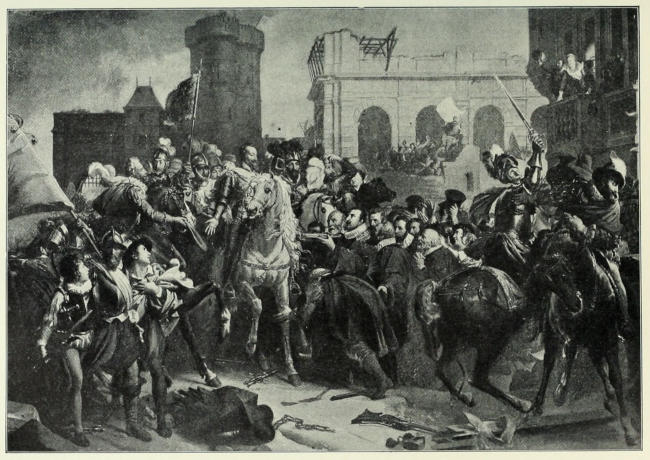
THE ENTRANCE OF HENRY IV INTO FRANCE
In another part of the line the duke of Brunswick, who led the leaguers’ reiters, was also killed. These reiters were accustomed after each charge to pass through gaps left for the purpose between each battalion to form again behind the line; but the viscount de Tavannes, to whom Mayenne had intrusted the drawing up of his army in battle array, was so short-sighted that he mistook the interval that should be left between the corps, so that there was not sufficient space left for this manœuvre. Thus the reiters returning from the charge, bore down upon the duke of Mayenne’s squadron of lancers, and threw it into disorder. The duke was forced to repulse them at the point of the lance, for there was no room to manœuvre his horses, and whilst striving in vain to restore order, he was violently charged by the king, who perceived his predicament; he was routed and forced to fly to the woods. Soon all the cavalry of the league shared the same disastrous fate, the battalions of infantry, hitherto covered by the cavalry, now found themselves alone in the middle of the plain, and attacked on all sides by the king’s forces.
The Swiss, though as yet not routed, held up their arms in token of surrender, and were immediately given quarter by the marshal de Biron; the lansquenets, encouraged by this example, and at the same time weakened by this defection, also held up their arms, declaring that they surrendered. But Henry and his soldiers held them in particular abhorrence. Several of them had been already concerned in the treachery of Arques, where they had feigned to give themselves up; several, engaged by the Protestant princes to reinforce the royal army, had gone over to the enemy; the king declared that they had transgressed against martial honour, and that he would give them no quarter. The massacre lasted a whole hour, but whilst they were being killed without resistance, the king cried, “Spare the French and put the foreigners to the sword!” And, as a fact, after the mêlée no more French were killed.
The fugitives of the league sought refuge, some in Chartres, some at Mantes. The bridge of Ivry, by which they made their escape, gave way, and the king’s cavalry, in order to pursue them, was forced to go by a longer route and to cross the Eure at Anet. The losses of the army of the league were nevertheless very considerable. Davilaf reckons them at six thousand men; D’Aubigné,e calculating the armies as being weaker by one-half than his estimate, also reduces the loss of the leaguers by the same amount, namely one-half. Since the beginning of the civil wars no such brilliant victory had yet been won. Henry IV, victor at Coutras, victor at Arques, victor at Ivry, seemed to surpass his rivals both in military ability and good fortune, and the people rejoiced as much in his good luck as in his skill.g
After this a new power displayed itself, which had never played a part in the quarrels of a nation before. It was the brilliancy of the sayings of the new king, which spread all through France, the land of all others in Europe where a brilliant saying has most weight. After the combat of Arques, where he had been foremost in the attack, he wrote to his friend the duke de Crillon, “Hang yourself, brave Crillon; we have fought at Arques, and you weren’t there.” At supper, on the night before the battle of Ivry, he had spoken harshly to an old German of the name of Schomberg; and while he was marshalling the troops before the charge, he stopped his horse. “Colonel,” he said, “we have work before us, and it may chance I don’t survive; but I must not carry with me the honour of a gentleman like you. I beg your pardon for what I said last night, and declare you a brave and honourable man.” He embraced the colonel. “Ah! sire,” said the German in his broken language, “you kill me with your words, for now there is nothing for it but to die in your defence.” Schomberg did so. He rode up to the rescue of the king in the hottest of the fight, and fell before Henry’s eyes.d
The Duke of Parma and the Spaniards
The change that came over public opinion after the battle of Ivry raised the hopes of the royalists. Henry was no longer a contestant but the logical master of the realm. This feeling of the people caused Henry to move but half-heartedly against Paris where the strength of his opponents lay. He besieged the city, but he did not forget that the inhabitants were his own people. He permitted Mayenne to send out the useless people, said to number some six thousand.a Henry fed them, and soothed their fears. Some peasants were brought before him for having introduced provisions into the beleaguered town, and expected to be hanged for aiding the rebels. He gave them all the money he had in his purse. “The Man of Béarn is poor,” he said; “if he were richer, he would give you more.”
Compared to these actions and words of Henry, the conduct of his opponents was not only unchivalrous but unpopular. Divisions raged high among the leaders of the league. Mayenne wished to be king; the duke of Lorraine wished his son to be king; and when Henry of Guise, the son of Balafré, escaped from his prison of Tours, and joined the garrison of Paris, he also wished to be king. The infanta, or daughter of Spain, wished to be queen; and it did not need half the quickness which is always found in the French to perceive that, compared with any or all of his competitors, the man of the white plume and the generous spirit was the fittest occupant of the throne.
But a rigorous pontiff filled the Roman chair. Sixtus V would hear of no accommodation with a heretic, and Henry would hear of no recantation when his motives might be suspected. “Master first, disciple afterwards,” was his motto, and the war went on. The Sixteen, as the sections of Paris called themselves, were in the pay of Spain. Availing themselves of the absence of Mayenne, they encouraged the brutal populace to break out into a riot; they tore the more moderate of the judges from their seats and hung them, with their president, above the doorway of the court. Mayenne came back. Great was his fear of Henry, but greater his wrath against the Sixteen. He hanged four of them from lamp-posts in the street, and restored the ordinary municipal officers to their authority. But regular authority dislikes rebellion, and the now pacified city looked kindly on the legitimate heir.
Other opponents were driven over to his side by the injudicious aid his enemies received. Alessandro Farnese, duke of Parma, was the most famous general of the time, and had been chosen to bring the legions of Spain and the chains of the Inquisition over to France in the year of the Armada, 1588. He was now selected to head the same legions to support the fantastic claim of his master’s daughter. Henry was driven to extremities, for Alessandro was unluckily the most cautious of commanders, and always refused a battle. The daring gallantry of the royalists, with Henry at their head, fell back like sparkles of foam before the imperturbable solidity of the Spanish lines. They would not fight—they would not retreat—they solemnly performed the work assigned to them, the protection of a border or the relief of a town, but they would do nothing more. Alessandro of Parma had nothing of the hero in him except his courage, and trusted nothing to chance. Against policy like this the Man of Béarn had no defence. His allies were not united in their desires. The English wished to drive the Spaniards from the shores of Brittany and Normandy, where they would have been dangerous neighbours to Elizabeth; Henry wished to drive them from the middle of France and send them to the shore, where they could do least harm to himself. He could raise no taxes by the legal machinery of parliament and council, and would not lay hard contributions on the districts he held.
[1590-1593 A.D.]
He was the poorest of gentlemen, this most lovable of kings; and hints are given that his majesty’s apparel was not altogether free from darns, or his boots from holes in the leather. Nothing kept its gloss but the plume of white feathers which swayed above his head, and his bright sword and imperturbable good-humour.d But even this left him as he faced the almost certain defeat which a battle would mean. In August he wrote to Gabrielle d’Estrées: “The issue is with God. If I lose the battle thou wilt never see me again, for I am not one to flee nor to retreat.”
But Parma’s masterly generalship was more than a match for the king’s chivalric courage. He relieved Paris after it had been reduced to the most awful straits. Two hundred thousand are said to have perished of hunger and disease. There were rumours that mothers devoured their own children; the Protestants had made merry over the fact that the one cheap thing in Paris was sermons; but such fanaticism was yet bound to conquer the king. The relief of Paris was a victory for the Spanish party which was growing stronger in the capital. In 1592 the same story was repeated at Rouen. Once more Parma outmanœuvred the king. But a wound in the hand received before Candebec was destined to prove fatal to the great Italian, and the conqueror of Antwerp withdrew to the Netherlands, and, then turning back, died in the harness at Arras, December 3rd, 1592.
Henry’s fortunes revived with the fall of this redoubtable adversary.a He gathered all his forces for a last attempt upon Paris, and his enemies as usual played into his hands. Philip of Spain, who had united all classes and creeds of Englishmen in favour of Elizabeth by his insolent Armada, now was the creator of French union by his domineering conduct in France. Mayenne summoned a states-general at his request, and Philip there in no courteous terms stated his royal will; it was very short and very decisive—they were to accept his daughter as queen, that was all. A compromise was attempted; they would declare the duke of Guise king, and he should marry the infanta. Philip refused; his daughter should be queen in her own right, and then would marry Guise. Mayenne, who saw, whether it was king or queen, his pretensions were at an end, procured a resolution of the parliament of Paris, that “any sentence, decree, or declaration contrary to the Salic law, should be void and of non-effect.” Whatever strengthened the Salic law and the direct succession was a vote on the side of Henry of Navarre.d
Henry IV and the League
The league was now divided into two parties, the Spanish League and the French League, who conspired incessantly, sometimes together, sometimes against one another, to promote their personal interests. But meantime the great national instinct was gradually winning France over to Henry’s cause; men’s eyes turned to him as the only one able to put an end to war at home and abroad, and to bring about national unity. The burning question of the day was, would Henry turn Catholic? Rumours were rife; the question was openly discussed. Such being the case, it was only to be expected that Henry would boldly face the question himself and lose no time in finding an answer.
[1593-1594 A.D.]
And this he found most puzzling, notwithstanding his broad and independent mind. It is M. Guizot’s opinion that Henry’s religious creed was not based on mature or deep conviction, but was rather the result of first claims of his having been born in the reformed faith; and that it was a feeling of patriotism, a desire to save France from all the horrors of civil and religious wars, that decided him to abjure his religion. However that may be, he did so decide, and on the 16th of May, 1593, announced to his council his intention of becoming a Catholic. On July 15th, 1593, he assembled a conference of Catholic and Protestant divines at Mantes, and ten days after, on Sunday, July 25th, he solemnly abjured his Protestant creed at the church of St. Denis. Here then, says M. Guizot, was religious peace, a prelude to political reconciliation between the monarch and the great majority of his subjects. And now the Catholic Henry was crowned king of France,[81] the 27th of February, 1594.a
France has known few periods which can be compared to this time of Henry IV; few periods when she has been nearer to ruin and yet has raised herself from a state of terrible disturbance to one of glorious peace. A kingdom only just relieved from the exhaustion of prolonged strife, and threatened with downfall by the new religious doctrines; feuds which stir up struggles whose annals are stained by murder, and which are destined to end in a huge massacre; a crown rendered insecure by the claims of rival houses, and in turn making use of criminal measures as a means of vengeance or finding in them its own punishment; a prince whose birth seems to call him to the throne while his beliefs seem likely to deprive him of it forever; poverty, famine, the growing claims of the foreigner whose pretensions increase in proportion to the misfortunes of France; and in the midst of all these vicissitudes a nation which does not know where to look for help, nor in whose hands to trust its fate—what scenes! what years! what memories full of dark heroic grandeur!
The importance of contemporary events and the sombre majesty which seems to preside over all the actions of the league, make it difficult to pass judgment on it. It presents, both as regards things and men, such striking contrasts, it has passed through so many different phases, and has included under one name so many motives entirely opposed to one another, that it would be impossible to criticise it from only one point of view. And yet what contrary opinions it has elicited! Some have praised, while others have condemned everything connected with it. It has been handed down as entirely faultless or utterly blameworthy.
But through all this confusion one thing is clear, and sums up the whole matter—namely, that the conversion of Henry IV was the triumph of the league and the ruin of its members. The law of France was not entirely on the side of Henry IV nor wholly in favour of his adversaries; it was divided. The accession of the king of Navarre placed in opposition two principles which had hitherto been united: hereditary monarchy, whose claims this prince represented; and the national religion, whose doctrines he did not profess. Can it be denied, unless we bring to bear on the examination of this period ideas which belong to a different age, that the union of monarchy and Catholicism had become a part of the constitution just as monarchy itself had? And had not the country some right to insist on the maintenance of this union, which was one of the first laws imposed on the sovereign? One thing remains certain, and that is that after the league this union was re-established, and peace along with it; that Henry IV, when he became king, recognised its existence by promising to be instructed in the faith; that, with rare exceptions, the best of the royalists, the bishops, those hundred bishops who so firmly supported him, the chief generals of his army, and his parliaments, continually referred to and called upon the king to remember this promise, either in the hope of attracting to him the members of the league, or of inducing him to embrace their religion; in short that France, exhausted, a prey to the horrors of civil war, and in danger of the Spanish yoke, did not rally round Henry IV till after his abjuration, but, that abjuration once pronounced, she unanimously declared in his favour.
Who can be astonished at this? Who could fail to understand that a nation accustomed to mingle its faith and its history, finding amongst its Catholic princes its greatest kings, and knowing nothing of the Protestants but the unhappy dissensions which were the result of persecution on the one side and revenge on the other, must hate the idea of seeing on the throne, which was the centre to which its dearest traditions clung, a representative of that belief which was destroying those very traditions? Was the promise of Henry IV to respect the Catholic religion a sufficient guarantee at that time, when party strife ran so high, when political law was on all sides confounded with religious law and had everywhere followed the vicissitudes of the latter, and when an instance of a king professing a different religion from that of the nation he ruled was unknown? And, as if to emphasise the apprehensions of the leaguers, did not England furnish them with an example of a nation which had changed its religion three times to suit the pleasure of three successive monarchs? This resolution to maintain the Catholic religion on the throne of St. Louis, regardless of all political considerations, was not the predominant idea of one party only: the whole of France was strongly imbued with it.
The league was responsible for more than this. How can we forget that besides inculcating the principle which it succeeded in rendering triumphant, the league was the moving spirit of many excesses, that it abolished beliefs, or used them as means to an end, as best suited its purpose; that it was responsible for the frenzied actions of the famous faction known as the Sixteen, of which the very name is sufficient; that it appealed in turn to revolutionary and tyrannical theories; that it menaced the monarchy even before it had been threatened by the reform party; and that the result of this violent party feeling was to place before the nation the alternative that France must either have a Catholic king who was not legitimate or a legitimate king who was not a Catholic?
Of course the union of the two principles which constituted the monarchy found partisans and opponents in both camps. In both also there were many of those turbulent spirits who war against peace, who elevate hatred into a duty, and encourage strife on principle. Some of these exaggerated the rights of the king, others those of the pope; though they compromised the former by their violence, and disavowed their support of the latter by rising in rebellion when the king and the pope were reconciled to each other. In both camps also, wise and moderate men with a true understanding of religion and of France were advancing by different paths towards the same goal. Jeannin, Villeroi, and perhaps at certain moments the duke of Mayenne, were approaching the same goal as Luxemburg, the duke of Nevers, the bishop of Paris and the archbishop of Bourges. But the royalists had the good fortune to possess as their leader a prince who, personifying one of the two great principles, was soon to submit to the other; whilst the members of the league, divided against themselves, having no recognised head, in revolt against monarchic authority and yet having no special right to be considered as the representatives of the Catholic religion, lost ground by the want of consistency in their claims.h
The extravagant enthusiasm of the league had evaporated; in part it had been reasoned down by the mild and rational philosophy promulgated in the Essays of Montaigne,i and in part scouted by the poignant ridicule of the Satire Ménippée.j These are the two chief literary works of the epoch—the former sufficiently known to every reader, the latter one of the finest specimens of political satire to be found in any language. It proved to the leaguers what Hudibras proved to the English Puritans—it exposed the absurdity and hidden selfishness of fanaticism, and showed that ridicule might be made a more effectual weapon than the sword.k
Henry, in his negotiations with the clergy, had ignored the ultramontanes, who leaned on Spain, but dealt with the patriotic national clergy. Whether Henry said that Paris was worth a mass or not,—and the saying was in accord with his wit and his sincerity,—he had left off conversion until he could deal with effect directly with the people, and not play over into the hands of the high Catholic party. France was ready for the act. By the end of 1593 the most of the kingdom had declared for Henry; the centres which had been in opposition, Meaux, Orleans, and Bourges, and finally Lyons gave in, and in the winter of 1594 he was crowned at Chartres,—Rheims not having yet declared for him. The papal absolution had not yet arrived and the higher clergy was mostly hostile still. But in March Paris opened its gates and Henry went to mass at Notre Dame amid the riotous joy of the citizens.a
Opposition of the Pope and Philip II
The only two powers who now delayed the recognition of the king were the pope and Philip. The Catholic Henry availed himself of the Pragmatic which had conveyed the patronage of abbeys and bishoprics to the crown, and turned the tables on the holy father by employing the honours of the church in pacifying the state. If a zealous leaguer still held back, hesitating to believe the sincerity of the conversion, he was convinced of the Catholicism of the most Christian king by the bestowal of the revenues of a vacant stall or rich deanery. Villars Brancas, a zealous papist and gallant soldier, who was governor of Rouen against the king, never gave credit to Henry’s attachment to the church till he was presented with two or three abbacies for his own enjoyment. Rouen then opened its gates, and the military abbot did suit and service to his orthodox and discriminating patron. All the leaders were softened by the same arts, and at last Guise and Montmorency were admitted into favour. Guise, a disappointed opponent, was made governor of Provence; and Montmorency, a discontented supporter, received the constable’s staff. Hatred, doubt, and bitterness of course lay for a long time in the hearts of the fanatical and ambitious. Clement VIII, the fifth pope who within four years had sat on the Roman throne, had not pronounced the absolution of Henry’s previous unbelief, and a youth, a pupil of the Jesuits, imbued with their principles, if not incited in this instance by their advice, attempted the murder of the king. His knife slipped, and only inflicted a trifling wound; but the whole nation was awake to the indignity of the action. The university and parliament pronounced against the Jesuits, and they were ordered from the soil of France. Henry confessed the step was necessary, but it was not legal, and in a few years he revoked the sentence of banishment, and allowed the society to return.d
[1594-1598 A.D.]
When the papal absolution came it was the sign of the end of the league, which collapsed when Mayenne made his peace early in 1596. The only revenge which the king allowed himself being, Sullyp tells us, to lead him on a hot, tiresome tramp around the park of Soisson, which the gouty Mayenne must acquiesce in without grimace.a
Meantime Philip II refused to recognise the king of France under any other title than that of Prince of Béarn, and in other ways also showed his hostility. So in January, 1595, Henry formally declared war against Spain and a conflict began which lasted for three years. It is not worth while to follow step by step this monotonous conflict, pregnant with facts which had their importance for contemporaries but which are not worthy of an historical resurrection.l Several battles were fought, several towns submitted; Amiens surrendered in September, 1597, after a long siege, and with the fall of Amiens fell all the knights who had been raising their heads throughout France. The Peace of Vervins was signed May 2nd, 1598, four months before the death of Philip II. So the peace was made; and in it the aged sixteenth century seems to sink to rest. It closed the wounds of all that strife of three generations which began with the Reformation as a group of purely religious wars, and, after dreary epochs of civil contest, came to an end in which nothing was said as to matters of faith, an end heralded by the great Edict of Toleration.m A month previous to the signing of the treaty of peace Henry had signed and published the Edict of Nantes, defined by M. Guizotl as his treaty of peace with the Protestant malcontents. Hitherto there had never been anything but truces or armed neutrality.a
THE EDICT OF NANTES
The Edict of Nantes, in common with almost all measures which have been taken to redress grievances in times of disturbance, consisted of two distinct parts: one of temporary value and intended to meet the special circumstances of the case, the other calculated to endure, and dictated by fixed principles. Much has been said about the excessive privileges granted by the Edict of Nantes to the Huguenots. This special organisation, giving them quite a peculiar position in the state; those two hundred towns, where they were to be secure from interference, and which were placed for a time in their hands; those places, strong enough to endure a siege and against which the whole of the royal forces were no more than adequate, given up to them—these, as Sully declared, were concessions quite incompatible with the security of any government, and when Cardinal Richelieu, after two civil wars, cut down these privileges without interfering with the Protestant religion, it became evident that they were not at all necessary to insure liberty of conscience.
The measures which did insure that liberty formed the very basis of the Edict of Nantes. They secured to the Huguenots the free practice of the reformed religion throughout the greater part of the kingdom, excepting certain towns belonging to the league, where the Calvinists had realised that it was better not to settle. They provided that Protestants should enjoy the same civil rights as Catholics, and the very law for depriving people of hereditary rights on account of religious opinions, which was to be formally promulgated in England against the Catholics, was as formally suspended in France with regard to the Protestants. Lastly, not to mention the less important clauses, a chamber was created in parliament called the chamber of the Edict, an allowance was granted to the Protestants for their ministers and their schools, and they were admitted to the dignities and offices of state.
The true spirit of the Edict of Nantes, temporarily obscured by the granting of the concessions which it enumerated, is contained in these latter clauses which granted toleration to the Protestants while depriving the Reformation movement of any political character whatever. At a time when sovereigns and people were in the habit of shielding their ambition and their crimes under the name of religion, Henry IV consistently tried, in his relations with foreign powers, as well as in his own kingdom, to separate the two orders, and to maintain civil unity in the midst of religious dissension; civil unity being in his eyes not only a pledge of peace, but the presage of a still higher unity.
Besides this tolerance granted to the Protestants, there is also an evident desire to encourage where it was possible a reconciliation with the church, and to put an end simultaneously to persecutions and to religious differences. He had seen that persecution, far from destroying opposition, only tended to excite it, and that the persecution itself, by a sort of reaction, tended to become more virulent. He expressed this with striking eloquence in the parliament of Paris, saying: “After St. Bartholomew four of us who were playing with dice at a table saw drops of blood appear there, and finding that after they had been wiped away twice they returned a third time I said I would play no more; and that it was a bad omen against those who had shed it; M. de Guise was one of the party.” He had said elsewhere: “It is a clear proof of unreasonable excitement to begin the work of conversion by subversion, of instruction by destruction, by extermination, and by war, when one ought to begin by fraternity, admonition, and gentleness.” Whilst granting these liberties to the Protestants, whilst further developing the significance of the Edict by ordering it to be enforced in Béarn and in the places where Catholics were in a minority, whilst he instanced his own example in order to protect the latter from the harshness of Protestant rulers, Henry turned his attention to the church; strove to satisfy her claims, to secure her liberty, and by so doing to insure her ascendency. “I know,” he said to the clerical deputies in 1598, “that religion and justice are the pillars and the foundation of this kingdom, whose preservation depends on justice and piety; and where these do not exist I wish to establish them, but little by little, as I wish to do everything. I will, God helping me, act in such a way that the church will be in as good a state as she was a hundred years ago. I hope to satisfy you and my own conscience.”h
REORGANISATION OF FRANCE WITH THE AID OF SULLY
In 1598 Henry IV had driven out the foreigner, united Catholic and Protestant, and finally established peace in his domestic and in his foreign relations. It was now necessary to heal France from all the blows she had received. “I have hardly a horse on which I could fight,” wrote Henry in 1596: “my doublets have holes at the elbows and my pot is often empty.” The country was in a like condition. A contemporary estimated that, since 1580, 800,000 persons had perished by wars and massacres, that nine cities had been razed, 250 villages burned, 128,000 houses destroyed. And since the period preceding the league, what fresh ruin! Workmen without work, commerce interrupted, agriculture ruined, brigandage everywhere—that was the condition from which Henry must raise France. The nobility had proposed to him a means to get out of this distress; they offered him all the money necessary for the government and the maintenance of the army on the sole condition of a decree “that those who held governments by appointment might hold them as their property upon acknowledging them to be from the crown by simple liege homage, a thing that was formerly practised.” This thing formerly practised was precisely what royalty had incessantly been destroying piece by piece for two centuries, and Henry IV was less disposed than any of his predecessors to restore feudalism. On the contrary, it was by withdrawing France from the hands of these “tyrants” in order to govern it himself that he undertook to regenerate it.
Henry had already found the man who was to aid him in this work which was more difficult than that of the battle-field; a man of strong good sense, intrepid heart, and withal a wise mind, the Protestant Maximilian de Béthune, later duke of Sully. Born at the château of Rosny, near Mantes, in 1560, he was seven years younger than the king. At the time of St. Bartholomew he was studying at Paris. He attached himself to the king of Navarre and followed him in all his adventures and his battles, showing himself as brave as any. He was often wounded, for example at Ivry, whence he was borne apparently dying, when the king met him and “embraced him with both arms” as “a brave soldier, a true French knight.” Not a knight, however, after the paladins of romance, for though he attended well to the affairs of his master, he did not forget his own. He married a rich heiress, a Courtenay. He did not disdain the profits of war, the pillage of cities or the ransom of captives, nor even the profits of business; he bought horses at a low price in Germany and sold them in Gascony for a high price. Increasing his fortune in every honest fashion, he established order in his own house as he did in the public finances. But, devoted to the prince and to the state, this good manager cut down his forest of Rosny to take the proceeds to Henry when the latter was at the end of his resources; and the zealous Protestant advised the king to end the war by becoming a Catholic. Sully was neither a Colbert nor a Bayard; he had, however, some of the qualities of both.n
Sully introduced into the government the energy of a soldier, and into the prince’s household the same economy and punctuality as prevailed in his own. Having become superintendent of finances, and having assumed the supreme direction of this department, he laid the traditions of method and of that perfect efficiency which cannot exist without it. He performed a very important, very difficult, but not very brilliant work. He formed men and trained them so that they could satisfactorily carry on existing institutions. By his unfailing watchfulness, he succeeded in having the accounts systematically kept, and rendered peculation almost impossible. As most of the hereditary financial offices had gradually acquired an independence which had been fostered by the civil wars, Sully tried to reunite, as far as they were concerned, the ancient ties of centralisation, so as to secure the influence of the supreme power over them. He also wished to have the census taken regularly, and to insure an accurate statement of the budget being drawn up. He wanted to find out the exact value of the taxes, and to institute a regular system for their collection; finally he took advantage of the low rate of interest to reduce the pensions paid by the state.
This change, and a better system for farming the taxes and of securing their returns enabled him to leave the ministry, having made up the deficit, and leaving several millions of savings in the cellars of the Bastille. This accumulation was very valuable at a period when there was hardly any better way of providing for future emergencies than by laying by money. Sully was the first superintendent of finance whose memory was not execrated, and even remained popular. Let us hear what is said of him in an anonymous eulogium, written probably after his death, and which, in spite of its somewhat obscure language, contains a true appreciation of his administrative powers: “He only, up to the present time, has discovered the connection between two things in the government of states, which our forefathers were not able to unite, and which they even considered incompatible: the amassing of wealth in the royal coffers, side by side with the diminution of taxation and increasing prosperity of the people: the increase of the king’s wealth simultaneously with that of private individuals.”
Sully called agriculture and cattle breeding the two feeders of France; he made a point of encouraging agriculture, the interests of which had already attracted attention in the sixteenth century, and he diminished the rates though he could not succeed in compelling the nobles to pay them in those provinces where the assemblies claimed the right of levying them. As for commerce and manufactures, he did not yet recognise their importance. He looked upon them simply as ministers to luxury, just as he saw nothing in luxury but the extravagance of individuals and the corruption of the public mind. Fortunately Henry IV, who did not share these very military prejudices, instituted an elective chamber of commerce, granted many facilities to manufactures which were taking root or seemed likely to take root in France, protecting them by fixing tariffs, commanded the most competent men to draw up memoranda on the economic interests of the country, created or rather tried to create an India company, and assumed the exclusive right of legislating in commercial matters—a right which had hitherto been claimed by the representatives of the provincial governments.
We owe to Sully the institution of two important administrations, one for public works by which many valuable enterprises were at once undertaken, such as the draining of marshy places, and the construction of canals; the other in connection with the mines, the working of which, having been granted as a monopoly to companies by Charles VI and Louis XI, had not produced very good results. His reforms extended to almost every service. In the army responsibility and discipline were re-established, the stock of ammunition, artillery, etc., was augmented, the condition of the troops ameliorated, and provision made for the wounded and for veterans. The fifteen years of this ministry were too short, though much was effected during their course; Sully could not carry out all the plans he had conceived. The most important of these were to accustom the nobility to take part in business, to form a training school for statesmen in connection with the king’s council, which would have insured the maintenance of traditions and made the carrying out of reforms much easier. He retired “satisfied,” he said in his letter to Marie de’ Medici, “with having by his industry and ingenuity succeeded in reducing to order the most terrible confusion which had ever existed in the finances of France.”b
AMOURS AND SECOND MARRIAGE OF HENRY IV
[1597-1599 A.D.]
Let us inspect another phase of the character of Henry of Navarre. Let us turn from the warrior and the reformer to the man and the lover.
Who has not heard of the fair Gabrielle? Henry saw her first at the château of her father, during one of his campaigns, and became enamoured. He frequently stole from his camp in disguise, and crossed the enemy’s lines to visit her. A hundred stories are told of the romantic adventures he underwent whilst wooing. He won, and was happy. Never had illegitimate love a more flattering excuse. Compelled to espouse, when a boy, the abandoned sister of Charles IX, his wedding feast had been stained with the blood of his friend, and the dissolute Marguerite led a life such as might be expected from such a race and such espousals. Henry consoled himself in the affections of Gabrielle d’Estrées, whose society he loved, and to whom he was constant. She had borne him several children.
And now the wish of Henry was to obtain a divorce from his queen, and to sanction his connection with Gabrielle by a marriage. So serious and sincere was he in this that all his courtiers applauded the determination. Sully alone looked cold. Henry consulted him, and besought his advice; and the minister represented to him all the dangers of a disputed succession, of the pretensions of the young duke de Vendôme, who could not be legitimated, and of all the obvious objections to such a step. Henry was grieved: he saw the justice of the counsel, and remained irresolute. Gabrielle broke forth in invectives against Sully, and at length demanded his dismissal. Henry brought his minister by the hand into the apartment of Gabrielle, and entreated her to be reconciled to him. She persisted in her pride and in bursts of resentment. “Know, madam,” said Henry, harsh for the first time, “that a minister like him must be dearer to me than even such a mistress as you.” Gabrielle henceforth gave herself up to grief. The king was true and kind as ever. In the spring of the year 1599 she was advanced in a state of pregnancy. Henry, about to go through the pious ceremonies of Easter at Fontainebleau, felt it decorous to separate for a few days from his mistress. She retired to Paris, weighed down by despondency and the blackest presentiment. Astrological predictions were then the mode; and some imprudent or malevolent information of this kind tormented her: “We shall never meet again,” were her words on parting from the king, and they proved true. She was taken with convulsions, delivered of a dead child, and expired in a few hours. Henry had mounted on horseback at the first news, and was halfway on the road to Paris, when he was told it was too late. The brave Henry could not support this blow: he wellnigh fainted, and was obliged to be conveyed back to Fontainebleau. There he retired, and shut himself up to indulge his grief. Sully alone was able to console him, and rouse him, after a time, to the affairs of the kingdom.
[1599-1600 A.D.]
It were to be wished, for Henry’s character, that his amours had ended here. His intention was to marry; and the niece of the grand duke of Tuscany, Marie de’ Medici, had already been mentioned. But the divorce had not yet been expedited by the pope; and the inflammable temperament of Henry took fire in the meantime with a new passion. Mademoiselle d’Entragues was the object, a being lovely indeed, but wanting alike the modesty, the sweet temper, and unambitious conduct of Gabrielle. She long enticed and tormented the monarch. Her father, the count d’Entragues, affected resentment and vigilance; and Henry had recourse to such disguise as he had formerly used to gain admission to Gabrielle d’Estrées. Henrietta d’Entragues had not the same taste: she is said to have so disliked the monarch in the humble dress of a gardener that she turned him from her presence. At length she obtained from Henry a promise of marriage in case that a son was born to her within the year, and Mademoiselle d’Entragues became marquise de Verneuil. Henry showed the contract to Sully, who, without other comment, tore and cast it under his feet. The king felt bound to write another; but in consequence of a stroke of lightning which fell on the house where the marquise resided, it ultimately became void. The fright which the lightning occasioned had the effect of destroying the hopes she had entertained of fulfilling her part of the contract, a stipulation indecent and unworthy of the monarch. Henry soon after was roused to a fuller sense of his dignity and of the nation’s weal. A divorce was by this time obtained; and he espoused Marie de’ Medici in the course of the year 1600.k
The duke de Bellegarde, a successful rival to Henry IV in the affections of several of his mistresses, had been sent by him to Florence to fetch the bride. The Tuscan princess, already twenty-seven years of age, had shown some inclination for gallantry. Paul Giordano Orsini, her first cousin, one of the nobles who accompanied her to the French court, was said to have inspired her with love. Concino Concini, grandson of a secretary of Cosmo, a young man of wit and pleasing appearance, but who had ruined himself by his licentiousness, came also in her train in search of fortune in France. With her also went Leonora Dori, a woman of low origin, remarkable for her slenderness and pallor, the daughter of a carpenter and of a woman of ill-fame. This woman, in attendance on the princess from her earliest infancy, had obtained a complete ascendency over her. Leonora had profited by her patronage to induce the noble Florentine house of Galigaï to bestow their name upon her. Marie gave her the post of tire-woman, destined by the king for a French lady. The new queen left Florence on October 13th, took ship at Leghorn for Marseilles, and proceeded from one festivity to another, until she arrived at Lyons on December 2nd.
It was not until December 9th that Henry, posting to Lyons, saw his queen for the first time. He was not greatly pleased with her stout figure, her round face, and her large, staring eyes. The queen had nothing endearing in her manner, nor was she of a cheerful disposition; she had no liking for the king, and did not pretend to show any; she did not propose to amuse or please him; her temper was peevish and obstinate. She had been brought up entirely according to the Spanish custom, and in the husband who appeared to her old and disagreeable she still suspected the relapsed heretic. Henry was detained at Lyons by the negotiations with Savoy, but the signing of the treaty of peace taking place on January 17th, 1601, he posted to Paris the next day, to be near the marquise de Verneuil, who pleased him far more than the queen, possessing precisely the charms, vivacity, and gaiety that the latter lacked.
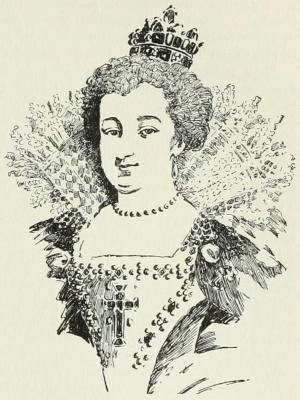
Marie de’ Medici
(1573-1642)
[1601-1602 A.D.]
After the departure of the king, Marie de’ Medici and all her court set forth for the capital; travelling by post, she only reached Paris on February 9th. The princess of Conti (Louise Marguerite de Lorraine) relates that the day of the queen’s arrival in Paris, “the king bade the duchess de Nemours (the first lady of the household) fetch the marquise de Verneuil, and present her to the queen. The aged princess attempted to excuse herself from so doing, saying she would lose all credit with her mistress; but the king insisted, and ordered her to do his bidding, and that somewhat rudely, which was contrary to his usual courteous habits. She therefore conducted the marchioness to the queen who, greatly astonished at the sight of her, received her with much coldness; but the marquise de Verneuil, very bold naturally, talked so much and so familiarly that she finally succeeded in forcing the queen to discourse with her.
“The king, tired of going two or three times a day to see the marquise, on perceiving that the queen had softened towards her, desired her to come to the Louvre where he had an apartment made ready for her. This, after some time, roused the jealousy of the queen, who had been entertained by several people with sayings of the marquise de Verneuil; who in truth, spoke of her freely enough and with little respect. The queen and the marquise were both enceinte, and the king seemed as if he did not know how to be on good terms with them both. He showed that respect to the queen to which her rank entitled her, but he was happier in the society of the marquise. Everyone wishing to please the king visited the latter, which was taken very ill by the queen. They dwelt so near one another as to be unable to avoid each other, and continual misunderstandings were the result.”g Sully was more than once called in to quiet their domestic broils. The birth of a son, afterwards Louis XIII, occurred at Fontainebleau in 1601 to allay the fears of a disputed succession, and also contributed to bind Henry to his queen.k
The king, though so well-wishing, never thought of cutting down the expenses of the court. Yet the desolation of the country, due to the civil wars, was appalling. The highways were lost in weeds and brambles, and wolves preyed on the country in great bands. Taxes could not be raised, so that finally the king gave up trying to collect arrears and in 1598 he gave up the taxes of 1594 and 1595.a
INTRIGUES OF DE BIRON
Another obstacle to the security and happiness of the monarch lay in the intrigues of his grandees. The people gave him little trouble; the turbulence of the civic class was over: they were ashamed, as well as weary, of the long disorders of the league, and in no way sought to renew them. Satisfied by the mild and economical management of the revenue by Sully, they applauded so beneficent a power, and forgot, or regretted not, that it was absolute. None clamoured for the states-general; they made loyalty a part of their religion; and abandoned all doctrines of liberty and republicanism to the hated Huguenots, who professed them.
The nobles, who were the contemporaries of Henry, could not find the same repose: they had lived a life of turbulence and war; they had been bred in intrigue, and in all the excitement of contending parties; peace could not content them. Then the life of a camp had placed them on a kind of equality with their monarch, who had terminated the war by yielding up the administering authority in the provinces to the several grandees. He had compounded with them, as much as conquered them; and the Protestant nobles had taken a position of equal independence with that of the Catholics. The high aristocracy, in fact, that Francis I so prudently kept down, had reconstituted itself in the subsequent reigns. They now made a covert, but not less serious proposal to Henry, choosing the duke de Montpensier, a stripling and a prince of the blood, to be their spokesman on the occasion. This demand was no less than to re-establish the old feudal system, by allowing the present governors of provinces to hold them in fief, and transmit them to their descendants. Henry was not a monarch to tolerate such a demand; and his angry reply struck young Montpensier with terror. The grandees determined to win by union and force what gentler means could not obtain. They conspired, leagued with Spain, with the duke of Savoy, and even with England, endeavouring to excite a malcontent party. Protestants as well as Catholics joined in this: the duke de Bouillon at the head of one, the proud Épernon representing the other. Such, however, was Henry’s power, and such his character for courage as well as promptitude, such, too, was the vigilance of Sully, that this intrigue could never be matured into a conspiracy. Henry’s frank and amiable temper won over many; and he never proceeded to punish the guilty until he had used every gentle means to admonish, to pardon, and recall them to duty.
The marshal De Biron was almost the only one of his nobles who still persisted in treasonable views. The king, on one occasion, had summoned him, charged him seriously, but not severely, with the crime, and showed him that he was well informed of his intrigues. Biron fell on his knees, confessed his weakness, but vowed that he would never more forsake the path of loyalty. Henry pardoned and embraced him. But Biron, vain and fickle, jealous even of his monarch’s fame, was weak enough to listen once more to the insinuations of Spain. The duke of Savoy, on a visit to Henry, manifested every sign of admiration for the king, while he occupied himself in corrupting the French courtiers, and in fomenting a party. He was ably seconded by the Spanish count de Fuentes. Biron was fascinated by the mighty promises of these intriguers: he was to have Burgundy as an independent state. The constable de Bourbon himself never received more magnificent promises. Nothing more displays the baseness and declension of the Spanish monarchy than its recourse to such weak and dishonourable machinations.
Henry soon after, wearied with the bad faith and subtle subterfuges of the duke of Savoy, made war on that prince. Biron was intrusted with the command, and in conducting it his treachery became manifest. One day, when Sully rode with him to view the siege of a fortress belonging to the duke, the former could perceive that the fire from the ramparts slackened, and was directed from them. Sully took the same ride alone on the following day, and was received with a heavy and well-directed cannonade. It afterwards appeared that the marshal had intended to entice the king into an ambuscade, where the fire of the enemy would have certainly proved fatal. The duke of Savoy, worsted by the arms of Henry, made his submission, and obtained peace. Biron continued his intrigues with Spain, in concert with the duke de Bouillon, with the count d’Auvergne, bastard of Charles IX, and probably with Épernon, and the whole body of the malcontent noblesse.
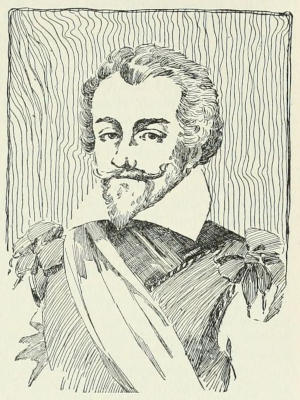
Charles de Gontaut, Duc de Biron
(1562-1602)
The king was perfectly aware of these intrigues. Biron was betrayed by his chief counsellor and instigator, a person named Lafin. Henry saw Biron once talking with Lafin, and warned him, saying, “I know that man; he will lead you into evil.” But the marshal was deaf to advice. Henry did not at first place much credit in the revelations of Lafin, who accused Sully himself among others of the court. But the informer produced written documents, proofs of Biron’s connection with Spain. Biron was summoned to court. It was the king’s intention to reproach his ancient comrade, to endeavour to awaken his loyalty, shame him into a confession of his treason, and again pardon him. Sully received instructions to pursue the same conduct, and to try every means short of letting the marshal know that Lafin had confessed all. Biron and the count d’Auvergne came to court boldly. Henry drew the traitor apart, led him into familiar conversation, showed himself open, frank, forgiving, yet suspicious. Biron betrayed no misgivings, no repentance, no wish to remove his sovereign’s distrust. At last, as they arrived before an equestrian statue of Henry lately erected, which was ornamented with trophies, the king asked, “What would the king of Spain say were he to see me thus?” Biron, who felt that this was meant to try him, insolently replied, “Sire, he scarcely fears you.” Then correcting himself, he stammered out, “I mean in that statue, not in this, your person.” Henry smiled sorrowfully, and gave up his merciful and friendly purpose. Sully, on his side, exerted himself to the same effect, but in vain. Biron was hardened. It was only then that Henry gave orders for his arrest, and that of the count d’Auvergne. As they left the king’s chamber, their swords were demanded. They were conveyed by water to the arsenal. Biron was tried before the parliament, condemned, and executed. He evinced the greatest rage on the scaffold; it amounted to frenzy, and was excited by his horror of so disgraceful a death. The executioner was obliged to hide his sword, and strike off the head of the culprit unawares.
THE LAST YEARS OF HENRY’S REIGN
[1602-1609 A.D.]
The last years of Henry’s reign are scarcely marked by any important incidents. The few that did take place, such as the conspiracy of the family D’Entragues, and the weaknesses into which Henry’s amorous disposition led him, are exaggerated in importance, and narrated by historians with a detail they little merit. The punishment of Biron, which Henry meant as a warning to his discontented nobles, succeeded in keeping them in awe. If they intrigued, it was in fear, and with a caution that marred all progress or purpose. The count d’Auvergne alone, though pardoned for being implicated with Biron, renewed his schemes in conjunction with the marquise de Verneuil; this mistress treated the king with the capriciousness and severity which a wronged beauty might use towards a gallant more advanced in years; the monarch construed her caprice into infidelity; and a loving quarrel grew to be a serious misunderstanding. Henry withdrew the written document of the promise of marriage. The father and daughter, joined by the count d’Auvergne, plotted against the king, it was said against his life; and, as usual, they found support in a Spanish emissary. They were all three arrested, tried, and condemned to death; but Henry pardoned his mistress, as well as her relatives, and commuted their punishment into exile. The restless and false D’Auvergne was confined permanently in the Bastille.
Squabbles with his queen, Marie de’ Medici, on account of her Italian favourites, Concini and his wife; distrust of Sully, excited by the envious courtiers; these, with national improvements, negotiations, festivals, and hunting parties, bring the reign of Henry IV nearly to its close.
In 1609, its happy and glorious monotony was varied by the enthusiastic admiration which the aged monarch conceived for Mademoiselle de Montmorency, the young and lovely daughter of the constable, who had just appeared at court and eclipsed all its beauties. There is some difference of opinion as to the nature of Henry’s admiration: the memoir writers of the age saw scandal in every connection; and certainly Henry’s past life and his known failings incline to the worst side. Bassompierre,o then a young man, relates that he himself became a suitor for the beauty’s hand, and that he was induced by the entreaties or commands of the enamoured king to desist. Bassompierre was a babbler, however, whose vanity breaks out in the arrogance of the mere pretension. The young prince of Condé was also smitten, but shrank back from so formidable a rival as the monarch. What belies the account of Bassompierre is that Henry came forward, and assured Condé that he might woo in all confidence, and that he had nothing to fear on that score from his king. If Henry had licentious views, Bassompierre, and not Condé, would have been the convenient husband of Mademoiselle de Montmorency.
Condé was the successful suitor, and the marriage was celebrated at court with unusual splendour. Henry, having given his word to the prince, indulged his predilection for the lovely bride by showering presents and favours upon her and her husband. The court, full of the malevolent, amongst whom the followers of the jealous queen were not the least forward, construed all these symptoms to be the homage of a guilty passion: they poured this in the prince’s ear; and Condé, alarmed for his wife’s honour, carried her off from the court by stealth, first to Picardy, whence, on receiving a summons from the king to return, he made a second flight, and gained the Low Countries. The king showed himself strangely affected by this incident: the discovery of Biron’s conspiracy did not cause him more trouble. Sully was called up in the night; and the whole court was roused by the agitation of the monarch, who was pacing and stamping up and down the chamber of the queen, while the courtiers stood “pasted to the walls,” says Sully, lest they should interrupt the monarch’s passion. The flight of the first prince of the blood, and his taking refuge with the Spaniards, was certainly a grave question, love and jealousy being set aside. The king demanded Sully’s advice, who hesitated, but being forced, advised him to “do nothing.” “Nothing!” said Henry; “call you that advice?” Sully replied that the escape of the prince was a matter of little importance, unless the king chose to make it important by raising a clamour, and showing that he took an interest concerning it. Henry, however, was not in a humour to treat the matter thus slightly and thus wisely: he instructed his ambassador to demand of the archduke to deliver up the prince and princess of Condé; and, as Sully foresaw, the court of Brussels, in refusing, filled Europe with calumnies against Henry; asserting that he wanted to take by force the wife of the first prince of the realm and of the blood. When Henry, immediately afterwards, menaced war, the outcry was that Europe was about to be deluged in blood for another Helen.
It was, indeed, unfortunate that Henry, who had remained so many years at peace, no doubt preparing and amassing the materials and resources of war, and cautiously awaiting fit pretext and proper reason, should now draw the sword for a cause at once criminal and absurd.k
Grand Design of Henry IV; His Death
[1609-1610 A.D.]
At home the rest of Henry’s reign was perhaps monotonous; but it was none the less momentous, for on the ruins of France the Bourbon monarchy was already building up the centralised absolutism which it was the work of Richelieu to perfect and Louis XIV to wield. But in foreign affairs the schemes of Henry were not less far reaching. France was to become the centre of European politics, the dictator of Germany. In Sully’s Economies Royales we may read of the details of the great scheme which anticipated that of Napoleon by two centuries. But such details are the work of subsequent addition and the plan of making Europe into a grand republic of fifteen states with well-balanced interests, etc., was perhaps not so clearly conceived even by Sully as historians have been accustomed to state. But some such design was undoubtedly behind the foreign policy which Henry was inaugurating at his death. He possibly intended to unite with France the Flemish, Dutch, and North German states in a movement that would overthrow Spain and Austria. His own statements make this plain.a
Henry IV had expressed on many occasions and had incessantly repeated in his diplomacy the end which he had in view. His object was to restore the cities and states of the empire to their former rights and liberties, to assure the liberty of the United Provinces, to base the politics of France upon the alliance of the secondary states, in the north the United Provinces, Denmark, Sweden, and the German principalities, in the south, Switzerland, Savoy, and the Italian principalities; finally to extend his system of religious tolerance so as to guarantee liberty everywhere to the dissenters from the established cult, whether these dissenters might be Catholics, Lutherans, or Calvinists; and to prevent religious wars or religious pretexts assigned to purely political wars and enterprises. He had long since declared to all the courts of Europe that he had ended the era of civil war in France and wished to end it everywhere else.
However it may be as to these observations, France, according to him, must pursue a double end in her foreign relations, lay the foundations of perpetual peace, and drive the Turks from Europe. In order to bring about perpetual peace it would be necessary to reduce the possessions of Austria, establish a certain balance of power, and create periodical diets or congresses, either for this or that category of states or for all Europe, with federal armies and fleets to execute the decisions made in common.b
He now resolved to realise his dream: but this, which had been a vision of heroism and philanthropy, was now degraded and sullied by the immediate motive. Henry, who was passionately fond of glory, saw the stain that was to rob his achievements of their brightness and purity. The accusation of the Spaniards troubled him: perhaps there was even truth in the reproach that the love of a sexagenarian king for a princess, and a married princess of twenty, was the only cause and pretext for convulsing Europe and shedding its best blood. This weighed upon Henry, and fretted him: his gaiety disappeared. Remorse and mortification came to cloud the heaven of his declining days. A dark presentiment, similar to that which had forewarned his loved Gabrielle of her fate, now gathered around Henry: he could not shake it off.
He intended leaving the queen as regent during his absence at the head of his army; and her previous coronation, a ceremony that had not yet taken place, was considered requisite. This detained him in the capital; and Marie de’ Medici, fond of state and ceremony, insisted on it, and delighted in it. Henry was annoyed and fretted: he frequently said he should never leave Paris alive, and he longed to contradict his presentiment. The coronation of the queen at length took place. On the following day, the 14th of May, 1610, he manifested strong feelings of despondency. Despatches brought him word that his enemies were making no preparations for defence, and that they gave out that the delivery of the prince and princess of Condé would at once allay his choler and arrest his schemes. This increased his ill humour: he called for Sully; but learning that his minister was ill at the arsenal, the king’s coach was ordered to convey him thither. Seven of the suite occupied with the king his ample carriage. The duke d’Épernon was in one corner, and Henry next to him. The vehicle proceeded, but was stopped in the narrow rue de la Ferronnerie by two loaded carts. This was the moment chosen by an assassin, Ravaillac, who, mounting on the step, and leaning full into the carriage, struck the king with a poniard, first in the stomach, and then in the breast. One of these stabs pierced the heart of the noble Henry.
To paint the rage and despair of the people would be impossible. The once detested Henry had won every heart; and the general grief for him partook of the character of madness. Tears were the least tokens of sorrow; many died on learning the catastrophe, amongst others the brave De Vic, the comrade of Henry. The lifeless body was borne to the Louvre, whilst Ravaillac, who made no attempt to escape, was taken, brandishing his dagger, and only preserved by the guards from being instantly torn in pieces. He had been a monk, strongly imbued with the king-killing principles that the Jesuits had broached. His crime had long been meditated by him; but no proof exists that he had been instigated either by Spain or by any knot of malcontent courtiers. Suspicion, indeed, has scattered its stain on all with an unsparing hand. Épernon, the queen, Concini, and many others, were accused as being privy to the deed; and the record of Ravaillac’s trial having been destroyed, whilst these personages possessed the chief influence, gives some colour to the charge. But the tortured culprit might idly or malevolently cast imputation on the powerful, as indeed he menaced to do. For when some one pressed him to name his accomplices, Ravaillac answered, “Suppose I name you.” The seed of his crime was the diabolical maxim to which the fanaticism of the league had given birth, and which it had rendered popular. It had germinated and grown in the dark solitude of a rancorous and fanatic spirit.k
CHARACTER AND POLICY OF HENRY IV
[1589-1610 A.D.]
There are two Henry IV’s; the Henry of tradition and the Henry of history. The one more heroic and, thanks to Voltaire,q more popular; the other, underneath his crafty good nature, much more able and, with his pliant character, much better fitted to raise a falling edifice than a simple character would have been. Henry of Navarre had the most brilliant bravery, a quality common to the warriors of that time and of all times. But it is pleasing in a prince, and the chief who is ever ready to offer his life to the sword point is sure to win his soldiers’ hearts. Reared among the mountaineers of the Pyrenees, he possessed an agility equal to theirs and a body incapable of fatigue. The vicissitudes through which he had passed had made his religion uncertain. Charles IX said to him, “Death or the mass!” He took the mass; later he abjured, and this abjuration was not to be the last. So he felt no anger against those who professed a different doctrine; his nature made fanaticism odious to him, and his position imposed tolerance upon him. Furthermore, he was a good comrade, showing the same face to good or to ill fortune. He bent under misfortune but did not break, and found resources in the most desperate situations. He loved pleasure, but not as it was loved by Henry III. He was kind through good nature as well as experience of life. He had friends who, it is true, got from his friendship more good words than good results; but his heart was open if his hand was closed, because he was for twenty years the chief of a party obliged to give much and to take nothing except from the enemy.
One night when D’Aubignée and La Force were sleeping not far from the king, the former complained bitterly to the latter of their master’s stinginess. La Force, overcome by fatigue, did not listen. “Don’t you hear?” asked D’Aubigné. La Force roused himself and asked what he was saying. “Why, he is telling you,” cried the king, who heard everything, “that I am a harsh, miserly fellow and the most ungrateful mortal on the face of the earth.” “He did not treat me worse on account of it,” adds D’Aubigné, “but he did not give me a quarter of a crown more.”
His forced residence at the court of the Valois had been fatal to his morals. For several years he forgot his rôle and his fortune. After the death of the duke of Anjou, Duplessis-Mornay wrote to him: “Pastimes are no longer in season. It is time for you to make love to France.” Henry felt this rebuke; he gave up his pleasures and put on his cuirass.n
In Sully’s Mémoires we find this description of him[82]: “Such was the tragical end of a prince, on whom Nature, with a lavish profusion, had bestowed all her advantages, except that of a death such as he merited. I have already observed that his stature was so happy, and his limbs formed with such proportion, as constitutes not only what is called a well-made man, but indicates strength, vigour, and activity; his complexion was animated; all the lineaments of his face had that agreeable liveliness which forms a sweet and happy physiognomy, and perfectly suited to that engaging easiness of manners which, though sometimes mixed with majesty, never lost the graceful affability and easy gaiety so natural to that great prince. With regard to the qualities of his heart and mind, I shall tell the reader nothing new by saying that he was candid, sincere, grateful, compassionate, generous, wise, penetrating.
“He loved all his subjects as a father, and the whole state as the head of a family; and it was this disposition that recalled him even from the midst of his pleasures to the care of rendering his people happy and his kingdom flourishing; hence proceeded his readiness in conceiving, and his industry in perfecting, a great number of useful regulations. Many I have already specified; and I shall sum up all by saying that there were no conditions, employments, or professions to which his reflections did not extend; and that with such clearness and penetration, that the changes he projected could not be overthrown by the death of their author, as it but too often happened in this monarchy. It was his desire, he said, that glory might influence his last years and make them at once useful to the world and acceptable to God; his was a mind in which the ideas of what is great, uncommon, and beautiful seemed to rise of themselves: hence it was that he looked upon adversity as a mere transitory evil, and prosperity as his natural state.
“I should destroy all I have now said of this great prince if, after having praised him for an infinite number of qualities well worthy to be praised, I did not acknowledge that they were balanced by faults, and those, indeed, very great. I have not concealed, or even palliated his passion for women; his excess in gaming; his gentleness often carried to weakness; nor his propensity to every kind of pleasure: I have neither disguised the faults they made him commit, the foolish expenses they led him into, nor the time they made him waste; but I have likewise observed (to do justice on both sides) that his enemies have greatly exaggerated all these errors. If he was, as they say, a slave to women, yet they never regulated his choice of ministers, decided the destinies of his servants, or influenced the deliberations of his council. As much may be said in extenuation of all his other faults. And to sum up all, in a word, what he has done is sufficient to show that the good and bad in his character had no proportion to each other; and that since honour and fame have always had power enough to tear him from pleasure, we ought to acknowledge these to have been his great and real passions.”p
Martin’s Estimate of Henry IV
The whole reign of Henry IV, after the Peace of Vervins, had been but a preface; the half-opened book is closed forever! All the past glory of the Béarnais would have been eclipsed by the magnificent results that his policy had prepared and that his arms were to realise. In spite of the exertions and the excesses of his life his robust constitution still promised him some years of military activity, enough without doubt to make sure if not of the complete triumph, at least of the predominance of his European system; his heirs would have done the rest! The politics of France, allied with the Protestants without being absorbed by Protestantism, triumphing by the aid of the entire foreign and French Reformation, would have been started beyond recall upon the paths of international equity, intellectual liberty, and religious tolerance. Henry IV would have made splendid reparation for the faults of Francis I and himself. He would not have abjured Catholicism, but with his victorious sword he would have obliterated his coronation oath and the humiliation of Roman absolution. Germany would not have seen the Thirty Years’ War, nor France the revocation of the Edict of Nantes. The seventeenth century would have had all its glory without its fatal errors.
God did not grant it him! Henry IV bore to the tomb not only the European system which he intended to inaugurate but all the elements of order and power that he had given to his country. France fell from the height to which he had raised her, until the day when a powerful genius came anew to bring order into chaos and to revive in part the policy of Henry, but under much less favourable conditions. This genius was that of an individual, not that of a king, and Henry IV has remained the greatest and above all the most French of the kings of France; not again has there been seen on the throne a soul so national, an intellect so liberal. No one ever felt better than he the true destiny of France. It is not without reason that the popularity of Henry has increased with the growth of the modern spirit; it is not without reason that the eighteenth century tried to make him the epic hero of French history. The labouring classes have never forgotten the king who was to them the most sympathetic in manners and in heart, the king who occupied himself most seriously with the interests of the soil and of labour. Thinkers will never cease to honour in him the forerunner of a new Europe, the just and profound mind whose diplomatic plans are to-day in many respects the politics of the most enlightened men, and finally the champion and martyr of the most sacred of liberties, that of conscience.c
Having listened thus to a contemporary and to a modern French estimate of the great ruler, let us take a parting glance at him through the eyes of a scarcely less appreciative English historian.a
STEPHEN’S CHARACTERISATION OF HENRY IV AND HIS TIMES
It has been said of Henry IV [says Sir James Stephen], with equal truth and force, that he was l’Hôpital in arms. The principles which had been asserted by the wisdom and the eloquence of the great chancellor became triumphant by the foresight and the conquests of the great king. In an age of wild disorder and overwhelming calamity, he was raised up to restore his kingdom to affluence and to peace. He appeared to rescue his Protestant subjects from the tyranny which had so long denied to them the freedom of conscience. He came to give a firm basis to the national policy, and to open to his people at large a new direction, and a wider scope, for the martial energies by which they had hitherto been at once so highly, and so ineffectually, distinguished. For these high offices he was qualified by great talents, and by many virtues. With a capacity large enough to embrace all the social, military, and political interests of his dominions, he combined that practical good sense and flexibility of address, without which there is no safe descent from the higher regions of thought to the real business of life. The intuitive promptitude, and the enduring stability, of his resolutions attested at once his large experience in affairs, and his wide survey both of the resources at his command, and of the contingencies to which he was exposed. He possessed that kind of mental instinct which advances by the shortest path to what is at once useful and possible, and which turns aside, with unhesitating decision, from any illusive and impracticable scheme. Never was a great innovator more characterised by practical wisdom; and never did such wisdom assume a more attractive aspect. His manners exhibited all the graces of his native land in their most captivating form. Delighted with his bonhommie, his gaiety, and his frankness, his subjects not only forgave his vices, but even found in them a fascination the more. They smiled at the scandalous amours of their gallant monarch as a not unbecoming tribute paid by human greatness to human infirmity. If they looked with awe on the desperate valour of his enterprises, on the inflexible rigour of his discipline, or on the soaring ambition of his political designs, they were reconciled to the stern character of the prince by the ever-flowing and genuine sensibilities of the man. If his lofty sense of his personal and ancestral dignity sometimes gave an austere aspect to his intercourse with his people, that pride of birth did but enhance the charm of his quick sympathy with the feelings and interests of the meanest of them. And, above all the rest, every Frenchman loved and admired in Henry the lover and admirer of France; and became patriotically blind to the faults of his renegade, and debauched, but still patriot, king.
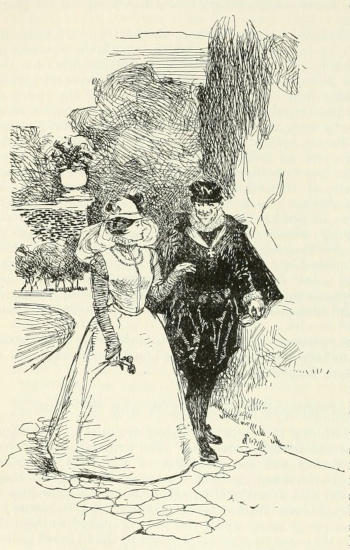
Costumes of the Time of Henry IV
And even now, when the spell is broken, and we may look back on the life of Henry IV with judicial impartiality, and reprobate the apologies which would have elevated his crimes into virtues, we cannot conceal from ourselves the fact that he conferred on his people benefits which well entitled him to their lasting gratitude.
For, first, Henry of Navarre was the founder of religious toleration in France. Until the Edict of Nantes there had been many truces, but no real peace, between the adherents of Rome and the followers of Calvin. To compel all the fragments of the Christian church to coalesce into one body, each member of which should hold the same opinions, and worship under the same forms, had been the inflexible policy of all his predecessors. To acquiesce in their separation, and yet to maintain each section in the nearest possible approach to an equality both of civil and religious privileges, was the no less inflexible design of Henry. His charter could not, indeed, restore unity to the church, but it established, on what seemed a secure basis, the unity of the state. The two religions were thenceforward placed under ecclesiastical laws widely differing from each other, but under a civil law common to them both.
The second great praise of the first of the Bourbon line is that of having rescued France from the abyss of bankruptcy and financial ruin in which it had been involved by the improvidence of the house of Valois. For the completion of that great work the larger share of honour is, indeed, due to Sully. But from his own Economies Royales we sufficiently learn that, unaided by the magnanimity, the self-denial, and the affection of the king, not even the zeal, the courage, and the sagacity of the great minister would have accomplished that herculean labour.
The third title of Henry to the place which he has ever held among the benefactors of France, has at all times been acknowledged by Frenchmen with more enthusiasm than any other of his services. He was the first of her kings who had at once the discernment to perceive how high a station belonged to her in the European commonwealth, and the energy to devise the methods by which that rank might be effectually vindicated.
It is not, however, on these grounds alone, that the reign of Henry IV occupies a memorable position in the constitutional history of his country. It was a period of great consummations and of great beginnings. Like some inland sea, which is at once the receptacle of many converging, and the source of as many diverging, streams, it was interposed between two eras strikingly contrasted with each other. It marked the close of the mediæval sovereignty, and the commencement of the modern monarchy,—the first a dominion of undefined rights, of unsettled habits, and of a fluctuating policy,—the second, a government absolute in fact and in right, severely consistent in its arbitrary principles, but elaborately adapted to the various exigencies of a civilised commonwealth. The hitherto unorganised elements of the state were now, for the first time, reduced into a political unity. The invidious distinctions of earlier times now began to give place to social equality; and the slow, though steadfast, progress of that unity and of that equality may be considered as the subject of the whole of the subsequent history of France. In the triumph of these two principles consists the peculiar distinction, and the chief boast, of the French policy, whether monarchical or republican, of later times; and, therefore, the age of Henry IV when considered as the origin of these great national characteristics, demands, and will repay, the most diligent attention.r
FOOTNOTES