Chapter XVII · THE DICTATORSHIP OF RICHELIEU (continued 2)
Reading edition
Richelieu, on the other hand, was one of the rulers of mankind, in virtue of an inherent and indefeasible birthright. His title to command rested on that sublime force of will, and decision of character, by which, in an age of great men, he was raised above them all. It is a gift which supposes and requires in him on whom it is conferred, convictions too firm to be shaken by the discovery of any unperceived or unheeded truths. It is, therefore, a gift, which, when bestowed on the governors of nations, also presupposes in them the patience to investigate, the capacity to comprehend, and the genius to combine, all those views of the national interest, under the guidance of which their inflexible policy is to be conducted to its destined consummation. For the stoutest hearted of men, if acting in ignorance, or under the impulse of haste or of error, must often pause, often hesitate, and not seldom recede. Richelieu was exposed to no such danger. He moved onwards to his predetermined ends with that unfaltering step which attests, not merely a stern immutability of purpose, but a comprehensive survey of the path to be trodden, and a profound acquaintance with all its difficulties and all its resources. It was a path from which he could be turned aside neither by his bad nor by his good genius; neither by fear, lassitude, interest, or pleasure; nor by justice, pity, humanity, or conscience.
The idolatrous homage of mere mental power, without reference to the motives by which it is governed, or to the ends to which it is addressed,—that blind hero-worship, which would place Wallenstein and Gustavus Adolphus on the same level, and extol with equal warmth the triumphs of Cromwell and of Washington, though it be a modern fashion, has certainly not the charm of novelty. On the contrary it might, in the language of the Puritans, be described as one of the “old follies of the old Adam”; and, to the influence of that folly, the reputation of Richelieu is not a little indebted.
In his estimate, the absolute dominion of the French crown and the grandeur of France were convertible terms. They seemed to him but as two different aspects of the great consummation to which every hour of his political life was devoted. In approaching that ultimate goal, there were to be surmounted many obstacles which lie distinctly perceived, and of which he has given a very clear summary in his Testament Politique. “When it pleased your majesty,” he says, “to give me not only a place in your council, but a great share in the conduct of your affairs, the Huguenots divided the state with you. The great lords were acting not as your subjects, but as independent chieftains. The governors of your provinces were conducting themselves like so many sovereign princes. Foreign affairs and alliances were disregarded. The interest of the public was postponed to that of private men. In a word, your authority was, at that time, so torn to shreds, and so unlike what it ought to be, that, in the confusion, it was impossible to recognise the genuine traces of your royal power.”
Before his death, Richelieu had triumphed over all these enemies, and had elevated the house of Bourbon upon their ruins. He is, perhaps, the only human being who ever conceived and executed, in the spirit of philosophy, the design of erecting a political despotism; not, indeed, a despotism like that of Constantinople or Teheran, but a power which, being restrained by religion, by learning, and by public spirit, was to be exempted from all other restraints; a dynasty, which like a kind of subordinate province, was to spread wide its arms for the guidance and shelter of the subject multitude; itself the while inhabiting a region too lofty to be ever darkened by the mists of human weakness, or of human corruption.
To devise schemes worthy of the academies of Laputa, and to pursue them with all the relentless perseverance of Cortes or of Clive, has been characteristic of many of the statesmen of France, both in remote and in recent times. Richelieu was but a more successful Mirabeau. He was not so much a minister as a dictator. He was rather the depositary, than the agent, of the royal power. A king in all things but the name, he reigned with that exemption from hereditary and domestic influences, which has so often imparted to the papal monarchs a kind of preterhuman energy, and has as often taught the world to deprecate the celibacy of the throne.
Richelieu was the heir of the designs of Henry IV, and the ancestor of those of Louis XIV. But they courted, and were sustained by, the applause and the attachment of their subjects. He passed his life in one unintermitted struggle with each, in turn, of the powerful bodies over whom he ruled. By a long series of well-directed blows, he crushed forever the political and military strength of the Huguenots. By his strong hand, the sovereign courts were confined to their judicial duties, and their claims to participate in the government of the state were scattered to the winds. Trampling under foot all rules of judicial procedure and the clearest principles of justice, he brought to the scaffold one after another of the proudest nobles of France, by sentences dictated by himself, to extraordinary judges of his own selection; thus teaching the doctrine of social equality, by lessons too impressive to be misinterpreted or forgotten by any later generation. Both the privileges, in exchange for which the greater fiefs had surrendered their independence, and the franchises, for the conquest of which the cities, in earlier times, had successfully contended, were alike swept away by this remorseless innovator. He exiled the mother, oppressed the wife, degraded the brother, banished the confessor, and put to death the kinsman and favourites of the king, and compelled the king himself to be the instrument of these domestic severities. Though surrounded by enemies and by rivals, his power ended only with his life. Though beset by assassins, he died in the ordinary course of nature. Though he had waded to dominion through slaughter, cruelty, and wrong, he passed to his great account amidst the applause of the people, with the benedictions of the Church; and, as far as any human eye could perceive, in hope, in tranquillity, and in peace.v
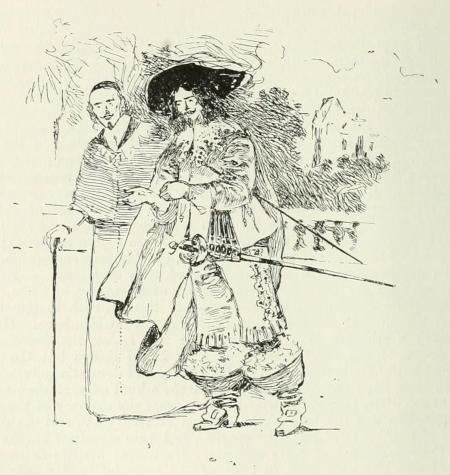
Costumes of the Period of Louis XIII
FOOTNOTES