Chapter IX · “THE CONVALESCENCE OF FRANCE”
Reading edition
Confused as was the long period of the last years of Charles VII, it may nevertheless be thus summarily defined—the convalescence of France. France recovered and England fell ill.—Michelet.b
The sorceress, the she-devil, was burned; the charm was doubtless broken, the spell removed; there was nothing now to prevent the English from conquering the kingdom of France. Nevertheless, before they should recover the power in fact they deemed it right to have the power in law on their side—to legitimise the young Henry VI by having him crowned. The coronation to which Charles VII had been led by an agent of the devil being, by that means itself, null and void, they wished to have for their little prince a coronation perfectly orthodox and irreprehensible.
[1431-1432 A.D.]
The ceremony took place the 17th of December, 1431; not at Rheims, which the English no longer held, but at Paris. An English prelate, Beaufort, the cardinal-bishop of Winchester, officiated, to the great discontent of the bishop of Paris; for assistants there were English lords, not a single French prince. There was no liberation of prisoners, no reduction of taxes, no largesse to the people. “A bourgeois marrying off his daughter,” says the Bourgeois de Paris,i “would have done better.”c The child king was found to have little intelligence or grace, and the day after Christmas he was taken from Paris to Rouen, and thence to England.d
Paris was far from prosperous under foreign domination. Public officials were ill paid. The university was no longer recruited, except from the English and Burgundian provinces. It lost its pupils; it lost still more when, a month after his arrival, Bedford established schools of civil and canon law at Caen, in the midst of the English provinces. Charles responded by creating, in his turn, a university at Poitiers, and by according new privileges to the schools of Angers.e
It was now that period when the feeble bond that still united the duke of Burgundy to the English began to give way. His sister, Bedford’s wife, died in November, 1432. The duke of Burgundy had never had much reason to like the English, nor had he more to fear them. Their war in France was becoming ridiculous.b
The marshal De Boussac, as the result of a conspiracy, was almost able to seize Rouen. His advance guard was already in the castle when his bands began to quarrel over the division of the booty, and the English drove them off. Dunois was more successful at Chartres; he had an understanding with a preacher of renown. The latter announced that he would preach every day in a certain church; the entire English garrison assisted devoutly at the sermon while the French took the town. The English, from whom so important a place had been taken, were not even able to capture a hamlet. A certain French captain, John Foucauld by name, was stationed at Lagny and greatly harassed the neighbourhood of Paris. The duke of Bedford and the earl of Warwick went to besiege the place. They soon made a breach in the wall, but when they saw the besieged bravely awaiting them, they returned to Paris, where they arrived on Easter eve, “apparently to confess,” says the Bourgeois de Paris,i maliciously, in his journal. Meanwhile several soldiers of fortune in the service of the king of France had seized St. Valéry, Gerberoy, St. Denis, and other places (1432).c
The Parisians, delighted at this retreat of Bedford from Lagny, made themselves no less merry on the subject of his second marriage. At fifty years of age he wedded a girl of seventeen, “sprightly, fair, and gracious,” a daughter of the count of Saint-Pol, one of the duke of Burgundy’s vassals, and that abruptly and furtively without saying a word to his brother-in-law. The duke would not have consented to the match. The Saint-Pols, raised by him for the purpose of guarding his frontier, were beginning to play that double game which was to be their ruin; they were giving the English a footing in the dominions of the duke of Burgundy.
Beaufort saw more clearly that if the alliance with Burgundy were broken off, the war would change its aspect; that it would become far more costly, and that the church would infallibly have to bear the expense. A beginning had been made with the church of France, from which it was sought to wrest all the pious donations it had received for sixty years. In this state of anxiety, he exerted himself strongly for peace, and had it arranged that a conference should take place between Bedford and Philip the Good. He succeeded in making the two dukes advance towards each other as far as St. Omer. But this was all; once in the town, neither of them would take the first step. Though Bedford ought to have seen clearly that France was lost for the English if he did not bring back the duke of Burgundy to their party, he remained peremptory on the point of etiquette; as the king’s representative, he awaited the visit of the king’s vassal, who never moved. The rupture was definitive.
France, on the contrary, was gradually becoming reunited, a result brought about chiefly by the efforts of the house of Anjou. The old queen, Yolande of Anjou, the king’s mother-in-law, brought him back the Bretons; and in concert with the constable Richemont, the duke of Brittany’s brother, she dismissed the favourite, La Trémouille.[48]
It was more difficult to allure the duke of Burgundy, who was supporting the pretender Vaudemont, in Lorraine, against René of Anjou, Yolande’s son.[49] That prince, who has remained in the memory of the Angevins and Provençals by the name of “the good king René,” possessed all the amiable qualities of old chivalric France; and with them, too, its imprudence and levity. He suffered himself to be beaten and taken prisoner at Bulgnéville, by the Burgundians (July, 1431). The duke of Burgundy restored him to liberty, under security.b
Philip the Good might well have congratulated himself on a victory which clipped the wings of the royalists in Lorraine, but he made no use of it, and now showed himself disposed for pacific measures. In September, 1431, at the very moment that the royalist captains were preparing to invade Charolais and Burgundy, he signed at Chinon a two years’ truce with Charles VII for his frontiers of Réthelois, Picardy, Burgundy, and Charolais.e The English had no good reason for their complaints of Philip’s loyalty in this; if he had concluded a separate truce for his own states, he did not treat for peace on their behalf or without them. The English ambassadors were called to take part in all negotiations; but it was very evident, at the conferences of Auxerre (July, 1432) and those held in the village of Simport (now Seineport) in March, 1433, that while peace was now almost an easy matter between Charles VII and Philip on account of the great concessions to which the king resigned himself, it was next to impossible between Charles VII and Henry VI.f
The princes were becoming friends, and there was nothing to hinder the people from doing likewise, if they had the will. Paris, governed by Cauchon and other bishops, tried to get rid of them and expel the English. Normandy, even, that little French England, at last grew weary of a war of which it was made to bear the whole burden. A vast rising took place, in 1434, among the rural population of Lower Normandy; the leader was a peasant named Quatrepieds; but there were knights also engaged in the affair, which was not a mere Jacquerie. The English could not fail soon to lose the province.
THE TREATY OF ARRAS (1435 A.D.)
[1435 A.D.]
They seemed themselves to look on their prospects as desperate. Bedford abandoned Paris. The poor town, smitten by turns with famine and pestilence, was too hideous an abode. The duke of Burgundy, nevertheless, ventured to visit it with his wife and son, on his way to the great assembly at Arras, where the terms of a treaty of peace were to be arranged. The Parisians welcomed him, and implored his aid, as though he had been an angel from God. The assembly in question was one of all Christendom, including ambassadors from the council, the pope, the emperor, the sovereigns of Castile, Aragon, Navarre, Naples, Milan, Sicily, Cyprus, Poland, and Denmark. All the French princes, and all those of the Low Countries, attended in person or by deputy; so did the University of Paris, and a number of good towns. All these personages being assembled, England herself arrived, in the person of the cardinal-bishop of Winchester. The conferences opened August 5th, 1435, in the chapel of St. Waast.
The first question to be considered was the possibility of an accommodation between Charles VII and Henry VI. But how was it to be effected? Each of them claimed the crown. Charles VII offered Aquitaine, and even Normandy, which was still in the hands of the English. The latter required that each party should retain what it then had, with the exception of mutual exchanges for the purpose of rendering the possessions of each more compact.
Nothing could be made of the English, and they were allowed to depart from Arras. Everyone turned towards the duke of Burgundy, beseeching him to have pity on the realm and on Christendom, which suffered so much from these long wars. But he could not make up his mind; his conscience and his knightly honour were engaged, he said; he had given his signature; besides, was he not bound to take vengeance for his father’s murder? The pope’s legates told him he might make light of such scruples, for they had power to release him from his oaths. But this did not yet satisfy him. Ecclesiastical law not seeming sufficient, recourse was had to civil law, and a fine case was drawn up, in which, to leave the minds of the jurisconsults the more free, the parties were designated by the names of Darius and Ahasuerus. The English and the French doctors gave such opinions as might have been expected of them respectively; but those of Bologna, whom the legates brought forward, declared, in conformity with the French lawyers, that Charles VI had no power to conclude the Treaty of Troyes.

A French Nobleman, First Part of Fifteenth Century
[1435-1436 A.D.]
The duke of Burgundy allowed the suppliants to argue and implore. But, in reality, the desired change had already taken place in him; he was weary of the English. The Flemings, who had so often forced their counts to remain united with England, were becoming hostile to that nation; they suffered from the forays of the garrison of Calais, and were maltreated when they went to that great wool market. England was then becoming a rival and enemy of Flanders; had she been friendly to that country, her friendship would henceforth have availed little. The duke of Burgundy had gained the barrier of the Somme, through the English alliance, and rounded and completed his Burgundy; but their alliance could no longer guarantee him the possession of his new acquisitions. Divided as they were, it was with difficulty they could defend themselves. Bedford alone could maintain some sort of balance between Winchester and Gloucester; but he died, at Rouen in September, 1435, and his decease was a further alleviation to the conscience of the duke of Burgundy. Thenceforth the treaties concluded with Bedford, as regent of France, appeared to him less sacred; such was the strictly literal mode of viewing things in the Middle Ages; he deemed himself bound during the lifetime of him to whom he had given his signature.
The duke of Burgundy’s two brothers-in-law, the duke de Bourbon and the constable De Richemont, contributed not a little to fix his wavering purposes. They plied him so hard that he vouchsafed at last to yield to their entreaties and grant mercy. The Treaty of Arras cannot be characterised by any other phrase. The king asked pardon of the duke for the murder of John the Fearless, and the duke did not pay him homage; thereby he became himself king, as it were. He retained for himself and his heirs all he had acquired: on the one side Péronne and all the fortresses on the Somme, on the other Auxerre and Mâcon.
The explanations and reparations for the death of Duke John were very humiliating. The king was to say, or have it said, that at that time he was very young, had as yet little knowledge, and had not been sufficiently advised to see duly into the matter, but that at present he was about to use all diligence in searching out the guilty parties. He was to found a chapel in the church at Montereau, and a convent for twelve Carthusians; and to erect, moreover, on the bridge where the act had been perpetrated, a stone cross, which was to be kept in repair at the king’s expense. The ceremony of forgiveness took place in the church of St. Waast. The dean of Paris, Jean Tudert, threw himself at the feet of Duke Philip, and cried him mercy, on the king’s part, for the murder of John the Fearless. The duke appeared moved, raised and embraced him, and told him there should never be war between King Charles and himself. The duke de Bourbon and the constable then swore a peace, as did the French and Burgundian ambassadors and lords.
[1436-1438 A.D.]
But the reconciliation would not have been complete if the duke of Burgundy had not concluded a definitive arrangement with the brother-in-law of Charles VII, René of Anjou. René, not having been able to adhere to the terms of the first treaty, had preferred returning to prison. Philip the Good released him and gave him back part of his ransom money, in consideration of the marriage of his niece, Mary de Bourbon, with René’s son. Thus were the houses of Burgundy, Bourbon, and Anjou united with each other and with the king. That of Brittany still vacillated; the duke did not declare himself; he found great profit in the war; it was said that thirty thousand Normans had taken refuge in Brittany. But whether the duke was English or French, his brother Richemont was constable of France: the Bretons followed him cheerfully; the Breton bands were the main force of Charles VII, and were called the bons corps.
THE FRENCH RETURN TO PARIS (1436-1437 A.D.)
This self-reconciliation of France drove the English distracted; their wrath blinded them, and they plunged as it were wilfully into their ill fortune. The duke of Burgundy wished to keep some terms with them, and offered them his mediation; but they rejected it, and plundered and killed the Flemish merchants in London. Flanders becoming incensed in its turn, the duke seized the opportunity to lead the communes to the siege of Calais.b For this he collected a large army in 1436, the Flemings, especially the Ghenters, answering his call to the number of forty thousand, and promising not merely to second his enterprise, but to accomplish it themselves. They found the task, however, so much beyond their power, that they grew disheartened, accused the Burgundians of betraying them, and marched off leaving the duke to extricate himself with his other forces as best he could.g
The Burgundian party turned round like the duke; those of Paris, of the halles even, the Burgundian quarter par excellence, called in the king’s forces and his constable, and installed them in the town. The English, who had still fifteen hundred men-at-arms there, and at first made a show of resisting, shut themselves pitiably in the Bastille, and then, apprehensive of famine, obtained leave to embark and descend the river to Rouen. The people, who had been harshly governed by three bishops on behalf of the English, pursued them with hootings, and shouted, “Fox! fox!” after the bishop of Thérouanne, the chancellor of the English. The Parisians were loath to let them off so cheaply, for they calculated that the ransom of so many rich nobles would bring in at least 200,000 livres; but it would have been necessary to besiege the Bastille, and the constable himself was at his shifts, money failing him. The king had only 1,000 livres to give him for the purpose of retaking Paris (1436).b
At length, in November, 1437, Charles made his solemn entrance into his capital, from which he had been an exile nearly twenty years. The constable rode on the monarch’s right hand, the count de Vendôme on his left, and the royal cavalcade was met at the Porte St. Denis by “the seven virtues and the seven mortal sins, well clad, mounted upon various beasts.” Charles had previously reunited the parliament of Poitiers to that of Paris, and the new judges and councillors returned to take their seats, and thus restore Paris to the rank of judicial capital of the languedoïl.g
THE PRAGMATIC SANCTION (1438 A.D.)
In that vast and multitudinous wretchedness, amid so many ruins, two things were still standing—the nobility and the church. The nobility had served the king against the English, gratuitously served a beggared king; it had consumed much of its own wealth, at the same time that it devoured the people’s substance, and it looked for compensation. The church, on its part, represented itself as very poor and afflicted; but there was this notable difference, that its poverty consisted in the suspension of its revenues—in general the capital remained. The king, indebted to the nobility, could discharge his obligations only at the church’s expense, either by forcing it to pay for him, which seemed difficult and dangerous, or rather by gently and indirectly, for the sake ostensibly of the ecclesiastical liberties, re-establishing the elections in which the lords had the paramount influence, and thus enabling them to dispose of benefices. These were often bestowed by the pope on the partisans of England; Charles VII had no inducement to respect his claims. He adopted in his pragmatique of Bourges (July 7th, 1438) the decrees of the council of Bâle, which re-established elections, and recognised the rights of the noble patrons of churches to present to benefices. These patrons, descendants of the pious founders or protectors, regarded the churches as portions severed from their fiefs, and desired nothing better than to protect them still, that is to say, to put their own men into them, by causing them to be elected by the monks or canons.
What delighted France in its then extreme poverty was that the pragmatique would stop the outgoing of money from the kingdom. The absence of gold was acutely felt. Under Charles VII it was really necessary as an instrument of war and a means of rapid action. The bankers were turning their speculations in that direction; previously occupied with the exchange of Rome and the transmission of the ecclesiastic tithes, they were about to draw on the English that bill of exchange which was paid with Normandy.
One thing, however, was to be feared, namely, that a church so completely closed against papal influence might become not national but purely seigniorial. It was not the king or the state that would inherit what the pope lost, but the lords and the nobles. At a period when organisation was still so feeble, it was not very practicable to act with effect from a distance; now at every election the lord was on the spot to present or recommend, and the chapters obsequiously elected his nominee; the king was very far away. It was a question whether the nobility were worthy of being intrusted with the chief active part in the affairs of the church—whether the lords on whom really devolved the choice of pastors and the responsibility for the salvation of souls were themselves the pure souls whom the Holy Spirit would enlighten in so delicate a matter.
THE ATROCIOUS CRIMES OF THE BARONS
[1435-1440 A.D.]
In his fief the baron of the twelfth century, haughty and stern as he might be, had yet a rule of conduct which, though unwritten, seemed but the more inviolable. This rule was “usage,” custom. In his most violent proceedings he saw himself accosted by his men, who said respectfully to him: “Messire, it is not the ‘usage’ of the good people here.” The fear of God and respect for usage, those two bridles of the feudal times, were broken in the fifteenth century. The lord was no longer a resident on his estate, and knew neither his people nor their customs. If he returns, it is with soldiers to raise money abruptly; he falls on the country occasionally like storm and hail, everyone hides at his approach, and the whole district is seized with a panic.
This lord, though bearing his father’s seigniorial name, was not the more a lord for all that; he was commonly a rough captain, a barbarian, scarcely a Christian. Often he was a leader of houspilleurs, tondeurs, or écorcheurs, like the bastard de Bourbon, the bastard of Vaurus, a Chabannes, or a La Hire. Écorcheurs (flayers) was their right name: ruining the ruined, taking away the shirt from him who had been left with nothing but a shirt to cover him; and if nothing remained but the skin, then stripping off the skin.
It would be a mistake to suppose that it was only the captains of the écorcheurs, the bastards, the lords without lordship, that were so ferocious. The grandees and the princes had acquired a strange appetite for blood in these hideous wars. What shall we say when we see John of Ligny, of the house of Luxemburg, exercising his nephew, the count of Saint-Pol, a boy of fifteen, in massacring fugitives?
They treated their relations just as they did their enemies; in fact, as regarded safety, the enemy was better off than the relation. It would seem as though there were no fathers, no brothers in those days. The count d’Harcourt keeps his father a prisoner all his life; the countess de Foix poisons her sister, the sire de Giac his wife; the duke of Brittany starves his brother to death, and that publicly—the horror-stricken passer-by heard his piteous voice imploring a morsel of bread for charity. One evening, on the 10th of January, Count Adolphus of Gelderland drags his old father out of bed, marches him five leagues on foot through the snow without hose, and throws him into a subterraneous dungeon (1440). The son, indeed, might have said in his own behalf that parricide was matter of usage in the family. But we find it likewise in most of the great houses of the time, in all those of the Low Countries, in those of Bar, Verdun, Armagnac, etc.
Gilles de Retz
[1426-1440 A.D.]
People were well inured to these things, but one such that came to light stupefied all men with wonder and horror. The duke of Brittany being at Nantes, the bishop, who was his cousin and his chancellor, was emboldened by his presence to proceed against a great lord of the neighbourhood, regarded with singular awe, a Retz of the house of Laval, which was itself a branch of the Montforts, of the lineage of the dukes of Brittany. Such was the terror inspired by that name that it had silenced every tongue for fourteen years.
The accusation was a strange one. An old woman called La Meffraie used to travel about the country and the heaths, and make up to the children who kept cattle or begged. Caressing and cajoling them, but all the while keeping her face half covered with a piece of black gauze, she used to entice them to the château of the sire de Retz, and they were never seen again. This Gilles de Retz was a very great lord, rich both in patrimony and by his marriage into the house of Thouars, besides which he had inherited the wealth of his maternal grandfather, John de Craon, lord of La Suze, Chantocé, and Ingrande.
There was found in the tower of Chantocé a tunful of calcined children’s bones, the remains, it was calculated, of some forty victims. Similar discoveries were made in the château de la Suze, and in every other place where he had made his abode. Murder accompanied him wherever he went. The number of children slaughtered by this beast of extermination is estimated at 140. How slaughtered, and why? In the answer to this question lay something more horrible than death itself. They were offerings to the devil. He invoked the fiends Barron, Orient, Beelzebub, Satan, and Belial, praying them to grant him “gold, knowledge, and power.”[50]
He was condemned to the flames and placed at the stake, but not burned. Out of deference for his powerful family and the nobility in general, he was strangled before the flames reached him. The body was not reduced to ashes. “Damsels of high condition,” says Jean Chartier,h went to the meadows of Nantes, where the execution had taken place, raised the body with their noble hands, and, with the aid of some nuns, gave it very honourable burial in the Carmelite church (1440).
Barbarism had returned, only without what was good in it, simplicity and faith. Feudalism had come back, but without its traits of devotedness and fidelity, and its chivalry. These ghosts of buried feudalism appeared like damned souls bringing unknown crimes to earth from their infernal abode. It mattered not that the English withdrew; France still continued the work of self-extermination. The provinces of the north were becoming a desert; the waste heaths were spreading. In the centre, Beauce was becoming overrun with briers and thickets; two armies sought and could hardly find each other there. The towns in which the whole population of the rural districts sought refuge, absorbed that miserable multitude, and yet remained not the less desolate. A vast number of houses were empty, says the Bourgeois de Paris,i and many a door was closed to open no more. The poor took from those houses whatever they could for firing. Paris was burning Paris. We may judge of the other towns from this one, the most populous of all, the town in which the government had held its seat, and where resided those great corporations, the university and the parliament. Famine and wretchedness had made it a focus of disgusting contagious maladies, the nature of which was not very accurately discriminated, but which were called at random the plague. Charles VII had a glimpse of that hideous thing which was still called Paris, was struck with horror, and hurried away. The English did not try to return thither. The two parties withdrew as if by a common understanding. The wolves alone were voluntary visitors, entering at evening in search of carrion; for as they no longer found food in the fields, they were rabid with hunger, and attacked men. The contemporary historian, who no doubt exaggerates, alleges that in September, 1438, they devoured fourteen persons between Montmartre and the Porte St. Antoine.
These terrible miseries are expressed, very feebly indeed, in the Complaint of the poor Commonalty and the poor Labourers. It is a medley of lamentations and threats; the starving wretches warn the church, the king, the burghers and merchants, and, above all, the lords, that “the fire is very near their hôtels.” They call the king to their aid. But what could Charles VII do—that king of Bourges, that weak and mean-looking personage,[51] how could they expect him to impose respect and obedience on so many audacious men? With what forces was he to put down the écorcheurs of the rural districts, and the terrible petty kings of châteaux? They were his own captains;[52] it was with them and through them he was waging war against the English.
CHARLES BEGINS THE WORK OF REFORM (1439 A.D.)
On the 2nd of November, 1439, Charles VII ordained in the states of Orleans, and at their request: that henceforth the king alone shall nominate the captains; that the lords, as well as the royal captains, shall be responsible for the acts of their men; and that both alike must answer before the king’s functionaries, that is to say, that henceforth war shall be subjected to the control of justice. The barons shall no longer take anything beyond their seigniorial rights, under pretext of war. War becomes the king’s affair, and he undertakes, in consideration of 1,200,000 livres a year granted him by the states, to maintain fifteen hundred lances with six men to each. By and by we shall see him back this cavalry with a newly created infantry of the communes. Contraveners shall obtain no grace; should the king pardon, his servants should take no heed thereof. The ordinance subjoined a more direct and more efficacious threat: the spoils of the contraveners shall belong to whoever shall take them. This was a tremendous clause; it armed the peasant, and sounded, as it were, the tocsin in the village.
What partially explains the boldness of the measure is that the self-styled royal captains, the pillagers and écorcheurs, had recently damaged their own strength. They had attempted an expedition to Bâle with the hopes of extorting ransom-money from the council, but instead of this they were themselves very roughly handled on their march by the peasants of Alsace; and then, seeing the Swiss ready to receive them, they returned with their tails between their legs. The king, who had taken Montereau, valiantly leading the assault in person (1437), took Meaux with his artillery (1439); then feeling himself in strength, he listened to the complaints made against the soldiery, and lent a gracious ear to the lamentations of his good subjects. Acts of justice were done with rapid despatch; the constable De Richemont, willingly exchanging his functions for those of provost-martial, hanged and drowned all along his route. His brother, the duke of Brittany, did not delay to strike that great blow, the sentencing and burning of Marshal de Retz. This first instance of justice done upon a lord was effected only in God’s name, and with the aid of the church; but it was, nevertheless, a warning to the nobility that their impunity was at an end.b
The most important effect of the memorable meeting of the states-general of 1439 was to render further meetings of that body unnecessary. In effect, the king was given the exclusive right to raise troops and to levy taxes. This virtually amounted to the creation of a permanent army, and, by implications, to the imposition of a perpetual tax. So at least the king interpreted it. From then on the king, having no need of the authorisation of the estates for the imposition of taxes, took good pains to dispense with its services. In point of fact it assembled but once more during the remaining period of his reign.p
Who were the intrepid advisers that urged the king upon this course of proceeding? Who were the servants that could have prompted him to these reforms, and procured for him the name given by contemporaries: Charles “the well served”?
Along with the princes in the council of Charles VII, the count of Maine, the cadet of Brittany, and the bastard of Orleans, there were also petty nobles, the brave Saintrailles, and those wise and politic men, the Brézés, nobles, but men who were nothing without the king. We find in it two burghers, Jacques Cœur, the money-changer, and the master of the artillery, Jean Bureau, both very humble roturier names. Bureau was a man of the robe, a master of the accounts. He threw down his pen, and by this remarkable transformation exemplified the truth that an able mind can apply itself to anything. Henry IV reformed the finances through a man of the sword; Charles VII waged war through a financier. Bureau was the first who made an able and scientific use of artillery.
War needs money, and Jacques Cœur contrived to supply it. Whence came he? We are sorry to know so little of his early career. All we know is that in 1432 we find him engaged in commerce in Beirut in Syria; sometime afterwards we see him at Bourges in the capacity of money-changer to the king. This great trader had always one foot in the East, and one in France. Here, he made his son archbishop of Bourges; yonder, he married his nieces or other female relations to the masters of his galleys. On the one hand he was continuing his Egyptian traffic; on the other he was speculating on the maintenance of armies and the conquest of Normandy.
Such were the able and humbly-born councillors of Charles VII. If it be asked who brought them about him, and what was the influence that made him yield to their advice, it will be found, if we are not mistaken, that it was a woman, his mother-in-law, Yolande of Anjou. We see her in possession of power from the beginning of this reign; it was she who caused the Maid to be received with favour; and it was with her on one occasion that the duke of Alençon arranged the preparations for a campaign. This influence, balanced by that of the favourite, seems to have been without a rival from the moment the old queen had given her son-in-law a mistress whom he loved for twenty years (1431-1450). This was Agnes Sorel.
AGNES SOREL; THE PRAGUERIE (1440 A.D.)
[1440 A.D.]
Agnes la Sorelle or Surelle—she assumed for arms a gold sureau (elder tree)—was the daughter of a gownsman, Jean Soreau, but she was noble by the mother’s side. She was born in honest Touraine. The naïveté of Agnes was early transplanted into a land of craft and policy, Lorraine. She was brought up with Isabella of Lorraine, with whom René of Anjou espoused that duchy. Isabella, the wife of a prisoner, waited on the king to beseech his aid, bringing her children with her and also her good friend from childhood, the demoiselle Agnes. The king’s mother-in-law, Yolande of Anjou, who stood also in the same relation to Isabella, was, like her, a woman of masculine mind; and they both agreed to attach Charles VII forever to the interests of the house of Anjou-Lorraine. The gentle creature was given him for his mistress, to the great satisfaction of the queen, who wished at any cost to remove La Trémouille and the other favourites.
Everyone knows the little story how Agnes said one day to the king that, when very young, she had been informed by an astrologer that she was to be loved by one of the most valiant kings in the world: she had thought that this was Charles, but she now saw clearly it was the king of England, who took so many fine towns from him in defiance of his beard; therefore to the king of England she would go. Stung by these words, the king burst into tears, “and quitting his hunting and his gardens, he took the bit in his teeth,” and to such purpose, that he drove the English out of the kingdom.
The pretty verses by Francis I[53] prove that this tradition was of earlier date than Brantôme.l Be this as it may, we have an equivalent testimony in favour of Agnes from a hostile pen, that of the nearly contemporary Burgundian chronicler, Olivier de la Marche.m “Certest Agnes was one of the most beautiful women I ever saw, and did in her quality much good to the realm.” And again: “She took pleasure in bringing under the king’s notice young soldiers and gentle companions, by whom the king was afterwards well served.”
Charles VII thought wisdom charming when preached by such lips; old Yolande in all probability spoke through Agnes, and no doubt she had the principal part in all that was done. More politic than scrupulous, she had welcomed with equal readiness the two girls that came to her so à propos from Lorraine, Joan of Arc and Agnes, the saint and the mistress, who both in their several ways were of service to the king and the realm.
This council of women, parvenus, and roturiers, it must be confessed, did not command much reverence, or greatly tend to set off to advantage the unroyal figure of Charles VII. To sit as judge of the realm on the throne of St. Louis, and be like him the guardian of God’s Peace, he ought apparently to have surrounded himself with people of a different sort. The league of the three ladies, the dowager queen, the queen, and the mistress, was not edifying in anybody’s eyes. What was Richemont? An executioner. Jacques Cœur? A trader in Saracen lands. A Jean Bureau, a limb of the law, “an inkhorn,” had made himself a captain, was riding all over the kingdom with his cannon, and not a fortress could stand before him; was not that a shame for the men of the sword? The foxes had become lions. Thenceforth the knights were to account to the knights at law—the most noble lords and the high justiciars were to tremble before the underlings of justice!
So much was this the tone of feeling prevalent among the nobles, not excepting those who were most immediately in contact with Charles VII, that even Dunois quitted the council after the famous ordinance. “The cool and tempered lord,” as Chartierh calls him, repented of having served his king too well. This bastard of Orleans had begun his fortunes by defending the town of Orleans, his brother’s appanage, in which service he had very adroitly employed the heroic simplicity of the Maid. After having grown great through the king, he wished to grow great against the king. The misfortune was that his brother the duke was still in England; but the ancient enemy of the house of Orleans, the duke of Burgundy (converted no doubt by Dunois), was labouring to get that future chief of the malcontents out of the hands of the English.
The duke of Alençon threw himself headlong into the affair; the Bourbons and the Vendômes lent their hands to it. The ex-favourite, La Trémouille, whom Richemont had removed, readily engaged in it. The most eager of all were the leaders of the écorcheurs, the bastard de Bourbon, Chabannes, and Le Sanglier (“the wild boar”). In truth, the matter was one that most nearly concerned them; the lords had their honours and jurisdictional prerogatives to contend for; but as for them, they had their necks to save; the gallows stared them in the face.
Nothing was now wanting but a leader. As the duke of Orleans could not be had, the malcontents took the dauphin, a mere child in point of age, but it was thought that a name would be sufficient. The supposed child, who was already Louis XI, had made his first efforts in arms, as he made his last, against the very party of the lords that chose him for their chief. At fourteen years of age he had been commissioned to pacify the marches of Brittany and Poitou. His first capture had been that of one of Marshal de Retz’s lieutenants; such a commencement did not promise the grandees a very trusty friend. Friend or not, he accepted their offers. This dauphin of France resembled Charles VII in no respect, but took rather after his grandmother, who was sprung from the houses of Bar and Aragon.
The king was keeping his Easter at Poitiers, and was at dinner, when word was brought him that St. Maixent had been seized by the duke of Alençon and the sire de la Roche; whereupon Richemont said to him in Breton fashion, “Remember King Richard II, who shut himself up in a fortress and got taken.” The king thought the hint a good one, mounted his horse, and galloped with four hundred lances to St. Maixent. The burghers had been fighting four-and-twenty hours for their king, when he came to their relief. De la Roche’s men were decapitated or drowned, according to Richemont’s custom, but Alençon’s were let go. The small fortresses of Poitou did not hold out; Richemont carried them one by one. Dunois then began to reflect, and he calculated too that the first who should leave the rest would be allowed good terms. He came, was well received, and congratulated himself on the course he had adopted, when he saw the king stronger than he had supposed, with 4,800 cavaliers, and 2,000 archers at his back, without having been obliged to weaken the garrisons in the marches of Normandy.
More than one of Dunois’ party thought as he did. Many an écorcheur of the south took the king’s pay, and fought against the écorcheurs of the north. Charles VII drove back the duke de Bourbon upon the Bourbonnais, securing the good will of the towns and châteaux by prohibiting all pillage. He assembled the states of Auvergne, and got them to declare loudly that the rebels were hostile to the king, only because he protected the poorer classes against the plunderers. The princes, abandoned by their followers, and obtaining no support from the duke of Burgundy, came in and made their submission; first Alençon, then the duke de Bourbon and the dauphin. As for La Trémouille and two others, the king would not receive them. The dauphin hesitated about accepting a pardon which was not extended to his friends, and said to the king, “I find then, my liege, that I must go back to them, for I have promised so.” The king replied coldly, “The gates are open for you, Louis, and if they are not wide enough, I will have sixteen or twenty fathoms of the wall pulled down for you.”
This war, so well conducted, was not less wisely terminated. The duke de Bourbon was deprived of his possessions in central France (Corbeil, Vincennes, etc.) and the dauphin was dismissed from court, and assigned an establishment on the frontier, in Dauphiné. Thus he was isolated, and allotted his separate portion; there was no getting rid of him, except by giving him a little royalty, in advance of his hereditary expectations.
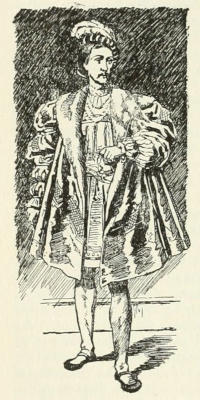
French Nobleman, Middle of Fifteenth Century
This praguerie of France (it was so called after the name of the great Bohemian praguerie), although it was so quickly ended, nevertheless produced some disastrous results. The military reform was postponed. The English were emboldened to attack Harfleur, which they took and retained. They released the duke of Orleans at the request of the duke of Burgundy (1440). When the ancient enemy of his house thus exerted himself to take him out of captivity, the king could not decently refuse likewise to guarantee the ransom-money, and aid in the deliverance of the dangerous prisoner. He proceeded straight on his return to the duke of Burgundy, who threw the chain of the Golden Fleece[54] over his neck, and gave him his niece in marriage. Against whom was formed this close union of two enemies, if not against the king? He took the hint.
[1440-1442 A.D.]
First of all, he obtained from the states a tenth to be levied on all the clergy of the realm. He recalled Tannegui du Châtel, the mortal enemy of the house of Burgundy. Then concentrating all his forces towards the north, he proceeded along the frontier, doing justice upon the Burgundian, Lorrainian, and other captains, who were desolating the land. Among those who made their submission, there was a man of turbulence, the most audacious of plunderers; audacious both from the strength his birth gave him, and because he was the common agent of the duke de Bourbon and the duke of Burgundy; this was the bastard de Bourbon. He did not get off so cheaply as he had expected. The king handed him over, Bourbon as he was, to the provost, who put him on his trial just like any other robber; and after being well and duly found guilty, he was put in a sack, and thrown into the river.
Another lesson, not less instructive, was given. The young count of Saint-Pol, relying on the protection of the duke of Burgundy, dared to intercept some of the king’s cannon on the march, and carry them off; the king deprived him of two of his best fortresses; Saint-Pol hastened to the king and besought pardon, but he could obtain no favour, except by submitting to the decision of the parliament on the litigated question of the Ligny inheritance.
EFFECTIVE PROGRESS AGAINST ENGLAND (1441-1444 A.D.)
Meanwhile the English, all this time so near Paris, and so strongly established on the lower Seine, had advanced up the river and seized Pontoise. Lord Clifford, who had surprised that important and formidable post, kept possession of it in person. The inveterate obstinacy of the Cliffords acquired but too much notoriety in the wars of the Roses. Besides the English, there were in Pontoise numerous deserters, who knew they had no quarter to expect.
Invincible pertinacity of purpose was displayed on both sides. The duke of York, regent of France, now came to the aid of Clifford, whom he was afterwards to put to death in the civil wars. He brought with him an army from Normandy, revictualled the place, and offered battle (June); Talbot was with him. The king let the English pass, fell back, and returned. Talbot also returned, and again threw provisions into the town (July). The duke of York once more marched his army back, but could not yet bring on an engagement. He was allowed to roam over the ruined Île-de-France as much as he pleased, and waste his strength in those useless evolutions. When they had exhausted and harassed themselves, in four times revictualling Pontoise, Charles VII seriously resumed the siege; Jean Bureau battered the walls with admirable activity; two murderous assaults were made, that lasted five hours; first a church, that served as a redoubt, was carried, and then the place itself (September 16th, 1441). Thus men, who dared not meet the English in the plain, attacked and defeated them by storm.
The recapture of Pontoise was a deliverance for Paris, and for the whole country around; cultivation could thenceforth recommence, the means of subsistence were secured. Yet the Parisians evinced no gratitude to the king; they felt but their present miseries and the burden of the taxes; these were beginning to affect the brotherhoods even, and the churches, which were loud in their complaints. There was no want of willingness on the part of the princes to take advantage of these discontents. The duke of Burgundy, without himself appearing, assembled them in his own home at Nevers (March, 1442). The duke of Orleans, with whom he did as he pleased, since he had delivered him, presided for him over the meeting, which consisted of the dukes de Bourbon and d’Alençon, the counts d’Angoulême, d’Étampes, and de Dunois. The king frankly sent his chancellor to this conclave which was held against him, and notified to them that he would readily hear what they had to say.
[1442-1443 A.D.]
Their demand and alleged grievances very plainly showed what were their secret views. The princes, therefore, in their love for the public welfare, and for the good people of France, set forth before the king the necessity of making peace. They called for the repression of the brigands.
The king’s reply, which was sedulously made public, was overwhelming, and the more so as its tone was calm and moderate. He answers specially, respecting the taxes, that the aids had been consented to by the lords on whose property they had been levied; that as to the tallages, the king had “notified” them to the three estates, although in matters so urgent, when the enemy was in occupation of one portion of the kingdom, and was destroying the rest, he had a good right to levy tallages of his royal authority. “It is not necessary to that end,” he says, “to assemble the estates; it is but a burden for the poor people who have to pay the charges of those who attend. Many notable persons have requested that these convocations should cease.”
The king, leaving the malcontents to waste time in their meeting at Nevers, was then performing a grand and useful journey all through his kingdom, from Picardy to Gascony, everywhere establishing peace, especially in the marches, in Poitou, Saintonge, and the Limousin. Strengthened in the north by the recovery of Pontoise, he went to make head against the English in the south. The count d’Albret, being hard pressed by them, had promised to surrender if the king did not come on the 23rd of June to “keep his day,” and await them on the lande of Tartas. They liked the condition, not believing that he could arrive in time, much less that he would offer them battle. On the appointed day they saw the king of France and his army on the lande (June 21st, 1442). All these Gascons, who had imagined themselves far beyond the king’s reach in a world of their own, were beginning to feel that he was everywhere. They came and did homage, performed feudal service, and the king rendered justice to them.
He did this conspicuously in an important case the following year (March, 1443). The estates of Comminges supplicated Charles VII on behalf of the aged countess de Foix who had been imprisoned by her husband. He frightened the count de Foix, liberated the old countess, divided the usufruct of Comminges between the husband and wife, and adjudged the property to himself. This startling act of justice struck great awe into all those lords who had hitherto been so independent.
This was not all. In order to remain always among them as judge, the king gave them a royal parliament, which was to reside in Toulouse. This judicial royalty of the south was altogether free of the parliament of Paris; it judged in accordance with the law of the country, the written law, and was not dependent on anyone, but was self-elected. Until such time as this great body could establish order and justice in Languedoc, Charles VII authorised the poor to take justice into their own hands, and hunt down the brigands and vagrant soldiers.
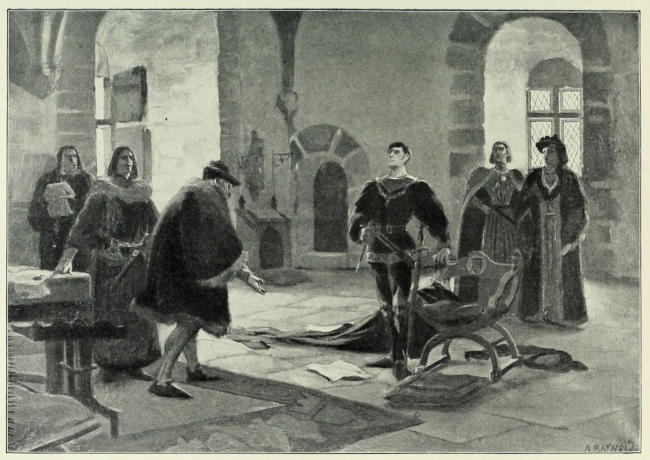
LOUIS XI AND CHARLES THE BOLD AT PÉRONNE
He could not remain long absent from the north. Dieppe, which had been recovered by a fortunate and bold stroke, was in danger of being lost again. A great fleet and an army were every moment expected from England; it was urgently necessary to anticipate their arrival. The dauphin got permission to undertake this service along with Dunois; many Picard and Norman gentlemen also volunteered. The Bastille was taken. The duke of Somerset, the English commander, returned to Rouen to rest from his toils and take up his winter quarters.
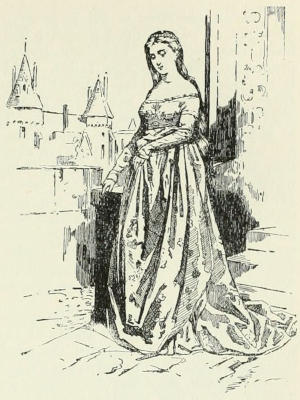
Costume of a Noblewoman, Middle of Fifteenth Century
[1443-1444 A.D.]
That winter, whilst Somerset was enjoying his victorious repose, the dauphin Louis was rapidly traversing the whole kingdom, to ruin and destroy the best friend of the English. The count d’Armagnac, dissatisfied by the way in which Comminges had been disposed of without giving him a share, had attempted to seize the whole country. He reckoned on the English, and particularly on the duke of Gloucester, who in fact wanted to marry Henry VI to a daughter of the count. The dauphin set out in winter, made his way over snows and swollen rivers, and found the game in its lair, everything that bore the name of Armagnac shut up in one place. Gloucester and the war party, though they had encouraged Armagnac, were unable to defend him. They had enough to do to defend themselves in England against the bishops, and the partisans of peace, Winchester and Suffolk, who had gained the upper hand.b Painful as it was to their pride they were obliged at conferences held at Arras, in 1444, to beg for a truce and the hand of a French princess, Margaret of Anjou, for their young king Henry VI, placing also a new enemy at their gates through the marriage of the dauphin Louis with Margaret of Scotland, daughter of James I.
EXPEDITION TO SWITZERLAND AND LORRAINE
Charles VII only granted that truce in order the better to complete the work of reform begun in 1439.c But there was a third people very embarrassing during the truce, the war-folk namely. What could be done was to induce them to go and rob elsewhere, to quit ruined France for thriving Germany, and make a pilgrimage to the council of Bâle, to the rich and saintly towns of the Rhine, and the fat ecclesiastical principalities.
[1444-1445 A.D.]
Just then the king received two applications for aid, the one from the emperor Frederick III against the Swiss, the other from René, duke of Lorraine, against the cities of the empire. The king was equally favourable to both proposals, and generously promised aid for and against the Germans.b
Switzerland had founded and consolidated its independence of Austria and the empire in three battles—Morgarten, Sempach, and Näfels—in which a handful of peasants had heroically vanquished great feudal armies. The French nobility was always ready for positive warfare, but that of Germany showed itself more circumspect and the Austrian provinces were reduced to setting, by means of wretched intrigue, the Swiss cantons one against the other, and then if possible to intervene. This time Frederick III reckoned to make the Armagnacs of Charles VII intervene for him.
The Battle of Sankt Jakob (1444 A.D.)
Charles hastened to set in motion, in as orderly a fashion as possible, an army of 14,000 French and 8,000 English, Scotch, Brabanters, Spaniards, and Italians. The commander-in-chief was the former leader of the praguerie—the dauphin Louis. This terrible band turned the Jura in fairly good order, and entered Switzerland by crossing the little river Birse. The Swiss, who were then besieging Zurich, were able to send only 2,000 men to meet the enemy. These brave fellows had expected only to skirmish and knew not with what force they had to deal. A messenger had come from Bâle to warn them of the numbers of the French, but they had killed him; and in the brutal pride their former successes had inspired, they threw themselves head-foremost on the first corps they met (1444). Their bravoura did not save them. After making a desperate resistance in a hospital and behind the dilapidated walls of a garden, their position was forced and they perished, every one. The dauphin had such respect for the brave men that fought so well that he went no further and made a treaty of alliance with the Swiss. As for the écorcheurs, they found nothing to take away from these poor mountaineers and many turned towards Alsace and Swabia.c
The dauphin’s return, and the report of the check the Swiss had suffered, considerably advanced the affairs of Lorraine. The towns which sheltered themselves under the name of the empire saw that, if the emperor and the German nobility had called in the French to the heart of the German countries, to save Zurich, they would not come and fight the French on the marches of France. Toul and Verdun acknowledged the king as protector.
Metz alone resisted. That great and aspiring town had others dependent on it, and was encompassed by from twenty-four to thirty forts. Épinal, however, had from the beginning seized the opportunity to emancipate itself, and had put itself into the king’s hands. The forts having afterwards surrendered, the Metz men made up their mind to negotiate. They represented to the king that “they were not of his realm or lordship, but that, in his wars with the duke of Burgundy and others, they had always received and comforted his men.” Thereupon, by order of the king, Master Jean Rabateau, president of the parliament, propounded many arguments to the contrary. The grand question of the limits of France and the empire could not be settled thus incidentally, and during a truce to the English war. The matter remained undecided. The king contented himself with drawing on the finances of the wealthy town of Metz.b
MILITARY AND FINANCIAL REFORMS (1443-1448 A.D.)
[1443-1448 A.D.]
These two expeditions had disembarrassed the king of the most riotous among his adventurers, and broken in the rest to an elementary discipline; it was at last possible to put into execution the ordinance of Orleans. In 1445, the army was consolidated into fifteen companies of one hundred lances; to each lance six paid men were reckoned—a man-at-arms and his esquire, three archers and a coutillier, all mounted. By these were the cities garrisoned, the largest having only from twenty to thirty lances; in this way the inhabitants remained stronger than the soldiers, and in a position to check any disorder. The demand for positions in the army was so great that numerous old stagers followed the companies about that they might be ready to snap up the first vacancy. All the others were obliged to retire immediately to their homes without disturbing the peace, under penalty of being given up to justice as vagabonds. Such was the progress of order that they obeyed and at the end of the fifteen days nothing more was heard of them; as for those who had enlisted, they submitted to a rigorous discipline. Charles VII had thus at his disposition a picked troop of nine thousand horse.
By another ordinance, that of April 28th, 1448, the king secured to France an advantage which she had hitherto furnished to foreigners—to the Genoese, at need—but had never herself possessed: a regular and permanent infantry. Each of the sixteen thousand parishes of the kingdom was obliged to furnish the king “a good comrade,” said the ordinance, “who has seen service.” He had to furnish at his own expense his brigandine, a light coat of armour of iron plates joined together; a short coat, light helmet, dagger, sword, crossbow, and quiver of arrows. He was obliged to drill on all feast days, and be ready to serve the king at any time he should be called upon to do so; he received in payment four francs a month when in service and exemption from all taxes and subsidies, excepting the aide and the gabelle.
The free archer did not become at once a model soldier; military genius was not developed in a day in a nation so long without arms. But while Villon depicts for us one of those archers dropping on his knees before a scarecrow, taking it for a gendarme, entreating pardon, and beginning to feel extremely ill, satiric poetry is not history; a century later, in 1554, the same archers, incorporated in the provincial legions of Francis I, gained against the first army in the world—the Castilian veterans—a battle that had been once lost by the men-at-arms; still another century, and in 1643, changing their quivers for guns, they had developed into the foot-soldiers that fought at Rocroi.
All these reforms were subordinate to that of the finances, set in motion in 1443 by Jacques Cœur. To establish a reciprocal control by the regulators of finances over one another; to oblige individual receivers to account to the receiver-general and the latter in his turn to the chamber of accounts; to force the king’s officers—the ministers of finance, the master of the horse, the treasurer of wars, and the commander of artillery—to render monthly accounts to the king in person—these were excellent and admirable reforms, thanks to which Charles VII found himself in a position to create in France an institution that the most powerful of his predecessors had been unable to establish—a military force dependent only on the king, and protecting him, instead of leaving him at the mercy of the barons’ evil humours, as had heretofore been the case. Since Charles V, the ordinary indirect taxes, such as that on salt, on merchandise, and on liquors, had been permanent. Since Charles VI, the land tax (the taille), for payment of the soldiers, had become permanent—that is, it continued to be levied without the vote of the estates. But the king gave guarantee for the proper administration of financial justice by declaring sovereign the cour des aides, which alone had the right to interpret ordinances pertaining to the taxes and was the last resort of all civil and criminal processes growing out of the administration of the finances.
Though it was not yet possible, in the fifteenth century, to reduce all France to one uniform law, she was at least beginning to emerge from the arbitrary customs of a justice exercised, above all in the north of France, according to unwritten laws. Charles VII thought—and the thought is an honour to him—that it was essential that all the laws of a kingdom should be written and “agreed upon by the lawyers of each country,” and examined and authorised by the supreme court and by the parliament, so that it would not be possible to deviate from the text thus officially inscribed. To him was due this innovation.
THE CLOSE OF THE HUNDRED YEARS’ WAR
[1448-1450 A.D.]
Having accomplished these reforms, Charles found himself sufficiently strong to finish with the English. A certain Francis de Surienne, an Aragonese adventurer in the service of the English, wishing to garrison one of the Norman villages possessed by the English, found himself repulsed on all sides. The soldiers, having received from Henry VI neither pay, provisions, nor munitions, were unwilling to share with this foreigner their already insufficient resources. The Aragonese, finding the doors of the allies closed to him, provided for the needs of his company after the fashion of the greater number of the military leaders: during the season of peace he fell upon Fougères, a rich city of Brittany, and gave it over to his men to plunder in lieu of their arrears of pay.
Immediately the king of France and the duke of Brittany demanded of the English governor of Normandy reparation and an indemnity of 1,600,000 crowns damages. They demanded an impossibility. The indemnity not arriving, the French set out to collect it for themselves at Pont-de-l’Arche, Gerberoy, Verneuil. Dunois entered the province with an efficient army which the Burgundians and Bretons joined voluntarily. Pont-Audemer, Lisieux, Mantes, Vernon, Évreux, Louviers, St. Lô, Coutances, and Valognes were taken or surrendered by the inhabitants without striking a blow.
England was then beginning her Wars of the Roses, which during thirty years were to cover her with blood and ruins. The parliament, not as yet daring to take action against the king, fastened upon his minister, the duke of Suffolk, and troubled itself little about Normandy, since the reverses there were new and potent arguments against the accused. The governor, Somerset, instead of concentrating his forces, divided them into twenty garrisons, and sent ambassadors to open negotiations; but, knowing no better how to make treaties than how to make war, he forgot to invest them with authority. Order, proficiency—all that had hitherto contributed to their success was now on the side of the French: to the French Victory went over. On October 18th, 1449, they appeared beneath the walls of Rouen.
In a moment all the inhabitants of Rouen were armed, but armed against the English, who took refuge in the citadel. Somerset was there, and the veteran Talbot, and numerous lords, officers, and soldiers; but it must be remembered that it would have been impossible to resist at once both the population and the French army. There was talk of a treaty, but on what conditions!—that, in addition to Rouen, Caudebec, Villequier, Lillebonne, Tancarville, Harfleur,—that is to say all the lower course of the Seine,—should be delivered up to the king of France; and that a hostage should be furnished in the person of the famous Talbot himself—the English Achilles.
The governor of Honfleur refused to recognise this capitulation. The city was taken in the middle of winter (December, 1449); Harfleur met the same fate. The English, pushed to extremities, sent a knight of great renown, Thomas Kyriell, with 6,000 men. It was a last effort. Landing at Cherbourg, Kyriell sought to join the duke of Somerset at Bayeux, by way of the shore; the French followed, and on April 15th, 1450, near the village of Formigny, the constables of Richemont from one side, the count of Clermont from the other, vigorously attacked him. Kyriell’s soldiers fought bravely, but were defeated and left 4,000 on the field. This insignificant number sufficed to blot out from the minds of the French the 30,000 dead at Crécy, the 12,000 captive at Poitiers and at Agincourt. Vire, Bayeux, Avranches, Caen, Domfront, and Falaise fell into the hands of Charles.
[1450-1453 A.D.]
The numerous garrison of Cherbourg counted upon having nothing to fear, thanks to its own strength and above all to the neighbourhood of the sea. From this side it was taken. The French cannoneers established seven batteries in the sea itself; when the tide rose they left their cannon well anchored on the beach and protected by oiled skins; when the tide fell they returned to them. It was the English who, first of all, had turned against the French, at Crécy and Agincourt, this terrible arm of the artillery; the latter now manipulated it better than themselves. Cherbourg capitulated, and in a year the whole of Normandy was taken. Also the French army presented a novel spectacle: disciplined and obedient, it now lived on its pay and not by plunder.
A month later, Dunois, Saintrailles, Chabannes, and the brothers Jean and Gaspard Bureau, who directed so advantageously the French artillery, marched with 20,000 men against Guienne. Bourg-sur-Gironde, Blaye, Castillon, Libourne, St. Émilion, offshoots from Bordeaux, which the English had loaded with privileges as they had that city, were easily taken. The inhabitants of Bordeaux, so well disposed to the England who bought their wines, attempted a sortie, fled upon catching sight of the enemy, and entered like the others into negotiations. The French granted nearly all that was asked of them. This was the 5th of June, 1451; the surrender was delayed until the 23rd. On that day, the herald of the city having cried with a loud voice for succour from the English for the people of Bordeaux, and no one replying, the gates were opened to the French.
However mild the conquerors were, the great town soon regretted that English domination so far removed as to be scarcely felt. Now it had to pay taxes and furnish soldiers, the harbour was deserted, the shops were encumbered with unsold tuns. If an English army had appeared, no matter how weak, Bordeaux would have thrown herself into its arms. Such an army now appeared.
The government of Henry VI, or, to speak more correctly, of Margaret of Anjou, had need of a great success abroad in order to establish itself at home. Talbot, earl of Shrewsbury, now eighty years of age, was charged with bringing Guienne again under the English rule. The first steps were easy. The inhabitants of Bordeaux themselves introduced the English into their town, September 22nd, 1452; almost the whole province followed their example, and the king of France had to recommence his conquest. With the spring of 1453 his troops were marching into Guienne; on the 14th of July they laid siege to Castillon.c
The Battle of Castillon (July 17th, 1453)
The royal army, the greater part of which, including the artillery under the Bureau brothers, was concentrated in the camp, nearly two thousand feet long by one thousand wide, occupied also an abbey, which was later on the priory of St. Florent, and which overlooked Castillon; on the plain of Mount Horable, near to the village of Capitourlans, were the Bretons of Count d’Étampes, to the number of 240 lances under the command of the knights of Hunaudaye and Montauban. The night of the 16th of July was passed in fortifying the camp, which was surrounded by deep trenches and defended by powerful artillery. Talbot on the morning of the 17th attacked the abbeys, defended by eight hundred free archers under the command of Jacques Rouhault and Pierre de Beauvau. The archers, terrified by the impetuosity of the English, who shouted the war-cry of their old leader, abandoned the abbey and retreated in the direction of the entrenched camp, followed by the enemy. On hearing of the approach of Talbot, Jacques de Chabannes left the camp and advanced at the head of two hundred lances. Aided by Rouhault and Beauvau, he protected the retreat of the archers. A very brief engagement took place; one hundred men were killed on either side. Rouhault, thrown from his horse, owed his safety only to the devotion of his archers, to whom he had sworn that he would live and die with them. Chabannes, surrounded at one moment, was delivered by his men.
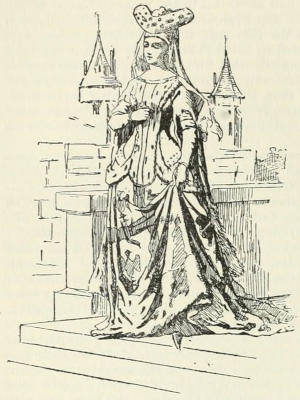
French Noblewoman, Early Fifteenth Century
Finally it was possible to effect the retreat. Talbot rallied his men and regained the abbey. There, seizing the provisions abandoned by the French, he broke open the casks and distributed wine to his soldiers; it was still early in the day; the earl of Shrewsbury (Talbot) had mass performed by his chaplain. The holy sacrament was about to be celebrated, when news was brought that the French were abandoning their enclosure and fleeing. “Never,” he exclaimed, “will I hear mass till I shall, to-day, have overthrown the band of Frenchmen which is before me”; and he gave orders to advance. The English advanced uttering their war-cry, “Talbot, Talbot, St. George!” Mounted on a little nag, the old captain was dressed in a simple red velvet cassock. Vain attempts were made to stop him, he was told that it was a false rumour, and that it would be better to await quietly the onset of the enemy; he answered his standard-bearer, who gave him this advice, by insults, and drove him away, it was said, by a sword-cut across the face. On arriving at the palisade Talbot began to shout, “On foot, on foot, all!” His men-at-arms, supported by the archers, who arrived gradually and fell into rank, were received by a formidable discharge; three hundred catapults, howitzers, culverins, and ribaudequins, the firing of which was directed by the famous gunner Giribault, threw their projectiles, which slew a large number of victims. The English hesitated. Talbot brought them back, and formed them in testudo; sheltered behind their bucklers they attacked the entrenchments. Talbot succeeded in planting the banner of St. George on the summit of the trench. A terrible conflict took place; for more than an hour they fought hand to hand.
Suddenly, from the neighbouring heights, the sires de Montauban and de la Hunaudaye descended with their Bretons, and took the enemy in the rear; this movement decided the issue of the combat. The English stopped to face this fresh body of troops. The terrible tempest of the artillery did not cease to rain down on them. Seizing the opportunity, the French dashed from the camp, some on foot, some on horse, and charged with fury. Talbot, though wounded, held out. A blow from a culverin struck him on the leg and threw him under his horse. The French archers surrounded him and pierced him with their arrows. His son, who had vainly endeavoured to persuade him to flee, died at his side, trying to protect him. The English, seeing the fall of their chief, fled in disorder. Some wished to regain their vessels or to cross the Dordogne at the ford of Rozan; the others took the road to St. Émilion. A body of about two thousand men under the leadership of the Gascon nobles fell back in good order on Castillon and succeeded in penetrating into the town. The French, tired, worn out, breathless, renounced the pursuit of the enemy; only the count de Penthièvre, with his troops, gave chase to the fugitives in the direction of St. Émilion. The English army was overwhelmed; thirty knights and four thousand soldiers perished; in the heat of the action they were killed without mercy. It is said that even in our day bones are found in the plain which was the scene of this sanguinary struggle. On the French side the loss was considerable; some of their leaders, Admiral de Bueil, Jacques de Chabannes, Pierre de Beauvau, were wounded, but not seriously. In spite of the reinforcements brought by the Gascon nobles, Castillon could not oppose a long resistance; the town capitulated July 20th. From there the army marched immediately against St. Émilion and Libourne, which opened their gates.n
Cadillac and Blanquefort followed suit. The royal army closed in around Bordeaux. The free archers overran the country; the ships loaned by La Rochelle and Brittany blocked the mouth of the Gironde. Bordeaux, threatened with famine, sent deputies to Charles VII. In their presence Jean Bureau made it a point to say to the king: “Sire, I have been reconnoitring for proper positions for our batteries; if such is your pleasure, I promise you on my life that in a few days I shall have demolished the town.” The envoys understood that this time they must accept what conditions the king would make. He stripped Bordeaux of her privileges, exacted a contribution of 100,000 crowns and ordered the banishment of twenty guilty citizens with the confiscation of their wealth; finally the construction of two citadels to guarantee the fidelity of the town in the future. The sire de l’Esparre, who had called in the English, promising a rising of all the nobility of the province, lost his head. On the 19th of October, 1453, Charles VII entered Bordeaux in triumph—the Hundred Years’ War was over. The English held nothing in France except Calais and two small neighbouring towns.c
Thus after a century’s struggle was decided the impossibility of English monarchs holding France, under whatever pretensions or rights. The French had outgrown those times when the sovereignty over them could be transmitted to foreigners, or divided with them by the mere laws of feudal heritage or proprietorial descent. All that the ablest kings and bravest warriors of England could do was to hold their ground upon the continent. Any lack of talent, suspension of vigilance, or remissness of energy on their part restored military superiority to the French upon their own soil, and insured with this their independence.
It was fortunate for both countries that such a decision had taken place, and that it should be final. The circumstances as well as the result of the war now rendered it so. The re-conquest of all the French provinces by Charles was not, like that of Philip Augustus or Philip the Fair, the work of trickery or deceit. It had been achieved in fair and stand-up fight, and, what was more remarkable, with forces on either side almost balanced in number. The French were not more numerous than the English at Formigny; and Talbot, when he fell at Castillon, led a greater army than that which defeated him. It was the French free archers, too, and peasant soldiers, who fought more than the knights on that field. Experience had taught the mistake of attempting to ride down the hardy sons of the soil by mounted gentry. English and French met on these last fields equal in courage and in strength. But as the French soldiers were now more carefully selected, disciplined, and organised, they were victorious over those of England, distracted as it was by civil war, sending forth armies as distracted as its government.g
THE LAST YEARS OF CHARLES VII
[1451-1456 A.D.]
About this time the services of the wise counsellor we have already mentioned—the great merchant and shipper, Jacques Cœur—were lost to the state. After the conviction of Jean de Xaincoings, receiver-general of the realm, for embezzlement in 1451, Jacques Cœur was accused of malversation in his office of treasurer of the crown. He was said to have heaped up incredible riches; and on some occasions he made a display of his wealth which in a great measure compensated for the evil proceedings, if such they were, by which he gained it. He furnished funds for fleets and armies out of his private stores, when they could not otherwise be had; and continued his sage advices to the king, inculcating economy and repose. Charles was still indolent and self-indulgent when no great national effort was to be made. He allowed the prosecution of his faithful servitor, accepted the sentence of death which was passed upon him, and only started up to the kindness and generosity of his character when he remembered his services, and granted him his life (1453). The rest of the treasurer’s story is very strange. Jacques Cœur escaped from prison and found refuge at Rome, was appointed admiral of the Italian fleets against the Saracens, trafficked in goods and money while sweeping the infidels from the sea, and died in the island of Chios, 1456, richer and more honoured than he had ever been in Paris. The king must have seen, when it was too late, that he had banished a financier whose advice on public affairs was cheaply paid for by the acquisition of private riches.j
Quarrels with Burgundy and with the Dauphin
[1451-1453 A.D.]
The expulsion of the English from the continent, where they no longer held any town save Calais, left the king of France in the presence of his powerful rival, the duke of Burgundy, who reigned over dominions no less vast, and after a manner quite as independent.
After the English had been driven from Normandy, Philip of Burgundy began to feel the hostility of Charles and of his court. Whenever his subjects, especially of towns, had cause of complaint against him, they appealed to the king of France and his parliament as suzerain. Ghent would not submit to the gabelle (or salt tax) imposed by Philip, and the people appealed to the king of France, who pretended that the gabelle peculiarly belonged to the suzerain, and a French embassy soon arrived to arbitrate between the duke and the Ghenters. The duke altogether set aside the demand of gabelle, but insisted merely on the fact of the chiefs of trades and the demagogues having usurped the entire power in Ghent, even the administration and the election of magistrates. The French envoys took completely the duke’s view of the difference, and gave an award, obliging the people of Ghent to admit the ducal bailiffs to a share of authority, to pay a large fine, give up the rallying emblem of the white chaperon, and desist from holding the meetings of the united trades.
In the following year, 1452, the French court returned to the charge and sent fresh ambassadors, not approving of the facility with which their predecessors had abandoned and condemned the democracy of Ghent. But at that time occurred the descent of Talbot on the Garonne, and the attention and efforts of Charles were necessarily turned in that direction. Duke Philip saw his opportunity. He must crush the rebellious towns ere Charles succeeded in expelling the English from Guienne. He raised a large army, brought it to Ghent, and captured several small places round it, cruelly hanging every prisoner. Treachery is reported to have been employed to induce the citizens to come forth to battle on the open plain. But 40,000 armed inhabitants of the Flemish capital, so often victorious in the field, scarcely needed any incentives to march to the relief of their towns and garrisons. Duke Philip was engaged in the siege of Gavre, from which the commander escaped to Ghent, craving succour, if the fortress was to be saved. The citizens accordingly mustered to the number of 30,000 and marched to attack the Burgundians. The encounter took place on the 23rd of July, 1453; it began by the cannon on both sides. The Ghenters were most of them slain, 20,000 being left on the field; and the duke, on beholding the heaps of slaughtered men, felt, for the first time, that these were his subjects, the sources of his wealth and the sinews of his strength.
In the same year Muhammed II carried Constantinople by assault, and extinguished the Greek empire in the East. The catastrophe, alarming to Italy and Germany, might well have aroused the king of France. Charles VII was not the hero of a crusade; the sphere of his activity and ambition did not extend so far. Yet, when the duke of Burgundy, in a solemn festivity at Lille, made a public vow to lead his armies against the Turks, when all his noblesse became associated in the same vow, and when the pope and emperor joined in the enterprise, Charles was mortified; nor was his jealousy diminished when Philip, after this vow, set forth in person to visit the Swiss and the Germans, in order to negotiate alliances and aid in his great design.
However wisely the councillors of King Charles had conducted his military operations, and his negotiations with England and with Burgundy, the spirit of their domestic administration was narrow in the extreme. The princes of the blood, however cautious and apparently submissive, looked with jealousy and anger upon those upstarts of the king’s court who so completely eclipsed and set them aside.
The king and his council, therefore, looked upon the duke of Burgundy’s proposed crusade as merely a scheme for enhancing his importance, and placing himself at the head of the princes of Europe and of a formidable army, and they resolved to attack and crush those of his subjects whom he supposed to be associates and fellow-conspirators with Duke Philip. The principal of these was his son Louis, who lived independently, but not tranquilly, in Dauphiné, now warring, now intriguing with the duke of Savoy, and omitting no opportunity of gaining followers and procuring money.
[1453-1457 A.D.]
The first of the dauphin’s friends whom the court attacked was the count d’Armagnac, who afforded every pretext for Charles’ interference. He was living in incest, excommunicated by the pope, and guilty of many crimes. Unable to resist Charles’ lieutenants, Armagnac was soon reduced, his seventeen castles were taken, and he was driven across the Pyrenees. The court then resolved to make an example of the duke of Alençon. The prince was noted for his gallantry and independent spirit, which had won the admiration of Joan of Arc. He had been foremost as a partisan against the English, yet was an object of suspicion to Charles. Dunois was sent to arrest and bring him to the king’s presence, who accused him of conspiring to receive the English into his fortresses. According to some he made an indignant answer to the king; according to others he confessed his treason, and gave information of the designs of his confederates.
By what was elicited from the duke of Alençon, the king’s suspicion and anger were increased against his son Louis, whom he resolved to leave no longer in possession of the revenues and government of Dauphiné, at least unless he submitted. In April, 1456, the king signified his intention of resuming the government of that province. The dauphin would not put himself in the power of the council, the members of which he believed capable of any crime. Nor would Charles receive his son into favour, except upon his complete submission. The march of an army, led by his declared enemy, Dammartin, alarmed Louis. He at first thought of resistance, but none of the nobles of Dauphiné or of his court would support him in resistance to his father. With a few followers Louis abruptly quitted Dauphiné, as Dammartin advanced into it, and hastened to St. Claude, in Franche-Comté. From thence he informed the king that he was determined to take part in his uncle the duke of Burgundy’s crusade against the Turks. He at the same time informed that potentate of his arrival. An answer of welcome speedily came, and Louis proceeded to Brussels. Here the duke embraced him so cordially and so long, as scarcely, so Chastelaink relates, to let his feet touch the earth. The dauphin was all in all for a few days; but a quarrel arising between the duke and his son, the latter was brought by his mother to Louis, who undertook to intercede for him, and remonstrate with his sire. This at once interrupted friendship and harmony. The duke saw in the dauphin one who might take his son’s part against him. Louis thus found it necessary to retire to the château of Gennape, near Brussels, where he lived on a monthly pension of 2,500 livres allowed him by the duke (1456-1457).
Death of Charles VII; the Influence of His Reign
[1457-1461 A.D.]
This was the very result which Charles most dreaded, and which he most carefully should have avoided. But his council feared the reconciliation between father and son: and some of them meditated setting Louis aside altogether, and prolonging their own power by proclaiming his brother Charles, then but a boy. The king would not entertain a project necessarily so fatal to his family and his kingdom. As to Charles, his inward distrust became at last a malady, and almost an insanity. Yet his suspicions were not without grounds; for as his health and strength visibly declined, especially after the breaking of a boil in the mouth, the members of his court—even those who had been the bitterest enemies of the dauphin—addressed letters to that prince containing information as to the state of things, and assurances of their own attachment. Even the king’s new mistress, the dame de Villequier,[55] was amongst those who hastened to seek security in the worship of the rising sun.
The desertion of his own ministers did not escape Charles, who reasoned that those who were so eager to abandon him in his decline might, without scruple, hasten his death. The dauphin is said to have caused some of the letters addressed to him to be placed within reach and view of the king. Charles’ terror was equal to his disgust. A captain told him that his physicians had been suborned to administer poison; one was instantly sent to prison, whilst the others fled. In his alarm, Charles refrained from taking sustenance altogether; and when the cause of his consequently weak state was discovered, and it was sought to administer food, his stomach refused to retain it. Thus did one of the most successful and triumphant among monarchs expire of mistrust—of hunger and inanition. Death levels all distinctions: Charles, the restorer of the French monarchy, died the death of a beggar (July 22nd, 1461).
The character of Charles VII is perplexing to the historian; it affords subject of surprise that such great aims, which must have been wisely conceived and steadily pursued, should have been attained by a personage in many respects so weak. We are thus obliged to separate the private habits of the prince from the public life of the monarch. In the one Charles was indolent, self-indulgent, inconstant, and immoral; in the other, active, adventurous, persevering, and patriotic. He first introduced the important novelty of a royal council. Such, indeed, had existed under his predecessor, but it was an assemblage of magnates, not of ministers, the orators and inferior members being the followers or exponents of their chiefs’ opinions. Charles VII did nothing without consulting his council. This, perhaps, is the most remarkable characteristic of his rule. And it stands in strong contrast with the habits of his son and successor, who ruled altogether from his own judgment, and who with far greater talents and capacity committed the greatest blunders, and fell far short in all his aims, which his sire contrived to avoid or to accomplish, by merely mistrusting his own omniscience and not disdaining the counsels of others.
The upper classes, their ideas, their spirit, and privileges, were no doubt undergoing in this century a great and remarkable change. This was the gradual metamorphosis from the feudal baron and knight into the courtly seigneur and the modern gentleman. As their numbers greatly increased it became impossible for all to preserve the superiority in power and wealth which the ancient holders of fiefs had possessed. The younger brothers of the gentry were obliged to seek for public service and live upon pensions or pay, in military or other capacity. But they carefully preserved themselves from losing caste, by insisting that they alone should fill these numerous offices. Thus the originally restricted class of the nobility in France was spread into the wider caste of the gentilhomme, the power and pretensions of the whole being undiminished.g
Most important of all, however, was the steady growth in power of the crown. We have seen that Charles VII practically dispensed with the aid of the states-general after 1439, and that in so doing he virtually established a standing army and a permanent tax.a In reality the taxes were already permanent, or nearly so, but they had been considered as extra revenue; now they became usual. Charles VII in suppressing the vote of the assembly followed the example of Charles V under identical circumstances, and thus rid himself of an obligation which was often only a useless formality, and often a hindrance and restraint.e
A more fatal consequence of this usurpation on the part of the crown was that the nobility and clergy, remaining exempt from the tax on land which was only levied on the property of the roturiers, ended by taking no interest in the question. They abandoned the great principles supported at the estates of 1355 and 1356, to wit, that no tax could be levied save with the assent of the estates, and that the three orders should be subjected to the same taxes. Liberty established itself in England because the prelates, nobles, and towns remained closely united in their resistance to the encroachments of royalty, all accepting the same burdens and vindicating the same guarantees. In France the nobility and clergy deserted the common cause, handed over the third estate to the arbitrary authority of the crown, and sold the public liberties for a pecuniary advantage. From that moment it was an admitted formula that the clergy paid with their prayers, the nobility with their swords, the people with their money. The third estate, betrayed by the privileged orders, approached the king, applauded all the attacks made by the crown on the rights of the nobles and clergy, and energetically aided it to consummate the ruin of their power, until the moment that it found itself alone, face to face with the crown, and overthrew it. The defection of the clergy and the nobility was the first cause of the establishment of absolute power and of the Revolution which was accomplished 350 years later.p
But little enough did Charles VII or his contemporaries concern themselves with such remote consequences of their deeds as are here ominously suggested; and, not to be ourselves blinded to the true historical relations of the times we are treating, let us seek again the atmosphere of the fifteenth century, and in leaving Charles VII take a parting glance at him through the eyes of a contemporary writer, whose quaint phrasing and peculiar smack of piety will remind us that our stage setting is still of the Middle Ages. That the phrases of the courtier are somewhat more flattering than strict justice demands need neither surprise nor concern us. “Charles VII,” says Henry Baude,o “was loved as much by his subjects as by foreign nations, who came often to him for advice in settling their disputes, and this because of the great justice that he observed. He was feared by the good and by the wicked: by the good, who were afraid to do evil lest it should come to his knowledge; by the wicked who were afraid of his justice. He was obeyed by his vassals and subjects, and well served by old, wise, and well-tutored servants, who knew his disposition to be such that he wished each to have his own. He died in old age [in reality he was but fifty-nine]; and after his death was in great solemnity, weeping, and lamentation honourably buried, and with great regret by men of all estates, in the church of St. Denis in France, with his ancestors. May God in his holy grace receive his soul into Paradise. Amen.”
FOOTNOTES