Chapter XVII · THE DICTATORSHIP OF RICHELIEU
Reading edition
Cardinal Richelieu is one of those men in whose favour the tide of affairs always turns at the critical moment, and who also have skill and courage to take it at the turn. Vigilant, cool, sagacious, and absolutely fearless, he never throughout his life missed a single point in the great game he played; and even with dramatic force knew how to snatch a triumph out of the very clutches of defeat.—Kitchin.w
[1629-1643 A.D.]
Armand Jean du Plessis, Cardinal Richelieu, grown now through the exercise of his own genius to be the mightiest man in all Europe, was born at the castle of Richelieu in Poitou, September 5th, 1585. He was therefore forty-three years old when the famous siege of La Rochelle, by which he broke the power of the Huguenots in France, was brought to a close. Chronic invalid though he was, he was destined to live fifteen years longer, and during that period to control the fortunes of France, and to exercise a dominating influence in European politics at large; to be recognised everywhere as the greatest statesman of his age. We have already seen enough of him to know that he is a man of the largest ideas, the most indomitable courage, and that he is a born master of men; we must understand also that he is the wiliest of intriguers, the shrewdest judge of human motives; that he has a taste for art and for literature; and that with it all he is not restrained from the successes of practical politics by any undue niceties of conscience. He is perhaps more similar in his mental equipment to Augustus than to any other great man of history; or let us say rather to Augustus with a certain share added of the genius of Julius Cæsar, further modified by some traits of Louis XI.
But why attempt to characterise? We shall see the great cardinal in the full exercise of these powers in the coming years. We shall see him carry war into Italy, acting as his own lieutenant-general. We shall see him take a hand in the Thirty Years’ War, and accomplish by diplomacy the overthrow of the great Wallenstein. We shall see him put down uprisings at home, triumphing over Marie de’ Medici and his other enemies; holding King Louis XIII as a child in leading strings. We shall see him dominating church and state alike, and exercising a permanent influence on the literature of his land through the foundation of the French Academy. And all the while we must remember that this myriad-minded statesman is the most hated of Frenchmen at the same time that he is the most feared. Even those he has benefited do not love him. “Let the world speak well or ill of the famous cardinal,” says Corneille, “neither in my prose nor in my verse will I mention his name; he has done me too much kindness to speak ill of him, and too much injury to speak well.” There is none to speak well of this strange man; but all speak of him with bated breath; all contemplate him with something of apprehension. A weird, incomprehensible figure, he stalks across the scene, lonely, hated, feared,—but always masterful. Let us follow out the details of his life story.a
RICHELIEU AND THE KING
The history of Richelieu is obscure as to the essential point, his resources, the ways and means. On what did he live and how? This is not to be seen either in his memoirs or his documents. All that we have of Richelieu’s accounts includes only four years (1636-1640) and in a very confused way gives the ordinary receipts, up to eighty millions. Not a word of anything extraordinary.
In 1636, when France was invaded, a tax on persons in comfortable circumstances (des gens aisés) was created, or rather regulated, and the agents placed everywhere in 1637, with the triple power of justice, police, and finance, collected it with great rigour. But one cannot doubt that something similar existed even before, especially in the passages of armies through certain provinces. Otherwise it is impossible to understand how, with such a deficit under ordinary circumstances, extraordinary and unforeseen expenditures, for wars or subsidies to allies, could have been made every year.
Hence action was variable, intermittent, sometimes brilliant, with relapses due to exhaustion. It was not possible to have a really permanent army. That was evident in 1629, when Richelieu finished the war with the Huguenots, but that with Italy was still in a critical state. He disbanded thirty regiments to raise others six months later. The same way, in 1636, he disbanded seven regiments in January to make them up again in June—an economy of five months, necessary perhaps, but which nearly lost France. In July nothing had been reorganised, and the enemy came to within twenty leagues of Paris.
The suffering of the great man of affairs who directed this machine with its spasmodic movements must have been terrible. And one can easily understand that he was always ill. The insufficiency of his resources, the continual effort to invent impossible money, on the other hand the court intrigues, the pricks of no one knows how many invisible insects, were something to keep him in a terrible agitation. But even that was not enough; twenty other devils haunted this restless soul, like a great ruined mansion—the battle of women, tardy gallantries, moreover theology and the wild desire to write, to make verses, tragedies! What tragedy could be more gloomy than his very person. Macbeth is gay in comparison. And he had attacks of violence in which his inner fury would have strangled him, had he not like Hamlet massacred tapestries with the blows of his dagger. More often he swallowed his bitterness and fury, covered everything with the outward seeming of ecclesiastical decency. His powerlessness, his passion, turned within, worked themselves out on his body; the red iron burned his soul and he was near to death.
His greatest evil was still the king, who might escape him at any moment. Spain, the court, waited for the death of Louis XIII. His wife and his brother looked at his face every morning and hoped. Valetudinarian at the age of twenty-eight, feverish, subject to abscesses which nearly carried him off in 1630, it was in vain he claimed to be alive, to act at times and show courage; it was held that he was dead, at least that no one had need of him. It was a curious union of two invalids. The king would have thought his kingdom lost if Richelieu were wanting. Richelieu knew that, with the king dead, he had not two days to live. So well hated, especially by the king’s brother, he had to plan to die with Louis XIII. Perhaps it was for that reason that he was so pleasing to the king, who was sad, suspicious, and malevolent and who never liked him, but who could always say to himself: “If I die, that man will be hanged.”
This double chance of death, on which the enemies of Richelieu placed their hope, was precisely what made him strong and terrible. He had moments when he talked and acted as though in the presence of death; and then the sublime, which he had sought so laboriously elsewhere, came of itself. He touches it, in fact, in passages of allocution which he had with the king on the return from La Rochelle, in the presence of his enemies, the queen-mother and the king’s confessor, the suave Jesuit Suffren. In this conversation he tells everything, his actual situation, what he has done, what received, what he owns, what he has refused. He has a patrimony of 25,000 livres rental and the king has given him six abbeys. He is obliged to make heavy expenditures, especially to pay for guards, being surrounded with daggers. He has refused 20,000 crowns pension, refused the appointments of the admiralty (40,000 francs), refused the right of admiral (100,000 crowns), refused a million which financiers had offered him in order not to be prosecuted.
He asks for his dismissal, not definitely but temporarily—he may be called back later if he is still alive and is needed. He explains clearly that he is in great danger and that he is obliged sometimes to conceal himself. Does he want to make himself necessary, declare himself indispensable, and so make sure of so much the more power? If that is his end, one must say that the method is very strange and daring. He speaks with the frankness of a man who has no end in view. He dares to give his master, perhaps as a last service, an enumeration of the faults of which the king ought to correct himself. And this was not one of those flattering satires, where one shows a slight fault, a shadow, as a successful method for showing the beauties of the portrait. No, it is a firm, hard judgment, like that of a La Bruyère, of a Saint-Simon, which would penetrate to the depths of a character after a hundred years, a judgment of the dead by a dead person. Quickness of mind and instability, suspicions and jealousy, no assiduity, no application to great things, impulsive aversions, forgetfulness of services, and ingratitude—not a trait is lacking.
The queen-mother must have trembled with indignation, with terror also, perhaps, feeling that the man who would venture such a thing would venture all—and that a man so composed, with death under his feet, would pay little regard to the death of others. The Jesuit must have fallen backwards, plunged into silence and humility. The king felt all this and received it as the testamentary word of one invalid to another, of one dying man to another. Richelieu, being begged and entreated, remained in the ministry. It was difficult for him to retire with affairs at such a crisis. The war with the Huguenots still continued in Languedoc, and the war with Italy was commencing. Richelieu, called by the pope as well as by the duke of Mantua, had a good opportunity which might relieve him from his embarrassments. Victor at La Rochelle, if he saved Italy he might hope that the pope would appoint him legate for life as Wolsey and George d’Amboise[88] had been—real kings and more than kings, since they united the two powers, temporal and spiritual.b
RICHELIEU ENTERS THE EUROPEAN ARENA
[1629-1630 A.D.]
France had submitted; six years of power had been sufficient for Richelieu to make himself her master; now he turned his incessant activity in the direction of Europe. “He feared the repose of peace,” wrote Nani, the ambassador to Venice, “and believing himself more secure in the turmoil of arms, he was the author of many wars, and of long and weighty calamities. We may say that having reunited divided France, succoured Italy, upset the empire, harassed England, and weakened Spain, he was the instrument chosen by heaven to direct the great events of Europe.”
The liberal, penetrating mind of the Venetian was not mistaken on this point; all over Europe the hand of Richelieu was felt. “Far and near, we must always negotiate,” he said. He had succeeded with negotiations in France, and he carried his ideas further. Numerous treaties had already marked the first years of the cardinal’s power; after 1630 his activity in external affairs was redoubled. From 1623 to 1640 seventy-four treaties were concluded by Richelieu; four with England, twelve with the United Provinces, fifteen with the German provinces, six with Sweden, twelve with Savoy, six with the Venetian Republic, three with the pope, three with the emperor, two with Spain, four with Lorraine, one with the Grison Leagues, one with Portugal, two with the rebels of Catalonia and Rousillon, one with Russia, and two with the emperor of Morocco; such was the network of diplomatic negotiation which the cardinal wove in nineteen years.
While the cardinal was holding La Rochelle in siege, the duke of Mantua died in Italy, and his natural heir, Carlo di Gonzaga, living in France as the duke de Nevers, hastened to take possession of his estates. Meanwhile the duke of Savoy claimed the marquisate of Montferrat. The Spaniards upheld him, and entering the duke of Mantua’s states, lay siege to Casale. When La Rochelle fell, Casale was still resisting; but the duke of Savoy had already seized the greater part of Montferrat, and the duke of Mantua asked help of the French king, whose subject he was. This furnished a new field of battle against Spain.t
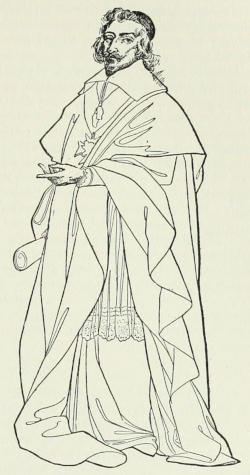
Richelieu
Nobody could understand why the cardinal thought insignificant possessions at a distance from France, like Mantua and Montferrat, were of such great importance.[89] He was obliged to explain to the king that Casale and Mantua were the citadels of Italy—the most valuable military stations in the basin of the Po; and then war was decided on. Richelieu left on the 29th of December with the title of “lieutenant-general representing the person of the king.” He had doffed the cardinal’s robe to assume the military uniform; under him were the cardinal De la Valette, marshals Montmorency, Schomberg, and Bassompierre, with Sourdis, now archbishop of Bordeaux, as administrative lieutenant. The duke of Savoy declared himself neutral and refused to revictual Casale, though he would allow the French free passage to go to its relief. The cardinal, determined in spite of this treacherous ally to gain possession of the passes into Italy, crossed the Alps at Susa and pretended he was about to march on Turin; he then rapidly marched back and besieged Pinerolo, which capitulated (1630). Spinola hastened to the defence of Piedmont, and owing to his superior forces checked the advance of the French. Louis XIII then took the command of the army himself and conquered the whole of Savoy; but he fell ill and his place had to be taken by the duke de Montmorency, who defeated the Spaniards at Vegliana and took possession of the marquisate of Saluzzo on the 10th of July. However, Mantua had been taken and Casale was sorely pressed, the French army was reduced by sickness, reinforcements were expected from the army in Champagne and money from Paris. The latter, however, did not arrive, for the marshal De Marillac and his brother the chancellor, acting under the influence of the queen-mother, neglected to send it off. Richelieu, rendered uneasy by the intrigues of his enemies, effected a truce through the mediation of the abbé Mazarin,[90] who had been sent from the court of Rome. Mazarin, who was a man of supple and crafty temper, gained and retained the confidence of Richelieu and was destined subsequently to carry on the work which the latter had begun. At the expiration of this truce the serious events which were passing in Germany prevailed on Austria, as we shall see, to conclude a definite peace. This was the Peace of Ratisbon, concluded on the 25th of October, 1630.d The emperor agreed to invest the duke de Nevers and withdraw the imperial troops from his states on the Grison passes provided that France would withdraw hers from Pinerolo and Savoy.a
ENMITY OF MARIE DE’ MEDICI AGAINST RICHELIEU
The termination of war was the commencement of new perils for Richelieu. He foresaw the fresh efforts of his enemies, and on the return of the court to Paris, he used all the resources of his address to avert and conciliate the resentment of the queen-mother. She dissembled, and did not forgive. Leagued with the Marillacs, and favoured by many of the nobility, Marie laboured to overturn the minister, who defended himself with firmness and adroitness. Louis XIII was of a feeble mind, still more enfeebled by a weak temperament and languid constitution. Resolution was a state above his powers; it was to him an unnatural tension, menacing at each instant a relapse.
Despite of this, he was clear-sighted. He loved France, was alive to its glory and prosperity, and saw that it required the strong hand of Richelieu to govern and to guide. He did not love the minister, indeed; and it was thus the more to his credit that he upheld him from a sense of his talents and utility. When Marie poured into his ear complaints against the cardinal’s insolence, against his tyranny and domineering ambition, Louis allowed that she was right. He acquiesced; and the queen-mother argued from this passive assent that the king shared her aversion and her views against the minister. She would hurry home to her palace of the Luxembourg after such interviews, and confidently assure her followers that her ascendency was complete, that the fall of Richelieu was near. By that hour, however, Richelieu was closeted with the monarch, was unfolding to him his high and masterly views of policy, was exposing the selfish manœuvres of Marie de’ Medici; and had at length gained in his turn such complete ascendency that the feeble Louis would not only assent, but kindle up for the moment with warmth and friendship towards his minister, and then, in confidence, betray the very secrets of his mother’s converse with him. Richelieu thus drew from a certain source the hopes, the plans, and the names of his enemies.
The Day of Dupes
In an interview with his mother, Louis, assenting to the justice of all her complaints against the cardinal, had proposed that his niece first, and then Richelieu himself, should come publicly and ask pardon of Marie at the Luxembourg. The king intended this as a measure of conciliation. The queen accepted it for the sake of seeing her enemy humbled. Accordingly, on the appointed day, Madame de Combalet, the cardinal’s niece, entered, and flung herself at the feet of Marie, imploring her forgiveness. The latter, instead of preserving the disdain that suited her purpose, or of assuming the air of forgiveness that the king desired, was unable to contain her temper, and burst forth in invectives against the suppliant lady. Madame de Combalet retreated, terrified and in tears. The cardinal himself succeeded, equally suppliant, and was received by the same volley of coarse vituperation. Louis XIII, scrupulous in his ideas of dignity and delicacy, shocked at the conduct of his mother, took the part of his minister, and reproved her; but at the same time bade Richelieu, in the same tone of anger, to retire.e
Everyone was convinced of the cardinal’s disgrace; it was already satirised on the Pont Neuf, and the little porter of the Samaritaine indulged in a thousand grimaces in imitation of his eminence. At the palace all minds were occupied with the approaching triumph of M. de Marillac, lord keeper of the great seal and fairly popular with the parliament on account of his being known to be for the interests of the queen-mother and Gaston of Orleans.
Already presidents in caps, councillors in scarlet robes, deliberated amongst themselves whether it would be made a criminal action to prosecute his eminence as guilty of tyranny and peculation. The ambassadors, watching the smallest diplomatic step in Paris, announced the inevitable disgrace of Cardinal Richelieu to their courts, and the increasing authority of the queen-mother. The Mémoiresf relate that Charles I, so ardent a promoter of royal prerogative, replied to the despatch of his ambassador: “The king of France is making a great mistake in disgracing a minister of so great competency.”
Louis XIII had set out for Versailles, that poverty-stricken palace he was too parsimonious to restore, and had there sequestered himself. A great concourse of people filled the apartments of Marie de’ Medici; the crowd surrounded her and Gaston of Orleans; power was about to pass into their hands. The queen-mother, smiling graciously, affectionately held the hand of Anne of Austria, with whom she conversed amicably. They treated each other as mother and daughter, although Anne of Austria, intensely proud of her noble Spanish blood, considered herself superior to a member of the princely and mercantile house of Florence. The court wore a new aspect; it was thought that the days of the regency would be reproduced and Marshal de Marillac, then with the army of Italy, seemed a new Concini destined to enjoy the favours of Marie de’ Medici. But the queen-mother was not sufficiently energetic. Naturally of an indolent disposition, she easily yielded to the Italian far niente, to that nerveless temperament which prevented her from prompt decision in decisive circumstances. She did not join her son at Versailles, but remained to be congratulated by the crowd of courtiers that surrounded her.
[1630-1631 A.D.]
During this time the friends of Richelieu were becoming uneasy. Cardinal de la Valette, that devoted prelate, had gone with all speed to Versailles, and had had his arrival announced to the king. The cardinal had been informed by Saint-Simon, the diminutive equerry and favourite, that Louis XIII had spoken of his minister in terms that did not lead one to suppose he was out of favour. La Valette was immediately ushered into the king’s presence and the king smilingly said to him, “Cousin, I think you are surprised at all that is taking place.” “Sire, more than your majesty can imagine.” “Well, cousin, return to Cardinal Richelieu and tell him that he is a good minister, and I desire him to come instantly.” The minister’s friend did not wait to be told a second time. Richelieu, who had retired to a small house in the village of Versailles, immediately hastened to the old palace. The interview took place in the presence of Saint-Simon, the first equerry, and the marquis de Mortemart, the first gentleman of the household. Richelieu, throwing himself on his knees, his customary attitude, thanked the king in humble and submissive terms for the favour he was conferring upon him. Louis showed himself kindly and affable. “Cousin, in you I possess the most faithful and loving servant it were possible to find. I consider myself the more obliged to protect you that I am cognisant of the respect and gratitude you bear the queen, my mother. I would have forsaken you, had you not shown these evidences of your generous nature. Be assured henceforth of my protection. I shall know how to disperse the cabal of your enemies; they abuse the credulity of the queen, my mother, who permits herself to be easily prejudiced. Continue to serve me faithfully, and I will uphold you against all those who have vowed your destruction.” “Sire,” replied Richelieu, “solitude is a necessity to me, and I will never remain at your court against the desire of the queen-mother.” “Cousin, it is not my mother that you need fear, but certain mischief-making spirits about her; I know them and I promise you they will do nothing.”h Thus the great cardinal triumphed, while his enemies were rejoicing at his supposed overthrow. The day when the queen-mother and her coterie were thus deceived—the 11th of November, 1630—has passed into history as the “Day of Dupes.”a
Exile of Marie de’ Medici
The popular feeling was nevertheless against Richelieu and in favour of Marie de’ Medici, whose munificence and fête-loving habits had won the good will of the Parisians. This had no small weight in detaining the king at St. Germain, where he held his court, and where the two queens appeared, although Louis scarcely spoke to them. Marie bore disgrace and contempt with impatience; but she could now find no one hardy enough to brave the cardinal and espouse her quarrel, except Gaston, her second son, the rash and weak duke of Orleans. The prince imagined a singular mode of vengeance. Accompanied by a body of young and armed companions, he entered the cardinal’s palace, came rudely into his presence, and apostrophised him in a rough and menacing speech. After this bootless outrage, Gaston retired, left the capital, and proceeded to levy troops in the provinces. Louis, on learning this sally of his brother, whom he peculiarly disliked, took up the cause of his minister more warmly; and attributing, not unjustly, the turbulence of Gaston to their mother, he openly reproached her, and warned her to become reconciled to Richelieu. Marie would not abandon her hate; and monarch and minister were obliged to proceed to extremities.
It required much address to bring the king to this point; and Richelieu was only enabled to reconcile Louis to use harsh measures towards his parent by means of the confessors whom he himself had provided for his master. These smoothed away the difficulties presented by the king’s conscience, or rather by his filial habits. Some months passed in vain attempts at accommodation; but the ultimate result was the flight of Gaston and of Marie de’ Medici out of the kingdom. The latter retired to Brussels. Thus Richelieu came triumphant from the second struggle. Bassompierre was sent to the Bastille; the duke of Guise[91] was deprived of his office of admiral, and went on a pilgrimage to Rome. Even the proud and veteran Épernon was obliged to crave pardon. The parliament objected to an ordinance of the king declaring the partisans of Gaston guilty of high treason. They rightly argued that such a condemnation could not be issued without trial or by other than a judge. But even from this just position they were compelled to recede. They were summoned to the Louvre; their edict of objection was cancelled in the presence of Louis and his minister, and the obnoxious ordinance registered in its stead. Richelieu showed a still more culpable contempt for the forms of justice in the trial of the marshal De Marillac. He was brought before a commission, which sat in the cardinal’s country-house at Ruel, accused of a long list of crimes, of all save his true fault of conspiring with Marie de’ Medici. Being convicted, he was beheaded in the place de Grève.
[1631-1632 A.D.]
Marillac was the second victim sacrificed to the supremacy of the minister. The desire of vengeance and of blood grows, like other criminal tastes, upon those who indulge and gratify it; and Richelieu stained deeply his high reputation. Hitherto the nobility bore the tyrannic ascendency of the cardinal with jealousy and impatience. They saw plainly that his designs were directed against their power and independence. Still, from want of union, and from the absence of a spirit amongst them capable of coping with their great enemy, they held back, in trembling though indignant submission, looked on while their chains were preparing, and even aided to forge them. Thus they had helped to put down the Huguenots, ever the mainstay of rebellion. They then, when too late, sought to intrigue with Marie de’ Medici against the cardinal. The trial of Marillac, not by his peers but by a mock commission, and the execution of that marshal on no grounds save enmity to the minister, filled all the noblesse with fresh indignation and alarm. And one who, from birth and position, might well take the lead of the highborn of France in this its cause, declared himself unhesitatingly on this occasion.
THE REVOLT OF GASTON AND THE EXECUTION OF MONTMORENCY
The duke de Montmorency was governor of Provence. He had distinguished himself in the Italian war; had never been foremost to complain or to intrigue; but, like his family, had been remarked for moderate and independent principles; tolerant though orthodox in religion; a loyal subject though no fawning courtier. In the king’s extreme illness, he had given his word to protect the minister, and Richelieu had other causes of gratitude.
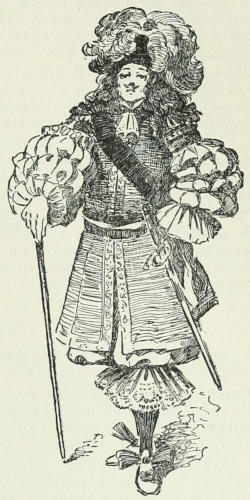
A French Gallant, First Half of Seventeenth Century
But Montmorency was now indignant at the insult offered to his rank in the person of Marillac. He felt it equally a shame that the king’s brother, the son of Henry IV, should be driven into exile by the enmity of an upstart minister. Gaston had fled to Lorraine, and there passed his time in the wooing and espousal of the duke’s daughter. Richelieu advanced to Lorraine, and Gaston was obliged to fly. He applied to Montmorency for protection and support, and the duke was both imprudent and generous enough to grant it. This could be done with arms alone. The dukes of Orleans and Montmorency therefore raised a little army, cantoned themselves in Languedoc, and resolved to fight the royal forces, which under Schomberg advanced against them. It appears that the population of the south looked with disfavour on the enterprise of the dukes, either in dread of Richelieu’s power and vengeance, or in dislike of the aristocratic cause. The issue of the rebellion was decided in a skirmish at Castelnaudary, where Montmorency, at the head of five hundred followers, charged the royalists, and was taken prisoner. The news of his capture dispersed his army, and left Gaston no resource but to join his mother at Brussels.
It was now in the power of Richelieu to give an example of his moderation. In pardoning Montmorency, he would have gained many hearts; nor would his power have been less formidable. Gaston even promised to submit, if his generous protector were spared: but Richelieu was inexorable; he knew what would be his own fate if overthrown. He recollected the fall of Ancre, of every favourite and minister whom the nobles had overthrown; and private reasons of vindictiveness concurred with the wish of making a striking example, and by the death of Montmorency giving the same salutary warning to his order as the execution of Biron had proved in the last reign. Richelieu had the power of communicating his own firmness to the king. Louis resisted the supplications of all the nobles of his court, of the princess of Condé, Montmorency’s sister, and even the clamours of the mob, who cried under the windows of the Louvre for mercy. The marshal De Châtillon begged the king to show himself to the people, and to grant to their prayers the life of the first noble of the land. “Should I obey the suggestions of the rabble, I should not act as a king,” replied Louis, displaying that extreme of monarchic arrogance which his posterity so deeply cherished and so dearly expiated. The kingdom’s safety might have been an excuse for cruelty—the pride of the monarch was none.
Montmorency owned his crime, and promised to redeem the disloyalty of a moment by devoting his after life to the king; but he made no mean submissions. In passing to the place of execution, he regarded the statue of Henry IV with emotion. He was the godson of that monarch, who knew how to unite clemency with firmness. But, shaking off thoughts of the past, he pointed onward to the scaffold, which he said was the surest road to heaven. In him perished the last of the lineal descendants of the great constable, the most illustrious of which were still said to be only the younger branch of that noble family.
FOREIGN AFFAIRS
[1629-1632 A.D.]
As soon as Richelieu felt assured that the political dissensions of France herself would no longer obstruct his plans abroad, he marched with firm step to that weakening of Spain and upsetting of the empire of which Nani speaks. Henry IV and Queen Elizabeth, in pursuit of the same ends, had sought and found the same allies. But Richelieu had better luck than they for the execution of his designs to run across the king of Sweden.t
Gustavus Adolphus was young, active, bellicose and surrounded by a military halo which permitted him to be looked upon as a future champion of Germany against the house of Austria. He had had several clashes with the emperor or his lieutenants over the Baltic towns, and the idea occurred to Richelieu to make use of his sword.l
Richelieu arranged a truce between the young king and the Poles with whom he was at war, in September, 1629; he then granted him by the Treaty of Berwald, in January, 1631, a subsidy of 1,200,000 francs, and threw him at Germany, pointing out, to excite his ardour, the immense booty to be seized, his co-religionists to be avenged, and the great rôle to be played on a brilliant stage.
The Thirty Years’ War was then at its height.[92] This struggle, both religious and political, began in Bohemia in 1618, and had extended little by little over the empire. The elector-palatine and the king of Denmark (Christian IV) had been, one after the other, vanquished and humiliated. The imperial army created and commanded by Wallenstein had penetrated as far as the Baltic, crushing under foot on its way, both Germany and her secular liberties. The oft-discussed problem of that country—that is, its partition among independent princes or its union under a single master, was on the point of being solved in favour of unity under the despotism of the house of Austria. Cardinal though he was, Richelieu acted like Francis I, like Henry II, and like Henry IV; he undertook the cause of the German princes without regard to their religion. His confidential agent, Father Joseph, managed the electors so well at the diet of Ratisbon in 1630, that they wrung from the emperor the recall of Wallenstein and the disbandment of his army, after which they refused to give the emperor’s son the title of king of the Romans, which Ferdinand II regarded as the implied price of these concessions. “A miserable Capuchin,” he cried in anger, “has been clever enough to put six electoral hats into his cowl.”
[1632-1634 A.D.]
Gustavus Adolphus fell upon the empire like a thunderbolt. He invented new tactics which disconcerted his adversaries. He defeated Tilly near Leipsic, killed him at the passage of the Lech, but was killed himself at Lützen (November 8th, 1632). “The world is for others,” he cried, as he fell. Richelieu picked up the hope and the fortune of the young hero. He was now free from all domestic anxiety and could employ his attention and his strength abroad. He boldly substituted in the struggle against the Austrian house, for exhausted Denmark and for Sweden bereft of her king, France full of youth and ardour.u
Richelieu still upheld his alliance with Sweden and the Protestant powers; and thus keeping the force of Austria employed, he was enabled to effect his next ambitious project, which was the occupation of Lorraine.
That province was in its origin feudatory to the empire, and was totally independent of France, except that from vicinity and interest its dukes were far more French than German. The Guises had drawn these ties closer. And now that the duke of Lorraine had harboured the duke of Orleans, and, against the king’s consent, had given him his daughter Margaret in marriage, the latter had reason or pretext for anger. Richelieu, as usual, caused an army, with the king at its head, to march to Lorraine. The duke was alarmed, and sought to parry the attack by offering to espouse Madame de Combalet, niece of the cardinal; but Richelieu refused to sacrifice the interests of the state to the aggrandisement of his family. Perhaps he saw in the offer a trap laid for him. Lorraine was invaded; and Nancy, its capital, besieged. The duchess of Orleans contrived to escape from it to Brussels; but Nancy fell into the power of the king. In vain did the duke negotiate, and make submissions; equally in vain did he resign his duchy in favour of his brother. The capital and fortresses were held in firm possession by Richelieu.
Here fell another noble, or rather an independent prince, from having espoused the quarrel of the duke of Orleans. Whilst the queen-mother gave signs of increased exasperation, by suborning an attempt to carry off the cardinal’s niece, Gaston began to be weary of exile. His favourite, Puylaurens, who had chief influence with him, was still more anxious; and Richelieu offered great advantages to the latter, if he would induce the prince to submit. Gaston at length did so, quitted Brussels abruptly, and repaired to Paris, where he was graciously and splendidly received. Puylaurens received the hand of the cardinal’s niece, and was created duke d’Aiguillon for his services. But Richelieu was a dangerous friend, except to an all-devoted servant. He sought to break Gaston’s marriage; and Gaston was obstinate in resisting. The cardinal laid the blame on the new duke d’Aiguillon, and without further pretext arrested and shut him up in the Bastille, where he soon after perished. Gaston was, as usual, enraged; and, as usual, allowed his rage to evaporate in vain menaces, and in vainer enterprises.
Wars with Austria
[1634-1635 A.D.]
The nobles checked, the Huguenot power destroyed, it remained to abase still lower the house of Austria, and to extend the territories of France at its expense. To make the Rhine the limit of the empire was the darling aim of Richelieu, as of Henry IV. Gustavus Adolphus and the Protestant princes of Germany had hitherto been instruments in Richelieu’s hand to effect or further this; but, since the death of the king of Sweden, the emperor had recovered his superiority, had defeated the Swedes, and reduced his enemies. It behooved France no longer to confine her efforts to negotiation; but to draw the sword, if she wished to preserve her ascendency or to prosecute her political schemes. She demanded certain advantages for thus declaring herself; and neither Sweden nor the malcontent Germans were backward in paying the price. Oxenstierna, the Swedish chancellor, ceded the fortress of Philippsburg to France. The league of Protestants put the whole of Alsace and its important fortresses under her protection. Lorraine was already occupied; and now Richelieu pushed northwards, and garrisoned Treves, forming, at the same time, a defensive alliance with Holland. Spain, informed of this treaty, sent an expedition to surprise the town of Treves; and war was in consequence declared by France against the emperor and the king of Spain, in the commencement of 1635. A herald was sent to Brussels to announce it; the last time that this species of feudal etiquette was observed.
Richelieu, the destroyer of the Huguenots, was thus leagued with the Protestant powers of Europe against its Catholic princes—a clear proof that his principles were politic, not bigoted. This war, which lasted thirteen years against the emperor and twenty-five against Spain, produced little glory to the minister, at least from its victories, and has brought as little interest to history.[93] It is marked by as much want of spirit as of talent. Yet the Thirty Years’ War in Germany, then drawing to its close, was marked with both. But religious differences had given ferocity to this war, which was carried on in the heart of Germany, and which put daily at stake the fate of kingdoms, capitals, and creeds. On the other hand, the war which we enter on was merely an extended line of frontier skirmishes, idle sieges, and fitful expeditions, in which Richelieu had the advantage, not from military but ministerial superiority. His vigorous administration enabled France to bear the expense and weight of the war, whilst the house of Austria, from the bad husbandry of more immense resources, became exhausted, and towards the close of it was in a tottering state. As to the lack of able generals, it may be observed that great military talent must necessarily be wanting at the commencement of a war, and that it requires half a score of years’ campaigning for the age and the nation to form its military system anew—the old never sufficing—and to find for that system a head and an arm capable of directing it. Turenne was a young officer at this epoch. It was not till the following reign that he and Condé were able to assert the superiority of French generalship.
[1635-1636 A.D.]
France entered on the campaign with four armies—one in the Low Countries, one on the Rhine, the others in Italy, and the Valtelline. The first exploit was one of promise and éclat. The marshal De Brézé was marching to join the Dutch through the country of Liège. Prince Thomas of Savoy, at the head of the Spanish, sought to prevent the junction. He was defeated by Brézé at Avein, and lost all his cannon and colours. Tirlemont was given up to the pillage of the victors. Louvain was besieged, and Brussels threatened. The unfortunate Marie de’ Medici was obliged to fly from the latter town, with the duchess of Orleans, pursued by the good fortune of her enemy Richelieu. Chance, however, may give a victory; talents can alone make the most of it. The French were obliged to retire behind the Maas. They and the Dutch, most ill-assorted allies, laid the blame of tardiness upon each other.
In the following year the imperialists had all the advantage. They penetrated into Picardy, passed the Somme, and took Corbie. Paris was in alarm, and her citizens began to retire southward. It was a critical moment for Richelieu. His ascendency over the king consisted solely in the monarch’s opinion of his sagacity and good fortune as minister. This opinion was greatly shaken; yet Richelieu kept a good countenance, and did all that the emergency required. He made the king show himself to the people; he despatched reinforcements to the count de Soissons, who commanded in Picardy. The Spanish knew as little as the French how to push an advantage. Instead of advancing upon the capital, they passed the time in pillaging, and were soon obliged to retreat. The court advanced to Amiens, whilst the army besieged and endeavoured to retake Corbie.
ATTEMPT TO ASSASSINATE THE CARDINAL
Here Richelieu’s good fortune saved him from new peril. The count de Soissons, son of that prince of the blood whose turbulence made him conspicuous in the first year of the regency of Marie de’ Medici, had stepped from the obscurity in which he had been kept, on the unexpected invasion of his government by the enemy. He had valiantly resisted; but the cardinal, who dreaded the renown of a prince of the blood, avoided placing any large force at his disposal, and at length brought the king himself to command and eclipse Soissons. The count vowed vengeance; he leagued with Gaston, ever ready to commence a plot; and they agreed to assassinate the cardinal at Amiens. Two gentlemen, named Saint-Ibal and Montrésor, were charged with the execution, but were to wait for the signal to be given by the duke of Orleans. An opportunity offered. Richelieu was alone at the foot of his staircase, which he had descended to his carriage, and in the midst of the conspirators. The agents had their hands on pistols, eagerly watching the countenances of both the count de Soissons and the duke of Orleans for the signal. Neither had the courage to give it, and Richelieu walked on; for the moment he was unsuspicious of the danger that he had escaped.
On reflection, the princes saw that the danger lay in having meditated the deed, rather than in having executed it. They tried other means, leagued with the Spaniards, and endeavoured to rouse the nobility to rebel. Épernon, to whom they chiefly applied, bade them, in answer, recollect the fate of Marillac and Montmorency. They did so, and fled from court; the count de Soissons to Sedan, and Gaston to Blois. But the latter was soon brought back by fair words.
CHARACTER OF LOUIS
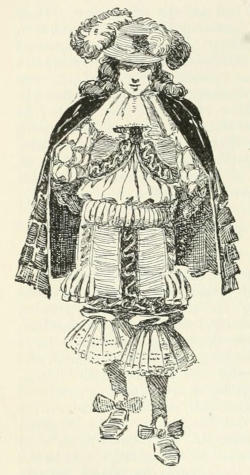
A French Gentleman, Time of Louis XIII
[1615-1638 A.D.]
In the midst of these intrigues, this warfare, these struggles betwixt nations and parties, Louis XIII was perhaps the personage who felt the least interested. “He led,” says Madame de Motteville,i “the most wretched and sad life; without court, or friends, or power; spending his time in catching birds, whilst his armies were taking towns.” He was plaintive, melancholy, retiring; not wanting either in good sense or in any other manly quality, perhaps, but cursed with a diffidence that neutralised them all. Thus he despaired of ever finding another minister like Richelieu; and, in fear of offending the cardinal, whom he might have controlled as well as employed, he resigned all authority into his hands. Another idea of his, proceeding from the same diffidence, and a great cause of discontent and sadness with him, was that he despaired to render himself agreeable to the fair sex. He was cursed with a bashfulness and a backwardness that he blushed to avow, and that he concealed under the colour of apathy and suspicion. This kept Louis XIII for a number of years a stranger to his young and not unlovely queen; as the same defect produced, in after years, a similar result with his descendant, Louis XVI. Anne of Austria, piqued by this coldness of her spouse, avenged herself by ridicule and sarcasm. The king’s indifference or distance thus became hatred; and Richelieu, who had cause to dread the young queen, fanned the latter sentiment. Louis nevertheless felt attracted towards female society, and he paid a kind of distant and formal court to Mademoiselle de Hautefort. This young lady as little understood his bashful and susceptible temper as did the queen, and Louis soon accused them both of leaguing together to mock him. The attentions of the king were then turned towards a new object, Mademoiselle de la Fayette, with whom the novel of De Genlis has perhaps rendered the reader familiar. She, of tenderer feelings and more penetration, knew how to appreciate the timid affections of the monarch. She cherished and returned them; never, however, overstepping the bounds of modesty. Louis, whose reserve, or “wisdom,” to use the words of Madame de Motteville,i “equalled that of the most modest dame,” at length ventured to propose an apartment at Versailles to Mademoiselle de la Fayette, who replied, after some hesitation, some intrigue, and certain interference, by retiring to a convent. The king wept, and was in despair; but his scruples would not permit him, like Louis XIV, to tear a beauty from the altar. He did not cease, however, to visit Mademoiselle de la Fayette at her convent; and long conversations were wont to pass between them through the grille or iron railing of the parlour. The monarch felt the influence of this virtuous young woman; her counsels, to which her piety now gave weight and her secure position boldness, prompted him to mistrust Richelieu, whom she represented as supporting heresy against Catholicism, and to give peace to Europe.
[1638-1641 A.D.]
Another voice, of equal weight with the king, was pouring the same sentiments into his ear. This was his confessor, the father Caussin, whom Richelieu had placed in that station, but who betrayed his confidence. To resist at once a mistress and a confessor was difficult, and the influence of the minister began to totter. One urgent counsel given to Louis by Mademoiselle de la Fayette and Caussin was that he should become reconciled to his queen; they showed, and even proved to him, that his suspicions against her were unjust. Richelieu, who observed the changed sentiments of the king towards Anne of Austria, was alarmed, and tried to prevent the reconciliation that he feared. Suspecting that the queen held a correspondence with Spain, he caused the police to visit and search her apartments at the Val de Grace. But his enemies were too adroit: no discovery was made, and the insult served but to display the unfounded rancour of the cardinal. After this the pious and generous voice of Mademoiselle de la Fayette had more influence; and, obedient to it, Louis XIII became reconciled for the time to his queen. The happy and unexpected consequence was the birth of a prince (afterwards Louis XIV) on the 5th of September following (1638). To this, however, the result was limited. Richelieu regained his ascendency over the king; the confessor was banished; Mademoiselle de la Fayette forgotten; and the queen, though no longer banished from the king’s presence, had as little share as before of his influence or friendship.
The fresh hold which Richelieu here took of the monarch’s confidence was owing, in a great measure, to the success of the war. In the beginning of the campaign two actions were fought at Rheinfelden, in the first of which the gallant duke de Rohan perished; in the second, the duke of Saxe Weimar defeated the imperials, and took their two generals, one of whom, the famous Johann von Werth, was sent to Paris. The principal consequence of this victory was the conquest of Breisach, the chief fortress of Alsace. The name of the town reminds us again of the celebrated Father Joseph, a Capuchin friar, the follower and confidant of Richelieu. We can scarcely imagine a statesman and an ambassador clothed in a monk’s frock and sandals: yet such was Father Joseph, a name more or less mingled in all the intrigues of the French court, and its negotiations with others. His influence was known, and he was dreaded by the court as a kind of evil spirit, in fact the demon of Richelieu. Although the latter never procured for his monkish friend the cardinal’s hat which he demanded, still the people called Father Joseph his “gray eminence,” at once to distinguish him from and assimilate him to his “red eminence” the cardinal. They had been friends from youth; congenial spirits in ambition, depth, and talent: the monk, however, sacrificed his personal elevation to that of the cardinal. Richelieu was much indebted to him: it was Joseph that roused and encouraged him, when stupefied and intimidated by the invasion of Picardy; and it has been claimed that after his death Richelieu showed neither the same firmness nor sagacity.[94] When Father Joseph was on his death-bed, Richelieu stood by it: it was a scene such as a novelist might love to paint. The conversation of the two ecclesiastics was still of this world; and the cardinal’s last exhortation to the expiring monk was, “Courage, Father Joseph, Breisach is ours!” a form of consolation characteristic of both.
REVOLT OF THE COUNT DE SOISSONS (1641 A.D.)
The count de Soissons, on the failure of his scheme against the cardinal, had taken refuge with the duke de Bouillon in Sedan. All the enemies of the latter, especially the exiles, looked towards this prince of the blood as the rallying-point, the support of their cause. Richelieu employed every art to pacify the count, remove his distrust, and entice him to court. All efforts proved vain; and Richelieu was even obliged to purchase the tranquillity of Soissons, and tolerate his independent posture. It was dangerous, however, to let such an example of disobedience subsist; and the cardinal at length sent an army, under the marshal De Châtillon, to reduce Sedan, and take or humble the count de Soissons. Châtillon was both valorous and skilful; but nothing could compensate for the ill humour and backwardness of the troops, who, with their officers, felt more inclined to a gallant prince of the blood than to the domineering cardinal. In an action that took place at La Marfée, near Sedan, the royal troops showed neither alacrity nor determination; and Châtillon, despite his efforts, was completely put to the rout. No obstacle seemed now to prevent the count de Soissons from marching to Paris, when the almost miraculous good fortune of Richelieu saved him from ruin. As Soissons rode over the field of battle, he pushed up his visor with his pistol; it was accidentally discharged, and the victor perished. Report did not fail to say that he was assassinated, and, of course, by the order of Richelieu; but there is no evidence to support such a rumour. Louis, who, on receiving tidings of the defeat, was preparing, with equanimity, to sacrifice the obnoxious minister, was now struck with his unvarying good fortune; and, with a superstitious feeling, bowed still lower to the cardinal’s will. The court did not share the monarch’s obsequiousness.e
CAILLET’S ESTIMATE OF THE ADMINISTRATION OF RICHELIEU
[1624-1642 A.D.]
Having regarded the great minister of Louis XIII as the politician who, after having conquered Protestantism and the reawakening of feudalism at home, continued abroad the work of Francis I and Henry IV, and finally subdued the power of Austria and laid the foundation of French ascendency in Europe, we hope now to show that Richelieu was as great an administrator as he was a politician, and that the sources of national wealth, as well as what was essential for sound administration, were subjects to which he gave deep and serious attention. It will be seen that he did not suffer the work of regeneration, begun by Henry IV and so disastrously interrupted by the dagger of the assassin Ravaillac, to fall to the ground. Undertaking in his boundless energy affairs of the most varied nature, this great genius gave a powerful impetus in every direction to the national activity, which, having been long restrained or wrongly directed, was ripe for producing great results.
Richelieu really laid the foundations on which Colbert and Louvois afterwards built under the eye of Louis XIV. To him is due the final triumph of pure monarchy, of that form of government which alone was legitimate at that time, because it alone could bring about and maintain unity in France. The kingship, elevated into a living symbol of the national welfare and of the best interests of the country, became a sort of rampart behind which Louis XIII’s minister, with indomitable energy, and with that breadth of mind which characterises a great man, carried on for eighteen years the work of monarchical centralisation. What he accomplished during this immortal dictatorship, in the midst of constantly recurring difficulties, is almost incredible. By destroying Protestantism as a political power, Richelieu made a distinct advance towards unity in the state. He gave a very essential bond of union to the higher administration by establishing the council of state, which remained practically unaltered till 1789. He rendered the triumph of monarchical authority over the new feudalism a certainty by lessening the excessive authority which the provincial governors had arrogated to themselves, by establishing resident overseers, who were energetic and obedient servants of the king, in various parts of the country to see that the law was properly administered, that the police were properly organised, and that the interests of the state in financial matters were not neglected; by commanding fortified places to be destroyed; and finally by his treatment of the most important members of the aristocracy as well as of the royal family, whom he punished or even banished when necessary, thus showing that the sword of the law was long enough to reach any head, however highly placed.
He obliged the parliament to keep strictly within the limits of its own judicial functions, and forbade its taking any part whatever in the management of public affairs. He maintained a perpetual struggle against provincial institutions, whose resistance, usually self-interested and unjust, tended continually to fetter the action of the central power. But though he abolished the power of all enemies of the royal prerogative, Richelieu himself was capable of holding very wide and liberal views. If he destroyed Protestantism as a political party, he rose above the religious prejudices of his time by adhering strictly to the terms of the treaties which had been concluded with the Protestants, and by fearlessly bestowing his favours and his confidence on many of them. If he compelled the nobility to renounce their claims to independence, he opened up to them new paths to fortune and power, he enabled them to engage in maritime commerce without any loss of dignity, he admitted them to the royal councils, and he founded schools for them. In short, he wished them to take the lead in the country by superiority of culture as well as of wealth. If he failed to assemble the states-general, he nevertheless did not claim to be independent of public opinion; he frequently summoned assemblies of important people and explained to them, in patriotic language, his great projects for the good of the country; he more than once took for his text the resolutions presented to the states of 1640 by the commons. Lastly, he created one of the most powerful engines of modern civilisation, the periodical press, by authorising the publication, under his patronage, of Renaudot’s Gazette.
Absorbed as he was by all these plans and preoccupations, Richelieu nevertheless found time to effect important improvements in all the public services. The statute of January, 1629, drawn up under the direction of Marillac, the keeper of the seals, summarises and completes the great statutes of the sixteenth century, and must be regarded as the most important attempt at codification previous to the time of Louis XIV. A stricter enforcement of police regulations increased the public security, whilst the numerous hospitals and benevolent institutions of all kinds founded at this time greatly ameliorated the condition of the labouring classes. Nor were manufactures, agriculture, and internal commerce neglected. Richelieu encouraged the formation of many companies whose object was to turn to account all the riches of the soil; he had the canal of Briare, begun in the time of Henry IV, finished, and he made wise regulations respecting the taxation of the common people and the allowance of provisions to be given to the troops, which improved the condition of the rural population. He was the creator of military administration; he gave France a merchant navy and a military navy, he organised consulates, concluded commercial treaties with Russia, Persia, Morocco, etc., and did much to encourage early French colonial enterprise. Literature, science, and the arts were also in a flourishing condition during this period. The special patronage accorded by Richelieu to artists and men of letters, whom he extricated from the precarious and humiliating position they had previously occupied; the creation of the French Academy,[95] the reorganisation of the Sorbonne, the foundation of the royal botanical gardens, of the royal press, and of the mint, prove how large a share in the striking development of the national genius which took place during his time may justly be claimed by the great cardinal.
It is difficult to believe that one single man can have carried out successfully so many plans whilst at the same time laying the foundations of internal prosperity and of political ascendency in Europe, and that amid such difficulties as no other statesman has ever succeeded in surmounting. And what makes all this the more wonderful was the frailty of the body which contained this invincible spirit, and which was liable to be prostrated by illness at any moment. Although Richelieu’s health was extremely delicate, and he was constantly falling ill, this extraordinary man seemed able to make his body obey his mind. He usually went to bed at eleven o’clock, and would sleep for three or four consecutive hours; then he would do some writing himself or dictate to a secretary till about six o’clock, at which time he would go to sleep again till between seven and eight, when he rose. Avenel has clearly proved that Richelieu kept some confidential secretaries night and day about his person, but that he had no offices. The secretaries of state, who were nothing more than his head clerks, used to come for his orders, get the necessary work done in their own offices, bring it when required to the prime minister for his inspection, and then signed the documents themselves. Richelieu only signed what was written in his own study. Father Joseph himself does not seem to have been permitted, any more than were the secretaries, the privilege of supervising the minutes signed by the cardinal. The latter wished everything to be seen and done by himself. To our thinking, nothing more striking could be conceived than the picture of this statesman fighting against sleep and death for every moment of his existence, in order to consecrate it to the glory of France.
What is specially characteristic of Richelieu, and gives him a distinct position among the founders of unity in France, is the clearness and the grandeur of his projects. Without foreseeing all the results of his system, results which he would no doubt have been unwilling to accept, he inaugurated with power and splendour that last social phase which the modern world was to pass through, before the light of a new era should shine upon it. Raising the kingship above family ties, and above all the traditions of precedent, he detached from it all foreign elements, and, isolating it within its own sphere, as a pure idea, he made it the living personification of the public welfare and the best interests of the nation. Thanks to this formidable weapon he broke away definitely from the traditions of the Middle Ages, and caused French society to enter once for all on the path of civil unity and equality. From the time of Louis the Fat to that of Louis XIV, the kingship had always pursued the mission which providence seemed to have laid upon it, to draw towards the shadow of the throne all the varied and inimical forces which divided the country between them; but there had been unfortunate intervals when it seemed almost as if the spirit of disaffection and anarchy would finally prevail, as happened after the reigns of Philip the Fair, Charles V, Louis XI, and after the death of Henry IV. From the time of Richelieu, the work of monarchical centralisation met with no further check. The kingship, having reached the height to which this great minister had raised it, was only to descend from that position in order to make way for a still wider and more productive form of government.
THE CHURCH AND THE STATE UNDER RICHELIEU
[1624-1639 A.D.]
Two great facts are of paramount importance in the history of the church of France during the first half of the seventeenth century. On the one hand a sort of intellectual and moral regeneration, a true religious renascence, was taking place in her midst, a movement which might be compared to the literary renascence which had taken place in lay society in the preceding century. On the other hand, the question so long debated between the temporal and the spiritual power was at last decided in favour of the former. Richelieu fought desperately against ultramontanism and loudly proclaimed the absolute independence of the civil power, and the necessity of having a national clergy whose interests should be bound up with those of the state.
The religious wars had left the French clergy in a deplorable condition. The church of France was in such a lax state that she seemed in danger of losing the fruits of the victory she had gained, by the incapacity or the vices of her members. However, we may say at once that this state of religious decadence was not irremediable. It was necessary to take prompt measures for reform, but the machinery for the work was there, and in greater completeness than appeared at first sight. It was only awaiting the workmen who were to set it in motion. If the wars of the league were responsible for great crimes and terrible outrages, they had also produced great virtues and fine characters. Men’s minds, somewhat enervated at the beginning of the sixteenth century by the introduction of a new morality, had regained their vigour in the struggle. Having erred temporarily they were nevertheless not weakened, and when the combat was over they felt an intense craving for action and for a living faith; two forces which, well directed, can accomplish wonders.
This condition of mind also explains the very practical tendency shown by the religious movement which then took place. Indeed one of the most remarkable features of this regeneration of French Catholicism was, as Henri Martinp observes, the predominance of the practical over the ascetic and contemplative element.
Richelieu did not intend to exclude either the nobility or the clergy from the administration of state affairs; on the contrary he treated the clergy just as he did the aristocracy. He sought to introduce members of the order into the king’s councils, but only on condition that they were sufficiently enlightened to be worthy of such a position. He acted in the same way with regard to the clergy. We see him giving most important positions, both military and naval, to ecclesiastics. What he insisted upon was that these two orders of the nobility and clergy should not subordinate the interests of the state to their own, as they had been too prone to do in former times. He wished the clergy to be part of the state and to belong to the state, and to contribute a fair proportion towards public expenses. In a word, he wished for a national clergy. Therefore in his struggles to maintain, in the civil power as well as in the religious order, the ascendency of the patriotic principles of the true Gallican spirit, Richelieu found himself supported by his bitterest opponent, the parliament, and deserted by the majority of the clergy, who saw in this extension of the civil power the possible abolition of their own privileges. In 1625, the clergy, in order to defend themselves from the constant demands for money made on them by the government, had decided that in future no deputy could vote subsidies under any pretext without having expressly received full powers in the matter, and that the opposition of a single province should be sufficient to annul the resolutions of the assembly. Richelieu replied that he could not admit the principle in virtue of which the clergy were claiming absolute immunity from taxation; that the needs of the state were real, while those of the church were chimerical and arbitrary; that if the king’s armies had not repulsed the enemy the clergy would have suffered much more.
The struggle about taxation between the civil power and the clergy attained still more formidable proportions in 1638. Richelieu seems to have made use of the brothers Dupuy to prepare the ground on which he intended openly to attack the immunities of the clergy in the matter of taxation. Pierre Dupuy in conjunction with his brother Jacques published anonymously, about the middle of 1638, his great work on the Liberties of the Gallican Church. He collected in the first volume some very daring tracts on the subject; then, following his usual method, he supported them by a second volume of official acts and significant precedents, systematically arranged under the title Proofs of the Liberties. In the tracts, published mostly during the troubles of the league, when the national orthodoxy of France was called in question, it was stated amongst other things that the pope had exercised no jurisdiction at all over the Gallican church during the first six centuries; that in the time of Clovis the sovereign head of the church after Jesus Christ was the king, not the pope; that the pope had no right to issue excommunications outside his own diocese; that there is no instance of either the popes or their legates presiding at any council held in Gaul before 742; that the said popes had not then any title which placed them above the other archbishops, and indeed did not possess any which was not common to them all. As for the proofs, “great care had been taken not to draw deductions from the acts; our kings, the assembled bishops of France, the parliament, and other sovereign bodies, the universities and some of the communities of the kingdom, were the authors of this work.” This was an adroit way of assuming the consent of the whole nation during many centuries.
The clergy understood the significance of the attack, and protested strongly against doctrines which they thought would declare them independent of Rome only to make them the slaves of temporal power. On the 9th of February, 1639, eighteen bishops met at the house of Cardinal de la Rochefoucauld and drew up a letter denouncing “this work of the devil” to their colleagues in a most violent manner. The cardinal undertook to deliver this letter to Richelieu. How the minister replied is not known; but from that time edicts more violent than ever were issued against the clergy.
[1639-1640 A.D.]
Amongst the bishops was one, the bishop of Chartres, who was entirely devoted to the cardinal, and who supported him strongly in his struggle with the church. He succeeded, it is said, in recovering a copy of all the edicts issued against the church in the most disturbed times and sent them to the superintendent Bullion. The latter made a report on them to the cardinal, and on the 16th of April, 1639, appeared an edict in which it was set forth that “ecclesiastics, communities, and other persons falling under the statute of mortmain are incapable of holding real property in France, that the king can compel them to pay dues on it within a year and a day of acquiring it, and in default of this the king may add the said property to his own domains; that the king is willing nevertheless to be satisfied with the payment of the indemnity for royal and feudal rights, which is due to him by his claims under mortmain; his majesty commands that these rights shall be sought out wherever they exist, in all sorts of livings, foundations, hospitals, confraternities, etc., excepting only the new communities, established thirty years ago, of the Jesuits and the Carmelites.” The edict commanded that the research should extend as far back as 1520. This was, according to financiers, a matter of nearly eighty millions for the state. A short time after, an order appeared commanding the alienation of 200,000 livres a year on the Hôtel-de-Ville, guaranteed for five years only by the clergy, and imposing on the latter a perpetual responsibility for these 200,000 livres, and this without their own consent. The irritation of the clergy had reached a climax. They protested forcibly against this measure. Richelieu thought it would not be wise to push things to extremities. A declaration issued on the 7th of January, 1640, announced that the king would be satisfied with a levy of 3,600,000 livres as a compensation for his royal rights.
It was then that Dupuy, seeing that the king’s authority was waning, published a violent discourse in defence of the king. Upon this an obscure priest named Hersent undertook in a Latin pamphlet, entitled Optatus gallus, to defend the rights of the church and denounce the machinations of those who were trying, he said, to foster schism in France. The parliament by a decision dated March 23rd, 1640, ordered the Optatus gallus to be torn up and burned “as casting doubt on the authority bestowed on sovereign princes by God.” On the 28th of the same month, the archbishop of Paris, F. de Gondi, with Léonor d’Étampes bishop of Chartres, Nicolas bishop of Orleans, and Séguier bishop of Meaux, signed a declaration couched in almost the same terms, and having for its special object to repel most decidedly the accusation of schism made against the cardinal and a portion of the French clergy by the author of the Optatus gallus.
As for the government, it recommenced its attacks on the clergy and, no longer satisfied with the 3,600,000 livres at first demanded, it called upon all holders of livings to pay over the sixth part of their income for two years (6th of October, 1640). The edict was published under the seal, and a chamber was established at the Louvre composed of councillors of state, both ecclesiastic and lay, and magistrates, whose function it was to carry out the provisions of the edict and settle the law. Berland, the prior of St. Denis-de-la-Chartre, who, having entered the clerical agency and not being recognised as an agent, had not the keys of the archives at his disposal, had the audacity to break in the doors and carry off the old assessment rolls, amongst them that of 1583, and to hand them over to the superintendent. When the new assessment was drawn up the agents of the clergy were desired to sign it. The abbé Saint-Vincent immediately formed an opposition party. This was suppressed by a decision of the 10th of November, which also forbade the agents “to hold any meeting either general or particular without the king’s permission.” The abbé Saint-Vincent then wrote to the dioceses telling them that all was lost. They decided to write to the cardinal and even the king, to appeal to his holiness, and to order public prayers to be offered up. In short, the clergy were in a state of indescribable tumult. The most violent accusations were hurled against this tyrant, this apostate, who was violating the privileges of the church, and trying to reduce her to a state of slavery which was quite unprecedented. Richelieu, however, who was at this time involved in a gigantic struggle against Austria and Spain, was anxious to be freed from all these entanglements at home. He appeared to give way and agreed to accept from an ecclesiastical assembly what he found it difficult to obtain by force. A general assembly was summoned at Mantes at the beginning of 1641. The government demanded 6,600,000 livres in all. The debate was long and stormy. The sieur d’Émeri was deputed by the king to signify to the archbishops of Sens and Toulouse and the bishops of Évreux, Maillezais, Bazas, and Toulon that they must leave the town, and each one retire to his own diocese without passing through Paris.
On the other hand the minority, who were devoted to Richelieu, made some very bold speeches. The affair finally ended according to Richelieu’s desires. The government reduced its claims to five and a half millions, which were voted by the majority on the 27th of May.r
THE CONSPIRACY OF CINQ-MARS (1641-1642 A.D.)
[1641-1642 A.D.]
One more effort was made to shake off the trammels of the hated cardinal. A conspiracy was entered into to deliver the land by the old Roman method of putting the tyrant to death; and the curious part of the design is that it was formed almost in the presence of the king.j
Louis XIII had at that time a favourite, Henry d’Effiat, son of the old marshal and marquis de Cinq-Mars. He was a young man of twenty-two years of age, with a handsome face, finished manners, magnificent and extravagant. The king, always gloomy, found the need of an agreeable person, capable of diverting his thoughts, and even of amusing him. Having formed an affection for Cinq-Mars, he gave him in succession the posts of keeper of the wardrobe and grand equerry. Richelieu, whose close observation extended even over the intimate friends of Louis XIII, did not take umbrage at the favour bestowed upon a young man of so frivolous a nature, son of a father who had been one of his most devoted servants, and step-brother of the marshal De Meilleraie; on the contrary he felt that the equerry usurped the place in the king’s confidence of one of his declared enemies, Mademoiselle de Hautefort.
But Cinq-Mars was a young madman and, as Monglat said, too presumptuous. Intoxicated by his success, thinking he could do in all things as he pleased, he began to show an inordinate ambition. He dreamed of the fortune of Luynes; he wished to be a duke and a peer, and to command the armies. Richelieu treated him like a child. Louis XIII had enough strength of mind to resist these follies, but not sufficient to send him away from him. He quarrelled with him, became reconciled again, and treated him as if he were a spoiled child. They called the equerry “the king’s plaything.” Cinq-Mars—offended at the way in which the cardinal snubbed him, encouraged, moreover, by the society of the Marais in which he was considered a success, and which was not afraid to show political opposition, in words at least—thought that he could, thanks to the liberty which Louis XIII granted him, compass the downfall of Richelieu. Louis XIII, like everyone else, felt the burden of his powerful minister’s rule. He allowed his favourite to talk; he even listened to him willingly, without taking him seriously. At heart he looked upon Richelieu as a necessary man and one whom he could not do without, as much from habit as from a conviction of the superiority of his genius. He told Cinq-Mars that he need never think of replacing him. Cinq-Mars then, with his daring and swift imagination, conceived the most incoherent ideas, such as killing the cardinal, waiting for his death, which the failing condition of his health made him think might be very soon, or bribing Gaston who would become regent if the king were to die. Each day he changed his plans, deciding upon no particular one. He had made vows, and probably more than vows, for the success of the count de Soissons. After the battle of La Marfée, he was advised to leave court, because of the suspicions that had arisen against him; he refused, hoping to refute them by his presence, and to think of some new plan by which he could compass the end he desired.
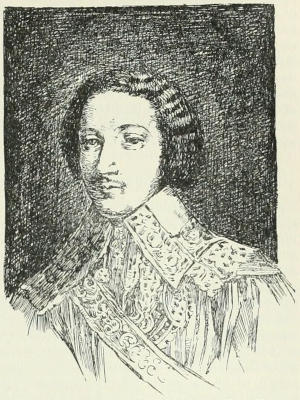
Henri Coiffier de Ruzé, Marquis de Cinq-Mars
(1620-1642)
Notwithstanding the risk, he formed a conspiracy. He tried to come to an understanding with the duke of Orleans, who might become regent, and also with the duke de Bouillon, whose fortress of Sedan was admirably situated to furnish him a refuge should he be obliged to fly from France. It was beginning over again the plot of the count de Soissons. Gaston answered vaguely, according to his custom, leaving others to act, and doing nothing himself. Bouillon showed himself more decided. Although he had accepted from the cardinal the command of the Italian army, he believed himself able, should the conspiracy prove unsuccessful, to withdraw to Sedan, and there await the death of the king. Francis Augustus de Thou, son of the historian, an inconsistent, restless, and nervous person, served as a go-between for the equerry, with the duke de Bouillon, and even with the queen. Bouillon simply observed that an army was necessary to protect Sedan. Cinq-Mars and Gaston then sent into Spain an agent, Fontrailles, with some blank signatures, to demand troops and a subsidy, and to propose a treaty. Olivares seized this opportunity to cause Richelieu trouble. Seriously or not, he accepted the proposals which Fontrailles made to him; he signed the treaty, scarcely discussing the terms of it, and contented himself with exacting from the princes a promise to restore to peace all that France had wrested from Spain. Fontrailles returned to Narbonne, where he found the conspiracy half divulged, and the head equerry decided to undertake nothing until he knew how the cardinal’s illness would end. The duke of Orleans, carried away by the passion and zeal of some of his followers, but always irresolute and full of contradictions, had not left Blois; Bouillon was in Italy at the head of the army, they could not even communicate with one another. Fontrailles took a great deal of trouble to establish a secret correspondence between them. It was not only the illness of the cardinal that induced them to wait, but also the striking failure of the king’s health. Cinq-Mars only looked upon the treaty as a last resource which they could keep back for a time. Gaston demanded that it should be given to him; then when Cinq-Mars, after much resistance, decided to send it to him, he kept it without signing it, or addressing the ratification to the governors of the Spanish Netherlands, as they had agreed to. Fontrailles fled to England.
RECOVERY AND TRIUMPH OF RICHELIEU
For a whole month Richelieu hung between life and death. At last he recovered, not indeed his health, but that energy which even suffering could not keep under. Prostrated by infirmity and pain, he appeared to have scarcely a spark of life, but, notwithstanding, never has one seen a finer example of Bossuet’s mot: “A courageous soul is master of the body it animates.” Retiring to Tarascon, a healthful and lonely town, under the care of the count d’Alais, governor of Provence, the cardinal, in spite of illness and absence, did not cease to rule the king, the government, and the army. A rumour was circulated that his retirement was due to fear; his enemies made a last attempt to destroy his influence over Louis XIII, but he triumphed over them on this as on all former occasions. The king, wearied by the length of the siege of Perpignan, and ill himself, left the camp to establish himself at Narbonne. There he fell a prey to the most contrary anxieties. He saw himself beset and spied upon on one side by Cinq-Mars, on the other by Chavigny and the Noyers. But, apart from the fact that he was in no wise willing to sacrifice Richelieu, he could perceive that the principal leaders and officers of the army were partisans of the cardinal, that the vain boastings of the equerry were displeasing to the military men, and that the latter indulged the maddest schemes for making himself well thought of. He was already very weary of his favourite, when on the 10th of June, 1642, he received a copy of the Spanish treaty that Richelieu sent to him at Narbonne by the intervention of Chavigny. How did this copy get into the cardinal’s hands? No one could tell; according to the most likely conjectures, he obtained it through one of his secret agents or by the treachery of the abbé De la Rivière, who sought his favour, or through a servant of the duke of Orleans. Louis XIII was most indignant, and no longer hesitated. On the 12th he ordered Cinq-Mars, De Thou, and two others, to be arrested. Cinq-Mars remained concealed all one day in a house in the town, but he was discovered, and imprisoned in the citadel of Montpellier. Bouillon was arrested in Italy by his brigadiers at the head of the very army that he commanded. Gaston only was not pursued. The abbé De la Rivière came in his name to acknowledge his fault and to beg for the royal pardon.
The king went to Tarascon to the cardinal to assure him that his sentiments had not changed, and that he wished to await with him the end of this great trial. We are told how Richelieu was in bed; how Louis, himself ill, was obliged to have a bed made up for himself by the side of Richelieu, and how they discussed thus the measures they ought to take. They decided that Gaston should be questioned and then pardoned, but on the condition of his making a full confession, the only means of convicting the accused parties. Louis XIII was unable to return to the army; he went to Fontainebleau by easy stages, arriving there the 23rd of July. Whilst on the road he heard of the death of his mother; Marie de’ Medici had left England, where her presence was looked upon as a public encumbrance. Not finding the inhabitants either of Spain or of Holland willing to receive her, she went to Cologne where, at the house of the archbishop elector, she terminated the anxieties of her wandering life. The chancellor and the members of parliament claimed that a prince could not be cross-examined like anyone else, and that it was necessary he should give his declaration in writing. This mode of procedure had been adopted towards the duke of Orleans. The judges received his declaration at Villefranche on their way to Lyons, where the commission would sit. This commission was composed of state counsellors, of masters of requests, and of several members of the Grenoble parliament. Cinq-Mars had been transferred from the citadel of Montpellier to that of Pierre-Scize. De Thou had been taken to Lyons in a boat towed up the Rhone by that of the cardinal. Bouillon was brought there from his side. Richelieu had started by going up the Rhone slowly, for he could not bear the least fatigue. As this navigation was very laborious, he left the river at Valence and was placed in a great litter, or room, made expressly and carried upon the shoulders of his musketeers, who succeeded each other in relays. He was partially paralysed, incapable of moving or even of signing anything; nevertheless he never ceased working, having beside his bed in this portable room a chair and a table for a secretary. In this fashion he arrived at Lyons. He remained there only a few days, leaving before the end of the trial, and continuing his strange journey, partly by land, partly by the Loire and the recently finished canal of Briare.
Gaston’s declarations left no doubt as to the reality of the plot. Cinq-Mars did not deny it; he owned to everything, and appeared before his judges with a bearing as noble as it was courageous. As for De Thou, he had played an absurd part, and one full of contradictions; “he was concerned in everything,” said Fontrailles,k “and denied knowledge of anything.” Priding himself upon a scrupulous loyalty and delicacy of conscience, he was made the confidant of all the conspirators and all the conspiracies invented against the cardinal and against the king. He had got it into his head that his name, his character, his title of former minister of state would assure him a high place in the government that should succeed to that of Richelieu. He was then mixed up with the enemies of the cardinal; he had even, which was far more serious, warned the queen of what was being prepared. Of his complicity there was no doubt. His guilt was not so certain.
The judges passed a sentence of death. Cinq-Mars was condemned unanimously; De Thou unanimously but for one voice. The execution took place at once upon a scaffold erected in the middle of the place des Terreaux (September 13th). The grand equerry and his friend died with as much dignity as resignation. De Thou, whose eager mind was filled with the deepest sentiments of religion, showed a martyr’s enthusiasm. Neither of them protested against the blow which struck them, but their youth, the sensation they had caused, the candour of their answers at the trial, their noble bearing upon the scaffold deeply affected the town of Lyons. “M. de Thou,” wrote Marca, one of the judges, “died like a Christian and a brave man. M. le Grand also showed an equal firmness and met his death with an admirable confidence, composure, and Christian devotion.” The sight of this execution awoke a very natural pity, seeing that the public knew little of the details of the plot. It was regarded as the last act of vengeance of a minister who felt his power ebbing with his life.l
THE LAST DAYS OF RICHELIEU
[1642-1643 A.D.]
The tempestuous year of 1642 was drawing to a glorious close. Fortune, after long wavering, threw itself on the side of France. Austria was humiliated and France was in the ascendency. Henry IV had won independence for her, Richelieu gave her supremacy; the work of Charles V and Philip II was undone forever. France resumed the position at the head of the nations which she had held when she led Europe in the Crusades of the Middle Ages. This grand symphony of victories resounded about a funeral pyre. All these conquered standards were lowered before a dying man. The epic poem that astonished the world for eighteen years was not to lack a majestic end; the hero was to be buried in the triumph which providence did not permit him to complete.
The victory over Cinq-Mars, and above all the general success of the French policy, had for a few months brought back the life that was ebbing away; but the slow dissolution of the worn-out organism had continued. On the evening of the 28th of November Richelieu, after returning from Ruel to the palais Cardinal, was taken with a violent fever, with pain in the side, and spitting of blood; four bleedings were insufficient to allay the fever. On the 2nd of December public prayers were offered for the sick man in all the churches of Paris, and the king came from St. Germain to see him. Richelieu talked to Louis like a man resigned to death, asked him to protect his family in memory of his services, recommended to him the ministers Noyers and Chavigny, and especially Mazarin whom he represented, it is said, as the person most capable of filling his own place; and finally submitted to the king a declaration which he had just had drafted against the duke of Orleans, to exclude that prince from all right to the regency and the administration of the kingdom in case of the death of the king. This was the last service that Richelieu rendered to France.
After the visit of the king the cardinal, feeling worse, asked the physicians how long he might still live. They, wishing to flatter the master to the very mouth of the tomb, replied that there was no need to despair—that God, seeing how necessary he was to the welfare of France, would intervene to save him. The cardinal shook his head and calling back one of the royal surgeons said, “Speak to me with open heart, not as a physician but as a friend.” “Monseigneur,” said the physician, “in twenty-four hours you will be dead or well.” “That’s the way to talk!” said Richelieu, “I like that.” He sent for the curate of St. Eustace, his parish. “Here is my Judge,” he said when the consecrated host was presented to him, “my Judge who is soon to pronounce my sentence. I pray him to condemn me if in my ministry I have followed any other end than the welfare of religion and of the state.” “Do you forgive your enemies?” asked the curé. “I have never had any but the enemies of the state.”
Most of those present contemplated the dying man with admiration, some with fear. “Here,” said Cospéan, the bishop of Lisieux, “is an assurance that dismays me!” Doubtless Richelieu,m in order to fortify his conscience, repeated the maxims of those two Latin testaments which contain his supreme thought; his official will in which he disposes of his dignities and his wealth concerns only his family; the other two are addressed to posterity. “I have been severe to some,” he said, “in order to be good to all. I have loved justice and not vengeance.” Was he very sure of it? “I have tried to give to Gaul the boundaries that nature intended for it, to identify Gaul with France, and to establish the new Gaul wherever the old one was.”
On the afternoon of the 3rd of December the king came to see the cardinal for the last time. The physicians, having no more hope, had given up the sick man to empirics, who gave him a little relief. But his feebleness was increasing; on the morning of the 4th, feeling the approach of death, he made his niece, the duchess d’Aiguillon retire, as she was “the person whom he had most loved,” according to his own words. This was the only moment, not of weakness, but of tenderness, that he had; his indomitable firmness had not given way during his long suffering. All present, ministers, generals, relatives, and servants, burst into tears; for this terrible man was, according to the testimony of his least favourable contemporaries, “the best master, relative, and friend that ever was known.” Towards noon he heaved a deep sigh, then a feebler one, then his body collapsed and was still; his great soul was gone. He had lived fifty-seven years and three months, the same number of years as Henry IV.
Human judgments [continues Martin] have been and still are contradictory concerning this minister of salutary harshness, this strong-armed labourer who is accused of having pulled up from French soil the good grain along with the tares. The most opposite opinions are in league for and against his memory. Before 1789 lords and commons, after 1789 ultramontanes and a large part of the liberals heap abuse upon him. Retzn claims that Cardinal Richelieu traded on all the evil intentions and all the ignorance of the last two centuries, in order to form in the most legitimate of monarchies the most scandalous and most dangerous tyranny. Montesquieuo believes that “the most harmful citizens of France” were Richelieu and Louvois.
On the other hand the partisans of unity and of strong and vigorous power, whether monarchists or democrats, rise in favour of the great man, as do all those who put the love of country above all other social or political sentiments. The Moniteur of 1789, as the mouthpiece of this party, exclaims with the voice of the Revolution itself: “Let the aristocrats rage against the memory of this intrepid minister who overthrew their pride and avenged the people for the oppression of the great. By sacrificing great victims to the tranquillity of the state he became its pacifier. He was the first to apply true remedies to the root of the evil by degrading the intermediate powers that had enslaved the nation for nearly nine centuries. Nothing that can make a vast kingdom powerful and glorious escaped his indefatigable activity.”
The popular instinct however has not decided the question as it has for Henry IV. The abstract and half veiled greatness of this invalid who from his bed overturned empires has not taken hold of the heart and the imagination of the unlettered masses and imprinted its pale mysterious figure in ineffaceable lines. The man who did most for the greatness of France is little known by the French people: is this the punishment for his severity towards the suffering masses and for his harsh maxims? “If the people were too much at ease, it would not be possible to hold them within the rules of their duty.”p
When the king heard of the death of his minister he coldly remarked: “A great statesman is dead.” He survived him but six months. A few days before his death he named Anne of Austria regent and Gaston, his brother, lieutenant-general of the kingdom. Louis XIII felt great remorse for the assassination of Marshal d’Ancre and for his treatment of his mother, the queen. He died at the château St. Germain, at the age of forty-two years. One of his contemporaries says of him that he was so indifferent in his government that all the world awaited his death with impatience, even those who owed most to him.c
STEPHEN’S ESTIMATE OF LOUIS XIII AND OF RICHELIEU
Louis XIII [says Stephen] was a man of large and just capacity. His ideas of the duties of his station were princely and magnanimous. He lived in profound submission to the law of his conscience, in the fear of God, and in veneration for all men in whom he saw, or thought he saw, any image, however faint, of the divine beneficence and power. But he was of a feeble, indolent, and melancholy spirit. He was habitually wrapt in reveries, sometimes splendid, though more often gloomy; but he was always incapable of prompt or decisive action. Though a king, he never was and never could have been a free man. It was among the necessities of his existence to live under the government of a master. After selecting and rejecting many such, he at length submitted himself to the dominion of Richelieu, and thenceforward endured that bondage to the last. He endured it certainly, neither from attachment nor from fear, but because, as often as he struggled to regain his liberty, his efforts were baffled by his admiration of the genius of his great minister, and by his persuasion that no other man could so effectually promote the welfare of his state and people.