Chapter XX · LOUIS XIV, SPAIN, AND HOLLAND
Reading edition
I doubt whether any human being ever enjoyed, in greater perfection, the blessing of nerves toned to habitual energy, and exempt from all morbid sensitiveness. Heat, cold, pain, fatigue, and hunger seemed to have no power over him. Not only his delicate courtiers but his hardy veterans admired the stoicism of their invulnerable king; and his mental composure was on a level with his bodily hardihood. No provocation could excite him to unseemly anger, and no calamity could depress him to unmanly dejection. If he was often the victim, he was never the slave of appetite or passion. Though constantly exposed to the allurements of the most exquisite flattery, and the most fascinating caresses, he never yielded himself to the guidance of any favourite, male or female; but adhered, with immutable constancy and calmness, to the ministers whom he had either trained or chosen.—Stephen.n
[1661-1679 A.D.]
The foreign situation in 1661 was most favourable. If it was necessary to wind up the affairs of Mazarin, all that had to be done abroad was to gather the fruits and enjoy the glory acquired. Europe was basking in a peace so profound that not a cloud seemed to threaten it. The powers were all occupied in reorganising their forces, some like England in reconstructing their government. Louis XIV was one of the freest of sovereigns; he was the most powerful, thanks to Mazarin; and he became the wealthiest, thanks to Colbert.
He desired them to preserve peace and give no offence to Europe. Nevertheless he had inherited from Mazarin a fixed plan, and certain projects in harmony with the spirit of his government. His ambition was to invalidate the renunciation of Maria Theresa, in such a manner as to create a right for himself or his sons to the Spanish succession, or at least to the Netherlands.[127]
He charged the archbishop of Embrun, his ambassador at Madrid, to demand that the renunciation be revoked. He maintained that it was not ipso facto, the infanta not having renounced her rights and the court of Spain having itself thus decided; that in all respects it had failed to obtain the necessary ratification; finally that the condition on which it had been made, the payment of a dowry of 500,000 crowns, had not been complied with. He offered, in case his plea was accepted, to ally himself the more closely with Spain, and even abandon all claims to Portugal in her favour; but Philip and his ministers eluded the question and refused to give an opinion.
[1661-1662 A.D.]
During the negotiations a serious affair occurred in London, where the baron de Vatteville, the Spanish ambassador, claimed precedence over the count d’Estrades, the ambassador of France. On October 8th, 1661, the Swedish envoy, the count de Brahé, was to be presented to the king of England. As the procession was about to start, D’Estrades tried to make his coach pass first, and a troop of armed men under orders from Vatteville stopped it. The Londoners took the part of the Spaniards; there was a fight—some were killed and wounded. In the end the French were obliged to retire.b
At this news Louis XIV ordered the Spanish ambassador to leave France, and the French ambassador to Spain to demand the punishment of Vatteville and a reparation which should make such affairs henceforth impossible.c
Philip IV granted this without much difficulty. Vatteville was recalled; and March 22nd, 1662, the marquis de Fuentes declared at the Louvre before the assembled court that the Spanish envoys would claim no precedence over those of France, except at the court of Vienna where they had long been accustomed to occupy the first place on account of the close ties which united the two branches of the house of Austria.
Meanwhile Spain still refused to recognise the rights of the infanta, and Louis XIV continued to uphold the Portuguese;[128] he even assisted in bringing about the marriage of Charles of England to a princess of the house of Braganza, who received Tangier, Bombay, and a considerable sum as dowry. Charles II sought, as did Cromwell, to develop English commerce and the navy, but he was needy, extravagant, and he feared the parsimony of parliament. Louis XIV advanced him money in secret and offered to buy back Dunkirk and Mardyck.[129] The bargain was concluded November 27th, 1662, and France recovered the two towns which Mazarin had turned over to Cromwell with regret.
By this acquisition Louis XIV took a first step towards the Netherlands, the object of his whole ambition. He awaited the moment when the question of Philip IV’s successor should be opened to uphold the rights of the infanta in the Belgian provinces, even though the determination of these rights was still a matter of debate. He wavered between the desire to reunite the major part of the Spanish Netherlands to France, giving the rest to Holland, or to occupy only a few places and erect the ten Belgian provinces into a republic or a neutral state. The latter plan was the less brilliant, but the easiest to carry out; and a state thus constituted would oppose a barrier to foreign invasion. Louis XIV negotiated in secret to obtain the eventual concurrence of Holland in his plans, but in spite of the efforts of the grand pensionary, the celebrated Jan de Witt, he could not obtain this. The Dutch understood too well that a Belgian republic would be dependent on Louis and would not oppose his ambitions.b Besides this the Dutch had a cause for complaint in the tax of 50 sous a ton, placed by Fouquet in 1659, upon foreign ships trading in French ports. After long debates this tax was reduced by half for Dutch ships and a defensive and commercial treaty was signed in 1662 in which France and Holland agreed to protect each other’s rights on land and sea.a
The duchies of Lorraine and Bar had been returned to Duke Charles IV in 1661 only on condition that he would not rebuild the ramparts of the towns, that he would only maintain one fortress, Marsal, and that French troops should have the right of passing through his territory. These conditions were not fulfilled. Louis lost patience and sent an army corps to Marsal. The duke bent before the necessity, and gave up Marsal on condition that he might hold the rest of his estates according to the terms of the treaty of 1661.c
Louis, admirably counselled by Lionne, took care in preparing the execution of his designs against the Netherlands not to arouse the defiance of Europe. He managed only ostensibly to sustain the Portuguese; simply authorising them to take into their service Marshal de Schomberg and a body of French volunteers which helped them defend their liberties.[130]
[1663-1665 A.D.]
While Louis was feeling his strength he eagerly seized any opportunity for military enterprise which would give a high idea of himself and serve his policy.b In spite of his rough treatment of the head of the church in 1662-1664, he displayed zeal for the interests of Christianity against its great enemy the Turks, who continued to press the siege of Crete[131] and extend their conquests in Hungary and to desolate by piracy the entire coast of the Mediterranean. Divers plans were proposed in the king’s council for attacking the Ottoman power on the Barbary coasts and repressing the pirates. A squadron commanded by the duke de Beaufort, the former hero of the Fronde, landed 5,000 picked soldiers at Jijelli, a small Algerian port between Bougie and Bona. Jijelli was taken without difficulty (July 22nd, 1664), but discord arose between Beaufort and his officers. They were soon hard pressed by the Turks of Algiers, reinforced by numerous Arab and Kabyle bands, while Beaufort cruised in front of Tunis instead of making a diversion against Algiers, as the king had ordered. The military resources of the Algerians and especially their artillery were greater than the French had imagined; discord broke out, and after having repelled a few attacks the French were compelled to re-embark in such haste that they left their cannon behind.
But the successes of Beaufort’s squadron, which the famous Chevalier Paul commanded, soon wiped out the stigma of this reverse; two Algerian flotillas were annihilated during the course of the year 1665.c
A touching example of self-sacrifice was an incident of this war. The dey of Algiers had among his captives an officer from St. Malo, named Porcon de la Barbinais; he sent him to offer to the king proposals of peace, making him promise to return in case his mission failed. The lives of 600 Christians were dependent upon his keeping his word. The propositions were not accepted. Porcon knew it. He went to St. Malo, regulated his affairs, then returned to Algiers, certain of the fate which awaited him. The dey had him decapitated. This man was the equal of Regulus, yet he is little known to fame.d
Reasons and pretexts for war with the porte were not long wanting. In 1664 some acts of bad faith on the part of the viziers were taken as an excuse for sending 6,000 men under the orders of Coligny-Saligny into Hungary, which the Turks were invading. This was a means of dissipating the religious clouds which the threats against the pope had raised at Rome and elsewhere. Louis XIV had still another reason. He had undertaken in obtaining a [three years’] prorogation of the league of the Rhine (1663) to furnish a contingent to his imperial allies in case the empire should be threatened. He attached the highest importance to maintaining a league whose principal object would be to close the road to the Netherlands to Austrian troops if ever war should break out between France and Austria, and he believed it all the more easy to play the rôle of protector in Germany since the emperor’s power there had sensibly declined since the Treaty of Westphalia.
Coligny-Saligny joined the Austro-German army commanded by Montecuculi; the French took a considerable part in the combat at Körmend, and especially in the battle of St. Gotthard (August 1st, 1664), where they paid dear for the principal honour of the victory. But the emperor and Austria, grateful though they were, could not pardon the French for having claimed to have saved the empire. Leopold hastened to treat with the Turks, and was as eager to deliver himself from his auxiliaries as he was from his enemies.b
Indeed the emperor was alarmed, and not without reason, to encounter the hand of Louis everywhere. A defensive alliance was concluded in August, 1663, between France and Denmark, as the result of a commercial treaty, advantageous to the French marine. A secret negotiation of the very highest importance was, about the same time, entered upon with Poland. Since 1661 that republic had taken Louis XIV as arbiter in its quarrels with Moscovy. In 1663, King John Casimir Vasa, discouraged by Poland’s constant woes, determined to lay down the crown: his wife, a princess of that branch of the Gonzagas which had long been established in France, entered into communication with Louis XIV to bring about the election of the duke d’Enghien, son of the Great Condé, to the Polish throne. With regret Louis saw Poland plunging to her own ruin, and decided to arrest the disaster by doing again that in which Henry III had so disgracefully failed—infusing French spirit into the land of the Jagellons. Colbert pushed the king to the same policy.c
THE WAR OF THE QUEEN’S RIGHTS (1667-1668 A.D.)
Meanwhile Louis XIV had not succeeded in having Maria Theresa’s act of renunciation revoked, and he now thought of compelling Madrid to recognise the right of devolution.
Such was the name given in Brabant and some of the other Belgian provinces to the law, by virtue of which, when there were children of two different marriages, those of the first inherited in preference to those of the second. Louis XIV claimed Brabant and its annexes, in the name of Maria Theresa. Philip IV rejected this new claim, which was most contestable, since if the rule of devolution really existed in the above-mentioned provinces, it had to be proven that it applied to the succession of princes as well as to those of private individuals. Moreover all the acts emanating from Spanish sovereigns since Charles V were manifestly contradictory of this. Nevertheless both parties remained on pacific terms until the death of Philip IV and Anne of Austria. The king of Spain expired after a lingering illness September 17th, 1665. The queen-mother, his sister, died of a cancer January 20th, 1666, after constant efforts to maintain peace between the two crowns.
Philip IV directed in his will that the 500,000 crowns constituting Maria Theresa’s dowry should be paid, but he regulated the succession in such a manner as to confirm the renunciation of that princess and to exclude all pretensions of the house of France to any portion whatsoever of his estates. He left the throne of Spain to a sickly infant scarcely able to walk, and who nobody believed would live. Foreseeing the contingency by which the death of this child, the young Charles II, would extinguish the male line, he stipulated that the throne should pass in that event to his second daughter Margaret and her children. Margaret was then fourteen years of age; she was betrothed to the emperor Leopold, and did in fact marry him the following year.
The reign of an infant under the regency of a foreigner, his mother, Maria Anna of Austria, the exhausted condition of the Spanish realm on account of the Portuguese war, offered a magnificent opportunity for Louis XIV’s ambition, but he waited until 1667 before declaring his project. Impatient as he was, a maritime war between England and Holland retarded the execution of his plans.
Under Charles II, as under Cromwell, England had in Holland a rival in commerce and the marine. Charles II, who was desirous of flattering public sentiment and who had the same reason as the Protector to seek in foreign war a diversion to calm restless spirits, entertained, moreover, a profound antipathy for De Witt and other leaders of the republican government at the Hague. He wished to re-establish the stadholdership to the profit of the young William of Orange, his sister’s son.[132] In this state of feeling it only required a hostile meeting between some Dutch and English ships off the African coast to precipitate the two navies into a fearful war.
The Dutch convinced themselves that they were the attacked party and demanded assistance of Louis XIV in fulfilment of the guarantee he had given them in 1662. At first Louis refused, alleging that it was not proved that the English were the aggressors, and he offered his mediation. His desire was to act cautiously with regard to England and not drive her to an alliance which Spain was seeking. As to the Dutch, he was beginning to regard them with distrust. The grand pensionary De Witt joined to his fine qualities a shrewdness, a proud reserve, and a talent for making advances without committing himself, which were little to the taste of the French agents. D’Estrades, ambassador to the Hague in 1665, considered an English alliance more desirable for France than one with Holland.
[1665-1667 A.D.]
The offer of mediation was declined. Louis XIV tried at least to confine his struggle to a naval war, for he did not wish to see the English on the continent. Meanwhile the states-general were insisting on the complete execution of the guarantee treaty. Louis ended by deciding to declare war on England. He gave out that he wished to convert the world to the religion which kept him to his word. But he informs us himself that there were still other reasons; he wished to keep Holland from carrying out her projects against the Netherlands, and prevent a reconciliation with England that might some day be a serious danger to France. He therefore upheld her, but he kept as much as possible to the rôle of a looker-on, and let the English and Dutch fleets almost annihilate each other in the four great combats of two campaigns. The duke de Beaufort and the Brest squadron never left the Channel. The French never fought the English except in the West Indies, where they captured a portion of the island of St. Christopher.
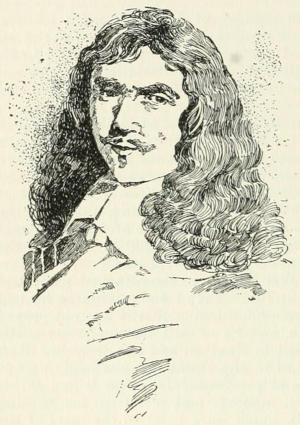
Henri de la Tour d’Auvergne
(1611-1675)
In the beginning of 1667 Louis XIV supported Sweden’s offer of mediation, and Breda was chosen as the seat of a congress. Besides the war, England was suffering from another scourge—the plague of 1666. Charles II was satisfied with France’s promise of a personal subsidy and with the restitution of St. Christopher without indemnity. The treaty was signed July 31st. Louis XIV did not await this moment to enter Flanders. He based his aggression on the formal refusal of all his demands by the court of Madrid, declaring that, having exhausted all peaceful means of obtaining justice, he was now going to take possession of what belonged to Maria Theresa.b
The league of the Rhine assured Louis of at least the neutrality of Germany; the emperor was not prepared for war; Europe, favourable or intimidated, beheld with astonishment King Louis XIV take the field in the month of May, 1667. He had collected an army of fifty thousand men carefully armed and equipped under the direction of Turenne, whom Louvois still obeyed with docility. This fine army was not unequal to the task of vindicating the queen’s rights to the duchy of Brabant, the marquisate of Antwerp, Limburg, Hainault, the county of Namur, and other territories. “Heaven not having established a tribunal on earth from which the kings of France may demand justice, the most Christian king can expect it only of his arms,” said the manifesto sent to the court of Spain. Louis XIV set out with Turenne. Marshal de Créqui was commissioned to keep a watch on Germany.
The Spaniards were caught unprepared; Armentières, Charleroi, Douai, and Tournay had but inadequate garrisons and succumbed almost without a blow. While the army was occupied with the siege of Courtrai, Louis XIV returned to meet the queen at Compiègne; the whole court followed him to the camp. “I brought the queen to Flanders,” said Louis XIV, “to show her to the people of that country, who indeed received her with all the joy imaginable, showing that they were sorry there had not been more time to prepare themselves to receive her more worthily.” It was at Courtrai that the queen took up her residence. Marshal de Turenne had gone in the direction of Dendermonde, but the Flemings had opened their sluices and the country was inundated; he was obliged to fall back on Oudenarde; the town was taken in two days. The king, still followed by the court, laid siege to Lille. Vauban, already celebrated as an engineer, formed his lines of circumvallation. Créqui’s army rejoined that of Turenne; an effort on the part of the governor of the Netherlands to relieve the town was anticipated; the Spanish troops sent for that purpose arrived too late and were defeated as they retired; the citizens of Lille had forced the garrison to capitulate; Louis XIV entered the place on the 27th of August, ten days after the trenches were opened. On the 2nd of September the king set out on the way back to St. Germain; Turenne also took the town of Alost before going into winter quarters.
THE TRIPLE ALLIANCE
[1667-1668 A.D.]
The first campaign of Louis XIV had been merely a warlike game almost without danger or bloodshed; it had nevertheless sufficed to alarm Europe. Scarcely had peace been concluded at Breda before another negotiation was secretly entered into between England, Holland, and Sweden. It was in vain that King Charles II was personally inclined to an alliance with France; his people had their eyes open to the dangers which Europe incurred from the arms of Louis XIV. On the 23rd of January, 1668, the celebrated Treaty of the Triple Alliance was signed at the Hague. The three powers requested the king of France to grant the Netherlands a truce till the month of May, in order to give time to treat with Spain and obtain from her, as France demanded, the final cession of the places conquered or of Franche-Comté in exchange. In reality the triple alliance was resolved to protect helpless Spain against France; a secret article pledged the three allies to take arms to restrain Louis XIV and if possible to bring him back to the position fixed by the Treaty of the Pyrenees. At the same moment Portugal made peace with Spain, which recognised her independence.
The king refused to concede the prolonged armistice which had been demanded of him: “I grant it till the 31st of March,” he had said, “as I do not wish to miss the season for taking the field.” The marquis of Castel Rodrigo laughed at this: “I am content,” he said, “with the suspension of arms which winter imposes on the king of France.” The governor of the Netherlands was mistaken; Louis XIV was about to prove that his soldiers, like those of Gustavus Adolphus, did not know what winter was. He had confided the command of his new army to the prince of Condé, who had been amnestied nine years before but had hitherto been a stranger to the royal favours.g
Under pretext of being in Burgundy for the estates, Monsieur le Prince had made careful note that Franche-Comté was without troops and unsuspecting, because the inhabitants did not doubt that the king would grant them neutrality as in the last war, since they had sent to him to demand it. He kept up the delusion.e
The gaieties of St. Germain were at their height, when in the depth of winter in the month of January, 1668, all were astonished to see troops marching in all directions, coming and going on the roads of Champagne and in the Three Bishoprics—trains of artillery, wagons of munitions stopping under various pretexts in the roads which lead from Champagne to Burgundy. That part of France was filled with movement of which the cause was unknown. The uninitiated out of interest, and the courtiers out of curiosity, exhausted themselves in conjectures; Germany was alarmed; the object of these preparations and peculiar actions was a mystery to everybody. The secrets of conspiracies were never more closely guarded than in this enterprise of Louis XIV.
Finally, on February 2nd, the king left St. Germain with the young duke d’Enghien, son of the Great Condé, and several courtiers; the other officers being at the rendezvous with their troops. He travelled on horseback by long stages and arrived at Dijon. Twenty thousand men, assembled by twenty different routes, found themselves on the same day in Franche-Comté, several leagues from Besançon, the Great Condé at their head.f Besançon and Salins surrendered at sight of the troops. When the king arrived he went to Dôle and caused counterscarps and demilunes to be set up. Four or five hundred men were killed here. The amazed inhabitants, seeing themselves surrounded by troops and without hope of succour, surrendered on Shrove Tuesday, February 14th. The king at the same time marched to Gray. The governor made as though he would defend himself, but the marquis d’Yenne, governor-general under Castel Rodrigo, who was of the country and had all his property there, came to surrender to the king and, going to Gray, persuaded the governor to surrender. The king entered Gray on Sunday, the 19th of February, and there caused a Te Deum to be sung, having the governor-general at his right hand and the governor of the town itself on his left; and the same day he set out to return. Thus in twenty-two days of the month of February he had started from St. Germain, had been to Franche-Comté, taken complete possession of it, and returned to St. Germain.e The king was back at St. Germain preparing enormous armaments for the month of April; he had given the prince of Condé the government of Franche-Comté.
Treaty of Aix-la-Chapelle (1668 A.D.)
War seemed imminent. The last days of the armistice were at hand. “The opinion of peace which prevails in France is a malady which is becoming widespread,” Louvois wrote in the middle of March; “but we shall soon be cured, since the time to take the field is drawing near. You must give out everywhere that the Spaniards will not have peace.” Louvois was uttering a shameless falsehood; the Spaniards were without resources, but they had still less courage than resources; and consented to the abandonment of all the places in the Netherlands conquered in 1667.
A congress was opened at Aix-la-Chapelle and was presided over by the nuncio of the new pope Clement IX, who was as favourable to France as his predecessor Innocent X had been to Spain—“a phantom arbitrator between phantom plenipotentiaries,” says Voltaire. The real negotiations took place at St. Germain. “I did not only take care,” writes Louis XIV, “to profit by the present conjuncture, but also to put myself in a position to turn to good account those which seemed likely to ensue. Amid the great augmentations which my fortune might receive, nothing seemed to me more necessary than to acquire for myself, among my smaller neighbours, a reputation for moderation and probity which might quiet in them those emotions of terror which all naturally feel at the aspect of too great power. I must not lack the means of breaking with Spain when I wish to do so; Franche-Comté which I surrendered might be reduced to such a condition that I could be master of it at any time, and my new conquests, well secured, would open me a surer entry to the Netherlands.” Determined by these wise motives, the king gave the order to sign; and the 2nd of May, 1668, the Peace of Aix-la-Chapelle was concluded. Before surrendering Franche-Comté the king gave orders to demolish the fortifications of Dôle and Gray; at the same time he commissioned Vauban to fortify Ath, Lille, and Tournay. The triple alliance was triumphant, the Dutch especially.g
PROJECTS AGAINST HOLLAND (1668-1672 A.D.)
The first period of the diplomatic and military history of Louis XIV closes with the treaty that ended the War of the Queen’s Rights. A new era is about to open in which Louis will cast aside the compass that was so safely directing the ship of France to follow no other guides than his passion and his fortune.
Recent events had succeeded in crushing the old French sympathies for Holland, much weakened since the Dutch defection of 1648. Resentment against the unfaithful ally, very keen in the active and military element of the nation, had reached a point of exasperation with the king, who was not unaware of the secret clauses of the Treaty of the Hague.[133] Louis, who had laid down his arms much less for the confederates of the Hague than for the sake of the future Spanish succession, bore a grudge against Holland, not so much for having really arrested his progress [by having formed the triple alliance] as for having boasted of doing so. Pride had turned the head of the little republic, which plumed itself on having laid colossal Spain low, saved Denmark from the blows of Sweden, beaten, or at least quit even with England, set a limit on French conquests, and drawn into its hands three-quarters of European commerce and sea trade.
But wounded pride was far from being the only motive that turned Louis XIV against Holland. He was convinced that he must crush her in order to get Belgium, and consequently he must appear, momentarily, to forget the end in order to remove the obstacle. He might then, strictly speaking, imagine to himself that he was still pursuing his old plans, and was only changing the means of French policy; but passion might easily make him take the means for the end. This passion, generated by diplomatic disappointments, was nourished and envenomed by the dissimilarity between the institutions, principles, and beliefs of the French and Dutch governments. Holland was not only an unfaithful ally—she was a republican and Protestant nation, the home of religious and political liberty, which Louis hated with a growing hatred as his monarchy became more clearly outlined in his head.
After the Treaty of Aix-la-Chapelle, the ruin of Holland became the king’s fixed idea. It was no longer a question of the commercial war so ably conducted by Colbert with his tariffs and his differential rights—it was a war of invasion and conquest that Louis was planning.c
The resolution taken, he adjourned its execution until such time as he had completed the organisation of his sea forces, which were not then on a level with those of the land, and until he could assure himself that Europe would not interfere with his plan. The able and indefatigable Lionne consecrated the last three years of his life (he died in 1671) to performing diplomatic wonders to acquire this certitude.
While he was waiting, Louis XIV neglected no opportunities that presented themselves to feed warlike passions and provide employment for his unengaged officers and troops. In 1669 he sent a volunteer corps to Crete to assist the Venetians, threatened in the capital of that island. Beaufort disappeared in a combat, and Vivonne ineffectually bombarded the grand vizier’s camp. But this was only a diversion from more important projects. Louis XIV wished to isolate Holland, and for that reason to break the triple alliance. He began by trying to detach England from it.
[1669-1670 A.D.]
The English were not less jealous than the Dutch of France’s maritime progress; they were not less frightened at Louis’ ambitions. But Charles II did not share these feelings. Although he had experienced all the hazards of fortune, the vicissitudes of his life had in nowise elevated his character. After the Treaty of Breda, he signed that of the Triple Alliance and united with the Dutch, as a concession to national sentiment. But he did not like parliament, and felt an especial aversion for the Presbyterian spirit, and the religious passions which had brought about the English Revolution. Finally, about 1670, he resolved to become a Catholic, perhaps through real conviction, perhaps through the influence of his brother, the duke of York, a secret convert to the church of Rome, who was animated by the true ardour of a neophyte; perhaps because he hoped to find in Catholicism a more solid support for his throne and his royal prerogative than in Anglicanism.
To realise his object a French alliance was indispensable. France alone could provide him with the money he needed; his court was wasteful and in debt, and parliament measured out subsidies with jealous parsimony. If France demanded the sacrifice of Holland, he was ready to make it.
Under these conditions he readily lent ear to the overtures of the French ambassadors, Ruvigny and Colbert de Croissy, the minister’s brother. He did not delay to let Louis XIV into the secret of his plans. Louis asked nothing better than to grant much on condition that England would join him in war on Holland. Nevertheless the negotiations dragged on account of the precautions necessary to secrecy, and it took more than a year to arrive finally at an understanding. When all was arranged Charles II demanded that his sister, the duchess of Orleans, should come to England and sign the treaty.b
The Treaty of Dover: Death of Madame (1670 A.D.)
On the 24th of May Madame Henrietta suddenly left the court which was at Lille and embarked at Dunkirk for Dover where Charles II was awaiting her. She persuaded Charles to sign the treaty without delay (June 1st). The English monarch led his sister to hope that he would consent that the attack on Holland should precede his declaration of Catholicism. This is what Louis XIV most wished for. The treaty, however, far from committing Charles to this course, stipulated that after Charles should have made “the said declaration,” Louis might choose the moment of attack on Holland.[134] Louis was to give Charles two millions, payable two and three months after the exchange of ratification and was to assist him with six thousand foot soldiers, if the return to Catholicism should excite trouble. Charles was to furnish Louis at least four thousand foot soldiers against Holland, Louis to reinforce the English fleet by thirty vessels, of at least forty guns, and to pay Charles an annual subsidy of three millions during the continuation of the war. The island of Walcheren (with Sluys and Causand at the mouth of the Schelde) were to go to England.
[1670-1672 A.D.]
An unforeseen catastrophe fell now like a thunder-clap upon the two royal families which had just sealed the pact of Dover. The household of Louis XIV’s brother had long been disturbed by domestic tempests. The amiable and brilliant Henrietta, adored by the court, esteemed by the king, who confided to her the most secret springs of his policy, inspired nothing but antipathy in her husband, an effeminate prince, as mediocre in mind as in heart, whose childish and strange habits have given rise to suspicion of shameful practices. The king had recently intervened in the family quarrels by imprisoning and afterwards exiling the chevalier de Lorraine, Monsieur’s favourite. After this the king had had great difficulty in compelling his brother to allow Madame Henrietta to go to Dover.
She returned in triumph; leaving Dover on the 12th of June, she appeared for a moment at St. Germain where the court was established; the 24th of June her husband took her to St. Cloud, where she had scarcely arrived when she complained of pains in her stomach and side. For several days she lingered, and on the 29th, after having drunk a glass of chicory-water, she was seized with a violent pain in the side; the next day before daybreak she was dead. In her last agony she repeated several times that she was dying of poison.
An outbreak of terrible suspicion against her husband and his people occurred at once. The king had an autopsy performed by the most celebrated physicians and surgeons of Paris, who agreed that death was due to natural causes, and that it was a wonder the princess had lived so long with her lungs and liver so gravely affected. The question, however, has remained a question of controversy among historians to this day.[135] The news of this tragic event made a great stir in England; but the real sorrow expressed by Louis XIV and the report of the physicians calmed Charles II and his court.c
Treaties with Other Powers (1670-1672 A.D.)
Already, as early as 1667, Louis XIV had privately provided for the neutrality of the empire by a secret treaty regulating the eventual partition of the Spanish monarchy. In case the little king of Spain should die without children, France was to receive the Netherlands, Franche-Comté, Navarre, Naples, and Sicily; Austria would keep Spain and the Milanese. Accordingly the emperor Leopold turned a deaf ear to the solicitations of the Dutch, who would have persuaded him to join the triple alliance; and a new agreement between France and the empire, signed secretly November 1st, 1670, reciprocally bound the two princes not to give help to their enemies. The German princes were more difficult to win over; they were beginning to be alarmed at the pretensions of France. The electors of Treves and Mainz had already assembled troops on the Rhine; and the duke of Lorraine seemed disposed to give them assistance. Louis XIV took as a pretext the erection of some fortifications contrary to the Treaty of Marsal; on the 23rd of August, 1670, he sent Marshal de Créqui into Lorraine; in the beginning of September the duchy was entirely subdued and the duke a refugee. To the emperor’s protest, the king responded that he did not want Lorraine for himself, but that he would never surrender it to anyone’s petitions. Brandenburg and Saxony alone refused neutrality point-blank; France had renounced the Protestant alliances in Germany, and the Protestant electors recognised the danger which threatened them.
Sweden also recognised it, but Gustavus Adolphus and Oxenstierna were no longer there; the memory of former alliances with France alone remained; the Swedish senators, one after another, allowed themselves to be bought. The treaty was signed the 14th of April, 1672; for an annual subsidy of 600,000 livres Sweden pledged herself to offer armed opposition to the princes of the empire who should attempt to succour the United Provinces; a space was being cleared round Holland.[136]
In spite of the secrecy which surrounded the negotiations of Louis XIV, De Witt was filled with anxiety; always favourable to the French alliance, he had sought to calm the irritation of France which imputed the triple alliance to the Dutch. Jan de Witt negotiated everywhere; Charles’ treaty with France had remained a profound secret, and the Dutch thought they could count on the good will of the English nation. They effaced the arms of England on the Royal Charles, a vessel taken by Tromp in 1667, and hid from sight a picture in the town hall of Dordrecht which represented the victory of Chatham with the ruart[137] Cornelis de Witt leaning against a cannon. These concessions to the pride of England were not made without a contest.
THE WAR WITH HOLLAND BEGINS (1672 A.D.)
The apprehensions of the grand pensionary were not without foundation; in the spring of 1672 all the negotiations of Louis XIV had been successful; his armaments were complete; he was at last about to crush the little power which had so long presented an obstacle to his designs. The king wrote in an unpublished memoir: “Amidst all my prosperity in my campaign of 1667, neither England nor the empire, both convinced of the justice of my cause, opposed themselves to the rapidity of my conquests, whatever interest they may have had to stop them. I found in my path only my good, faithful, and old-time friends, the Dutch, who instead of identifying themselves with my fortune as with the foundation of their state, sought to dictate to me and to compel me to peace, and even dared to threaten violence in case I refused to accept their interference. I confess that their insolence stung me keenly and that I was ready, at the risk of what might happen to my conquests in the Spanish Netherlands, to turn all my forces against this haughty and ungrateful nation; but having summoned prudence to my aid and considering that I had neither the number of troops nor the allies requisite for such an enterprise, I dissimulated and concluded peace on honourable conditions, resolved to postpone the punishment of this perfidy to another time.” The time had come; to the last effort at conciliation attempted in the name of the states-general, by De Groot, son of the celebrated Grotius, the king answered with a haughty threat: “When I heard that the United Provinces were endeavouring to corrupt my allies, and were urging kings, my relatives, to enter into offensive leagues against me, I sought to put myself in a position to defend myself, and I raised some troops; but I intend to have still more towards the spring, and I will then use them in the manner which I may judge the best adapted for the welfare of my states and for my glory.”g
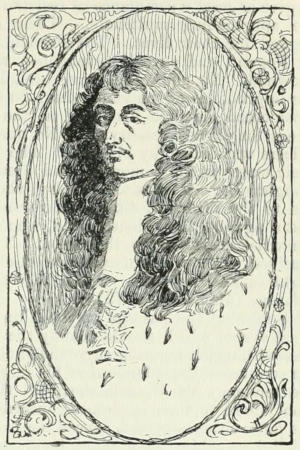
Louis II de Bourbon, Prince de Condé
(1621-1686)
A public treaty had just been signed between France and England (February 12th), and the English, according to their custom, attacked without declaration of war. On March 23rd an English squadron assailed a Dutch merchant fleet returning from Smyrna off the isle of Wight. The Dutch defended themselves so well that the aggressors after two days of fighting were only able to capture two or three merchant ships and one man-of-war. Charles II’s declaration of war was published March 29th, six days after this fight. That of Louis XIV was launched on the 6th of April.c
“The king sets out to-morrow, my daughter,” writes Madame de Sévignéi to Madame de Grignan on the 27th of April; “there will be 100,000 men outside Paris, the two armies will join hands; the king will give orders to Monsieur, Monsieur to Monsieur le Prince, Monsieur le Prince to M. de Turenne, and M. de Turenne to the two marshals, and even to the army of Marshal de Créqui.”g
Ninety thousand men were gathered from Sedan to Charleroi; the bishop of Münster, the bishop of Cologne, and other German princes furnished about 20,000 more. The king led this magnificent army in person; Condé, Turenne, Luxemburg, Chamilly, were in command under him. Vauban was to take the towns, Pellisson to record the victories. What had Holland to bring in opposition to such an enemy? She had a formidable navy; two admirals, regarded to this day as the greatest of their century, Tromp and De Ruyter; rich colonies, and an immense commerce; but she had neglected her land-forces, so often dangerous in a republic; she could hardly count upon 25,000 militia, badly equipped and wholly without discipline, and 20,000 men promised by the elector of Brandenburg were at the same time very insufficient and very far away. The intestine struggles also enfeebled her; there were two parties, the one led by Jan de Witt, and entirely devoted to the cause of ancient liberty. The other aimed at the restoration of the young prince of Orange to the heritage of his ancestors, and profiting by the present danger nominated him captain-general at the age of twenty-two.
The Passage of the Rhine (June, 1672 A.D.)
Meanwhile Louis XIV advanced along the Maas, upon the lands of the bishop of Liège, his ally, in order not to invade Spanish territory, thence along the right bank of the Rhine from Wesel to Toll-Huys. There the inhabitants informed the prince of Condé that the dryness of the season had made the river fordable. Crossing was easy. On the other shore only 400 to 500 cavalry were to be seen and two feeble regiments of infantry without cannon. The artillery mowed down their flank. While the king’s household and the crack regiments of cavalry, in number about 15,000 men, were crossing in safety, the prince of Condé went beside them in a copper-bottomed boat. A small number of the Dutch cavalry rode into the river to give at least a semblance of resistance, but took flight immediately before the approaching multitude. Their infantry laid down their arms and begged for their lives. The French lost in that passage only the count de Nogent, and several cavalrymen who strayed from the ford and were drowned. No one would have been killed on that day had it not been for the imprudence of the young duke de Longueville. It was said that, being intoxicated, he fired his pistol at the enemy, who were begging on their knees for their lives, crying, “No quarter for that rabble!” One of their officers was killed by his shot. The Dutch infantry despairingly resumed their weapons for a moment and fired a charge which killed the duke de Longueville. A captain of cavalry, who had not taken flight with the others, ran to the prince of Condé who was mounting his horse, and pressed his pistol against the prince’s head, who by a movement turned aside and had his wrist shattered by the bullet. This was the only wound Condé ever received. The French, exasperated, charged upon that infantry, which took flight in all directions. Louis XIV crossed on a pontoon bridge with his infantry (June 12th, 1672).d
Such was the passage of the Rhine, celebrated ever after as one of the great events which should occupy the memories of men. That air of greatness with which the king surrounded all his actions, the fortunate rapidity of his conquests, the splendour of his reign, the idolatry of his courtiers, finally the tendency the French, above all the Parisians, have towards exaggeration joined to their ignorance concerning war which ruled in the idle life of the large cities—all this caused the passage of the Rhine to be regarded as a prodigious achievement whose fame continued to be exaggerated. The common belief was that the whole army had crossed the river swimming, in the face of a thoroughly entrenched army, and in spite of the artillery of an impregnable fortress called Tholus (Toll-Huys). It was very true that nothing could have been a more imposing sight to the foe than this passage, and if there had been a corps of serviceable troops on the other side the enterprise would have been very perilous.f
Fifteen years later Bossuet said in his funeral oration of the prince of Condé, “Let us leave the passage of the Rhine the prodigy of our century and of the life of Louis the Great.” But Bossuet was not writing history in his funeral orations. Neither does Napoleon in his Mémoires share the enthusiasm of the sacred orator: “The passage of the Rhine is a military operation of the fourth order, since in that place the river is fordable, impoverished by the Waal, and moreover was defended by only a handful of men.” “I have seen a woman,” says Voltaire, “who crossed the Rhine twenty times at that place to defraud the customs.” The Toll-Huys was exactly what its name indicates.
THE FRENCH IN HOLLAND AND GERMANY (1672-1673 A.D.)
[1672-1673 A.D.]
With the Rhine crossed, Holland was open to invasion. The provinces of Overyssel, of Gelderland, and Utrecht submitted without trying to defend themselves; there were very few hours during the day in which the king did not receive news of some victory. An officer wrote to Turenne: “If you will send me fifty cavalrymen I will take two or three fortresses with them.”
Four soldiers became in a few moments masters of Muiden, the key to Amsterdam, because the sluices by which the country surrounding the capital could be flooded were in this village. The generals called to council were anxious to march at once upon Amsterdam, Louvois thought it better to garrison the forts; the army was in this manner enfeebled and its operations retarded. Upon this the Dutch took courage once more, and concentrating the state forces into the hands of one man, raised William of Orange to the stadholdership (July 6th, 1672). This prince was to save the independence of his country.d Soon afterward an infuriated populace slaughtered the illustrious chiefs of the republican party, Jan and Cornelis de Witt. French historians charge William with complicity in these murders. Burnett, however, says that William “always spoke of it to me with the greatest horror possible,” and there seems no good ground to doubt that this sentiment was genuine. To suppose otherwise would seem to belie the character of this far seeing, cautious, unconquerable man.a
The military dictatorship confided to the prince of Orange gave a new aspect to the situation; he had the dykes cut, flooding all the country surrounding Amsterdam, and forced the French to retreat before the inundation.d
The French king, in the meantime, in answer to the Dutch deputies who sought for peace (De Groot was of the number), demanded for himself the limit of the Rhine, and the re-establishment of the Catholic religion in Holland, besides satisfaction to the demands of the English. The Dutch magnanimously refused such terms. The capital was for this year secure behind its waters; the French army being weakened by garrisoning so many towns. Condé pressed the monarch to dismantle these towns, and unite the army to reduce Amsterdam; but Louvois, minister-at-war, biased by his peculiar pursuits, would not consent to the demolition of a single bulwark. The consequence was that nothing more could be effected, and Louis returned, to enjoy the congratulations of his capital and the flatteries of his court.j
THE NEW COALITION AGAINST FRANCE (1673 A.D.)
This is an epoch of great importance. The state system of the treaty of Westphalia was really upset by Louis’ aggressions, e.g. the German states making common cause with Emperor; and the fear of French predominance acted from now on through the Dutch war and the War of the Spanish Succession as a new and dominant force in European politics, much as the pre-eminence of the Hapsburgs had acted before Westphalia. From now to the treaty of Utrecht, European history is on another track, and the treaty of Utrecht, which closes the foreign policy of Louis XIV, is the real end of the chapter of history we are now beginning.a
Neither Spain nor Germany could remain indifferent spectators of Louis XIV’s progress and Holland’s peril. Although Spain had not pronounced herself, Monterey, the governor of Brussels, had furnished the prince of Orange some auxiliary troops. The elector of Brandenburg, Frederick William—“the Great Elector”—promised his assistance to the states-general by a secret treaty. He also agitated the north German courts and that of Vienna, representing to them the necessity of a coalition. Austria, more reserved, was none the less exasperated in spite of the arrangement to which she had consented, and concluded a ten years’ defensive alliance with the great elector. The emperor likewise concluded another treaty with the states-general, promising auxiliary troops for a subsidy.
Louis XIV, warned by these events, gave these princes the most solemn assurances of his intention to respect the Treaty of Westphalia as well as the imperial territory. But as these assurances had no effect, he finally declared that the continuation of their armed condition would be regarded as an act of hostility against his allies of Cologne and Münster, and he declined the responsibility of any war that might ensue.
Montecuculi [the imperial general] and the great elector united their forces, which with the German contingents amounted to 40,000 men. Louis XIV gave orders to Turenne to leave to Luxemburg the protection of the conquered towns in Holland, and to betake himself with 16,000 men to the lower Rhine, keeping the Germans from crossing, and to protect the territories of Cologne and Münster. Condé was charged with covering the upper Rhine and Alsace with an equal number of troops. The Germans’ plan was to march upon the Maas, to establish themselves there, and then to bring thither the prince of Orange and cut off in this manner communication between France and the French garrisons in Holland. But Turenne, stationed at Andernach, kept them a long time on the banks of the Rhine. They tried to cross higher up; Condé had destroyed the bridge at Strasburg, but after several weeks they succeeded (on November 23rd) in building a bridge of boats near Mainz. Turenne doubled on his track to cover the Maas. The Germans spread themselves over the electorate of Treves and the Palatinate; but this country being already ruined they could find no sustenance, and they recrossed the Rhine to live on the lands of Cologne and Münster. Turenne followed them.
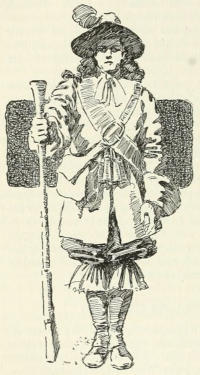
Soldier, Time of Louis XIV
Meanwhile Orange rallied a Spanish corps commanded by Marchin; he drove off Duras who was guarding the Maas with several French regiments, and conceived the bold idea of occupying Charleroi. He undertook the siege on the 15th of December, but he did not have sufficient material and had to retire before the arrival of Condé’s troops and the Flemish garrisons which Louis XIV ordered to Charleroi. [Notwithstanding the lack of troops, withheld through the jealousy of Louvois, these are said to have been Turenne’s most brilliant campaigns.]
By March, 1673, Turenne had driven the Germans across the Weser, and Frederick William, convinced of his powerlessness, and discontented with his allies, asked for peace. Louis XIV was eager to grant it, for he was in a hurry to dissolve the coalition, and simply imposed conditions that the elector should not assist Holland, or maintain troops beyond the Weser. Louis consented to withdraw his own troops from Frederick’s territory except from the towns in the duchy of Cleves, which he intended to hold until peace should be declared. This treaty was made definite the 6th of June, 1673, at Vossem, and Louis XIV almost at the same time signed two others with the duke of Hanover and the elector of Cologne, assuring defensive and offensive alliances on the part of France. Henceforth he regarded himself as delivered from all fear on the side of northern Germany.
Louis was not willing to submit to a mediation purposed by the emperor with arms in his hand. In the month of December, 1672, he accepted that which the Swedes offered. The mediation of Sweden was accepted by the other belligerents; it was agreed that a congress should be held at Cologne, but various delays postponed the first pourparlers until June, 1673.
Louis XIV in agreeing to this congress had attached little importance to it and counted in reality upon war alone. For the campaign of 1673 he disposed of 800,000 men without counting the garrisons of Roussillon, Pinerolo, and Lorraine. In the month of June he sent Turenne into Hesse to watch the imperials who were reorganising their army. He gave Condé the command of the Dutch garrisons and placed Luxemburg under him. He himself went to besiege Maestricht with 45,000 of his best troops. He had no desire to declare war upon the Spaniards although Monterey had upheld the Dutch; nevertheless he traversed their territory and made a false demonstration upon Brussels in order to deceive them.
The 10th of June he arrived before Maestricht. He had reserved for himself the chief command, which he wished to share with no one. But Vauban was with him and alone conducted and directed the work of approach. This was begun on the 17th and on the 29th the miner was under the town. The next day the garrison, although strong and well commanded, was obliged to capitulate.
If the taking of Maestricht was a brilliant success, the king really sacrificed to it the campaign in the Netherlands, which had an unfortunate ending. The Anglo-French fleet had, on its side, appeared in the arena. It numbered 90 ships of the line of which 30 were French. Parliament had voted a subsidy, but as it suspected King Charles’ project of becoming a Catholic, it had made a condition that a declaration of conformity to the Anglican church should be imposed upon all officers of the crown. The duke of York was unwilling to submit to the obligation of the “test” and had been dismissed from the admiralty. De Ruyter took command of the Dutch fleet with Tromp second in command, and advanced against the enemy, giving two battles on the 7th and 14th of June which remained undecided. The Anglo-French fleet having put back into the Thames for repairs embarked the troops under Schomberg’s command and set sail for the shores of the Netherlands. De Ruyter on the 21st of August gave a more decisive battle, in that it prevented the landing of the forces, and compelled the fleet to retire.
The Dutch, emboldened by this success, raised little by little their tone and their claims at the congress of Cologne. They cut down greatly the concessions they were offering France and reduced to almost nothing those they consented to grant the king of England, the elector of Cologne, and the bishop of Münster. They intended to make no sacrifice essential to keeping their rank as a great power. Louis XIV held out for a long time and obtained nothing; finally, on the 30th of September, he reduced his claims to Aire, St. Omer, Cambray, Ypres, and their dependencies and the two castellanies of Bailleul and Cassel. As these places belonged to Spain, he demanded that Spain should be indemnified by the United Provinces, which would have recovered all that they had lost. This proposition was rejected like the others.
Holland was now counting on more important alliances than those of 1672. She no longer feared England, where the reawakening of the Protestant spirit would reduce Charles II to powerlessness. She had signed on the 30th of August three treaties, with Spain, with Austria, and with the duke of Lorraine. Spain had not declared war on Louis XIV, as she did not wish to enter the arena except with a European coalition; but now, having procured resources by extraordinary taxation and having succeeded in overcoming the irresolution of the court of Vienna, she made a twenty-five-years’ treaty of offensive and defensive alliance with the republic, promising to furnish 8,000 men.
Austria, assured of Spain and the military co-operation of several German states, among others Saxony, resolved to recommence her preceding campaign. She made a point of war of Turenne’s presence on the right bank of the Rhine and demanded the restitution of the places of the empire, that of Lorraine for Duke Charles IV, and the abandonment of France’s claims to the fiefs of Alsace and the Three Bishoprics. On Louis XIV’s refusal, Leopold addressed a declaration to the diet of Ratisbon, making known his intentions, and signed with Holland a ten-years’ treaty of offensive and defensive alliance, enjoining himself for a subsidy to furnish 30,000 men. As for the duke of Lorraine, he put, on consideration of a subsidy, his sword and his troops at the service of the Dutch. Thus the latter were paying for the war, and the war under these conditions was changing its character, becoming European, and little by little withdrawing from their territory.
Louis XIV recalled Condé to Flanders, where he left him with but few troops. He gave Luxemburg the supreme command of the Dutch garrisons, and he planned himself to lead the army which had taken Maestricht to the Rhine, to occupy the bridges, and to support Turenne. Up to the last minute he refused to believe in the coalition, but when he saw it an accomplished fact he resolved to face it. Treves was occupied August 26th; Louis XIV then visited Alsace and Lorraine, strengthening fortifications without taking into consideration the privileges the towns enjoyed from the Treaty of Münster. Montecuculi, at the head of the imperials, left Bohemia in September and marched towards the Rhine. Turenne tried without success to stop him at the Tauber and at the crossing of the Main. He turned north, crossed the Rhine on a bridge of boats near Mainz, and finally marched upon Bonn, before which he joined the 25,000 Spanish and Dutch troops led by the prince of Orange, at the end of October.
Orange had taken the offensive, and captured Naerden in six days (September), crossed the Spanish Netherlands, where Condé had not sufficient force to stop him, and gained the electorate of Cologne, to join hands with the imperials. [This juncture of imperial and Dutch troops constituted an important success for the coalition.] United they attacked Bonn and took it on November 12th.
The taking of Bonn detached Germany from Louis XIV. Louvois had already a few days before given Luxemburg orders to evacuate Utrecht and the more distant places, keeping only those on the Maas, Waal, and Rhine, to destroy as far as possible abandoned fortifications, to reduce garrisons to 20,000, and to send home 30,000; but these orders took time to execute, and their execution, being compulsory, was a fresh subject of triumph for Holland and Europe.
The winter stopped hostilities, without ending the reverses; for Louis XIV now saw himself abandoned by England and the whole empire aroused against him.b
Defection of England and the Imperial Allies (1674 A.D.)
[1674-1675 A.D.]
The Protestant inquietude of the English parliament had not yielded to the influence of the marquis de Ruvigny, French ambassador to London, and the nation wanted peace with the Dutch. Charles II yielded in appearance at least to the wishes of his people. On February 21st, 1674, he went to parliament to announce to the two houses that he had concluded with the United Provinces a prompt, honourable, and, he hoped, durable peace, as they had asked for. At the same time he wrote to Louis XIV asking him to pity rather than accuse him of a consent that had been dragged from him. The English and Irish regiments remained, without remark, in the service of France, and the king did not withdraw his subsidy from his royal pensioner.
Thus, link by link, the chain of alliance which Louis XIV had cast around Holland was coming apart. In her turn France was finding herself alone. The congress of Cologne had dissolved. None of the belligerents was looking for peace.g
The bishop of Münster, who could no longer count on the help of the French, had already secretly approached the emperor, and in April, 1674, agreed to defend by arms the decisions of the diet of Ratisbon, and restore all that he had taken from the Dutch. The electors of Treves and Mainz concluded an offensive pact with the emperor. So did the elector palatine, that eternal enemy of Austria. As early as January, Denmark, seeing Sweden inclined towards France, had thrown herself on the side of the emperor. The dukes of Brunswick and Lüneburg promised auxiliaries to Leopold for a subsidy. In May the elector of Cologne treated with the United Provinces, and then gave them back the places he had taken. Like the king of England, in abandoning France he at least left the soldiers he had furnished. On the 28th of May the Germanic diet finally pronounced against France and declared that the emperor’s war was a war of the empire. The great work of French politics was destroyed; Austria had regained, thanks to Louis XIV’s excesses, the supremacy and the direction of Germany against France.c
OPERATIONS IN FRANCHE-COMTÉ; TURENNE IN ALSACE (1674-1675 A.D.)
With the war thus become European, Louis XIV changed its object with a decision that did him honour. He abandoned Holland, which he was not strong enough to retain, and turned all his forces against Spain, the weakest of the states of the league. With 20,000 men and Vauban, he took the direction of Franche-Comté. The second conquest was almost as rapid as the first; Besançon was taken in nine days, and the entire province in six weeks (May, 1674).
The allies had planned for this year a double and formidable invasion of France by way of Lorraine and through the Netherlands. Turenne was to stop the one, Condé the other. But the enemy was so slow in beginning operations that the conquest of Franche-Comté was finished before they had decided on their movements. Turenne was thus enabled to take the offensive: he crossed the Rhine at Philippsburg with 20,000 men, destroyed with fire the whole Palatinate in order to prevent the enemy from subsisting there, and fought a number of unimportant engagements at Sinsheim and at Ladenburg in July, 1674, where he showed resources of tactics unheard of until then.d To this day numberless ruins of castles along the Rhine bear witness to the savage work of Turenne.a
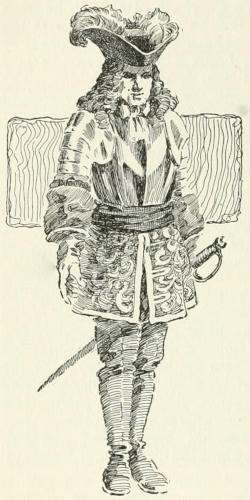
A Captain, Time of Louis XIV
The imperials numbered 40,000 men. Moreover it was known that the elector of Brandenburg, Frederick William, was coming with all haste at the head of 20,000 men to assist Bournonville [who replaced Montecuculi, who was ill, in the command of the imperial troops], and to crush the French by superiority of numbers. This juncture once effected, the French would be done for. Already in Germany they spoke of nothing less than marching on Paris itself. Many princesses accompanied the elector, saying they would “make the acquaintance of the French ladies, to learn manners from this polite nation.”
Fortunately Turenne was on the watch. To prevent the two armies joining, he began by attacking that which was nearer. He approached Bournonville by a forced march of forty hours, and, without even giving his soldiers time to rest, fell on the surprised imperialists at Enzheim and forced them to retire under the walls of Strasburg in the greatest disorder (October 4th, 1674). It was a great victory, but the numerical inferiority of his troops hindered his reaping its full fruits. Ten days after this victory the elector of Brandenburg in his turn passed the Kehl bridge and joined his 20,000 men to Bournonville’s army. Turenne received scarcely sufficient reinforcements to repair his losses at Enzheim. The situation became more and more serious. How could it be thought that the genius of a single man could compensate for such an overwhelming disparity of forces—how believe that 20,000 Frenchmen could hold their own against 60,000 Germans? No one doubted that the nation would soon be swallowed up in defeat. Fear gained ground in the northeast provinces; peasants abandoned their fields and flocked into the towns to seek shelter from the enemy. Even at Paris great anxiety prevailed. It seemed as if the capital of France would soon be at the mercy of the German army.
Alsace comprises the country between the Rhine and the Vosges, forming, from Hüningen or Belfort at the south, to Weissenburg on the Lauter at the north, a long band of territory of almost constant breadth. The river and mountain which serve for limits for this province in the east and west run nearly parallel one with the other. The Vosges separate Alsace from Lorraine. After the juncture of the two armies near Strasburg on the 14th of October, Turenne retired slowly in good order in the direction of the defiles which assured communication between Alsace and Lorraine. The Germans followed the same route in this retrograde march. By this time November had arrived with its cold and snow. The German generals, reassured by Turenne’s retreat, thought the campaign over. So they postponed military operations until the following spring, as well as the invasion of Lorraine or Franche-Comté, and thought of wintering quietly in Alsace. To get more supplies, they spread their troops all through the province and installed them in quarters separated one from the other. Seventy thousand imperials or Brandenburgers thus took up quarters from Strasburg to Belfort in upper and lower Alsace. Frederick William installed himself at Colmar, where his wife and court joined him. The only thought now was how to speed the cold and rainy season by the help of fêtes.
Meanwhile Turenne was quietly marching on Lorraine with his troops. On the 29th of November the last French soldier left Alsace by the defile of Lützelstein, in the north of Zabern. The news reached Paris. The court murmured; Louvois let loose his wrath against the marshal who had failed to save Alsace; the people, who had had a momentary hope after the success at Enzheim, gave themselves up again to despair.
Turenne, not condescending to reassure public opinion—an opinion clearly against him—began to put into execution the admirable plan he had conceived. He divided his army into many detachments, placed them under the direction of experienced officers, to whom his only instructions were that they should defile from north to south along the western slopes of the Vosges; and reunite on a given day in the neighbourhood of Belfort. Thus, while the enemy dispersed itself imprudently in its winter quarters, the French army, concealing its intention by means of the Vosges chain, concentrated itself in upper Alsace. Issuing from the province near Zabern in the north, it re-entered at forty leagues from there, near Belfort in the south. Success complete, unheard of, crowned this splendid stroke of genius. Such was the devotion of the French soldiers to their chief that they accepted without murmuring the necessity of marching in the depths of winter, in a country without roads, covered with snow and intersected with torrents. From the 5th to the 27th of December, the army, at the cost of incredible fatigue, marched from Lützelstein to the pass of Belfort. There the marshal reassumed in person the command of the troops, which he had divided up to facilitate the march. On the 29th of December he came upon the first body of the enemy, near Mülhausen, and destroyed it. Horrified at this sudden appearance, in upper Alsace, of an army they had thought to be encamped in Lorraine, near Nancy or Metz, the German generals realised the mistake they had made in dispersing their forces. They tried to repair the fault by sending orders for concentration in every direction.
It was too late. Turenne advanced with lightning speed. From Mülhausen, the place of his first victory, he went northwards. Near Colmar, by Türkheim, the imperials showed fight. He attacked them furiously on the 5th of January, 1675, and put them to flight. The remnant of the enemy retired on Schlettstadt. The marshal pursued them without giving them any rest. From Schlettstadt he pursued them at the sword’s point to Strasburg, making an immense number of prisoners and carrying off cannon and standards. On the 11th of January the small number of Germans who had not been put hors de combat, killed, or taken, during this terrible campaign, recrossed the bridge of Kehl in the greatest disorder (1675). Alsace was delivered. A formidable invasion was spared to France.k
This campaign prepared with such secrecy, executed with an adroitness so prudent, was ended in less than six weeks, and excited the enthusiasm of the whole of France; Louis XIV wrote to the marshal: “I hope you will soon return, as I am most impatient to see you to demonstrate to you by word of mouth how much I appreciate the great and important services you have rendered me, in the last victory you have gained over my enemies.” On the entire route the inhabitants whom Turenne had saved from the ravages of war turned out filled with admiration and gratitude, so that his return was a march of triumph until he reached St. Germain.
CONDÉ IN THE NETHERLANDS
While Turenne was victorious in foiling the invasion from the east, Condé arrested that of the north. He prevented 90,000 Spaniards and Dutch from invading Champagne. He entrenched himself at Charleroi, with the Sambre behind him, in a position where the prince of Orange dared not attack him. Condé, who did not voluntarily prolong the war of defence, pursued the enemy to his retreat and attacked the rearguard at Seneffe, near Mons (August, 1674), routing it completely, broke through the centre, and attacked and threw into disorder the remainder of the army, which was drawn up in a very strong position. When night came, he had had three horses shot under him, and the victory was still undecided. “He now,” says an eye-witness, La Fare,l “ordered new battalions to advance and cannon to be brought forward to attack the enemy at daybreak. All who heard this order trembled, and it was very evident that he was the only one who still desired to continue the battle.” The following day, the two armies separated with an equal loss of from seven to eight thousand men.
The prince of Orange, in order to prove that he had not been defeated, besieged Oudenarde. Condé proved himself the victor, and forced him to abandon this enterprise; but Grave, the last of the French conquests in Holland, opened its gates. Chamilly had defended it ninety-three days, and caused the loss of 16,000 men to the assailants.
LAST CAMPAIGNS OF TURENNE AND CONDÉ (1675 A.D.)
In the early summer (June, 1675) Turenne returned at the head of his army of the Rhine. He moved into the Palatinate. The emperor opposed him with Montecuculi, who passed for a consummate tactician. They took six weeks to follow and observe each other, and their reputations which had seemed to have reached their apogee were still more augmented by these actions. Finally they decided to come to battle near the village of Salzbach in a place chosen by Turenne; where he believed himself certain of victory, when the marshal on examining the position of a battery was struck by a stray shot, which also tore off the arm of Saint-Hilaire, lieutenant-general of the army (July 27th, 1675). The latter’s son burst into tears. “It is not for me that you should weep,” said Saint-Hilaire to him, “but for this great man.” Turenne’s death was truly a national calamity. Louis XIV, in order to show honour to the greatest military leader of his century, had him interred at St. Denis, in the royal sepulchre. But in time, the memory of the services of Turenne grew fainter, at least at court, and his reputation appeared overestimated. In 1710 in the midst of the distress of the War of the Succession, his family built a mausoleum for him in the chapel of St. Eustace. By order of the king, the ornamentations and armorial bearings were destroyed, under the pretext that they were not suitable to such a sacred spot.
[1675-1676 A.D.]
The death of Turenne undid the whole result of an able campaign. The French, discouraged and seemingly seized with a panic of terror, fled in the direction of the Rhine. Montecuculi penetrated into Alsace by the bridge of Strasburg. At the same time the duke of Lorraine, Charles IV, hastened to besiege the city of Treves with 20,000 men. Créqui tried to come to his assistance, but was beaten at Consarbrück. He rushed into the town, and after several weeks of heroic defence was obliged to capitulate through the cowardice of the garrison (September, 1675). “His misfortune,” says Condé, “made him a great general.” Condé was right.
After the death of Turenne, Condé was sent to Alsace to arrest the progress of Montecuculi and to reanimate the confidence of the troops. He forced the imperials to raise the sieges of Zabern and Hagenau, and to recross the Rhine. This was his last victory; he never again appeared at the head of the armies, but retired to Chantilly, where he lived thereafter in the society of men of letters and philosophers. During the campaign in Holland, he sought an interview with Spinoza, and when Malebranche published his Recherche de la vérité he sought to meet the author. He enjoyed holding erudite conversations as much as fighting battles, taking part in them with intelligence, with ardour, and sometimes, says La Fontaine, took reason, like victory, by the throat! If in conversations on literature he was sustaining a good cause he spoke with much grace and gentleness, but if he upheld a bad one it was not wise to contradict him. Boileau was once so astonished, relates Louis Racine, by the fire of his eyes in a dispute of that nature, that he prudently yielded, and said in a low voice to his neighbour, “From now on I shall always agree with the prince whenever he is in the wrong.” Bossuet says, “What a charming picture is presented to us in the avenues of Chantilly, where the fountains play unceasingly by day and by night, and our greatest poets debate with one of our greatest warriors.”
EVENTS OF 1676; AFFAIRS IN SICILY
In the following year (1676) the same campaign of sieges of which Louis was so fond was recommenced. Condé and Bouchain were taken; Maestricht, besieged by the prince of Orange, was delivered; but the Germans re-entered Philippsburg, which Fay defended three months and did not give up until he ran out of powder. An unexpected victory, however, consoled France for these slight successes and reverses. The inhabitants of Messina, in Sicily, revolting against Spain, had placed themselves under the protection of Louis XIV in 1675. He sent them a fleet commanded by the duke de Vivonne, brother of Madame de Montespan, who had Duquesne under him. This illustrious sailor, born at Dieppe in 1610, had begun life as a privateer and pirate; after which he had entered the service of Sweden, where he acquired some reputation. Returning to France in order to enter the royal navy, he passed through all grades, became lieutenant-general, but could not rise any higher as he was a Protestant. On the coasts of Sicily his adversaries were De Ruyter and the Spanish. The first battle fought near the island of Stromboli was undecided (1676); a second combat off Syracuse was a complete victory; De Ruyter was killed there.
Louis XIV ordered military honours to be paid by all French ports to the vessel which transported to Holland the remains of that great naval hero. Finally Duquesne, Vivonne, and Tourville, in a last encounter at Palermo, crushed the hostile fleets. France had for a time the control of the Mediterranean (1676).
[1676-1678 A.D.]
The Dutch had taken Cayenne in that same year, and ravaged the French Antilles. The vice-admiral D’Estrées armed, at his own expense, eight ships with which the king intrusted him, in consideration of reserving half the prizes. He retook Cayenne and destroyed ten ships of the enemy in the harbour of Tobago where they had thought themselves to be in security. In 1678 he took the island itself and all the Dutch factories in Senegal. The French flag now floated over the Atlantic as it did over the Mediterranean.d
In spite of the sufferings of his kingdom Louis XIV persisted in 1676 in the conditions he wished to impose on England and the empire, and which these two powers were unwilling to accept. He was still flattering himself over being able to keep England in the neutrality [she had committed herself to by the treaty of peace with Holland in 1674]. England’s neutrality was indeed what concerned him most. He gave money to Charles II and gave orders to the ambassadors, Ruvigny and Courtin, to distribute more money, among such ministers, courtiers, and members of parliament as they could win over. But the English desired that, at any price, Louis should return his conquests or that Charles II should join the Dutch to crush him. Parliament demanded the recall of those English troops which Churchill was commanding in the army of the Rhine.
Charles himself was only desirous of satisfying public opinion, and of conciliating that satisfaction with what he had promised Louis. He believed he would do this by assuming the rôle of a mediator. He started the idea of a congress that it was difficult for the powers to reject, and which was particularly pleasing to Holland, overcome by the burden of maritime war. During the preliminary negotiations of the congress, for which the town of Nimeguen was chosen, Charles signed a new secret treaty with Louis XIV (February, 1676), the two kings reciprocally engaging to make no separate peace with the Dutch. Louis XIV on his side overwhelmed the prince of Orange with offers that would detach him from Spain. All was useless.
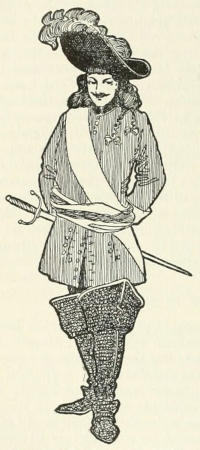
Soldier, Time of Louis XIV
The campaign of 1677 was preceded like that of 1676 by several attempts at negotiations in England and Holland. Courtin, who had replaced Ruvigny in England, wrote to Louis XIV that it was absolutely necessary to detach the prince of Orange from his allies, which might be accomplished by the intervention of Charles II. In consequence the king renewed to Orange and the states-general his former offers. He proposed to abandon the places necessary to cover Ghent and Brussels, to make a commercial treaty with Holland, and to conclude with her an eight years’ truce which would give Spain the time to reflect. If, on the expiration of the delay, Spain persisted in sustaining other claims, France and Holland would divide the Netherlands between them. William did not absolutely repel these conditions, but replied that he could not abandon his allies without dishonour.
In order to have some faith placed in his pretended moderation, Louis signed with Charles II, on February 24th, a commercial treaty which offered some advantage to the English. Charles II insisted that France should make peace. He represented that Holland would not separate from her allies, that in the end he would be obliged to uphold her, and that he could not continually go against the sentiments and interests of his subjects.
The enterprises in Sicily had brought England’s uneasiness to a climax. She already saw the ruin of her trade with the Levant, and Charles II proposed a project of peace, the basis of which was that France should keep Franche-Comté and a part of the places conquered in the Netherlands; that she should grant the Dutch a barrier and a commercial treaty; that she should indemnify the duke of Lorraine and abandon Sicily; but it remained to come to an understanding on a number of particular points and on the determination of the places that should remain to Louis XIV. The latter wished to give up only three—Charleroi, Ath, Oudenarde; and he demanded that Spain should cede him Ypres, Charlemont, and Luxemburg in exchange. He was all the more obstinate because he knew the states-general were tired of war and the damage inflicted upon commerce. He hoped to separate them from the prince of Orange, through the establishment of a barrier and some tariff concessions, but these concessions were so weak that the Dutch only laughed at them. As for the congress of Nimeguen, where the discussion of the propositions between the plenipotentiaries of the various countries began on the 6th of May, 1677, it would necessarily take too much time to put a stop to military events.b
CAMPAIGN OF 1677; NEGOTIATIONS FOR PEACE
Créqui had succeeded Turenne in Germany, Luxemburg replaced Condé in the Netherlands. The former made amends for his defeat at Consarbrück by a campaign worthy of Turenne. By a succession of quick marches, which kept him constantly between the enemy and the French frontier, he covered Alsace and Lorraine against an adversary superior in numbers, defeated him at Kochersberg, between Strasburg and Zabern (October 7th, 1677), and took Freiburg from him, thus taking the war to the right bank of the Rhine. Luxemburg, who resembled more the victor of Rocroi, captured Valenciennes in conjunction with the king, where the musketeers raised formidable works in broad daylight, then Cambray, and with Monsieur, against the prince of Orange, fought the battle of Cassel, near St. Omer, which capitulated (April, 1677).d
The coalition was now seriously shaken. Orange was everywhere accused of small ability for leadership. At Brussels and at Ghent the people broke loose against the Dutch. Even in Holland the peace party began to be demonstrative. Louis XIV reduced his tariff by half, in October, 1677, in order to stimulate the pacific desires of the Dutch. The latter, exhausted and tired of continually paying useless subsidies to their allies, complained that the Spaniards were always behindhand in fulfilling their engagements, that the Germans never left Germany, and that the prince of Orange never found provisions or stores in Belgium.
William and his partisans replied to these complaints that the honour of the country was at stake, that the United Provinces could not abandon the allies to whom they owed their salvation, and he had still one resource. This was to force England, which according to him was alone capable of doing it, to call a halt to the armies of Louis XIV. He went to London, where Charles II not only authorised but desired his presence, believing that it would be a convincing response to the defiances and murmurs of the nation. Scarcely had the prince arrived when he asked the hand of Mary, daughter of the duke of York. The king, who had long judged this alliance necessary, hastened to grant it. The marriage was celebrated on the 15th of November.
Charles II believed that Louis XIV would now raise no obstacle to accepting the proposals of peace: but he was mistaken—Louis rejected them, as going too far beyond those he had proposed himself, and which he already considered too moderate. The other powers, Spain and the empire, also declined them and preferred to continue the war. Charles II, having signed a treaty with the states-general on January 10th, 1678, found himself compelled to go further than he wished. He was obliged to recall the English troops serving in the French army and to prepare armaments.
Louis XIV took little notice of these demonstrations, strengthened the remainder of his armies, and decided to strike a great blow in the Netherlands, where Vauban had just retaken St. Ghislain in the depths of winter.
At the opening of the campaign of 1678, France could count on 219,000 men under arms, of whom half, it is true, were only fit for garrison service. Louvois was resolved to capture Ghent, and deceived the enemy by false demonstrations on other places, which led them to reduce the garrison at Ghent. When this had been done, he suddenly appeared under the walls of the town on the 1st of March. In less than two days 70,000 men were assembled and the siege was begun. Louis XIV, who had gone on a journey to Metz and the borders of the Maas to outwit the Spaniards, suddenly changed his direction and arrived on the 4th. The queen and the court followed closely, but stopped at Tournay. Four marshals, Humières, Luxemburg, Schomberg, and Lorges, assisted the king, Vauban pressed the works. The town, in spite of its siege and the number of watercourses and canals protecting it, was promptly surrounded. The 500 men forming the garrison declined to defend it. It surrendered the 9th, and on the 11th the castle capitulated. The army now marched upon Ypres, which it took on the 25th after eight days of entrenchment and in spite of a bloody resistance. The king, after this rapid campaign and its two important acquisitions, returned to St. Germain on the 7th of April.
Louis XIV now believed himself secure in imposing his conditions. He sent them the 9th of April to Nimeguen and to London: they were the same as before the taking of Ghent and Ypres. He allowed his plenipotentiary a month to have them accepted, but this term was further extended to the 10th of August. The latest successes of the French had had the effect that Louis XIV hoped for, that of strengthening the peace party in Holland. Amsterdam and the large towns refused to prolong these sacrifices. Charles II hastened to approve the French conditions. The Dutch, ready to agree to Louis’ commercial stipulations, did not find his proposed restitution of places sufficient to form such an efficient barrier that they could oblige Spain to accept. Suddenly Villa-Hermosa (successor of Monterey in the governorship of the Spanish Netherlands) received the order from his court to lay down his arms. The Madrid cabinet, divided and exhausted, had resigned itself to the abandonment of that which had been lost, from fear of losing that which was still retained. This decision relieved the states of Holland of their last scruples. Louis XIV then put forward a condition which was nearly the ruin of everything. He declared that, in engaging to restore Maestricht and the other places on the Maas of which he was master, he intended to maintain garrisons in them until his ally Sweden should have recovered that which Denmark and Brandenburg had taken from her. This exigence aroused the Spaniards, disconcerted the Dutch, exasperated the English, and drove Charles II to despair. They gave up all hope of ending the war. On July 26th, Charles II signed a treaty of defensive alliance with the states-general.
Louis XIV realised the necessity of getting out of this hole, and as he did not wish to recede, he engaged Sweden to ask the withdrawal of this condition, which Charles XI generously did. The Dutch plenipotentiaries at Nimeguen, Van Beverningk, Odyk, and Van Haren asked on August 7th for a conference with the French plenipotentiaries, D’Estrades, D’Avaux, and Colbert. They debated together for more than twenty-four hours, and finally, before midnight on the 10th, they signed a treaty of peace and a treaty of commerce with France.[138]
LOUIS XIV SETTLES WITH THE COALITION (1678-1679 A.D.)
[1678-1679 A.D.]
The first treaty returned to the states-general Maestricht and the little towns which Louis XIV had kept in the vicinity and in Limburg, on sole condition that free exercise of the Catholic religion should be allowed. The second re-established freedom of commerce and navigation between the two peoples.
D’Estrades brought in person the news of the treaty to Marshal de Luxemburg, encamped on the plateau of Casteaux not far from Mons, which a detachment of his troops was blockading. The prince of Orange, who had come face to face with the French army with almost equal forces (45,000 men), knew of the Peace of Nimeguen, but had not yet received official notice. He began a sharp attack upon Luxemburg, and the battle raged for six hours around the abbey of St. Denis. It was a hard fight. A regiment of French refugees fighting under the Dutch flag was literally hacked to pieces. The day remained undecisive; and on the next the courier announcing the peace arrived in the Dutch camp, and the two armies separated.
The Dutch having signed the peace were assailed with violent recriminations on the part of their German allies, especially the elector of Brandenburg, the king of Denmark, and the bishop of Münster. But the great point for them was to obtain the definite adhesion of Spain. The latter country, exhausted and ill-governed, had long shown a great repugnance to making peace. But as soon as Charles II had attained the age of fourteen, his majority, the great personages of the kingdom forced the queen to drive Valenzuela out; then they compelled her to accept exile herself. Don John took the title of prime minister and seized the government (June 20th, 1677). As the emperor insisted on the re-establishment of his sister, Maria Anna, Don John, almost embroiled with the court of Vienna, was compelled to lend his ear to pacific propositions.
The treaty between France and the court of Madrid was finally signed September 17th, 1678. Louis XIV restituted Courtrai, Oudenarde, Ath, and Charleroi, which the Treaty of Aix-la-Chapelle had given him; also Binche, St. Ghislain, Ghent Leuw, and Puigcerda in Catalonia, which Marshal de Navailles had taken that same year. On his side he retained with definite title St. Omer, Cassel, Aire, Bailleul, Poperinghe, Ypres, Wervicq, Warneton, Cambray, Bouchain, Valenciennes, Condé, Bavay, Mauberge, and the whole of Franche-Comté. The treaty of 1668 had in reality only been a truce, giving France advance posts in the heart of Belgium and leaving Spain with other places, isolated spots in the midst of French possessions, particularly on the borders of the Schelde. The treaty of 1678 established a much more regular border, by assuring France a series of strongholds bound one to the other, and closing all avenues to the kingdom from Dunkirk to the Maas, and leaving the Spanish Netherlands another series of places which offered the same advantages though in a less degree. The Treaty of Nimeguen was, in spite of a few restitutions demanded by Europe as a guarantee of peace, one of the most glorious and most advantageous that France had ever signed.
The emperor and the empire remained to be reckoned with. They were left out of the Dutch and Spanish treaties. They began by protesting and continuing the war. The imperial army, without stopping at the negotiations of Nimeguen, undertook, under the duke of Lorraine, to retake Freiburg in Breisgau, and to penetrate into Alsace. In May it appeared on the Rhine between Offenburg and Wilstett. Créqui was again charged with protecting Freiburg; and conducted a campaign which was as fortunate as it was able, and which placed a seal upon his fame. The Germans, reduced to powerlessness at every turn, quickly ended the campaign. The emperor, abandoned by the Dutch and embroiled with the Spaniards, ended by desiring peace. The possession of Philippsburg indemnified him for the loss of Strasburg. The princes of the empire, with the exception of a few in the north, refused to pursue the now objectless war. The subsidies of Spain and Holland had ceased. Leopold consented to a treaty which was signed January 15th, 1679, between the emperor, the empire, and France. The whole difficulty centred around the allies, whom Austria refused to abandon and for whom she demanded satisfaction. The king made a few concessions; but he would not give up Lorraine to Duke Charles except in retaining Nancy and four military routes. The duke rejected these conditions. Louis XIV also reserved to himself the right of passage through eight towns of the empire, to join the duchy of Cleves, and to continue the struggle with the elector of Brandenburg.
The imperial princes, interested in keeping their conquests over the Swedes, were the only ones who would not lay down their arms. They did not have to wait long to see themselves forced to do so, for Louis XIV was not willing at any price to abandon unfortunate allies whose actions had been of service to him. Pecuniary indemnity served to interest the dukes of Brunswick, Lüneburg, and the bishop of Münster. The elector of Brandenburg refused this sort of compensation. Créqui entered the duchy of Cleves, occupied the county of Mark, [the two possessions of the elector by the Rhine] and the town of Lippstadt beyond the Rhine, and advanced as far as the Weser, whose passage he forced June 30th, near Minden. The elector, incapable of continuing this unequal struggle, had on the eve of that day made his submission. His envoy signed at St. Germain a treaty by which he restored to the Swedes that which he had taken from them, stipulating a rectification of the Pomeranian frontier, and an indemnity of 300,000 crowns which France paid. The king of Denmark was the last to treat. He restored the towns he had taken, but received no pecuniary indemnity. These successive treaties, consequent upon those of Nimeguen, re-established things in Germany almost upon the footing of the Treaty of Westphalia.
[1680 A.D.]
All the powers had been weakened in the eight years’ war. Holland alone escaped almost intact from the storm which had threatened to destroy her. As for Louis XIV, he emerged from the struggle aggrandised and triumphant. He triumphed all the more in that he owed nothing to anyone—not even to the king of England, who, having shown himself equally incapable of making war or peace, now raised against himself as much scorn in France as hatred in his own state. If France had suffered considerably from a prolonged struggle which demanded enormous sacrifices, she had displayed resources superior to those of any other power, although Holland had shown herself the richer in proportion. France had struggled single-handed against the empire. The king’s proud device, “Nec pluribus impar,” was justified. The courtiers and the soldiers were unanimous in granting him the title of Louis the Great; an equestrian statue representing him in the costume of a Roman emperor was raised a short time after in Paris in a square which was called the Place des Victoirés.b
FOOTNOTES