Chapter XVIII · THE SUPREMACY OF MAZARIN
Reading edition
Any other nation, after its Mazarins, its Fouquets, its Louvois, so many wars, so many glories, so many heroes, so many rascals, would have stayed crushed and never arisen. Nevertheless, France still lives.—Michelet.b
[1643-1661 A.D.]
Louis XIII had hastened to carry out all the provisions of Richelieu’s will. His own did not meet with the same fate, for its most important dispositions were immediately modified. While regretfully appointing Anne of Austria regent he had put strong restrictions upon her authority and provided that the partisans of Richelieu, Mazarin and the prince of Condé, were to control the government. He knew the queen had not been unaware of the conspiracies of the court, not even of that of Cinq-Mars, and that she had always listened to Richelieu’s enemies. Towards the end he had drawn nearer to her and his brother, but without granting them his confidence.
[1643 A.D.]
Scarcely had Louis closed his eyes when Mazarin resolved to give over the entire government to the queen. Unity and power seemed, to the cardinal, the most necessary thing: he came to an understanding with the bishop of Beauvais, almoner of the queen; he was able to persuade Gaston, Condé, and the other councillors, who withdrew opposition in consideration of the compensation offered them. Consequently, on the 18th of May, parliament met in extraordinary session; the peers were present. The queen attended with the young Louis XIV and held a bed of justice. On the express renunciation of the duke of Orleans and the prince of Condé the assembly unanimously set aside all the restrictions to the queen’s power, and decided that the title of lieutenant-general held by the duke of Orleans would be simply honorary.c
The queen-mother was now in her forty-second year. She inspired almost universal sympathy, by her good looks, agreeable manner, and previous misfortunes which now counted for virtues. Age had made her more sedate and more devout; her devotion, however, was still mingled with gallantry, but it was the serious romantic gallantry of Spain which is not incompatible with external dignity and reserve. Facile and genial in ordinary intercourse, but altogether impulsive and insincere when her passions were aroused; going when necessary as far as perjury—though doubtless with the resource of mental reservation—to extricate herself from a wrong step; intrepid by temperament, in spite of more than one act of moral cowardice; of an unconquerable stubbornness in her prejudices and in certain of her attachments, although sensitive to ingratitude; at the same time absolute by her temperament and her principles, and unable through inactivity to exercise the absolute power, her queenly nature was invaluable to a minister capable of making a favourable impression on her head and her heart.
Mazarin made an attack on both of these at the same time, and soon occupied an unshakable position with her. Their correspondence leaves doubt neither as to the passion which this minister expressed and which he inspired in the queen, nor as to the constancy which Anne had at least the merit of preserving in this last passion, which the progress of age did not extinguish.[96]
Mazarin was of the same age as the queen. We may recall his brilliant début as a diplomat thirteen years before, when before Casale he prevented two armies from falling upon each other. Since then he had remained faithfully attached to the interests of France, which had raised him to the cardinalate without his having received holy orders—he never was a priest.[97] He gave himself out to be a Roman nobleman. His enemies denied this, and asserted that his father, a Sicilian merchant, had taken refuge in the states of the holy father, after having gone bankrupt at Palermo. A. Renéee has investigated every version of the cardinal’s origin and concludes that his father, the son of a Sicilian artisan, came a fortune-seeker to Rome, where he became chamberlain to the constable Colonna. At all events the mind, the face, the complaisance, and the dexterity of the young Giulio Mazarini won him, at an early age, the patronage of some of the noble houses of Rome, and after having tried the sword, the young adventurer felt his vocation and assumed the soutane as a stepping-stone to diplomacy; at the age of twenty-eight he met Richelieu—we know the rest.
The character and the future of the fortunate Italian were still at this moment a problem for the court and for the public.d As yet he frightened no one. He was far from being believed as powerful and especially as much a master of the queen’s mind as he already was. He often spoke of returning to Italy. What then was the astonishment when, on the very evening of the bed of justice, it developed that Anne of Austria had designated him to preside over the council.c
It would take a simple mind indeed to believe that an event as foreseen as the death of the king should have taken the queen unawares, that she should not have known which way to turn, and that she should have seriously offered the power to this one or to that. The whole affair was certainly settled beforehand; and for what reason? By reason of her indolence, which told her that a bed already made was better to lounge on, sleep in, than a new arrangement which would oblige her to will, to think. She knew that, ready to set out from London, from Brussels, from Madrid, there was a crowd of exiles, calling themselves martyrs to the queen’s cause, who would demand the crown for their martyrdom. How to satisfy them? She was all ears to him who taught her the sweetness of ingratitude.
In this Mazarin was admirable. He often varied, but never on this point. His character offers the beauty of a well-sustained type which does not contradict itself. Ingrate towards Joseph and Chavigny, who made him in France, he got out of two scrapes during the Fronde by the same means—ingratitude towards Condé and then towards De Retz. Finally he crowned his life with what was worse than all—ingratitude towards the queen, his old-time sweetheart.
The puppets of Richelieu, odious, detested, the Chavignys, the Bouthilliers, were impossible; Mazarin was a stranger, with no ties in France, and ready to depart as soon as he had put the queen au courant. He was packing up his things. A good excuse for remaining. The queen appeared very uncertain. She consulted much, hesitated much. Finally Condé came to tell Mazarin, “ready to depart,” that the queen made him chief of the council, keeping also Chavigny and his father, the chancellor Séguier, the same who had conducted the inquiry against her in 1637.
A mortal blow for Beaufort and the Vendômes, the queen’s friends. When they demanded an explanation she said that Mazarin would not let her forget her friends, that he was au courant of affairs, a stranger, consequently the less dangerous, that he was amusing, but above all disinterested. This disinterestedness was so extreme, and the poor man remained so poor, that after a few years, when he was driven out and wished to return, he was able to raise an army with his own money!b
BATTLE OF ROCROI (MAY 18TH-19TH, 1643 A.D.)
But before anything could happen, Paris was suddenly struck with a piece of good news which produced the very greatest effect. While under the last reign no great battle had been accomplished by the French armies, that of Louis XIV opened with the victory of Rocroi.
Francisco de Mello had advanced to the frontier of the Low Countries with 28,000 men, counting on profiting by the uncertainty into which the last illness and death of Louis XIII would plunge the French government. France had, on her side, an army in the field to observe him, and it was Louis XIII’s will that this army be placed in command of the duke d’Enghien, son of Condé, a young prince of twenty-two years, the choice of whom must attach his house all the more closely to the future regency. Enghien had served hitherto only as a volunteer; but he had been instructed, exercised, and formed in the best of schools. He had already shown in war a vigour and intelligence which everyone applauded. He inspired confidence both in his officers and his soldiers. They foresaw in him a great captain. As an adviser and to moderate his ardour he had been given an able lieutenant-general, Duhallier, become Marshal de l’Hôpital, and several excellent maréchaux de camp, Gassion, La Ferté-Senneterre, and Sirot.
The Spaniards entered Champagne, and besieged Rocroi. The place, important by its situation at the head of the Ardennes, was in no condition to resist. Enghien, having collected between St. Quentin and Guise 14,000 infantry and 6,000 horse, marched to its relief. On the way he learned of Louis XIII’s death, but the news did not stop him. He resolved to give battle to relieve the tedium of methodic warfare—this was also the advice of Gassion and Sirot. On the 18th of May he arrived before the Spaniards, who, protected by woods through which the French had to pass, were not expecting to see them appear; and the time they took to range themselves for battle permitted the French prince to approach. The day was far advanced and he contented himself with a small amount of cannonading. The next day Enghien ordered the attack at daybreak, for he wished to forestall the arrival of a corps which General Beck was bringing to Francisco de Mello. He himself, with Gassion, charged at the head of the right wing and routed the enemy. The left wing, commanded by Marshal de l’Hôpital and La Ferté-Senneterre, had less success. It disputed its ground but was badly used. Enghien and Gassion, victorious on the right, did not neglect their advantages. They immediately fell upon the Spanish division which was in action with De l’Hôpital, the moment at which, thinking itself victorious, it began to break ranks and was running to pillage the tents of the French. Sirot, in command of the reserves, received the order to advance, and he waited to execute it until the very moment when Enghien and Gassion should have renewed the contest. Then he gave it, and the victory was decided. The two divisions of the enemy broken and put to flight, there yet remained the Spanish reserve infantry which formed a square battalion difficult to penetrate. It was composed of picked veterans and commanded by the old count de Fuentes, who had to be carried in a litter at the head of his soldiers. The victorious Enghien threw himself upon the square, dealt it several sharp attacks, and finally broke it by attacking its rear and flanks while his cannon thundered upon it.c
The massacre was appalling. Moved to pity, the duke d’Enghien threw himself between the two armies, commanding his men to spare the vanquished. “All the Spanish infantry,” says La Moussaie, “crowded round him and his commanding officers, seeking shelter from the fury of the French, and more particularly of the Swiss, who could not bring themselves to make prisoners of any.” After giving orders to the prisoners’ guard, the prince collected his troops and prepared to receive Beck, should he have the courage to meet him on the plain. But Gassion shortly returned from his pursuit of the enemy and informed the duke that he had nothing to fear from the German general. Beck had not even passed beyond the edge of the wood, being content with rallying the fugitives, and at the approach of Gassion’s cavalry he had fled precipitately towards Luxemburg.
Seeing his triumph thus complete, the duke d’Enghien, with the Christian piety that never forsook him even in battle, fell on his knees, in company with his whole army, and gave thanks to God for the victory. Thus ended one of the most bloody and most glorious days in the history of France. The battle had lasted four hours. The Spanish army left 8,000 dead upon the field, and 6,000 prisoners in the hands of the French. Among the slain was the brave count de Fuentes. Don Francisco de Mello had been made a prisoner for a few moments, but he managed to escape and took refuge at Mariembourg, then at Philippeville, where he collected the fragments of the Spanish army. Two hundred flags and sixty standards fell into the hands of the French. The Spanish baggage wagons were plundered and were found to contain all the money destined for the pay of the troops. The French lost about two thousand men.f
Enghien possessed the power of prompt decision and knew the value of time. He turned his victory to good account by marching immediately upon Thionville, the possession of which was of extreme importance to the Three Bishoprics and at the siege of which Feuquières had come to grief in 1639. Mazarin approved his plan and furnished all that was necessary for the siege. Instead of proceeding with that methodical regularity learned from the Dutch, Enghien pressed his attacks; they were very deadly, especially for the officers, but his plan was to reach his end the more quickly, to astonish the enemy, and to avoid sickness, which was more fatal than artillery in prolonged sieges. Thionville surrendered the 8th of August. The little town of Sierck, which commanded Luxemburg, capitulated a few days later.
Enghien was placed at a bound above all the captains employed by Richelieu. The French army, formed by eight successive years of campaigns, equal at least to those of neighbouring nations, leaving nothing to be desired in instruction, experience of its officers, discipline, good administration, or material organisation, had finally found a leader worthy of it. Enghien, with his eagle glance, great promptitude of execution, and an ardour which he knew how to moderate, disconcerted the rational and prudent tactics of the enemy’s generals. The battle of Rocroi bore witness to the military progress of France, and dealt a serious blow to the prestige of the Spanish armies, when Spain had, for three years, been seeing her power shaken and her resources weakened.c
THE IMPORTANTS (1643 A.D.)
The return of Mazarin to power was received with surprise and mortification by the returned exiles, the enemies of Richelieu, those who had deemed themselves possessed of the heart and confidence of the queen. They were for the most part young men, such as the duke de Beaufort, and a host of noble striplings, who were all, nevertheless, profound statesmen in their own esteem.
With pretensions to govern, they found it necessary to alter or conceal their juvenile and frivolous habits; they affected to be grave and sententious, and some even thought it necessary to give time to study and reflection; a whim, the characteristic and beneficial consequences of which are seen in the Mémoires of De Retz and the Maximes of the duke de la Rochefoucauld. The latter was at this time one of the young friends of the queen. Despite the talents that some of these youths afterwards displayed, their present pretensions and demeanour were considered as absurd, and the party was ironically called les Importants, that of the “important.” On the side opposed to them were drawn up Cardinal Mazarin, the old partisans of Richelieu, and, amongst the noblesse, the prince of Condé and his gallant son, the duke d’Enghien.
The queen-regent, as became her position, affected neutrality, but supported her newly chosen minister. The importants, however, hoped to regain the ascendency through the means of Anne of Austria’s old favourite, Madame de Chevreuse, who was now returning from her long exile. This lady had once been all-powerful with the queen: her misfortunes, occasioned by that attachment, gave her, she thought, an increase of claim; she totally put out of consideration how far the policy of a regent might interfere with the affections of a queen, and her party pretensions were as high as her resentments. She was warmly and cordially welcomed back by Anne; Mazarin hastened to conciliate her, and commenced by placing 50,000 crowns before her, asking if he might count her amongst his friends. Madame de Chevreuse required the dismissal of Chavigny, and the cardinal instantly consented to sacrifice the secretary: then came the great demands of the party, viz., that Sedan should be restored to the duke de Bouillon, the government of Brittany to the duke de Vendôme, and that of Guienne to young Épernon; Le Havre, too, was required for the future duke de la Rochefoucauld.
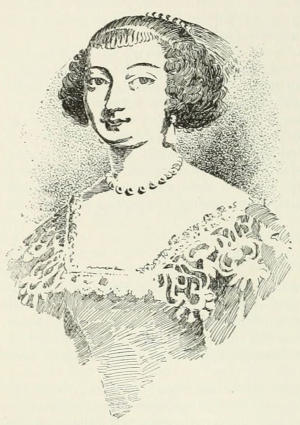
Madame de Montbazon
These demands were no less than to re-constitute the power and independence of the grandees, that Richelieu had spent his life and steeped his memory in blood in order to reduce. Anne of Austria and Mazarin, now in the place of authority held by Richelieu, could not but see with his eyes: the adroit Mazarin, however, did not give to Madame de Chevreuse the flat and peremptory denial that would have come from Richelieu’s mouth; he looked complaisant and yielding, and drew on the negotiatrix of the importants to fresh pretensions. One of these was to supersede the chancellor Séguier by Châteauneuf. Now Châteauneuf had presided at the commission which condemned the duke de Montmorency, and to favour him would be to outrage the princess of Condé, sister of that duke. Mazarin pretended to stand out on this point, hesitatingly, no doubt; Madame de Chevreuse insisted; and the cardinal, determined to break with a party whose pretensions were exorbitant, and which sought to replace the aristocracy on its old footing of superiority to government and ministry, affected to break with them rather than insult the family of Condé; thus securing powerful support, and averting the suspicions of the young noblesse from the political jealousy which he bore them.
A rupture was declared; and a lady’s quarrel soon afterwards occurred to precipitate hostilities, and give the minister a pretext for acting. The duchess de Longueville, of the family of Condé, and one of the beauties of the court, was maligned by Madame de Montbazon, sister-in-law of Madame de Chevreuse. The latter found a billet-doux in the handwriting of the former, and addressed, she asserted, to the count de Coligny. This piece of scandal or calumny convulsed the entire circle of influential personages. The duke d’Enghien challenged the duke de Beaufort; the Duke of Guise and the count de Coligny fought in the Place Royal, Madame de Longueville being spectatress of the discomfiture of her chevalier, who died of his wounds. The queen in vain endeavoured to bring about an accommodation. The importants were too deeply mortified, and nothing short of the disgrace of the cardinal would satisfy them. The queen peremptorily refusing this, the duke de Beaufort entered into a scheme for making away with the cardinal by violence. Circumstances occurred to baffle and interrupt the design. Épernon was sounded in the meantime by one of the conspirators, and he instantly betrayed it. The duke de Beaufort was consequently arrested on the following day. Mesdames de Montbazon and Chevreuse were both exiled, as well as the duke and duchess of Vendôme, the dukes of Guise and Mercœur, and other less illustrious nobles. Here is the exculpation of Richelieu, and the excuse of his severity. No sooner is Anne of Austria, his rival and enemy, in the place of power, than she is obliged to adopt his policy and his strong measures, notwithstanding that such acts did violence to her private feelings. She wept on ordering the arrest of Beaufort; but, like the late monarch, she was compelled to sacrifice her feelings to her own interest and that of the state. The reign of the importants lasted three months and a half.
[1643-1647 A.D.]
The four years which succeeded 1643 were years of tranquillity to the regent, triumph to Mazarin, and glory to France. The petulance of the noblesse was checked by the discomfiture of the importants. Mazarin, instead of imitating Richelieu and reigning by terror alone, sought to captivate by giving scope to pleasure, and creating a general taste for light and social amusements. He encouraged fêtes and gallantry. He was prodigal of favours, of money, of everything save authority. He bound the noblesse, and their more froward dames and mistresses, in golden and in flowery chains; and those who a year before were clamouring for independent governments, then limited their ambition to a duke’s title. The sage La Rochefoucauld himself has recorded in his Mémoiresm how he pleaded for this important distinction, in order, as he observes, that his wife might enjoy the privilege of a tabouret or stool at court.g
THE EDUCATION OF THE YOUNG KING
Louis XIV, born September 5th, 1638, had now (1645) completed his seventh year; that being the age at which kings passed from the control of women to the control of men, it became necessary to provide him with a governor and a tutor. To Cardinal Mazarin the queen desired to hand over the supreme control of Louis’ bringing up, and for that purpose created for him the post of superintendent of the king’s education.
Several contemporary writers have reproached Mazarin with having directed the education of the young Louis carelessly. La Porte, a groom of the bed-chamber to the king, accused the cardinal of having no other dream than to obtain empire over the young prince’s will by surrounding him with his own family and partisans. Madame de Motteville,k without being quite so prejudiced, claims that he thwarted the good intentions of the young prince’s governor, the marquis de Villeroi. Nevertheless, an entry in the note-books proves that even as early as 1647 Mazarin exerted himself to remove from the prince such persons as he thought dangerous. In the case of François de Rochechouart, who enjoyed an old-established credit with the queen, Mazarin declared that a place must not be given him near the king; “for,” he writes, “his incessant flatteries are extremely prejudicial to the king, and prompt him to regard with great displeasure those who speak the truth to him.” Yet one must recognise that during a long period the cardinal, absorbed in politics, paid little heed to the king’s education. It was only during the later years of his life that, having reached the summit of power and glory, he helped by his counsels to inspire in the young Louis habits of order, of regular work, of strong and tenacious will, of supreme and authoritative government. Judging by results, this education was far from being sterile. The king’s governor, intrusted to accompany him everywhere, to watch over his safety and direct his actions, was Nicolas de Neufville, first marquis, then duke and marshal, de Villeroi. This individual had gained a certain renown in war, but it was pre-eminently as a clever and pliant courtier that he shone. He was a willing tool in the hands of the minister. It seems that his rôle was limited to winning the young king’s good graces, to teaching him the ways and manners of the court, in which he himself excelled, and to giving him for companion and favourite his own son, François de Neufville-Villeroi, who became in his turn Duke-Marshal de Villeroi.
The post of tutor was filled by Hardouin de Beaumont de Péréfixe, doctor of the Sorbonne, who ultimately became archbishop of Paris, and to whom we owe a History of Henry IV written for the instruction of Louis XIV. The classical education of the young king was meagre. Madame de Mottevillek tells us “he was made to translate Cæsar’s Commentaries; he learned to dance, to draw, and to ride, and he was very skilful in all bodily exercises.” The Venetian ambassador, Nani, asserts that the tutor did neglect to teach the young king the principles of virtue.f
MILITARY GLORY (1644-1648 A.D.)
[1644-1648 A.D.]
The year 1644 is marked by the brilliant manœuvres of the duke of Enghien and Turenne.g After the capture of Sierck, Enghien drove the Germans back across the Rhine, and crossed after them; he hastened to repair the losses and defeats which the French had met with on the frontier after the death of Marshal de Guébriant, which had occurred at the siege of Rottweil in Swabia (1643). [Guébriant’s army, now badly led by several leaders, had allowed itself to be surprised by the imperials at Tuttlingen.] Enghien found Freiburg im Breisgau taken and the Bavarian general Mercy beneath its walls with an army greater than his own. Enghien had two marshals of France under him, of whom one was Grammont and the other Turenne, who had just been created marshal after having served brilliantly in Piedmont against the Spaniards. The duke and his two generals attacked Mercy’s camp intrenched on two heights. The battle recommenced three times on three different days (August 3rd-5th, 1644). It is said that the duke of Enghien threw his commander’s baton into the enemy’s entrenchments and, sword in hand, went after it at the head of the Conti regiment.[98] The battle of Freiburg, more bloody than decisive, was the duke’s second victory. Mercy decamped four days afterwards. Philippsburg, Worms, and Mainz were the proof and the fruit of the victory.
Enghien returned to Paris, received the acclamation of the people and demanded recompense of the court; leaving his army to the prince-marshal Turenne. But this general, skilful as he was, was beaten at Marienthal (May, 1645). Enghien hastened back to his troops, resumed the command, and joined to the glory of again commanding Turenne that of repairing his defeat. He attacked Mercy on the plains of Nördlingen, and won a great battle early in August. Marshal de Grammont was captured, but so was General Glen who commanded under Mercy, and the latter himself was among the slain. Mercy, who has been reckoned among the great captains of his time, was buried close to the battle-field, and on his tomb was graven, “Sta Viator; Heroem Calcas” (Halt traveller, thou treadest on a hero).
The name of the duke d’Enghien[99] now eclipsed all others. In October, 1646, he besieged Dunkirk in sight of the Spanish army, and was the first to give that place to the French. Such success and such service brought forth less reward than suspicion in the court, and made him as much feared by the ministry as by the enemy. Condé [as we must now call him] was therefore withdrawn from the scenes of this conquest and glory and sent into Catalonia with inefficient and ill-paid troops. He besieged Lerida, but was obliged to raise the siege (1647). A wavering state of affairs soon forced the court to recall the prince to Flanders. The archduke Leopold, brother of the emperor Ferdinand III, was besieging Lens in Artois. Condé, restored to the troops which had always been victorious under him, led them straight for the archduke. This was the third time he had given battle with disadvantage in numbers. He spoke to his soldiers these simple words: “Friends, remember Rocroi, Freiburg, and Nördlingen!”[100] (August 20th, 1648).
He himself relieved Marshal de Grammont, who was about to surrender with the left wing; he captured General Beck. The archduke saved himself with difficulty with the count of Fuensaldaña. The imperials and the Spaniards composing the army were scattered; they lost more than a hundred banners and thirty-eight pieces of cannon, which was a considerable number for that time. Five thousand prisoners were taken; three thousand men were killed; the rest deserted and the archduke was left without an army. Never since the foundation of the monarchy had the French won so many battles in succession, and ones so noted for military ability and courage.
While the prince of Condé was thus counting the years of his youth in victories, and the duke of Orleans, brother of Louis XIII, was upholding the reputation of a son of Henry IV and of France by the capture of Gravelines (July, 1644), Courtrai, and Mardyck (November, 1644), the viscount de Turenne had taken Landau, had driven the Spaniards from Treves, and re-established the elector. In November, 1647, with the help of the Swedes under Wrangel, Torstenson’s successor, he won the battle of Lawingen, and that of Zusmarshausen (May, 1648). He compelled the elector of Bavaria to leave his states, at the age of almost eighty. The count d’Harcourt took Balaguer and beat the Spaniards. They lost Porto Longone in Italy (1646). Twenty vessels and twenty galleys of France, which composed almost the whole navy as re-established by Richelieu, defeated the Spanish fleet off the Italian coast.
This was not all. The French arms had again invaded Lorraine; and Duke Charles IV, a warrior prince, but an inconstant, rash, and unfortunate one, saw himself at the same time deprived of his state by France and kept prisoner by the Spaniards (May, 1644). The allies of France pressed the Austrian power on the north and south. The duke of Albuquerque, the Portuguese general, won the battle of Badajoz from Spain in March, 1645. Torstenson defeated the imperials near Tabor and obtained a complete victory. The prince of Orange, at the head of the Dutch, penetrated as far as Brabant.
The king of Spain, beaten on every side, saw Roussillon and Catalonia in the hands of the French. Naples in revolt against him had just given itself into the hands of the duke of Guise, the last prince of that branch of a house fruitful in illustrious and dangerous men. This one, who had passed only for a bold adventurer, because he did not succeed, had at least the glory of boarding single-handed a bark in the midst of the Spanish fleet and of defending Naples with no other resource than his own courage.
At the sight of so many misfortunes crushing the house of Austria, so many victories accumulated by the French, seconded by the success of their allies, one would have believed that Vienna and Madrid were only waiting to open their gates, and that the emperor and the king of Spain were almost without dominions. Nevertheless these five years of glory, crossed with only a few reverses, brought few real advantages and much spilled blood, but no revolution. If one was to be feared it was for France. She was on the verge of ruin in the midst of this apparent prosperity.i
TREATY OF WESTPHALIA (1648 A.D.)
[1641-1648 A.D.]
Negotiations for peace had been going on for a long time. Proposed in 1641, conferences were opened April 10th, 1643, in two Westphalian cities—Münster and Osnabrück. The questions for consideration were the altering of the map of Europe after a thirty years’ war; of providing the empire with a new constitution; and of regulating the civil and religious rights of the several Christian nations. France was represented at this congress by able negotiators, the count d’Avaux and Abel Servien; but her best diplomats were Condé and Turenne, whose swords had simplified the negotiations by rendering peace a necessity. At the last moment Spain withdrew, hoping to profit by the troubles of the Fronde, then commencing in France. The other countries, in haste to have finished, signed the peace (October 24th, 1648).
During the Thirty Years’ War Austria had striven to stifle religious and political liberty in Germany. Austria being defeated, that against which she had fought remained and increased. The Protestants obtained full liberty of conscience, and imperial authority, but lately threatening, was annulled; the princes of the German states, confirmed in the exercise of complete authority over their territories, had the right of alliance with foreign powers so long as these alliances (so read a vain restriction) were “against neither the emperor nor the empire.”
The two powers which had achieved the defeat of Austria had stipulated for themselves important indemnities. Sweden gained the island of Rügen, Wismar, western Pomerania with Stettin, the archbishopric of Bremen, and the bishopric of Verden—that is to say, the mouths of the three great German rivers, the Oder, the Elbe, and the Weser—with 5,000,000 crowns and three votes in the diet. France continued to occupy Lorraine, promising to restore it to its duke when he should have complied with her conditions. She obtained the empire’s renunciation of all right over the Three Bishoprics—Metz, Toul, and Verdun, which she had possessed for a century; over the town of Pinerolo, ceded by the duke of Savoy in 1631; over Alsace, which was now—with the exception of Strasburg—given to France, carrying her boundaries beyond the Vosges as far as the Rhine. She also obtained Breisach, on the right bank of that river, and her right to garrison Philippsburg was recognised; the right of navigation on the Rhine was guaranteed her.
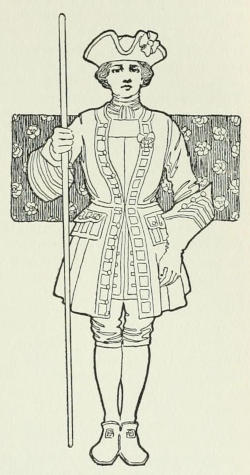
A French Officer, Middle of Seventeenth Century
These were great advantages; because, by recovering Alsace, France covered Lorraine on the side of Germany and established herself to the north of Franche-Comté, which since Henry IV she had enveloped on the south; so that the return to France of these two provinces was only a question of time. Not only were her frontiers now better outlined for defence, but she was able to maintain an offensive position. By the acquisition of Pinerolo France planted a foot beyond the Alps in Italy; by Breisach and Philippsburg, beyond the Rhine in Germany. By opening the eyes of the German states to their right to contract foreign alliances France was always able to buy over one or another of their indigent princes, and by guaranteeing the execution of the treaty, she gave herself the right to interfere in German affairs. The empire—being now no more than a sort of confederation of 360 states, Lutheran and Catholic, monarchical and republican, laical and ecclesiastical—became of necessity the theatre for all sorts of intrigues, the battle-field of Europe, as Italy had been at the beginning of modern times, and for the same reasons—division and anarchy.
The Treaty of Westphalia, which was the foundation for all diplomatic conventions from the middle of the seventeenth century until the French Revolution, put an end to the supremacy of the house of Austria, and rescued the independence of the small states. If the Bourbons had not inherited the ambition of the Habsburgs, and roused against themselves the same coalitions, the Peace of Westphalia would have accomplished the supremacy of France and the political liberty of Europe.
MAZARIN’S DOMESTIC POLICY
[1646-1648 A.D.]
While Mazarin gloriously continued the policy of Richelieu, his power in France was being destroyed by factions.h
At first he used his power with moderation. He affected, at the beginning of his supremacy, as much of simplicity as Richelieu had displayed of arrogance. Far from employing guards, and keeping up royal splendour, he had at first the most modest retinue. He was affable and even gentle where his predecessor had shown inflexible pride.
But with all this, taxation was necessary to maintain the war against the Spaniards and against the emperor. The finances of France were, since the death of Henry IV, as badly administered as those of Spain and Germany. The excise offices were in chaos, ignorance was extreme, thievery was paramount. The revenue of the state amounted during the first year of the regency to between fifteen and sixteen million livres. This was quite sufficient if there had been any economy in the ministry; but in 1646 and 1647 there were deficits. The superintendent of the finances was at times a Sienese peasant named Particelli Émery, whose soul was even baser than his birth, and whose extravagance and debauchery aroused the nation to indignation. This man invented burdensome and ridiculous expedients. He created and sold posts of inspectors of fagots, of licensed hay venders, of king’s councillors, of wine hawkers; he sold letters of nobility. The debts on the Hôtel-de-Ville at Paris then amounted to only about eleven millions, but the fund-holders were deprived of several quarterly dividends; import duties were increased; several posts of masters of requests (to whom all petitions were intrusted) were created; about eighty thousand crowns of magistrates’ salaries were held back.
It is easy to realise how far the minds of the people were aroused against two Italians, both come penniless to France, who had enriched themselves at the expense of the nation and who now had such a hold over them. The parliament of Paris, the masters of requests, the other courts, the fund-holders, rebelled. In vain did Mazarin remove his confidant Émery from office and relegate him to one of his estates—there was indignation that this man should have estates in France. The cardinal was held in abhorrence, although at this very moment he was consummating the great work of the Peace of Westphalia; for it must be noted that this famous treaty and the “day of barricades” are of the same year, 1648. The civil wars began at Paris as they had begun in England, over a little money. In 1647 the parliament of Paris, in verifying the tax edicts, showed itself spiritedly opposed to them. It acquired the confidence of the people by remonstrances which were very wearying to the ministry. But it did not revolt. Its spirit became embittered and hardened by degrees. The populace might rush to arms at once and choose a leader as they had done with Masaniello at Naples; but magistrates and statesmen proceed with more deliberation, and begin by observing the proprieties as far as party spirit will permit.
Cardinal Mazarin had thought that by skilfully dividing the magistracy he would prevent all troubles, but his cunning was met with inflexibility. He withdrew four years’ salary from all the higher courts, at the same time remitting the paulette; that is to say, exempting the judges from paying the tax devised by Paulet under Henry IV for assuring the magistrates the permanency of their posts and permitting them to sell them. This retrenchment was not an injury, but he did not withdraw the four years’ salary from parliament, thinking to disarm it by this favour. But parliament scorned this mark of grace which exposed it to the reproach of preferring its interests to those of the others; and it did not hesitate to issue an arrêt d’union with the other courts of justice. Mazarin, who was never able to pronounce French, having said that this arrêt d’ognon was an attacking measure, and having had it vetoed by the council, this single word ognon made him ridiculous, and as one never yields to one that is scorned, parliament became more active.
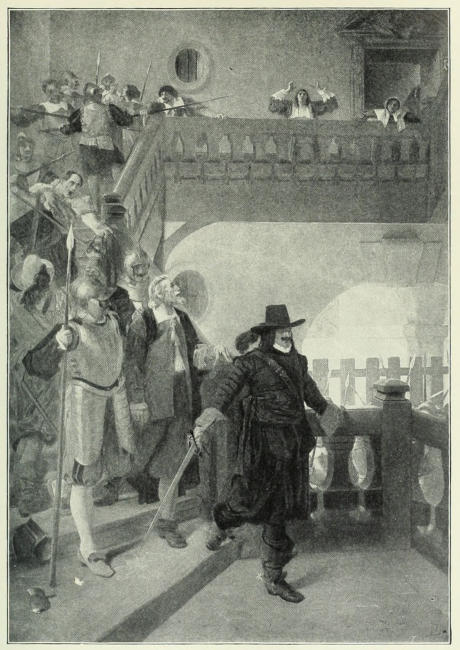
THE ARREST OF BROUSSEL
It loudly demanded that all the intendants regarded by the people as extortioners should be recalled, and that the new kind of magistracy instituted under Louis XIII, without the procedure of ordinary forms, should be abolished. This was to please the nation as much as to irritate the court. It desired that, according to the ancient law, no citizen should be put in prison without his natural judges knowing of it within twenty-four hours.
Parliament did more; it abolished the intendants by a decree with orders to the king’s prosecutors in its jurisdiction to inform against them. Thus the hatred of the ministry, supported by the love of the public weal, threatened the court with a revolution. The queen yielded; she abandoned the intendants and asked only that three be retained. In this she was refused. While these troubles were brewing the prince of Condé won the famous victory at Lens, which crowned his glory. The king, who was only ten years old, exclaimed, “Parliament will be very sorry!” These words make it sufficiently evident that the court looked upon the parliament of Paris as an assembly of rebels. Indeed, the cardinal and his courtiers gave it no other name. But the more the parliamentarians were treated as rebels the more resistance they made.i
This state of affairs between ruling power and the parliament expressing the feelings of the people brings us to that remarkable revolt known as the Fronde, “the last echo of the civil wars of the sixteenth century.”
“The origin of the name,” says Martin,d “seems to have been the comparison made between the young and turbulent conseillers aux enquêtes and the urchins who gathered in the city ditches to indulge in mimic fights with slings (frondes). The malcontents adopted the name of frondeurs, and longed for the glory of ‘slinging the court well’ (bien fronder la cour). The first to adopt this title of frondeur was, it is said, the councillor Bachaumont, son of the president Le Coigneux.” Kitchinq says that the name of the Fronde was first adopted by the coadjutor to the archbishop of Paris, Paul de Gondi, of whom we shall presently speak. “The young lords and dames,” says Crowe,g “who afterwards embraced the party, willingly adopted a name which so well characterised their petulance, and sportive rather than serious rebellion.” But the Fronde, sportive though it may have been to the nobles, was the cause of immense misery to the people. Famine and pest walked in its train and the country was enormously depopulated.a
FIRST INSURRECTION OF THE FRONDE (1648 A.D.)
[1648 A.D.]
The queen and the cardinal resolved to arrest three of the most stubborn magistrates of the parliament: Novion Blancménil president of a court of justice, Charton president of a court of inquiry, and Broussel former councillor-clerk of the grand chamber. They were the tools of party leaders and not leaders themselves. Charton, a man of very limited abilities, was known by the nickname of “I say this,” because he always opened and closed his remarks with those words. Broussel had nothing to recommend him but his white hairs, his hatred for the ministry, and a reputation for always raising his voice against the court no matter on what subject. His confrères paid little attention to him, but the populace idolised him.
Instead of arresting them without any hubbub in the silence of the night, the cardinal thought to impress the people by having them arrested in broad daylight, on August 26th, 1648, while the Te Deum was being sung at Notre Dame for the victory of Lens and the Swiss of the chamber were carrying into the church the seventy-three banners taken from the enemy. It was precisely this plan that caused the ruin of the kingdom. Charton escaped, Blancménil was taken without difficulty, but it was not the same with Broussel. An old servant, seeing her master thrown into a coach by Comminges, a lieutenant of the bodyguard, collected a mob. It surrounded the coach, which was smashed to pieces; but the French guards lent assistance to Comminges and got Broussel away from his friends. He was taken out on the road to Sedan. The arrest, far from intimidating the people, irritated and emboldened them. Shops were closed. The great iron chains which at that time were at the entrance to the principal streets were stretched across them; barricades were built, and four hundred thousand throats cried “Liberty and Broussel!”i
The marshal de la Meilleraie with two hundred guards tried to disperse them; he drove some back to the Pont Neuf, where his progress was impeded, and where he met Paul de Gondi, coadjutor of the archbishop of Paris, so famous later under the name of Cardinal de Retz, who had rushed out in his robes amongst the mob. After having harangued and momentarily tranquillised the populace, De Retz hurried with the marshal to the Palais Royal, to represent the alarming state of the city to the queen. Anne of Austria, who knew the coadjutor’s character, suspected him as one more likely to throw oil than water on the flame. “It is rebellion itself to imagine that the people can rebel,” said she; “you would have me deliver Broussel; I will first strangle him with these hands.” This resentment, seconded by the jeers of the court, had the ill effect of converting De Retz into a dangerous enemy.g
The Day of the Barricades (August 27th, 1648)
It is difficult to reconcile all the details of what followed, related by Cardinal de Retz,j Madame de Motteville,k Advocate-General Talon, and many others; but all agree upon the principal points. During the night which followed the riot the queen had about two thousand troopers, quartered a few leagues from Paris, come into the city to protect the king’s residence. The chancellor Séguier had already proceeded to the parliament accompanied by a lieutenant and several archers to quash all its decrees and even, it is said, to suspend that body.
But during that very night the factionists assembled at the house of De Retz, and everything was arranged to arm the city. The chancellor’s coach was stopped and overturned. He escaped with difficulty, with his daughter the duchess de Sully, who in spite of him had insisted on accompanying him. He retired in disorder into the hôtel de Luynes, jostled and insulted by the populace. The civil lieutenant now took him into his coach, and escorted by two Swiss companies and a squadron of gendarmes attempted to bring him to the Palais Royal. The people fired on them; several were killed and the duchess de Sully was wounded in the arm.
Two hundred barricades were formed in an instant; they were pushed to within a hundred paces of the Palais Royal. The soldiers, after seeing several of their number fall, retreated and looked to see what the bourgeois were going to do. The parliament marched on foot in a body to the queen, across the barricades which were lowered before it, and demanded the liberation of its imprisoned members. The queen was obliged to set them free.i
The barricades were immediately levelled, and the people ceased their turbulence and clamour. “Never was disorder more orderly managed,” says Madame de Motteville;k “the citizens who had taken up arms to prevent the ascendency of the rabble and to check pillage were little more peaceable than the populace itself, and roared for the liberation of Broussel with equal violence.” The court in yielding had but temporised, however; and it soon made its escape from the capital to St. Germain. Such was the first insurrection of the Fronde.g
Cardinal de Retz has boasted of having all by himself armed the whole of Paris on that day (August 27th, 1648), which has been called the “Day of the Barricades” and which was the second of its kind. This singular man is the first bishop of France to plan a civil war without religion for a pretext. He has described himself in his Mémoires,j written in a grandiose manner with the impetuosity of genius and an unevenness which are the mirror of his conduct. He was a man who, from the depths of debauchery and the infamous consequences which it brings, preached to the people and made them idolise him. He breathed faction and conspiracy; he had been at the age of twenty-three the soul of a conspiracy against the life of Richelieu; he was the author of the barricades; he precipitated parliament into cabals and the people into seditions. His extreme vanity made him undertake bold crimes in order that they might be talked about. It was this same vanity that made him repeat so often, “I am of a house of Florence as ancient as that of the greatest princes”[101]—he whose ancestors had been merchants like so many of his compatriots.i
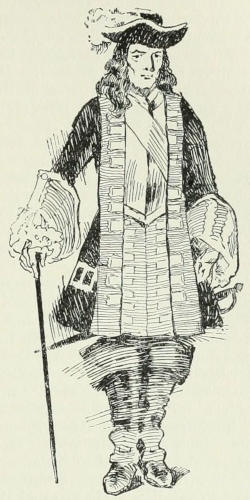
A French Officer, Middle of the Eighteenth Century
The hopes of the queen were now in the young prince of Condé. But that young hero, though opposed to the party of the importants, was not yet prepared to martyrise his popularity for Mazarin. He proposed his mediation. Mazarin accepted it, well knowing how soon the hot prince would lose patience at the formal and democratic pleadings of the parliamentary statesmen. De Retz, now the leading man of the popular party, made every effort to gain Condé, who replied, “My name is Louis de Bourbon: I will not shake the throne.” Through his means negotiations were entered into with the court; the elders of the parliament, and Molé, the president, at their head, being anxious to avoid a civil war, whilst the violent party, bestowing on the pacific chiefs the nickname of barbons, pushed matters to extremities. They had revived an old law, passed after the fall of the marshal D’Ancre, which prohibited the administration of the kingdom by foreigners, thus aiming at Mazarin. Still a second accommodation took place: a royal declaration, dated the 28th of October [the very day of the signing of the Peace of Westphalia], accepted the principal articles of the plan of reformation, and the court returned to the capital.
[1648-1649 A.D.]
This proved but a hollow truce, entered into by both parties out of respect for Condé, whom both feared and both hoped to gain. The popular party was suspicious; De Retz continued his intrigues; whilst the queen urged Condé to make preparations for defending the royal authority by force. It has been the fate of all attempts to establish liberty in France to be frustrated, not by the opposition of the aristocracy, but by their affecting to abet and adopt its principles.
In the Fronde, the magistracy of Paris, supported by the citizens, endeavoured to supply the want of a national assembly. They framed a constitution; forced it on the court without effusion of blood; and might have succeeded in upholding and perhaps ameliorating it, when the young noblesse interfered, drove the citizens to insurrection first, then to submission, and for the sake of their selfish quarrels, which all their light-heartedness and valour cannot redeem, they sacrificed the last hope that the French had of even a degree of liberty; they pierced the last plank that shut out the overwhelming ocean of despotism. We certainly, of the present day, can look but with a small degree of hope or approbation on a judicial body which grasps at legislative power. But had the noblesse known its true interests, and acted its natural part of mediator, the states-general might have superseded the parliament in its political functions; the moderation of the provincial deputies would have tempered the ardour of the capital, and the ever consecutive extremes of insurrection and pusillanimous submission might both have been avoided.
The old party of the importants now roused itself. The duke de Beaufort escaped from prison. The duke de Bouillon, smarting under the loss of Sedan, joined counsels with him; and both intrigued with the violent men in the parliament to form an insurrection against the court. The duchess de Longueville brought her charms to support the same cause: these decided La Rochefoucauld, her lover, to adopt it. She used all her influence to the same effect with her brother Condé in vain. In default of him, the prince of Conti, his brother, was won over. No cause could subsist, in the opinion of these gentlemen, unless it could boast the name of a prince of the blood. The duchess de Chevreuse, though still in exile, corresponded with the party, and promised to it the accession of the princes of Lorraine. Madame de Montbazon was found united in the same cause with her rival, Madame de Longueville. The marshal D’Hocquincourt offered the strong and important fortress which he commanded, in homage to the charms of the former. “Péronne,” wrote he to her, “is at the disposal of the fairest of the fair.” A crowd of nobles gaily joined the conspiracy; and the court was once more obliged to make its escape from Paris, and retire to St. Germain, in January 1649.[102]
Strong and extreme measures were at last resolved upon, although not prepared with that vigour and foresight that Richelieu would have displayed. Troops, under Condé and the duke of Orleans, prepared to invest Paris, and occupied on either side of the city the bridges of Charenton and St. Cloud; but with only 12,000 men, the utmost of the royalist force, it was impossible to invest the metropolis. A royal order, commanding the parliament to retire to Montargis, was treated by them with contempt. A civic guard was raised, to the number of 12,000, the chief officers, it is remarkable, being lawyers and officers of parliament; the provost of the merchants, however, retained the supreme command. In addition to these, a stipendiary force of 20,000 men was raised in a few days, by means of a house tax, fixed at so much for every plain house-door, and double the sum for the gate which admitted a carriage. The noblesse did not forget their petty ambition, even in adopting the bourgeois cause. The duke d’Elbeuf had first seized on the chief command, and was reluctant to yield it to the prince of Conti. The duke de Beaufort, however, was the most popular chief, owing to his affable manners and handsome person. He was called the roi des halles (the king of the markets). The war, if it can be called such, commenced by the attack of the Bastille, at which the ladies of the party assisted. It surrendered gallantly to these fascinating adversaries. On his side, Condé began to press towards the walls; and some skirmishes took place, in which a few were slain, amongst others the duke de Châtillon.
Two circumstances soon after occurred that much altered the views and shook the resolutions of the court. One was the defection of Turenne, who, won over by his brother the duke de Bouillon, promised to march the army, which he commanded on the Rhine, to the support of the Fronde; the other was the connection of the frondeur nobles with Spain, and the public reception by the parliament of an envoy from that power. This savoured of the inveteracy of the league. The elder magistrates, and principally Molé the president, indignant at this alliance with the enemies of the country, began to exert themselves to frustrate the violent projects of the young noblesse, and to seek an accommodation with the court. The majority of the parliament, already disgusted with the froward, frivolous, and arrogant behaviour of the nobles, came so far into the same views, that Molé himself, with some of his brethren, was despatched to the queen at Ruel, to essay an accommodation. The court grasped at the opportunity, but still negotiated for advantages; whilst Bouillon stirred the populace of Paris against the moderation of the parliament, and urged the alliance with Spain. Molé, determined to disappoint the ambitious duke, signed a treaty with the court in haste, on the 11th of March, ere Turenne could arrive, or Spain despatch its aid.
Great was the indignation of the populace, and of the seditious leaders, at the news of this peace. All cried out treason. Bouillon was confounded, and De Retz perplexed. Molé knew that he risked his life by thus balking the seditious ardour of both the nobles and the mob; but the thought gave him courage, not hesitation. The critical moment was that of declaring the treaty to the assembled parliament. A ferocious crowd, crying “Treason! no peace! no Mazarin!” surrounded the Palais de Justice; and the throng within its walls was scarcely less hostile or less calm. Molé stood up and read the treaty; clamour instantly covered his voice. The prince of Conti exclaimed against a peace concluded without his knowledge, and that of the nobles his friends. “You, then, are the cause,” retorted Molé: “whilst we were at Ruel, you were treating with the enemies of France; you were inviting the archduke, the Spaniard, and the foe to invade the kingdom.” “It is not without the consent of several members of the parliament that we took this step,” replied the prince, not denying the charge. “Name them,” was Molé’s instant retort; “name the traitors, that we may proceed to try and judge them.”
The firmness of the president at once awed the nobles, and won over the majority of the assembled magistrates to support him. The only hope of the favourers of sedition was in the rabble, which, incensed and tumultuous, had penetrated into the passages and corridors of the palace. Some, with poniards and arms, demanded the head of the president. “Give us up the grande barbe” (long beard); so they called the venerable magistrate. Others shouted the word “Republic.” Molé heard them with unshaken courage. Those around besought him to make his escape by a postern. “Justice never skulks,” replied Molé, “nor will I, its representative. I may perish, but will never commit an act of cowardice, which would give hardihood to the mob.” Accordant to this magnanimous resolution, the chief magistrate walked boldly down the principal staircase through the mob, awing the most audacious by his firmness. Even De Retzj was lost in admiration; and has recorded that he could perceive in the countenance of Molé, then threatened by the fury of the multitude, not a motion that did not indicate imperturbable firmness, and at the same time a presence and elevation of mind greater than firmness, and every way supernatural. This is one of the noblest exhibitions of courage which history has recorded.
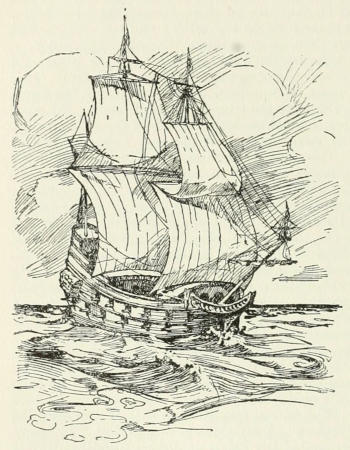
French Man-of-War, Time of Louis XIV
When the chiefs of sedition saw that they could not conquer, and that the treaty would pass in their despite, each hastened to make his private offers and demands of the court. Bouillon wanted Sedan; Turenne, Alsace; Elbeuf, the government of Picardy; Beaufort, to be admiral. They were not listened to. Angered and resolved to proceed to extremities, they wrote to Turenne to advance, and to the archduke to invade the north. But Turenne’s treason was defeated by Erlach, commander of the Swiss—himself obliged to fly; and the archduke, his support failing, retreated. Thus the moderate portion of the parliament, supported by the civic guard, succeeded in restoring peace with the court, despite the opposition of the nobles and the mob. The reader will not fail to remark how distinct these several classes kept from each other, even when in alliance and fighting the same battles; a state of society that has not ceased at the present day to characterise France: whilst in England, the blending of the lower ranks of the nobly born with the higher ranks of the industrious and unennobled, effected by the habits and institutions of the country, have rendered the pernicious line of demarcation betwixt castes and classes almost invisible to the historian.
SECOND ACT OF THE FRONDE; ARREST OF CONDÉ
[1649-1650 A.D.]
The scene now shifts, and another act of the Fronde commences, displaying the chief actors in altogether new characters and dresses. No sooner was the peace declared than the prince of Condé, jealous of the cardinal, united with the nobles whom he so lately combated: he visited his sister, Madame de Longueville, became reconciled to her and to La Rochefoucauld; the duke de Beaufort and the coadjutor being the only two that remained at the same time hostile to Mazarin and jealous of Condé. A few nobles, however, were not sufficient to give weight to the demands of the prince, and Mazarin resisted them. The prince, in consequence, saw the coadjutor, and planned, or pretended to form, an alliance with him and the violent members of the parliament. The court, terrified at the prospect of being so abandoned, and of seeing Condé at the head of the frondeurs, granted all the desires of the latter, who, ashamed to break with his new allies, yet left without a pretext to continue his quarrel with Mazarin, “changed his mind three hundred times in three days.” The haughty prince, who hated the parliament and the rabble, at last decided to disappoint the coadjutor; he became reconciled to Mazarin, and of course quarrelled with the frondeurs, whom he accused of an attempt to assassinate him. The same imprudence, the same haughtiness, petulance, and overbearing temper marked the prince to whichever side he leaned, and disgusted both. As a friend he was even more troublesome than as an enemy: Mazarin and the queen felt this; they could no longer tolerate his insolence; and the present moment, as he had left himself no friends in any party, seemed the best opportunity for being revenged on him.
To arrest and send the prince to prison was the old monarchic mode of treating the froward; but one of the articles stipulated by the parliament, and secured to them in the last treaty, was that every prisoner should be interrogated in four-and-twenty hours, and delivered over to his lawful judges. To infringe upon this law might rouse the parliament, and re-excite the rebellion of the Parisians. To secure himself against such an event, Mazarin leagued with—whom? The coadjutor himself, and the most violent of the frondeurs! They, the populace sharing their sentiments, hated Condé for his ancient enmity and his late desertion. De Retz and Mazarin, accordingly, had interviews, the former entering the Palais Royal by night in disguise. The consequence of this secret understanding soon appeared. The prince of Condé, the prince of Conti, his brother, and the duke de Longueville were arrested at the door of the council-chamber, and sent to Vincennes in January, 1650. The dukes de Bouillon and de la Rochefoucauld, as well as the duchess de Longueville, succeeded in escaping; the princesses of Condé were ordered to retire to Chantilly. Bonfires, illuminations, and every sign of joy on the part of the Parisians marked this extreme measure. The popular hatred of Condé and confidence in De Retz lulled for the moment their dislike of the cardinal Mazarin.
Two events which mark the spirit of the time, and which occurred previous to the prince’s arrest, must not be passed over. The honour of a tabouret, or stool at court, was only granted to the ladies of princes of sovereign houses, or to the wives of dukes and peers. Exceptions, however, had been made in favour of the younger branches of the Rohans, the La Trémouilles, and the family of Bouillon. La Rochefoucauld pretended to the same distinction: the prince of Condé supported his claim. The noblesse instantly assembled to the number of eight hundred, and formed a protest against such pretensions, which went, they said, to destroy the natural equality that existed amongst all gently born. The dispute led to a discussion of political rights and principles, then the dangerous mania of the age, and some voices clamoured for the states-general. The French noblesse are entitled certainly to the credit of having demanded these national assemblies at a time when the judicial body or parliament, in whom the favour and confidence of the people were then centred, deprecated any such proposition. It may be asked why the chiefs of the judicature, and such upright lovers of liberty as Molé, were opposed to the convocation of the states-general. The answer is that the example of England, then in the mouths and minds of many, terrified them, and made them prefer their own body as a constitutional check, to such a representative assembly as that which, in the neighbouring kingdom, had begun with civil war, and ended in regicide and despotism. It must be owned they had some cause for fear. A revolution is bad enough; but an imitative revolution, a parody of such a great event, is to be deprecated tenfold, as incurring all the evils and few of the advantages of the convulsion.
Already the people of Paris talked of republics and liberty: the monarchy, they said, was too old, and it was time it should expire. Nay, the duke de Bouillon himself, adopting the revolutionary phrase, proposed on one occasion to purge the parliament. The taste for assembling and debating was general. The annuities charged on the Hôtel-de-Ville were suspended by the troubles: three thousand of these fund-holders, chiefly citizens of Paris, met, drew up resolutions, petitioned, and clothed themselves in black, the uniform of the tiers or third estate. Molé instantly rebuked them, as attempting to form a chambre de communes, a house of commons. The citizens were indignant at the comparison: and this very reproach, that they were imitating the commons of England, had great effect in dissipating their assembly.
RESISTANCE OF BORDEAUX (1650 A.D.)
Principles, however, were soon forgotten in the general sympathy which the misfortunes of Condé excited. The haughtiness, the imprudences of the hero of Rocroi and Lens were now forgotten; and the nobility began to rally to his cause as their own. The court were at first successful in reducing Normandy, the government of the duke de Longueville; but in Languedoc and the provinces on the Gironde, the dukes de la Rochefoucauld and de Bouillon soon gathered an army of adherents, and were joined by the wife and infant son of the prince.
Clémence de Maillé, princess of Condé, had hitherto commanded little respect either from the world or from her husband, who, having married her merely as the niece of Cardinal Richelieu, was ashamed of her humble origin and his own condescension. She now however displayed a heroism and an attachment worthy of the spouse of the Great Condé. The princess escaped with her young son, the duke d’Enghien, from Chantilly, and after some delay in a fortified place, joined the dukes de la Rochefoucauld and de Bouillon in the south. But the noblesse was not then the predominant order in the state, and she was obliged to seek more powerful protection in the parliament of Bordeaux. This provincial court of justice was highly incensed against the duke d’Épernon, governor of Languedoc; and consequently ill-disposed towards the queen and the cardinal, who seconded him. They of course embraced with ardour the new laws established by the parliament of Paris, which gave to the courts of magistracy power to control the measures of government, and which forbade arrests without bringing the accused to speedy trial. They could little comprehend the manœuvres by which De Retz and his violent party induced the parliament of Paris to overlook the imprisonment of Condé. They were eager to take his part and to admit the princess within their walls; but at the same time had considerable distrust of the nobles who supported her, and who were negotiating with Spain. To satisfy these scruples, the princess entered Bordeaux alone; but the popular clamour drowning the voice of the magistrates, she soon had the city at her command, and the dukes de Bouillon and de la Rochefoucauld entered with their troops and took the command.
The queen and Mazarin led the young king and an army commanded by the marshal De la Meilleraie to reduce Bordeaux. Its first feat was to raze Verteuil, the famous château of the La Rochefoucauld family, a barbarous act, and inconceivable in Mazarin, who loved the arts. Bordeaux was then invested, and its suburb was carried after a valiant defence, in which La Rochefoucauld displayed remarkable gallantry. To gain footing in the town itself was soon found impossible, such was the obstinacy of the armed citizens. Whilst Mazarin and the court thus lay encamped before Bordeaux, Turenne had entered the north of France, and was marching without opposition towards the capital, intending to liberate the princes from Vincennes. Condé, confined in the donjon of that castle, whiled away his captivity by cultivating the few flowers that the terrace of his window could contain. “Who would have thought,” exclaimed he, in learning the resistance of Bordeaux, “that my wife should be fighting whilst I was gardening!” The princes were removed from Vincennes to the safer retreat of Marcoussis, and Turenne, who, fearing to indispose the parliament of Paris by appearing at the head of foreign troops, retired again towards the frontier.
DISGRACE AND EXILE OF MAZARIN (1650-1651 A.D.)
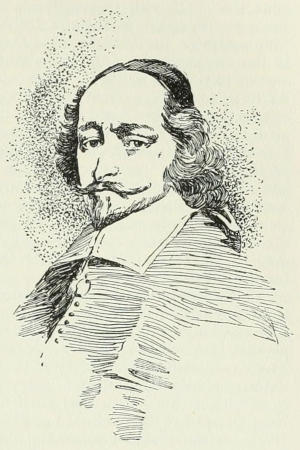
Mazarin
[1650-1651 A.D.]
The coadjutor and the violent frondeurs grew weary of their alliance with Mazarin, into which their fear and hatred of Condé had alone induced them to enter. They not only found Mazarin ungrateful and insincere, refusing even to De Retz the cardinal’s hat that he demanded, but their popularity, which was their chief force, and their influence over the parliament, were rapidly diminishing from their union with the court. Mazarin, suspecting the intention of the frondeurs, and alarmed by the march of Turenne, granted peace to Bordeaux, concluding more a truce than a treaty with the princess of Condé, La Rochefoucauld, and Bouillon.
The minister then returned to Paris, where he found the parliament no longer silent as to the arrest of Condé, but prepared to expostulate, and demand his release. Mazarin caused the princes to be instantly conveyed from Marcoussis to La Havre, where they were still more in his individual power. La Rochefoucauld and Bouillon also returned to Paris; and a series of intrigues took place; these partisans of Condé negotiating at the same time both with the coadjutor and with Mazarin for his release. An alliance with either would effect this, and La Rochefoucauld was in doubt. The coadjutor, in the habit of a cavalier, came by night to the rendezvous at the house of the princess palatine. La Rochefoucauld went in equal secrecy to the Palais Royal. The over-caution of the cardinal lost his cause. La Rochefoucauld pressed him at once to conclude the alliance, and give orders that Condé should be set at liberty. Mazarin hesitated. Unprincipled as he was himself, he could not believe it possible that the friends of Condé could unite with De Retz. La Rochefoucauld warned the cardinal in parting that the morrow would be too late. Mazarin smiled incredulity and irresolution; and the duke, hurrying to the other place of rendezvous, concluded the agreement with the coadjutor. The effects of this alliance were immediately manifest. The majority of the parliament clamoured for the release of Condé, and addressed the queen on the subject. It was necessary to yield; and Mazarin saw that, deserted by all parties, he would infallibly be the victim.
In his rage he anathematised the parliament before the whole court, called it an English house of commons, compared the coadjutor De Retz to Cromwell and himself to Strafford, and declared that, in sacrificing its minister to popular clamour, the crown would, as in the case of Strafford, sacrifice itself. This conversation, being reported to the parliament by De Retz, raised a storm indescribable, and terminated in an address to the queen, desiring that Mazarin should be banished from her councils, and that the prince should be liberated. Nought was left the cardinal but flight. He took his departure immediately. It was agreed that the queen and young king were to follow him, and that, possessed of La Havre and the persons of the princes, they would be able either by open war or negotiation to bring the parliament and the frondeurs to more reasonable terms. This project however failed, through the cunning and activity of the coadjutor, who, learning the queen’s intention of departing, raised a mob round the palace, and made her virtually a prisoner there. Cardinal Mazarin alone found himself without authority. He could not even gain entrance into Havre unless unattended. He entered, nevertheless, saw the captive princes of Condé, Conti, and Longueville, endeavoured to cajole them, and set them at liberty, without receiving in return a single mark of gratitude or regard. Thus every way disappointed, Mazarin resigned himself to his disgrace, and left the kingdom.[103]
CONDÉ IN POWER (1651 A.D.)
The prince of Condé was now all-powerful—the parliament, the Fronde, the noblesse, the populace, had all rallied to him; the minister was in exile, the queen a prisoner. Many blamed him for not setting aside Anne of Austria, and assuming the regency; but he was totally without the qualities requisite for taking advantage of his position; he was too lazy, too confident, too generous, too rash: and, making not a single exertion, the several parties that had united to compel at once his release and the exile of the minister were allowed again to fall asunder, and abandon to the court the recovery of its ancient influence. The noblesse at this period were animated with a strong desire to imitate the magistracy, and, by remaining united, to restore or re-establish the influence of the aristocracy, in opposition both to crown and judicature. They assembled in the convent of the Cordeliers (afterwards doomed to hold a club of a very different kind, that of Danton), and formed a house of peers, discussing state affairs, and fixing the privileges of the nobles. The parliament took fire at this, and forbade the assemblies. The noblesse looked to Condé to head them; but he, without principle or aim, and deeming his interests, as prince of the blood, distinct from those of the aristocracy, held back at this crisis. The noblesse called the assembly of the church, then sitting, to their aid, who protested, and complained that the parliament had altered the ancient constitution of the kingdom, by adding themselves as a fourth and spurious estate to the three established ones of king, lords, and commons. Despite of this, the parliament had force and the popular feeling on its side. The noblesse were obliged to succumb, and dissolved their assembly; not, however, before they had recourse to the queen and the royal authority, who issued a declaration, promising to convoke the states-general for the following September.
Here the queen recovered consideration and authority sufficient to enable her to aim at and grasp more, by allying with the prince of Condé. One of the stipulations betwixt them was that the marriage should be broken off betwixt the prince of Conti and Mademoiselle de Chevreuse. The coadjutor, connected by gallantry and friendship with the family of Chevreuse, was indignant at this, and a quarrel ensued betwixt Condé and the old party of the Fronde. Hence another scene in the drama, which represents Condé insulted by those very men who had been so instrumental in releasing him. De Retz and the prince nearly came to blows in the Palais de Justice; and the former had almost fallen a victim to the passion of La Rochefoucauld, who jammed the coadjutor betwixt two folding doors till he was almost suffocated: the duke at the same time called to one of his friends to stab De Retz, an injunction that was not obeyed, and perhaps not intended to be obeyed. It is, nevertheless, startling to the modern reader to find the courtly author of the Maximes engaged personally in the office and using the language of the assassin.
The consequence of these dissensions was the recovery of her authority by Anne of Austria, who, in affecting to ally with Condé, was merely enticing him to disgust and desert the Fronde. This achieved, she flung off the mask, and Condé found himself as much detested by all parties as a few months back he was their favourite and their rallying word. The prince, thus deserted, endeavoured to make common cause with the noblesse, and clamoured for the states-general; but it was too late: the parliament united with the court in opposing their convocation, and Condé in despair retired from Paris, obliged to seek support in civil war and an alliance with Spain.
RETURN OF MAZARIN (1651 A.D.)
In September, 1651, Louis XIV, then approaching fourteen years of age, was declared to have completed his minority. The day was celebrated with great magnificence. The royal authority remained, however, as before, in the hands of the queen: her only thought was the recall of Mazarin. The attachment borne by Anne to this prelate-minister is inexplicable. She might have reigned supreme, and been the arbiter betwixt contending parties, could she have consented to leave Mazarin in exile. De Retz endeavoured to impress this necessity upon her; but power appeared to her worthless without the cardinal; and no sooner had Condé broken with the parliament, and burst into war against the court, than the minister prepared to return. He levied an army, made an attempt on Brissac, and soon after joined the court at Poitiers, taking as usual the chief seat in the council.g
At the first news of his return, Gaston of Orleans, brother of Louis XIII, who had demanded the removal of the cardinal, levied troops in Paris without knowing for what they would be employed. Parliament renewed its decrees; it proscribed Mazarin and put a price on his head. This proscription tempted no one to earn the 50,000 crowns, which, after all, would never have been paid. With another nation and in another age, such a decree would have found executors; but here it served simply to incite fresh pleasantries. The Blots and the Marignys, wits, who carried gaiety into the tumult of these troubles, caused to be placarded all over Paris a distribution of the 50,000 crowns—so much for whoever should cut off the cardinal’s nose, and so much for an ear, so much for an eye, so much to make him a eunuch. This ridicule was all the effect of the proscription against the minister’s person, but his furniture and library were sold by a second decree. This money was destined for the assassin’s pay, but it was dissipated by the depositaries, like all funds that had been raised hitherto. The cardinal on his side used against his enemies neither poison nor steel and, in spite of the bitterness and madness of so much partisanship and hatred, no great crimes were committed. The party leaders were less cruel and the people less furious than in the days of the league—this was not a war of religion.
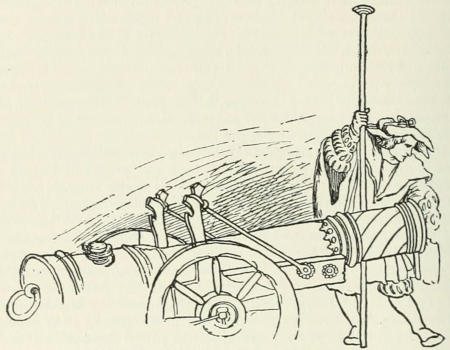
Cannon of the Seventeenth Century
The spirit of madness which reigned at this time so possessed the whole body of the parliament that, after having solemnly ordered an assassination which everyone ridiculed, it passed a decree by which several councillors should betake themselves to the frontier for information against the army of Cardinal Mazarin: that is to say, the royal army. Meanwhile the king interdicted the parliament of Paris and transferred it to Pontoise. Fourteen members attached to the court obeyed; the others resisted. There were now two parliaments, which, to cap the confusion, thundered against each other with reciprocating decrees, as in the days of Henry IV and Charles VI.
It was precisely at the time when this company was going to extremities with the king’s minister that it declared the prince of Condé, who had only armed himself against this minister, guilty of lèse majesté; and by a turn of mind which its preceding steps could alone make credible, it ordered the new troops of Gaston, duke of Orleans, to march against Mazarin and forbade at the same time any money from the public receipts to be used in maintaining them. We can expect nought else from a company of magistrates, thrown out of their proper sphere, knowing not their rights, their real power, political affairs, or war, assembling and deciding amid tumult, making decisions of which they had no thought the day before, and at which they themselves were afterwards astonished. The parliament of Bordeaux was then serving the prince of Condé, but it kept to a little more rational conduct, because being further removed from the court it was less agitated by opposing factions. More important matters were interesting the whole of France.
THE LAST PHASE OF THE FRONDE
[1651-1652 A.D.]
Condé, leagued with the Spaniards, was on a campaign against the king; and Turenne, having quitted these same Spaniards, with whom he had been beaten at Rethel, had just made his peace with the court and was in command of the royal army. The exhausted finances did not permit either of the two parties to maintain great armies, but small ones did not the less decide the fate of the state. Louis XIV, brought up in adversity, went with his mother, his brother, and Cardinal Mazarin from province to province, without having as many troops about his person, by a great deal, as he had afterwards for a single guard in times of peace. Five to six thousand men, some sent from Spain, others raised by the prince of Condé’s partisans, pursued him into the very heart of his kingdom.
Meanwhile the prince of Condé hastened from Bordeaux to Montauban, taking towns and everywhere increasing his party. All the hope of the court lay in Marshal Turenne. The royal army found itself near Gien on the Loire. The opposing force of Condé was some leagues away, under the orders of the dukes de Nemours and de Beaufort. The duke de Beaufort was incapable of commanding anything. The duke de Nemours was braver and more amiable than he was skilful. Both together had demoralised their army. The soldiers of Condé knew that their leader was a hundred leagues away and believed themselves lost, when, in the middle of the night, a courier presented himself at the outposts in the forest of Orleans. The sentinels recognised in this courier the prince of Condé himself, who had come all the way across France from Agen, with many adventures and always in disguise, to place himself at the head of his army.
His presence did much and his unexpected arrival still more. The royal army was divided into two corps. April 7th, 1652, Condé fell upon that which was at Bléneau, commanded by Marshal d’Hocquincourt, and his corps was dissipated as quickly as it had been attacked. Turenne could not even be warned. The terrified Mazarin hastened to Gien in the middle of the night to awaken the sleeping king and himself tell him the news. The little court was in consternation; they proposed to save the king by flight and to conduct him secretly to Bourges. The victorious Condé drew near to Gien; the desolation and the fear increased. Turenne reassured their spirits by his firmness and saved the court by his skill. With the few troops that remained to him he made such fortunate movements that he prevented Condé from following up his advantage. It is difficult to decide which won the more honours, the victorious Condé or Turenne who had robbed him of the fruits of victory.[104] It is true that in this fight at Bléneau not four hundred men were killed; but the prince of Condé was none the less on the point of making himself master of the entire royal family, and of having in his hands his enemy Cardinal Mazarin. It would be hard to find in history any smaller battle with greater interest and more pressing danger.
Condé, who did not flatter himself that he could surprise Turenne, as he had done Hocquincourt, marched his army towards Paris. He hastened to that city to enjoy his glory and the favourable disposition of a blind populace. The admiration they had for his last fight,—all of whose details had exaggerated the hate that was borne for Mazarin,—the name and the presence of the Great Condé, seemed at first to make him absolute master of the capital; but at the bottom all minds were divided. The coadjutor—now become Cardinal de Retz, reconciled in appearance with the court which feared him and which he defied—was no longer the master of the people and no longer played the principal rôle. He ruled the duke of Orleans and was opposed by Condé. Parliament wavered between the court, the duke of Orleans, and the prince. Although all were in accord in crying down Mazarin, each one was nursing his own particular interests in secret; the people were a stormy sea whose waves were driven at chance by many contrary winds.i
Condé hoped to find the parliament his ally against Mazarin: but the stern magistrates, though firm in their abhorrence of that minister, were not more favourable to Condé, and openly reproached him with his Spanish alliance. From the parliament he did not scruple to appeal to the people, whose lowest class rose in tumult, and threatened the magistrates. The very courts proved no refuge: councillors and judges were insulted and even beaten as “Mazarins.”
Condé, thus disappointed in the support of the parliament, and of the respectable citizens, could not cope unaided with the royal army. The Parisian rabble, very forward in a riot, could not be made to stand the fire of regular troops. The prince had recourse to the Spaniards, who, themselves busied in the sieges of Gravelines and Dunkirk, induced the duke of Lorraine to march into France and support Condé. The skilful strategy of Turenne, however, compelled this new auxiliary to retreat; and the prince, after a fresh attempt to raise sedition in the capital and control the parliament, was reduced to fight Turenne with far inferior forces. The latter drove him from St. Cloud, and Condé marched to take post at Charenton, when, his rival pressing him closely, as he defiled round the walls of Paris, the prince was obliged to throw himself into the faubourg St. Antoine, behind the entrenchments formerly raised for their defence by the inhabitants.
Battle of St. Antoine (July 2nd, 1652)
The gate of Paris called St. Antoine was then immediately under the Bastille, the cannon of which swept the three roads diverging from it. Condé, denied entrance into the city, was still secure from attack on this side; and, posted in the central position of the gate St. Antoine, he determined to make head against the royalists, who approached to attack him by the three roads. Mazarin and Louis XIV were on the heights, now covered with the cemetery of Père Lachaise, spectators of the ensuing action, the young monarch being most anxious to witness the destruction of this rebellious prince.
The triple attack commenced: that on the prince’s left, commanded by three sworn and personal enemies to him, was defeated by his valour, the chiefs all perishing. The hero then rushed to defend the central street: he met Turenne in person, and there the conflict was more doubtful. “Did you see Condé during the action?” asked someone of Turenne when the affair was over. “I must have seen a dozen Condés,” was the reply: “he multiplied himself.” On the right the action was most bloody: the nobles of the prince’s party were almost all slain or wounded there, amongst the rest La Rochefoucauld, who, struck on the head, was carried off by his wounded son. Turenne was the most powerful; and no chance appeared of Condé’s saving himself and the relics of his army, when the gate of St. Antoine unexpectedly opened to receive him, the cannon of the Bastille at the same time sending their fire up the three attacked streets, and thus effectually checking the progress of the royalists.
This well-timed succour came from Mademoiselle de Montpensier, daughter of the duke of Orleans, whose sympathy for the heroic Condé, now in distress, was aided by the clamours of the populace, enraged at beholding a rash and imprudent but still generous prince sacrificed to the detested Mazarin. She wrung from the municipal officers the orders for opening the gates; herself directed the firing of the guns of the Bastille; nay, her hand is said to have applied the match. Mademoiselle had aspired to the hand of Condé, to that of the king, and might hope at least to espouse a sovereign prince. But Mazarin observed, on seeing the fire of the Bastille, and knowing who commanded it, “That shot has killed the husband of Mademoiselle.”g
SECOND EXILE OF MAZARIN
After this bloody and useless combat of St. Antoine the king could not return to Paris; and the prince did not remain there long. Popular feeling and the murder of several citizens, for which he was believed to be responsible, made him odious to the people. [He fled from Paris and joined the Spanish army, October, 1652.] However, he still had his faction in the parliament. This body, now intimidated by a wandering court, and driven after a fashion from the capital to Pontoise, pressed by the cabals of the duke of Orleans and the prince, declared, by a decree, the duke of Orleans lieutenant-general of the realm, although the king was an adult. The two parliaments of Paris and Pontoise, contesting the authority one with the other and issuing contradictory decrees, agreed in demanding the expulsion of Mazarin—so much did the hatred of this minister seem the essential duty of every Frenchman. The court saw itself obliged once more to sacrifice Mazarin whom everyone believed the author of the troubles, but who was but their pretext. For a second time he left the country, and to increase his shame the king must needs make a public declaration dismissing his minister, the while praising his services and deploring his exile.
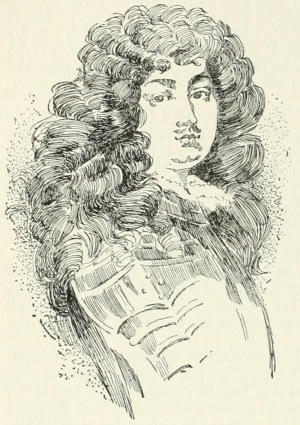
Louis XIV as a Young Man
Charles I, king of England, who had just lost his head on the scaffold, had in the beginning of his troubles abandoned the blood of Strafford, his friend, to his parliament. Louis XIV on the contrary became the peaceful master of his realm by permitting his minister’s exile. Thus the same weakness bore different results. The king of England, in abandoning his favourite, emboldened a people that breathed war and hated kings; and Louis XIV, or rather the queen-mother, by dismissing the cardinal, removed all pretext for revolt from a people tired of war and who loved royalty.
While the state was thus torn at home it had been attacked and weakened abroad; all the benefits of the battles of Rocroi, Lens, and Nördlingen were lost; the important place of Dunkirk was retaken by the Spaniards (September, 1652); they drove the French from Barcelona, they retook Casale in Italy (October, 1652).
Scarcely had the cardinal left for Bouillon, place of his new retreat, when the citizens of Paris, of their own accord, sent to the king and asked him to return to his capital. Louis entered Paris October 21st, 1652, and all was so peaceful that it would have been difficult to imagine that a few days before all was in confusion. Gaston of Orleans, unfortunate in his undertakings, which he never knew how to carry out, was relegated to Blois, where he passed the rest of his life in repentance; and he was the second son of Henry the Great to die without much glory. Cardinal de Retz, as imprudent as he was audacious, was arrested in the Louvre, and after having been sent from prison to prison long led a wandering life which he finished in retreat, where he acquired virtues which his great courage had not known in the agitations of his fortune.
Several councillors who had most abused their ministry paid for their actions with exile; the others withdrew into the limits of the magistracy and others attached themselves the closer to their duties with an annual gratuity of five hundred crowns which Fouquet, attorney-general and superintendent of the finances, gave them surreptitiously. The prince of Condé meanwhile, abandoned in France by nearly all his partisans, and badly assisted by the Spaniards, continued a disastrous war on the frontiers of Champagne. There still remained factions in Bordeaux, but they were soon pacified.i
[1652-1653 A.D.]
Thus ended the Fronde. Voltaire dismisses it in a few pages, satisfied with recording its bon mots. He seems to have looked upon this civil war as merely a pastime, entered into by a few froward youths and their mistresses. He did not see in it the serious, the sanguinary and unhappy struggle of a nation for its liberty. Even later writers, more profound than Voltaire, have designated the Fronde as “the last campaign of the noblesse.” It was indeed so. But the noblesse formed not the prominent body. It was the parliament, the magistracy, that put itself forward to represent the commons, of which they claimed and established the privileges for themselves. This was, no doubt, an audacious and hopeless enterprise. The states-general, the ancient representative assembly of the nation, was the form to which they should have rallied. But the extravagance of the English parliament deterred them; and they fixed upon their own body, as a less democratic and dangerous assembly, to participate in legislative power. The scheme was new: it was conceived with boldness, and supported with courage; and if the legists failed in arriving at settled liberty by its means, they may plead that representative assemblies have frequently failed in the same endeavour.g
MAZARIN AGAIN IN POWER (1653 A.D.)
The calm in the kingdom was the result of Cardinal Mazarin’s banishment; however, scarcely had he been driven away by the general cry of the French people and the king’s decree, when the king made him come back. He was astonished to see himself re-enter Paris all powerful. Louis XIV received him like a father and the people like a master. He held a great reception at the Hôtel-de-Ville amid the acclamations of the citizens; he threw money to the populace, but it is said that in his joy for so happy a change he showed his scorn for the inconstancy or rather the folly of the Parisians. The officers of parliament, after having placed a price on his head like a public robber, sued, almost all of them, for the honour of asking his protection; and this same parliament a short time after condemned by contumacy the prince of Condé to lose his life. They saw the cardinal, who urged this condemnation of Condé, marry to the prince of Conti his brother, one of his own nieces—a proof that the power of the minister was going to be boundless.
The king reunited the parliaments of Paris and of Pontoise; he forbade the assembling of the chambers. Parliament wished to remonstrate, one councillor was sent to prison; several others were exiled: parliament kept quiet; the change had already come.i
[1653-1655 A.D.]
The events of Louis XIV’s youth were such as to inspire him not only with high ideas of his kingly rights, but to prove to him the necessity of absolute power in the monarch.[105] In the great English rebellion, and in the Fronde, he had seen freedom under its most hideous aspect, and followed by the vainest of results. We can scarcely then blame him personally for his despotic propensities, which, moreover, his manly and ambitious character tended to increase. The young king and his brother Philip, then called the duke of Anjou, were educated in the privacy of the palace. The nieces of the cardinal were their playmates; and Louis formed successive attachments for two of these young ladies, especially for Maria Mancini, afterwards the wife of the constable Colonna. So intimate was the connection betwixt Mazarin and Anne of Austria that many were persuaded of their marriage.[106] Certainly her attachment to him was personal and tender. Louis XIV always preserved for the cardinal a sort of filial reverence: he may be said to have learned in the school of implicit obedience how to be himself despotic.
At intervals, however, the imperious temper of the young monarch burst forth, and betrayed itself. In 1655, the parliament, after registering certain fiscal edicts, thought proper to re-examine them, to complain, and show symptoms of their ancient independence. Louis was at Vincennes, engaged in the chase, when he heard of their conduct. Instantly, without consulting the cardinal, or even tarrying to change his dress, the young monarch galloped to Paris, entered the Palais de Justice and the Hall of Parliament in his hunting habit, booted, and with whip in hand. “Gentlemen,” said Louis to the astonished legists, “everyone is acquainted with the ill consequences of your former assemblies. Their recurrence must be prevented. I command you instantly to cease busying yourself with my edicts. And you, Mr. President, I forbid either to call or suffer such assemblies.” This bold assertion of the royal will from the mouth of a stripling proved sufficient to crush the reviving spirit of the magistracy. It was silent, and obeyed.g
WAR WITH SPAIN CONTINUES
Condé, who had become general in the Spanish armies, was unable to revive what he had himself weakened at Rocroi and Lens. He was fighting with raw troops against the veteran French regiments that had learned to conquer under him, and that were now commanded by Turenne. The fate of Turenne and of Condé was to be uniformly victorious when they were fighting together at the head of the French and to be defeated when they were commanding the Spanish.