Chapter XIX · “L’ÉTAT, C’EST MOI”
Reading edition
The two foundations of the absolute throne of Louis XIV were terror and admiration: the terror of a power which had subjugated the army, the church, the magistracy, the noblesse, and the municipalities; the admiration of a power to which literature and art, arms and fortune, rendered their richest and their uninterrupted tribute. King-worship had never before taken so entire a possession of any Christian state. Never had the luxurious pomp of an Oriental court been so intimately and so long associated with the energies, the refined tastes, and the intellectual culture of an European sovereignty. During fifty successive years, Louis continued to be the greatest actor on the noblest stage, and in the presence of the most enthusiastic audience, of the world.—Stephen.p
[1661-1715 A.D.]
Never had there been at any court more intrigues and hopes than during the last hours of Cardinal Mazarin. Women who had any pretence to beauty were flattering themselves that they would now govern a twenty-two-year-old prince whom love had already so far seduced as to make him offer his crown to his mistress. The young courtiers had hopes that the reign of the favourites would return; each minister was expecting the first place; none of them thought that a king who had been so excluded from affairs would dare take upon himself the burden of government. Mazarin had prolonged the king’s childhood as far as he could; and only for a short time had been giving him instructions, and that because the king had demanded it. So far were they from expecting to be governed by their sovereign, that of all those who had hitherto worked with the prime minister there was none who asked the king when he wished an audience. One and all asked, “To whom shall we now address ourselves?”—and Louis XIV replied, “To me.”b
The secretary of state for war, Michel le Tellier, hastened with the astounding piece of news to the queen-mother, who laughed in his face: “In good faith, M. le Tellier, what do you think of it?” This resolution, however, was nothing but the accomplishment of the advice twenty times given by Mazarin, and if there was any cause for astonishment it was not that the king took the advice but that he held to it; he was, as La Bruyère says, “his own prime minister and exacted of the chief state functionaries that they deal directly with him.” For thirty years he worked regularly eight hours a day. He relates in his Mémoires,f with legitimate pride, the effect produced by the announcement of his assumption of authority, and he recommends his son in a few truly eloquent words “not to forget that it is by work one reigns; to rule without working is to be ungrateful and defiant towards God, unjust and tyrannical towards man.”
But what is still more remarkable is that the young prince who so boldly assumed the power had already mapped out his policy. Not only did Louis XIV rule with the boundless power of some of his predecessors, but he was the first to establish in France the theory of an absolute monarchy. In his eyes royalty was a divine institution. Sovereigns were the representatives of God upon earth—his inspired lieutenants; and on this account participators, in a fashion, in his power and infallibility. And as royalty, in making itself absolute, had kept to the old principle of feudal law, that sovereignty and property are the same thing, Louis not only believed himself master of his subjects, but the owner of their possessions—a monstrous doctrine which carries us back to oriental monarchies. At all events it did not seem to him that authority to which he recognised no limits but those imposed by conscience and by religion, ought to remain sterile. He wished it active and hard working; he believed that kings had imperious duties to fulfil. It was thus that Louis XIV understood his royal profession.c Nor can it be denied that he carried out to a large extent in practice the theory of royalty that he professed. He was destined to reign for fifty-four years after the death of Mazarin; his reign in its entirety being one of the longest in history. After Mazarin he had no minister whom he did not dominate: he was king in fact as well as in name. He came to be by far the most famous monarch of his time. His court at Versailles set a standard of magnificence which other monarchs of that and succeeding ages strove to imitate without hoping to rival.
In his political relations with his subjects, as has been said, Louis came to represent the culmination of that autocratic system which for generations had been almost steadily advancing in France,—a system which had known such exponents as Louis XI, Francis I, and Henry IV; and which Sully, Richelieu, and Mazarin had done so much to fortify. Nor did he confine his theory to his own subjects. He came finally to feel almost the same proprietary right in the affairs of Europe and he attempted with the aid of his armies to dictate to foreign nations somewhat as he dictated within the bounds of his own territory. And, having the good fortune to be served by two great soldiers, Condé and Turenne, he was enabled, notwithstanding his own rather meagre military talents, to carry out the idea here also with some measure of success. It was a qualified success, to be sure, for he did not secure the control of Holland at which he aimed; he did not very greatly extend the boundaries of France; and if his grandson was left finally in possession of the Spanish throne, this was a victory tempered with the concession that the thrones of Spain and France should never be consolidated. Nevertheless, to have embroiled all Europe in war after war; to have been the central figure of a long epoch; to have given his name to an important period of history; to have placed that name in the small list of those rulers to whom posterity concedes the title “Great,”—this surely is to have played the part of king right royally.
This reign, then, is a curiously full and vital one. We shall best understand it perhaps if we study it first from within, witnessing the activities of the great monarch in his relations with his own people before turning (in subsequent chapters) to the foreign relations of the kingdom. As preliminary to this study of the economic and social development of France during the long reign of Louis XIV, we must take a glance at the interesting figure of the monarch himself. In the first place it must be remembered that this remarkable man had a remarkable heritage. He numbered among his direct ancestors not far removed such remarkable characters as Henry IV of France, the German emperor Charles V, and the Spanish sovereigns Ferdinand and Isabella. This in itself suggests a strange mixture of races in his ancestry. But further examination of his ancestral tree reveals even more striking facts. It appears that this greatest of French kings is, so far as his ancestral blood is concerned, almost as much Spaniard or Italian as he is French; and quite as much German. His father was born in France, his mother in Spain; of his four grandparents one was born in France, one in Spain, one in Italy, one in Germany. Of his thirty ancestors within four generations only eight were born in France while ten were born in Germany or in the yet farther outlying regions of Hungary and Bohemia; the remainder of the company being distributed between Spain (and Portugal) and Italy. The subtended table[111] showing details of the ancestry of Louis XIV for four generations will make these facts clear at a glance. It is worthy of careful study as illustrating in detail the heterogeneity of ethnic elements that went to build up the personality of this cosmopolite. Persons fond of generalising as to national characteristics will perhaps feel that the more conspicuous traits of Louis’ personality are not difficult to account for in the light of his conglomerate ancestry.
[1661-1683 A.D.]
Leaving such speculations, however, to whoever may choose to make them, let us turn from the ancestry of the king to the king himself. “He had,” says Kitchin,q “all the qualities which strike the eye: and was, as Bolingbroke acutely remarked, ‘if not the greatest king, the best actor of majesty at least that ever filled a throne’; as a king should be, he was courteous, dignified, calm, and ‘debonair,’ firm in act and speech, and constant: he had a great sense of duty and propriety; and said himself that a king should act according to the dictates of good sense; he cultivated that habitual discretion and seriousness of manner which often cloak ignorance or want of capacity. He spoke but little, that little, however, was to the point; he was reserved, was thought rather stingy, did not often laugh. These characteristics were backed by one marked quality, strength of will, which could be obstinacy: and were all made subservient to one persistent passion, the inordinate desire of reputation and glory.” Yet Kitchin sees in Louis, on the whole, a “second-rate man,” distinctly inferior in many ways to his grandfather, Henry IV. Thus he declares that “In no branch of his life’s work does Louis show one spark of originality; even Voltaire confesses that there was ‘more uprightness and dignity than spring’ in him: he had no boldness and no enthusiasm: ‘he made war without being a warrior,’ decreed many laws, but had not the slightest idea of legislation; he busied himself with administration, but had no real organising gifts. He had that sure mark which distinguishes the second-rate man from the great man: he loved details for their own sake; he shrank instinctively from all that was noble and strong; and chose the inferior agent in preference to the better.”
It seems almost paradoxical to pronounce such a judgment as this upon a monarch of such celebrity. Yet perhaps the judgment is not far from just. Louis XIV had the good fortune to follow Henry IV and Richelieu and Mazarin; the later years of his reign, in which he was in effect gathering the harvest of his own sowing, are far less notable than are the earlier ones during which he profited by the labours of his forerunners. Yet after all allowances are made for Louis’ shortcomings and for his mistakes, it seems futile to deny that the famous monarch who for the space of almost three average generations dominated the European situation had at least some of the elements of greatness.
With this introduction to the personality of Louis XIV, we are now prepared to take up in detail the affairs of his government. First of all, as has been said, we shall consider those measures through which the internal prosperity of France was furthered during the early years of the reign. In so doing we shall have occasion to see something of the ministers who aided Louis in this work. There are no more Richelieus and Mazarins; yet in Colbert we have a man not altogether unworthy to wear the mantle of these great predecessors; nor are Le Tellier, Lionne, and Fouquet by any means despicable.a
THE MINISTERS
The clercs au secret who, in 1547, became ministers of state were four in number; each of them administered not only certain affairs, but all the affairs of certain provinces. They formed an impracticable organisation. The religious wars, the troubles of Louis XIII’s minority, prevented any change.[112]
In 1619 a single member of the ministry was charged with the conduct of war and with the correspondence with the chefs de corps; another in 1626 had the foreign affairs. Finally under Louis XIV the ministry of the king’s household was established for ecclesiastical affairs and those of the navy. Important posts, raised to offices, that is to say, making their holders irremovable—such as the chancellor-keeper of the seals, chief of the magistracy, and controller-general of the finances—were like two other ministries. The special functions allotted to each of the four secretaries of state did not prevent them from keeping, for other affairs, the old-time division by provinces which existed until the Revolution.
The ministers whom Mazarin had left behind him were Pierre Séguier, chancellor and keeper of the seals, a sort of irremovable minister who was clever enough, by assuming no political importance, to make himself regarded as necessary for fifty years; Michel le Tellier, secretary of state for war, Hugues de Lionne who had charge of the marine (the portfolio of which he kept till 1669) and of foreign affairs; and Nicholas Fouquet, the superintendent of finance. The first two were distinguished men, the third a superior man; as for the fourth, Fouquet, by his encouragement of letters, he had acquired the reputation of a generous Mæcenas, and he counted illustrious persons among his friends—Pellisson, La Fontaine, Gourville, Madame de Sévigné and Mademoiselle de Scudéry, who have pleaded his cause before posterity without gaining it. He had put, or rather left, the finances in extreme disorder and he himself drew without scruple on the treasury. He was increasing the king’s expenses and diminishing the receipts; finally, what was still more serious, he seemed to seek supporters everywhere, even amongst the great nobles, and he fortified the places of which he held command as though to prepare for himself, in case of disgrace, an impregnable retreat. He was almost a frondeur; he was certainly a knave. Less was needed for Louis to strike him.
The king had a secret minister who every evening called his attention to the errors and falsehoods of the superintendent. This was Jean-Baptiste Colbert, born at Rheims in 1619 of an ancient family of tradesmen and magistrates. He had been intendant to Mazarin, who before he died had said to the king: “Sire, I owe you everything; but I think I am to some extent discharging my debt when I give you Colbert.”c
This working together in secret was the cause of the catastrophe of Fouquet, in which were involved many others. The fall of this minister, who is much less to be reproached than is Cardinal Mazarin, teaches us that it is not the privilege of everybody to commit the same faults.b
The precaution of disarming Fouquet was made in advance. His post of general prosecutor assured him the privilege of being judged by parliament; and the king put no trust, and for reason, in the justice of parliament. Fouquet therefore was skilfully inveigled into selling his post. It is said that he discarded his robe of office in the hope of obtaining the cordon bleu, which the king did not wish any longer to give to persons connected with justice. Moreover, he was counting on becoming chancellor on the death of the aged Séguier. Of the 1,400,000 francs, the price of his office, he offered one million as a pure gift to the king, who had expressed to him a desire for ready money. He thus prepared the instruments of his own ruin. It was feared that at the moment of his arrest his friends would attempt to get him to Belle-Île and to agitate Brittany and Normandy where many malcontents were under cover. A journey to Brittany was planned for the coming month of September, under pretence of holding the provincial estate at Nantes and of obtaining a greater gratuitous gift through the presence of the king.d
Fouquet’s undoing was thus already resolved upon when the king accepted the magnificent fête which the minister arranged for him at his house at Vaux for August 17th, 1661. The palace and its gardens had cost him about eighteen millions.[113] He had built the mansion twice over and bought three hamlets whose area was included in the enormous gardens, then considered the most beautiful in all Europe. The fountains of Vaux, since relegated to mediocrity by those of Versailles, Marly, and St. Cloud, were marvels in their day. But however magnificent the place, its enormous cost proves that he had been served with as little economy as he himself served the king. It was also true that St. Germain and Fontainebleau, the only pleasure places used by the king, could not compare in beauty with Vaux. Louis XIV felt this and it irritated him. All over the mansion were to be seen the arms and motto of Fouquet—a squirrel with these words, Quo non ascendam? (To what point shall I not mount?)
The king interpreted the device for himself; the ambition of the motto did not serve to appease the monarch. The courtiers remarked that the squirrel was everywhere painted pursued by a snake which was the arms of Colbert. The fête was far beyond those which Mazarin had given, not only in magnificence but in taste. The Facheux of Molière was presented for the first time: Pellisson had written the prologue, which was much admired.b
The king said to the queen-mother in anger, “Ah, madame, shall we not make this fellow disgorge his prey?” And he was tempted to have the minister arrested on the spot; however, he restrained himself.c
On the 5th of September, during the prearranged sojourn of the court of Nantes, D’Artagnan, captain of the musketeers, laid hands on Fouquet as he was leaving the cabinet of the king, put him into a coach and conducted him under a strong escort to the château of Angers. He had the greatest difficulty in protecting the superintendent during the journey from the fury of the people. All his houses were sealed and his property was seized. Among the latter were found directions as to what his friends should do in case he was arrested. The plan, like those that Cardinal de Retz had made several times, consisted in procuring for him places, money, and presses by means of which France could be inundated with pamphlets. Fouquet was transferred without delay to Vincennes and brought before a chamber of justice.e
He was accused of wasting the revenues, which was only too true, and of plotting against the safety of the state, which was never proved. At the end of three years nine judges gave their voices for death, thirteen others for banishment. The king, aggravating the penalty, changed it into perpetual imprisonment and Fouquet was incarcerated in the citadel of Pinerolo, where he died after nineteen years of captivity (March 23, 1680).c
The Man with the Iron Mask
For a long time Fouquet’s end remained a mystery; and even Voltaire, writing little more than a half century afterwards, says, “We do not know where died the unfortunate man, whose least actions in the days of his power made a stir.” For this reason attempts were afterwards made to connect Fouquet with one of the most extraordinary episodes of the secret history of Louis XIV’s reign.a
We know that a masked and unknown prisoner, object of an extraordinary surveillance, died in 1703 in the Bastille, whither he had been brought from the Îsle Ste. Marguerite in 1698 (and was buried under the name of Marchiali). He had been detained about ten years in these islands, and traces of his existence are found in the fortress of Exilles and at Pinerolo as far back as 1681. Now no great personage disappeared in Europe about this time. What powerful motive had the government of Louis XIV for concealing this mysterious visage from human sight? Many explanations more or less chimeric, more or less plausible, have been attempted of the “man with the iron mask” (an erroneous term; the mask was not of iron but of black velvet; it was probably one of those loups so long in use). In 1837 Le Bibliophile Jacob (Paul la Croix) published an ingenious volume to prove that Fouquet was passed off as dead, sequestered anew, and, masked, dragged from fortress to fortress until his death in 1703.d
Many other theories have been advanced to account for this person’s identity. It has been said that he was a twin brother of Louis XIV, who had been made to disappear; the count de Vermandois, natural son of Louis XIV and Mademoiselle de la Vallière, who was imprisoned for having struck the dauphin; the duke de Beaufort, who disappeared at the siege of Candia (1669); the duke of Monmouth, nephew of James II; Count Girolamo Mattioli, minister of Mantua, who was abducted from Turin for having prevented his master from selling Casale to the king of France (this hypothesis is sustained by Toping); or Giovanni di Gonzaga, Mattioli’s secretary; a son of Anne of Austria by Buckingham or Mazarin; the Armenian patriarch Avedick; and, according to a recent theory of M. Bazeries, a certain general De Bulonde, imprisoned for raising the siege of Candia in spite of Catinat’s orders.h But the very multiplicity of theories sufficiently shows the doubtful character of each and all of them; and the identification of the man with the iron mask still holds a place among the most curious of the unsolved enigmas of history.a
THE MINISTRY OF COLBERT
The great trial of Fouquet involved another victim: Pellisson was condemned to restore 200,000 livres. But he was one of those skilful persons who, having fallen, always rise. From having been a Calvinist he became a Catholic and perhaps died a Protestant; from being Fouquet’s friend he became the favourite of the king [Louis XIV] and drew up his Mémoiresf in which he speaks of the superintendent’s thefts, and he founded a prize at the Academy for an annual eulogy of Louis XIV. Thanks to his verses and his prose, which were supple like his conduct, he was very successful in money matters. In 1677 he was in receipt of 75,000 livres, just the same sum as Vauban received, without counting abbeys and priories. Finally he was a kind of prime minister and had charge of the funds devoted to the conversion of heretics, and yet he brought so much dignity into his office that posterity has forgotten in him the man of business and only remembers the man of letters. Colbert succeeded Fouquet with the title of controller-general. In 1666 Michel le Tellier left his charge to his son, the celebrated Louvois; the first ministry of Louis XIV was thus complete.
Colbert directed five of the French departments of administration: the king’s household, with the fine arts, the finances, agriculture, with commerce, public works, and, after 1669, the navy—a crushing weight under which he did not succumb.
“Jean Baptiste Colbert,” says a contemporary, “had naturally a frowning countenance. His hollow eyes and thick eyebrows gave him an air of austerity and rendered him at first sight savage and forbidding; but afterwards when one came to know him, he was sufficiently facile, expeditious, and immutably steadfast. He was persuaded that good faith is the solid foundation of all business. Infinite application and an insatiable desire to learn took with him the place of knowledge. He was a restorer of the finances, which on his accession to the ministry he found in a very bad condition. A solid but ponderous intelligence, born principally for calculation, he disentangled all the embarrassments which the superintendents and royal treasurers had purposely introduced into the accounts in order that they might fish in troubled waters.” Let us add that this austere and hard financier, “this man of marble,” as Gui Patin calls him, had a heart. “We must be careful of every five sous in matters which are not of necessity,” he wrote to Louis XIV, “and lavish millions when it is a question of your glory. A useless banquet costing 3,000 livres gives me incredible pain; and when it is a question of millions of gold for the affair of Poland, I would sell all my goods, I would pledge my wife and children, and I would go on foot all my life to provide them.”
Reorganisation of the Finances
The finances, indeed, had fallen back into the chaos from which Sully had rescued them. The public debt was four hundred and thirty millions, the revenues were swallowed up three years in advance, and out of eighty-four millions in annual imposts the treasury received scarcely thirty-five. Colbert began by annulling or reimbursing at the rate of purchase eight millions of bonds on the Hôtel-de-Ville, which had been acquired at an insignificant price, and caused the chambre de police to make an investigation of the malversations committed by officers of finance during the last twenty-five years; the very curés had to press their parishioners to denounce abuses. The money lenders who had taken advantage of the necessities of the state to lend to it at usurious interest were made to disgorge their profits; the fines rose to one hundred and ten millions; several money lenders were hanged. These were measures in harmony with the spirit of the times but not in accordance with good policy; the surest way for the state to avoid having to submit to burdensome contracts in evil days is to hold, in good ones, to a promise once given, because there are no usurers save for those who are suspected of not paying their debts.
Colbert was the true creator of the budget. Hitherto money had been dispensed haphazard, without consulting the receipts of the treasury. He was the first to draw up annually a provisional statement divided into two chapters in which the probable revenues and expenses were set down beforehand. When a secretary of state had a disbursement to make he signed an order for the intended payment; the persons receiving it presented it at the office of the controller-general’s department, when the payment of the sum was charged on a particular fund and this assignment was presented for the king’s signature.
Colbert modified the form and assessment of the imposts. The taille, or tax on landed property, was personal, that is it was paid by the roturiers and in certain circumstances two or three times in the same year. He wished to make it real as it was in the south, as it now is everywhere—that is to say, payable on the landed property, whoever the holders might be. In 1661 it had reached fifty-three millions; he brought it back to thirty-two. Amid the troubles of the Fronde many persons had been ennobled on their own authority or had bought titles of nobility for a few crowns; these were so many privileged individuals added to the real ones. As early as 1662 Molière in the École des femmes had laughed at this vanity which cost the people dear. A royal ordinance revoked all the letters of nobility granted within the last thirty years: Gros-Pierre was obliged to show his titles and had none, and nearly forty thousand families amongst the richest in the parishes were once more subjected to the impost which proportionately lightened the burdens of their neighbours.
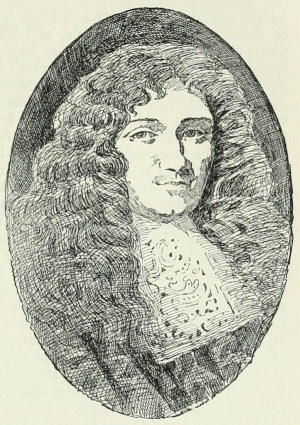
Colbert
(1619-1683)
The controller-general rightfully preferred to the taille the aides or indirect taxes to which all contributed. He diminished the price of salt, a commodity of the first necessity to the poor; but he increased or created taxes on coffee, tobacco, wines, cards, etc., and from one million five hundred thousand francs brought them up to twenty-one millions. Thus the indirect taxes, some of which have been so vigorously attacked in our own day, had their origin in an idea of justice and equality.
He disliked loans, not because he did not understand the advantage of borrowing at a low price to repay burdensome debts, but he dreaded giving Louis XIV facilities for burdening the future to the advantage of the present. On leaving the council in which the first loan was decided on, in 1672, he bitterly reproached Lamoignon for having approved this measure. “Do you know as I do the man with whom we have to deal, his passion for display, for great enterprises, for all kinds of expenses? Here is a free course opened for loans and by consequence for unlimited expenditure and taxes. You shall answer for it to the nation and to posterity.”
In truth a time was to come when Colbert would be no longer there and Louis XIV would borrow at 400 per cent. At least the great minister tried to protect the treasury against the exigencies of the financiers by inviting the small capitalists to pour their funds directly, without costly intermediaries, into a loan account which he established for the purpose and into which the money flowed.c
Colbert’s efforts extended into so many fields that it is impossible to follow them in detail. His service to agriculture was most beneficial. He exempted very large families from paying tithes, and forbade the seizure of implements and beasts of labour for non-payment of taxes. He improved the breeds of horses and cattle by crossing them with imported animals. His code for water highways and forests is still largely in force.
He assisted industry by sparing no means of obtaining the manufacturing secrets of neighbouring countries. In 1669, says Duruy,c there were 42,220 looms and more than 60,000 workers in wool alone. The draperies of Sedan, Louviers, Abbeville, and Elbeuf were unrivalled in Europe; tin plate, steel, faience, and morocco leather, which had largely been imported, were now made in France; the cloth and serges of Holland, Genoese point, and velvets were imitated and equalled, the carpets of Persia and Turkey surpassed at the Savonnerie, at Aubusson, and at Beauvais. The rich silken stuffs shot with gold and silver were made at Tours and at Lyons; at Tour-la-Ville (near Cherbourg) and at Paris they made finer glassware than at Venice. The tapestries of Flanders yielded to those of the Gobelins.
For commerce the great minister did much by regulating customs and reducing tariffs. He made Dunkirk, Bayonne, and Marseilles free ports, and was the projector of the Burgundian canal opened in 1692, and built between 1664 and 1681, that connected the Mediterranean at Cette with the Garonne (and consequently the ocean) at Toulouse. Henry IV’s council of commerce was re-established in 1665 and the king presided over its fortnightly meetings.
At that period the Dutch and the English were far ahead of the French in foreign trade. The better to compete with these rivals Colbert substituted privileged associations for the isolated efforts of individuals. “He established,” says Duruy,c “five great companies modelled on the English and Dutch societies; those of the Indes Orientales and the Indes Occidentales in 1664; the Compagnie du Nord and the Compagnie du Levant in 1666, and the Compagnie du Sénégal in 1673, according them exclusive commercial monopolies and granting them considerable loans. He wished to restore life to the colonial system, much neglected since the days of Richelieu. The French now possessed only Canada, with Acadia, Cayenne, the Île de Bourbon [Île de Réunion], and several establishments in Madagascar and the Indies. Colbert purchased, for less than a million, Martinique, Guadeloupe, St. Lucia, Grenada, and the Grenadines, Marie Galante, St. Martin, St. Christopher, St. Bartholomew, Santa Cruz, and Tortuga (Île de la Tortue) in the West Indies. He placed under the protection of France the French filibusters of Santo Domingo who had seized the western portion of the island (1664). He planted new colonies in Cayenne (1677) and in Canada (1665). He took Newfoundland in order to control the entrance to the St. Lawrence, and began the occupation of the magnificent valley of the Mississippi, which had just been explored by that adventurous captain, Robert de la Salle (1680). In Africa he wrested Gorée in Senegal from the Dutch in 1665 and took possession of the east coast of Madagascar. In Asia the Compagnie des Indes established itself at Surat and Chandarnagar and afterwards at Pondicherry,” but to offset these achievements he was short-sighted enough to close the colonial ports to foreign vessels and to forbid in 1669 the importation of sugar and tobacco from Brazil.
Colbert also revived the navy and established the naval inscription by which the people of these maritime provinces, in return for certain advantages, furnished the necessary recruits for the navy, dividing them according to age and family position into different classes (the régime des classes). He likewise instituted in 1672 the corps of marine guards, composed of one thousand gentlemen, in order to have good officers, a school of cannoneers for good marksmen, a school of hydrography, and a board of naval construction.
For the encouragement of the fine arts and the sciences, the Academy of Inscriptions and Belle-Lettres was founded in 1663, the Academy of Science in 1666, the Academy of Music (1669), the Academy of Architecture in 1671. A school of fine arts established at Rome (1667) received the prize pupils of the Academy of Painting in Paris who copied on canvas or in marble the masterpieces of antiquity. The cabinet of medals founded also a school for the study of oriental languages. The Royal Library received many additions and the Mazarine Library was opened to the public. The Jardin des Plantes was enlarged and the foundation of academies in the provinces encouraged. All the famous littérateurs and artists of the day were generally pensioned, including many from foreign countries who were induced to take up their residence in France.a
Michelet’s Estimate of Colbert
The king in 1683 was relieved of Colbert. He pressed heavily upon him, forced him to reckon, was always talking of making the receipts balance the expenditures. In his long ministry of twenty years he had passed through two phases. During the first he tried to live on the revenue; during the second, dragged on and compelled, he borrowed and lived on the future. One moment he lightened the taxes and nevertheless collected ninety millions; but the king spent one hundred millions.
Between him and the king there was a dispute about everything: concerning buildings—he condemned Versailles: concerning religion—he upheld the Protestant manufacturers. He died from his public disgrace—died because he could do nothing and had lost hope. Ridiculous quarrels were forced upon him. The king reproached him for the expense of Versailles, which had been built in spite of his advice to the contrary.[114]
He died, detested and cursed. It was found necessary to bury him at night to protect his body from the insults of the populace. Songs were composed, ponts neufs on the death of the tyrant. Was this word wrongly applied? Not at all. This great man had been the tyrant of France in two ways at once—tyrant through his position, the times, and the necessity of things; tyrant through his violence in well doing and his impatience, through his impulsiveness of will.
The war and Louvois, the king and the court, Versailles and the immense waste had been blamed very justly. But there was something else. The situation was tyrannical. Colbert built on a foundation already ruined, on that of the misery which grew in that century without anything being able to stop it—political and moral causes come from afar, above all, the indolence of the nobility and of the Catholics, which after having ruined Spain was about to ruin France. Mazarin had killed Colbert in advance. The tax placed by the league of notables on the small landholder, which was doubled about 1648, compelled him to sell his field to the lord of the parish. But these fields, gathered together under idle hands, produced little. Under Colbert there was a famine every three years. To sustain the army and the working classes with ease, he himself kept the wheat at a low price, almost always forbidding its exportation, thus discouraging agricultural labour. From 1600 to 1700 every manufactured article quintupled in value. Wheat alone was treated as a natural product, in connection with which labour would avail nothing; nothing was done for it; it remained at the same price. That evil of Spain, the hatred of work, the taste for a life of ease had for a long time been inoculated in France. Colbert revolved in the circle of a fatal contradiction. He wanted to discourage idleness, he said; he struck at the false nobles. With what? With the authority of the king—of the king of nobles, who, attracting everything to the court, “ennobling” the nation, drew it into idleness. The dead and unproductive life of the courtier, of the priest, more and more deadened everything.
This man of work was devoured by three great unproductive classes: the nobles, who more and more lived on the state; the officials, whom the progress of order brought into existence; the third class, the permanent army, enormously increased. Now, the king drawing little or nothing from the large rich body, that is the clergy, Colbert, triply crushed, was obliged to create a productive class, to over-stimulate work by driving industry abroad. War of customs duties, and soon a war of armies, resulted. He himself, who was so interested in maintaining peace, actively engaged in the war against Holland, and expected to gain something from it for the navy and for industry.
History can cite nothing greater or more terrible than his sudden improvisation of the marine. It astonishes, it frightens, both by material enormity and by moral violence. Colbert demanded from France the severest sacrifice which had ever been asked of her (before the conscription[115]).
He showed the same vehement impatience in commercial regulations, in the improvisation of a French industry. He was justly indignant at seeing an ingenious people, very artistic in many things, awaiting and receiving from elsewhere all the products of the useful arts. Manufactories are not only a product of wealth but of education also, a special development of certain faculties, of a certain aptitude. A people who did only one thing would be very low in the scale of nations. Colbert awakened and revealed in the French people an unknown aptitude; he caused a new art to burst forth, that above all, which puts good taste and elegance into all the requirements for the fitting out of a house, which relieves material life by a noble gleam of mind. It was splendid, it was grand of him. But the means were less happy. On the one hand, this budding industry he wanted perfect all at once; that young plant which could not grow without the liberties of life he confined and choked with tyrannical precautions. Almost at the outset, his regulations were laws of terror (even to putting a person in the pillory for defective merchandise, 1670). By requiring this perfection he hoped to gain credit for French goods abroad and to make people buy them with confidence. But, on the other hand, he prevented the manufacture of goods of inferior quality, to satisfy the less pretentious needs of the poorer classes.
The grandeur of this industrial creation has been told wonderfully well; but not its fall, its prompt decadence. It perished both from the general poverty (no more buyers) and from emigration (the producers left even before the death of Colbert). His last glances beheld the decay of the edifice which was soon to crumble to pieces.
The great historian of France for the end of this century is Pesant de Boisguillebert. He is not acquainted with ancient times and he is wrong in thinking that evils date from 1660. He is none the less truthful and admirable in the picture he gives of the misery of the country and of the crying abuses which continued even under Colbert. The three fiscal terrors (tailles, aides, douanes) are found there in characters of fire. One must see the unfortunate peasant collectors, who raise the land-tax and are responsible for it, march through the village. They go only together in companies for fear of being killed. But it is impossible to take away anything from him who has nothing. Everything falls back upon the collectors. The king’s bailiff seizes their cattle, the village flocks, then even their persons. They are imprisoned.
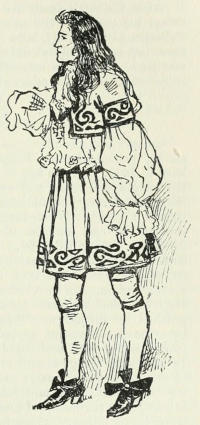
Costume of a Nobleman, Time of Louis XIV
The case of the aides is much worse. The clerks, become merchants, make a fierce war on the merchants who wish to buy wine from the vine grower and not from them. All communication is broken off. “Everything which comes from Japan quadruples its price, merely on account of the distance. But everything here which passes from one province to another becomes twenty times dearer, twenty-four times. Wine for a sou at Orleans is worth twenty-four at Rouen. The salesman alone is six times more terrible than pirates and tempests, than a sea of four thousand leagues.” France pulls up its vines. The people no longer drink anything but water. The custom-house has killed foreign commerce. No merchant dares any longer to put himself in the hands of a receiver, who brings a suit against him if he wishes and who is judged only by his own judges.
Thus the people, thus Colbert, remained the miserable slaves of the financiers, of the general farmers of the taxes, of negotiators, of partisans more powerful than the king. Colbert, on his coming to power, had had the good fortune to hang several of them. In vain. They survived and flourished and in the end strangled him; much worse, they caused his name to be cursed. Under Mazarin there was absolute chaos. Under Colbert there was relative order. The old abuses subsisted, but with the odious force of order which an established government lent to them. Under Mazarin France, miserable and in rags, still drank wine; but under Colbert it drank water.
Progress was an evil. Under Colbert, the farming of the taxes was not given out to favourites, but was sold at auction, to the highest bidder, and thus it brought in more. Yes, but on the condition that the farmers were permitted to use the terrible severity which made tax collecting a war. In his mortal effort Colbert thus acted against himself. She escaped him, however, do what he would—this France whom he wished to cure, tormented by recors, eaten up by bailiffs’ men, expropriated, sold, and executed.
The great malediction under which he died troubled him on his death-bed. A letter from the king came to him and he did not wish to read it. “If I had done for God,” said he, “what I have done for this man, I would be sure of being saved, and I do not know where I am going.” We know it, hero! You are going into glory. You remain in the heart of France. Great nations, who judge with time like God, are as equitable as he, valuing the labour less according to the result than in proportion to the effort, the grandeur of the desire.l
After Colbert’s death his ministry was divided. The marquis of Seignelay, his son, had the navy; the finances were intrusted to Claude le Pelletier (1683-1689), later by the count de Pontchartrain (1689-1699); these last succeeded but did not replace him. After 1689 the general penury was such, that Louis was obliged to send to the mint the masterpieces in chiselled silver which adorned Versailles.
LOUVOIS
[1666-1691 A.D.]
Colbert had organised peace; Louvois, “the greatest and most brutal of clerks,” organised war. François Michel le Tellier, marquis de Louvois, was born in 1641. At the age of fifteen years he entered the office of his father, the secretary of state, and was initiated by a long apprenticeship into the science of military administration, to which he brought an activity equal to that of Colbert. When Louis XIV determined to assume the rule, Louvois became the real minister of war, although he did not succeed his father, Michel le Tellier, till 1666. He reformed the army, and his reforms lasted as long as the old monarchy. If he preserved the system of voluntary enlistment which had been in practice for three centuries, he diminished abuses and dangers by a more exact discipline and more severe regulations. He established uniforms by ordering that each regiment should be distinguished by the colour of its clothes and by various marks (1670). He introduced the use of copper pontoons for crossing rivers; he instituted magazines of food and supplies, barracks, military hospitals, the Hôtel des Invalides, all things almost unknown before his time. He created the corps of engineers whence came the great Vauban’s best pupils; schools of artillery at Douai, Metz, and Strasburg, the companies of grenadiers in the infantry, the regiments of hussars in the cavalry, and lastly cadet companies, a species of military school for the gentilshommes.
The army still showed the spirit of feudal times. The soldier belonged less to the king than to his colonel; the cavalry was given too much importance and the nobility would serve only in it. From this reign the French infantry became and long remained the first in the world. Louvois required it to march in step and substituted the gun and bayonet for the pike which was still prevalent; but it was not till after his time that Vauban succeeded in making the gun at once a weapon for projectiles and a weapon for fencing, and so rendered it the most formidable instrument of destruction which was ever put into the hands of men.
He made a revolution in the army by the ordre du tableau and by the creation of the service of inspection. He did not destroy the venality of offices which had been introduced into the army, and was exercised almost entirely to the profit of the nobles; but in order to merit promotion it was no longer sufficient for them to have ancestors—they must have services; and the grades, from the rank of colonel, became the prize of seniority—an excellent reform in those days, which would be so now no longer. The hatred of the nobility pursued the minister who was degrading “those born to command others, on the pretext that it is reasonable to learn to obey in order to command; who wished to accustom seigneurs to equality and to mingle with all the world indiscriminately.” Louvois, with inflexible firmness, required that each should perform his duty; to secure this he instituted inspectors-general who made the king’s authority and his own everywhere present; and severe rebukes awaited negligent officers.
He created recreation camps, a ruinous innovation when these assemblies of troops were only a spectacle to divert the ladies of the court and the king’s ennui, but an excellent school for officers and generals when preparing for the great manœuvres of war. It was only after his death that the order of St. Louis was instituted (1693) for the purpose of bestowing honours as a reward for military services—this time without distinction of birth, but not without distinction of religion; the reformed could not obtain it. By such measures France was able to have under arms, in the war of Flanders, 125,000 men; for that with Holland, 180,000; before Ryswick, 300,000; during the War of the Spanish Succession, 450,000.
VAUBAN
There was one point, the only one, perhaps, on which the minister of war and the minister of marine were in accord: namely, the fortification of the kingdom. To accomplish this immense work they found the man who is, with Colbert, the greatest of this reign. Le Prestre de Vauban was a gentilhomme of no great family, who was born at Saulieu in Burgundy in 1633. His father died in the service, leaving him only his name. A prior of the neighbourhood took him in and brought him up. When he had completed his seventeenth year the Fronde was in full swing. Eleven of his brothers, uncles, and relatives were under arms; one morning Vauban ran away and hastened to join the Great Condé, who received him as a cadet and soon made him an officer.
Vauban fought well; he studied more. The good prior had given him some notions of geometry; he developed them and these first acquirements decided his vocation. Having passed into the royal army he served under the chevalier de Clerville, the most renowned engineer of that time, and at twenty-five directed the works during the sieges of Gravelines, Ypres, and Oudenarde. In 1668 his reputation was so great that Louis XIV charged him with the fortification of Dunkirk. This first work of the young engineer was a masterpiece: two moles projecting over six thousand feet into the water and defended by formidable batteries created a harbour where nature had put only an unfavourable shore. The waters inside and those of the high tides skilfully manipulated, incessantly hollowed the channel and restored to the sea the mud it brought up. Henceforth Vauban was the indispensable man whom every general demanded when he had a siege to make. In time of war he took towns; in time of peace he fortified them. It has been calculated that he worked on 300 old towns, that he constructed 33 new ones, that he conducted 53 sieges, and was present at 140 important actions. He was several times wounded; for in order to reconnoitre the situation of a place and to spare the blood of his soldiers, he exposed himself in such a manner as to call forth the accusation of temerity, had not his cool and deliberate courage been like the fulfilment of a duty.
Vauban, who fortified towns, knew still better how to take them. He introduced the use of hollow cannon-balls for dispersing earth; ricochet firing to dismount the artillery of the besieged and destroy the angles of the bastions; above all he perfected the parallels at the siege of Maestricht in 1673. These parallels joined the trenches which converged towards the town, and gave the attack the advantage over the defence. Vauban went forward slowly but surely; he marched under cover by lines on which the troops were in a position to render each other mutual support, did not hurry on attacks when he could dispense with them, took pains to spare the soldiers, who had previously been flung away, and attained his object incomparably more quickly and with fewer losses, because he first silenced the enemy’s fire and left on the ramparts neither a tenable point nor a cannon in condition to be fired. There was no longer any impregnable fortress and it was easy to look forward to the day when every well-besieged town would be taken. It is to him that we also owe the invention of the socket which allows the infantry to fire whilst still keeping the bayonet at the end of the gun.
SÉGUIER, LEGISLATIVE WORKS
[1665-1685 A.D.]
In a memorial handed to the king, August 15th, 1665, Colbert had proposed to remodel the whole legislation so that there should be in France but one law, one system of weights and measures; in addition he asked for gratuitous justice, the abolition of the venality of offices, the price of which was reckoned at four hundred and twenty millions, and the diminution of the number of monks, and the encouragement of useful callings.
A commission was appointed. When the members had held a meeting and at last brought their task to a conclusion they discussed the matter with eminent members of the parliament in the presence of the ministers, under the presidency of the chancellor Séguier, sometimes under that of the king. Six codes were the result of these deliberations: in 1667 the civil ordinance or Code Louis which abolished some iniquitous procedure belonging to the justice of the Middle Ages, “true witness of human imbecility,” says Montaigne, shortened its delays and regulated the form of the registers of births, marriages, and deaths which, it was ordered, were to be deposited at the office of each law-court; in 1669 that of Rivers and Forests which continues in its principal dispositions; in 1670 the ordinance of Criminal Instruction which the parliaments accepted only after many lettres de cachet and decrees of exile; it restricted the application of the torture and various cases of provisional imprisonment, fixed rights of jurisdiction so that none might be deprived of his natural judges, laid down identical rules for all tribunals, thus preparing the way for unity of principle by means of unity of form, but did not yet allow either counsel or defender for the accused in capital cases, preserved the atrocity of earlier penalties, the wheel and quartering, and still made the penalty disproportionate to the crime; in 1673 the ordinance of Commerce, a true title to glory for Colbert; in 1681 that of the Navy and the Colonies, which has formed the common law of the nations of Europe and serves them to this day as maritime law; in 1685 the Black Code, which regulated the condition of negroes in the French colonies.
These ordinances form the greatest work of codification executed from Justinian to Napoleon. Some portions of them are still in operation.
LIONNE, FOREIGN AFFAIRS AND DIPLOMACY
[1661-1715 A.D.]
If Colbert and Louvois, by the re-establishment of the finances, the creation of a navy, and the reform of the army, allowed Louis XIV to make war successfully, Lionne, secretary of state for foreign affairs, prepared that success by his negotiations. “He had,” says Choisy, “a superior genius: his understanding, naturally keen and penetrating, had been still further sharpened in the affairs in which the cardinal had early employed him.” Saint-Simon, who was no flatterer, also says that he did everything with a skill and superiority quite unequalled. The king indeed watched closely over this branch; he himself wrote the first despatches to his ambassadors; he often wrote minutes of the most important letters with his own hand, and he always had the instructions sent in his name read aloud to him.
When Lionne died in 1671 the king gave him as successor the marquis de Pomponne who had conducted several embassies with success and was then in Sweden, whose king he had succeeded in detaching from the Dutch alliance. Pomponne directed all the negotiations which terminated in the Peace of Nimeguen. “But,” said Louis XIV, “the office I gave him was found to be too great and extensive for him. I was obliged to order him to retire, because everything that passed through his hands lost something of the grandeur and force which are needed in executing the orders of a king of France who is not unfortunate.”
TRIUMPH OF THE ABSOLUTE MONARCHY
Some of these ministers of Louis XIV, especially Colbert and Louvois, were certainly great administrators; they were not, they could not be, great statesmen. Colbert himself aimed at making France richer only in order to render the king more powerful; and all laboured to constitute the excessive centralisation which enveloped the whole country, its industry and commerce, the arms and the brain, with a thousand bonds of a minute regulation, so that the initiative of the ministers was everywhere substituted for the action of individuals and communities. The result of this system was to be that France would live less by her own vitality than by that of her government. When age and sickness should freeze that ever-present hand all would decline. A great people would be subjected to the vicissitudes of one man’s existence.
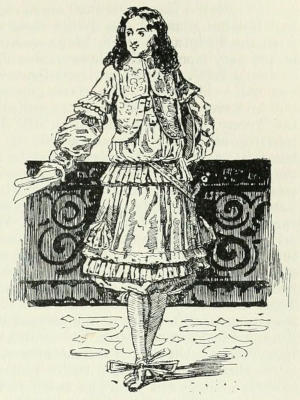
A Court Costume, Time of Louis XIV
If the administration of the realm was as much the work of Louis XIV’s ministers as his own, one thing belonged to him alone: this was the general direction he gave to the government and to society—the skilful and energetic manner with which he knew how to control all other powers, to annul them, and make them to serve his greatness; it was in fact that art of ruling which no other prince, in Saint-Simon’si judgment, possessed to a greater degree. We have already seen his ideas on the rights of sovereigns; he had summed them up in that phrase attributed to him, it is said, in his youth, at the end of the Fronde: “L’État, c’est moi—The State, it is I.”[116]
He believed this; everybody believed it with him, and the church taught it. Bossuet founded the divine right of the monarchy on maxims drawn from the Scriptures. “Oh kings, ye are gods,” exclaimed the great bishop at the very moment that Lebrun was filling Versailles with the apotheosis of Louis XIV. While he lived there was but one uncontrolled and limitless will—his own. The states-general might have recalled other wills, but he never convoked it; he punished those that spoke of it, and when, at the Treaty of Utrecht, the allies, still defying his ambition, tried to exact that the conditions of peace should be ratified by a national assembly, he haughtily refused and declared that he regarded the demand as an insult to the majesty of the throne. The minority of the provinces had their own estates, but he suppressed many of them. Those which remained, as in Languedoc, Burgundy, Provence, Brittany, etc., never assembled except to execute the orders of the ministers. Whatever remained of municipal liberty disappeared like that of the provinces. The king, coining money with the ancient rights dear to the towns, changed the mayoralties into hereditary offices and sold them to the highest bidders. An edict of 1683 placed the financial administration of the towns under the direction of the intendants. Their finances did not improve. The communities were made responsible for the payment of the taille as the curiates had been under the Roman emperors. Former fiscal arrangements had ruined the magistrates. The new one held them exempt, but ruined the communes.
A phrase sums up this entire policy—unfortunately it was spoken by Colbert: “It is not well,” he wrote to a governor, charging him to let an elective magistracy fall into desuetude, “that some one should speak in the name of all.”
Submission of Parliament
Royalty had taken five centuries to undermine the great body of the feudal aristocracy, and the better to perfect this work had formed with its own hands another body—that of the judiciary order. In the sixteenth century they spoke of the parliaments as “the strong columns on which the monarchy is supported,” but in the seventeenth the new royalty wished for no other support than its absolute power.
Nevertheless, thanks to the sale of offices, which left the same offices in the same hands, thanks to the dignity of the magistrate’s lives, to the political rôles they had played on several occasions, to the esprit de corps which had quickly been established in the bosom of the great judiciary companies, there had been raised alongside the nobility of the sword a nobility of the robe, which seemed quite as troublesome as the other because it already had its souvenirs and regrets. It was not always easily managed. It parried attacks with that force of inertia peculiar to assemblies of aged men, which is difficult to overcome at a time when tradition stands for law. The spirit of opposition, everywhere punished, took refuge here—political opposition, scarcely sensible in the parliament of Paris, provincial opposition in the others, all religious opposition, under the form of Jansenism. One of Louis XIV’s ideas which he sought to realise with the greatest perseverance was to transform the parliaments into simple courts of appeal, to put his state councils over them, even the parliament of Paris which had brought about the Fronde. In an edict of 1667 he proscribed it from enregistering ordinances within a week and he suffered no remonstrance. The following year he had torn from the parliament registers the records of all its deliberations during the civil war, in order to efface even the memory of its old-time pretensions. Besides this he changed its title of sovereign court into that of superior court, as if the first were a usurpation of royal sovereignty.
Submission of the Nobility
It appeared a more difficult task to reduce the nobles. Cardinal Richelieu had razed their fortresses and cut off the heads of some of the most unruly. Mazarin had bought them or vanquished them by ruse. Louis XIV made himself their master by drawing them around him by his fêtes, dragging them from their domains, where they thought too often of their ancestors and still felt themselves free, filling his antechamber and household posts with the descendants of those who had made his fathers tremble, and forming for royalty such brilliant cortèges as the representative of God on earth would wish to be surrounded by.
If they had titles and honours they had no political influence in the state. In his councils, the king, after the death of Mazarin, admitted but a single one of the old noblesse, the duke de Beauvilliers, governor of the royal children; and he chose all his ministers from those of middle conditions, in order, according to Saint-Simon’si forceful expression, to be able “to plunge them into the depths of nothingness from which he had drawn them.” The French nobility never knew how, like that of England, to become a political class; it was never anything but a military caste.
The Third Estate
Louis XIV preferred, following in this the ancient monarchical traditions, to be served by the middle class, more educated and, moreover, more devoted, because it did not yet feel the inconveniences of absolute power, as it had been feeling for centuries those of the feudal régime. Louis turned over to it all the financial, political, and judicial functions; he established it peacefully in the administration of the realm; he pushed it energetically towards commerce and industry—two forces of the new era—and the regard he had for those petites gens named Boileau, Racine, Molière, announced the coming substitution of the rights of intellect for those of birth. Louis XIV thus unknowingly paved the way for democracy in France and the Revolution. However he must not be regarded as a sort of bourgeois king, a roi des maltôtiers, as Saint-Simoni disdainfully calls him. His policy, the high idea he had of his person, the rigorous ceremonial which made a sort of redoubtable and inaccessible divinity of him, the carrousels, the brilliant fêtes—none of these recalls to mind the modest pictures of constitutional monarchies.[117] More than that, those nobodies whom Louis made his councillors, his ambassadors, and his secretaries of state quitted their plebeian state before entering his court. They became the marquis de Louvois, the count de Pontchartrain, the marquis de Torcy. While working with the bourgeois, the grandson of Henry IV always had the desire to remain the king of the noblemen.
LOUIS XIV AND THE CHURCH
[1661-1685 A.D.]
Louis XIV conducted himself towards the clergy as he had done towards the nobility—in honouring them he watched to see that they robbed him of none of his power. The great lords, with but few exceptions, were removed from the church as they had been from the administration. Therefore the aristocratic Saint-Simoni reproaches Louis “with having ruined the episcopacy by filling it with seminarian pedants and their pupils without education and without birth”—a strange reproach from the mouth of a man who had lived with Bossuet, Fénelon, Fléchier, and Massillon, the eternal honour of the French church.
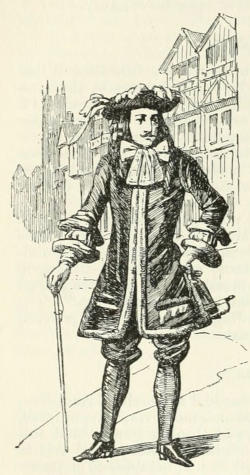
Street Costume, Time of Louis XIV
(From an old French print)
The clergy was therefore under Louis XIV one force the more at the disposal of royalty. In the affair of the régale, the bishops even upheld the king against Rome. The régale was the king’s right to enjoy the revenues of certain benefices, bishoprics, and archbishoprics, during vacancies in the sees. In 1673 an edict declared all the French sees subject to the régale. Two bishops refused to obey and their action was approved by the pope. Louis XIV, to end the dispute, convoked an assembly of French clergy which adopted, in 1682, under the inspiration of Bossuet, four propositions which were registered by the courts and the faculty of theology. They were in substance: God gave to St. Peter and his successors no power, direct or indirect, over temporal affairs. The Gallican church approves those decrees of the Council of Constance which declare the œcumenical councils superior to the pope in spiritual affairs. The rules and customs received in the kingdom and in the Gallican church must remain unalterable. The pope’s decisions, in matter of doctrine, shall not be irreformable until the church has accepted them.
Innocent XI neither approved nor quashed these resolutions, but he refused to grant bulls of investiture to those bishops, appointed by the government, who had been members of the assembly. The consequence was that at his death there were twenty dioceses without heads. The matter was, however, brought to a conclusion in 1693 by a compromise. Innocent XII granted the bulls of investiture and the king ceased to impose upon the theological faculties the obligation of teaching the four propositions of 1682.
The Protestants
The dissenters profited nothing by the quarrel with the court of Rome.c
Since the Peace of Alais the Protestants, being deprived of their political organisation, of their “towns of security,” and of everything which had helped to form them into a party, had been living in obscurity, doing their best to make their enemies forget them, and carefully abstaining from taking any part in the civil troubles of the time. During the Fronde not one of them had shown any sign of life. Their attitude towards the government was that of a child in disgrace, and towards the Catholics that of a disdainful enemy. They persisted in isolating themselves from the rest of the nation, and continued to correspond with their friends in England and Holland. They were law-abiding, peaceable, and industrious citizens, and contributed their full share to the greatness and prosperity of their country by their courage and their energy.
Nevertheless, the nation continued to look on them with mistrust, as if they were foreigners; France felt as if there were a little Holland in her midst, rejoicing at the success of the greater one (with which it was then waging ineffectual war). To reunite the Protestants with the national church was a fixed idea with Louis XIV. This desire inspired his policy, and was the chief goal of all his efforts; this was to be “the noble work and special feature of his reign”; and he looked upon the enterprise as a noble one, not only from a political but from a religious point of view. He was beginning to get into a narrow devotional groove, and allowed the Jesuits to exercise a powerful influence over him. He wished to free himself from the reproach of heresy, which his conduct towards the pope had drawn down upon him, and to atone for the irregularities of his youth. He resolved to revoke the Edict of Nantes. The assembly of the clergy, the parliament of Toulouse, the Catholics in the south all advocated this measure so strongly that it appeared to be the general desire of the nation; Louvois in his ambition, Le Tellier in his fanatical piety, also did their best to urge the king on, and last, but not least, Madame de Maintenon, whose influence during the rest of his life was to be paramount, threw all the weight of her persuasions into the scale in order to bring about the revocation of this edict.
Up to this time bribery had been the chief means employed in the attempts to convert the Protestants. Richelieu had used this method with great success. Louis XIV followed his example with favourable results; flattery, favours, rewards of every kind were lavishly bestowed in the attempt to gain over the Protestants. Pensions were given to the newly converted, they were exempted from taxation, all sorts of offices were given to them over the heads of staunch Catholics. A fund was formed for making conversions, with Pellisson, a converted Protestant, as director. France was flooded with missions, sermons, tracts, and books of dogma.
Calvinism suffered such severe losses that Madame de Maintenon said, “Very soon it will be ridiculous to belong to that religion.” But these methods of bribery and persuasion were not rapid enough, and harsher methods began to be used: royal edicts, parliamentary decisions, and orders issued by governors of provinces and cities rendered the preaching of the reformed doctrines difficult, made the Protestant pastors very uneasy, forbade their synods to assemble. Protestants were deprived of their pensions and of their titles of nobility; the chief burden of the taxes was laid on them; they were excluded from the king’s household, from the university, from holding municipal offices. They were also forbidden to practice as lawyers or doctors. They were expelled from financial offices, the rights of free citizenship were refused to them, they were not allowed to be members of corporations, their schools were closed, any of their places of worship which had been built since 1598 were destroyed, and their children were taken from them to be educated as Catholics. Then the Protestants began to fly from France (1682); but emigration was forbidden under pain of being sent to the galleys.
The Calvinists in the south made one last appeal to the king in March, 1684, begging him to allow them to serve God according to the dictates of their own conscience, or else to take refuge in some other country. For answer, the king sent them a number of missionaries accompanied by a detachment of dragoons, who were supposed to be the most cruel of all the French soldiers. Every day conversions by the hundred were announced to the king. On the 2nd of September all the Protestants of Montauban changed their religion by a resolution passed at a meeting in the town hall; on the 5th of October Montpellier, Castres, Lunel, etc., followed suit; then the dioceses of Gap and Embrun, then the whole of Poitou. The governor of Languedoc said that he had seen sixty thousand people converted in three days. It was thought that nothing more remained to be done, but to publicly announce the destruction of a sect which had only a few adherents left in distant provinces, among the rude inhabitants of the mountainous parts; it was necessary to strike only one more decisive blow and so complete the work for which a long series of unjust acts and the ingenious tyranny of the last fifty years had been the preparation. Père Lachaise, the king’s confessor, and Louvois promised that not a single drop of blood should be shed.
Revocation of the Edict of Nantes (1685 A.D.)
Accordingly on the 22nd of October, 1685, an edict appeared ordaining: (1) The suppression of all the privileges which had been accorded to the Protestants by Henry IV and Louis XIII; (2) the proscription of Protestant worship throughout the kingdom (except Alsace and Strasburg); (3) the expulsion of Protestant ministers, the closing of Protestant schools, and the demolition of the churches, etc. Numerous rewards were given to those who agreed to change their religion; Calvinists were forbidden on pain of being sent to the galleys and the confiscation of their property, to go out of France; permission was given them to remain on their own property and engage in business without their worship being interfered with so long as they did not hold public services.
This edict was received in France with the greatest enthusiasm: sermons, poems, pictures, medals were produced with astounding rapidity to celebrate this great act of unity! At last the whole country was to be under one jurisdiction and under one king! Louis XIV was a second Constantine, a modern Theodosius. Never had any king performed such a wonderful achievement, nor was it likely that any parallel to it would be seen in the future. The whole of Europe was amazed at the promptitude and ease with which this great king had stamped out a heresy which had defied the efforts of six of his predecessors.
The only complaints that arose were directed against the leniency of that clause which allowed the Protestants to worship in their own fashion in private. This clause was only a lure, and Louvois wrote to the governors and those in authority: “His majesty desires that those who refuse to embrace his religion should be treated with the utmost rigour, and those who foolishly pride themselves on being the last to be converted are to be driven to the extremity of their endurance.” Then began a series of bloody atrocities which the king had never commanded, and which were not at all in accordance with his character for moderation. A defenceless population was delivered over to the cruel brutality of the soldiery, men were put to the torture, women were subjected to a dishonour worse than death, children were torn from their parents, houses and farms were wrecked, converts who refused to take the sacraments were sent to the galleys, as were those who harboured Protestant ministers or those who attempted to leave the kingdom. Sentence of death was pronounced against all who practised any other than the Catholic religion, against all Protestant ministers, and all who formed themselves into gatherings or held meetings. Those who were weak yielded; they were dragged to the altar and, with the executioner standing over them, forced to commit sacrilege. “Torture, abjuration, and forced communion,” says Saint-Simon,i “often all took place within twenty-four hours,” and the executioners were the guides and the sponsors of the convert. Almost all the bishops took part in these hasty irreverent practices. Most of them urged on the executioners and used every means to swell the number of conversions, for they sent an account of their triumphs to the court, and were anxious to gain as much glory and substantial recompense as possible. The king received from all quarters news and details of these persecutions; those who had abjured Protestantism and received the communion were counted by the thousand. The king gloried in his power and in his piety; the bishops sent him the most fulsome panegyrics on the great work he was doing; pulpits rang with his praises.
The Protestants fled from the country. The police were unable to prevent them. Certificates of confession were required from all travellers, sentence of death was pronounced against anyone who countenanced or assisted others in emigrating. The emigrants had been deprived of seventeen millions of francs in house and land property, the frontier was guarded by numerous troops; but all these measures were vain, and in spite of them fifty thousand families left the kingdom, and took refuge in Holland, England, Germany, and Switzerland. They consisted of nobles, tradesmen, and manufacturers. This active, energetic, and enlightened body of men, placed at the service of foreigners their talents, their swords, the secrets of French manufactures, their wealth, and a relentless hatred of the tyrant who had banished them. Their emigration did an irreparable injury to France. They were received everywhere with the greatest kindness; they were even invited to leave their country, and good positions were promised them. One part of London was peopled with silk-weavers and workers in crystal and steel; and England became the leading manufacturing nation. Brandenburg rose from its abasement; Berlin became a town; Prussia was opened up; the influence of the refugees on Frederick William’s states was so marked that it is from this time that their greatness and their subsequent weight among European powers may be dated. Amsterdam built a thousand houses for them, William gave them pensions, granted them privileges, and provided them with places of worship; he formed them into a royal guard of six hundred noblemen and two regiments. He made use of their ministers, embittered by hatred, to flood Europe with pamphlets against Louis XIV. Henceforth on every battle-field the French would meet these emigrants filled with a fierce hatred of their country, and, for more than a century afterward, French soldiers found that their bitterest enemies in Germany were the descendants of these refugees.j
The Jansenists
[1661-1715 A.D.]
Nor did Louis protect the Jansenists who were, on certain points, in disagreement with the church of Rome. The Jansenists owed their doctrine to a bishop of Ypres, named Jansenius, who died in 1638, and to the abbé of St. Cyran who had sustained some ancient opinions, which seemed to be new, upon grace and predestination. Jansenism deserves at least a passing word especially on account of the character of the men who defended it. The most illustrious of them, the great Arnauld, Lemaistre de Sacy, Nicole, and Lancelot, retired to the ancient Cistercian abbey of Port-Royal des Champs, near Versailles, when Pascal also joined them in 1654, and there, leading a solitary life, these Catholic puritans set the world an example of assiduous works of the hands and the intellect, of lively piety, and of austerity which went as far as asceticism. They wrote, for the most part in common, some excellent works which are still in use; they had some illustrious pupils, among others Racine; they won over to a great part of their doctrine almost the entire magistracy.c
The Jesuits then monopolised the authority and influence of the church, whose spirit and moral code they attempted to modify, and adapt to the present courtly and despotic times. The studious, reasoning, and ascetic brethren of Port-Royal saw the tendency of the Jesuit preaching, the false and worldly basis of their creed. It was on the subject of Jansenism that the Jesuits had declared themselves, and had come forth in the arena of argument. The pious wits of Port-Royal seized the opportunity, took up a cause sufficiently absurd in its fundamental dogmas, but which they were enabled to support by battering the still more absurd outworks of the Jesuits. The latter won the pope to their side, and obtained from the head of the church a condemnation of the tenets of Jansenius. The polemic writers of Port-Royal bowed to his holiness, confessed that he was infallible as a high priest, in condemning such and such belief, but most fallible as a critic, since not one of these propositions, so lustily condemned, were to be found in Jansenius. This ingenious effrontery succeeded; for, under colour of disputing about such abstractions, Pascal and Arnauld attacked their enemies in more vulnerable points—in their moral laxity, their sophistic logic, their worldliness, courtliness, and servility. Louis XIV took the Jesuit side. Many of the courtiers, who dared no longer draw the sword in rebellion, ventured to move the tongue, and exercise thought at least in independence. Amongst the most distinguished sectaries of Port-Royal was the duchess de Longueville, sister of Condé, the famous partisan of the Fronde, and mistress of La Rochefoucauld. Her hôtel, once the resort of the coadjutor [de Retz] and his party, of the hot cavaliers that drove the court from Paris, was now the lurking-place and concealment of the Jansenists. She braved the royal authority at all times, whether in the cause of the noblesse or of religion; gallant and dissolute in the Fronde, in Jansenism rigid and devout. “She was Jansenist in truth and heart,” says Brienne, “just as she had indulged her gallantries with the same sincerity, and always drums beating” (the expression means openly and boldly): “a princess of the blood need fear nothing; and Madame de Longueville marched on her way with head erect.” Although the Jansenism of Pascal and of Arnauld was the protestation of reason, common sense, and deep religious feeling, against the corruptions of the Jesuits, that of Madame de Longueville and her class must be considered as a kind of covert opposition to the court, and to the despotic will of the sovereign. The froward love of independence, that could no longer exercise itself in political intrigue, found more harmless vent in criticism and polemics.k
The outcome of the Jansenist disputes was that in 1709 the king caused the buildings of Port-Royal des Champs to be levelled to the ground.[118] The bodies of the inoffensive solitaires were disinterred, and dogs were seen quarrelling over them.
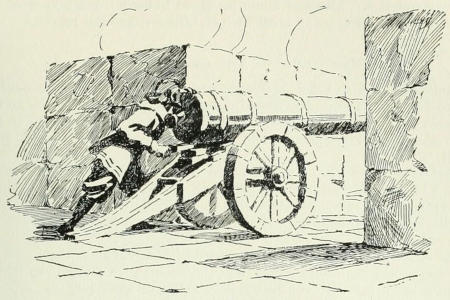
Cannon used in the Time of Louis XIV
THE POLICE
The police was the creation of Louis XIV. In 1687 he appointed a magistrate to oversee the Paris police, Nicholas de la Reynie, who was succeeded in 1697 by the marquis d’Argenson—these were the first two lieutenants de police. They established order, decency, and security in the city. Now commenced the system of public lighting; from the 1st of November to the 1st of March, lanterns, burning candles, were placed at the ends and in the middle of every street. There were five thousand of these lights in Paris. The watch was augmented and reorganised. Firemen replaced the Capuchins in the fire Service. The narrow streets, often cut up and always filthy, were cleaned, widened, and paved; coaches and cabs for the public were introduced; Pascal even devised the omnibuses, which did not succeed at that time. The custom of going about Paris on horseback was no longer kept up except by a few obstinate representatives of the olden times.
The police attended to other things; it censured all writings,[119] it held up the post, and read in what was afterwards called the cabinet noir, all suspected correspondence, and to relieve the government of too slow methods of justice it multiplied the lettres de cachet[120] which removed all guarantee of personal liberty to citizens. The new power charged with the overseeing of persons and opinions, thus became like an ever-open eye, always defiant of royalty. Thus were all the orders of state, all the existing authorities, all the conditions—parliament, nobility, bourgeois, clergy, and dissenters—reduced and dominated. Vauban, Catinat, and Fénelon resisted the contagion. Condé himself, in spite of his rank, his services, and his spirit, became a courtier. Turenne alone managed to keep a position from which he could tell the king many truths which others dared not repeat.c
THE COURT OF THE GRAND MONARCH
Louis XIV put so much brilliancy and magnificence into his court that the smallest details of its life seem interesting to posterity, to such an extent were they an object of curiosity to all the courts of Europe and to all his contemporaries. The splendour of his government shone on his pettiest actions.
That is why no historian has failed to write of the early affections of Louis XIV for the baroness de Beauvais, for Mademoiselle d’Argencourt, for the niece of Cardinal Mazarin, who was married to the count de Soissons, the father of Prince Eugene, and above all for Marie Mancini, her sister, who afterwards married the constable Colonna.
The court, after the triumphant return of Mazarin after the Peace of the Pyrenees, busied itself with games, and the ballet, with comedy, which, being only new born, had not yet become an art, and with tragedy, which had become a sublime art in the hands of Pierre Corneille. A curé of St. Germain l’Auxerrois, who inclined to the rigorous ideas of the Jansenists, had often written to the queen against these spectacles, ever since the first years of the regency. He claimed that a person would be damned for being present at them. He even had this anathema signed by seven doctors of the Sorbonne, but the abbé de Beaumont, the king’s preceptor, provided himself with more approbations of doctors, than the strict curé had with condemnations. He thus quieted the scruples of the queen, and, when he became archbishop of Paris, he gave his authority to the opinion he had supported as abbé.
There had been one continual succession of fêtes, entertainments, and gallantries since the marriage of the king. Interrupted by the death of Mazarin, they were redoubled on the marriage of Monsieur, brother of the king, with Henrietta of England, sister of Charles II [which took place twenty days after Mazarin’s death]. After the cardinal’s death the court became the centre of amusements and the model for other courts. The king prided himself on giving fêtes which should cast those of Vaux into oblivion.
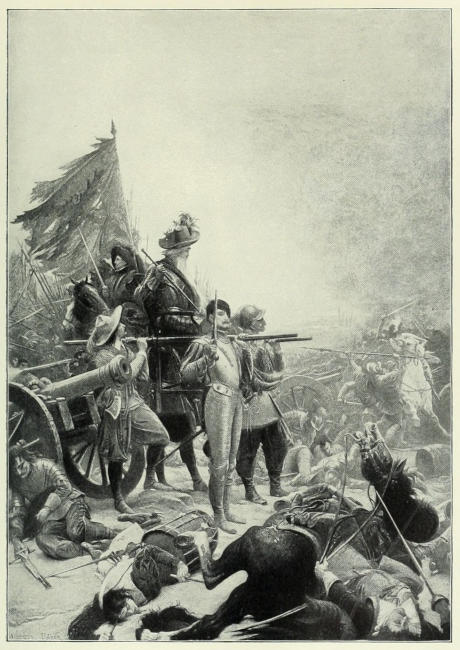
ROCROY
The good taste of society had not yet received its full perfection at court. The queen-mother, Anne of Austria, began to be fond of retirement.[121] The reigning queen could scarcely speak French and her goodness was her only merit. The princess of England, the queen’s sister-in-law, brought to court the attraction of a kindly and animated style of conversation, which was soon seconded by her reading of good works and her sure and fine taste. She perfected herself in the language, which she still wrote poorly at the time of her marriage. She inspired a fresh mental stimulus, and introduced graces and a politeness into court, of which the rest of Europe had scarcely an idea. Madame had all the wit of her brother Charles II, embellished by the charms of her sex, by the talent and the desire to please. The court of Louis XIV breathed forth a gallantry which a sense of propriety made more piquant. That which reigned at the court of Charles II was bolder, and too much grossness disfigured its amusements.
There was at first between Madame and the king a great deal of sprightly coquetry and a secret understanding, which was shown in little attentions often repeated.[122] The king sent her verses; she answered them. It chanced that the same man was at once the confidant of the king and of Madame in this ingenious intercourse. This was the marquis of Dangeau. He conducted the correspondence for both king and princess; thus serving both of them without letting one suspect what he was doing for the other.
Mademoiselle de la Vallière
These pastimes gave way to the more serious and more protracted passion which the king had for Mademoiselle de la Vallière, maid of honour to Madame. He experienced with her the rare pleasure of being loved solely for himself. She was for two years the hidden object of all the gallant amusements, all the entertainments which the king gave. A young valet de chambre of the king, named Belloc, composed several recitals which were interspersed between dances, sometimes in the queen’s, sometimes in Madame’s apartments, and these recitals expressed with an air of mystery the secrets of their hearts, which soon ceased to be a secret.
All these public entertainments which the king gave were so many homages to his mistress. In 1662, a tournament (carrousel) was held opposite the Tuileries in a large enclosure which has retained its name from this event, Place du Carrousel. There were five quadrilles. The king was at the head of the Romans; his brother of the Persians, the prince of Condé of the Turks, the duke d’Enghien, his son, of the Indians, the duke of Guise of the Americans.
The queen-mother, the reigning queen, the queen of England, widow of Charles I, forgetting for the moment her misfortunes, were under a dais to see this spectacle. The count de Saulx, son of the duke de Lesdiguières, took the prize and received it from the hand of the queen-mother. These fêtes reanimated more than ever the taste for devices and emblems, which tourneys had formerly made the fashion, and which had lasted after them.
In 1662, an antiquarian called D’Ouvrier designed for Louis XIV the emblem of a sun darting its rays on a globe, with the words: Nec pluribus impar. The idea imitated somewhat a Spanish device made for Philip II, and which was more appropriate for the Spanish king, who owned the best part of the New World and so many states in the old, than for a young king of France who as yet gave only hopes. This device had a prodigious success. The armoires of the king, the crown furniture, the tapestries, the carvings, were decorated with it. The king never wore it in his tournaments.
The fête of Versailles, in 1664, surpassed that of the carrousel by its originality, by its magnificence, and by the pleasures of mind which, being joined to the splendours of these diversions, added an attraction and graces which no fête before had ever had. Versailles began to be a charming place of abode.
The 5th of May the king came there with the court, composed of six hundred persons, who, together with their suites, were entertained at his expense, as well as all those who assisted in preparing the entertainments. Nothing was ever lacking at these fêtes except buildings especially constructed for giving them, such as were raised by the Greeks and Romans. The quickness, however, with which theatres, amphitheatres, and porticoes were erected, and ornamented with as much magnificence as good taste, was a marvel which added to the illusion and which, diversified since in a thousand different ways, increased the charm of these exhibitions.
There was first a sort of tournament. Those who were to take part appeared on the first day as in a review; they were preceded by heralds at arms, by pages and equerries who carried their devices and their shields. On the shields were written verses composed by Périgny and Benserade. This latter especially had a singular talent for those gallant verses in which he always made delicate and piquant allusions to the character of the persons, to the personages of antiquity or of fable which were represented, and to the passions which animated the court. The king represented Roger; all the crown diamonds glittered on his coat and on the horse he rode. The queens and three hundred ladies, under triumphal arches, watched this entrance.
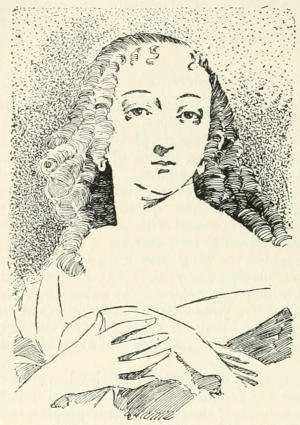
Mademoiselle de la Vallière
(1644-1710)
The king with all eyes fastened upon him distinguished only those of La Vallière. The fête was for her alone; she enjoyed it hidden in the crowd. The cavalcade was followed by a gilded car, 18 feet high, 15 feet wide, and 24 feet long, representing the chariot of the sun. The four ages, of gold, silver, bronze, and iron, the signs of the zodiac, the seasons, the hours, followed this car on foot. Everything was in character. Shepherds carried pieces of the barrier which were adjusted to the sound of trumpets, followed at intervals by bagpipes and violins. Certain persons who followed Apollo’s car came first to the queens to recite verses appropriate to the place and time, to the king and the ladies. When the races were finished and night was come, four thousand great torches lit up the space wherein fêtes were given. Tables were served by two hundred persons, representing the seasons, fauns, sylvan creatures, dryads, together with shepherds, vintagers, harvesters. Pan and Diana advanced on a moving mountain from which they descended to place on tables the most delicious products of field and forest. Behind these tables in the half circle, a theatre filled with performers arose. The arcades which surrounded the tables and theatre were ornamented with five hundred green and silver chandeliers, holding candles; a gilded balustrade shut in this vast enclosure. These fêtes, so far superior to those invented in romances, lasted for seven days. The king carried off the prize of the games four times, and then let other cavaliers contest for the prizes he had gained, which he abandoned to them. The comedy of the Princesse d’Élide, although not one of Molière’s best, was one of the most agreeable attractions of these entertainments, on account of an infinity of fine allegories on the customs of the times and by the apposite observations which form an agreeable feature of such entertainments, but which lose their point for posterity.
The chief glory of these entertainments, which in France perfected good taste, good form, and talent, came from the fact that they detracted nothing from the continual labours of the monarch. Without these labours he would have been able only to hold a court, he would not have known how to reign; and if the magnificent amusements of this court had increased the misery of the people, they would have been only odious; but the same man who had given these fêtes had also given the people bread in the famine of 1662. He caused grain to be brought, which the rich bought at a low price, and which he gave to poor families at the gate of the Louvre. He had returned three millions of taxes to the people; no part of the interior administration had been neglected.b Yet it cannot be overlooked that bad economics underlay most of these financial measures,—as, indeed, of all Colbert’s work.a
The legate Chigi, sent by Pope Alexander VII, arrived at Versailles in the midst of all these enjoyments to render satisfaction to the king for the assault of the papal guards.b This attack had taken place on August 20th, 1662, at Rome. It precipitated a quarrel very similar to that which had taken place in London the preceding year. The liveried servants of the duke de Créqui, the ambassador, had a fight with the Corsican guard; one of them was killed, the duke was insulted and his coach fired upon. Louis XIV demanded reparation. The court of Rome attempted, according to the custom of the times, to gain time; the king insisted, sent the papal nuncio to the frontier under escort, occupied the county of Venaissin, sent troops into the duchies of Parma and Modena in Italy, and finally threatened war. Alexander VII, seeing that these menaces were serious, gave in (1664). His own brother, the legate Fabio Chigi, brought in person the desired satisfaction. Louis XIV then gave back Avignon and Venaissin.e This visit of the papal delegate revealed to the court a new spectacle. The grand ceremonies were fêtes for the public. The honours paid him made the satisfaction more brilliant. Seated under a dais, he received the greetings of the superior courts, of the municipal courts, and of the clergy. He entered Paris to the sound of cannon, having the great Condé at his right and the son of that prince at his left; and in this manner he came to humiliate himself, Rome, and the pope, before a king who had not yet drawn a sword. After the audience he dined with Louis XIV, and the chief thought of all was to treat him magnificently and give him pleasure.
[1669-1679 A.D.]
All this gave to the court of Louis XIV an air of grandeur which affected all the other courts of Europe. The king wanted this éclat, which was attached to his person, to reflect on all that surrounded him. To distinguish his principal courtiers he invented blue cassocks embroidered with gold and silver. The permission to wear them was a great favour to men influenced chiefly by vanity. They were sought after almost like the collars of the order. We may mention here, since we are speaking of details, that it was the fashion then to wear cassocks over a doublet ornamented with ribbons, and over this cassock passed a shoulder band to which the sword was attached. A kind of lace band was worn around the neck and on the head a hat decorated with two rows of feathers. This fashion, which lasted until 1684, became that of all Europe with the exception of Spain and Poland. Almost everywhere people prided themselves on imitating the court of Louis XIV.
Louis established order in his household, regulated ranks and factions, and created new offices in connection with his person, such as that of the grand-master of his wardrobe. He re-established the tables instituted by Francis I, and augmented them. There were twelve for the officers of the king’s household, which were served with as much niceness and profusion as those of many sovereigns. He wanted all strangers to be invited to them, and this attention lasted during all his reign. There was another attention which was even more select and polite. When he had the pavilions of Marly built in 1679, all the ladies found a complete toilet-set in their apartments; nothing which belonged to commodious luxury was forgotten. Whoever was on a journey could give repasts in his apartments, and was served there with the same delicacy as the master. These little things acquire value only when they are sustained by greater ones. In everything which the king did might be seen splendour and generosity. He made a present of 200,000 francs to the daughters of his ministers on their marriage.