Chapter VII · THE BETRAYAL OF THE KINGDOM
Reading edition
Fourteenth century France was the prey of Anarchy, of Civil War, of Foreign Invasion. When one considers the unhappy reigns of Philip of Valois and of John, the captivity of the king, the occupation of France by the English, the insanity of Charles VI, and the crimes of Isabella of Bavaria, one can explain why two centuries separated the literary epoch of France from that of Italy.—Villemain.t
[1380-1422 A.D.]
Charles V was but forty-three years of age when he died. His death was a great misfortune for the country, for his eldest son was only twelve years old, and intrusted to the care of his three uncles, the dukes of Anjou, Burgundy, and Berri, grasping men, each solely preoccupied with one subject—the first with the kingdom of Naples where Queen Joanna had proclaimed him her successor, the second with the great fief of Flanders which he would in time inherit, the third with his pleasures and his wealth. The young king, who came to the throne as Charles VI, and who, owing to his tender years, was quite at the mercy of his relatives, had, on his mother’s side, a fourth uncle, the duke de Bourbon, an excellent prince but wholly without influence; and a brother, the duke of Orleans.
During the late king’s last moments, his eldest brother, the duke of Anjou, who by virtue of his title would assume the regency, kept himself hidden in an adjacent chamber. Scarcely had Charles drawn his last breath than the duke seized the crown jewels, and by threatening the treasurer, Savoisy, with death, got hold of a number of gold and silver ingots which had been sealed up in the walls of the castle of Melun by masons who had immediately been got rid of. The year before, while governor of Languedoc, he had caused an insurrection by his rapacious acts, and in Montpellier alone condemned two hundred citizens to the stake, two hundred to the gallows, two hundred to the block, eighteen hundred to the loss of their property, and the rest of the town to a fine of 600,000 francs. The king modified these atrocious sentences and recalled the duke. Unfortunately the power of regency belonged to this prince. His brothers, like himself, filled their pockets; Burgundy allotted himself the government of Normandy and Picardy; Berri, who had already had Berri, Auvergne, and Poitou in appanage, took Languedoc and Aquitaine. Thus a third of the realm became a field for his rapacity.
[1380-1382 A.D.]
A new reign always brings a moment of hope. The abolition of certain taxes was demanded, and the duke promised to suppress all those which had been instituted since Philip the Fair. He might as well have promised to renounce the government of France; the regent did not know how to keep his word. One day a mounted crier appeared in the public square, and announced that the king’s silver plate had been stolen, promising a large reward to whoever recovered it. When a crowd had gathered to discuss the news, he cried that the next day a new tax would be levied on all merchandise sold, and galloped away at full speed.
The next day, in truth, which was the first of March, 1382, tax-gatherers appeared in the market-place and demanded a tax on a bit of cress which had just been sold by an old woman. A furious riot at once broke out. The rebels rushed to the Hôtel-de-Ville and the arsenal, and armed themselves with new mallets that had been stored up there in view of an attack from the English. These maillotins were, for the moment, masters of the situation; then, as in all popular riots of this time, fury gave way to terror and discouragement. The princes, who took the matter in hand, executed in secret the most seditious and imposed on others the most ruinous fines, with the proceeds of which the duke of Anjou departed for Italy. But the new tax was withdrawn and the leaders of the riot were punished secretly. The Parisian rising had meantime spread to Rouen, Rheims, Châlons, Troyes, and Orleans, where it formed the nucleus of two other revolutionary movements—one in the north in Flanders, the other in the south in Languedoc.
The duke of Berri had scarcely appeared in his province of Languedoc when trouble broke out. The pope interfered and put an end to it, but the pope could not stop the executions and cruelties of the governing prince. The peasants despoiled of everything by the soldiers commenced a sort of jacquerie (peasant revolt). They took refuge in the mountains, especially on the slopes of the Cévennes and thence, organised into armed bands, rushed down upon the nobles and wealthy inhabitants, giving no quarter to those whose hands were not callous with toil. They were called the tuchins. Affairs in Flanders were still more serious.
WAR IN FLANDERS: BATTLE OF ROOSEBEKE (1382 A.D.)
The Flemings had rebelled, in the preceding reign, against their French count who amused himself with violating the municipal franchises of the country. Peter Dubois and Philip van Artevelde, son of the famous brewer, had led with success the insurrection of the “chaperons blancs” (white-caps), and at the battle of Bruges (May 3rd, 1382) had overturned the last hopes of Count Louis. Philip van Artevelde pushed the insurrection with the same boldness and in the same manner as his father. Plenipotentiaries from Ghent, Ypres, and Bruges were sent to Richard II of England, offering to recognise him as king of France if he would come to their aid. For a quarter of a century the breath of revolt had been blowing over the middle classes throughout Europe—the enterprise of Rienzi at Rome, Wat Tyler in England, then Étienne Marcel and now the “Jacques,” the “maillotins,” the “tuchins,” and the “white-caps”! Insurrection, smothered in one place, broke out afresh in another, and it was to be feared, as Froissartc says, “that all nobility and refinement would be dead and lost in France as well as in many other countries.”
[1382-1383 A.D.]
One day while the dukes of Burgundy and Berri were discussing together the dangers of the situation and the necessity for intervention in Flanders, and of striking at the roots of the spirit of revolt and liberty, the young king entered, with a hawk on his fist. “Well, my dear uncles,” said he, “and what are you talking about in such solemn council?” “Ah, monseigneur,” replied Berri, “here is my brother of Burgundy who complains of the people in Flanders where the wretches have turned their lord and nobles out of their heritage. They have a leader who calls himself Artevelde, a true Englishman for courage, who has besieged a crowd of nobles in Oudenarde, and swears he will never leave and will have his will with those in the town unless your power relieve them.” “By my faith,” rejoined the king, “I have a great desire to help them. For God’s sake, let us go there. I want nothing more than to arm myself, for I have never yet been armed, and if I wish to reign with power and honour, must I not learn the use of arms?” And he was anxious to set out that day or the next.
A great army was soon ready. At its approach all the Flemish towns made submission and the people of Ghent had now no resource but to win a great battle by throwing themselves upon the enemy with the impetuosity of the boar, as they had done at Bruges and as they now tried to do at Roosebeke, November 27th, 1382. They were tied one to the other, so as to make it impossible to retreat, and advanced in a single battalion. This manœuvre had been successful at Bruges against a much smaller number. But this time the wings of the great French army folded upon them, and, assailed on its side, the battalion was helpless. The lances of the cavalry carried much farther than the short Flemish spears, and the latter could not reach the enemy which was attacking them. Disorder soon reigned supreme in the little cohort surrounded on all sides.
“The men-at-arms,” says Froissart,c “knocked down the Flemings with all their might. They had well-sharpened battle-axes, with which they cut through helmets and disbrained heads; others gave such blows with leaden maces that nothing could withstand them. Scarcely were the Flemings overthrown when pillagers advanced, who, mixing with the men-at-arms, made use of the large knives they carried, and finished slaying whoever fell into their hands, without more mercy than if they had been so many dogs. There was a large and high mound of the Flemings who were slain; and never was there so little blood spilt at so great a battle where such numbers were killed.” Twenty-six thousand dead remained upon the field and among them the whole battalion of Ghent, including Artevelde. Flanders was not laid low by this defeat, for Ghent held out for two years more. But the nobles had avenged the shame of their defeat at Courtrai; and to efface even the memory of it, on leaving the town which had lodged them for a fortnight but where they had found, hanging in the churches, the golden spurs of the knights killed in 1302, they gave it to the flames after ransacking it. On his own account the duke of Burgundy took down from the cathedral a magnificent clock with figures which he removed to Dijon and set up in the south transept of the church of Notre Dame. It is still there.
INSURRECTIONS IN PARIS AND ROUEN
The Paris riots, quite as much as the rising at Ghent, had been put down at Roosebeke. The Parisians realised that nothing more would be tolerated from them, but hoped nevertheless by showing their strength that nothing would be attempted. So they set out to meet the king to the number of twenty thousand armed men, who drew up in line of battle beneath the heights of Montmartre. At this sight the nobles said to themselves: “Look at the fine rabble and its insolence. Why didn’t they come with our army to serve the king in Flanders? They kept well out of it, and instead of ringing the bells to celebrate our victories, they dare to show themselves in arms before their lord.”
Heralds came forward who asked the Parisians: “Where are your leaders? Which of you are captains?” The Parisians replied, “We have none other than the king and his nobles.” The heralds then demanded whether the constable and four barons would be allowed to enter in safety. “Ah, you laugh at us,” returned the Parisians; “go, tell them that we are ready to receive their commands.” The constable then confronted them. “Well, men of Paris,” he said, “who has made you come out thus from the city? You look as though you would fight your lord the king.” “My lord,” they replied, “we have no such wish and we never had; we only wish to show the king the power of his fair city of Paris. He is very young and does not know what we could do for him should he ever need us.” “Well said,” retorted the constable, “but the king for this once does not wish to see you thus. If you would that he enters your city, go back to your homes and lay aside your arms.” They obeyed (1383).
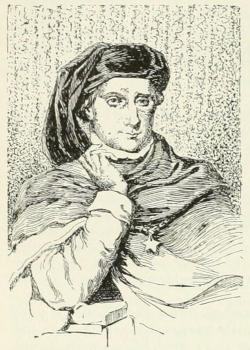
Charles VI
(From an old French print)
The next day the king arrived. The gates were all wide open; but he wished to enter through a breach and had a section knocked out. Then he made his way through the streets, helmeted, lance in hand, with the most terrible air his young person could assume. Executions began at once; first those of the city’s liberties. They took away its franchises, its elective magistrates, provost, aldermen, clerk, syndic, centurions, and tithing-men; they suppressed the people’s masterships, corporations, and brotherhoods; they deprived them of their arms and of the chains that made the streets safe. Then followed executions of persons; they arrested, made summary investigation, and finished by killing. Three hundred of the richest bourgeoisie were drowned, hanged, or decapitated with scarcely a form of trial. Noteworthy were the deaths of Nicholas le Flamand, one of those who followed Étienne Marcel the day of the slaying of the two marshals, twenty-six years before, and of John Desmarets, avocat-général in the parliament, one of the negotiators of the Peace of Bretigny, and who was worn out in vain efforts between the two parties. His trial was iniquitous and his death touching. “When Desmarets,” says the monk of St. Denis,d “arrived at the place of execution, ‘Ask mercy of the king, Master John,’ the people cried, ‘that he may forgive your crimes.’ The old man turned to them and replied, ‘Loyally and well did I serve King Philip his great-grandfather, King John, and King Charles, his father; never had these kings anything to reproach me with; and this one would reproach me neither, had he the age and knowledge of a grown man. I do not believe him responsible in the least for this judgment. I have done nothing to ask mercy of him. It is God alone from whom I must ask it and I pray him to pardon my sins.’”
[1383-1388 A.D.]
The bourgeoisie were brought together and read a long list of their misdeeds, with the punishments they deserved. At the moment when terror was at its height the two uncles of the king threw themselves at his feet and begged for pity. He let himself be influenced, and announced through his chancellor that he would change the punishments into fines. “This was,” says Mézeray,e “the true reason for this coup de théâtre!” Paris did not get off on less than 400,000 francs, worth to-day about 20,000,000; at Rouen, Rheims, Troyes, Châlons, Orleans, Sens, in Auvergne and Languedoc, the same proceedings took place, especially the enormous fines. “And this all went,” says Froissart,c “to the profit of the duke of Berri and the duke of Burgundy, for the young king was in their power!” This blow fell upon the bourgeoisie more disastrously than that of 1359, because the government was then in the hands of an intelligent man who checked the feudal reaction; in 1383 the princes gave themselves a free hand. The upper middle class was decimated and ruined; and when, after thirty years, public grievances caused them to essay another revolution, they were in no condition to assume its control and left it to violent men, who drenched Paris with blood.
In 1384 the count of Flanders died and the duke of Burgundy, his son-in-law, inherited his vast dominions. In 1369 Charles V, in order to facilitate the marriage of his brother the duke of Burgundy with the heiress of the county of Flanders, had abandoned French Flanders to him. But at the same time the king exacted an agreement from his brother, that the donation would be restored on the death of the latter’s father-in-law, Louis de Mâle. But the count of Flanders survived the king, and Philip the Bold easily obtained from Charles VI the remission of his promise. Henceforth the house of Burgundy will turn all its affection towards these rich provinces, and as it finds means for aggrandisement in this direction at the expense of the petty German princes, it will forget little by little both the stock from which it came, and the France which began its greatness.
The following year was employed in immense preparations for an invasion of England. They collected, says Froissart, enough ships to make a bridge from Calais to Dover; there were fourteen hundred of them. They built a whole town of wood, which could be taken apart, piece by piece, in order to take an entrenched camp with them. But they let the proper moment for crossing over pass, and the project had to be given up, but not until enormous sums had been squandered. Another expedition against the duke of Gelderland who, for the price of a pension of £400 from England, bade defiance to the king of France, cost still more, and came to nothing (1388).
THE KING ASSUMES THE RULE (1388 A.D.)
The voice of public opinion was still very feeble, but it could be heard. On the return from the sad war in Germany, the king called a general council in the hall of the palace of the archbishop of Rheims, and demanded of those present, in virtue of the obedience they owed him, their advice on the conduct of public affairs. Peter de Montaigu, cardinal of Laon, took the floor, and praising the king’s good qualities, exhorted him to begin the exercise of his absolute power by taking under his own control and direction the ministry of war and his own household, taking counsel from no one. Others supported the cardinal’s advice; Charles declared himself determined to follow it and thanked his uncles for the good offices they had rendered him. The king had scarcely left Rheims when the cardinal of Laon died by poison.
[1388-1389 A.D.]
The former counsellors of Charles V, the “small fry,” the marmousets as the great lords dubbed them in disdain, Olivier de Clisson, Bureau de la Rivière, Le Bègue de Vilaines, John de Novian, and John de Montaigu, reassumed, as ministers of state, the direction of affairs. The new administration was wise and economical, and stood for internal order and foreign peace, but through it the king only became the more prodigal; having no longer the pleasures and distractions of war, those of the fête and tourney became necessary to him, and these diversions now never ceased.b
Prodigious sums were needed for the “incomparable” fêtes in which Charles VI gloried, and which attracted to Paris the flower of the knights and noble ladies of all Christendom. This vast concourse of strangers, the stir, the joyful tumult, the dazzling shows intoxicated the young nobility and even the people of Paris; the Parisians had their share of the rain of gold and recovered in one way what was taken from them in another. In the first days of May, 1389, the most magnificent tournament which had ever been seen was held at St. Denis on the occasion of the knighting of the two sons of the late duke Louis of Anjou, the eldest of whom, Louis II, duke of Anjou and count of Provence, was preparing to set out to assert his claims to the kingdom of Naples against the heir of Charles of Durazzo. Charles VI had endeavoured to realise the most brilliant descriptions of the romances and to present to the feudal world a complete type of chivalric splendours. The ceremonial of initiation to the “holy order of chivalry,” which had almost fallen into disuse since the adoption of the custom of conferring the order on the field of battle, was reproduced with scrupulous exactness.
In a neighbouring field the lists had been prepared, surrounded with wooden galleries for the ladies; and in the great court of the abbey a banquet hall had been constructed 192 feet long by 36 wide and hung throughout with tapestries of silk and gold. The first day of the tournament twenty-two knights in green and gold armour were conducted into the lists to the sound of music, by twenty-two fair ladies similarly attired and mounted on elegant palfreys; each gave her knight a ribbon of her own colours. The contests lasted all day; then the company proceeded from the enclosure to the festival hall and after the supper the ladies awarded the prize to the two who had done the best. The rest of the night was passed in dances and caroles[30] and in “pastimes” of a less innocent kind. The fête lasted three days and three nights—nights of orgy and delirium which rendered the venerable cloisters of St. Denis the witnesses of many voluptuous mysteries and which must have strangely scandalised the chaste shade of St. Louis in the depths of its tomb.
The jousts and balls were succeeded by a ceremony of a sterner character but equally sumptuous: the young king loved to vary his emotions and his shows. He had been seized with “a great love” for the memory of Bertrand du Guesclin, a feeling which was shared by the whole nation: although nine years had passed since the death of that great captain, and though Charles V had honoured him with a splendid funeral, Charles VI insisted on recelebrating the obsequies of Messire Bertrand in presence of all the French and foreign nobility whom the tournament had brought together.
The fêtes of St. Denis had not satiated Charles VI; he remembered that the queen his wife had not yet been crowned: this was a fine occasion to indulge in fresh magnificences. He resolved to have Isabella anointed at Paris, and to compensate himself for the paucity of ceremonial which had been accorded to the queen’s first entry into the capital. He notified his intention “to those of Paris,” in order that they might be prepared, and charged the old queen, Blanche of Navarre, widow of Philip of Valois, to arrange the ceremony. Accordingly Blanche ordered the Chronicles of St. Denis to be examined for everything which they reported concerning the anointing of queens in olden times. Froissartc and the monk of St. Denisd have vied with one another in describing the queen’s procession which arrived before St. Denis the 22nd of August, 1389, with all the princesses, some in painted and gilded litters, others on palfreys marvellously caparisoned. The king’s uncles, who sought every opportunity to approach the supreme power, had presented themselves at court with their families; the dukes and all the great nobles escorted the litters which entered Paris to the sound of a thousand instruments and between two rows of horsemen clad, some in scarlet silk, others in green silk: they were on the one side the members of the king’s household, on the other twelve hundred citizens of Paris led by the provost of the merchants. Across the whole of the rue St. Denis and the Grand Font (the Pont au Change) were hung draperies of silk, camlet, and cendal (taffetas), which “shut out the sky”; all the houses were hung with silks and tapestries of a high warp and the windows were crowded with women adorned with dresses of brilliant materials and with gold necklaces. Fountains of milk and perfumed wine flowed at the street corners, and beautiful young girls offered the passers-by to drink from golden goblets. At the Porte St. Denis, at the moûtier (monastery) of the Trinity, at the second Porte St. Denis or Painters’ Gate (Porte aux Peintres), at the church of St. Jacques de l’Hôpital, at the Grand Châtelet, platforms, wooden castles, and richly ornamented theatres had been erected; one represented God in his paradise and the starry heavens filled with angels who sang “very melodiously” and congratulated in rhyme “the lady enclosed amongst fleurs-de-lis”; another “showed” the king of France and his twelve peers, King Richard Cœur de Lion, and King Saladin with his Saracens. A rope had been stretched from one of the towers of Notre Dame to the Pont au Change: as the queen passed the bridge a man dressed as an angel, seated on this rope, descended from the towers of Notre Dame, passed through an opening in the awning which covered the bridge, placed “a beautiful wreath” on the queen’s head, and “was drawn up again through the said opening as if he were returning to heaven.”
The procession presented itself before Notre Dame, whence it returned to the Palais, and the next day the queen was anointed and crowned in the Sainte-Chapelle, by the archbishop of Rouen. The descriptions of the banquets which took place at the “marble table” in the great hall of the Palais, and of the jousts at the Hôtel St. Pol are to be found in Froissart.c The king had adopted a golden sun with rays as his device: he was one of the victors in the jousts. The rich presents of the city of Paris to the queen and the duchess of Touraine, the king’s sister-in-law, contributed to pay for the gaiety of the court; the Parisians offered the princesses gold and silver plate to the value of sixty thousand crowns: they doubtless calculated on being repaid for this munificence by a large diminution of the taxes; but their expectation was cruelly deceived. The king left Paris a few days later, and as a farewell to his people left an increase of the gabelle and an ordinance which prohibited, under pain of death, the use of silver coins of twelve and four deniers which had been in circulation since the reign of the late king.f
HATRED OF THE NOBLES FOR THE MINISTRY (1389-1392 A.D.)
[1389-1392 A.D.]
The ministry attempted to combat this state of affairs or at least to extenuate its disastrous effects. It economised in state expenditure to make up for the king’s extravagance, and the state was the gainer by the arrangement.

Costume in the Reign of Charles VI
The ministers gave Paris back its provost and conferred upon the bourgeoisie the right to acquire fiefs, as though they were nobles, and deprived the duke of Berri of his government in Languedoc, where four hundred thousand inhabitants had fled into Aragon. Not being able to inflict further punishment on Berri, they caused his treasurer Bétisac to be put to death. This Bétisac had merited the hate of all by his exactions. But they did not dare condemn him as an embezzler, since the duke of Berri had authorised all his acts and it was on the duke himself that the complaints of the people should have fallen. So they laid a trap for Bétisac, by advising him to declare heretical opinions, for which he would be summoned to ecclesiastical jurisdiction which would exculpate him. The accused man followed this advice and they burned him for a heretic instead of hanging him for a thief.
The “small fry” ruled the kingdom for four years. Four years in which the king’s uncles and the great nobles had to keep their hands off the management of affairs, and longed for an opportunity to get back into power. Finally an Angevin nobleman, Peter de Craon, mortal enemy of the leader of the marmousets, the constable Olivier de Clisson, placed his personal hatred at the service of the aristocracy’s political resentment.
On June 13th, 1392, at the close of a fête given at the Hôtel St. Pol, the constable lingered a little to take leave of the king and the duke of Orleans, and then with eight attendants, two carrying torches, made his way towards the rue Ste. Catherine. Here Peter de Craon was waiting for him, with forty mounted brigands, scarcely a half dozen of whom knew what was expected of them. When Clisson appeared, Craon’s men threw themselves on his attendants and extinguished their torches. Clisson at first thought it a joke of the duke of Orleans, whom he supposed to have followed him. “My lord,” he said, “you are young, we must pardon you. These are the pranks of youth.” But Peter de Craon cried, “Die, die, Clisson; here you shall die.” “Who art thou,” asked Clisson, “who speakest such words?” “I am Peter de Craon, your enemy. You have many times provoked me, and shall here pay for it. Forward,” he called to his men, “I have him whom I wanted and will have.” The constable tried to defend himself but was soon wounded and thrown from his horse. In falling, his head came against the unlatched door of a bake-shop, which gave way. This saved him. The assassins thought him dead; they had, moreover, recognised the constable, and fearful of having attacked so powerful a personage, they fled with Craon to his castle of Sablé in Maine.
The news of the outrage was brought to the king as he was preparing for bed. He called his guard, had torches lighted and went to the bake-shop where Clisson was beginning to recover consciousness. “Constable,” said the king, “how do you feel?” “Weak and poorly, sire.” “And who brought you to this pass?” “Peter de Craon, sire, and his accomplices, treacherously and with no warning.” “Constable, nothing will be paid more dearly or amends made for than this thing.”
Peter de Craon, who no longer felt himself safe in the castle of Sablé, sought refuge with the duke of Burgundy, who, called upon to deliver up the rascal, caused him to be hid and replied that he knew nothing whatever of him. Charles immediately collected an army, swearing to take no rest until he had punished this rebellion. The dukes of Burgundy and Berri endeavoured to block this enterprise. Their hatred towards Clisson had grown since they learned he possessed great wealth. The constable, believing himself about to die, had made his will, and besides his fiefs and heritage he had disposed of 1,700,000 francs’ worth of personal property. But the king paid no heed to the delays and bad will of his uncles and to the fears which his physicians expressed for his health. He led his army as far as Le Mans.
THE KING GOES MAD: THE PRINCES RETURN TO POWER (1392 A.D.)
It was the middle of summer, during the prolonged August heat. As the king was crossing the forest, a man dressed all in white seized his bridle and cried, “Stop, noble king, go no further, thou art betrayed.” This sudden apparition startled the king greatly; a little farther on the page who carried the royal lance nodded in the saddle. The lance fell and struck a shield a resounding blow. At the sound of arms the king trembled, drew his sword and cried, “Quick, quick, upon the traitors!” He thrust his naked sword at his brother the duke of Orleans, who barely avoided it. One of his knights finally had to seize him from behind. They disarmed him. He no longer knew anyone.
The king was mad. Some said it was sorcery, but the king himself was to blame. Possessor at twelve years of age of that unlimited power which is often the undoing of the strongest characters, he was at twenty-four worn out with every pleasure and emotion in the range of human experience from debauch to battle-field. His constitution was ruined, his mind shaken; a violent shock had deranged everything.
When it was hinted that the king was the victim of poison or sorcery, “No,” exclaimed the duke of Berri, “he is neither poisoned nor bewitched, except by bad advice.” These words sealed the fate of the marmousets. A few days later Clisson demanded of the duke of Burgundy the pay of the knights who had accompanied the king on his last expedition. The duke looked him through and through, and said, “Clisson, you need not trouble yourself about the affairs of the kingdom, for without your help it will be well governed. It was an evil day for the realm when you first meddled with it. How the devil have you got so much money, that you were recently able to will away 1,700,000 francs? Neither his majesty, my brother Berri, nor I with all our present power have been able to acquire so much. Leave my presence and let me never see you again, for were it not for my honour I would put your other eye out.” Clisson hastened to the safety of his castle in Brittany, while parliament declared him guilty of extortion, and banished him from the country, imposing a fine of 100,000 silver marks. The sire de Montaigu, warned by this experience, sought refuge at Avignon. Bureau de la Rivière, the sire de Novian, and Le Bègue de Vilaines were arrested and imprisoned in the Château St. Antoine (the Bastille).
[1392-1396 A.D.]
The king’s uncles came again into full possession of the government: what would they do? They signed a twenty-eight years’ truce with England in 1395 and gave King Richard II the infant princess Isabella, Charles VI’s daughter, in marriage. But four years later (1399) the English deposed and afterwards, it is said, strangled their king, and this valuable alliance was broken.b
The signing of the truce of 1395 was a real assurance of peace in France, even in Brittany, where Clisson, banished to his fiefs, had armed his vassals at once and attacked John de Montfort. But the duke of Burgundy appeared in person at Ancenis, mediated between the two parties, and made them in January, 1395, sign a reciprocal promise to lay down their arms. Shortly after this John IV attended the meeting of Charles VI and Richard II at Guines (where the truce was arranged) and obtained from the English the restitution of Brest which had only been pledged to them.
With peace thus restored France was now able to occupy herself more particularly with the great questions then agitating all Europe: that of the papal schism of which all Christendom was longing for the end, and that of the crusade—or rather the barrier which it was felt must be raised against the conquests of the Ottoman Turks in the European provinces of the Greek empire.g
Forty years before the Ottoman Turks had crossed the Bosporus, taken Adrianople and a portion of the Danube valley. Now they were threatening Hungary. A crusade was therefore resolved upon, and put under the direction of a young man of twenty-four, John, count of Nevers, who later became the famous duke of Burgundy (John the Fearless). Young and old, equally short-sighted, gaily descended the Danube, taking the whole matter as a pleasure excursion. When they arrived at Nicopolis, King Sigismund of Hungary advised them to meet the advance troops of the enemy with his Hungarian foot-soldiers and light cavalry, and to reserve the knights for the real Ottoman army which would appear afterwards. But no one was willing to forego the honour of striking the first blow. So all opposed themselves to the advance-guard, threw themselves upon the first enemy who appeared, and arrived exhausted and in disorder at the top of a hill where they were received by the redoubtable janissaries which Amura had just organised, and who made short work of the breathless, disordered troops. It was said that Bajazet put ten thousand captives[31] to death in his own presence, saving only from the massacre the count of Nevers and twenty-four nobles whom he ransomed (1396).b Consternation was universal throughout France, especially in Burgundy. Duke Philip strangely abused the obligations of feudalism which compelled vassals to ransom a captive lord or his son and raised as much from his vassals as from the royal treasury, more than double the 200,000 ducats which Bajazet demanded for the freedom of his captives.f
DOMESTIC TROUBLES AND SCANDALS
[1396-1407 A.D.]
The government of the aristocracy was not fortunate: its acts were discrediting it abroad; its quarrels were weakening it at home.
Isabella of Bavaria was but fifteen years old when she came from Germany to wed Charles VI. Without parents, without a guide in the midst of a corrupted court, she learned its morals quicker than she learned its tongue, and she lived solely for luxury and pleasure. Years did not render her conduct more circumspect, or her thoughts more serious. From pleasure she descended to debauchery. Charged after the king’s affliction with the keeping of his person, she used the authority obtained through the melancholy situation of her husband to satisfy her passions, her vices, and her vengeances. It will soon be seen how fatal this foreign queen was to France.
The duke of Burgundy, Philip the Bold, kept the sovereign authority until his death in 1404. His son, John the Fearless, wished to receive, with his heritage, his father’s influence in the government, but the duke of Orleans, the king’s brother, all powerful with the queen—master, through her, of the king and the dauphin; chief of the nobility, and brilliant knight himself—had no intention of renouncing the power to anyone. So there soon sprang up, between John the Fearless and Orleans, a rivalry that threatened to become civil war right in the midst of Paris. Each collected his arms and fortified his palace; they were about to fight when the aged duke of Berri interposed. He brought Burgundy to the bedside of Orleans who was lying ill and made the two men embrace and talk and take food together. This reconciliation took place November the 20th, 1407; on the 23rd Louis of Orleans fell, assassinated by John the Fearless.
For more than four months, the duke had been planning this murder. He had bought, in the city, a house for the ostensible purpose of storing wine, corn, and other provisions, but really concealed in it seventeen hired assassins. This house, situated in the rue Vieille du Temple, near the Porte Barbette, lay in the path of the duke of Orleans while returning from the king’s residence to his own palace. Wednesday, the 23rd of November, at eight in the evening, the duke of Orleans left the Hôtel Montaigu on muleback. The night was very dark, and he was accompanied only by two equerries mounted on one horse and four foot attendants carrying torches. Although it was not late, all the shops were closed. The duke, keeping a little behind his people, was singing softly to himself and toying with his glove when suddenly the assassins, concealed by the corner of a house, rushed upon him crying, “Die! Die!”
“I am the duke of Orleans,” the duke shouted. “Then we want you,” they replied, striking him. A page tried to cover the prince with his body and was killed. A woman who witnessed the affair from a window screamed murder. One of the assassins called to her, “Shut up, wretch.” Then by the light of the torches she saw come out of the duke of Burgundy’s recently bought house, a large man with a red hat over his eyes, who, with a lantern, looked to see that there had been no slip as in the case of the constable De Clisson. But this time the murderers had well earned their wage. The body was literally hacked to pieces; the right arm was cut in two, the severed left wrist was thrown to one side, the skull split from ear to ear, and the brains scattered on the pavement. At this the man in the red hat said to the others, “Put out your lights and let us go, he is dead.” They put their torches back into the house they had occupied, strewed caltrops behind them to prevent pursuit, and retired to the Hôtel d’Artois in the rue Mauconseil.
[1407-1409 A.D.]
The next day John the Fearless went, like all the princes, to see the corpse, and sprinkled it with holy water, at the church of the Blancs-Manteaux. “Never,” he said, at sight of the dead, “has so foul a murder been committed in this realm.” He wept at the funeral and held a corner of the pall. Some days later, however, when the provost of Paris announced in the council that he would make every effort to find the assassins if they would give him permission to search the palaces of the princes, John the Fearless became confused and grew pale. Then it was he drew aside the duke of Berri and the king of Sicily, “I did it,” he whispered, “the devil tempted me.” This state of mind soon passed, and the duke of Burgundy resolved to admit and justify his crime. In fact the next day he boldly appeared at the council of the princes, but his uncle Berri met him at the door and said, “My good nephew, don’t come in this time. I don’t want you here.” The thought came to the guilty man that perhaps they were going to arrest him, and he fled at once to his possessions in Flanders. From there he proclaimed, preached, and wrote to the world that he had but forestalled an ambush of the duke of Orleans. A Franciscan monk, the learned John Petit, was the following year charged with the proof in twelve arguments, in honour of the twelve Apostles, that if the duke was killed it was for the glory of God, since he was a heretic; for the good of the king, since he wished to usurp the throne, and for the public welfare, since the state was rid of a tyrant.
To this strange apology for the murder, from the pen of a monk, Burgundy added a bloody victory.b An insurrection of the people of Liège against their bishop, a creature of the duke, called the latter from Paris. His influence had caused John, a younger brother of the house of Bavaria, to be elected bishop; John took deacon’s orders to entitle him to assume the episcopal sovereignty, but he refused to be priested, preferring the helmet to the mitre. The Liègeois were discontented at having a profane knight in lieu of a bishop; they entreated and petitioned John to take upon him the sacerdotal character. He laughed at them. They rebelled and drove him out. Such was the crime of the Liègeois. The duke of Burgundy marched against them; a battle was fought at Hasbain, in which the burgesses of Liège were as unfortunate as those of Ghent had been at Roosebeke. It is said that twenty-six thousand dead were counted on the field of battle.h
This was the best argument in Burgundy’s defence; he returned to Paris promising the people an immediate abolition of taxes, and extracted from the king a letter of forgiveness, in which Charles VI declared that he cherished no resentment towards the author of his brother’s death (Peace of Chartres, March, 1409).
The duchess of Orleans, the beautiful and gentle Valentine Visconti, was at least spared this last shame. The death of her husband killed her. She had taken for her motto, “Rien ne m’est plus; plus ne m’est rien,” and “died in 1408” [says Juvénal des Ursinsi] “in anger and grief.”
The duke of Orleans was not worth much regret. His administration had been as deplorable as his morals. He had declared war on England, and had not carried it out, and had used this pretext for an increase of taxes which he himself had appropriated. Burgundy had bitterly opposed this new burden, and to appease the people, and especially to lay his own hand on the rich spoil, he now sent the superintendent of finances to the scaffold (1408). Then he restored the Parisians their ancient free constitution, the rights to elect their provost and to organise a citizen militia under elective leaders, and even to hold noble fiefs with the privileges thereto attached. Besides this he was extremely popular, which state of affairs he increased by showing citizens, even the least important, such consideration as they had never before known. These were the market people who formed, in Paris, the strength of the Burgundian party. Feudalism never forgave John the Fearless for having sought such support, no more than it did for having compromised seignorial inviolability by slaying a prince of the blood, the king’s brother. A considerable faction of the nobility turned against him. The avengers of Orleans ranged themselves under the banner of the father-in-law of one of his sons, the count d’Armagnac, who gave the party its name (1410). Thus, with the king mad, the queen ignored and incapable, the dauphin threatened by his excesses with his father’s end, the first prince of the blood stained with an infamous murder, there was no government—only armed factions, and war at home and abroad. Such was the state of France; nothing but disaster could come of it.
CIVIL WAR
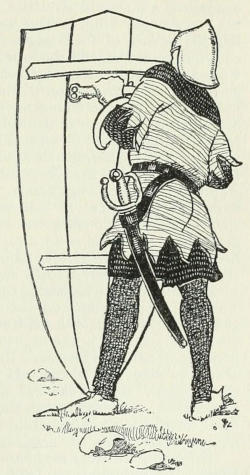
Shield used in the First Part of the Fifteenth Century
From 1410 to 1412 the two factions attacked each other twice, and twice came to a settlement (Peace of Bicêtre, November, 1410; Peace of Bourges, July, 1412). Both sides made advances to the English to win over the country’s enemy.b The Gascon soldiers, preferring a plundering life in the midst of France to their own rude and poor homes, were constant to their banners. The duke of Burgundy, on the other hand, could not get his Flemings to quit their families and crafts for more than forty days; he was therefore obliged to call in the English. Henry IV sent a body of archers to his aid, with whom he drove his enemies from the north of the capital (February, 1410). In May we find Henry in league with the Orleans party, who were to restore to the English, in recompense, all their ancient possessions in France. The emissary who bore this treaty was seized at Boulogne; its contents were made public, and great odium was in consequence excited against the Armagnacs. The hapless monarch, Charles, recovering for a moment from his frenzy, joined in this indignation; he called an army, displayed the oriflamme, and marched with the Burgundians to besiege Bourges. The campaign, as usual, ended without an action, in a kind of treaty. Both parties felt the thirst of pillage and of blood; both wanted the courage to decide their differences in a general combat. No period of history manifests such an utter want of talent; no prowess was shown except in tournaments; no statesmanship save in the planning of a murder. Although the passions of men possessed of power and means were excited to the utmost, yet not a decisive blow was struck in policy or in arms. The fortune of the struggling parties was left to events—to chance. Success and reverse, the former at least, if not both, unearned, alternately ensued; conquerors and conquered pursued and fled, rolling like destructive waves over the necks of a prostrate and ruined people. Civil wars in general, destructive as they are of peace and prosperity, beget at least the virtue of courage; yet it was not so in France. The peasantry were crushed and trodden down; the nobles and knights feared to trust them with arms. The Bretons and the Gascons, natives of distant provinces, were the only foot-soldiers, the sole infantry of France at this time; and a handful of English sufficed in these quarrels to give the advantage to either party.h
[1410-1413 A.D.]
In this condition of affairs there was much to recall the worst days of king John, and to better them the bourgeoisie took the initiative, parliament, as in 1356, holding back. The University of Paris was very proud of having recently accomplished the deposition of two anti-popes, the election of Alexander V, a former doctor of the Sorbonne, and the convocation of a general council for the consideration of reforms within the church; and the bourgeoisie thought it could pacify the state as it hoped to have pacified Christianity. It obtained from Charles VI, in one of his lucid moments, a decree ordering all the princes back to their provinces and forbidding them to leave. But in a few months the war recommenced. The Armagnacs committed a thousand atrocities, telling their victims to seek vengeance from the “poor mad king.” The body of citizens asked, in the king’s council, that the defence of Paris might be committed to a friend of Burgundy’s, the count of Saint-Pol, and the latter, not very sure of the upper middle classes, wished to overcome them by means of the populace. He took refuge in the great and rich corporation of the butchers which he authorised to raise five hundred men for the municipal defence. The butchers armed their servants and all the men employed about the slaughter-houses. This violent mob, accustomed to the sight of blood and killing, and who made a slaughterer named Caboche their chief, let themselves be led for a time by their masters and the learned men of the University of Paris. Then Paris presented the most singular and terrible spectacle. One day the mob presented itself at the dauphin’s palace, forced him to appear on a balcony and through their spokesman, the old surgeon, John de Troyes, made him listen to their demands. He must send away his evil companions; lead a more regular life in every way; and take care of his health, and of his soul. The butchers charged themselves with superintending this change of morals which would bring with it, according to their ideas, the reformation of the kingdom. They set a watch around the Hôtel St. Pol for the safety of the king and monseigneur the duke of Guienne, and if they heard the sound of instruments and dancing in the night they entered boldly to put a stop to it, and preserve decency and order. But these rough and violent natures were not always content with words. If they had compassion on “that good fellow, the dauphin,” they broke out against those who were corrupting him and removed them violently from the palace and dragged them before the parliament for justice, even sometimes administering it on the way to those who had displeased them the most.
However, the able members of the party drew up, for the repression of abuses, the ordinance of 1413, known as the Cabochian ordinance, whose application would have been successful, if in making elections universal it had not made its administration impossible (May 25th). “But,” says Augustin Thierry, “men were found to conceive that great reform charter, joint work of the citizens and the university, while none could be found to execute and maintain it. Wise men and those accustomed to affairs had at this time neither will power nor political energy. They kept themselves apart, and all action rested upon fanatics and the unruly who precipitated, through their intolerable excesses, a reaction which brought about their fall and put a stop to all reform.”
[1413-1415 A.D.]
What the bourgeoisie respected, the mob outraged. It proscribed not only vice and immorality, but wealth, and mingled pillage and murder with its reforms; it disgraced finally those who had employed it and who, blushing at the association, now preferred the Armagnacs to the Cabochians. Called upon by all men of moderation the Armagnacs put a stop to the mob’s excesses, but at the same time overthrew the reform measures of the bourgeoisie (September 5th, 1413). John the Fearless fled again to his Flemish provinces.b Charles VI marched in person against him at the head of the Armagnacs, besieged and took Soissons, of which the inhabitants of every age and sex were inhumanly massacred. Arras was next invested,[32] but the Armagnacs becoming disgusted at the tediousness of the siege, as the Burgundians had been the previous year at that of Bourges, an accommodation ensued, the duke of Burgundy making verbal submissions, and promising never to show himself in Paris again. (Treaty of Arras, September, 1414.)
HENRY V INVADES FRANCE—A FRENCH VIEW
[1415 A.D.]
Whilst France was thus occupied and torn by civil contests, Henry V had succeeded, in 1413, to the throne of England.h He now judged the time come to interfere in the French mêlée. He stood, moreover, in need of a foreign war to settle himself on the throne his father had usurped. Since the great campaigns of the preceding century, the idea of a war with France had ever been popular in England. Therefore, when Henry proposed a serious expedition, he obtained easily from parliament six thousand men-at-arms and twenty-four thousand archers, with whom he debarked at Harfleur on the 14th of August, 1415. After a heroic defence which lasted a whole month, Harfleur, unsuccoured, was compelled to give up. But Henry V had lost fifteen thousand men (two thousand men-at-arms, thirteen thousand archers)—the half of his army. Too feeble now for any great undertaking, he resolved to march across country to Calais, and to throw the French knighthood a new and insolent defiance.
The English left Harfleur on the 8th of October, traversing the Pays de Caux, not without some resistance, although they took nothing but food and wine from the towns for fear of arousing the inhabitants. On the 13th they arrived at Abbeville intending to cross the Somme there, but they found the ford at Blanquetaque so well defended this time that they were obliged to ascend the stream as far as Amiens.
Near Nesle a peasant pointed out a ford that could be reached across a marsh. It was a difficult and dangerous passage; they would be lost if attacked. But the French army was still far away. Besides, the nobles would not have wished a combat in this swamp; they were seeking a fine battle in open field and to this end asked king Henry for a day and place for a fight. To which the Englishman replied that it was not necessary to name either day or place, since every day would find him on the field.
In spite of this answer, they feared, in the French army, that the enemy would escape; and to make sure they should not, the princes took up a position between the villages of Tramecourt and Agincourt [French Azincourt], where the English must necessarily pass, on a narrow plain, newly ploughed and all sodden with rain.b
On Thursday, the 24th of October, the English having passed Blangy learned that the French were close at hand, and thought they were about to attack them. The men-at-arms dismounted from horseback, and all of them kneeling down, and lifting up their hands to heaven, prayed to God to take them into his keeping. Nothing, however, took place as yet, the constable not having reached the French army. The English proceeded to quarter themselves at Maisoncelle, still nearer to Agincourt. Henry V disencumbered himself of his prisoners, saying to them, “If your masters survive, you will present yourself again at Calais.”
At last, they discovered the huge French army, its fires and its banners. There were, according to the estimate of the eye-witness, Lefebvre de St. Rémy,j fourteen thousand men-at-arms, in all perhaps fifty thousand men; thrice the number of the English. The latter had eleven or twelve thousand men remaining of the fifteen thousand that had marched from Harfleur, ten thousand of them at least being archers.
The Welshman, David Gam, the first who brought word to the king of the enemy’s presence, being asked how many men the French might have, is said to have replied, “Enough to be killed, enough to be taken prisoners, enough to fly.” An Englishman, Sir Walter Hungerford, could not forbear from observing that it would not have been amiss to have brought ten thousand more stout archers; there were as many in England who would have desired no better. But the king replied peremptorily, “Now in our Lord’s name, I would not have one man more. The number we have is that which he has willed; these folks place their confidence in their multitude, and I in him who so often gave victory to Judas Maccabæus.”
The English having still a night at their disposal, employed it usefully in making their preparations, and providing as well as possible for both body and soul. First, they rolled up the banners for fear of the rain, and took off and folded up the handsome coats of arms they had put on for the fight. Then in order to pass the cold October night in comfort, they opened their baggage and laid straw under them, which they procured from the neighbouring villages. The men-at-arms fitted the rivets of their armour, the archers applied fresh strings to their bows. They had for several days employed themselves in cutting and sharpening the stakes which they usually planted before them to stop the advance of cavalry. Amidst all their preparations for victory, these brave men did not forget their souls’ weal, but set their accounts in order with God and their consciences. They confessed hastily, those at least whom the priests could attend, and all this was done without noise, in whispers. The king had commanded silence, under penalty of forfeiture of their horses for the gentlemen, and of loss of the right ear for those of lower degree.
It was otherwise on the French side, where the time was spent in making knights. In every direction there were great fires which showed everything to the enemy; a confused din of people shouting and calling to each other; a bustling mob of valets and pages. Many gentlemen passed the night on horseback in their heavy armour, no doubt to avoid soiling it in the deep mud, which with the cold rain chilled them to the bones.
MICHELET’S ACCOUNT OF THE BATTLE OF AGINCOURT (OCTOBER 25TH, 1415)
On the morning of St. Crispin and St. Crispinian’s day, October 25th, 1415, the king of England heard three masses, bareheaded, but otherwise in full armour. “For it was his custom,” says John de Vaurin,k “to hear three masses each day, one after the other.” He then put on a magnificent helmet with an imperial gold crown. He rode without spurs on a gray palfrey, and made his men advance over a field of green corn, where the ground was less spoiled by the rain, the whole army forming one body, with the few lances he had in the centre, flanked by bodies of archers. He then rode slowly along the line, speaking a few brief sentences: “You have a good cause; I am come but to demand my right. Remember that you belong to old England; that your kindred, your wives and children are awaiting you there; see that you return to them with good cheer. The kings of England have always fared well in France. Look to the honour of the crown; look to yourselves. The French say they will cut off three fingers from each archer’s hand.”
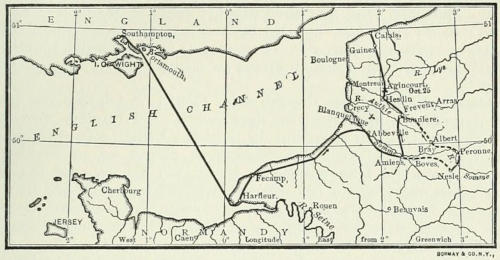
Map illustrating the March of Henry V and the Battle of Agincourt
(The dotted line indicates a doubtful part of the route.)
The ground was in so bad a condition that no one was disposed to attack. The king of England parleyed with the French, offering to renounce the title of king of France, and to surrender back Harfleur, provided he were given Guienne, with some few convenient additions, Ponthieu, a daughter of the king, and 800,000 crowns. While this parleying between the two armies was going on the English archers were securing their stakes.
The two armies formed a strange mutual contrast. On the French side were three enormous squadrons, like so many forests of lances, following each other in lengthened file through the narrow plain; at their head the constable, the princes, the dukes of Orleans, Bar, and Alençon, the counts of Nevers, Eu, Richemont, and Vendôme, a multitude of lords, a dazzling iris of enamelled armour, escutcheons, banners, the horses fantastically disguised in steel and gold. The French, too, had archers, men of the commonalty; but where were they to be placed? Every post was numbered, and no one would give up his own; these men would have been a blot upon so noble an assemblage. There were cannon, but it does not appear that they were made use of; probably there was no place for them either.
The English army did not look handsome. The archers had no armour, often no shoes; for headpieces they had sorry caps of boiled leather, or even of willow with a crosspiece of iron; the axes and hatchets stuck in their belts gave them the appearance of carpenters. Many of these good workmen had taken off their breeches, in order to be at their ease and to work the better. It is a strange, incredible, and yet certain fact, that the French army really could not stir either to fight or to fly. The rear alone escaped.
At the decisive moment, when old Thomas of Erpingham, having drawn up the English army, threw his truncheon into the air, crying out, “Now strike!” and when the English had replied with a shout from ten thousand throats, the French army, to their great astonishment, still remained motionless. Horses and riders, all appeared enchanted, or dead in their steel cases. The fact was that the big war horses, loaded with their heavy riders and their steel caparisons, had sunk deep in the stiff soil, had become firmly fixed there, and only struggled out to advance slowly a few paces. Such is the acknowledgment of the English chroniclers; a modest acknowledgment, which does honour to their probity.
Lefebvre,j John de Vaurink and Walsinghamm expressly say that the field was nothing but viscid mud. “The place was soft and cut up by the horses, so that it was with great difficulty they could drag their feet out of the ground. The French were so loaded with harness that they could not advance. They had long and very weighty coats of mail, hanging below the knees; below these they had leg harness, and above them plate harness, and, moreover, helmets of proof. They were so much crowded together that they could not lift their arms to strike an enemy, except some of them in the front.”
Another historian of the English side, Titus Livy,l informs us that the French were drawn up thirty-two deep, whilst the English were ranged in but four ranks. This enormous depth of the French served no purpose; their thirty-two ranks consisted wholly, or almost so, of cavalry; the majority of whom, far from being able to act, did not even see the engagement; whereas every man of the English was efficient. Of the fifty thousand French, two or three thousand only could fight against the eleven thousand English, or at least might have done so if their horses could have extricated themselves from the mud.
To rouse those inert masses, the English archers discharged volleys of ten thousand arrows with extreme rapidity and pertinacity at their faces. The iron-clad horsemen stooped their heads, otherwise the arrows would have entered through their visors. Then, from the two wings of Tramecourt and Agincourt, two French squadrons began with much spurring to execute a clumsy charge, led by two excellent men-at-arms, Messire Clignet de Brabant and Messire William de Saveuse. The first squadron, advancing from Tramecourt, was unexpectedly taken in flank by a body of archers concealed in the woods; neither squadron reached the enemy.
Of twelve hundred men who began this charge, there remained not more than 120 when they came up with the English palisades. Most of them had fallen in the mud by the way, men and horses. Would to God that all had so fallen; but the others, whose horses were wounded, could no longer control the frantic animals, which rushed desperately back on the French ranks. The vanguard, far from being able to open and let them pass, was, as we have seen, so closely packed together that not a man could move. We may imagine the frightful accidents that took place in that dense mass, the horses wild with terror, backing and smothering each other, flinging off their riders, or crushing them under their armour as the iron masses clashed together. Then came the English to complete the havoc. Coming out from their line of stakes, and throwing down their bows and arrows, they advanced quite at their ease with axes, hatchets, heavy swords, and leaded clubs, to demolish that confused mountain of men and horses. In process of time they succeeded in clearing away the vanguard, and made their way, with the king at their head, to the second line of battle.
It was perhaps at this moment that eighteen French gentlemen made a dash at the king of England. They had made a vow, it was said, to die or bring down his crown; one of them struck off a point from it; all perished in the attempt. This on dit is not enough for the historians, who further adorn the tale, and convert it into a Homeric scene, in which the king fights over the body of his wounded brother, like Achilles over that of Patroclus. Then it is the duke of Alençon, commander of the French army, who kills the duke of York and cleaves the king’s crown. Being speedily surrounded, he yields; Henry holds out his hand to him; but he was already slain.[33] What is more certain is that the duke of Brabant arrived in haste at the second stage of the engagement. He was the duke of Burgundy’s own brother, and seems to have sought the field to clear the honour of his family. He arrived very late, but time enough to die. The brave prince had left all his men behind him, and had not even put on his coat of arms: instead of which he took his banner, made a hole in it, passed his head through it, and charged the English, who slew him instantly.
There remained but the rearguard, which soon dispersed. A great number of cavaliers, dismounted, but raised up again by their servants, had made their way out of the throng of battle and surrendered to the English. At this moment, word was brought the king that a French corps was pillaging his baggage; and at the same time he saw some Bretons or Gascons in the French rear, that seemed about to return to the charge against him. He was alarmed for the moment, especially as he saw his men embarrassed with so many prisoners, and instantly ordered every man to kill his captive. Not one obeyed; those soldiers without shoes or breeches, who held the greatest lords of France in their hands, and thought they had made their fortunes, were now ordered to ruin themselves. As they refused to comply, the king appointed two hundred men to act as executioners. “It was a sad spectacle,” says Lefebvre,j “to see those poor disarmed wretches, who had just received promise of quarter, slaughtered in cold blood, cut and hewed, head and face!” The alarm was groundless. It was only some pillagers of the neighbourhood, people of Agincourt, who, in spite of their master, the duke of Burgundy, had taken advantage of the opportunity. The battle being ended, the archers made haste to strip the slain, whilst they were yet warm. Many were dragged forth alive from beneath the corpses; among others, the duke of Orleans. Next day the victor, on his departure, killed, or made prisoners, all that remained alive.[34] “It was a piteous sight to see the great nobles who had there been slain, and who were already stark naked, like those who were born of men of no account.” An English priest was not less affected by the spectacle. “If this sight,” he says, “excited pity and compunction in us, who were strangers, and but passed through the country, how great was the sorrow for the native inhabitants. Oh, may the French nation come to peace and union with the English, and depart from its iniquities and its evil ways!” Sternness then prevails over compassion, and he subjoins: “Meanwhile, let his grief be turned upon his head.”
The English lost 1,600 men; the French 10,000, almost all gentlemen, 120 lords having banners. The list fills six large pages in Monstrelet, beginning with seven princes (Brabant, Nevers, D’Albret, Alençon, the three De Bar); then come lords without number, Dampierre, Vaudemont, Marle, Roussy, Salm, Dammartin, etc., the bailiffs of Vermandois, Mâcon, Sens, Senlis, Caen, and Meaux, and Montaigu, the brave archbishop of Sens, who fought like a lion.[35]
The duke of Burgundy’s son bestowed the charity of a grave on all the dead that lay naked on the field of battle. Twenty-five square rods of ground were measured out, and in that huge pit were laid all the bodies that had not been carried away, fifty-eight hundred men by the tale. The ground was consecrated, and a thick thorn hedge was planted round it, for fear of the wolves. There were but fifteen hundred prisoners, including the dukes of Orleans and Bourbon, the counts d’Eu, de Vendôme, and de Richelieu, the marshal de Boucicaut, Messire James d’Harcourt, Messire John de Craon, etc.p
MASSACRE OF THE ARMAGNACS IN PARIS (1418 A.D.)
[1415-1418 A.D.]
With this rich capture, Henry hastened to re-embark at Calais. His army, reduced to ten thousand men, was unable to consider any further enterprise. The duke of Burgundy had taken no part whatever in the battle of Agincourt;[36] it was his enemies that brought about that shameful defeat. If he had made haste, he might have entered Paris as its master. D’Armagnac, the new constable and successor of D’Albret, showed more promptitude; he took possession of the capital, of the king and the dauphin his son, who was still a minor; that is to say, of the entire government. To recall a little popularity to the side of the party he showed a praiseworthy activity, borrowing ships from the Genoese, raising troops in France, and besieging Harfleur (1416). But funds were lacking and he fell back on the great resource of the times, debasement of money and false loans.
John the Fearless was always the patron of the poor. Paris murmured, and John the Fearless, to increase the fermentation, prevented the arrival of provisions in the city. He succeeded in carrying off Queen Isabella from Tours and having her declared regent. He forbade the cities, in his name, to pay the taxes imposed by D’Armagnac, and he entered into negotiations with the English (1417).
The latter had now returned. Henry V had taken Caen (1417), and like a conqueror who is sure of himself had divided his army into four divisions, the more quickly to accomplish his purpose. What, in fact, did he have to fear? The dukes of Brittany, Anjou, and Burgundy had signed treaties of neutrality with him. D’Armagnac could do nothing, for he was reduced to “borrowing from the saints,” in melting their shrines, with the people of his party fast abandoning him because they were not paid enough; it was necessary to protect Paris with the Parisians who hated and betrayed him.
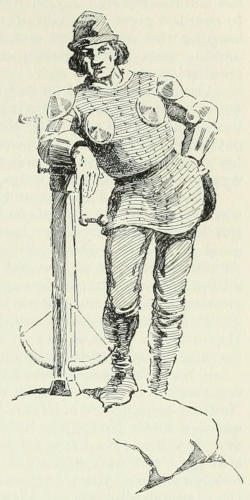
A French Crossbow-man, Beginning of Fifteenth Century
One Perrinet Leclerc, iron merchant on the Petit Pont, had charge of the small gate at St. Germain. “His son,” says Monstrelet, “and some reckless young companions, who formerly had been punished for their escapades,” plotted to deliver the city over to the Burgundians. On the night of May 29th, 1418, Perrinet entered his father’s chamber while the old man slept and stole the keys from under the pillow. The sire de l’Isle-Adam informed in advance, was on the other side of the moat. He entered with eight hundred men, and the former partisans of the faction, the butchers, the slaughterers—all the people of the market flocked around him. Some Armagnacs tried to escape, taking the dauphin with them; but the greater part including the constable were thrown into prison, where their lives were soon in peril. The mob, which in 1413 had made its first appearance, reappeared on the scene in 1418 exasperated and furious with misery and uneasiness. Provisions failed and Paris was threatened with famine at the same time that ugly rumours circulated in the crowd; the Armagnacs were coming to assail such a gate, such a faubourg; the English, another. The cause of these misfortunes, they cried on every side, were those Armagnacs they had in their keeping. Vengeance must be had upon them and an end put to their schemes.
Sunday the 12th of June, 1418, the mob got under way and rushed to the prisons, Hôtel-de-Ville, Temple, St. Éloi, St. Magloire, St. Martin, and the Grand and Petit Châtelet, to murder indiscriminately everyone they found there. Armagnacs or not, by Monday morning sixteen hundred people had perished, killed in the prisons and streets. Their bodies were left there and “bad children played with them and dragged them about.” With that of the constable they amused themselves by raising a large strip of skin “to represent the white scarf of Armagnac.”
THE DUKE OF BURGUNDY MASTER OF PARIS (1418 A.D.)
These dreadful occurrences had just taken place when John the Fearless returned with the queen to Paris, amidst the enthusiastic acclaims of the crowd, who believed he brought peace and abundance with him. Vain hope! Neither one nor the other was to come from the duke of Burgundy, but on the contrary to all preceding misfortunes there was added an epidemic which carried off in Paris and its environs fifty thousand persons. Again the fury of the mob became uncontrollable and wrought its vengeance on the wretched beings that had been overlooked in the prisons or sent there since June. The 31st of August an immense assemblage formed itself under the orders of the hangman Capeluche, and set out for the prisons. The duke of Burgundy hastened after them imploringly, and even went so far as to press the hand of Capeluche, but in vain. A new massacre took place. Some days after the duke sent the bloodthirsty mob after some Armagnacs, shut up, as he said, in Montlhéry, and as soon as they were gone he shut the gates of Paris behind them and had Capeluche beheaded.b
In becoming master of Paris, the duke of Burgundy had succeeded to all the embarrassments of the constable D’Armagnac. He had now in his turn to rule the great city, victual and maintain it, which could only be done by keeping the Armagnacs and the English at a distance—that is to say, by making war, re-establishing the taxes he had suppressed, and losing his popularity.
The equivocal part he had so long played, accusing others of treachery, while he himself was betraying his country, was now to come to a close. As the English were ascending the Seine and menacing Paris, he had no alternative but to forego his hold on the capital, or to give them battle. But by his eternal tergiversation and duplicity, he had enervated his own party, and was now powerless alike for peace or war.
The people of Rouen and Paris, who had chosen him for their leader, were Burgundians, indeed, and foes to the Armagnacs, but still more foes to the English. They were astonished, in their simplicity, to see that their good duke did nothing against the enemy of the kingdom. His warmest partisans began to say, as the Bourgeois de Parisq relates, that “he was, in all his proceedings, the slowest man that could be found.” The Armagnacs possessed the whole centre, Sens, Moret, Crécy, Compiègne, Montlhéry, a girdle of towns round Paris, Meaux, and Melun; that is to say, Marne and Haute Seine. The duke sent to Rouen all the forces he could spare without leaving Paris unprotected, namely, four thousand horse.
It had long been foreseen that Rouen would be invested. Henry V had approached it with extreme slowness. Not content with having two great English colonies in his rear, Harfleur and Caen, he had completed the conquest of lower Normandy by the capture of Falaise, Vire, St. Lô, Constance, and Évreux. He kept possession of the Seine, not only by Harfleur, but also by Pont de l’Arche. He had already re-established some degree of order, reassured the clergy, and invited the absentees to return, promising them support in case of their compliance, and declaring that otherwise he would dispose of their lands or their benefices. He reopened the exchequer and the other tribunals, and appointed his grand treasurer of Normandy supreme president over them. He reduced the tax on salt to almost nothing, “in honour,” says Rymer,r “of the Holy Virgin.”
SIEGE OF ROUEN (1418-1419 A.D.)
[1418-1419 A.D.]
There were in Rouen fifteen thousand foot-soldiers and four thousand horse, in all, perhaps, sixty thousand souls—a whole people to feed. Henry, knowing he had nothing to fear, either from the dispersed Armagnacs, or from the duke of Burgundy, who had just besought of him another truce for Flanders, did not hesitate to divide his army into eight or nine bodies, so as to embrace the vast compass of Rouen. These bodies communicated with each other by means of trenches, which protected them from shot; whilst in the direction of the open country they were defended from a surprise by deep ditches set with thorns. He was prepared for an obstinate resistance, but his anticipation was surpassed. There was a strong Cabochian leaven in Rouen. Alain Blanchard, the chief of the arblast men, and the other Rouennese leaders, seem to have been connected with the Carmelite Pavilly, the Parisian orator of 1413. The Pavilly of Rouen was the canon Delivet. These men defended Rouen for seven months.
The king of England, thinking to terrify the inhabitants, had gibbets erected all round the town, and hanged the prisoners on them. He barred the Seine, too, with a wooden bridge, chains, and barges, so that nothing could pass. The Rouennese seemed reduced to extremities at an early period of the siege, and yet they held out six months longer; it was a miracle. They ate up the horses, dogs, and cats. When these were gone, those who could anywhere find a morsel of food, however filthy, took good care not to let it be seen; a thousand greedy wretches would otherwise have seized upon it. The most horrible necessity that befell the town was that of expelling all who could not fight, twelve thousand old men, women, and children. The piteous crowd presented themselves before the English intrenchments, and were received at the sword’s point. Repulsed alike by their friends and their enemies, they remained between the camp and the town, in the ditch, without any other food than the weeds they plucked. There they passed the whole winter, with nothing between them and the sky.
Meanwhile, the duke of Burgundy was beginning to put himself in motion. First, he went to Paris from St. Denis, where he made the king go through the solemn mockery of displaying the oriflamme, to remain a long while at Pontoise, and again a long while at Beauvais. There he received another message from Rouen by a man who had risked his life to convey it. It was the voice of an expiring town, and said merely that fifty thousand men had died of famine in Rouen and its environs. The duke of Burgundy was touched by this sad tale, and promised succour; then having got rid of the messenger, and feeling assured that he should hear no more of Rouen, he turned his back on Normandy, and took the king to Provins.
A surrender was then inevitable; but the king of England, desirous of making an example on account of so long a resistance, wished to have the inhabitants at his mercy. The Rouennese, who well knew what was the mercy of Henry V, resolved to undermine a wall, and to pass out that way by night with arms in their hands, trusting in God’s grace. The king and the bishops reconsidered the matter, and the archbishop of Canterbury personally offered the besieged the following terms of capitulation: (1) their lives to be spared, five men excepted (those of the five who were rich, or churchmen, got themselves out of the difficulty, and Alain Blanchard paid for all; the English were bent on an execution, in order to ratify the principle that the resistance had been rebellion against the lawful king); (2) for the same reason, Henry insured to the town all the privileges which the kings of France, his ancestors, had granted to it, “before the usurpation of Philip of Valois”; (3) it had to pay a tremendous fine—300,000 gold crowns—one-half before the end of January (it was already the 19th of that month), the other half in February, 1419. To squeeze all that from a depopulated, ruined town was no easy matter.
HENRY AND JOHN THE FEARLESS (1419 A.D.)
The king of England being occupied with the task of organising the country he had conquered, granted a truce to the two French parties, the Burgundians and the Armagnacs. He felt it necessary to refit his army; and, above all, to collect money and discharge his debts to the bishops, who had lent him funds for his long expedition.
Henry was so far from apprehending danger from the dauphin, that he was not afraid to displease the duke of Burgundy. The latter sought an interview with him, and proposed to him a marriage with a daughter of Charles VI, with Guienne and Normandy for a dower; but Henry required also Brittany as a dependence of Normandy, besides Maine, Anjou, and Touraine.
But the duke of Burgundy had about him persons who besought him to treat with them. They were followers of the dauphin, Barbazan, and Tannegui Duchâtel, the commanders of his troops. It was full time France should become self-reconciled, when her ruin was so imminent. The parliament of Paris, and that of Poitiers, laboured equally to that end; so, too, did the queen, who talked, wept, and found means to move his hardened soul.
On the 11th of July was beheld, at the bridge of Pouilly, this singular spectacle: the duke of Burgundy surrounded by the old servants of the duke of Orleans, and by the brothers and kinsmen of the Agincourt prisoners, and of the victims butchered in Paris. Of his own accord he knelt before the dauphin. A treaty of amity and mutual aid was signed and submitted to by both parties. But on the 29th of July, less than three weeks after the signing of the treaty, the Burgundian garrison of Pontoise, near Paris, suffered themselves to be surprised by the English; the inhabitants fled to Paris, which they filled with consternation, and this augmented when, on the 30th, the duke of Burgundy, carrying away the king from Paris to Troyes, passed beneath the walls of the capital, without making any other provision for the defence of the distracted Parisians than naming his nephew, a boy of fifteen, captain of the town.
[1419-1420 A.D.]
Seeing all this, the dauphin’s followers believed, rightly or wrongly, that the duke had a secret understanding with the English, and his servants told him, it is alleged, that he would perish in an interview which the dauphin sought with him. The dauphin’s people had set about erecting on the bridge of Montereau the gallery in which it was to take place; a long, tortuous wooden gallery, without any barrier in the middle, contrary to the custom always observed in that suspicious age. In spite of all this he persisted in his resolution to meet the dauphin; such was the wish of Dame de Giac, who never quitted him.
As the duke did not come in time, Tannegui Duchâtel went to fetch him. The duke hesitated no longer, but slapped him on the shoulder, saying: “Here is the man I trust in.” Duchâtel made him hasten his pace, for the dauphin, he said, was waiting. In this way he separated him from his suite, so that he entered the gallery along with none but the sire de Noailles, brother of the captal de Buch, who was in the service of the English, and had just taken Pontoise. Neither of them came out alive (September 10th, 1419).
The altercation which took place is variously related. Tannegui Duchâtel, however, averred that he had not struck the duke. Others boasted that they had done so. One of them, Le Bouteiller, said: “I said to the duke of Burgundy: ‘Thou didst cut off the hand of the duke of Orleans, my master; I am going to cut off thine.’” However little worthy of regret was the duke of Burgundy, his death did the dauphin immense mischief. John the Fearless and his party had both fallen very low, and in a little time there would have been no more avowed Burgundians. Everyone was beginning to despise and hate him; but from the moment he was killed all were again Burgundians.
THE TREATY OF TROYES (1420 A.D.)
We must not suppose that Paris easily admitted the foreigner, but extreme lassitude and inexpressible suffering made everyone only too happy to find a pretext for a settlement with Henry. Each man exaggerated to himself his feelings of pity and indignation. The shame of calling in the stranger was veiled by a fair show of just vengeance; but the real fact was that Paris yielded, because it was perishing of hunger. The queen yielded, because, after all, if her son was not to be king, her daughter, at least, would be queen. The duke of Burgundy’s son, Philip the Good, was the only person who acted sincerely; he had his father’s death to avenge. But he, too, doubtless, thought to find his advantage in the new order of things; the Burgundy branch would thrive by the ruin of the elder branch, by placing on the throne a stranger, who would never have more than one foot on the continent, and who, if he were wise, would govern France through the duke of Burgundy.
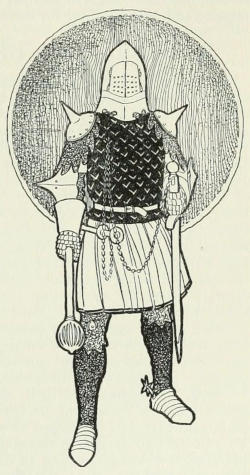
French Man-at-arms, Beginning of the Fifteenth Century
Paris then left the Burgundians, who again possessed full authority in the town, to do as they thought fit. Young Saint-Pol, nephew to the duke of Burgundy, and captain of Paris, was sent, in November, to the king of England, with Maître Eustace Aloy, “in the name of the city, the clergy, and the commune.” He received them extremely well, declaring that he desired nothing but the independent possession of what he had conquered, and the hand of the princess Catherine; and he said graciously: “Am I not myself of the blood royal of France? If I become the king’s son-in-law, I will defend him against all men living.” He obtained more than he demanded. His ambassadors, encouraged by the inclinations of the new duke of Burgundy, asserted their master’s right to the crown of France, and that right the duke acknowledged. The king of England had spent three years in conquering Normandy; the death of John the Fearless seemed to give him France in one day.
The treaty concluded at Troyes, May 20th, 1420, in the name of Charles VI, secured to the king of England the hand of the daughter of the king of France, and the reversion of the kingdom: “It is agreed that immediately after our decease the crown and realm of France shall remain and be perpetually to our said son King Henry and his heirs. The faculty and exercise of governing and ordering the public affairs of the said realm shall be and remain, during our life, to our said son King Henry, with the counsel of the nobles and sages of the said realm. During our life the letters pertaining to matters of justice shall be written and shall proceed under our name and seal; nevertheless, for as much as extraordinary cases may occur, it shall be competent to our son to write his letters to our subjects, wherein he shall order, prohibit, and command, on our behalf, and on his own, as regent.” After this, was not the subsequent article a mockery? “All conquests which shall be made by our said son king, over the disobedient, shall be and shall be made to our profit.”
This monstrous treaty concluded worthily with these lines, in which the king proclaimed the dishonour of his family, the father proscribed his son: “Considering the enormous crimes and misdemeanours perpetrated upon the said realm of France by Charles, styling himself (soi-disant) dauphin of Viennois, it is agreed that we, our said son the king, and also our very dear son Philip, duke of Burgundy, will in no wise treat concerning peace or concord with the said Charles, nor will we treat by ourselves or others, except with the consent and counsel of all and each of us three, and of the three estates of the two realms aforesaid.”
The mother received prompt payment for the shameful phrase, soi-disant dauphin. Isabella immediately had 2,000 francs a month assigned to her, payable out of the mint at Troyes. For this price she denied her son, and gave up her daughter. The English took from the king of France, at one stroke, both his kingdom and his child. The poor girl was forced to wed a master, and brought him for dower her brother’s ruin.p
HENRY’S STRUGGLE WITH THE DAUPHIN (1420-1422 A.D.)
Such was the tenor of the Treaty of Troyes, so glorious to Henry, yet so impracticable of accomplishment, that it must be doubted whether there was any sincerity in the French signers of it. To be avenged of the dauphin, and to crush him by the assistance of England, was evidently the foremost thought, the first desire. But it is scarcely credible that the duke of Burgundy looked forward to continuing, after the accomplishment of his vengeance, the faithful vassal of the house of Lancaster. The arrangement of one king governing the two countries was plainly impracticable. And that Henry himself could have entertained it only shows how the most vigorous intellects may allow their perspicacity and sense to be clouded by success and superstition. He was well aware that his new position could only be preserved by force of arms. On the occasion of his marriage with the princess Catherine, which took place on June 2nd, the knights of both countries were for celebrating the event by a tournament. But he forbade the rival combat, and told those who proposed it to join him in the siege of Sens, where they might exercise their prowess against the Armagnacs. Sens made but a trifling resistance.h Next, this implacable hunter of men hurried to Montereau, and not being able to reduce the castle, he had his prisoners hanged by the ditch sides.
With all his impetuosity he was forced to have patience before Melun, where the brave Barbazan detained him many months. The king of England, employing all the means of which he could avail himself, took Charles VI and the two queens to the siege, presenting himself as the son-in-law of the king of France, speaking in his father-in-law’s name, and using his wife as a bait and a snare. All these clever devices were ineffectual. The besieged resisted valiantly; obstinate conflicts took place round the walls, and beneath them, in the mines and countermines, and Henry did not spare his own person. At last, however, provisions failed, and the garrison were constrained to surrender. Henry, according to his custom, accepted the capitulation, and put to death several citizens, all the Scotchmen who were in the place, and even two monks.
During the siege he had got the Burgundians to deliver up to him Paris and the four fortresses, Vincennes, the Bastille, the Louvre, and the Tour de Nesle. He made his entry in December, riding between the king of France and the duke of Burgundy. The latter was dressed in mourning, in token of grief and vengeance, perhaps also from a feeling of shame for the unworthy part he played in thus introducing the foreigner. The king of England was accompanied by his brothers, the dukes of Clarence and Bedford, the duke of Exeter, the earl of Warwick, and all his lords. The king of England was well received in Paris. He entered into formal possession as regent of France, by assembling the estates on the 6th of December, 1420, and making them sanction the Treaty of Troyes.
[1420-1421 A.D.]
That the son-in-law might be sure of inheriting, it was necessary that the son should be proscribed. The duke of Burgundy and his mother presented themselves before the king of France, sitting as judge in the Hôtel St. Pol, to make “great plaint and clamour of the piteous death of the late duke John of Burgundy.” The king of England was seated on the same bench as the king of France. Messire Nicholas Raulin demanded in the name of the duke of Burgundy and his mother that Charles, styling himself dauphin, Tannegui Duchâtel, and all the murderers of the duke of Burgundy, should be carted through the streets, with torches in their hands, to make amende honorable. The king’s advocate spoke to the same effect, and the university supported the demand. The king authorised the prosecution, and Charles was cried and cited at the Marble Table, to appear within three days before the parliament. He did not put in an appearance and was condemned by default, sentenced to banishment, and stripped of all right to the crown of France (January 3rd, 1421).
The cumbrous and devouring army which Henry brought with him was but too necessary to him. His brother Clarence was defeated and killed, with two or three thousand English, in Anjou (battle of Baugé, March 23rd, 1421). In the north even the count d’Harcourt had taken up arms against the English, and was overrunning Picardy. Saintrailles and La Hire were advancing by forced marches to combine with him. All the men of family were gradually going over to the side of Charles VII, to the party that made bold expeditions and adventurous forays. The peasants, it is true, who were the sufferers by these pillaging exploits, would in the long run declare for a master who could and would protect them.
The ferocity of the old Armagnac marauders was of service to Henry’s cause. He did a popular thing in besieging Meaux, the captain of which town, the bastard De Vaurus, a sort of ogre, had filled the country round with indescribable terror. But as the bastard and his men expected no mercy, they defended themselves with desperate determination. They detained the English the whole winter, eight long months, before Meaux, till cold, want, and pestilence consumed that fine army. The siege began on the 6th of October, and on the 18th of December, Henry, who already saw his forces diminishing, wrote urgently for fresh soldiers to Germany and Portugal. Englishmen were probably more costly to him than those foreigners. To induce the German mercenaries to take service with him rather than with the dauphin, he caused them to be told, among other things, that he would pay them in better coin.
He could not reckon on the duke of Burgundy. That prince appeared for a short while at the siege of Meaux, but soon withdrew, under pretence of going into Burgundy, and obliging the towns in his duchy to accept the Treaty of Troyes. Henry had good reason to believe that the duke himself had secretly instigated their resistance to a treaty which annulled the contingent rights of the house of Burgundy to the crown, as well as those of the dauphin, the duke of Orleans, and all the French princes. And why had young Philip made such a sacrifice to the friendship of the English? Because he thought he needed their aid to avenge his father and beat his enemy. But it was much rather they who had need of him. Fortune had forsaken them. Whilst the duke of Clarence was getting himself beaten in Anjou, the duke of Burgundy had been brilliantly successful in Picardy, where he had come up with the dauphin’s partisans, Saintrailles and Gamaches, before they could form a junction with d’Harcourt, and had defeated and made them prisoners.
[1421-1422 A.D.]
During that interminable siege of Meaux, whilst Henry was seeing his fine army dissolving away around him, word was brought him that the queen had been delivered of a boy at Windsor Castle. He evinced no joy, and comparing his own destiny with that of the child, he said, with prophetic sadness: “Henry of Monmouth will have had a short reign and will have conquered much; Henry of Windsor will reign long and will lose all. God’s will be done!”