Book 3 — The Magic of Numbers By JAMES L. LANYON
Reading edition
That there are a great many magic squares; that the numbers in these squares are arranged according to a definite system; that squares with very remarkable properties are easily constructed, are facts not generally known.
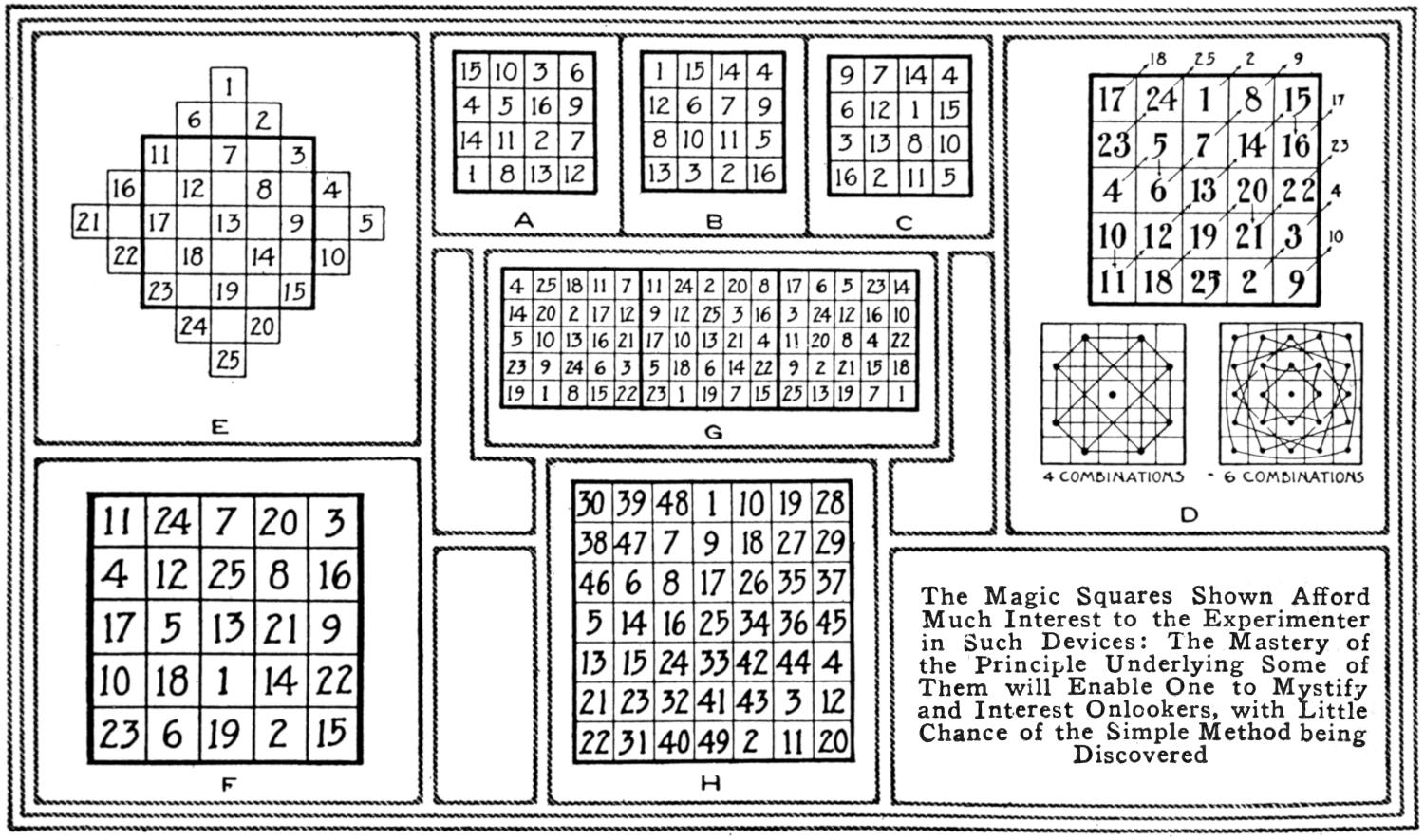
Consider the magic square A of 16 numbers. Add up any four numbers straight across, up and down, or diagonally—10 ways in all—and the sum in each case will be 34. But that is not all: Take the four numbers in any one quarter of the square, as for example, 15, 10, 4, and 5, and the sum will be 34; or take the four central numbers, or the four corner numbers, and the result will be the same. But even this does not exhaust the magic of the square. Add any four numbers arranged symmetrically around the center, as 3, 10, 8, and 13, or 10, 4, 7, and 13, and the result will also be 34. In fact, it is really not necessary to have them arranged symmetrically, because it will be found that four numbers arranged as are 6, 10, 11, and 7, or 1, 4, 16, and 13 will produce the same magic number of 34.
There are two other combinations of the 16 numbers that will give the same result. They are shown at B and C. In fact the second one, B, not only exhibits some of the former combinations, but also includes such sets of four as 14, 5, 3, and 12, or 15, 8, 2, and 9, which places to the credit of this square numerous combinations. Such special features as this simply add another element of mystery and interest. Thus, while the square B has these two combinations exclusively to its credit, the first, A, and the third, C, have such special arrangements as 5, 16, 1, and 12, or 15, 6, 11, and 2. Also 10, 3, 5, and 16, or 4, 5, 14, and 11, making the total number of such combinations for the first square 34.
Magic squares of 25 numbers also have remarkable properties. Examine the square D and note the many possible combinations graphically set forth in the small diagrams. Not only do any five numbers in a row or along a diagonal make 65, but almost any four arranged around the center, with the center number 13 added, will give the same result.
This square is a good example by which to illustrate one of the methods of construction of these interesting devices. Thus, place 1 in the middle square of the top row, and then write the numbers down consecutively, always working in the direction of the arrows as indicated. When any number falls outside, as number 2 does at the start, drop down to the extreme square in the next row and insert the number there, as was done in this case. It will be observed that 4 falls outside, and so it is moved to the proper square as suggested, which will be at the extreme left of the next row above. Continuing, it is found that at 6 it is necessary to drop down one square and continue in the direction of the arrows. At 9 it is necessary to drop down to the proper extreme square as shown. The next number, 10, must again be provided for at the square on the left of the next higher row. The square ahead being already filled, 11 is placed below; after this there is “clear sailing” for a time. In this manner magic squares with seven or nine numbers to the side may be made easily. When puzzles and catch problems are under discussion, it is always mystifying to take one’s pencil and quickly make out a magic square according to this easily remembered method. The small diagrams at D suggest some of the combinations.
Another method of constructing a square of 25 numbers diagonally is shown at E. Place the outside numbers in the open spaces at the opposite side of the square, maintaining the same triangular relation, which results in the arrangement shown at F. While this combination is entirely different from the previous one, it exhibits the same mysterious properties.
15 10 3 6
4 5 16 9
14 11 2 7
1 8 13 12
A
1 15 14 4
12 6 7 9
8 10 11 5
13 3 2 16
B
9 7 14 4
6 12 1 15
3 13 8 10
16 2 11 5
C
17 24 1 8 15
23 5 7 14 16
4 6 13 20 22
10 12 19 21 3
11 18 25 2 9
4 COMBINATIONS 6 COMBINATIONS
D
1
6 2
11 7 3
16 12 8 4
21 17 13 9 5
22 18 14 10
23 19 15
24 20
25
E
11 24 7 20 3
4 12 25 8 16
17 5 13 21 9
10 18 1 14 22
23 6 19 2 15
F
4 25 18 11 7 11 24 2 20 8 17 6 5 23 14
14 20 2 17 12 9 12 25 3 16 3 24 12 16 10
5 10 13 16 21 17 10 13 21 4 11 20 8 4 22
23 9 24 6 3 5 18 6 14 22 9 2 21 15 18
19 1 8 15 22 23 1 19 7 15 25 13 19 7 1
G
30 39 48 1 10 19 28
38 47 7 9 18 27 29
46 6 8 17 26 35 37
5 14 16 25 34 36 45
13 15 24 33 42 44 4
21 23 32 41 43 3 12
22 31 40 49 2 11 20
H
The Magic Squares Shown Afford Much Interest to the Experimenter in Such Devices: The Mastery of the Principle Underlying Some of Them will Enable One to Mystify and Interest Onlookers, with Little Chance of the Simple Method being Discovered
Although they do not contain quite so many combinations, the three magic squares shown at G all add up to this same magic number of 65, straight across, diagonally, and many other ways. A square with seven numbers to the side, worked out according to the first method described, is illustrated at H. The magic number here is 175. Since the general principle is similar to that involved in the squares described in detail, the working out of the numerous combinations of the squares shown at G and H will be left to the interested experimenter.