Book 3 — An Automatic Window Closer
Reading edition
The window closer consists of a weight, A, attached to one end of a cord, B, which runs through several pulleys and has its other end attached to a hook in the center of the window sash, as shown in Fig. 1. The weight A is held in an elevated position by a small trigger which is operated with an electromagnet.
The arrangement of the weight and its control is shown in Fig. 2. The latch C is held in a horizontal position by an extension on the arm D, which in turn is held by a latch, E. The latch C is mounted on the same supporting shaft as the arm D, and they are connected with a coil spring having the tension in such a direction that it holds the latch C down on the extension of the arm D. When the weight moves up through the box the latch C will rise and allow it to pass down beside it. The latch holding the lower end of the arm D may be released by means of an ordinary vibrating bell arranged so that its clapper will strike the extension F on the latch and thus cause its upper end to move from the engagement with the arm D. A small coil spring is attached to the arm D so that it will be returned to its vertical position when the weight has passed C and thus make it ready for the next operation without any adjustment except raising the weight and setting the clock.
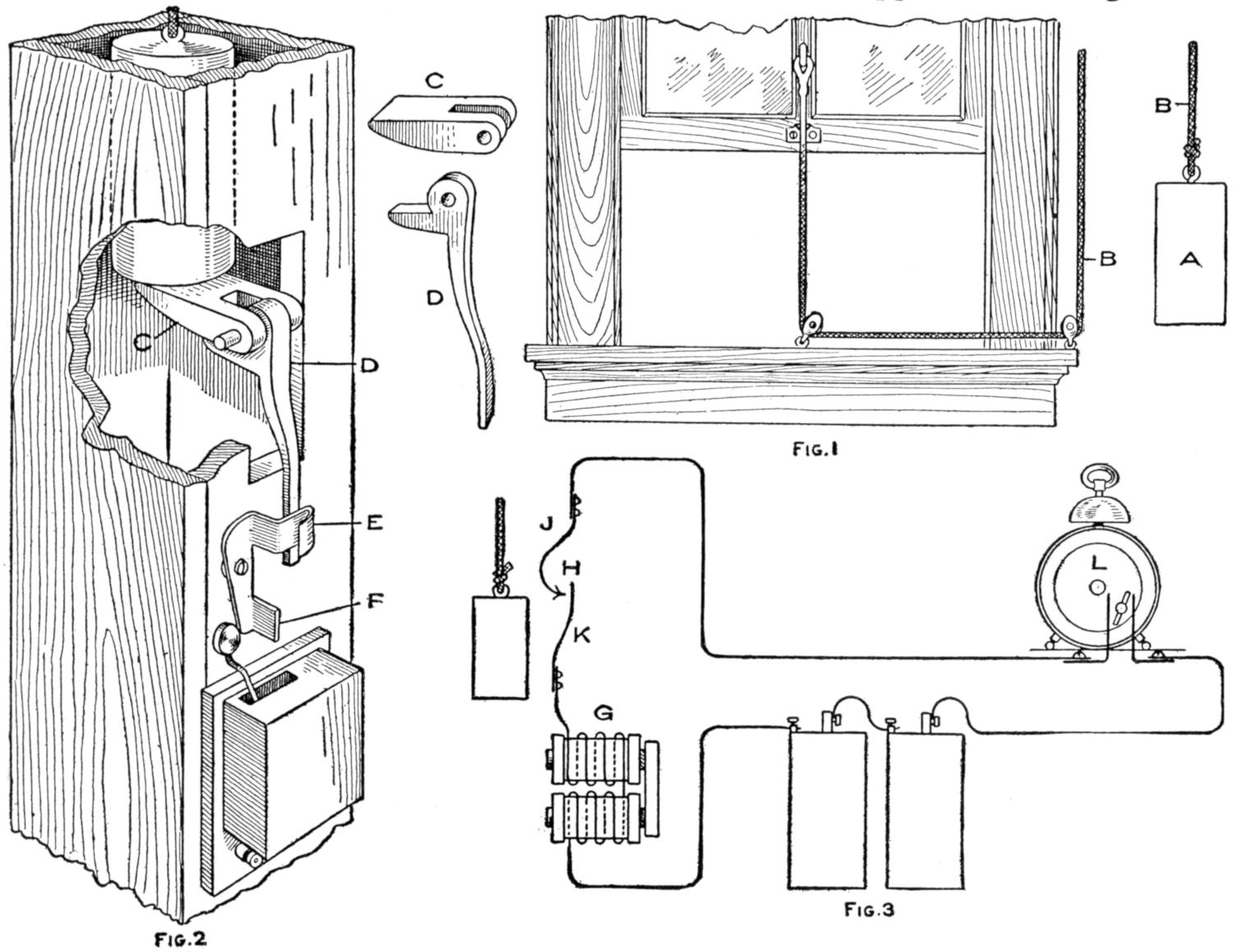
Fig. 2 Fig. 1
Fig. 3
The Window is Automatically Closed by a Weight at the Time Set on the Alarm Clock When the Key Closes the Electric Circuit, Causing the Magnet to Release the Latch
A diagram of the electrical circuit is shown in Fig. 3, in which G represents the electromagnet to trip the trigger that supports the weight, and H the contact which remains open until the weight is raised to the upper position, when the spring J is forced against the spring K and closes the circuit. The circuit still remains broken until the contact L is closed by the key on the alarm clock, which is set in a vertical position between two springs representing the terminals of the wire. The contact H should be so located on the housing for the weight that it will be closed only when the weight is resting on the latch C. The circuit is then opened as soon as the latch C is released, and the clapper will stop vibrating.
¶When a pencil becomes too short for the hand, apply paste to about 1 in. of the rubber end, roll on a sheet of paper about 6 in. long, and almost all of the pencil can be used.