Book 3 — A Mysterious Watch
Reading edition
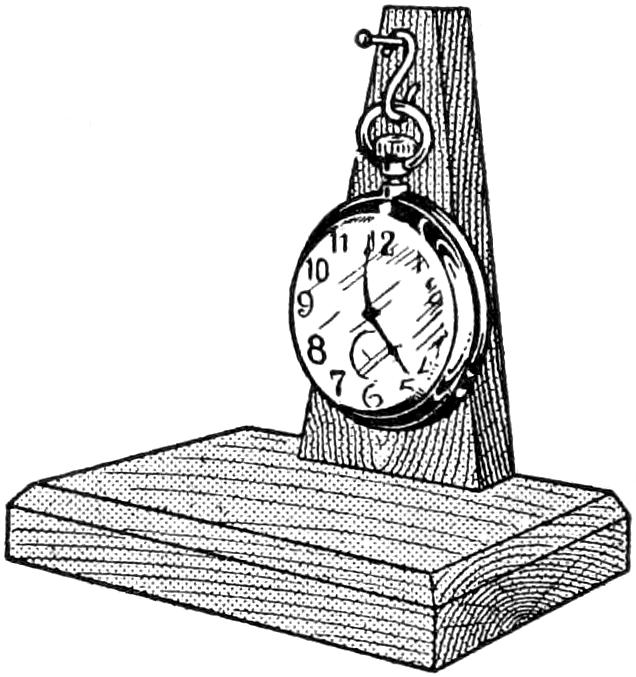
A very interesting experiment may be made with the ordinary dollar watch in illustrating the law of the pendulum. A pendulum 39.1 in. long will make 60 one-way swings per minute, the number of swings varying inversely as the square root of the length. By actual count it was found that the balance wheel of the watch in question made 240 one-way swings per minute, which is just 4 times as fast as the 39-in. pendulum. Therefore, according to the foregoing law, a pendulum ¹⁄₁₆ as long, or about 2¹⁄₂ in., would swing in unison with the wheel of the watch. The question then arises as to what would happen if the watch itself were suspended so as to swing as a pendulum of the latter length. The experiment was made as illustrated, with the result that the watch keeps on swinging continuously. The swing amounts to about ³⁄₈ in., and appears so vigorous that it is almost incomprehensible that the small spring in a watch should be able to maintain so much weight in continuous motion for 24 hours.

Bait Casting for Game Fish by Stillman Taylor
There are many enjoyable phases of the fisher’s art, but bait casting from the free reel probably has a wider appeal than any other branch of angling. The pleasure of handling a short bait-casting rod is in itself a good sport, even when casting done in the back yard is made for distance and accuracy only. Get two or three enthusiastic casters together, and you may have an interesting little tournament, held on a vacant lot, on the lake, or on the greensward of a city park. There is plenty of action in casting from the reel, and it is its variety that has made angling of this type so universally popular. True, considerable practice is required before the caster is able to shoot an accurate plug far off, but the knack may be gained after reasonable application. The handling of the short rod differs from all other angling methods—it is an active sport rather than a contemplative recreation—and when the fun of handling a good outfit is combined with the sport of coaxing out a black bass, shooting a wooden minnow among the lily pads for pickerel, or casting the bait for those pirates of our fresh-water lakes, the wall-eyed pike and the muskellunge, the angler gets a taste of fishing—plus.
The Outfit and Its Selection
A good firearm is necessary to the good marksman and a well-made, nicely balanced rod, to which is clamped a smooth-running reel, is the essential equipment of an able angler. Bait casting is, of course, more a matter of skill than of outfit, but that is no reason why the angler should be handicapped by poor tackle, although large expenditure is not necessary in obtaining a satisfactory outfit. The casting rod may be from 5 to 6 ft. long. Where the caster regards length of cast as the important factor, the 5-ft. length will probably give the best satisfaction. However, the superiority of one over the other in this regard is rather to be found in the elasticity and quality of the rod than its length. The skill of the caster is, moreover, the ruling factor. The 5¹⁄₂-ft. rod is better than the 5-ft. length for fishing purposes, and the 6-ft. rod is more resilient than the 5¹⁄₂-ft. tip. If the greatest range is not of more importance than the landing of the fish, the longer rod will prove the most pleasant to handle.
The split-bamboo rod has many friends, and a well-made rod of this material is a thoroughly satisfactory casting tool. A fine-quality casting rod of split bamboo costs from $10 to $25. A fairly good rod may be bought for $2 or a trifle less, and a smooth-running reel for another $2, while a line for it will bring the total up to about $5. An outfit of this kind purchased with discrimination, while not embodying everything that a critical angler would desire, will cast a long and accurate line and stand up under the strain of handling our heaviest game fish. The one-piece rod is classed by many anglers as the ideal casting rod. The two-piece rod is handier to pack and is more generally used.
The chief fault in bait-casting rods is the stiff action of the tip section. For tournament casting, a fairly stiff rod is desirable. The same requirement holds good for muskellunge and other heavy fishing. A flexible rod affords more pleasure in playing black bass and other active “gamey” fish. However, the best way to test out a rod is by casting with it.
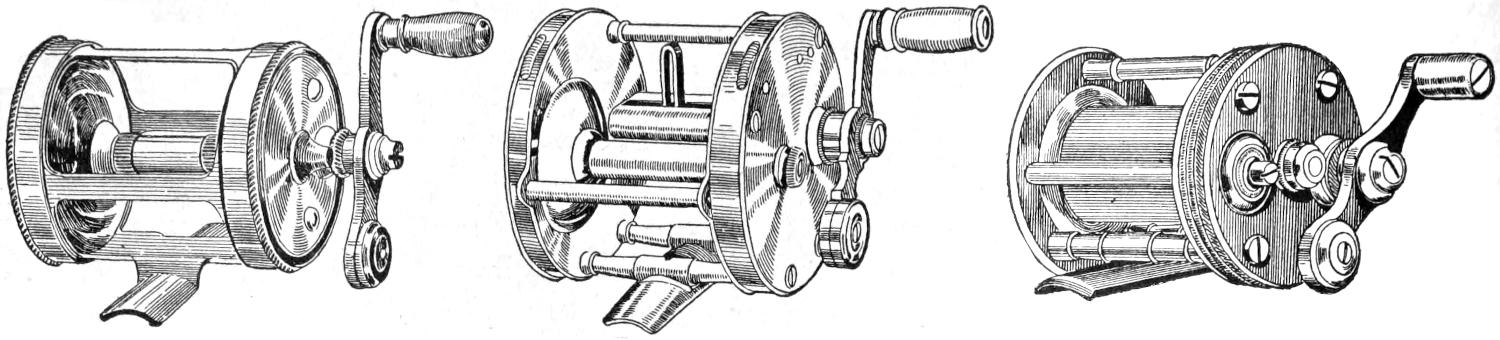
A Serviceable Reel Costing $4, a High-Grade Reel Costing $13.50, and a Fine Tournament Casting Reel Costing $26, are Shown from Left to Right. The Center One Has a Level-Winding Device and a Thumb-Click Drag on the Rims of the Plates. The Tournament Casting Reel Has a Cork Arbor and Jeweled Bearings
The steel casting rod is well liked by some casters, but only a high-quality steel rod is worthy of consideration. It is generally not classed as the equal of a well-made solid-wood or split-bamboo rod, for casting. The better-grade steel rod is springy and flexible, and for this reason is a good rod for casting for black bass. Still, most anglers have a steel rod in their outfits, but it is not as generally used at tournaments as the time-tried wooden rod.
The guide is an important detail of a casting rod. Inexpensive rods are usually provided with large metal guides, while the better rods are fitted with agate guides, or with agate tip and hand guides. A guide, ¹⁄₂ in. in diameter, at the butt of the rod is large enough and will handle the line smoothly.
The single grip is sometimes preferred by casters, but the additional grip placed above the reel is desirable if much fishing is done. Solid-cork hand grasps are most satisfactory, being less slippery when wet and less tiring to the hand than handles made of other materials. If the lower grip is properly shaped with a forward edge, the forefinger will find a firm grip upon it, and the finger hook will not be needed. However, some anglers prefer to use the hook, and if the rod is not so fitted, a detachable hook may be fastened to it. A reel band that locks securely is desirable, and all the better grades of casting rods are so fitted.
The quadruple reel is the logical choice of the bait caster, the spool turning four times to one turn of the handle. As the work demanded of a bait-casting reel is different and more exacting than that of the click reel used in fly casting, its design is radically different. The best type of click reel is of large spool diameter and narrow between plates, while the typical casting reel is its direct opposite—being long-barreled, with plates of comparatively small diameter. For tournament casting the finest outfit will naturally be selected, but for practical work it is unnecessary to pay $25 for a finely wrought reel. Three typical reels are shown in the illustration. The one at the left holds 80 yd. of line, can be easily taken apart for cleaning, and costs $4. In the center is a level-winding reel with thumb click and adjustable drag placed on the rims of the plates. It holds 60 yd. of line, and costs $13.50. At the right is a very high-grade reel for tournament casting. It has a cork arbor, jeweled bearings holds 60 yd. of line, and costs $26.
Any of the better grades of braided silk are suitable for the bait-casting line. The average price for a dependable line is about $1 for 50 yd. A small size line is best, and sizes G and E are preferred. A brown and green, or other dark-colored, line is preferable for fishing. The black and white, all white and other light-colored, lines are satisfactory for tournament use. After a day’s fishing the line should be unreeled and looped around the back of a chair in loose coils to dry, or loosely wound upon a drying reel.
For practice and tournament casting one of the standard ¹⁄₄ and ¹⁄₂-oz. loaded wooden or metal plugs may be used. The popularity of bait casting from the reel has brought forth a large variety of artificial baits. These wooden and enameled lures are used by anglers because they bring the catches.
The wooden minnows, and other forms of artificial bait, may be roughly classed in three divisions: the surface lures for use on top of the water; the diving and under-water baits; and the weedless varieties, which are usually of the surface type. No bait caster’s outfit is complete unless it includes one bait of each class, and to meet fully the different and varying conditions of weather, season, and water, it is a good plan to select one of each type in light and medium-dark colors. A variety of typical baits are shown in the page plate at A, B, C, etc. Many of the baits are provided with one or more eyes for attaching the line, thus enabling the caster to spin his bait at different depths. All of the wooden-body baits will float, and only dive under the surface when reeled in; the quicker they are retrieved the deeper they spin. While many of these baits have been designed especially to entice the black bass, practically all of them are good for pickerel and general fresh-water casting, particularly the minnow baits.
The other items which complete the bait caster’s outfit are the landing net and tackle box. The net should be well made, with a steel hoop 13 in. or larger in diameter, and should have a handle about 3 ft. long. The folding type of net is the most convenient, and is provided with a separate handle. The tackle box may be of sheet metal or leather, with partitions for holding reels, baits, and the angling “what not.” A convenient and serviceable landing net costs $1 or more, and a tackle box will cost about as much.
Suggestions on Making the Cast
Although much practice is required before the caster can take his place in a tournament, “getting the hang” of handling the short rod and free-running reel comes quickly. As soon as the simple principles are understood, length and accuracy will come only through practice. Bait casting is easier than fly casting and the angler need concern himself only with the length and accuracy of his cast, since delicacy does not enter into this phase of fishing. The coarser sweet-water fish, like black bass and pickerel, are not frightened when the bait hits the water with a splash—indeed, the splash of the bait attracts them.
Two methods of casts are used by bait casters, the overhead and the underhand or side cast. The overhead cast is used largely by the practical angler, as well as by those who take part in tournament contests, because the bait is projected a longer distance and may be more accurately placed. If the novice will thumb the line, as shown in Fig. 1, with thumb bearing directly on the cross rod of the reel with the ball of the thumb resting lightly on the line, one or two trials will show the correct manner of spooling. The line is retrieved as shown in Fig. 2, care being taken to form correct habits from the start. To make the cast, reel in the bait until it is some 6 in. from the tip, release the click or drag, and press the ball of the thumb firmly upon the spooled line. Carry the rod over the shoulder until it is horizontal or nearly so, as in Fig. 3, and then bring it smartly forward, checking it quickly when it reaches an angle of some 45°, as shown in Fig. 4. This projects the bait forward in a straight line. When the rod is brought forward the tension of the thumb on the spool is released so that the spool will revolve freely, but enough pressure must be communicated by the thumb to prevent the reel from spinning faster than the line is unreeled from the spool, otherwise backlash will occur. The use of the whole arm and the weight of the body, combined with the elasticity of the pliant rod, enables the caster to cover a surprisingly long distance after a little practice. A distance of 150 ft. is not difficult to attain, but for fishing, a well-placed cast of 60 or 75 ft. is long enough to reach promising stretches of water.
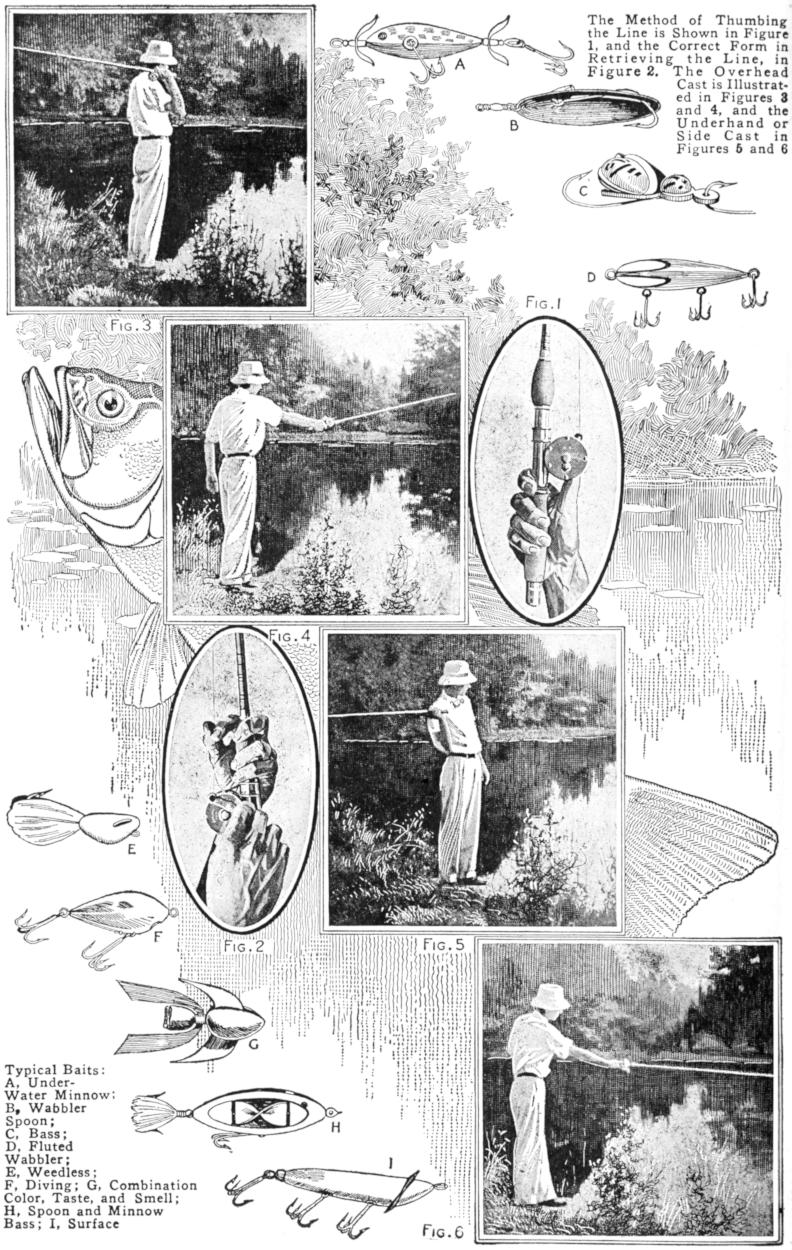
Fig. 3 A The Method of Thumbing the Line is Shown in Figure 1, and the Correct form in Retrieving the Line, in Figure 2. The Overhead Cast is Illustrated in Figures 3 and 4, and the Underhand or Side Cast in Figures 5 and 6
B
C
D
Fig. 4 Fig. 1
E Fig. 2 Fig. 5
F
Typical Baits: A, Under-Water Minnow; B, Wabbler Spoon; C, Bass; D, Fluted Wabbler; E, Weedless; F, Diving; G, Combination Color, Taste, and Smell; H, Spoon and Minnow Bass; I, Surface G Fig. 6
H
I
The underhand or side cast is somewhat easier to master, and is made much in the same way as the overhead cast, only the rod is swung horizontally to the rear, the tip on a level with the angler’s chest, as shown in Fig. 5. Bring the rod forward smartly in the direction it is desired to shoot the bait, check the rod when about horizontal, partly releasing the pressure of the thumb, just enough to allow the spool to revolve freely, and check the line as the bait hits the water. Figure 5 shows the beginning of the side cast and Fig. 6 the cast completed. This cast is useful when fishing from a shore overhung with trees, and with practice the bait may be projected a long distance.
The chief factor of skill in bait casting from the reel lies in controlling the line, and the thumb must be trained to do this through practice. Some casters turn the reel sideways with the handle downward while making the cast, but the majority keep the reel level and cast with it in the same position as when reeling in. Thumbing the line is easiest done when the spool is well filled, and if the casting line is not long enough to do this, sufficient common line should be first wound on to fill it.
The successful bait caster is one who possesses an intimate knowledge of the fish he casts for, and while a lengthy exposition is not to form a part of this article, reference to the fish commonly sought by the caster will not be amiss. The fish generally of interest to the bait caster are small and large-mouth black bass, pike, muskellunge, and pickerel. The small-mouth black bass is classed as the finest game fish, ounce for ounce, by many casters. The muskellunge, often confused with the Great Lakes or English pike, is more limited in range than the pike, being found in the Great Lakes region and the waters of the St. Lawrence River.
Since the habits and general characteristics of the large-mouth bass are much the same as its near relative, the small-mouth, the following hints apply to both. When wading, it is well to cast downstream. Cast in the shallows, near the weeds and snags, and close to stumps. As little noise should be made as possible.
For early-spring casting, bass are likely to be found in the shallows and sheltered places during the day, because the water is cool at this season. The pickerel will also be found in the warmer and shallower waters. The most successful baits at this time are the diving minnows, and other under-water lures. As the warmer days of late spring and early summer appear, the bass swim out into deeper and cooler water, while the pickerel remain close to the lily pads. The wooden minnows are excellent baits to use at this season. When the weeds are very thick, one of the several kinds of weedless baits may be used.
The early-morning and late-afternoon hours are the best for midsummer casting, and the shallow places are the good spots to work over. If there are any brooks or streams emptying into the lake or pond, do not neglect to work this stretch well at the mouth. When the sun is low, the white or light-colored surface baits may be substituted for the medium-dark colored diving varieties, and for casting after dark, a luminous or moonlight bait will often give good results. During the fall months fishing conditions are similar to casting in the spring, but the deep water is then the warmest, and the under-water or diving baits are usually the best.
To catch bass, the angler must cast his bait where the fish are feeding, and he will find it an advantage to match natural conditions, so far as possible, in selecting his baits. For casting on bright days in clear waters, the red, white and red, white, or green minnows are good lures, as are also the silverplated spoon baits. Cast well ahead of the boat, and reel in very slowly to keep the plug spinning well below the surface. On cloudy days and in muddy waters, after a heavy rain, for example, use red and yellow baits and goldplated or burnished-copper spoons. The best all-around bait—equally good for bass and pickerel—is one of the green-backed minnows, but no one bait can be expected to meet all conditions, hence the caster should have a fair assortment of baits.
A stiff casting rod with plenty of backbone is essential for muskellunge. The angler is out after big game and must be prepared for the sport. A hard, braided silk line, size E, and 3-0 or 4-0 hooks, snelled and swiveled, are the best. Any of the wooden baits suitable for pickerel—the minnows especially—are good for muskellunge. A man to handle the oars is a handy companion, and after casting the bait just outside the weed bed, make for deep water as soon as a fish is hooked. The fish will be seen and felt quickly enough, and when it breaks water and leaps in the air, give it a little slack line quickly, otherwise the strain will snap the leader. A twisted, bronzed trace is the best to use between line and bait, and this need not be longer than a foot—6 in. is enough. When the fish is brought alongside, shoot him through the head with a revolver which is probably the most satisfactory manner of making an easy landing.