Book 3 — Photographic-Print Washing Machine By HARRY MARCELLE
Reading edition
Many amateur photographers have occasion to make a considerable number of prints and find the washing of them tedious, by the ordinary methods. In order to overcome this difficulty the print-washing machine shown in the sketch was made. It is simple in construction and performs the work quite satisfactorily at a saving of not a little time. Since the water in which the prints are washed must be agitated, a pivoted tray is provided. A unique feature is the water wheel through which the water supply passes, at the same time developing power to operate the rocker arm, by means of which the tray is agitated.
The frame for the large trough, which contains the tray and other apparatus, is made of 2 by 4-in. uprights, braced with 2 by 2-in. pieces. The trough is made of ⁷⁄₈-in. stock, joined at the ends with a water-tight grooved, or dado, joint. The top is fitted to form a cover and may be hinged or arranged as a lid, supported and held in place by cleats, fixed on its under side with screws. The trough and its fittings may be made of a size suited to individual requirements. The device illustrated is 4 ft. long, and has a trough 18 in. wide and 13 in. high. The interior of the trough is given a coat of tar to make it waterproof, and the exterior may be painted thoroughly to preserve the wood.
The rocking tray, in which the prints are placed, is made of ⁵⁄₈-in. stock. It is 5 in. high, 15 in. wide, and 28 in. long. Splash boards are fixed at its ends, as shown, and the bottom is made of muslin, reinforced with wooden strips, ¹⁄₂ in. wide. The tray is supported on a rod or pipe at its center, the ends of the support being set into the sides of the trough. A crank arm of wood or metal is attached to the center of one end of the tray, and operates through an opening in the top of the trough. The crank arm engages a crank fixed to the shaft of the water wheel, as shown in the sketch. The crank must be made not longer than 2 in., or the resulting action on the tray will pour out too much water, the prints being thus in danger of damage.
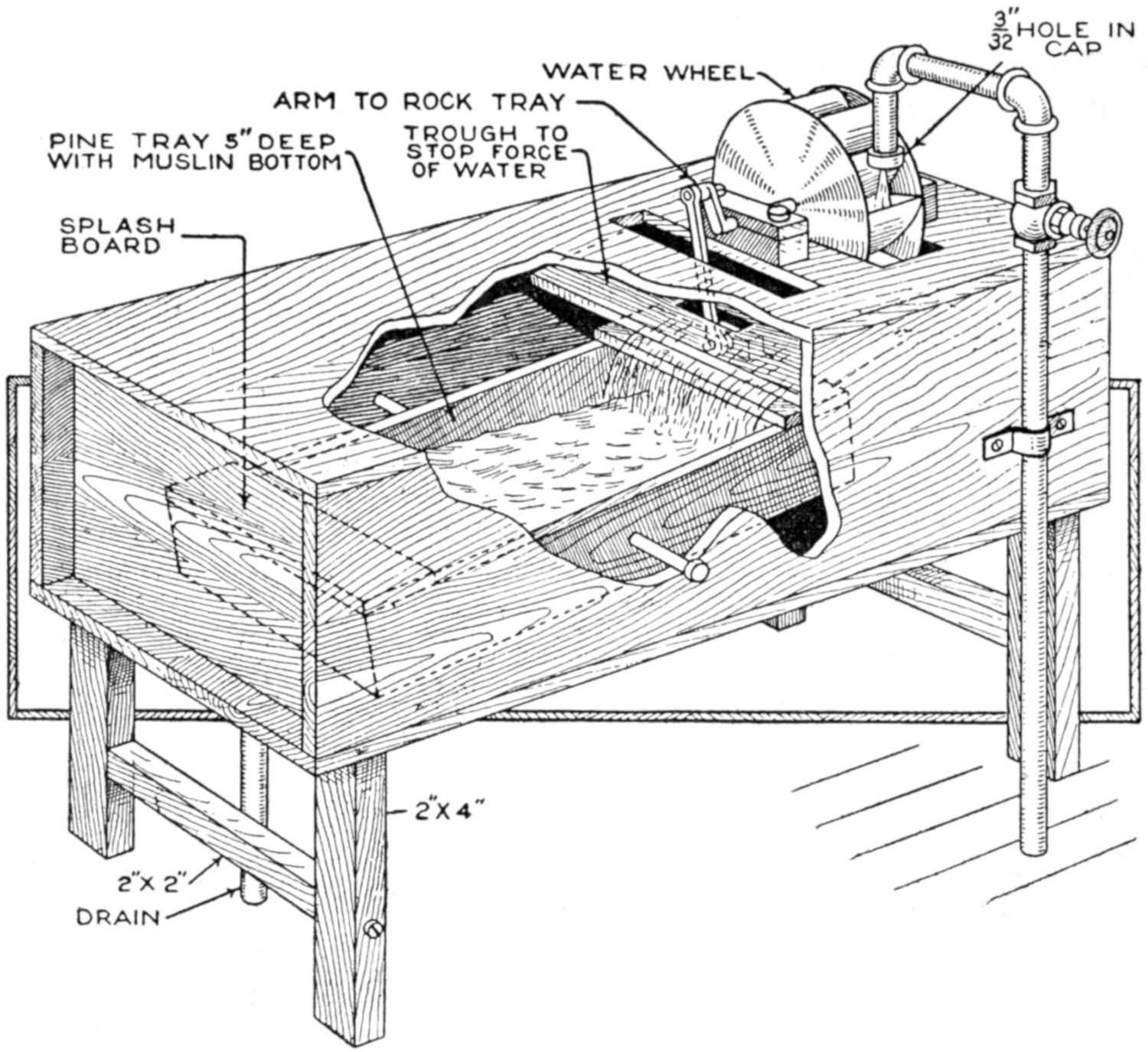
The Spray Forced from the Pipe Gives Power to the Water Wheel, Which in Turn is Transferred to the Rocker Arm Attached to the Tray
The water wheel is made of two round disks of sheet metal, 9 in. in diameter. Strips of wood are fitted between them so that the wheel is 3 in. wide on the face. Wooden blocks, grooved to fit the shaft of the water wheel, are used as bearings. They are fixed to the top with bolts. The water supply is provided through a pipe at one end. A cap is fitted over the end of the extension on the pipe and a small hole drilled through it. This forces the water against the blades of the water wheel rather than permitting it to drop under normal pressure. The flow of water is regulated by the valve on the supply pipe, and the excess water is drained off at the opposite end of the trough. The force of the water, as it leaves the water wheel, is lessened, and the water carried gently to the tray, by means of a board set between the top and the tray, at the wheel end of the trough.