Book 3 — Homemade Relay of Inexpensive Materials
Reading edition
A practical relay was made of odds and ends gathered in the workshop. The base is of wood, ³⁄₄ by 3 by 6 in. The magnets A are made of two wire nails driven into the base, the heads projecting 1¹⁄₂ in. They are wound with six layers of fine insulated No. 25 gauge wire, as shown in the small sketch. The ends of these magnet wires are carried to the two binding posts B and C, taken from dry-cell carbons.
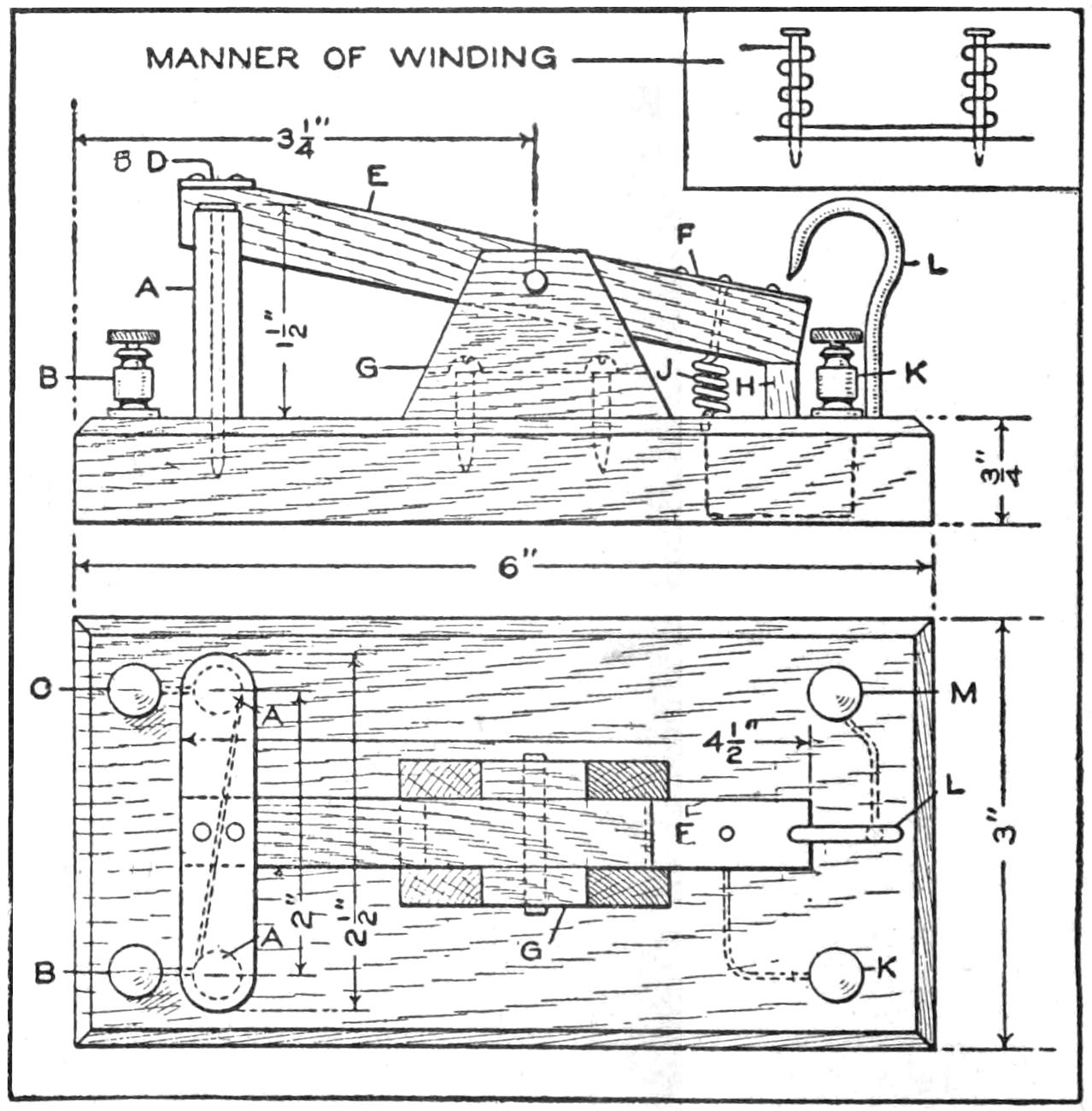
Nails, a Screw Hook, and Similar Common Materials, were Used in Making This Relay
The armature D is a piece of soft iron, ¹⁄₂ by 2¹⁄₂ in., screwed to the armature lever E, which is a ¹⁄₂ by 4¹⁄₂-in. piece of wood. A piece of tin is tacked to the opposite end F, and a ¹⁄₈-in. hole is bored through the lever, 2¹⁄₂ in. from the front end. Nail a wooden block, G, to the base, slotted to accommodate the lever, so that when the latter is pivoted in the slot, the armature will lie directly over the magnet heads. Fit a wooden stop, H, under the end of the lever, so that the armature is held ¹⁄₈ in. above the magnets, by a brass spring, J, connected to the tin, F, and the binding post, K, with copper wire. Arrange the brass hook, L, so it comes in contact with F when the armature bears down upon the magnets. Connect this hook to the binding post, M. When current flows through the magnets, the armature is pulled down and the contact of the hook, L, with the tin, F, completes a secondary circuit.—L. R. Hardins, Harwich, Mass.
¶A nutcracker may be used as a substitute for a pipe wrench or pliers, and its toothed handles grip round objects quite firmly.