Book 3 — How to Make Combined Kites By C. M. MILLER PART I—A Dragon Kite
Reading edition
Dragon kites are made as hideous as the maker can possibly conceive, and while the one to be considered is no beauty, it is more droll than fierce-looking. In general appearance the dragon and centipede kites are like huge caterpillars floating about in the air. The kite sometimes twists and the balancer sticks appear to be large hairy spines. Usually the tail end swings higher than the head. It is like so many single kites, pulls hard, and requires a strong cord for the line. The individual circular sections may number 20, and if placed 30 in. apart, would make a kite about 50 ft. in length, or the number of sections may be more or less to make it longer or shorter. The kite will fold up into a very small space, for carrying about or for storage, but care should be taken in folding not to entangle the harness.
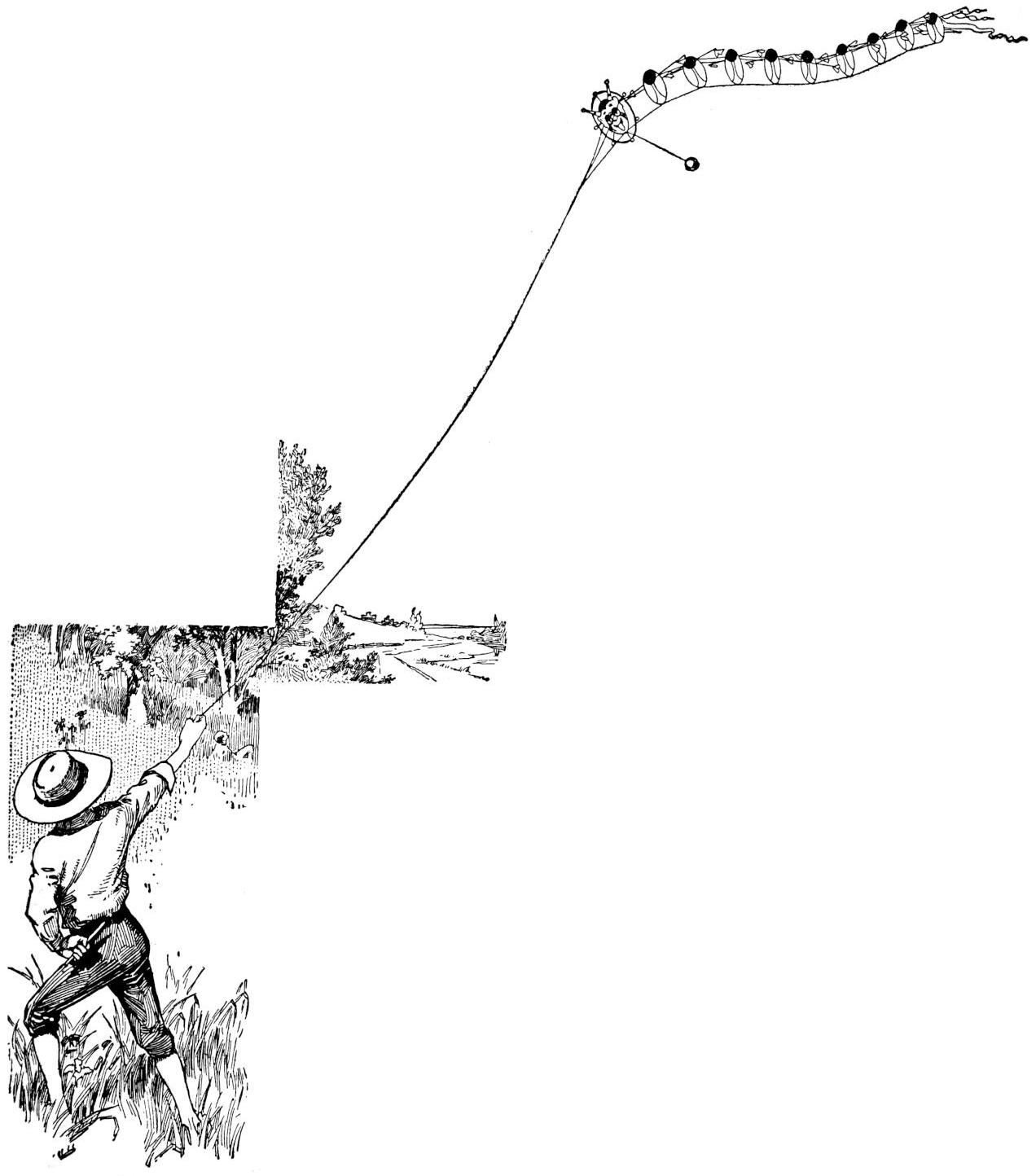
In General Appearance the Dragon Kite Is Like a Huge Caterpillar Floating About in the Air
The Head
The head requires much more work than any of the other sections. There are two principal rings to this section, as shown in Fig. 1. The inner ring is the more important, the outer one being added for the protection of the points when alighting. The construction of the framework is shown in Fig. 2. It is made entirely of bamboo. The bamboo is split into strips, about ³⁄₁₆ in. wide, for the ring A. As the bamboo strips will be much too thick, they must be pared down to less than ¹⁄₁₆ in. The diameter of the ring A is 12 in., and a strip of bamboo to make this ring should be about 38 in. long, so that there will be some end for making a lap joint. The ends of the strip are held securely together by winding them with linen thread. The Chinese boys use strips of rice paper, about ¹⁄₂ in. wide and torn lengthwise of the paper. The rice-paper strips are made wet with paste before winding them on the joint, and when they dry out the shrinkage will bind the ends securely.
Two crosspieces, of the same weight as the ring stick, are placed 3¹⁄₂ in. apart, at equal distances from the center and parallel, as shown at B and C. The ends of these pieces are turned at a sharp angle and lashed to the inside surface of the ring A. To make these bends, heat the bamboo over a candle flame until it will give under pressure, then bend and it will stay in shape after it becomes cold. This method of bending should be remembered, as it is useful in making all kinds of kites. Two small rings, each 3¹⁄₂ in. in diameter, are put in between the two parallel pieces, as shown at D and E. These are for the eyes of the dragon. The rings are lashed to the two crosspieces B and C. As the eyes revolve in the rings they should be made perfectly true. This can be done by shaping the bamboo about a perfectly round cylinder, 3¹⁄₂ in. in diameter. To stiffen the whole framework, two pieces of bamboo, ¹⁄₁₆ in. thick, ¹⁄₈ in. wide, and 20 in. long, are lashed to the back as shown by F and G. There is a space of 3 in. between the inner ring A and the outer ring H, giving the latter a diameter of 18 in. It is made of a bamboo strip, ¹⁄₈ in. wide, and should be less than ¹⁄₁₆ in. thick. It may be necessary to make this large ring from two pieces of bamboo, to get the length, and in such case be careful to make a perfect ring with the ends well lashed together. Two short pieces are lashed to the two rings, as shown at J and K. The supports for the horns consist of two pieces, ¹⁄₈ in. wide and less than ¹⁄₁₆ in. thick, and they are lashed to the upper crosspiece and to both rings, so that the parts L and M are exactly halfway between the ends of the pieces F and G and radiate out from the center of the ring A, the other parts, N and O, pointing to the center of the eye rings, respectively. The ears are unimportant and may be put on if desired. The rings on the horns and the stick ends may be from ¹⁄₂ to 2 in. in diameter, cut from stiff paper, but if larger, made of bamboo.
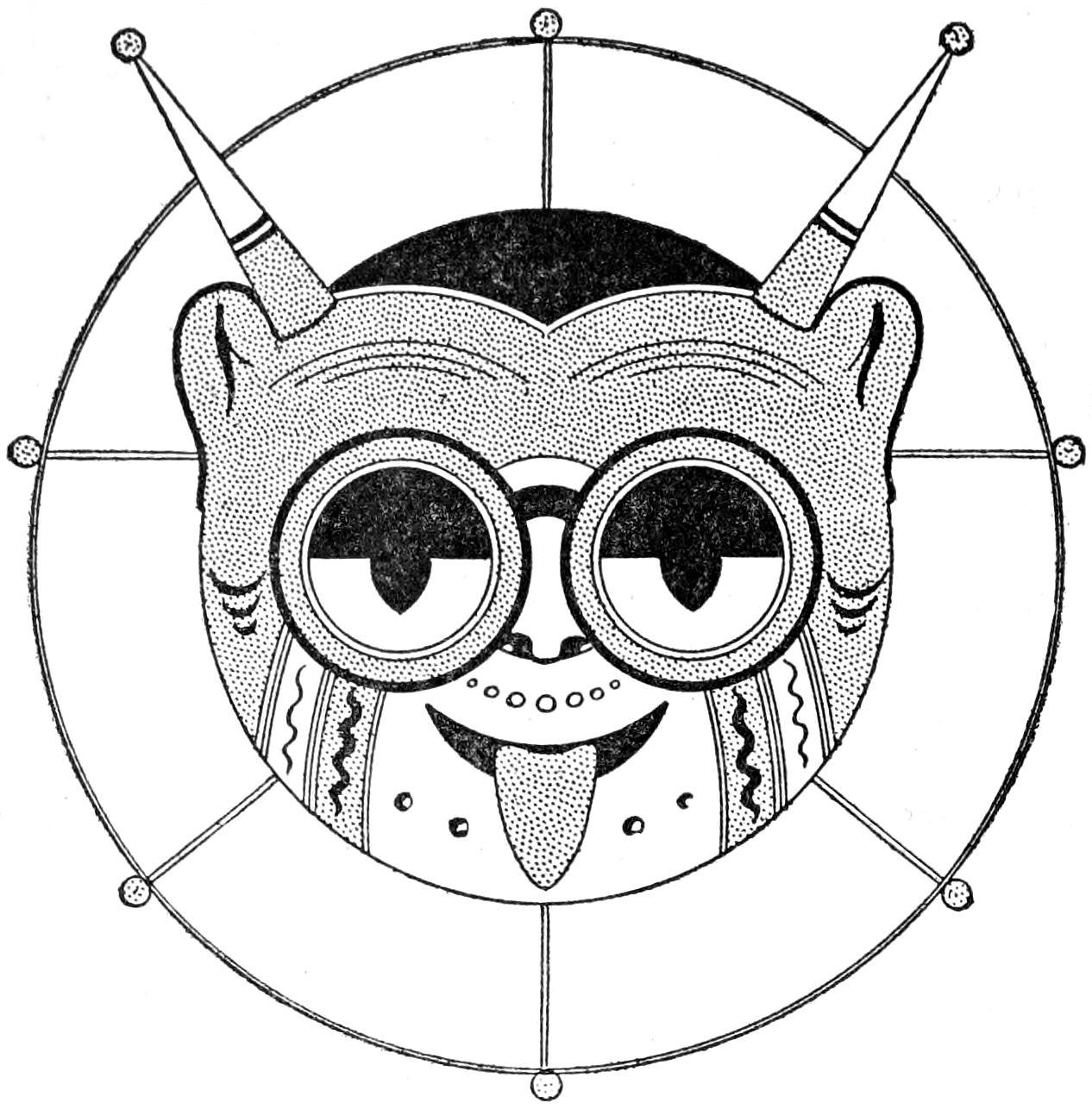
Fig. 1 The Kite-Head Section, Having Horns, Ears, and Revolving Eyes, Is Very Hideous
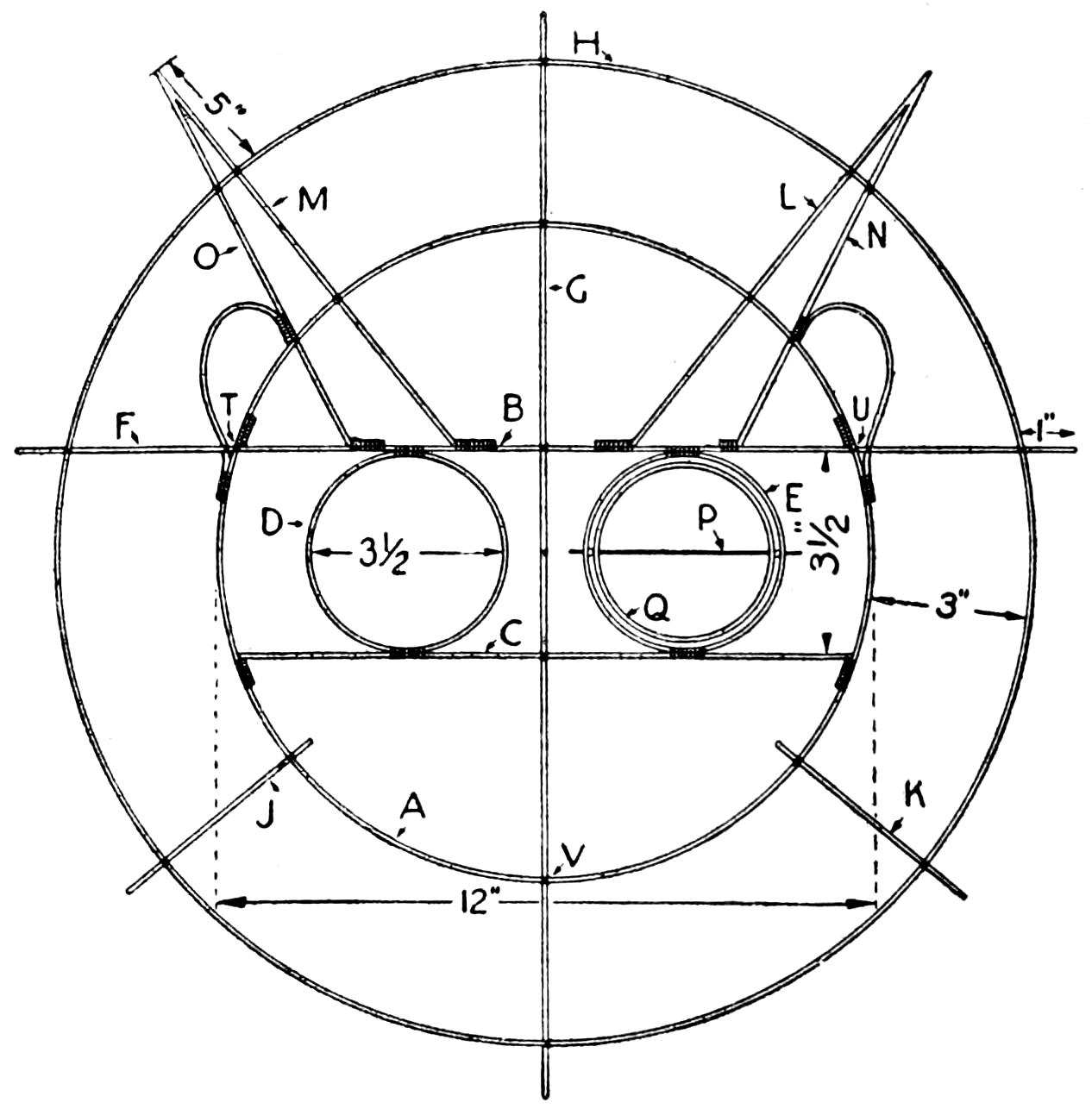
Fig. 2 The Framework for the Head Section is Made Entirely of Bamboo Strips Lashed at the Joints
Chinese rice paper is the best material for covering, and it should be stretched tightly so that there will be no buckling or bagging places. The only part covered is that inside of the inner ring A, the horns, and the ears, leaving the eye rings open. The shades are put on with a brush and water colors, leaving the face white, or it can be tinted in brilliant colors. Leave the horns white and color the tongue red.
The Eyes
The frame for each eye is made of bamboo, pared down to ¹⁄₃₂ in. in thickness and formed into a perfect ring, 3¹⁄₄ in. in diameter. Each ring revolves on an axle made of wire passed through the bamboo exactly on the diameter, as shown at P, Fig. 3. The wire should be long enough to pass through the socket ring D or E, Fig. 2, also, and after the eye ring is in place in the socket ring and the axle adjusted, the latter is fastened to the eye ring with a strip of paper wrapped tightly around the wire and pasted to the bamboo of the ring. A glass bead, placed on the wire axle between the socket rings D or E and the eye ring Q on each side, keeps them apart and the revolving one from striking the other.
Each side of the eye ring is covered halfway with rice paper, as shown in Fig. 4. The part R is on the upper front half, and that shown by S is on the back lower half. Placing the two halves in this manner causes an unequal pressure of the wind on the whole eyepiece, and thus causes it to revolve on the axle. The front upper half of the eyepiece is made black, and the smaller dark portion extending below the darkened half is a round piece of paper placed just between the two halves so that half of it will show on both front and back of the eyepiece. When the eyepiece is given a half turn in its socket the back side will come to the front and will appear just the same as the other side. Some kite builders add pieces of mirror glass to the eyes, to reflect the light and cause flashes as the eyes revolve in their sockets.
A Section Kite
The ring for the section kite is made the same size as the inner ring of the head kite, or in this case 12 in. in diameter. The bamboo for making this ring should be ¹⁄₈ in. wide and ¹⁄₁₆ in. thick. The balancer stick, 36 in. long, is located about the same place as the cross-stick F, as shown in Fig. 2, and must be made small, light and well balanced. Small tufts of tissue paper, or feathers, are attached to the tip ends of the balancer sticks, as shown in Fig. 5. The cover for the section kite is put on tightly, the same as for the head, the colors indicated in the sketch being only suggestions, as the builder can color them as desired. The balancer on the last section should have streamers, as shown in Fig. 6, for a finish. The streamers are made of light cloth.
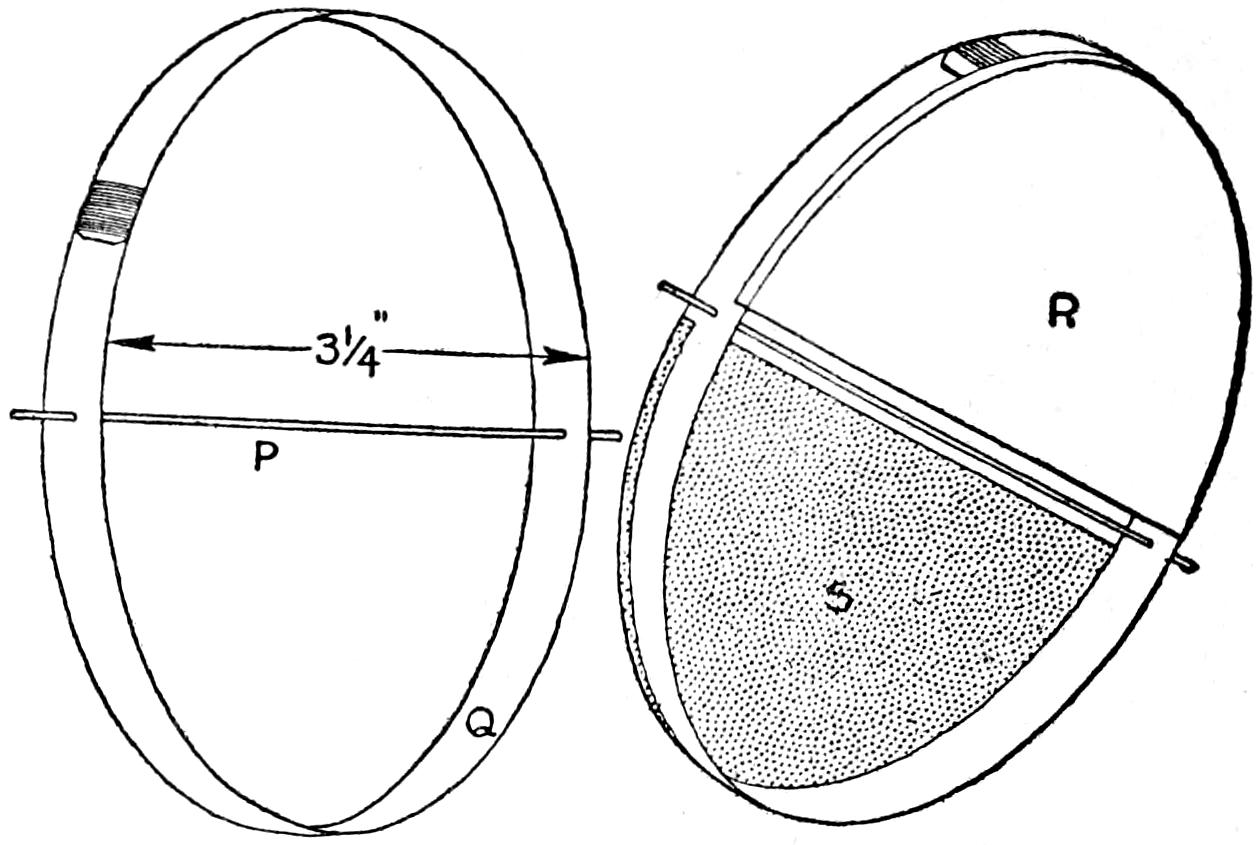
Fig. 3
Fig. 4
Two Bamboo Rings with Paper Coverings, to Make Them Turn in the Wind, Constitute the Eyes
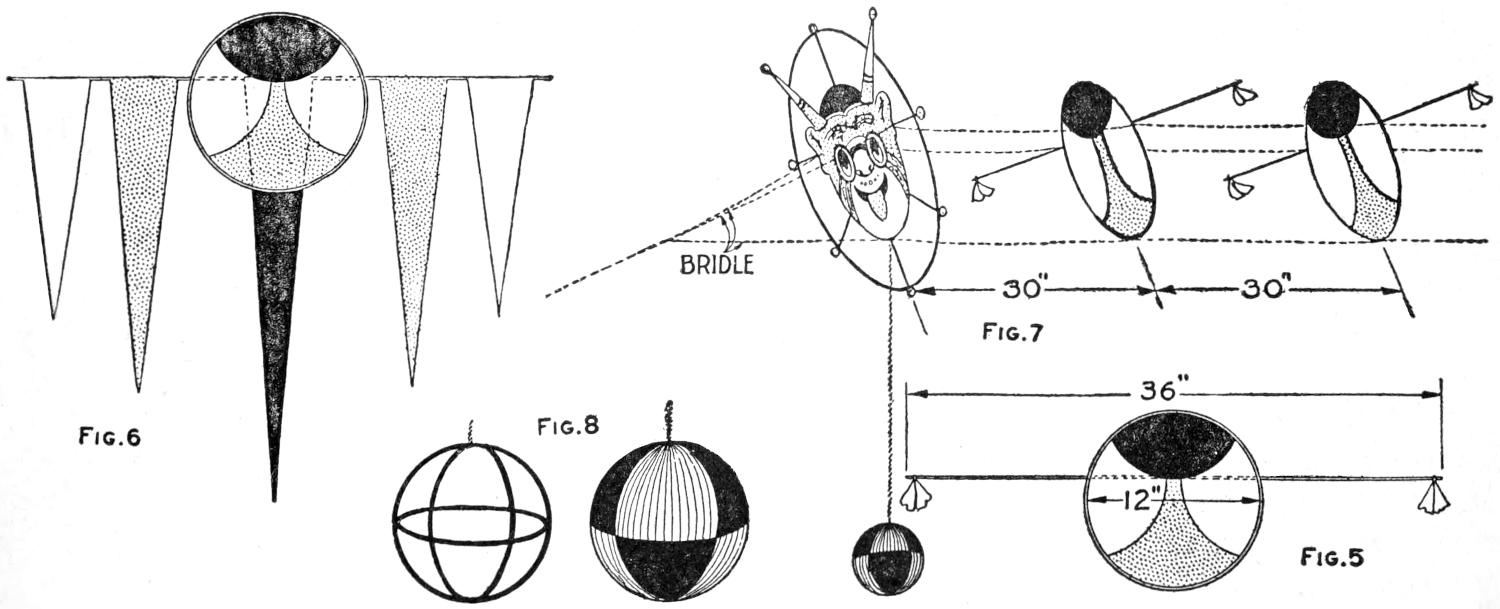
Fig. 6 Fig. 7
Fig. 8 Fig. 5
The Section Kites Have Balancers and the Disks are Given Bright Colors So That They will Produce the Effect of a Great Dragon When in the Air, the Head Piece Having a Ball Balancer Hanging from the Under Edge
The Harness
As previously stated, 20, more or less, sections can be used, and the number means so many separate kites which are joined together with three long cords, spacing the sections 30 in. apart. The cords should be as long as the kite from the head to the tail, allowing sufficient extra length for the knots. As such a kite will make a hard pull, the cord used should be a six-ply, hard-twisted seine twine. Start by tying the three long cords to the head kite at the points T, U, and V, Fig. 2. Tie the next section at corresponding places just 30 in. from the head kite. The construction will be much easier if the head kite is fastened to a wall so that each cord may be drawn out to its proper length. Continue the tying until all sections are attached just 30 in. apart. Other spacing can be used, but the distance selected must be uniform throughout the length of the kite. The individual kites, or sections, may vary in size, or they can all be 9 in. in diameter, instead of 12 in., and the balancer sticks 30 in. long instead of 36 in., but a kite of uniform sections is much better and is easier to make. The positions of the sections as they will appear in the kite are shown in Fig. 7.
The Bridle
The Chinese bridle is usually made of three strings, which are attached to the same points on the head kite as the harness cords, or at T, U, and V. The lower string is longer than the two upper ones so that the proper inclination will be presented to the breeze. As the head is inclined, all the section kites will also be inclined. Some makers prefer a balancer on the head kite, and in one instance such a balancer was made in the shape of a ball. A ball made of bamboo strips is shown in Fig. 8, and is attached as shown in Fig. 7.
Flying the Kite
It will be necessary to have a helper, and perhaps two, in starting the kite up, as the harness might become entangled. Quite a little run will be necessary, but when up the kite will make a steady flier and will pull very hard. If the first attempt is unsuccessful, try readjustment of the bridle or a little different position in the breeze, and see that the balancers are not tangled. Quite a number of changes may be worked out on these plans, but it is necessary to bear in mind that the distances between sections must be equal and that the general construction must be maintained.