Book 3 — A Simple Self-Contained Motor
Reading edition
To say that the subject of this article is the simplest motor in the world is not to overestimate it, for the apparatus is not only a motor reduced to its essential elements, but combines within itself its own source of electric power, all without the use of a single piece of wire. The experiment is very interesting and instructive and will well repay a careful construction along the lines indicated, even though not in strict accordance with the dimensions given.
The first step is to procure a permanent magnet, about ³⁄₈ in. in diameter and 6 in. long. If such a magnet cannot be conveniently secured, a piece of tool steel with flat ends should be hardened by heating it to a dull red and plunging it in water, and then strongly magnetized. This may be readily accomplished by slipping a coil of insulated wire over it through which the current from a storage battery or set of primary cells is passed. If these are not at hand, almost any electrical supply store will magnetize the steel.
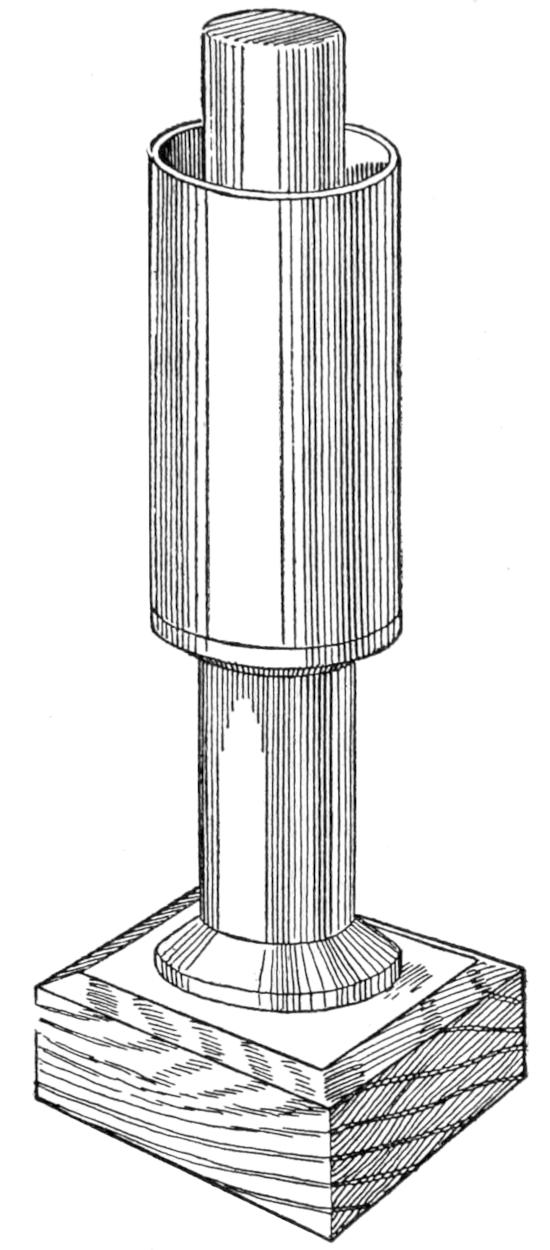
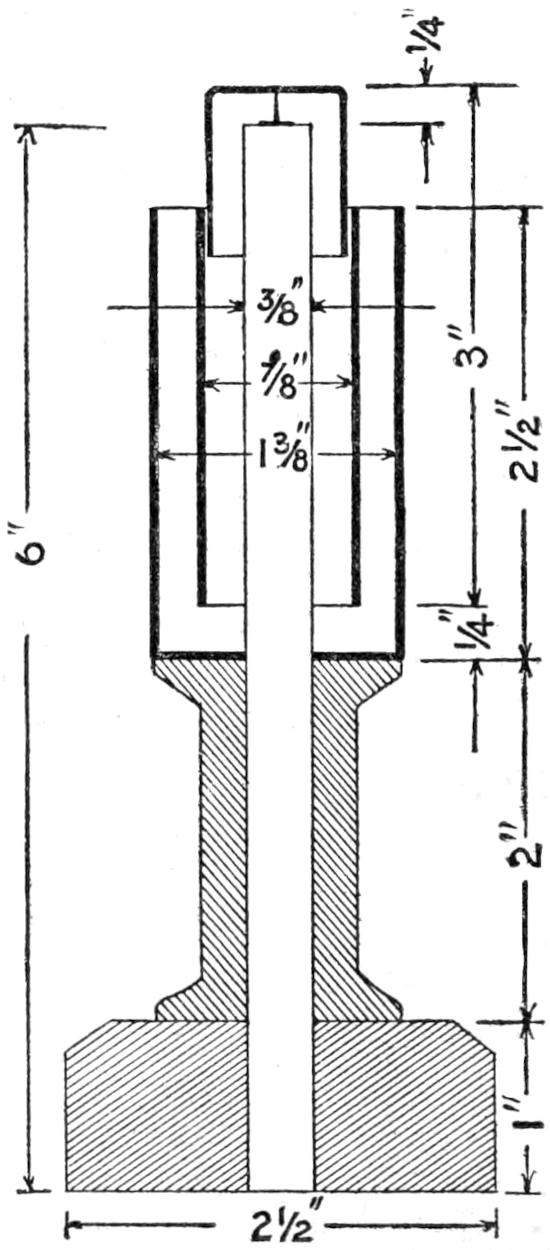
A square base block with neatly beveled corners is now in order, which is trimmed up squarely and a hole bored centrally through it to receive the lower end of the magnet. Procure a neat spool and make a hole in it large enough to pass over the magnet. Glue the spool to the base after locating it in the exact center.
The outer and larger cylinder is of copper, or of brass, copperplated on the inside. It is cup-shaped, with a hole in the bottom just large enough to permit the magnet to be pushed through with a close fit, to make a good electrical contact. The magnet may be held in place by having it closely fit the spool and the copper cylinder, and by soldering the heads of a couple of small tacks, or nails, to its under side and driving them into the spool. Coat the magnet with pitch, or paraffin, from the top down, and around its connection with the bottom of the cylinder. The small thimble shown at the top should be of brass or copper, and while one can be easily formed of sheet metal and soldered, it is not improbable that one could be made in seamless form from small article of commerce. In the exact center of the under side of the top of this thimble, make a good mark with a prickpunch, after which a small steel thumb tack should be filed to a fine needle point and placed, point up, exactly central on the upper end of the magnet, to which it is held with a little wax. The smaller cylinder is simply a piece of sheet zinc bent into a true cylinder of such a size that it may be sprung over the lower end of the thimble. This done, it is only necessary to slip the zinc over the end of the magnet until the thimble rests on the thumb tack, and then pour some dilute muriatic or sulphuric acid into the outer cylinder after which the thimble and attached zinc will begin to rotate. The required strength of the acid and the resulting speed will depend upon the nicety of suspension and the trueness of the rotating zinc cylinder. The zinc will have to be changed, but the copper undergoes no deterioration.