Book 3 — A Photographic Printing Machine By L. B. ROBBINS
Reading edition
A printing machine for “gaslight” papers, to be used in localities not equipped with gas or electricity and where printing is to be done after daylight, is shown in the sketch. The measurements given are only approximate, as conditions will determine its size. That shown is made as follows: First procure a 6¹⁄₂ by 8¹⁄₂-in. or 8 by 10-in. printing frame. Remove the brass clips from the pad and fasten one end of the pad to the frame, by a pair of small hinges, with the glass in the frame. Procure a box, about 12 by 15 in., by 8 in. deep, with one side open. Cut a rectangular opening through the 12 by 15-in. side a bit smaller than the printing frame, and secure the frame in place over the opening with screws. Saw a slot ³⁄₄ in. wide through the top of the box—the end nearest the hinged end of the printing frame pad—running it the full width and about 3 in. from the front.
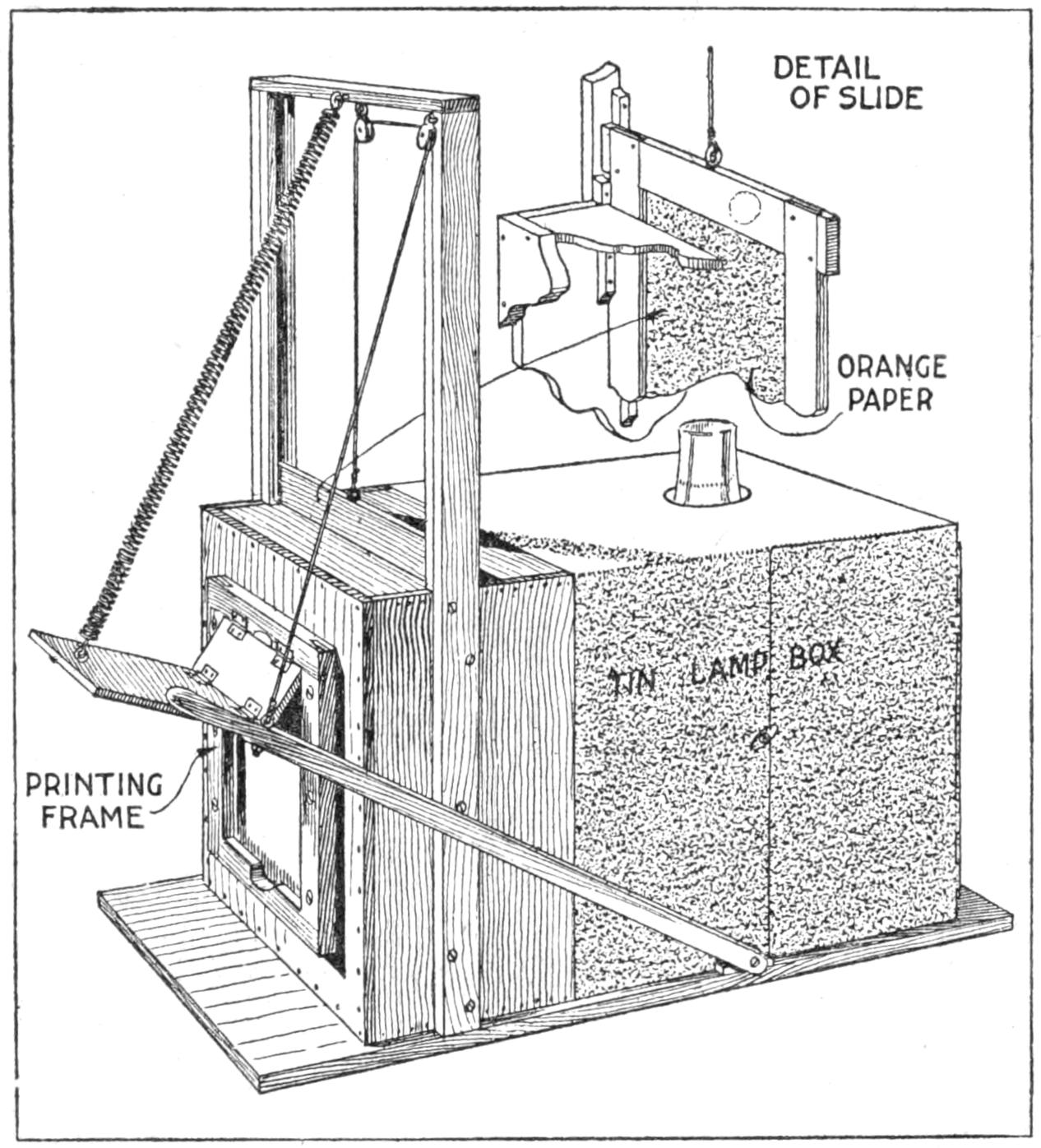
Photographic Printing may be Done Rapidly by the Systematic Use of This Machine
Nail cleats along the inside of each side of the box, placing them vertical and parallel, and about ³⁄₄ in. apart, so as to form a slide groove in conjunction with the slot. This groove is to receive a frame or curtain constructed of stock, 2 in. wide and ¹⁄₂ in. thick. The outside dimensions of the curtain are a trifle smaller than the inside measurements of the box itself. Cover the frame with orange paper, and when finished insert it through the slot in the top of the box. Build a frame as indicated, on the outside of the box. Along the inside of the uprights fasten cleats, thick enough to come flush with the ends of the slot. These serve to steady the curtain when raised. Make a suitable baseboard and secure the box to it. Then with sheet tin construct a lamp house extending from the back of the box and of sufficient size to accommodate a round-wick lamp. Leave an opening in the top to admit the chimney, provide holes for ventilation, and a door by which the lamp may be adjusted. When completed, paint the interior of the box and lamp house white, to intensify the printing quality of the light. Tie a piece of stout cord to a screw eye inserted in the upper end of the sliding curtain, lead it through two pulleys fastened as shown, and down to the hand lever. The latter is pivoted at the rear end by a bolt. Attach a spring to the lower end of the hinged pad on the printing frame. This holds the pad out of the way when not in use. A curtain-roller spring is suitable for this purpose.
To operate the machine, place the negative and paper in position, and, with the left hand, bring the pad down. Pull down the hand lever with the right hand, raising the orange curtain. When the required exposure is made, release the lever, shutting off the direct light. While nearly all light is shut out by means of the lamp house, the paper may be handled safely and easily by means of that admitted through the orange curtain. By systematic arrangement and handling of materials, it is surprising what an amount of work can be turned out by the aid of this machine, especially if one person attends to the exposing and another to the developing.