Book 3 — Camera for Taking Pictures from a Kite By CHARLES I. REID
Reading edition
When watching a kite flying at a considerable height one frequently wonders how the landscape appears from such a viewpoint as would be possible from a kite. Few of us can have the experience of a ride in an aeroplane, but it is quite possible to obtain a view from the kite, by proxy as it were, through the use of a kite camera. A kite of large dimensions would be necessary to carry an ordinary camera taking pictures of fair size, hence it is necessary to devise one of lighter construction, so that a kite of moderate size may carry it to a height of several hundred feet. Such a camera is shown in the illustration attached to a box kite. Details of construction are shown in the smaller sketches.
A camera consists, briefly, of a light-proof box, with a lens at one end and a sensitive plate or film at the other. For a kite camera, a single achromatic lens will suit the purpose. Such a lens is not expensive and may be taken from a small camera. It must be obtained before the camera is begun, since the size of the latter is dependent upon the focal length of the lens and the size of the picture to be made. A camera taking pictures 2 in. square is satisfactory for kite photography, and if it is desired to enlarge the pictures, this may be done in the usual manner.
The box of the camera is made cone-shaped in order to reduce the weight and air resistance. Its sides are of light-weight, stiff cardboard, reinforced at the corners to insure that no light will enter. The back of the camera is a tight-fitting cover of cardboard, having the same measurements as the picture to be taken. The lens is fitted to an intermediate partition, as shown in the sketch. It is necessary to determine the focal length of the lens and to set it at a distance from the inner side of the cardboard back of the camera—the film surface—so that it will focus properly for photographing distant objects.
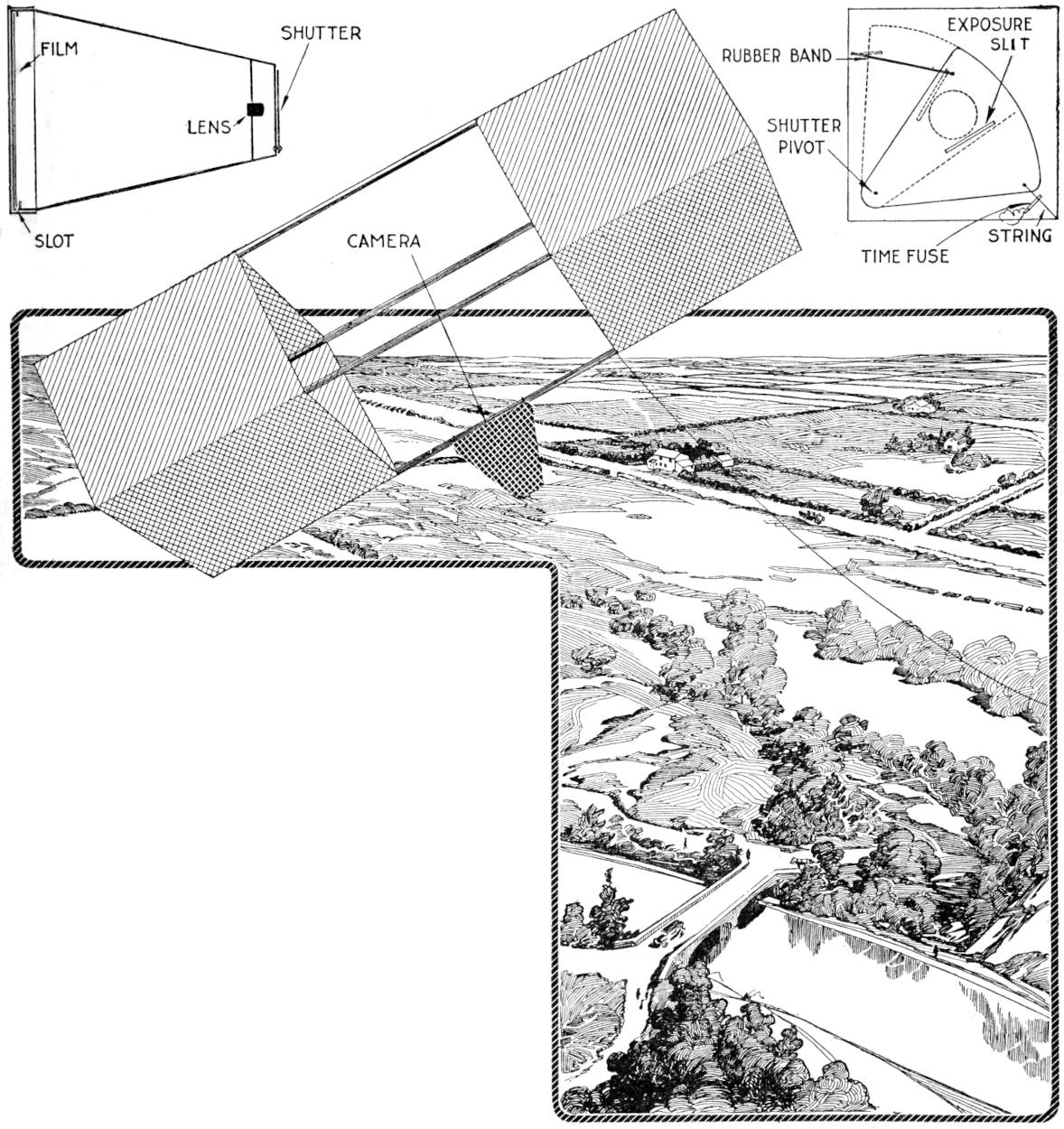
The Kite Camera Offers a Diversion in Photography, and Has Practical and Commercial Uses as Well. The Camera Shown Is of Light Weight, Simple Construction, and Produces Film Exposures Two Inches Square. A Sectional View of Its Construction is Given at the Left, and the Details of the Shutter Device at the Right
The front is provided with a circular opening of a size large enough not to obstruct the view of the lens. A shutter made of thin pressboard is fitted over the opening, as shown in the sketch at the right. A slit is cut in the shutter through which light is admitted in making the exposure as the shutter is drawn back. The size and width of the slit regulates the exposure, and a few trials must be made to determine the most suitable speed of exposure for the lens used. The shutter is pivoted at its lower end and drawn back by a rubber band. A string, to which a time fuse is attached, controls the releasing of the shutter to make the exposure. The string holds the shutter closed against the pull of the rubber band until the fuse burns up to the string, severing it. The fuse must be long enough to enable the kite to attain a suitable height before the string is burned. When the shutter has been set, and the fuse attached ready for lighting, the camera may be taken into the dark room for loading. A piece of film, cut to the proper size, is placed carefully into the light-proof sliding cover, as with a film pack, the sensitive side, of course, being placed nearest the lens.
The camera is attached to the kite securely at the middle, as shown, so that when the kite is in flight a view nearly straight down will be obtained. When all is in readiness the fuse is lighted and the kite started on its flight. By timing experimental flights, the required length of fuse may be determined in order to permit the kite to attain the desired height at the time of exposure.
The kite used for taking pictures from the air should be large enough to carry the kite easily. One of the box type illustrated is satisfactory, although other types may be used. A kite camera for the amateur has great possibilities for experimentation, but requires care in construction and a reasonable knowledge of photography. To the person willing to master the details, kite photography offers a pleasurable diversion as well as practical uses in photographing plots of ground, groups of buildings, manufacturing plants, and other subjects which cannot be photographed by other methods.