Book 3 — Locking Window Sash
Reading edition
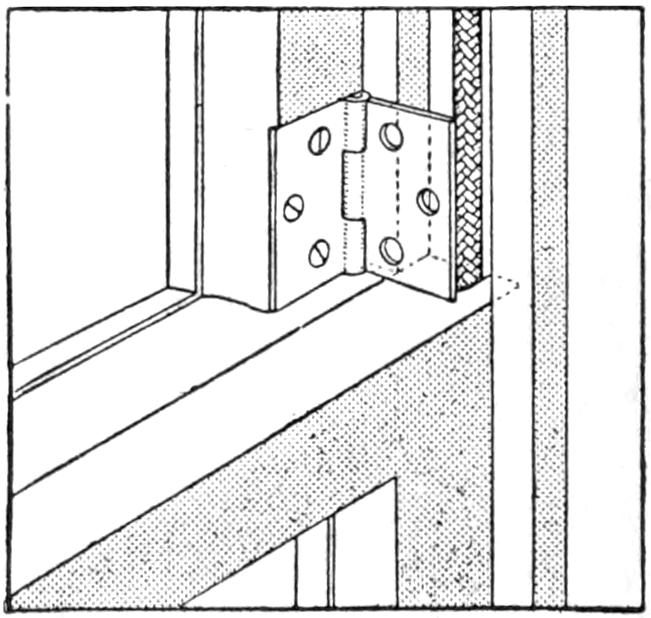
An excellent lock for window sash is to use two small, but strong, hinges one fastened on each side of the top sash close to the upper edge of the lower sash. This allows one wing of each hinge to swing freely which permits it to be swung over the upper edge of the lower sash, locking both securely. In placing the hinges in this position, they are out of sight and not in the way.
THE SHOTGUN AND HOW TO USE IT By Stillman Taylor PART II—The Choke and Pattern of a Gun
Having picked out a gun that “fits the man,” the matter of choke and pattern should be considered. For trap shooting and for wild fowling, the full-choke gun may be considered a necessity, since it will throw the charge of shot within a relatively small circle; in other words, make a denser pattern. Chokeboring is accomplished by constricting the barrel at the muzzle from ¹⁄₂₅ to ¹⁄₅₀ in., the amount of taper depending on the size of the bore and gauge. The narrowing of the muzzle forces the charge of shot together and prevents the pellets from scattering over a wide area. Guns are bored with varying degrees of choke, from the full to the plain cylinder, and the manufacturers compare them by recording the number of pellets which any given choke will shoot in a 30-in. circle at 30 yd., or any other range selected as the maximum distance. This gives the pattern from which we find that the full choke produces 70 per cent, the half choke 60 per cent, the quarter choke 50 per cent, and the cylinder 30 per cent.
For trap shooting and wild fowling the expert considers it essential that his 12-gauge should be capable of throwing not less than 300 pellets; hence he selects a full-choked gun with a pattern of 300 or better. As a full-choked 16-gauge will pattern about 275, it may be used for ducks with good success. For a general-purpose gun, a pattern from 250 to 275 will prove quite satisfactory for ducks and upland game, and this may be had by picking out a half-choked 12-gauge, or selecting a full-choked 16-gauge. The 20-gauge gives a pattern of about 245 shot, and thus scatters its charge over too large a circle to prove effective on wild fowl, although it is very effective on upland game, which is flushed not over 35 yd. from the shooter. A gun patterning from 225 to 250 may be considered the ideal upland gun, and this may be had by choosing a quarter-choked 12-gauge, a half-choked 16-gauge, or a full-choked 20-gauge gun. These are known as “open-choked” guns, are the most effective at short ranges, up to 35 yd., and cannot be depended upon to kill clean when used at longer ranges.
Shooting with Both Eyes Open
To handle the weapon well is the desire of every sportsman, and this knack is not difficult to attain, providing the novice will make a good beginning. First of all, it is necessary to hold the gun correctly, and while the forward hand may grip the fore end at any convenient point, a well extended arm gives a better control of the gun when aiming, by giving free play to all the muscles of the arm; hence the gun should be held in a manner natural to the shooter, rather than in imitation of the style of another.
The old manner of aiming the shotgun by closing one eye and sighting along the rib is fast becoming obsolete, for better shooting may be done by keeping both eyes open. Doctor Carter was the first great exponent of binocular shooting, and while but few men can hope to approach this famous gunner’s skill, every one can learn to handle a shotgun more quickly and with greater accuracy by following his common-sense method. It may appear a bit strange at first to disregard the sights and keep both eyes open, and aim the gun by merely pointing it in the desired direction, but to sight along the rib and attempt to see the bead on the muzzle end can only make a slow and poky shot. This old-fashioned method may be good enough for making patterns on a stationary target, but it is not much of a success for wing shooting. For fine rifle shooting the left eye is invariably closed for target work, but for snap-shooting both eyes are kept open, the sights are disregarded, and the aim is taken by pointing the gun at the object to be hit. Of course, there are many good gunners who shoot with one eye closed, but the novice who is anxious to become a good wing shot should make it a point to practice with both eyes open. Vision is always clearer, and the objects more accurately judged with both eyes open than with one, and when this is done, and one eye controls the line of aim, the shooter is not so likely to make mistakes in estimating the distances and the rapidity of the flight of his game. In shooting, the right eye naturally governs the right shoulder, and vice versa, and this is so because habit has trained the eye to do this. To find which is the master eye, hold a pencil out at arm’s length and point it at some small distant object with both eyes open, then close the left eye, and if the pencil still points to the object, the right eye controls the vision, and is the master eye. Should the closing of the left eye alter the aim, the right eye must be trained by practice until it becomes the master eye, or else the gun must be shot from the left shoulder, which is many times more difficult. The modern way of mastering wing shooting is to point the gun where both eyes are looking, and after a little practice this may be done quickly, and the charge thrown more accurately at the object than by closing one eye, or sighting along the barrel in the old manner.
The Knack of Hitting a Flying Target
When shooting at clay targets, or at a flying bird, allowance must be made for the swiftness of flight and the distance from the shooter to the game, or in other words, the shooter must calculate the speed of the flying target and allow the probable time it will take for the shot to reach its mark. To make a quick snap shot at the flying target, the gun may be directly thrown at the mark and discharged as quickly as possible, or the gun may cover the mark and be quickly swung ahead and the charge sent at the point where the swiftly moving bird will be found when the shot gets there. Snap-shooting is only possible when the birds are flying straight away or quartering, and as the shooter fires point-blank at the rapidly moving bird, the shot must be delivered so rapidly that only a very quick and responsive trigger and a fast man back of it can hope to score even a fair percentage of hits. A more certain way of aiming a snap shot is to throw up the barrel below the bird, then rapidly swing it to the proper elevation ahead of the moving target, and throw the shot at the point where the line of the aim and the flight of the bird intersect. For shots at quail, woodcock, and partridge in the brush, the quick snap shot often must be taken, regardless of the chances of missing, for to delay even a second will lose the bird. When a bird rises near the shooter, no allowance of lead or elevation are required, and the charge is thrown directly at the bird.
The rapid swing, however, is the most accurate manner of using the shotgun, at all angles and at any distance within the killing zone of the weapon. To make this shot, the gun must be thrown up behind the bird and then rapidly swung ahead of it, throwing the charge without checking the swing of the arm. In this style of snap-shooting, the elevation of the gun must be identical with the flight of the bird, inasmuch as the gun follows it, and if the gun is swung about three times as fast as the bird is traveling, plenty of allowance for the time necessary to press the trigger and deliver the shot at the determined point will be made.
To swing deliberately and cover the bird with the sight, then shove the gun ahead to give the proper lead, is all right for duck shooting where the game is usually seen approaching and thus remains within range for a longer time. But this deliberate style of handling the gun is far too slow for the uplands, and since the rapid swing is the only accurate manner of cutting down the fast bird, and usually useful for wild fowling, the novice should confine his practice to this practical style of wing shooting.
Stationary-Target Practice
The first great mistake the novice is likely to make is the natural one of supposing that he must take his gun to the field and learn how to handle it by practicing at flying game. This is by no means the best method, and there is scarcely a poorer way of becoming a wing shot, because the gunner is intent upon bagging the game and forgets to observe the many little points of gunnery, shooting high and low, and making the hundred and one mistakes of judgment he would not be guilty of when practicing at a stationary mark. Snap and wing shooting is the last word in shotgun handling, requiring quickness in throwing the gun, as well as a trained eye to calculate the distance from and the speed of the flying target. To acquire confidence in using the gun, begin by shooting at a fixed mark. A good target may be made by obtaining a dozen, or two, sheets of stout wrapping paper and painting a 4-in. circle in the center of each sheet. Tack it up on a board fence or on a board hung on a tree, measure off 60 ft., and try a shot. The shot will not spread very much at this short range, and it will be an easy matter to determine the result of your skill in holding a dead-on to the large mark. To avoid flinching and other movements of the head and body, caused by the recoil, begin your first practicing with a light powder-and-shot charge, say, about 2 dr. of bulk measure, or its equivalent in smokeless, and ⁷⁄₈ oz. of No. 8 or 9 shot. There is no advantage in using a heavier charge, and the recoil of the gun will appear much greater in deliberate shooting at a target than is likely to be felt during the excitement incidental to shooting in the field. A dozen shots at these targets will enable the gunner to make a good score by deliberate holding, and when this can be done without flinching, snap and wing shooting may begin.
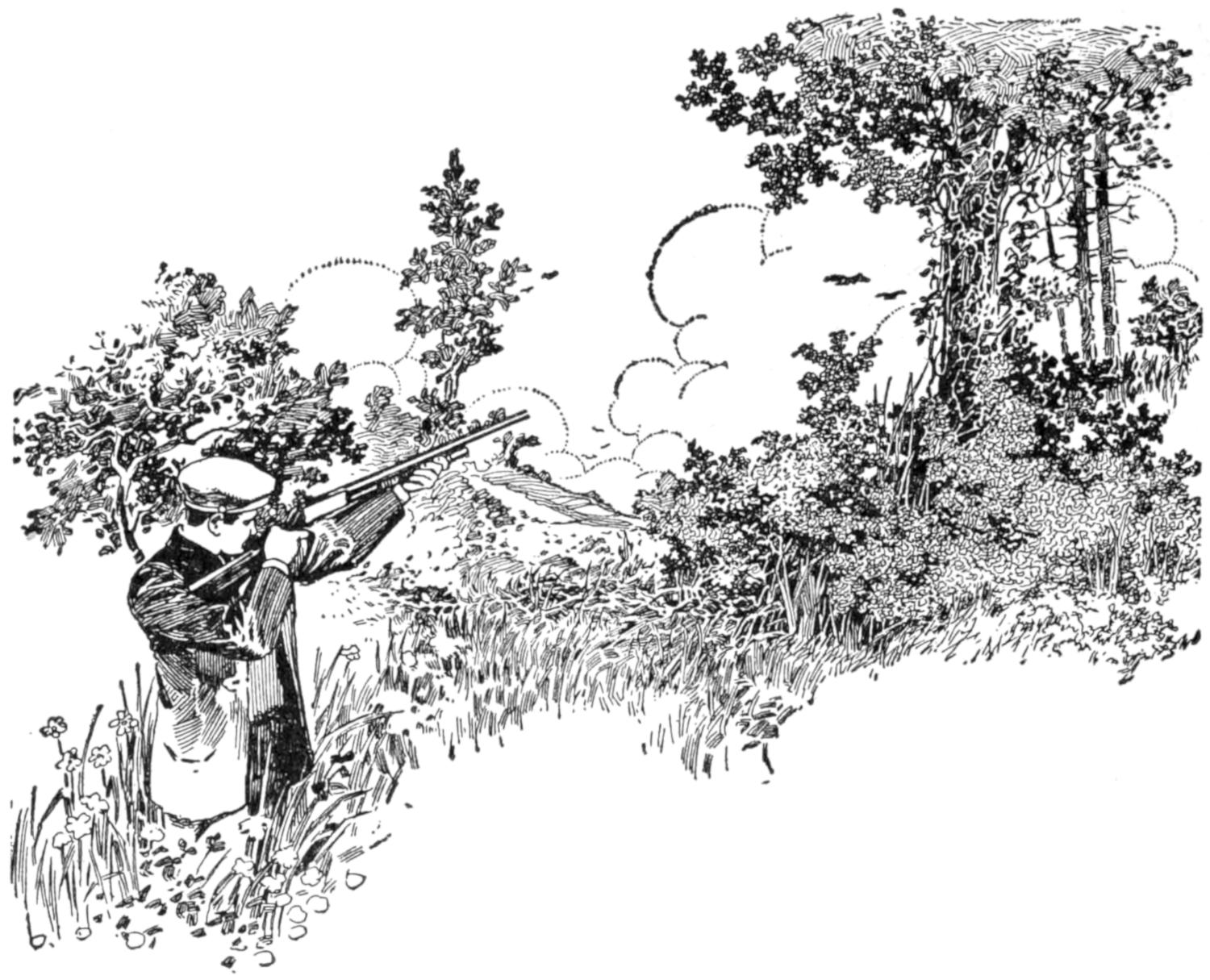
The Forward Hand may Grip the Fore End at Any Point, but a Well-Extended Arm Gives a Better Control of the Gun
Snap and Wing Shooting
The object which the gunner should now strive for is to train the eye, hand, and gun to work in unison, and to do this, bring the gun quickly to the shoulder, point it to the mark, and press the trigger without stopping the upward and even swing of the barrels. At the first few trials some difficulty may be encountered with the pressing of the trigger at the proper moment, but a little practice will soon tell how to time the shots. Note the phrase, “press the trigger,” for the trigger is not pulled by the forefinger alone, but rather pressed by closing both hands, the forward hand on the fore end pushing and closing, and the hand grasping the stock being drawn back and squeezed at the same instant. This is easily done, but rather hard to picture. After a few trials with an empty gun, the novice will see the point, and also discover the fact that the recoil of the arm is much lessened by this proper grip of the weapon.
Confine the first practice in snap-shooting to throwing the gun to the shoulder, and when proficient in hitting the mark, try a snap shot by swinging the gun from the side, right to left and also left to right. Do not attempt to check the even swing of the gun, but rather let the barrels swing past the mark, concentrating the mind upon pressing the trigger the instant the line of aim covers the mark. Practice swinging slowly, and after being able to hit the mark with the center of the charge pretty regularly, increase the speed of the swing. In doing this, it will be discovered that the speed of pressing the trigger must also be increased to balance the speed of the moving barrel, and very likely it will be found that the natural tendency is to press the trigger a bit late. This is the common mistake which practically every novice makes when in the field, although the error is likely to pass unnoticed when after game.
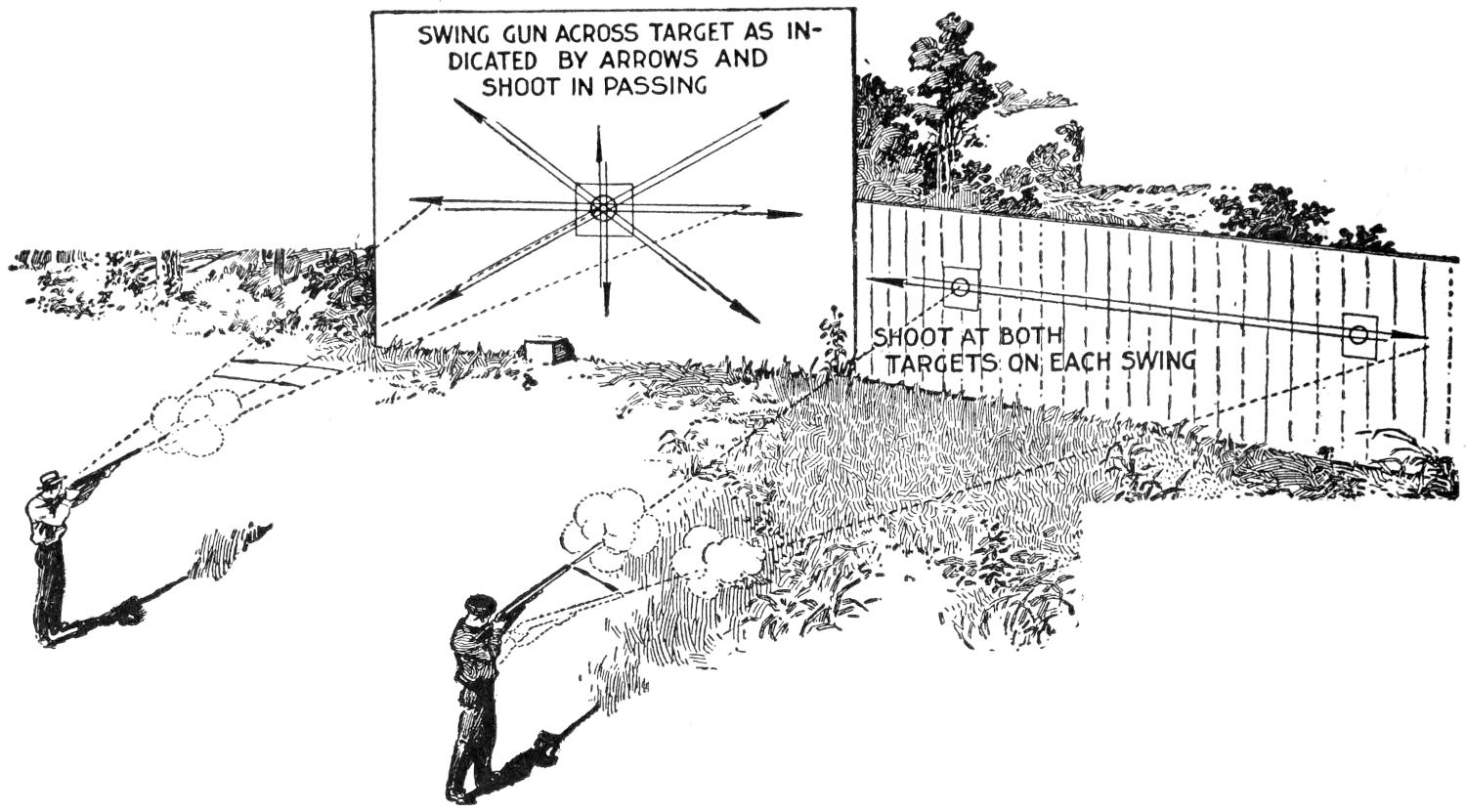
SWING GUN ACROSS TARGET AS INDICATED BT ARROWS AND SHOOT IN PASSING
SHOOT AT BOTH TARGETS ON EACH SWING
Train the Eye, Hand, and Gun to Work in Unison, by Bringing the Gun Quickly to the Shoulder, Pointing It at the Mark, and Pulling the Trigger without Stopping the Motion of the Barrels
As the gunner acquires proficiency in swinging the gun from side to side, try swinging the gun at different angles, changing the angle of the swing with each shot, from right to left and upward, at an oblique angle upward, and so on, until it is possible to hit the mark with a fair certainty from a variety of angles. When trying out the several swings, one should always begin slowly and increase the speed of the swing as he becomes more expert, only making sure to shoot by calculation and not by guess. The manner of acquiring expertness sounds easy and is comparatively easy, and, as it is the backbone of snap-shooting, improvement will be rapid if the novice is willing to practice slowly and master each detail in turn. Do not make the mistake of overdoing the thing at the outset by shooting too long at a time. A box of 25 loads is ample for a day’s practice, since it is not how much one shoots, but how well, that counts.
Snap-Shooting at Moving Targets
When the gunner has reached the point where he can hit the stationary target by swinging his gun both fast and slow, he has acquired better control of the weapon than many old shooters, and he is well prepared to take up snap-shooting at flying or moving targets. The access to a gun club where clay birds may be shot at, will prove of much value, but this is not absolutely necessary, since tin cans, bits of brick, and bottles, thrown in the air at unknown angles by a companion, will afford the needed variety. Better than this is one of the inexpensive “hand traps” which project the regulation clay targets by means of a powerful spring worked by a trigger. One of the large powder manufacturers makes a trap of this kind, and a very good trap can be had for $1.50. The standard clay targets cost about $2.50 a barrel of 500. Practice of this sort may be made a very interesting and highly instructive sport, providing the targets are projected from different and unexpected angles, thus simulating the many-angled flight of the live bird.
Value of Second Barrel in Shooting
The use of the second barrel should not be overlooked in practicing with the idea of becoming an all-around wing shot, for the second shot is often needed to kill a cripple, or bring down a bird which has been missed with the first shot. Two-shot practice should begin by placing two paper targets about 20 ft. apart, then shooting at the first one and continuing to swing the gun to cover the second target. Practice swinging from various angles as directed for the initial practice, increasing the speed of the swing as proficiency is gained, and fail not to profit by the mistakes which must inevitably occur to all who try to master the shotgun. After a reasonable amount of practice, conducted along these lines, the gunner may venture afield, and if his acquaintance includes an old seasoned sportsman who will point out the mistakes made, much may be learned regarding the knack of handling the gun, as well as relating to the haunts and habits of our wild game birds.
Cleaning and Care of the Gun
A good shotgun is a thoroughly reliable and dependable weapon, but as with all tools of the sportsman’s craft, the best results can only be had when the arm is in good condition. It is gun wisdom always to clean the weapon after a day’s shooting, and the amateur should make it a positive rule never to put his gun away until it is cleaned. The sooner firearms are cleaned after the firing the better, and if cleaned before the burnt powder has had time to corrode the steel, much future trouble is saved. In cleaning the barrels, never rest the muzzle against the floor. If a rest is needed, use an old piece of carpet or a bundle of rags. Clean from the breech end only, as any slight dust, or burr, at the muzzle will greatly impair the shooting qualities of any firearm. Never use a wire-wheel scratchbrush, as it will scratch the polished steel; a soft brass-wire cleaner is the only suitable implement for this work. There are several good cleaners to be had. For removing any rust deposits, a brass brush may be used, while for ordinary cleaning, plenty of cloth should be run through the barrels, taking care that it touches every part of the interior. This is easily done by rotating the cleaning rod as it is pushed through the barrel from the breech to the muzzle. When putting the gun away, the barrels should be stopped, at the breech and muzzle, with tightly fitting corks, or gun ropes may be run through the barrels after soaking them in some good oil. To prevent rusting, cover the metal, outside as well as inside the barrels, by smearing on a little heavy lubricating oil. Slip covers of chamois are often used to protect the stock and barrels before putting them in the leather case, but stout woolen covers are better, since chamois is likely to absorb more or less moisture.
The mechanism of a gun is not exactly complicated, but the novice had better leave well enough alone and not attempt to dismount the locks or tinker with the mechanism. The modern steel barrel is very hard and not easily dented, but if so injured, it is better to ship it to the factory for repairs than to trust it to the crude methods of the average gun repairman.
A gun should be given ordinary good care, and this is not forthcoming if one makes a practice of opening it and letting the barrels drop down with a bang. Snapping the triggers on an empty barrel is likewise foolish. If one desires to practice trigger pressing, put a couple of empty shells in the barrels.
If one owns a good-grade shotgun, the stock is probably finished in oil and hand-rubbed to a nice, durable polish. On cheap arms the varnish is usually employed to give an attractive finish in the store. Of course, this varnish will scratch, and otherwise come off, and spoil the appearance of the arm. If a good finish is wanted, do not re-varnish the stock, but remove all the old varnish by using a little varnish remover, and rub down with oil. For an extra-fine polish, wet the wood to raise the grain; rub down with very fine sandpaper; wet the wood again, and sandpaper a second or a third time; then rub down with oil until the wood is saturated with it, and polish with a cloth, using plenty of pressure, and the stock will be as fine in appearance as if it had the “London oil finish” supplied with all high-grade guns.