Volume 1 — CHAPTER VIII. (continued 2)
Reading edition
One day Ukwa found them sitting on the banks, so he came up behind and seized them. Their screams brought their father, Ud Diljil, out of the river, to see what was the matter. Ud Diljil, whose right side was green in colour and in form like a crocodile, whilst his left side was that of a man, protested mildly, but allowed Ukwa to take away his daughters and wed them, merely giving vent to a series of incorrect prophecies regarding them.
Nik-kieya, the elder sister, gave birth to two sons and three daughters, and Ung-wad, the younger, to one son only, named Ju, or Bworo. The eldest son of Nik-kieya was named Nyakang (Nik-kang or Nyakam) and inherited the pleasing crocodilian attributes of his mother and grandfather. Meanwhile Ukwa married a third wife, whose eldest child, a son, was named Duwat.
On Ukwa’s death there was a furious quarrel between Nyakang and Duwat as to who should succeed Ukwa. It ended by Nyakang, with his sisters Ad Dui, Ari Umker, and Bun Yung, his brother Umoi and his half-brother Ju, acquiring wings and flying away to the south of the Sobat. Here they found the Shilluk country inhabited by wicked Arabs, so they drove them out and founded a most successful kingdom. According to their genealogy this would have been about 1200 A.D., or later.
Nyakang had a creative power which he used greatly to the advantage of the kingdom. In order to people the vast territory more quickly, he proceeded to create a people from the animal life he found in the forests and rivers. From crocodiles and hippopotami, and from wild beasts and cattle, he created men and women. When these had brought forth many children, the parent stock was removed by death, so that the children might not know of their origin.
The new creation and their offspring form the Shulla race or common people, in distinction from the direct descendants of Nyakang’s family. The latter continue to bear authority and fill the priestly function to this day. All outside the royal and priestly line are accounted Shullas.
Nik-kieya still exists. She never died and never will. The western part of the Sobat and part of the White Nile near there is her favourite abode. She often appears, usually in the form of a crocodile, but at times in different forms and always in the river or on its banks. No sacrifices are ever offered to her. When she wishes, she takes what is required from among men and beasts; and when it is so, the people must not complain; indeed, it is an honour when Nik-kieya is pleased to take her sacrifice of man or beast from a family.
Nik-kieya becomes judge also in certain difficult cases, it is said, particularly in cases of illegitimate children. When the man accused denies fatherhood, the case is turned over to Nik-kieya. The disputants are taken to the river bank, and along with them a goat. They are then put into the river, and the one that Nik-kieya carries off is judged guilty, and he or she is left in the hands of Nik-kieya, to be punished. The beauty of this method is that a consciousness of guilt, added to a belief in and fear of Nik-kieya often causes confession, and thus the case is ended. It is not quite clear why the goat is taken to the river. It may be to give Nik-kieya a chance for a sacrifice without taking a human being, or it may be because a goat tied close to the river will attract crocodile from quite a distance. To Nik-kieya are ascribed many wonderful miracles, and it is feared also that in actual practice she becomes a cloak for sin.
Around this mythical being and her demi-god son are wrapped many superstitions, not the least of which is that sacrifices to and the worship of, the great deity Jo-uk, are carried out by the intermediary of Nyakang, the demi-god.
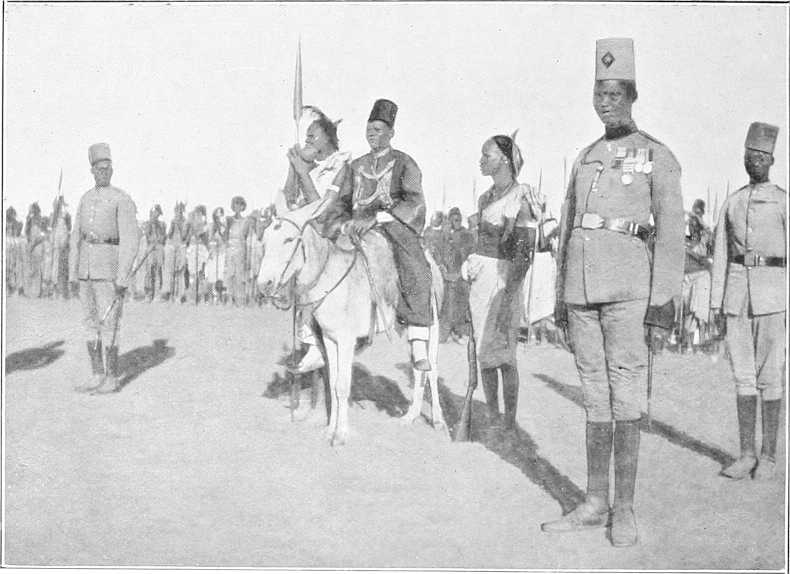
EX-MEK KUR WAD NEDOK—DEPOSED 1903.
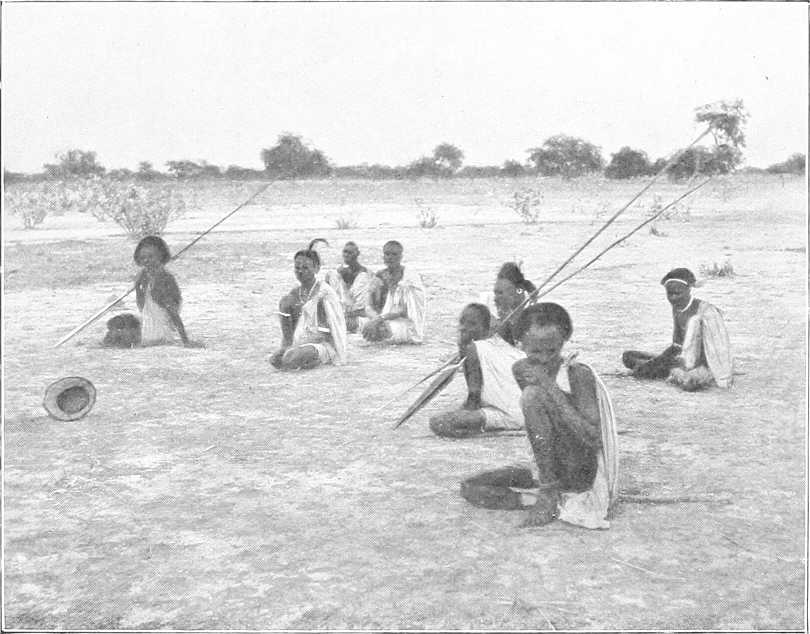
SHILLUKS ON A VISIT.
Jo-uk is recognised as the father and source of all life, of evil as well as good. He is treated rather as a deity to be feared and propitiated, but he enters into the small relations of life all the same, and most incidents, such as death, sickness, going on a journey, etc., are referred to his action. The Shilluks believe that Jo-uk is everywhere, and that man when he dies goes to Jo-uk; but whether anything happens to him in consequence seems doubtful.
To Jo-uk sacrifices are made at least once a year, at the beginning of the rainy season, and much of good and evil are attributed to him. This sacrifice consists in the slaying of an animal by the priest of each village for the people of his village, assembled at the house of the “Nyakang.” The animal is slain with a holy spear, and the flesh divided among the people, cooked and eaten. Then follows a dance, with much drinking of merissa to make their hearts merry. For this sacrifice and dance, which is apparently the sum of their worship, there are especial houses. But in each village there is a small temple, similar in structure to the larger one. In this, or more correctly, around this, the elders of the people assemble for the transaction of all serious business, and call their gods to witness in all covenants. No village is without this small temple, and it is the only building on which any ornamentation is attempted. It is called the house of Nyakang, not the house of Jo-uk.
In cases of illness sacrifices are made to Nyakang. The Shilluks bury their dead inside the confines of their villages close to the house where the deceased had lived, killing a bullock at the wake, the horns of which are set up to mark the place of interment.
History.After Nyakang there have been, including the present one, 26 kings. The following is the list[131]:—
1. Nyakang. 15. Nyadok.
2. Dag (Dok). 16. Akwot.
3. Odage. 17. Ababdo.
4. Kudit. 18. Awin.
5. Dokodo (Dakkode). 19. Akoj.
6. Boj (Boiwj). 20. Nedok (Nyadok).
7. Tugo (Tuka). 21. Kwad Keir (Kwat Ki).
8. Nya Dwai (Nya dwi). 22. Ajang (Ajung).
9. Nya Ababdo. 23. Gwin Kun (Kwoe Kon).
10. Muko (Mu Kao). 24. Yor Adodit (Yur).
11. Nya To (Nya Ta). 25. Akol.
12. Nyakong (Nik Kang). 26. Kur Wad Nedok.
13. Okun (Ukon). 27. Fadiet Wad Kwad Keir.
14. Nya Gwatse (Nkwaji).
Kur Wad Nedok was appointed king by the Dervishes as a reward, it is said, for betraying Mek Yor Adodit to them. During Kur’s absence in Omdurman, Akol was appointed mek by the Shilluks. Ak Kwo Kwan, son of Akol, is a pretender to the throne, but has few adherents.
It is related that all kings from Dag to Nyadok were killed by the Shilluks. Kwad Keir, Ajang, and Gwin Kun fell by the hand of the “Turks.” Yor fell in fight with the Dervishes. Kur abdicated. Akol is dead; he is said to have been shot by the Dervishes. The descendants of the kings are called “Gwared,” in contrast with the ordinary Shilluks, who are called “Ororo.” The royal descendants form the upper class, while the Oroko are at the beck and call of the kings.
The idea of kingship is implanted wherever the Gwared exist, and the latter are numerous. It is, therefore, not easy to exterminate the idea of royalty.
Royalty in this country is royalty, both by selection and inheritance at the same time. It is so by selection because the leading men of the country select the king from a variety of claimants, and by right of inheritance, inasmuch as only sons of kings are entitled to ascend the throne.
The right of accession to the throne is acknowledged as belonging primarily to the sons of the late king.
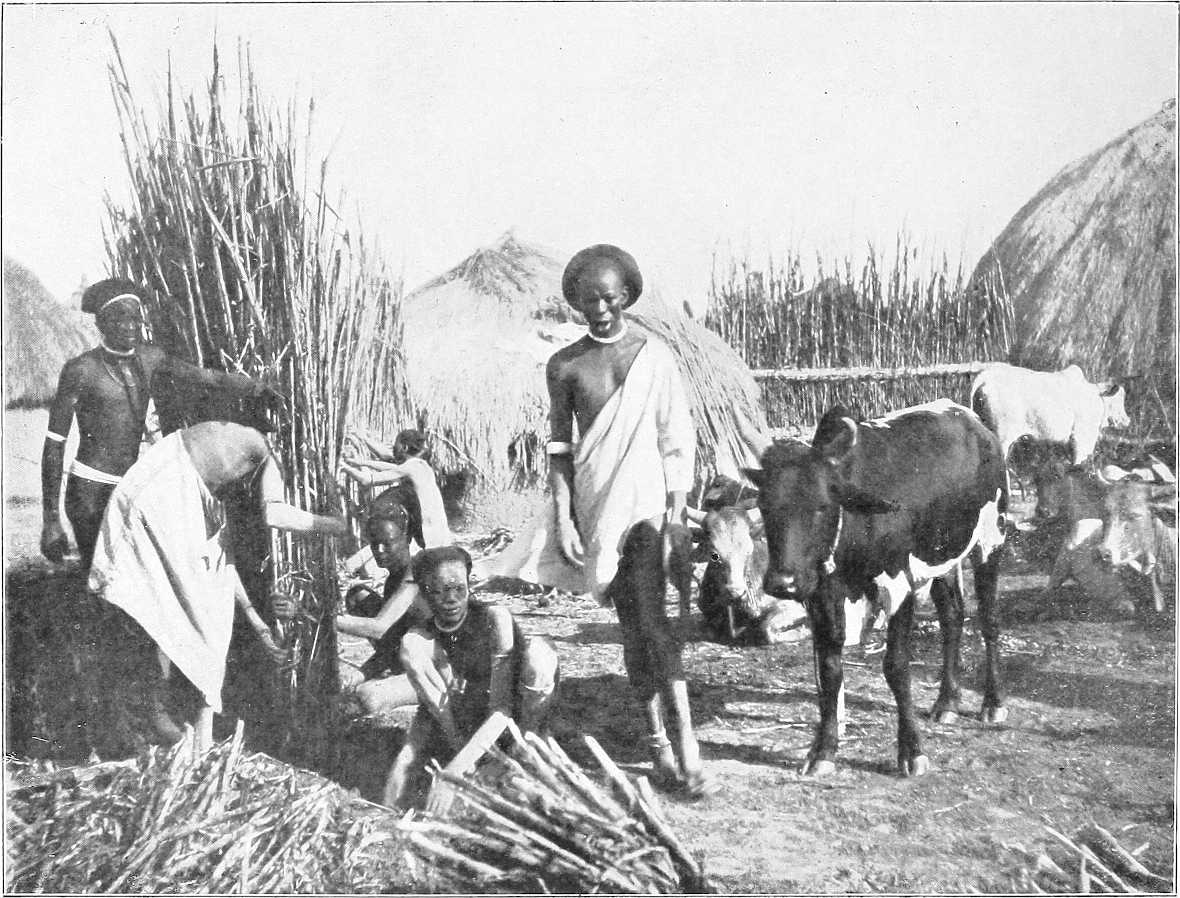
SHILLUK VILLAGE SCENE.