Volume 1 — CHAPTER VII.
Reading edition
FROM 1900 ONWARDS.
1900.The new year opened auspiciously by the capture of Osman Digna on the 18th January by Captain F. Burges, Mamur Mohammed Bey, and a police patrol, in the Warriba Hills, some 90 miles south-west of Suakin. This notorious Emir was sent to Rosetta to join the other Dervish prisoners, and is now (1904) at Damietta.
Sudd and Survey expeditions.All the rivers were exceptionally low during the winter of 1899-1900, and the various expeditions and survey parties which were now started off had much difficulty in getting through to their posts.
Major Peake commenced clearing the sudd on the last day of December, and succeeded in opening a channel in the following April (vide p. 304). Sir W. Garstin also came up to study the Bahr el Jebel and Bahr el Ghazal rivers.
At the end of February parties of English (Uganda) (under Captain Gage), French (under Lieutenant Tanquedec), and Congolese (under Commandant Henry) troops arrived at Omdurman, having been found by Major Peake trying to cut their way through Block 3. The Uganda and Congolese parties were sent back, and the French (who were evacuating the Bahr el Ghazal) continued their journey to Europe.
Abyssinian Frontier.With the object of coming to an arrangement with Abyssinia regarding the frontier between that country and the Sudan, two surveying expeditions were sent out towards the end of 1899, under Major Austin, D.S.O., and Lieutenant Gwynn, D.S.O., respectively. The former, with Lieutenant Bright, surveyed up the Sobat and Baro Rivers to Gore, and thence in a southerly direction to the Gelo, returning viâ the Pibor River to Nasser. Owing to obstruction on the part of local Abyssinian chiefs Major Austin was unable to penetrate to Lake Rudolf, but the geographical results of his expedition were most useful. Lieutenants Gwynn and Jackson started up the Blue Nile to Famaka, thence south along the edge of the Abyssinian plateau, and across the Sonka to the Garre river, whence they returned viâ Nasser, after doing much valuable survey work.
On 22nd December, 1899, Sir R. Wingate was appointed Sirdar and Governor-General, vice Lord Kitchener, called to South Africa.
Millenniumists.In January, 1900, an increasing sect in Omdurman, which was dubbed “the Millenniumists,” and might have led to trouble, was suppressed.
Rabeh Zubeir.In April Rabeh Zubeir was attacked near Lake Chad by three converging French columns; he himself was killed, and his kingdom absolutely destroyed.
The rest of the year was mostly occupied in the Government settling down to its work, organising the exhausted country, etc.; no events of any importance took place till the end of the year.
Kiro.A Sudanese post was established in November at Kiro, on the left bank of the Upper Nile, a few miles north of the Belgian post, about 5° 30′ north lat. This post, finding in April, 1901, that it was just south of 5° 30′, crossed the river to Mongalla, where it established itself permanently.
Occupation of Bahr el Ghazal.On November 29th, 1900, an expedition under Lieut.-Colonel Sparkes left Omdurman in steamers in order to occupy the Bahr el Ghazal. It consisted of five British and 13 native officers, 82 regulars, and 266 irregulars, with necessary stores, transport, etc.
The party arrived at Meshra el Rek on 14th December, 1900, and patrols were sent out to reconnoitre. 1901.Tonj was quickly fixed on as temporary headquarters (1st January, 1901), and small expeditions were made by Colonel Sparkes to Wau, Fort Desaix, Rumbek, Amadi, Kiro, Shambe, and back to Tonj, whilst the remainder of the party consolidated its position and made friends with the natives. Lieutenant Fell, R.N., started cutting the sudd in the Jur river, with the object of opening up a waterway from the Bahr el Ghazal river, but his arduous labours, lasting for the next 15 months, were not crowned with success till June, 1902. Major W. Boulnois meanwhile conducted a patrol to Deim Zubeir, Telgona, Faroge (Forga), and Chamamui, meeting with a most friendly reception from the chiefs of these districts, and returned to Tonj on 10th April. Shortly afterwards the same officer proceded to Rumbek and chastised some raiding Nuers, with the effect of bringing the Agars and other Dinkas in at once to acknowledge Government authority.
Colonel Sparkes now made an extensive patrol to the south, to visit Sultan Tembura of the Nyam Nyams. Here, after many difficulties of travel, he arrived on 25th June, 1901, and was most cordially received by the Sultan, whose people were of a comparatively highly civilised order. Sparkes returned to Wau on the 27th July, and proceeded north shortly afterwards, suffering severely from fever. In November, as Major Boulnois, besides many of the troops, was invalided owing to the same cause, Major Hunter assumed command of the Occupation Force.
Frontiers.In the spring of 1901 the question of the Sudan-Eritrea and Abyssinian Frontiers claimed the attention of the Sudan Government. Colonel Hon. M. G. Talbot concluded, with Lieutenant Colli, at Kassala, on 16th April, a treaty[210] regarding the frontier between Sabderat, the Atbara, Tomat, and Todluk, and a new grazing convention was also concluded between Colonel Collinson (Mudir of Kassala) and Signor Martini (Governor-General of Eritrea) on 28th February, 1901. Major Gwynn, D.S.O., with Captain Smyth, V.C., continued his surveys from Famaka northwards (he having arrived at this place from Addis Abbaba on the 14th April), and fixed a series of important points during his journeys, which extended altogether from Jebel Jerok to Gallabat.
Major Austin’s expedition.Meanwhile Major Austin and Lieutenant Bright had started from Nasser on a further expedition south-eastwards from Nasser on the 12th January. They were to find stores provided by the Abyssinians at Murle, on the north bank of Lake Rudolf, but on arriving at this point, after making a valuable survey from Nasser, they found no signs of Abyssinians or stores. They then struck south along the western shore of the lake, and after suffering severely from hunger and sickness, and losing 39 out of 53 of their men by starvation, they eventually arrived at Lake Baringo on the 6th August.
Darfur.Since 1898 Ali Dinar had been with some difficulty establishing himself on the throne of Darfur. He was appointed Government-Agent in that country, and in June, 1901, he began paying an annual tribute.
Raids in Darfur.In September Ali Dinar sent a strong force under Tirab Suleiman against the Maalia and Rizeigat Arabs in the south, whom he wished to bring under his sway. Tirab raided them heavily, and on their taking refuge in Kordofan threatened to pursue them thither. The consequent consternation in Kordofan was only allayed by the Mudir mobilising a force of camel corps, etc., near the frontier at Foga and Nahud. Matters quieted down, and Ali Dinar expressed his apologies.
Wadai.[211]To turn to affairs in Wadai:—
At the end of 1898 Sultan Yusef died and nominated his second son Ibrahim to succeed him, whilst Abdel Aziz his eldest son, who was a violent and war-like character, was blinded to preclude the possibility of disturbance. As Dud Murra the youngest of the three brothers got on well with Ibrahim he was left unmolested, and the late Sultan Yusef’s body was duly interred at Wara, the recognised burial place of Wadai Sultans. Ibrahim, on his accession, though his father Yusef was a strong Senussiist, refused to give up merissa drinking and declared himself an anti-Senussiist. It was at Sultan Yusef’s request that Senussi had sent Mohammed El Sunni as his representative at the Court of Abesher at the end of 1897.
Owing to widespread animosity against Ibrahim, caused partly by this friction with the Senussiists and partly by his execution of several of the Agids[212] he determined to leave Abesher on the pretext of going on pilgrimage to Wara, but in reality to seek refuge in the mountains of Abu Sinun. Sheraf El Din now took charge of affairs with the tacit consent of Jerma Othman the chief Agid, and sent an expedition to bring back the fugitive Ibrahim alive or dead. He was eventually betrayed by the ex-dervish Emir Zogal[213] and brought to Abesher, where after being, it is reported, blinded, he died of his wounds and was buried (1900). “Better,” he said, “to die as a Sultan in my Palace than to flee shamefully before slaves.” (The party sent to capture Ibrahim was under the command of the slave Gorani Gelma.) In 1902 his remains were transferred to Wara.
Thereupon Ahmed Abu Ghazali (so-called on account of his long neck), the son of the former Sultan Ali, was proclaimed Sultan through the influence of Sheraf El Din, who continued to have the chief hand in the government. This direction of affairs by a eunuch was, however, extremely unpopular and, as a protest, in September, 1901, Sultan Bekhit of Dar Sula refused to comply with orders from Abesher. Jerma, too, endeavoured to install Asil as Sultan in place of Ahmed Ghazali, but as the latter threatened to have Asil’s eyes put out, he fled to Fitri and surrendered near there to Lieut.-Colonel Destenave, in the French sphere. Ahmed now became annoyed with Jerma, as he considered him responsible for the flight of Asil, whilst the people, on the other hand, by whom Jerma was much liked, demanded the head of Ghazali’s chief adviser, Sheraf El Din. The Senussi agent, however, Mohammed El Sunni, now stepped in and effected a reconciliation between Jerma and Sheraf El Din, but the Sultan deeply incensed at the conduct of Jerma determined to kill him. Mohammed Sunni, hereupon, again intervened at the critical moment and obtained his reprieve.
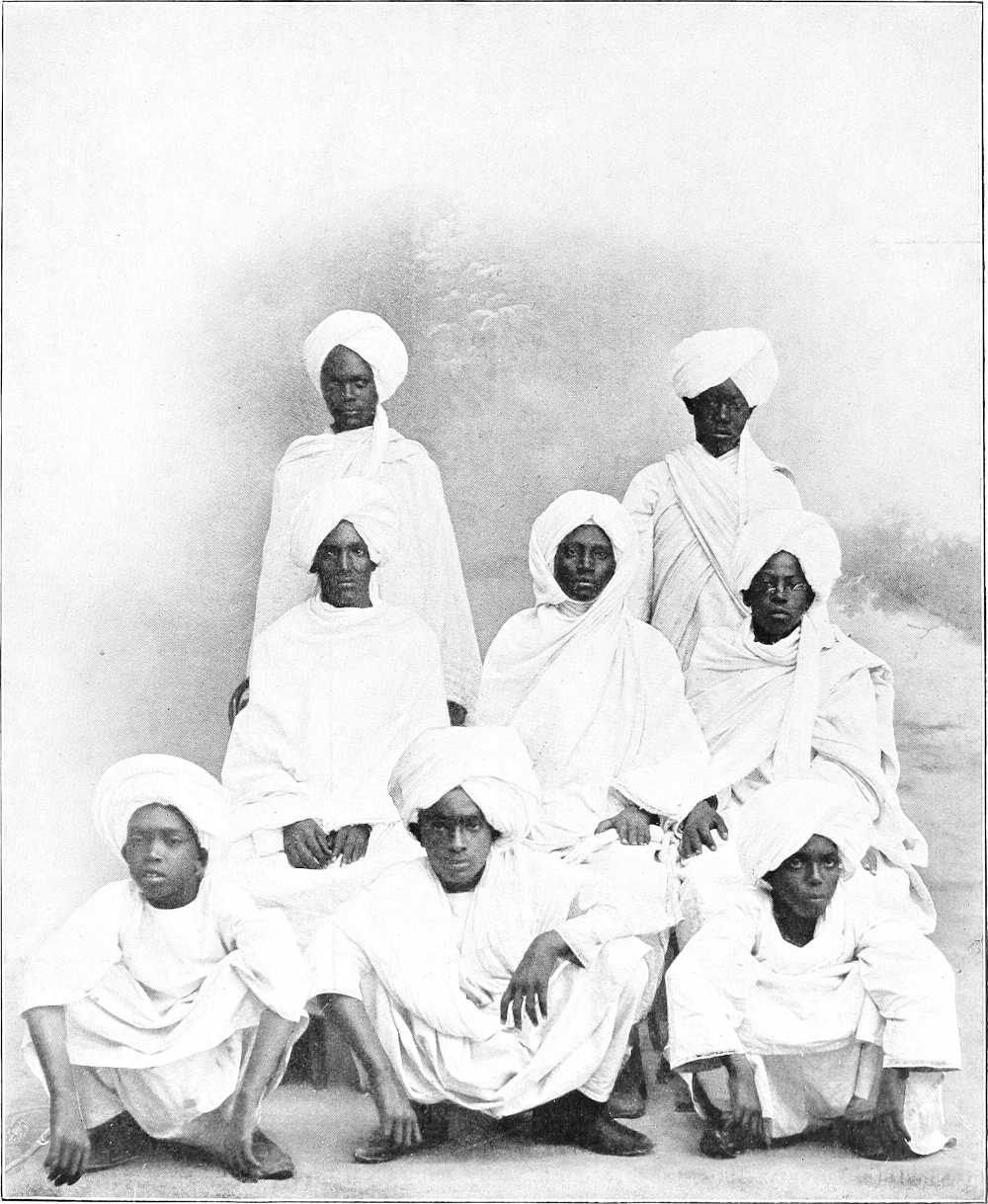
By kind permission of] [Capt. Amery. SONS OF THE MAHDI AND KHALIFA. (Now being educated in Egypt.)
With Jerma free again the Sultan and Sheraf El Din considered they were no longer safe at Abesher and both resolved to seek refuge in Dar Salamat. On the flight of the Sultan, Jerma at once assumed the direction of affairs at the capital and unsuccessfully attacked the fugitive Sultan’s rearguard soon after it had quitted Abesher. The pursuit was continued and a severe engagement took place about 40 miles further south. Another action was subsequently fought in Dar Salamat in November, 1901, and Ghazali continued his flight to El Batha.
Jerma now returned to Abeshe and in December 1901 proclaimed Dud Murra, a youth of barely 20 years of age and brother of Sultan Ibrahim, as Sultan.
Mohammed El Sunni.Mohammed El Sunni, the Senussi agent, is reported (1903) to be dead, and since the death of the Senussi, in May, 1902, the prestige of that doctrine is said to have materially decreased in Wadai.
Rome Conference.In November, in consequence of difficulties in the frontier negotiations between the Sudan, Eritrea and Abyssinia, a Conference was held in Rome, which resulted in agreements satisfactory to all, and included customs, postal and telegraph conventions between the Sudan and Eritrea (vide pp. 292-295).
Recapitulation to the end of 1901.Meanwhile the Sudan Government had been settling itself, exploring its vast territories, organising and administering the country, instituting legislation, extending communications, and in general laying the foundations of good government. Various small disturbances, not necessary to chronicle in detail, had occurred, chiefly in the neighbourhood of the frontiers, slave-raiding or refusal of sections of tribes to pay tribute being the chief causes; but on the whole, in spite of deficiency of population, limited numbers of officials, and rigid but necessary economy, the Sudan settled down into an era of peace and growing prosperity.
1902. Bahr el Ghazal.In January, 1902, Captain A. M. Pirie occupied Deim Zubeir and Chamamui, and was then recalled, owing to the murder of Lieutenant Scott-Barbour by the Agar Dinkas. This officer had been in charge of a camel convoy between Shambe and Rumbek, and was treacherously assassinated on the banks of the Naam river (Rohl) on 10th January. A punitive expedition was quickly organised by Major Hunter, and in a series of rapid marches it killed many of the Agars, burned their villages and captured their cattle. A further expedition under Captain L. Stack, arriving viâ Shambe from Khartoum in March, completed the punishment. Myang Matyang, the chief offender, died in July of wounds received, and the Agars came in and sued for peace, which was granted.
Ali Dinar.In January Ali Dinar was seriously ill, and was at one time reported to be dead; but he recovered completely.
Nuer expedition.A small exploring expedition sent under Major Blewitt up the Khor Filus into the Nuer country, belonging to Denkur, in April only resulted in the Nuers first defying the troops, and then fleeing further into the interior.
Sudd.Meanwhile Major G. E. Matthews had been hard at work for five months on the 15th block of sudd, but, owing to there being no current to take away the cut blocks, it was practically a hopeless task, and was temporarily given up, the “false channel” which circumvented this portion of the sudd proving sufficient for purposes of navigation.
Surveys.During the spring Major Gwynn continued his surveys along the Sudan-Eritrea frontier, fixing points up to Ras Kasar on the Red Sea, and eventually finishing up at a point 100 miles north of Suakin.
Treaty with Menelek.On the 15th May a treaty was signed at Addis Abbaba, defining the Sudan-Abyssinian frontier line, and containing other important clauses (vide p. 296).
Western Sudan.The great religious Sheikh El Senussi, who had previously been residing at the oasis of Kufra, becoming uneasy at the advance of the French in the Lake Chad region, as well as being apprehensive of the possible eventualities that might follow the victory of Omdurman, moved his headquarters to Geru,[214] about 10 days north of Abesher, in the year 1900. In order, too, to extend his influence and safeguard his interests, he established a zawia at Bir Alali about four days north of Lake Chad and wrote on three separate occasions to Sultan Ali Dinar of Darfur requesting him to prepare zawias for him in Jebel Marra and in Dar Zaghawa. The Sultan, however, was unwilling to be saddled with such an illustrious but inconvenient guest, and the matter eventually fell through in 1902. From that time no visits of Senussiists to El Fasher have been reported.
At last the situation in the west was brought to a head by a French patrol searching a Senussiist zawia in Kanem for reported arms. A collision ensued some time in August, 1901, which was insignificant and partook of the nature of a raid. On 19th November, however, a more serious collision took place, in which a small French force was defeated by Sheikh el Barrani, the Senussi representative in Kanem.
On the 18th January, 1902, the French, strongly reinforced, attacked the Senussiists at the zawia of Alali, in Kanem, and the latter, though assisted by the Aulad Suleiman (Tuareg) tribe, sustained a severe defeat.
The Jehad was now proclaimed by the Senussi, and hundreds of his adherents flocked into Geru from Tripoli, Wadai, and the surrounding deserts. It appears, however, that the intention of the Senussi was merely to act on the defensive, for no forward movement was undertaken; there were even rumours that the Sheikh intended to retire north to Kufra to avoid collision with the enemy. At a third action, however, which appears to have been fairly decisive, Mohammed Abu Egeil, the Senussi general in Kanem, was killed, and the Senussiists fell back eastwards and northwards.
During May, 1902, the Sheikh el Senussi sickened, owing, it is said, to his anxiety regarding the situation. He is reported to have died on 30th May, and to have nominated his nephew, Ahmed el Sherif, as his successor. The story of his death was not confirmed, and for a long time rumours were rife of his appearance at Kufra, at Jaghbub, etc., with the intention of proclaiming himself a Mahdi, of going to Mecca on pilgrimage, etc., etc.; the shrine in which he was buried was reported to have been opened, and found empty, and many other stories of his reappearance were told. It seems, however, most probable that he did die on or about the date given, and it is certain that his successor has removed himself and all his property back to Kufra.
Darfur.In July Ali Dinar reported that Arabi Dafaalla, ex-Dervish Emir on the Upper Nile, had surrendered to him with all his men and 3,000 rifles, and had received the “Aman.”
Cholera.During the summer the cholera, which had been ravaging Egypt, made its appearance at Halfa, and eight natives died. Owing, however, to the strict surveillance there and at Suakin no further cases occurred in the Sudan.
On the 20th July Major Hunter, Acting Commandant of Bahr el Ghazal, died of blackwater fever.
British garrison.During the winter of 1902-03 the British garrison of Khartoum was raised from one company, which up to this time had remained only during the cold weather, to a whole battalion, permanently quartered there.
Small disturbances.Various small raids into the Sudan took place during the years 1900-03 along the Abyssinian frontier, the chief offenders being Wad Mahmud in the Keili district, and a brigand named Hakos on the border near Gallabat. Appeals to the higher Abyssinian authorities produced little result, owing to their want of control over these outlying districts. The end of these two brigands is recorded later.
In Kordofan the restless tribes of the southern hill districts were never at peace, but the inter-tribal disturbances were purely local, and in no way threatened the stability of the Government in these parts.
1903.In the Eastern Sudan the Rasheida slave-traders and the Gemilab tribe threatened at various times to give trouble, but they have quieted down, and the latter tribe has “come in.”
Delimitations.At the end of 1902 Major C. W. Gwynn proceeded, with Major C. E. Wilson, to the further delimitation of the Abyssinian frontier. He completed the demarcation from the Setit to just south of Kirin, and returning, viâ Kodok, in May, 1903, settled the limits of the new Sudanese leased territory of Itang on the Upper Baro River.
Colonel Hon. M. G. Talbot also met the Italian delegates at Kassala in February, 1903, and together they delimitated the frontier from Abu Gamal to the Setit, opposite the mouth of the Khor Royan, which point now forms the junction of Eritrea, Abyssinia, and the Sudan (vide p. 290).
Bahr el Ghazal.Colonel Sparkes set out on 13th January on a patrol to Hofrat el Nahas, the famous copper mines in Southern Darfur. He arrived there on March 1st, and was told that no European had visited it since 1876. The country was totally deserted, and it was evident that if the mines were worked, transport, although perhaps possible on the Bahr el Arab during some parts of the year, would be a matter of great difficulty. Colonel Sparkes returned to Deim Zubeir on 21st March, having marched a distance of 667 miles.
A patrol was meanwhile sent to open up relations with the powerful Azande chief, Yambio. Its commander, Captain Armstrong, was most unfortunately killed by an elephant on the 23rd February, and although the journey was continued by Colour-Sergeant Boardman, R.M.A., the expedition did not meet with success, for on reaching the Nyam Nyam country it was attacked by Yambio’s son (Mangi), and had to retire, though without loss (except of baggage, etc.).
Wadai.After continual fighting with Dud Murra, Ahmed El Ghazali was caught (20th March, 1903) in an ambush; his eyes were put out, and he was kept a captive with the Agid Salamat at Abesher. Wadai now became more or less settled, and trade was reopened to the north and east.
Bahr el Ghazal negotiations.During the past three years negotiations with the Government of the Congo Free State on the subject of the Bahr el Ghazal have been taking place; up to date, however, they have produced no definite result.
Shilluks.In April, Kur Wad Nedok, Mek of the Shilluks, was deposed for malpractices, and Fadiet Wad Kwad Keir elected in his place.
Kordofan. False prophet, September.On the 1st September, 1903, it was reported from El Obeid that a certain Mohammed El Amin, who had recently returned from Mecca and settled in Jebel Tagale, had proclaimed himself Mahdi. Colonel Mahon, C.B., D.S.O., left Khartoum at once with a squadron of cavalry, and marching viâ the Fachi-Shoya-Sherkeila route surprised and captured the false prophet at Ageila without fighting. He was conducted to El Obeid, where he was hanged on the 27th September.
October.It having been reported that Mansur Abdel Rahman, a cousin of Sultan Ali Dinar of Darfur, was raiding or collecting taxes from people in Kordofan, Captain Carter proceeded with a small force of Camel Corps from El Eddaiya and surprised the party, numbering some 40 rifles and horsemen, at Sherafa, and captured Mansur, who was subsequently liberated after the restoration of the property he had taken.
Nile-Red Sea Railway.Work on this railway was commenced in November, 1903.
Darfur.During the summer of 1903 one or more treasonable conspiracies to seize the throne of Darfur were nipped in the bud by the present Sultan Ali Dinar. Adam Rijal, the Commandant of Jebel El Hella, and Tirab Suleiman, another important general, both suffered the death penalty in consequence. The ex-Dervish Emirs, Zogal and Karamalla Kirkesawi, were also both mysteriously put out of the way.
In December, 1903, at the Sultan’s request, the boundaries of Darfur were clearly explained to him in writing.
Mahmal.The first Mahmal[215] to leave Darfur for Mecca since the conquest of that country by Zubeir Pasha in 1873 arrived at Khartoum in November. The value of the “Surra”[216] was stated to be about £450. The Mahmal proceeded viâ Suakin to Jedda, and returned to Khartoum at the end of June.
Upper Nile. Thalweg Agreement.A provisional agreement defining the Thalweg of the Nile between N. Lat. 5° and 5° 30′ was drawn up on 13th September by Captain R. C. R. Owen, representing the Sudan Government, and the late General Utterwulghe, on behalf of the Government of the Congo Free State.
Floods.The winter of 1903-04 will be memorable for the exceptional height of the Nile and its tributaries in the Upper Nile region, consequent on which there followed very extensive floods.
Eastern Sudan. Hakos.The brigand Hakos, who had caused considerable annoyance by raiding and robbery along the frontier between the Setit and Gallabat, was reported to have been killed on 16th December near Nogara. Had his career not been thus suddenly terminated, the Emperor Menelik had agreed with the Sudan Government to take combined action against him.
Abyssinian Coal Expedition.An expedition to prospect for coal in the valley of the Goang (Upper Atbara), near Chelga, was despatched by the Sudan Government from Khartoum in December, 1903.
1904. Itang.Captain H. H. Wilson left Kodok on the 23rd December, 1903, with merchants to establish a trading station at Itang on the Baro. After making the preliminary arrangements there he visited Ras Tesemma Nado at Gore. His Excellency, the Governor-General, subsequently visited Itang in May, 1904.
Ibrahim Wad Mahmud.In April, 1903, after the delimitation of the Abyssinian frontier, Ibrahim Wad Mahmud, the notorious slave raider of J. Jerok, was informed that as his village fell within the limits of the Sudan, he must cease raiding and settle down. As Ibrahim, however, in spite of a second letter of warning, continued to raid and openly defied the Government, in February a mixed force of about 800 men (partly irregulars) with two guns was sent under the command of Lieutenant-Colonel Gorringe (Governor, Sennar), to capture him. The expedition was completely successful and Jebel Jerok was surprised; Ibrahim, who succeeded in escaping, was handed over to Major G. de H. Smith[217] by Sheikh Hamed of Asosa on the 3rd of March. He was subsequently brought to Wad Medani, where he was tried and hanged on the 23rd May, 1904.
Bahr El Ghazal. Lemaire Expedition.In October, 1903, a scientific mission hailing from the Congo Free State, under the leadership of the explorer Lemaire, arrived at Mvolo in the south-east Bahr El Ghazal. It withdrew in the following spring, but was again seen in 1905.
1904. Yambio Patrol.On the 27th January a strong patrol, under the command of Captain P. Wood, left Tonj to visit the Nyam Nyam Sultan Yambio. The object of the patrol was to establish friendly relations with the Nyam Nyam chiefs Riketa, Yambio, and Mangi. On arrival at Riketa’s (a son of Yambio, and avowedly friendly), the patrol met with a treacherous and hostile reception. Riketa’s village was accordingly destroyed, and the patrol returned to Tonj. Captain H. E. Haymes, R.A.M.C., who was wounded in the head, subsequently died at Tonj on the 15th March.
Yambio is now dead. Owing to his persistent treachery and hostility, a column under Major Boulnois was sent against him, and in a smart action by Major Carter, February 9th, 1905, Yambio and ten of his men were killed.
Sudan-Eritrean Frontier.A provisional agreement regarding a slight rectification of the Sudan-Eritrea frontier near Karora was drafted by representatives of both Governments in January. It has not yet been ratified.
Sudd.The work of opening the 15th block of sudd on the Bahr El Jebel was recommenced by Lieutenant Drury, late R.N., in October, 1903, and continued during the succeeding 6 months, but eventually had to be again abandoned before the real channel of the river had been entirely cleared. The clearing of this block will probably be resumed, and it is hoped, completed in 1905.
Kordofan.In the spring of 1904, as several of the Meks of the Nuba Mountains continued to disregard Government orders to cease raiding and return looted property, punitive measures of a minor description were undertaken after repeated warnings, with most satisfactory results. In September, 1904, Major O’Connell with a force of 340 rifles, 3 guns and friendlies, successfully enforced the submission of the Nubas of Jabel Daier, about 60 miles south of El Obeid.
Sketch of events in the Lado Enclave.After their defeat of the Dervishes at Rejaf in February, 1897 (vide p. 263), the Belgians, under Chaltin, proceeded to occupy the territory leased to King Leopold under the Treaty of May, 1894, whilst Arabi Dafaalla and his Dervishes retreated to his deim at Bor and thence, at the end of 1898 or beginning of 1899, across the Bahr El Ghazal to Kalaka and Dar Kara.
Chaltin at once commenced to build and fortify stations at Lado (which had ceased to exist), Kiro, Loka, and Yei, whilst further south, Dufile (now moved to New Dufile), and Mahaji, etc., were occupied. At the end of 1901 Captain Hanolet was appointed Commandant Supérieur of the Enclave, and continued to improve the stations and communications with great energy. In August, 1903, Captain Hanolet was replaced by Commissaire Général G. Utterwulghe. The lamented death of this able and universally popular officer took place at Yei on the 8th May, 1904; he was succeeded by Commandant Wacquez.
Lado is now the headquarters of the Lado Enclave, whilst Yei, a fortified military station on the river of that name, is next in importance. Good roads connecting the stations on the Nile with Yei are in course of construction, and automobiles are now being used with some success to assist in the supply of the troops in the Enclave. These number some 2,000-3,000 native regulars, who are said to be excellent soldiers.
A railway connecting the Congo at Stanleyville with the shores of Lake Albert Nyanza at Mahaji, immediately to the south of the Enclave, is now in course of construction.
Mahdi on Blue Nile.In August, 1904, a religious fanatic named Adam, having first obtained promises of support from the Kenana Kawatil, openly declared himself Mahdi in the Kenana Khot near Senga. Prompt measures were taken to effect his arrest, and in the fight which ensued on his refusal to surrender the Mahdi and the whole of his adherents (11), were annihilated, while the Egyptian Mamur of Senga was unfortunately killed by the rebels.
Progress in 1903-04During 1903-1904 the Sudan Government extended its influence over and established posts in some of the remotest parts of its territory. In the north, the desert west of Dongola was widely explored and a post established on the Arbain road. The Arab tribes living in the wildest regions of the Southern Atbai were visited and much of this country mapped. Further south, the heart of the district inhabited by the redoubtable Gemilab tribe was reconnoitred and surveyed. Posts were established in the little-known country, previously infested by Abyssinian brigands, between the River Setit and Gallabat, and in consequence of these measures for public security the trade with Abyssinia at the latter place rapidly increased.
South of Roseires the administration was extended to the mountainous district of J. Tabi, hitherto practically unexplored and unknown, and inhabited by a shy and distinctive Negro race. Further south, the country of the more northern Burun adjoining the Abyssinian frontier and, until recently, the happy hunting ground of border slave raiders, was pacified and effectively garrisoned by regulars, whilst the opening up of trade routes from the border districts of Abyssinia to the Blue and White Niles and Sobat was commenced. In the Upper Nile Province, the Shilluk tribe was brought under the more direct control of the Government, whilst considerable progress was made with the Dinkas on the Sobat and the deeply suspicious Nuers of the Bahr El Zeraf, whose country had long remained unexplored by a white man. The Pibor river was navigated for 170 miles beyond the Akobo junction, or 240 miles from its mouth, and its source was roughly determined.
At Mongalla a suitable station was constructed and the almost unknown tribes, Beri and Aliab, visited in the spring of 1904, posts being established where necessary.
In the Bahr El Ghazal Province,[218] patrols traversed a great part of the country and the main roads were improved sufficiently to admit of the successful introduction of wheeled transport. In Southern Kordofan effective administration was extended, and detachments of regular troops were quartered throughout the Nuba mountains.
The most important step taken by the Government during 1903-1904 for the economic development of the Sudan was the commencement of a railway connecting the port of Suakin with the present main line near the Atbara mouth. In addition, reconnaissances were carried out for a branch line from Abu Hamed to Merowe and Affat in the Dongola Province.
The future advancement of the country was further enhanced by the efforts made by the Government to encourage the cultivation of cotton, both by the issue of large grants of seed as well as by an arrangement through which a fair price was guaranteed to the producer for all cotton placed on the market.
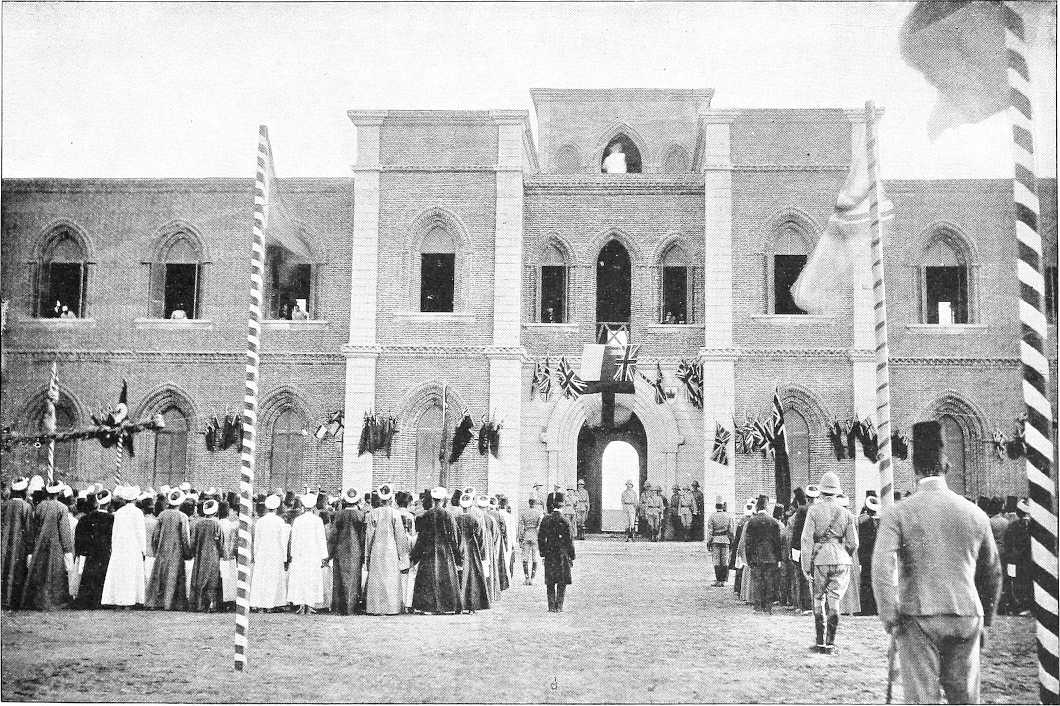
Visits of distinguished persons.It only remains to be stated that in January 1900, and again in February 1905, T.R.H. the Duke and Duchess of Connaught, and in November 1901 His Highness the Khedive, visited Khartoum; a year later General Lord Kitchener did the same and opened the Gordon College; whilst Lord Cromer paid visits in December 1899, January 1901 and January 1903, proceeding as far as Gondokoro in the latter year.
H.R.H. Princess Henry of Battenberg, accompanied by the Princesses Victoria of Battenberg and Beatrice of Saxe-Coburg, visited Khartoum in February 1904.
Sir William Garstin visited the White Nile, Bahr El Ghazal, Bahr El Zeraf and Blue Nile in 1899-1904, and the Bahr El Jebel in 1901 and again in 1904, when he also explored the River Atem or “Gertrude” Nile. In 1903 he visited Uganda, Semliki River, Albert Nyanza, as well as the Bahr El Jebel. The results of these journeys have now been published, August 1904 (F.O. Blue Book, Egypt, No. 2, 1904).
Explorers.The following noted travellers, in addition to numerous distinguished sportsmen, have passed through Khartoum at different times since 1898: Wellby, Grogan, Donaldson-Smith, Henri, Gibbons, Neumann, Austin, Bright, Lionel Decle, Macmillan, and Bulpett, Sir C. Eliot, Powell Cotton, and Pierre. The latter arrived in January, 1904, from Zemio in Haut Ubangi viâ Deim Zubeir and Wau.
GOVERNORS-GENERAL OF THE SUDAN.
Name. Date.
Mohammedan. Gregorian.
Osman Bey 1240 1825
Maho Bey 1241 1826
Khurshid Pasha 1241 1826
Ahmed Pasha Abu Udn 1254 1839
Ahmed Pasha El Minikli 1259 1844
Khaled Pasha 1262 1846
Abdel Latif Pasha 1266 1850
Rustem Pasha 1267 1851
Ismail Pasha Abu Jebel 1268 1852
Selim Pasha 1269 1853
Ali Pasha Sirri 1270 1854
Ali Pasha Sharkas 1271 1855
Arakil Bey 1273 1857
Hassan Bey Salama 1275 1859
Mohammed Bey Rasikh 1278 1862
Musa Pasha Hamdi 1279 1863
Jaafar Pasha Sadek 1281 1865
Jaafar Pasha Mazhar 1282 1866
Mumtaz Pasha 1287 1871
Ismail Pasha Ayub 1289 1873
Gordon Pasha 1293 1877
Rauf Pasha 1296 1879
Abdel Gader Pasha 1299 1882
Ala El Din Pasha 1300 1883
Gordon Pasha 1301 1884[219]
Kitchener Pasha 1316 1899
Wingate Pasha 1317 1899
By kind permission of] [M. Venieris. RECEPTION OF LORD KITCHENER AT THE GORDON COLLEGE, KHARTOUM. NOVEMBER, 1902.