Volume 1 — APPENDIX C.
Reading edition
ZOOLOGY OF THE SUDAN.
ZOOLOGY.
In preparing the following notes on the Zoology of the country, it has been assumed that the Mammals and Birds will present the most general interest. The variety and distribution of the large “game” animals has been briefly sketched, and, to make space for this, reference to the Invertebrate animals has been omitted.
Mammals.
Primates.Apes and Monkeys are well represented in the Sudan. The Chimpanzee (Anthropopithecus troglodytes schweinfurthi) occurs in the Bahr el Ghazal region, where also is found the beautiful black and white fur-bearing Colobus guereza; Baboons (Papio hamadryas and P. anubis), Grivet (Cercopithecus sabæus) and Patas Monkeys (C. patas) abound and are widely distributed. Lemurs (Galago) occur, but are seldom met with.
Carnivora.The Lion is found wherever the country is suited to its habits, and is in places plentiful. In 1880, one was seen half-way between Berber and Suakin, but at the present time it ranges little further north in the Sudan than Kassala. The Leopard, commoner than the Lion, but warier and less often seen, is even more widely distributed; the Cheetah or Hunting Leopard (Cynælurus jubatus) less so. Among smaller felines are the Serval, Caracal and Libyan Cat (Felis serval, F. caracal and F. libyca).
Hyænas, spotted and striped (H. crocuta and H. striata) are common; much rarer and more local is the Hyæna-like, but smaller, Aard Wolf (Proteles cristatus).
Jackals, Foxes and Fennecs are abundant; the Wild Dog (Lycaon pictus) is scarcer.
Smaller carnivora are Civets, Genets, the Mongoose, the Ratel, and the pretty little black-and-white Zorillas, which in coloration remind one of the American Skunks.
Insectivora.The Insectivora are represented by Hedgehogs and Shrews (Erinaceus and Crocidura).
Bats (Chiroptera) are plentiful.
Rodentia.Rodents (Rodentia) are represented by the common Porcupine, Hares, Ground-Squirrels (Xerus), Rats, and the Jerboas and Gerbilles—curious little nocturnal creatures living in holes in the desert sands. They have long hind legs and tails, progress by leaps like miniature kangaroos, are of a protective sandy coloration, and subsist entirely without water.
Ungulata.Much the most interesting to the general traveller and sportsman are the Ungulata or hoofed animals, and in this “big game” the Sudan is particularly rich.
The Elephant is found on the Setit (from which during the Kharif or rainy season it ranges as far north as the Gash), the Upper Atbara, the Rahad, the Dinder, and the Blue Nile; it ranges across the Gezira in smaller numbers and becomes more plentiful again along the Upper Sobat, Pibor, the Bahr-el-Jebel, in the Bahr-el-Ghazal Province, along and west of the Bahr-el-Arab as far north as Kalaka. The ivory from these southern swampy districts is much larger than that from the Blue Nile and Abyssinian frontier—tusks running up to 130 lbs. or so in weight—but it is not of quite as good quality. No organized effort to capture and train adult African elephants has been made in modern times, and attempts to rear the young on cow’s or goat’s milk or farinaceous substitutes have generally failed.
The Black Rhinoceros (R. bicornis) was found as far north as the Gash in 1880; a very few still remain on the Setit, the Rahad, Dinder and Blue Nile; on the Bahr-el-Jebel, in the Bahr-el-Ghazal Province, and on the Bahr-el-Arab it is less scarce, while there is some reason to believe that in this last-named tract of country the White Rhinoceros (R. Simus) is not yet extinct. The destruction of Rhinoceroses in the Sudan is absolutely prohibited.
A curious little animal somewhat doubtfully placed by naturalists near the Rhinoceroses is the Hyrax, a small animal, in shape somewhat resembling a guinea-pig, which inhabits rocky hills in many parts of the Sudan.
The Wild Ass is found in some of the Eastern deserts; while Zebras (probably Grant’s Zebra) just extend into Sudan territory north of Gondokoro on both banks of the Bahr El Jebel.
Buffalo—the shorter-horned northern form (Bos caffer equinoctialis) are numerous in suitable localities, and appear to be holding their own; their distribution is roughly the same as that given for the Elephant.
Of Hartebeests, Bubalis tora is common on the Setit, the Upper Atbara and the Blue Nile tributaries; Bubalis jacksoni takes its place on the White Nile, Bahr-el-Ghazal and in S.W. Kordofan; a much scarcer and more local species, apparently Bubas Neumanni has been found on the White Nile near J. Ahmed Agha. The Tiang[233] or Bastard Hartebeest (Damaliscus tiang) is abundant in the Gezira, and in the southern and western parts of the Sudan; on the eastern side of the country it does not range north of the Dinder.
The Water-buck (Cobus defassa) is generally distributed where water and grazing are to be found; the beautiful Mrs. Gray’s Water-buck (C. maria)—the males of which are marked with a snow-white patch on the withers—is one of the most local of African Antelopes, inhabiting only the swamps of the Bahr-el-Ghazal and Bahr-el-Jebel.
The White-eared Cob (C. leucotis), commencing near Renk, follows the White Nile upwards, increasing in abundance in the Bahr-el-Ghazal, occurring also on the Sobat and the Pibor, and extending along the Bahr-el-Jebel into Uganda. On this last river the Uganda Cob (C. thomasi) has been shot.
The Roan Antelope (Hippotragus equinus bakeri) is locally distributed from the Setit to the south-west of the Sudan; the Blue Nile tributaries are perhaps the chief stronghold of this noble beast.
The Oryx leucoryx is plentiful in Western Kordofan; the Oryx beisa occurs in one or two localities east of the Atbara. The Addax ranges into the deserts of the Western Sudan, but very few have yet been shot by any European.
The greater Kudu (Strepsiceros capensis) is one of the scarcer Antelopes in the Sudan, occurring locally in Kordofan, and from the Blue Nile to the neighbourhood of Suakin.
The largest known form of Eland (the Taurotragus oryx gigas of Von Heuglin) is found in the Bahr-el-Ghazal Province.
The Lesser Reedbuck (Cervicapra bohor) occurs on both the Blue and White Niles and their tributaries, the Blue Nile examples carrying the finest heads. The Bushbuck of the White Nile is Tragelaphus scriptus, the Blue Nile form being T. decula.
The commonest Gazelles of the Sudan are the Ariel, the Red-fronted, the Dorcas, and Isabelline Gazelles (Gazella sœmmeringi, G. rufifrons, G. dorcas, and G. isabella), widely distributed; more local are the Addra Gazelle[234] of Kordofan (G. ruficollis) and Heuglin’s Gazelle of the Setit (G. ptilonura). Smaller common Antelopes are the Duiker, Dig-dig, and Oribi (Cephalophus, Madoqua, and Ourebia).
The Klipspringer (Oreotragus saltator) is found sparingly on the hills of the Red Sea Littoral.
Ibex (Capra nubiana) frequent the rocky hills of the Kassala and Suakin districts; Wild Sheep (Ovis lervia) have a wider range, but are much scarcer and shier, and have not been recently shot in the Sudan.
Giraffes are in parts numerous, their range in the Sudan area being approximately that of the Elephant, except that they are absent from localities which are entirely swampy.
A few Hippopotami still remain as far north as Dongola, and a few are to be found near Khartoum. Up the White Nile and the Bahr-el-Ghazal they abound, to such an extent that in places they become dangerous or a positive nuisance.
Wart-hogs (Phacochærus) are common and widely spread; while the Sennar Boar (Sus sennarensis) has only been obtained, and very rarely, in this one district.
Edentata.A scaly ant-eater (Manis) occurs, and also a curious ant-bear (Orycteropus æthiopicus), very similar to the “Aard Vaark” of the Cape.
Cetacea.No Cetaceans have been found in the Sudan rivers.
Birds.
The Bird fauna of the Sudan is rich and interesting. Visitors will be most struck by the aquatic species whose abundance on the rivers forms one of the most pleasing features of the scenery. The practice of shooting at birds from steamers (forbidden by law, as is all trading in plumes) cannot be too strongly deprecated. This practice has within the last 30 years banished most of the bird-life from the Egyptian parts of the Nile for ever.
Most of the birds, which are summer visitors to Europe, winter in the Sudan, or pass through it on their way further south. Conspicuous among these winter visitors are Hoopoes, Golden Orioles, Bee-eaters, Shrikes, Warblers, Wagtails, Flycatchers, &c. Small resident species are abundant, the various kinds of Weaver-finches predominating in numbers and collecting in vast flights. Among this family the beautiful scarlet and black “Dura-bird” (Pyromelana franciscana) and the long-tailed Whydah Bird (Steganura paradisea) are specially noticeable. The handsome Glossy Starlings—characteristic African birds—are represented by the genera Spreo, Lamprocolius, and Lamprotornis. Several species of Nightjars occur, noteworthy among which is the remarkable Standard-Wing (Macrodipteryx), bearing a large racket-shaped web at the end of an elongated wire-like feather in each wing.
Colies, or “Mouse-birds,” Kingfishers, Hornbills (chief among which is the great black-and-white Bucorax abyssinicus), Bee-eaters, Rollers and Cuckoos are well represented, as also are Larks and Wheatears. Shining little Sun-birds frequent the forests and enter the gardens in the towns.
Green parrakeets are common, and the grey parrot may be found on the Uganda boundary.
Of birds of prey there are Vultures, Eagles, Falcons, Ospreys, Harriers, Buzzards, Hawks, and Owls in great variety—among which may be mentioned the Noisy River Eagle (Haliaetus vocifer), the Secretary Bird (Serpentarius secretarius), and the handsome Bateleur Eagle (Helotarsus ecaudatus).
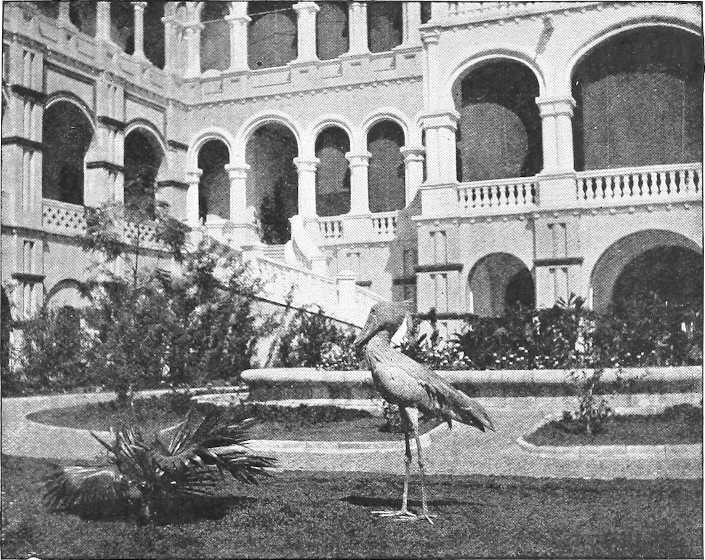
The rivers abound with Pelicans, Cormorants, Darters, Herons, Egrets, Bitterns, Storks, Ibises, and Spoonbills. Among these the great carrion-feeding Adjutant or Marabou (Leptoptilus crumeniferus) is conspicuous. The remarkable and very local Whale-headed Stork (Balæniceps rex) is found in the swamps of the Bahr-el-Ghazal and Bahr-el-Jebel, while the stately Saddle-billed Stork (Ephippiorhynchus senegalensis)—iridescent black and white with long brilliantly-coloured bill—is more widely met with. Flamingoes are scarce; Spur-winged and Egyptian Geese, and Whistling Teal, resident and plentiful. Their numbers are swelled by large hosts of northern-breeding ducks, which arrive in the autumn and remain till the spring. Vast numbers of Plovers, Godwits, Whimbrels, Sandpipers, and Terns also winter on the Nile. Snipe occur, but in comparatively small numbers, the area of irrigated land being very limited, and the grasses of the Nile swamps being too high and thick for them.
COURT OF THE PALACE, KHARTOUM, WITH Balæniceps rex.
Three species of Sandgrouse are very abundant; the commonest (Pterocles exustus) affords the best bird shooting in the country—in the dry season they daily flight in thousands from the deserts to drink at the rivers. Doves and Guinea-fowl swarm in most parts; Francolins are more local and less plentiful. Quail are also found in parts.
A large Bustard (Eupodotis arabis) is plentiful and gives pretty rifle shooting. Three or four smaller bustards also occur.
The strikingly-beautiful Crowned Crane (Balearica pavonina) is resident and common, and in the winter immense flights of Common Cranes (Grus grus) and smaller numbers of the Demoiselle (Grus virgo) spread over the country.
The Ostrich is generally distributed, but is most abundant in Western Kordofan.
Reptiles.
The common African Crocodile (Crocodilus niloticus) abounds in the Sudan rivers. Large Monitor Lizards or “Waranas,” reaching 5 or 6 feet in length, are not uncommon: among smaller lizards are various Chameleons, Geckoes, and Skinks.
Soft-backed river Turtles (Trionyx) are plentiful. A common land Tortoise is Testudo calcarata: a common aquatic Tortoise is Sternothærus adansoni.
Of snakes the largest is Python sebæ; of poisonous species the Cobra, the Horned Cerastes, and, further south, the Puff-Adder occur: harmless species are more numerous. On the whole, snakes in the Sudan are not plentiful enough to be troublesome, and the mortality due to snake-bite seems insignificant.
Batrachians are rather poorly represented: a Toad (Bufo regularis) very like the common European species is the most abundant.
Fish.
The Nile fish have recently been very thoroughly investigated, the collection formed by Mr. Loat, under the auspices of the Egyptian Government, being the largest ever brought together from one country.
Those interested in the subject may note that the scientific results of the “fish survey” will shortly be published in the form of a Monograph, by Mr. G. A. Boulenger.
[Briefly speaking, it may be said that the rivers swarm, almost throughout, with fish; they are mostly of a coarse kind, some running to an immense size—40 to 50 lbs. being quite an ordinary weight for some species.—Note by Editor.]