Volume 1 — APPENDIX D.
Reading edition
THE ANTIQUITIES OF THE SUDAN.
(Vide also pp. 221-228.)
The three decades following the Egyptian conquest of the Sudan in 1819 were each marked by the appearance of a large work dealing with the antiquities of the newly-opened provinces. Unfortunately the authors of these works, Cailliaud, Hoskins, and Lepsius, have found no successors of equal means and perseverance, so that our knowledge of the actual remains stands about as Lepsius left it. When Cailliaud (1820) and Hoskins (1833) visited the Sudan, nothing certain was known of the ancient relations of Egypt and Ethiopia, and the wildest philological theories were in the air. The imposing monuments which these travellers found fitted the theories that Egyptian art was the oldest art known; Ethiopia was supposed by some to be the mother of Egypt; here, then, at Meroe, Hoskins fancied that he had found the cradle, not of Egypt only but of the whole civilised world. Criticism began with Lepsius (1842): the style of these remains convinced him that they were not the archaic parents of Egyptian art but the late offspring of a mésalliance between Egypt and the luxuriant South. The progress made since his day enables us to recognise more clearly the main lines of development, though it will require years of research to fill in the details of our picture.
In the following notes the antiquities are grouped for convenience into four divisions—the Prehistoric, the Egyptian, the Meroitic, and the Christian.
1. Prehistoric.—We know now that the dynastic culture of Egypt was developed at Abydos, Memphis and elsewhere, long before it reached the Sudan, but from the very earliest days desire for the products of the south must have attracted the trader and the soldier, and so carried the culture of Egypt ever further to the south. The ivory and the skulls found in pre-dynastic Egyptian tombs, and the dwarfs and black troops referred to in the Historical Summary, are sporadic witnesses to a coming and going along the Nile Valley which must have lasted for tens of thousands of years. What and whom the early travellers found we cannot say: the country was probably partitioned among a number of petty princelets like the Meleks whom Burckhardt describes as reigning in the provinces of Dongola and Berber in the eighteenth century, and some of the old forts reported in this region and in the desert may date back to this period. To this epoch possibly belong also some of the groups of tumuli visible between the 4th and the 6th cataracts and elsewhere, but of them only one,[235] of the Bronze Age, has been hitherto excavated. A closer study of the surface will doubtless bring to light vestiges of the Stone Age, as it has already done in Egypt and Somaliland.
2. Egyptian.—The first effective occupation of the northern parts of the Sudan dates from the Middle Empire, but though it is represented by several monuments noted in the list below, it did not last for long. The kings and queens of the New Empire returned to the conquest and exploration of the south, and left much more striking memorials of their greatness. The tablets found at Tel el Amarna are full of requests from Syrian princes for gold, which was exported to them unworked, and by them smelted and wrought into ornaments and vessels. Now the bulk of this gold came from the numerous mines which still exist between the Red Sea and the Nile; in a word the Northern Sudan was the “Rand” of the ancient world. The shafts and huts of the miners, their washing-tables, grinders, and other appliances are found still in situ, and the position of some of the finest temples is now seen to be determined by their nearness to rich auriferous regions. This is, perhaps, the most important discovery made since the days of Lepsius.
Under the eighteenth and nineteenth dynasties the Northern Sudan was an Egyptian province, an appanage often of the heir-apparent, and the monuments of this date (see below) are thoroughly Egyptian in character. Under the twenty-second dynasty the conditions were reversed and Egypt became an Ethiopian province; but, as is usual, the civilised power conquered its conqueror, and although Napata now reached its zenith, the character of buildings, statuary, and inscriptions, was not native but Egyptian; this was only natural, seeing that the Ethiopians could command the best workmen in Egypt. It is not until the sixth century B.C. that we begin to see signs of a change. The inscriptions of Heru-Sa-Atef and Nastasenen clearly betray the native origin of their authors; they were written in hieroglyphics by priests who aimed in vain at reproducing the old classical idiom of Thebes. Their last editor very aptly compares them to attempts of a Dongolawi to write Koranic Arabic.
3. Meroitic.—With the conquests of Alexander and his successors and the spread of the Roman Empire, Ethiopia was brought into touch with a wider system than any it had yet seen, and this Greco-Roman period coincides with the development of a complex original style, in which the African character seems to find its first articulate expression. Exact dates for the numerous monuments in this style cannot be given; some may go back before the time of Alexander, some of the most elaborate certainly fall late in the Roman period. The architectural forms of the latter show the gradual supersession of Egyptian conventions by European designs and construction, while the rich attire of the rulers portrayed bears witness not less to their barbaric taste than to the wealth which radiated under the Pax Romana even beyond the limits of the empire. In this mingling of East and West these works should be compared with those of other schools that arose under the shadow of the Roman Empire, such as the Palmyrene school in Syria and the Greco-Roman Buddhist school in the north-west of India.
The most characteristic works of this school are to be found in the Berber province. The pyramids (Bagarawiya) and the avenue of rams and the pylon-fronted temples (Nagaa and Wadi El Sufra) point back to Egyptian prototypes, but side by side with these we see temples where the pylons have given way to columns fluted and spaced in the fashion of a Roman peristyle shrine, and one small building which has even been described as a Christian basilica!
The Meroitic Pantheon is equally mixed: we pass from the Ammon of Thebes to the Ammon of Napata, and from him to a strange Ethiopian Serapis and a still stranger local or Indian lion-headed god.
The subjects are mostly, like those in Egypt, scenes of adoration or offerings of spoils of victory, but the persons sculptured are Egyptian neither in type nor costume. The best-known of these is the fat Queen “Candace,” whose very fleshly charms are set off by masses of jewellery, heavy necklaces, armlets, bracelets, sandals, and clinging feather-like garments. Her consorts and attendants are only less richly bedizened with jewels and rare stuffs, embroidered with crosses, crescents, “and other delights.” Other panels represent water goddesses and hunting scenes with wild beasts (lions, elephants, etc.), led in captivity by men and genii. The small objects found on these sites (now mostly at Munich and Berlin) give the same impression of barbaric wealth, and the relatively numerous bells show that the Ethiopian of those days was as fond of noise as his black successor.
Unfortunately the inscriptions which accompany these buildings cannot be deciphered. As we saw above, Egyptian was a foreign language to the people of Napata in the sixth century. On the Meroitic monuments not only is the language foreign, but new phonetic values have been given to the old hieroglyphic signs, which makes even transliteration impossible until more bilingual inscriptions turn up.[236] And these hieroglyphics persist until superseded by a script based on Egyptian demotic or perhaps some Arabian alphabet, which is equally unintelligible.
4. Christian.—The Christian antiquities have fared still worse at the hands of explorers than the earlier ones; the traveller notes “ruins of a Coptic convent” and hurries on to something more congenial. Lepsius collected a few inscriptions, and these have been supplemented from time to time; a few things have been found at Soba and rough sketches published of one or two churches.
The most interesting building known to the writer is the church at Old Dongola, a building in two storeys of burnt bricks, subsequently encased in a thick shell of sun-dried bricks. The ground plan of this is believed to be unique: it looks like an adaptation to Christian ends of old Egyptian structural motives. This building and the ruin-heaps into which many other churches—still called Kanisas by the natives—have been reduced, show that all the lessons of construction learnt under the Roman Empire were not forgotten under the rule of the Christian kings. The pottery of this period was, so far as one can judge from fragments still lying on the surface, more finely levigated, better baked, and more variously decorated than in earlier or later days.
Inscriptions in three languages have been found. At Soba, and perhaps at Geteina (White Nile), Christian inscriptions occur in an unknown language, but in the Greek alphabet eked out by five additional letters; from the Dongola province and from Northern Nubia come inscriptions in Greek and in Coptic. Some of these are dated in the eighth and ninth centuries A.D., and the formulæ used in them are similar to those found in Egypt.
The list of ancient sites, etc., appended does not pretend to be complete. Those who wish for further information are referred to the following authorities, which may be supplemented from the bibliography; but they must remember that the study of these antiquities is still in its infancy.
Authorities.(1.) Discoveries.—Cailliaud, “Voyage à Méroé,” Paris, 1826; Hoskins, “Travels in Ethiopia,” London, 1833; Lepsius, “Denkmäler,” Berlin, 1842, etc.
(2.) Special Memoirs.—Ferlini, “Relation Historique,” 1838; Maspero, “Études de Mythologie et d’Archéologie Egyptiennes,” III, Paris, 1898; Heinrich Schäfer, “Die Aetiopische Königsinschrift des Berliner Museums,” Leipzig, 1901.
(3.) Much valuable information may be obtained also from the large histories of Egypt by Maspero, Budge, and Petrie, and from the handbooks published by Murray, Bædeker, and Cook (“The Nile,” by Dr. Budge). Illustrations and slight descriptions of some of the antiquities have been published by J. Ward in the “Monthly Review” for August, 1902, and May, 1903, and of the gold mines in the prospectuses issued by the companies prospecting.
Space does not suffice to give details of all the antiquities: a bare list must suffice. The initials given below are as follows:—Murray’s Handbook of Egypt, 1900 (M.); Dr. Budge’s “The Nile,” 1901 (B.N.); Lepsius “Denkmäler,” 1842 (L.); Cailliaud’s “Voyage à Méroé, 1820” (C.); Rawlinson’s Egypt (Story of the Nation Series) (R.); Dr. Budge’s “A History of Egypt,” 1902 (B.E.); Hoskins, 1833; J. Ward (articles in “Monthly Review,” August, 1902, and May, 1903, with illustrations) (W.).
Antiquities on or near the Nile Banks.
About 2 miles above Halfa, on the west bank, is an ancient Egyptian site with several temples.
Abu Sir.Five and a half miles above the same town, on the west bank, is the rock of Abu Sir. The chief historical interest of this spot (from which a fine view of the 2nd Cataract is obtained) is the variety of names inscribed on it, reaching back several hundred years.
Matuka. B.C. 2760? or 2430?Three miles south of Abu Sir are remains of the fortress and small temple of Matuka, built by Usertsen I of the Twelfth Dynasty.
On a large island opposite are the remains of a similar fortress and on another small island to the south are the ruins of a Coptic church called Darbe (M. 983)
Semna and Kumma. B.C. 2320? B.C. 1600? B.C. 2300.Forty-three miles south of Halfa are the fortress temples of Semna and Kumma, built by Usertsen III. Rebuilt and extended by Thothmes III of the Eighteenth Dynasty. In good preservation. Amenemhat III also marked the rise of the Nile here (B.N. 489, 490; B.E. iii, 46, 48, etc., iv, 94, vi, 187, and vide p. 222).
Amara. B.C. 1000?At Amara are important ruins of a temple with sculptured columns (L.; B.N. 491).
At Selima Oasis, 55 miles west of Sagiet El Abd, are remains of old convents, built out of still older remains, on which there are unknown inscriptions. (Vide p. 203.)
Sai. B.C. 1660-1600?At Sai Island, 130 miles from Halfa, are remains of a town and Coptic church, and of cemeteries, also of a temple with inscriptions of Thothmes III and Amenhotep I (Eighteenth Dynasty).
Sedinga. B.C. 1800.At Sedinga, 6 miles further, are the ruins of a fine temple by Amenhotep III, a column and a cemetery (B.E. iv, 111).
J. Dush. B.C. 1620?Six miles to the south is Jebel Dush, with a tomb contemporary with Thothmes III (B.N. 402).
Solib. B.C. 1500.A mile further on is Solib, with the well-preserved remains of a magnificent temple by Amenophis III (L.; B.N. 492; B.E. iv, 59, etc.; Hoskins, etc.). Many treasures removed to Jebel Barkal.
Sesebi. B.C. 1370 or 1275?Sesebi, opposite Dalgo, contains a ruined temple by Seti I, father of Rameses the Great. (L.; B.E. v, 9.)
In the district between Dalgo and Koya are several ancient workings for gold and copper, which account for the presence of rich temples near.
Tombos.On the Island of Tombos, near Kerma, are granite quarries and one statue unfinished.
Argo.On the Island of Argo (Arkaw) are ruins of a temple and of two granite statues lying on the ground (about 24 feet long, including pedestal), of Sebekhotep III, of the Thirteenth Dynasty, or else, more probably, of the Napata period.
Karman.Near Argo, on the right bank at Karman are the ruins of a large town, and two large mud-brick tombs (B.N. 493, and L.), called Dafufa and Karman.
Six or seven miles south of New Dongola, on the right bank at a place named Kawa, is a delicate little Egyptian temple, date unknown, in good preservation. (Discovered and partially excavated by Colonel Hon. J. Colborne, 1885.)
Khandak marks the site of an ancient Egyptian town of which traces may be seen in the citadel.
South of Khandak are traces of Christian or older sites at Firgi and Khalewa on the west bank (Greek inscriptions have come from the latter), and on the east bank at Amentogo, Arab Hag (inscription from obelisk set up in Napata (?) by Piankhi) and a few miles east of Meganda, the last two in the Latte.
Old Dongola.Old Dongola, now almost deserted, was the capital of the Christian kingdom of Dongola in the sixth century.
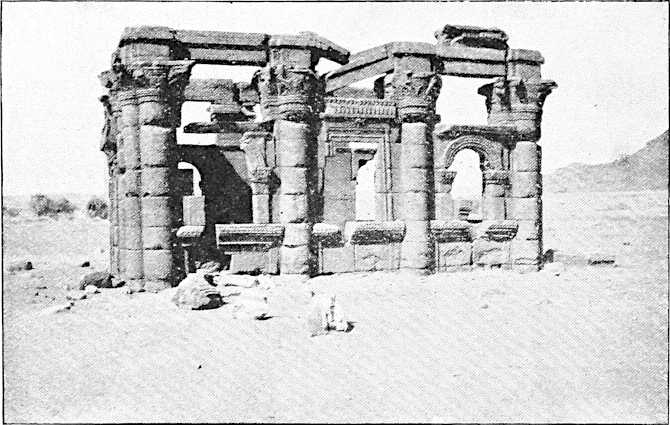
NAGAA: ROMAN BUILDING IN THE DESERT—SHOWING THE TRANSITION FROM EGYPTIAN TO ROMAN STYLE.
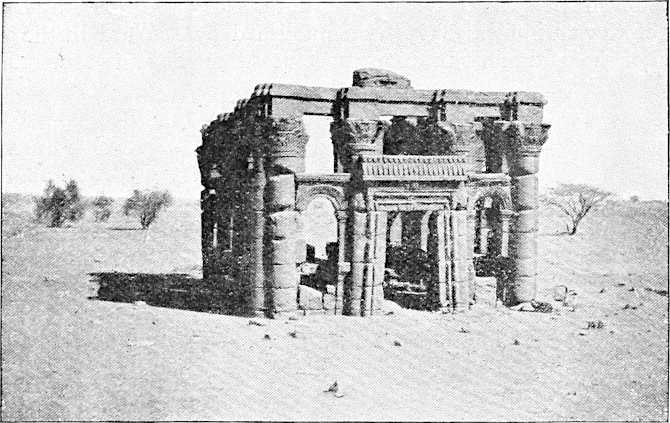
NAGAA: ROMAN BUILDING IN THE DESERT.
The upper floor of the fine church there is now used as a mosque. On a ridge between the church and the river are remains of ancient fortification. An obelisk of Piankhi, now at Cairo, the fellow to that at Arab Hag, was found here, but had been probably carried from Jebel Barkal. Some Christian inscriptions have been found here (see “Journal of Theological Studies,” IV, p. 583).
Kurru, Zuma, Tangasi.At Kurru and Zuma (east bank), and Tangasi, 7 to 10 miles from Merowe, are remains of large groups of pyramids (B.N. 496), a few of stone, others of mud-brick from which the stone casing has been removed.
On Gimeti Island are traces of a church.
Merowe. B.C. 900 to B.C. 200.Merowe (north bank) and Abu Dom Sanam (south bank) mark the site of Napata (Nept or Nepita). The old city appears to have been on the south bank, and of considerable size (vide p. 222). A few miles from the river on this bank, in low hills, are the remains of a number of rock-hewn tombs, and 3 or 4 miles up-stream from Abu Dom, on the north bank, lie the pyramids and ruins of the temples of Napata.
Jebel Barkal.Jebel Barkal, 302 feet high, the “Holy Mountain” of the inscriptions, can be seen for many miles round; on the plain by the side of the hill are ruins of eight or nine pyramids, and on the rising ground are eight more, varying from 20 to 60 feet in height.
Circa B.C. 700. Nuri.The principal temples are those of Taharka and Piankhi, close to Jebel Barkal. At Nuri, 7½ miles from Merowe, on the south bank, are the remains of 35 pyramids, solidly built, and probably of the Middle (?) Empire. At Wadi Ghazal are the remains of a fine Christian monastery. (B.N. 496-503; Cailliaud; Lepsius.)
Belal.A few miles beyond Belal (foot of the 4th Cataract) and on the south bank are the remains of a Coptic church and fortified monastery.
Opposite Hamdab Island, 6 miles further on, are the ruins of a pyramid.
Berber.No further remains have been discovered for the next 250 miles or more. There is evidence that Berber was in the ancient days a starting point, as now, for caravans for Suakin, but there are no ancient remains, as far as is known.
Island of Meroe and Bagarawiya. B.C. 400 to A.D. 250.On crossing the Atbara the “Island of Meroe” is entered, and at Bagarawiya, some 45 miles south of the Atbara, three important groups of pyramids, about 100 in all, are reached. These, also called the pyramids of Assur, lie about 3 miles from the river, and are the tombs of kings and princes of the old capital, which lay somewhere near Shendi. An important find of jewellery of the Roman period was made here by Signor Ferlini, an Italian doctor, in 1834. (B.N. 509-513; L.; Cailliaud; Ferlini; W.) Since then the tops of many pyramids have been damaged in similar searches.
About 29 miles south of Shendi, on the east bank, is the entrance to the Wadi Ban Nagaa, and near it is a village of that name. Three miles down the river are the ruins of a small ancient Nubian temple.
Nagaa.Twenty-three miles south-east from the railway station of Wadi Ban Nagaa, and situated in a low waterless desert, are the extensive remains of an ancient town. The walls of six temples are still standing, at least in part, and the foundations of several others can be traced. Two of them are connected together by an avenue of rams. One of the temples is almost purely Roman in style, and belongs, perhaps, to the third century A.D.; others are transitional; these are in comparatively excellent preservation. (Description by Rev. L. Gwynne; B.N. 514, 515; Cailliaud [elaborate]; and W.). They were also visited by Wurt (1811), Demetrio (1822), Holroyd (1837), and Lepsius.
El Sufra.Twelve miles north-east of Nagaa are the ruins of El Sufra, also called El Masurat, a group of buildings within walls, of the Roman period, with a Meroitic inscription (C.; L.; and Hoskins, and B.N. pp. 515-516). One and a-half miles off are some Christian temples (?) (B.N. p. 515). A road track leads south-east from Shendi viâ Nagaa temples to Soba, and there are, it is reported, old temples on the way.
Khartoum.There are no visible ruins of ancient temples at Khartoum, though it is known that it was the site of a large town (vide p. 228). A colossal Christian (?) stone lamb has been brought here from Soba (W.).
Soba.At Soba, believed to be the old capital of the Christian Kingdom of Alwa, built on the old Ethiopic site of “Sobas,” 13 miles from Khartoum and on the east bank of the Blue Nile, are some remains of granite pillars and of a Christian church, including a decorated base with a large cross carved on it (W.). Little is known about this. There is said to have been a bridge here over the Blue Nile.
Miscellaneous.
J. Geili.At Jebel Geili, 92 miles east from Khartoum, there is a carving in Meroitic style on a huge granite block at the south-eastern end of the hill, and on a neighbouring rock higher up the hill are the carved outlines of three horses (dates unknown).
Koliteb.At Koliteb, 113 miles from Tokar, on one of the Kassala roads, there are ancient and rude carvings of men and camels on the rocks (Junker).
Mamân.At Jebel Mamân, 201 miles from Suakin, on the “Ermenab” route to Kassala, there are some curious old Christian stone ruins and tombs (Schweinfurth; Z.A.E., 1865, p. 398).
Sennar.Little or nothing of the old Sennar Kingdom is left.
At Geteina, on the White Nile, some inscribed bricks and pottery of the Christian period have been found. These are now preserved at Khartoum in the Gordon College Museum.
El Ein.Vide p. 211.
W. Mogaddam.Vide Vol. II, route Gabra—Korti.
W. El Fura.Just above the wells of El Fura are the remains of a large rectangular fort (about 60 by 50 yards), with massive stone walls some six feet high and eight to ten feet thick, with curious square projections, perhaps for flanking defence. It may belong to the same period as the great stone fortifications at Old Dongola and Khandak, but the masonry presents one curious feature not observed there, namely, the frequent use of stones with the long dimensions vertically placed. It would serve to command the wells on a road from Merowe to Napata.
Tombs, Atbai.North of the Berber-Suakin road, Lieutenant Newcombe, R.E., reports some curious tombs. Two are near the Wadi Amur (E. Long. 36° 15″, N. Lat. 19° 15″), and one is close to the watershed of Khor Garrar (E. Long. 36° 40″, N. Lat. 20°). The ground plan of these tombs is octagonal; they were roofed apparently by a dome supported on a hexagonal (?) drum, and lit by plain rectangular windows. It is impossible to say whether they belong to the late Christian or the early Mohammedan period. The rounded battlement which crowns the corners of the eight walls is a common feature on Sheikhs’ tombs.
It only remains to point out that the surface of Sudan antiquities has barely been touched. It is hoped that as money becomes available more of the ancient history of the Sudan may be brought to light, and more particularly is it hoped that the meaning of the Nubian and Meroitic hieroglyph inscriptions may shortly be discovered.
The whole matter is being gradually taken up by the Sudan Government, but want of funds hampers the work.
The distinguished Egyptologist, Dr. Wallis Budge, of the British Museum, has already paid several visits to the country.