Chapter VIII · SHIELDS AND SHIELDING
Reading edition
Shielding is one of the most important branches of practical podiatry. A great amount of study must be given to this work, and to afford his patient relief and comfort through the application of shields and strappings, the operator is continuously called upon to exercise his mechanical ingenuity or to develop this trait if it be not already existent.
The surgical treatment of a condition may be faultless, and yet upon the application of an ill-fashioned or poorly-fitted shield, the patient will experience even a greater amount of discomfort or pain than before the treatment was commenced, and the operator’s previous good work is thus undone.
Definition. A shield is an appliance fashioned from some skin or fabric and used for the purpose of relieving pressure or friction, or to protect a tender part upon the foot. The nomenclature which is adhered to under this heading is comparatively a simple one. The various forms and varieties of shields mentioned and discussed are named either for their shape or for the particular parts of the foot to which they are applied. In some instances the two are combined. Thus a “lateral plantar half-moon or crescent shield” has a crescent shaped body and is used for the protection of an area on the lateral part of the plantar surface.
MATERIALS
Various materials are in general use today in the practice of podiatry for padding or shielding. The object is to give here a brief yet comprehensive description of each in its turn, together with a general survey of when, where and how they may be used.
Chamois. This skin presents a material which may be used in shielding parts where a pad of great thickness is not required. Chamois skin is quite thin and has not a great deal of stability or “body” in its make-up, and skins of a uniform thickness throughout are seldom obtainable. The hide thins out considerably toward the belly of the animal and for this reason there is a great amount of waste. However, in many cases chamois may be used with success in connection with helomata on the dorsal or outer lateral surfaces of the fifth toe, the dorsal surfaces of the intermediate, and the ends of all the toes. For heloma molle, shields of chamois may also be used to good advantage, as they are soft and pliable and when placed between the digits they readily take the shape of the toes without causing the irritation following the use of shields of a coarser or stiffer “body” in like positions.
Buckskin. Buckskin is probably the most generally used material for shielding in practice today. This hide has good “body” and even when skived to paper thinness retains a great amount of its stability. Buckskin can be obtained in thicknesses ranging from one-sixteenth to one-quarter or even three-eighths of an inch, but care should be exercised in its selection that no pieces of coarse-grained skin be chosen. This is noted because the coarse or “pebbled” skin does not skive readily, and when bevelled off, the edges remain ragged and uneven. There are several firms manufacturing excellent grades of buckskin. Shields of buckskin may be generally used in all conditions and locations, the thinner skins on the toes and dorsal surfaces and the thicker on the plantar surfaces and on the metatarsophalangeal joints of the great and fifth toes.
Adhesive Moleskin. A so-called moleskin having a prepared medicated adhesive substance on one side is becoming very popular with the profession. It may be obtained in rolls of from one to ten yards long, and from seven to twelve inches wide. It is very thin but has good “body,” and under the pressure to which it would be ordinarily subjected as a shielding material, does not stretch nor pull out of shape. Because of this thinness and its pliability and softness, no skiving of its edges is necessary, and it makes a neat, clean, practical material from which thin shields may be fashioned. Adhesive moleskin may be employed wherever chamois or the thinner grades of felt or buckskin are used.
Sheep Skin. Sheep skin is one of the lesser used but, nevertheless, practical shielding agents. Its one disadvantage is that the finished surface is smooth and shiny and an adhesive substance does not remain intact unless applied at the time the shield is to be used. This, however, does not present any serious objection to the use of the skin, as it is easily skived, has good “body” and presents a neat, clean appearance on the foot. It is employed wherever chamois may be used.
Felt. Plain white piano felting, of the softer and more pliable grades, is largely used at the present time. This felt can be obtained in thicknesses of from one-sixth to three-eighths or even one-half inch. The last mentioned thickness is very seldom used, and then only in cases where a slight support is needed for the longitudinal arch or as a pad in cases of painful heel. In both these instances the felt is pasted in the shoe rather than adhered to the foot. The one-sixteenth inch grade is used (1) between the toes (applied usually without adhesive); (2) as a substitute for chamois, kid or buckskin in all places where these latter may be used. The thicknesses ranging from one-eighth to three-eighth inch are used generally on the lateral surfaces of the first and fifth metatarsophalangeal articulations, on the plantar surface under the prominences of the same joints, and for protecting painful areas on the dorsum of the foot (its lateral borders), or in the region of the heel and the tendo Achillis. Felt shields may be applied with or without adhesive, and strapping should be done dependent upon the length of time the shields are required to remain.
For badly inflamed or tender helomata, felt presents an ideal material for shielding. Shields of this material are softer and more yielding, and while they cannot be expected to stand the same amount of usage as those of buckskin they are, nevertheless, strongly recommended in the above named condition. After the aperture is cut to fit the part to be protected, its (the aperture’s) edges are nicked with scissors so that when applied they will expand and readily take the shape of the indurated areas. While they naturally pack down and become of denser consistency than at the time of application, felt shields never become as hard as those made of buckskin.
Adhesive Felt. This is the ordinary prepared felt manufactured by several firms, one side of which is covered with a preparation of dry gum arabic. Upon moistening this adhesive, the shield may be adhered to any part. Shields of adhesive felt are very handy to use when protection is desired for a short time and are very seldom strapped unless they are to be applied to the plantar surfaces. They have no specific use and may be applied wherever shields of other materials are used.
Lamb’s Wool. This material is used principally for insoles in shoes in cases of painful heel or severe callosities on the plantar surfaces, and in conditions where the integument of the foot is thin and the patient experiences pain or burning sensations when walking. The wool is left on the hide, so that there is ample body for the application of adhesive substances. This material, in the uses mentioned above, is seldom adhered to the foot itself, but is, rather, placed in the shoe.
PREPARATION OR MANUFACTURE OF SHIELDS.
The definite points to be considered in the making of a proper fitting are not many; these are important:
1. Location of the part to be protected so that the size and shape of the shield may be determined.
2. Thickness of the shield.
3. Skiving.
4. Aperture.
Location of the Parts to Be Protected. Extreme care should be exercised in deciding upon the size and shape of the shield. The location and size of the area to be protected should be taken into consideration and the shield should be so fashioned that no part of it extends on the tissue upon which its presence might cause irritation. For instance, a shield is to be applied on the dorsal surface of one of the intermediate toes; it should be wide enough to cover the surface of that toe, but should not be allowed to curl downward upon the digit’s lateral surfaces or to lap over or extend upon the adjoining toes. Again, a shield applied on the plantar surface should never be allowed to extend forward to a point where it might crowd under the toes and come in contact with their webs.
No shield applied for the protection of one area should be allowed to extend over and press upon another area which is not normal integument. The reason for this is obvious, for in covering an heloma, for instance, a greater amount of pressure is brought to bear upon that excrescence, with the result that it is subjected to a greater amount of irritation and pressure than would be caused by the shoe itself.
Thickness of the Shield. Just as great harm is brought about by using a shield that is too thick or too thin as follows the absence of the protection which a shield provides. If it be too thick, the great amount of pressure put upon the surrounding area will depress those tissues to such an extent that severe congestion, with its accompanying pain and discomfort, is liable to ensue. In making a shield too thin, no protection is afforded to the area where it is desired and at the same time the toe is bundled up with a lot of padding and plaster which is entirely unnecessary, in that it does no good. The use of a shield should be avoided in all cases, when possible, but there are many situations in which a shield is indicated and which, when applied, proves highly effective. Shields naturally pack down more quickly when the weight of the whole body is constantly being applied, and so, naturally, the thicker varieties of shielding are used on the plantar surfaces. This applies to all shielding materials and in particular to felt.
Skiving. Skiving is a process by which the edges of a shield are thinned or bevelled to a “feather” edge. This is done for three principal reasons:
(1) When a shield’s outer edges are skived to a “feather” edge, it no doubt adheres to the integument in a much more satisfactory and lasting manner than if those edges were allowed to retain a uniform thickness with the main body of the shield.
(2) By thinning the shield down at the edges any danger of unneeded and detrimental pressure upon the underlying and surrounding areas is removed. The object is merely to protect a certain part, and, therefore, if a pad is used which is of sufficient thickness around the painful area to protect the diseased tissue, the aim is accomplished, and to have any considerable thickness to the shield, except as it is immediately adjacent to the area to be treated, is entirely unnecessary.
(3) Skiving a shield at its outer extremities does away with, or at least minimizes, the danger of the shield being loosened or shifted, and consequently it will remain longer in place and with better results.
The inner edges of the aperture made in the shield for the protection of the diseased part should also be skived. This is done with the idea of conforming the shield, as nearly as possible, to the shape of the indurated integument and does away with any irritation to the part which might be caused were these edges left perpendicular.
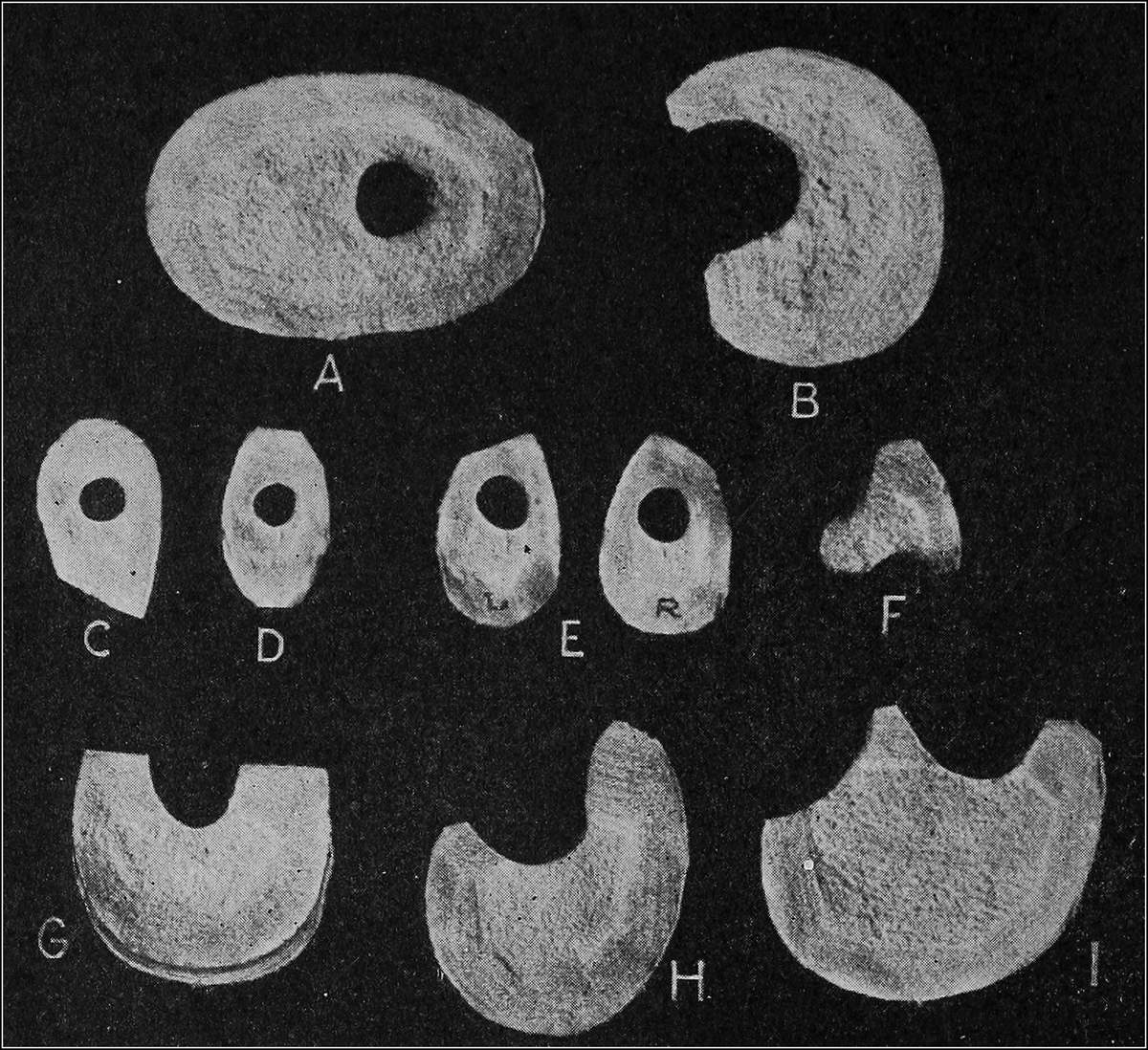
Fig. 1.
A. Oval; B. Half-moon or Crescent; C. Interdigital; D. Dorsal (Intermediate Toes); E. Fifth Toe (Right and Left); F. Boot Shield; G. Dorso-digital Half-moon (Built Up); H. Modified Half-moon I. Medio-plantar Crescent (With Cut-out for 1st or 5th Joint)
Aperture. For the purpose of protecting a diseased part from the pressure of footgear, an aperture or opening is made in the body of the shield. The size of this aperture is so fashioned as to be slightly larger than the part to be protected. Many mistakes are made in shielding, due to the aperture not being cut in the proper place, and care should be taken in this connection. This opening is not always made in the centre of the shield; in many instances it must be placed either to one or to the other side of the median line, running anterio-posteriorly, and in other cases it should be nearer the front rather than the back of the shield, and vice versa.
For example: we are to shield an heloma on the fifth toe. Upon examination of the part we find that the growth occurs on the dorsal ridge of the digit and that while there is a considerable area of the normal integument on the toe’s outer lateral side, the space between the inner edge of the growth and the fourth toe is very narrow. The aperture must then be so made in the shield that a very narrow portion of the skin or fabric rests upon the strip of normal tissue toward the fourth toe and that the wider edge extends down the side of the fifth digit. Again: in some instances we find that the spot to be protected is much nearer the distal end of the toe and the nail than the proximal part. The opening should then be made much nearer the anterior part of the shield than the posterior, so that when applied, the anterior part of the shield will not cover the nail or overlap the distal end of the toe. Too much stress cannot be laid upon this particular feature of shield-making and their application, and the student and practitioner alike will do well to give these points great consideration.
Method of Skiving. The most generally used and in all probability the most efficient method of skiving a shield is as follows: the material used, after being cut to the shape and size desired, is placed with the left hand. The skiving knife is then taken firmly in the right hand and with an oblique stroke away from the operator, the edges of the shield are cut away and thinned to a “feather” edge. This is continued around the whole outer circumference of the shield until a uniform thickness is obtained. After this procedure, should the centre of the shield present any inequalities or uneven ridges, these are pared away in a like manner until the whole surface is uniformly smooth.
One side of all pieces of buckskin will be found to be firmer and have a better body than the other. This is the surface to be allowed to remain intact, the bevelling being done on the reverse side. This insures a firm surface for the application of an adhesive substance.
The Skiving Knife. The knife which seems to be most practical for our purpose in this procedure should have a blade from three and one-half to five inches long, about three-quarters of an inch wide at its base and tapering gradually until, at the end, the width of the blade is about three-eighths of an inch. This insures a large cutting surface and the blade, being tapered instead of an even width from point to base, allows the operator to employ an oblique movement in skiving the shield.
The handle of this instrument should be fairly large and round, so that it will admit of a firm hold. A so-called “Murphy knife” is found to be a very practical and inexpensive instrument for skiving.
APPLICATION AND STRAPPING OF SHIELDS
In applying a shield, care should always be taken that the aperture is of sufficient size to protect all of the affected area. If this is not done, great inconvenience and perhaps severe pain is caused to the patient, in that the shield rests upon tender tissue which should be protected. It is also good policy to allow for any shifting which may take place. As for example, in the instance of an heloma: the shield should be applied so as to leave some space between the anterior edge of the indurated integument and the anterior edge of the shield’s aperture. The foot in the process of walking (and particularly if the patient wears high-heeled shoes) is being constantly pushed towards the forward part of the shoe, and, therefore, a shield protecting an heloma on the dorsum of any of the toes will be pushed back rather than forward. By taking this into consideration the shield, if it does shift, will still have a sufficient amount of sound integument to rest upon before it pushes back on the growth itself.
Adhesive Substances. Adhesive substances for adhering the shield to the integument should have no irritating properties whatsoever. The late George Erff perfected a small, neat alcohol lamp with a “sauce pan” attachment in which these adhesive substances, usually sold in stick form, are easily and quickly melted to a fluid consistency when they may be easily applied to a shield by means of a fine camel’s hair brush. This enables the operator to spread the adhesive substance in a thin and even coat over the whole surface and is a much superior method to the older way of applying it directly from the heated stick.
Strapping. In adhesive plasters, by means of which shields may be securely held in place, we have a great assortment from which to choose. Plain rubber adhesive plasters are manufactured by many firms, as is the zinc oxide (medicated) adhesive plaster. Special plasters, medicated in various ways, are also on the market in abundance and no doubt find their use in special cases. It is found, however, that the zinc oxide plaster is perhaps the most practical in all instances, although by no means the cheapest. This plaster retains its adhesive properties much longer than the numerous other plasters which have been experimented with from time to time, and, being at the same time medicated with zinc oxide, an antiseptic, it makes a practical, cleanly and non-irritating adhesive plaster.
There are several important points to take into consideration in applying adhesive plasters for fastening shields more firmly on the surfaces of the foot.
(1) No Strapping Should be Applied Too Tightly. Too much cannot be said or written relative to allowance being made in strapping a shield for the natural movements of the foot. It must always be remembered, in the first place, that a patient’s foot, elevated on the support of the operating chair, is at rest. There is no weight upon it, and consequently the tissues of the foot are not expanded to their fullest extent. For this reason circular strapping placed around a toe to hold a shield in place may seem sufficiently loose to allow perfect comfort; but when the patient steps down and walks for a few minutes, this same toe is expanded to a considerable extent, with the consequence that the plaster either cuts into the tender integument between or under the digit, or if not that, at least causes a severe enough irritation to occasion great annoyance every time a step is taken. Therefore, one of the first important points to be taken into consideration in applying a shield is the tightness with which the adhesive strips may be drawn.
This is equally important in applying shields to the plantar surfaces, because, here also, allowance must be made for a great amount of expansion. In applying shields to these surfaces the toes should be extended as far as possible (drawn back toward the dorsum of the foot), the strapping to be applied while the toes are held in this position. Were the adhesive strapping applied whilst the toes are in a flexed position, the integument on the plantar surfaces would be found in a series of folds or wrinkles. This integument is not always in that condition, however, and, consequently, when the patient allows the weight of his body to come upon the foot, in taking a step, and the toes are extended to their fullest, the tissues covering the plantar surfaces would be drawn and the strapping will pull on the skin, making the patient decidedly uncomfortable, or it will tear away altogether and so become useless.
(2) Allowance Made for a Swollen Toe. In this connection particular attention must be paid to the strappings of a shield. In many cases of helomata, or more particularly in acute conditions of interphalangeal bursitis, the integument immediately adjacent to the induration is not alone inflamed, but the whole toe is ordinarily swollen. In cases of this nature it will be found advantageous not to carry the strappings completely around the digit, but rather to place them so that, while they will hold the shield in place, they do not cover or come in contact with more of the swollen areas than is absolutely necessary to secure adhesion. This applies, of course, more particularly to the dorsal and lateral surfaces of the four lesser digits. To accomplish this two strips of half-inch plaster, each about one inch in length, are placed parallel to each other, one over the anterior and one over the posterior end, and adhered to the integument on each side of the shield. In many instances it will be found advisable to do away with adhesive straps entirely and merely allow the shield to remain on for a day or two, when, the inflammation and swelling having subsided, a shield may be applied and strapped if necessary.
(3) Edges of the Shield to Be Covered as Much as Possible. It should always be the endeavor of the operator to cover the anterior and posterior edges of the shield and as much of the lateral surfaces as is possible. This minimizes the danger of those edges being raised from the integument during the normal movements of the foot. With this in view, it is perhaps wise to use as wide plaster as possible on the plantar, and, in many instances, on the dorsal surfaces as well.
There are five widths of plaster generally used in chiropody for the purpose of adhering shields. The narrow strip, manufactured by Johnson & Johnson expressly for chiropodists, the one-half-inch strip, the one inch strip, the inch-and-a-half strip and the two-inch strip. The two-inch width is seldom used, and then never in connection with shielding, but rather for strapping weak ankles and arches.
(4) End of the Plaster to Be Rounded. This is for the purpose of preventing the tendency of the plaster to loosen up at the ends. By doing away with as many “corners” as possible and instead making rounded ends, the plaster is found to adhere much more firmly and the tendency to curl is reduced to a minimum.
SPECIFIC SHIELDING
Great Toe. The shields necessary in connection with affections of the hallux are four in number:
1. Those used in connection with bunions or metatarsophalangeal joint affections.
2. Those used in connection with corneous developments over the extensor tendon on the dorsum.
3. Those used in connection with corneous developments along the inner border or on the plantar surface.
4. Those used in connection with corneous developments on the adjacent sides of the great and second toes.
Location 1. Affections of the first metatarsophalangeal articulation or of the superadjacent tissues, usually require shields of considerable size, thickness and “body.” Buckskin or felt are the materials to be used in this situation, as they can be skived to considerable thinness at the edge where pressure is unnecessary and often detrimental.
There are two forms of shields which may be used in this connection, viz.: the metatarsophalangeal oval or the metatarsophalangeal half-moon. In a majority of cases the half-moon shield is the most practical, but the full oval may be used at times with equal or even better results.
The metatarsophalangeal oval (Fig. 1-A), is an oval shield about three inches long and two inches wide, which is used principally where the pressure causing the painful affection comes from the under lateral side of the joint. The aperture is so placed that it is much nearer the edge of the shield which goes under the joint, for it must be remembered that this shield should not extend down and to the plantar surface of the foot, where it might cause an inequality and undue pressure. The greatest amount of protection should come from the position of the shield, and for this purpose that portion of the skin or fabric is left thick, so that its elevation will equal at least, if not exceed, that of the affected part.
In strapping a shield in this location the half-inch, one inch, or inch-and-a-half strips may be used. The inch plaster is probably the most practical, as it is of sufficient width to bind down the anterior and posterior edges of the shield and still will not extend over on the affected part in the aperture. These strips should each be about four inches in length and should be so arranged as to cross each other on the dorsum, one binding down the other. Thus the anterior and posterior edges of the shield, as well as the lateral surface on the dorsum of the foot, are covered. Some practitioners even advocate the use of strips of sufficient length to “criss-cross” both on the dorsum and on the plantar surfaces. It will sometimes be found that the anterior strips of adhesive plaster will extend too far up on the dorsal surface of the great toe and thus may interfere with its proper movement. In these instances it is advisable to cut out a curved portion of the strip so as to allow normal extension of the toe, without irritation from the plaster. The same holds good if the plaster should for any reason extend over the affected part in the aperture. The plaster should be cut away with curved scissors so that it remains only on the body of the shield. The half-inch plaster is sometimes used in strapping the metatarsophalangeal oval shield and is most generally adhered in the form of a triangle, the strips to be of sufficient length to cover each other on the sound integument, and so applied as to bind down all edges of the shield. The inch-and-a-half plaster is generally used in this manner in cases where it is desirable to cover the affected part of the joint as well as the shield, making the whole dressing practically waterproof. Then two strips of the inch-and-a-half plaster are used; each strip is split on both ends and lapped over so that it may be drawn down tightly on all sides of the shield. Three strips of the inch width would answer the same purpose but would make a larger and more bulky dressing.
The metatarsophalangeal half-moon (Fig. 1-B) is used in all cases where the pressure or friction comes upon the dorsum or the dorso-lateral part of the affected joint. The reason for its use in these instances is obvious. If the pressure comes only upon one or both of these locations, there is surely no need of protecting the joint from plantar-lateral pressure, and the use of the full oval shield is contra-indicated in that its one lateral surface, resting on tissue upon which there is already much pressure, might become uncomfortable and detrimental to the general condition of the joint.
The shield is adhered to the dorsal surface in such a manner that its two points are anterior and posterior to the affected part, with the broad lateral portion resting alongside on the dorsal surface. It will generally be found advisable and necessary to fashion the “anterior point” of the shield somewhat narrower and thinner than the posterior, as the former usually extends over upon the dorsum of the great toe and interferes with its movement if allowed to remain thick and bulky. In any event the greatest amount of protection is derived from the “posterior point” and the broad lateral surface of the shield, and this anterior point may be safely thinned or entirely eliminated (see Modified Half-moon Shield). In strapping the metatarsophalangeal “half-moon” shield, three strips of the inch width plaster, each four inches long, are adhered, one over the anterior tip of the crescent and extending well upon the dorsal and plantar surfaces, and the remaining two strips across the posterior part of the shield, overlapping each other and the two ends of the first applied strip (Fig. 2).
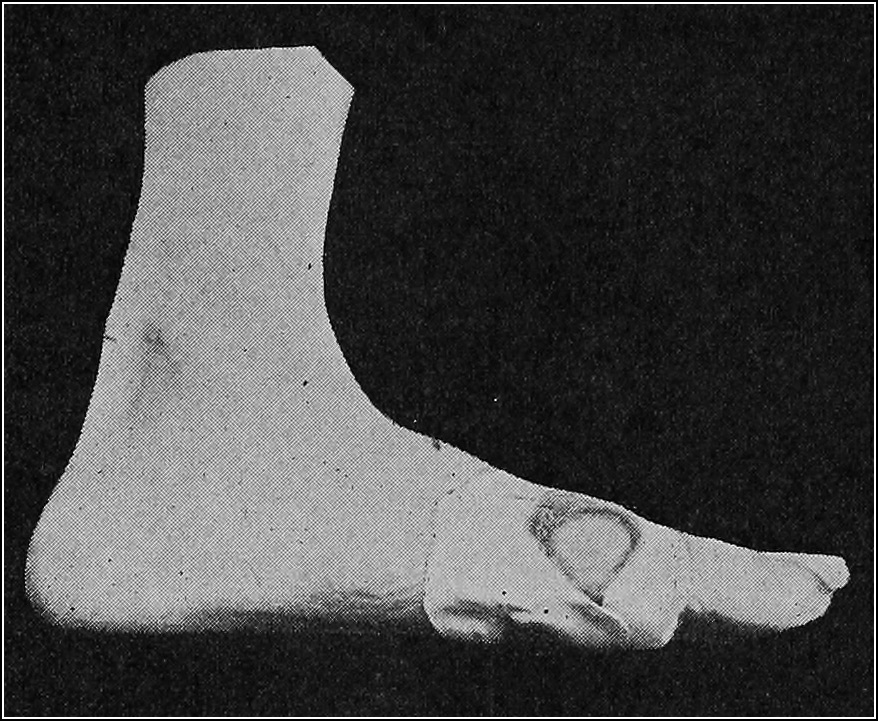
Fig. 2. STRAPPING FOR METATARSOPHALANGEAL HALF-MOON SHIELD
Location 2. Shields are often required on the dorsum over the tendon of the extensor muscle for the protection of corneous formations or denuded spots due to rubbing of a new shoe on this prominence. Felt shields of considerable thickness are most generally used in these instances, as they are more pliable than those of buckskin and, in consequence, are not so harsh. They are usually cut in oval shape (though not so large as those described under Location 1), and are strapped in triangular arrangement with half-inch strips. In some instances, where pressure upon those portions of the tendon anterior and posterior to the affected area is undesirable, two straight pieces of felt of considerable thickness (so as to be of higher elevation than the prominence of the tendon) may be substituted with good results. They are placed on each side of the tendon and parallel with it. The strapping in this case consists of two half-inch strips placed across the felt shield at right angles to the long axis of the toe. A very practical protection of tender areas in this location is a half-moon shield whose opening is only of sufficient width to protect the affected spot. This shield is made from adhesive felt, and after it is fashioned and skived, a strip of the glazed adhesive, slightly wider than the tender prominence, is removed without disturbing the balance of the felt constituting the body of the shield. The shield is then applied and the adhesive substance thus comes only in contact with integument on each side of the tendon, allowing that cord to move at will without interference; at the same time ample protection is given the affected part.
This shield is usually strapped by using two strips of one inch width plaster, each about three inches long. They are adhered, each overlapping the other, on the body of the shield, thus binding down its posterior and two lateral edges to the sound integument. Where a strapping of this nature would interfere with the normal movements of the tissues of the toes or of the great toe, one strip, three inches long and an inch-and-a-half wide, may be substituted and placed across the body of the shield (at right angles to the toes), thus binding down its posterior and a portion of its lateral edges.
Location 3. In cases of tyloma or heloma on the plantar or inner lateral border of the great toe, oval shields of buckskin are almost entirely used (same as Fig. 1-B, only smaller, to accommodate the smaller surfaces). There are two impractical points to be considered and avoided in this connection: (a) on shielding a part on the inner border of the great toe, the shield should never be allowed to extend up on the dorsum of the toe and lap over or cover the lateral and posterior nail folds. The tissues about the nail are sensitive to a degree, and any untoward pressure will in most instances start new troubles in this region. The adhesive strappings will, of course, cover a greater portion of the nail; but as the plaster is unusually thin, a great amount of trouble from the strips is seldom experienced. (b) In shielding the plantar surface of the hallux, the pad should never be fashioned to such length as to interfere with the natural bending of the toe at the web. If this be allowed the patient will experience a feeling of “fullness” at that point which may seriously interfere with his natural gait and comfort, besides which, irritation may be caused in these parts.
The strapping of shields applied to the plantar or to the inner border of the great toe is of necessity similar, as the pad is merely in a different position and the strips must practically cover the same territory. One-half-inch plaster answers most purposes and two strips are cut of sufficient length to encircle the toe and overlap each other on the side of the digit opposite the shield. Too many thicknesses of plaster between the toes should always be avoided, and to make this effective many practitioners prefer the narrow chiropodist strip, using one strip to encircle the toe twice, once on the posterior and once on the anterior edge of the shield. This is a matter of preference, but the writer favors the half-inch strip, as it has more adhesive surface and will consequently fasten the shield more firmly to the integument.
Location 4. Corneous excrescences, whether hard or soft, are not commonly found between the great and second toe but, when so located, a shield is generally needed as an aid to treatment. A shield for this condition may be of buckskin or chamois, if intended to last for any time, and should be strapped in place. Felt shields are often used, minus adhesive and strapping, where temporary protection is needed. Using a shield without adhesive in any interdigital disturbance enables the patient to remove it and set it back at will, in this way avoiding the hardening or shifting when the shield is allowed to remain in place during and after a bath.
In fashioning any shield to be used in an interdigital location, the lower edge (that applied next to the web of the toe) should be cut on a slant (Fig. 1-C), to conform with the angle of the toe web. This procedure not alone makes the wearing of the shield more comfortable, but also gives it a steady base to rest upon, whether adhesive be used or not. In shielding an heloma between the great and the second toes, and particularly if the heloma be of any size or on either toe, it will usually be found advantageous to adhere the shield to the great toe. The second toe is uncommonly long and slender, and in most instances presents a very small surface around the heloma, to which a shield may be made to adhere.
The strapping of a shield in this location is similar to that applied on the opposite side (inner border) of the great toe; in most cases the half-inch plaster is employed and the ends are fashioned to overlap each other on the plantar or inner lateral surfaces of the digit.
Intermediate Toes (2d, 3d, 4th): Dorsal Surfaces. In shielding the dorsal surfaces of the intermediate digits, pads of buckskin, adhesive moleskin or chamois are exclusively used. On most feet the dorsal surfaces of these toes are quite narrow and care should be taken that the shield is not so wide as to interfere or rub against the toes adjoining or to lap around the toes on their interdigital surfaces. The shield should be wide in the centre (in which location the aperture is cut) and should taper slightly toward each end. “Tapering slightly” does not in any sense mean to a point, but merely sufficient to conform to the general shape of the toe. Proper skiving is essential to a well fitting shield in this location, as it must adhere firmly on all sides and must not act as an irritant to the underlying and surrounding areas nor to the adjacent toes. For a sample of this shield see Fig. 1-D.
In strapping a shield to the dorsal surfaces of the three intermediate toes, the narrow chiropodist strip is generally found to be the most practical and probably the most generally used. It is best made to adhere in the following manner: strip to be six inches in length; with one end of the strip start on the side of the toe carrying the plaster downward on a tangent to a point opposite the rear portion of the shield, then crossing this posterior part of the shield, so bringing it (the strip) completely around the toe to the place of beginning. Cover the beginning “end” with the strip and carry it over the anterior portion of the shield; complete the dressing by adhering the remaining end of the plaster to the side of the toe opposite the beginning. We thus have two strips of plaster over the anterior of the shield lying next to each other and making approximately a quarter-of-an-inch of adhesive surface and only one strip over the posterior portion. In this way the anterior portion, which is most liable to loosen up from the constant rubbing of the stocking and shoe in walking, is doubly bound to the toe (Fig. 3).
In many instances where a shield is to remain for a day or so only, glazed felt will admirably answer all purposes. It is cut similar in size and design to the buckskin or chamois shield, but is most generally applied without strapping.
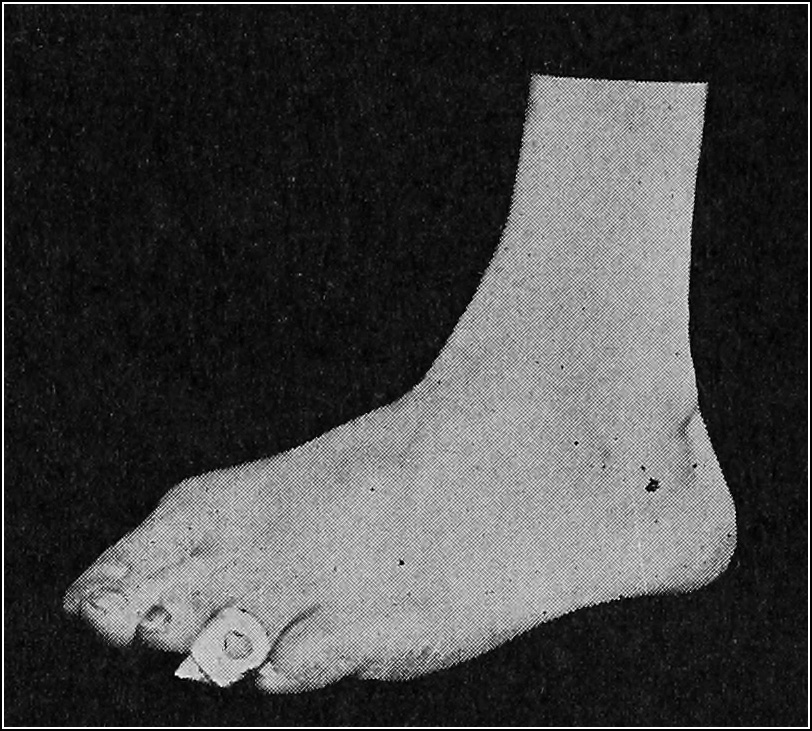
Fig. 3. SHIELD APPLIED TO DORSUM OF FOURTH TOE
The Dorso-Digital Oval Shield. One more practical method of shielding an heloma on the dorsum of any of the intermediate toes may be described. In many instances, whether distinct hammer toe be present or not, the first interphalangeal articulation will be found decidedly prominent, and enlarged to such an extent as to make the application of an individual shield impractical. A large oval shield of buckskin or eighth-inch felt (Fig. 4) should then be used. The aperture is fashioned to fit the part to be protected and the long axis of the shield is allowed to rest across and upon the adjacent toes. A shield of this nature is seldom if ever strapped, and is removable by the patient while at rest or during the bath, to be replaced when the shoe is worn. The writer has observed many cases where the proximal phalanges of the intermediate toes were in a state of constant extension due to the contraction of the extensor tendons, and leaving a decided hollow in the dorsum of the foot directly over their metatarsophalangeal joints. In a condition of this nature a thick shield of this pattern is particularly practical and may be used not alone to protect a tender part, but also to fill up this hollow and allow the shoe to fit more firmly.
Where helomata are present on the dorsum of all of the phalangeal joints, this variety of shield is, of course, contra-indicated, as undue pressure would be brought to bear upon the already troublesome excrescences and a great amount of trouble would in this way be invited. In some instances a full oval shield is not used, but a dorso-digital half-moon, as shown in Fig. 1-G, is substituted. No definite ruling can be made as to which form of shield should be used, as each case presents a different aspect and the mechanical work must be applied accordingly.
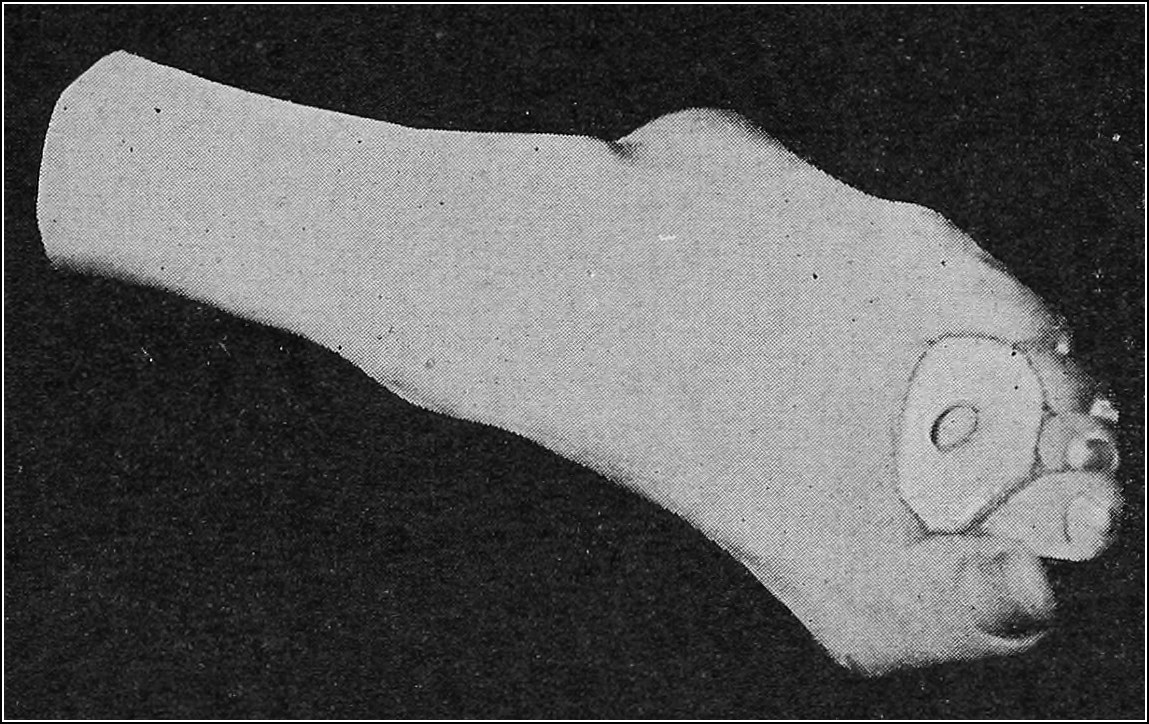
Fig. 4. DORSO-DIGITAL OVAL SHIELD APPLIED TO THIRD TOE
End of the Intermediate Toes. Shielding is often necessary on the ends of the toes, and in such instances the padding should, as a rule, be made very thin and the subsequent dressing not bulky. This is advisable for several reasons: first, helomata in this locality are usually under or immediately adjacent to the nails and too great an amount of pressure cannot be put upon these structures; second, that there is trouble on the end of the digit is proof positive of the shoe being too short and, therefore, if too thick a shield be used, the pressure on the surrounding tissues will be too great to be comfortable; third, helomata in these locations are seldom found to be elevated to any extent above the normal surface of the integument and when removed, the tissues are usually at their normal elevation, so that shields of material as heavy as those used in connection with helomata in other localities are unnecessary.
A shield of thin buckskin, adhesive moleskin or chamois is best in these cases. It is applied, generally, so that the long axis is across the end of the toe and seldom so that the ends of the padding overlap the free edge of the nail or compress the plantar surface of the digit. Where the heloma to be protected is situated close to the nail, and it is advisable that the padding extend over that structure, by clipping the nail closely and filing it down and at the same time using an exceedingly thin shield, successful protection can be secured without unfavorable results. Such shortening of the nail is, however, not advisable in all cases. This article deals entirely with shielding, but attention must be here drawn to the fact that there are many instances of an heloma occurring on the end of one of the lesser toes, when a shield is contra-indicated. There are many cases where the toe nail, if allowed to grow long, will protect the tender part far more successfully than will a shield. Therefore, it is always well to consider if protection can be obtained from the nail itself before applying a shield in this location.
Strappings. The application of adhesive strips to a shield in this locality demands considerable ingenuity on the part of the operator, but there is no stereotyped method to be employed. One general method may, however, be explained: cut two pieces of chiropodist strip, each about two-and-one-half or three inches long. Apply the centre of one strip over one end of the shield, lateral to the aperture, and carry one end of the strip on a line running toward the proximal end of the toe and in a manner so as to cover as much of the edges of the shield on that side as possible.
Overlap these plaster ends on the interdigital surface of the toe opposite to the place of beginning. Adhere the second in like manner to the other surface of the shield on the side of the aperture, and carry the plaster ends in such a way as to cause them to overlap each other on the interdigital surface of the toe opposite the place of beginning. In this way both lateral and nearly all of the plantar edges of the shield will be covered and bound down with adhesive plaster. It will be found generally that the edge of the shield coming under the free edge of the nail needs no reenforcement by adhesive strips, as the length of the nail will prevent any tendency to loosen up the plaster in that location. Cut a third strip about two inches long and with it circle the toe, binding down all four ends of the two strips already applied. Trim off the ends of the plaster, which extend from under this last applied strip, and the whole makes a neat practical shielding for trouble in this situation. (Fig. 5).
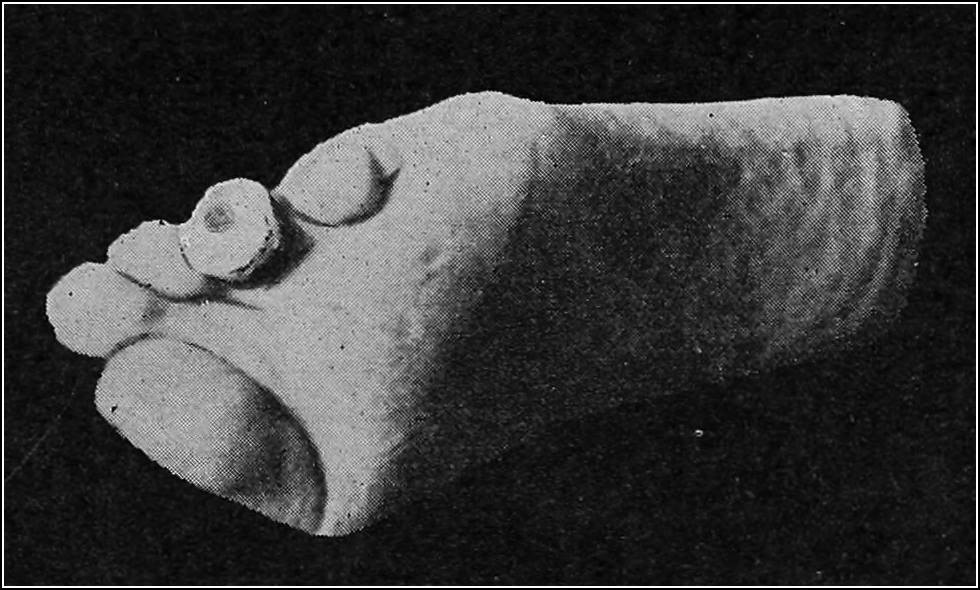
Fig. 5. SHOWING SHIELD APPLIED TO END OF FOURTH TOE
There are many ways in which a shield in this location may be strapped, but as always, and particularly in this instance, there are so many circumstances which go to alter the mode of strapping that it would be well-nigh impossible to explain them all or to outline a set method of procedure.
Interdigital Surfaces. Helomata, both hard and soft, often occur between the toes and, in these cases, to insure complete relief to the patient, a shield is usually an absolute necessity.
Buckskin, sheepskin, adhesive moleskin, and chamois are the materials most generally used for interdigital shields although the thinner varieties of white felting, with or without adhesive, may be substituted in some instances. The shield should be fashioned of equal length to the surface of the toe, from the web to the distal end, and should be only wide enough to correspond to the thickness of the toe. If the shield be allowed to lap over on the dorsum of the toe or under on its plantar surface, new pressure is brought to bear on these parts, to the discomfort of the patient. It must always be remembered that the toes bend during the various movements in walking, and that if a shield be allowed to curl under the toe, the thickness of the material used will interfere, to a great extent, with the normal flexing and extending of the toe, even to such a degree in some instances as to cause lesions of more or less severe character on the skin.
To allow any shield to cover or to press upon the tissues directly adjacent to the nail is always to the discomfort of those parts, and in this, as in all other instances, should be avoided.
The bottom of the shield (Fig. 1-C) should be cut on a tangent, so as to conform to the corresponding slant of the toe web. This insures not only the minimum danger of irritation on those tender parts, but also allows the shield a firm base upon which to rest, and prevents any possible tilting or shifting.
Shields for application to the interdigital surfaces seldom need to be of great thickness, and the thinner the shield used the more flexible it is, and the less pressure is brought to bear on the outer surfaces of the toes. It must be remembered that everything placed between the toes, of necessity, spreads those members further apart, and naturally this causes a greater amount of pressure from the boot on the outer surfaces. Skiving is an essential requirement in interdigital shields, although in some instances where they are to be used between the great and second toes, this (skiving) may be omitted.
Thin felt shields, minus adhesive, are often employed between the toes for transient protection, a fresh one being usually placed in position daily.
Strapping. The most practical method of strapping an interdigital shield is by means of the narrow chiropodist strip. The method used is similar in every particular to that employed in the use of the same width strip in applying a shield to the dorsum of the intermediate toes.
Another less used method is as follows: take a six-inch chiropodist strip; at its centre adhere it to the upper end of the shield (that nearer the distal extremity of the toe), and carry both ends around the toe, crossing them on the side opposite to the starting point. Then bring the loose ends around the toe again to the side upon which the shield is adhered and overlap them over the bottom of the shield, allowing the ends to run for attachment on the sound integument.
Fifth Toe: Dorsal Surface. There are more corneous developments on this digit than on any of the others, and as this toe presents a free surface on its outer side, which is not the case with any of the other lesser digits, many varieties of shielding and of strapping are used.
As with the dorsal surfaces of the intermediate toes, buckskin and adhesive moleskin are the most generally used shielding materials, and pads of the thinner varieties are in most cases sufficient for the needs. But, as this toe is probably the most abused of any and is often found distorted into positions of extreme flexion or extension and is sometimes lapped over the fourth toe, shields of a greater thickness, or “built up” pads, are very often indicated. The ordinary buckskin or adhesive moleskin shield is fashioned oval in shape, but the anterior end is cut either straight across or slanted toward the outer lateral edge, so that we have a shield, round at its posterior extremity and tapering toward the anterior end, having a straight edge (Fig. 1-E). Shields for the fifth toe must be carefully skived, especially at the anterior end which goes toward the nail. The writer has often seen cases in which new helomata, sometimes as many as three or four, have developed on the dorsum of this toe anterior to the original callosity, exclusively caused by the habitual wearing of thick shields.
The size of the shield depends wholly upon the size of the toe and the area to be protected, but the length of the shield should never be allowed to interfere with the bending of the toe at its metatarsophalangeal articulation. If this precaution is not observed, in walking the shield rubs against the dorsum of the foot and is not alone loosened at its posterior edge, but causes irritation to the skin in that region. As with those used on the dorsum of the intermediate toes, the aperture of a shield for the fifth toe should be cut of sufficient size to allow a space between its (the aperture) anterior edge, and that of the calloused area; this is to allow for backward shifting.
Another form of shield used in cases where the small toe is flexed to a degree and an heloma has developed on its apex, is what may be called the fifth digital half-moon (Fig. 1-B). It is usually necessary to build up a shield of this variety. By “built up” is meant that two thicknesses of material are used, one pasted upon the other, to give the shield greater thickness and stability. The upper thickness is formed so as to protect the rear and lateral sides of the corneous area, but not the front. The second, or under thickness, is fashioned round at its posterior edge and straight at its anterior surface. This, being placed under the upper layer, gives the shield sufficient thickness to be of equal height to the elevation of the heloma or even higher, thereby avoiding all undesirable pressure upon the painful area, and at the same time filling out whatever hollow there may be in the foot at this point.
Strapping. There are five general methods of strapping to adhere a shield to the dorsal surface of the fifth toe. Some conditions demand the use of one of these and none other, but in most instances any method may be used with good effect. These five methods are as follows:
1. Narrow chiropodist strip. 2. Combination narrow and half-inch strip. 3. Half-inch strip (using one strip). 4. Half-inch strip (using two strips). 5. Inch strip.
Number 1. In using the narrow chiropodist plaster, the strip is applied in a similar manner to that already described for toes, arranging the plaster so as to cover the anterior of the shield with two widths of the strip and the posterior surface with but one (Fig. 6). As an alternative for this, the method described in the second instance in connection with interdigital shields may be utilized.
Fig. 6. STRAPPING OF 5TH TOE SHIELD WITH CHIROPODIST STRIP
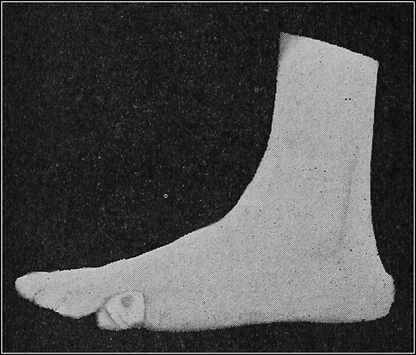
Fig. 7.
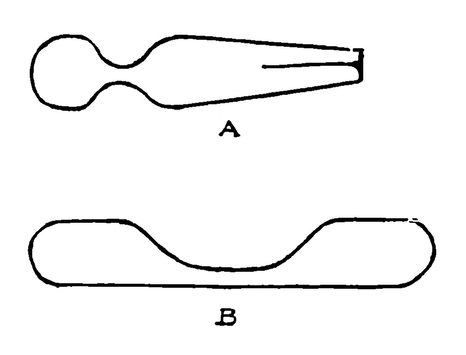
Number 2. The narrow strip and the half-inch combination consists of a narrow strip, about four inches in length, adhered to the inner surface of the toe and carried twice around the toe across the surface of the shield, anterior to the aperture. This, as will be seen, binds down the distal end of the shield. The half-inch strip, about three inches in length, is then cut as shown in Fig. 7-B.
Taking this strip in both hands, insert it between the toes in such a manner as to allow the narrow portion of the plaster to fit into the narrowest part of the toe web. Then carry the outer broad end of the strip around on the dorsum of the toe and adhere it across that part of the shield posterior to the aperture, taking care, however, that the adhesive plaster is half on the shield and half on the integument adjoining it. Adhere the remaining broad end of the plaster (that coming from between the toes) over the first applied posterior strips, taking the same care that shield and skin are both covered by the plaster (Fig. 8).
Fig. 8. SHOWING SHIELD STRAPPED WITH NARROW AND HALF-INCH STRIP
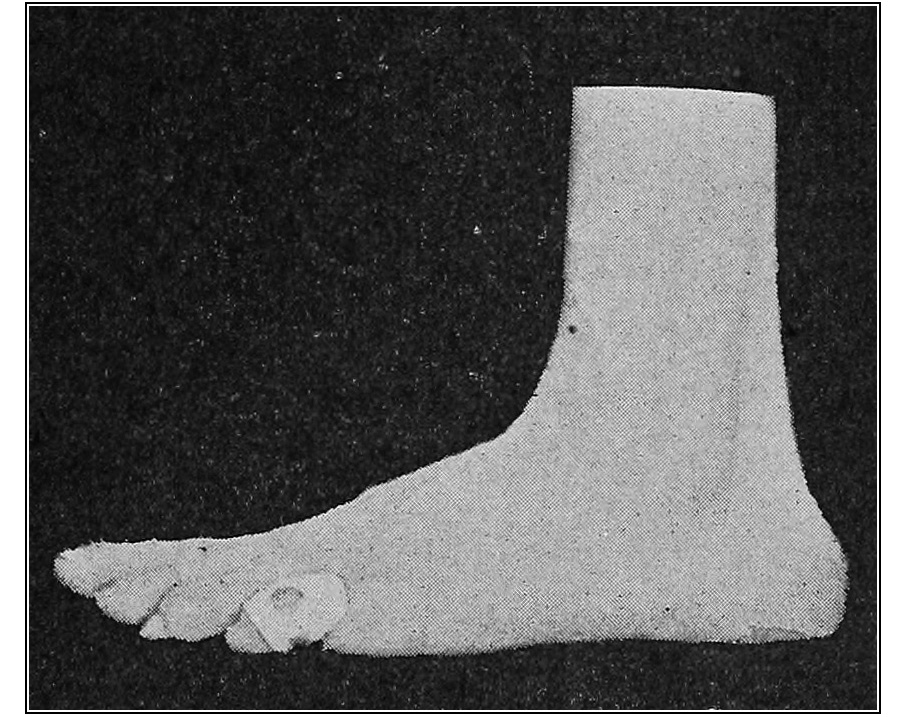
Fig. 8a. SHOWING DRESSING COMPLETE WITH COCOON OVER APERTURE
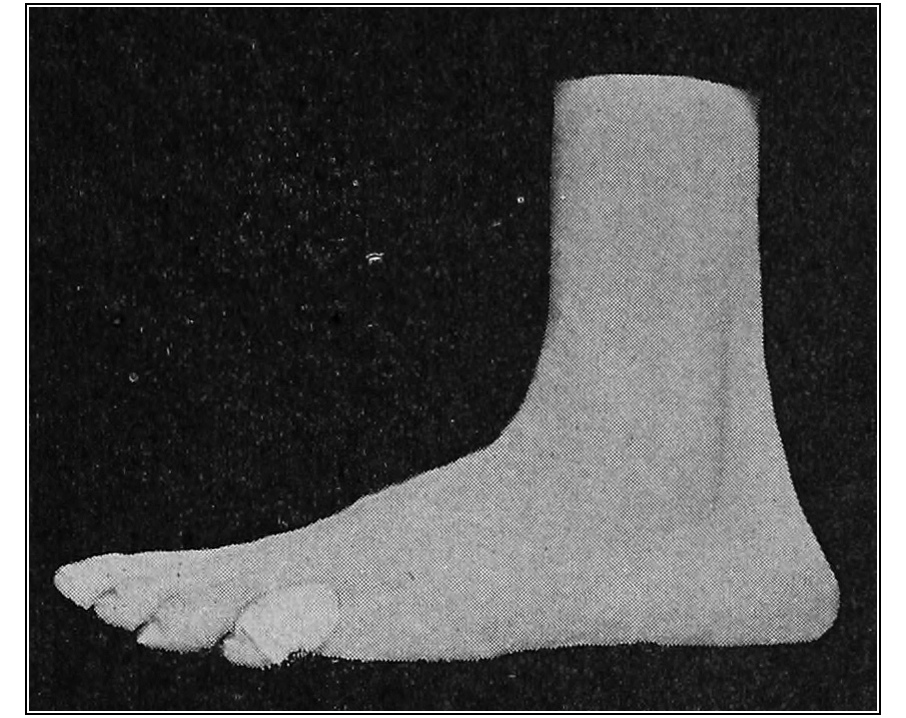
This alternate style of strapping is particularly useful in cases where the narrow strips of method No. 1 are found to irritate the skin of the toe web, or if there be a corneous excrescence developed there which cannot be covered by the plaster; instead of using the half-inch strip, as just described, a half-inch or inch strip, about two inches in length, is cut and placed across the posterior of the shield and is adhered to the integument on the dorsum and plantar of the foot. Should any portion of this posterior strip lap over the aperture, it should, of course, be cut away.

Fig. 9.
Number 3. In this manner of strapping (using one one-half-inch strip) we have one of the most practical methods in vogue today. A strip about six inches in length is fashioned in the manner of Fig. 9. The wide portion in the strip’s centre is then adhered to the anterior surface of the shield and the ends are carried around, one on each side of the toe, in such a manner as to allow the narrowest portions to criss-cross in the narrow part of the toe web on the plantar surface. The wide ends are then carried around the dorsum of the toe and are overlapped on the posterior portion of the shield. This method of applying the plaster supplies a greater amount of adhesive surface than by the use of the narrow strip and is just as practical, or more so, in many ways.
Number 4. In using two one-half-inch strips to adhere a shield to the dorsum of the fifth toe, the plaster is fashioned as shown in A and B (Fig. 7). The strip marked “A” is cut about two inches in length and split on the square end. That marked “B” is about three or three and one-half inches in length. The strip “A” is laid over the anterior surface of the shield with the split end toward the inner side of the toe. The anterior one of the two split ends is then drawn tightly over the anterior edge of the shield and adhered to the inner surface of the toe; the remaining split end is adhered over the first and should also be drawn tightly, so that the anterior portion of the shield is closely bound to the dorsum of the toe. The rounded end of the plaster strip is then carried around the outer side of the toe in such a manner as to allow the narrow portion of the plaster to rest over the corresponding narrow part of the toe on its plantar surface. The wide extremity is brought around to the inner side of the toe and is placed over the split ends already adhered. This binds them securely to the interdigital surface of the toe. Any loose ends showing after the foregoing is completed should be clipped off. One wide end of the strip “B” is then adhered across the posterior surface of the shield and the plaster carried around the toe (the narrow portion of the plaster fitting in the narrow part of the toe web) and the remaining wide end is overlapped on the posterior portion of the shield, thus securing the other wide end already adhered to the shield.
Another method, differing merely in the position of the last wide end of the strip “B,” is as follows: instead of adhering this end criss-cross over the posterior portion of the shield, bring it further toward the anterior of the toe and adhere it directly across and over the aperture, fastening the end upon the inner side of the toe. This makes a waterproof dressing with none of the shield showing when the dressing is complete; it is contra-indicated when a soft dressing is desired over the inflamed parts.
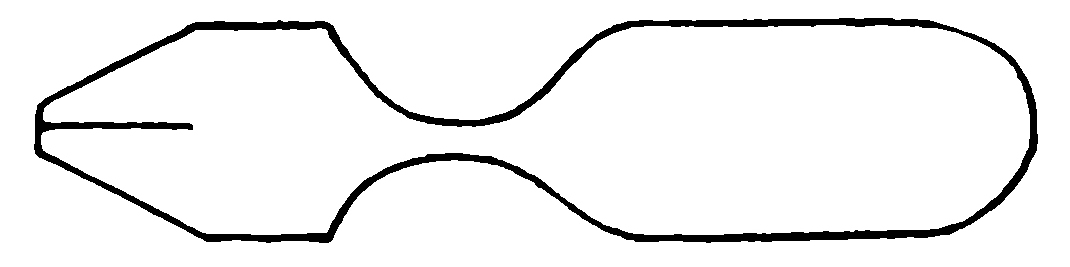
Fig. 10.
Number 5. The other method which may be used is to cut off about six inches of one inch plaster (although the length used depends upon the size of the toe), and fashion it as shown in Fig. 10. The split ends are then adhered on the inner side of the toe, so that the wide portion next to them is drawn tightly over the anterior surface of the shield. The narrow portion is then carried around the outer side of the toe and is placed, as previously described, on the corresponding narrow surface of the toe web, and the remaining wide end is brought between the toes and over the posterior surface of the shield, entirely covering the pad and adhering it to the integument on the outer surface of the shield, over the metatarsophalangeal joint. This also makes a practically waterproof dressing (Fig. 11).
Fig. 11. SHOWING ANTERIOR PORTION OF ADHESIVE STRIP APPLIED
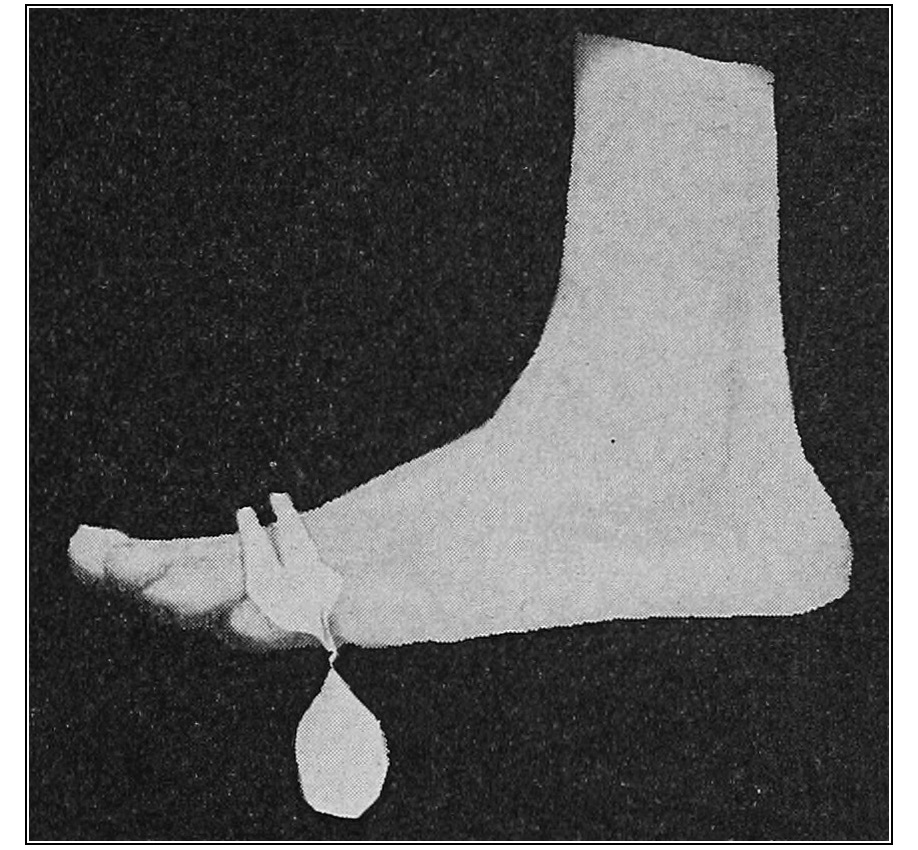
Fig. 11a. SHOWING DRESSING COMPLETED
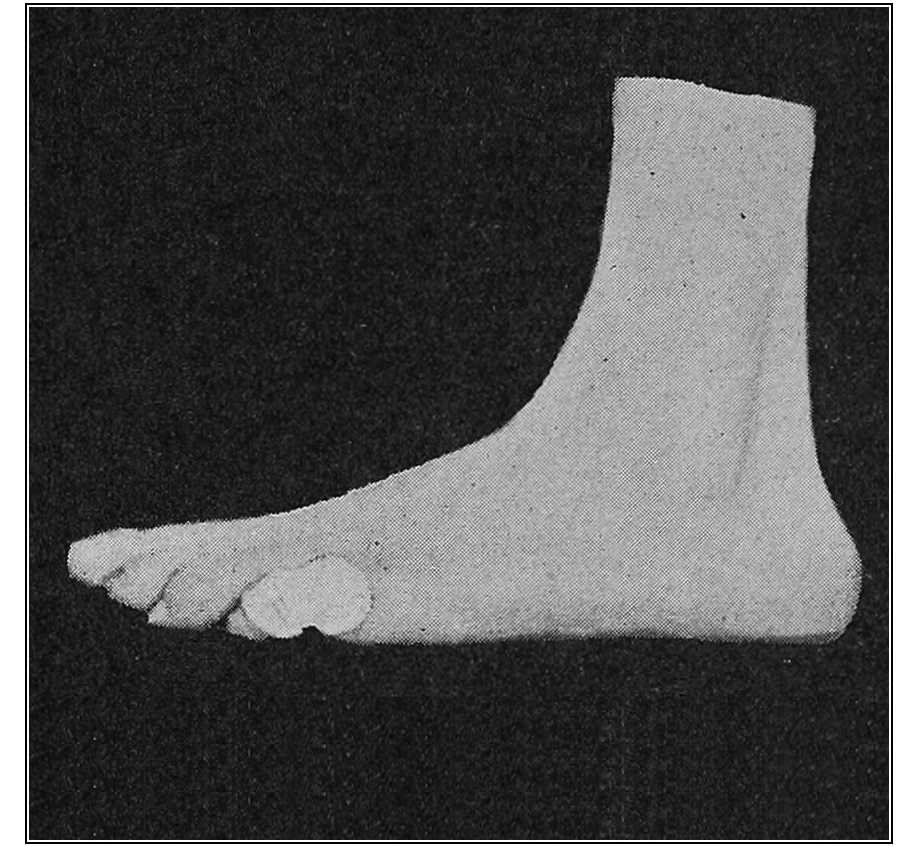
Fifth Digital, Built Up, Half-Moon Shield. In strapping a “built up” half-moon shield in this connection there are one or two methods which will answer in all cases. The first method is the use of but one strip of plaster, either of one inch or of one-and-a-half inch width. This is placed transversely across the body of the shield so that no plaster extends over into the aperture, and it is adhered to the integument on the dorsal and plantar surfaces of the foot. As this shield is so much wider than the toe, it is not practical to encircle the toe with adhesive strips in fastening it. The other method at times employed, and the one that is advocated, in that it binds down the “points of the crescent,” situated laterally to the corn when the shield is in place, consists in the use of two strips of the one inch plaster. These are each cut about two inches in length, one being placed diagonally across the body of the shield in such a manner as to cover the outer lateral point of the shield, and the other in a like manner, so as to cover the inner lateral point of the shield and overlapping the first applied strip on the body of the shield. In many instances, however, this variety of shield is not strapped and is removed and reapplied by the wearer at will.
It may sometimes be found advisable, when a small shield cannot be used and where the spot to be protected is nearer the distal part of the toe, and in consequence would not receive sufficient protection from a half-moon shield placed at its proximal end, to apply to the part a full oval shield, slightly modified as to its anterior edge. This shield is of the same shape as that shown in Fig. 1-E, except that it is larger. It is made from the thicker grades of buckskin and is fashioned so as to rest on the fourth toe and over the fifth nail, and for this reason these two contact surfaces of the shield must be well skived. This shield is seldom strapped and then only at its posterior surface, and in like manner to the strappings described for the fifth digital half-moon. A large shield of this kind evens up the whole surface of that part of the foot and so equalizes the pressure that it is distributed generally.
Lateral Surfaces. Helomata on the outer lateral surface of the fifth toe are generally shielded in a manner similar to those occurring on the dorsum; the shield in the lateral location, however, should never be of great thickness. In most instances corneous developments of the small digit on these surfaces are situated adjacent to the nail and the shield, and to be comfortable, should not be allowed to overlap the nail structures. If, however, to obtain proper protection, overlapping must be allowed in order to cover these areas, the shield should be of paper thinness, especially at its anterior end.
In this situation a shield is often used which gives protection from the anterior, posterior and outer lateral but not from the inner lateral surface, which would of necessity have to be adhered over the dorsum of the toe and the nail.
This form of shield is practically of the same shape as the ordinary fifth toe protector but with the inner lateral surface next to the cut away aperture. It is particularly practical in cases where the spot to be protected is directly next to or in the corner of the nail. By a shield so fashioned, the protection of the part is derived from all but the nail.
Strapping. The narrow chiropodist strip affords the most practical method of strapping a shield in this location, and the method is similar to that employed on the dorsum of the fifth or intermediate toes.
In strapping the last mentioned form of shield, the strips are applied in a similar manner. Care is taken to adhere the plaster over both points of the shield, anterior and posterior to the affected part.
Interdigital Surfaces. The shielding of helomata occurring on the inner surface of the fifth toe is similar in method to that employed in shielding like parts on the intermediate toes. This applies to the strapping as well. Thick shields are contra-indicated, as they force the fifth toe out against the shoe; if used on that part they will undoubtedly create trouble to the toe in question. Both hard and soft helomata often occur in this connection; they are located, not on the sides, but rather well down in the web of the toe. In such cases a specially fashioned shield is required which, from its shape, is known as a “boot shield” (Fig. 1-F). This shield is of material such as is used in making the ordinary interdigital pad, being the thinner grades of adhesive moleskin, buckskin, or chamois. It is applied usually on the adjacent side of the fourth toe, the narrow portion uppermost and the wider part with its concave surface directly above the uppermost ridge of the corneous area. This not alone prevents lateral pressure, but, by means of the tongue-like shape at one side of its base, it also prevents pressure on the part from the plantar surface.
It is often found that helomata, developing in the interdigital web of these toes, are caused by pressure on the part, due to the dropping of the fourth metatarsal bone. To bring the head of this bone up into position, and in that way relieve the pressure, it is often found necessary to apply a felt or buckskin shield on the plantar surface of the foot under this articulation. This may be done in addition to applying a shield between the toes or each may be used separately, as experience dictates. Alfred Ahrens, of New York, one of the teaching staff of The First Institute of Podiatry, has devised a shield, known by its shape as the “duck shield,” which is so fashioned as to present a shielding surface between the fourth and fifth toes, as well as an expanded end which extends down upon the plantar surface and throws the head of the fourth metatarsal up into normal position.
Strapping. The narrow strip is the most practical means of strapping a “boot shield” to the fourth toe. Two turns of the plaster are carried around the digit, the first covering the shield about at its centre and the second crossing near its uppermost end. One half-inch strip may also be used, its two ends crossing each other on the side of the fourth toe, opposite the shield; or in some instances, if the shape of the toe permits, the ends may be adhered to the dorsal and plantar surfaces of the foot.
Metatarsophalangeal Articulation. In protecting a part in this location three styles of shield may be employed:
1. Oval. 2. Half-moon. 3. Modified half-moon.
Number 1. The thicker grades of buckskin or felt are generally used for this protection, as the part, if affected, is usually considerably elevated above the surrounding integument. As in connection with the first metatarsophalangeal articulation, the oval shield is so fashioned that the principal protection will be derived from the upper lateral and posterior surfaces. The anterior and under lateral surfaces are made correspondingly thin and narrow, so that no undesirable pressure is brought to bear on the integument beneath these surfaces. In this instance, two reasons may be given for such a course: first, all unnecessary pressure is naturally contra-indicated; second, the protection from these sides is, in nearly every instance, useless and unproductive of results. Usually, if the point to be protected be near the band of the fifth toe, the shield must be scalloped so as to allow for the backward movement of this digit when in an extended position. Great care must be taken in applying all shields to allow for the natural movements of the parts in walking. In this position, more particularly, a cumbersome, ill-fashioned shield may become a source of irritation during the movements of the foot in exercise. Ninety per cent. of shield troubles are due to their being improperly fitted or to their imperfect fashioning.
If a shield used in protecting the fifth metatarsophalangeal articulation is not scalloped, as previously mentioned, to allow for the backward movement of the proximal phalanges of this digit, irritation is not only bound to occur, but the movement of the toe will loosen up the anterior rim of the shield (despite strapping), and consequently shifting of the shield is sure to occur.
In strapping an oval shield to this part, two strips about four or five inches long are cut from the one inch width plaster. They are adhered so as to cover the anterior and posterior portions of the shield and the upper loose ends, made to overlap on the dorsum of the foot, are carried firmly over the side to the plantar surface, overlapping also on the sole of the foot.
From experience, the writer much prefers the substitution of the so-called half-moon, or the modified half-moon shields (Fig. 1-H) in place of the oval just described.
Number 2. The metatarsophalangeal half-moon shield supplies all the necessary protection from its upper lateral and posterior surfaces without extending down around and under the plantar surface of the joint. It must always be remembered that the insole of the shoe joins its shank at this point and, in many instances, particularly if the shoe has been worn to any extent, the insole is inclined to curl up and to thicken, and in nearly every case where the shield is allowed to run over the edge of the foot, undue pressure, with its train of bad effects, is made on the parts.
The half-moon shield is placed on the dorsum of the foot, the “points of the crescent” extending anteriorly and posteriorly to the part to be protected. The anterior is made narrower and thinner than the posterior point for, as is the case with the oval shield, the greatest amount of protection must come from the wide lateral surface (the main body of the shield) and from that portion lying posterior to the protected part.
As is the case in any shield, the anterior part of the crescent or half-moon variety must be placed far enough forward so that if it does shift, there will still be sufficient normal integument for it to rest upon before it comes in direct contact with the anterior edge of the calloused area. However, care must also be taken and allowance made so that backward movement of the fifth toe does not tend to loosen up this anterior edge.
In strapping the half-moon shield, two strips, four inches long and one inch wide, are used in like manner as that described in the strapping of the oval shield. In some instances the anterior point of the crescent is found to be narrow enough so that a strip of the half-inch plaster, cut the same length, may be substituted with equally good results. The inch width, or in some cases the inch-and-a-half width, is used across the posterior portion of the shield.
Number 3. The modified metatarsophalangeal half-moon shield is practically the regular half-moon minus its anterior point. Many practitioners have suggested a shield of this nature for protection of the first and fifth metatarsophalangeal joints for the reason that the anterior point is of little or of no use and may become a decidedly detrimental feature should the shield shift in any way. Its application and strapping is similar in every particular to that of the half-moon. The writer, however, has often used two strips of one inch width plaster, each about three inches long, and has adhered them in criss-cross fashion over the posterior of the shield so as to cover the entire posterior portion and some part of the lateral edge, and has also found this method entirely satisfactory.
Plantar Surfaces. The plantar surfaces of the foot, being subject to continued pressure and at times to considerable friction, are prone to develop many calloused and corneous areas. In many of these cases shielding is absolutely imperative to successful treatment.
It must always be remembered that these excrescences are, in a measure at least, a protection to the underlying parts, and their removal often makes the patient conscious of their loss. Ofttimes the tissues so exposed become congested and decidedly tender. This, of course, is to be considered at all times, but particularly so on the plantar surfaces of the foot. Another point which must be taken into consideration in this connection is that the normal tissue padding (fat and muscles) of some people’s feet is very thin; in consequence, the heads of the metatarsal bones are unprotected. In most cases of this kind shields must be applied to take the place of nature in order to insure any degree of comfort to the patient.
Shields to be placed on the plantar surfaces, and particularly those to be applied to the metatarsophalangeal regions on the “ball” of the foot, must of necessity be of decidedly heavier quality and contain more “body” than those applied to the dorsal or lateral regions. The reason is that the constant weight of the body quickly flattens the shields out to such an extent as to render them useless as far as protection is concerned.
The full oval shield (Fig. 1-A) is the agent best calculated to protect sensitive areas on the plantar surfaces, and it can be safely said that it may be and is used in almost every case of this kind. Naturally the most general locality for the formation of helomata is under the metatarsophalangeal articulations. These areas, particularly in persons whose feet are thin and lack the proper natural padding, become the seats of severe callosities and helomata. The shield to be used should always be of sufficient size to allow surface enough so that the patient will rest upon the shield rather than on the integument; but they should never be allowed to extend up under the toes or be placed in any way so as to irritate the tender tissues surrounding the diseased area. For this reason many practitioners have advocated the use of the medio-plantar crescent shield (Fig. 1-I), so placed that the greater body of the shield is posterior to the heloma and the “points of the crescent” extend forward laterally to the heloma and point toward the toes. This variety of shielding is particularly efficient when the part to be protected is located rather anterior to the metatarsophalangeal articulations, as is often found in cases of blisters and verrucæ. However, in most instances where the trouble is situated directly over these joints, an oval shield may be used with perfect impunity and good results will usually follow.
The long axis of the oval shield is placed, as a rule, crosswise on the foot, as the greater amount of protection is derived from the surfaces immediately adjoining the affected area, laterally rather than anteriorly and posteriorly. In cases of excessively arched feet (not necessarily pes cavus) and when the integument is quite thin, a great deal of protection may be afforded by “building up” the shield on its surfaces, which are to be posterior to the areas to be protected. This fills up, to some extent, the hollow caused by the high longitudinal arch and gives the patient a larger surface upon which to stand or walk. This same theory of shielding may be successfully applied in cases where the calloused area covers the whole “ball” of the foot, making it impractical to shield any one spot without jeopardizing the comfort of the rest of the integument by placing a shield over it. A large piece of felt may then be applied directly posterior to the callosity, the felt to be of sufficient thickness to allow the patient to rest upon the shield rather than upon the painful calloused area.
Strapping. In strapping the plantar oval shield, the one inch width plaster is most generally used. Three strips are cut, one about two inches and the remaining ones approximately three or four inches in length. The short strip is then placed over the anterior edge of the shield and is adhered to the integument, adjacent laterally to the shield. One of the longer strips, placed diagonally over the shield’s lateral edge, starting from and covering the plaster strip already adhered transversely across the anterior end and running backwards and covering the whole lateral surface of the shield, is adhered to the integument immediately posterior. The remaining long plaster strip is then placed in like manner over the other lateral surface of the shield and is adhered so as to cover the posterior end of the first placed lateral strip. This lapping of the plaster ends lends reenforcement to the strapping and undoubtedly minimizes the danger of the plaster loosening and at the same time all the edges of the shield are bound down to the integument (Fig. 12).
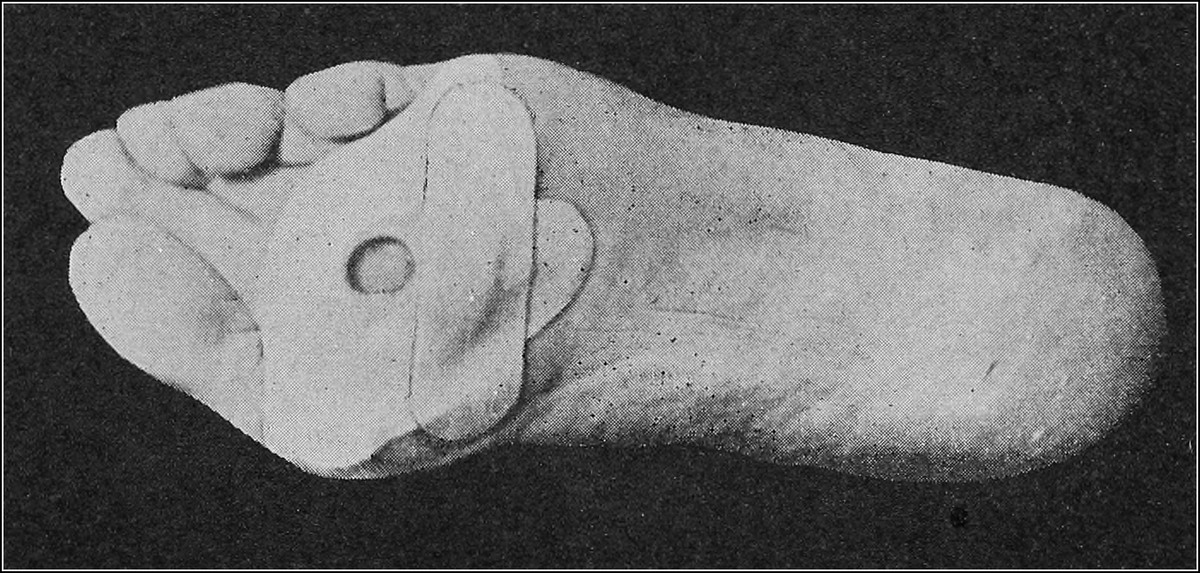
Fig. 12. SHOWING COMPLETE STRAPPING FOR MEDIO-PLANTAR OVAL SHIELD
It should be remembered that when applying adhesive strips in the strapping of a plantar shield, the toes should always be drawn backward towards the dorsum of the foot to their fullest extent, the straps to be applied whilst the toes are held in this position. This is to allow for the extension of the toes in the last position of walking and prevents the plaster from pulling on the sound integument.
In several instances it has been advocated that but two one inch width strips be used on a shield of this nature, and the same method may well be applied to the strapping of the medio-plantar crescent shield previously described. These strips are cut of equal length, each about four-and-a-half or five inches. About one inch from one end, each strip is narrowed from the sides so as to allow the admission of the plaster between the toes. This one end is then adhered to the integument on the dorsum of the foot, the narrow portion being carried between the third and fourth or the fourth and fifth toes (as the size of the shield may indicate) and the remaining portion of plaster is adhered diagonally across the outer lateral surface of the shield. The other strip, adhered in like manner on the dorsal surface, is carried between the toes (usually the great and second) over the inner lateral surface of the shield, lapping over the end of the first strip applied. This method of strapping covers, to a considerable extent, the anterior portion of the shield and does away with the transverse strip which in many cases becomes an irritating agent to the tender integument under the toes.
The argument against this method of strapping may be the danger of irritation between the toes. From the experience had in using this method, the writer has had no bad results, and if the strips are properly adhered, the normal movements of the foot being taken into consideration and the plaster lying between the toes cut sufficiently narrow, no bad results can take place and there is no doubt of the greater efficiency and lasting power of the strapping.
The Lateral Plantar Half-moon. When the area to be protected is situated on the extreme lateral edges of the plantar surface, as often found in these locations, and the callosity extends to or sometimes over the lateral border of the foot, the full oval shield is contra-indicated. In its place the lateral plantar half-moon is substituted with better results in all cases.
This variety is identical with the dorsal half-moon shield and is applied so that the main body of the shield lies laterally on the plantar surface, while the “points” are allowed to extend somewhat over the lateral border of the foot so that some protection is afforded from this source. The major protection, however, is, of course, obtained from the main body of the shield on the plantar surface.
The anterior “point of the crescent” is generally fashioned so as to be narrower and thinner than the posterior, for in nearly every instance this must extend near the under surface of the great toe and of the small digit, and must in no way be allowed to interfere with their movements. Two strips of one inch width plaster are generally used in strapping the lateral plantar half-moon, although in some instances it will be found necessary (due to the close proximity of the digital webs) to substitute a strip one-half inch in width for the anterior strapping.
The straps are so placed as to overlap both on the dorsal and plantar surfaces and to bind down the anterior and posterior edges of the pad. In all strapping the result to be obtained is the binding down of the edges of the shield rather than merely binding down the main body.
Lateral Borders. Practically the only spot on the lateral borders of the foot where callous formations may be met is over the expanded base of the fifth metatarsal bone, although blister formations or other tender areas may develop anywhere along the edges.
The full oval shield is almost entirely used in connection with protection in these locations and is usually strapped with three strips of the inch width plaster or, if the shield be small, three strips of one-half inch width plaster will answer.
These are placed as follows: one strip slightly shorter than the other two is adhered transversely across one end of the shield and the other two are applied diagonally from the ends of the first, so as to completely cover the lateral edges of the shield and overlap each other on the sound integument beyond its end.
Os Calcis Region. Many cases coming to the notice of the podiatrist require the application of a shield in the region of the os calcis, either on the plantar, lateral and posterior surfaces of the heel itself, or further upward on the prominence of the tendo Achillis. The oval shield is most generally used in these instances, and felt will usually be found to be the most practical shielding material. Felt, in particular, is advocated because it is softer and more yielding than most other materials, and in shielding a tender area on the tendo Achillis, nothing harsh can be used without danger of causing irritation to the surrounding and underlying soft parts.
Strapping is similar to that used in adhering the oval shield to the lateral border, but naturally the operator must exercise his own ingenuity in the method of strapping to meet the conditions present.
The art of applying a shield is not one to which any set rules can be applied. Each case is individual and the operator who goes about this branch of his work in a stereotyped manner will find his efforts devoid of results.
Often a half-moon shield is used where the part to be protected is so located that a full oval shield may not be applied. Sometimes the “points” are applied upward and sometimes the main body of the shield lies above the protected area and the “points” are downward. The strapping is similar to a strapping for any such shield and the strips are applied in such a way as not to interfere with normal movements of the heel or of the tendon.
There are many instances in which incipient bursal inflammations are developed adjacent to the tendo Achillis, due to the wearing of a new or stiff pump or boot. Many cases of this nature were found among the militiamen preparing to go to the “border” last Spring. The constant marching in new and stiff shoes, which was part of their training, caused a great amount of trouble just above and at the insertion of this tendon. In these cases two pieces of felt, shaped to the tendon and thick enough to fill up the hollows at its sides, were applied and then strapped securely in place by strips of adhesive plaster, one inch in width, which covered felt, tendon and all. This strapping served not alone to secure the felt shielding in place, but also to immobilize the part so that these deeper inflammations had a chance to subside.
Dorsal Surfaces. On the dorsal surfaces of the foot, over the articulations of the metatarsal bone with the internal cuneiform and the cuneiform with the navicular, small and seemingly insignificant, helomata miliare (seed corns) are found to develop. In many instances the removal of these growths will not bring relief unless a shield is applied with the final dressing. This is due to the lack of muscular padding over these bones and the skin becomes irritated by tight lacing of the shoes.
A small oval shield, not too thick and usually of thin buckskin, kid or adhesive moleskin, is usually applied, although the thinner varieties of felt may be used with good results. The shield is generally strapped in a manner similar to those applied to the lateral borders or to the os calcis region, that is, with three strips of one-half inch width plaster applied to cover all edges of the shield in triangular form.
MORTON’S TOE AND METATARSALGIA
The treatment of anterior arch trouble is usually and wisely recommended to the orthopedic specialist, but there are numerous incipient and advanced cases for which the podiatrist must necessarily give at least temporary relief. Shields, as well as strapping, play an important part in the rectification of these annoying conditions, and under this heading the shielding in particular will be discussed.
The heads of the metatarsal bones forming the anterior metatarsal arch, having dropped from their normal positions, cause pressure upon the digital nerves and bring on the varieties of pain which are found in these conditions. It seems a logical theory that in order to alleviate these painful manifestations, support so designed as to return these bones to their normal position and hold them there would constitute a practical and efficient treatment.
From the podiatrist’s standpoint, this may be accomplished by means of shields of felt or buckskin, adhered to the plantar surface of the foot in this region or by placing such supports in the shoe. These methods may at least afford temporary relief and in some instances, if their use be persisted in, permanent cures have been effected. The cure, however, is usually attempted by means of metal appliances which are worn in the shoe and which have a raised portion or “button” just posterior to the metatarsal heads.
There are several forms of shields (or rather in this instance pads or supports) which are in general use for the correction of anterior arch trouble. These vary in size, shape, and thickness according to the number of bones involved in the displacement. Varying success is met with in the use of these supports and each individual case is usually found to demand changes or modifications in the support, so that the following description should be taken for the general points alone:
Morton’s Toe. This affection, being limited to a displacement of the head of the fourth metatarsal bone with the lateral pressure from it upon the digital nerve, naturally does not need so large a shield as would be demanded were the bones of the whole anterior arch out of alignment.
A pad of felt, about two-and-one-half inches long, an inch-and-a-half wide at the anterior point, made to taper slightly towards the posterior end, and three-eighths-of-an-inch thick, will be found to give relief in most cases. The felt is skived at the posterior end so that its thickness lessens gradually as it extends posteriorly along the metatarsal bone. The pad is applied directly to the rear of the head of the fourth metatarsal bone, and the thickness of the pad serves to force the depressed bone upwards and thus into proper alignment. It may be found necessary at times to use even thicker material in the manufacture of the pad or to place a small piece of felt upon its upper surface, so that as it is adhered to the part, this elevated area will come directly posterior to the depressed metatarsal head and thus elevate it.
In strapping the piece of felt, two or three strips of one inch plaster are used. These are long enough to cover the width of the plantar surface and to extend upon the dorsal surface on each side. One end of the plaster is firmly adhered to the dorsum of the foot, the plaster being carried around under the foot over the pad, to be then adhered to the inner dorsum of the foot. Sufficient tension should be put on the adhesive strips to pull both borders of the foot down, thus aiding the pad in pushing the heads of the affected metatarsal bones up in place. In fact, in some cases a strapping of this nature with adhesive plaster will serve to give at least temporary relief to the patient without the use of a pad. Some practitioners advocate a pad of sufficient length to cover a greater portion of the metatarsal bone.
If the pad is entirely covered by the three lengths of adhesive plaster, it will not alone last longer but the danger of its slipping out of place is minimized.
Metatarsalgia. When the whole anterior arch is involved in a displacement, a pad of sufficient size and thickness to support the heads of all the metatarsals is necessary. There are two principal forms of support in general use. A strip of buckskin or felt of sufficient length (which will, of course, vary in different feet) to cover the four lesser metatarsal heads and about one-and-one-half to two inches in width, is adhered to the foot just posterior to the depressed parts. This is covered with adhesive plaster and serves as a support to the whole anterior arch region.
In the writer’s experience, however, the fifth metatarsal bone is rarely involved in this general depression, and this seems natural when it is considered that the first and the fifth metatarsal bones act as pillars for this arch in the normal foot.
Should complaint be made of a pain coming from the anterior arch trouble and occurring between the fourth and fifth toes, it usually will be found to emanate from the depression of the fourth metatarsal head. Keeping this in mind, a pad or support, which has found great favor, is fashioned from thick felt or buckskin (one-quarter to three-eighths) in such a way as to allow its anterior edge to come just behind the metatarsal heads. This pad should be about four or five inches long and the portion that extends back under the longitudinal arch should be skived so that it easily conforms to the contours of the foot in that region. In order to obtain support to the three middle metatarsal heads, the corners of this pad, which would extend over those of the first and fifth, are to be cut away; otherwise the pad would cause undue pressure upon parts requiring no support and thus prove detrimental.
The pad is held in place with adhesive strips extending from the outer to the inner dorsum, applied in the same manner as described for the Morton’s toe pad.
This pad practically gives the patient a new sole to walk on, and at the same time holds the depressed bones up in place. It will often be found advantageous to apply a pad of this kind, about one-eighth or one-quarter of an inch thick, in conditions where the patient complains of a burning sensation in the soles of the feet, even though there be no apparent lesion or displacement of the metatarsal bones.
A number of devices are on the market for the relief of all forms of affections common to the arches of the foot. The relative merits of such contrivances will be fully discussed in the forthcoming volume on Podiatry Orthopedics (Schuster and Stafford), to be published under the auspices of The First Institute of Podiatry.