Chapter VI · DRESSINGS AND BANDAGING
Reading edition
DRESSINGS.
Definition. A dressing is the material applied to a wound for the purpose of excluding the air, stimulating repair and protecting the affected areas from irritation and from other untoward conditions.
Four classes of dressings are used in podiatry, viz.: the moist dressing, the dry dressing, the ointment dressing and the occlusive dressing.
The Moist Dressing. The moist dressing is generally composed of several thicknesses of gauze applied to a part and moistened with some germicidal, antiseptic, astringent, antiphlogistic or sedative solution.
There are two forms of moist dressing: the evaporating and the non-evaporating.
The Evaporating Moist Dressing, generally known as the wet dressing, is an application of several thicknesses of gauze saturated with a solution and allowed to remain uncovered so that evaporation of the solution takes place. The gauze is remoistened from time to time so that it is kept continually wet. The action of this form of dressing, independent of the specific action of the solution employed, is heat reducing and causes localized anemia. It may be employed wherever infection or inflammation is present.
The Non-Evaporating Moist Dressing is composed of several thicknesses of gauze saturated in a solution and covered with some impervious covering such as gutta percha tissue, oiled silk or fish skin. This form of dressing, independent of the action of the solution employed, is heat producing and locally hyperemic. It is contra-indicated in the presence of pus, as the warmth and moisture produced by its use is congenial to the growth of bacteria. It should only be used when the skin is unbroken, in such cases as sprains and bruises, or where the action of a poultice is not contra-indicated.
The Dry Dressing. The dry dressing is composed of several thicknesses of sterile gauze applied to a part and allowed to remain dry. There are two forms of dry dressing, (1) that in which the gauze itself is alone applied, and, (2) one composed of dry sterile gauze or cotton used for the purpose of applying a dusting powder, having either antiseptic, astringent or stimulative qualities or in some instances, all three. The plain gauze dressing is used where asepsis and drainage alone are desired in a wound, all symptoms demanding the treatment by means of drugs having been eliminated. The gauze is used either as a “wick” and packed into a cavity as a drain, or in a series of thicknesses covering the whole affected area.
The dusting powder dressing consists in applying a powder to the affected surfaces and covering the same with several thicknesses of sterile gauze, or with a pledget of sterile cotton. The dusting powder is used when astringency is desired, as from bismuth subgallate (dermatol); or where stimulative and antiseptic action is desired, as from thymol iodide (aristol).
The Ointment Dressing. The ointment dressing is one in which an ointment, held in place either by lint, gauze or cotton, plays a conspicuous part in the repair of the lesion. The ointment is either spread upon the fabric used, or is applied directly to the affected areas by means of a spatula. This form of dressing can be used in the treatment of superficial inflammations, blisters, pernio, etc., but is contra-indicated in the presence of a discharge, as the fatty or oily base of the ointment interferes with the absorption of such a discharge and so prevents proper drainage of the part.
The Occlusive Dressing. The occlusive dressing is one employed for the purpose of excluding the air and of completely sealing the parts. In podiatry this occlusion is obtained by the use of collodion, either plain or medicated, by a combination of collodion and cotton, or by the application of compound tincture of benzoin.
FABRICS.
There are a number of fabrics which may be used for dressing materials in podiatry. The three most important are gauze, cotton and lint.
Gauze is a thin meshed, loosely woven cloth employed in the manufacture of bandages and used for wound dressings; such gauze should be sterilized or impregnated with antiseptics.
The varieties of gauze which are of practical use in the practice of chiropody are:
(1) Plain aseptic gauze, either dry or moist; a gauze sterilized either by dry heat, so that the fabric remains dry, or subjected to moist heat (steam) sterilization from which the gauze retains a certain amount of moisture. The dry gauze is put up commercially in pasteboard boxes, and can be thus obtained in quantities of one square yard and upwards. The moist aseptic gauze is obtainable in as small a quantity as the former, but comes in sealed glass jars which may be kept upon the operating stand or cabinet.
(2) Corrosive sublimate gauze is put up in glass jars in quantities of one square yard and upwards. The gauze is saturated in a solution of mercury bichloride and may be obtained in strengths from ¹⁄₂₀₀₀ to ¹⁄₁₀₀₀₀.
(3) Iodoform gauze is put up for surgical use in the same manner and quantity as No. 2. The medication impregnates the whole fabric and constitutes an excellent method of applying the drug. On account of the suggestive odor of iodoform, however, this gauze has lost favor with the podiatrist.
(4) Borated gauze, or gauze impregnated with boric acid in 10% strength, is used in podiatry where a mild antiseptic dressing is desired. It comes in glass jars in quantities similar to the two foregoing varieties.
The forms in which gauze are used in podiatry practice are numerous. The following are the most important:
(1) Bandage. Gauze, in varying widths, makes a highly practical bandaging material. Cotton bandages are used, but cannot compare with even the poorer grades of linten gauze for durability. The reader is referred to the sub-heading, “Bandaging,” at the end of this article.
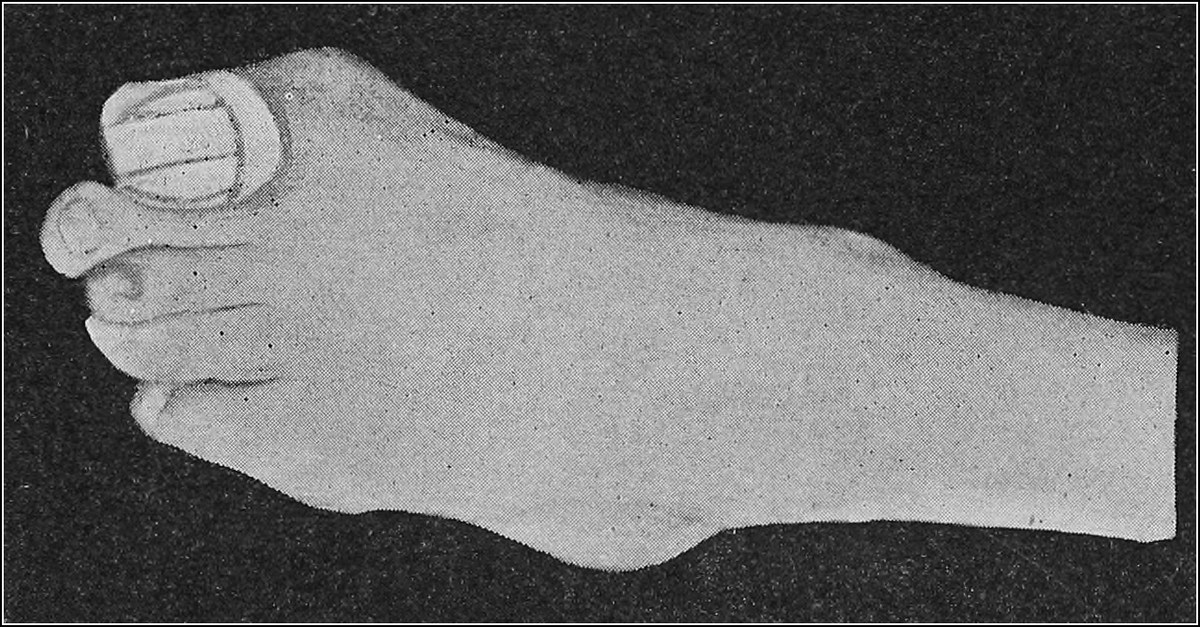
LARGE GAUZE SQUARE FOR DRESSING INGROWN NAIL
(2) Large gauze squares. It is a common practice among podiatrists to cut large quantities of gauze into pieces about three inches square. These have two uses: (a), to dry off instruments dripping with alcohol or whatever germicidal solution has been used, before operation, and (b), as a dressing applied over the affected area. In the latter instance this size square is practical where the whole distal end of the toe is to be covered, as in applying a moist dressing in the treatment of ingrown nail, or where there is a large area to be covered on the dorsum, plantar or lateral sides of the foot or upon the lower leg. As a “wipe” for instruments, one thickness, and as a dressing, three or four thicknesses are used.
(3) Small gauze squares. These are about an inch-and-a-half square and have their principal use as a dressing to cover one side of a toe nail, or to cover a small area of the integument, or as a “wick” in the drainage of a large sinus or deep ulcerative condition. Both the large and small squares, cut to size, are sterilized by heat and are then placed in a formaldehyde sterilizer until used; this assures their absolute asepsis.
(4) Nail Groove and Sinus Pledgets. For the more confined areas of the nail groove or for a small sinus, gauze is cut into small pieces measuring about one-half inch long and one-eighth inch wide. Several thicknesses of the fabric are cut together so that even from a small amount of gauze many small pledgets or “wicks” are obtainable. These small gauze pieces are very practical for packing a nail groove, and, as the fibre is looser and the pledgets do not harden, they make a much softer and more yielding pad for the nail than does cotton.
In the drainage of a small sinus, these small pieces of gauze offer a very practical material for use as a “wick.” Three or four strands of the fabric may be inserted at the mouth of the sinus to prevent surface granulation, while the repair in the deeper tissue is still incomplete.
Cotton. Cotton is the white, fluffy, fibrous covering of the seeds of the cotton plant which, when ginned and refined to a uniform smoothness, furnishes a medium which is used extensively in surgical dressings.
Aseptic absorbent cotton is manufactured by a number of firms and, except in the cheaper grades, no irregularities or foreign matter are found in the fabric.
Cotton is used in podiatry practice by winding it on the end of a wooden or metal applicator. The fabric, thus fashioned about the applicator, is used either dry or dipped in some medication for applying solutions to the foot. It is also used to dry parts or to wipe instruments; as a dressing, it is used principally in combination with collodion to make the cocoon dressing. This name is derived from its resemblance to the cocoon of the silkworm or the butterfly.
A cocoon dressing is a pledget of cotton, the fibre of which is smoothed and is placed in one direction, while the edges of the pledget are thinned out or “feathered.” The cotton is applied over the part and collodion (preferably flexible collodion) is painted over it by means of a brush or a glass rod in such a manner as to bind the edges of the cotton firmly to the skin. The collodion when applied is semi-liquid, and as its constituents, ether and alcohol, evaporate upon contact with the air, the pyroxylin remaining becomes an integral part of the cotton, joining intimately with its fibres and with the surface of the skin. After the edges are bound down in place, the collodion may be painted once along the length and once across the fibre at the centre of the dressing, so as to bind the dressing into one cohesive whole; it is not wise, generally, to saturate the whole pledget with collodion, as when dried, the dressing will be hard and unyielding. In the procedure first described the dressing is semi-occlusive; in the latter, occlusive. The cocoon dressing is used principally as a covering for a part when an ointment has been applied and, as in these cases the parts beneath are tender, it is wise to have the dressing as soft and pliable as possible.
This form of dressing may be used alone or it may be applied as a covering and protection over the aperture of a shield after an ointment has been applied to the part. It is found very practical when applied over a nail fold and groove in which an ointment has been used. The dressing will confine the unguent to the proper areas and prevent it from running over that side of the digit. In dressing a blister or other irritated area, due to ill-fitting shoes or mended hosiery, the cocoon is also very practical. The cotton not alone serves to hold the medication in place, but acts as a padding so that the part may not be subjected to further irritation.
Cotton is also used in the form of a small pledget for packing a nail groove. The pledget or roll should be small and thin and is used to hold a medication in place; at the same time it constitutes a soft pad upon which the edge of the nail rests.
Lint. Lint is a flocculent material procured by ravelling or scraping linen.
Surgeon’s absorbent lint as a dressing and shielding material, is continuously coming more into vogue. Otto Sjogren of New York is a great believer in its efficacy and in his demonstrations at The First Institute of Podiatry strongly advocates its use. The late W. A. Kennedy of Philadelphia was also strong in his advocacy of lint as a dressing and is on record as follows: “The essentially favorable feature in utilizing lint for shielding purposes is that, when properly adjusted, there is no pressure on the parts which it serves to protect. Most, if not all, of the material of which shields are ordinarily made, is of an unyielding character, and, in consequence, the capillary circulation of the compressed part is disturbed. If such a condition exists, absorption is prevented and the treatment is in most instances harmful rather than helpful. Because lint is a loosely woven cotton fibre, it does not pack in a hard mass, but always remains soft and yielding; nor is it necessary to apply it excepting in thin layers.
“The method of use should be as follows:
“Select a perfect sheet of lint and cut off a square or oblong piece slightly larger than the lesion and round off the corners so that they will not bulge when plaster strips or bandages are applied. Then cut a round opening in the lint, slightly larger than the lesion. Spread such medicament as is desired on the part requiring it, and then place the fluffy side of the lint next the skin, in situ, with the edges of the opening surrounding the part under treatment. Over this dressing, place a piece of lint so as to cover the existing dressing in its entirety and apply ordinary adhesive plaster to retain the whole in place. The thickness of the dressing represented in layers of lint will depend upon the necessities of each individual case, but in the experience of the writer, the most satisfactory results are obtainable where the dressing is least bulky. At times, when several layers of the lint are requisite to the patient’s comfort, it will be found advisable to cut out the sides of one of the under layers for the purpose of making a half-moon dressing; then apply the top covering.
“In the accompanying illustrations most of the required dressings shown are of two thicknesses only, the under layer having the round opening and the upper layer acting as a protective as well as an absorbing medium. This method will be found useful, in that drainage may take place properly where there is a suppurating surface, and even though the patient does not return for treatment at the time suggested, there will be no danger of septic infection because of a damming in the flow of exudate, a menace which is so common in some forms of dressing. Patients will rarely complain that the plaster ‘draws’ offensively if the above dressing is properly applied.
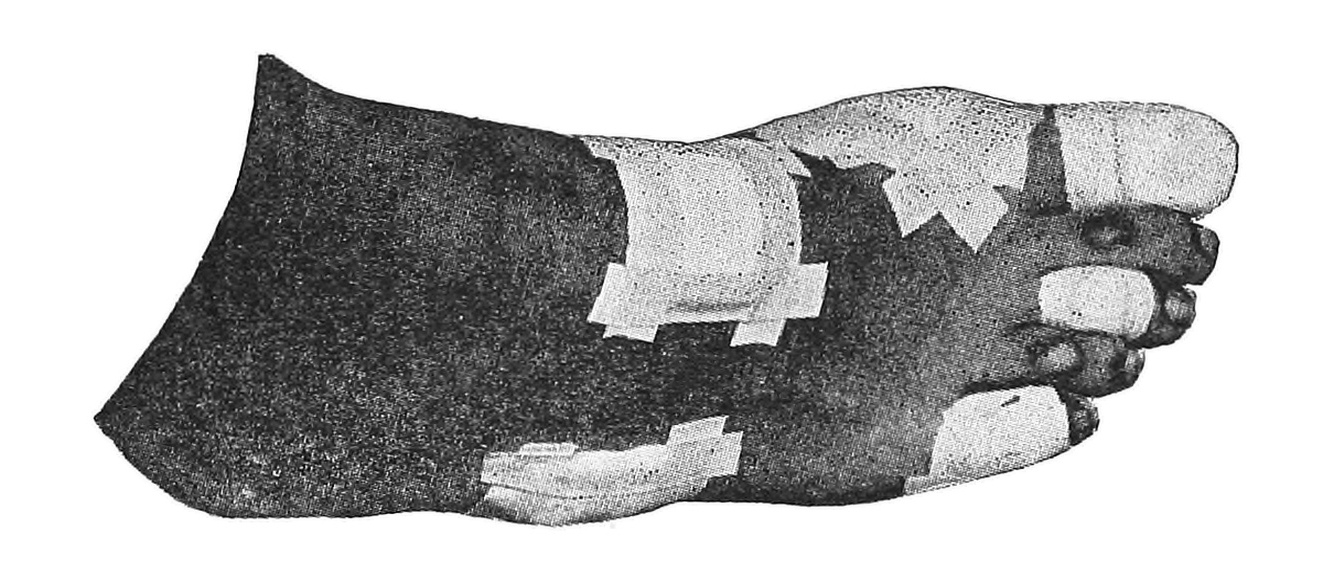
DORSAL LINT DRESSING
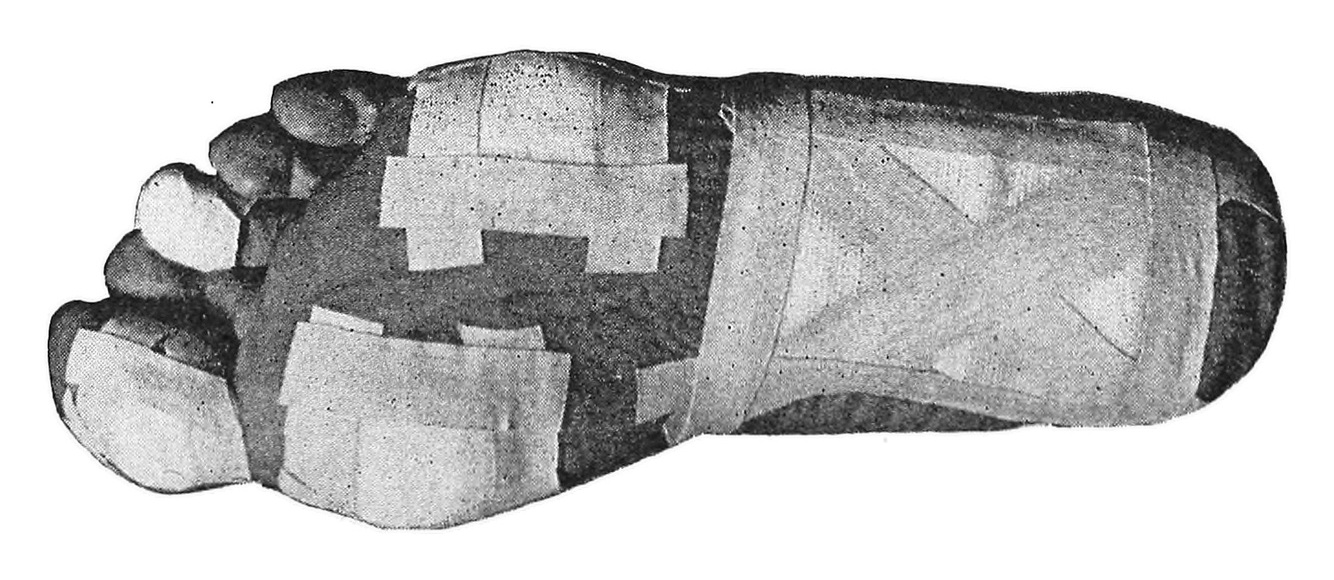
PLANTAR LINT DRESSING
“The plantar aspect of the foot exhibits four full dressings and half of another.
“The dressing covering the great toe may be utilized for any lesion from a callous to a perforating ulcer; the one on the distal end of the middle toe, for heloma or for any other condition usually met with in this region.
“The dressing covering the fifth metatarsophalangeal articulation can be applied for perforating ulcer, for callous or for vascular heloma and can be placed anywhere after treating this lesion. The dressing covering the os calcis region is of a single thickness and can be used in varying sizes for any lesion found on the plantar surface.
“The partial dressing, covering the first metatarsophalangeal articulation is used from one to any required number of layers for covering bunions, enlarged joints, etc.; the other section of this dressing is shown on the dorsal aspect of the foot in the other illustration.
“The dressing covering the dorsal aspect of the great toe is used after any ingrown nail treatment and the dressings on the third and fifth toes are applied after the removal of helomata.
“The dressing covering the fifth tarsometatarsal articulation is very useful in combating the calloused and oft-times inflamed area produced by the side seam of shoes, especially of the low-cut type.
“Lastly, the dressing covering the tarsal aspect is a comfortable arrangement to apply after removing the minute helomata produced by the eyelets of a shoe or for any other lesion found on the dorsal surface.
“In case of extensive ulceration or of profuse discharge from a lesion, it is advisable to use several layers of sterile or medicated gauze before applying the absorbent lint to the surface.”
Collodion. Plain flexible collodion is used extensively in podiatry as an agent to bind cotton into place upon a part or as a vehicle of application for a number of drugs, or whenever an occlusive dressing is applied. Flexible collodion is ordinary collodion to which is added castor oil and turpentine. These drugs serve to reduce the contraction of the film during evaporation. Plain collodion, as evaporation takes place, contracts in area and when applied is liable to draw or “pucker” the skin about the part. Flexible collodion has practically no contractile tendencies during evaporation.
Flexible collodion, unmedicated, is used as an application over chilblains or in other conditions where occlusion is desired.
Medicated Collodions. Flexible collodion, medicated with various drugs, is also used extensively in podiatry. The four named and described below are the most important, and are most generally used.
Iodized Collodion (C. Iodatum, N. F.). Iodized collodion is a five per cent. solution of iodine in flexible collodion.
It is used in podiatry as a covering for the exposed tender tissues after removal of a callositas or an heloma. The film formed by the collodion serves as a protection against friction to the part and the iodine contained in the mixture acts as an antiseptic and counter-irritant. This combination may also be used where any counter-irritant action is desired and wherever the tincture may be used.
Ichthyolated Collodion, 5 to 15% of ichthyol in collodion, is used for the same purposes as the iodized collodion in the protection of a previously pared callous, and as an antiphlogistic and stimulant in erythematous chilblain, this form of medication is used extensively and with good results. It forms an occlusive film over the chilled parts, and by the action of its constituent, ichthyol, serves to stimulate the deranged functions and to promote absorption in the congested parts.
Benzoated Collodion, 5 to 10% of tinctura benzoini composita in flexible collodion, may be applied in post-operative procedures in heloma, etc., as described in preceding paragraphs, and is also efficient as a stimulant in the treatment of pernio and as a covering for blisters and other superficial lesions where no discharge is present.
Salicylated Collodion is a medicated collodion with the following formula:
Salicylic acid, 30 parts; Ext. of cannabis Indica, 5 parts; Collodion, 240 parts.
It is extensively used in the medical treatment of heloma or callositas. This combination is disintegrative in its action and should not be applied on sound or normal integument.
Collodion, either plain or medicated, is contra-indicated in the presence of a discharging surface. By sealing the lesion, no drainage is possible, and the waste materials thrown off are kept confined to the detriment of the healing process.
Paraffin Preparations. Barth de Sandfort, a French naval surgeon, in experimenting for drugs to treat the cases of burns developing from the liquid fire and burning oil attacks of the Great War, discovered and perfected a substance known as “ambrine.” The exact composition of this paraffin is a secret, and for this reason it has been received coldly in this country, but a number of similar paraffin preparations have been developed and are in general use today. The four most popular of these are known commercially as paraffin No. 7, paraffin No. 7-11, parresine and redintol.
Paraffin No. 7 (Dr. Hull) consists of paraffin (hard), 67%; paraffin (soft), 25%; olive oil, 5%; oil of eucalyptol, 2%, and resorcin, 1%. To prepare paraffin 7, first melt the hard paraffin, then add in the order named the soft paraffin, olive oil, oil of eucalyptol and resorcin.
Paraffin No. 7-11 (Dr. Adams) consists of paraffin (hard), 69%; paraffin (soft), 25%; olive oil, 3%, and thymol iodide, 3%. The preparation of paraffin 7-11 is similar to that described for the preceding combination.
Parresine (officially adopted by the United States Army and Navy) is a wax-like substance, containing about 95% of paraffin; this is treated by the addition of a vegetable wax and mineral and vegetable resins so as to modify its physical character, especially as regards plasticity, ductility, pliability and adhesiveness. It also contains eucalyptol, a valuable antiseptic, which is added to cover the characteristically disagreeable odor developing from burned surfaces and other large abrasions during the process of healing.
Redintol is a mixture of paraffin and resins, having similar melting points. The firm manufacturing it have prepared a special form of sheet cotton for use in connection with the application of this product.
Technic. The technic of the application of these paraffin preparations is similar and is described in detail in the chapter on “Burns.” The advantages of the wax treatment are numerous.
(1) It is an inexpensive dressing (a pound of wax and a pint of liquid petrolatum, together costing about sixty cents, will dress many burns).
(2) It is a comfortable dressing because it is smooth, and the granulating surface does not grow through it as with the gauze. The paraffin is hard enough to make the dressing somewhat rigid and to act as a splint.
(3) It is a cleaner dressing, because the wound discharge is not permitted to soak through the impermeable wax covering, soiling all the linens that come in contact with the patient.
(4) Superficial burns heal more readily under this treatment than with any other previously used method.
(5) It is a most comfortable dressing, for the reason that the granulations do not grow through it, and the dressing is lifted off painlessly.
(6) The resulting scars are not as pronounced.
(7) It is a stimulant of granulations.
Disadvantages. The disadvantages of the wax treatment are:
(1) Some patients refuse to be treated with the wax (it is applied hot directly to the injured area) because of the pain.
(2) So many extravagant claims have been made for it, that the one who uses it for the first time will probably be disappointed.
(3) An infected wound is covered with a sealed dressing.
(4) We have no way of controlling the temperature of the wax. Taken from the boiling water at 212 degrees Fahr., it is too hot. Cooling at 114 degrees Fahr., it is too cold. The degree of pain caused the patient is the only means one has of knowing if it is too hot, unless one tries it first on the back of the hand.
(5) Around the skin edges it is painful.
IMPERVIOUS COVERINGS.
In connection with moist dressings, several varieties of impervious covering may be used.
Oiled Silk is a rubberized material of great strength, usually yellow in color and soft and smooth to the touch. The use of this material is quite general in podiatry for all moist, non-evaporating dressings. The technic of application consists in cutting a square of the fabric of sufficient size to cover the whole of the gauze dressing, also all sides of the toe (if this be the location of use) and a considerable amount of the surrounding healthy tissue. It is held in place either by a roller bandage, or by means of adhesive strips fastening down its edges to the adjacent surfaces. Dressings covered by oiled silk are apt to be bulky and for this reason, when the shoe is to be worn, it is not generally used.
Gutta Percha Tissue is a thin perishable material placed on the market by several firms. It is not to be compared with oiled silk for durability, but the dressing covered by gutta percha is not nearly so bulky, and for this reason it is popular and practical for use in podiatry. It is generally applied over the gauze by vulcanizing its edges to the surrounding integument. This is accomplished by means of heat, and, when completed, presents a neat dressing which is absolutely occlusive, and from which none of the solution used on the gauze underneath can escape. A square of the rubber tissue of sufficient size to more than cover the dressing is cut and held in place with the hand. A match is then applied to the edges of the square and while they are still melted they are lightly adhered to the surrounding skin. The tissue will adhere to the skin and will remain intact for a considerable period of time. The gutta percha is then covered by several turns of a roller bandage to protect the thin tissue from the rubbing of the shoe. Gutta percha tissue may also be held in place by means of adhesive strips as with oiled silk, but the vulcanizing process is by far the most popular and, insofar as confining the solution is concerned, it is also far more practical.
Fish Skin is a manufactured material of tissue paper thinness and has proven very popular for use as an impervious covering. The technic of application is similar to that described for oiled silk and it is held in place by the same means. It does not make a bulky dressing and for this reason its popularity has probably exceeded that of oiled silk.
BANDAGING.
A bandage is a strip of gauze, muslin, flannel or other material of varying widths and lengths, used in the various branches of medicine for retaining dressings, applications and splints and to produce compression. Occasionally they are applied to retain heat. Bandages also help keep a wound clean by preventing the ingress of foreign matter.
Bandages are made of different materials, chief among which is gauze. This is made of lint, woven into a soft material, which is easily applied to all parts of the body. Muslin is a heavier cotton material and is made of cotton or silk or of a mixture of both (lisle) with rubber. Flannel is wool woven into a soft, firm, semi-elastic material. Rubber bandages are used to induce excretion and for compression.
Bandages vary in width and length, depending on the size of the parts for which they are intended. For convenience, bandages are usually manufactured in widths varying from one-half inch to six inches, and in length from one to ten yards or more. Those which are used in podiatry vary in width from one-half inch to three inches. The standard length of bandages is five yards and ten yards. These may be cut and the unused piece preserved. A table of the widths of the various materials used in podiatry practice, showing the parts for which they are best adapted, follows:
LESSER TOES GREAT TOE FINGERS ANKLE WRIST ANKLE WRIST LEG FOREARM LEG FOREARM LEG
Gauze ¹⁄₂″ 1″ 1¹⁄₂″ 2″ 2¹⁄₂″ 3″
Muslin 1″ 1¹⁄₂″ 2″ 2¹⁄₂″ 3″
Flannel 2″ 2¹⁄₂″ 3″
Elastic 2″ 2¹⁄₂″ 3″
Rubber 2″ 2¹⁄₂″ 3″
A roller bandage consists of one piece of material rolled in the shape of a cylinder, having a core and a free end, and is the kind used in podiatry.
A double roller bandage consists of one piece of material, rolled from both ends, so that when it is completed there are two cylinders and no free end.
A plaster of Paris bandage is composed of a piece of gauze or crinoline into which is rubbed powdered plaster of Paris. This bandage is placed in water and then applied to a part; after a few moments the entire bandage becomes hard and solid. This form of bandage prevents mobility and is used for fractures and dislocations. In podiatry it is used for taking impressions of the foot for fitting mechanical appliances. Bandages are classified as follows:
Circular—being circular turns around a part.
Figure of eight—the turns crossing each other like the strokes of the figure 8.
Oblique—covering the part by oblique turns.
Recurrent—the turns returning to the point from which they originated.
Spica—the turns crossing and recrossing, resembling in arrangement the husks of an ear of corn.
Spiral—the turns ascending or descending, each turn covering about two-thirds to three-fourths of the preceding turn.
Spiral reverse—when the bandage is turned in reverse position so that the inner side becomes the outer and the outer side rests against the skin, in order to better adapt itself to the part.
Bandages are designated by various names, according to the shape they assume when completed, and they are sometimes named after the men who first used them; for example, “Barton’s bandage” of the head.
The bandages used in podiatry are designated by the shape they assume. The names of the various bandages of the foot follow in the order of their importance:
Spiral bandage of the toes. Spica bandage of the foot. Figure of eight bandage of the ankle. Spiral reverse bandage of the leg.
The Spiral Bandage of the Toes. This bandage is applied to the great toe more often than to the lesser toes. Gauze, one inch wide for the great toe and one-half inch wide for the lesser toes, is used.
This bandage may be started by a few circular turns around the ankle, then diagonally across the dorsum of the foot to the base of the great toe; but this may be simplified by making a simple circular turn around the proximal end of the toe, with the free end towards the heel, which will firmly lock the bandage. If the distal end of the toes is to be covered, the bandage is now applied from the proximal end of the toe on its plantar surface, over the distal end to the proximal end on the dorsal surface. This is repeated back and forth as often as necessary to cover the parts by what are known as recurrent turns. The spiral turns are now started and as the bandage moves toward the distal end of the toe, each turn must cover about two-thirds or three-fourths of the preceding one. When the toe is covered, the spirals are continued back to its base, where the bandage is tied off. Many toes are not cylindrical but taper to a point; so that when the spirals reach the distal end of the toe, the bandage bulges on the inner side. This bulging may be avoided by making a reverse turn over the part instead of a simple spiral.
The Spica Bandage of the Foot. Bandage 1¹⁄₂ to 2 inches wide is used, depending on the size of the foot. The free end of the bandage is placed on the dorsum of the foot at the ankle joint, and is locked by several circular turns around the ankle. The bandage is passed diagonally forward across the dorsum of the foot to a point opposite the head of the metatarsal bone, then across the plantar surface of the foot to the opposite metatarsal bone, and diagonally backward across the dorsum of the foot, crossing the first half of the turn, producing an X. The turn is finished by passing the roller back over the tendo Achillis. This is repeated, the second turn covering about two-thirds of the first and so on backward until the desired area is covered. The bandage is finished by a few circular turns around the ankle and is tied off in the usual manner.
Figure of Eight Bandage of the Ankle. This bandage resembles the spica bandage of the foot in every way except that the first turn extends to the base of the metatarsal bone instead of to the head and, instead of tying it off at the ankle, a few spiral reverse turns are made up the leg. It is tied off as are the other bandages.
The Spiral Reverse Bandage of the Leg. This bandage is considered by many to be the most difficult of all the bandages of the extremities to apply. A few figure of eight turns are made around the ankle and then the spiral turn is made; the bandage is reversed so that the inner side becomes the outer and the outer side rests against the skin. Each turn should cover about three-quarters of the preceding one, and care should be taken that at the point of reversing the bandage, no wrinkles or uneven folds are produced. The reverse turns should not be made over a wound or a part that may be irritated by additional pressure.