Chapter XVIII · CHIMATLON
Reading edition
Chimatlon, or pernio, is an inflammation of the skin and of the deeper structures which is the result of exposure to reduced temperatures. The severity of the condition depends upon the length of the exposure as well as upon the degree of temperature. If the skin alone is involved and there is no loss of tissue, chimatlon mild, or chilblains, is the term applied to the lesion; where there is an involvement of the deeper structures the condition is called chimatlon severe, or frost bite. In many instances it becomes difficult to distinguish between a severe chilblain and a mild frost bite. However, for the sake of scientific study, in all cases in which the deeper tissues are involved and suppurative processes affecting these structures manifest themselves, the condition should be considered as chimatlon severe, for these cases are usually due to prolonged exposure to low temperatures.
CHIMATLON MILD
Derivation. Chimatlon, from the Greek, meaning the severity of winter.
Synonyms. Chilblains, Dermatitis Congelationes, Erythema Pernio.
Definition. Chimatlon mild, or chilblains, is a local inflammation of the skin due to exposure to cold and dampness.
Etiology. Chilblains are primarily due to exposure to cold in varying degrees. When the part is exposed to a decreased temperature, the vasomotor nerves become affected and the cutaneous circulation is impaired. This interference with the blood flow produces congestion, leading to inflammation, which latter is followed by a serous discharge or even by the production of pus. Dampness hastens the affection of the vasomotor nervous system of the skin, and where this organ is very sensitive, in the presence of moisture, only a moderate decrease in the temperature is necessary to produce all the symptoms of severe chilblains.
The parts of the body most usually affected are the hands and feet; the distance of the extremities from the heart is probably the reason for this impairment under the other abnormal conditions. Where the horny layer of the skin is thin, it receives its nourishment normally, regardless of the distance from the heart; but on the hands and feet the skin is thicker and is imperfectly nourished and a decrease in temperature, in the presence of moisture, results in local inflammation.
Females are more disposed to chimatlon mild than males, and young people more than old. Aside from cold as an etiologic factor, there is also the predisposition which is equally as important in the production of chimatlon mild and should be considered in every case. Imperfect circulation in the limbs, due to varicose veins and arterial disturbances, caused by a deranged nervous system, are often causes of chilblains and must be given consideration.
Any part of the body exposed to the air may become affected, particularly the ears and nose. Several cases of chimatlon mild of the skin over the throat have been recently reported, due to walking against a strong wind, with the throat bared to the weather.
Symptoms. The symptoms in the mild form of chimatlon vary with the severity of the exposure. In very mild cases the only perceptible symptoms are a tingling or slight itch, and the part feels cold and clammy to the touch. The most common cases show the parts colored dark blue or purple, immediately after exposure and during the reaction. The parts are inflamed and there is severe itching coupled with pain. After reaction has set in, the color of the lesions varies from a scarlet to a purple. There is no sharp line of demarcation between the affected and the surrounding area, but there is a gradual blending between the discolored and the normal tissues. There is considerable congestion, the parts are swollen and after a complete reaction, heat manifests itself. These symptoms may soon subside or they may persist for many months. In general, they are of a transient nature, but the parts remain permanently weakened and congested, and are easily affected from the slightest cause.
In the more severe types of chilblains, blebs are formed which, when opened, exude serum or even pus. The blebs are commonly found at the ends of the toes, and sometimes the entire distal end of the digit is covered by one lesion.
No pain is felt immediately after exposure, but as reaction commences, shooting pains develop, and if the reaction is severe, these pains become almost unbearable. Itching is present to a marked degree, and after reaction is complete, dull pains and burning are noticed until the affected parts become normal.
Pathology. The immediate effect of cold upon the skin is to constrict the small blood vessels and to retard the stream within them. Under quite severe or prolonged exposure there may ensue a destruction of the minute vasomotor nerve terminals in the arterioles, which control their constriction and dilation. This nerve function is thereafter permanently affected and the muscular coat of the vessels in the parts impaired, atrophies from disuse. It is this degree of chimatlon which is classified as chimatlon mild, or chilblains. (Destruction of tissue beyond this, is classified as chimatlon severe or frost bite).
In winter there is a natural conservation of heat, by the constriction of the superficial capillaries; the blood supply to the skin is diminished and heat radiation is thus controlled. This reduction in the peripheral blood pressure especially affects the feet and other parts remote from the heart.
Later on besides this natural deficiency in the blood supply, there is in chimatlon mild a deficiency of freely circulating blood, due to the blood vessels relaxing. The reverse condition may seem to be proven by the heightened color but in reality this redness is due to too much blood in the tissues. There is however, congestion; the blood entering the tissues has but little motion, the pulse wave is lost in the relaxed vessels and the stream is in consequence a sluggish one. The reduction in the supply of fresh blood is probably the direct cause of the pain; the lack of oxygen brought to the parts and the retention of excrementitious chemical substances, act as irritants to the sensory nerve terminals. Persons suffering with chilblains have feet which are generally cold to the touch in spite of their being surcharged with blood. The blood in them is rendered sluggish and the heat is not retained long, nor is there a sufficiently rapid supply of fresh blood to replace it.
In summer time, when the general peripheral circulation is at its maximum, vascular conditions are equalized throughout the entire body surface and are congenial to conditions in affected areas.
All the peripheral vessels are dilated and the blood pressure within them is increased to facilitate heat radiation and the maintenance of a cool body. “The season is congenial to persons who suffer with chilblains in winter because the pathologic condition is compensated by the physiologic vasodilatation and heightened blood pressure.” (Maximilian Stern, M.D.)
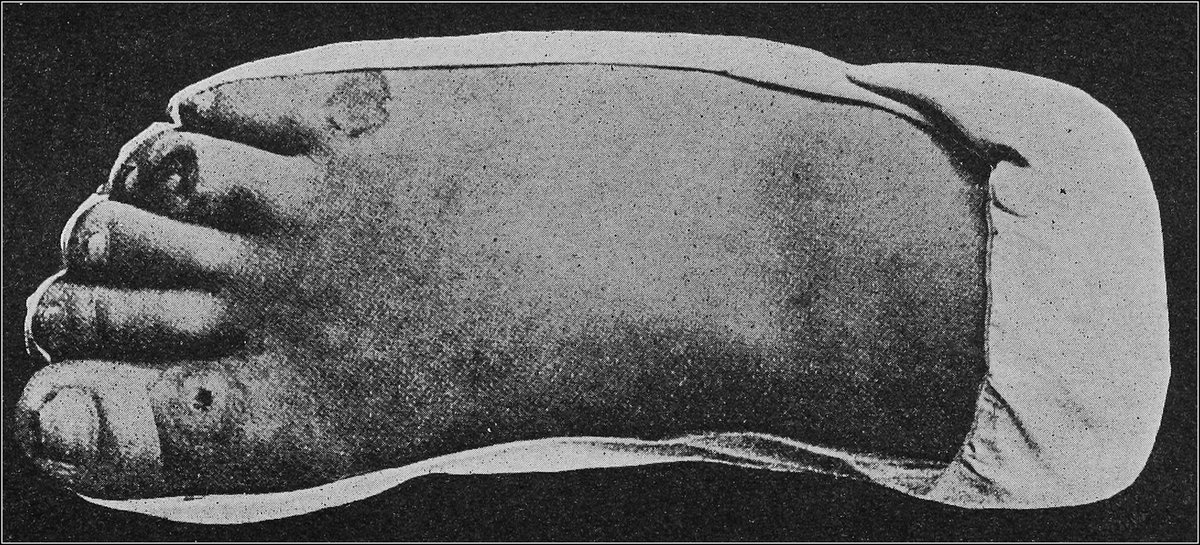
CHIMATLON MILD FROM THE JACOBI ATLAS
Diagnosis. Chimatlon mild is a true inflammation of the skin with or without bullous formation and serous or purulent exudation. The color varies from a light scarlet to a deep purple and the lesions blend gradually with the surrounding normal tissue. The part feels cold and clammy to the touch, this being a characteristic symptom in spite of the heightened red color. The blood present in the parts is sluggish so that its temperature is below normal.
Chilblains of the metatarsophalangeal joint of the great and fifth toes may be mistaken for bursitis. The chief difference between the two conditions is found in the history of the case, which in chilblains shows exposure, while in bursitis the lesion is usually accompanied by hallux valgus. The usual sites of chimatlon mild of the foot are the heel, the tips of the toes, the great and little toe joints and the webs between the toes. The pains of chilblains are transient and of a shooting variety, and are present with the shoe on or off, while those of bursitis are constant and dull, and are present only when the shoe is worn. Where inflammatory processes have continued so that the deep tissue are involved, the pains are of a throbbing nature in both lesions, so that other symptoms must be observed to determine upon a proper diagnosis.
Chimatlon Mild Bursitis
History of exposure No history of exposure
Hallux valgus not usually present Hallux valgus usually present
Pains of shooting variety Pains dull and steady
Pains present at all times Pains absent with shoes off
Intense itching No itching
The lesions of chimatlon are irregular in shape and may involve the entire forefoot, including both the dorsal and the plantar surfaces. The heel over the tendo Achillis, as well as the skin on the sole and lateral surfaces over the os calcis, are common sites of chilblains. These lesions are usually deeply colored, the redness gradually diminishing as the periphery is reached.
The blebs which have formed, may exude serum or even pus, and these lesions may be easily differentiated from the blebs of pompholyx and eczema by carefully noting the history of the case, the age of the patient and the general appearance of the foot and leg.
Prognosis. The ultimate cure of chilblains is uncertain. Cases of a mild type often respond immediately, while others persist indefinitely. The painful symptoms are readily relieved, but the lesion itself often continues until the change of season, when the warmer weather brings about a cure. This is due to the changes that occur in the cutaneous circulation during warmer weather. Recurrence is the rule in those who have poor circulation from anemia or other causes.
Treatment. The treatment for chimatlon mild consists in bringing about a gradual reaction. This should be commenced immediately after exposure, and is accomplished by rubbing the parts with snow or cold water. It must be remembered that the reaction must be gradual. If the parts exposed are rapidly warmed, the reaction will be equally rapid, and serious results may follow. After reaction has been established, the treatment varies with the severity of the resulting inflammation.
When the skin has been broken and blebs or bullae are present, the lesions must be healed first. For this purpose ointments are most desirable. The parts should be thoroughly cleansed with an antiseptic such as phenol (1-40) or bichloride of mercury (1-2000), and by removing serum or pus present, with hydrogen peroxide. The surface of the lesion may then be dressed with any of the following:
℞ Ichthyol 8.00
Petrolatum q. s. ad. 32.00
M. ft. ung. Sig. Apply over affected parts twice daily.
℞ Acid. carbol. 0.60
Acid. boric 2.00
Petrolatum q. s. ad. 32.00
M. ft. ung. Sig. Apply on chilblain once daily.
℞ Spirit. terebinthinae 2.00
Acid. boric 2.00
Petrolatum q. s. ad. 32.00
M. ft. ung. Sig. Apply on chilblain once daily.
Wet dressing of Burow’s Solution, diluted with equal parts of distilled water, applied for a few days, produces satisfactory results in lesions where there is marked inflammation and swelling.
In severe ulcerative processes that do not granulate readily, a strong stimulant, such as balsam of Peru or some iodine preparation, should be used until the entire area is healed.
After the skin has been healed, or in cases where the skin has not been broken, the treatment varies with the severity of the lesion. In very mild cases, massage followed by an application of the compound tincture of benzoin, which, because it furnishes an occlusive coating and acts as a support for the skin, is often sufficient. The liquor alumini acetatis (Burow’s Solution) may be used as an astringent wet dressing to reduce the swelling and inflammation. The part may also be painted with a four per cent. solution of silver nitrate at frequent intervals, to be then covered with raw cotton; or nitric acid, diluted with aqua cinnamoni, 15 minims to the ounce, may be painted over the unbroken skin.
A very satisfactory liniment which has been used extensively to relieve the pain and reduce the inflammation in this condition consists of the following:
℞ Guaiacol 8.
Spts. terebinth. 28.
Ol. olivae q. s. ad. 64.
M. ft. lin. Sig. Rub on affected parts at bedtime.
The itching, which is a marked symptom of chimatlon mild, can readily be controlled by the application of camphorated soap liniment. Its action is almost instantaneous.
Ichthyol has proven to be a valuable agent in the treatment of chilblains; it may be used with collodion, or as an ointment, the following being found satisfactory:
℞ Ichthyol 8.
Lanolin q. s. ad. 32.
M. ft. ung. Sig. Spread on gauze or lint and apply.
It must be borne in mind that the apparent cure of an acute lesion of chimatlon mild, is not in reality an absolute cure, and thorough precautions must be taken to prevent recurrence. Stimulation of the cutaneous blood supply and the vasomotor nervous system is essential, and for this purpose, massage and the alternate hot and cold foot baths are advisable. The latter treatment should be used at least once daily and if possible, twice a day. The feet should be kept in hot water for thirty seconds and then plunged into cold water and kept there for fifteen seconds. This is repeated for an entire ten minute period.
Electricity, in the form of the faradic or the high frequency currents, may be used to assist in the stimulation of the action of the skin. These treatments should be given for ten minutes, three times a day.
The hygiene of the foot is all important, and this should be explained at length to the patient. The feet should be protected by wearing woolen or cashmere stockings, the latter being preferred, and should be used from early in the fall until late in the spring. Hose of this kind prevent heat radiation, so necessary for those who suffer from chilblains; they also absorb excretory moisture, all of which prevents recurrence of the lesions. It is necessary to conserve the body heat as much as possible, and warm underclothing, covering the entire body, should be worn; the patient should be instructed to take some form of general exercise. Footgear should be wide enough to allow freedom of the toes and the shoes should be made of either calf skin or vici kid. The wearing of silk stockings and patent leather shoes must be discouraged if good results are to be expected.
Where the skin is not broken, Dr. Charles T. St. Clair of Bluefield, West Virginia, advises as follows: “coal oil (kerosene) applied night and morning to old itching frost bites of the feet gives almost immediate relief. It should be applied with a cloth and cotton soaked in the kerosene and allowed to evaporate, which it will do in a few minutes. If the sock is put on and the person goes to bed with the foot still wet with the oil, it may burn the skin.”
CHIMATLON SEVERE
Derivation. Chimatlon, from the Greek, meaning the severity of winter; severe, with extremely bad effects on the tissues.
Synonyms. Frost bite, pernio, dermatitis calorica.
Definition. Chimatlon severe is a local inflammation of the skin and deeper structures, produced by exposure to extreme cold, and is a result of complete or partial paralysis of the vasomotor nerves.
Etiology. The one cause for the severe form of chimatlon is prolonged exposure to an extreme degree of cold. The decrease in atmospheric temperature lowers the temperature of the parts exposed, thereby causing complete or partial paralysis of the vasomotor nerves and producing congelation of the blood vessels. When the congelation is complete the parts are deprived of their nourishment, and finally become devitalized.
Symptoms. Immediately after exposure, numbness develops and all sensation is gradually lost. The parts are congealed and if there is complete freezing, they present a white, blanched appearance. The tissues affected may be so completely frozen, that upon thawing, they are either found to be absolutely dead, or their vitality so greatly impaired that there is very little reaction and gangrene may result in a very short time. If the area is not completely frozen, the reaction is rapid, the tissues become purple, swollen and very painful. The parts may become gangrenous, in which case the line of demarcation and separation between the gangrenous and the healthy tissues evidences itself. The affected tissue is at first white but gradually becomes blue and finally black. The fluids in the tissues rapidly evaporate and the odor of decaying flesh is very apparent.
If the parts do not become gangrenous, the symptoms that present themselves are those of inflammation. The tissues become swollen and assume a deep purple color, which, as the circulation is restored, becomes lighter and, after inflammation has subsided, gradually disappears. Blebs may form and there may be an exudation of serum or even of pus.
Pathology. The changes that occur in chimatlon severe are much the same of those of the milder type, the former however, causing complete destruction of tissue, or the development of gangrene. The cold causes a constriction of the blood vessels and the stream within them is retarded. The minute nerve terminals in the smaller arteries, which control the dilation and constriction, are destroyed and their function is lost. The vessels now contract and in extreme cases remain so. Where the exposure has not been severe enough to cause complete death of the vessels, there is a dilation after the contraction, with a very slow movement or even complete stasis of the blood stream.
Gangrene or necrosis will manifest itself in extreme cases almost immediately, and often after reaction has commenced, the tissues may be cast off. At the line of demarcation between the normal and the dead tissues, the changes that accompany inflammation take place.
Diagnosis. The diagnosis of frost bite is not very liable to be confused with any other condition, in that the history shows exposure to an extremely low temperature. The disease known as “Trench Foot,” when it first manifested itself, during the world war, was considered a form of chimatlon, but since research work has been done along the lines of the new disease, it has been found to be quite another condition. Trench Foot will be discussed following this chapter.
The color of the part is characteristic. Immediately after exposure, the tissues are blanched, and as reaction progresses, the color deepens from a light scarlet to a deep red purple or black, depending on the length of the exposure and the severity of the condition. As reaction advances, the gangrenous tissue is separated from the normal tissue by a distinct slough, which, as previously stated, is known as the line of demarcation.
The milder cases of frost bite and the severer cases of chilblains are often confused, particularly in cases of the former when the loss of tissue has been avoided. The confusion, although of no great moment (inasmuch as the treatment of both lesions is identical), may be avoided by remembering that frost bite develops quickly and that the parts have been exposed to a very low temperature, while chilblains develop more slowly, are less painful and do not require exposure to a very great decrease in temperature for their causation.
Prognosis. When the part has been completely frozen and the circulation to the parts has ceased, there is no possibility of saving the tissues. However, in cases seen immediately after exposure, in which proper treatment is commenced at once, it is often possible to save large areas that would otherwise be lost. Amputation is the only cure in cases where gangrene has developed. The ulcers which result after the dead tissue has been removed, respond very slowly, requiring from one to four months to heal.
Recurrence is the rule, due to the fact that the vasomotor nerves never regain their normal vitality, and persons who have had frost bite will develop symptoms from the least imaginable cause.
Treatment. In all cases of frost bite, even when the parts seem hopelessly frozen, the first treatment should consist of bringing the parts back to normal temperature by a gradual reaction. This should be carried out as thoroughly as possible, for it often is the means of saving large areas of tissue. A case in which the entire forefoot is involved may be thus saved so that only one or two toes are lost. Such a patient would be able to walk comfortably, whereas if no care were taken with the preliminary treatment, the patient might become a hopeless foot cripple.
A gradual reaction is brought about by rubbing the parts with snow or cold water. The affected parts may be placed in a vessel containing cold water, or they may be wrapped in cloths wrung out in cold water. The final result depends largely upon the length of time elapsing between the exposure and the inauguration of the first treatment.
If the parts are completely frozen, gangrene will soon manifest itself. If the affected part is only partly frozen, a gradual reaction can be brought about by the above-described means and if the subsequent inflammatory reaction is gradual, gangrene may be averted or at least limited. Cold water dressings should be continued for some time after reaction has occurred, and should be maintained until the certainty of the avoidance of gangrene is fixed. The line of demarcation and separation will be indicative of this fact.
When all of the gangrenous tissue has separated, the remaining ulcer should be treated just as though it had arisen from any cause. In cases of gangrene of the toes and feet, complete or partial amputation should be practised as soon as the lines of demarcation and separation are well established. When gangrene has been avoided in frost bite, the treatment consists in stimulating the affected area. Various medicaments are useful, among which may be mentioned oil of turpentine, balsam of Peru, tincture of iodine, ichthyol and strongly carbolized ointments.
If the frost bite is of the bullous, pustular, vesicular or escharotic type, soothing agents such as ichthyol, Burow’s solution, etc., should be applied to the affected parts.
Wrapping the affected parts in dry salt has been suggested by a western chiropodist, who claims to have obtained excellent results by the use of this agent.
In cases where gangrene has been averted, the following have proved of great value:
℞ Acid, carbol. 1.
Acid, boric 2.
Petrolat, q. s. ad. 32.
M. ft. ung. Sig. Apply every morning.
℞ Ichthyol 8.
Lanolin q. s. ad. 32.
M. ft. ung. Sig. Apply on lesions once daily.
℞ Ichthyol 8.
Aquae q. s. ad. 32.
M. Sig. Paint over the affected area.
In frost bite, after the gangrenous tissue has been removed, the resulting ulcer may be treated with a stimulant. For this purpose balsam of Peru, iodine, ichthyol and other agents have proven successful. These ulcers do not respond readily, because of the decrease in vitality of the surrounding tissues, and patience is essential for a final cure. The patient must be told that the lesion will require a long time to heal.
Hernance (Therapeutic Gazette, 1895) draws the following conclusions from the study of thirty cases: “1. Ichthyol is the drug that gives most relief to pain and is as good a protector as any other application. 2. Acetanilid ointment is the best dressing when the parts are raw and ulcerated, preventing suppuration and promoting granulation. 3. In a certain number of cases one can do nothing but keep the parts clean and wait until nature throws off the diseased tissue.”
Massage is a very good therapeutic agent for chimatlon severe, and should be applied twice a day, if possible. This will help stimulate the circulation and tone up the faulty nerve endings. Electricity should also be used wherever possible, the high frequency and the faradic currents being the best. Applications directly to the affected parts for ten minutes, once or twice a day, will aid materially in bringing about a rapid cure.
The prevention of the recurrent attacks may be accomplished by treatment commenced in the early fall, and including massage, proper shoes, cashmere stockings, and other prophylactic measures. This treatment is essential, particularly for those who are anemic and under-nourished.