Chapter XVI · FISSURES, BLISTERS, AND BURNS
Reading edition
FISSURES (Fissura)
Definition. Fissura or fissures, as used in this sense, are cracks or clefts in the surface of the skin, some involving only the epidermic layers, some penetrating deep into the corium.
Etiology. Fissures occurring on the foot, due to trauma, are far in the minority as compared with those occurring as secondary lesions in hyperidrosis, uric acid diathesis and other systemic conditions. They are usually due to a too strenuous drying of the interdigital surfaces with a rough towel. They may also be caused in like locations by excessive walking, but the condition of the skin of the patient has much to do with their formation. If the skin be dry and a great amount of its elasticity is gone, these lesions are much more prone to develop than where the skin tension is practically normal. The interdigital toe webs are often cracked or fissured in spreading the toes too far apart, and this has been caused, at times, by the podiatrist working between the toes and stretching them to obtain room for his instruments or dressings.
Treatment. The natural treatment for a condition of this kind would be to obtain astringent action. This may be accomplished by a number of drugs, principal among which is silver nitrate. Tannic acid preparations are also frequently used, but they cannot compare in efficiency with the silver salt. A number of mild vegetable astringents of the same group are similarly employed by podiatry practitioners.
If the fissure is superficial, involving only the epidermic layers, compound tincture of benzoin, painted freely over the parts, after they have been thoroughly cleansed and dried, will be found advantageous in inducing rapid healing. Dusting powders such as tannoform, bismuth subgallate, bismuth subnitrate and thymol iodide, may also be successfully employed in these cases, but where the fissure is deep, the edges angry and red, and the whole area is involved in the inflammatory process, none of these are, as a rule, of avail, and more radical methods must be employed.
Nitrate of silver presents the most efficient means whereby astringent action may be obtained in the parts. Weak solutions, from 1% to 10%, are most generally employed, but it is often found necessary to use stronger solutions, even as high as 50%.
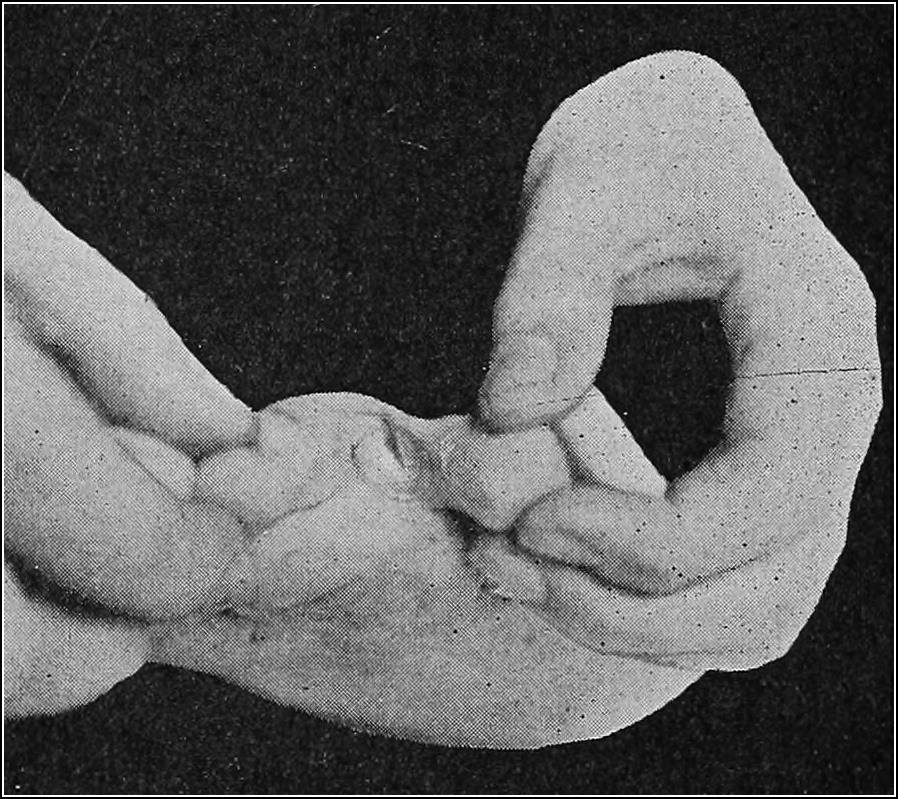
FISSURED TOE WEB
Technic. The parts are first thoroughly cleansed and any callous around the edges of the fissure is carefully and completely removed. This is an essential procedure, for no lateral granulation will take place, nor can direct apposition be obtained if this callous be allowed to remain.
Small particles of material from the hosiery or other foreign bodies should also be thoroughly removed. The recesses of a deep fissure present excellent places of lodgment for minute particles which are always to be found in footgear, and it is these bodies which produce infective processes. The above precautions having been observed, alcohol, 60%, should be freely applied and the parts thoroughly dried. Silver nitrate may then be painted deep down into the floor of the fissure, by means of a cotton wound applicator. This will produce some smarting, but it is transient and there will be no great amount of irritation. The silver solution should also be applied to the surfaces adjacent to the edges of the fissure, for it must be remembered that silver nitrate is sedative and this action is desirable in reducing the local inflammation.
Where the fissure is deep and of long standing, it may be found necessary to resort to a 25% or 50% solution or even to the fused stick. When cases are observed where proud flesh has developed in the fissure, due to continued irritation, it is necessary to use the stronger solutions or the stick at once. The proud flesh may be in such form as to permit of surgical removal. Where this can be accomplished, the bleeding stump is usually cauterized with silver solution, 50%. If a surgical procedure is impractical, the fused stick may be used to cauterize the neoplasm and thus eradicate it.
A dressing should be applied over the parts after the fissure has been treated. This may consist of several thicknesses of gauze, fashioned to fit between the toes, if the fissure be in that location; if the lesion be upon a plane surface, a square of gauze should be applied and held in place by adhesive strips.
A cocoon dressing may be substituted for that of gauze, and in many instances will be found more practical. It has been found necessary at times to apply some ointment or grease over the fissured area to aid in softening the parts and rendering them more flexible. Massage, at intervals, with olive oil or mutton tallow, will also be found advantageous in bringing about this result.
No dressing is applied over the parts after the use of compound tincture of benzoin, for this drug forms its own coating, which is practically impermeable. If a dusting powder be used alone, the parts are first thoroughly dried, whereupon the powder is dusted lightly into the fissure, and a wisp of cotton is placed over the part and held in place with collodion.
Pure ichthyol has also been found efficient in these instances; a drop is placed in the fissure and is retained there by means of cotton or gauze.
Astringent treatment, as described, should be continued until the fissure has entirely healed, and in the use of silver nitrate it will be found advisable to remove all remnants of the previous application before the drug is again used. The eschar is easily removed, but it must also be remembered that in some instances it may be advisable to allow the eschar to remain, and the wound to granulate under its protective covering.
This article has been confined almost entirely to fissures occurring in the interdigital webs for the reason that these parts are their usual sites of occurrence. At times, however, they do form in other parts of the foot—on the heels along the sides of the foot, and on the ends of the toes. The treatment in any locality is similar. When infection is present it should be arrested; if proud flesh has developed, that must be eradicated; in all cases astringent treatment is necessary to a successful outcome.
BLISTERS (Bullae)
Definition. A blister is a collection of fluid in the skin beneath the outer epidermic layers, which latter are raised to form the upper wall of the sac, the base of the blister being formed by the mucous layers of the epidermis or by the corium.
Etiology. The cause of practically all blisters met with in podiatry is traumatism. Those occasioned by the friction brought to bear on the surfaces of the foot by a new or unyielding shoe predominate, but occasionally the podiatrist is called upon to treat these lesions arising from a burn. In discussing the subject of blisters under this heading, those of traumatic origin only will be considered. Those occasioned through burns, or superficial vesicular developments of specific origin will be discussed in chapters dealing with the disease or diathesis in connection with which they may develop.
Pathology. The pathologic process causing the formation of a traumatic blister is a simple one. Due to the constant rubbing of a shoe, the superficial epidermic layers are loosened up, one layer from the other, and, owing also to this external irritation, the serous elements of the blood are caused to leave the vessels and thence find their way into the intercellular spaces caused by this loosening. Collections of fluid of this nature are known as bullae or blisters. The so-called “blood blister” is of a similar origin except that the injury (in this case usually a severe trapping or pinching of the tissue) is sufficient to cause the rupture of one or more capillaries whose blood contents extravasate into the overlying epidermic layers.
Usual Points of Location. Blisters developing upon the pedal extremities are most common in the spring of the year when people begin to wear Oxford ties or other styles of low shoes. They occur principally upon the posterior surfaces of the heel at the upper extremity of the os calcis, or upon the tendo Achillis, just above this point, and are caused by the rubbing of the stiff heel of the shoe upon these parts.
Bullae are also often found to develop over or immediately adjacent to the prominent extensor tendon on the dorsum of the hallux. In these locations the stiffness of the shoe in “breaking” over this point is found to be the irritant agent.
Whilst the two foregoing locations are the most general sites of occurrence, they are, at times, also found to develop upon the plantar surfaces, and in some instances upon the ends or between the toes.
Treatment. The method of treatment to be accorded these cases depends upon the condition that the affected part may be in at the time of observation.
Ordinary Conditions. When the blister is found to be unbroken and no great degree of inflammation is present, the sac should be opened and its contents evacuated. This is best accomplished by means of a fine-pointed, sterile scalpel or bistoury. The blister is punctured through the unaffected epidermis immediately adjacent to its base, and thereupon gentle yet firm pressure is exerted until all the fluid contents are evacuated.
Once the contents have been removed, thorough asepsis should be inaugurated. The parts should be swabbed with alcohol, 60%, and allowed to dry by evaporation, or be dried with a sterile wipe. In dressing these conditions it must be remembered that protection must be obtained as well as granulation induced. Recognizing these to be important factors in treatment, the choice of a proper dressing should be carefully made.
The cocoon dressing (see “Dressings and Bandaging”) is practical in these cases, as the cotton serves to afford great protection to the parts and also to confine whatever medication is to be applied as a curative agent.
Dressings of sterile gauze or surgeon’s lint may also be used, and consist of a square of gauze or lint applied over the part and held in place by means of adhesive strips.
The cocoon dressing may or may not be reinforced by adhesive strapping, as the judgment of the operator determines. If strapping becomes necessary in this connection, half-inch or one inch width plaster is generally used. The strips (each about three or three and a half inches in length) are applied in the form of a triangle, binding down the edges of the dressing. It is also found advisable to avoid using too much collodion on the cotton. These dressings should never be hard; it is, therefore, preferable to bind down the edges and then merely paint the collodion in one narrow strip across and with the fibre of the cotton. If adhesive strapping is to be used for the adherence of gauze or lint, the one-half inch plaster is the most practical in almost every instance.
The strips are each cut about three inches in length, unless the size of the gauze or lint squares makes it desirable to have them longer, and they are placed in rectangular fashion over each of the four sides of the dressing. It should always be the endeavor, when possible, to bind down the edges of the fabric to the skin, and to accomplish this the adhesive strips are made adherent, half on the dressing and half on the underlying skin. This serves to hold the dressing more firmly in place and also to prevent foreign matter from getting under its edges.
Ointments are generally found to be the most advantageous applications in cases of ordinary bullae. There are several of these from which we may choose. Ammoniated mercury, 10%, and ichthyol, 10%, are probably the most generally used and are efficient.
Broken Conditions. In many instances the blister, through neglect and improper puncturing, has become broken and the affected epidermic layers are stripped off, being attached at one point only, or are entirely gone.
The parts should be thoroughly cleansed with alcohol, 60%, and all loosened epidermis removed. Never leave any flaps of skin about the edges of the denuded area, for they not alone serve as excellent places for the lodgment of hostile bacteria, but are also apt to curl up and, becoming thickened, may irritate the denuded surfaces by pressure.
The lesion being thoroughly aseptic, a dressing should be applied. If infection be already present in the part, the treatment should consist of the application of wet dressings of mercury bichloride, ¹⁄₂₀₀₀, or weaker, until all inflammation has subsided. If no infection be present, a dressing which will be protective, healing and sedative should be placed over the parts. A shield is usually a necessary adjunct to every successful treatment in cases of this nature.
It will always be found advisable to have the aperture of the shield sufficiently large, not alone to protect the denuded area, but also to include some of the surrounding integument.
In locations about the os calcis region and along the surfaces of the tendo Achillis, an oval pad of a soft grade of felt is found to afford the best protection. In cases where the blister has developed over the extensor tendon on the dorsum of the great toe, a strip of white felt, about one inch long and one-half inch wide, placed parallel to the tendon, and of sufficient thickness to be higher than its elevation, is found to be the most practical means of shielding the affected area. An oval shield, if used in this latter instance, should have a groove fashioned on its under surface in which no adhesive is placed and which allows for the free play of the tendon in movements of the foot.
The choice of an ointment, if one is to be used, should be carefully made, for asepsis is to be at all times maintained and granulation must be induced.
Ammoniated mercury, 10%, and sulphur, 10%, are to be highly recommended as antiseptic ointments, and the latter, in particular, has tissue stimulating properties. Ichthyol, 10%, balsam of Peru, 5%, or scarlet red, 3%, may also be used, the latter two where the lesion shows signs of indolence and needs stimulation.
At times a dry dressing, either of plain sterile gauze, or gauze, combined with a dusting powder, secures good results in these cases. Thymol iodide and bismuth subgallate probably lead the list in popularity but a very efficient substitute is found in a combination of equal parts of bismuth subnitrate and powdered calomel.
The areas should be thoroughly dried before any dusting powder is applied. This is best accomplished by applying alcohol and allowing it to dry by evaporation, which may be hastened by blowing air upon the area. A practical means of applying dusting powder is afforded by compressed air. Under low pressure any powder may be blown from the nebulizer upon the parts in a thin and even coating.
Both the ointment and the dry dressing should be changed in from twenty-four to thirty-six hours until complete granulation is observed and the structures of the denuded corium are entirely covered. Dressings which are allowed to become stale and which harden, are apt to act as irritant agents to the tender granulating surfaces and not only retard normal healing but further break down the tissues.
Cocoon dressings may also be employed to apply either ointments or dusting powders, as just described for gauze. They will remain in place for much longer periods of time than will gauze or lint, but in these cases, as the dressing must be changed daily, this is not an important consideration.
Prognosis. The tissue lost in blister cases properly dressed and protected should be replaced rapidly and stimulation is seldom found necessary. The course is active but short. It is advisable to have the patient refrain from wearing the shoe which originally caused the disturbance so that no untoward irritation is brought upon the part during treatment. After the epidermis covering is complete, it will be found advantageous to paint the parts with silver nitrate, 50%. The eschar so formed will act as a protective agent to the parts until the skin regains its normal strength.
BURNS
The podiatrist is not called upon to treat many burns on the foot, and when these conditions are present they are, as a rule, not extensive. The subject is so important, however, and so much progress has been made in recent years along the lines of burn treatments, that a thorough knowledge of this subject is of great interest to the modern practitioner.
Definition. A burn is a lesion caused by heat or by caustics. The lesion may be superficial in the tissue involvement or it may have penetrated to the deeper tissues and, if extensive, may cause permanent injury or death.
Pathology. Intense heat being applied to the surface of the body destroys the vascular supply, and so shocks the nervous sensibility of the part that the nerves are temporarily, sometimes permanently, paralyzed. This causes the tissue to slough and a more or less deep ulceration is formed. The edges are found to be a dark, angry red in color and the floor of the ulceration is usually a pale, unhealthy yellow or white. In small areas the pain is intense, while if large areas be involved to such an extent as to include the main trunks, the parts rapidly become anesthetized and gangrene ensues. Discharge from the ulceration is generally profuse.
As the podiatrist will only come in contact with the smaller burns the discussion in this chapter is confined to their consideration.
Treatment. The burn, whether caused by direct heat or by chemical reaction, is at first aseptic and this asepsis must be maintained throughout the entire treatment. If the burn is very recent, an immediate application of carron oil (equal parts of linseed oil and limewater) will be found to relieve much of the pain, and to keep the tissues in fairly healthy condition. If this medication is not obtainable, a paste of sodium bicarbonate will also prove efficient. All air should be excluded as soon as possible, and many advocate the application of a simple grease smeared freely on the abraded surfaces. These are purely first aid procedures, however, and have no part in scientific treatment.
After the acute pain has been reduced or entirely relieved, treatment should be instituted which will at once induce granulation and maintain asepsis. Strong germicides, particularly those with toxic properties, should be studiously avoided, for it must be remembered that the vitality of the part has been severely shocked, even in a superficial burn. Nothing must be done to retard the healing process.
Ointment or dusting powder dressings are advocated in these cases, but the most efficient treatment lies in the use of one of the newer paraffin preparations (see Dressings and Bandaging). The method of application of these paraffins is as follows and is the original technic as formulated by Dr. de Sandfort, who is the originator of this method of treatment:
Method of Use. Paraffins are used warm, consequently in a liquid state (158°-176° F.).
Heating. Place a piece of the material in a bowl, tin cup, or other convenient receptacle, set in any vessel containing a little water, which should be kept on the point of boiling for ten minutes.
Precautions to Be Taken.
1. Care should be taken to prevent the splashing of the boiling water into the container holding the paraffin. When the water begins to boil, reduce the temperature to avoid drops of water being thrown into the wax. It must be remembered that these compounds, completely devoid of water (anhydrous), do not burn the tissues at 176° F., while even the smallest quantity of water added would have the contrary effect.
2. While the mixture is being heated, cut a piece of absorbent cotton of sufficient size to amply cover the burned area, and divide it into layers as thin as possible. At the same time, have ready the gauze and band, needed to bind and keep the waxen shell in place.
The Dressing. When the paraffin is in a liquid state, and is at a temperature of from 140° to 150° F., take a soft camel’s hair brush, dip it into the mass and spread it on the wound, without pressing; that is, as much as possible dabbing it on and not brushing it on. This operation is repeated until the glazing is complete, taking care to leave no spot uncovered. Immediately afterwards, place quickly on the first wax glaze one of the thin layers of absorbent cotton already prepared, as explained above, so that it becomes easily impregnated with the wax, and then, with the same dabbing movement, brush on several more applications of the paraffin.
If the wound is extensive, the operation is done on small square surfaces, successively and close together (about 4 by 4 inches). These little surfaces become, by the application, part of one another. This proceeding is to avoid the first coat of glaze, because it is essential to form (on the whole surface of the wound) a shell uniformly warm which keeps its warmth a long time, thanks to the close attention of the wax with absorbent cotton. Two layers of cotton can be applied successively, saturated with the mixture, although this is not indispensable.
When the application is complete, the dressing is finished by binding with ordinary gauze or cotton, kept in place by bands. If desired, gauze can be replaced in part by oiled silk, or even paper.
Note. In not following the precise instructions already given, grave errors can be committed. Thus, should the layer of absorbent cotton be applied directly to the wound and afterwards covered with the first layer of the paraffin it causes:
1. A very painful burning sensation. These applications on a wound are very soothing, while cotton impregnated with the paraffin applied direct to the wound causes a distressing, burning sensation.
2. At the moment of removing the dressing, a pulling and even tearing of the tissues is caused. If the wound has not been previously glazed by an application of a first layer of paraffin, as explained above, the cotton will adhere.
Removing the Dressing. For the first few days the waxen shell must not be left in place for more than twenty-four hours, on account of an abundant secretion of lymph, which takes place beneath it. The sero-purulent liquid flows under the wax covering (which proves that the waxen layer does not adhere to the tissues like collodion, with which paraffin has been wrongly compared) and exudes from under the edges of the dressing. After a few days, this exudation diminishes and the dressing can be left in place for forty-eight hours at a time and even longer.
To remove the dressing, untie the bands and take off the ordinary gauze or oiled silk, thus exposing the “shell.” An incision is made in the “shell” by means of a blunt knife or scissors and it is easily peeled off. The dressing is removed more easily than a glove. The wound is afterwards bathed with boiled water and the cleansing is further perfected by washing with absorbent cotton soaked in boiled water. Then it is dried, either by a current of warm air or by a piece of cotton wool, care being taken not to rub, or cause the granulations to bleed. The new dressing is not applied until the surfaces are thoroughly dry.
Important Recommendations.
1. In washing the wounds, antiseptic solutions must not be used, unless extremely weak.
2. Anxiety need not be occasioned by the grey aspect and fetid odor which emanates from the wound when the waxen shell is removed. In fact, after this washing, it is seen that beneath this purulent liquid, the tissues present an intense vitality and an excellent appearance. In order to properly proliferate the elements of healing, it even seems as if they have need to bathe in this purulent liquid, which might be termed auto-serotherapia.
3. In application, the wax should be brushed on with strokes or daubs all directed the same way, and these should commence at the top of the part and be carried downward, never starting at the bottom and going upward.
After several days of treatment, skin granulation will be observed, white spots appearing more especially at those points, where the sero-purulent liquid has remained in the greatest abundance.
Care should be taken not to apply paraffin at a temperature of more than 105° F.
Contrary to the usual practice, the abundant granulations must never be cauterized with nitrate of silver or any other caustic. In spite of their development, at times considerable, little by little they begin to be strangled by the regenerating elements of the skin, which finally replace them.
In case of persistent atony of the wound or of excessive growth of granulations, the paraffin treatment can be interrupted every three or four days by a wet dressing (water slightly alcoholized) for a period of twenty-four hours. Paraffin treatment is afterwards resumed, which the patient often requests himself, on account of the comfort derived from the waxen shell.
After some days of treatment, there appears sometimes on the healthy skin surrounding the wound an eruption of sudamina, caused by the perspiration confined under the waxen shell. To make it disappear, cover it with an ointment of oxide of zinc, then powder with talc, always continuing the paraffin application over the wound.
Conclusions.
1. Paraffin preparations instantly alleviate the pain.
2. They constitute a warm shell, a heat retainer, under which the tissues, protected against outside contamination and maintained at a temperature always constant, rapidly heal.
3. They become non-adhesive after a short period, thus rendering removal instantaneous, without pain, without hemorrhage and without tearing the tissues of neo-formation, thus permitting the integral healing of the tissues, without apparent scars, without contraction of the skin or of the tendons.
4. Without causing persistent and incurable functional weakness.
Important. Heating these preparations in a bath of boiling water raises the temperature to nearly 212° F., therefore, before applying to the wound, they should be removed from the water bath and allowed to stand for a minute or two so as to reduce the temperature below 105° F.
If an ointment be used, a bland healing type should be chosen. Among these ichthyol ointment, 5% to 10%, is probably found to be as efficient as any, although zinc oxide, 10%, balsam of Peru, 5%, and various sulphur ointments, 3% to 10%, may be substituted with equal results.
On a freely discharging surface, of course, an ointment is contra-indicated and a dusting powder must be resorted to or merely a dry aseptic gauze dressing applied. The dusting powders to be used are the two bismuth salts, subgallate and subnitrate, although the latter is found to be irritant at times; thymol iodide may also be used and its antiseptic and healing action makes for its general popularity in these cases.
The ointment or dusting powder is covered with a cocoon, gauze, or lint dressing which is held in place by collodion or adhesive strips, respectively.
The dressing should be changed daily until granulation is complete. Burns are stubborn lesions to heal and the podiatrist should not slight them in any way. They are prone to infective processes, and the least neglect is apt to cause the undoing of all that previous treatment has accomplished.