Chapter XV · DISEASES OF THE NAILS
Reading edition
The nails of the hands and feet are subject to various diseases. The chief of these are:
Onychocryptosis, or ingrown nail. Onychophosis, or calloused nail groove. Onychia, or inflammation of the matrix. Paronychia, or inflammation around the nail. Onychauxis, or club nail. Onychatrophia, or atrophy of the nail. Onychoptosis, or falling off of the nail. Onychorrhexis, or brittle nail.
Some of these diseases of the nails are the result of a general systemic disturbance, but only the local treatment of such conditions becomes the province of the podiatrist. It is often necessary to distinguish between a local chiropodical condition and a local manifestation of some serious systemic disease; it is then necessary for the medical practitioner and the podiatrist to join hands in making a diagnosis for the proper guidance of both practitioners.
Onychocryptosis, or ingrown toe nail, is a common affliction of the nail, and is thoroughly described in a separate chapter.
Derivation. From the Greek, onyx, nail, and krypto, I hide or conceal.
Onychophosis, or calloused nail groove, is also one of the common types of nail lesions, and is discussed separately. This lesion is often mistaken for ingrown toe nail, and treatment, improperly directed, often causes bad results.
Onychia or Onychitis is an inflammation of the matrix with suppuration and final shedding of the nail.
Derivation. From the Greek, onyx, nail, and itis, inflammation.
Etiology. Onychia may be due to trauma, causing malformation of the nail, and subsequent inflammation, but is most usually due to bacterial infection. Removal of ingrown toe nails under septic conditions, or the entrance of bacteria through self-inflicted or other wounds offer opportunities for infective processes on a part of the body none too clean at best. Syphilis, tuberculosis and eczema are also often etiologic factors.
Pathology. Bacterial infection or trauma causes the nail matrix to become inflamed, with the accompanying pathologic changes that occur in all inflammatory processes. There is a gradual solution of the continuity between the nail proper and the matrix, and as the degenerative processes continue, namely the formation of pus and the solution of the tissues which comprise the matrix, the grooves in the nail matrix, which hold the corresponding ridges of the nail, are lost and the mechanical union of the two parts cease. The nail subsequently falls off. If the entire matrix has been destroyed, no new nail will grow, but this does not usually occur. Malformation of the new nail is quite common, due to partial destruction of the matrix.
Diagnosis. The matrix of the nail is inflamed and severe pain is felt when pressure is brought to bear on the nail plate. The nail bed and the nail grooves are often involved and the inflammation may continue to such an extent as to involve lymphatics and cause destruction of a large area of tissue.
Pus forms at the root of the nail, and the nail itself gradually becomes loosened from its bed. In cases due to injury or local infection, one or two toes may be involved, but when the cause is of systemic origin, all of the nails, including those of the hand, may become infected.
Treatment. The treatment of simple onychia consists in protecting the part from further injury and irritation and it often becomes necessary to cut the shoe to accomplish this. In severer cases, shoes should not be worn until resolution commences.
Wet dressings are valuable, Burow’s solution or boric acid solution being all that is necessary in mild cases.
When pus manifests itself, it is necessary to remove the nail over the abscess and to establish free drainage. Wet dressings of bichloride of mercury (¹⁄₅₀₀₀) for 48 hours may be used, and when drainage is complete, the cavity may be swabbed with silver nitrate, 5 to 10%. Dry dressings of thymol iodide or boric acid powder will usually suffice to complete a cure.
The parts should be packed with sterile gauze so as to keep the soft tissues separated from the nail and to prevent irritation and pressure. This packing should not be too tight otherwise pus absorption with subsequent infection, is likely to occur.
In extreme cases, in which the surrounding tissues are involved and destruction has gone on to a greater extent, the entire nail must be removed, and the matrix destroyed by caustics or by curettage.
Paronychia, or Paronychitis, is an inflammation of the tissues around the nail, and may involve all the tissues of the distal phalanx, including the bone.
Synonyms. Felon, panaris, whitlow.
Derivation. From the Greek, para, beside, and onyx, nail.
Etiology. Paronychia is usually caused by local bacterial infection, due to treating the nail grooves with unclean instruments, or it may be of systemic origin. It is often associated with onychia and in these cases is due to a spreading of the inflammation of the matrix to the surrounding tissues. Pressure of an ill-fitting shoe or stocking or of a foreign body may be a cause, and ingrowing toe nail may later develop into a paronychia. Syphilis often causes this lesion.
Pathology. The pathology of paronychia is much the same as that of onychia. The tissues surrounding the nail become inflamed, either by bacterial infection or by trauma, and all the signs and symptoms of inflammation manifest themselves. Swelling is marked and pus may or may not be present. Tissue destruction continues unless proper treatment is given, and the bone is often involved, causing periostitis or osteitis.
Diagnosis. Simple paronychia may exist without any hypertrophy of the nail itself, and may be due to pressure of a shoe or to a chronic ingrowing toe nail. The great toe is most commonly affected. The inflammation may be only slight and superficial, or it may be quite severe with great pain and swelling, terminating in a general intercellular infection with suppuration. Nourishment is interfered with and the nail may be shed much the same as in onychia. Pain is of a throbbing type which is immediately relieved when the abscess cavity is opened and the pus drained.
Treatment. Like onychia, paronychia should be treated with wet dressings and stimulating medications. In cases in which there is no suppuration, the following ointment will give good results:
℞ Acidi salicylici grs. X
Ung. hydrarg. amm. Oz. 1
M. ft. ung. Sig. Keep on affected part constantly.
The corners and lateral edges of the nail should be separated from the soft tissues by means of sterile gauze, or they may be removed. Pus should be drained, with the assistance of antiseptic wet dressings such as bichloride of mercury, ¹⁄₅₀₀₀, and if excessive granulations are present, they should be snipped off or destroyed with silver nitrate. If necessary, free incisions should be made, which will relieve the pain as well as assist in draining the pus.
In chronic paronychia it often becomes necessary to remove the entire nail, including the root, and under local anesthesia, this is easily accomplished. Rest is essential in these cases, and after suppuration has ceased, stimulants such as balsam of Peru or ichthyol may be used to good advantage.
In cases of paronychia, due to syphilis, it must be remembered that the treatment must be constitutional as well as local and the family physician of the patient should attend to the former feature of the treatment. Mercurial ointments, applied twice daily, are usually employed locally.
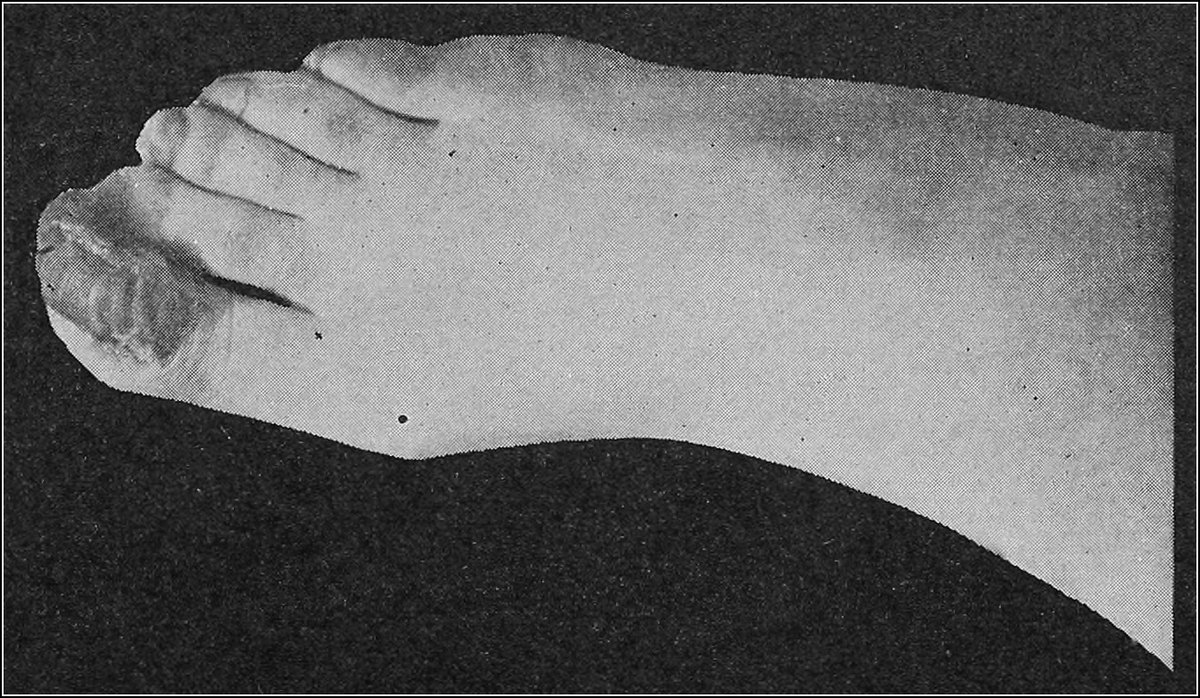
ONYCHOGRYPHOSIS
Onychauxis, or hypertrophy of the nail, is an overgrowth or enlargement of the nails of the fingers and toes. When the hypertrophy is accompanied by deformity, the condition is called onychogryphosis.
Derivation. From the Greek, onyx, nail, and auxe, increase.
Etiology. Enlargement of the nail is a result of hyperplasia of the papillæ of the matrix, the thickening occurring at the base, front, lateral edges or over the entire area of the nail depending on the part diseased.
Pressure is no doubt a causative factor, and lack of care of the nails will also cause a thickening. Injury to the matrix will cause the nail to become hypertrophied, producing in most cases a true club nail (onychogryphosis).
Chronic cutaneous lesions, such as eczema or psoriasis and other diseases such as syphilis, gout and rheumatism, and nervous diseases or injury to the nerves supplying the nails, may act as causes for onychauxis.
Pathology. Pressure or injury causes a widening of the nail fold which allows the formation of a thicker nail. The nail bed is irritated at the same time and a horny mass forms on it below the nail, which acts as a barrier to the forward movement of the nail cells, and by raising them up, determines more or less, the degree of deformity. The papillæ of the matrix become enlarged, and may be seen protruding above the normal structure, when the nail is removed.
The thickened and deformed nail thus produced, is often the cause of other nail lesions, due to its pressure on the soft tissues. Bacterial infection is also common at this point, due to the fact that the mass of epithelial cells is a good breeding place for microorganisms.
Diagnosis. Onychauxis may be congenital or acquired, usually the latter. Simple hypertrophy of the nail is rarely found, but overgrowth with deformity is quite common. The nail becomes hardened, due to a closer cohesion of its component cells; its transparency is lost, and it assumes a dirty brown or even black color. The surface becomes rough, due to the presence of longitudinal and wavy transverse ridges.
One or all of the nails may be affected; there may be a simple thickening or there may be a lateral overgrowth, which may result in paronychia. The inflammation may be slight or it may be severe and purulent. The nail, as it continues to become thickened, may assume various shapes resembling claws, talons, horns, etc. The big toe nail is the one most usually affected and often only the one foot is involved. This is indicative of a traumatic etiology.
Tuberculosis patients have a moderate onychauxis in most cases, particularly on the nails of the fingers, while hypertrophy is often seen in the inflammatory lesions such as eczema, psoriasis, etc.
Older persons are more liable to be affected with hypertrophy of the nail than younger persons, as there is a natural tendency to epithelial overgrowth in the aged.
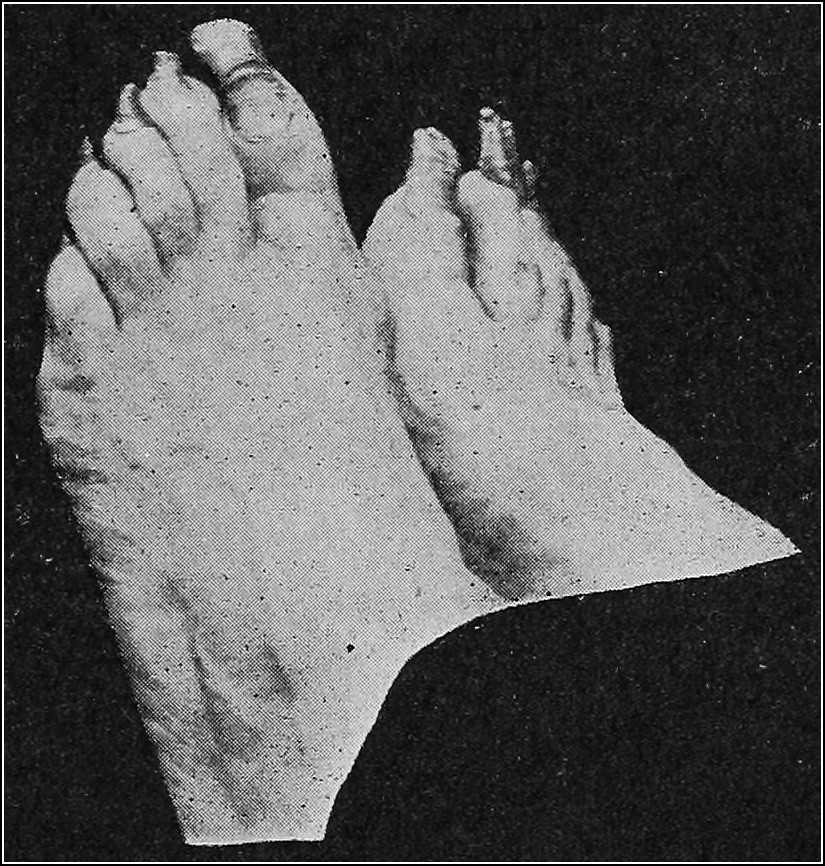
ONYCHAUXIS
Treatment. To affect a cure in case of hypertrophy of the nails it is necessary to recognize the cause. Thus, in cases of onychauxis, in which the general systemic condition is at fault, treatment must be directed by the family physician along constitutional lines and includes the taking of tonics, arsenic, mercury, etc. If a cutaneous lesion is the etiologic factor, it becomes necessary to treat the case both generally and locally. If the cause be an external one alone, local treatment is sufficient. For these latter conditions, the treatment is divided into palliative and radical procedures.
The palliative treatment consists in keeping the nail properly cut. For this purpose, the rotary file, or surgical drill, as it is called, is very efficient. Suitable burrs are used, and care is taken that the skin of the nail grooves is not injured. Infections are easily caused through the careless use of this instrument. After the nail has been thinned and is as nearly like a normal nail as is possible, the part should be cleansed with alcohol, and tincture of iodine (4%) should be applied. The grooves may be packed with sterile cotton and covered with collodion (cocoon dressing) which will avoid any tenderness that may be felt after the nail has been cut down. The hard nails may also be softened by the application of sodium sulphide or liquor potassae and when softened, may be scraped away.
If thickened or club nails become very painful, it is often necessary to resort to radical measures, as this is the only permanent cure for this trouble. The entire nail must be completely removed under local anesthesia, and subsequently the entire nail matrix should be thoroughly scraped away by means of a sharp curette. The wound thus produced is kept in sterile dressings and is allowed to heal by granulation. It is quite common to find only a small area of the matrix that is vital, particularly in chronic cases of club nail, so that curettage is really a simple procedure. A complete cure should be effected in from two to three weeks, the patient being able to walk with a cut-out shoe two or three days after the operation.
Onychatrophia, or atrophy of the nails, is a condition in which the nails of the toes and fingers become smaller and often are shed from the grooves in which they are contained.
Derivation. From the Greek, onyx, nail, and atrophia, atrophy.
Etiology. Atrophy of the nails may be caused by any one of many factors, among which are the inflammatory skin diseases, nervous diseases, constitutional disorders and injuries.
Injury to the nail matrix causes complete or partial cutting off of nourishment. If the nourishment is completely cut off, the nail matrix will disintegrate and cause the nail to be shed. New nails usually grow in these cases. If the injury is less severe, there is only a temporary arrest in the nail growth, and the nail becomes thin and small discolorations are seen in the nail substance.
Inflammation of the soft tissues around the nail which is accompanied by suppuration, may cause atrophy and shedding of the nail. The nail will grow again as a rule, but often when the etiology is systemic, the new nails shed as soon as they are formed (onychia maligna).
In nervous diseases, such as cerebral paralysis, tabes dorsalis, syringomyelia, leprosy, division of the nerves, etc., from the vasomotor disturbances due to the nerve lesion, a bleeding may occur about the posterior nail fold, and atrophy of the nail may result. The nails, as a rule, usually grow again.
In stasis of the blood stream in the extremities due to heart lesions, in venous congestion from emphysema, or in any lesion in which the circulation is impaired, the nails may undergo atrophy, particularly the nails of the fingers.
Diseases causing scarring of the nail matrix, such as pustular syphilides, gummata and variola, give rise to a partial destruction of the matrix and a shedding of the nail. Subsequent scarring may completely destroy the matrix, so that no new nail can grow.
In systemic diseases that cause wasting of the tissues, such as chronic tuberculosis, nephritis and diabetes mellitus, the matrix is usually under-nourished and the nails become discolored, soft and brittle, and often crumble.
Chemical poisons, such as arsenic, silver and lead, may cause atrophy of the nails. Those who work with chemicals and are compelled to put their fingers in acids and in alkalies often develop brittle, opaque nails. In general toxemias, the affliction of the nail is caused by interference with the nail nourishment at the matrix.
Pathology. When the nourishment of the matrix has been interfered with, the cells do not develop as rapidly as they should, and the nail becomes thin and streaked. The lustre is lost and the nails become gray or yellow, and often also become brittle. If the grooves in the nail bed are destroyed, the mechanical attachment between it and the nail is lost and the nail is cast off. Infective processes cause complete or partial destruction of the matrix by solution, and this in turn causes complete or partial loss of nail. White spots (leuconychia), said to be due to the entrance of air under the nails, are often seen, and gradually move toward the distal end of the nail.
Diagnosis. Atrophy of the nails may be congenital or acquired, the former being rare and usually accompanied by imperfect development of the phalanges and scantiness of the hair throughout the body (alopecia universalis). Acquired atrophy in some form is the usual condition.
The nails present various appearances. They may be thin, soft, brittle, lustreless or opaque, split very easily, may be streaked or even worm-eaten in appearance. One or all of these conditions may be present. Thinning and splitting of the free ends may accompany systemic diseases, and some chronic inflammatory (especially scaly) skin lesions. Some nails are thinned at the ends with a central fissure extending toward the root. Transverse thinning or furrows are met with in fevers. The nails are always affected when nutrition has been lowered, due to depression of the general health.
In wasting diseases, such as chronic tuberculosis, diabetes, etc., the spoon-nail is observed. This is a condition in which the lateral and free margins are raised, leaving a spoon-like depression in the centre.
Trauma, parasites, lowered nutrition and nervous diseases cause a crumbly, brittle nail. This is fairly common, and may be limited to one or more nails of the toes and fingers or it may be general. The atrophy may begin at either end, and extend forward or backward.
Treatment. Treatment of a local nature is worthless if the cause be systemic. Much like hypertrophy, the cure of atrophy depends on an exact determination of the etiology. Systemic treatment along proper lines will usually effect a cure. Local treatment consists in protecting the nails from irritation and sometimes even from water. The nails should be cut even and smooth and mollifying ointments and lotions are advisable. Cocoon dressings are very efficient for affording protection. In atrophy, due to local circulatory interference, balsam of Peru (50%), in castor oil, or even pure, will stimulate nail growth. This should be applied once a day and can be retained by cocoon dressing. As a soothing agent the following may be employed.
℞ Acid. boric.
Bismuth. subnitratis aa 0.60
Ung. aquae rosae
Unc. zinci oxidi aa 16.00
M. Ft. ung. Sig. Apply to the nails morning and night.
Onychoptosis, falling off of the nail, and Onychorrhexis, brittle nail, are atrophies and have been discussed as such in the preceding sub-head.