Chapter XVII · BURSITIS
Reading edition
Bursae are closed sacs or pouches containing fluid, found in all parts of the body, covering and protecting exposed or prominent bony surfaces, and interposed between tendons and parts over which they play. They serve as protective cushions to prevent physiologic wear and tear.
There are two varieties of bursae found in the human body: the bursae mucosae, those secreting a mucous or a gelatinous substance, and the bursae synovia, those secreting a thin, viscid substance, and which are similar in structure to synovial membranes.
The principal form of bursae found in the foot is of the synovial type and for this reason the treatment of this variety is that discussed in this chapter. Bursae may be either deep-seated or subcutaneous and the latter variety are those which, through trauma, usually become inflamed and troublesome in the regions of the foot. The deeper seated bursae, however, often become involved in a pathologic process, and the podiatrist is called upon to treat these cases as well as those involving subcutaneous variety.
Definition. Bursitis is an inflammation of the bursa sac. The inflammation may be acute, subacute or chronic. Acute bursitis is a condition in which the general inflammatory symptoms are active, the course short, and in which the overproduction of synovial fluid has found an outlet and is discharging on the surface of the skin. Subacute bursitis is a condition in which the inflammation has not reached a true acute stage, but in which it is more in evidence and more active than in the chronic form. Chronic bursitis is a condition in which the inflammation is long standing and of an inactive nature and where no great amount of overproduction of synovia is in evidence. In chronic cases the walls of the sac itself are generally found thickened and leathery; where this condition occurs in the bursa over the first metatarsophalangeal joints it is often inadvertently called a “bunion”.
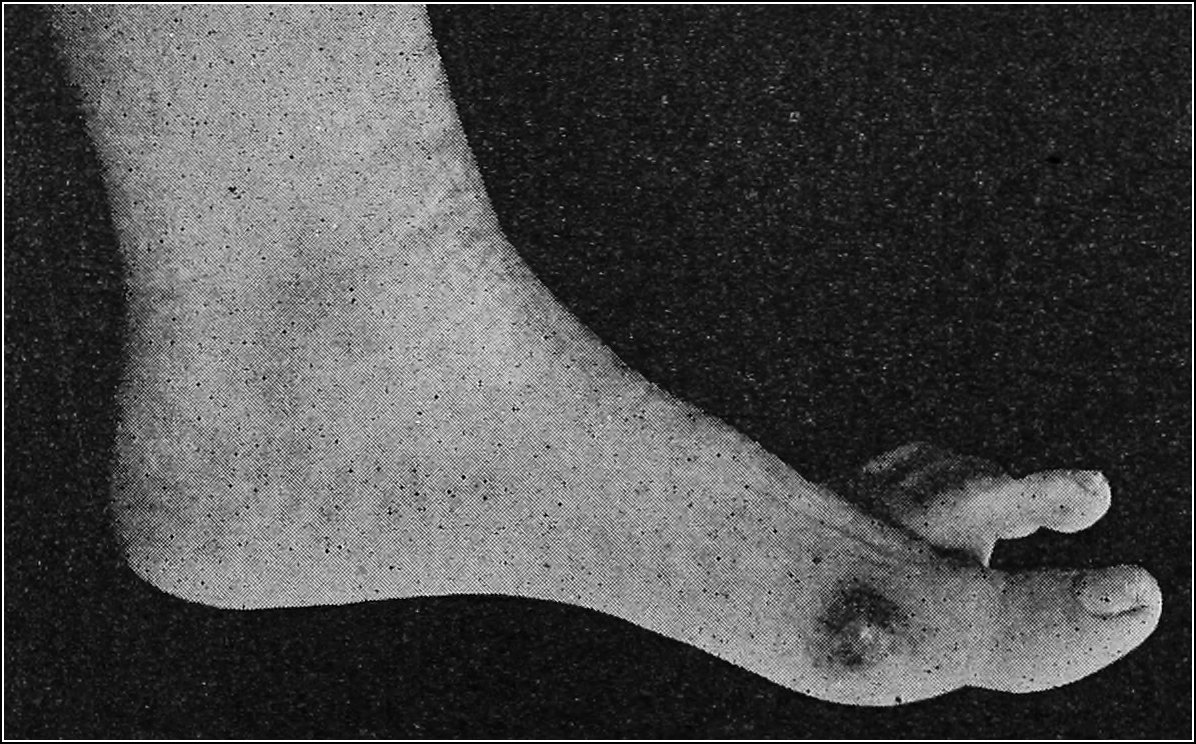
ACUTE BURSITIS
Etiology. Bursitis occurring in the foot is in nearly every instance due to trauma. A blow, a knock, a part being stepped on, or the continued pressure of an ill-fitting shoe, may be the exciting causes of this disturbance. Malalignment of a joint may be a secondary cause, such as would occur in hallux valgus. In this instance the deep-seated bursa would be affected. Bursitis would hardly develop from this alone, however, and the exciting cause is found in the pressure of footgear or some other injury to the part.
Location. As bursa sacs are only found covering a bony prominence, or interposed between the sheaths of tendons and muscles, or between these structures and the skin, serving in each capacity to prevent physiologic wear and tear, bursitis occurring in the foot will be found in these locations.
The first and fifth metatarsophalangeal joints (metatarsophalangeal bursitis); the interphalangeal joints of the toes (interphalangeal bursitis); the posterior and outer surfaces of the os calcis (retrocalcaneal bursitis); and the tarsometatarsal region on the dorsum of the foot (dorsal bursitis) are the principal sites of occurrence. The base of the fifth metatarsal is also a spot over which bursal inflammation will occasionally develop.
Pathology. The pathology of bursitis is primarily that of any inflammation. Due to trauma, the parts are subjected to a severe irritation which causes an engorgement of blood in that location. Serous infiltration of the tissues takes place and the functional activity of the sac is increased. Materials from the blood for the production of synovia, are secreted in abnormal amounts, and in consequence the sac becomes distended from the superabundance of fluid. In time this fluid must find some outlet, for synovia is secreted so rapidly that the lymphatic system cannot absorb the excess. This outlet must naturally develop toward the point of least resistance, which, in these cases, is outward toward the periphery. The tissue is broken down to a small extent and a minute sinus is formed which permeates the tissues and opens upon the surface of the skin. From the peripheral opening the excess of fluid is thrown off, and when this stage is reached the distension in the part is naturally lessened and the patient is fairly comfortable.
Symptoms. Objective Symptoms. The parts will be found considerably swollen, red and hot. Loss of function is noted and fluctuation is present.
Subjective Symptoms. Pain on slightest pressure and at times upon forced movements; impaired function; heat, and a feeling of fullness or distension in the part.
Characteristics. The characteristics of bursitis, whether acute or chronic, are so plain that no error in diagnosis should ever be made. However, many of these cases are mistaken for suppurated helomata, probably through the fact that both are conditions in which a discharge is present. Why this error should be made is a mystery, for while it is true that there is an exudation in both instances, the characteristics of the discharges are so different that only a careless or inexperienced person could mistake one for the other. The important characteristics are:
(1) The distension in the bursa sac proper causes a swelling of the parts adjacent and superjacent so that the whole area over and around the affected part will be found enlarged and puffy. Fluctuation is present and often the sac itself may be grasped in the fingers, so distended are its walls.
(2) Removal of the overlying calloused area, should one be present, brings to view the sinus opening, in the acute stage. The tissues are blanched in appearance and are leathery and hard to digital or instrument touch. The opening of the sinus is usually very small and its edges are circumscribed and even. The sinus itself has the appearance of a healthy granulating surface and at no time is there apparently any membranous lining. Probing will determine that the sinus follows an almost vertical course with no sub-borrowings or offshoots in any direction. There is no loss of tissue upon the surface of the skin, such as would be found in connection with an heloma involved in a suppurative process, except at the opening of a canal.
(3) Digital pressure exerted laterally and anterio-posteriorly usually is rewarded by the oozing of a thickish, viscid, almost colorless fluid from the sinus opening. There is nothing in the appearance of this fluid that should lead one to mistake it for pus. Very often this fluid oozes from the part of its own volition, due probably to the pressure of the excess fluid in the sac beneath. The fluid causes no active decomposition of hydrogen dioxide and the ebullition caused by the contact is almost negative. This constitutes one more point of differentiation between the changed synovial fluid discharged from an acute bursitis and a pyogenic exudation.
Treatment. The treatment of bursitis varies according to the degree of inflammation, and the general conditions present. We may divide the treatment into three classes: the radical operative, the non-radical operative, and the palliative. The first mentioned is a purely surgical procedure, complete in itself, and consists in the removal or curettage of the inflamed sac. The last two are usually combined and are procedures which are generally practised by the podiatrist.
The Radical Operative Treatment. Under proper aseptic conditions an incision is made in the overlying tissues and the sac is removed in its entirety; the parts are then sutured, and a few days rest and elevation of the foot brings complete union. This method may be varied in that the sac is not removed, but a free incision is made into it and the parts thoroughly curetted. One other of the purely surgical procedures is to make a free incision into the sac to accomplish thorough drainage. This latter procedure is generally practised in cases of infected bursitis.
Inasmuch as the non-radical operative and the palliative methods of treatment are purely podiatry procedures and are usually combined, they will be discussed as one subject.
The Non-Radical Treatment. There are several methods by which bursitis in its various stages may be successfully treated. They vary in some details but all agree on two most important points: rest and the absence of pressure.
A bursitis developing over a bony prominence upon the foot, usually occurs in connection with some form of superficial callosity or an heloma. The inflammation of the sac may be due to the neglect of a growth of this nature, or, as previously explained, to some distinct injury to this part.
To successfully treat a condition of this nature it is found necessary at all times to accomplish the removal of the excrescence. This is done in the usual manner by either the shaving or dissection method. These growths must be removed for several reasons:
(1) To remove all hardened and thickened epidermis so that no further irritation from that source will be present.
(2) To allow the operator a chance to effect drainage for the overproduction of bursal fluid.
(3) To allow the medications used to come in direct contact with the underlying tissues without the necessity of penetrating several layers of epidermis and expending their action upon and through them.
Under proper aseptic conditions, the superficial thickened epidermic layers are removed and the excess fluid is allowed to drain off. It will often be found that the callous forms a “plug” which extends down into the surface opening and prevents this excess fluid from being thrown off. Once this drainage is accomplished, other procedures, dependent upon conditions present, should be utilized for the alleviation and cure of the bursitis.
Rest. By far the most effective means of bringing about a speedy cessation of the inflammation occurring in the bursa sac is to procure absolute rest for the part involved. It has been noted that in a number of cases when no medical or surgical treatment has been afforded, inflammations of this nature resolve themselves speedily upon complete rest. There is nothing remarkable or supernatural about this for inasmuch as the bursa is only used during the movements of a part, it is easily understood why a trouble of this nature will clear up rapidly if the part is kept immobile.
Removal of Pressure. There are many cases of bursal inflammation which occur in people who are not able to lay up and give complete rest to the affected part. The next most effective measure in these cases is the judicious and proper use of shielding. In applying a shield to a case of this nature it should always be remembered that the parts affected are usually swollen to a considerable extent around the tissues immediately overlying the sac itself. For this reason a shield such as would be employed for the protection of an heloma in a like situation, is not practical. This is more particularly the case where the bursitis is located on one of the interphalangeal joints of the toes. In this location an individual shield which is to rest on the affected toe alone cannot be applied, for the whole area overlying the inflamed sac will be found swollen and leathery and the tissues anterior and posterior, as well as those covering the interdigital surfaces of the toe, are ordinarily more or less involved in the general inflammation. In this instance, then, we must resort to some sort of shielding which will take the shoe pressure from the part, and yet which will be distributed over the whole digital surface and not on the diseased toe alone. A dorso-digital oval or crescent shield (see chapter “Shields and Shielding”) answers the purpose and is entirely effective in most instances.
Probably the most practical method of removing all pressure from the inflamed areas is to have a circular portion of leather immediately overlying the part removed from the shoe and another softer piece adhered over the opening. The appearance of this will be inconspicuous and the small pouch thus formed allows the patient to wear a shoe, affording comfort, which, however, exerts no pressure upon the lesion. It is wise to remove a piece of leather considerably larger than the circumference of the affected part, otherwise the edges of the aperture cut in the shoe may become depressed and press upon and irritate the already inflamed areas.
Strapping. Enlarging upon the theory of rest, inasmuch as complete absence of movement aids materially in reducing the local irritation, strapping is a practical means of immobilization.
This procedure, although used in these situations, is not so practical in bursitis occurring over the first and fifth metatarsophalangeal joints, or over the interphalangeal joints, as it is in other locations upon the foot.
Adhesive strapping is applied in such manner and at such tension as to accomplish almost complete immobilization, and for this reason it will be readily seen that this method cannot be used in cases where the added pressure will produce additional irritation. Several lengths of adhesive plaster are placed over the part and adhered tightly to the surrounding integument so that very little or no movement is allowed in the affected part.
Strapping, to prevent movement, is particularly effective when the bursitis has occurred in the os calcis region between that bone and the tendo Achillis (retrocalcaneal bursitis). The foot is placed in plantar flexion and a long strip of 1¹⁄₂ or 2 inch plaster is anchored at the centre of the upper part of the calf and is then carried down over the heel on the plantar surface of the foot. This strip is then reinforced by transverse straps applied over the heel at the insertion of the tendon.
Aside from these general methods of procedure thus discussed, the podiatrist must resort, in a majority of cases, to local treatment which will hasten the ultimate resolution of the inflammatory process. These local methods of treatment are conveniently divided into six groups:
1. Hydrotherapeutic measures. 2. Moist and wet dressings. 3. Unguent dressings. 4. Counter-irritation. 5. Massage. 6. Electricity.
Hydrotherapy. Hydrotherapeutic measures may be resorted to in the treatment of bursal inflammations and either thermal extreme may be used with equal results. As one person will react to one extreme more readily than to the other, the choice of heat or cold usually depends upon the individual case.
Hot Applications are probably most practical in these instances in the form of compresses. Several thicknesses of gauze, saturated in water, as hot as can be borne, are applied over the affected areas, the hot water being replenished as soon as the compress commences to cool. Hot applications act as mild poultices and their action is similar to them in a limited and modified form. They tend to hasten resolution of the inflammatory process by accelerating absorption. It is unwise, however, to continue hot applications for too long a period; it is found preferable to have the patient apply hot compresses for periods of one hour duration two or three times a day, allowing the part complete rest in the intervals.
Hot compresses, applied continuously for some hours, are apt to bring about an over-stimulation in the parts to such an extent as to produce a slough. To be effective, it must be remembered that the compress must be kept hot for the entire period of application. This may be accomplished by immersion in hot water, by moistening intermittently, or by keeping the compress covered with some heat-confining covering. In the latter instance, oiled silk is in all probability the most practical agent, but even the use of an impervious covering does not relieve the patient of the necessity of remoistening the compress with hot water, at frequent intervals.
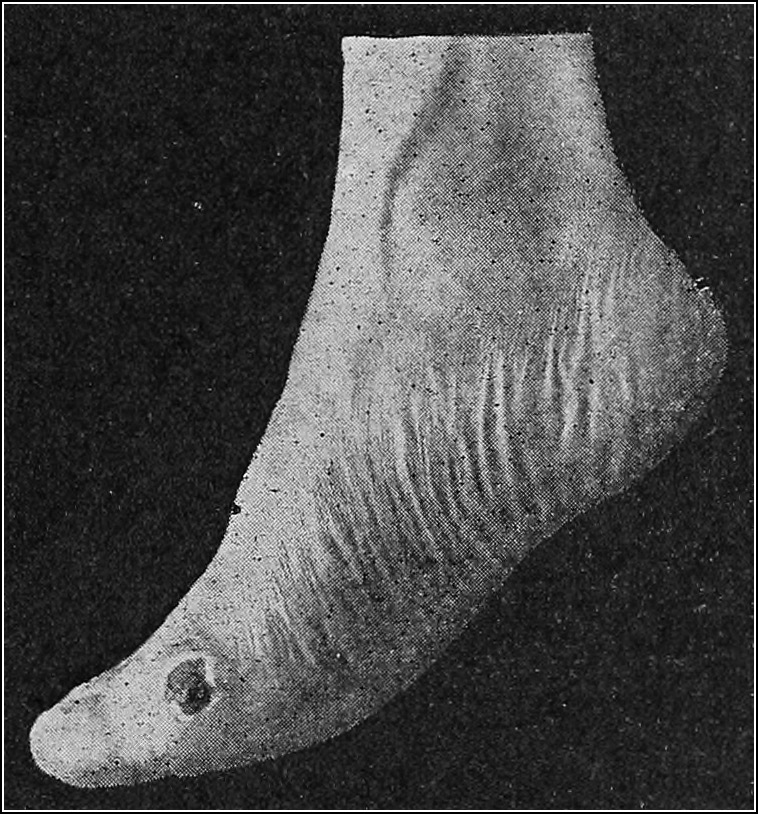
INFECTED BURSITIS
Cold Compresses, as here advised, are either applications of cold water on a compress of gauze or some similar material, kept constantly wet, the use of ice bags or packs, or a cold water drip. The surfaces of the foot, particularly if the bursitis be on the toes, are so small, however, that as a general rule, ice bags or packs are not practical. The cold produces anemia of the parts by contracting the calibre of the blood vessels, and forcing the blood from the capillaries. They also tend to anesthetize the nervous sensibility and are in that way also pain reducing. There is one bad feature, however, in the use of cold as a hydrotherapeutic agent. The resulting reaction, which is generally bound to occur, gives the patient considerable annoyance and is apt in time to increase the infiltration and distension in the part. Again, should the patient have any tendency toward chilblains, the moist cold is almost always sure to develop the tendency into a reality.
The Poultice is the older and now obsolete method of applying moist heat to a part. The stimulative action of this form of application is at times so severe as to cause deleterious effects upon the diseased tissues. A cataplasma should never be used where a distinct loss of tissue is in evidence, in the presence of pus, or where the vitality of the parts is considered to be subnormal, either from the age or condition of the patient, or because of the diseased condition of the part.
The most generally used materials in this connection are flax-seed, and slippery elm, and the most practical manner for preparing a poultice for use in podiatry is to make several small bags (about two or three inches square) from cheesecloth or some like material. These are filled half full with the meal and are dropped into a vessel containing boiling water. The bags and their contents are allowed to boil for eight or ten minutes and are then applied to the part as hot as can be borne. This method does away with the rather “messy” procedure of laying a cloth on the part and then applying the warm mass by means of a spatula, spoon or like implement; also the poultice, so made, may be used again and again. The usual method of procedure in using poultices, when recommended, is to have the patient apply them continuously for about an hour during some part of the day. It is found much more effective to have moist heat applied for a longer period at one time than to apply three poultices a day, one in the morning, one at noon, and the last at night. The patient removes one bag as soon as it starts to cool and replaces it with another taken hot from the boiling water. This form of treatment, of course, tends at first to increase the overproduction of synovial fluid, and proper drainage must at all times be preserved so that this excess may be carried off.
Baking. With the development of the modern baking apparatus, this method of applying heat to a part has come into use in cases of subacute or chronic bursal inflammations. The heat applied by this means is dry, in contradistinction to that obtained from hot applications of water and from poultices. As the synovial bursae are of similar structure to the true synovial membranes of the joint cavities and capsules, they are subjected to similar ailments. It stands to reason, therefore, that if baking is beneficial in several forms of arthritis, it is also beneficial in some forms of synovial bursitis. Some podiatrists have baking apparatuses installed in their offices; where this is not the case it is recommended that, when such treatment is thought advisable, the patient be sent to some hospital or institute where this treatment can be administered. Baking serves as a hyperemic agent (to bring an abnormal supply of blood to the part) and in this way to aid in the more rapid absorption of the exudates in the affected region.
Moist and Wet Dressings. In conditions of acute bursitis, an efficient means of reducing the inflammatory symptoms is found in the use of wet dressings. Moist dressings (those with mackintosh protection) should not be used in these cases when the skin is broken, when there is any suspicion of a discharge, or where infection is present.
The agents which may be used with such wet dressings are mercury bichloride, liq. aluminum acetate, saturated solution of boric acid and alcohol, equal parts, and lead and opium wash.
Mercury Bichloride may be used as a wet dressing in all cases of acute bursitis, but more particularly where infection is present. It should never be used with mackintosh covering, for even without the confinement thus afforded, its action serves to macerate the skin to a great extent. The solution may be used either hot or cold and in no instance stronger than ¹⁄₄₀₀₀. This strength solution should only be resorted to in cases where the infection is acute and has progressed to some extent, weaker solutions, ¹⁄₅₀₀₀ or ¹⁄₁₀₀₀₀, being found efficient in a majority of cases. Mercury bichloride, on account of its toxic properties, should not be used after the infective process has been reduced, and there are many arguments in favor of an efficient substitute for it even in the initial instance. However, no solution which is practical for use in these cases can be depended upon for beneficent results as surely as corrosive sublimate. In chronic bursal inflammations, corrosive sublimate is contra-indicated.
Liq. Aluminum Acetate can be used in place of bichloride of mercury in many cases of acute bursitis. The solution is decidedly astringent, and while this action is to be desired at times, nevertheless it has been found detrimental in the treatment of some cases of acute bursitis, because when it penetrates through the sinus into the bursal sac it has been found to create a decided irritation upon these deeper tissues. Liq. aluminum acetate, therefore, is shunned by many in the treatment of these cases, but aside from this one detrimental feature, the action of the acetate is efficient and is productive of good results. The drug may be used plain, or diluted with sterile water to reduce its irritant, astringent qualities. A dressing of liq. aluminum acetate, like bichloride, should never be confined in a mackintosh covering, as it will macerate the skin, quickly and thoroughly. This solution is particularly effective in subacute cases where no infection is present when its astringent action goes far to reduce the infiltration in the parts. It should be applied cold.
Boric Acid-Alcohol Solution may be used in all cases of acute or subacute bursal inflammations. It is efficient in septic cases and its quality of rapid evaporation aids materially in reducing the inflammatory symptoms, independent of the therapeutic action of the component drugs. This solution, on account of its rapid evaporation, must be renewed more often than either of the foregoing, but while this demands more attention on the part of the patient, it is immeasurably better for the general condition of the disease. The one disadvantage in having the patients attend to the moistening of the dressing is that often they will fail to carry out instructions properly; but a condition of this nature, properly attended, will respond as quickly to the boric-alcohol application as to aluminum acetate or to mercury bichloride, and with none of the irritant or toxic tendencies of both of these. This solution is applied cold.
Lead and Opium Wash may be used in the treatment of bursal inflammations, usually in the subacute or chronic stages. In cases where the integument is broken, avoid the use of this medication on account of the irritant qualities of the lead it contains. Prolonged applications are apt to develop a dermatitis, and if the skin is broken, local lead poisoning will not only be more pronounced, but will be manifest in a shorter space of time. Lead and opium wash, hot, is an advantageous application in the treatment of chronic bursal inflammations, the heated applications being continued for about thirty minutes at a time, at intervals of two or three hours. It should always be remembered in using this wash that it exhibits marked irritant qualities upon prolonged application.
The choice of a moist dressing to be used in subacute or chronic cases, especially the latter, should be carefully made. Boric acid, saturated solution, is an efficient and safe drug to use under rubber, fish skin, or oiled silk covering but, as before mentioned, mercury bichloride and liq. aluminum acetate are contra-indicated in this connection.
Unguent Dressings. Ointment dressings are used in this instance under the same rules and considerations which govern their application in all other conditions. No ointment should be applied on any inflamed bursa where there is a discharge of any nature. The operator must never forget that the base of all ointments is either oily or fatty and a serous discharge, coming from any surface, cannot be absorbed by the fabric used as a dressing if even a thin unguent film is interposed.
Certain classes of drugs, however, which are known to be beneficial in certain stages in the treatment of bursitis, can be readily applied in unguent form and for this reason the question of using them may be profitably discussed here. The action demanded of drugs to be used in the treatment of bursal inflammations are antiphlogistic, analgesic and antiseptic. The latter action is particularly demanded in cases where surfaces denuded of epidermis are found. Some stimulant action is at times desired and drugs which have properties of this nature may also be included in this armamentarium. The following named ointments may be used, therefore, with beneficial results in certain stages of bursal inflammations: ichthyol, sulphur, menthol, balsam of Peru, scarlet red and salicylic acid.
Unguentum Ichthyoli, 3% to 10%, is used in all cases where an emollient action is desired. The stimulating action of the drug in this form is negative, but it can be relied upon to reduce acute inflammatory symptoms. Ichthyol may be combined best with either lanolin or vaseline as a base; the former is preferred inasmuch as it does not become rancid when exposed to a variety of conditions as does the latter. Lanolin being a wool fat product is supposed to have a beneficent action upon certain pathologic conditions of the skin, and so it is used as the base of many ointments.
Unguentum Sulphuris, 10%, may be used in many conditions of subacute or chronic bursitis. Its antiseptic action makes it a desirable choice for use when the integument is broken or when a distinct antiseptic action, in addition to the general action of sulphur as an antiphlogistic, is sought.
Unguentum Balsamum Peruvianum is used in these instances, principally when some loss of tissue in the part is noticeable and where stimulation is required to accelerate granulation. Peruvian balsam is sometimes combined with ichthyol (5% of each) in ointment form. In this combination the ointment has marked stimulative and antiphlogistic qualities. Balsam of Peru is used in strengths of from 3% to 10% in a vaseline base.
Scarlet Red is a highly efficient stimulative ointment. It is used alone, with zinc oxide or with borated vaseline, and should never be applied in too thick a coating. The parts should first be made thoroughly aseptic and dried, and then scarlet red applied on gauze in a thin even coat. Care should be taken that the application of scarlet red does not cause over-stimulation to the parts, and thus prove detrimental to the general condition of the lesion.
Unguentum Acidi Salicylici, 2% to 5%, may be used to good advantage where the parts overlying the thickened sac are found to be somewhat calloused. One application of an ointment of this strength will serve to disintegrate this overlying thickening, thus making the parts flexible and soft. A stronger ointment than this should never be used in these cases, as salicylic acid is a strong epidermic disintegrant and will cause decided irritation if used in greater than 5% strength. In such cases salicylic acid may also be combined with collodion in the same percentage, 5 grains of ext. cannabis indica being added as an anodyne. Unguentum salicylic should never be used when the skin is broken or the tissues show any tendency to thinness. All ointments used in the treatment of bursitis are applied and kept in place by the use of a cocoon dressing. If a shield is to be used, it is first applied; the ointment is then placed in the shield aperture and the cotton and collodion dressing is made to cover the whole. The ointment should be renewed at frequent intervals in order that the dressing may not become hardened, and thus become an irritant.
Counter-Irritation. Counter-irritation means literally an irritation which is developed to act against a previous irritation. It would seem, theoretically, that in cases of bursitis, this form of treatment is particularly advantageous. A bursal inflammation is a fairly deep-seated condition which should readily respond to a counter-irritation developed on the surface overlying the trouble. Counter-irritant agents should be used only in subacute and chronic cases, more particularly in the latter; for it is found that this form of treatment applied to an acute bursal inflammation tends to intensify rather than reduce the symptoms.
In treating such cases we have a number of counter-irritants which may be used with consistently good results: iodine, capsicum, turpentine and mustard, are the most important and most commonly used.
Iodine is today, in all probability, the most generally used agent to induce counter-irritation in podiatry. Its present popularity as a germicide, however, has over-shadowed its action as a counter-irritant.
To obtain the maximum counter-irritant action from tincture iodine (U. S. P. 7%) it should be applied in a heavy coat at frequent intervals until such time as the inflammatory symptoms have entirely subsided. The continued use of iodine after this has been accomplished should be avoided as the tincture is irritant and mildly corrosive, and numbers of patients will be found whose skin will not stand its activities. Churchill’s tincture of iodine (about 16%) has been advocated for general use as a counter-irritant, but its action in many cases will be found too irritant for ordinary use.
The theory of counter-irritation, simplified, is that a drug applied at a spot more or less distant from an inflamed area will cause an irritation in this new locality and thus aid the original condition, inasmuch as it will draw away the excess blood in the original part and allow the vessels to contract to normal calibre and the circulation there to become normal. Realizing this, it is readily understood why tincture of iodine should not be used as a counter-irritant in acute cases. With a discharging sinus to contend with, applying iodine over its opening at the periphery might be the cause of a severe irritation in that location which would further increase the tissue loss and thus prove a detriment to the general condition.
Capsicum is generally applied in these conditions in the form of a plaster. It should never be used in acute cases as its greatest efficacy is apparent in those cases with chronic characteristics. Capsicum plaster is applied and renewed as necessary, until the symptoms of the deep inflammation have subsided. Shields are usually employed to remove the pressure while a chronic case is under treatment, and this removal of all irritation which the shoe might produce aids materially in the relief and cure of these conditions.
Turpentine may be massaged into the parts for the purpose of counter-irritation although its action is at times severe; it should never be used where the skin is broken or where a discharge is present. It is not so desirable an application as either of the foregoing for it is found impractical to give proper massage to the comparatively small areas which are affected in bursal inflammations.
Mustard has been recommended for use in cases of chronic bursitis, either in the form of a moderate local application or in a general foot bath. It is decidedly energetic in action, and should be used with great discretion and care. Every skin will not stand the action of mustard and for this reason it is not advocated as a general counter-irritant agent. Upon the failure of any of the other drugs mentioned under this heading, however, it may be tried, and if properly used, may prove conducive to good results.
Massage. Massage is at times a potent factor in aiding absorption in chronic cases. There is no question but that the stimulation afforded by this procedure is efficient and will aid materially in returning the tissues to normal.
Some cases of bursitis which occur upon the foot, however, are confined to such limited areas that massage is impractical.
Several drugs which are reputed to have great powers of penetration are recommended as agents which can be safely massaged into the parts and even if the action claimed for them is overestimated, their use at least serves to reduce the friction upon the surface tissues.
Many of the so-called “petrogen compounds”—drugs in combination with petroleum (mineral oil)—are recommended for use in these cases, and are undoubtedly of some benefit. Petrogen iodine, 10%, and petrogen camphor, 5%, (Wyeth) are the two most generally used, and have been found to be productive of good results.
The compound is applied to the parts and then rubbed, first lightly, then gradually increasing the pressure, by the fingers and palm of the hand. It is found advantageous to massage the parts at first with a circular movement, confining the energy to the areas immediately overlying the enlarged sac. After about five minutes, the pressure is increased and considerable of the surrounding integument is included in the massage. The direction of the finger movements is then changed from a rotary one to a series of long strokes under considerable pressure, first toward the diseased sac, following as nearly as possible the blood supply to the part, and then away from the sac, following the outgoing vessels. This serves first, to increase the vascular supply, and then to aid in its quick removal, and reduce the congestion in the part. With this, the lymph activity is also increased so that it helps to absorb the waste products more rapidly.
Massage should be recommended as a daily treatment and should be continued until all signs of infiltration have disappeared. Perseverance is necessary, for in chronic bursal inflammation, the changes are not noticeable nor should they be expected to be rapid.
Electricity. Many forms of electrical application are recommended in the treatment of chronic bursal inflammations. Among those most commonly employed are the high frequency, and the faradic currents. Vibration, induced by electric impulses, is also recommended and is employed generally by the podiatrist.
High Frequency Current, more popularly known or rather misnamed “violet ray,” is generally found efficient and is more generally used than any other form of electric application. This current serves to produce active stimulation in the parts and by this means tends to accelerate all functional activities and to hasten absorption. Whether the more popular priced and small sized high frequency machines on the market today really do create any but a very superficial stimulation, is a question, and for this reason a machine of greater power is recommended. The parts are treated daily, the glass electrode being applied for about eight or ten minutes at a time.
Faradic Current is also recommended for daily use being applied by means of a moistened sponge electrode. The treatment is from five to ten minutes duration. Stimulation is obtained by this treatment which, as in the case of the high frequency current, aids the general absorption in the affected areas.
Vibration used in these cases may be produced by electricity direct, or through a modern air compressor, controlled by electricity. Vibration is only recommended in chronic cases; it increases the functional activities of the part. It should be applied daily.
Bursitis is a stubborn condition in any form, and can only be relieved and finally cured by scientific and rational treatment. The operator should bear in mind that rest and the absence of shoe irritation will do as much or even more for the general improvement of the condition than can be accomplished by drugs. Surgical procedure is certainly to be recommended in cases where no improvement is shown under palliative methods, even though this requires a cessation of activity on the part of the patient, and means the transfer of the patient to the care of a practitioner of surgery.