Chapter IV · STERILIZATION
Reading edition
In the practice of medicine and its allied branches, it is recognized that no unsterilized object is clean; it is therefore necessary for every such object to be sterilized before being brought in contact with, or near to a wounded surface, or to a surface about to be wounded.
Previous to the time of Lister, who was the first one to practise and to advocate asepsis and antisepsis, it was considered normal for a wound to suppurate and the consequent appalling results were accepted as being in order. Today, however, asepsis and antisepsis have been proven to be absolute essentials to intelligent treatment, and it is accordingly necessary that every practitioner treating the human body, should exercise the greatest care so as to prevent the invasion of hostile bacteria.
Sterilization may be defined as the act of rendering an object sterile (clean), by the destruction of microorganisms, preferably by means of heat. To perform any operative work, so that there is perfect asepsis, or freedom from bacteria, depends entirely upon the care exercised in practising such asepsis. The instruments, the dressings, the field of operation and the hands of the operator are all media for contamination and the infection of wounds, and the sterilization of all these is necessary, as infection might come from lack of care in the preparation of any one of these details before an operation.
Instruments. The most efficient way of rendering instruments sterile, is by immersing them in boiling water for fifteen minutes. To each quart of water used in the sterilizer, is added one-half an ounce of sodium carbonate (washing soda). This prevents rusting and also acts as a solvent for any fatty substance that may be on the instruments.
Superheated steam is used for sterilizing instruments, but this requires especially large and expensive apparatus which is not at the command of most practitioners. Dry heat will destroy bacteria, but it is not as effective as moist heat (steam). To procure absolute results requires a high temperature, which effects the temper of the steel in the instruments.
Instruments with sharp cutting edges, such as are used in the removal of helomata, are blunted by boiling. They are therefore best sterilized by immersing them in pure carbolic acid for a few minutes, followed by dipping in grain alcohol, the instruments being handled with a pair of forceps.
Dressings. Dressings such as gauze, bandages, absorbent cotton and other cloth materials are best sterilized by steam which is allowed to circulate through the material for fifteen minutes, and they may then be placed in dry heat for a short time, thus allowing the moisture to evaporate. If a steam sterilizer is not available, the dressings may be boiled, or they may be baked for ten minutes in a temperature not lower than that of the boiling point of water. Care should be taken that the heat is not great enough to scorch or burn the materials.
Sterilized dressings of all kinds may be purchased in convenient, hermetically sealed packages, and may be safely used without preparation. Once such a package has been opened and used, the contents do not remain sterile; the materials left over from an operation should not be used at another operation unless they have been again thoroughly sterilized.
Field of Operation. The skin of the foot is much thicker than that on the other parts of the body and in addition it usually does not receive the same hygienic care as does the rest of the skin surface. It is therefore highly essential that additional precautions be taken in preparing the foot for operation.
The entire foot should be scrubbed with soap and warm water so as to remove as much of the exfoliated skin and dirt as possible. It is then immersed in a solution of bichloride of mercury (¹⁄₂₀₀₀) and wrapped in a sterile towel until ready for operation. The foot may also be prepared by first scrubbing with soap and water, washing with alcohol, 60%, and finally painting the part to be operated upon with tincture of iodine. Iodine has proven to be the best antiseptic in use today, but very often it interferes with chiropodical operations due to the stain it produces. This may be overcome to a certain extent by washing the part with alcohol after the iodine has been applied.
Alcohol in a sixty per cent. solution is a very efficient antiseptic and wherever iodine cannot be used, it may be substituted. A piece of absorbent cotton, dipped into the alcohol, is placed in contact with the part to be treated and is allowed to remain for a few minutes. Like iodine, alcohol penetrates the layers of the epidermis and so destroys the bacteria that lurk between the outer layers.
Hands of the Operator. There are several ways of cleaning the operator’s hands, but each such procedure is preceded by thoroughly scrubbing them with green soap and a nail brush for at least ten minutes, in warm water. Alcohol or ether should then be rubbed over the hands to dissolve fats, and they should then be dipped in a solution of bichloride of mercury (¹⁄₂₀₀₀) for a few minutes. A most efficient way of sterilizing the hands consists of the following: after scrubbing the hands as before described, take equal parts of chloride of lime and carbonate of soda (about one-half teaspoonful of each) and add enough water to make a paste. This is thoroughly rubbed into the hands and when the sensation of warmth has disappeared they are rinsed in sterile water.
The use of rubber gloves to protect the hands is of some advantage in that they may be thoroughly boiled before they are used; but unless the hands are sore or the skin is tender, they should not be employed, as they decrease the sense of touch so necessary in chiropodial procedures.
STERILIZING APPARATUS
There are many kinds of apparatus for each form of sterilization, and the podiatrist, in selecting a sterilizer, must be guided by the size of his purse as well as the amount of space he can afford for such an apparatus.
The steam sterilizer is unquestionably the best for general purposes, and the dual compartment arrangement is better than a single chamber outfit. Steam sterilizers for office purposes vary in size from the small single chamber, measuring four inches wide, eight inches long and four inches deep, to the larger double chamber which measures twelve inches wide, twenty-four inches long, the upper chamber twelve inches deep and the lower chamber six inches deep. The latter sterilizers are the best possible for the podiatrist’s work, in that they allow for the sterilization of towels, dressings and instruments at the same time, and there is no direct contact between the instruments and the boiling water. The apparatus may be heated by gas or by electricity, gas being the most desirable as it is more easily controlled and regulated. The cost of the instrument equipped for gas heating is very much cheaper, and the operating expense is less than when electricity is similarly used.
As its name implies, the double compartment sterilizer is composed of two distinct sections which are easily separated, and when put together look as if they were one section. The lower compartment is more shallow than the upper and contains the water which is boiled for the manufacture of the steam to be utilized in the sterilization. The upper compartment has an inner jacket which is so arranged that the steam passing from below is collected in it, and is admitted into the compartment proper through a small opening at one end. This causes the steam to be forced in under a slight pressure, which increases the heat and adds to its power as a germ destroying agent. The opening is controlled by an inlet valve which may be adjusted so as to prevent the steam from entering the compartment. The steam then circulates around it in the jacket and in this way dry heat is generated in sufficient quantity to allow for dry heat sterilization. If space permits, it is advisable to have two such sterilizers, one for steam sterilization and the other for dry heat sterilization. The instruments, towels and dressings may thus be dried which prevents the rusting of the steel, and makes the linen more easy to handle. These sterilizers are as well, an ornament to any office.
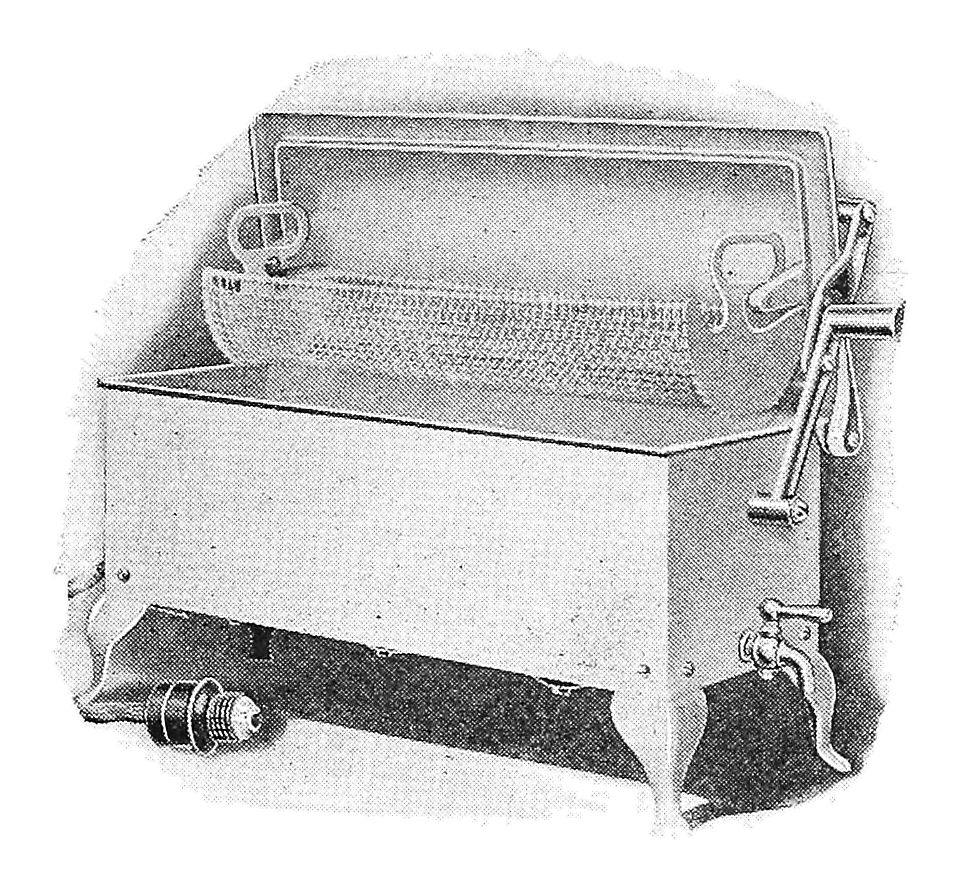
ELECTRIC STERILIZER
Where space is limited, the smaller electric sterilizers may be substituted for the larger outfits. There are many styles and shapes of this kind of instrument, but the principle is the same in all of them. There must be ample space for the reception of the instruments, and the cover must be closed when the water is boiling. The electric current is passed into a metallic disc, situated beneath the bottom of the water receptacle. As the current passes through this disc, it becomes hot, and the water in the compartment is gradually heated until the boiling point is reached. The current must never be left on when the machine is not in use, for when the water has evaporated, the heat will cause the solder holding the joints of the sterilizer to melt and cause a separation of the seams. This molten solder might even drip on something combustible and set it alight. There are some electric sterilizers which are equipped with safety devices which prevent this possible accident. The device provides so that when this heat is great enough, it melts a small piece of an alloy with a very low melting point. This metal is held in position by a clamp which is attached to the current flow and when this melts, the current is cut off and further heating is impossible. This is a very valuable attachment, particularly when one is inclined to be careless.
Another form of smaller electric sterilizer consists of a glass compartment into which is placed the heating apparatus. This latter is composed of coils enclosed in a metal protector. The protector is attached to a handle, through which pass the electric wires. This coil and handle is placed into the glass bowl and is held fixed by a small clamp. A cover is then placed over the bowl, which is so arranged as to allow the wires to pass through it.
For sterilization with pure phenol and alcohol, it is necessary to have two wide mouth, glass stoppered, two-ounce bottles. When the instruments are being sterilized they may be left standing in either bottle until ready for use. A piece of felt, cut to fit the inside bottom of each of the bottles, should be placed in situ, so that when sharp edged instruments are placed in the bottles, their points will not be broken, by coming in contact with the hard glass.
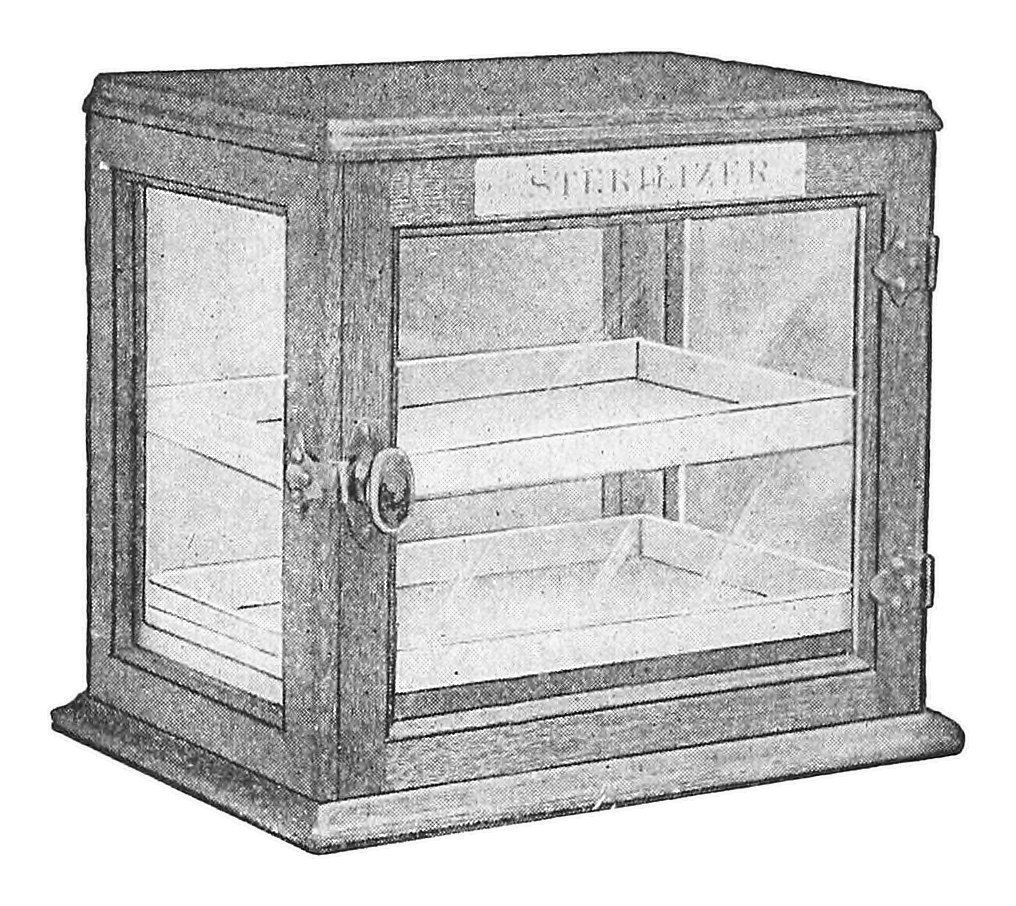
FORMALDEHYDE STERILIZER
Formaldehyde gas is an agent which has germicidal properties, and is used to a great extent where steam sterilizers are not available. Formalin, a concentrated solution of the formaldehyde gas, readily gives up its gaseous constituent so that when the liquid is placed on a flat tray, the gas will penetrate objects around it. Cabinets have been constructed which are so arranged that the lower shelf contains the solution, and the upper shelves may be used for instruments, dressings, towels, etc. When the cabinets, which vary greatly in size, are tightly closed, the gas will penetrate every object contained therein, thus destroying any microorganisms which might be present.