Chapter XIV · ONYCHOCRYPTOSIS OR INGROWN TOE NAIL
Reading edition
Definition. Onychocryptosis, or ingrowing or ingrown toe nail, is a condition in which the lateral edge of a nail has penetrated through the epidermic layers and has become imbedded in the adjacent or subjacent soft parts of the lateral nail groove. This abnormal condition gives rise to a number of complications, viz: simple inflammation, ulceration, circumscribed or diffused cellulitis and the formation of proud flesh. These may occur singly or as is commonly found, the last three in unison. The unclean condition of people’s footgear, the general unsanitary conditions of the foot, or maltreatment of ingrown nail in its incipiency, often give rise to the still graver septic complications which ultimate in a general septicemia.
A nail then to be classed as an ingrowing nail must be specifically ingrowing. Mention is made of this fact, which many in their wisdom may deem superfluous, because so many conditions of callous or helomata in the nail groove are mistaken for ingrowing nail and their treatment as such is not only useless, so far as a cure is concerned, but is decidedly detrimental to the comfort of the patient and to the future general condition of the nail involved.
Etiology. A large percentage, perhaps larger than most people imagine, of ingrown nails arise from the injudicious cutting of the part by an inexperienced person. Directly after an amateur operation upon a painful nail, acute symptoms of ingrowing nail do not necessarily develop—although it does happen in many cases; but the etiology of a great number of acute and well defined cases of ingrown nail, as stated, can be traced primarily to self-inflicted nail injury at some previous time.
The changes taking place in the nail and in the tissues of the nail groove after the removal of the lateral border of the nail, are pronounced. Take, for example, the great toe nail, as this is the most easily studied on account of its size and at the same time is the most general seat of troubles of this nature.
The nails are placed on the dorsal surfaces of the toes as a means of protection to the expanded extremities of the distal phalanges. Perhaps the Divine Providence in moulding his masterpiece, man, foresaw the advent of modern footgear and realizing its baneful effect upon the human extremity, developed upon the great toe a heavy nail from which a great deal of protection for the more tender tissues beneath might be obtained. At any rate, the great toe nail today bears the brunt of the pressure from our leather footgear and for that reason is probably the seat of so many painful afflictions.
The free edge of the normal great toe nail is found to be more flattened and expanded than the posterior portions of the nail nearer its root. This flattened expansion holds the softer tissues of the end of the toe and of the lateral border of the nail groove in place under the nail and also prevents them, if allowed to remain untouched, from crowding up or around the nail at any quarter. But allow the free edge and the lateral border of the nail to be removed, and particularly by inexperienced hands—and observe what takes place. These softer tissues which were normally held in place by the free borders of the nail, fill up the spaces left by the removal of the nail borders. Even this condition, were the nail to remain stationary and cease to grow, would not be conducive to great pain or inconvenience. But the nail is being continually pushed forward by the formation of new cells at its posterior extremity. This is embedded in the posterior nail fold, and when the newly formed portion of the same width as originally found arrives at the point where the softer tissues are crowded up and into the space left by the removal of the borders of the nail, instead of growing over them and forcing them back into their normal position, it finds this impossible, and grows into them.
From the foregoing we are not to take it for granted that all cases occur from injudicious cutting of the nail’s lateral borders. Short and tight shoes and hose are in some cases the exciting causes of ingrowing nails and, from observation, we are led to believe that while the actual ingrowing nail is not hereditary, nevertheless the predisposition toward nail inversion is manifest through an entire family or even through a generation.
In the case of tight footgear or hosiery, the cause is the crowding of the great toe against its neighbor, forcing the softer tissues of the nail groove and flap to be crowded against the lateral edge of the nail. In these cases the principal site of occurrence will naturally be the outer sides of the great toe; in fact, in most cases, this groove will be found to be the most general site of occurrence. The soft tissues of the nail flap being crowded over and around the nail’s lateral edge, there naturally follows an irritation in the groove, caused by the nail rubbing upon these tissues which, in time no doubt leads to ulceration of the parts with the accompanying inflammatory symptoms.
Uric acid diathesis may in one sense be said to be the cause of some cases of ingrown nail in that when patients so suffer, the nails are prone to chip off at the edges leaving the latter ragged and so allowing a chance for irritation from the saw-like projections, ultimating in an ulcerated condition of the wounded parts.
Complications. Other than the general inflammatory conditions brought about in connection with the ulceration caused by the edge of the nail penetrating the softer tissues, proud flesh is probably the complication most generally met with in these cases.
Proud flesh, thus produced, is due undoubtedly to the constant irritation of the nail upon the exposed surfaces of ulcerated area. It forms in many shapes and the mass developed depends largely upon the length of time the condition is allowed to progress without proper treatment. The excess growth is usually found covering the whole exposed area, or only forming in a teat-like prominence with a small circumscribed base and expanded extremity. The pain to the patient is undoubtedly augmented by the presence of proud flesh and the discharge from the ulcerated areas is thereby increased. Hemorrhage from the movement of the toe in walking is prone to occur and the general unwholesomeness of the part is thus exaggerated.
In some cases the production of these exuberant granulations takes place under the body of the nail as well as in the groove or on the flap and they are not clearly discernible until the imbedded portion of the nail is removed, when they will be seen to crowd upward into view.
Any open wound upon the surfaces of the foot is very liable to septic infection. Regardless of the cleanly care one may give his feet and regardless of the washing of hose, infection will still take place, and only naturally so. The feet are coming constantly in contact with septic surfaces and the inside of a shoe presents large areas for the resting place of countless microorganisms in that it combines the three elements which are best suited for the growth of bacteria, viz: heat, moisture and darkness.
Ingrown nails are even more prone to infection than is a lesion in connection with an heloma or a fissured toe web, and in many instances where cases have been allowed to run for some time before the surgeon or podiatrist is called into consultation, infection has already occurred.
In connection with septic cases, abscess cavities are often found immediately in the nail groove, under the body of the nail itself or with a suppurative sinus burrowing backward under the posterior nail fold and involving the whole of the matrix in an acute suppurative process. In exaggerated cases, the cellulitis may be diffused throughout the whole digital region. However, these cases are rare, as walking has become well-nigh impossible long before this takes place and the patient will have been under scientific treatment before the case has reached such proportions.
Treatment. From the standpoint of the podiatrist, there are two distinct methods of operative technic in ingrown nail cases, the radical and the palliative. They differ as to the exact technic of the removal of the ingrown portion, but agree on practically all other points.
In that but for the first part of the operation these two methods are similar, they will be discussed separately as to that alone, and the post-operative procedures and dressing of both will be combined into one general discussion. Under each heading the treatment of the surrounding tissues is mentioned, but the reader is referred to the heading “Prophylaxis” for a thorough and comprehensive discussion of the various procedures necessary to their proper care.
Asepsis. Proper aseptic precautions must be observed in all lesions and particularly so with ingrown nail cases. As has already been stated, conditions of this nature are prone to infection because the surfaces and recesses or the nail groove present excellent lodgment for bacteria, and this point should always be borne in mind.
The parts should first be thoroughly cleansed with ether. This removes all greasy or oily matter from the field of operation and allows the antiseptic solutions subsequently used to come in direct contact with the affected surfaces.
Some effective antiseptic should then be used as a spray to prevent the washing in of bacteria from the surrounding parts. There are a number of solutions which are useful for this purpose; liq. zinci et alumini compositus, N.F., and liq. zinci et ferri compositus, N.F., are both highly recommended. Liq. cresolis compositus may also be used with excellent results, although it carries the somewhat disagreeable odor of the cresols. These solutions are all active in strengths ranging from two to five per cent.
Iodine is unquestionably the best antiseptic that can be applied to the field of operation, but as its discoloration of the tissues prevents the operator from visually observing geographic points he may need for further diagnosis, and as this drug also acts as a corrosive to metal instruments, it is found advisable in many instances to refrain from its use.
As a substitute for iodine, alcohol is the next most efficient germicide. Sixty per cent. strength is recommended, as in that proportion it has greater penetrative and antiseptic value than the stronger solutions.
The alcohol, applied by means of a cotton wound applicator, is rubbed into the parts, or a pledget of sterile cotton or gauze, saturated in the solution, may be applied over the field and allowed to remain for two or three minutes prior to operation.
When the operator has followed the foregoing, or a similar line of procedure, the removal of the ingrown portion of nail may be begun. For simplicity’s sake, the methods of treatment will be discussed, beginning with the uncomplicated case, and the various complications will be considered under separate headings.
UNCOMPLICATED CASES
Removal of the Ingrown Portion. Having obtained thorough asepsis of the affected and surrounding areas, the operator by means of a small, blunt sterile probe, should endeavor to locate the exact position and size of the ingrown portion of nail, which should then be removed by means of a sterile nail chisel.
The Nail Chisel. This instrument is a narrow steel blade set in a long or short handle, as the operator desires, the operating end of which is slightly oblique so that, upon direct pressure, the blade cuts in a diagonal manner. This is for the purpose of minimizing the danger of penetration into the nail bed. In the radical operation a broader and heavier chisel is sometimes used so that the softer tissues may be included in the incision.
The Radical Method. Proper antiseptic precautions having been taken, the circulation is cut off at the base of the toe by the application of a tourniquet. Under local anesthesia, induced preferably by the hypodermatic injection of novocaine, 1%, the nail is split longitudinally to the root with an ingrown nail chisel, care being taken not to split the nail at or near its centre—a procedure practised by some surgeons. When the nail has been cut through the root, the free portion is grasped with an artery forceps and is lifted out of the nail groove. It is often necessary to dissect the nail from adhesions which have formed.
The proud flesh, should any be present, is now snipped off with a pair of curved scissors and if necessary a portion of the enlarged nail flap is also included in the cut. The soft tissues should be cut so that the structure remaining appears normal in size.
The nail matrix is thoroughly curetted over its entire exposed area, as is the nail bed along its whole surface to the distal end. This procedure must be thorough to insure against recurrence. Bleeding is of a capillary type and is easily controlled by digital pressure.
The Palliative Method. With a sterile nail clipper, a small cut is made on the affected side in the free edge of the nail. The chisel is then placed in this notch and gentle yet firm pressure is exerted so that the instrument cuts through and splits the nail.
The cut made is in the shape of an arc, following as nearly as possible the normal line of the lateral edge of the nail. The broadest part of the arc is at the anterior or free edge of the nail, gradually reducing the width of the piece to be removed until the lateral edge is reached. In this way a clean sweeping cut is made which does not invade and consequently does not irritate the tissues about the nail root.
The palliative method of operative technic in ingrown nail cases is based on the theory that the condition is not one of a misdirected growth of the nail, but rather a case of the soft tissues adjacent to the nail crowding up, around and over the nail proper; and that the nail body as it pushes continually forward, cannot force this mass back into its normal position and, of necessity, must grow into it.
There is no lateral hypertrophy of the nail nor does it present any misdirected growth.
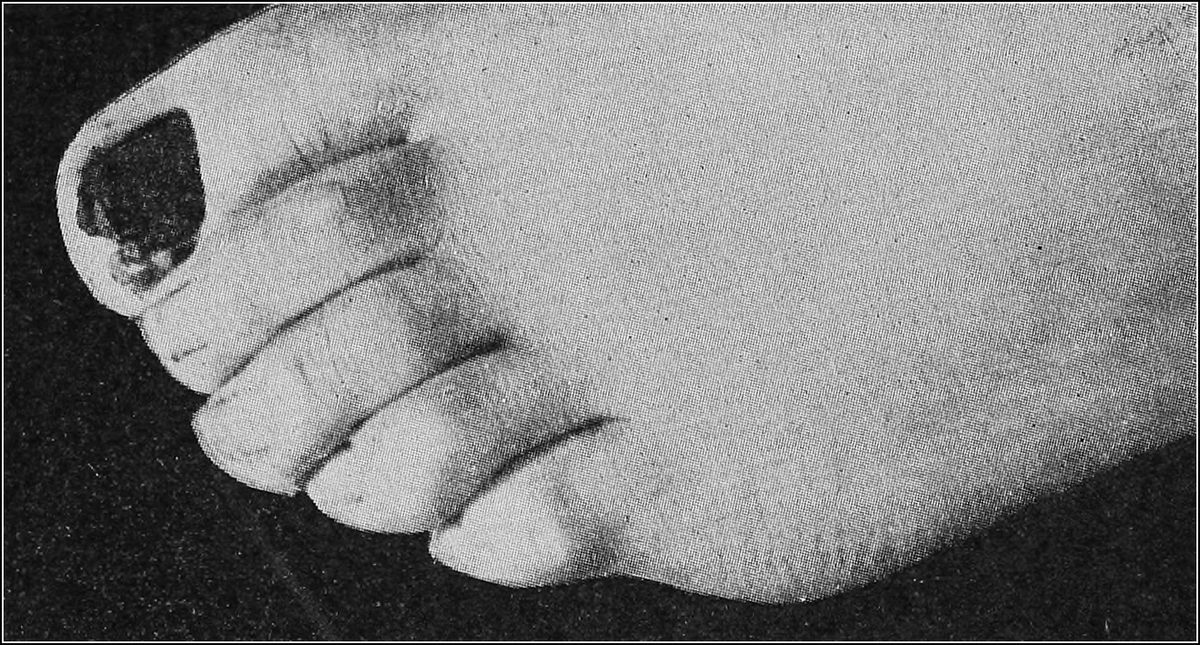
ONYCHOCRYPTOSIS (SUPPURATING)
Keeping this theory in mind, it would seem unnecessary and poor surgery to remove the portions of the matrix of the nail from which the affected side develops when in reality it is not the nail that is at fault but rather the soft tissues adjacent to it; and the ingrowing of the nail body is purely secondary to the displacement of these soft tissues. As ever in surgery, however, it remains a matter of judgment as to which operation should be done so as to obtain the best results. When the palliative methods fail to be effective, the radical operation is permissible—never the reverse.
The palliative method has for its object the removal of the portion of nail whose irritant free border is embedded in the tissues and, this accomplished, to treat these softer tissues in such a manner that they will become normal as to position and all else. By such a manner and method of treatment, sufficient space is obtained at its lateral edge for the nail to grow to its full width and in time to become perfectly normal as to appearance, function and feeling.
The straight nail chisel, in most instances, can be used, but where the ingrown portion of nail is deeply embedded, a right or left curved chisel can be substituted with greater success. The curve in this variety of chisel aids the operator in lifting the nail out of its bed, while at the same time the cutting process is not hindered.
Dressing. Following the removal of the offending portion of nail, the operator should make sure that no nail slivers, previously existing or of his own making, remain in the nail fold. Assured of this, the parts should then be thoroughly irrigated either with alcohol, 60%, or mercuric chloride, ¹⁄₄₀₀₀. Hydrogen peroxide may be used as an irrigant where pus is present, but it should not be depended upon as a germicide as its action is very transient and superficial. A final dressing is then put in place.
There seems to be a wide diversity of opinion as to what constitutes a proper dressing after the nail has been removed. Whatever else individual experience may show to be useful, the dressing should be one embodying antiseptic, astringent and healing properties. The antiseptic, surely regardless of what other action is to be desired; the astringent, so that inflammatory symptoms may be speedily combated and the ulcerated areas contracted; and the healing so that granulation may be the more speedily promoted.
Three forms of dressings may be classified: the wet; the dry; the ointment.
The Wet Dressing. The nail groove is packed with a small piece of sterile gauze. Care should be exercised that a thin fold of the gauze be placed under the edge of the nail between it and the tissues into which the ingrown portion of nail was embedded. A piece of sterile gauze, of about three or four thicknesses and about two inches square, is then placed over the affected fold of the nail, covering the inflamed area and extending over the nail itself. This pledget is then saturated with a solution of the operator’s choosing to meet the needs of the case under treatment. Two solutions seem to be favored above all others in this connection: mercuric chloride, ¹⁄₅₀₀₀, or weaker, and liq. aluminum acetate. The latter solution is at most times preferable, as it possesses antiseptic qualities (nearly, if not equal to corrosive sublimate without exhibiting the toxic properties of the latter) and produces an astringent and antiphlogistic action on the tissues. Strong germicidal solutions such as the mercuric chloride are at times found to be decidedly detrimental, in that they not alone cause maceration and desquamation of the skin, but in some instances, if too strong, they destroy the newly formed connective tissue granules.
The gauze square which covers the whole end of the toe, and which is saturated with either solution just described, is held in place by a roller bandage or by adhesive strips.
The usual method of applying these strips is to place one on each side of the gauze square, adhering them over the end of the toe and to and on the skin, and one over the centre of the dressing, carrying it over the end and down to and on the plantar surface of the toe. A circular strip is then carried around the toe, over the posterior end of the dressing, thus binding down the ends of the three strips previously applied.
No impervious covering such as gutta percha, oiled silk, etc., should be used in this instance, or, in fact, in any condition where the skin is broken. The warmth and moisture produced by such a covering is congenial to the growth and development of hostile bacteria.
The wet dressing, then, should be left uncovered so that evaporation may take place and a quantity of the solution used should be prescribed for the patient, so that the dressing may be moistened with it from time to time. The dressing without impervious covering is antiseptic and heat reducing because of the evaporation and frequent replenishment of the solution.
The Dry Dressing. Dry dressings in this sense consist in the application either of plain, dry, sterile gauze packed in the nail groove and unmoistened, or dusting the affected parts with some antiseptic powder to maintain asepsis in the wound and to bring about normal granulation.
Of these two forms of dry dressing, that constituted by the plain dry gauze is productive of better results than are obtained by the dusting powders. A lesion caused by the nail penetrating the soft tissues of the nail fold, in the process of healing, necessarily discharges a certain amount of waste material produced in the tissue repair. In consequence, where a dusting powder is used, the serous discharge at times combines with the particles of the powder to form a crust which, in the confined areas of the nail groove, often becomes equally as irritating as was the ingrown nail itself.
However, in some instances dusting powders may be used with impunity and many practitioners favor and report success in their use.
Aristol (thymol iodide), dermatol (bismuth subgallate), bismuth subnitrate and boric acid (powder), preferably the first two named, may all be safely used in the treatment of ingrown nail cases. Aristol depends upon the liberation of iodine for its antiseptic action while the two bismuth salts, the subgallate and the subnitrate, combine marked astringent properties with their antiseptic qualities.
After the powder is dusted into the affected groove, a thin layer of sterile gauze is packed lightly under the lateral edge of the nail and a cocoon dressing is placed over the whole.
This form of dressing is applied until resolution of the inflammatory process and granulation of the wound has taken place.
The Ointment Dressing. All ointments are necessarily of fatty or oily consistency and, in consequence, when applied over a surface excreting a serous discharge, are liable to confine this discharge to the affected areas rather than allow it to be absorbed by the gauze dressing, and so drain the wound. For this reason the use of ointments on discharging surfaces is not particularly recommended. Many practitioners use them, however, and presumably with beneficial results.
Two classes of ointments may be used in this connection: antiseptic and stimulating. Under these headings the following are suggested: sulphur, 10% (vaseline or lanolin base); ammoniated mercury (white precipitate), 5%; balsam of Peru, 10%; scarlet red (medicinal Biebrich), 4%.
The ointment is placed in the nail groove by means of a spatula, and sterile gauze is packed lightly under the nail, holding the ointment in place. This is covered with a cocoon dressing and is renewed until the parts regain their normal condition.
COMPLICATED CASES
Proud Flesh. The development of unhealthy, exuberant granulations is a common occurrence in connection with ingrown nail cases, especially when they have been allowed to progress before proper treatment has been inaugurated.
In all cases the primary steps in the treatment are essentially similar to those described under “uncomplicated cases.” Proper asepsis and antisepsis are at all times to be strictly observed, and any ingrown portion of nail should in all cases be first removed before additional treatment is administered.
The speedy and complete removal of the unhealthy granulations is at all times essential. This may be accomplished either by excision, by the actual cautery or by the use of escharotics. The operator must always remember that the presence of proud flesh in a wound not alone retards the normal healing process, but also prevents the wound from healing without the formation of an abnormal amount of new tissue. If, for instance, a mass of proud flesh the size of a pea were present in connection with an ingrown nail and allowed to remain without further treatment, the tissue would in time present a perfectly normal appearance. That is, the exuberant granules would sooner or later develop an epithelial covering which would be of like appearance to the normal surface of the skin. But in doing so, the tissues would still retain the shape and size of the original mass of exuberant granules and we would find a teat of tissue, the size of a pea, jutting out of the normal surface of the nail groove.
Keeping in mind, then, that to obtain a speedy and normal healing action in a wound the proud flesh present must be eradicated, it should appeal to the operator that the quickest means for its removal must be the best. Two quick and complete methods for obtaining this desired result are found in (1), excision (by the use of the scalpel or curved scissors), and in (2), the actual cautery.
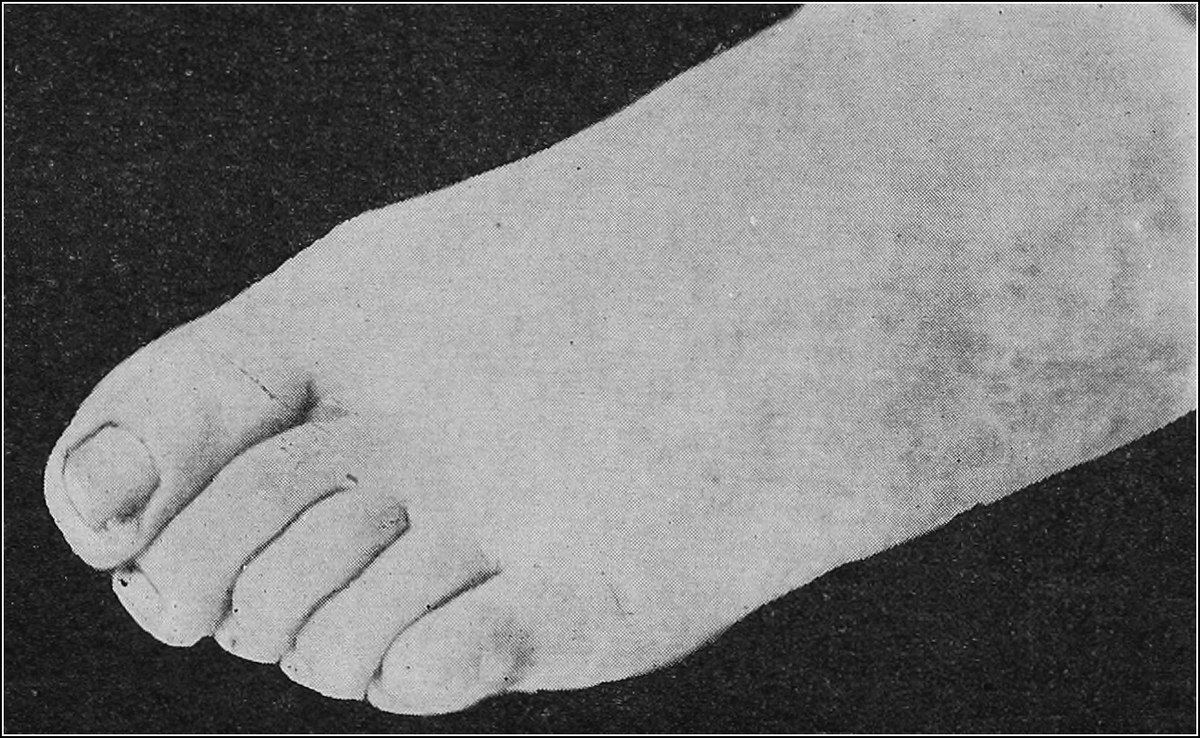
BEGINNING INGROWN TOE NAIL
Excision. Excision of the proud flesh cannot be resorted to in all cases, but in most cases at least the larger portion of the exuberant granulations can be removed in this manner.
The condition in which the use of the curved scissors is particularly advocated as most efficient is that in which the mass of proud flesh is found in pendulous form, where its base is narrow and covers but a small area and where the mass expands into an enlarged extremity. In cases where the proud flesh is found generally throughout the nail groove, and in some instances under the lateral edge of the nail itself, the scissors or scalpel cannot be used with good effect, if at all. Then of course other means must be employed.
Method of Procedure. After the field of operation has been thoroughly sterilized and the ingrown portion of the nail has been located and removed, the exact situation and amount of proud flesh is ascertained. If at all practical, a sterile scissors (preferably of the curved variety) is inserted under the granulating mass and the whole is quickly snipped off at its junction with the normal integument. Where the mass is considerable, it will be found advisable to ligate the toe at its base by means of a few tight turns of adhesive tape or by the use of a rubber ligature. This precaution will lessen the resulting hemorrhage and it can be more readily controlled.
Where the amount of proud flesh to be excised is small, the blood flow is easily arrested by digital pressure.
It will generally be found conducive to the best results to anesthetize the parts by hypodermatic injections of novocaine or by means of the ethyl chloride spray. This is not necessary in every instance, however, as the advisability of producing anesthesia depends upon the amount of tissue involved and the nervous condition of the patient.
After the exuberant granulations have been cut off, Monsel’s solution, adrenalin chloride or some other styptic is applied to the bleeding capillaries.
It may be found advisable to apply silver nitrate, 50%, or even nitric acid, c.p., to the bleeding parts. This serves not alone to check the hemorrhage, but the escharotic action tends to destroy whatever remaining shreds of the proud flesh may still be present.
The oozing arrested, the ligature is removed. The nail groove is packed firmly with sterile gauze (firmly, so as to further check the vascular supply to the parts) and a wet dressing of liq. aluminum acetate is applied. In the event of no further recurrence of the proud flesh, the case is treated in any of the ways described under “uncomplicated cases.”
The Actual Cautery. The electric cautery presents a quick and sure means by which proud flesh may be destroyed. Local anesthesia should first be induced by means of a hypodermatic injection of novocaine, 1%, or by use of a freezing spray, such as ethyl chloride. In most instances the use of the ethyl chloride will be found sufficient for the needs of the case although its anesthetic effect is quite superficial and transient. Novocaine, on the contrary, is both lasting and complete in its effect.
The argument against the use of the actual cautery is one of humaneness rather than one of science. Regardless of the lack of sensation produced by the anesthetic, patients will rebel at the sight of a white hot cautery. The mental shock of seeing one’s flesh seared by a hot iron is pronounced, and at the present time no podiatrist can take liberties with the patient’s feelings as does the surgeon, without jeopardizing his reputation and diminishing his clientele. On the other hand, while the mental anguish of the patient may be greater during the use of the actual cautery, the subsequent suffering is much less than that following the application of an escharotic.
After the use of the cautery, a wet dressing of liq. aluminum acetate or a solution of boric acid and alcohol, equal parts, may be applied and renewed until all acute inflammatory symptoms have subsided when a dressing may be employed to hasten granulation.
Escharotics. The use of caustics for the destruction of proud flesh is probably the most generally used method in vogue today. Nitric acid, caustic potash and silver nitrate, either in fused or in solution form, may all be used in most every instance.
Inability for any reason to resort to the use of a curved scissors, the scalpel, or the cautery compels us to look among the caustics for an agent to accomplish the desired results. Keeping in mind the aforementioned fact, that the quickest means for proud flesh removal or destruction is the best, we naturally lean toward the strong corrosives as a means to bring about this end.
Nitric Acid. Nitric acid (aqua fortis), in all probability, is the most efficient member of this class of drugs, as its action is both energetic and penetrating. In cases where the exuberant granulations are found involving the entire nail fold and in no particular localized area, aqua fortis is found very useful. Usually one application is sufficient to destroy all vestige of the unhealthy tissue, but in extreme cases added treatment may be necessary.
Care is taken to cover the surrounding healthy integument with some greasy substance (vaseline is generally preferred) to prevent the acid from coming in contact with it and avoiding the consequent bad effects. The acid is then applied by means of a cotton wound applicator (wooden applicators are preferred, as they are inexpensive and may be thrown away after being used) or a glass rod. The nail groove should be firmly packed with sterile gauze and a wet dressing of liq. aluminum acetate or of bichloride of mercury, ¹⁄₅₀₀₀, or a boric acid and alcohol solution, equal parts, should be applied over the affected parts. At the next examination, any remaining shreds of the unhealthy granulation are to be looked for and, if found, another but lighter application of the acid should be applied. It is wise to remove the eschar caused by the previous application so that deeper penetration and more efficient action from the drug may be obtained.
This is continued until all remnants of the proud flesh are destroyed, when the toe should be dressed to induce speedy and healthy granulation.
Caustic Potash. Potassium hydroxide (caustic potash) may be used in place of nitric acid for the destruction of proud flesh. The preference for the latter seems to be due to the fact that wound’s caused by the action of nitric acid are prone to heal more rapidly than those due to the use of caustic potash; also because the action of aqua fortis can be more readily counteracted should the need for such action arise.
Caustic potash should be used with care, the same precautions to protect the healthy tissue being taken as in the use of nitric acid. Apply caustic potash on a small cotton wound applicator, packing the nail fold with sterile gauze to be followed by a moist dressing of liq. aluminum acetate.
Silver Nitrate. The use of the silver stick or a strong solution of the salt to destroy any great amount of proud flesh is not advocated. In the first place the caustic action of silver nitrate is due solely to the nitric acid generated by its use, and so the aqua fortis should be used to obtain a speedier and more energetic removal of the unhealthy tissue. Secondly, silver nitrate coming in contact with the albuminous tissue, decomposes, oxidizing it and forming a metallic deposit on the surface which becomes an impermeable eschar. This hard crust not alone prevents the silver salt from penetrating into the tissues—the action of silver nitrate is thus called “self-limiting”—but also being unyielding, acts as a direct irritant to the denuded tissues.
Silver nitrate is, however, particularly efficacious after the great amount of the proud flesh has been removed by means of excision; in this situation it acts as a styptic to arrest the capillary flow of the bleeding stump, and as a mild caustic to destroy the remaining shreds of the unhealthy granulation. It is also a beneficial application for hardening the tissues of the nail fold to prevent further recurrence of the ingrowing nail. This subject will be fully discussed under “Prophylaxis.” After excision of the proud flesh, silver nitrate should be used in solution of fifty per cent. and the toe dressed as has been previously described.
Burnt Alum. Burnt alum is still another remedy used in podiatry for the destruction of proud flesh. Its use is not now favored for that direct purpose, but there are some situations in connection with the treatment of the condition in which it may be used with good results. It is the least energetic of all the escharotics herein mentioned, and many prefer to class it rather as an astringent. The burnt alum is dusted in the nail groove directly on the mass of proud flesh and the groove is then packed with sterile gauze. Because of its extremely mild action, comparatively speaking, burnt alum will not accomplish its work of destruction with the rapidity nor the completeness of the other mentioned drugs; moreover it causes considerable irritation and pain to the patient. The modern practitioner is inclined to relegate this drug, as a caustic, to the shelf, to be used only in cases where a strong astringent action is desired.
Liquor Ferri Subsulphate. Monsel’s solution has been used to dry up unhealthy granulations because of its astringent action rather than on account of its caustic properties.
Treatment of Acute Infective Inflammations. Infection is in all probability more generally met with in connection with ingrown nail cases than in any other ailment primarily occurring on the foot. The state in which the toe may be found is dependent upon the length of time the case has progressed without proper treatment. Cellulitis may be circumscribed or diffused, and lymphangitis, both of the reticular or tubular variety, may be present.
Following the usual antiseptic and aseptic precautions relative to the field of operation, the operator’s hands and the instruments, drainage of the suppurated areas must first be obtained.
In the average case, an abscess cavity is usually found in or adjacent to the lateral nail fold, and in many instances the pus sac will be punctured during the removal of the ingrown portion of the nail. It is sometimes found necessary to remove an overlying portion of nail, other than the ingrown portion, to give free access to the suppurating process and to afford drainage for its purulent discharge. A sterile chisel of the straight variety is generally used to accomplish the removal of the ingrown portion of nail, care being taken that the cutting edge is inserted deep enough to penetrate only the nail and not to pierce the underlying soft parts.
Some practitioners do not advocate the removal of portions of the nail and prefer rather merely to drill a hole through the nail body and excavate the pus through this channel. No doubt circumstances alter cases, but the writer would prefer having the septic tract wholly exposed so that thorough irrigation and proper treatment may be accomplished.
Having given free drainage to the pus cavities, the parts should again be sprayed with alcohol, 60%. Hydrogen peroxide, which manifests its greatest efficacy in pus cases, should then be freely applied until ebullition ceases.
In cases where the sinus is small and deep and an ordinary cotton wound applicator is too large for insertion into its recesses, a wooden applicator tipped with iodine (these applicators already prepared are now on the market) will be found fine enough for this accomplishment.
There is also on the market a fine, hollow, flexible needle, with a bulbous extremity in which there is an opening, that fits any hypodermic syringe. Two or three drops of iodine are drawn into the barrel, the needle is inserted into the sinus, and its contents are evacuated by piston pressure. This enables the operator to get the drug down into the sinus so that it comes into direct contact with its deepest surfaces. This needle is made of a non-corrosive metal.
The next point to be considered is the form of dressing to be used. If the case has progressed to a point where the operator feels the necessity of a surgeon’s advice, the latter should by all means be called in as a consultant. The writer feels, however, that in most instances the modern practitioner of podiatry is well equipped to successfully treat even severe cases of this nature.
The affected nail groove is packed with sterile gauze and a large piece of the fabric, of several thicknesses, is placed over the whole inflamed area. This is saturated with a solution of mercuric chloride, ¹⁄₅₀₀₀, and is remoistened at intervals by the patient so that it is constantly wet. In some cases it may be wise to have the patient remain in the office several hours to make sure that the infected parts are kept constantly immersed in a solution of mercuric chloride, ¹⁄₅₀₀₀. This treatment has been found to be extremely beneficial in reducing the inflammation so that a moist evaporating dressing, as described above, may be safely applied. Rest is another feature to be employed in the treatment of these cases. The patient should be instructed to refrain absolutely from the use of the affected parts until such time when the inflammatory conditions have subsided or are under control. The podiatry patient as a rule is loathe to have his or her energies in any way curtailed, but the mention of “blood poisoning” is usually sufficient stimulus to send the patient to bed when so ordered.
Prognosis. The prognosis in all cases of ingrown nail under proper treatment is favorable. The length of time elapsing before a cure is affected is of course dependent upon the condition of the toe and the general condition of the patient.
In cases where the nail penetration is slight, and the inflammatory conditions are in their incipiency, one or at most two treatments will be sufficient to heal the ulceration and to restore the toe to its normal condition. Complicated cases necessarily take longer to relieve and longer to cure.
The surgeon is still rather reluctant to believe that an ingrown nail can be cured without removal of the affected half of the nail, the lateral nail fold, and a portion of the matrix. This method of procedure in nearly every instance incapacitates the patient for fully two weeks and it is doubtful whether anything is gained (taking all matters into consideration) over the methods of ingrown nail treatment as here outlined.
The surgical argument is based on the contention that unless the matrix underlying the affected nail be removed, the nail will again grow into the tissues. This is unquestionably so, but in a majority of cases, as explained previously, the trouble is not due to a misdirected growth of the nail, but rather to the tissues surrounding the free edge and lateral nail border crowding up, around and over the nail.
It may then be safely stated that an ingrown nail properly treated and which has been subjected subsequently to proper prophylactic measures, is curable; not temporarily, but permanently.
PROPHYLAXIS
In considering the measures employed by which the general condition of the nail may be improved so as to prevent a further recurrence of the ingrowing tendencies, we will make, for simplicity’s sake, six divisions. Five of these relate to the nail itself and to the subjacent tissues, and one to the footgear and hosiery of the patient.
1. Thinning the Nail Through Its Long Axis. When the acute inflammatory symptoms have subsided and the ulcerated areas healed, in other words when the toe and the nail have returned to normal, measures should be taken to prevent the latter from becoming again ingrown. With a rotary file, the centre of the nail should be ground to a paper thinness through its long axis. What is accomplished by this procedure?
The nail is normally convex on its outer surface and the apex of its dome is the centre of the nail body. This portion, being the greatest point of elevation, naturally receives the brunt of the pressure from the shoe. If the nail, then, is allowed to remain thick in the centre of its body, the shoe pressing upon it will find the nail unyielding and in consequence will cause its lateral borders to be forced down into the nail grooves. By thinning the body of the nail to such an extent that it becomes thin and flexible, the shoe presses upon a yielding surface, in consequence of which the nail “gives” or spatulates at its centre and the pressure upon its lateral borders is decreased if not prevented entirely.
Having done away with any untoward pressure which might be brought to bear on the nail, we next turn to:
2. Hardening the Nail Groove, and Shrinking the Flap. In many cases, after all acute symptoms of the disturbances have subsided, we find that the flap of tissue adjacent to the once affected nail and forming the outer side of the groove, is greatly thickened and enlarged.
This must be reduced in order that the new-forming nail will have sufficient room to develop to its normal width and we must also harden and toughen the nail groove so that it will present a surface that the nail, as it grows out, will not be able to penetrate, should it be so inclined.
Silver nitrate is the most generally used and most efficient agent to carry out a treatment of this kind. Solutions varying in strength from 5% to 50% are recommended, and the selection depends on what is to be accomplished and the length of time which may be given to the treatment.
By persistent use of silver nitrate solution, 50%, an enlarged and thickened nail flap may in time be reduced to normal. Applications about one week apart—in some cases ten days or two weeks to intervene—will usually work wonders in conditions of this kind. The groove should be thoroughly cleansed and dried and the silver solution should be applied on a small cotton wound applicator and painted well down under the nail and over the tissue in the enlargement. A dressing, usually cotton and collodion, is then applied and allowed to remain undisturbed until the patient’s return. The action of this solution is astringent and sedative. It is bound to reduce the chronic inflammatory symptoms that may be present and, acting as an astringent, it gradually shrinks the enlarged flap until the normal line of the lateral nail fold is reached.
During the treatment, there is absolutely no pain nor inconvenience to the patient. Care should always be exercised that the silver solution be not applied if any hemorrhage has been caused in the removal of a previous eschar, as it is sufficiently caustic to cause ulceration should it come in contact with such a denuded surface. Packing of the nail groove will be discussed under the sub-heading “Packing.”
Subsulphate of iron (Monsel’s solution) may be used in the treatment of cases of this nature, but its action as an astringent in this connection is so mild that it is of necessity a slow process to effect a complete cure.
The solution, usually applied to the groove on gauze, is allowed to remain. In fact, the patient is often advised to procure a quantity of the drug and keep the gauze moistened.
The patient should be seen at periods of about a week or ten days, when both the dressing and the eschar caused by the action of the iron salt are removed. Fresh gauze is packed under the nail and the treatment continued.
Ferric chloride has much the same action in this connection as the subsulphate, but this drug has never been so popular, for the reason of its greater irritant qualities, few of which are to any degree manifest in Monsel’s solution.
Ointments or collodion containing large percentages of salicylic acid—as high as sixty to seventy-five per cent.—are sometimes used to destroy an enlarged nail flap by strong disintegrative action. The ointment is usually prepared on a cerate base and sufficient wax is added to thicken the paste so that the tendency to melt and run over portions of the integument, where its action would be detrimental, is minimized.
The ointment is applied in the groove and over the top surface of the mass to be destroyed and is allowed to remain for a few days when the disintegrated portion is removed and another application made. This action of salicylic acid, used in considerable strength, is at times painful and cannot be borne by every patient. The treatment is a good one, however, and is rapidly coming into the prominence and popularity it deserves. Salicylated collodion is similar in action to the ointments containing salicylic acid, and the same general procedure holds good for both applications. The collodion is applied on all surfaces of the mass, is covered with a cotton and collodion dressing and a second application is made upon the removal of the disintegrated portion.
It is sometimes advantageous to alternate the silver nitrate treatment with that of salicylic acid. An application of the ointment or the collodion is made and upon removal of the disintegrated portion, the silver solution is applied. After the lapse of about two weeks, the salicylic acid is again applied and the treatment continued alternately in this manner until the desired result is obtained.
3. Packing. We here come to one of the most important procedures necessary to a successful prophylactic treatment of an ingrown nail. Whether the nail groove is to be packed loosely or tightly is a question of great import and should be given careful consideration by the operator. Often the comfort of the patient and always the ultimate outcome of the case is dependent on the proper packing of the nail groove as an after-treatment.
There appears to be a great tendency to pack the groove full to overflowing with gauze, cotton, or what not, and, although there are some instances where a procedure of this kind is necessary, it is usually conducive to a great amount of pain to the patient and has a decidedly deleterious effect on the tissues under treatment.
In general, it is wise to pack the groove as lightly as possible, using only a small pledget of gauze or cotton and taking care that the fabric is well under the nail and interposed between it and the tender areas underneath. It must be remembered that no matter what fabric be used for packing, it rapidly hardens and becomes more or less irritant to the tissues. Should the nail groove be packed to such a degree that at the time of dressing it is unyielding and hard, it is easily realized what the condition of this dressing will be in the course of a few days.
The only time a nail groove might be tightly packed is in connection with the treatment of proud flesh when the tight packing tends to interrupt the circulation to the part and thus aids in retarding the growth of the superfluous granulations. Another instance when a groove may be packed tightly is in a case where no inflammation is present and when it is the desire of the operator to hold the softer tissues down and away from the edge of the nail so that sufficient room may be allowed for the nail to grow out and attain its normal width. A word in connection with this theory. Silver nitrate solutions, twenty-five to fifty per cent., applied to the groove hardens the tissue by means of the eschar developed on its surface and a tight packing to hold these tissues in place is an ideal combination for the prophylactic treatment of a previously acute ingrown nail case, when by such tight packing no noticeable inconvenience is caused to the patient. If cotton is used as a packing it should be rolled into a loose thin pledget, the finer “point” of which is inserted under the edge of the nail near its posterior fold, and the thicker end is packed under the nail at its distal portion. One thickness of gauze is generally sufficient and, at most, two thicknesses may be used, unless, of course, tight packing is required.
In connection with this prophylactic treatment it may sometimes be wise to place a shield of felt or buckskin between the tender part and the adjacent toe to hold that member away from the affected areas and so that the medications applied may be allowed a chance to complete their therapeutic action undisturbed. This shield is not strapped but is merely placed between the toes, resting on the interdigital web, and is just high enough to reach the base of the nail and so does not come in direct contact with the area under treatment.
4. Allowing the Nail to Grow Long. The nail should be allowed to attain as great a length as possible, particularly at its lateral points, without interference with the continuity of the patient’s hosiery, and yet not long enough to cause pressure from the toe of the boot.
This can be best accomplished by cutting the free edge of the nail in a concave manner. The lateral points are kept, if possible, long enough so as to extend to a point slightly beyond the distal end of the nail fold and the rest of the free edge is cut in a circular manner so that at its centre it is no longer than just sufficient to cover the anterior edge of the nail bed. This manner of cutting, combined with thinning the nail body through its central longitudinal axis, prevents any great amount of pressure from being exerted by the shoe upon the apex of the nail’s convexity. It will also, to a great extent, prevent the nail from cutting through the patient’s hosiery. If the whole nail is allowed to grow long, and its free edge to extend over the end of the toe, some leverage is bound to be brought upon this extended portion and in consequence there is a tendency to press the lateral edges of the nail into the grooves, which, of course, is to be avoided at all costs.
5. No Lateral Cutting. In connection with the length which the nail is allowed to retain, it is absolutely imperative that no lateral cutting be done. Some cases of ingrown nail have been observed in even very young children (in one instance a baby of fourteen months). The primary cause in every case was found to be the overzealous care on the part of the parents to prevent just the condition they had caused by injudiciously removing from time to time the lateral edges of the sufferer’s toe nails.
6. Proper Boots and Hosiery. In addition to the various means for preventing the recurrence of an ingrowing nail, great care should be exercised in the selection of the patient’s footgear.
Shoes of sufficient width and length should of course be advocated so that at no time will the toes be cramped by any degree of pressure.
The wearing of a pointed boot or slipper in which there is not sufficient width at the ends of the toes to allow those members proper latitude, should be discouraged. When footgear is worn in which this cramped condition of the digits is brought about, it will be generally found that the soft tissues lying adjacent to the lateral edges of the nail are crowded up alongside the latter and an enlarged and thickened flap, which is the cause of so much trouble, is formed. Lace boots are probably the most practical of any in that they may be firmly fastened about the ankles and over the instep, and thus prevent the foot from sliding forward and coming in contact with the toe of the boot. Pumps of all varieties are without a doubt the most detrimental footgear worn today—for they have absolutely no support or anchorage at the ankle and, in some cases, patients find themselves flexing the toes in the endeavor to retain the slipper on the foot.
Hosiery, too, should be neither tight nor short, as a short stocking or sock may cause pressure upon the toe nails and so be the forerunner of trouble.