Chapter VIII · (continued 2)
Reading edition
During the summer of 1782, although the frontiers of New York were not altogether quiet, the scene of activity in border warfare was transferred further west. There were none of the organized raids of the enemy in the valleys of the Mohawk and Schoharie, with which the inhabitants had become so familiar.
In February, 1783, the last movement of the war on the border took place in this region. It was an attempt by Colonel Willett to surprise the garrison at Oswego. A forced march of a night and a day was made through the trackless forests, on the snow, from the Mohawk Valley to the vicinity of the fort. Then preparations for the assault were made, but when the column advanced the guide became confused and lost his way. As surprise was essential for success, the attempt was abandoned. Willett and his men found their way back as best they could, enduring on the return march intense suffering from fatigue, cold, and exposure. Colonel Willett then proceeded to Albany, at which place he arrived in time to hear peace proclaimed.
The story of this chapter opened with the determination of a boundary line between the king of Great Britain and his allies. It closes with an assurance on the part of the Continental Congress, which is intended to pacify the Indians, that, "as the country is large enough to contain and support us all, and as we are disposed to be kind to them, to supply their wants, and to partake of their trade, we, from these considerations and from motives of compassion, draw a veil over what is passed, and will establish a boundary line between them and us, beyond which we will restrain our citizens from hunting and settling, and within which the Indians shall not come, but for the purpose of trading, treating, or other business equally unexceptionable."[1318] The discussion of how far the kindly spirit which pervades these promises has been maintained in subsequent dealings with the Indians does not fall within the subject of this chapter.

CRITICAL ESSAY ON THE SOURCES OF INFORMATION.
THE relations of the Indians to the British government and to the colonies during the period immediately preceding the Revolutionary War, is readily studied in The life and times of Sir William Johnson, Bart., by William L. Stone (Albany, 1865, in 2 vols.[1319]), which was intended to form a part of a history of the relations of the Iroquois to current events. Stone completed but two volumes of the series, the Life of Brant and the Life of Red Jacket. The Life of Sir William Johnson, being incomplete at the time of his death, was finished and published by his son, of the same name.[1320] The book for awhile stood alone in its detailed treatment of the official relations and dealings of the superintendent with the Indians. Later publications have infringed somewhat upon its monopoly.
The Pennsylvania Archives, and the Minutes of the Provincial Council of Pennsylvania, commonly cited as "Colonial Records", lay bare the secrets of the province, and furnish authentic information upon many points which prior to their publication were obscure.[1321]
The documentary publications of the State of New York are for the purposes of this chapter of even more value than those of Pennsylvania. They contain many official papers from the hands of Sir William Johnson, and letters from Guy Johnson, Daniel Claus, and Generals Carleton and Haldimand, treating of Indian affairs. Some of these documents help us materially in the study of the situation. The history of the publications known as the N. Y. Colonial Documents and Documentary History of N. Y. is told elsewhere;[1322] but the Journals of the Provincial Congress are of peculiar use in the present inquiry.[1323] Such of the conferences, treaties, and agreements with Indians on the part of the colonies, the Continental Congress, and the government of the United States as have been printed, are scattered through a variety of publications.[1324]
The literature of border life, from which the habits and methods of life of the frontier inhabitants may be drawn, is too extensive to permit any attempt at an exhaustive recapitulation of titles. Especial use has been made in this chapter of Dr. Joseph Doddridge's Notes on the Settlements and Indian Wars,[1325] perhaps the most valuable of the many works upon this subject. Notwithstanding the sufferings from Indian raids which Dr. Doddridge himself endured, he deals fairly with the subject of border warfare, and candidly admits the terrible responsibility of the whites for counter outrages. He draws a vivid picture of the lack of law on the frontier, aggravated as it was by the conflicts of colonies. "In the section of the country where my father lived", he says, "there was for many years after the settlement of the country neither law nor gospel. Our want of legal government was owing to the uncertainty whether we belonged to Virginia or Pennsylvania." "Thus it happened that during a long period we knew nothing of courts, lawyers, magistrates, sheriffs, or constables." "Every one was, therefore, at liberty to do whatever was right in his own eyes."
In An Account of the remarkable occurrences in the life and travels of Col. James Smith, etc., etc.,[1326] the author unconsciously gives us a picture of the lawlessness of frontier life and the power of the volunteers. The story is told in a simple manner, and the narrative is full of interest. The rare Chronicles of Border Warfare, by Alexander S. Withers (Clarksburg, Va., 1831), is a recognized authority, and is frequently quoted. It was reproduced in substantial form in Pritt's Border Life of Olden Times,[1327] a compilation of reprints of volumes, narratives and statements relating to border life. The relations of the Indians to current events are also to be traced in Gale's Upper Mississippi, etc.,[1328] and in Ketchum's History of Buffalo.[1329] The latter work covers much of the ground which Col. Stone had preëmpted. The materials are well arranged, the views of the author are clearly presented, and as a result the volumes form a valuable contribution to the history of the Indians.[1330] Many details will be found collected in Drake's Book of the Indians.[1331]
James Handasyd Perkins was a careful student of the early history of the country, and contributed many articles to the periodical literature of his day on the subject of Indian history and border warfare, which have been collected.[1332] The compiler of Annals of the West,[1333] in the preface to the third edition of that work, says: "The first edition was issued at Cincinnati, where he (the compiler) was assisted by the lamented James H. Perkins, a gentleman highly competent for the task." In the second edition of the Annals "the editor had the valuable assistance of Rev. J. M. Peck, a gentleman whose long residence in the far West, and familiarity with the history of those portions of the work less elaborately treated of in the first edition, rendered him admirably qualified for the undertaking." This work, in its chronological arrangement of events, touches upon a portion of the ground covered by this chapter. In 1791, J. Long published in London a volume entitled Voyages and Travels of an Indian Interpreter, etc. Long arrived at Montreal in 1768. His occupation for the next seven years made him familiar with frontier life and Indian ways. He volunteered in 1775 with the Indians who entered the English service, and was at Isle au Noix with a few Mohawks on the occasion of their collision with the Americans. He also served a short time with the regulars. He states intelligently the value of the alliance of the Six Nations to the English.
Wills de Haas, in his Indian Wars of Western Virginia,[1334] has devoted one chapter to "Land Companies",[1335] and another to the "Employment of Indians as Allies." His treatment of these topics is brief, but the chapters contain much more information on the subjects than can generally be obtained from American histories.
In Fugitive Essays, etc., by Charles Whittlesey (Hudson, Ohio, 1852), an article is reproduced from the January number (1845) of the Western Literary Journal and Review, entitled "Indian history: their relations to us at the time of the American Revolution", which is well worth examination.
The Calendar of the Virginia State Papers and other Manuscripts, 1652-1781 (Richmond, 1875),[1336] though meagre as a whole, is particularly full on the subject of the encroachments of individuals and companies on Indian lands. Among these papers is the deposition of Patrick Henry, setting forth that he felt compelled to withdraw from all connection with land schemes, when, as a member of Congress, he found himself in a position where he might be called upon to act as a judge in matters in which he was directly interested. It may be inferred from what he says that there were among his associates some who were not so scrupulous.
Many of the questions involved in the adjustment of boundaries and settlement of treaties between the Indians and the British government survived the Revolution, and reappeared before the United States Congress in the struggles of land companies for possession of their alleged purchases.[1337] Through the memorials to Congress presented by the Illinois and Ouabache Land Company, which are to be found scattered through the Senate and House documents, as well as in separate tracts, we learn that in order to sustain the claim of this company it became important to show that the Six Nations did not own the Wabash region. For that purpose Deputy-Superintendent Croghan made affidavit that "the Six Nations claim by right of conquest all the lands on the southeast side of the river Ohio down to the Cherokee River, and on the west side of the river down to the Big Miami River."[1338] The king had agreed with the Indians that his people should not go west of an established boundary line. He had warned settlers off their lands. The colonists who were in arms against the king were after the lands, by fair means or foul. What was considered fair means in those days, and what causes there were for the exasperation of the Indians, cannot be fully appreciated unless the subject be followed even beyond the days of the Revolution.
The Register of Pennsylvania[1339] also contains a variety of material relating to the subject. A number of the early documents will be found in Hubley's American Revolution (1805).
In making an estimate of the Indian population within the borders of the United States at this time, I have been obliged to rely largely upon my own deductions. Bancroft (United States, iii. ch. 22), giving an estimate of the number of Indians east of the Mississippi and south of the St. Lawrence and the chain of lakes in 1640, says: "We shall approach, perhaps exceed, a just estimate of their numbers if we allow ... one hundred and eighty thousand souls" (edition of 1841). It will be observed that the foregoing estimate includes the Canadian Indians. In the preparation of the estimate which I have given, I have examined many scattered statements of the number of warriors of the different tribes, which comprehend different areas within their respective limits, and which frequently overlap each other. The arbitrary spelling of Indian names often presents the same name in such different dress as to make its identification difficult. If we bear in mind that the name as it appears in print is a phonetic rendering of a word which from the mouths of different individuals would sound differently to the same ear, and further, that those who have given us the various renderings were men of different nationalities and of different degrees of cultivation, we shall oftentimes be able to recognize the same tribe in separate statements, under names the spellings of which at first sight have no seeming identity. As regards this Indian population, a tabulated statement will he found in Jefferson's Notes on the State of Virginia, which relies upon Croghan, Bouquet, and Hutchins, supplemented by Dodge and Gallatin. Croghan's estimate will be found in Proud's History of Pennsylvania (vol. ii. p. 296.)[1340] Bouquet's estimate will be found in the Historical Account of his expedition,[1341] headed "Names of different Indian Nations in North America, with the numbers of their fighting men." Hutchins's estimate will be found in An historical narrative and Topographical description of Louisiana, by Thomas Hutchins (Philadelphia, 1784, App. iii. p. 65), headed "A list of the different nations and tribes of Indians in the Northern District of North America, with the number of fighting men." Sir William Johnson's estimate of the Present State of the Northern Indians,[1342] made Nov. 18, 1763, will be found in the Doc. Hist. of New York, i. p. 26, and in N. Y. Col. Docs., vii. p. 582.
The estimate of Sir James Wright is in the Georgia Hist. Soc. Coll. (Savannah, 1873), iii. part 2, p. 169. The synopsis of the Indian tribes, by Albert Gallatin, is printed in the Amer. Antiquarian Soc. Proc., ii. Still another list was published in Sketches of the History, manners, and customs of the North American Indians, with a plan for their melioration, by James Buchanan, Esq., his Britannic majesty's consul for the State of New York (New York, 1824, 2 vols.), i. ch. xii. pp. 138-39, where it is called "Names of the different Indian nations hitherto discovered in North America, the situation of their countries, with the number of their fighting men" (1770-1780).
Buchanan claimed to have received this list from Heckewelder, the missionary, and it is identical, except for certain palpable errors in transcribing, with a list in what is now known as Trumbull's Indian Wars, the authorship of which is attributed in the original edition[1343] to the Rev. James Steward, D. D. Dr. J. Hammond Trumbull, in reply to a question from me, says the book was "written by Henry Trumbull, then of Norwich, when about seventeen years old."[1344]
Gilbert Imlay, in A Topographical Description of the Western Territory of North America, etc. (London, 1792, p. 234), gives a list of Indians on both sides of the Mississippi, and from the Gulf to the St. Lawrence. This list was made up from "Croghan, Boquet, Carver, Hutchins and Dodge." The figures that he uses are plainly intended for the number of the fighting-men, but he puts the total population in this district at less than 60,000. In a second and a third edition, the list is modified. He gives twenty-eight tribes east of the Mississippi, and his calculation of population is based upon 700 to a nation or tribe. He finds in all 20,000 souls, and "consequently between 4,000 and 5,000 warriors."
I have had occasion in this investigation to examine somewhat the question of the population west of the Mississippi, for two purposes: 1st, to determine the numbers to be eliminated from some of the general statements which include tribes whose residence was in the Far West; and 2d, to test the question of the proportion of warriors to population. Brackenridge's Views of Louisiana[1345] has proved of especial service for these purposes. There are also some statistics in Perrin du Lac's Voyage dans les deux Louisianes, etc.[1346]
The Collections of the Massachusetts Historical Society contain many estimates of the population of the natives in different parts of the country, made at different times. Among these an estimate (1795, p. 99) of the Creeks, Choctaws, Chicasaws, Cherokees, and Catawbas, furnished by Dr. Ramsay, places their total population in 1780 at 42,033,—fighting men 13,526. An estimate of the Indian nations employed by the British in the Revolutionary War, made by Captain Dalton, superintendent of Indian affairs for the United States (Ibid. x. p. 123), was published in 1783, and gives the number of men furnished by the tribes as 12,680, of whom the Six Nations proper contributed 1,580. The Choctaws, Chicasaws, Cherokees, and Creeks furnished 2,200. The value of this list lies only in the opportunity which it affords for testing the probable accuracy of some of the others.[1347]
There is in the Doc. Hist. of New York (i. p. 17) "an enumeration of the Indian tribes connected with the government of Canada in 1736." It is difficult, if not impossible, to identify many of the tribes in this estimate.[1348]
Elias Boudinot, in A Star in the West; or an humble attempt to discover the long lost tribes of Israel, preparatory to their return to their beloved city, Jerusalem (1816), devotes a small portion of his discussion to the question of population (p. 131 et seq.).[1349]
"A Table of the principal Indian Tribes" was printed in the American Pioneer, a monthly periodical (Cincinnati, i. pp. 257, 408, and ii. 188), where it was credited to Drake's Indian Biography; but in fact it was taken from the Book of the Indians by the same author, which is prefaced with an alphabetical enumeration of the Indian tribes and nations. The numbers of the different tribes are given, and the date of the estimates from which the numbers were derived. Franklin furnished a partial list of warriors in 1762, which may prove useful for comparison, and is included by Benjamin Vaughan in the Political, Miscellaneous, and Philosophical Pieces, &c., written by Benjamin Franklin, &c., &c. Now first collected (London, 1779).[1350]
Colonel Force, in the American Archives, gives a vast amount of material on the employment of Indians as soldiers by the Americans, which before had been lost from sight in scattered publications. The indexes to these volumes do not suitably analyze their contents. The chief corresponding British repositories are Almon's Remembrancer,[1351] a mine which was worked by all the earlier writers upon the Revolutionary War, and to-day the original authority for much of our information; and the Parliamentary Register, often called the Parliamentary Debates,[1352]—more specific accounts of which, as well as of the Annual Register, the Gentleman's Magazine, and the Scots Magazine, will be found in another place. All of these help to show us the information upon which the British public formed their opinions.
The attitude of Congress upon the Indian question has been traced by means of the Journals and Secret Journals of Congress.[1353]
The fact that the powers conferred upon Carleton for the suppression of rebellion in the provinces probably influenced opinion somewhat in the colonies has been already adverted to, as well as the further fact, shown by extracts from other commissions, etc., that there was no special meaning to be attached to the language used in the commissions. That it did have weight and was used as an argument in the discussion is shown in a review of The plan of the Colonies, or the charges brought against them by Lord M——d and others, in a letter to his Lordship, printed in The Monthly Review or Literary Journal (liv., for 1776, p. 408). "Let him review Gen. Carleton's last commission", says the writer. "Your Lordship has already seen it once too often. For what purpose was he authorized to arm the Canadians, and then to march into any other of the plantations, and his majesty's rebellious subjects there to attack, and, by God's help, them to defeat and put to death? For what purpose did Guy Johnson deliver black belts to all the Indian tribes in his district, and persuade them to lift up the hatchet against the white people in the colonies? The Congress is possessed of those very war-belts; they have a copy of Governor Carleton's commission; they have long since possessed the whole plan."
Unfortunately, the chief American compilation, aiming to be a reflex of current news,—Moore's Diary of the American Revolution,—is singularly deficient in excerpts respecting the opinions on employing Indians.[1354] There is need of but brief references to the consideration of the subject among the later writers,—such as Ryerson in his Loyalists of America (ii. ch. 33); Mahon (ch. 52) and Lecky (iv. 14), in their respective histories of England. There is special treatment of the matter by William W. Campbell in "The direct agency of the English Government in the employment of the Indians in the Revolutionary War", published in the New York Hist. Society Proc. (1845, p. 159).[1355]
Frederic Kidder, in The Expeditions of Capt. John Lovewell (Boston, 1865, p. 114), says: "The last trace of them [the Pequakets] as a tribe is in a petition to the government of Massachusetts, dated at Fryeburg, in which they ask for guns, blankets, and ammunition for thirteen men who are willing to enroll themselves on the patriot side. This document was indorsed by the proper authorities, and the request was granted."[1356]
On the 10th of July, 1775, Adjutant-General Gates, at Cambridge, in a circular letter of instructions for the use of recruiting officers, says: "You are not to enlist any deserter from the ministerial army, nor any stroller, negro, or vagabond, or person suspected of being an enemy to the liberty of America, nor any under 18 years of age." "You are not to enlist any person who is not an American born, unless such person has a wife and family, and is a resident in this country" (Niles's Principles and Acts, etc.). Though no mention is made of Indians, the fact of their not being excepted is often pointed out as of significance.
Letters in the N. H. Provincial Papers[1357] betray the fears, along the border, of Carleton and Johnson, and reveal the friendly disposition of the Canadian Indians.
The references for the Kennebec march of Arnold are given in another chapter; but in Senter's Journal, there mentioned, we have the details of Arnold's interview with the Indians at Sartigan, and of the inducements which he offered them for enlisting. The fact that Indians joined the American army at this point is corroborated by Judge Henry, in his Account,[1358] while the topic is also treated in E. M. Stone's Invasion of Canada (Providence, 1867).
Many of the more important acts and resolves of the several colonies, apposite to this inquiry, are in the American Archives. The importance which circumstances gave to the position taken by the Provincial Congress of Massachusetts Bay causes great interest to attach to the proceedings of that body. Many conferences between committees and different Indians were held, the accounts of which are found in A Journal of the Honourable House of Representatives of the Colony of the Massachusetts Bay in New England. Begun at the Meeting House in Watertown in the County of Middlesex on Wednesday the Nineteenth day of July, Anno Domini, 1775.[1359] These will also be found in a reprint of the Journals for 1774-1775, entitled Journals of each Provincial Congress of Massachusetts in 1774-1775, etc., Boston, 1838.
General Gage, in his letter to Stuart, complained of two things: the employment of Indians by the rebels and the shooting of his sentries. It has been shown that the acts of the Massachusetts Bay Provincial Congress justified his first assertion. As to the second, see Frothingham's Siege of Boston.[1360]
The Military operations in Eastern Maine and Nova Scotia, during the revolution, chiefly compiled from the journals and letters of Col. John Allan, by Frederic Kidder (Albany, 1867), completes the story of the attempt to secure the services of the Eastern Indians, and gives the reasons alleged by the Indians for not complying with the treaty entered into at Cambridge, to furnish a regiment.[1361]
The events which took place in the Mohawk Valley during the summer and fall of 1775 were of far-reaching importance. Their history is recorded in the correspondence of such men as Washington and Schuyler, in the meetings of local committees, and in conferences with Indians. Accounts of many of them are to be found in the N. Y. Col. Docs. and in the American Archives. There is besides a mass of material in the possession of scattered families, much of which has been worked over by local historians.[1362] The most important of all these later works is the Life of Joseph Brant (Tha-yen-dan-e-gea), including the Border Wars of the American Revolution, etc., by William L. Stone.[1363]
The prodigious labor performed by Colonel Stone in the classification and orderly arrangement of the immense amount of his material will be gratefully appreciated by the investigator to-day, even though he has at command publications by the state and national governments containing much of the same material. Since Colonel Stone's day other laborers have been diligently at work in the same field, gleaning facts and collecting historical material of various kinds. Their work has revealed some errors in the Life of Brant,[1364] which are not of such importance, however, as to displace the work from its position as the chief authority on the subject. The habits and modes of life of the Indians and the organization of the confederacy of the Six Nations were not understood as thoroughly when Colonel Stone wrote as they are to-day. It is not surprising, therefore, to find that Morgan, in his League of the Iroquois, does not agree with Stone in the assertion that Brant was the principal war-chief of the confederacy. A portion of Stone's ground had been earlier covered by William W. Campbell in his Annals of Tryon County, or the Border Warfare of New York during the Revolution (N. Y., 1831),[1365] a work still looked upon as authority upon many points, republished (1849) as The Border Warfare of New York during the Revolution, or the Annals of Tryon County. Another volume devoted to the same topics, but widely different in character and in execution, is Jephtha R. Simms's History of Schoharie County and Border Wars of New York (1845), republished in 1882, with additional matter, as The Frontiersmen of New York, showing customs of the Indians, vicissitudes of the pioneer white settlers, and Border Strife in two wars, with a great variety of romantic and thrilling stories never before published,—both editions showing an industrious care to amass, with little skill in presentation.
The Revolutionary War divided the councils of the Six Nations. Had they acted as a unit in favor of the English, the problem would have been more difficult for the provincials. The friendly warnings of the Oneidas were of constant use to the Americans throughout the struggle. Their position materially changed the problem which was set for St. Leger, and though they did not then act aggressively, their unfriendly attitude must have caused his retreating column uneasiness. These Indians were probably of greater service as neutrals—who in that character were able to penetrate the enemy's country and report what was going on—than they would have been had they taken up the hatchet on the American side at the outset. Their attitude was largely due to the Rev. Samuel Kirkland, the missionary.[1366]
In the account of the border wars, as in all other respects, Lossing's Field-Book is a useful publication, based upon ordinarily accepted authorities, with local anecdotes, traditions, and descriptions interjected by the author.[1367] A contemporary narrative (Mass. Hist. Soc. Coll., ii.), called an "Historical Journal", was necessarily written without opportunity for critical revision.
We have a narrative of events from the English side in Stedman's American War, where it is said that Montgomery was "joined by several parties of Indians" (i. p. 133), and that Ethan Allen's party numbered "about one hundred and fifty men, composed of Americans and Indians." One inducement for Burgoyne's employment of Indians was "a well-grounded supposition that if he refused their offers they would instantly join the Americans." Wyoming, we learn, "fell a sacrifice to an invasion of the Indians" (ii. p. 73). He speaks of "the Indian settlements of Unadilla and Anaguago, which were also inhabited by white people attached to the loyal cause."
Thacher's Military Journal, a contemporaneous account of current events on the American side, as they appeared or as they were told to the author, is often of help in fixing the date of some event about which there is a dispute, even when the description itself of the action is meagre, or consists of mere mention. Thus he puts the destruction of Cobleskill in 1778, when Campbell says it was in 1779,—an error on the part of the later writer, unless there was more than one raid upon that insignificant settlement, as stated by Stone.[1368] Thacher's account of the battle of Oriskany and siege of Fort Stanwix is brief, but it shows that the first stories about the affair were quite reasonable.
In the study of the topography, so far as it was known, and of the geographical nomenclature of the frontier just previous to the outbreak of the Revolutionary War, the Memoir upon the late War in North America, by M. Pouchot,[1369] will be found very useful.
The story of St. Leger's expedition and the battle of Oriskany, though told at some length in this chapter as illustrative of border warfare, is so essential a part of the campaign of Burgoyne that the critical discussion of the authorities has been, except in some matters pertaining to the use of Indians, treated rather in connection with the story of that campaign than here.[1370]
The historical introduction upon Sir John Johnson which Gen. J. Watts De Peyster contributed to The Orderly-Book of Sir John Johnson (Albany, 1882) indicates a marked change of opinion upon the exploits of Johnson, as compared with the views which he had expressed in earlier accounts of the battle of Oriskany published by him in 1859, 1869 (Hist. Mag., Jan.), 1878 (Mag. of Amer. Hist., Jan.), and 1880. He confesses that an examination of the British accounts has given him a somewhat enthusiastic admiration for Johnson's methods, but his repeated study has not yet cleared up all errors.[1371] This Orderly-Book gives us the movements of Sir John Johnson's command up to the time that they left Oswego. Through the details for guard and fatigue duty during the delay at Buck Island we get at the different commands which formed the expedition. De Peyster and Stone conclude, from the introduction of a general order for the issue of forty days' rations for five hundred men, just before leaving Buck Island, that this determines the number of St. Leger's command, but the evidence is hardly conclusive.[1372]
In James E. Seaver's Life of Mary Jemison (N. Y., 1856, 4th ed.) we have the story of the way in which the Senecas bewailed their losses, given by a woman who had been long among them as captive and adopted member; and it is on her authority (p. 114) that it is sometimes stated that the English offered bounties for scalps.[1373] An account of the exertions of Red Jacket to keep his people out of the conflict will be found in J. Niles Hubbard's An account of Sa-go-ye-wat-ha, or Red Jacket and his People (Albany, 1886), ch. 3.
As respects the Minisink massacre, the accounts made public by Brant were fairly accurate, though they ran some risk in being transmitted first to Niagara, thence to Quebec, and finally to England. They stand the test of time better than the American accounts. The Tory organ in New York, Rivington's Gazette, printed the first American accounts, representing that only thirty escaped from the ambuscade,—a statement followed in several histories; but the local authorities, on the strength of investigations made at the time of erecting the monument, generally agree on the smaller statements of loss.[1374]
The earliest account of the massacre at Wyoming is in a letter written at Poughkeepsie, July 20, 1778, just after the fugitives had arrived there,[1375] and this account seems to be largely the source whence Gordon, Botta,[1376] and Marshall[1377] drew their accounts. Owing probably to the fact that Marshall cites Ramsay in his footnotes, this last historian is frequently included with the others in the general charge of having furnished an exaggerated and erroneous statement of this deplorable event,[1378] but, in fact, Ramsay is reasonably accurate, and is free from many of the errors which characterize the other narratives.[1379]
Hinman's Connecticut during the Revolution contains an account of the Wyoming massacre, transcribed directly from a contemporaneous publication. A full account of the massacre will be found in Girardin's continuation of Burk's History of Virginia (iv. of the series, p. 314 et seq.), based upon the shocking tales of the fugitives. The popular account was repeated in the History of the Revolution which purported to have been written by Paul Allen.[1380]
Isaac A. Chapman, the first of the local historians to touch the subject, prepared a manuscript, with a preface dated Wyoming, July 11, 1818; but the book was not published until after his death, as A Sketch of the history of Wyoming[1381] (Wilkesbarre, 1830).
Charles Miner, the first to sift out the errors from the accepted accounts, after collecting from survivors their personal experiences, published a series of newspaper sketches which led to his History of Wyoming, in a series of letters from Charles Miner to his son, William Penn Miner, Esq., etc. (Philadelphia, 1845). He carefully chronicled the antecedent history of the Connecticut colony, and gave the first trustworthy detailed account of the invasion, and the articles of capitulation granted to the several forts by Major John Butler. Mr. Miner's agent was apparently refused, at the foreign office, London, a copy of the report of Major Butler. This important document will be found in Wyoming, its history, stirring incidents and romantic adventures, by George Peck, D. D. (New York, 1858).[1382] The author says in his preface: "Forty years since we first visited Wyoming, and from that period we have enjoyed rare advantages for the study of its history." He gives the report of Zebulon Butler to the board of war,[1383] dated at Gnadenhütten, July 10, 1778 (p. 49), the report of Major John Butler to Lieut.-Col. Bolton, dated at Lackuwanak, 8th July, 1778 (p. 52); and there is a thorough résumé of the discussion as to Brant's presence at Wyoming (pp. 87, 88, 89). The report of Butler to Bolton was presumably the document which he received through the favor of Hon. George Bancroft, who cites it (United States, x. 138) in his account of the Wyoming invasion.[1384]
Col. William L. Stone treated the subject in a thorough manner in The Poetry and History of Wyoming containing Campbell's Gertrude of Wyoming, and the History of Wyoming from its discovery to the beginning of the present century.[1385] The book has passed through several editions, and the same historical materials are also used in his Life of Brant.[1386]
The massacre at Cherry Valley has not, like Wyoming, an especial literature of its own. The event is described in the Remembrancer,[1387] and in all the histories, and is fully treated in Campbell's Annals of Tryon County (ch. 5), in Simms's Frontiersmen of New York, and in Stone's Life of Brant (i. ch. 17). Both Campbell and Simms lived in this region, and it was the special field in which Brant was operating. This particular expedition was not under Brant's control. He had apparently concluded the season's work and joined Walter N. Butler's force reluctantly, being jealous of him for having command of the expedition. At Wyoming the soldiers were massacred, but the citizens were spared. At Cherry Valley most of the soldiers escaped, but in the first heat of the attack the citizens were indiscriminately slaughtered. It would have been better for Brant's reputation if he had been present at Wyoming rather than at Cherry Valley,—although so far as his influence is concerned it was evidently exerted to prevent excesses.[1388]
Among the Sparks MSS. (no. xlvii.) in the Harvard College library, there are some extracts from the diary of Benjamin Warren, who was in the fort at Cherry Valley at the time of the attack. He says the attack on the fort was renewed early on the morning of the 12th, but was easily repelled.
The Boston Gazette and Country Journal of Dec. 7, 1778,[1389] contains an account from an officer who was in the fort November 11th, when it was attacked. He says it rained hard that morning. The enemy "passed by two houses, and lodged themselves in a swamp a small distance back of Mr. Wells's house, headquarters; half past eleven A. M. Mr. Hamlin came by and discovered two Indians, who fired upon him and shot him through the arm. He rode to Mr. Wells's, and acquainted the colonel, the lieutenant-colonel, major, and adjutant. The two last (the house at this time being surrounded by Indians) got to the fort through their fire; the colonel was shot near the fort." The fort was subjected to a brisk fire for three hours and a half. On the 12th the enemy collected the cattle, and at sunset left. McKendry's account of the attack on Fort Alden agrees in substance with that of Benjamin Warren.[1390]
The expedition of General Sullivan (1779) against the Indian towns in New York has proved a fertile field for discussion. Its policy has been assailed; its management condemned; its results belittled. There is no want of records of occurrences in the campaign,[1391] but their interpretation has not been settled, and probably never will be. The account of Gordon is especially bitter against Sullivan, and he cuts down the number of villages from forty, as given by Sullivan, to eighteen.[1392]
Thomas C. Amory, in his Military Services of General Sullivan, aims at a vindication of Sullivan by the use of material which was not known to his detractors, and he has diligently pursued this purpose elsewhere.[1393] The character of the charges against Sullivan has been partially indicated in the quotations already given. He has been attacked because he demanded so many troops for the expedition. Whether it would have been wise to venture with a smaller force so far into Indian country, which was within easy supporting distance of the outposts of the enemy, is a matter of opinion, concerning which no new facts have been recently brought to light. We know that Sullivan expected help from the Oneidas which he did not receive, and that he anticipated that the Indians would receive aid from Niagara, in which he was agreeably disappointed. I have already stated that in my judgment he had a right to expect formidable opposition, and the only explanation of his not meeting with greater resistance is to be found in the perplexity in Haldimand's mind occasioned by the boats which Clinton had collected in the Mohawk Valley. On this mental confusion Sullivan could not have counted.[1394] The number of men demanded by Sullivan in the preliminary discussions about the campaign was much larger than the number actually furnished him. It was perhaps not out of place for him to secure, if he could, a force large enough to place his campaign beyond failure, but, taking into consideration the general condition of army matters, the number demanded was entirely disproportionate to the work to be performed. He wanted 2,500 men to march up the Susquehanna, and 4,000 men to invade the towns by way of the Mohawk (F. Moore, Corresp. of Laurens, N. Y., 1861, p. 136). In fact, he had 2,500 men in his own command, and Clinton's force brought the numbers up to 4,000.[1395] He has been accused of making demands for supplies which were unreasonable, both as to quality and as to quantity, and it is evident from Washington's correspondence that he feared Sullivan was not willing to march light enough for such a campaign. While Sullivan was not familiar with Indian campaigns, and perhaps demanded more supplies at the outset than Brodhead, or Clarke, or Williamson would have asked for, the numbers of his command must not be forgotten. Nor must the fact be overlooked that the provisions which were delivered to him proved to have been put up in bad packages, and had spoiled.[1396]
Sullivan has also been found fault with for not protecting from Indian raids the neighborhood in which his army was stationed while waiting for supplies. His action in this respect was deliberate. He was of opinion that the blows struck along the border during this interval of time were intended to divert him from the purposes of the campaign, and that any attempts to check these desultory attacks, by sending out expeditions here and there, would simply be playing into the enemy's hands.[1397] The charge of extravagant living during the march seems absurd. At a time when the army was on half rations and the men were using ingenious devices to take advantage of the growing crops, he could hardly have had much opportunity for riotous living. When the expedition started the corn was green and suitable to roast. As they advanced it became too mature for this, and the soldiers were compelled in other ways to prepare it for food.[1398]
Curious differences of opinion prevailed in the several accounts as to the numbers of the enemy who opposed the army at Newtown. Some of the accounts place them as low as 700, while others put them as high as 1,500.[1399]
Sullivan has been ridiculed for the language used in describing the Indian settlements; but his descriptions, though misleading, are the natural expressions of a man who found in these settlements evidences of a higher civilization than he had expected. A comparison of the entries in the various diaries and journals will show that many were surprised at the excellence of the Indian houses, while others saw only the discomforts of life under such surroundings.[1400] General Sullivan has been assailed because he did not attack Niagara. There had been some discussion about a second campaign against Canada and an attempt on Niagara, but Washington's correspondence shows that it had been abandoned in connection with the campaign against the Indian towns, unless it could be accomplished through the Indians themselves. The instructions to Sullivan show this,[1401] and a letter from Sullivan, given in the Laurens Correspondence (p. 141), shows that Sullivan did not conceive it to be a part of the campaign, even if he had deemed an attack on Niagara possible.
In his report to the Committee of Congress, January 15, 1776, Washington discusses the possibilities for the forthcoming campaign.[1402] For the reduction of Niagara he estimates that an army of twenty to twenty-one thousand men would be required; thirteen thousand to remain in the East, and seven or eight thousand to operate against Niagara. The expenses incident to such a campaign, and the great number of men required, practically put it out of the question, and his conclusion was as follows: "It is much to be regretted that our prospect of any capital offensive operations is so slender that we seem in a manner to be driven to the necessity of adopting the third plan,—that is, to remain entirely on the defensive; except such lesser operations against the Indians as are absolutely necessary to divert their ravages from us." January 18 he wrote to General Schuyler: "It has therefore been determined to lay the Niagara expedition entirely aside for the present, and to content ourselves with some operations on a smaller scale against the savages and those people who have infested our frontier the preceding campaign."[1403]
The details of the work performed by the New Jersey contingent have been fully set forth in General Maxwell's Brigade of the New Jersey Continental line in the Expedition against the Indians in the year 1779. By William S. Stryker, Adjutant-General of New Jersey (Trenton, 1885), a paper read before the New Jersey Historical Society, January 17, 1884.[1404] Various order-books of the campaign have been preserved.[1405]
The Centennial Celebration of General Sullivan's Campaign against the Iroquois in 1779. Held at Waterloo, September 3d, 1879 (Waterloo, N. Y., 1880), was edited by Diedrich Willers, Jr., and contains a carefully prepared and clearly written historical address by the Rev. David Craft, which the editor calls "the most complete and accurate history of General Sullivan's campaign which has yet been given to the public." The diligence of Craft in his search for the sources of authority for the campaign is shown in his "List of Journals, Narratives, etc., of the Western Expedition, 1779"[1406] (Mag. of Amer. Hist., iii. 673), in which the titles of nineteen journals, narratives, etc., which had at that time been published, are given, with information as to the places of deposit of the MSS., and as to the newspapers, magazines, or books in which they were published. The titles and what was known about the places of deposit of eight journals, etc., which had not been published, and of one journal which relates to the Onondaga expedition, and which had been published, are also given.[1407] Of the journals which had not been published when Craft wrote, three, or portions of three, were used by Gen. John S. Clark in his account of the Sullivan campaign in the Collections of the Cayuga Historical Society, Number One (Auburn, 1879,—250 copies), including the journal of Lieut. John L. Hardenburgh, of the Second New York Continental Regiment, from May 1 to October 3, 1779, with an introduction, copious historical notes, and maps of the battlefield of Newtown and the Groveland ambuscade. General Clark also makes use of "parts of other journals never before published,"[1408] which give the work of detachments, thus placing before the reader a complete account of the whole work of the expedition, in the words of those who participated in it, together with a list of journals, etc., similar to that of Craft, but sufficiently different in details to show independent work.
The remains of Lieutenant Boyd and those who fell with him, in their desperate attempt to cut their way through the enemy by whom they were surrounded, were in 1842 removed from their place of burial, and deposited with appropriate ceremonies at Mount Hope. A collection of the various proceedings on this occasion was edited by Henry O'Reilly, as Notices of Sullivan's Campaign, or the Revolutionary Warfare in Western New York; embodied in the addresses and documents connected with the funeral honors rendered to those who fell with the gallant Boyd in the Genessee Valley, including the remarks of Gov. Seward at Mount Hope (Rochester, 1842).
Brodhead's campaign against the Indian settlements on the Alleghany, in Western New York and Pennsylvania, was carried out while Sullivan was on his march. Like Van Schaick's raid on the Onondaga towns, although independently executed, it formed part of the scheme of the season's work. In Gay's Popular History of the United States (vol. iv.) there is a good general account of Sullivan's campaign, but in a note (p. 7) it is said that "Brodhead's expedition has usually been considered of little moment, and it has been denied, or doubted, by some writers, that it ever took place. Its incidents are for the first time collated and fully told by Obed Edson, in the Magazine of [Amer.] History, for November, 1879." As a matter of fact, however, there has never been occasion for investigators to doubt that this campaign had taken place, or to underestimate its value. The report of Brodhead was given to the public at the time,[1409] and was published in full in the Remembrancer (ix. p. 152). Washington, in his letter to Lafayette, which has already been quoted, mentioned the work done by Brodhead with evident appreciation of its extent and value.[1410]
The details of the Mohawk Valley invasions are given in the works by Stone, Simms, and Campbell, which have so frequently been quoted, and in the Remembrancer.[1411] The joint expeditions in 1780 were separately treated by Franklin B. Hough in the Northern Invasion of October, 1780 (New York, 1866,—no. 6 Bradford Club Series; 75 copies printed). The work is described as "a series of papers relating to the expedition from Canada under Sir John Johnson and others against the frontiers of New York, which were supposed to have connection with Arnold's treason, prepared from the originals, with an introduction and notes." Reference has already been made to the fact that Hough differed from Stone as to the cause for the removal of the Oneidas from their castles in the winter of 1779-1780, and their establishment near Schenectady. Hough says (p. 32): "Some of the Oneidas evinced a willingness to join the enemy. To prevent such a misfortune, four hundred of their people were removed to the neighborhood of Schenectady, and there supported at public cost." In a note he adds: "We find nothing among the Clinton Papers to justify the statement of Colonel Stone[1412] (Brant, i. 55) relative to the destruction of the Oneida settlements by the enemy during the winter of 1779-80, and are led to believe that the removal of these people to a place of safety in the interior was a measure of policy rather than of actual necessity from the presence of the enemy." There is among the Sparks MSS. actual evidence that Hough's conclusion was correct. In a letter from General Haldimand, dated at Quebec, Nov. 2, 1779, he says: "He [Sir John Johnson] halted at Oswego, with an intention to cut off the Oneida nation, who have uniformly and obstinately supported and fought for the rebels, notwithstanding the united remonstrances and threats of the Five Nations, joined to every effort in our power to reclaim them. In this he has likewise been disappointed, the Indians of Canada refusing their assistance", etc.[1413] A letter of Guy Johnson to Lord Germain makes the same statements.
NOTES.
A. OPINIONS OF PROMINENT AMERICANS ON THE EMPLOYMENT OF INDIANS IN WAR.
It is not easy to determine the position of prominent individuals on this question prior to the date when Congress had come to a conclusion. The passage of the Quebec Bill in 1774, and the ample powers which were conferred upon Carleton to suppress revolt, had occasioned alarm. Perhaps the circumstances justified suspicion, but there was no special cause for it. The language used in Carleton's commission was copied from the commission of James Murray. If there had been no change of governors, the powers conferred upon the governor could never have been supposed to have been specially directed against the rebellious colonies.[1414] After the outbreak of hostilities, we meet, in the published correspondence of the day, with occasional expressions of opinion on the question of employing Indians. It must not be forgotten that when these letters were written rumors were current that the English in Canada were endeavoring to secure the services of Indians, and to the extent that the writers believed these statements their opinions were doubtless influenced by them. On May 14th, Joseph Warren wrote to Samuel Adams, saying: "It has been suggested to me that an application from your Congress to the Six Nations, accompanied with some presents, might have a very good effect. It appears to me to be worthy of your attention, etc." (Frothingham's Warren). On August 4th, Washington communicated to the President of Congress the opinion of a Caughnawaga chief, that if an expedition against Canada was meditated the Indians in that quarter would give all their assistance. On Sept. 21st, he reported to the honorable Congress that, "encouraged by the repeated declarations of Canadians and Indians, and urged by their requests", he had dispatched the Arnold expedition (Sparks's Washington and his Corresp. of the Rev.). On August 27th, Schuyler wrote to Washington that he was informed that "Carleton and his agents are exerting themselves to procure the savages against us." While he did not believe that Carleton would be successful except in procuring some of the remote Indians to act as scouts, he nevertheless added, "I should, therefore, not hesitate a moment to employ any Indians that might be willing to join us" (Lossing's Schuyler). Judge Drayton, of South Carolina, on September 25th addressed the Cherokee warriors at Congaree in the following words: "So should we act to each other like brothers; so shall we be able to support and assist each other against our common enemies; so shall we be able to stand together in perfect safety against the evil men who in the end mean to ruin you, as well as ourselves, who are their own flesh and blood." In January, 1776, Washington felt that the important moment had arrived when the Indians must take a side. He knew that if the Indians concerning whom he wrote did not desire to be idle, they would be "for or against us." "I am sensible", he added, "that no artifices will be left unessayed to engage them against us." On April 19th he wrote to the President of Congress: "In my opinion it will be impossible to keep them in a state of neutrality; they must, and no doubt soon will, take an active part either for or against us. I submit to Congress whether it would not be better immediately to engage them on our side." On July 13th he reported to the President of Congress that, without authority from Congress, he had directed Gen. Schuyler to engage the Six Nations in our interest on the best terms he and his colleagues could procure. "I trust", he added, "the urgency of the occasion will justify my proceeding to Congress." On the day of the Declaration of Independence he again wrote to Congress, submitting the propriety of engaging the Eastern Indians. Notwithstanding the various arguments against employing them, John Adams thought "we need not be so delicate as to refuse the assistance of Indians, provided we cannot keep them neutral." In June, the Rev. Samuel Kirkland said that the Indians were generally of opinion that it was impracticable for them to continue longer in a state of neutrality. Gen. Schuyler, notwithstanding his early expressions of readiness to "employ any Indians that might be willing to join us", seemed reluctant, when the time came, to avail himself of their services. He preferred to get decently rid of the offer of the Caughnawagas rather than to employ them. As to the Six Nations, he evidently felt that the utmost to be hoped for was to hold a portion of them quiet through the influence of such men as Kirkland and Deane.[1415] Schuyler's labors as Indian commissioner had been in the direction of neutrality; and even after direct instructions from Congress to engage the Six Nations on the best terms that could be procured, he wrote in reply, with evident satisfaction, when the news of the disaster to our forces in Canada was spread among the Indians, that "our conduct in demanding a neutrality in all former treaties has been greatly applauded in all their councils." The Life of Jonathan Trumbull, Sen., Governor of Connecticut, by I. W. Stuart (Boston, 1859), gives particulars concerning the contact of this active participant in affairs with some of these questions of policy. Trumbull, as well as the Massachusetts committeemen, was in correspondence with Major Brown in Canada, and through him as well as through them information was conveyed to the Provincial Congress of Massachusetts Bay of rumors of a projected attempt to recapture Ticonderoga and Crown Point with a force of regulars and Indians.
B. EVENTS AT THE NORTH, NOT CONNECTED WITH THE SIX NATIONS.
Among the Western tribes, the Delawares were divided, but the majority of the Indians were unfriendly, and completely under the influence of the English commander at Detroit. At the East the attitude of the Indians was not so pronounced, and they were slow to move. On June 20, 1776, Washington wrote to Schuyler that he was "hopeful the bounty Congress had agreed to allow and would prove a powerful inducement to engage the Indians in our service." From Schuyler he learned that "our emissaries among the Indians all agree that it would be extremely imprudent to take an active part with us, as they think it would effectually militate the contrary way." The reference in Washington's letter to bounties applies to the resolution of Congress to offer bounties, which had passed three days before the letter was written. With the same prompt attention he wrote to the General Court of Massachusetts, transmitting the resolve of Congress authorizing the employment of the Eastern Indians, exactly three days after its passage; at the same time he solicited the aid of that body in carrying it into execution. He designated five or six hundred as the number which he wished to have engaged. On the same day he wrote to the Continental Congress that he had communicated with the General Court of Massachusetts Bay, "entreating their exertions to have the Eastern Indians forthwith engaged and marched to join this army." It appears from the correspondence and from the proceedings at the conferences that he had already written a letter to these Indians, and it chanced that his letter to the Provincial Congress reached Watertown at about the same time that a delegation from the Eastern Indians reported there in consequence of his letter to them. When the Indians were called upon to state by what authority they spoke, they produced the letter from Washington, leaving it to be inferred that they were accredited upon their mission in consequence of the letter having been received. At the conference which was held with them they were full of high-sounding phrases of friendship. "We shall have nothing to do with Old England", they said, "and all that we shall worship, or obey, will be Jesus Christ and George Washington." The report of the conference states that "a silver gorget and heart, with the king's arms and bust engraved on them, were delivered to the interpreter to be returned to the Indians. He presented them to their speaker, but with great vehemence and displeasure he refused to take them, saying they had nothing to do with King George and England; whereupon the President told them they should have a new gorget and heart, with the bust of Gen. Washington and proper devices to represent the United Colonies." A treaty was exchanged with these Indians on July 17, 1776, whereby they agreed to furnish six hundred Indians to a regiment which was to be officered by the whites, and have in addition to the Indians two hundred and fifty white soldiers. As a result of all this, the Massachusetts Council subsequently reported that seven Penobscot Indians, all that could be procured, were enlisted in October for one year; and in November, Major Shaw reported with a few Indians who had enlisted in the Continental service. The Council of Massachusetts Bay expressed their regrets to Gen. Washington that the major had met with no better success. Washington's letter to the Eastern nations appears to have contained advice to them to keep the peace if they concluded it was to their advantage. These nations afterwards protested that the young men who in the character of chiefs made the treaty of war acted without authority, and they therefore returned the treaty. This practically ended efforts to secure alliance with Eastern Indians. There was further correspondence between Congress and Washington concerning the Stockbridge Indians, in which Congress first announced that the enlistment of these Indians must stop, and then at Washington's request permitted it to be renewed. Finally Congress was content to instruct the government agent to engage the friendship of the Eastern Indians, "and prevent their taking part in the unjust and cruel war against these United States."
C. EVENTS AT THE SOUTH.
The first result of the struggle between Great Britain and the colonies for the friendship of the Indians was felt in the North at St. John's and the Cedars. The first aggressive movement within the limits of the colonies took place in the South. The correspondence of Sir James Wright traces the progress of events in that department. The "Liberty People", as he says, asserted in June, 1775, that Stuart was endeavoring to raise the Cherokees against them, and "all that Stuart could say would not convince them to the contrary." In July Sir James heard that the Provincial Congress had agreed to send 2,000 pounds of gunpowder into the Indian country as a present from the people, "not from the king, or from the government, or from the superintendent, or from the traders, but from the people of the province."
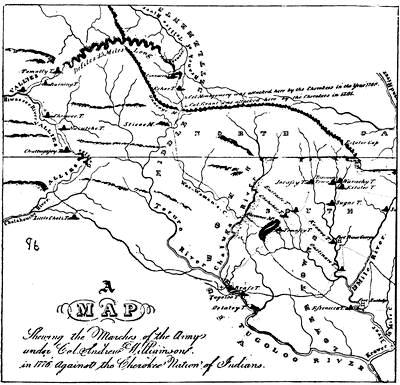
Note.—Portion of the map in Drayton's Mem. of the Amer. Rev., ii. 343. Key: Double dotted line shows the march of the army; the single dotted line shows the march of detachments; the + indicates battlegrounds.
There is among the Rochambeau maps (no. 36) a small but good plan (5 × 4 inches), called An accurate map of North and South Carolina, with their Indian frontier, showing in a distinct manner all the mountains, rivers, swamps, marshes, bays, creeks, harbors, sandbanks, coasts, and soundings, with roads and Indian paths, as well as the boundary of provincial lines, the several townships and other divisions of the land in both the provinces,—from actual surveys by Henry Mouzon. It is the same map given in Jefferys' American Atlas (1776, no. 23), and was republished in Paris in 1777 by Le Rouge, and is included in the Atlas Amériquain. The middle, upper, and over-hill towns are given on one of the sections of Arrowsmith's map (1795-1802), and also upon the Carte des Etats-Unis de l'Amérique Septentrionale.—Copiée et Gravée sur celle d'Arrowsmith, etc., etc. Par P. F. Tardieu, à Paris, 1808.
Faden issued in 1780 a map of the northern frontiers of Georgia, by Archibald Campbell.—Ed.
This powder was seized by the royalists, but as an offset the annual presents of Stuart were seized at Tybee by the "Liberty People." It was stated that the best friends of Great Britain lived in the back parts of Carolina and Georgia. If the Indians were put in motion, they, and not the rebels, would suffer. Nevertheless, the first blow from the Indians came from that quarter. Early in July, 1776, news was received at Savannah, at Charleston, and at Fincastle, Va., that the Indians were at work upon the border, carrying destruction wherever they went. On the 7th of July, General Lee wrote to the president of the Virginia Convention that an opportunity offered for a coöperative movement. The Continental Congress, having received a report of the circumstances from the president of South Carolina, recommended, on the 30th of July (1776), the States of Virginia, North Carolina, and Georgia to afford all necessary assistance. As soon as the first intelligence of the outbreak in South Carolina reached Col. Andrew Williamson, who at the beginning of this campaign apparently ranked as major, he promptly rallied the inhabitants of the frontier of that State. By the middle of July he had collected a body of 1,150 volunteers. With this force he invaded the Indian territory, and during the remainder of the month of July and the first half of August he was occupied in destroying the Cherokee lower towns. On his return to his main camp from a raid with a detachment, about the middle of August, he found that a number of his men had gone home, and that many of those who remained were suffering for clothes and other necessaries. He erected a fort at Essenecca, which he named after President Rutledge, and furloughed a part of his force until August 28th.
At the same time that the depredations were committed which caused Col. Williamson to invade the Indian country, the settlements in Virginia and North Carolina, on the border of what we now know as Tennessee, were threatened by the Indians. The inhabitants along the border at once "forted" themselves. A small force collected at Eaton's station met a party of Indians on the 20th of July, and repulsed them, with a loss of thirteen of their warriors. Watauga, where 150 persons, of whom 40 were men, had assembled in the fort, was besieged by another band. The Indians hung about the fort for six days, and skulked in the woods for a fortnight longer, but left on the approach of a relief column. Other Indians went up the Holston to Carter's Valley, but accomplished nothing in that immediate vicinity.[1416] The settlements in Virginia, in the Clinch Valley and for a long distance from this point, were, however, raided, and the surrounding country devastated.
Georgia performed her share of the season's work simultaneously with Colonel Williamson's first raid. An independent command, led by Major Jack,[1417] operated against the lower towns beyond the Tugaloo, during the latter part of July.
The work performed by South Carolina and Georgia during the months of July and August was not considered complete. It was determined to inflict a blow which would be remembered. About the first of September Colonel Williamson again marched into the Indian country, this time at the head of about two thousand men. It was intended that on an appointed day in September he should effect a junction with General Rutherford of North Carolina, who at the head of twenty-four hundred men simultaneously marched from that State. Although the two columns met in Indian territory, the junction was not effected at the appointed date, and the work of destroying the middle towns and valley settlements was independently performed. Virginia sent out an expedition at the same time against the upper or over-hill towns. This force, after it was joined by some companies from the northwestern portion of North Carolina, numbered eighteen hundred men, and was commanded by Colonel William Christian. The purposes of this expedition were successfully accomplished.
The South Carolina troops had the misfortune to encounter nearly all the resistance that was offered by the Indians, and the two expeditions lost 22 men killed, with 11 men mortally wounded, and 63 men otherwise wounded. They had the satisfaction, however, of knowing that the joint expedition had thoroughly performed its work. The Cherokee towns were burned, and the crops of the Indians were destroyed. The attack by the Indians consolidated the colonists and aroused their indignation. The Council of South Carolina asserted that they were now convinced of what they had before but little reason to doubt, "the indiscriminate atrocity and unrelenting tyranny of the hand that directs the British war against us." The Assembly spoke of it as a "barbarous and ungrateful attempt of the Cherokee Indians, instigated by our British enemies." The Cherokees accepted such terms of peace as their conquerors allowed. Next year separate treaties were made between representatives of the tribes and Virginia and North Carolina, and between other representatives and South Carolina and Georgia. In the treaty in which South Carolina participated, a portion of the Indian territory was ceded to that State on the ground of conquest. For several years thereafter the Indians kept so quiet that but little was heard from them in that portion of the country. As a sequel to the campaign it may be noted that, on the 25th of September, President Rutledge informed the Assembly of South Carolina that Colonel Williamson desired instructions as to whether the Indians taken prisoners should become slaves. Such an impression prevailed in camp, and one prisoner had already been sold as a slave.[1418]
McCall, in his History of Georgia, is authority for the statement that General Rutherford was accompanied on his march by a small band of Catawba Indians. In Virginia the matter of enlisting Indians was considered in the Convention, and on the 21st of May, 1776, a resolution was passed to engage a number of warriors, not to exceed two hundred. A few days afterward, however, the execution of this resolution was postponed in such a way as to make it ineffective.
In January, 1777, Col. Nathaniel Gist was authorized by Congress to raise four companies of rangers, and was instructed to proceed to the Cherokee or any other nation of Indians, and to attempt to procure a number of warriors not exceeding five hundred, who were to be equipped by Congress and receive soldiers' pay.[1419]
We have seen that in 1777 treaties were made with the Cherokees. The Indians at the Chickamauga settlements, which were clustered along the Tennessee, below the site of Chattanooga, and near where the river crosses the state line, had not participated in the treaties. In the interval between the joint campaign in the fall of 1776 and the spring of 1779 outrages had been committed by these Indians, and it was determined to punish them. A thousand volunteers from the back settlements of North Carolina and Virginia assembled on the banks of the Holston, in the northeastern part of Tennessee, a few miles above where Rogersville stands. Of these Col. Evan Shelby had command. They were joined by a regiment of twelve-months men which belonged to Colonel Clarke's Illinois expedition. On the 10th of April, 1779, this force embarked in dug-outs and canoes, descended the rapid running stream, surprised the Indians, killed a number of them, burned eleven of their towns, destroyed their provisions, and drove off or killed their cattle. All this having been accomplished without a battle, the troops returned.
In 1780 the contribution of men by the border settlements of North Carolina to the force which fought the battle of King's Mountain left those settlements exposed to Indian raids. As soon after the battle as possible some of the men were sent to Watauga. They learned upon arrival that news had been received of an Indian advance. Col. John Sevier organized an expedition against the Indians, and marched to meet them. The number of volunteers thus hastily gathered together reached about one hundred and seventy. At the end of the second day's march the Indians were discovered. They retreated, and the next day Sevier followed them. The customary ambuscade was prepared by the Indians, but the American leader was too wary to be deceived. On the contrary, he adopted their own tactics, and defeated them in a brief engagement at Boyd's Creek, in which twenty-eight Indians were killed. A few days after this Colonel Sevier was joined by Col. Arthur Campbell, with troops from Virginia. The united forces amounted to seven hundred men. They penetrated the country to the southward, burning a number of Indian towns, and held a council with a large body of Cherokees. After completing the expedition, a message was sent, on January 4, 1781, to the chiefs and warriors of the Indians. It was signed by Col. Arthur Campbell, Lieut.-Col. John Sevier, and Joseph Martin, agent and major of militia, and consisted of a summons to the Indians to send deputies to negotiate a treaty of peace at the Great Island within two moons.[1420]
Towards the end of August, 1780, Colonel Williamson and Colonel Pickens, of South Carolina, raided the Indian territory and destroyed a large amount of stores. To prevent further depredations, the Indians were compelled to remove their habitations to the settled towns of the Creeks.
During the summer of 1781 the Cherokees invaded the settlements on Indian Creek. Colonel Sevier called for volunteers, and attacked them. He killed seventeen Indians and put the rest to flight.
Early in 1781 General Greene made a treaty with the Cherokees, by which they engaged to observe neutrality. This treaty having been violated by the Indians during the summer, Gen. Andrew Pickens, at the head of a mounted force of three hundred and ninety-four men, penetrated to the Cherokee country, burned thirteen towns, killed upwards of forty Indians, and took a number of prisoners. McCall (Georgia, ii. 414) thus summarizes Pickens's method of campaigning: "The general's whole command could not produce a tent or any other description of camp equipage. After the small portion of bread which they could carry in their saddle-bags was exhausted, they lived upon parched corn, potatoes, peas, and beef without salt, which they collected in the Indian towns." Soon after this expedition some of the Creeks and Cherokees again invaded Georgia. They were met beyond Oconee River by Colonel Clarke and by Col. Robert Anderson, of Pickens's brigade, and were driven back. Major John Habersham was sent out by Wayne on an expedition, and his report, Feb. 8, 1782, is in Hist. Mag., iv. 129. In February, 1782, Governor Martin addressed a letter to Colonel Martin and Colonel Sevier, instructing them to drive intruders off the Cherokee lands.
During the summer of 1782 a body of Indians crossed the State of Georgia without being discovered, and on the morning of the 24th of June surprised General Wayne's command. After the first flush of success attendant upon the surprise had been overcome by the Americans, they repulsed the Indians, with the loss of fourteen killed, among whom was one of their chiefs. The kind treatment of some prisoners who were taken aided in detaching the Indians from the British side.
In September, 1782, the upper-town Cherokees, in a talk, complained piteously of the intruders upon their lands, and said they had done nothing to break the last treaty. At the same time, other Indians of the same tribes began depredations. Colonel Sevier, with one hundred volunteers, marched into the Indian country, held a conference with the friendly Indians, and punished those who were hostile by burning their villages.
The Southern campaigns against the Indians have not been treated as fully in local and general histories as those against the Northern tribes. The policy of the several leaders in these campaigns was not entitled, perhaps, to the same recognition as has been awarded to that which governed the Sullivan campaign. The several columns from Virginia, North Carolina, South Carolina, and Georgia each burned Indian towns and devastated Indian crops, but the plan was not directed by the general in command of the national armies. There have been but few local historians in the South who have searched for diaries, journals, and letters containing details of such affairs. At the time when the centennial anniversaries of these events might fitly have been celebrated by the publication of such original material as could be found, there was not the same disposition in the South to be grateful for the results of the Revolutionary War as then prevailed in the North. Further than that, the materials from which such contributions to history are generally made had been scattered and destroyed during the civil war. For these reasons, the number of books which treat of the border wars in the South is small.
The most complete accounts of the attacks upon the Cherokee settlements which have been published are to be found in the histories of Tennessee. John Haywood's Civil and Political History of the State of Tennessee from its earliest Settlement up to the year 1796, etc. (Knoxville, 1823), is an extensive collection of facts concerning the various raids of the Indians and the counter attacks upon their scattered settlements, which has been freely used by subsequent writers. J. G. M. Ramsey, in his Annals of Tennessee to the end of the eighteenth Century: Comprising its settlement as the Watauga Association from 1769 to 1777; A part of North Carolina from 1777 to 1784 (Charlestown, 1853), relies to a great extent upon Haywood, and acknowledges his obligation by frequent references in his footnotes. In the preparation of this work, Mr. Ramsey says that he had access to the journals and papers of his father, a pioneer of the country, and also to the papers of Sevier, of Shelby, the Blounts, and other public men. He examined the papers of all the old Franklin Counties and the public archives at Milledgeville, Raleigh, Richmond, and Nashville.
Haywood says the Georgia expedition was commanded by Col. Leonard McBury. Ramsey follows Haywood in this regard. All the other accounts say that Major or Colonel Jack was in command.
The campaign of the Virginia column is briefly described in Girardin's continuation of Berk's History of Virginia.[1421] Brief allusions to this campaign are made in Wheeler's Historical Sketches of North Carolina, and in Martin's History of North Carolina. The story is more fully told in an Historical Sketch of the Indian War of 1776, by D. L. Swain, which is reprinted from the North Carolina University Magazine (May, 1852) in the Historical Magazine (Nov., 1867, p. 273). This account states that there were "three armies simultaneously fitted out by Virginia, North Carolina, and South Carolina", but makes no mention of the work which the Georgia contingent had already performed.
A journal kept during the Williamson expeditions was published in the Historical Magazine, vol. xii. (Oct., 1867, p. 212), by Professor E. F. Rockwell, of North Carolina, as "Parallel and combined expedition against the Cherokee Indians in South and North Carolina in 1776." The writer describes the houses in the Cherokee towns as follows: "Their dwelling-houses is made some one way and some another. Some is made with saplings stuck in the ground upright; then laths tide on these with splits of cane or such like; So with daubing outside and in with mud merely, they finish a close warm building. They have no chimnies, and their fires are all in the middle of the houses."
C. L. Hunter, in Sketches of Western North Carolina, Historical and Biographical, illustrating principally the Revolutionary period, etc. (Raleigh, 1877), under "General Griffith Rutherford" gives a brief account of the march against the middle towns, and under "Colonel Isaac Shelby" he gives a paragraph to the expedition against the Chickamaugas in 1779.
It has been stated that the Cherokee outbreak in the South was the first aggressive movement made by the Indians during the Revolutionary War, and that this fact has caused the joint attack of the colonies to be noticed in the general histories of the times. It naturally finds a place in Moultrie's Memoirs and in Ramsay's South Carolina, but without detail. If we turn to Drayton's Memoirs we shall find an extended account of the expeditions of Colonel Williamson, who commanded the South Carolina troops, in the summer of 1776, when they ravaged the Cherokee settlements,—the campaigns being illustrated by a map of which a fac-simile is given herewith. Several letters are published in the Appendix as authorities. The movements of Major Jack in Georgia are given (Ibid. p. 313), and some account of the march of General Rutherford's army from North Carolina and of the attempts at coöperation. It is stated (Ibid. p. 353) that Virginia also raised an army, but no account of the movement of the troops is given.
The American Archives contain reprints of letters from several points in the South, which enable us to trace the history of most of these movements. We have rumors of the outbreak from various places scattered from Georgia to Virginia; stories of the siege of Watauga and of the gathering of the Indians in Carter's Valley; accounts of the desolation along the frontier; of the marches of Rutherford and of Williamson; of the speech of Rutledge, and of the replies of the Council and of the Assembly of South Carolina.
The Remembrancer also reprints some of these letters. Drayton, in his Memoirs (ii. p. 212), says that Col. Bull, in March, 1776, marched to Savannah with four hundred Carolina troops, "to awe the disaffected, to support the Continental regulations, and in particular to prevent the merchant ships from going to sea." These troops were accompanied by some Georgia militia and by "about seventy men of the Creek and Euchee Indians." In corroboration of this statement Drayton cites the Remembrancer (1776, Part ii. pp. 333, 334), where is a letter from Charleston, which opens, "By a remarkable Providence, the Creek Indians have engaged in our favour." It then goes on to describe how they became enraged with the Tories because they destroyed the house of a white man with whom the Indians were friendly, and adds that "they have brought down 500, who have killed several men of the fleet."
Another reference to the use of Indians by the Americans will be found in McCall's Georgia (ii. p. 82), where he says that General Rutherford was "joined by the Catawba Indians."
Various accounts of events connected with these campaigns will be found in the Remembrancer (Part ii., 1776, pp. 286, 319-334; and Part iii., 1776, pp. 50, 252-274, and 275), including a letter, Sept. 4th, which says: "The colonel's (Williamson's) next object will be the middle towns, where he expects to be joined by General Rutherford with 200 [2,000?] North Carolinians. Colonel Lewis, of Virginia, will go against the upper or over hill settlements, so that we have no doubt the savages will be effectually chastised."
The treaty at De Witt's Corner, May 20, 1777, between South Carolina, Georgia, and the Cherokees was printed in the Boston Gazette and Country Journal, Aug. 18, 1777.
A description of the Cherokee lower towns and of the siege of Watauga is given by Edmund Kirke (James R. Gilmore) in Lippincott's Magazine (July and August, 1855), in a paper on "The Pioneers of the South West." Bare mention is made of the fact that Georgia participated in the campaign of 1776, by Stevens in his Georgia, who follows Moultrie in assigning the command of the Georgia troops to Colonel Jack.
McCall, in his History of Georgia, gives a curious account of an attempt by a party of Americans to penetrate the Indian country and seize Cameron. Their leader, Capt. James McCall, had with him two officers, twenty-two Carolinians, and eleven Georgians. They were suspected by the Indians of treachery, and were themselves attacked. Their leader was captured and several of the men were killed, but the greater number escaped, and after severe sufferings reached the settlements. Drayton (Memoirs, ii. 338) states that this expedition of McCall's was forwarded in consequence of an agreement on the part of the Cherokees in June to permit the arrest of refugees in their towns. The attack was therefore a piece of treachery on the part of the Indians. McCall himself escaped shortly afterward, and joined the Virginia column of invasion. He again made an attempt to seize Cameron. This time he reached the Indian town where Cameron had his headquarters, but the latter had left for Mobile the morning that Captain McCall arrived at the town. McCall gives an account of a raid by General Pickens in the fall of 1782. This apparently is the same as the one described in 1781.
C. C. Jones's Georgia deals with the border wars to about the same extent as McCall. The precise time of Jack's raid is not given, but Jones has followed those who have spoken of it as simultaneous with the joint movement in Virginia and North and South Carolina, among whom we find Ramsay in his History of the Revolution of South Carolina. A letter to Gov. Bullock, from B. Rea, July 3, 1776 (Remembrancer, Part iii., 1776, p. 50), says: "I shall order the draft that has been made of this regiment to Broad River and Ogeechee as soon as possible, but not to go over the line till I receive your excellency's orders, which I shall wait for with impatience. I shall likewise be glad to know how far we are to act in concert with the Carolinians, or if we are only to guard our own frontiers." This shows that troops were put in the field by Georgia before the question of coöperation was raised, but that it immediately suggested itself as a possibility.
It will be inferred from what has been said that confusion of dates as to the movement of the troops exists. McCall tells the story as if Jack's march in the middle of July were part of a preconcerted plan, in which South Carolina, North Carolina, and Virginia participated. Jones, as has been seen, follows him in this respect. Ramsey, in his Annals of Tennessee, says Christian went into the field on the 1st of August. Williamson, on his second raid, and Rutherford started out about the 1st of September. Christian's march was evidently in coöperation with them, and doubtless at the same time, although in Foote's Sketches of Virginia it is said (pp. 118, 119) that Col. William Christian's campaign against the Cherokees was in October. It is probable that he did not return to the settlements until that month.
It is evident that the attack upon the lower towns of the Cherokees by the Georgia militia was not regarded at the time as a part of the joint concerted movement. On the 5th of August President Rutledge issued a proclamation requiring the Legislative Council and General Assembly to meet at Charleston on the 17th of September, at which time his excellency congratulated them on the success of the troops under Colonel Williamson, and added, "It has pleased God to grant very signal success to their operations; and I hope by his blessings on our arms, and those of North Carolina and Virginia, from whom I have promises of aid, an end may soon be put to this war." In the replies of the Council and of the Assembly recognition is made of the coöperative movements of the North Carolina and Virginia forces. No reference is made in any of these proceedings to the Georgia contingent.
The Boston Gazette and Country Journal, Sept. 16, 1776, contains an account of the outbreak in North Carolina, which says: "The ruined settlers had collected themselves together at different places and forted themselves: 400 and upwards at Major Shelby's, about the same number at Captain Campbell's, and a considerable number at Amos Eaton's." It then describes the relief of Watauga by Colonel Russell with three hundred men. The acts of these men and the first raid of Williamson were the spontaneous movements of the frontier inhabitants. The participation of Georgia was inspired from headquarters at Augusta, with intelligent comprehension of the value of coöperation. The campaigns of the month of September were concerted.
The raid of Gen. Andrew Pickens is described in Ramsay's South Carolina and in Henry Lee's Memoirs, the account in the latter being copied in Cecil B. Hartley's Heroes and Patriots of the South (Philad., 1860). The raid of Col. Arthur Campbell is described in Girardin's continuation of Burk's Virginia (iv. p. 472). Campbell's report, in the Calendar of the State Papers of Virginia (i. p. 434), says that he destroyed upwards of one thousand houses, and not less than fifty thousand bushels of corn and a large quantity of other provisions.
D. CONNECTICUT SETTLERS IN PENNSYLVANIA.
In 1768, the Proprietaries of Pennsylvania secured an Indian deed for the territory already claimed by the Susquehanna Company of Connecticut, and a lease was executed, which vested in certain enterprising individuals the rights of the Proprietaries to this region, whether gained by royal grant or by purchase. This was followed by simultaneous preparation on the part of the Pennsylvanian lessees and of the Connecticut Company for the occupation by settlers, who were expected to defend their rights against other claimants. The Pennsylvanians were first on the ground, and in January, 1769, built a block-house on the land which had been improved by former Connecticut settlers. Early in February the first detachment of colonists from Connecticut arrived, and then began the contest for possession, which was waged, with success alternating on either side, until the fall of 1771. Houses were burned, crops were laid waste, cattle were driven off and killed, and there was some bloodshed during the progress of these hostilities. Proclamations were put forth by the governor of Pennsylvania, and warrants were issued by the courts of that province for the arrest of the Connecticut leaders for the crime of arson. The several military expeditions of the Pennsylvanians were generally accompanied by a sheriff, whose mission was supposed to be to execute the laws. The citizens of that province do not appear to have been in sympathy with the lessees of the Proprietaries. If they had been, it would have been easy to have crushed the Connecticut colony. This settlement was not at the outset recognized as a part of Connecticut. Permission had been given the company to apply to his majesty for a separate charter. The expectation that an independent government might perhaps be formed, and the opposition to the movement already expressed at London, explain the supineness of the mother colony. The Susquehanna settlement depended for its life upon the efforts of the company. Five townships were laid out, and liberal offers of shares in the lands were made to the first settlers in each of them. Three more townships were subsequently settled on the same plan. These inducements had attracted settlers in such numbers that the Pennsylvanian lessees could not dispossess them. In the autumn of 1771 the Pennsylvanians withdrew, leaving the Connecticut colonists, for the time, in undisturbed possession. Some correspondence followed between the authorities of the colonies, in which the government of Pennsylvania sought to ascertain how far the colony of Connecticut backed up the emigrants; and the governor of that colony in reply denied having authorized any hostile demonstration, but carefully avoided saying anything which could be interpreted as a relinquishment on the part of the colony of its rights under the charter to the land. During the next two years the settlement, although looked upon by Pennsylvania as an invasion and not as yet acknowledged by Connecticut, increased in numbers and prospered. Meetings of the Proprietors were occasionally held, at which the affairs of the towns were adjusted in a general way, authority being delegated to a committee of settlers to act in the intervals between the meetings. In June, 1773, the company adopted at Hartford a form of government for the settlers, stating in the preamble that "we have as yet no established civil authority residing among us in the settlement." In October the Connecticut Assembly resolved that the colony would "make their claim to these lands, and in a legal manner support the same." Commissioners were appointed, and fruitless negotiations were opened with Pennsylvania. In January, 1774, the territory of Susquehanna Company was incorporated into the town of Westmoreland, and became temporarily a part of the county of Litchfield, Connecticut. Almost simultaneously, proclamations were issued by the governors of the two colonies, each prohibiting settlements on the disputed territory except under authority of the colony which he represented. Meantime the settlements in the valley increased. In September, 1775, about eighty settlers, who had just arrived on the west branch of the Susquehanna, were attacked by the Pennsylvania militia. One man was killed; several were wounded; and the men of the Connecticut party were taken prisoners to Sunbury. Upon receipt of this news the Continental Congress, in November, passed resolutions urging the two colonies to take steps to avoid open hostilities. This was, however, of no effect. Boats from Wyoming, loaded with the property of settlers, were seized and confiscated at Fort Augusta. During the fall, extensive preparations were made by the Pennsylvanians for an invasion of Wyoming, under authority from Governor Penn, for the purpose of enforcing the laws of Pennsylvania. In December, Congress expressed the opinion that all appearance of force ought to stop until the dispute could be decided by law; but at the time that the resolution expressing this opinion was under consideration, an army of Pennsylvanians, accompanied by a sheriff, was already invading the valley. The Connecticut people, having been forewarned, successfully resisted this military posse. Several lives were lost in this attempt of the Pennsylvanians to dispossess the colonists. With this failure the attempts of Pennsylvania to expel the Connecticut settlers by force ended. The Revolutionary War was now in progress. Connecticut needed her able-bodied men. She now forbade further settlement on the disputed territory unless licensed by her Assembly.
The Trumbull MSS. in possession of the Mass. Hist. Soc. contain copies of the papers connected with the discussion of the title of the colony to its settlement in the Susquehanna Valley. There is probably no single collection of papers so rich in this direction.
E. JOURNALS AND DIARIES OF THE SULLIVAN EXPEDITION.
A list of the journals of Sullivan's expedition was prepared by the writer of this chapter for publication in the Mass. Hist. Soc. Proc., Oct., 1886, and this list in an extended and revised form was to be appended here; but the repetition is rendered unnecessary by the publication of an elaborate volume by the State of New York, Journals of the military expedition of Major-General John Sullivan against the Six Nations of Indians in 1779, with records of Centennial Celebrations,—compiled by George S. Conover, under the direction of Frederick Cook, Secretary of State. It reprints, and in some cases gives for the first time in type, the journals of twenty-six participants, pertaining either to the main expedition or to that against the Onondagas. An enumeration is also given of the journals known to have existed, but no longer to be found.
Appended to the journals are the reports of Sullivan, Brodhead, and a roster of the expeditionary army. The main historical narrative is an elaborate account, compacted from four centennial addresses, given by the Rev. David Craft in 1879, and revised from the original publication in the Centennial Proceedings of the Waterloo (N. Y.) Library and Historical Society. In a note it is shown that a collation of all the journals supports Sullivan's statements in his official report, making his total loss in the campaign 41 men, while 41 Indian settlements or towns were destroyed.
The portraits of the book are those of Sullivan (with the spear), General Clinton (profile), Gansevoort (by Stuart), and Philip Van Cortlandt. The rest of the volume describes the various centennial celebrations in 1879, at Elmira, Waterloo, Geneseo, and Aurora, with the addresses, principal among which is one by Erastus Brooks on "Indian History and Wars", and another by Major Douglass Campbell on "The Iroquois and New York's Indian policy."
The maps include one by Gen. John S. Clark of the battlefield of Newtown (not far from Elmira) and the Chemung Ambuscade; another, by the same, of the Groveland Ambuscade, near Conesus Lake, and the route thence to the Genessee; five maps of as many sections of Sullivan's route, surveyed by Lieutenant Benjamin Lodge, the originals of which make a part of the collection of maps made by Robert Erskine, the topographical engineer of the Continental army, and by his successor, Simeon De Witt, and now in the cabinet of the N. Y. Hist. Society. Gen. J. S. Clark, in describing these maps, says that the route of Dearborn on the west side of Cayuga Lake, and General Clinton's descent of the N. E. branch of the Susquehanna, do not appear to have been surveyed, but that Clinton's route is well illustrated in a sketch of Col. William Butler's march (Oct.-Nov., 1778) made by Capt. William Gray, which is also included in the volume. The five maps above referred to are reproductions from the originals, with some names added from the rough preliminary sketches, also preserved in the same collection. A rough plan of Tioga, in fac-simile of a drawing in the journal of Capt. Charles Nukerck, is also given.—Ed.
F. BOUNTIES FOR SCALPS.
It has been stated in the narrative that the colonies themselves were partially responsible for the low estimate in which Indians were held by the inhabitants of the frontiers. Bounties had been so frequently offered for the destruction of wild animals and of Indians that the border settlers might well infer that the law drew no distinction between the savage and the brute. Mrs. Jackson, in her Century of Dishonor (App. p. 406), quotes from Gale's Upper Mississippi (p. 112) a vigorous denunciation of the acts of the governments in granting bounties for scalps: "In the history of the Indian tribes in the Northwest, the reader will at once perceive that there was a constant rivalry between the governments of Great Britain, France, and the United States as to which of them should secure the services of the barbarians to scalp their white enemies, while each in turn was the loudest to denounce the shocking barbarities of such tribes as they failed to secure in their own service. And the civilized world, aghast at these horrid recitals, ignores the fact that nearly every important massacre in the history of North America was organized and directed by agents of some one of these governments." One or two instances, taken from the records by way of illustration, will suffice to show how the settlers along the frontier and legislators reciprocally viewed this subject. In November, 1724, John Lovewell, Josiah Farwell, and Jonathan Robbins, presented a "Humble Memorial" to the General Court of Massachusetts Bay, in which they set forth that they, with forty or fifty others, were "inclinable to range and keep out in the woods for several months together, in order to kill and destroy their Indian enemy, provided they could meet with incouragement suitable." For five shillings a day, and such other reward as the government should see cause to give them, they would "employ themselves in Indian hunting one whole year." On the 17th of November, the General Court by vote authorized the formation of the company, the men to receive "two shillings and sixpence per diem, the sum of one hundred pounds for each male scalp, and the other premiums established by law to volunteers without pay or subsistence" (Kidder's Captain John Lovewell, pp. 11, 12). Col. Johnson, in 1747, was "quite pestered every day with parties returning with prisoners and scalps, and without a penny to pay them with" (Stone's Sir William Johnson, i. 255, 342). For the outlay made in this behalf Col. Johnson was ultimately reimbursed by the province of New York. In the memorial or representation of their case, submitted by the rioters who murdered the Conestega Indians to the authorities at Philadelphia, it is written: "Sixthly. In the late Indian war, this Province, with others of his Majesty's colonies, gave rewards for Indian scalps, to encourage the seeking them in their own country, as the most likely means of destroying or reducing them to reason; but no such encouragement has been given in this war, which has damped the spirits of many brave men, who are willing to venture their lives in parties against the enemy. We therefore pray that public rewards may be proposed for Indian scalps, which may be adequate to the dangers attending enterprises of this nature." On the 12th of June, 1764, the authorities of Pennsylvania offered bounties for scalps, presumably in response to this petition (Penna. Col. Rec., ix. 141, 189).