Chapter VIII
Reading edition
THE INDIANS AND THE BORDER WARFARE OF THE REVOLUTION.
BY ANDREW McFARLAND DAVIS,
American Antiquarian Society.
THE peace which followed the quelling of the Pontiac war gave opportunities for settlements to be pushed westward. The population on the border, rendered lawless by environment, was not likely to observe treaties. Fear of the Indians was more potent to restrain these restless men than dread of punishment by colonial authorities. Conflicts of colonial jurisdiction and disputed land claims added to the chronic confusion of the situation.
It needed all the tact and discretion of which that remarkable man, Sir William Johnson, was master to prevent outbreaks, and the danger was not over until the boundaries were adjusted with the Six Nations and other Indians, at Fort Stanwix, in 1768. There was far more cause for complaint against the English on the part of the tribes whom Sir William was able to control than on the part of the Senecas, who, in September, 1763, had surprised and scalped a working party with their guard. Encroachment upon their lands had also irritated the Mohawks, who particularly resented an attempt of a Connecticut company to colonize the valley of the Susquehanna. Early in the spring of 1763, the Connecticut company sought to secure Sir William's influence with the Indians in quieting the company's title, which was based upon the Connecticut charter and upon alleged Indian deeds. The company failed in this, as well as in an attempt to negotiate with the confederacy. The Indians, instead of granting a deed, sent to Connecticut a delegation of Mohawks, accompanied by Guy Johnson, to represent to the governor of that colony the peril with which further attempts at colonization would be attended.[1260] These efforts arrested the movements of the company, and for the time immigration was checked. They were not early enough, however, to prevent one of those horrible attacks which stand out in our memories as types of Indian warfare and which in the minds of many readers obscure all other conceptions of Indian character. A number of families had already settled in this region, under the auspices of the Connecticut company, and had built themselves homes near the present site of Wilkesbarré. On October 15, 1763, they were suddenly attacked by Indians, and one woman and nine men were killed and scalped. The rest of the inhabitants fled to the mountains, and such as did not perish worked their way through the wilderness to the nearest settlements. Their villages were destroyed, their cattle killed, and their crops laid waste. Avenging expeditions were promptly organized in Pennsylvania. One marched to the Delaware town at Wyoming, but found it deserted. Another laid waste the Delaware and Munsee towns on the west branch of the Susquehanna.
The Moravian Indians at Wyoming, who had taken no part in the massacre of the Connecticut settlers, removed for safety to Gnadenhütten, whence they were taken to Philadelphia for greater security. At Paxton, Pennsylvania, the inhabitants assembled secretly, and attacked a settlement of the harmless Conestogoes. The cause for this wicked slaughter has never been clearly explained,[1261] but the subsequent memorials of the rioters seem to indicate that it was part of a general plan to exterminate the Indians. Whatever the motive, popular approval was strong enough to shield the perpetrators of such shameless deeds.[1262] The entire band of the Conestogoes was exterminated,[1263] and their town was destroyed. The first attack was made on them on the night of the 14th of December, when this band of murderers surrounding the town, killed all who happened to be there. Those Indians who were absent took refuge in Lancaster, where they were lodged in a public building, spoken of by some as the workhouse, by some as the jail. On the 27th, their enemies followed them to this refuge, and in cold blood slaughtered them all, men, women, and children, indiscriminately.
The Moravian Indians, who had taken refuge at Philadelphia, were next threatened by the rioters, who marched towards that place with the avowed intention of killing them also. The provincial authorities appealed to General Gage for help, but before his reply reached them they sought to throw the Indians upon New York for protection. It happened that a company of regulars was about to march from Philadelphia for New York, and under their escort the Indians were dispatched, with intention to place them under charge of Sir William Johnson. The New York authorities refused, however, to permit the Indians to enter that province. Meantime General Gage placed troops at the disposal of Governor Penn. The Indians were conducted back to Philadelphia, and orders were given to repel by force any attack. The rioters again approached Philadelphia, but were dissuaded from attack, and Pennsylvania was spared the shame of further atrocities by the "Paxton Boys."
After this excitement was over the labors of Sir William Johnson to prevent renewed conflict were still constant. He complained, in his correspondence,[1264] of murders, robberies, and encroachments on the rights and possessions of the natives. The frontier inhabitants, according to him, thought themselves at liberty to make settlements where they pleased. He lost heart, while on the other hand the settlers openly bade defiance to authority. In 1766 he wrote: "Murders are now daily committed on the frontiers, and I fear that an Indian war is inevitable." In January, 1767, he announced that Colonel Cresap, of Maryland, himself held a treaty some time during the last year with several warriors of the Six Nations, who passed that way, and who were persuaded to grant to him a considerable tract of land down the Ohio toward Green-Brier. With prophetic instinct, Sir William added: "If this be true, it will be productive of dangerous consequences." A large part of Johnson's time was spent in protecting the Indians from such fraudulent conveyances of their land as were made through transfers where there was but a shadow of title, through forgeries, and through deeds executed without proper formalities, under circumstances which would prevent recognition of the transaction by the tribes. Many deeds, which upon the face seemed properly executed, were secured from the signers when they were so completely intoxicated that they were ignorant what they were doing. Others conveyed by metes and bounds an extent of territory far exceeding the intention of the grantors. No transfer of land made by a band of warriors, on the war-path or on a hunting expedition, would have been recognized by the confederacy. Sir William himself said: "A sachem of each tribe is a necessary party to a fair conveyance, and such sachem affixes the mark of the tribe thereto, as a public seal of a corporation." The title to the land was supposed to be in all. Even the women had a voice in transfers by bargain and sale.[1265] It was one of the principal occupations of Sir William Johnson's life to adjust difficulties arising out of transfers, such as the one to Cresap, of which he had heard, and in which he saw the seeds of future trouble, if it should prove to be true. In his review of the trade and affairs of the Indians in the northern district of America, he recapitulates the wrongs of the Indian.[1266]
Life in the midst of such impending dangers bred contempt for authority, even on the part of men who were well disposed. The strong arm of the government was but feebly felt in the distant bottoms in the western parts of Pennsylvania, Maryland, and Virginia, which settlers were beginning to appropriate to their own use. The inhabitants of the frontiers were a law unto themselves, and sometimes unto the authorities. Men who diligently read their Bibles and pondered over the teachings of the gospels could tear scalps from the heads of Indians. The government was powerless to protect the frontiers except through the agency of volunteers, and they in turn were able at any moment seriously to complicate the situation. In the organization of companies of rangers the weakness of the government was exposed, and through them the independence of the settlers was developed. Such companies frequently adopted Indian costumes, painted their faces, and manœuvred by Indian tactics. The habits of the Indian more than the civilization they had left, influenced their modes of life. They attacked for revenge, and were barbarous because the savages were. In the case of the Indians such methods in warfare came by inheritance. They were modified somewhat by the spirit of the missionaries, and however cruel they may have been, they were at any rate absolutely free from assaults on woman's chastity. In the case of the settlers, the promptings of civilization were disregarded, and it would seem as if the system of bounties for scalps had taught them to regard the Indian as on the level of a brute. Nevertheless, the rule had exceptions; and it would not be just to paint all the settlers along the borders in these repulsive colors, or to believe that there was a universal desire for the extermination of the Indians.
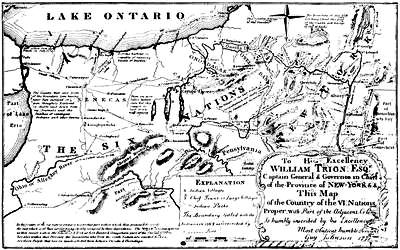
Note.—This map was found in MS. among a collection of maps and charts which were presented to the New York State library by Obadiah Rich, of London. It had been sent to Lord Hillsborough in 1771, accompanying a memorial concerning the Iroquois, prepared by the Rev. Charles Inglis, of Trinity Church, New York city, who had endeavored to christianize them. This paper was subsequently recovered from the descendants of Dr. Inglis in Nova Scotia, and is printed in the Doc. Hist. N. Y. (quarto), iv. p. 661, accompanied by an engraved copy of Johnson's map, of which a reduction is given herewith. The map is also given in Pearson's Schenectady Patent, 1883, p. 433; in Hough's edition of Pouchot, ii. 148.
In N. Y. Col. Docs., viii. 136, Guy Johnson's map, showing the line fixed at Fort Stanwix, Nov., 1768, is given as copied from the original in Sir William Johnson's letter, Nov. 18, 1768, to Hillsborough, preserved in the State Paper Office. In Ibid. viii. 31, is a copy of the map annexed to the Report and Representation of the Board of Trade, March 7, 1768, showing the line of the bounds with the Indians. Cf. on this line Doc. Hist. N. Y., i. 587; N. Y. Col. Docs., viii. 110; New Jersey Archives, x. 55, 95; Mill's Bounds of Ontario, p. 21; Olden Time, i. 399; Schweinitz's Zeisberger, ch. xviii.; View of the title to Indiana (1776; see Hildeburn's Bibliog., no. 3,490). Respecting the territory of the Oneidas, see Magazine of American History, Oct., 1885, p. 387, where the accuracy of the map in Morgan's League of the Iroquois is questioned.—Ed.
This hazardous contact of Indian and border settler stretched along a doubtful line which extended from Oneida Lake to the central part of the valley of the Ohio. In 1768 the boundaries were adjusted at Fort Stanwix, between representatives of the English government, on the one part, and the Six Nations, the Delawares, the Shawanese, the Mingoes of Ohio, and other dependent tribes, on the other. A deed of the land to the east and south of a line which ran from a point just west of Fort Stanwix south to the Susquehanna, thence up the West Branch and across to Kittanning on the Alleghany, thence down that river and the Ohio to the mouth of the Tennessee, was then duly executed to the king of England. An exception from its terms was made of the land occupied by the Mohawks, whose settlements were all to the east of the agreed boundary line. The hunting-grounds comprised within the limits of the States of Kentucky and Tennessee were claimed by the Six Nations as conquered territory, and they paid no regard to the claims of the Cherokees, who had arranged a boundary with Stuart, the Indian agent, to a part at least of the same region, the northern termination of which was the mouth of the Kanawha River. It was understood by the Indians that no white man was to settle to the west of the line agreed upon.[1267]
The far-reaching influence of the Indian superintendents restrained this aboriginal population from violent outbreak from 1764 until the collision at Point Pleasant, Virginia, in 1774. This was undoubtedly precipitated by atrocities committed upon the Indians in the Ohio Valley, near Wheeling. Underlying the immediate causes for irritation during this period were reasons for complaint, revealed in the correspondence of Sir William Johnson, which would probably have led to warfare at an early date. Among these was the influx of settlers upon the hunting-grounds of the Indians, where, regardless of treaties, the land across the Ohio was parcelled out in "tomahawk improvements", as the squatter rights of the day were denominated. These proceedings attracted the attention of General Gage, and on the 8th of August, 1772, he issued a proclamation, calling attention to the fact that some persons had "undertaken to make settlements beyond the boundaries fixed by treaties made with the Indian nations", "where they lead a wandering life, without government and without laws", "causing infinite disturbance." Such persons were ordered to "quit these countries instantly and without delay, and to retire at their choice into some one of the colonies of his majesty." The peace which was negotiated by Lord Dunmore brought but little quiet to the settlers on the border. Indian raids were frequent, and the details of their horrors are sickening, but the loss of life by these raids has been greatly exaggerated. The Indians seldom ventured beyond the region which was scantily peopled. The watchfulness of the settlers, and their promptness to assemble and pursue, averted many disasters. At such a time Virginia and Pennsylvania were wrangling over the right to grant patents for land, the settlement of which had so much to do with the uneasiness of the Indians.[1268]
In New York, settlements were more compact. Rights of territory were better defined and better understood. Indian lands had been better protected there from direct invasion and from fraudulent transfer. Danger from trespass was better appreciated. The Indians themselves, being under the personal oversight of their superintendent, were better controlled. His immediate presence made him more useful in the adjustment of disputes without resort to the tomahawk. The frontier patriots of Tryon County, "unlike the rude inhabitants of most frontier settlements", are stated by a careful student of the records to have been "scrupulous in their devotion to the supremacy of the laws." The confederacy of the Six Nations, as a whole, had not participated in the events in the valley of the Ohio, but they shared with their dependants and allies in the uneasiness caused by such aggressions upon Indian territory. Some of their warriors had taken part in the Virginia war, and the "temper of the whole Indian race, with the exception of the Oneidas, was soured by these occurrences of the year 1774." The first official labors of importance which devolved upon Colonel Guy Johnson, who, after the death of Sir William Johnson in 1774, had been appointed to the office of superintendent, were to check the resentment of the Six Nations.[1269] His success in those labors showed that he had inherited, by virtue of his office, some of the respect and affection which the natives had lavished upon his predecessor.
Such was the condition of affairs when Washington took command of the army, in July, 1775, with instructions not to disband any of the forces already raised, until further directions from Congress. It is not probable that all the members of the Congress were aware of the full meaning of these instructions. There were among the men whom Washington was thus instructed not to discharge a number of Indians regularly enlisted as minute-men. Had the question of employing Indians been submitted to Congress at that time, it would probably have been answered in the negative; but it had already been settled by the Provincial Congress of Massachusetts Bay when they accepted the services of Indians.[1270]
On the first day of April, 1775, the Committee on the State of the Province reported to that congress a resolve beginning with these words: "Whereas a number of Indians, natives of the town of Stockbridge, have enlisted as minute-men." A committee was next appointed to draft a letter to the Rev. Mr. Kirkland,[1271] and to frame an address to the chief of the Mohawk tribes. The letter requests Mr. Kirkland to use his influence with the Six Nations "to join with us in the defence of our rights;" but if he could not "prevail with them to take an active part in this glorious cause", he was "at least to engage them to stand neuter." The address calls upon the Indians to "whet their hatchet, and be prepared to defend our liberties and lives."
It is evident that the Stockbridge Indians were further importuned,[1272] for on the 11th of April their chief sachem answered a communication from the President of the Provincial Congress (the contents of which can only be conjectured) by offering to visit the Six Nations and find out how they stood. "If I find that they are against you", he said, "I will try and turn their minds."... "One thing I ask of you, if you send for me to fight, that you will let me fight in my own Indian way." The Massachusetts Congress also tried to draw recruits from the Indians of Nova Scotia, and addressed them on the 15th of May, 1775,[1273] as their "friends and good brothers;" adding as an inducement for their enlistment that "the Indians at Stockbridge all join with us, and some of their men have enlisted as soldiers." Captain John Lane was sent down among these Eastern Indians to raise one company of their men, "to join with us in the war with your and our enemies." Nothing, however, resulted from this, except the arrival in June of Captain Lane with one chief and three young men, and at a later date the execution of a barren treaty.[1274] In addition to these efforts put forth by the Provincial Congress, attempts were early made in the same direction by provincial officers;[1275] and thus by general or special effort at the very beginning of the war, the Americans secured the services of such Indians as were willing to enlist, and the English followed so close in their steps as to confound, to the casual observer of their mutual criminations, the evidence of priority. The Indians engaged upon the American side produced no material influence upon military movements. Their presence in camp has been ignored by many writers. The responsibility for the intention is the same as if the effort had been successful. It must, however, be remembered that small bodies of Indians, serving with whites, were controllable and easily restrained from excesses. After the evacuation of Boston, the tide of events changed the field of war, and altered the composition of the troops. The army began to assume a national aspect. The voice of Massachusetts was no longer pre-eminent in military affairs.
The Continental Congress contained representatives of other colonies who keenly felt the dangers from the use of Indians by the enemy. The expressions of opinion in that body were, therefore, much more conservative than in the Provincial Congress of Massachusetts Bay. On the 18th of May it appears by the Journals that indubitable evidence of a design formed by the British ministry of making an invasion had been received. In June, according to the Secret Journals, Governor Carleton was making preparation to invade the colonies, and was "instigating the Indian nations to take up the hatchet against them." On the 30th the Committee on Indian Affairs was instructed "to prepare proper talks to the several tribes of Indians for engaging the continuance of their friendship to us, and neutrality in our present unhappy dispute with Great Britain." On the 1st of July there is a hint of a possible change of position shown in the passage of a resolution, "that in case any agent of the ministry shall induce any Indian tribes, or any of them, to commit actual hostilities against these colonies, or to enter into an offensive alliance with the British troops, thereupon the colonies ought to avail themselves of an alliance with such Indian nations as will enter into the same, to oppose such British troops and their allies." The statement that Carleton was instigating the Indians to "fall upon us" was repeated July 6th.[1276] On July 12th the Committee on Indian Affairs recommended that the country be divided into three Indian departments, and that commissioners be appointed, with power to "treat with the Indians in their respective departments, in the name and on behalf of the United Colonies, in order to preserve peace and friendship with the said Indians, and to prevent their taking any part in the present commotion." This recommendation was adopted. On July 13th, a formal speech was addressed to the Six Confederate Nations, urging them to keep peace. On the 17th the commissioners were recommended to employ Mr. Kirkland, in order to secure the friendship of the Indians and continue them in a state of neutrality. On July 21st a plan of confederation was submitted to Congress by Franklin, in which "a perpetual alliance, offensive and defensive", was proposed, "to be entered into as soon as may be with the Six Nations." On December 2d it was resolved that the Indians of the St. Francis, Penobscot, Stockbridge, and St. John and other tribes may be called on in case of real necessity, and that giving them presents is suitable and proper. On March 8, 1776, the growing disposition to make use of Indians found expression in a resolve "that Indians be not employed as soldiers in the armies of the United Colonies, before the tribes to which they belong shall, in a national council, held in the customary manner, have consented thereto, nor then without express approbation of Congress." On May 25th the opposition seems to have been completely overcome, when Congress resolved "that it is highly expedient to engage the Indians in the service of the United Colonies."[1277] On June 3d authority was conferred upon General Washington to employ in Canada a number of Indians, not exceeding two thousand; and on the 6th instructions were given to the standing Committee on Indian Affairs to devise ways and means for carrying into effect the resolution of the 3d. Meantime the news of the disaster at the Cedars was received, and its circumstances impelled Congress to special efforts in behalf of the colonies. On June 14th the commissioners of the Northern Department were instructed to "engage the Six Nations in our interest, on the best terms that can be procured." On the 17th, the restriction in the resolution of the 3d, which limited to Canada the use of the Indians to be raised, was removed, and the general was permitted to employ them in any place where he should judge they would be most useful. He was further authorized "to offer a reward of one hundred dollars for every commissioned officer, and thirty dollars for every private soldier of the king's troops, that they should take prisoners in the Indian country, or on the frontiers of these colonies." The days of irresolution were over. Congress was now irrevocably committed to the proposition of permitting the general commanding the armies to take what advantage he could of Indian auxiliaries, and to offer them bounties for prisoners. The next utterance of Congress on this subject is to be found in the Declaration of Independence, in which the king is arraigned because "he has endeavored to bring on the inhabitants of our frontiers the merciless Indian savages, whose known rule of warfare is an undistinguished destruction of all ages, sexes, and conditions." This was closely followed by a resolution on July 8th, authorizing Washington to call forth and engage the Indians of the St. John, Nova Scotia, and Penobscot tribes. The address to the people of Great Britain was adopted the same day. The address to the people of Ireland, in which it is asserted that "the wild and barbarous savages of the wilderness have been solicited by gifts to take up the hatchet against us, and instigated to deluge our settlements with the blood of defenceless women and children", was agreed to July 28, 1776.[1278] After this, the acts and resolutions of Congress were consistent with the resolution in which they declared that it was highly expedient to employ the Indians. Instructions were given from time to time to secure the greatest advantage out of the services of the Indians, in behalf of the country which was now struggling for independence; and in 1779 it was resolved that twelve blank commissions be furnished the commissioners of the Northern Department for the appointment of as many Indians, the name and the rank of each commission to be filled at the discretion of the commissioners.[1279]
The English approached the question differently; and there can be but little doubt that the proposition to use Indian warriors was more shocking to the cultivated Englishman, who was in no danger from their barbarous excesses, than to the American of corresponding attainments, whose life had been spent in close contact with men to whom such incidents had been every-day experiences. The fierce invectives of Chatham,[1280] in 1777, against the ministry for having enlisted the services of Indians, were founded on a proper estimate of the responsibilities of an invading army. Lord North recognized this distinction when, in 1775, he said that Carleton raised Indians only for purposes of defence. Military men knew that the natives, who had taken part in every war in America between the French and the English, must inevitably be drawn into any protracted contest between Great Britain and the colonies. It could be foreseen that, if the English retained Canada and Detroit, operations would be conducted by way of Lake Champlain, Oswego, and Detroit, which would involve the use of Indian territory. If any inference could be drawn from the past, no armed occupation of strategic positions within Indian territory, and no use of the rivers and natural highways of the back country for military purposes during a time of actual war, could be made without collision with the natives, unless such occupation and use was by their consent. Such consent could only be gained by alliance. General Gage and Lord Dunmore, both in close contact with the situation, placed their opinions on record soon after hostilities broke out. On June, 12, 1775, Gage wrote to Lord Dartmouth: "I hear that the rebels, after surprising Ticonderoga, made incursions and commenced hostilities upon the frontier of the province of Quebec, which will justify General Carleton to raise bodies of Canadians and Indians to attack them in return; and we need not be tender of calling on the savages, as the rebels here have shown us the example, by bringing as many Indians down here as they could collect." Lord Dunmore, whose indiscretions and brutality were so serviceable in stamping out loyalty among men of wealth and intelligence in Virginia, sought no justification in the example of the rebels. He wrote to the Earl of Dartmouth, on May 1st, that he hoped "to be able to collect from among Indians, negroes, and other persons a force sufficient, if not to subdue rebellion, at least to defend government;" and in the fall of the same year he endeavored to carry out his policy.[1281] Carleton was apparently averse to the employment of Indians in aggressive movements. At any rate, he took refuge behind his orders, which did not permit him "to act out of the line of the province."
Colonel Guy Johnson was the object of much suspicion during the months of May and June, 1775. He repudiated with vigor the position which these suspicions attributed to him, and said that he could not sufficiently express his surprise at those who had, either through malice or ignorance, misconstrued his intentions, and supposed him capable of setting Indians on the peaceable inhabitants of Tryon County. He was a servant of the king and an ardent loyalist. From the mere performance of his official duties he was necessarily an object of suspicion to the Americans. He was the person who furnished the natives with supplies. "We get our things from the superintendent. If our ammunition is stopped we shall distrust you", said an Indian speaker to the delegates from Albany and Tryon counties. These supplies were furnished by the king to those whom he termed his allies. It was evident that the king would not continue to furnish supplies, if their only effect was to keep the neighboring Indians on good terms with colonists who, while claiming to be loyal subjects, were actually in arms against his government. As the distributer of supplies, the safety of the superintendent was of great importance to the natives, and a rumor that the "Bostonians" contemplated seizing his person[1282] caused the Indians much alarm. Whether Johnson believed this rumor or not, he fortified his house. This act, as well as his sudden removal to Fort Stanwix, and thence to Oswego,—at both of which places he held conferences with Indians,—increased the numbers who doubted the sincerity of his statements. Yet even here, after these suspicious movements, he protested to the Provincial Congress of New York against the charges brought against him: "I trust I shall always manifest more humanity than to promote the destruction of the innocent inhabitants of a colony to which I have been always warmly attached." The conference at Oswego caused alarm to the inhabitants of Tryon County, and the air was filled with rumors of Indian invasion. Colonel Johnson reported to Dartmouth that he left home the last of May, "having received secret instructions from General Gage", and that he "assembled 1,458 Indians at Ontario,[1283] and adjusted matters with them in such a manner that they agreed to defend the communications and assist his majesty's troops in their operations." At the Albany conference the Indians were interrogated about the proceedings at Oswego, and repeatedly asserted that the superintendent's advice to them was to preserve neutrality.[1284] The statements made by the Indians at the conferences were generally to be relied upon. Johnson's language has perhaps been misunderstood. The assistance "to his majesty's troops in their operations" may have been limited to the agreement to defend the communications, the military value of which Johnson appreciated, but the full effect of an agreement to defend which the Indians did not comprehend. In the middle of July, Johnson arrived at Montreal, and another conference was held with 1,664 Indians, at which their services were secured for the king. Brant, who was present, afterwards said: "We immediately commenced in good earnest, and did our utmost during the war."
In the South, John Stuart, the Indian superintendent of that department, was also an object of suspicion. At a hint from friends he fled from Charleston to Savannah, and in turn to St. Augustine. From this spot, on July 18th, he wrote to the Committee of Safety of Charleston, asserting that he had never received any orders from his superiors "which, by the most tortured suspicion, could be interpreted to stir up or employ the Indians to fall upon the frontier inhabitants, or to take any part in the disputes between Great Britain and the colonies."[1285] A few weeks later he received from Gage a letter written just before that officer left Boston, the vindictiveness of which was probably prompted by anger. This letter contained instructions to "improve a correspondence with the Indians to the greatest advantage, and even when opportunity offers make them take arms against his majesty's enemies, and distress them all in your power; for no terms are now to be kept with them; they have brought down all the savages they could against us here, who, with their riflemen, are continually firing on our advanced sentries;[1286] in short, no time should be lost to distress a set of people so wantonly rebellious."[1287] Stuart apparently proceeded to carry out what he conceived to be the desires of his superior officer, and, in a letter of October 3d, reported progress.
From England instructions were forwarded on July 5, 1775, by Lord Dartmouth to Colonel Johnson, "to keep the Indians in such a state of affection and attachment to the king as that his majesty may rely upon their assistance in any case in which it may be necessary." On the 24th Dartmouth wrote: "The intelligence his majesty has received of the rebels having excited the Indians to take a part, and of their having actually engaged a body of them in arms to support their rebellion, justifies the resolution his majesty has taken of requiring the assistance of his faithful adherents, the Six Nations. It is, therefore, his majesty's pleasure that you do lose no time in taking such steps as may induce them to take up the hatchet against his majesty's rebellious subjects in America, and to engage them in his majesty's service, upon such plan as shall be suggested by General Gage." This work Johnson had already accomplished even before the instructions of July 24th were written. In the fall of the same year that Dartmouth thus placed the British government on record as willing to employ Indians in the war, without other restrictions than such as were to be suggested by General Gage, the Earl of Shelburne, on information received, attacked the administration. "The Indians had been tampered with", he said. "A trial of skill had been made to let the savages on the back settlements loose on provincial subjects. Barbarous as was the measure and cowardly as was the attempt, it had failed." This was on November 10th. Ten days later Lord North asserted that, "as to the means of conducting the war, there was never any idea of employing the negroes or the Indians, until the Americans themselves had first applied to them; that General Carleton did then apply to them; and even then it was only for the defence of his own province." Lord North was not well informed on proceedings in the colonies.
The attitude assumed by the British government in the order of July 24th represented the position which was retained during the remainder of the war. From Halifax, on June 7, 1776, General Howe assured Lord George Germain that his best endeavors would be used to engage the Indians of the Six Nations, and he hoped by the influence of Colonel Guy Johnson to make them useful. Notwithstanding the fact that the intercepted correspondence between General Gage and John Stuart, the superintendent, had been in possession of the Americans for some months, Henry Stuart, a deputy of his brother, on May 18, 1776, asserted that it was not the design of his majesty "to set his friends and allies on his liege subjects." This was probably true, but there were a number of inhabitants of the Southern colonies who could hardly have been classified as "liege subjects" at that time, to whom this announcement could not have conveyed much satisfaction. From an intercepted letter from the same source a scheme for co-operating with the fleet when it should appear on the coast, by marching troops from Florida in concert with a force composed of Creeks and Cherokees, to the frontiers of North and South Carolina, was made public. In the fall of 1776 Lord George Germain forwarded a supply of presents to the Indians, and called the attention of the generals in command to the necessity of securing their services. In November, 1777, the Earl of Suffolk justified the alliance with the Indians on two grounds: "one as necessary in fact, the other as allowable on principle; for, first, the Americans endeavored to raise them on their side, and would gain them if we did not; and next, it was allowable, and perfectly justifiable, to use every means that God and nature had put in our hands."[1288] This avowal called forth from the Earl of Chatham a fierce denunciation of its author.
In the review which has been submitted of the acts and opinions, official and personal, on both sides the ocean, concerning the employment of the Indians in the Revolutionary War, the actors have been allowed to speak for themselves as nearly as possible. If we follow the order of events, we can see that the flaming rhetoric of the address of the Continental Congress to the people of Ireland, and the caustic arraignment of the king of Great Britain in the Declaration of Independence, were calculated to produce an erroneous impression as to the American position upon the subject. With the publication, which afterwards took place, of the correspondence of prominent men of the times, and of official documents from state and national archives, this became evident. Sparks, in his Washington,[1289] says: "It has been usual in America to represent the English as much the most censurable on this score in the Revolutionary War; and if we estimate the amount of deserved censure by the effect produced, this opinion is no doubt correct. But such is not the equitable mode of judging on the subject, since the principle and intention are chiefly concerned, and not the policy of the measure nor the success of the execution. Taken on this ground, historical justice must award the Americans a due share of the blame." We may complain of the brutal eagerness of Lord Dunmore to sustain his official position at any expense to his people; we may hold up for abhorrence the vindictive nature of the orders transmitted by General Gage; we may point out the disingenuous evasions or downright falsehoods of Colonel Guy Johnson; but we must accept responsibility for the enlistment, before the battle of Lexington, of the Stockbridge Indians by the Provincial Congress of Massachusetts Bay. We may claim with apparent justice that the Continental Congress was reluctant to employ Indians; yet we cannot undertake to reconcile the resolutions of that Congress on May 25 and on June 17, 1776, with the indignation against Great Britain, expressed so shortly afterward in the Declaration of Independence and the Address to the people of Ireland, for doing what Congress, by resolutions of previous date, had first declared to be highly expedient, and then had specifically ordered to be done.
The examination which has heretofore been made of the position of the colonies on the question of the employment of Indians as soldiers has already brought to light some of the events requiring notice which took place in the Northern Department. The few Mohegans, whose unfortunate enlistment as minute-men furnished argument for Gage "that the colonies were collecting all the Indians that they could", were practically the only Indians the colonies found ready to take up arms in their behalf. During the summer and autumn of 1775 Washington was much encouraged by reports of the friendly disposition of the Eastern and Canadian Indians. He was visited at Cambridge by delegations from the Penobscot, the St. Francis, and the Caughnawaga tribes, who in friendly talks conveyed the impression that they favored the colonies. The Six Nations were sorely perplexed and divided in their councils.[1290] The residence of the superintendent among them, his power as the distributer of gifts, the traditional respect and affection that they had for his predecessor, and, above all, the active agency of Joseph Brant, the Mohawk chief, whom the superintendent adroitly engaged as his private secretary, all conspired to take them over to the enemy.
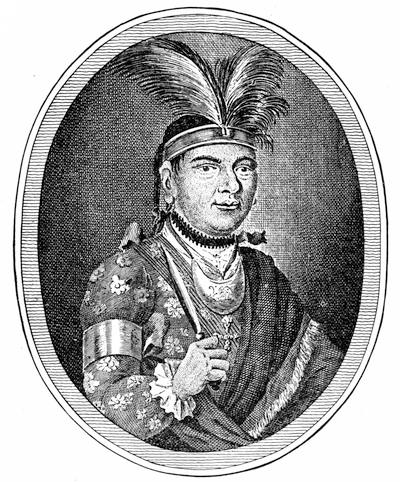
JOSEPH THAYENDANEGEA.
This portrait of Brant, "from an original drawing in the possession of James Boswell, Esq.", is engraved in the London Mag., July, 1776. It is reëngraved in the N. E. Hist. and Geneal. Reg., ii. 345.—Ed.
It is surprising that any influences could have overcome, even partially, this combination of circumstances in favor of the English; but, as it proved, the personal attachment of the Oneidas and Tuscaroras for Kirkland the missionary, and Dean the interpreter, was powerful enough, when exerted in favor of neutrality, to prevent the greater part of those tribes from following their brethren. Various conferences were held during the summer between delegations of whites and representatives of the Eastern tribes of the confederacy, in all of which those Indians who participated professed their willingness to remain neutral.[1291] In the autumn of 1775 the Indian commissioners of the Northern Department held a preliminary conference at German Flats, and thereafter a formal conference at Albany, at which the peace-speech of Congress was presented to the Six Nations, or rather to that part of the confederacy which was represented at the conference.[1292] An agreement of neutrality was entered into, but its value was greatly diminished by the fact that in the preliminary speeches the Indians insisted upon the necessity of keeping open their communications. This meant that they would regard the occupation of Fort Stanwix as an invasion of their rights.[1293] While these proceedings were going on, some of the Indians who had accompanied Guy Johnson to Montreal returned to their homes. When Dean, under orders from the commissioners, went out to explain to the tribes the nature of the Albany treaty, he met these Indians from Montreal. He says they were members of the Cayuga, Mohawk, and Seneca tribes, and they informed their brethren that they had taken up the hatchet at Montreal against the colonies. The Indians who had been at Albany were displeased at this, and their influence so far prevailed that the famous war-belt delivered by Guy Johnson was surrendered to General Schuyler on the 12th of December at Albany.[1294]
In the Mohawk Valley, the departure of Guy Johnson, in the summer of 1775, left Sir John Johnson the most prominent royalist, and at the same time the most conspicuous friend of the Indians, in that region. He was surrounded by several hundred Scotch Highlanders, who were devoted to him personally, and followed his lead in politics. Early in January, 1776, General Schuyler received orders to proceed to Johnstown, apprehend Sir John, and disarm his followers. In carrying out these orders the jealousy of the Indians had to be considered. Conferences were held with them. They tried to dissuade the general from invading the valley with an armed force, but he carefully explained to them the situation, and insisted upon advancing.
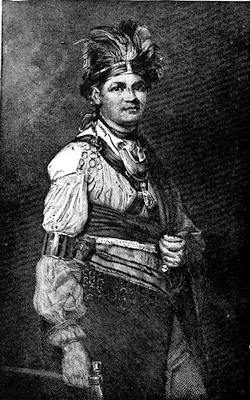
BRANT.
Stone gives two portraits of Brant: one in his younger days, after a picture belonging to the Earl of Warwick, and painted by G. Romney; the other after a painting by Catlin, following an original by E. Ames, and representing him at a later age.
The younger of these two is herewith given. (Cf. J. C. Smith's Brit. Mez. Portraits, iii. 1306; and McKenney and Hall's Indian Tribes, vol. ii.) Cf. also J. N. Hubbard's Sa-go-ye-wat-ha (Albany, 1886), p. 88.—Ed.]
The Indians were, however, invited to be present at the conference with Sir John. As a result of the expedition, the Highlanders were disarmed and Sir John was arrested and paroled. In May, it being reported that Sir John was not observing his parole, a second expedition was dispatched to Johnson Hall.[1295] Without waiting to be arrested, Sir John fled to Canada with a numerous body of followers, and shortly thereafter entered the English army. It was in this same month that the affair of the Cedars took place. Here, for the first time, Joseph Brant—Tha-yen-dan-e-gea—appeared in the field against the colonies. As a youth he had been placed at the school for the instruction of Indians, which was conducted by the Rev. Eleazer Wheelock, afterwards president of Dartmouth College. Brant is said to have been a man of good personal appearance and of great physical courage. Enough of his life had been spent among the whites to make him feel at ease in European costume, and to fit him to enter society without fear of transgressing ordinary rules of etiquette. As the private secretary of Guy Johnson, he had followed the superintendent to Montreal. From that point he went to England, where he was received with consideration. After a brief stay he returned to Canada, arriving in time to participate, while his memory of British adulation was still fresh,[1296] in the joint attack of the British troops and Indians on the Americans at the Cedars.[1297]
The necessity for occupying Fort Stanwix became early apparent to the Americans, and was the subject of frequent correspondence. This fort was at the carrying-place between Lake Ontario and the Mohawk,[1298] and from this post, on September 23, 1776, Colonel Dayton wrote that "Indian rumors report Colonel Johnson at Oswego with a large force."[1299] The alarm was, however, premature.
In the spring of 1777[1300] intelligence reached the Tryon County committee of the march of Brant, with a large body of warriors, across the country from Canada to the region where the Susquehanna River crosses the line between New York and Pennsylvania. Considerable restlessness was also noted at this time among the Tories. The presence of this large force of Indians under Brant caused great uneasiness to the settlers, and in June General Herkimer, with about three hundred of the militia, marched to Unadilla. Then followed one of the most singular incidents, as the story is generally told, of the whole border war. Herkimer's whole proceedings up to this point were aggressive. He had ventured with an armed force into Indian country. Upon his application, a co-operative force under Colonel Van Schaick was dispatched to Cherry Valley. The presence of Brant in the vicinity with a large body of followers was known, and Brant had already avowed his loyalty to the king. Yet after a conference, to which Brant came with evident reluctance, and at which he made a display of the force with him in such a way as to make Herkimer's followers uneasy, the meeting terminated without apparent result, unless Brant's renewed assertion of loyalty may be so regarded.[1301] Very soon after this a conference was held at Oswego between the officers of the British Indian Department and the Six Nations, at which the greater part of the latter were secured for the service of the king, and the lines were finally drawn between them and those members of the confederacy who were disposed either to maintain neutrality or who actually favored the American side.
While these events were occurring, Burgoyne had started upon his march by way of Lake Champlain, confident that he could without difficulty effect a junction with the British force from New York. Lieutenant Hadden mentions that Burgoyne said at an early date in the campaign that "a thousand savages brought into the field cost more than twenty thousand men." What confidence he had in his allies at the start diminished as he advanced. On the 11th of July he wrote to the secretary of state "Confidentially to your lordship, I may acknowledge that in several instances I have found the Indians little more than a name",—a name which he sought by a proclamation to make a terror; but in doing so he gave his adversaries ground for holding him responsible for such enormities as the murder of Miss McCrea,[1302] and for refusing to believe his indignant denials. His doubts of the value of the Indians as soldiers were soon verified. They could scout and forage, but at Bennington they were useless. They, in turn, finding that Burgoyne endeavored to restrain them in their customary methods of warfare, and that there was but little opportunity for plunder, began to drop away. At the most critical period of the campaign they deserted in large numbers, and could not be prevailed upon to return. Their presence, far from proving a terror to the provincials, consolidated and thus strengthened them, while on the other hand it undoubtedly led the English to overestimate their own strength.[1303]
By orders from London, dated March 26, 1777, the advance of Burgoyne was supported by a simultaneous movement by way of the St. Lawrence and Lake Ontario. Lieutenant-Colonel Barry St. Leger, made a brigadier for the purpose, led a force of about 650 regulars, Hessians, Canadians, and Tories, with upwards of 800 Indians, as stated by Colonel Claus, who had charge of them.
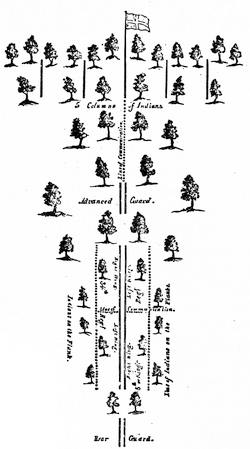
ST. LEGER'S ORDER OF MARCH.
After the cut in Stone's Brant, i. 219, following the original draft found in St. Leger's baggage. Cf. Lossing's Field-Book, i. 241.—Ed.
This command, bearing a few six-pounders, three-pounders, and cohorns, marched from Oswego, in the latter part of July, for the valley of the Mohawk. Unusual precautions were taken to protect the flanks by Indians, and the way was led by scouts. The Oneidas gave the Americans ample warning. Fort Stanwix was at the time under the command of Colonel Gansevoort, with Colonel Marinus Willett as second,—both excellent officers. The regular garrison consisted of 550 men, who were poorly supplied with provisions and munitions of war. Indians infested the woods during the summer, and several atrocious murders were committed, even near the fort. On August 2d, a reinforcement of 200 men reached the garrison, with two bateaux loaded with stores. The supplies had been barely taken into the fort when St. Leger's advanced guard appeared. The increased garrison had now six weeks' provisions and an abundance of ammunition for small arms, but only nine rounds a day for the cannon for the same period. During the summer the garrison had partly repaired the fort, and had felled trees along the banks of Wood Creek, so as to impede navigation.
News was conveyed to St. Leger of the approach of the reinforcement, convoying supplies for the garrison. In the hopes of intercepting them he authorized Lieutenant Bird to invest the place with the advanced guard, at the same time adding to Bird's command a body of Indians under Brant. Thinking perhaps that the garrison might offer to surrender upon the approach of the investing force, he instructed Lieutenant Bird not to accept a capitulation, but to await the approach of the main body of troops; saying, "This is not to take any honor out of a young soldier's hands, but by the presence of the troops to prevent the barbarity and carnage which will ever obtain where Indians make so superior a part of a detachment." On the 3d of August, St. Leger arrived with the greater part of his force, himself taking charge of operations which had been begun by Lieutenant Bird on the 2d. Wood Creek had been "most effectually choaked up", as St. Leger termed it, by the garrison of the fort; consequently he could not at once bring forward his artillery and stores. He forwarded to the garrison copies of a proclamation similar in tenor to that issued by Burgoyne, and on the 4th completely invested the fort and began the siege. Instead of the unfinished work which he says he had been led to expect, he found it "a respectable fortress, strongly garrisoned with 700 men, and demanding for its speedy subjection a train of artillery of which he was not master."
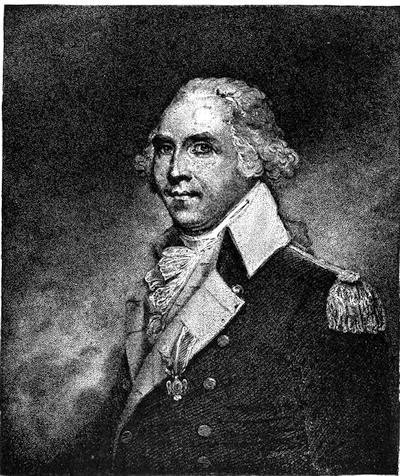
PETER GANSEVOORT.
After a picture by Stuart as engraved by Prud'homme. Cf. Stone's Brant, i. 209; and his Campaign of Burgoyne, p. 221; Lossing's Field-Book, i. 240.—Ed.
The torpor of the inhabitants of Tryon County had excited indignation at Kingston and at Albany. Under the pressure of an invading force, the people responded to the call of General Herkimer, and that officer soon found himself at the head of about 700 men.[1304] Among them were a small number of Oneida Indians. On the 4th of August this assemblage of men from the frontier moved forward from Fort Dayton at German Flats, where they had gathered together, and on the 5th encamped near Oriskany. From this point a message was sent to Colonel Gansevoort reporting their approach, and asking him to announce his knowledge of the fact by three rapid discharges of cannon. The messengers did not succeed in entering the fort until the morning of the 6th between ten and eleven o'clock. The three guns which were intended to communicate to Herkimer the intelligence that the garrison knew of his approach, were then fired at the fort. Herkimer's men were, however, too impatient to wait for co-operation on the part of the garrison. At that hour they had already advanced between two and three miles from their camp, and were engaged with the enemy. In justice to Herkimer, it must be said that he endeavored to prevent the advance, but it was evident from the temper of his men that if he had not consented to move he would have lost their confidence.
At the time of Herkimer's approach, St. Leger was but poorly prepared for an engagement. The garrison and the relief column together were equal in number to St. Leger's total force. The passage of the creek had been so completely blocked that 110 men were nine days in freeing it from obstruction. To get his artillery and stores forward, St. Leger was obliged to clear a path or roadway sixteen miles in length. He had but 250 soldiers on duty at the camp when the news reached him that the Americans were advancing. From these he could spare but 80 men to co-operate with 400 Indians in an ambuscade which was prepared for Herkimer. Sir John Johnson commanded 50 of these, and was posted, for the purpose of checking the column, on the road over which the Americans were advancing. It was intended that the Indians and a small party of rangers under Colonel Butler, who concealed themselves in the woods by the sides of the road, should, when Sir John had performed his part of the work, pour in their fire from all sides. At ten o'clock on the morning of the 6th, the approach of the unsuspecting and undisciplined American troops, with their wagons, was heard by the Tories and Indians in their place of concealment. The presence of the enemy was first revealed to the Americans by a volley from the impetuous Indians, who could not restrain themselves long enough for the perfect development of the plan, but opened fire before the head of the column had reached Sir John Johnson's post, and before the rear guard, with the wagons, had completely entered the fatal circle. Had the regiment which composed the rear guard been made up of men accustomed to warfare, they might even then have done good service in behalf of the surprised column. Unfortunately, those who could get away fled, leaving their companions to their fate. The returns show that even this regiment suffered severely in the engagement. A desultory combat followed, in which each of the entrapped Americans fought for himself, taking advantage of whatever opportunities offered for defence. The remnant of the surprised and disordered troops, thus brought to bay, proved formidable opponents, and punished severely the Indians, who bore the brunt of the fighting. Quite early in the action several of the American officers were killed or wounded. General Herkimer was shot through the leg, and his horse was killed. The saddle was removed from the animal and placed at the foot of a tree. Upon this the disabled general was seated by his men, and by his coolness and indifference to suffering and to danger won their respect. A heavy shower, which interrupted the progress of the battle, afforded opportunity for the Americans to arrange for co-operation. After the shower was over, the contest was renewed, and, according to the American accounts, fresh troops from the English camp participated. Local annals are filled with tales of feats of valor and vindictiveness which characterized this portion of the combat. At length the Indians, wearied with the protracted contest, and disheartened by the loss of several of their warriors, left the field. The English troops closely followed them. A diversion made by the garrison probably hastened the retreat. During this action the American loss was, according to their own accounts, about two hundred killed and nearly as many wounded and prisoners. The British loss was stated by themselves to have been not over six killed and four wounded. From the same source we learn that the Indians lost thirty-three killed and about as many wounded.
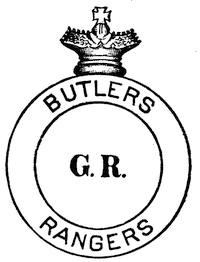
THE BUTLER BADGE.
Note.—The above cut of a brass emblem worn by Butler's men follows one in Simms's Frontiersmen of New York, ii. 68, drawn from a sample ploughed up in Otsego County;—Ed.
After the shower which checked the battle at Oriskany was over, Colonel Willett, at the head of two hundred and fifty men, with a three-pound carronade, sallied forth from the fort. The camp was almost entirely unprotected. Lieutenant Bird, who was in charge of the portion which Willett attacked, had received information that Sir John Johnson needed succor, and had abandoned his post and marched towards Oriskany. Colonel Willett penetrated the camp, secured a large quantity of guns, ammunition, Indian weapons, blankets, etc., captured nearly all the books and papers of the expedition, evaded an attempt on the part of St. Leger to cut off his retreat, and safely effected his return to the fort with all his plunder, without losing a man.[1305] The Indians, before going out to fight, had stripped themselves nearly naked. On their return to camp they found neither clothing, tents, nor blankets. Thus ended the day. The relief party under Herkimer was shattered. The fort was still besieged, and the besiegers had now opportunity to open their communications; but their camp had been rifled, and their Indian allies, discouraged by their losses, had no further interest in the siege, and began to think of home. St. Leger sought to secure a capitulation on the ground of the defeat of Herkimer, and caused the captured militia to write accounts setting forth the strength of his force and the excellence of his artillery; but Gansevoort was firm. The argument that the English would be unable to restrain the Indians from barbarities if the siege were protracted was also spurned by the garrison. Failing in this direct attempt upon their fears, an effort was made to reach them through the people of the county. A proclamation was put forth by Sir John Johnson, D. W. Claus, and John Butler as superintendents. This also was of no effect. It being desirable to communicate with Albany, Colonel Willett and Major Stockwell penetrated through the enemy's camp by night, and proceeded on foot through the woods to Fort Dayton. From that point Colonel Willett went to Albany. He found that General Arnold had already been ordered to relieve the fort. The siege, notwithstanding the fact that the artillery was of little avail, was continued until the 23d of August. The garrison, ignorant of the fate of Colonel Willett and Major Stockwell, were in grave doubts as to how long they could hold out. On the 23d, the enemy suddenly abandoned their camp, leaving a great quantity of material behind. The retreat was precipitated by false intelligence which Arnold caused to be conveyed to the English camp. St. Leger evidently suspected the ruse, but was unable to prevent its effects.
The gallant Herkimer did not long survive the battle. A simple, unlettered man, without experience in leading troops, he paid the penalty of his mistakes at Oriskany with his life. His intrepidity during the action and the coolness with which he faced death convinced his followers of his dauntless courage, and his loss was deeply felt.
The Indians, in their resentment for the severe losses with which they had met, murdered several of the American prisoners. They also burned one of the Oneida settlements, destroyed the crops, and killed or drove away the cattle belonging to the village. Colonel Butler, in his report to Sir Guy Carleton concerning affairs at Fort Stanwix, coolly says, "Many of the latter [prisoners] were, conformable to the Indian custom, afterwards killed." On the retreat the Indians became uncontrollable, and robbed the English officers. In the words of St. Leger, they "became more formidable than the enemy we had to expect."
The failure of St. Leger and the capitulation of Burgoyne placed the affairs of the colonies in such position that Congress deemed it worth while to renew negotiations with the Indians. The time seemed opportune for securing the services of the Six Nations, and the commissioners were, on the 3d of December, 1777, instructed "to urge them to some decisive enterprise which will effectually tie them to our cause." On the 4th the commissioners were authorized to expend $15,000 as a reward to the Indians for reducing Niagara. In February, 1778, they were instructed to speak to the Indians "in language becoming the representatives of free, sovereign, and independent States." "Whether it would be prudent to insist upon the Indians taking an active part in behalf of these States" would depend upon the temper in which they should appear to be. Action upon that point was submitted to the discretion of the commissioners. The temper of the Senecas was found to be far from favorable; and instead of attending the conference, they sent a message expressing surprise that while the tomahawk was still sticking in their heads, and they were still grieving for the loss of their friends at Oriskany, the commissioners should think of inviting them to a treaty. On March 4th, Washington was empowered by Congress, if he should think it prudent and proper, to employ in the service of the United States a body of Indians, not exceeding five hundred. On the 7th, Colonel Nathaniel Gist was instructed to enlist Indians on the borders of Virginia and North Carolina, not to exceed two hundred in number. On June 11th, Congress recommended aggressive warfare, being satisfied, from the presence of British agents among the Indians, that the cruel war had been "industriously instigated" and was still being "prosecuted with unrelenting perseverance by principal officers in the service of the king of Great Britain."
In 1778, according to the plan of campaign as given by Guy Johnson in his correspondence, the English forces on the western borders of New York were divided into two bodies: one, consisting of Indians under Brant, to operate in New York, while Deputy Superintendent Butler with the other should penetrate the settled district on the Susquehanna. Brant, who, according to Colonel Claus, "had shown himself to be the most faithful and zealous subject his majesty could have in America", did his work unsparingly, and ruin marked his track. In the valley of the upper Mohawk and the Schoharie nothing but the garrison-houses escaped, and labor was only possible in the field when muskets were within easy reach. Occasionally blows were struck at the larger settlements. In the last of May, Brant, with about three hundred and fifty Indians, destroyed a number of houses in the Cobleskill Valley, and routed, with severe loss, a militia company which attempted to pursue him.[1306] In June, the little town of Springfield, at the head of Otsego Lake, was burned. Such of the men as did not take flight were seized as prisoners. The women and children were not injured. During the same month, Sir John Johnson, with a company of loyalists, made a sudden descent upon the Mohawk Valley, the scene of their former homes, and took a number of citizens prisoners.
In July, 1778, the threatened attack on Wyoming took place. This region was at that time formally incorporated as the county of Westmoreland of the colony of Connecticut. This result had been accomplished by the persistence of the emigrants, under most discouraging circumstances and at the expense of some bloodshed. In the fall of 1776, two companies, on the Continental establishment, had been raised in the valley, in pursuance of a resolution of Congress, and were shortly thereafter ordered to join General Washington.[1307] Several stockaded forts had been built during the summer at different points. The withdrawal of so large a proportion of the able-bodied men as had been enlisted in the Continental service threw upon the old men who were left behind the duty of guarding the forts. Repeated alarms, during the summer of 1777, compelled the young men to scour the woods, but their vigilance did not prevent some prisoners being taken by the Indians. In March, 1778, another military company was organized, by authority of Congress, to be employed for home defence. In May, attacks were made upon the scouting parties by Indians, who were the forerunners of an invading army. The exposed situation of the settlement, the prosperity of the inhabitants, and the loyalty with which they had responded to the call for troops, demanded consideration from Connecticut, to whose quota the companies had been credited, and from Congress, in whose armies they had been incorporated; but no help came. On June 30th, an armed labor party of eight men, which went out from the upper fort, was attacked by Major Butler, who with a force estimated by the American commander in his report at eight hundred men, Tories and Indians in equal numbers, had arrived in the valley. This estimate was not far from correct; but if we may judge from other raiding forces during the war, the proportion of whites is too large, for only a few local Tories had joined Butler. The little forts at the upper end of the valley offered no resistance to the invaders.
On July 3d, there were collected at "Forty Fort", on the banks of the river, about three miles above Wilkesbarré, two hundred and thirty Americans, organized in six companies (one of them being the company authorized by Congress for home defence), and commanded by Colonel Zebulon Butler, a resident in the valley and an officer in the Continental army. It was determined, after deliberation, to give battle. In the afternoon of that day, this body of volunteers, their number being swelled to nearly three hundred by the addition of old men and boys, marched up the valley. The invaders had set fire to the forts of which they were in possession. This perplexed the Americans, as was intended, and they pressed on towards the spot selected by the English officer for giving battle. This was reached about four in the afternoon, and the attack was at once made by the Americans, who fired rapidly in platoons. The British line wavered, but a flanking fire from a body of Indians concealed in the woods settled the fate of the day against the Americans. They were thrown into confusion. No efforts of their officers could rally them while exposed to a fire which in a short time brought down every captain in the band. The Indians now cut off the retreat of the panic-stricken men, and pressed them towards the river. All who could saved their lives by flight. Of the three hundred who went out that morning from Forty Fort, the names are recorded of one hundred and sixty-two officers and men killed in the action or in the massacre which followed. Major Butler, the British officer in command, reported the taking of "two hundred and twenty-seven scalps" "and only five prisoners." Such was the exasperation of the Indians, according to him, that it was with difficulty he saved these few. He gives the English loss at two whites killed and eight Indians wounded.[1308]
During the night the worst passions of the Indians seem to have been aroused in revenge for Oriskany. Incredible tales are told of the inhumanity of the Tories. These measures of vengeance fell exclusively upon those who participated in the battle, for all women and children were spared.
As soon as the extent of the disaster was made known, the inhabitants of the lower part of the valley deserted their homes, and fled in the direction of the nearest settlements. Few stayed behind who had strength and opportunity to escape. In their flight many of the fugitives neglected to provide themselves with provisions, and much suffering and some loss of life ensued. The fugitives from the field of battle took refuge in the forts lower down the valley. The next day, Colonel Zebulon Butler, with the remnants of the company for home defence, consisting of only fourteen men, escaped from the valley. Colonel Denison, in charge of Forty Fort, negotiated with Major Butler the terms of capitulation which were ultimately signed. In these it was agreed that the inhabitants should occupy their farms peaceably, and their lives should be preserved "intire and unhurt." With the exception that Butler executed a British deserter whom he found among the prisoners, no lives were taken at that time. Shortly thereafter, the Indians began to plunder, and the English commander, to his chagrin, found himself unable to check them. Miner even goes so far as to say that he promised to pay for the property thus lost. Finding his commands disregarded, Butler mustered his forces and withdrew, without visiting the lower part of the valley. The greater part of the Indians went with him, but enough remained to continue the devastation, while a few murders committed by straggling parties of Indians ended the tragedy. The whole valley was left a scene of desolation. In August the American forces returned, and a few settlers came back and endeavored to save some of their crops, but occasional surprises by Indians warned them that the region was still unsafe. In September, Colonel Hartley marched with one hundred and thirty men against the Indian towns of Tioga and Sheshequin, and broke up those settlements.
Brant, meanwhile, had not been idle. On July 18th he burned a little settlement about six miles from German Flats, called Andrustown. In the latter part of August, German Flats, a settlement containing thirty-four houses, was destroyed and the cattle were driven away. Only two lives were lost, the inhabitants having taken refuge in Fort Dayton. The rapine was not, however, all on one side. From Schoharie an American expedition under Colonel William Butler threaded its way through the woods, forded the flooded streams, and destroyed the Indian town of Oquaga, and on their return burned the Tory settlement and the grist and saw mills at Unadilla.
In the spring of 1778, General Lafayette ordered a fort to be built at Cherry Valley, and this post was afterwards garrisoned by the Continental regiment under Colonel Ichabod Alden. During the fall, information of a positive character was conveyed to Colonel Alden that the place was threatened. Some of the officers of the garrison were accustomed to sleep outside the fort, and notwithstanding the warning, this practice was continued. Neither Alden nor his men were familiar with Indian warfare. The citizens wished to move their effects into the fort, but Colonel Alden quieted them by saying that he had good scouts out, who would give timely warning. One of these scouting parties, through carelessness, was captured on the night of November 10th, and by this means the enemy learned the exact condition of affairs. The invading force is said to have consisted of two hundred whites and about five hundred Indians, the whole under command of Captain Walter N. Butler. This officer had been arrested as a spy near Fort Stanwix during the siege, and had been condemned to death, but had been reprieved, and had escaped from custody. He had with him a body of Senecas, besides Brant and his Mohawks. The night after the capture of the scouting party, the enemy encamped near the village. On the morning of the 11th, under cover of a heavy rain, they penetrated a swamp in the rear of the house used as headquarters, where they concealed themselves, awaiting a favorable opportunity for attack. Chance favored the garrison, and gave them a brief warning. A resident of the valley, on the way to the village, at about half past eleven o'clock discovered two Indians, and was fired upon by them.
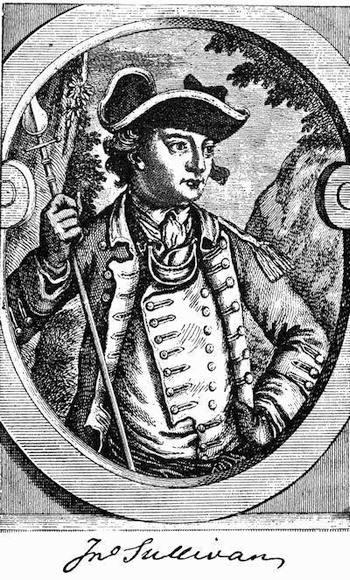
From the Gesch. der Kriege in und ausser Europa, Dreyzehnter Theil, Nürnberg, 1778. The original of this design was a print published in London, Aug. 22, 1776. Reproductions of it will be found in Irving's Washington, quarto ed., vol. iii.; E. M. Stone's Our French Allies, p.76; T. C. Amory's Sullivan. Cf. also Murray's Impartial History, p. 241; Jones's Campaign for the Conquest of Canada, p. 88; Lossing's Field-Book, i. 272.
For a view of Gen. Sullivan's house at Durham, N. H., with a paper on its associations, see Granite Monthly, v. 18, 80. For his family, see N. E. H. and Gen. Reg., 1865, p. 304.—Ed.
Although wounded, he was able to reach headquarters in advance of the enemy, and give the alarm. The regimental officers hastened towards the fort, and some of them succeeded in reaching it before the Indians surrounded it. Colonel Alden was one of the first victims of his own infatuation, having been shot while trying to reach the fort. For three hours and a half the enemy protracted their efforts to capture the post. Sixteen Continental soldiers were killed during the attack on the village, and thirty-two of the inhabitants, principally women and children, were massacred. Some of the murders were committed under circumstances of peculiar barbarism, in which whites competed with Indians. The houses, barns, and out-houses of the settlement were burned. The garrison, although too weak to attack the enemy, was strong enough to defend the fort. The enemy having completed the work of destruction as far as they could, retired, but made a feeble renewal of the attack on the 12th. This was easily repelled, and they then devoted themselves to collecting the cattle belonging to the villagers. The greater part of the prisoners who had been captured were liberated on the 12th, and permitted to return to the settlement. In setting them free, Captain Butler entered into a correspondence with General Schuyler, in which he endeavored to relieve himself from responsibility for the massacre. Brant also denied responsibility for it. Butler in his letter asserted that at Wyoming "not a man, woman, or child was hurt after capitulation, or a woman or child before it." If we admit the disclaimers of the Butlers, father and son, the fact still remains that they headed raiding parties, where plunder and destruction of property were the main purposes of the expeditions, and where the massacre of the inhabitants was one of the possibilities of success. Strip from the stories of Wyoming the exaggerations of the frightened refugees, the brutal massacre of the prisoners remains. The mercy which was extended to the prisoners at Cherry Valley merely reduces the number of horrors which were committed there. The massacre still stands out conspicuously as the most shocking in its details of any event in this region during the Revolution. Fortunately for the memory of Sir John Johnson, notwithstanding his prominence as the scourge of the Mohawk Valley during the war, his name is not associated with either of these events.
On March 6, 1779, Washington, acting under instructions from Congress, "to take effectual measures for the protection of the inhabitants and the chastisement of the Indians", tendered to General Gates the command of an expedition "to carry war into the heart of the country of the Six Nations, to cut off their settlements, destroy their next year's crops, and do every other mischief which time and circumstances will permit." This offer Gates declined, and on March 31st General Sullivan was appointed to the command. He was to lay waste all the Indian settlements in the most effectual manner, "that the country may not be merely overrun, but destroyed." Sullivan was to assemble his forces in Pennsylvania. General James Clinton was to assemble a force in the Mohawk Valley. In all the preliminary discussions of the campaign it was contemplated to make the main advance by way of the Mohawk. This idea was, however, abandoned, and it was arranged that Clinton should cross over to the Susquehanna River, and by that route effect a junction with Sullivan. As a preliminary to the campaign, Colonel Van Schaick, on the 18th of April, left Fort Stanwix at the head of five hundred and fifty-eight men, including officers, and made a sudden descent upon the Onondaga towns. The expedition was completely successful, and on the 24th Van Schaick was back at the fort, and able to report that this work of destruction and plunder had been accomplished, with the loss of only one man. On June 16th, General Clinton arrived at Canajoharie, where he found about fifteen hundred troops. From that point over two hundred boats and three months' provisions for the command were transported over the hills to Lake Otsego. On June 30th, Clinton reported to Sullivan that this transfer had been accomplished, and that he was now ready to come down the river. Here he remained with his troops until August 9th, awaiting orders. Meantime he constructed a dam across the outlet of the lake, by means of which he raised the water about a foot.
By the latter part of June the troops which were under Sullivan's immediate command had assembled in the Wyoming Valley. They numbered, on the 21st of July, 2,312 rank and file. They remained in this valley, awaiting the arrival of stores, until the last day of July, when marching orders were issued. During this period of idleness the troops at Wyoming and at Lake Otsego chafed at their inaction. The enemy continued the policy of desultory attacks and devastating raids, some of which were committed in close proximity to the American encampments. In May, at Fantinekill and at Woodstock, in Ulster County, New York, houses were destroyed, cattle killed, and prisoners taken. On the night of July 19th, Brant, with a force one third white and two thirds Indians, variously estimated at from ninety to one hundred and sixty men, made a descent upon the Minisink settlement. The citizens and militia of Goshen marched next day in pursuit, and were joined on the 21st by a small detachment of the Warwick militia, the whole number being, according to Colonel Hathorn, who took command, one hundred and twenty. On the 22d they overtook Brant, were completely outwitted by him, and were defeated, with a loss of forty-four killed.
In Pennsylvania several outrages were committed in the immediate vicinity of Sullivan's army. On July 28th Freeland's fort, on the West Branch of the Susquehanna, was taken by the enemy, and a small detachment sent from Northumberland for its relief was badly cut up. Neither Clinton nor Sullivan were diverted from the purposes of the campaign by these forays. The Oneidas had agreed to join Clinton, but were prevented by a threatening message from General Haldimand. They excused themselves to the American general on the ground that they feared an attack on their castles, should they assist in the campaign. Their defection had no influence upon operations. On the 13th Sullivan destroyed the Indian town of Chemung, and then fortified a post at a narrow point on the peninsula, a short distance above the junction of the Tioga and Susquehanna. Clinton, on receipt of orders to advance, destroyed the dam at the foot of the lake on the 9th, and successfully embarked his bateaux on the flood of his own creating. On the 22d the junction of the two columns was effected. On the 26th the united forces moved forward, and on the 29th encountered the enemy under the Butlers, McDonnell, and Brant at Newtown, five miles from Elmira. Here the enemy had selected a spot on rising ground which commanded the road, and had thrown up a rude breastwork of logs. Some attempt had been made to conceal it by placing before it brush and young trees. Here they were apparently prepared to make a stand. General Poor was dispatched with his brigade to gain a hill to the right, and from thence to attack the enemy's left flank. After allowing some time for Poor to reach his destination, Sullivan opened with his artillery. Poor met with resistance, but when he had forced his way to a position which became threatening to the enemy, they abandoned their whole line.[1309] On the 30th Sullivan proposed to his men, as provisions were short, that they should go on half rations, trusting to the country to furnish them the rest. This was readily agreed to. The baggage and heavy guns were sent back, and on the 31st the column advanced, taking for campaign artillery four light three-pounders and a small howitzer. The main army marched down the east side of Seneca Lake to its outlet, destroying villages, cornfields, and orchards on the way. From the foot of the lake a party was sent down the Seneca River towards Lake Cayuga to destroy a town, and another was sent a short distance up Lake Seneca, on the west side, for the same purpose. From the foot of this lake the main army moved westward, skirting the northern ends of lakes Canandaigua, Honeyoye, and Hemlock, destroying as it moved. Then it bore to the southwest, and passed the southern end of Lake Conesus. On the 14th of September, about sunset, the expedition arrived at the great castle of the Senecas, on the west side of the Genessee River, and on the opposite side of the valley from the site of Geneseo. On the evening of the 12th, as the army approached this region, Sullivan ordered a scouting party to be sent out. It was his intention that only five or six men should go, but the officer in charge of the party, Lieutenant Thomas Boyd, took with him twenty-six men, including the Indian guides. In the darkness, Boyd unconsciously passed the encampment of Butler and his force, who were ambushed near Lake Conesus, waiting for Sullivan. On the morning of the 13th, Boyd, having reconnoitred an Indian town, sent word to camp by two of his men, and halted where he intended to await the approach of the army. While waiting here, some Indians were discovered by the party, whom Boyd indiscreetly pursued. By this means his force was led directly into the power of Butler, whose men completely surrounded the Americans and opened fire upon them. Nerved to desperation, a gallant attempt was made by the devoted band to break through the enemy's lines. In this attempt eight of them succeeded. Fifteen of the party were killed. Two, Boyd and his sergeant, were captured. The two captives were taken to Seneca Castle, or "little Beard's town", and honored for their brave defence with tortures of unusual cruelty. The "western door of the Long House", as this place was termed by the Indians, consisted of one hundred and twenty-eight houses, some of which were well built. The gardens were filled with corn and vegetables. All these were destroyed; and on the 15th the army, having completed its work, began its return march. Sullivan had, on the outward march, dispatched a messenger from Catharine's town to the Oneidas, calling upon them to furnish him with some warriors. At Kanadasaga, near the foot of Lake Seneca, on his return, he received a message from them, explaining why their warriors had failed him, and putting in a plea for mercy in behalf of the Cayugas. He accepted their excuses, but paid no attention to their requests. From Kanadasaga he sent Colonel Smith, with a command, to complete the destruction on the west side of Lake Seneca. He also detached Colonel Gansevoort, with one hundred and five men, with instructions to proceed to Albany, and on the way to destroy the lower Mohawk Castle. Through motives of policy, the latter part of this order was not carried out to the letter. A detachment was also sent out to destroy the towns on the eastern side of Lake Cayuga. On the 21st another detachment was dispatched, with orders to lay waste the towns on the western side of Lake Cayuga, and to intercept the Cayugas if they should attempt to escape the officer who had gone up on the other side of the lake. The rest of the army then marched south, between Seneca and Cayuga lakes. When they reached the valley of the Tioga, an expedition was sent up that river on an errand of destruction. On the 28th these several detachments, with the exception of Gansevoort's, had all rejoined the main column, having accomplished their work without resistance. They were then met by a supply of provisions from Tioga. The work of destroying Indian towns and crops was finished. Fort Sullivan, near the junction of the rivers, was abandoned and razed. The army descended the Susquehanna to Wyoming, which place they reached October 7th. By the route which they took, the distance marched by the army, in going from Wyoming to Seneca Castle, was two hundred and fifteen miles, all of it in Indian country, without a road over which a wagon could be transported. Forty Indian towns were destroyed. Some of them were insignificant. Several had from twenty to thirty houses. One had one hundred and twenty-eight houses. Colonel Gansevoort, speaking of the lower Mohawk Castle, said: "It is remarked that these Indians live much better than most of the Mohawk families. Their houses were well furnished with all necessary household utensils, and a great plenty of grain." The excellent construction of some of the houses of the Seneca and Cayuga villages was a source of surprise to the invaders. They marvelled at the well-conditioned orchards, the cultivated gardens, and the extensive cornfields. They left behind them, on the sites of these villages, smoking ruins and blighted vegetation. Notwithstanding the fact that the expedition was delayed so long waiting for stores, it was undertaken with the certainty that there was not enough on hand for the purpose, if the army was to rely upon what was supplied. General Sullivan was compelled to march thus or not at all. In numbers the troops fell short of what had been counted on. They met with no opposition worthy of note. The losses during the campaign, by accident, by sickness, and in the field, amounted to only forty. They could not have foreseen that General Haldimand would be so completely bewildered as to their intentions, and that he would refuse to believe that they could purpose invading this region, until too late to render the Indians assistance.[1310] The greater part of the warriors of the Six Nations were in the field on the side of the English. It was but reasonable to anticipate that the Indians would receive aid from their allies in defence of the Indian country. Everything militated against the probability of the expedition being able to accomplish its work with such ease. The expedition was too large to treat the question of supplies in the same way that an ordinary raiding party would have done. Through the delays in procuring supplies, it was prosecuted at a time when the army could subsist partially upon the growing crops. Had Sullivan started when he expected, he must have depended upon his train. Otherwise the Indians could easily have destroyed their stores and impeded the progress of the army.[1311]
As a part of the original scheme, a simultaneous movement from Fort Pitt against the Indian towns on the Alleghany was ordered. The difficulty of communication between the two forces led to the abandonment of all idea of co-operation. Colonel Brodhead, who had charge of the movement on the Alleghany, was left to pursue his own course. On August 11th he left Pittsburgh at the head of six hundred and five rank and file, with one month's provisions. With this force he proceeded up the river by boat to Mahoning; there the stores were loaded on pack-horses, and the march was begun. On the way to the Indian towns the advance guard came in contact with a party of between thirty and forty warriors, whom they put to flight. The detachment marched for a distance of about two hundred miles from Pittsburgh, and destroyed the Indian settlements along the Alleghany extending for eight miles, and consisting of one hundred and thirty houses. The growing crops and provisions were ruined. This extraordinary march was made without the loss of a single man, and without meeting any warriors except the party already mentioned.
On October 20, 1779, Washington wrote to the Marquis de Lafayette, saying: "General Sullivan has completed the entire destruction of the country of the Six Nations, driven all the inhabitants, men, women, and children, out of it, and is at Easton on his return." He further said that Colonel Brodhead had inflicted similar chastisement on the "Mingo and Muncey tribes", living on the Alleghany, French Creek, and other waters of the Ohio. Washington concluded with these words: "These unexpected and severe strokes have disconcerted, humbled, and distressed the Indians exceedingly, and will, I am persuaded, be productive of great good; as they are undeniable proofs to them that Great Britain cannot protect them, and that it is in our power to chastise them whenever their hostile conduct deserves it."[1312] The cruel steps taken against the Senecas, Cayugas, and Onondagas were probably justifiable as war measures. War against these Indians without the adoption of their own tactics could only be prosecuted at a great disadvantage.[1313] The destruction of their homes and the consequent removal of the natives to a point more distant from the American settlements, together with the necessity thus thrown upon the British government of providing for their allies, undoubtedly affected the aggressive power of the Indians and diminished the value of their alliance. But if it was expected that raids upon the border settlements would be stopped by this campaign, then the authorities must have been disappointed. The border knew no peace until the war was ended.
The Indians, driven out of their own country and left without shelter and without food, took refuge at Niagara for the winter. The Oneidas feared an attack, and abandoned their castles. About four hundred of them placed themselves under the protection of the government at Schenectady. In April, 1780, the settlement at Harpersfield was destroyed, and a scouting party of Americans which happened to be in the neighborhood was captured. Repeated blows were struck at the scattered, poorly defended settlements along the border. The lower Mohawk was invaded by a force under Sir John Johnson, and the local histories, in their records of the work of the summer of 1780, have a melancholy monotony of conflagration and plunder. In August the settlement at Canajoharie was laid waste by Brant, and several small settlements adjacent to Canajoharie, and at Norman's Kill, not far from Albany, were ravaged. From the valley of the Mohawk the enemy moved southward, destroying a number of houses and capturing prisoners in Schoharie Valley. In October, 1780, Schoharie Valley was again ravaged, this time from the south, by an invading force of about one thousand in all, under Sir John Johnson, which consisted of Tories, together with Brant and his Mohawks, and Cornplanter with a body of Senecas. They had, by way of artillery, two small mortars and a brass three-pounder.[1314] There were three forts in the valley, in which the inhabitants took refuge. The invaders did not succeed in capturing either of the forts, and the loss of life in them was small, but they left scarcely a building standing in the whole valley.
After thoroughly completing the work of destruction in Schoharie Valley, the invaders proceeded to the valley of the Mohawk, and ravaged the country on the north side of the Mohawk from Caughnawaga to Stone Arabia and Palatine. A little force from Stone Arabia, acting, it is supposed, under a promise of support from General Van Rensselaer, undertook to check them. The general had collected some of the militia, and was to fall upon the rear of the enemy. The promised support was not furnished. Colonel Brown, who led the attacking party, was killed, and his followers were badly cut to pieces. After this encounter Sir John's forces renewed their work of destroying property in the neighborhood of Stone Arabia, and then moved slowly up the river, ravaging the country as they went. The invaders were followed by the Americans, whose numbers increased as they moved, until they were numerically stronger than the enemy. There were some Oneidas with the Americans, under command of one of their own number holding a commission from the Continental Congress as lieutenant-colonel. On the afternoon of October 20th, just at nightfall, a skirmish took place between the two commands at the spot selected by Sir John for his evening bivouac. It was soon terminated by the increasing darkness, of which the Americans took advantage to withdraw to a camping place about three miles back, and the invaders, availing themselves of the opportunity, hurriedly sought the woods. During their flight the enemy captured a party of Americans which had been dispatched to destroy their boats.[1315] After this raid the upper Mohawk Valley and the Schoharie Valley rivalled in their desolation the region of the lakes which had been invaded by Sullivan the preceding year. Numbers of prisoners had been carried off during these raids, some of whom were liberated shortly after capture. Others were detained till the close of the war. In one instance a child was returned by Brant, with a letter, in which he said "I do not make war upon women and children. I am sorry to say that I have those with me in the service who are more savage than the savages themselves."
Simultaneously with the operations in the Mohawk Valley, the enemy ascended Lake Champlain and captured Forts Ann and George. Portions of Kingsbury, Queensbury, and Fort Edward were burned. A branch of this expedition destroyed the settlement at Ballston. At the same time, a party of about two hundred, chiefly Indians, under Major Haughton of the 53d, left Canada, and destroyed several houses in the upper part of the Connecticut Valley, and carried off thirty-two inhabitants as prisoners.[1316]
The work of retribution on the part of the Indians did not stop with what has been recorded. Even during the succeeding winter Brant was on the war-path, appearing now here and now there in the Mohawk country cutting off stragglers and detached parties. Great difficulty was experienced in furnishing the garrisons at the outposts with provisions. Distress ensued, and there was serious danger that the outlying defences could not be maintained. Fort Stanwix was badly damaged in May, 1781, both by flood and by fire, and in consequence the post was shortly afterward abandoned. The command of the Mohawk Valley was this season assigned to Colonel Willett. He carefully acquainted himself with its condition, and infused a portion of his own active spirit into the management of affairs. Very shortly after he assumed command, on June 30th, Currietown, a village near the mouth of the Schoharie, was destroyed. With a small force, Willett pursued the raiders, overtook them, and routed them with severe loss. In July, Colonel Willett wrote that the number of men in Tryon County liable to bear arms did not exceed eight hundred. At the beginning of the war the enrolled militia numbered 2,500 men. He accounted for this reduction by supposing that one third had been killed or made prisoners, one third had gone over to the enemy, and one third had abandoned the country. Indeed, life in the valley had become almost unendurable. The only places of safety were within the walls of the stockaded forts which were scattered through the region. All through the summer of 1781 detachments of the enemy struck blows at different points along the border. The most conspicuous of these desultory acts of devastation was the destruction of the little town of Wawarsing. Unsuccessful efforts were made this season to seize the persons of both General Gansevoort and General Schuyler. The active movements of the year closed with a foray on the Mohawk by Sir John Johnson and Major Walter N. Butler, in the latter part of October. When the Americans learned the approach of the invaders, Colonel Willett gathered a force together, with which, although inferior in numbers to the enemy, he attacked them at Johnstown. The varying fortunes of the day were, on the whole, with the Americans. The enemy fled, after dark, to the woods. Willett followed them for some days, and had a collision with their rear guard, in which the notorious Major Walter N. Butler was shot through the head and left on the field.[1317] The difficulties of the military as well as the political situation had been greatly complicated this summer by the menacing aspect of the British forces on Lake Champlain, and doubts as to the fidelity of certain of the leaders in Vermont, whose hostility to the threatened extension of the authority of New York over the inchoate State had been pronounced in terms of bitter earnest.