Chapter I · (continued 2)
Reading edition
In 1767 strife was renewed on what are known as the Townshend Acts. Charles Townshend was Chancellor of the Exchequer in the Chatham-Grafton ministry. He had reluctantly voted for the repeal of the Stamp Act, and still held to his opinions that the colonists should pay some share of the civil and military expenses arising from their defence and government; and if, to secure promptness and uniformity of action, some modification of their charters should be found necessary, then that ought to follow. In conformity with these views, he had given some pledges in respect to deriving a revenue from America, and, during Chatham's retirement, had brought forward his scheme of taxation in certain resolutions of the Committee of Ways and Means, April 16, 1767,[82] the substance of which was enacted June 29th, to go into effect November 20th. There were two acts known as the Townshend Acts: the first[83] providing for the more effectual execution of the laws of trade, and for the appointment of commissioners for that purpose; and the second[84] granting duties on glass, paper, colors, and tea, and legalizing writs of assistance. The revenue thus raised was to be applied to "defraying the charge of the administration of justice, and the support of the civil government in such provinces where it should be found necessary; and towards further defraying the expenses of defending, protecting, and securing the said dominions." Before the act went into operation Charles Townshend died (September 4, 1767), and Chatham's powers continued to be enfeebled by disease. It was the misfortune of Great Britain that both these able men should have been withdrawn from the public service during this critical period, and that the policy of each had to be represented by inferior men. Chatham's conciliatory methods had no fair trial; and Townshend's coercive measures were pressed neither with unity of purpose nor vigor of execution.
Between the passage of Townshend's Acts in the summer of 1767 and their taking effect in November, the colonists had ample time to study and organize opposition, stimulated by the arrival (November 5, 1767) of Burch and Hulton, two of the five commissioners of customs who had been sent over to enforce them. At first the people expressed their resentment, in which, as usual, those of Boston took the lead, by renewing their non-importation agreements. In the mean time efforts had been made to introduce domestic manufactures.[85] These practical measures in Massachusetts were supplemented by one of the ablest discussions of colonial rights which had yet appeared. In the early winter of 1767-8 John Dickinson published in a Philadelphia newspaper a series of essays entitled The Farmer's Letters, which soon attracted notice both in America and England.
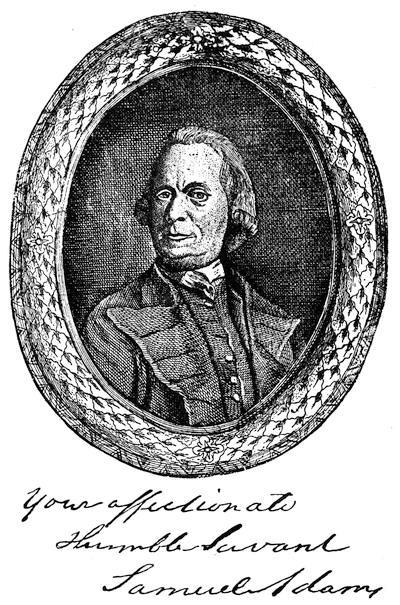
From An impartial History of the War in America (Boston, 1781), vol. i. p. 325, engraved by J. Norman, a Boston engraver.
In 1772, when Adams was forty-nine, John Hancock commissioned Copley to paint pictures of Adams and himself, to commemorate their political union, and the two portraits hung for many years in the Hancock mansion on Beacon Street in Boston, before they were given to the town. That of Adams is a three-quarters length, and shows him standing at a table, holding a paper, in the attitude of speaking (Perkins's Copley, p. 28). As engraved by H. B. Hall, it is given in Wells's Life of Samuel Adams, vol. i.; and it is also engraved in Delaplaine's Repository (1815); in Bancroft, vol. vii. (orig. ed.), and in other places, as well as, on wood, in the Mem. Hist. of Boston (iii. 35). After having hung for some years in Faneuil Hall, it has now been transferred to the Art Museum. It was engraved—the bust only—by Paul Revere, for the Royal American Mag., April, 1774, and a reproduction of this is given by Wells (vol. ii.). A copy of the original was made by J. Mitchell, and from this a mezzotint by Samuel Okey was issued at Newport in 1775.
Another and smaller picture, also by Copley (Perkins, p. 29), and said to have been painted in 1770, hangs in Memorial Hall, Cambridge, and has been engraved in the Mem. Hist. of Boston, ii. 438. Cf. Sanderson's Signers, vol. ix.
The Copley type of head characterizes the engraving by J. Norman, given above from the Boston edition of a current history. The London edition (1780) of the same book has a picture which has little resemblance to the Copley type, as will be seen by the fac-simile likewise herewith given, and marked "London, 1780."
There was a picture made late in life by John Johnson, which has been destroyed; but from a mezzotint of it, made in 1797 by Graham, H. B. Hall reëngraved it for Wells's third volume, and on wood in Higginson's Larger History, p. 255.
The statue by Miss Whitney follows the Copley head. One copy of this is in the Capitol at Washington, and another in Dock Square, in Boston.—Ed.
Their influence among all classes was widespread and profound.
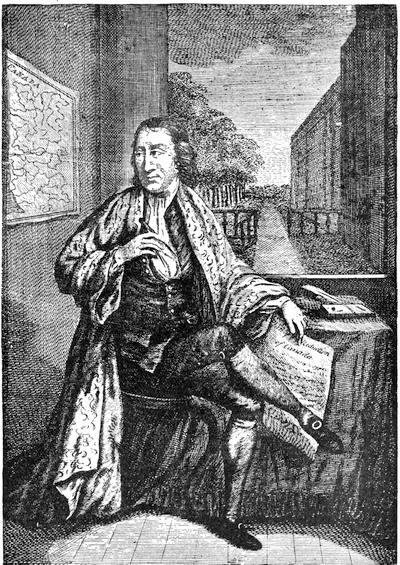
SAMUEL ADAMS, LONDON, 1780.
The year 1768 was one of the most momentous of the Revolutionary period. Hitherto the colonists, in defence of their property, had denied the supremacy of Parliament as based on usurpation; but now, in defence of their privileges, they denied the prerogative of the king, the source of their political existence. This grew out of the Massachusetts Circular Letter. The General Court came together December 30, 1767. John Hancock, James Otis, and Joseph Hawley were prominent members, but though James Otis was still active, Samuel Adams was the master spirit. Never was his practical sagacity more serviceable to the cause; never did his genius for politics shine brighter. His fruitful pen is apparent in the remarkable series of state papers called forth by the Townshend Acts, comprising the letter of the House to their London agent (January 12, 1768), the Petition to the king (January 20), and the Circular Letter to the assemblies of the several colonies (February 11).[86] If the Townshend Acts were to be successfully resisted, union of sentiment and action among all the colonies was essential. This was the object of the circular letter. It was an arraignment of Parliament and the ministry in respect to the revenue acts, and the system by which the British government proposed to make civil officers, including the judges, the instruments for its enforcement; and it solicited an interchange of opinions on these subjects.[87] Governor Bernard watched the proceedings of the House with the deepest interest, nor was he long in doubt as to the nature of the circular letter, for two days after its adoption a copy of it was proffered, in case he desired it.[88] This letter was preceded (besides the documents already mentioned) by letters to the Marquis of Rockingham, General Conway, Lord Camden, and to the Lords Commissioners of the Treasury. The details of these papers cannot be given here. They present the whole case of the colonies, their rights, their grievances, their remonstrances, and their petitions. They proceeded mainly from the pen of Samuel Adams, who, when he had shaken himself clear from profuse professions of loyalty and disclaimers of "the most distant thoughts of independence", rose to the annunciation of the loftiest principles of statesmanship, in the declaration that "the supreme legislative, in any free country, derives its power from the constitution, by the fundamental rules of which it is bounded and circumscribed;"—"that it is the glory of the British Constitution that it hath its foundation in the law of God and nature;"—"that the necessity of rights and property is the great end of government;"—"that the colonists are natural-born subjects by the spirit of the law of nature and nations;" and "that the laws of God and nature were not made for politicians to alter." Nor does he confine himself to the enunciation of abstract principles, but states the rights of the colonists of Massachusetts on historical grounds, and shows the oppressive and impolitic nature of the acts complained of.[89] Changes were taking place in the Grafton ministry which boded evil to the colonies. Shelburne, the most liberal friend of the Americans, was succeeded by Hillsborough in December, 1767, and Conway by Weymouth, January 20, 1768. While the circular letter was on its way to the colonies and to Westminster (for it was intended also for England), events were occurring at Boston which showed the temper of the people, and had no inconsiderable influence upon the action of the British government. The anniversary of the repeal of the Stamp Act, March 18, 1768, did not pass without popular demonstrations of ill-will to the customs officials, nor did the governor escape abusive language from the mob.[90] For some years these officers had been resisted in making seizures of uncustomed goods, which were frequently rescued from their possession by interested parties, and the determination of the commissioners of customs to break up this practice frequently led to collisions; but no flagrant outbreak occurred until the seizure of John Hancock's sloop "Liberty" (June 10, 1768), laden with a cargo of Madeira wine. The officer in charge, refusing a bribe, was forcibly locked up in the cabin, the greater part of the cargo was removed, and the remainder entered at the custom-house as the whole cargo. This led to seizure of the vessel, said to have been the first made by the commissioners, and for security she was placed under the guns of the "Romney", a man-of-war in the harbor. For this the revenue officers were roughly handled by the mob. Their boat was burned, their houses threatened, and they, with their alarmed families, took refuge on board the "Romney", and finally in the Castle. These proceedings undoubtedly led to the sending additional military forces to Boston in September.[91]
The General Court was in session at the time, but no effectual proceedings were taken against the rioters. Public sympathy was with them in their purposes, if not in their measures. But the inhabitants of Boston, in town meeting on the 14th, in an address to Governor Bernard, probably drawn by Otis,[92] among other matters complained of being invaded by an armed force. With grim humor, the address represents the commissioners, who had fled for safety to the Castle, as having "of their own notion" relinquished the exercise of their commission, and expressed the hope that they would never resume it, and demanded of the governor to give immediate order for the removal of the "Romney" from the harbor. Some weeks later (June 30) the Council passed the customary resolution, setting forth "their utter abhorrence and detestation" of the riotous proceedings, and desiring that the governor, through the attorney-general, would prosecute all guilty persons, that they and "their abettors might be brought to condign punishment."[93]
When the circular letter was laid before the ministry, April 15, 1768, it caused great excitement in parliamentary circles, and led to the gravest mistake which was made by the government during the entire Revolutionary period. Other measures, perhaps without exception, had a show of necessity; nor, as the British Constitution was then interpreted by the highest authority, were they clearly unconstitutional. But when the Earl of Hillsborough, speaking for the king, June 21, 1768, required the Massachusetts House of Representatives to rescind their circular letter on pain of immediate dissolution, there was a violation of the constitutional right of the House to express their opposition to measures deemed injurious to their constituents, and to communicate their sentiments to other colonies whose interests were similarly affected. Equally unwise was Hillsborough's letter to the colonial assemblies, requiring them to disregard the Massachusetts circular. Responses to the circular letter, when they expressed the sentiments of the assemblies rather than those of the royal governors, were in full sympathy with Massachusetts.[94] The representatives, says Bernard, "have been much elated, within these three or four days, by some letters they have received in answer to the circular letter",[95] and Hutchinson thought that "the strength which would be derived from this union confirmed many who would otherwise have been wavering."[96] But when Governor Bernard (June 21, 1768) communicated to the House instructions from the king to rescind the circular letter, and recommended immediate action as of important consequence to the province, no doubt it caused anxiety. Under a similar pressure New York had receded. The House apprehended the gravity of the situation, and took seven or eight days for consideration, and even then desired to consult their constituents. But when Bernard informed them that further delay would be considered as a refusal, they voted, 92 to 17, not to rescind, and "the number 92", Hutchinson says, "was auspicious, and 17 of ill omen, for many months after, not only in Massachusetts Bay, but in most of the colonies on the continent."[97] They doubtless were influenced by Otis, who spoke with great power, and, according to Bernard, unsparingly denounced the ministry and "passed an encomium on Oliver Cromwell."[98] Massachusetts deliberately disobeyed the king's command, and defied his power. Before dissolution, the House agreed (June 30, 1768) upon a message to the governor, arguing the question very fully, and declaring their refusal to rescind; a letter to the Earl of Hillsborough; and a Report and Resolves, in which they repeat the story of their grievances, doings, and rights with great fullness and ability.[99]
The effect of this action, so honorable to the House, was unfavorable upon the ministry. De Berdt, the London agent, in a letter to the House, August 12, 1768, giving the substance of a conversation with the Earl of Hillsborough, says that his lordship informed him that he would have used his influence for the repeal of the Townshend Acts, and believed he could have obtained it; but since the news respecting the non-rescinding of the circular letter, the matter was in doubt. "The crown must be supported, or we sink into a state of anarchy."
In July, 1768, General Gage, then at New York, had been directed by the ministry to remove one or two regiments to Boston; and when the news of the riots of March 18 reached England, on August 14, two additional regiments were ordered from Ireland. When rumors of these orders became rife in Boston, there were indications that the country would be raised to prevent the landing of the troops; but different counsels prevailed. A town meeting was held in Faneuil Hall on the 12th and 13th of September, which agreed to call a meeting of the towns.[100] Ninety-six towns and eight districts were finally represented in the convention which assembled at the time appointed (September 22). Their first act was a petition to the governor setting forth their apprehensions in respect to a standing army. This the governor refused to receive, but he expressed his opinion of the unauthorized meeting they were holding, directed them to separate instantly, and threatened to assert the prerogatives of the crown. After a recital of grievances, with declarations of loyalty and promises of assistance to civil magistrates in suppressing disorders, they adjourned on the 29th. Their proceedings were moderate,—a moderation induced, as some supposed, by the arrival at Nantasket, September 28, from Halifax of a fleet of seven armed vessels, with nearly a thousand troops.[101] If contempt of the royal prerogative, after the refusal to rescind the circular letter, could have been more pointedly expressed, it was by holding a provincial convention without sanction of law. Between these measures and April 19, 1775, no step involving a new principle was taken. The burning of the "Gaspee" in 1772 and the destruction of the tea in 1773 were merely the filling in of a picture firmly sketched in outline.
The refusal of the provincial council and of the town to provide for quartering the royal troops on their arrival was a practical nullification of the Mutiny Act, which served still further to strain the relations between Massachusetts and the British ministry. Parliament came together November 8, 1768. Both Houses were swift to condemn the late proceedings of the General Court of Massachusetts and of the town of Boston. On December 15 these acts were made the basis of eight resolutions, introduced by the Earl of Hillsborough, and an address to the king, moved by the Duke of Bedford, to obtain information respecting the actors in the riotous proceedings since December 10, 1767, with a view, if deemed advisable, of ordering their transportation to England for trial. These were passed by the House of Commons (January 26, 1769), after a debate in which the whole subject of American affairs was discussed.[102] The news of these proceedings at first created some uneasiness in Boston among those implicated; but apprehension subsided when it was learned from their friends in England that the voting of Bedford's Address by the two Houses was merely political;[103] that lenient, not rigorous, measures were intended by the ministry; and that the late act laying duties would be repealed. This intelligence reassured the patriotic party, but correspondingly depressed the tories, who saw no hope in the vacillating policy of the ministry.[104] A policy was much needed. Chatham had resigned in October, 1768, and the Duke of Grafton became the nominal, as he had long been the real, head of the ministry. Lord North, Chancellor of the Exchequer, had charge of the revenue. The Duke of Grafton favored the total repeal of the Townshend duties, but Lord North favored the retention of that on tea, as a matter of principle; and so it was decided by a majority of one in the Cabinet Council. Parliament rose May 9, and four days later the Earl of Hillsborough reported to the several colonies the resolutions of the government on the circular letter. Lord Hillsborough's letter gave little comfort to the Massachusetts House of Representatives, whose firmness was commended by Pennsylvania and Virginia, and the threat of transportation of the Bostonians to England for trial under a statute of Henry VIII. called forth from the latter colony vigorous resolutions and an address to the king, May 16, 1769.[105] Jefferson has given the history of these resolutions.[106] This action did not meet the approval of Lord Botetourt, the governor of Virginia, and he dissolved the House of Burgesses. This, however, did not prevent the delegates from meeting at the Apollo, in the Raleigh tavern, and, as citizens, entering into a non-importation agreement which bore the names of Henry, Randolph, Jefferson, and Washington, and became an example to all the colonies.[107] During the remainder of the year 1769 the progress of the Revolution was confined chiefly to Massachusetts, and there it assumed the form of an altercation between the House of Representatives and the governor in respect to the presence of the king's forces.[108] Coming in for their annual session near the end of May, the House, unwilling even to organize in the presence of the military, sent a message to the governor, remonstrating against so gross a breach of its privileges, and requesting him to give orders to remove the standing army, the main guard of which was kept with cannon pointed at the very door of the State House.[109] There was no design in this arrangement, but it was very menacing, nevertheless. For nearly two weeks messages kept passing back and forth, to the purport, on the governor's side, that he had no authority to remove the troops, they being under the commander-in-chief; and on the part of the House, that they would do no business while the troops remained. It occurred to the governor that, if he could not remove the troops, he could remove the General Court; and this he did by directing the secretary to adjourn it to Cambridge. The Court did not appreciate this stroke of humor, and proceeded to business only after a protest of necessity. But Bernard's career was drawing to a close. June 28th he informed the House that the king desired him to repair to Great Britain. July 8th the House passed nineteen resolutions,[110] covering the whole ground of dispute with the home government, and arraigning the governor for various political misdemeanors. They petitioned for his recall; and Governor Bernard left the province, accompanied by the reproaches of the House and manifestations of joy by the people. He did not succeed in a position in which all who had preceded him and all who followed him failed. He could not serve well two masters.
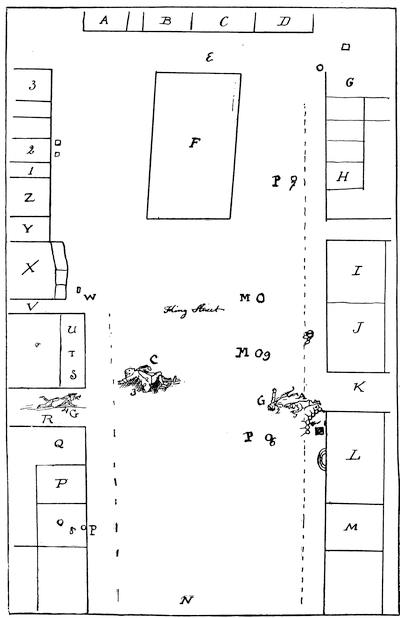
PLAN OF KING STREET AND VICINITY.
Note.—The plan on the following page is a reduction from that used in the trial following the massacre, and was made by Paul Revere. It now belongs to the MS. collections of the writer of this chapter. The key to the letters in the street, a part of the original drawing, is lost. Those attached to the buildings, etc., are substituted for the legends which are in the original, and which would be illegible in the reduced scale of the present reproduction. They signify as follows:—
A, Doctr Jones; B, Doctr Roberts; C, Brigdens, goldsmith; D, John Nazro, store; E, Main Street; F, Town house; G, Brazen Head; H, Benj. Kent, Esq., house; I, Mrs. Clapham; J, Exchange Tavern; K, Exchange Lane; L, Custom House; M, Col. Marshall's house; N, "N.B. The pricked line is the Gutter;" O, Mr. Paine's house; P, Mr. Davis's house; Q, Mr. Amory's house; R, Quaker Lane; S, Warden and Vernon's shop; T, Levi Jening, shop; U, Mr. Peck, wa[t]ch maker, shop; V, Court Square; W, whipping-post; X, J. & D. Waldo, shop; Y, Pudin Lane; Z, G. C. Phillips, house; 1, Ezk. Prince, Esq., office; 2, Guard House; 3, Mr. Bowse, shop.
Revere engraved a large folding picture of the massacre, which appeared in the official Short Narrative, which has been reproduced in the Old State House Memorial (Boston, 1882, p. 82) and in the Mag. of Amer. Hist. (Jan., 1886, p. 9), in an article on Revere by E. H. Goss. A reëngraving of Revere's plate is in the London (Bingley) edition of the same, and on a smaller scale in the other London (Dilby) edition, and this last is reproduced in the Mem. Hist. Boston, iii. 40. Thomas's Mass. Kalendar (1772) has a woodcut representation, after Revere's drawing. Cf. nos. 579 to 583 of the Catal. of the Cab. of the Mass. Hist. Soc.—Ed.
When Sir Francis Bernard[111] sailed for England on board the "Rippon", in August, 1769, he left the administration in the hands of Lieutenant-Governor Hutchinson. For several months nothing of importance took place, except misunderstandings growing out of the non-observance of the non-importation agreements (which were renewed March, 1770), and quarrels between the troops and the populace which resulted in the deplorable scenes of March 5, 1770. The circumstances which led to this affair are too well known to need recital in detail. While the town was occupied by British regiments, collisions were constantly occurring. None knew better than the populace the helplessness of the soldiers to resent insult or injury by arms. Even in case of riots, the reading of the Act and the intervention of the civil power were necessary preliminaries to firing upon the crowd. Nothing but confinement of the soldiers to their barracks could have prevented collisions with the populace. The patriot leaders had determined to get rid of the regiments at all cost. The affair at Gray's wharf on Saturday, March 2, led to the more serious affray on Monday, the 5th. On the evening of that day, between seven and eight o'clock, the cry of fire and ringing of bells drew together a large crowd, which was followed by a collision with the troops, and resulted in the death of three persons and wounding of several others, two mortally. The Boston Massacre soon became known throughout the country, and aroused a spirit of resistance hitherto unfelt. Its immediate effect was the withdrawal of the troops from the town to the Castle, on account of the resolute attitude assumed by Samuel Adams. The men who lost their lives in this affray were buried in one grave, to which they were followed by an immense procession, and for some years the anniversary of their death was observed by commemorative ceremonies. All classes in the community joined in execrating the soldiers, and gave no ear to justifying or mitigating circumstances. Inflamed and grossly inaccurate accounts of the transactions were drawn up and scattered through the colonies and sent to Great Britain. But time somewhat allayed the first feeling of animosity; and when the facts became better known, it clearly appeared that the soldiers had fired, without orders, upon the crowd only when it had become necessary in defence of their lives. Captain Preston (October 24) and the soldiers (November 27) engaged in the affray were brought to trial on a charge of murder, and were all acquitted, except two soldiers who were convicted of manslaughter. These were slightly branded, and all of them were liberated. John Adams and Josiah Quincy, Jr., appeared in their defence, and with equal honor the jurors did their duty in accordance with the law and the evidence. The news of the events of March 5 became known in London April 21, through Mr. Robertson. one of the commissioners of the customs.[112]
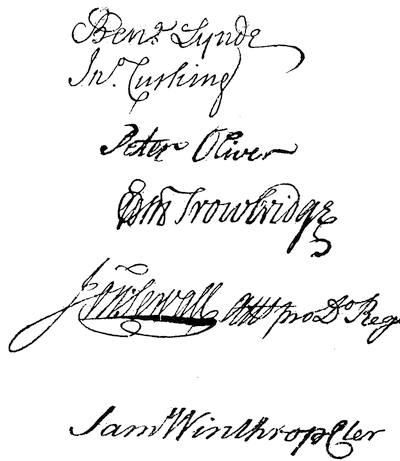
THE COURT AT THE TRIAL
A fac-simile of a group of original autographs belonging to the writer of this chapter. Winthrop was the clerk of the court. The Attorney-General Sewall drew the indictment, but did not appear for the king.—Ed.
The Townshend act, though drawn conformably to the colonial distinctions between internal and external taxes, produced the same dissatisfaction as the Stamp Act had done. There was no real difference. If Parliament could lay external taxes, it could lay internal taxes. Non-importation agreements in the several colonies followed in 1769, and so long as they were observed, even without great strictness, were disastrous to British merchants, the value of whose exports to the American colonies between Christmas in 1767 and Christmas in 1769 fell off nearly £700,000 sterling; or, if we take the figures for those colonies where the agreement was most effective, in New England from £419,000 to £207,000, in New York from £482,000 to £74,000.[113] Though the agreement was not observed equally in all the colonies, nor in entire good faith in any,—Massachusetts and Rhode Island, particularly, suffered some discredit in this respect, as compared with New York and Philadelphia,—the general result seriously alarmed British merchants, who petitioned Parliament for the repeal of the Townshend act.[114] These petitions were considered in the House of Commons March 5, 1770, and Lord North, in accordance with Earl Hillsborough's circular letter, proposed to take off all the duties laid by the Townshend act of 1767, except that on tea, which he would preserve as a sort of declaratory act, especially since the conduct of the Americans had been such as to prevent an entire compliance with their wishes.[115] Governor Pownall offered as an amendment the entire repeal of the act, and supported his motion in an extremely able and interesting speech.[116]
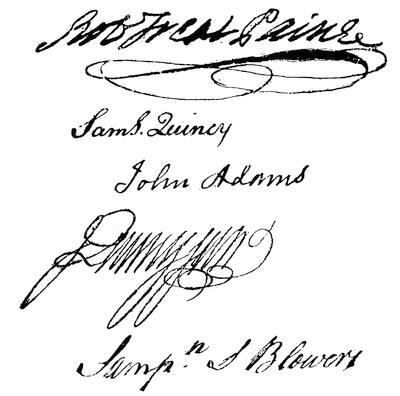
THE COUNSEL OF THE GOVERNMENT AND OF THE ACCUSED
A fac-simile of a group of signatures belonging to the writer of this chapter.—Ed.
Pownall's amendment was lost by a vote of 204 to 142. The merchants failed to procure a repeal of the duties, although Alderman Trecothic made one more effort in their behalf, on the 9th of April, "in a very sensible speech."[117]
When the news of the Boston Massacre reached England late in April, 1770, it recalled attention to American affairs, which, after the defeat of Trecothic's motion, seemed to have been laid aside for the remainder of the session. Trecothic called for the papers.[118] While waiting for them, Governor Pownall made a speech on the "powers of government [which] the crown can and ought to grant to the dependencies of the realm; what form and power of government the British subject in those parts ought to be governed by; what powers are granted, both civil and military; and what arrangements, and means taken, for administering and executing these powers."[119] Burke, in the second of eight resolutions, affirmed "that a principal cause of the disorders which have prevailed in North America hath arisen from the ill-judged and inconsistent instructions given, from time to time, by persons in administration, to the governors of some of the provinces of North America."[120] Later, the same resolutions were brought forward in the House of Lords by the Duke of Richmond. But Burke was not acting in good faith. A close observer wrote at the time: "It is plain enough that these motions were not made for the sake of the colonies, but merely to serve the purposes of the opposition, to render the ministry, if possible, more odious, so that they may themselves come into the conduct of affairs, while it remains very doubtful whether they would do much better, if at all, than their predecessors."[121] This resulted well for the colonies, and, in the long run, for the progress of liberal ideas in both countries. But to those who wished for the continuance of the British connection, and believed in its practicability, it must have been a matter for profound regret that the liberal leaders, from Chatham to Fox, simply found fault with the acts of the ministry, and proposed nothing instead. The ministry, conciliatory to-day and severe to-morrow, had no fixed policy. American affairs gave way to the exigencies of a general election, just as we have lately seen in this country, great interests jeopardized by the unwillingness of both political parties to treat them on the eve of a presidential election. If, instead of this vacillating and inconsistent policy, both parties had given their attention to devising some rational system of colonial administration, as proposed by Pownall,[122] leaving local affairs to the colonists, but placing imperial affairs under a permanent board, not changeable with every ministry, the colonies and the mother-country might have remained united, perhaps for a generation, longer.
The Townshend duties, except those on tea, were repealed in April; but this did not satisfy the colonists, and dissensions arose among the merchants of the several colonies in regard to the non-importation agreement. Those of New York became dissatisfied with Boston and Newport merchants, who had agreed to import non-dutiable articles, even before the news of the repealing act; and in October, 1770, all sections fell into the same plan, but no teas were to be imported. The Sons of Liberty in New York in vain resisted this arrangement.
In Massachusetts the patriots were seldom without causes of just complaint. Governor Hutchinson, in obedience to instructions of General Gage, had delivered (September 10) the keys of Castle William, in Boston harbor, which belonged to the province, to Colonel Dalrymple, who was the servant of the king; and following royal instructions, had refused to convene the General Court at Boston, instead of Cambridge, or to assent to any bill by which the assessors (in 1771) could tax the officers of the crown.[123] These exercises of the royal prerogative, and the payment of the governor's salary by the crown, involved constitutional questions of higher import, as the British Constitution then stood, than the question of parliamentary supremacy, and were matters of unceasing contention. In 1770, Franklin was chosen London agent of the colony, although not without some objection, in the place of De Berdt, recently deceased (May), and Hutchinson was appointed governor in March, 1771.
In 1772, although it was a year of general quiet, two events happened, which, in different ways, promoted the purposes of the more ardent patriots,—the burning of the "Gaspee" at Providence in June, and the formation of committees of correspondence in November. On the 9th of June, Lieutenant Dudingston, commander of the "Gaspee", who had shown great activity in the revenue service at Rhode Island, in undertaking to intercept the "Providence Packet", Captain Lindsay, ran aground on Namquit Point. While in this position, the "Gaspee" was boarded on the following night by a party of citizens led by John Brown, a respectable merchant. In the mêlée the lieutenant was wounded and the vessel was burned. The affair created a great sensation in England, and it was ordered that those engaged in it should be sent to England for trial. For this purpose the home government appointed colonial commissioners, who sat at Newport from the 4th to the 22 January, 1773, to inquire into the matter.[124] At the end of their deliberations they required Wanton, the governor of Rhode Island, to arrest the offenders, for trial in England. He appealed for directions to the Assembly, as did Stephen Hopkins, the chief-justice of the highest court. That body referred the matter to the discretion of the chief-justice, and he accordingly refused to arrest, or to allow the arrest of, any person for transportation.[125] Nothing came of the order except ill-humor in England and indignation in the colonies, where it was regarded as an invasion of their constitutional right of trial by their peers.
Samuel Adams was always busy on political subjects; nor were subjects wanting. The Earl of Hillsborough had been succeeded in the American department (August 4, 1772) by Lord Dartmouth; but the change in administration made no change in the policy of paying the salaries of the provincial judges by the king, and thus rendering them less dependent on the popular will. This was thought to be in derogation of colonial rights, especially so long as the judges held their seats only during the king's pleasure.
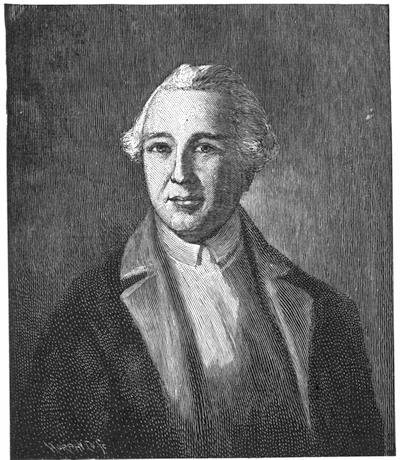
JOSEPH WARREN.
From a pastel owned by the heirs of the late Hon. C. F. Adams. It is unfinished below the chest.—Ed.
Accordingly, a town meeting assembled in Faneuil Hall, October 28, and adjourned November 2d. Samuel Adams moved "that a committee of correspondence be appointed, to consist of twenty-one persons, to state the rights of the colonies, and of this province in particular, as men, as Christians, and as subjects; to communicate and publish the same to the several towns in this province and to the world, as the sense of this town, with the infringements and violations thereof that have been, or from time to time may be, made; also requesting of each town a free communication of their sentiments on this subject."[126] This was the beginning of an organization (November 22), entered into with hesitation by some of the leading patriots of Boston, which finally secured the public confidence, and became a great power for the concentration of popular sentiment.
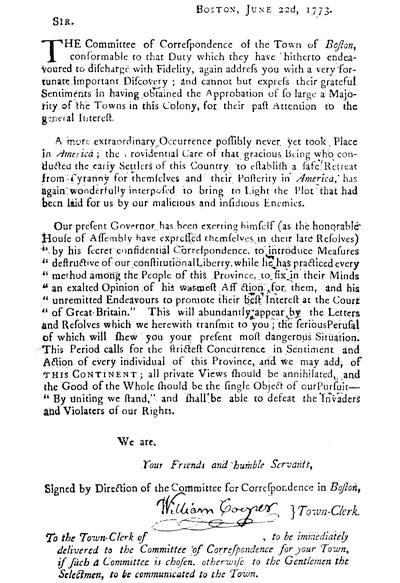
Slightly reduced from an original in the Boston Public Library.—Ed.
It undoubtedly led to the larger measure of intercolonial correspondence instituted by Virginia during the next spring; and not the least of its claims to consideration is the fact that it engaged the attention and secured the services of Joseph Warren as the trusted lieutenant of Samuel Adams.[127]
The American Revolution rests upon grounds so high and clear, and was carried forward by measures so honorably conceived and so persistently adhered to, that all who adopt its principles must regret any circumstance in its history by which the opinion of candid people is divided. Such a division is found in connection with the Hutchinson letters. The story is briefly this:—In the years 1768 and 1769 Thomas Hutchinson and Andrew Oliver, then officers in Massachusetts, appointed by the crown, and sworn to a faithful discharge of their duties, with several other persons, in a private correspondence with Thomas Whately, an English gentleman, formerly, but not then, connected with the government, communicated facts about colonial affairs the truth of which has never been impugned, and expressed opinions which Tories might honestly entertain. These letters in some unexplained manner found their way—either from the cabinet of the person to whom they were addressed, after his death, or, as is more likely, from the papers of George Grenville, to whom Whately had probably entrusted them for perusal—into the hands of Franklin, the colony agent in London, by whom they were sent in 1773, with an unsigned letter, to the speaker of the Massachusetts House. The injunctions in respect to them were loosely regarded, and they were published by a breach of faith which implicated a large body of men. They were made the basis of a petition by the General Court to the king for the removal of their writers from the offices which they held; but after a hearing before the Privy Council, January 29, 1774, the petition, which the province did not attempt to support by evidence, was dismissed as "groundless, vexatious, and scandalous." Two days later, Dr. Franklin was removed from the office of deputy postmaster-general for the colonies,—a circumstance of great consequence to the American cause, since it irrevocably committed to it one who had been thought its lukewarm promoter.
Massachusetts, which had led in most of the Revolutionary movements, did not take the lead in establishing committees of correspondence between the colonies. That honor belongs to Virginia; and its chief cause was the action of the commissioners in the "Gaspee" case. March 12, 1773, Dabney Carr, who had been put forward at the suggestion of Jefferson, moved certain resolutions in the Virginia House of Burgesses, which, supported by Richard Henry Lee and Patrick Henry, were unanimously adopted. Rhode Island followed in adopting similar measures. On May 28th the Massachusetts House responded to Virginia.[128] Hutchinson justly considers this as one of the most important and daring movements of the patriotic Party during the Revolution.[129] It paved the way for the union of the colonies and for the General Congress which was convened at Philadelphia the next year.
To the patriots of Philadelphia belongs the credit of making the first public demonstration against the project of the East India Company for transporting their accumulated stock of tea to America, in a series of resolutions passed October 18, at a meeting held in the State House.[130] News of the intention of the company to do this had reached America in August. Samuel Adams was ready. The towns in the province of Massachusetts were aroused by Joseph Warren's circular letter in behalf of the Committee of Correspondence, September 21, 1773, and the Philadelphia resolutions were adopted in Faneuil Hall. Constant communications were kept up between the importing colonies. Ships loaded with tea were dispatched about the month of August to Boston, New York, Philadelphia, and Charleston, but the tone of the public press in those towns indicated a determination not to allow the sale of the cargoes. The Charleston consignees, on the request of the people, resigned; those at Boston refused. November 28, one of the tea ships arrived in Boston, followed not long after by two more. These were placed under guard by the patriots. The consignees would neither resign nor return the tea, and the time was near at hand when they would be seized for non-payment of duties. Thursday, December 16, a large meeting of the citizens was held at the Old South Church, at which Josiah Quincy, Jr., spoke in words that have become historical. After all efforts to induce Hutchinson to grant a pass for the return of the tea (which he thought would be illegal) had proved futile, a war-whoop was sounded at the door of the Old South, and a large company of men disguised as Indians rushed to Griffin's wharf. Teas to the value of £18,000 were thrown from the vessels into the sea, and the same treatment was bestowed upon another cargo which came some weeks later. This act, although applauded throughout the colonies, was not imitated by them; other means were found to prevent the sale of the teas.[131]
While the news of these events was on its way to England, John Adams signalized his zeal in the patriotic cause and evinced his faith in the provincial constitution by leading in the impeachment of Chief-Justice Oliver for having accepted his salary from the crown instead of the people, in derogation of their fundamental rights.[132]
Governor Hutchinson, finding himself powerless to quell the storm, determined to put himself in closer communication with the ministry by going to England, but was delayed by the death of Lieutenant-Governor Oliver, until he was finally superseded by General Gage, who arrived in Boston May 13, 1774. As he was about to leave, he received an address, dated May 30, approving his conduct, and signed by many respectable Tories; but some of them were afterwards obliged by threats of popular violence to make their recantations in the newspapers. June 1, he sailed from Boston, and never saw his native shore again.[133] In the mean time an account of the destruction of the teas had reached England, and produced great indignation, which was shared to some extent by the most ardent friends of the colonists, whose efforts to mitigate and delay the punishment visited upon the offending people of Boston were unavailing. On the 7th of March, the king sent a message communicating the despatches from America; and on the 14th Lord North brought in the Boston Port Bill, which transferred the commerce of Boston, after the 1st of June, to Salem, but gave power to the king, in council, to restore it, upon the return of order and full compensation to the owners for the teas destroyed. Having passed both Houses, this received the king's assent March 31, and took effect June 1. While the measure was pending in the House of Lords, Lord North introduced another bill, which provided for the appointment of councillors by the crown, the appointment and removal by the governor of judges of the superior courts, justices of the peace, and other minor officers, and, with the consent of the council, of sheriffs. The governor's permission was made necessary for the holding of town meetings, except for the choice of officers. It was also provided by another act that offenders and witnesses might be transported for trial to the other colonies, or to England.[134]
These severe measures did not pass without resistance or protest by the liberal party in Parliament. They reached Boston June 2, 1774, were printed in the newspapers on the 3d, and soon found their way into all the colonies, where they excited indignation against the ministry and sympathy for the people of Boston, which was manifested by liberal contributions for relief when afterwards the loss of business had brought distress. If anything more was needed to arouse the anger of New England, it was supplied by the Quebec Bill, less objectionable to that section because it extended the bounds of Canada over regions for which the colonies had contended, than because it perpetuated civil and ecclesiastical institutions hateful to the descendants of Puritans. Hutchinson thought that these severe measures would bring the recalcitrant Bostonians to reason. But he was mistaken. The matter had already passed from the forum of reason, and was reserved for the arbitrament of impending war. Instead of being subdued, the spirit of the people became more resolute.
The Boston Port Bill, designed as a punishment for the destruction of the tea, brought ruin to the commerce of Boston, and distress to all whose subsistence depended upon it; but its political effect was to draw the colonies together, and that was so effectually promoted by the vigorous action of the committee of correspondence that the idea of a continental congress soon became general.
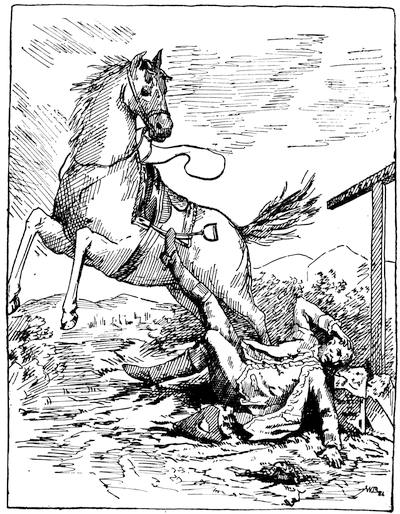
A CONTEMPORARY PRINT.
Sketched from a finely executed mezzotint, published in London in 1774. The man thrown from his horse seems to be Gage. The original belongs to the Boston Public Library.—Ed.
On May 26, 1774, Governor Gage informed the General Court that by the king's command its sessions would be held at Salem from June 1st until further orders. The court was convened at that place, and the patriots, guided by Samuel Adams, were making arrangements for a general congress at Philadelphia, when the governor, getting a hint of their action, sent Flucker, the provincial secretary, with a message to dissolve them. The secretary, however, found the door of the chamber of the Representatives locked; and before it was opened, that body had determined that "a committee should be appointed to meet, as soon as may be, the committees that are or shall be appointed by the several colonies on this continent, to consult together upon the present state of the colonies", and had chosen James Bowdoin, Samuel Adams, John Adams, Thomas Cushing, and Robert Treat Paine delegates thereto. Such was the origin in Massachusetts of the first Continental Congress which met at Philadelphia September 5, 1774.[135]
The 17th of June, the day on which delegates to the Continental Congress were chosen, is also notable for "the Port Act" meeting in Faneuil Hall. From the general distress among the laboring classes in Boston the Tories had expected a reaction in favor of the ministry; consequently a counter demonstration by the patriots was deemed advisable. In the absence of Samuel Adams, then at Salem, John Adams was chosen moderator, and from this time he was one of the most conspicuous actors in the American Revolution. Joseph Warren was also present, and active in the cause which, a year later, he consecrated with his blood. The action of the town became widely known from a broadside, which is here reproduced.
After the repeal of the Stamp Act and the modifying of the Townshend act, there remained nothing to threaten seriously the pockets of the colonists. The tea duty had been retained to save the claim of parliamentary supremacy, which was not likely to be asserted in any offensive way. The navigation acts must soon have given way to a more liberal and equitable policy, and everything out of Massachusetts—certainly out of New England—indicated that the people were becoming tired of strife, and were ready for a return to more cordial relations with the mother country. This was what Samuel Adams feared, and determined to prevent. To this end nothing could have been more efficient than his policy in respect to the teas, and nothing more to his mind than the consequent action of Parliament. After this a contention which had been mainly local became general. The essential modification of the Massachusetts charter was a blow which imperilled every colonial government, and made the cause of Massachusetts that of every other colony,—a cause for which other colonies manifested their sympathy not only in relieving the distress occasioned by the closing of the port of Boston, but by uniting in declarations of their common right to maintain the integrity of a system of government which had been forming through many generations.
The Congress of 1774 was the inevitable result of the conduct of the British ministry subsequent to the peace of 1763. This served only to engender discontent in the colonies, and to strengthen the purpose of the patriotic party to hasten a revolution which many regarded as inevitable in time. The parliamentary government of the colonies fell into confusion for want of a well-defined policy and a consistent administration. But instead of such a policy, colonial affairs were regulated by ministers as wide apart in their views as Grenville, Rockingham, Townshend, Grafton, Shelburne, Hillsborough, Lord North, and Earl Dartmouth. Nothing could have kept the colonies as an integral part of the empire except some plan such as Franklin or Pownall might have devised and Shelburne might have administered. But the colonies were remote and but little known, and in the complication of European affairs, and amid the contentions of parties, they received only slight and intermittent attention from the ministry or the Parliament. No statesman save Choiseul seems to have understood the completeness of the change in interests which had been brought about by the extinction of the French power in America, or the necessary advance of the colonies under a new régime to a place among the great powers of the world. The colonists themselves felt, rather than understood, their relations to nationality and to the commerce of the world. This was the time chosen by the British ministry to impose upon them the restrictive mercantile system of Charles II.
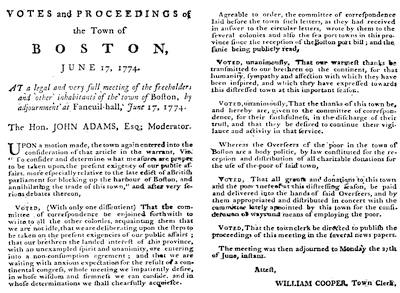
BROADSIDE, JUNE 17, 1774.
The original is in the Boston Public Library. There are other significant broadsides of about this time. On June 8th, the citizens of Boston issued an address to their countrymen relative to the blockade of their port, and on July 26th they adopted a letter on the blockade, which was sent to the several towns,—both in broadside.—Ed.
It is doubtful, however, whether any policy could have rendered permanent the subjection of the colonies, even such a nominal subjection as that in which they had always been held. In looking for the causes of the Revolution, it is well to discriminate between those which were general in their effects and those which were local. The latter had been more actively operative and of longer existence in Massachusetts, where the Revolution began, than in any other colony. These were interwoven with the civil and ecclesiastical history of her people, which made them peculiarly apprehensive in respect to threatened invasion of rights which they had secured only by expatriation. Although the peculiar experience of Massachusetts did not cause the Revolution, it is doubtful whether, except for that experience, the Revolution would have occurred for some years. Nor was resistance to the Anglican ecclesiastical pretensions, connected as they were with the most odious features of the prerogative, confined to New England, but made itself felt in New York and in Virginia.[136] The general causes were the ever present and ever active strife between parties,—the liberals and the conservatives,—arising from a diversity of political ideas, and intensified by ambition, interest, and personal animosities. But the proximate causes of the Revolution will be found in that change of policy which led the ministry, at the close of a war that had strained the colonies to the utmost, to enforce the navigation laws, to lay taxes, to invoke the prerogative, and finally to overthrow the government of Massachusetts, and thus to threaten the autonomy of the people under the provincial constitutions.

CRITICAL ESSAY ON THE SOURCES OF INFORMATION.
THE change in British colonial policy contemplated by the ministry during the progress of the French War, and entered upon between 1763 and 1774, developed those causes of dissatisfaction which had been intermittently operative for more than a century, and finally led to war in 1775. In the preceding chapter I have omitted, or passed lightly over, many incidents of the period which had no particular political significance, and dwelt more at length on the principles and causes which led to the Revolution. I shall pursue the same course in this essay.
The growth and development of the colonies brought forward, in succession, two practical questions. The first was, how far the interests of the colonies, as appendages to the crown, but subject, nevertheless, to an undefined parliamentary authority, could be subordinated to the interests of the trading and manufacturing classes in England. This was purely an economic question, and the answer to it in England assumed the subjection of the colonies and the validity of the mercantile system, neither of which was vigorously contested by the colonists so long as neither was rigidly enforced. But the question changed during the progress, and more especially at the close, of the French War, and then became this: How far could the interests of the colonies be subordinated to the necessities of an imperial revenue and the political policy of an empire? Hence arose the second question: What degree of autonomy could be allowed to the colonies, as integral parts of the empire, entitled to its privileges and subject to its burdens, when both were to be determined consistently with the constitutional prerogatives of the king and the supremacy of Parliament on the one side, and on the other with the natural and acquired rights of the colonies?
Regarded purely as an economic question, it was a matter of indifference to the colonists whether their pockets were depleted by the enforcement of an old policy or by the adoption of a new policy. The Sugar Act of 1733, if enforced, would have produced a parliamentary tax. The Grenville Act of 1764 did no more. But the former was intended as a regulation of trade; the latter to produce a revenue. This difference of intent raised a constitutional question, and it was on this constitutional question, behind which lay the real economic question, that the patriotic party chose to fight the battle. Grenville's Act, as an external tax, produced but little; and the Stamp Act, as an internal tax, not a farthing.
It was, therefore, mainly on the constitutional question—of the right to tax, rather than to throw off intolerable burdens—that people divided into parties. As Webster said, "They went to war against a preamble. They fought seven years against a declaration."[137] To understand the attitude of the tories on the economic question as well as on the constitutional question, we must consider the state of colonial affairs which led to the Congress of 1754, and the tentative efforts of that body to find consistent and reciprocal relations of the colonies to the imperial government, for union, defence, and revenue. To understand the attitude of the patriots, we must consider the reasons of the ministry for rejecting such a union, and their efforts to force each colony into relations to the crown and Parliament deemed by them consistent and reciprocal, but regarded by the colonists as subversive of their rights as Englishmen, and of their rights acquired by charters, growth, development, and usage, which, as they justly claimed, had become constitutional.
Though the enforcement of the navigation laws and acts of trade, at the close of the French War, is regarded by historians as one of the principal causes of the Revolution, I fail to find a satisfactory or entirely accurate account of them, either as the basis of the mercantile system, or, later, of a revenue system. Such a treatment would hardly be practicable in the limits of a general history. These laws have been elaborately discussed by Thomas Mun, Sir Josiah Child, Sir William Patty, Charles Davenant, Joshua Gee, John Ashley, and, not to mention others, Adam Smith and Henry Brougham. But these authors wrote with reference to their influence, as part of the mercantile system, on British interests. How they affected colonial interests is the question which chiefly concerns us.
To answer this question we must know not merely what those laws enacted, but to what state of colonial trade they originally and successively applied. For instance, what, from time to time, by development of agricultural or other industries, between 1640 and 1774, had the colonists to sell, and what, as they increased in wealth, did they wish to purchase; and where, left to the unrestricted course of trade, would they have carried their products, and where purchased their merchandise? In other words, what would they have done and become under free trade?
Then we must know what changes in this normal condition of trade were intended by the navigation laws, and to what extent and with what effect their partial enforcement operated before 1763. With these facts before us, we could estimate with some exactness the valid objections to the new system on the part of the colonists, when enforced by the British navy, commissioners of customs, admiralty courts, and writs of assistance, and what was their influence in bringing on the Revolution.
Having made up the debit account, we should be able to set against it the compensations in naval protection, bounties,[138] drawbacks, British capital, and long credits, in developing colonial agriculture and commerce.[139]
Unfortunately there does not exist any history of the commerce of the American colonies, from the Commonwealth to 1774, as affected by navigation laws, acts of trade, and revenue measures. No one who has read the twenty-nine acts which comprise this legislation will recommend their perusal to another; for, apart from their volume, the construction of these acts is difficult,—difficult even to trained lawyers like John Adams, whose business it was to advise clients in respect to them.[140] Nor have special students, like Bancroft, stated their effect with exact precision, as in respect to the Act of 1663;[141] and notably in respect to the Townshend Act of 1767,[142] where his error amounts to a perversion of its meaning. Palfrey has been more successful, though not entirely free from error.[143] The author of the Development of Constitutional Liberty,[144] a work of uncommon research and ability, reads the act of 1672 as though it prohibited the carrying of fish from Massachusetts to Rhode Island except by the way of England, failing to notice that it was not one of the "enumerated articles", or that even those could pass directly from colony to colony upon payment, at the place of export, of duties equivalent to those laid upon their importation to England. To give a monographic treatment to the subject would require familiarity with the construction of statutes, and exact information not only of the shifting conditions of colonial trade, but of the evasions which called forth supplemental acts, or constructions of existing acts by the Board of Trade.[145]
In Burke's Account of the European Settlements in America[146] much may be found respecting colonial products and commerce, and especially those of New England (in ch. vii.), which leaves little to be desired concerning the sources of her wealth, and the complaints of British merchants of the methods by which it had been acquired. But I have found nowhere else so full and clear an account of the course of trade of Boston at the time of the Revolution, and the effect upon it of the enforcement of the navigation laws and acts of trade in 1770, as in an anonymous pamphlet entitled Observations of the Merchants at Boston in N. E. upon Several Acts of Parliament, 1770.[147]
An essential part of this history is that which relates to the medium of exchange, and to the attempts of Parliament to regulate the issue of paper money as a legal tender in the interests of British merchants.[148]
The history of the navigation laws suggests the similarity of the causes which led to the successive revolutions of 1689 and 1775 in Massachusetts. The violation of these laws was a principal reason for the abrogation of the first charter, in 1684, graphically described by Palfrey,[149] and their enforcement by courts of admiralty, under Dudley, Andros, and Randolph, was one cause of the overthrow of the Andros government in 1689.[150] The resistance to the same and additional enactments, when enforced as revenue measures, led to the alteration of the second charter in 1774, and this again led to revolution by the united colonies.
One of the most efficient instruments in the execution of the navigation laws was the writs of assistance granted by the court in Massachusetts in 1761.[151]
If the student of American history finds difficulty in accepting the common accounts of the constitutional opinions and motives of two fifths of the colonists, among whom were many who must be regarded as intelligent and respectable, his doubts as to the accuracy of these narratives receive some confirmation when he becomes familiar with the history of the Congress of 1754, the circumstances which led to it, and the opinions of some of its representative men. A comparison of their views will show how far they were willing to go in the "abridgment of English liberties", for the sake of union, defence, and government. Franklin, Hutchinson, and Pownall formed plans for union, and all were at Albany in 1754, and participated in the discussions, though Pownall, not being a member, explained his views outside the congress.[152]
The difference between Pownall, Hutchinson, and Franklin was this: that while all contemplated the union of the empire under one general government as something dictated by the interest of all the parts, Hutchinson limited the power of the President more than Franklin, and Pownall was unwilling to contemplate the transfer of its seat to America; the prospect of which gave Franklin no concern. "The government cannot be long retained without union. Which is best, to have a total separation, or a change of the seat of government?"[153] Speculations as to the results of such a union are now idle, unless for the interest drawn towards them by Professor Seeley's Expansion of England, and Franklin's belief, expressed in 1789, "that if the foregoing plan [that of 1754], or something like it, had been adopted and carried into execution, the subsequent separation of the colonies from the mother country might not so soon have happened, nor the mischiefs suffered on both sides have occurred, perhaps, during another century."[154]
A comparison of the views of such men as Franklin, Hutchinson, and Pownall, expressed before they were forced into partisan relations to the impending conflict, help us in forming opinions respecting their conduct when affairs, no longer within the control of individuals, were swept onward by an uncontrollable impulse. Neither the colonies[155] nor the ministry approved of the proposed union; and when the new policy of raising a revenue was inaugurated the colonies were without defined integral relations to the mother country, and the government without administrative machinery for their regulation. The result was confusion. The press became heated, and an angry war of pamphlets ensued. At first the controversy was confined to the distinction between internal taxes and commercial regulations, but soon it involved the whole question of parliamentary power. This was elaborately and temperately discussed in the Farmer's Letters, by John Dickinson, but nowhere in America with more fulness (within the period covered by this chapter) than by Governor Hutchinson and the two Houses of the Massachusetts General Court, in messages and answers respectively, in January and February, 1773.[156]
So far as the Revolution grew out of the Massachusetts controversy between the king's representatives and the General Court, its progress may be traced in the Speeches of the Governors of Massachusetts, 1765 to 1775, and the Answers of the House of Representatives to the same.[157] These authentic documents, with the Journals of the House and the Records of the Town of Boston, may be referred to as showing the temper with which the parties treated each other, and the questions that were of paramount interest. The student will not find it easy to ascertain the facts which should make the history of the period. Contemporaneous accounts were generally drawn up with a partisan disregard of truth, and too much has been written subsequently in the same spirit. For the critical period of 1768, when the troops were sent over on account of the revenue riots, we have Bernard's Letters, which, though representing only one side, were written under a sense of official responsibility to the government. Though much complained of at the time as wanting in candor, their statements were evaded rather than controverted by the Answer of the Major Part of the Council, in a letter to the Earl of Hillsborough (April 15, 1769), as well as in The Vindication of the Town of Boston (Oct. 18, 1769), drafted by Samuel Adams. For the entire period covered by this chapter, I find no narrative apparently more just, or opinions more candidly expressed, than in Ramsay's History of the American Revolution. Remote from the scene of the conflict, Ramsay shared the passions of neither party.
The most important events of this period were the passage of the Boston Port Bill, and other related measures. The reasons which led to these acts are set forth at length in The Report from the Committee on the Disturbances in the Colony of Massachusetts Bay, April 20, 1774.[158] In this report may be seen the strength of the British case. Franklin's view of the matters referred to in the Report of the Lords may be found in a paper entitled Proceedings in Massachusetts,[159] and the bill itself was discussed in an interesting pamphlet by Josiah Quincy, Jr., Observations on the Act of Parliament.[160]
Franklin's paper was a clever argument in which he treated facts so as to serve his purpose rather than that of historic truth. His use of Oliver's phrase, "to take off the original incendiaries", which was a pleasant ad hominem hit, has been adopted seriously by Bancroft,[161] in a chapter entitled "A Way to Take off the Incendiaries." The concessions which Franklin was willing to make for a settlement of the difficulties, as late as December 4, 1774, may be seen in "Some Special Transactions of Dr. Franklin in London, in Behalf of America", in Ramsay.[162]

EDITORIAL NOTES.
The argument of Otis on the Writs of Assistance is the first well-arranged expression of the gathering opposition,[163] and what John Adams called "the heaves and throes of the burning mountain", forerunning the eruption, were shown in James Otis's A vindication of the conduct of the House of Representatives of the province of the Massachusetts-Bay; more particularly, in the last session of the general assembly (Boston, 1762).[164]
John Dickinson and Joseph Galloway were already pitted against each other on the question of maintaining the proprietary government of Pennsylvania, or of seeking a royal one.[165]
Frothingham[166] says the earliest organized action against taxation was when the town of Boston passed instructions to its representatives, May 24, 1764, the original writing of which is among the Samuel Adams MSS. The paper was printed in the newspapers of the day, and shortly afterwards in the famous tract of Otis, The Rights of the British Colonies asserted and proved,[167] in which, however, he failed, with all his fervid and cogent reasoning, to stand in every respect by the advanced position which he had taken in his plea against the Writs of Assistance.[168]
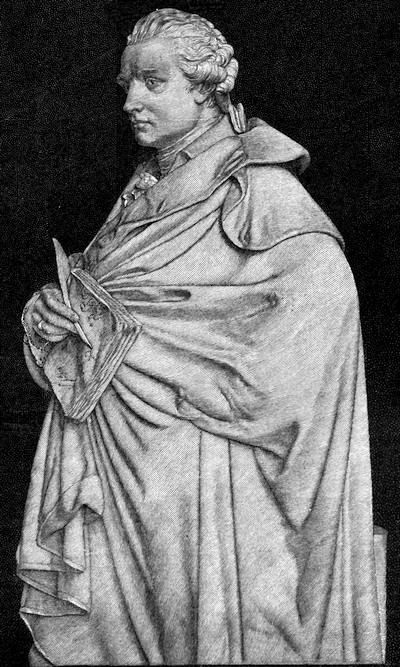
JAMES OTIS.
After a statue of James Otis, by Crawford, in the chapel at Mount Auburn. The usual portrait of Otis is by Blackburn, painted in 1755, and now owned by Mrs. H. B. Rogers. The earliest engraving of it which I have noticed is by A. B. Durand in Tudor, and again in the Worcester Magazine (1826), vol. i. It has been engraved by W. O. Jackman, J. R. Smith, O. Pelton, and best of all by C. Schlecht, in Gay's Pop. Hist. U. S., iii. 332. Cf. Loring's Hundred Boston Orators, and the woodcut in the Mem. Hist. Boston, iii. 6. The earliest engraved likeness is probably a rude cut on the title of Bickerstaff's Almanac (1770), which is reproduced in Lossing's Field-Book of the Rev., i. 486.
There is a photograph of the house where Otis was killed by lightning (May 28, 1783) in Bailey's Andover, p. 86. Cf. Appleton's Journal, xi. 784. The principal detailed authority on the career of Otis (born, 1724; died, 1783) is William Tudor's Life of James Otis, which Lecky, in his England in the Eighteenth Century (iii. 304), calls "a remarkable book from which I have derived much assistance." Francis Bowen wrote the life in Sparks's Amer. Biog., vol. xii. John Adams had an exalted opinion of Otis, and Otis's character receives various touches in Adams's Works (x. 264, 271, 275, 279, 280, 284, 289-295, 299, 300). Bancroft depicts him in 1768 (vol. vi. 120, orig. ed.), but he failed rapidly later by reason of the blows he received in an assault in Sept., 1769, provoked by him. Cf. Greene's Hist. View (p. 322); D. A. Goddard in Mem. Hist. Boston (iii. 140); Barry's Mass. (ii. 259).
One of the ablest as well as one of the most temperate expressions of the stand taken by the colonies was in Stephen Hopkins's Rights of the Colonies examined; published by Authority (Providence, 1765).[169]
Similar arguments were set forth in behalf of Connecticut by its governor.[170]
Already, in 1764, when Oxenbridge Thacher printed his Sentiments of a British American, he had formulated the arguments against the navigation acts and British taxation, which ten years later, in the Congress of 1774, Jay embodied in his Address to the British People.[171]
John Adams, in later years, when distance clarified the atmosphere, looked upon the conflict which Jonathan Mayhew waged with Apthorpe, and with the abettors of all schemes for imposing episcopacy on the people by act of Parliament, as the repelling of an attack upon the people's right to decide such questions for themselves, and as but a forerunner of the great subsequent question.[172]
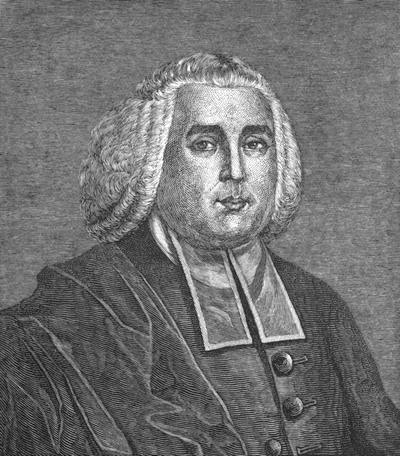
JONATHAN MAYHEW.
Copied from a mezzotint engraving in the American Antiquarian Society's possession, marked "Richard Jennys, jun., pinxt et fecit."
A portrait by Smibert, and engraved by J. B. Cipriani, is in Hollis's Memoirs (1780), p. 371; and a reëngraving has been made by H. W. Smith. Cf. Bradford's Life of Mayhew; Thornton's Pulpit of the Rev.; Mem. Hist. of Boston, ii. 245, with note on his portraits.
The principal source of detailed information about Mayhew is Alden Bradford's Memoir of the life and writings of Jonathan Mayhew (Boston, 1838). Cf. Tudor's Otis (ch. 10); Thomas Hollis's Memoirs; Tyler's Amer. Lit. (ii. p. 199); touches in John Adams's Works (iv. 29; x. 207, 301); and on his death, Dr. Benjamin Church's Elegy, Dr. Chauncy's discourse, both in 1766, and the Life of Josiah Quincy, Jr., p. 384.
The issue on the question of taxation without representation was forced, after many indications of its coming,[173] when the British Parliament passed the Grenville Act in 1764, and in the next year what is known as the Stamp Act, a tax on business papers, increasing their cost at different rates, but sometimes manyfold.[174] The question of the authorship of the bill is one about which there has been some controversy,[175] and, contrary to the general impression, the truth seems to be that the consideration of the bill caused little attention in and out of Parliament, and the debates on it were languid.[176]
In May a knowledge of the passage of the Stamp Act reached Boston,[177] and it was to go into effect Nov. 1st. In June the Massachusetts legislature determined to invite a congress of all the colonies in October. In August it was known that Jared Ingersoll for Connecticut and Andrew Oliver for Boston had agreed to become distributors of the stamps. The mob hanged an effigy of Oliver on the tree afterwards known as Liberty Tree,[178] and other outrages followed. The governor did not dare to leave the castle. Dr. Mayhew delivered a sermon, vigorous and perhaps incendiary, as Hutchinson averred when he traced to it the passions of the mob which destroyed his own house in North Square on the evening of August 26th.[179] The town contented itself with passing a unanimous vote of condemnation the next day.[180] On Sept. 25th Bernard addressed the legislature in a tone that induced them to reply (Oct. 25th), and to fortify their position by resolves (Oct. 29th).[181] Finally, in December, Andrew Oliver,[182] the stamp distributor, was forced to resign, and on the 17th to sign an oath that he would in no way lend countenance to the tax.[183]
The spirit in Boston was but an index of the feelings throughout all the colonies.[184] The histories of the several States and the lives of their revolutionary actors make this clear.[185]
In October, 1765, what is known as the Stamp Act Congress assembled in New York, in the old City Hall.[186] Its proceedings are in print, and its deliberations are followed in the general histories and in the lives of its members.[187]
Franklin had, with considerable opposition, been appointed the London agent of Pennsylvania in 1764, and, being in that city, was accused by James Biddle of promoting the passage of the Stamp Act, but his letters show how he seems only to have yielded when he could not prevail in opposing.[188]
In July, 1765, the Rockingham administration came in, followed by the parliamentary sparring of Grenville and Pitt. In February, 1766, Dr. Franklin was examined before the House of Commons as to the temper of the colonies respecting the Stamp Act. He gave them some good advice,[189] and a full report of the questions and answers is preserved.[190] Parliament having passed the so-called Declaratory Act (March 7th) in vindication of its prerogatives, Pitt and Conway effected the repeal of the Stamp Act (March 18th), and vessels immediately sailed to carry the news to the colonies.[191] The whole question of taxation, thus brought squarely to an issue by the controversy over the Stamp Act, induced frequent rehearsals of argument in debates and pamphlet, and the later historians have summarized the opposing views.[192]
Josiah Tucker, the Dean of Gloucester, began in 1766 a series of tracts, which he continued for ten years, in which he advanced sentiments respecting the colonies, not very flattering, while at the same time he held to arguments which few at the time admitted the force of, when he advocated the peaceful separation of America from the crown.[193]
The most important presentation of the Tory insistence in defence of the Stamp Act policy came directly—or, at least, through his secretary, Charles Lloyd—from Grenville himself, in his attack on the Rockingham party, in the Conduct of the late Administration examined, with Documents.[194]
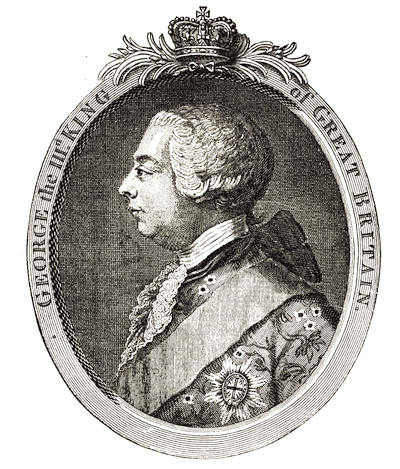
GEORGE THE THIRD.
Reproduction of a print in Entick's General Hist. of the Late War (3d ed., 1770), iv. frontispiece. A profile likeness, showing the king in armor, is in Murray's Impartial History of the present War in America, (London, 1778).
The movements for organization to suppress importation, which had begun in 1765, taking shape particularly in Philadelphia in Oct. and Nov.,[195] were brought into definite prominence by the votes of Boston, Oct. 28, 1767,[196] copies of which were circulated in broadside, as shown in the annexed fac-simile.[197] The influence of these had more marked effect in England than had followed any previous manifestations of that kind.[198]
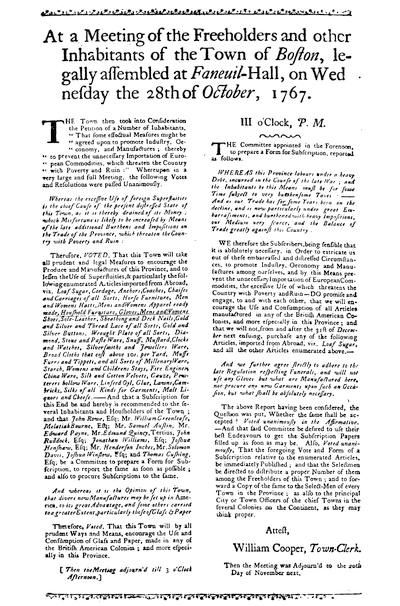
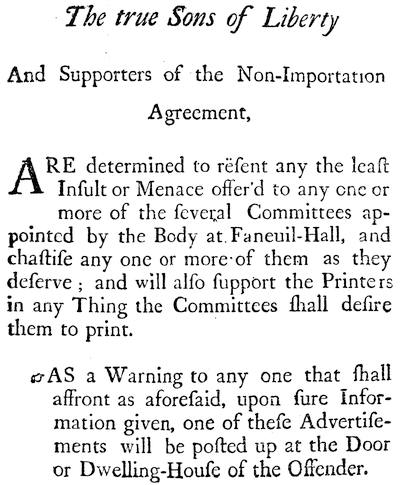
HANDBILL
Copy of a broadside in the library of the Mass. Hist. Society.
Some other fac-similes are also given indicative of the prevailing coercive measures, which soon became popular. The next year (1768) committees were appointed in New York to consider the expediency of entering into measures to encourage industry and frugality and to employ the poor, and by 1769 the movement looking to independence of the British manufacturers became general through the colonies.[199]
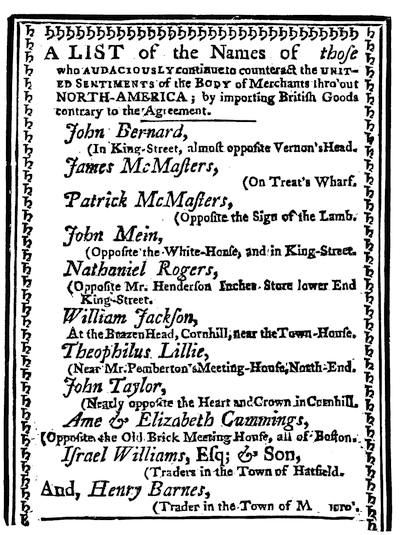
FROM EDES AND GILL'S NORTH AMERICAN ALMANACK, 1770.
In February, 1768, the Massachusetts House of Representatives, by a circular letter addressed to the other colonies, invited them to consultation.[200] It drew from Hillsborough a circular letter of warning to the continent,[201] and in May Virginia issued a letter inviting a conference.[202] On June 10, 1768, the seizure of the sloop "Liberty" brought further riotous proceedings in its train.[203]
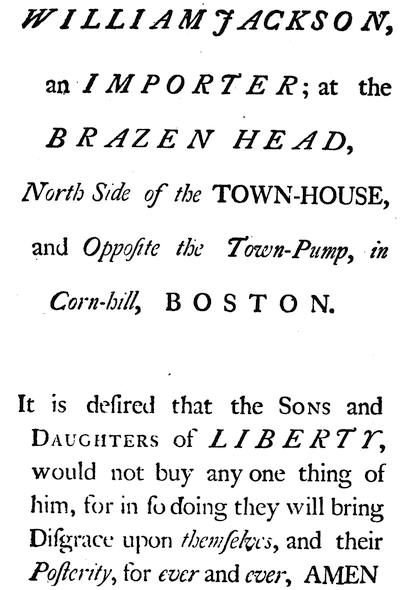
PROSCRIBING AN IMPORTER.
After an original handbill in the Mass. Hist. Soc. library.
What is known as the "War of the Regulators", or "Regulation", a series of riotous disturbances in North Carolina, 1768-1771, has usually been held to be one of the preliminary uprisings against British oppression. A. W. Waddell, in a paper in the N. E. Hist. and Geneal. Reg. (1871, p. 81), contends that it was nothing but a lawless outburst, and advances evidence to prove that the participants were but a small majority of the people, with no great principle in view; that they were ignorant, never republicans, became Tories, and were opposed by the prominent Whig leaders. He considers that Caruthers and other local historians[204] are responsible for the common misconception arising from their attempt to reflect credit on North Carolina for what is claimed to be an early patriotic fervor.
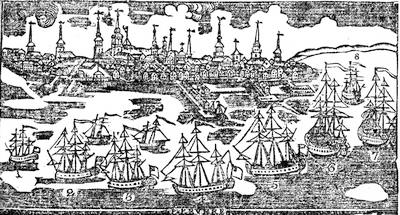
LANDING OF THE TROOPS IN BOSTON, 1768.
Fac-simile of an engraving by Paul Revere, which appeared in Edes and Gill's North American Almanack, Boston, 1770. It is reëngraved in S. G. Drake's Boston, p. 747, and in S. A. Drake's Old Landmarks of Boston, p. 119. Key: 1, The "Beaver", 14 guns; 2, "Senegal", 14; 3, "Martin", 10; 4, "Glasgow", 20; 5, "Mermaid", 28; 6, "Romney", 50; 7, "Launaston", 40; 8, "Bonetta", 10.
Revere also engraved a large copperplate of the same event, which is given in heliotype fac-simile, on different scales, in the Boston Evacuation Memorial (p. 18) and Mem. Hist. of Boston (ii. 532). Cf. also Gay's Pop. Hist. U. S., iii. 356; Dearborn's Boston Notions, 126, etc. The same view of the town was again used by Revere, but extended farther south, in a cut in the Royal American Mag. (1774), which is given in fac-simile in the Mem. Hist. of Boston, ii. 441. There is also a water-color mentioned in Mass. Hist. Soc. Proc., 2d ser., ii. 156. On Revere as an engraver, see W. S. Baker's American Engravers, Philad., 1875, and the list in N. E. Hist. and Gen. Reg., 1886, p. 204.
In Sept. (dated 14th) the selectmen of Boston sent a circular to the other towns, calling a convention (Boston Rec. Com. Rept., xvi. 263) to consider the declaration of Bernard "that one or more regiments may soon be expected in this province" (original broadside in Mass. Hist. Soc., Misc. MSS., 1632-1795). It is printed and explained in that society's Proceedings, iv. 387. The convention sat from Sept. 22d to 29th. On the 30th, in the early morning, the British fleet took soundings along the water-front, and in the afternoon a number of war-ships came up from the lower harbor and anchored with springs on their cables. On Oct. 1st the landing took place. The news spread through the land, and the irritation was increased. (Cf. Mass. Hist. Soc. Proc., xx. 9; Barry, Mass., ii. 370; Loring, Boston Orators, 75; Franklin's Works, vii. 418.)
The question of the expense of quartering troops had been raised by Massachusetts and New York in 1767 (Hutchinson, iii. 168), and a letter of Gage on the subject is in the Shelburne Papers, vol. li. (Hist. MSS. Com. Rept., v. 219). Cf. Hillsborough to Governor Franklin in N. J. Archives, x. p. 12. The message of the Assembly to Bernard, praying for their removal (May 31, 1769), is in Hutchinson (iii. App. 497).
A contemporary vindication of the movement, and of Herman Husband, the leader, bringing the history of the commotions down to 1769 only, evidently based on material furnished by Husband, was printed in Boston in 1771.[205] Husband himself seems, during the preceding year, to have printed anonymously, giving no place of publication, a narrative of his own, fortified by the letters of Tryon and others, with the remonstrances and counter-statements.[206]
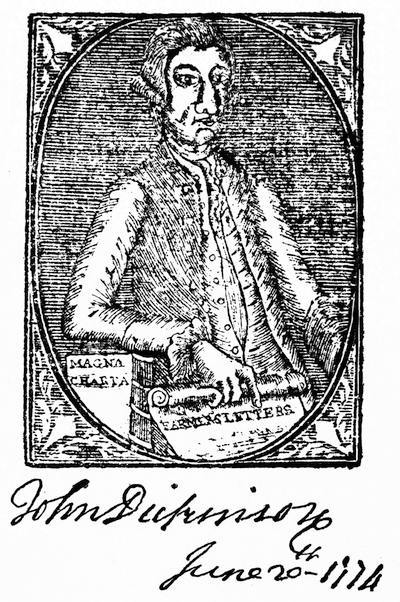
This cut from Nathaniel Ames's Astronomical diary or Almanack, 1772, Boston, is inscribed "The Patriotic American Farmer, J-n D-k-ns-n, Esq., Barrister-at-Law, who with Attic Eloquence and Roman spirit hath asserted the liberties of the British Colonies in America." Cf. Scharf and Westcott's Philadelphia, i. 276.
C. W. Peale's portrait of Dickinson (1770) was engraved by I. B. Forrest. Cf. Catal. of Gallery of Penna. Hist. Soc. (1872), no. 161; Lossing's Field-Book, i. 476.
On Dickinson's influence, see "The great American essayist" in the Mag. of Amer. Hist., Feb., 1882, p. 117; Sept., 1883, p. 223; Read's Life of George Read, 49, 79; Wells's Adams, ii. 38; Quincy's Josiah Quincy, Jr., 104; Green's Hist. View, 370; Lossing's Field-Book, i. 476. Cf. letters of Dickinson in Mem. Hist. Boston, iii. 22; Lee's Life of A. Lee, ii. 293, 296, etc.
The most conspicuous presentation of the American side in 1768 were the famous Farmer's Letters, as they were usually called, of John Dickinson.[207]
Some of the most important of the documents of the Boston patriots were printed in London under the supervision of Thomas Hollis, long a devoted friend of the colonists.[208]
During 1768 and 1769 we find record of the workings of political sentiments in the colonies in abundant publications.[209]
The most important development in 1769 came from some letters which had been addressed by Governor Bernard and General Gage to the ministry, and to which, in the exercise of his rights as a member of Parliament, Alderman Beckford had obtained access and taken copies, subsequently delivered by him to Bollan, who transmitted them to Boston, where they were at once printed. From these letters the public learned of the urgency which the governor had used with the government to induce it to institute more stringent measures of repression.[210]
The publication of these letters led to the printing of An appeal to the world; or a vindication of the town of Boston, from many false and malicious aspersions contain'd in certain letters and memorials, written by Governor Bernard, General Gage [etc.]. Published by order of the town (Boston, 1769),[211] and induced also a letter to the Earl of Hillsborough.[212]
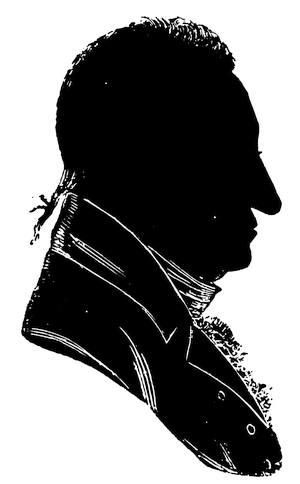
WILLIAM LIVINGSTON.
Fac-simile of the engraving in Sedgwick's Life of William Livingston. Cf. Lossing's Field-Book, i. 330.
There are in the Sparks MSS. (no. xx.) copies of annotations which Franklin, then in London, made on the margins and fly-leaves of sundry pamphlets, which just at this time were engaging attention in London, and these comments show how the struggle was regarded by a mind of Franklin's astuteness, amid the influences of the British capital. Sparks printed parts of these annotations in his Familiar letters and miscellaneous pieces by Dr. Franklin, and again in his edition of Franklin, vol. iv.[213] Some letters which passed between Franklin and William Strahan in 1769 are also of great interest.[214]
The Boston Massacre of March, 1770, was the violent culmination of prevailing passions, and was in a measure induced by the sacrifice of life which resulted from the boarding by a press-gang from the "Rose" frigate of a ship belonging to Hooper, of Marblehead,[215] and by the riotous proceedings which, in Jan., 1770, brought about the death of the boy Snider.[216] Soon after the affray of March, the town of Boston published a Short Narrative of the Horrid Massacre in Boston (Boston, Edes and Gill, 1770),[217] which depicted the condition of the people at the time, and gave an appendix of depositions, including one of Jeremy Belknap.[218] Copies were sent to England at once,[219] but the rest of the edition was kept back till after the trial, when "Additional Observations" were appended.[220] The volume, thus completed, was reprinted in New York in 1849, with notes and illustrations by John Daggett, Jr.; and again in Frederick Kidder's History of the Boston Massacre (Albany, 1870), which is the most considerable monograph on the subject.[221]
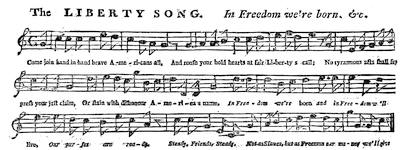
FROM BICKERSTAFF'S BOSTON ALMANAC, 1769.
This song was written by John Dickinson, with some assistance from Dr. Arthur Lee, and was sent (printed in the Penna. Chronicle, July 4, 1768) by Dickinson from Philadelphia to Otis, accompanied by a letter dated July 4, 1768. It was sung to the tune "Hearts of Oak", and was made conspicuous in Boston by being sung at Liberty Hall and the Greyhound Tavern in Aug., 1768. It had been reprinted in the Boston Gazette, July 18th. An amended copy, "the first being rather too bold", was given in the Penna. Chronicle July 11th. In September it appeared as a broadside, with the music. Edes and Gill's Almanac, in reprinting it in 1770, says it is "now much in vogue in North America." (Cf. Tudor's Life of Otis, pp. 322, 501; Moore's Songs and Ballads of the Rev., p. 37; Drake's Town of Roxbury, p. 166; Mem. Hist. of Boston, iii. p. 131.)
A parody appeared in the Boston Gazette, Sept. 26, 1768 (Moore, p. 41). This parody gave rise to the "Massachusetts Song of Liberty", which is given in Edes and Gill's Almanac (1770), as well as in Bickerstaff, under the full title of The Parody parodized, or the Massachusetts Liberty Song. It has been ascribed to Mrs. Mercy Warren. (Cf. Moore, p. 44; Lossing, Field-Book of the Rev., i. 487.) The Almanac (Edes and Gill) of 1770 also contains "A new Song composed by a Son of Liberty and sung by Mr. Flagg at Concert Hall, Boston, Feb. 13, 1770."
A stenographic report was made of the trial of Preston, and sent to England, but it has never been published.[222]
The trial of eight of the soldiers took place Nov. 27, 1770, and John Hodgson,[223] the stenographer of the earlier trial, made a Report, The trial of William Wemms, ... published by permission of the Court (Boston, 1770),[224] which gives the evidence and pleas of counsel, and a report of the trial of Edward Manwaring and others, accused of firing on the crowd from the windows of the custom-house. They were acquitted.[225]
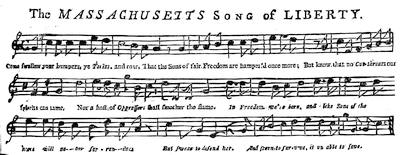
FROM BICKERSTAFF'S BOSTON ALMANAC, 1770.
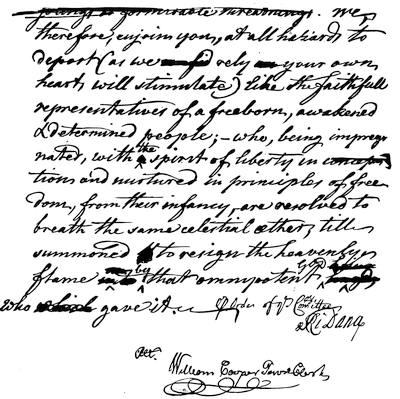
PART OF INSTRUCTIONS TO BOSTON REPRESENTATIVES, MAY 15, 1770.
The original draft of these instructions, in the handwriting of Josiah Quincy, Jr., is among the Quincy MSS. in the cabinet of the Mass. Hist. Society. This is a reproduction of the last page, showing the signatures of Richard Dana and of Cooper, the town clerk.
The principal statement on the government side was A Fair Account of the late unhappy disturbance at Boston, extracted from the depositions that have been made concerning it by persons of all parties, with an appendix containing affidavits and evidences not mentioned in the narrative that has been published at Boston (London, 1770).[226] This Fair Account contained a deposition of Secretary Andrew Oliver, tending to show that the soldiers were justifiably defending themselves; and making public the doings of the governor's council thereupon. This "breach of a most essential privilege" excited animadversion, and the council censured Oliver.[227] The purport of the English presentations is to show that the soldiers did not fire till duly provoked by assaults, and the more candid American writers, like Ramsay, Abiel Holmes, Hildreth, and others, seem to allow this.[228]
Bancroft (orig. ed., vi. 347) has a long note on the evidence about the provocation and first assault. He gives ten reasons for thinking Preston gave orders to fire, and six reasons for thinking the provocation was not sufficient to justify the firing. The evidence in this form is omitted in the final revision of Bancroft.
The anniversary of the Massacre was observed in Boston till the struggle for Independence was passed, and a series of annual orations commemorates the continued and aroused feelings of the people.[229]
The appendix to the third volume of Hutchinson's History records the sparring of Hutchinson and the legislature during the next six months.[230]
The list of Haven in Thomas (ii. 606) gives the American tracts published in 1770; but the more significant ones of the year appeared in London.[231]
The year 1771 was less eventful. In England, it seemed for a while as if the worst had passed. W. S. Johnson had written at the close of the preceding year (Dec. 29, 1770), "The general American controversy is at present looked upon here as very much at an end."[232] Franklin had been made the agent for Massachusetts;[233] he was still putting tersely to his correspondents the American view of the controversy,[234] and he had a conference with Hillsborough.[235]
Hutchinson in March had succeeded to the governor's chair, with reluctance, as he professed.[236] The American tracts may be gleaned in Haven's list.[237]
The events of 1772 are of more interest. The Boston patriots emphasized their arguments in their instructions to their representatives in May.[238] Later (July 14th) they passed a remonstrance against taxation and sent it to the king.[239]
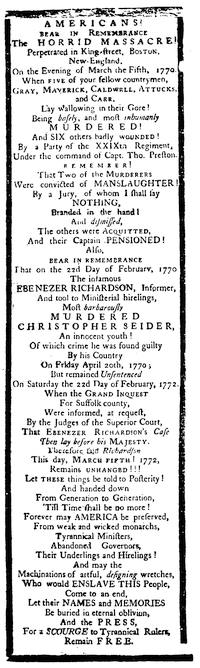
Note.—The annexed cut is part of a handbill in the library of the Mass. Hist. Society.
There are diverse views as to the originator of the committees of correspondence. Gordon's opinion (i. 312) that James Warren was the instigator was adopted by Marshall, but is held by Bancroft (vi. 428) to be erroneous. John Adams gave the first movement to Samuel Adams.[240] One of the first-fruits of the committee, as a provincial measure, was the report drafted by Samuel Adams (Nov. 2, 1772), which was printed as the Rights of the Colonies.[241] The vote passed by Virginia, March 12, 1773, was the immediate cause of intercolonial activity.[242]
The seizure and destruction of the revenue vessel Gaspee in Narragansett Bay, June 10, 1772, is considered by Rhode Island writers as the earliest aggressive conduct of the patriots. John Russell Bartlett,[243] in the R. I. Colonial Records (vol. vii. pp. 57-192), gathers all the documentary evidence, and this was in 1861 published separately as A History of the Destruction of his Britannic Majesty's Schooner Gaspee ... accompanied by the Correspondence connected therewith; the action of the General Assembly of Rhode Island thereon, and the official journal of the ... Commission of Inquiry appointed by King George III.[244]
Early in 1773 the patriots of Boston produced what is called "the most elaborate state paper of the Revolutionary contest in Massachusetts." This is the reply of the House of Representatives to the governor in the contest then waging with him.[245]
The act which included the duty on tea had passed Parliament June 29, 1767, and in March, 1770, it had been repealed, except, in order to maintain the theoretical right of Parliament to tax, the tax on tea had been retained in force. Pownall[246] had exerted his utmost to make the repeal include tea. The test was deferred till it was announced[247] that the East India Company was assisted by government in sending over a surplus of tea which they had. A series of impassioned gatherings in Boston, and demonstrations not so boisterous in the other colonies, led to the destruction of the tea in Boston harbor, and elsewhere resulted in the transshipment of the tea whence it came.[248]
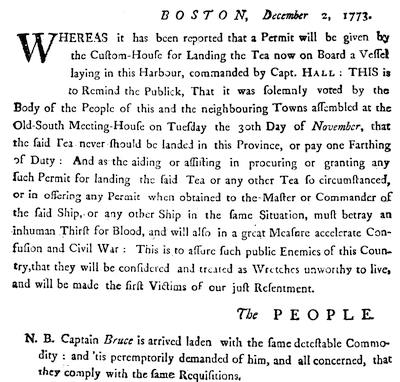
A BOSTON WARNING.
After an original in the Mass. Hist. Society.

A PHILADELPHIA POSTER.
After an original in the library of the Pennsylvania Hist. Society.
Another significant event of 1773 was the episode of the Hutchinson letters. They had been written (1767-1769), from Boston, to Thomas Whately, and came, after the latter's death (June, 1772), by some unknown means, into Franklin's hands. When Cushing[249] and the patriots printed them,—for the rumor of their existence led the "people abroad" to compel their publication,[250]—Franklin made no complaint, and bore with reserve the defamation which was visited upon him in England, and which is still repeated by later English writers,[251] Franklin finally prepared a statement in vindication, but it was not published till Temple Franklin printed his edition of Franklin's Works.[252] The letters were printed without any indication of Franklin's connection with them; but when a duel grew out of the publication, in which a brother of Whately was wounded by Mr. Temple,[253] who had been accused of purloining the letters, Dr. Franklin, to prevent a further meeting, published a note in the Public Advertiser, acknowledging his agency.[254] Sparks appends a note in his edition,[255] in which he refutes the claim of Dr. Hosack (Biographical Memoir of Dr. Hugh Williamson, 1820) that Williamson had been the medium of transmitting the letters.[256]
Mr. R. C. Winthrop, in discussing the question,[257] introduces a paper of George Bancroft, "Whence came the papers sent by Franklin to Cushing in his letter of Dec. 2, 1772?" Bancroft's conclusion is that Whately sent the letters to Grenville (who died Nov. 13, 1770), and they were found among his papers, and through some agency or consent of Temple passed into Franklin's hand.[258]
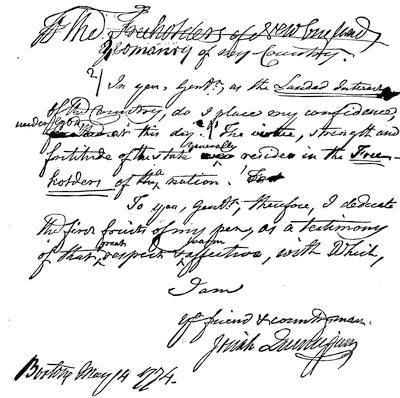
QUINCY'S DEDICATION.
This is the original draft of the dedication to Quincy's tract on the Port Bill, the MS. of which is among the Quincy MSS. in the cabinet of the Mass. Hist. Society. Its full title is Observations on the act of parliament commonly called the Boston port-bill; with thoughts on civil society and standing armies (Boston, 1774; Philad., 1774; London, 1774. It is reprinted in the Life of Josiah Quincy, Jr. Cf. Sabin, xvi. 67,192, etc.)
The letters, when laid before the Massachusetts Legislature, produced some resolutions (June 25, 1773),[259] followed by a petition to the king,[260] asking that Hutchinson and Oliver might be removed from office. This led to the presence of Franklin before the Privy Council, and the attack on Franklin's character by Wedderburn.[261]
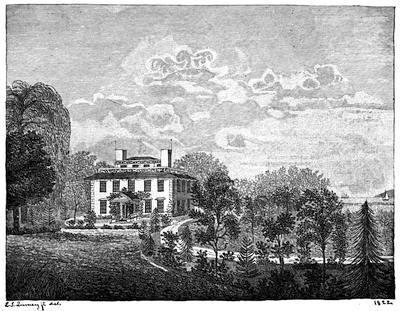
THE QUINCY MANSION.
After a water-color painted by Miss Eliza Susan Quincy in 1822. The house was built in 1770, by the father of the patriot, Josiah Quincy, Jr. The original sketch is among the Quincy MSS. in the Mass. Hist. Soc. cabinet. Cf. cut in Appleton's Journal, xiv. 161. Of Josiah Quincy, Jr., there was an engraving made in his lifetime, which was held to be a good likeness, and from this, and with the family's assistance, Stuart, fifty years after Quincy's death, painted the picture which is engraved in the Mem. Hist. Boston, iii. 37.
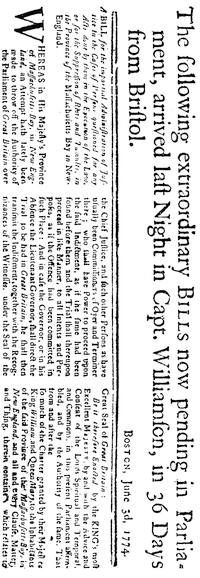
HEADING OF A HANDBILL
Fac-simile of the top portion of an original broadside in Mass. Hist. Society's library. The bills were that for the impartial administration of justice, and that for better regulating the government of the province of Massachusetts Bay.
The earliest significant movement in 1774 was the impeachment of Peter Oliver, chief justice, and younger brother of the late lieutenant-governor, for receiving his salary from the crown,—the controversy respecting the governor and other officers being thus made independent of the people, having been one which had been active for two years past.[262]
Gen. Gage had landed in Boston May 17th, to put in force, June 1st, what is known as the Boston Port Bill (approved March 31, 1774), or An Act to discontinue, in such manner, and for such time as are therein mentioned, the landing and discharging, lading or shipping, of goods, wares, and merchandise, at the town, and within the harbour of Boston, in the province of Massachuset's Bay, in North America.[263]
While Salem and Marblehead were thus made chief ports of entry, the commerce of Boston was suddenly checked, and the town was forced to a dependence for succor upon other towns and other colonies.[264]
The effect of the measures on the other colonies was instant and widespread.[265]
One of the immediate results in Massachusetts because of these oppressive acts was a retaliatory "Solemn League and Covenant" agreed upon in the provincial assembly,—a combination made more or less effectual by the active agency of Boston and Worcester in issuing broadsides against the use of imported British goods.[266]
In July, 1774, close upon his arrival in London, Hutchinson held an interview with the king, and set forth his opinions of the condition of affairs in the colonies.[267]
In August, 1774, Gage received the two acts mentioned in the annexed fac-simile of a handbill.[268]
It is claimed by Dawson[269] that the movements of 1774 in New York Were precipitated by the merchants and their adherents, "aristocratic smugglers", who formally organized themselves in May, 1774; and it was on the 6th of July that Alexander Hamilton made his stirring appeal at "the great meeting in the fields."[270] Further south a similar spirit prevailed.[271]
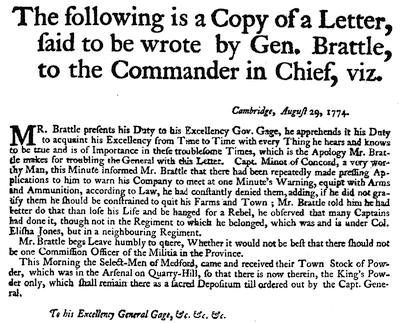
HANDBILL.
Fac-simile of an original in the library of the Mass. Hist. Society, where is another, dated Sept. 2, 1774, quoting this, and including an address by Gen. Brattle to the public, deprecating the current belief that his action in writing that letter was inimical to the cause. Cf. H. Stevens's Catal. (1870), no. 261. See on this mater John Andrews's diary in Mass. Hist. Soc. Proc., viii. 351, 354.
The question of originating the Congress of 1774 is one upon which there has been some controversy. It seems evident that the first proposal for a congress for general purposes was in a vote of Providence, R. I., May 17, 1774.[272] Cushing of Massachusetts and Dr. Franklin appear to have exchanged views on the subject in 1773.[273] Hancock seems to have suggested a congress in March, 1774.[274] In May the Sons of Liberty in New York formally proposed a Congress.[275] A resolution of the Massachusetts House of Representatives, June 17th, looked towards one, and similar action took place in the House of Burgesses in Virginia.[276]
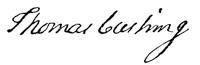
The Congress opened with a concession of the New England members, when Samuel Adams proposed the Episcopalian Duché for chaplain.[277] John Adams tells how the scheme of the Congress struck him,[278] and we learn from him something of the appearance and bearing of an assembly, where the "Tories were neither few nor feeble", and the political feelings were far from being in unison. "One third Whigs, another Tories, the rest mongrel", he says.[279] Franklin thought that only unanimity and firmness could conduce to any good effect from it.[280]