Chapter II · (continued 3)
Reading edition
The principal engraved map is a Plan of the city and environs of Quebec with its siege and blockage by the Americans from the 8th of December, 1775, to the 13th of May, 1776. Engraved by Wm. Faden, London; published 12 Sept., 1776. The original MS. draft is among the Faden maps (no. 20) in the library of Congress. There are other plans as follows: Mag. of Amer. Hist., April, 1884, p. 282; Leake's Life of Lamb, p. 130; Atlas to Marshall's Washington; Carrington's Battles, p. 138; Stone's Invasion of Canada, p. xvii.; a marginal plan in Sayer and Bennett's New Map of the Province of Quebec, published Feb. 16, 1776; and a German "Plan von Quebec" in the Geschichte der Kriege in und ausser Europa, Nuremberg, 1777, Dritter Theil. There is a marginal map of Quebec in an edition of Carver's map of the Province of Quebec, published by Le Rouge in Paris in 1777, and included in the Atlas Ameriquain (1778).
For views of Quebec and the points of attack, see Moore's Diary of the Rev., i. 185; Lossing's Field-Book, i. 198; and Mag. of Amer. Hist., April, 1884, p. 274. A view of the plains of Abraham is in Ibid., p. 296.
The retreat continued to Crown Point, and in July Sullivan was relieved by Gates; and the campaign was over,—nothing accomplished. On July 26th Governor Trumbull reviews the condition of the army in a letter in Hinman's Conn. during the Rev. (p. 560).[653] The letters of Ira Allen and John Hurd express the uneasy state of mind along the frontier, which now took possession of the exposed settlers (N. H. Prov. Papers, viii. pp. 301, 306, 311, 315-317, 405). Insecurity was felt at Ticonderoga (N. H. State Papers, viii. 576, 581).
Congress twice appointed commissioners to proceed towards Canada. In Nov., 1775, Robert R. Livingston, John Langdon, and Robert Treat Paine were sent, with instructions dated Nov. 8th,[654] to examine the fortifications of Ticonderoga and the highlands, and "to use their endeavors to procure an accession of the Canadians to a union with these colonies;" and their report (Nov. 17th), with a letter to Montgomery (Nov. 30th), is in the Sparks MSS. (lii. vol. ii.). In March, 1776, Benj. Franklin, Samuel Chase, and Charles Carroll were instructed (Journals of Congress, i. 289; Force, v. 411) to proceed to Canada to influence, if possible, the sympathies of the Canadians. Carroll was a Roman Catholic, and he was accompanied by his brother, John Carroll, a priest.[655] Much was expected of the mission on this account (Adams's Familiar Letters, 135). Franklin, delayed at Saratoga (April), began to feel that the exposures of the expedition were too much for one of his years, and sat down to write "to a few friends by way of farewell."[656] Carroll kept a diary, which has been since printed.[657] There are papers appertaining to the mission in Force's Archives, 4th, iv., v.; Sparks's Washington (iii. 390), and his Corresp. of the Rev. (i. 572), and Lossing's Schuyler (vol. ii.).[658] On Jan. 31, 1850, Mr. William Duane delivered an address on Canada and the Continental Congress before the Penna. Hist. Soc., which is printed among their occasional publications.
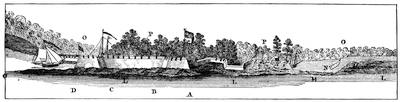
SULLIVAN'S ISLAND.
A part of a view published in London, August 10, 1776, and made by Lieut.-Col. Thomas James, of the Royal Regiment of Artillery. June 30, 1776. It represents the position of the fleet during "the attack on the 28th of June, which lasted nine hours and forty minutes." The position of the ships is designated by A, "Active", 28 guns; B, "Bristol", flag-ship, 50 guns; C, "Experiment", 50 guns; D, "Solebay", 28 guns. The "Syren", 28 guns, and "Acteon", 28 guns, and the "Thunder", bomb-ketch, were nearer the spectator as was the "Friendship", of 28 guns. L is Sullivan's Island; M, a narrow isthmus, defended by an armed hulk, N; the mainland is O; myrtle-grove, P.
Faden also issued at the same time, as made by Col. James, a long panoramic view of Sullivan's and Long islands, showing the American and British camps on the opposite sides of the dividing inlet.
Mr. Brantz Mayer's introduction to the Centennial ed. of Carroll's journal is largely concerned with the question of the Catholic pacification of Canada. Cf. Brent's Life of Archbishop Carroll; and B. W. Campbell's "Life and Times of Archbishop Carroll" in U. S. Cath. Mag., iii. The unfortunate comments (Oct. 21, 1774) of the Continental Congress on the Quebec Act was much against the persuasions of the commissioners, and it was soon evident that all their efforts, on this side at least, were futile. (Cf. Force's Am. Archives, ii. 231.)
After Franklin and John Carroll had left Montreal, Charles Carroll and Chase remained, endeavoring to support the military councils.[659]
I. The Attack on Sullivan's Island, June, 1776.—Clinton's proclamation to the magistrates of South Carolina, June 6, 1776, is in Ramsay's Revolution in South Carolina, i. 330. Lee's report to Washington (July 1, 1776) is in Sparks's Correspondence of the Revolution, i. 243; to Congress (July 2d), in Ibid., ii. 502; in Lee's Memoirs, p. 386; in Force's American Archives, 5th ser., i. p. 435; N. Y. Hist. Soc. Coll., 1872, pp. 100, 107; and in Dawson (p. 139). John Adams (Familiar Letters, 203) notes the exhilaration which the news caused in Philadelphia.
There are other contemporary accounts in Gen. Morris's letter in the N. Y. Hist. Soc. Coll., 1875, p. 438; in R. W. Gibbes's Doc. Hist. of the Amer. Rev., 1776-1782, pp. 2-19; in Force's Archives; in Frank Moore's Diary of the Rev., i. p. 257; in Moore's Laurens Correspondence, p. 24. A "new war song" of the day, referring to the battle, is given in Moore's Songs and Ballads of the Rev., p. 135. A broadside account was printed in Philadelphia, June 20, 1776 (Hildeburn's Bibliog., no. 3342). A plan of the attack after a London original was published in Philadelphia in 1777, with a "Description of the attack in a letter from Sir Peter Parker to Mr. Stephens, and an extract from a letter of Lieut. Gen. Clinton to Lord Geo. Germaine" (Hildeburn, no. 3539).
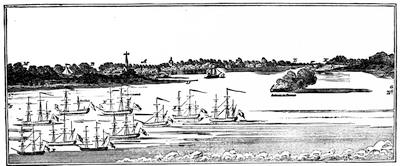
CHARLESTOWN, S. C., AND THE BRITISH FLEET, JUNE 29, 1776.
After a print published in London by Faden, August 10, 1776, taken by Lieut.-Col. James, the day after the fight.
Key.—A, Charlestown; B, Ashley River; C, Fort Johnston; D, Cummins Point; E, part of Five-Fathom Hole, where all the fleet rode before and after the attack; F, station of the headmost frigate, the "Solebay", two miles and three quarters from Fort Sullivan, situated to the northward of G; H, part of Mt. Pleasant; I, part of Hog Island; K, Wando River; L, Cooper River; M, James Island; N, breakers on Charlestown Bar; O, rebel schooner of 12 guns.
There is "An exact prospect of Charlestown, the metropolis of South Carolina", in the London Mag., 1762, a folding panoramic view, which shows the water-front with ships in the harbor.
The earliest general account is by Moultrie himself in his Memoirs of the American Revolution. Cf. Gordon's Amer. Rev.; and John Drayton's Memoirs of the American Revolution [through 1776] as relating to the State of South Carolina (Charleston, 1821, two vols.). Of the later general historians, reference may be made to Bancroft (orig. ed.), vol. viii. ch. 66, and final revision, iv. ch. xxv., a full account; to Dawson, i. ch. 10, to Carrington, ch. 27, 28; to Gay, iii. 467; Irving's Washington, ii. ch. 29; Lossing's Field-Book, ii. p. 754. Something can be gleaned from Garden's Anecdotes of the Revolution; Memoirs of Elkanah Watson; the life of Rutledge in Flanders's Chief Justices; and from such occasional productions as William Crafts's address (1825), included in his Miscellanies; Porcher's address in the South Carolina Hist. Coll., vol. i.; C. C. Jones, Jr.'s address on Sergeant Jasper in 1876, and the Centennial Memorial of that year and the paper in Harper's Monthly, xxi. 70, by T. D. English.
On the British side we have Parker's despatch (July 9th) in Dawson, p. 140; a letter of Clinton (July 8th) in the Sparks MSS., no. lviii.; Clinton's Observations on Stedman's History; the reports in the Gent. Mag. and Annual Register; the early historical estimate in Adolphus's England, ii. 346. Jones, New York in the Revolutionary War, i. 98, gives the Tory view. There is a contemporary letter by a British officer given in Lady Cavendish's Admiral Gambier, copied in Hist. Mag., v. 68. Hutchinson (Life and Diary, ii. 92) records the effects of the fight in England.[660]