Chapter VI · (continued 2)
Reading edition
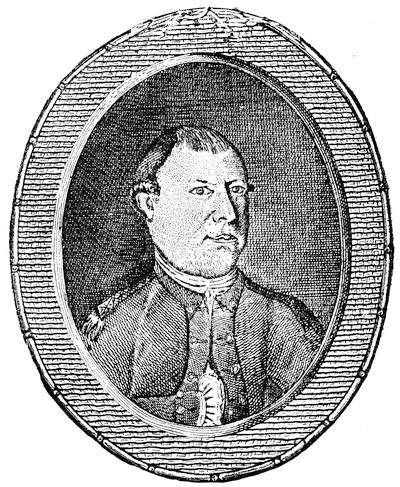
NATHANAEL GREENE. (Norman's print.)
Moultrie[1035] was a prominent actor in the defence of his native State before the capitulation of Charleston. After that he resided with the other officers at Haddrell's Point until his exchange in 1781. At a later day he was present at the entry of the victorious army into Charleston. Whenever he speaks from his own observation, Moultrie may be trusted[1036]. But he seems to have been too ready to listen to exaggerated stories, and though we must believe that there was a foundation for his account of the sufferings of the Charleston prisoners, it should always be remembered that the charges were indignantly denied by the British officers in charge.
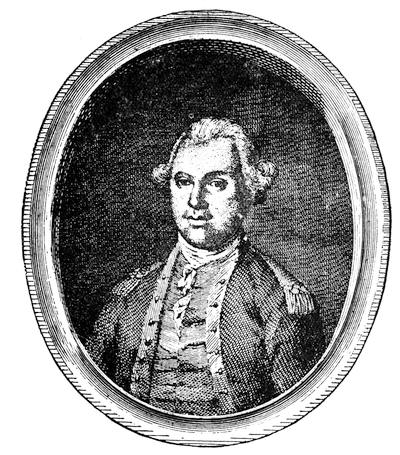
GENERAL GREENE. (From Andrews' History of the War.)
Portraits of General Greene.—One of the earliest of the contemporary prints is the rude copperplate, made by the Boston engraver Norman, which appeared in the Boston edition (1781, vol. ii. p. 229) of An Impartial History of the War in America. A fac-simile is annexed. In 1785, Andrews' History of the War, published in London (vol. i.), had a youthful picture, a reproduction of which is also given herewith. The next year the Columbian Magazine (Sept., 1786), published in Philadelphia, gave an engraving after R. Peale's likeness of Greene, of which a better engraving by Robert Whitechurch can be found in Irving's Washington (ii. p. 8) and in E. M. Stone's French Allies (p. 496). In 1794 the New York Magazine (May) gave as from an original painting a copperplate engraving, of which a fac-simile is given on another page. It is evidently a rendering of the canvas of which, after a photograph given in George W. Greene's Life of Greene, the woodcut on the page opposite to the other is a more adequate representation. There is also a print in the Monthly Military Repository, N. Y., 1796-1797. A portrait by C. W. Peale was engraved, while in the Philadelphia Museum, by Edwin, and appeared in Lee's Memoirs of the War in the Southern Department (vol. i., Philadelphia, 1812). It was again engraved by James Neagle in 1819 for Charles Caldwell's Memoirs of the life and character of the Honorable Nathanael Greene (Philadelphia, 1819); and in 1822 it furnished the head and shoulders, turned in the opposite direction, for the full-length figure, engraved by J. B. Longacre, after a drawing by H. Bounetheau, which is in the first volume of William Johnson's Sketches of the life and correspondence of Nathaniel Greene (Charleston, 1822). One of the pleasantest of the likenesses of Greene is that painted by Col. John Trumbull, which was engraved by J. B. Forrest for the National Portrait Gallery (New York, 1834). The same picture is selected by W. G. Simms for his Life of Greene, and it is given in R. E. Lee's ed. of Henry Lee's Memoirs of the War (N. Y. 1869), and H. B. Anthony's Memorial Address (Providence, 1875) on presenting the statue of Greene to Congress. This statue, modelled by Henry K. Brown, was offered in 1870, and a cut of it is given in the Presentation of the Statue of Major-General Greene in the Senate, Jane 20, 1870 (Washington, 1870), an account of which, under the title of Proceedings in Congress attending the reception of the statue of Maj.-Gen. Greene, was reprinted (twenty copies) in Providence the same year. For congressional documents pertaining, see B. P. Poore's Descriptive Catal. of U. S. Gov't publications, pp. 896, 901, 1221. Congress voted a medal to Greene after the battle of Eutaw, and on one side it bears a profile likeness of Greene. It is engraved in Lossing's Field-Book, ii. 704; and in Ibid. p. 720, is a view of the monument erected to the memories of Greene and Pulaski. The Polish hero has since, however, been commemorated in a separate monument, so that the shaft first erected is now called a memorial of Greene alone. Greene died in 1786 of a sunstroke, at a plantation near Savannah, which had been given to him by the State of Georgia,—it being the confiscated estate of the late royal lieutenant-governor,—and he was buried in Savannah; but when the monument was built, the search to discover his remains was unsuccessful. Cf. The Sepulture of Greene and Pulaski, by C. C. Jones, Jr. (Augusta, 1885)—Ed.
Henry Lee, of Virginia,—"Light-Horse" or "Legion Harry", as he was often called,—though not in the South prior to the days of the Cowpens, was so intimate with all the actors in the operations after the fall of Charleston, and enjoyed such advantages for acquiring information of earlier events, that as a source of information his book[1037] is of considerable value. As the work of an outspoken and generally impartial military critic of these campaigns, it has no equal. It should be borne in mind, however, that as to dates and minor details it needs the confirmation of contemporary documents.[1038] Like so many of the Revolutionary heroes, Lee in his later years became involved in unfortunate speculations, and a painful disease increased the distress of his last days.[1039] As an orator he fashioned phrases which have not yet lost their hold on the popular mind. As a writer he avoided the stilted sentences of his contemporaries, and his book may still be read with pleasure. Probably no one enjoyed the confidence of Greene to such an extent as Henry Lee.[1040]
Nathanael Greene came of good Rhode Island stock,[1041] and, like other prominent Rhode Islanders of his day, was a self-educated man. Fortunately for posterity, though not always for himself, Greene was a copious and candid letter-writer. His letters and fragments of letters, so far as they have been printed, are his best biography.[1042] He has not lacked biographers, however. First, in point of time, was Charles Caldwell, who put forth a worthless volume as early as 1819.[1043] William Gilmore Simms, the Carolina novelist, also tried his hand at the alluring theme, and his book, while possessing no claim to originality, has at least the merit of being interesting. The most formidable of these early biographies was the work of Judge Johnson, of Charleston. He enjoyed the best facilities, as the Greenes placed the family papers at his disposal. Many of these documents he printed at length, and as a repository his work has a value.[1044] In other respects it is worth very little. This is due mainly to the fact that in order to glorify his hero he belittled every other prominent character—with the exception of Marion.[1045] A formidable antagonist of Johnson was soon found in the person of Henry Lee, the son of Light-Horse Harry. He resented the slurs of Johnson, and even wrote a book[1046] to show the small reliance to be placed on the learned judge's military criticisms. As a review, the work of the younger Lee is interesting, but it is so one-sided as to be of little importance.
It is, however, to the labors of a descendant that the great leader owes much of the honor in which he is held. In various publications, from the little seven-page sketch in the Pennsylvania Magazine of History (vol. ii. p. 84) to the large three-volume biography,[1047] the grandson sought to spread the fame of the grandsire. Unfortunately, through these family works of love there runs the same spirit of adulation that so disfigured Johnson. A still greater drawback to the value of the largest work is the hesitation of the author in printing letters and documents not elsewhere in print.
In this respect the biographer of Greene's able lieutenant, Daniel Morgan, set a good example. In fact, Graham's Morgan[1048] is an excellent and generally trustworthy book. It is to be noted that Graham has cleared Morgan from the charge that he retired from the army after the Cowpens, through a treasonable fear that the Revolution would not be successful. Nor does the assertion that Morgan was chagrined at the treatment accorded him by Greene appear to be well founded.
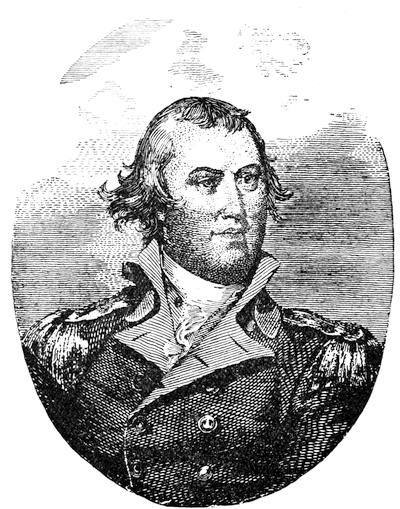
GENERAL GREENE. (New York Magazine, 1794.)
But of all the Southern leaders, Marion was most fortunate in his biographers.[1049] It is true that Horry's work was largely written by Mason L. Weems, notorious for his so-called Life of Washington. Both Horry and James had a foundation for their narratives. The confidence reposed by Greene in his ablest leader of irregular troops is best seen in their letters printed by Gibbes in his Documentary History,[1050] which is composed mainly of the "Horry Papers", already used in Horry's memoir. Another partisan worthy of mention was Pickens. But of him only slight and unworthy sketches have been printed.[1051]
The only extended notice of Benjamin Lincoln is the biography by Francis Bowen in Sparks's collection.[1052] This book was not written in the calm judicial spirit that should characterize an historical work. Many of Lincoln's order-books have been preserved, and have been of material service in preparing the foregoing narrative. Though Lincoln's career was marked by no brilliant successes, his work was always well done, and demands a fuller recognition.[1053]
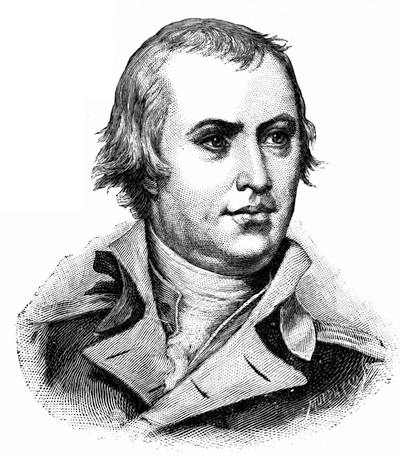
GENERAL GREENE. (After a Photograph of a Painting.)
Little original material concerning the operations in Georgia has come to light. It is fortunate, therefore, that Hugh McCall overcame his physical infirmities to such an extent as to enable him to finish the second volume of his History of Georgia. This writer was an active cavalry leader in the defence of his native State. He also fought well on other fields. It should he said, however, that what he wrote of actions in which he did not take part should be received with caution. His work is the basis of all subsequent accounts of the war in Georgia.
Anthony Wayne and his Pennsylvanians did good service in Virginia, and later in Georgia. But the life of Wayne remains to be written.[1054] His letters and reports are scattered here and there through the books. The best account of his career is the one printed by his son in the Casket, a magazine not to be found in every library.
The second volume of Wheeler's Sketches of North Carolina contains many articles by actors in the struggle. But they were mostly written long after the event, as, too, were those in the North Carolina University Magazine. They should not be relied upon unless confirmed.[1055] This is the more regrettable as there is very little original material in print relating to these North Carolina campaigns from a North Carolina point of view. The most labored defence of the "Old North State" is Caruthers' Incidents.[1056] Much of this work seems to be based on good material; but one should be especially careful to separate such portions from those founded on tradition, which must have misled Caruthers in several instances. Of the same general character are Johnson's Traditions;[1057] Logan's Upper Country of South Carolina; Foote's Sketches of Western North Carolina; and C. L. Hunter's Sketches of Western North Carolina (Raleigh, 1877). Such are the main sources of information from the American side so far as the campaigns in the Carolinas and Georgia are concerned. Let us now turn to Virginia.
On his way South, Greene left Steuben[1058] in Virginia to organize and push forward recruits as fast as possible. The gallant Prussian seems to have been ill-suited to the command of raw republican militia; but the American leaders in the State, Muhlenberg, Lawson, and Stevens, aided him as well as they could. It was not until the arrival of Lafayette with his Continentals from the Eastern States that much was done to oppose the enemy. The governor of Virginia, Thomas Jefferson, showed a lamentable lack of energy during Arnold's and Cornwallis's invasions, though the word "imbecility", applied to his conduct by Howison, would seem to be undeserved.[1059] Of course, Jefferson's biographers have defended their hero from these charges,[1060] but Giradin's Continuation of Burk's Virginia,[1061] written in the neighborhood of Monticello, and apparently under Jeffersonian auspices, is the most extensive account of Jefferson's administration from his side.
It was not, however, until the publication of the Virginia State Papers[1062] that the truth concerning the campaigns preliminary to Yorktown could be ascertained. But these two volumes taken in connection with the Nelson Papers have thrown a new light on all these transactions.[1063]
Washington's Writings and Sparks's Correspondence of the Revolution contain much relating to all these operations, though Washington's Journal and his order-books are even more valuable for the Yorktown campaign. Of the commander of the auxiliary troops, the Marquis of Rochambeau, I have found little outside of his well-known Mémoires.[1064] For much of what we know concerning the movements of the French we are indebted to John Austin Stevens, a former editor of the Magazine of American History. His articles, as well as those by other hands, will be mentioned in the Notes.
The papers of the British commanders have been much better preserved. All official documents of popular interest and conducing to the glory of the nation were published, sometimes in full, sometimes in extract, in the governmental organ known as The London Gazette. Thence they were copied, in whole or in part, into the Remembrancer, Gentleman's Magazine, Scot's Magazine, Political Magazine, and often into that portion of the Annual Register known as "Principal Occurrences." Many of them, and many other papers of the greatest importance, were printed in the Parliamentary Register, or Debrett's Debates, as it is often called.
The Sackville Papers, forming the third appendix to the Ninth Report of the Royal Commission on Historical Manuscripts,[1065] contain much of very great value; but many of the most important papers therein printed have been accessible in other forms. Soon after the surrender at Yorktown, the House of Lords appointed a committee to inquire into the conduct of the Yorktown campaign. Later, upon their order, many of the letters and papers bearing on this event were printed. They may be found in the Parliamentary Register,[1066] while many were translated into French, and published in a small volume under the title of Correspondance du Lord G. Germain avec les Généraux Clinton, Cornwallis, etc. (Berne, 1782). Most of these documents, however, had been already printed in other places. The surrender induced Cornwallis[1067] and Clinton to lay upon the shoulders of each other the responsibility.[1068] The truth seems to be that neither was responsible, since the disaster was due, above all, to the arrival of De Grasse and the consequent transference of the control of the sea from the British to the Allies. For this neither Clinton nor Cornwallis was to blame. The quarrel led to the publication, however, of so many papers of the greatest importance that the historical student can hardly regret its occurrence.
Nor was Clinton on good terms with Mariot Arbuthnot, who had accused Clinton of permitting thievery to go on under his very eyes.[1069] Naturally this want of cordiality made coöperation very difficult. After Clinton's departure Cornwallis was the commander-in-chief in the South; but Colonel Nesbit Balfour, who commanded in the city of Charleston, made separate reports to Germain. He does not seem to have been possessed with a very sanguine disposition, and his reports therefore present a more accurate picture of affairs than do the despatches of Cornwallis himself.
Several of the British officers wrote formal accounts of their doings, the most notable of which is Tarleton's Campaigns.[1070] Portions of it are trustworthy, but in general the author placed his own services in such a favorable light that the true course of history is almost unrecognisable. Nevertheless, the book contains so many documents not elsewhere to be obtained, except at great labor, that it has a value. Tarleton's unjust discriminations and criticisms brought forth a most caustic review from the pen of Mackenzie,[1071] a Scotch officer, who served in a regiment which often accompanied the "Legion." Cornwallis, who had also been attacked by Tarleton, never replied to his criticisms in print; but he wrote to a "friend" (cf. letter dated Calcutta, Dec. 12, 1787, in the Cornwallis Corres., i. 59, note) that "Tarleton's is a most malicious and false attack; he knew and approved the reasons for several of the measures which he now blames. My not sending relief to Colonel Ferguson, although he was positively ordered to retire, was entirely owing to Tarleton himself: he pleaded weakness from the remains of a fever, and refused to make the attempt, although I used the most earnest entreaties." It should be noted, however, that this alleged refusal on Tarleton's part created no coolness at the time. Simcoe's narrative[1072] is even more egotistical than Tarleton's. But his details may be relied upon if one constantly remembers that events are related without any regard to their real importance. Captain, afterwards General, Graham served with Cornwallis in the 76th Highlanders through the most important portions of his North Carolina and Virginia campaigns. His Memoirs,[1073] therefore, though execrably edited so far as the American portion is concerned, should be consulted. Another book which partakes of the nature of an original source is the so-called Journal[1074] of R. Lamb, who served through the war, and his statements have a value. The only regimental history of much interest is Hamilton's Grenadier Guards,[1075] a corps which after Cowpens rendered good service, and this account of their achievements bears all the marks of originality. There are but few manuscripts of importance, written by British officers, accessible on this side of the ocean.[1076]
The most valuable history of the Revolution from a British pen is Gordon's well-known work. This author was assisted by Gates and Greene so far as the Southern campaigns were concerned. The volumes contain, moreover, many fragments of letters that have never seen the light in their entirety. Taken altogether, this work ranks with Ramsay as an authority of the very first importance. The only other important History of the American War from the English side is the work which bears the name of Charles Stedman on the title-page. Whoever the author of the text may have been, the writer of many of the notes in the part devoted to the war in the South was undoubtedly an on-looker. Still another work worthy of mention in this place, though mainly as the repository of documents, is Beatson's Memoirs. In addition there are numerous diaries, journals, etc. They relate mainly to but one battle or campaign, and will be mentioned in the following "Notes."

NOTES.
Savannah, 1778.[1077]—Campbell's formal report to Germain was first printed in The London Gazette for Feb. 20-23, 1779,—reprinted in Remembrancer, vii. 235; Hough's Siege of Savannah, Introduction, p. 7; Gentleman's Magazine, 1779, p. 177; and Dawson's Battles, i. 477. Major-General Augustine Prevost's report is in the Gazette for Feb. 23, 1779, and Remembrancer, vii. 243. It deals especially with his march from St. Augustine and capture of Sunbury.[1078] An American account of this latter event is in McCall's Georgia, ii. 176. Captain Hyde Parker[1079] reported to the Admiralty through the customary channel, and his report usually follows that of Prevost, as above. Howe seems to have presented no formal report, but Lincoln wrote to Washington (Corresp. Rev., ii. 244) early in the next year, describing the disaster. Howe's own side of the case, however, is fully set forth in the Proceedings of a General Court-Martial held at Philadelphia in the State of Penna. by order of his Excellency General Washington, Phila., 1782; reprinted in the New York Historical Society's Collections (1879, pp. 213-311), where will be found Howe's orders (Dec. 29th,[1080] p. 282) and statement (pp. 285-310). The court, presided over by Steuben, acquitted Howe on all the charges "with the highest honor." Nevertheless, the majority of writers have been unfavorable to Howe. See especially Moultrie's Memoirs, i. 244; Lee's Memoirs (2d edition), p. 40; Ramsay's Rev. in S. C., ii. 4. This last is a fairer view, and is followed by Gordon (American Revolution, iii. 212). See also Stedman, American War, ii. 66; McCall's Georgia, ii. 164, and C. C. Jones's Georgia, ii. 314. In this, the most recent history of Georgia, all the old statements are repeated.[1081]
An American description from a different point of view is the Account of the Capture of Mordecai Sheftall, Deputy Commissary of Issues to the Continental Troops for the State of Georgia, in White's Historical Collections of Georgia, p. 340. Sheftall also testified at the court-martial.[1082]
Minor Actions, 1779.—There is not much to be found as to Lincoln's doings before the siege of Savannah except his manuscript "order-books." Moultrie made an elaborate report of his encounter near Beaufort.[1083]
McCall was present at Kettle Creek, and his account[1084] of Boyd's overthrow has been generally followed by later writers. No official report of the affair has been found. The disaster at Brier Creek was much better chronicled. First comes Ashe's report to Lincoln (Moultrie, Memoirs, i. 323, and abridged in Dawson, Battles, i. 492). Lincoln wrote a good account of the affair (an extract of his letter in Dawson, as above), and the evidence given at the court-martial[1085] which tried Ashe is as full as can be desired.[1086] The British accounts do not differ essentially from these.[1087]
There is no lack of original material as to Prevost's unsuccessful attempt on Charleston,[1088] and Lincoln's attack on Stono. Moultrie made no formal report, but the documents and bits of journals scattered through his Memoirs (i. 412-506) may well take its place. Prevost's report of his attempt was dated June 12, 1779 (London Gazette, Sept. 21-25, 1779, reprinted in Remembrancer, viii. 302). His report as to Stono is in the Gazette, as above, and also in Remembrancer viii. 300. Lincoln's version of the latter affair is contained in a letter to Moultrie (Memoirs, i. 490, and Dawson, i. 501). Moultrie also printed other letters (cf. especially one from Colonel Grimkie in Memoirs, i. 495), and an interesting journal by an unknown hand is in Remembrancer (viii. 349). Capt. John Henry, who succeeded Parker, in his reports corroborated Prevost as to the offer of neutrality on the part of some one in Charleston (London Gazette, July 10-13, 1779, and Remembrancer viii. 183). Clinton also has something to say on the campaign in general in a report to Germain (Remembrancer, viii. 297).[1089]
Lincoln has been criticised for his march into Georgia, but the movement had the unanimous support of his generals. Cf. report of the council of war in Moultrie, i. 374. He supposed rightly, as we now know (cf. Prevost's report in Remembrancer, viii. 302), that the British commander's only object was to compel his return to South Carolina. Moultrie could have offered sufficient resistance if one half of his men had not deserted. Nevertheless, Lincoln was assailed in the Charleston papers, and complained bitterly of their unfairness. Cf. letter to Moultrie in Memoirs, i. 477. With regard to Rutledge's offer of neutrality, Professor Bowen has undoubtedly gone too far in describing it as "little short of treason."[1090] Still, if, as Rutledge's friends claim, the proposition was made merely to gain time, it was not made in good faith, and was therefore highly discreditable to the governor. But there is no evidence that the proposition was made in any such spirit, except the statement in Ramsay, which was copied by Gordon. The truth seems to be that Rutledge, greatly overestimating the numbers of the enemy, sought to save his native State from pillage. He yielded too easily to his fears. Moultrie takes no pains to conceal his disgust at the offer. The younger Laurens refused to have anything to do with the matter, while Gadsden and Ferguson, two members of the Council, voted against the proposal, and Edwards, another member, wept at the thought. Unfortunately, the minutes of the Council have been lost. Cf. Johnson, Reply to Bentalou and Sparks.[1091]
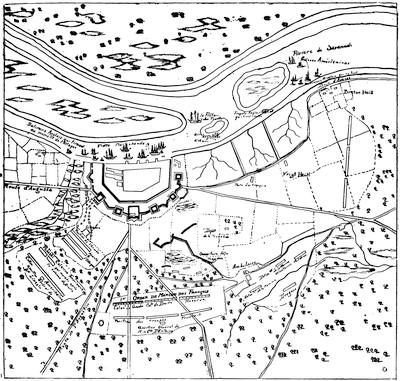
SIEGE OF SAVANNAH, September-October, 1779.
Sketched from a MS. map belonging to Dr. Samuel A. Green, of Boston, found in Paris, and giving the French view.
The plans of the siege are mainly English ones. That made by Colonel Moncrieff and published by Faden is used in Stedman's American War, ii. 79, and is reduced in Lossing's Field-Book, ii. 736. Cf. also C. C. Jones's Two Journals for a fac-simile (reduced in Hist. of Georgia, vol. ii.) of a Plan of the French and American Siege of Savannah in Georgia in South America [sic] under Command of the French general Count d'Estaing. The British commander in the town was General August Prevost, 1779. It is from Hessian sources, and resembles Faden's. Also see Moore's Diary of the Amer. Rev., 1st ed., ii. 221. Carrington (p. 483) gives an eclectic map. Two contemporary MS. French maps (one measuring 28 × 16 and the other 22 × 22 inches) are in the Boston Public Library (Dufossé, Americana, no. 5,495). There are various MS. plans of Savannah and the siege among the Peter Force maps, and one in the Faden collection in the library of Congress. A good map of this region is The Coasts, Rivers, and Inlets of the Province of Georgia; surveyed by Joseph Avery and others, and published by command of Gov't by J. F. W. Des Barres, 1st Feb., 1780. Parker did not find his charts correct. Remembrancer, vii. 246.—Ed.
It is to be noted that, although there is no record of the actual presence of Indians at this siege, their absence was not due to any remissness on the part of Rutledge, who made every effort to persuade a band of "eighty Catawbas" to act with Moultrie. (Cf. the latter's Memoirs, i. pp. 397, 419, and 453.)
Siege of Savannah, 1779.—The best account of this disastrous siege is the Journal, by an unknown hand, which Col. C. C. Jones has translated, with copious notes, in his Siege of Savannah in 1779 as described in two contemporaneous journals of French officers in the fleet of Count D'Estaing, Albany, 1874, pp. 9-52. The other journal, of which he there gives a partial translation, is the well-known Extrait du Journal d'un Officier de la Marine de l'escadre de M. le Comte D'Estaing, 1782.[1092] Still another French account is in the form of an official report,[1093] and may have been the report of the commander himself. This is by no means certain, though Soulés (Troublés, iii. 217), in speaking of the numbers given in this report, says: "Le Comte d'Estaing dit dans sa relation", etc. This was first printed in the Paris Gazette, and was reprinted in the English and American papers of the time.
Prevost made an elaborate report to Germain, under date of Savannah, Nov. 1, 1779. It was accompanied by translations of the correspondence between the commanders, and was first printed in The London Gazette, Dec. 21-25, 1779.[1094] Captain John Henry also reported through the usual channel. He viewed the siege from a point different from Prevost's, and his report is therefore of interest.[1095] Hough has also reprinted in his Savannah two "journals" from English sources.[1096] Mention must also be made of a valuable Memorandum of a very critical period in the Province of South Carolina, inclosed in a letter from J. H. Cruger to H. Cruger, etc., dated Savannah, Nov. 8, 1779, in Magazine of American History, 1878, p. 489.[1097]
Lincoln's report is very meagre (Hough, Savannah, 149). It should be supplemented by An Account of the Siege of Savannah furnished by an Officer engaged in the attack, Major Thomas Pinckney.[1098] Stevens, the Georgia historian, had access to Prevost's order-book, and he has printed in his Georgia (ii. 200, etc.) a few documents not otherwise accessible. Lincoln's order-book is still in existence, and his papers were used by Lee in his valuable account of the affair (Memoirs, i. 99). The orders for the assault have been printed.[1099]
Moultrie was not present during the siege, but he gives a graphic account of the assault (Memoirs, 33-43). It is curious to note his attempt to defend the militia from the charge of luke-warmness on the ground that they joined the army to witness the surrender of the British, not to take part in a bloody storm. Ramsay was present at the siege, and his account is good (Rev. in S. C., ii. 34. See also Gordon, iii. 325, and Stedman, ii. 121). Captain McCall was there, too, and his account (Georgia, ii. 240-283) may be regarded as an original authority. The local histories[1100] are sufficiently detailed for the general reader, and there are at least two good French accounts,[1101] while the German historians[1102] should not be neglected, as there was a "Hessian" regiment in the town.
D'Estaing has usually been represented as hurrying on board and sailing away just in time to avoid a predicted storm. So far was this from being the case, that, although the assault was made on the 9th of October, the French were in front of the town on the 19th and 29th of the same month. The bulk of the fleet was blown from the anchorage on the 26th, though the last frigates did not leave until the 2d of November.[1103] Historians ignoring these facts have too often praised the prescience of D'Estaing. The truth seems to be, that, being conscious of exceeding his instructions and impatient of delay, the French commander hazarded everything on an assault, and lost. The delay in getting away was due for the most part to the bad discipline which prevailed in the fleet.[1104]
This gallant defence made Prevost a major-general, though he enjoyed his honors for but a short time, as he died in 1786. Maitland, to whose timely succor so much was due, died on the 26th of October from a fever contracted, it was supposed, during his gallant march to the aid of the beleaguered town. Cf. Hough, Savannah, p. 110. The success of the defence was due mainly to the talents and energy of the engineer officer, Moncrieff, attached to Prevost's expedition. No one was more conscious of this than Prevost, who wrote of him in the warmest terms in his report to Germain.[1105]
The charge of Oct. 9th was fatal to two of the most romantic characters in our Revolutionary history, Jasper and Pulaski.[1106]
Charleston, 1780.—Lincoln presented no detailed report of his unsuccessful defence of Charleston, though a short note announcing the capitulation is in print. Lincoln asked for a court of inquiry into his conduct.[1107] But as no one doubted his integrity or capacity, no court was ever held. As to the siege itself, Moultrie has been the main reliance. His Memoirs (ii. pp. 65 et seq.) contain the official correspondence between the opposing commanders, and a diary or journal running from March 28th to May 12th, which bears all the marks of a contemporaneous document. Ramsay, too, was present at the defence, but his account (Rev. in S. C., ii. 45-62,—followed by Gordon, iii. 346) is very meagre.[1108]
On the British side, the descriptions in Tarleton (Campaigns, 4-23) and Stedman (American War, ii. 176-192) are interesting and detailed. So far as they relate to events outside of the immediate vicinity of the city, they are trustworthy; but neither of these officers was present at the siege itself.[1109] Of more importance than any contemporary account, with the possible exception of Moultrie's journal, is the report of Clinton to Germain. It is also in the form of a journal, and runs from March 29th to May 12th, and is printed as a part of The London Gazette Extra, issued on the 15th of June, 1780.[1110]
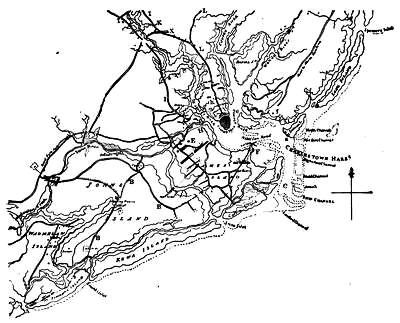
CHARLESTON, 1780.
"Key: A, landing of the king's troops at Edisto inlet on the 11th Feb., 1780. B, march of the army on landing from James island. C, the king's ships in the offing, waiting for the spring tides to cross the bar, which being effected the 20th March, they anchored in Five Fathom hole, whence having [passed] through a heavy fire from Fort Moultrie and the batteries of Sullivan island, [they] dropped anchor before the town on the 9th of April. E, redoubts to protect the transports in Stono river. F, strong redoubt erected near Fort Johnson. G, battery to remove the enemy's ships at d in Ashley river. H, bridge made over Wapoo. I, march of the army from Linning's to Drayton's, 29th March, whence having crossed Ashley river, [it] halted the same night at X. K, encampment of the army, 30th March, on Charlestown Neck. L, march of a strong reinforcement to Col. Webster's corps, under the command of Earl Cornwallis, to cut off the enemy's communication by Cooper river. a, Fort Moultrie and works on Sullivan island, with the enemy's ships to enfilade the channel (surrendered on terms the 4th of May to the seamen and marines of the fleet). d, strong post on Lempries. e, ships in Cooper river, and Boom to obstruct the navigation. f, post on Mount Pleasant. g, Gibbs' Landing. h, redoubts and batteries to establish the first parallel begun the 1st of April. i, second parallel finished the 19th April. k, third parallel completed the 6th of May, whence having by sap drained and passed the enemy's canal works, [it] was carried on towards the ditch of the place, and the garrison, consisting of upwards of 6,000 men, [were] surrendered to his Majesty's arms, under the command of Lt.-Gen. Sir Hen. Clinton, K. B., etc., and Vice-Admiral Mariot Arbuthnot, on the 10th of May, 1780. The king's army and works are colored red, the enemy's yellow."—Ed.
The correspondence between Clinton and Germain with regard to the planning of this campaign is in the Ninth Report of the Hist. MSS. Commission, App. iii. pp. 95, 98, etc.[1111] In this same appendix are three letters from Arbuthnot to Germain, giving interesting details. His official report was made to Mr. Stevens, secretary of the Admiralty, and was printed with Clinton's report. It is especially valuable with regard to the operations of the fleet. There is a critical account of the siege in Lee's Memoirs, i. 115-142, and the more popular descriptions are unusually good, especially those from German sources.[1112]
Minor Actions, 1780.—It is to be regretted that we have no official account of the disaster at the Waxhaws from the American commander. Tarleton's official report to Cornwallis was originally printed in The London Gazette Extra, July 5, 1780.[1113] The description of the affair in Dawson's Battles, i. 582, is based upon Adj. Bowyer's Particular Account of Colonel Buford's defeat. It differs materially from the account of the British commander.[1114]
Lee says that most of the wounded died of their wounds. This can hardly be true, as Muhlenberg in a letter to Washington (Muhlenberg's Muhlenberg, 368) says that the prisoners taken at the Waxhaws have nearly all returned. There are no plans of the battle, and it has been found impossible to make any estimate of the numbers engaged.[1115]
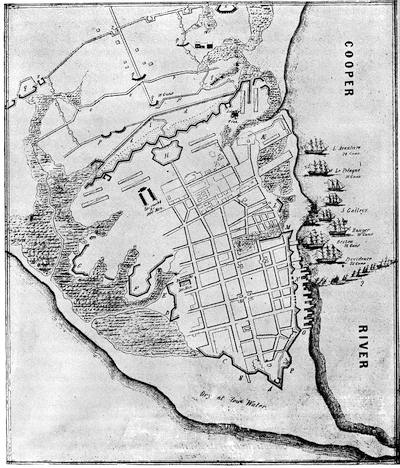
SIEGE OF CHARLESTON.
Reduced from the plan in Johnson's Traditions and Reminiscences of the Amer. Rev. (Charleston, 1851), p. 247.—Key (American works): A, Wilkins, 16 guns; B, Gibbs, 9 guns; C, Ferguson, 5 guns; D, Sugar House, 6 guns; E, old magazine, 5 guns; F, Cummings, 5 guns; G, northwest point, 4 guns; H, horn-work (citadel) and lines, 66 guns, beside mortars; K, Gadsden's wharf, 7 guns; L, Old Indian, 5 guns; M, Governor's bridge, 3 guns; N, Exchange, 7 guns; O, end of the bay, Littleton's bastion, 4 guns; P, Darrell's, 7 guns; Q, boom, eight vessels, secured by chains and spars.
(British works). 1, 2, 3, 4, 5, 6, redoubts begun April 1st; o, second parallel, finished April 19th; p, third parallel, completed May 6th; q, gun batteries; r, mortar batteries.—Ed.
There is a contemporary English map: Environs of Charleston, S. C. Published June 1, 1780. By Capt. George Sproule, Assistant Engineer on the spot; and a MS. Sketch of the coast from South Edisto to Charlestown, 1 March, 1780,—showing, among other things, "the rebel redoubt" at Stono. The best plan of the siege itself is A Sketch of the operations before Charleston, the Capital of South Carolina. Published 17th of June, 1780, according to Act of Parliament, by I. F. W. Des Barres, Eng. It will be noticed that this was put forth two days after Clinton's despatch of May 14th was published in London. It is a large map, showing the positions in colors. There are two copies in the Harvard College library. It has been reprinted by Mayor Courtenay in the Charleston Year-Book for 1882, P. 360, as "Sir Henry Clinton's Map, 1780", with a description (p. 371). Some one has apparently attempted to remove the inscription referred to above, and only the words "of June, 1780" are legible. In other respects it is identical with the Des Barres map. In his Year-Book (1880, p. 264) Mayor Courtenay has reproduced an interesting Plan of Charlestown. With its Entrenchments and those made by the English, 1780. It relates only to the lines themselves, and was probably the work of an American. There is a good map, with lines in colors, in Faden's Plans of Battles, which is reproduced in Tarleton, p. 32, and Stedman, ii. 184, Ramsay (Rev. S. C., ii. 59) gives an excellent map of a later date, as does Gordon (iii. 358). See also Lossing, Field-Book, ii. 765; Marshall's Washington, atlas no. 10; Moore's Diary, ii. 258; Carrington's Battles, p. 498; Mag. of Amer. Hist., 1883, p. 827; and R. E. Lee's edition of Lee's Memoirs, p. 146. Mention should also be made of a MS. plan in the Faden coll., and of a map, apparently of French origin, the property of Daniel Ravenal, of Charleston (Charleston Year-Book, 1884, p. 295), which Mr. De Saussure regards as a copy of "Brigadier-General Du Portail's engineer's map;" but there seems to be no evidence of this in print. There is a good chart of Charleston harbor in the corner of Des Barres's map, and in the so-called Mouzon Map (1775), while Ramsay (Rev. S. C., ii. 52) has a Sketch of Charleston Harbour, showing the disposition of the British fleet under the command of Vice-Admiral Mariot Arbuthnot in the attack on Fort Moultrie on Sullivan's Island in 1780.
Attempts at the identification of localities have been made by W. G. De Saussure in Charleston Year-Book (1884, pp. 282-308), and in an Historical Map of Charleston, 1670-1883, in the Year-Book for 1883. A plan of Fort Johnson on James' Island is in Ibid. (p. 473). These latter maps are also in a reprint of a portion of this Year-Book, issued under the title of 1670-1783: The Centennial of Incorporation, 1883 (Charleston, 1884).
There are other charts of the harbor in the No. Amer. Pilot; in the Neptune Americo-Septentrional. A chart of the harbor and bars by R. Cowley is sometimes noted as published in London in 1780.
There are other maps of Charleston in Bellin's Petit Atlas Maritime, vol. i. 37; in Castiglione's Viaggio p. 309, etc. There are among the Rochambeau maps in the library of Congress (no. 19) Vues de la rade de Charleston et du fort Sullivan, 1780, and a colored plan (no. 46), measuring 20 X 18 inches, called Plan de la ville de Charlestown, de les retrenchments et du siège fait par les Anglais en 1780.—Ed.
For the period between the Waxhaws and the disaster near Camden, the reports of Cornwallis are of value (Remembrancer, x. 261; Pol. Mag., i. 261, etc.); Ramsay, Rev. in S. C., ii. 128-145, has a fair account. The affair at Ramsour's Mill has not been given due prominence in the general histories. There is a good account of it in Caldwell's Greene, 123. But the description which has generally been followed is the one which General Joseph Graham—who was not present at the fight—printed in the Catawba Journal for Feb. 1, 1825.[1116]
Colonel Williams transmitted a report of the action at Musgrove's Mill to Gates (Remembrancer, xi. 87). But the best account of the affair is in Draper's King's Mountain, who (p. 122) gives a list of his authorities. See especially MCCall, Georgia, ii. 304-317; Jones, Georgia, ii. 452; and Amer. Whig Rev., new series, ii. 578.
Gates's Defeat near Camden, 1780.—The defeated general dated his official report at Hillsborough, Aug. 20, 1780 (Remembrancer, x. 335; Tarleton, 145; Sparks's Correspondence of the Revolution, iii. 66 and 76; Mag. Amer. Hist., v. 502, etc.). Cornwallis presented two reports bearing on the campaign. In the first—sometimes dated Aug. 20th, and sometimes Aug. 21st—he follows his movement to his arrival at Camden. The second—always dated the 21st—takes up the story at that point. They are both in the London Gazette Extra for October 9th, 1780.[1117]
I have found nothing official from Rawdon; but on Sept. 19th, 1780, he wrote to his mother, the Countess of Moira, describing the events preceding the battle. He speaks of the course taken by Gates as "the ruinous part which they, the Americans, actually did embrace", adding that De Kalb had advised Gates to cross Lynch's Creek and attack him there. This Rawdon learned from an aide to De Kalb[1118]—probably Du Buysson—who was taken with his chief.[1119]
Tarleton, too, was a participator in the action, and his account (Campaigns, 85-110), though written long after the event, is valuable. It begins with Cornwallis's arrival at Camden.
But the description of the campaign and battle which far outweighs all others, is the Narrative of the Campaign of 1780, by Colonel Otho Holland Williams, Adjutant-general,—printed as "Appendix B" to Johnson's Greene, vol. i. pp. 465-510, and copied thence into Simms's Greene, Appendix. There is no reason to doubt the general accuracy of the story, though no one knows when Williams wrote it. Two of the American commander's aides wrote accounts. The more important is the letter from Thomas Pinckney to William Johnson, the biographer of Greene, dated Clermont, July, 1822, and therefore written long after the battle; but the author's recollections so exactly agree with the facts as now known that it is an account of the greatest value.[1120]
The other is Major McGill's letter to his father, written within eight miles of the scene of action.[1121]
McGill carried Gates's despatches to Jefferson, then governor of Virginia, and gave him an account of the battle, which formed part of a statement "of this unlucky affair, taken from letters from General Gates, General Stevens, and Governor Nash, and, as to some circumstances, from an officer [McGill] who was in the action."[1122]
Still another excellent narrative of the campaign is in A Journal of the Southern Expedition, 1780-83. By William Seymour (Penna. Mag. of Hist., vii. 286, 377), who was sergeant-major of the Delaware regiment. The journal begins at Petersburg, May 26, 1780, thus describing the whole movement.
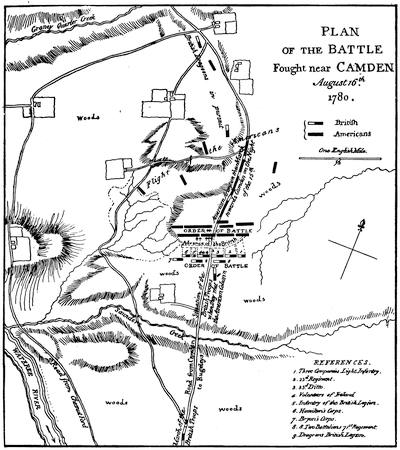
CAMDEN, August 16, 1780.
Faden's map, dated March 1, 1787,—the same used in Tarleton (p. 108) and in Stedman (ii. 210) and in the latter dated Jan. 20, 1794. Key: 1. Three companies light infantry. 2. Twenty-third regiment. 3. Thirty-third regiment. 4. Volunteers of Ireland. 5. Infantry of the British Legion. 6. Hamilton's corps. 7. Bryan's corps. 8, 8. Two battalions, seventy-first regiment. 9. Dragoons, British Legion.
This same plan is re-engraved in the Mag. of Amer. Hist., v. 275, and in R. E. Lee's ed. of Henry Lee's Memoir of the War, etc., p. 182. The original MS. of the plan is among the Faden maps (no. 51) in the library of Congress. There is an eclectic plan in Carrington's Battles, p. 533; but the best of the modern maps is that by H. P. Johnston in Mag. of Amer. Hist., viii. 496. Cf. Lossing's Field-Book, ii. 466. The Political Mag., i. 731, has a map of the roads about Camden.—Ed.
There are numerous descriptions by persons who, though not actually present at the disaster, yet enjoyed exceptionally good advantages for obtaining correct information.[1123]
Of the earlier historians, Gordon (History, iii. 391 and 429) enjoyed the best advantages. He visited Gates in 1781 and used his papers. These MSS. had disappeared until a few years ago, when Dr. T. A. Emmet, whose grandfather was Gates's counsellor, found them in a garret. (Cf. Mag. Amer. Hist., v. 241.) A portion of this collection was printed in Ibid. v. 281; as to the value of those reserved I have been able to learn nothing. A large part of the papers printed consists merely of the orders issued during the campaign. The most important of these—technically termed "after-orders", giving the order for the movement which brought on the action—have been printed over and over again.[1124]
We have no detailed account of Sumter's attempt to injure the enemy, nor of his overthrow at Fishdam Ford, except that in Tarleton's Campaigns, 110-116. As may be imagined, Tarleton gave his own side of the case more than due prominence. Lee, in his Memoirs (i. 187), gives a good account. He adds that "Tarleton evinced a temerity which could not, if pursued, long escape exemplary chastisement." There is something in Stedman, ii. 211, and in Ramsay, Rev. in S. C., ii. 152. The accounts in the more popular books are so inaccurate that no mention of them is required.[1125]
Treatment of the Southern People by the British.—The well-known letters from Rawdon to Rugely have been widely printed.[1126]
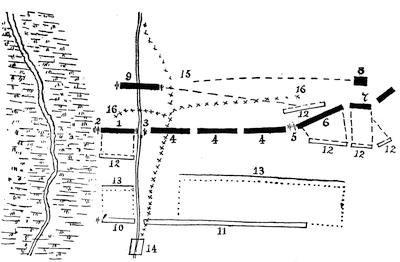
GATES'S DEFEAT AT CAMDEN.
The movements as detailed in a plan by Colonel Senff, preserved among the Steuben Papers (N. Y. Hist. Soc.), are shown in this sketch after a cut in the Mag. of Amer. Hist. (1880), vol. v. p. 275. The plan and accompanying journal, taken from the Steuben Papers, are in the Sparks MSS., no. xv. A marsh and the river were on the American right and the British left. The road to Camden is marked by parallel lines. The American right, 400 Marylanders under General Gist, were between the road and the low ground at 1, with two cannon on their right at 2, and two others on the left in the road at 3. Beyond the road were three brigades of North Carolina militia (4, 4, 4), under Brigadiers Rutherford, Graigery, and Butler, with two field-pieces at 5, on their left. Beyond this the American line was completed by 700 Virginia militia under Brigadier Stevens (6), and 300 light infantry under Colonel Potterfield (7). Colonel Armand, with 60 horse, was in the rear (8) of this part of the line, and as a reserve Smallwood with the first Maryland brigade of about 400 men, was across the road at 9. [The names are given as in the sketch.]
On the British side the first troops to appear were at 10 with a field-piece, and their main body formed at 11. The American troops at 6 and 7 advanced to 12, and were met by the British (11) moving by their right flank and then advancing to 13. The American reserve (9) then moved to 12 to support the left wing, while the right wing (1) advanced to 12 and engaged the British left (13). The Americans at 4, 4, 4, and 12 (opposite 6 and 7) now broke and fled. At this opportune moment the British cavalry (14) charged along the line shown by small crosses, and turning to the right and left took in reverse the Americans at 1, and the reserve (9) in their new position at 12. The whole American army scattered in retreat before the British advance.—Ed.]
With regard to the treatment of those captured at Savannah and Charleston, Southern writers do not seem to have strictly adhered to the truth. Those captured by Campbell were protected by no treaty of capitulation; and as to those taken at Charleston, the charges of Moultrie and others were always denied.[1127]
Isaac Hayne, at the time of the surrender of Charleston, was a colonel in a militia regiment, but, being in the country, he was not included in the capitulation. His wife and two children were ill with the small-pox, and it was impossible to take them to a place of refuge. He went to Charleston and offered to give his parole as a prisoner of war. He was told that he must take the oath of allegiance or be confined as a rebel. It was a hard position, and, thinking of his wife dying at home, he took the oath; not, however, until he had called Ramsay (Rev. in S. C.) to bear witness that he was forced to it by necessity. He retired to his farm, and lived there unmolested until the success of the American arms once more brought his friends around him. Then he was told by the British leaders that he must arm on the king's side or go to prison. He regarded this as a violation of his agreement, and enlisted under Pickens. He commanded a regiment of militia drawn from the neighborhood, and composed of men who believed with him that when protection was withdrawn the duty of allegiance went with it. Soon after this he captured, not many miles from Charleston, Williamson, a noted renegade, who was regarded by his former friends as the "Arnold of the South." On his way back Hayne was captured, taken to Charleston, and hanged.[1128] The fact that Greene and Marion (Gibbes, Doc. Hist., i. 125) both regarded it as calling for retaliation[1129] goes a great way towards showing that Rawdon and Balfour acted harshly and precipitately in the matter; but the case is an admirable example of the light in which Cornwallis—for Balfour tried to justify his conduct by a reference to the letter or order issued by Cornwallis after Camden—persisted in regarding those who fought for their country and their rights. It seems to me, however, that Cornwallis's position was a false one; and to assert, as Balfour asserted, that South Carolina was completely conquered in 1780, was to assert what was not true. Rawdon sailed for home soon after this affair. He was captured by the French, and did not reach London until after Yorktown. He was immediately assailed in the House of Peers by the Duke of Richmond for his share in this business. In reply he challenged the noble duke, and the upshot was that Richmond apologized.[1130] Many years later, Lee sent Rawdon a copy of his Memoirs, in which Hayne is warmly defended. Rawdon, then Earl of Moira, wrote a long letter (June 24, 1813) in reply, but his defence does not appear to be sound.[1131] It should be said, in justification of the light in which Hayne was regarded by the British officers at the time, that they believed he had taken a second oath to the king just before his capture in arms; but this does not appear to have been the case.[1132]
The most aggravated case of murder on the American side was the shooting of the Tory Col. Grierson after his surrender, near Augusta. The murder was committed in broad day, yet Pickens declared that the murderer was not known.[1133]
King's Mountain.—There is very little original material in print bearing on Clarke's siege of Augusta. McCall's narrative (Georgia, ii. 321) has been very generally followed. An anonymous account from a British source is in the Remembrancer, xi. 28.
Lyman C. Draper,[1134] in his King's Mountain and its Heroes, gives nearly all the important documents relating to that action. Unfortunately, as its title indicates, there is too much hero worship[1135] in the volume, and Draper's own account is based too largely on tradition to be wholly trustworthy, and is too diffuse and intricate. As a repository of documents, however, the volume is of the first importance. I shall attempt only a summary of the documents bearing on the movement.
Shelby wrote to his father five days after the fight (Draper, 302), and later, on October 26th, to Col. Arthur Campbell (Draper, 524). The statements in the first letter as to losses, etc., are strangely at variance with those contained in an official report signed by Campbell, Shelby, and Cleveland on October 20th.[1136] Col. William Campbell also wrote to Arthur Campbell on the same day (Draper, 526; Gibbes, p. 140, and elsewhere). Draper gives several other accounts, the most important being "Battle of King's Mountain", probably written by Robert Campbell, "an ensign in Dysart's corps" (Draper, 537, from MS. in possession of the Tenn. Hist. Soc.). Gen. Joseph Graham, who had no part in the fight, being still confined in the hospital from the wound received at the defence of Charlotte, wrote a description.[1137] David Campbell, in a letter (Foote's Sketches of Virginia, 2d series, p. 126) dated Montcalm, Dec. 1, 1851,[1138] defended his ancestor. Still other accounts are in Draper, many of them reprints; and a letter from Iredell to his wife, dated Granville, Oct. 8, 1780 (McRee's Iredell, i. 463), should not be overlooked.
The most interesting description of the campaign from the British side is in the Diary of Anthony Allaire, of Ferguson's corps.[1139] The chronology is useful in fixing dates, and his narrative of his treatment while in captivity and during his successful attempt to escape is very interesting. He is also supposed to have been the author of a letter written by "an officer from Charleston, Jan. 30", which is printed in Rivington's Royal Gazette of Feb. 14, 1781, and reprinted in Draper, 516.[1140]
There are two interesting letters from Rawdon, showing the extent of the disaffection to the royalist cause in the Carolinas.[1141]
Cornwallis seems to have presented no detailed report; at least, none has been printed, to my knowledge. There are allusions to the affair which show how deeply he was impressed by the coming of the men from beyond the mountains. The effect it had upon the plans of the British can be learned from a letter from Germain to Clinton, dated Jan. 3, 1781, in which he regrets that Ferguson's defeat compelled Cornwallis to require Leslie to quit the Chesapeake.[1142]
There is also an anonymous memoir of A Carolina Loyalist in the Revolutionary War in Chesney's Essays in Modern Military Biography (London, 1874, pp. 461-468), which contains something of interest.
[The latest contribution to the story of the parts played by John Sevier, Isaac Shelby, and James Robertson in helping to work the discomfiture of the British in the Southern colonies is the Rear Guard of the Revolution by Edmund Kirke [J. R. Gilmore], N. Y., 1886. The author says "his materials were principally gathered from old settlers in East Tennessee and Western North Carolina, one of whom was the son of a trusted friend of Sevier, Dr. J. G. M. Ramsey of Knoxville, the author of the Annals of Tennessee, who in his youth had known Sevier and Robertson, and who was nearly ninety years old when he was questioned by Gilmore."—Ed.]
Minor Actions, 1780.—The library of the Massachusetts Historical Society contains an original account of Weemys's unfortunate night attack on Sumter's camp at Fishdam Ford, from the pen of the British commander. It should not be followed too closely, as it was not written until many years of peace and poverty had clouded Weemys's judgment and memory. A more trustworthy description is in a letter from Sumter to Smallwood, written on the field of battle, Nov. 9, 1780 (Maryland Papers, p. 122). It is to be regretted that no letter of his relating to the affair at the Blackstocks has been preserved; for the British accounts are very confusing, Tarleton even claiming the victory (Campaigns, p. 178). This he did on the strength of a despatch from Cornwallis to Clinton, dated at Wynnesborough, Dec. 3, 1781.[1143] This, in its turn, as Mackenzie points out (Strictures, p. 71), was based—so far as it relates to the affair at the Blackstocks—on Tarleton's own report. In fact, Tarleton was beaten at that time. Mackenzie does not seem to have been present in person, but his account was based on the declarations of witnesses. It is the best description of the fight that we have, and has been followed by later writers, notably by Stedman (ii. 226-231). The only account that we have from an American source was written by Col. Samuel Hammond, who was present, as he was at the Cowpens (Johnson's Traditions, pp. 507, 522). It should not be too closely followed. There are a few reports and letters written by Cornwallis, and by Rawdon during his chief's illness, relating to this period, that should not be overlooked.[1144]
Greene's Campaign in General.—The standard authorities relating to Greene's campaign have already been mentioned.[1145] Lee was Greene's most trusted adviser, but there were others also deep in his confidence, such as Morgan, O. H. Williams,[1146] William Washington,[1147] Carrington,[1148] Howard,[1149] and W. R. Davie.[1150] Greene also utilized the services of the partisans Marion, Sumter, Pickens, and the rest. There is a noted passage bearing on the proper method of treating these men in one of Greene's letters to Morgan before the affair at the Cowpens. It seems that Morgan had complained of Sumter's order to his subordinates to obey no commands unless conveyed through him. Greene replied to Morgan: "As it is better to conciliate than aggravate matters, where everything depends so much upon voluntary principles, I wish you to take no notice of the matter, but endeavor to influence his conduct to give you all the aid in his power." It was by pursuing such a course that Greene secured the coöperation of all men in the South.
A good knowledge of the scene of operations is indispensable to a thorough understanding of Greene's remarkable campaigns. The general direction of the rivers should be especially noted, as upon it the success of a particular movement often turned.[1151]
The Cowpens.—Morgan's official report (Jan. 19) to Greene and Greene's instructions to Morgan (Charlotte, December 16, 1780) are in Graham, pp. 260, 467, while from that point and date the whole campaign can be traced by the letters printed by Graham.[1152]
A letter from Tarleton to Morgan dated on the 19th, two days after the battle, and relating to prisoners and wounded, is in The Charleston News and Courier. I have nowhere found a formal report by Tarleton. His description of the fight, at the time, is undoubtedly embodied in Cornwallis's report to Germain, dated Turkey Creek, Broad River, Jan. 18, 1781.[1153]
At a later day Tarleton wrote out an account (Campaigns, pp. 213-223). Seldom has a commander written a more unfair account of his defeat. Not merely that he is unjust to Morgan, but he is also very unjust to his own men. A much better description, by a British eye-witness, is Mackenzie's (Strictures, 95, followed by Stedman, Amer. War, ii. 316-325). Indeed, this last is in some respects the best account that we have. A narrative from "Colonel Samuel Hammond" (Johnson's Traditions, pp. 526-530) is not trustworthy.[1154]
The Retreat.—Our knowledge of the period from the Cowpens to the crossing of the Dan is based to a great extent upon the letters of the American leaders.[1155]
Cornwallis made a formal report to Germain, dated Guilford, March 17, 1781.[1156] Balfour in an independent report to Clinton (Remembrancer, xi. 330, and Polit. Mag., ii. 328), gave a somewhat similar account of the operations; but the most important document that has yet been printed is Cornwallis's Order-book, covering this period. It opens with an order of January 18, 1781, and runs with scarcely a break to March 20th. It was used by Graham in his preparation of the Life of Morgan, but was not generally accessible until some years later, when Caruthers printed it as the appendix to the second volume of his Incidents. Caruthers' own account of the movement (Incidents, pp. 13-67), although weighted with personal reminiscences, is still the best single narrative.[1157]
Tarleton's description (Campaigns, 222) of the march is far from satisfactory, and should be supplemented by that of the less partial Stedman (Amer. War, ii. 325) and Gordon (iv. 37).[1158]
The only action of this retreat that deserves special mention is the very gallant charge of the Guards at Cowan's Ford over the Catawba. It was especially creditable to the Grenadiers, and has received far less attention at the hands of American writers than it deserves. A good account is in Hamilton's Grenadier Guards, ii. 243,[1159] and Stedman has devoted considerable space to it. On the other hand, it should be said that the description in Tarleton cannot be reconciled with known facts, and deserves no credit.
The Guilford Campaign.—Lee's description of the overthrow of Pyle and his companions has been generally followed by historians. It is not entirely satisfactory (Memoirs, i. 306).[1160] Lee says that the action was begun by the Tories, and that he acted merely on the defensive. General Joseph Graham, who was on the field as a captain of militia, asserts the contrary.[1161]
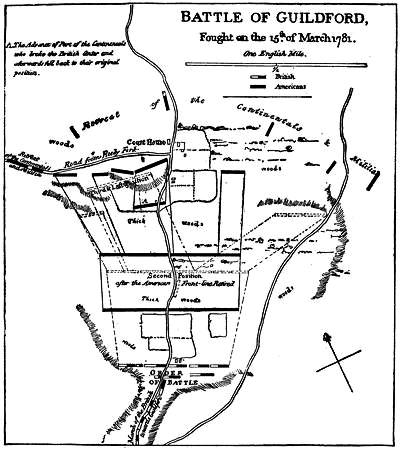
GUILDFORD, March 15, 1781.
Sketched from Faden's map (March 1, 1787), which is the same as the map in Tarleton (p. 108), with the same date, and in Stedman, ii. 342, with slight changes, dated Jan. 20, 1794. It is followed in the maps in Mag. of Amer. Hist. (1881), p. 44; in R. E. Lee's Lee's Memoir, etc., p. 276; in Caruthers' Incidents (Philadelphia, 1808), p. 108; in Lossing's Field-Book, ii. 608. There are among the Faden maps (nos. 52, 53) in the library of Congress two MS. drafts of the battle,—one showing the changes in the position of the forces. Johnson (Greene, ii. 5) gives five different stages of the fight, and G. W. Greene (iii. 176) copies them. His lines vary from the descriptions of Cornwallis. Cf. Carrington's Battles, p. 565; Hamilton's Grenadier Guards (ii. 245); Harper's Monthly, xv. 162, etc.—Ed.
As to the other operations leading up to the final action at Guilford Court-House, and as to that combat itself, the reports and other letters of the opposing commanders, Greene[1162] and Cornwallis,[1163] are all that can he desired.
The narratives of Lee (Memoirs, i. 338-376) and Tarleton (Campaigns, 269) are interesting, though neither saw much of the battle,—Tarleton being in reserve, and Lee's attention being fully occupied by the regiment of Bose. Wounds received at the Cowpens unfortunately prevented Mackenzie from speaking with authority of Tarleton's account of this battle.[1164]
The best account by a later writer is that in Caruthers (Incidents, 2d series, pp. 103-180); but, like all North Carolinians, he endeavors to excuse the early flight of the militia of that State, and his narrative is too largely founded on tradition.[1165]
Hobkirk's Hill.—The official reports serve us first: Greene's, full and precise,[1166] on the American side; and on the British, Rawdon's and those of the intermediate officers, till the accounts reached Germain.[1167]
Col. O. H. Williams also wrote an interesting account of the fight in a letter to "Elie" (his wife), dated Camp before Camden, April 27, 1781 (Potter's American Monthly, iv. 101, and Tiffany's Williams, p. 19). Still another of Greene's officers—Major William Pierce—in a letter (August 20) devoted considerable space to this indecisive engagement (Mag. Amer. Hist., vii. 431-435). A somewhat different description by a looker-on was written many years afterwards by Samuel Matthis, an inhabitant of the district. It is entitled: Account of the battle of Hobkirk's Hill as some call it, or Battle of Camden as called by others, tho' the ground on which it was fought is now (1810) called the Big Sand Hill above Camden (American Historical Record, ii. 103).
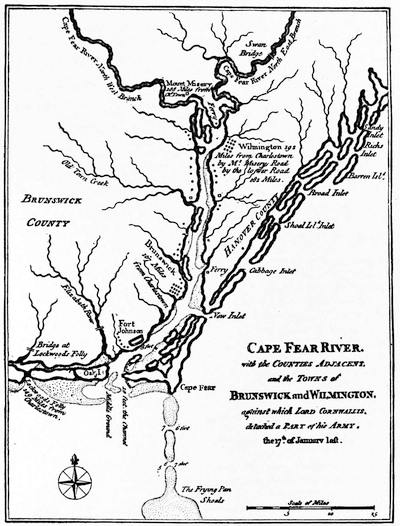
From the Political Magazine (vol. ii p. 117).
There is a chart of Cape Fear River, 1776, in the No. Amer. Pilot, no. 28.—Ed.
Whether Greene was or was not surprised is the only point about which there has been much dispute in recent years. Johnson (Greene, ii. 72) has effectually disposed of this question in Greene's favor; but it must be admitted that he was "very suddenly attacked", to use the words of Lee, who was not present at the battle, and who seems to have forgotten the exact relation of events of this campaign. The account of this affair in the lives of Greene by Johnson and Greene (iii. 241), as well as that in Marshall's Washington (iv. 510), is based upon an unpublished narrative by Colonel Davie, which is among the "Greene MSS."[1168]
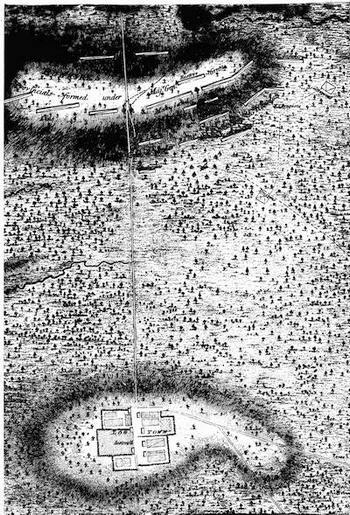
HOBKIRK'S HILL. (Sometimes called the Second Battle of Camden.)
Sketch of the battle of Hobkirk's Hill, near Camden, on the 25th April, 1781, drawn by C. Vallancey, Capt. of the Vols. of Ireland. [The cross-swords show] where the enemy's piquets were attacked. Faden, Aug. 1, 1783. It is the same plate, with slight changes, used in Stedman (ii. 358), where it is dated Feb. 6, 1794. It is reëngraved in R. E. Lee's ed. of Henry Lee's Memoirs of the War, p. 336. Johnson's plan (Greene, ii. 76) is reproduced in G. W. Greene's Greene, iii. 241. Carrington (p. 576) gives an eclectic plan, and there is a small plan in Lossing's Field-Book, ii. 679.—Ed.
The Capture of the Posts.—For the account of the capture of Fort Watson, Marion's report (April 23) to Greene has been the main reliance (Simms, Marion, p. 231; Pol. Mag., ii. 548; Remembrancer, xii. 127, etc.). Lee's narrative of this period (Memoirs, ii. 50) is detailed, but it was written too long after the war to be accurate. This is unfortunate, as we have no other account of the taking of Fort Motte (Memoirs, ii. 73) by an on-looker, unless we accept the letter sent by Greene to Congress as an original source. It is not known when Greene arrived at Fort Motte, which was at some time before the surrender.[1169]
At this time Marion became discouraged, and wrote to Greene that he contemplated retiring. These letters are in Gibbes, p. 67-69. Rawdon presented a report covering this period.[1170]
The siege of Augusta was much better chronicled, as with it McCall (Georgia, ii. 321) again becomes useful.[1171] Another description, though from what source is not stated, is in Johnson's Traditions, 354. Lee's account is in his Memoirs, ii. 81-95 and 100-118. The first part refers more especially to the capture of Fort Granby and of Fort Galphin, an outpost of Augusta. The official correspondence between Lee and Pickens on one side and Brown on the other has been printed over and over again.[1172]
Siege of Ninety-Six.—Cruger[1173] presented no formal report of his defence—so far as I know; but there is a good account of the siege in Mackenzie's Strictures, pp. 139-164, written by Lieutenant Hatton, of the New Jersey Loyalist Volunteers: cf. p. 129. Mackenzie himself is very severe on Tarleton's account (Campaigns, 495). Greene's very meagre report is dated Little River, June 20, 1781 (Caldwell's Greene; Pol. Mag., Tarleton, 498, etc.).[1174]
Rawdon's report of his successful attempt to relieve the garrison is in Remembrancer, xv. 9.[1175]
Neither Greene nor Lee (Memoirs, ii. 119) intimate that the stockaded fort was abandoned before Lee's assault, though the English authorities assert it. Nor does Greene allude to the gallant sally of the defenders of the "Star", which compelled the assailants to retire from the ditch, with great loss to themselves.[1176]
Eutaws.—I should place first Greene's official report, though it is not as full as could be desired.[1177]
Williams has left two accounts: the first is a letter, dated Fort Motte, Sept., 1781 (Tiffany's Williams, p. 22). The important paper, however, is entitled: Account furnished by Colonel Otho Williams, with additions by Cols. W. Hampton, Polk, Howard, and Watt (when written is not stated), in Gibbes (pp. 144-157). It is a long and detailed description of the battle by men who actually took part, but as it may have been written long after the event, too much reliance should not be placed upon it. Still another description of the campaign, though not of the battle, is contained in two letters from Major William Pierce to St. George Tucker (Mag. Amer. Hist., vii. 435). Lieutenant-Colonel Stuart presented a report to Cornwallis, which has been widely reprinted.[1178]
It differs from the American accounts in many particulars, especially as to the disorganization of his own troops, which very likely has been described in too glowing colors by American writers. Lee was present at the battle, but his description (Memoirs, ii. 276-301) of the contest is sometimes hard to reconcile with the accounts of his fellow-soldiers. Greene, according to Williams, was hardly satisfied with the conduct of that partisan leader, and Lee soon after retired from the army, ostensibly for other reasons. Neither Johnson (Greene, ii. 219) nor G. W. Greene (Greene, iii. 384) have added much to our knowledge of this action, and the same may be said of the other writers on the war.[1179]
Greene's Later Campaigns.—There are many letters of this period in the third volume of Sparks's Correspondence of the Revolution, and in Gibbes's Documentary History (1781-1782). Many of those in the latter are of merely local interest, a large number of them relating more especially to a quarrel between Horry and Mahem, Marion's two subordinates. Lee, too, after his return from Yorktown became discontented, and many letters which passed between him and his commander are printed by Gibbes. Much of Lee's uneasiness was doubtless due to the prominence which Greene awarded to Laurens. Leslie's letter proposing a cessation of hostilities was enclosed by Greene in a letter to the President of Congress (Remembrancer, xiv. 324). A truce not being acceded to, he demanded provisions (Remembrancer, xv. 28). This too being refused, he endeavored to seize them. One of the expeditions resulted in the death of Laurens.[1180] Gist made a report of this action, and there is a note from Greene to Washington.[1181] Benjamin Thomson,—afterwards Count Rumford,—at this time lieutenant-colonel in a regiment stationed near Charleston, wrote many letters in Jan., 1782, which have been printed by the Royal Commission on Hist. MSS. in their Ninth Report, Appendix, iii. p. 118.[1182]
An account of the march of the reinforcements sent south under St. Clair is in Harmer's Journal, while the "Journal" of Major Denny in Penna. Hist. Soc. Memoirs, vii. pp. 249 et seq., contains much of interest relating to the operations around Charleston.[1183] Mention should also be made of a series of letters from Major Pierce to St. George Tucker, bearing on this period, in Mag. Am. Hist. (1881), pp. 431-445, while there is an original account by Seymour in Penna. Mag., vii. 377. A British narrative of the same operations is in Political Mag., iv. 36-44.[1184]
There are several descriptions of the triumphant entry of the Americans into Charleston on the 14th of December, 1782; that by Horry in Charleston Year Book (1883) is perhaps the best.[1185] Of the contemporary historians, Gordon (vol. iv. 173-177, 298-305) has given the best account of this time.[1186] In the library of the Mass. Hist. Soc. there is a manuscript giving details of the emigration at the evacuations of Savannah and Charleston.[1187] It appears from this that no less than 13,271 of the former inhabitants of those States, including 8,676 blacks, left with the British army when it finally retired from the South.
The British in Virginia, 1779 and 1780.—Besides the documents mentioned in the Virginia Calendar of State Papers, there are full and detailed accounts by Mathews and Collier of their doings at Portsmouth and Suffolk.[1188] There is some account also of the naval portion of this expedition in Town's Detail of Some Particular Services performed in America, compiled from journals ... kept aboard the Ship Rainbow, New York, 1835, pp. 77-88.[1189]
Clinton's instructions to Leslie are in Clinton's Observations on Cornwallis, App., pp. 25, 27. There is little else bearing on this movement except a few letters from Steuben in Historical Mag., iv. 301, and Corres. of the Rev., iii. 203.[1190]
Arnold and Phillips in Virginia, 1781.—With regard to the first part of Arnold's raid into Virginia, we have several letters from him to Clinton.[1191] On the American side there are many interesting letters in the Maryland Papers (134-144), and in Muhlenberg's Muhlenberg, 404, etc. See also Ibid. 216-253, for a description of Gen. Muhlenberg's share in resisting these incursions. Steuben, as Greene's lieutenant, had the chief command in Virginia at the time, and Kapp in his Steuben (Amer. ed., p. 371 et seq.) has not failed to give him full credit for his courageous endeavors.[1192]
Lafayette and Cornwallis in Virginia.—Lafayette, during his campaign against Phillips, and afterwards against Cornwallis, was considered as under the command of Greene. He reported to Greene, and his reports may be found in the Remembrancer, (vol. xii.).[1193] He also kept up an incessant correspondence with Washington, and Sparks's Corres. of the Rev.[1194] should therefore be compared with the papers in Lafayette's Memoirs.[1195] A few reports and letters from Cornwallis at this time will be found in his Correspondence (i. 105 et seq.). Tarleton (Campaigns, 279) gives a good account of the march from Guilford to Wilmington and thence to Petersburg, from his point of view. Gen. Graham was at that time a captain in the 76th regiment, which, with the 80th, bore the brunt of the action at the crossing of the James. The account of the affair in his Memoirs (pp. 53-55) is one of the best we have. Simcoe, in his Journal (ed. 1787, pp. 146-177; Am. ed., pp. 209-250), has given a detailed description of the campaign. He has exaggerated his own services, but has atoned, in part, for this by giving a set of good plans of the rencounters which he tried to dignify into battles.[1196] Giradin (Continuation of Burk, iv. 490) has given the Jeffersonian version of the period.[1197]
This gallant struggle of Lafayette against great odds was very creditable to him and to his soldiers; but it had little or no influence on the final result. Nevertheless, it has attracted the attention of recent writers, and has brought out two good articles: one from the pen of Carrington (Mag. Am. Hist., vi. 340, with map), the other from a less known writer, Mr. Coleman (Ibid. vii. 201).[1198]
The Yorktown Campaign.—Clinton and Cornwallis, in their pamphlets on the conduct of the campaign, printed most of the important documents which passed between them and their superiors and subordinates. Others will be found in the documents printed by order of the Lords, and still others in the biographies of the different commanders. I shall point out only the most important. In a letter (Wilmington, April 18, 1781) Cornwallis explained the reasons for the Guilford campaign, gave an account of his later movements, and advocated a march into Virginia. On the 24th he wrote to Phillips that his situation at Wilmington was very distressing (Parl. Reg., xxv. 155, etc.). On the preceding day he had announced his determination to Germain to go north (Parl. Reg., xxv. 145; extracts in numerous places, among others in Tarleton, 325). But more valuable than these are two letters to Clinton written April 24th (Parl. Reg., xxv. 156; extracts in Cornwallis's Correspondence, i. 94; Cornwallis's Answer, p. 55; and in many other places). Clinton disapproved this movement from the outset. (Cf. letter, May 29th, in Clinton's Observations on Cornwallis, App. p. 99.) Cornwallis tried to justify his conduct in a letter dated Portsmouth, July 24th (Parl. Reg., xxv. 207, etc.). On the other hand, Germain was "well pleased to find Cornwallis's opinion entirely coincided" with his (Parl. Reg., xxv. 135). Cornwallis therefore went north without any misgivings.[1199]
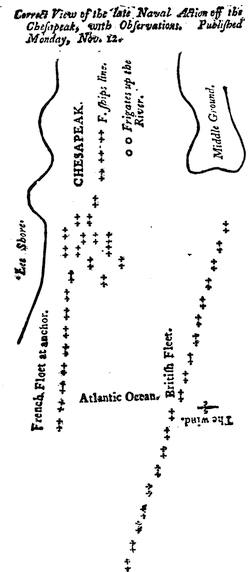
DE GRASSE'S VICTORY.
A contemporary type-sketch from the London Magazine. The Political Mag., 1784, p. 20, has a folding plan. The most detailed plan is in Stedman (ii. ch. 44), The position of the English and French fleets immediately previous to the Action on the 5th of Sept., 1781, which is reproduced in Mag. of Amer. Hist., Nov., 1881, p. 367. For the operations in and about the bay, see Carrington's plan in his Battles, p. 596. Contemporary charts of the bay are in the No. Amer. Pilot, nos. 26 and 27; the Neptune Americo-Septentrional, no. 20; and Des Barres's Atlantic Neptune. Graves's despatch on his failure, dated at sea, Sept. 14, is in the Political Mag., ii. 605, with other accounts (p. 620); with further explanations from Clinton and Graves (p. 668). Cf. Ibid. iii. 153. John G. Shea edited in 1864 two contemporary journals as Operations of the French Fleet, etc., with a plan. One of these journals was printed at Amsterdam in 1783 (Murphy Catal., no. 1,386). Cf. Stedman, ii. ch. 44; Chevalier's Hist. de la marine française (Paris, 1877), ch. vii.; Léon Chotteau's Les Français en Amérique, p. 248; Moore's Diary, ii. 476.—Ed.
On June 11th Clinton ordered Cornwallis to seek some defensive position (Parl. Reg., xxv. 160). Four days later he wrote that he should need some of Cornwallis's troops (Parl. Reg., xxv. 175, and Cornwallis's Answer, App. p. 112). This request he repeated on the 19th, and again on the 26th (Parl. Reg., xxv. 177, and Germain Corresp., 187). In this last he announced his purpose of marching on Philadelphia. On the 30th Cornwallis wrote one or two letters questioning the utility of the defensive post he was ordered to occupy (Parl. Reg., xxv. 169, and at greater length in Cornwallis's Answer, App. p. 118). In another letter, dated July 8th, he again questioned the utility of a defensive post. Clinton on his part, in two letters of July 8th and 11th, censured the Virginia commander for repassing the James, and ordered him to occupy Old Point Comfort (Parl. Reg., xxv. 171). Again, in another letter of the same date as the second of these, he reiterates his order to fortify a station in the Chesapeake for the protection of large ships. Admiral Graves also wrote to Cornwallis, urging him to seize and fortify Old Point Comfort (Cornwallis's Answer, App. p. 180). A board of officers was now sent to report on the practicability of holding Old Point Comfort as a station for line-of-battle ships. They reported (Parl. Reg., xxv. 182) that the proposed site was not suitable, and this decision Cornwallis communicated to Graves (Aug. 26th, in the App. to his Answer). He also wrote to Clinton on the next day somewhat bitterly in regard to his criticisms and orders (Corn. Corresp., i. 107). Thinking that his orders required him to fortify Yorktown, he repaired thither, though writing to O'Hara that the position was a bad one on account of the heat, etc. (Corn. Corresp., i. III.). Clinton also wrote three letters at about this time, which Cornwallis did not receive until after his surrender. The first and important one is in Parl. Reg., xxv. 182, while all three are in the Appendix to Cornwallis's Answer, pp. 237, 251, 257. Such are the most important documents bearing on the responsibility[1200] for the disaster at Yorktown.
Cornwallis's official report to Clinton (Yorktown, Oct. 20, 1781) was forwarded by Clinton to Germain on Nov. 15, 1781.[1201] The two commanders kept up a constant correspondence during the siege, and from their letters the details may be gathered. These are all printed in the Appendix to the Parliamentary Register and in numerous other places.
As soon as it was known at New York that Cornwallis was besieged by such superior numbers, every effort was made to relieve him.[1202] The fleet had been so badly cut up during the recent encounter with De Grasse that Graves refused to venture again to sea before extensive repairs had been completed. Consequently, when the relieving fleet arrived off the capes of the Chesapeake the capitulation of Yorktown had been signed. The letters and reports relating to this abortive endeavor will be found in the Parl. Reg., xxv. pp. 190-200. There seems to be no reason to blame Clinton or Graves for this delay.[1203]
The correspondence between the opposing commanders as to the surrender has been often printed, as have the articles.[1204] As late as Oct. 19th Clinton wrote to some one in England giving an account of the operations leading to the siege.[1205] On Oct. 29th Clinton wrote to Germain the first official news concerning the surrender. This letter (London Gazette, Nov. 24-27, 1781, and Remembrancer, xiii. 33) is marked as received on Nov. 27th; but Wraxall, in a well-known passage, says that the first official news of the surrender was received on the 25th.[1206]
The Ninth Rep. of the Hist. MSS. Commission (App. iii. pp. 112-114) contains four letters from "G. Damer" to Lord George Germain, relating to the Virginia campaigns from Phillips's expedition to the end. These letters are of exceeding value and interest. They bear out the assertion so often made in the preceding narrative as to the great want of harmony which prevailed in the higher ranks of the British forces in this country.
Washington's official report[1207] announcing the surrender (Remembrancer, xiii. 60, and innumerable other places) is of far less importance than his order-book and his journal (May to Nov., 1781), which last is in the State Department at Washington (T. F. Dwight in Mag. Am. Hist., vi. 81). The portion on this campaign is in Ibid. (vol. vi. pp. 108-125; vii. 122-133).
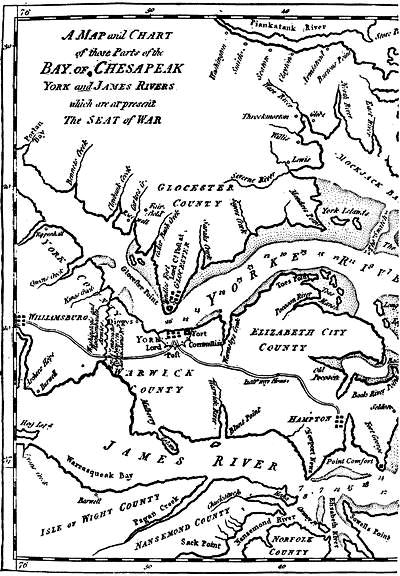
YORKTOWN CAMPAIGN.
From the Political Mag., ii. 624, being the westerly half of the map there given, originally published in London, Nov. 30, 1781, by J. Bew. Faden published in 1781 A Plan of the Entrance of Chesapeake Bay, with James and York Rivers, by an officer, which shows the condition in the beginning of October.—Ed.
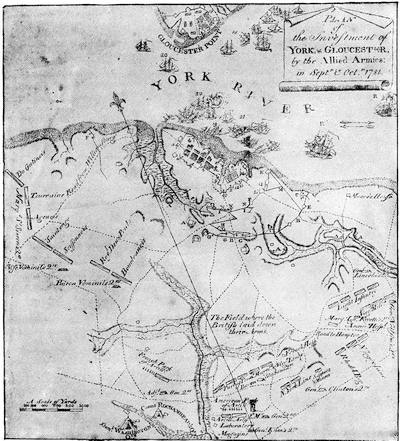
SIEGE OF YORKTOWN, 1781. (Ramsay.)
Note on the Maps of the Yorktown Campaign.—There is among the Rochambeau maps the original sketch, done with a pen and a wash, 40×12 inches, showing the different encampments of the French army between Boston and Yorktown, which is etched in Soulés' Histoire des Troubles de l'Amérique Anglaise, and reproduced in Balch's Les Français en Amérique, and in Mag. of Amer. Hist., v. p. 1, and vii. pp. 8, 12, 17.
The route of the allies from Chatham to Head of Elk, by Lieutenant Hills, a British map, is in Mag. of Amer. Hist., v. 16. Cf., for a general view, Harper's Mag., lxiii. p. 328. The best account of this march and the return to Boston is by J. A. Stevens in Mag. Amer. Hist., iii. 393; iv. 1; v. 1; vii. 1.
The earliest American map of the siege is one by Sebastian Bauman, an officer of German extraction attached to Lamb's artillery, whose draft was engraved in Philadelphia in 1782. There are copies in the N. Y. and Penna. Hist. Societies, and, reduced one half, it is given in the Mag. of Amer. Hist. (vol. vi. 57), and it is also in Johnston's Yorktown, p. 198. There is among the Rochambeau maps in the library of Congress (no. 63) a Plan of the investment of York and Gloucester by Sebastian Bauman; the French in yellow, the Americans in blue, and the English in red.
The earliest American maps issued to accompany narratives were Ramsay's in his Rev. in So. Carolina, ii. 545 (reproduced herewith, and followed in Harper's Mag., lxiii. 333, and Lowell's Hessians, 278); Gordon's, in his vol. iv. 196, also follows Bauman; Marshall's, in his Atlas to his Washington (reproduced herewith). Later published are the maps in Sparks's Washington, viii. 186; in Atlas to Guizot's Washington; in Irving's Washington, quarto ed., iv. 356; E. M. Stone's Our French Allies, 424; Carrington's Battles, 646; Lossing's Field-Book, ii. 518; Ridpath's United States; J. A. Stevens's Yorktown Centennial Handbook; Johnston's Yorktown (pp. 133, 144).
The leading British map of the siege is A Plan of Yorktown and Gloucester ... from an actual survey in the possession of Jno. Hills, late lieut. in the 23d Regiment (Faden, London, Oct. 7, 1785). There is another dated March 1, 1787, and, though a different plate, it corresponds nearly to the one in Stedman, ii. 412, which is reproduced in the Mag. of Amer. Hist., vi. p. 8; Tarleton's Campaigns, ch. vii.; R. E. Lee's ed. of Henry Lee's Memoirs, etc., p. 300; Hamilton, Repub. of the U. S., ii. 263. Other early English maps are: A Plan of the Posts of York and Gloucester in the Province of Virginia, established by his Majesty's Army, etc., which terminated in the Surrender ... on the 17th Oct., 1781. Surveyed by Capt. Fage of the Royal Artillery, which contains a small plan showing the position of the army between the ravines. What appears to be an original map is the Plan of York Town shewing the Batteries and Approaches of the French and Americans, 1781, on p. 61 of the Memoir of General Graham. A large map in colors is: Plan of York Town in Virginia and adjacent country exhibiting the operations of the American, French, and English armies during the siege of that place in Oct. 1781, by J. F. Renault. Leake's Lamb, p. 278, contains a fair map, with contours shown, although incorrectly.
There are MS. maps of the siege in the British Museum. Other MS. maps of Yorktown and the neighboring waters, including the drawn plan made for Faden's engraved map, are among the Faden maps (nos. 90, 91, 92) in the library of Congress.
There are among the Rochambeau maps in the library of Congress several illustrating the siege of Yorktown and attendant movements in Virginia:—
No. 50, Carte des environs d'Hampton, 1781, measuring 36 x 24 inches, and colored faintly.
No. 52, a pen-and-ink Plan de Portsmouth, Va., 15 x 12 inches.
No. 53, Plan des ouvrages de Portsmouth en Virginie, colored, 15 x 12 inches.
No. 54, Carte detaillé de West Point sur la rivière de York au confluent des rivières de Pamunky et Matapony, a colored sketch.
No. 55, a pen-and-ink sketch, Batteries de West Point de la rivière York, 15 x 12 inches.
No. 56, a pen-and-ink sketch, Plan des environs de Williamsburg, York, Hampton and Portsmouth, measuring 12 x 12 inches.
No. 57, a colored plan, 3 x 4 inches, showing the French army in camp, Sept., 1781, called Carte des environs de Williamsburg en Virginie.
No. 58, Plan d'York en Virginie, avec les attaques faits par les armées français et Américain en Oct. 1781, a colored sketch.
No. 59, Siége d'York, 1781, a colored plan, 23 x 24 inches.
No. 60, Plan des ouvrages faits à Yorktown en Virginie, a tracing, 24 x 20 inches.
No. 61, a sketch in ink and water-colors, with an elaborate key, Notes sur les environs de York, 24 x 12 inches.
Balch refers to a MS. map by Soulés, preserved in the Archives de la Guerre at Paris, and another attached to the MS. Journal de mon séjour en Amérique, which he attributes to Cromot-Dubourg. Soulés' map, Plan d'York en Virginie avec les attaques et les campemens de l'Armée combiné de France et d'Amérique, is given in his Troubles, etc., vol. iv., reduced in Mag. of Amer. Hist. (June, 1880).
Another published French map is a Plan de l'armée de Cornwallis, attaquée et faitte prisoniere dans Yorktown, le 19 8bre par l'armée combinée Française et Américaine. Dessiné sur les lieux par les Ingenieurs de l'armée à Paris. Chez Le Rouge, Xbre, 1781. Another good French map has no clew to its authorship except the words "M. fecit." It is entitled Plan de l'Attaque des villes de Yorck et Gloucester dans lesquelles etoit fortifié le Général Cornwallis fait prisonnier le 19 Octobre, 1781 (a copy in Harvard College library). Two anonymous French maps are: Plan d'York en Virginia avec les attaques et les Campemens de l'armée de France et de l'Amérique (fac-simile in Mag. of Amer. Hist., 1880, p. 440), and Carte de la partie de la Virginie ... avec le plan de l'Attaque d'Yorktown et de Gloucester. There is also a Paris map of Virginia, published by Esnauts and Rapilly, giving the Baie de Chesapeake avec plan de l'attaque.
There is a German map by Sotzman.
All these maps were based on more or less imperfect surveys. A map giving correct topography, Yorktown, Virginia, and the Ground Occupied in the Siege of 1781; a topographical survey by direction of Brev.-Maj.-Gen. G. W. Getty, U. S. A., commanding Artillery School, Fort Monroe, 1880, was drawn by Lieut. Caziare. A reduced fac-simile is given in Mag. of Amer. Hist. (vii. 408,—described, p. 339). Caziare also drew the plan, embodying the lines of Faden and Renault, which is given in Patton's Yorktown, p. 34, and Mag. of Amer. Hist., vii. 288. A section of another and earlier government survey, by Major Kearney, showing the roads as they were in 1818, is in Johnston's Yorktown, p. 103. Cf. his list of maps in Ibid., p. 198.—Ed.
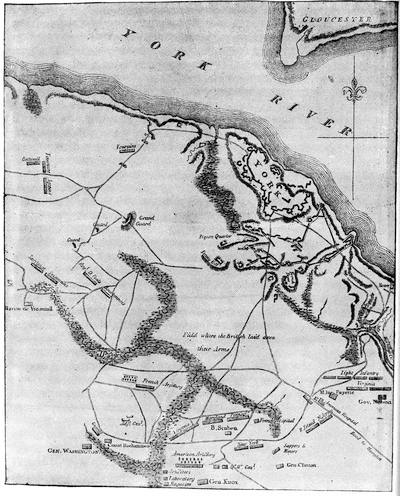
YORKTOWN, 1781. (Marshall's Washington.)
Portions of his orderly-books, extending, with breaks, from June 19, 1781, to April 30, 1782, were printed in the Amer. Hist. Record (iii.; on the siege itself, pp. 403, 457-462). The orderly-books were reprinted at Philadelphia in 1865,[1208] while two orders of Sept. 15th and 25th, not included, are in the Penna. Hist. Mag. (1881), and in Johnston's Yorktown, 199. Many other important journals and orderly-books on the American side are preserved.[1209]
On the French side we have several contemporary accounts. First of all I should place an anonymous journal which has been attributed to Rochambeau.[1210] The Diary of a French Officer, 1781 (March 26 to Nov. 18, 1781), presumed to be the work of Baron Cromot-Dubourg, an aide to Rochambeau, was brought to light by Mr. Balch (Mag. Am. Hist., vii. 295), and is printed in Ibid. iv. 205, from an unpublished MS. then in the possession of Mr. C. Fiske Harris,[1211] of Providence, R. I.[1212] In some respects this is the most valuable paper of this class that we have. Still another important diary is the Journal of Claude Blanchard, Commissary of the French Auxiliary Army sent to the United States during the American Revolution, 1780-1783. Translated from the French MS. by William Duane, and edited by Thomas Balch (Albany, 1876, pp. 92-184 especially including the march back to Boston).[1213]
In 1879 Mr. J. A. Stevens printed in the Mag. of Amer. Hist. a series of letters from Count Fersen to his father, occasionally inclosing a bit of journal, a great deal of which relates to the operations before and after Yorktown, and it is in all respects a very valuable contribution. The greater part of Deux-Pont's Campaigns[1214] relates to this period, while the Journal of an Officer (pp. 148-164) and portions of the diaries kept by the naval officers refer to the same campaign.
The French accounts of the assaults on the redoubts are in the above. Hamilton's report to Lafayette is in Remembrancer, xiii. 61, while Lafayette's report to Washington is in Corresp. of the Rev., iii. 425.[1215]
There are good accounts of this campaign in the standard books.[1216] Of the more recent works, Henry P. Johnston's Yorktown[1217] stands first, though it was written with an evident bias. J. H. Patton[1218] also produced a small volume. Giradin's Continuation of Burk (iv. 519) contains a one-sided description; and the lives of any of the Revolutionary worthies[1219] devote a considerable space to the campaign. Among these is the Life of Muhlenberg by his son (268-276), in which an unfounded claim is advanced for the sire that he commanded the storming party led by Hamilton. The more popular books also have detailed accounts,[1220] while the subject has been repeatedly treated by orators, notably by Robert C. Winthrop.[1221]

EDITORIAL NOTES ON EVENTS IN THE NORTH, 1779-1781.
While the events followed in the preceding chapter were all tending, both by Washington's victory and Greene's defeats, to a discouragement of the English necessary to induce the British government to desire a peace, the succession of events in the North had hardly any interdependence, and of themselves conduced but little to the same end. The campaigns of Sullivan in 1778 and 1779, the dismal failure of the Massachusetts expedition to Penobscot in 1779, and the plot of Arnold, are considered in other chapters. A brief commentary upon the other transactions of this period here follows. The spring of 1779 was not an encouraging one for the cause. Washington had kept his main army during the winter at Middlebrook (Irving, iii.; Greene's Greene, ii. 160), and he was now resolved on a defensive campaign (Bancroft, x. ch. 9). He gave his views to Congress (Sparks, vi. 158); but that body inspired little confidence. It did something to increase the efficiency of the army in creating an inspector-general (Journals, iii. 202); but its internal bickerings were sadly discouraging (Greene's Hist. View; Bancroft, x. 208; Greene's Greene, ii. 170, 175; John Adams's Works, i. 292). The legislators were powerless to regulate prices as they wished, and riots were in progress at their very doors (Reed's Reed, ii. ch. 6). They sent A circular letter to their constituents, and urged enlistments in an address (May 26th; Niles's Principles, etc., 1876, p. 405); while Gouverneur Morris prepared for them some Observations on the American Revolution, published according to a Resolution of Congress, by their Committee for the Consideration of those who are desirous of comparing the Conduct of the Opposed Parties, and the several Consequences which have flowed from it (Phila., 1779). (Cf. Sparks's Gouv. Morris, and the letter of Thomas Paine, Hist. Mag., i. 20.)
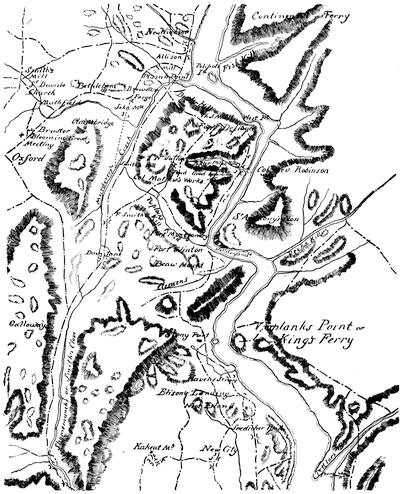
HESSIAN MAP OF THE HUDSON HIGHLANDS.
The British in New York were as inactive as Washington was. We get pictures of the life of the fortified town in the Memoirs of the Baroness Riedesel; Duncan's Royal Artillery, ii. ch. 28; Montresor's account in N. Y. City Manual, 1870, p. 884,—also see that for 1863; Gen. Pattison's letters in N. Y. Hist. Soc. Coll., 1875; Memoirs of General Samuel Graham.
Heath was commanding east of the Hudson (Memoirs), and Gen. McDougall at West Point, which had been fortified the previous year (Sparks, v. 224, 282, 311; Ruttenber, Obstructions, 115; Lossing, Field-Book, ii. 132; Journal of Capt. Page in Essex Inst. Hist. Coll., iv., v.) There is among the Moses Greenleaf MSS. (Mass. Hist. Soc.) an orderly-book beginning at West Point, Jan. 1, 1779, and ending at Morristown, Dec. 12, 1779.
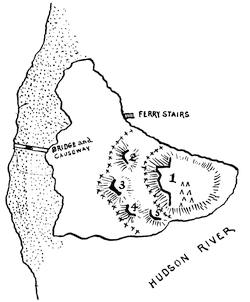
STONY POINT.
There is annexed a sketch from the Hessian Plan des opérations dans l'Amérique septentrionale depuis 12 Aoûst, 1776, jusqu'à 1779. The broken lines mark the roads. Cf. The Country west of the Hudson, occupied by the American army under Washington, from a MS. map drawn for Lord Stirling in 1779, given in Evans's Memoir of Kosciuszko (1883), etc.
Early in July (2d) there was an affair between Tarleton and Col. Sheldon at Poundridge in Westchester (Tarleton's Memoirs; Mag. Amer. Hist., iii. 685). Washington, as the season advanced, kept to the Highlands, and an attempt to draw him down was made by Clinton in dispatching Tryon with a marauding force to invade Connecticut by water. Tryon's instructions, July 2d, are in Charles H. Townshend's British Invasion of New Haven and Connecticut, with some account of the burning of Fairfield and Norwalk. They did not contemplate the destruction of houses; and Johnston, in his Observations on Judge Jones (p. 59), controverts that Tory chronicler who charged such intent upon Clinton. Cf. Hinman, Hist. Coll. of Conn., 607; Stuart's Jona. Trumbull, ch. 37; Chauncey Goodrich in New Haven Hist. Soc. Coll., ii. 27; Moore's Diary, ii. 180; Ithiel Town's Particular Services, etc., p. 90; Gen. Parsons's letters in Hildreth's Pioneer Settlers of Ohio, 537; Dawson, i. 507; Hist. Mag., ii. 88; Lossing, i. 424; Sparks, Corresp. of Rev. i. 315; Leonard Bacon's oration on the Centennial; and addresses of E. E. Rankin and Samuel Osgood in the Centennial Commemoration of the burning of Fairfield (New York, 1879). Cf. Mass. Hist. Soc. Coll., iii. 103; Diplom. Corresp., ii. 253; iii. 99.
There is an address of Admiral Collier and Gen. Tryon, July 4th, to the inhabitants of Connecticut. Tryon subsequently published an Address of Maj.-Gen. Tryon, written in consequence of his late expedition into Connecticut (Sabin, xiii. 53, 495). Trumbull feared another invasion in the autumn (Hist. Mag. ii. 10).
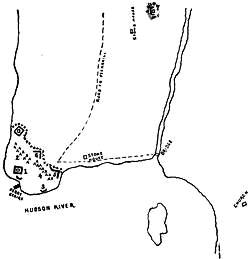
VERPLANCK'S POINT.
The posts at Stony Point and Verplanck's had been begun as outposts of West Point, and to protect King's Ferry, the crossing below the Highlands. Before the works were finished the British had captured them, in June (Sparks's Washington, vi. 292). Washington planned a surprise of the British garrison, and the two annexed sketches, furnished to him by Gen. Heath, seem to have been prepared in anticipation of the movement.