Chapter VI
Reading edition
THE WAR IN THE SOUTHERN DEPARTMENT.
BY EDWARD CHANNING,
Instructor in History in Harvard College.
IN the autumn of 1778 the British commander-in-chief, Sir Henry Clinton, determined to attempt for the second time the subjugation of the Southern colonies, and Savannah was selected as the first point of attack. On November 27, 1778, Lieutenant-Colonel Archibald Campbell, with thirty-five hundred men of all arms, sailed from Sandy Hook, and anchored off Tybee Entrance December 23d. Meantime a deserter from an advance transport had given the Americans warning. Their commander was General Robert Howe, a good but unsuccessful officer, who had not been fortunate in securing the confidence of the authorities of Georgia. Ascertaining these facts, Campbell pressed on without awaiting the arrival of Brigadier-General Augustine Prevost with a reinforcement from Florida. On the 28th, late in the afternoon, the British fleet assembled in the Savannah River, off Giradeau's house on Brewton Hill, which is about two miles from Savannah in a straight line, though double that distance by road. A causeway, nearly half a mile in length, ran from the river to the bluff through a rice-field which in ordinary times could have been flooded, but over which the bluff was now accessible from all points.
On the morning of the 29th the Highlanders carried the position with trifling loss, when Campbell, advancing toward Savannah, found the Americans most advantageously posted across the highroad. Through no fault of Howe, his rear was attained, while he awaited an attack in front. The Americans suffered a severe loss, and only a small part of them succeeded in joining Lincoln beyond the Savannah River. Campbell pushed up the Savannah, and in ten days the frontier of Georgia was secured, and this was the condition when Prevost arrived and took command.
Although Lincoln had arrived at Charleston on December 6th, he was not able to reach Purisburgh before the 5th of January, 1779. His army, composed almost entirely of militia, refused under him, as it had under Howe, to be governed by the Continental rules of war.[1014]
At first it seemed to the enemy that the occupation of Georgia could be easily maintained, but the neighboring militia rallied under Pickens, and drove the British back. The American success, however, was brief, for Colonel Prevost, a brother of the general, turned upon General Ashe, who with a detachment from Lincoln's army was following the British retreat. The Americans were surprised and suffered a defeat, which cost Lincoln one third of his army and restored to Prevost his superiority in Georgia.[1015]
The scale again turned. Lincoln, reinforced, once more severed the British communications with the up-country Tories, when Prevost, to disconcert his adversary, at first sought to get between him and Charleston, and then suddenly advanced on the city itself. Here Moultrie, who had been watching the British advance, threw up some defences. Negotiations for a surrender followed, and Governor Rutledge, who was in the town, even proposed a scheme of neutrality for the State during the war, to which Prevost would not listen. The British now intercepted a messenger from Lincoln, and finding that general closing in upon him, Prevost suddenly decamped and marched toward Savannah.
The summer was uneventful; but in the early autumn D'Estaing, who after leaving Newport had been cruising with some success in the West Indies, now turned northerly, and on September 3 (1779) his advance ships arrived off the mouth of the Savannah River. A landing, however, was not effected until the 12th, when the troops landed at Beaulieu, on Ossabaw Sound, fourteen to sixteen miles from Savannah. They did not reach that town until the 16th, so that Prevost had time to call in his scattered detachments, and all but those from Beaufort had arrived when, on the evening of that day, D'Estaing, in the name of the king of France, summoned him to surrender. A correspondence followed, which was prolonged till the defences were strengthened and Maitland got up from Beaufort with eight hundred men, when Prevost refused to surrender.
D'Estaing had been all the more willing to grant the truce as Lincoln, who was looked for from Charleston, had not arrived on the 16th. By the 23d a considerable part of the Americans had joined the French, and siege operations were begun. Guns were brought up from the French ships and trenches pushed to within three hundred yards of the besieged lines. On September 24th a sortie was made by the garrison for the purpose of developing the strength of the besiegers. The sortie was repulsed with ease, but the French, following the assailants back to their lines, were exposed to a murderous fire, and incurred a heavy loss in killed and wounded. The bombardment was then begun with vigor, but with little effect. At last, on October 8th, D'Estaing declared that he could not keep his vessels longer exposed to the Atlantic gales. An assault was determined on. In the night the sergeant-major of one of the Charleston militia regiments deserted to the enemy and gave full information of the intended movement, and further declared that the attack on the British left would be only a feint, the real attack being directed against the Spring Hill redoubt, on the right.[1016]
The assault took place, and failed as much by a lack of coöperation between the columns as by the treachery. This disaster so dispirited the allies that Lincoln crossed the river on the 19th, and when he was safe on the other side the French withdrew to their ships and sailed away,—their last frigate leaving the river on the 2d of November.
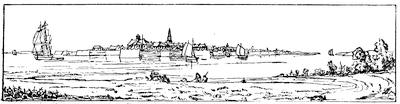
VIEW OF CHARLESTOWN, S. C.
Sketched from a marginal view on a chart of The Harbour of Charlestown, from the surveys of Sir Jas. Wallace, Captain in his Majesty's navy and others, published in London by Des Barres, Nov. 1, 1777, and making part of the Atlantic Neptune. Cf. Mag. of Amer. Hist. (1883), p. 830. The Catal. of the king's maps (Brit. Mus.) shows an engraved view of 1739, and other early views are noted in Vol. V., p. 331. There is a view by Leitch, in 1776. In a paper, "Up the Ashley and Cooper", by C. F. Woolson, in Harper's Magazine, lii. p. 1, there is a view of Drayton house, occupied by Cornwallis as headquarters.—Ed.
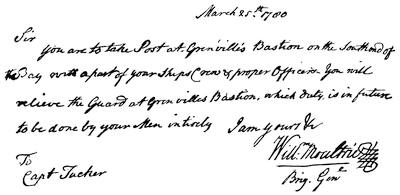
GENERAL MOULTRIE'S ORDER, March 25, 1780.
From the Commodore Tucker Papers in Harvard College library.—Ed.
The sailing of the French left the coast again exposed, and Clinton, coming from New York, now prepared to attack Charleston. On the 11th of February, 1780, a landing was made on Simmons' Island, just to the north of the North Edisto River. Thence by John's Island, Stono Ferry, Wappoo Cut and River, the Ashley was reached, and a lodgment was effected on the neck of land at the seaward end of which Charleston stands. Clinton advanced with caution. On the 1st of April the first parallel was opened about eight hundred yards from the American works.
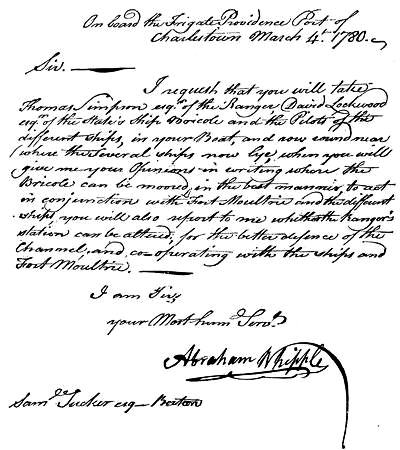
From the Tucker Papers in Harvard College library.
On the 21st of March the British fleet, commanded by Admiral Mariot Arbuthnot in person, had crossed the bar unopposed. Some time was spent in taking on board their provisions and guns. Then on the afternoon of the 7th, 8th, or 9th of April—for there is a hopeless confusion as to the exact date—in the midst of a furious thunder-shower the fleet ran by Fort Moultrie without material damage, except to the store-ship "Eolus", which was abandoned. The greater portion of the garrison of Moultrie, commanded by Colonel C. C. Pinckney, was then withdrawn,—the feeble remnant surrendering on the 6th of May, with scarcely a show of resistance.
On the 8th of April guns were mounted in battery in the first British parallel. On the 11th, Lincoln having refused to surrender, fire was opened. The second parallel was completed on the 19th, bringing the British to within four hundred and fifty yards of the opposing line.
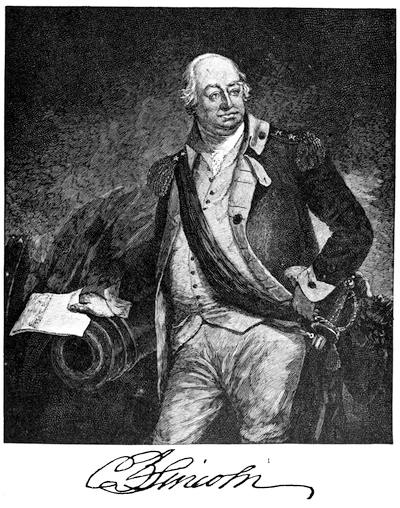
After a picture by Col. Sargent, owned by the Mass. Hist. Society (Proc., Jan., 1807, vol. i. p. 192; Catal. Cabinet, no. 13). A copy by Herring was engraved by T. Illman. Cf. Jones's Georgia, vol. ii. (bust only); Irving's Washington, quarto ed., vol. iii.; Harper's Mag., lxiii. 341. A rude contemporary copperplate print, by Norman, appeared in the Boston ed. of An Impartial Hist. of the War (1784), vol. iii. 64.—Ed.
On the morning of the 13th Tarleton and Ferguson, by a sudden push, dispersed the force at Monk's Corner, which had guarded Lincoln's supplies. On the 18th a reinforcement of three thousand men arrived from New York, and enabled Clinton to complete the investment of the town, the command on the eastern side of the Cooper being given to Cornwallis. There was during the next few days a sortie, some desultory fighting, and an unsuccessful correspondence for a surrender. On May 8th the third parallel was completed, bringing the besiegers to within forty yards of the works, while the canal in front of the lines was partly drained and the batteries were ready to open fire. Clinton again summoned the garrison, but again Lincoln declined to surrender,—this time because Clinton refused to regard the citizens as anything but prisoners on parole. On the 11th the British reached the ditch and advanced to within twenty-five yards of the works. Resistance was no longer to be thought of, especially as the citizens themselves now petitioned to have the terms offered by Clinton accepted. The articles were accordingly drawn up and signed on the 12th, and the English took possession.
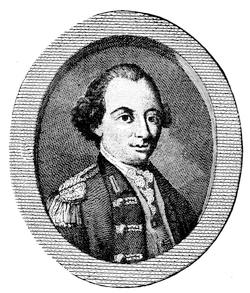
CORNWALLIS.
From Andrews' Hist. of the War, London, 1785, vol. ii. There is an engraving after an original drawing by T. Prattent in the European Mag., Aug., 1786. There are engravings of him later in life in Lee's Memoir of the War in the Southern Department (Philadelphia, 1872), vol. ii., and in the Cornwallis Correspondence. Cf. Harper's Mag., lxiii. p. 325; Irving's Washington, ii. 282; Boyle's Official Baronage, i. 459. Reynolds painted him in 1780, having already painted him in 1761. The former picture was engraved by Chas. Knight in 1780. Cf. Hamilton's Engraved Works of Reynolds, pp. 19, 169. There is a mezzotint by D. Gardiner. Cf. John C. Smith's Brit. Mez. Port., ii. 745; and in Ibid., iv. 1,444, an engraving by Ward after a picture by Buckley is noted. There is a contemporary account of Cornwallis in the Polit. Mag., ii. 450.—Ed.
On that day the Continentals to the number of perhaps fifteen hundred—there were about five hundred in the hospital at the time—marched out, with colors cased and drums beating the "Turk's March", and laid down their arms. By regarding every adult capable of bearing arms as a militiaman, Clinton reckoned his prisoners at five thousand. Lincoln has been severely censured for this defence, but if the Carolinians had rallied as expected, he might have held out until the heats of the summer and the arrival of De Ternay would have compelled Clinton's retirement.
Clinton now sent out three expeditions to the up-country, the most important of which was destined to secure the region north of the Santee and Wateree.[1017] Cornwallis, commanding this expedition, detached Tarleton against Buford, who had with him the remnants of the American cavalry and some Continentals from Virginia. Tarleton overtook him at Waxhaw Creek on the 29th of May. Of the five hundred Americans who entered the fight, one hundred and thirteen were killed, while one hundred and fifty were wounded. The slaughter was vindictive, and "Tarleton's Quarters" will never be forgotten in the upper regions of South Carolina.
Clinton and Arbuthnot, judging their conquest of the province permanent, now proclaimed as rebels all who refused the oath of allegiance, and then sailed for New York, leaving Cornwallis in command.
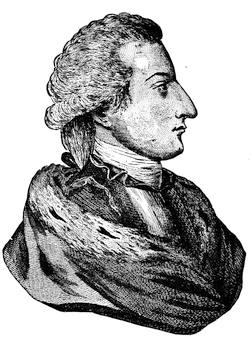
CORNWALLIS.
From the London Mag., June, 1781 (p. 251).—Ed.
The new commander's proclamations, following upon those of Clinton and Arbuthnot, were enough at variance with them to create discontent among those inclined toward the British side. The spirits of the patriots began to revive, especially in the back regions, where Colonels Locke and Williams and Generals Rutherford and Sumter gathered strong bands around their standards. The fights at Ramsour Mills, Rocky Mount, Hanging Rock, and Musgrove Mills, which these partisans conducted, were in the main successful, but all were lost to sight in the great disaster which soon overtook the American arms near Camden.
Early in the spring of 1780, it had been decided to send a reinforcement under De Kalb to Lincoln, at Charleston. With about fourteen hundred men of the Maryland and Delaware lines, that general left Morristown on the 16th of April, 1780, and on the 1st of June, in Petersburg, he learned of the fall of Charleston. He decided to push on with the utmost speed, in the hope that his coming might still save the interior of the State. But delay after delay occurred, and De Kalb did not reach the Deep River before the 6th of July, when he found nothing prepared for his reception; and what was still more inexcusable, the North Carolina militia, under Caswell, were holding aloof. On the 25th a new commander of the Southern armies arrived in Horatio Gates, the popular hero of Saratoga. His appointment had been made by Congress against the wishes of Washington, but in obedience to a general popular consent. De Kalb received Gates with genuine pleasure, and took his place at the head of the regulars, then forming the whole army.
Against the advice of his ablest officer, Otho H. Williams, Gates determined to join the North Carolinians in their camp near Lynch's Creek, since they would not join him, and with them he hoped to seize Camden. Two days after his arrival, on July 27th, the march began, and after the most acute suffering from hunger the regulars joined the militia. So lax was the discipline among Caswell's men, that Williams and a party of officers rode through their lines and camp without being once challenged. Approaching the general's tent, they were informed that it was an unseasonable hour for gentlemen to call. Yet Caswell was within striking distance of a disciplined army, commanded by an enterprising general, Lord Rawdon. Marching a little farther, the British were found in a strong position on the southern bank of Little Lynch's Creek.
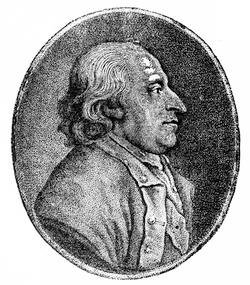
HORATIO GATES.
From Du Simitière's Thirteen Portraits (London, 1783).—Ed.
By a march up the creek, Gates might have placed his superior force on Rawdon's flank and rear. This was what Rawdon feared, and what De Kalb is said to have advised. Instead he passed two days in idleness, and then, inclining to the right, marched to Clermont or Rugeley's Mill, on the road from Charlotte to Camden, and not more than thirteen miles from the latter. There, seven hundred militia from Virginia joined him. From that place, too, he sent four hundred men, including some regulars, to assist Sumter in a contemplated attack on the enemy's communications. It was now determined to seek a more defensible position on the banks of a creek seven miles nearer Camden. This position could be turned only by marching a considerable distance either up or down the creek. Exactly what Gates had in view by this movement can not now be ascertained.[1018]
Cornwallis arrived at the front on the morning of August 14th, and decided to surprise Gates; but the two armies started on respective marches at precisely the same hour, ten o'clock of the evening of August 15, 1780. Their advanced guards met at about half past two the next morning. Armand, a French adventurer, with his "legion" forming the American van, retired panic-stricken, and the two armies deployed across the road. The position in which the opposing generals now found themselves was singularly favorable to the smaller numbers of the British, as the front was necessarily very short, owing to a marsh which protected while limiting either flank. This advantage Cornwallis was not slow to perceive. A hurried council was held on the American side, and it was decided that there was no alternative but to fight. At dawn the enemy was observed getting into position on the extreme left. Stevens, with the Virginia militia, already in line, was ordered to charge before the enemy's formation was complete. It so happened that Cornwallis, thinking the Virginians were making some change in their dispositions, ordered his right forward. Led by the gallant Webster, the British came on with such a rush that the men of Virginia threw down their loaded guns with bayonets set, broke and dispersed to the rear. Nor did the North Carolinians do better. Seeing the Virginians break, they did not await the onset, but threw away their arms and fled. One regiment indeed, inspired by the example of the regulars, fired several rounds before it broke. Deserted by those whom they had marched so many weary miles to succor, the men of Maryland and Delaware fought till to fight longer was criminal. Then the under-officers, on their own responsibility, brought off all they could, for their commander, De Kalb, overwhelmed by eleven wounds, had fallen into the hands of the enemy,—"a fate", says Williams, "which probably was avoided by other generals only by an opportune retreat." That night Gates found himself at Charlotte, sixty miles from the scene of conflict. Caswell was with him, and they were soon joined by Smallwood and Gist. In fact, excepting the one order issued to the Virginians at the outset, the leaders seem to have left the conduct of the fight to De Kalb and the subordinate officers. From Charlotte Gates retired to Hillsborough, where the legislature was then sitting.
Cornwallis seems to have been satisfied with the havoc wrought on the field of battle, for he pursued without vigor, and soon returned to Camden and gave his attention to Sumter. That enterprising but negligent chieftain had captured the redoubt at the ferry over the Wateree, and had ensnared a convoy destined for Cornwallis. On the night of the 17th, hearing of Gates's overthrow, Sumter left his camp, and moved with such celerity that a corps which Cornwallis sent against him failed to strike him. Shortly after, Tarleton found him less vigilant, and came upon him so unexpectedly that resistance was hardly attempted, and Sumter escaped with scarcely half his force.
Gates has been severely blamed for this defeat; too severely, it seems to me. The march of the regulars from Buffalo Ford to Lynch's Creek was undoubtedly full of hardship, but it was well planned and executed. Nor do the troops who made it seem to have been demoralized by it. On the contrary, seldom have men fought more gallantly than De Kalb's division fought on the morning of August 16, 1780. The Virginians, whose flight made defeat probable, followed the Continentals in the march across the "desert", and did not suffer nearly as much as the leading division. The North Carolina militia, whose panic turned a probable defeat into a rout, had no part whatever in that painful march. The disaster was due to the over-confidence which Gates felt in his men. Had the militia stood firm, the event of the campaign might have been different. There was no defect in Gates as a strategist or tactician. He had a larger number of men in line than his opponent. His dispositions were as perfect as the time and place permitted. The defeat Was "brought on", to use the emphatic words of Stevens, the gallant leader of the Virginians, "by the damned cowardly behavior of the militia."
From Camden Cornwallis advanced to Charlotte, overcoming all obstacles which the militia under Davie interposed. Other militia, meanwhile, under Clarke, advanced on Augusta, but British reinforcements from Ninety-Six, under Cruger, forced Clarke to abandon the attack, and, burdened with the families of some leading Whigs, he retired towards the mountains. Cornwallis, hearing of this, ordered Ferguson, who had been beating up recruits in the upper country, to endeavor to cut Clarke off. Now it happened that at this very time the sturdy frontiersmen, under the leadership of Colonel William Campbell, Colonel Isaac Shelby, Lieutenant-Colonel John Sevier, and Colonel Charles McDowell, had assembled at Watauga, bent on the destruction of Ferguson and his little army.[1019] To the number of one thousand and forty they left their place of meeting on September 26th and marched for Gilberton, where Ferguson was supposed to be. On the 30th they were joined by Colonel Cleveland, with three hundred and fifty men from North Carolina. The senior officer was McDowell, but from his slowness he was not deemed the best man to conduct such an arduous enterprise, and while he was sent to Gates to name a leader they chose Campbell for their chief. Pressing on, they reached the Cowpens, where they were joined by Williams and Lacy, with about four hundred men from the Carolinas.
Meantime Ferguson, not ignorant of the approach of this formidable force, which appeared to have sprung from the earth, had begun his retreat towards Charlotte. Anxious to intercept Clarke, he had delayed his march longer than was prudent, and had taken post on the top of a spur of King's Mountain, where he probably hoped to be reinforced before the enemy should come up with him. While at the Cowpens, on October 6th, the Americans received certain information of Ferguson's position. They resolved to select the best mounted of their little army, and, leaving the poorly mounted and the footmen to follow, to go in pursuit of Ferguson and fight him wherever found. In the evening, therefore, they broke up from the Cowpens, and, marching all night, reached, without being discovered, the foot of King's Mountain on the afternoon of the next day. The spot on which the British were found was singularly well suited to the mode of fighting in which the backwoodsmen were adepts. King's Mountain proper is sixteen miles long, and in some places is high and steep. The southern end, however, where Ferguson was encamped, rises only about sixty feet. It was wooded, except on the summit, which partook of the nature of a plateau. The Americans, under their respective leaders, so timed their movements that Ferguson was surrounded almost before he knew it. The band led by Campbell seems to have made the first attack from the south. It was speedily driven back at the point of the bayonet, but re-formed at the foot of the hill and returned to the charge. Meantime Shelby was pressing on from the north. He, too, was driven back, when, re-forming his men, he also returned to the fight. These charges and countercharges were three times repeated. Cleveland, Sevier, and the rest did their work splendidly in their respective positions. The British, inspired by the example of their heroic leader, fought bravely and well; but their position was so perilous that their loss was double that of the assailants. Ferguson, while leading a charge, or perhaps while endeavoring to cut his way out, was killed. De Peyster, the second in command, showed the white flag, as was his duty, resistance being useless, but the firing did not cease for some time, even though the beaten Tories were suing for quarter. At that moment an attack was made from the rear by another band of British, who were probably returning from a foraging expedition. This new and sudden attack led to a renewal of the slaughter of the unresisting foe on the hill.
The neighborhood was bare of provisions, and the next morning the now half famished victors, with their no less hungry prisoners, made a hurried retreat towards the mountains. On the 13th the Americans arrived at a place then called Bickerstaff's Old Fields, about nine miles from the present hamlet of Rutherfordton. There they improvised a court, and sentenced thirty to forty of their prisoners to death. But after nine had been hanged, the remainder were reprieved or pardoned.
Such was the famous battle of King's Mountain in South Carolina. It changed to a great extent the whole course of the war in the Southern department, as it deprived Cornwallis of the only corps that he could afford to hazard for a long time out of supporting distance. As for Cornwallis, as soon as he heard of the disaster, instead of sending Tarleton in pursuit, he broke up from Charlotte, and retired as fast as he could to Wynnesborough, in South Carolina, midway between Camden and Ninety-Six, where he would be within supporting distance of either in case they were attacked. He was followed by Gates, who encamped at Charlotte, his light parties advancing even to Rugeley's.
Not long after his arrival at Wynnesborough, Cornwallis detached Tarleton, with a portion of the Legion, to disperse the band with which Marion awed the country between the Santee and Pedee rivers. Tarleton had now to deal with a soldier both bold and discreet. All his artifices were unavailing to entrap Marion, and he was recalled to go in pursuit of Sumter, who had encamped at Fishdam Ford, not far from the British headquarters. Meanwhile, Major Wemyss had attacked Sumter just before daybreak on the morning of November 11th. He approached the camp unchallenged at first, but he soon encountered a picket, which fired five shots before retiring. Two shots disabled Wemyss. His second in command, continuing the attack without a proper knowledge of the ground, was repulsed. Sumter, hearing of the approach of Tarleton, prudently withdrew from such a dangerous neighborhood, and had reached the ford of the Tyger, near Blackstocks, when Tarleton appeared. Unable to cross, he drew up his men on the side of a hill. Tarleton, rashly attacking with his advance, was beaten off with great loss. The British leader withdrew to his main body, and prepared to storm the hill the following morning; but in the night Sumter crossed the river, and once over his men dispersed in every direction. The American loss at these two actions was small, though a wound received at the Blackstocks kept Sumter from the field for several months.
From this time on the war in the Southern department assumed a new and brighter aspect, for on December 2, 1780, less than a month after the affair at the Blackstocks, Nathanael Greene arrived at Charlotte, and took command of the remnants of the gallant Continentals who had fought so splendidly at Camden. He was respectfully received by Gates, who retired to his Virginia farm.[1020]
The task that Greene had before him might well have appalled the boldest. Without food, without money or credit, almost without an army, he was expected to face the most enterprising commanders—Cornwallis, Rawdon, and Tarleton—that the British had on this continent, while they were at the head of a large and well-appointed army. But Greene was not the man to be easily disheartened. With the possible exception of Washington, the best soldier of high rank in the American army, he resembled his chief in being a careful observer of men. His judgment, too, with regard to all matters connected with war was excellent, and has seldom been surpassed. As a strategist he had no equal in the opposing army, while he possessed the rare power of being able to adapt his tactics to the army and to the country, although it has been claimed that credit has been given him for what really was the product of another mind.
Gates handed over to his successor an army which numbered on paper twenty-three hundred and seven men, including nine hundred and forty-nine Continentals. But so many were insufficiently clad and equipped that, to use the new commander's own words, "not more than eight hundred were present and fit for duty." Food was scarce, and the morale of the army was low. Greene sought a new camp on the eastern bank of the Pedee, opposite Cheraw Hill, where food was more abundant. There he subjected his men to a discipline to which they had long been strangers, while Morgan, with a strong detachment, threatened Cornwallis's other flank.
Morgan took with him four hundred of the Maryland line, under Lieutenant-Colonel J. E. Howard, two companies of Virginia militia, and about one hundred dragoons led by William Washington. To these were afterwards added more than five hundred militia from the Carolinas. Morgan advanced to Grindall's Ford on the Pacolet, near its confluence with Broad River. In this position he seriously menaced Ninety-Six and even Augusta itself. Cornwallis needed to dislodge him before he could advance far in his projected invasion of North Carolina. He therefore detached Tarleton, with his Legion and a strong infantry support, against Morgan, while he himself advanced with the main body along the upper road to North Carolina, thus placing himself on Morgan's line of retreat whenever that commander should be driven back. Learning of these movements, Morgan retired from Grindall's Ford, and moving with commendable speed on the night of January 16, 1781, encamped at the Cowpens. Tarleton was now close upon him, and, marching the greater part of the night, he discovered the Americans drawn up in line of battle on the morning of the 17th. The position which Morgan had chosen was in many respects a weak one. The country was well fitted for the use of cavalry, in which the British excelled, while the Broad River, flowing parallel to his rear, made retreat difficult if not impossible. Nor were the flanks protected in any manner.[1021] Hardly waiting for his line to be formed, and with his reserve too far in the rear, Tarleton dashed forward.[1022] A militia skirmish line was easily brushed aside, and the main body of militia, after firing a few rounds with terrible precision, also retreated. The Continentals, however, under their gallant leader, stood firm. But Howard's flank soon became enveloped. He ordered his flank company to change its front. Mistaking the order, the company fell back, and the whole line was ordered to retire upon the cavalry. The British, who had been joined by the reserve, thinking that the Americans were retreating, came on like a mob. Seeing this, Howard ordered the 1st Maryland to face about. They obeyed, and poured such an unexpected and murderous fire into the advancing foe that the British line paused, became panic-stricken, turned, and fled. In vain did Tarleton call upon his dragoons for a charge. His order was either not delivered or was misunderstood. Colonel Washington, on the other hand, advanced with a rush, and the day was won. Almost to a man the British infantry was either killed or captured. But they had fought well, and their loss, especially in officers, bears testimony to their splendid conduct on the field.[1023]
King's Mountain lost to Cornwallis his best corps of scouts. This disaster deprived him of his light infantry, whose presence during the forced marches now to come would have been of incalculable service. For this reason the affair at the Cowpens, while in reality only a fight between two small bodies of troops, in importance of results deserves to be ranked among the most important conflicts of the war. It was indeed, as has so often been said, "the Bennington of the South."
Cornwallis, when he had detached Tarleton to the defence of Ninety-Six, and later, when he had ordered him to push Morgan to the utmost, had expected to be able to get on Morgan's line of retreat, and thus drive him into the mountains, or at least prevent his rejoining Greene. But with Greene on his flank at the Cheraws, he had been afraid to move far from Camden before Leslie with the reinforcements could get out of Greene's reach. He was, therefore, no further advanced than Turkey Creek, twenty-five miles away, when the news of the disaster at the Cowpens reached him. On the 18th, Leslie, with two battalions of the Guards under O'Hara and the Hessian regiment of Bose, arrived. On the 19th the pursuit was begun, and on the 24th Cornwallis reached the crossing of the Little Catawba at Ramsour's Mill, only to learn that Morgan had crossed at the same place two days before. In fact, that enterprising leader, instead of being dazzled by the victory at the Cowpens, passed the Broad River on the evening of the day of action, and, pursuing his route toward the mountains, passed Ramsour's Mill on the 21st. With the bulk of his detachment he then sought a junction with the main body under Greene. Turning to the east, he crossed the Catawba at Sherrald's Ford on the 23d, and took post on the eastern bank. At this place he finally rid himself of his prisoners, sending them to Virginia under an escort of militia.
There can be little doubt of the chagrin Cornwallis experienced at the escape of Morgan. It prompted him to destroy what he thought was useless baggage, and to make another attempt to overtake the Americans. This burning of his train occupied two days, and, necessary as it may have seemed, the consequent lack of supplies led to the fearful suffering of his army after Guilford, and made his retreat to Wilmington a necessity. It was his first grave error in his struggle with Greene. On the 27th he put his troops in motion for the Catawba, but before he reached the fords a sudden rise of the river made the crossing an impossibility, and gave Morgan two days' respite. The delay was still more important in giving Greene time to reach the post of danger and take command of the detachment. The news of the victory at Cowpens had not reached the camp at the Cheraws until the 25th. Instantly divining the course that Cornwallis would pursue, Greene sent an express to Lee, who, as soon as he had joined, had been dispatched to coöperate with Marion in an attack on Georgetown, next to Charleston then the most important seaport in South Carolina. The attack failed for some reason that is not quite apparent; but Lee brought off his troops in safety, and rejoined Greene in time to render most important service. On the 29th, the main army, under command of General Huger, left the camp for Salisbury, where Greene hoped to be able to concentrate his entire force. On the 31st the Catawba began to subside. Putting their troops in motion, Greene and Morgan directed their steps toward Salisbury, where they arrived on February 2d. The Yadkin was crossed in safety the next day, though rising rapidly all the time; then sending orders to Huger to join him at Guilford Court-House, and not at Salisbury as formerly ordered, Greene once more breathed freely.
On the afternoon of the 1st, Cornwallis had also put his troops in motion. His design was to make a feint of crossing at Beattie's Ford while with the Guards he should pass the river at the less known Cowan's Ford. By some means, Davidson, who commanded the militia in that region, became cognizant of the design, and stationed himself at Cowan's with about four hundred men, where he expected to hold Cornwallis in check long enough to be of real service to the retiring Americans.
Shortly before daybreak Cornwallis reached the river, and saw the watch-fires on the opposite bank. Without a moment's hesitation the Guards rushed into the rapid stream. When about halfway across they were discovered, and a fire was opened upon them by the militia. But now occurred one of those accidents that so often in war defeat the best-laid plans. The ford, turning in mid-stream at an angle with the direct line, ran under a bank where the militia were waiting for the British; but when they arrived at the turning-point, instead of inclining to the right, the Guards—their guide having deserted through fear—kept straight on, and gained the bank with a loss of only sixty in killed, wounded, and missing. The militia retired, and although Tarleton was sent after them, they made good their retreat with a loss which would have been trifling but for a mortal wound under which the gallant Davidson fell. There were many hair-breadth escapes during this splendid charge. Cornwallis's horse was shot under him, but reached the bank before he fell. Leslie was carried down stream, and O'Hara's horse rolled over with his rider while in the water.
Pushing on with all speed possible in the wretched condition of the roads, Cornwallis's van, under O'Hara, reached the Yadkin at the Trading Ford a few hours after the Americans had crossed; but O'Hara, though he missed the soldiers, captured a train of wagons belonging to the country people who were flying with the army. Here again the forces of nature came to the assistance of the Americans, for the Yadkin rose so rapidly that it could not be forded, and Greene had carefully secured all the boats on the eastern bank.
Cornwallis now gave up all idea of preventing the union of the two wings of the opposing army, which, indeed, was effected soon after at Martinsville, near Guilford. The British commander decided to place himself between his opponents and the fords of the Dan, hoping thereby to prevent the Americans taking refuge in Virginia. Accordingly, on the 7th he crossed the Yadkin at the Shallow Ford. It was now a serious question with Greene to escape the new danger. The militia failing to come to his aid, he was obliged to protect his Continentals by a flight into Virginia. He determined to cross the Dan at Irwin's Ferry, and sent orders to have boats ready at that point. On the 10th the march was renewed. The light troops, united in one division, were placed under the command of O. H. Williams, with orders to delay the enemy as much as possible. By rapid marching the main army reached Irwin's Ferry and crossed on the 13th and 14th, before Williams and the rear-guard came in sight. The experience of this light division has been well told by Lee, whose Legion first measured sabres with Tarleton's men on the 12th. From that time the rear of the Americans and the advance of O'Hara were almost constantly in sight of each other. At every crossing or other suitable place Williams would draw his men out and thus compel the British to deploy; then, his object being accomplished, and the British delayed for a few minutes, the march would be resumed, and the two armies would soon be marching as one again. Cornwallis, conscious finally that his prey had escaped, turned back to Hillsborough, and, erecting the Royal Standard, called upon all loyal North Carolinians to rally to the aid of their royal master.
On the 18th, only four days after his escape, recruits had come in so rapidly that Greene detached Lee across the Dan to seek information, and to show the Tories that the Americans were by no means beaten. Lee had, in addition to his legion, two companies of the Maryland line. He was joined on the southern side of the river by Pickens with a considerable body of Carolina militia.
On the 23d Greene himself crossed the Dan with the main army, and sought the difficult country on the head-waters of the Haw, as the Cape Fear River is called in its upper course. Here again, as during the retreat, the light troops were put into the hands of Williams. The two divisions manœuvred with such precision that Cornwallis was held at arm's length, while militia and Continentals came into the American camp from all directions. The American commander saw that the time had now come to give way no more. He stationed himself on a hillside near Guilford, and awaited the approach of the British. The position which had attracted his attention during the retreat possessed a combination of rising ground, cleared spaces, and woods which could hardly be surpassed for the irregular formation that Greene, following the example set by Morgan at the Cowpens, deemed best suited to his troops.
To Cornwallis, the presence of Greene had been most disastrous. Strategy had failed to annihilate his opponent, and the offered battle, even on ground of the American general's own selection, was welcome to the British commander; and on the morning of the 15th of March, 1781, the trial came.
In his front line Greene put the North Carolina militia, their flanks resting in the woods, the centre being protected in some measure by a rail fence. Three hundred yards behind were posted the Virginia militia under Stevens and Lawson. Though militia in name, some of those under Stevens were veterans in reality. But, taught by his bitter experience at Camden, Stevens posted riflemen behind his line, with orders to shoot any who should run. The Virginians were entirely in the woods. Three to four hundred yards behind them, on the brow of a declivity, with open fields in their front, were the regulars. On the right was the Virginia brigade under Huger. Then, after an interval for the artillery under Singleton, came the Maryland brigade, commanded by Williams. The first regiment was led by Gunby, with Howard as lieutenant-colonel. This was the regiment which had aroused universal admiration by its splendid conduct at Camden and its wonderful subordination at the Cowpens, when a gallant charge converted a bloody check into a crushing disaster. The second Maryland regiment, commanded by Ford, was new to the service. It held the extreme left of the line. The regulars presented a convex front. Lee with the "Legion" and Campbell's riflemen from the backwoods acted as a corps of observation on the left, while Washington, with the regular cavalry and the remnant of the Delaware regiment under the heroic Kirkwood and Lynch's riflemen, protected the right flank.
As soon as Cornwallis found himself in the presence of his enemy, he deployed without reserves, except the British dragoons under Tarleton. The "Hessian" regiment of Bose and the 71st under Leslie, with the 1st battalion of the Guards in support, held the right; next came the 23d and 33d regiments under Webster, with the Grenadiers and the 2d battalion of the Guards under O'Hara in support; while the extreme left was occupied by the light infantry of the Guards and the Jägers. The artillery was on the road with Tarleton. As the line moved forward it first encountered the North Carolinians, who fired a volley, and perhaps more, before they broke. On the extreme right, however, Lee with his light troops held the regiment of Bose and the 1st battalion of the Guards in check. But the defection of the North Carolinians separated him from the rest of the army. The first line being broken, Webster rushed upon the Virginians. But the woods were so thick, and the defence of the Virginians so stout, that his loss at this point was very considerable. At length, Stevens having been wounded in the thigh, the Virginians retired and Webster advanced upon the Continentals. On his right was Leslie with the 71st. When the advancing line reached the front of the 1st Maryland, it was received with such a murderous fire that it stopped. The Marylanders then advanced with the bayonet, and the British gave way and retreated. It has been said by writers on both sides, that had Greene thrown forward another regiment at this moment the day would have been won. But this is by no means certain, as the events of the next few minutes were to show. For Leslie with the 71st and O'Hara with the Guards now came up and assailed the 2d Maryland with such fierceness that it broke and fled. But the 1st Maryland was not far off. Wheeling into line, it opposed the Guards until Washington charged and broke the British line. J. E. Howard—now in command, Gunby having been dismounted—then followed with the bayonet, and pressed the enemy so hard that re-formation was for the moment impossible. Cornwallis, seeing that the flight must be stopped at all hazards, ordered his artillery—posted on an eminence in the centre of the field—to open on the Marylanders through the ranks of his own men. In this way the pursuit was checked, though at terrible loss to the British.
Greene's hopes were soon dashed. The shattered lines of the enemy re-formed and returned to the conflict. Pressing heavily on the Virginia regulars, and reinforced by the 1st battalion of the Guards, which had disengaged itself from Lee, the whole American line was endangered. Greene, who wished to run no chances, and who probably did not know that Lee had once more connected himself with the main line, ordered a retreat. The artillery, the horses having been killed, was left on the ground, but otherwise the withdrawal was easily and skilfully effected.
Such was the battle of Guilford. Numerically, Greene was superior; but of good troops he had only a handful. When the two leaders summed up their losses, it became evident that a decisive blow had been struck at Cornwallis. The Americans lost seventy-nine killed and one hundred and eighty-four wounded, together with one thousand and forty-six missing. Of these last some may have been wounded, but by far the greater part were militiamen, who had returned to their homes. Cornwallis reported his own loss at ninety-three killed, and four hundred and thirteen wounded, and twenty-six missing—a most serious diminution of his force.
Cornwallis in his proclamation and letters maintained, however, that he had achieved a great triumph. It was his despatch to Germain which occasioned the well-known assertion of Charles James Fox that "another such victory would destroy the British army." Even before the fight it had been almost a necessity to open communications with the sea, as the army was suffering for want of the stores that had been destroyed at Ramsour's Mill. Believing the Cape Fear River navigable as far as Cross Creek, Cornwallis had sent Major Craig to seize Wilmington and to open navigation as far as possible, which he succeeded in doing to a point at a short distance above Wilmington. Leaving his wounded at the New Garden Quaker Meeting-house, near the battlefield, Cornwallis set out on the morning of the 18th for Wilmington, arriving there on April 7, 1781. Greene had pursued as soon as possible. But his ammunition, never very abundant, was now almost exhausted. Besides, food was very scarce in the district to be traversed, and Greene arrived at Ramsey's Mill only to find that Cornwallis had built a bridge over Deep River at that point and escaped, although Lee had pressed so hard on his rear that the bridge could not be destroyed. Here the pursuit ended; for the Virginia militia, now that their time was up, refused to serve longer. Though Cornwallis escaped, and though Greene had lost one of the best contested battles of the war, he had won the campaign. He was free once more to turn his attention toward relieving South Carolina of her military rulers. On April 6th, one day before Cornwallis arrived at Wilmington, the southward march began, Lee being detached to operate on the line of Rawdon's communications with Charleston.
Lee soon joined Marion, who was skulking in swamps between the Pedee and Santee, and, uniting forces, the two captured a fortified depot of Watson, the British officer scouring this region, and then endeavored to prevent his rejoining Rawdon.
On the 7th of April Greene had broken up from Ramsey's, and, taking the direct road, had encamped on Hobkirk's Hill, to the north of Camden, and about a mile and a half from the British works at that place. As Rawdon did not come out from his intrenchments, Greene on the 23d moved nearer. Anxious for Marion and Lee, and desirous of supporting some artillery which he detached to them, Greene moved to a position south of Camden. It appears, however, that on the 23d or 24th he decided to fall back. Accordingly, on the afternoon of the 24th he reëncamped on Hobkirk's Hill. During that night a renegade drummer-boy informed Rawdon of the position and number of the American force. He also said that Greene had neither artillery nor trains near at hand, although both were on the march to join him. It was a most propitious time to strike, and Rawdon determined to attempt a surprise the next morning.
Making a considerable detour to the right, he struck the American left almost unperceived. Greene had thrown out a strong picket in that direction, but the superiority of the British was so great that they drove in the guards and were upon the Americans before the formation was complete. That the attack was not a disaster was due to the prudence of Greene, who had encamped in order of battle. Perceiving that Rawdon's line was very short, Greene ordered Ford with the 2d Maryland to flank it on the right, and Campbell was told to do the same on the left. Gunby with the 1st Maryland, and Hawes with the Virginia regulars, were ordered to attack with the bayonet in front, while Washington with the cavalry was to get into the rear and take advantage of any opening that might offer. Unfortunately, neither Ford nor Campbell were able to put in their men before Rawdon, seeing his danger, brought up his reserves and extended his flank. This was owing partly to Ford being struck down in the beginning of the movement.
The defeat of Greene, however, was due to one of those accidents against which no foresight can provide. It seems that as the 1st Maryland was getting into position to charge, or perhaps as it was moving forward, Beattie, the captain of one of the leading companies, was shot. His men began firing, and fell into confusion. Then Gunby, instead of pushing his rear companies forward, as Greene always declared he should have done, ordered the regiment to form on the rear companies. The men retiring were seized with a panic, and the heroes of three battles broke. They were rallied soon after, but it was then too late. The whole line was compromised, and Greene ordered a retreat.
Though Greene was not surprised, the attack was most unexpected. This was owing in a great measure to the woods in his front, which permitted Rawdon to reach the picket line without discovery. Even then Greene fully expected victory, and had his men done their duty, as he had a perfect right to expect, this adventurous attempt of the young British commander would have resulted in his complete overthrow. Such was Greene's opinion, and such is the opinion of most American writers.[1024] Retiring first to Sanders Creek or Gum Swamp, the very spot Gates was trying to reach when he met Cornwallis, and later to Rugeley's Mill, Greene brought up his provisions and recruited the strength of his men. Though not beaten at Hobkirk's Hill, Greene was greatly discouraged. Especially distressing was the non-arrival of expected reinforcements. The terms of service of his best men were expiring, and he could see no source from which to draw recruits. His losses in the recent engagement had not been so great as those of his opponent; but Marion and Lee had been unable to prevent Watson from rejoining his chief. Still Greene did not lose heart. As soon as his men had recovered from fatigue he crossed the Wateree and posted himself at Twenty-five-Mile Creek, on the road from Camden to Fishing Creek and the Catawba settlements.
Watson reached Camden on May 7th. On the evening of the same day Rawdon moved out from his fortifications, and, crossing the Wateree, turned on Greene, intending to pass his flank and attack him from the rear. But Greene was too vigilant, for, learning of Rawdon's departure from Camden, he retired still higher up the river, first to Sandy's Creek and later to Colonel's Creek, the latter being nine miles from his former position. The position on the further bank of Colonel's Creek was very favorable to the party attacked. The light troops had been left in the front, as at Hobkirk's Hill. Coming upon them at Sandy's Creek, Rawdon mistook them for the main body, and their position seemed so strong that he did not feel willing to risk an attack. It was impossible for him to remain longer in Camden with Greene in such threatening attitude, especially as his line of communication with Charleston was in the hands of Lee and Marion. On the 10th, leaving his wounded who were unable to be moved at Camden, Rawdon evacuated that place, and marching to the east of the Santee, he crossed at Nelson's Ferry and took post at Monk's Corner, not more than thirty miles from Charleston.
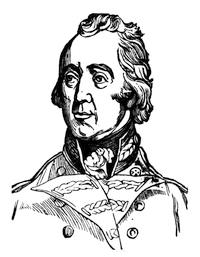
RAWDON.
From Doyle's Official Baronage, ii. 151. The likeness by Reynolds was painted in 1789, and is at Windsor Castle, and is engraved in the European Mag., June, 1791; it was also engraved in mezzotint by John Jones. Cf. Hamilton's Engraved Works of Reynolds, pp. 56, 183, and J. C. Smith's Brit. Mezzotint Portraits, ii. 767. Cf. Irving's Washington, 4o ed., iv. 331.—Ed.] There is an account of Rawdon's career to date in Pol. Mag., ii. 339, and Lossing has given a sketch of his life in Harper's Monthly, xlvii. 15. He is better known by his later title of Marquis of Hastings, which he bore as governor-general of India. Cf. note to p. 49 of Cornwallis Corresp. It is to be noted that both he and his chief, Cornwallis, showed a humanity in after life which did not grace their careers in America.
One of the motives which had induced Rawdon to make this precipitate retreat was the hope of saving the garrison of Fort Motte, an important post on the Congaree, near its confluence with the Wateree. Lee and Marion had appeared before the place on the 8th. They had pushed the siege with vigor, but were so destitute of artillery and siege tools that it seemed the siege might be prolonged until the coming of Rawdon should enforce its abandonment. Happily it occurred to some one that the roof of Mrs. Motte's house, which stood in the middle of the inclosure, could be set on fire. It is related that Mrs. Motte herself furnished the bow and arrows with which this was accomplished. At any rate, soon after Rawdon's watch-fires were seen in the distance the house was on fire, the stockade untenable, and the garrison prisoners of war. Marion then separated from Lee, and, turning toward Charleston, compelled the enemy to look well to his communications.
When Rawdon evacuated Camden he sent orders to the commander at Fort Granby to retire to Charleston, and directed Cruger, at Ninety-Six, to join Brown at Augusta. Neither of these orders reached its destination. As soon as the post at Motte's had surrendered, Lee was ordered to Fort Granby. Proceeding with his usual celerity, he arrived before the place in the night of the 14th. His single piece of artillery opened on the fort as soon as the morning fog had dispersed. The garrison was completely taken by surprise. Time being of the utmost importance to Lee, the besieged were promised their baggage—in reality the property of plundered patriots—if they would immediately surrender. The terms were accepted, and Lee joined Pickens at Augusta.[1025]
Lee reached this place on the evening of the 21st of May. On his way he had captured a small stockade, containing, under a strong guard, valuable stores for the Indians. Augusta is, or rather was, situated on the southern bank of the Savannah River. Its defences consisted of a strong work, Fort Cornwallis, in the centre of the town. It was garrisoned by a force of regulars under Lieutenant-Colonel Brown, who had already once successfully defended the place. Not far from Fort Cornwallis was a smaller work, named after its defender Fort Grierson. While Lee watched the garrison of the larger fort, Pickens and Clarke advanced to the attack of Fort Grierson. Its defenders soon were compelled to leave their stronghold for the main fort. Their attempt to reach it was a vain one, as most of the garrison were captured or killed.[1026]
The attack on Fort Cornwallis was now pressed with vigor. As at Fort Watson, use was here made of an expedient, already tried in the campaign, of advancing a log pen or Mahem tower, on the top of which was mounted the besiegers' only piece of artillery, whence it was used with great effect. The defence was most gallant, the garrison often sallying, and even attempting to blow up a house in which a covering party of riflemen were to have been placed; but the explosion was premature. Everything being ready for an assault, the garrison capitulated after one of the most splendid defences of the war. Lee then went to the assistance of Greene, who was now conducting the siege of Ninety-Six.
The village of Ninety-Six was then situated near the Saluda River, about twenty-five miles from Augusta. For many years a post had been established there as a protection against the Indians. When the British overran the State, it was selected as a proper position for one of the exterior line of posts of which Camden was the most important, though the possession of Augusta gave to the British the command of upper Georgia. When Camden was evacuated, Ninety-Six became useless and should have been abandoned; but the messengers bearing Rawdon's orders to that effect were stopped by the Americans. When, therefore, Greene arrived before the place, on the 22d of May, he found it defended by Lieutenant-Colonel Cruger, with about 500 men, mainly New York loyalists. A stockade protected the rivulet which supplied the garrison with water, and their main fort, the "Star", had sixteen salient and reëntering angles. Greene was not strong enough completely to invest this fort, and he contented himself with an attempt to carry it by regular approaches.
This was Greene's first siege, and, unfortunately, he had no engineer of the requisite ability. Acting on the advice of Kosciusko, ground was broken at a distance of seventy paces from the "Star." The besieged soon sallied, destroyed the uncompleted works, and retired with trifling loss, taking with them the intrenching tools. The British were surprised at the temerity of the Americans in opening their trenches so near. The sally taught Greene a lesson, for he next opened a trench at a distance of four hundred paces, under the protection of a ravine. The work was now pushed with vigor, and, notwithstanding numerous sallies on the part of the garrison, by the morning of June 18th the third parallel was completed. The assailants were now within six feet of the ditch, while riflemen in a Mahem tower kept the besieged from their guns during the day.
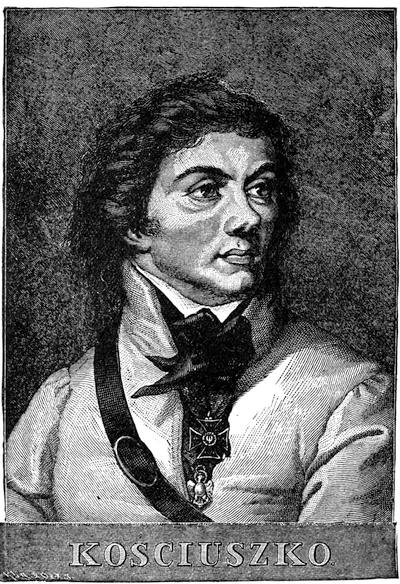
Note on Portrait of Kosciuszko.—After an engraving by Anton Oleszeynski. Cf. Dr. Theodor Flathe's Geschichte der neuesten Zeit (Berlin, 1887), i. p. 205. Cf. A. W. W. Evans's Memoir of Kosciusko, privately printed for the Cincinnati Society, 1883. There was a model made in wax from life by C. Andras, from which an engraving was made by W. Sharp (W. S. Baker's William Sharp, Engraver, Philad., 1875, p. 66).
There are some notes on Kosciusko by Gen. Armstrong in the Sparks MSS. Cf. Greene's Hist. View, 297, and B. P. Poore's Index, for his claims on the United States (p. 131).—Ed.
Lee with the "Legion" had arrived from Augusta on the 3d, and had conducted operations against the stockade covering the watering-place with such vigor that it had been evacuated on the 17th. Four days more would have placed the garrison in the power of the besiegers. But it was not so to be. Rawdon, in Charleston, had received considerable reinforcements direct from Ireland, and early in June he pushed forward through the heat, and eluded Sumter.[1027] With Rawdon within a day's march, Greene must either take the fort by storm or abandon the siege. He decided on an assault,—probably more to satisfy the desires of his men than because he thought it was the best thing to be done. On the 18th, at noon, the attack was made in two columns, Greene not being willing to hazard his whole force in a general storm. On the extreme right, Lee, with "Legion" infantry and the remains of the gallant Delaware regiment, directed his efforts against the stockaded fort, which had already been abandoned, according to the British account of the siege. At all events, Lee had no trouble in carrying out his part of the work. But on the other flank the assault was not so successful. Lieutenant-Colonel Campbell, with his Virginia regiment and with the 1st Maryland, formed the storming column. They advanced with great gallantry, but, though they gained the ditch, they could not effect a lodgment on the parapet. They were driven back with considerable loss by two parties of the besieged, which attacked them in the ditch on both flanks in such a way that the artillery and riflemen in the tower could not fire without injuring friend and foe alike. Greene called off his men, and Rawdon being within a few miles, he retired on the next morning to a safe place of retreat. In the end he retreated as far as Timm's Ordinary, between the Broad and Catawba rivers. Rawdon, his men worn down with their long march, could not overtake him, and finally halting on the banks of the Enroree, he turned back to Ninety-Six. That place being untenable with the means at his disposal, he divided his men into two parties. With one he regained the low country, resigning the command to Stuart on account of ill-health.[1028] Gathering the Tories of the neighborhood, Cruger escorted them to Charleston, while Greene led his army to the High Hills of the Santee, where he passed the heats of the summer.
At length, toward the end of August, Greene learned that Stuart was proposing to establish a fortified post at a strong and healthful position called Eutaw Springs. Greene determined to prevent this, and descending from his camp he made a wide detour to get across the river which separated the two armies; for although he was distant from Stuart only sixteen miles as a bird flies, the most practicable route was nearly seventy miles long. He crossed the Wateree at Camden, and, marching parallel to the river, crossed its affluent, the Congaree, at Howell's Ferry on the 28th and 29th. Proceeding by slow and easy marches, he reached Burden's plantation on the 7th of September. At that place Marion joined him, and preparations were made for an advance on the enemy the next day. Stuart at Eutaw seems to have been singularly negligent. He sent out but one patrol, which was captured by Lee. He would have been surprised had not two men deserted from the North Carolina regiment and given him warning. As it was, he had barely time to call in his foraging parties before Greene was upon him.
Stuart had with him about 2,300 men of all arms, Greene rather less. The British commander ranged his men in one line, the right being protected by Eutaw Creek, while the left was in the air, as the military term is. Greene advanced in two lines, the militia, under Marion, Pickens, and Malmady, being in the front. The right of the second line was held by Sumner with the North Carolina regulars. In the centre were the Virginia Continentals under Campbell, while on the left J. E. Howard and Hardman led the two Maryland regiments. To Lee, who had the advance during the march, was assigned the protection of the right flank, Henderson with a South Carolina brigade covering the left. The cavalry under Washington and the brave remnant of the Delaware regiment brought up the rear, and acted as a reserve.
Here at last there was no wavering among the militia, excepting those from North Carolina, who nevertheless fired several rounds before breaking. Under Marion and Pickens the rest fought splendidly. It is said that some of them fired no less than seventeen rounds before giving way; then Sumner advanced with the North Carolina regulars. At length they, too, were forced back; but the British following them with too great impetuosity, their own line became deranged. This was the opportunity for the men of Maryland and Virginia to retrieve the reputation lost at Guilford and Hobkirk's Hill, and splendidly they responded to the call. Rushing forward,—the Virginians alone disobeying orders so far as to fire,—the whole burst upon the enemy in front and swept him from the field. Unfortunately, their course led through the British camp, and they dispersed to plunder the abandoned tents. Now it happened that when the British fell back a party threw themselves into a strong brick house and an adjoining picketed garden; thence they delivered a withering fire upon the victors of a moment before. And more unfortunate still, when the "Legion" was ordered to charge the retiring foe, Lee could not be found, and the charge, being made without vigor, was a failure. On the right, too, the British had not retreated: they still occupied a flanking position, from which they could not be dislodged, even though Washington and all but two of his officers were killed or wounded in the attempt. All these things, coupled with the heat, compelled Greene to sound the retreat. Leaving such of the wounded as were within range of the brick house on the field, he retired to his camp at Burdell's, seven miles distant, that being the nearest point where a supply of good water could be obtained. Both commanders claimed the victory. It would be not unfair, perhaps, to call it a drawn battle. Neither party can be said to have retained possession of the field, as Stuart retreated with great precipitation from the vicinity on the night of the next day. Greene acknowledged a loss in Continentals alone of 408 in killed and wounded. The loss in militia has never been stated. It must have been considerable, as a portion of the militia fought with great obstinacy. According to the American accounts, the enemy lost in prisoners 500 men, including 70 wounded. But Stuart reported only 257 missing; his killed and wounded he gives at 433.
As soon as Greene ascertained the retreat of the enemy he followed with all speed; but Marion and Lee were too weak to prevent Stuart's receiving a reinforcement. Stuart finally halted at Monk's Corner, while Greene passed the Santee at Nelson's Ferry and retired to the High Hills.
Cornwallis at Wilmington had a difficult problem to solve. Should he go south to the relief of Rawdon, or north to the conquest of Virginia? Another campaign in North Carolina was plainly out of the question. The distances were so great and the country was so sparsely settled that it was a matter of great difficulty to move any considerable force there, even when unopposed. The recent campaign had fully demonstrated that a bold and enterprising leader with a handful of trained troops could seriously impair the usefulness of a royal army, even though he could not destroy it. The best base of operations for another campaign in South Carolina was Charleston, and the best way to get there was by water; but any such movement looked too much like a retreat to be seriously considered. Besides, Cornwallis did not believe that he could get to Camden in time to relieve Rawdon, as the place was not provisioned for a siege. On the other hand, a movement into Virginia offered many advantages. There the army would always be within easy march of the sea, and reinforcements could be brought from New York or sent thither with great ease. Then, too, it seemed to Cornwallis—and his supposition was probably correct—that with Virginia, the great storehouse of the Southern armies, once in his hands, the complete conquest of the Carolinas would be easy and certain. So impressed was he with this idea that he endeavored to induce Clinton to shift the headquarters of the army from the Hudson to the Chesapeake; but Clinton had other views, and New York remained the base of operations. Clinton even went further, and avowed his dislike of the whole plan of operations; but Cornwallis had the approval of Germain, and the northern movement was undertaken.
Clinton, however, had always looked with favor on desultory expeditions to Virginia, as they drew the attention of that State to her own defence, and therefore away from the defence of the Carolinas. As early as the spring of 1779, he had sent Matthews and Collier to the Chesapeake, with instructions to do as much damage to the Americans as possible; but beyond plundering Portsmouth and burning Suffolk they accomplished little, and returned to New York. The next year Leslie was detached in the same direction to effect a diversion in favor of Cornwallis's invasion of North Carolina. King's Mountain not only put an end to that invasion, but compelled Cornwallis to call Leslie to his aid. Leaving Portsmouth, which he had fortified, Leslie sailed for Charleston, and reached the front in season to take part in the campaign against Greene. On Leslie's withdrawal Clinton sent another expedition to Virginia to destroy military stores which had been collected for the supply of Greene. The command this time was given to Arnold, though, to guard against a new treason, dormant commissions were given to his chief officers, Lieutenant-Colonels Dundas and Simcoe. Arnold penetrated to Richmond without encountering much opposition. He destroyed nearly everything of value at that place, and then endeavored to seize some arms which had at one time been deposited at Westham. Failing in this, he descended the river to Portsmouth. The militia had now collected in considerable numbers. For this or for some other reason, Arnold kept within the fortifications of that place.
About this time Rochambeau had sent a few vessels to annoy the British in the Chesapeake; but, besides capturing the "Romulus",—a 44-gun ship,—they did little, and returned to Newport. Washington now proposed that the two armies should unite in an attempt to capture the traitor. To this end he detached Lafayette with the light infantry,—a picked corps of about twelve hundred men from the New England and New Jersey lines,—to act in unison with a force of the same size which Rochambeau detached from his army. Lafayette, for a time concealing his destination by a feigned attack on Staten Island, reached Annapolis in safety. Leaving his troops there, to be brought the rest of the way by the French fleet when it should arrive, Lafayette proceeded to Suffolk. He found Muhlenberg, with the militia, at that place, guarding the approaches to Portsmouth. But the French were not fortunate, since their departure from Newport was so long delayed that the fleet arrived off the Capes of the Chesapeake only to find Arbuthnot guarding the entrance. In the fight which followed, both sides claimed the victory. But all the advantages of victory were on the side of the British, as Destouches' ships were so badly cut up that he was obliged to return to Newport. Success now being improbable, Lafayette returned to his troops, and the march to the North was begun. At the Head of Elk new orders were found, directing him to return to the South and place himself under the orders of Greene. The cause of this radical change in plan was the reinforcement of two thousand men under Phillips which Clinton had sent to Virginia.
Phillips arrived on March 25, and took command. Towards the end of April, the British to the number of twenty-five hundred landed at City Point on the James River. Steuben, who was then at Petersburg, took up a strong position at Blandford, where the enemy found him on the morning of April 25. He was soon obliged to retreat. The enemy then marched to Petersburg, and destroyed a large amount of tobacco and other valuable property. The 27th saw them at Osborn's, where they captured, after some show of resistance, a fleet of merchant vessels.
When Phillips and Arnold arrived at Richmond they found that Lafayette was before them. The young Frenchman had reached Baltimore on the 17th of April. Purchasing on his own credit shoes and clothes suited to a Virginia summer, he made a forced march, and threw himself into Richmond twenty-four hours in advance of the British. Not wishing to attack him in such a strong position, Phillips retired down the river, followed by the Americans. On the 7th of the next month (May, 1781), the British commander received word from Cornwallis that he would join him at Petersburg. Suddenly ascending the river, he reoccupied that town on the night of the 9th. On the 13th Phillips died, and a week later Cornwallis arrived and assumed command, Arnold returning to New York.
Then followed a series of marches, the design of the British commander being to cut Lafayette off from Wayne, who was marching to his support. But Lafayette moved with too great celerity. Early in June the desired junction of the Americans was made near Raccoon Ford, on the Rapidan. Meantime, while Lafayette was out of reach, Cornwallis sent out two expeditions. The first, under Simcoe, operated against Steuben, at that time guarding the stores at the Point of Fork. The Prussian veteran, mistaking Simcoe's detachment for the main army, abandoned the stores and retired with great precipitation. The second expedition, led by Tarleton, was designed for the capture of the civil rulers of Virginia, but a Virginia Paul Revere warned them of their danger in time, and they made good their escape,—though it is said that Jefferson, then resting from the fatigues of the session at Monticello, had but five minutes to spare. But the raid, successful, or not, had no importance, although popular writers are wont to dwell upon it.
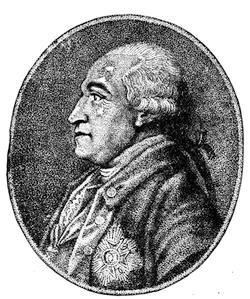
STEUBEN.
From Du Simitière's Thirteen Portraits, London, 1783. Cf. Harper's Mag., lxiii p. 336, and the lives of Steuben.—Ed.
With Wayne and his Pennsylvanians, in addition to his own Light Infantry, Lafayette felt strong enough again to oppose the enemy in the field. By a well-executed movement through an unknown and long-disused road, the young marquis placed himself between Cornwallis and Albemarle Old Court House, whither the stores had been removed from Richmond. Cornwallis, instead of attacking him, retired down the James, Lafayette following at a distance of about twenty miles. On the 25th of June the British were at Williamsburg, the Americans being not far off, at Bottom's Bridge. While at Williamsburg, Cornwallis sent Simcoe to destroy some boats and stores which had been collected on the Chickahominy. Lafayette, on his part, detached Butler of the Pennsylvania line, with orders to attack Simcoe on his return. A partial engagement ensued at Spencer's Ordinary, which ended in Simcoe's being able to continue his retreat.
It can hardly be said that this retrograde movement on the part of the British was due to the presence of Lafayette, although his presence undoubtedly contributed toward making Cornwallis desirous of getting into communication with Clinton. It is probable, too, that Cornwallis hoped to be so strongly reinforced that the conquest of the State during the coming autumn would be assured. But Clinton, believing, from intercepted despatches, and from the movements of the Americans, that Washington was meditating an attack on New York, instead of complying with Cornwallis's desires, ordered him to send a portion of his own troops to New York.
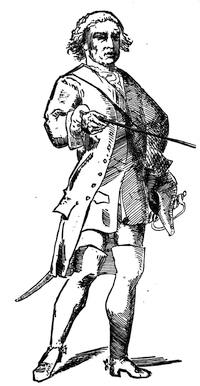

After a sketch supposed to be by Fersen, aide of Rochambeau, and following a reproduction given in Balch's Les Français en Amérique, p. 174. Cf. Irving's Washington, quarto ed., and E. M. Stone's Our French Allies, p. 281; Harper's Mag., lxiii. 329.—Ed.
The latter, therefore, retired to Portsmouth, where the embarkation could be easily effected. To Lafayette, the crossing of the James seemed to offer the chance of at least picking off a rear guard; but Cornwallis was attacked too soon, owing in part to the impetuosity of Wayne, and the onset came near being a disaster. In the end, however, Wayne succeeded in bringing off his men, though he lost two pieces of artillery. Cornwallis, fearing an ambuscade, did not push the pursuit. He then made his way to Portsmouth unmolested, while the Americans sought a healthy summer camp on Malvern Hill. Just at this moment, owing to the arrival of reinforcements in New York, Clinton decided to leave Cornwallis's force intact. Furthermore, he determined to establish a permanent base in the Chesapeake, and ordered Cornwallis to fortify a place, mentioning Old Point Comfort, where the navy could be sheltered. He also authorized him to take possession of some other post, as Yorktown, if he thought it necessary. Now Cornwallis seems to have regarded the fortifying of Yorktown as the only alternative, and the engineers and naval officers declaring Old Point Comfort unsuitable for a naval station, he seized York and Gloucester, and began the erection of the proper works. Clinton always asserted that he had no intention of ordering anything of the kind. But the weight of evidence seems to be in favor of Cornwallis. At all events, he took possession of Yorktown. As soon as his movements were discovered, Lafayette left his summer camp, and, taking a strong position in the fork of the Pamunkey and Mattapony rivers, sent out parties to watch the further movements of the enemy, Wayne being ordered toward the south, as if to the assistance of Greene. Such was the situation in Virginia when the French came to the aid of the Americans, and began the operations leading to the siege of Yorktown.
On the 1st and 2d of May, 1780, the Marquis of Rochambeau, with about five thousand men, left the roadstead of Brest. The transports were convoyed by a small fleet of seven ships of the line, under the command of the Chevalier de Ternay. Their progress was slow, and it was not until July 12th that the fleet anchored in Newport harbor.[1029] Batteries were immediately erected on shore to protect the shipping from the English fleet, which was under Arbuthnot. This admiral, hastening from Charleston, in company with Clinton, now bent his whole energy toward the destruction of the French fleet. But the British commanders, always on bad terms, quarrelled, and Washington threatening New York, while the New England militia rallied to the defence of their newly arrived allies, the attempt on Newport was abandoned. A naval blockade was kept up, however, and the French army was neutralized by a few ships of war. Thus they passed the remainder of 1780 and the first part of 1781.
On the 8th of May (1781) M. de Barras, successor to De Ternay, who had died in the preceding year,[1030] arrived at Boston. He brought news of the departure from Brest of a powerful fleet commanded by M. de Grasse. This French admiral had with him a small convoy with six hundred recruits for Rochambeau; but the bulk of his fleet was destined primarily for the West Indies. De Grasse had been directed, however, to come on the American coast in July or August, relieve the fleet at Newport, and for a limited period act in conjunction with the American and French armies. On May 21st a conference between Washington and the French commanders was held at Weathersfield, in Connecticut. It was there determined to make a united attack upon New York, provided De Grasse could coöperate. This was Washington's plan, though an expedition against the British in Virginia seems even then to have been proposed. Later a note from De Grasse arrived, asking where he should strike the American coast. Rochambeau replied that it would be best for him to look into the Chesapeake, and then, should no employment be found there, to proceed to New York. Rochambeau also inclosed the articles of the Weathersfield conference, hinting at the same time that De Grasse must be his own judge as to the practicability of crossing the New York bar with his ships. Finally he asked him to borrow for three months the brigade under St. Simon, which was destined to act in conjunction with the Spaniards.
On the 18th the advance of the French left Providence for the Hudson. Washington at this time was encamped at Peekskill. Ten days later, on June 28th, he determined to seize by surprise, if possible, the forts on the northern end of New York Island. The night of July 2d was selected for the enterprise, and the command of the advance was given to Lincoln; Lauzun, with the French Legion, making a forced march to his aid. But the scheme failed. The enemy attacked Lincoln, and Lauzun reached the scene of conflict too late to be of assistance. The troops were drawn off in safety, however, and retired to Dobbs Ferry, where they were joined by the French infantry on July 6th. While awaiting the arrival of the fleet, nothing was attempted beyond a reconnoissance in force of the northern defences of the island. It was this movement which induced Clinton to send for the Virginia troops.
On August 14th a letter from De Grasse arrived which put a new face on the whole war; for the French admiral announced that he should sail for the Chesapeake, with a view to carry out the scheme of Rochambeau for a united movement against Cornwallis. He added that his stay on the American coast would be short, and that he hoped the land forces would be ready to act with him.
FRENCH OFFICERS.
There was now nothing to be done but to abandon the cherished project against New York, and to move all of the allied armies that could be spared from the vicinity of New York to the Chesapeake. Leaving Heath with four thousand men to garrison the forts on the Hudson, and suitable parties to guard against an irruption from Canada, Washington set out with the rest of the land forces for Williamsburg, by the way of Philadelphia, Head of Elk, and the Chesapeake. On the 19th the army crossed the Hudson at King's Ferry, and moved as though to attack Staten Island. This feint was so well managed that Clinton was completely deceived. On September 2d the Americans marched through Philadelphia, the French following on the 3d, 4th, and 5th. By the 8th the allied army was again united at the Head of Elk. The news of the arrival of De Grasse at the Capes of the Chesapeake had reached Washington on the 5th, and had been communicated to the troops on the following morning.[1031]
De Grasse, on his arrival at Lynnhaven Bay, just inside Cape Henry, had found an aide of Lafayette's, and soon the marquis arrived in person. As soon as possible the troops under St. Simon were landed at Jamestown Island, and Wayne was recalled from his southward march. These corps, with the light infantry and the Virginia militia, took up a strong position at Williamsburg, not more than twelve miles from Yorktown. Cornwallis reconnoitred the lines; but they were too strong to be attacked except at great risk. Confident in being relieved by Clinton and Graves, he retired to his fortifications.
Had Rodney done his full duty he would have followed De Grasse in his northward cruise. But pleading illness, he sent fourteen ships of the line, under Hood, to the assistance of Graves, and sailed himself for Europe.[1032] The event was most fortunate for the American cause, as the control of the sea for a brief period passed away from the British. It should be said that Rodney had written to Graves, warning him of his danger; but through a fortunate accident the letter never reached Graves, and the first he heard of the coming of De Grasse was on the arrival of Hood. That admiral on August 25th had looked into the Chesapeake on his way north; but the French had not yet arrived. Graves had already discovered that Barras had sailed from Newport with a siege train and tools, and the two admirals, conjecturing, therefore, that the destination of Barras was the Chesapeake, determined to seek him there and destroy him before the arrival of the main fleet. They reached Cape Henry on the 5th of September, and there they found, not Barras, as he had purposely taken a long, roundabout route to avoid them, but De Grasse. The English fleet numbered nineteen sail of the line, the French twenty-four, but fifteen hundred men were absent, engaged in landing the troops of St. Simon. Nevertheless, De Grasse slipped his cables and stood out to sea. The ensuing action was indecisive, but De Grasse accomplished his purpose, as the British were obliged to seek New York to refit. On his arrival back at Lynnhaven Bay he found Barras. There was now abundant transportation, and by the 26th of September the allied troops—Washington's, Rochambeau's, Lafayette's, and St. Simon's—were concentrated at Williamsburg.
Two days later, on the 28th, the allied army marched to Yorktown, and found Cornwallis occupying an intrenched camp outside the immediate defences of the town. On the 29th the lines were extended so as to envelop the place, the Americans taking the right, with their right flank resting on Wormley Creek. Cornwallis, seeing that he would be outflanked, withdrew to the inner defences, and on the morning of the 30th the besiegers took possession of the abandoned works.[1033]
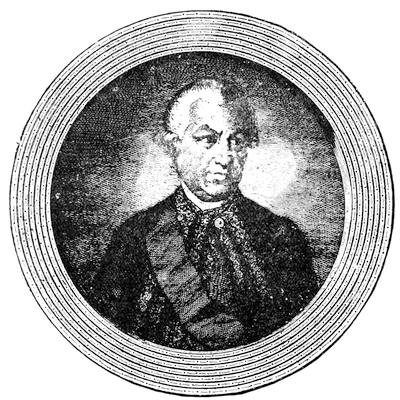
COUNT DE GRASSE.
From Andrews's Hist. of the War, Lond., 1785, vol. ii. Cf. European Mag., ii. 83; Hennequin's Biographie maritime, iii. 297; E. M. Stone's French Allies, 396, 398; Mag. of Amer. Hist., vi. p. 1; Harper's Mag., lxiii. 330.
The Operations of the French feet under the Count de Grasse in 1781-82, as described in two Contemporary Journals (New York, 1864, for the Bradford Club, 150 copies), edited by John G. Shea, gives two narratives, of which one purports to have been written by a certain Chevalier de Goussencourt, who is hostile and cannot be identified, while the other is anonymous and friendly. This last had been printed at Amsterdam in 1782, and it is suspected was written by De Grasse himself. A sketch of De Grasse's life, for which his family gave material, is prefixed. It also contains (p. 192) the account, abridged from the Gazette de France, Nov. 20th, in the Remembrancer, xiii. 46. A Notice Biographique of De Grasse, by his son, was published in Paris in 1840.—Ed.
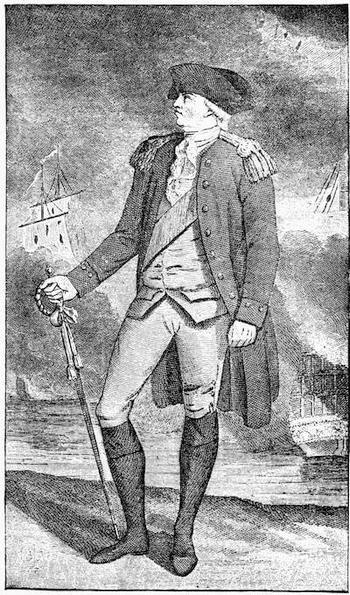
COMTE DE GRASSE.
From the London Mag., Aug., 1782, p. 355. There is a profile head in The Operations of the French fleet under the Count De Grasse (N. Y. 1864).—Ed.
On the night of the 5th and 6th of October the first parallel was opened, at a distance of between five and six hundred yards from the enemy's works. It extended from the river bank below the town to a deep ravine nearly opposite the centre of the besieged lines. A battery on the bank above the town opposed a battery of the enemy in that quarter, and also prevented the British fleet from enfilading the works. Guns were mounted and fire opened from this parallel on the afternoon of the 9th. The ground was singularly favorable to the construction of the approaches, and by the night of the 11th and 12th the works were in such a state of forwardness that the second parallel was begun, not more than three hundred yards from the British lines. On the extreme right, however, there were two redoubts, commanding this parallel, which on the night of the 14th and 15th were carried by storm,—the smaller one, on the right, by Lafayette's division, the advance being commanded by Alexander Hamilton; while the one further away from the river was stormed by a party of French infantry commanded by Colonel G. de Deux-Ponts, the Baron de Viomenil having command of the division. The loss on the American side was inconsiderable, but that of the French was severe, the redoubt carried by them being larger and much more strongly garrisoned. Before morning the two redoubts were included in the second parallel. Cornwallis, hoping for relief, determined to prolong the defence as long as possible. To this end, on the morning of the 16th, Lieutenant-Colonel Abercrombie led a determined but useless assault on two batteries at the French end of the trenches. Cornwallis next tried, on the night of the same day, to cut his way out by passing his men over to Gloucester Point; but a storm arose in the midst of the ferrying, and the enterprise, hazardous at best, was abandoned.
An assault becoming practicable, at ten o'clock of the morning of the 17th, four years since Burgoyne's surrender, a drummer-boy appeared on the parapet and beat a parley. Negotiations were begun, but, though pushed with the greatest energy by Washington, the final articles were not signed in the trenches until two days later, on the 19th. On that day, at noon, two redoubts were taken possession of by detachments from the French and American forces. At two in the afternoon the British army, with colors cased and drums beating "The World turned upside down", marched out and laid down their arms; O'Hara, in the absence of Cornwallis, making the formal surrender to Lincoln, Washington's representative.
At the beginning of the siege the British numbered not far from seven thousand men of all arms,—perhaps a few more. On the day of the capitulation, according to Cornwallis, little more than thirty-eight hundred were fit for duty, including the garrison at Gloucester Point. The allied army is usually given at sixteen thousand men,—nine thousand Americans, including thirty-five hundred militia. The French numbered probably more than seven thousand. The total British loss during the siege was five hundred and forty-one, including the missing. The allied loss, excluding the missing, was seventy-six Americans and one hundred and eighty French. It has been stated that, at the time of the surrender, there were about fourteen hundred unfit for duty in the allied camp. This great victory, due even more than most victories to chance, virtually ended the war. It remains only to describe the closing scenes in the South.
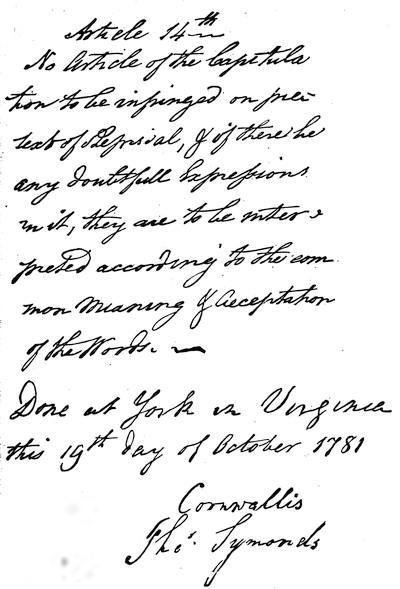
CAPITULATION OF YORKTOWN.
From a fac-simile of the articles in Smith and Watson's Hist. and Lit. Curios., 1st ser., 6th ed., pl. xxxiv. Cf. Lossing's Field-Book, ii. 523. The articles are given in Shea's Operations of the French fleet, p. 78; R. E. Lee's ed. of Lee's Memoirs, 509; Tarleton, 438; Polit. Mag., ii. 67; Sparks's Washington, viii. App. 8; Cornwallis Corresp., App.—Ed.
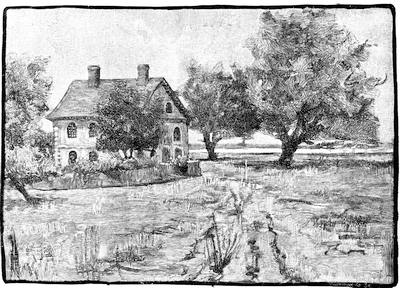
NELSON HOUSE, YORKTOWN.
After a drawing given in Meade's Churches and Families of Virginia, i. 204. It was here that Cornwallis had his headquarters.
See other views and accounts in Balch's Les Français en Amérique, 1; Mag. of Amer. Hist. (1881), vii. 47 (by R. A. Brock); x. 458, July, 1881; Brotherhead's Signers of the Declaration of Independence (1861), p. 61; E. M. Stone's Our French Allies, p. 428; G. W. P. Custis's Recoll. of Washington, p. 337. A journal of Mr. Samuel Vaughan in 1787, owned by Dr. Charles Deane, describes the havoc made in this house by the bombardment.
The Moore house, at which the terms of surrender were arranged, is depicted in Appleton's Journal, xii. 705; Mag. of Amer. Hist., vi. 16 (etching); E. M. Stone's French Allies, 466; Lossing's Field-Book, ii. 530. Washington's headquarters at Williamsburg is shown in the Mag. of Amer. Hist., vii. 270. A view of the field where the arms were laid down is in Paulding's Washington, vol. ii. The so-called Cornwallis Cave is drawn in Scribner's Mag., v. 141. For other landmarks, see Lossing's Field-Book, ii. 509; Cycl. U. S. Hist., 155-157; Porte Crayon's "Shrines of Old Virginia" in Lippincott's Mag., April, 1879. In the Mag. of Amer. Hist. (1881), pp. 270, 275, are views of Washington's headquarters at Williamsburg; and of those, earlier occupied by Cornwallis, the president's house of William and Mary College.
For the Yorktown and Saratoga medal, see Loubat's Medallic Hist. U. S.; Amer. Jl. of Numismatics, xv. 76; Coin Collectors' Journal, vi. 173; Sparks's Franklin, ix. 173.
The best known picture of the surrender is Trumbull's painting, which is engraved in Harper's Mag., lxiii. 344, and elsewhere. Cf. early engravings of the scene in Barnard's Hist. of England; in Godefroy's Recueil d'Estamps (Paris, 1784).—Ed.
Greene's army had been so roughly handled at the Eutaws that it was the first of November before he felt strong enough again to take the field. He advanced first to Dorchester and the Round O. Then, reinforcements arriving from the troops set free by the surrender at Yorktown, he assumed a more vigorous offensive. He advanced to the eastern bank of the Edisto, between Jacksonborough, where the legislature was then assembling, and Charleston, still in the hands of the British. But if the Pennsylvanians were a welcome addition on account of their strength, they brought also a spirit of discontent. A plot was discovered to betray the army into the power of the enemy. A few examples were made and the attempted treason stamped out.
Greene now detached Wayne, with about five hundred men, to do what he could toward the recovery of the Georgia seaboard. On his approach the British retired to Savannah, burning everything that could not be removed. Wayne was too weak to attempt more than the blockade of the town. But on the 21st of May Lieutenant-Colonel Brown left the fortifications as if to attack the Americans. Placing himself between this party and the garrison, Wayne surprised Brown by a night attack, killing or dispersing the whole party. About a month later he was himself surprised by a large body of Creek Indians led by a British officer. Successful at first, the savages were finally beaten off, with the loss of their chief Escomaligo and a dozen braves. On the 11th of the next month, July, 1782, Savannah was evacuated, and the whole State once more came into the hands of the Americans.
The British government had decided upon the abandonment of all posts in America with the exception of New York. On August 7th, Leslie, then commanding in the South, announced in "after orders" that the evacuation of Charleston had been determined on. He also wrote to Greene, proposing a cessation of hostilities. The proposal was declined, Greene having no instructions on the point. Later Leslie again wrote, offering to pay for all rice and other provisions that might be brought into Charleston; but Greene, fearing that the rice was intended for use during a campaign against the French in the West Indies, again refused. Leslie then endeavored to seize the coveted articles by force. One of his foraging parties, commanded by Lieutenant Benjamin Thompson,—better known by his later title of Count Rumford,—surprised and dispersed Marion's brigade while its commander was absent attending a meeting of the legislature. The most serious loss through these desultory expeditions was in the death of the younger Laurens, who was killed during a useless skirmish at Combahee Ferry. This was the last action of the war in the South. On the 14th of December the British left Charleston, and three days later their last ship passed the bar and went to sea. The South was free.
CRITICAL ESSAY ON THE SOURCES OF INFORMATION.
THE most complete contemporary account of the Southern campaign is David Ramsay's Revolution of South Carolina.[1034] This author, by birth a Pennsylvanian, removed to Charleston in 1773, and at once took a leading part in the management of the affairs of that town. During the stormy years of 1779-1780 he was a member of the governor's council, but went with the Charleston artillery company to the siege of Savannah. When Rutledge, with a portion of his council, left Charleston during the siege, Ramsay remained behind with Gadsden. He was, therefore, a prisoner during the greater portion of Gates's and Greene's campaigns. Ramsay was thus a prominent actor in many of the scenes described in his volumes, while his facilities for obtaining accurate information as to the rest were so excellent that his book may be regarded as an authority of the first importance. He retold the story in a condensed form in several other publications.