Chapter II
Reading edition
THE CONFLICT PRECIPITATED.
BY JUSTIN WINSOR,
The Editor.
"YOU must be firm, resolute, and cautious; but discover no marks of timidity", wrote one from London to James Bowdoin, February 20, 1774.[324] Firm, resolute, cautious, but bold! This was the impelling spirit of the hour. Hutchinson was at the same time writing to Dartmouth that anarchy was likely to increase, till point after point was carried, and every tie of allegiance was severed.[325] Indications were increasing that the conflict of argument and the burst of political passion were before long to give way to the trial of force, and to the inevitable severing of friends which a resort to arms would entail. All this was prefigured on the first of June, 1774, when Hutchinson, bearing with him the addresses of his admirers,[326] left his house on Milton Hill forever, and walked along the road, bidding his neighbors good-bye at their gates; when, as he approached Dorchester Neck, he got into his carriage, which had followed him, and was driven to the point, where he took boat, was conveyed to a frigate, and in a short time was passing out by Boston light, leaving behind the line of ships at their moorings, which, with shotted guns, marked the beginning of the Boston blockade. That severing of friends and that threat of war was at that moment, away off in Virginia, accompanied by the tolling of bells out of sympathy for Boston. The Massachusetts yeomanry had not yet openly seized the musket, but their tribune, Sam. Adams, a few days later, turned the key upon the governor's secretary in Salem, when that officer was sent to dissolve the assembly. It was then that Adams and his associates proceeded to pass votes, with no intention of submitting them to the executive approval,—the beginning of the end, which we have seen Hutchinson but a few months before had anticipated. Between the upper and the nether mill-stone, between the patriots of Massachusetts and the Tories of Parliament, the charter of William and Mary was rapidly crushed. Parliament determined that all power should come from them, and the province leaders determined otherwise. So the distribution of authority provided under the charter ceased. The rival powers in and around Boston could not long abstain from force. Each watched the other, in the hopes of a pretext to be beforehand, without being the aggressor.
On the first of July, 1774, when Hutchinson, in London, was convincing the king that the ministry's aggressive measure was going to bring the recalcitrant Bostonians to terms, Admiral Graves, in his flag-ship, was entering Boston harbor, and new regiments soon followed in their transports. Presently one could count thirty ships of war at their moorings before the town, and the morning drum-beats summoned to the roll-call strong garrisons at Castle William, in Boston itself, and at Salem, now the capital. It was known that arms were stopped, if any one tried to carry them from Boston; and it soon became evident to Gage that it was best to concentrate his force, for he removed his headquarters from Danvers[327] to Boston, and thither his two regiments followed him. Perhaps he had heard of the enthusiasm of a certain young officer, whom he had seen twenty years before, saving all that was saved, on Braddock's bloody day; and how, surviving for the present crisis, he had just declared, in distant Virginia, that he was ready to raise, subsist, and march a thousand men to Boston. Gage must have known George Washington quite as well as the Bostonians did, who were, it is to be feared, better prepared on their part to look upon Israel Putnam, as he marched into town from Connecticut with a drove of sheep for the hungered populace, as a greater hero than the Virginian colonel.
September came in, and it did not look as if the conflict could be put off longer.[328] On the first of that month Gage sent a detachment to the Powder House beyond Quarry Hill, in the present Somerville, and it brought away ammunition and cannon and took them to the castle.
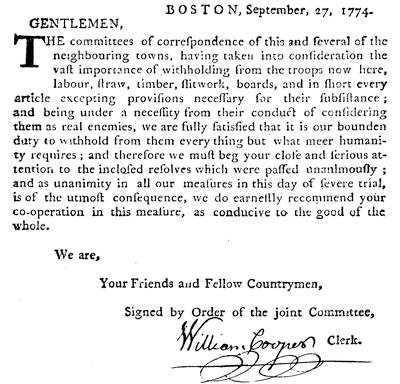
NOTICE OF THE COMMITTEE OF CORRESPONDENCE.
From an original in the volume of Proclamations, etc., in the library of the Mass. Hist. Society.
News of the inroad spread, and on the next day crowds gathered in Cambridge with arms in their hands. They assembled before Lieutenant-Governor Oliver's house[329] and forced him to resign. Joseph Warren, in Boston, heard of the tumult and hastened to the spot. His influence prevailed, and the sun went down without the shedding of blood. It was ominous, however, to Gage, and he set to work rebuilding the old lines across Boston Neck, and constructing barracks. He soon encountered difficulties. Somehow laborers could not be hired, nor provisions be bought. Somehow his freight-barges sunk, his carts of straw got on fire, his wagons were sloughed; and somehow, with all his vigilance, a few young men made up for the loss of the powder-house pieces by stealthily carrying off by night some cannon from Boston,[330] besides some others from an old battery in Charlestown. It was soon found that the men on the Neck lines needed protection, and Admiral Graves tried to send up a sloop of war into the South bay to enfilade the road from Roxbury, if occasion came; but her draught was too much, and so he employed an armed schooner. By November the works were finished. Warren thought them as formidable as Gage could make them, but the old Louisbourg soldiers laughed at them and called them mud walls.
Meanwhile, in October, the military spirit was taking shape throughout the province. On the 5th the legislative assembly, which had met at Salem on Gage's call, though he sought to outlaw them by rescinding (September 28) his precept, had declared his attempted revocation without warrant in law, and had resolved itself into a provincial congress. The body then adjourned to meet in Concord, where, under John Hancock's presidency, they appointed a Committee of Safety to act as the executive of the province, and chose three general officers,—Preble,[331] Ward, and Pomeroy. The militia was organized, and minute-men were everywhere forming into companies. Gordon tells how the country was astir with preparations. Connecticut was not far behind in ordering her militia to be officered, and in directing her towns to double their stock of ammunition, while she voted to issue £15,000 in paper money,—the first of the war.
"An armed truce", wrote Benjamin Church, "is the sole tenure by which the inhabitants of Boston possess life, liberty, and property." Away from Boston, the towns made common cause. "Liberty and Union" was to be read on a flag flying in Taunton. When news of these and similar events reached England, Lord North told Hutchinson that, for aught he could see, it must come to violence, with consequent subjection for the province.[332] When such tidings reached Virginia it found her officers just sheathing their swords after their conflict with the Indians in the mountains, and resolving next to turn their weapons against the oppressors of America. Gage, in Boston, whom Warren really felt to be honest and desirous of an accommodation, was awaking to a juster measure of the task of the ministry, which might, he said, require 20,000 troops to begin with. As he pondered on such views, he might have heard, on the evening of the 9th of November, 1774, the ringing of the bells which greeted the return of Sam. Adams and his colleagues from the Philadelphia congress. Shortly after the middle of the month the British in Boston went into winter quarters.[333] So November passed;—the Committee of Safety had arranged to raise and support an army, and the recommendation of the Continental Congress had been approved.
December came. Boston was not yet burned, as some in London believed it was when Quincy heard them laying wagers in the coffee-houses,[334] and if Sam. Adams was not the first politician in the world, as others told the same ardent young Bostonian, he was sharing conspicuous honors at home, with his distant kinsman, John Adams. The latter, as Novanglus, in his public controversy with the unknown Massachusettensis, was just attracting renewed attention. But that sturdy patriot, while he was arguing in public, was comforting himself in private by reckoning that Massachusetts could put 25,000 men in the field in a week; and New England, he counted, had 200,000 fighting men, "not exact soldiers", he confessed, "but all used to arms."[335] Tidings were coming in which told how this warlike spirit might be tested. Governor Wanton, of Rhode Island, had spirited away from the reach of the British naval officers forty-four cannon, which were at Newport. Paul Revere had gone down to Portsmouth and harangued the Sons of Liberty, till they invaded Fort William and Mary and (December 14, 1774) carried off the powder and cannon.[336] From Maryland, where they had lately been burning a tea-ship,[337] the word was that its convention had ordered the militia to be enrolled. From Pennsylvania it appeared that Thomas Mifflin was conspicuous among the Quakers in advocating the measure of non-intercourse. From South Carolina the news was halting. Could her rice-planters succeed in getting their product excepted from such a plan? They did. Gage had some time before[338] written to Dartmouth that they were as mad in the southern Charlestown as in northern Boston; and when one of their Tory parsons had intimated that clowns should not meddle with politics, they had been as fiery as they could have been in Massachusetts.[339] Gordon, of Jamaica Plain, in appending notes to a sermon which he had just preached on the Provincial Thanksgiving of December 15, 1774, refers to the brave lead of Virginia in the present time, as nine years before she had been foremost in the stamp-act time.[340] Governor Dunmore was reporting to Dartmouth (December, 1774) that every county in Virginia was arming a company of men, to be ready as occasion required.
John Adams, at Philadelphia, read to Patrick Henry from a paper of Joseph Hawley, that the result of the action of the ministry rendered it necessary to fight. "I am of that man's opinion", replied the ardent Virginian.[341] With the new year (1775) that opinion was becoming widespread. Ames' Almanac (1775), published in Boston, was printing, for almost every family in New England to read, "a method for making gunpowder", so that every person "may easily supply himself with a sufficiency of that commodity." Day by day news came to Boston from every direction of the indorsement of Congress, and of the wild-fire speed of the dispersion of the military spirit. Those who remembered the 40,000 men who marched towards Boston at the time of the D'Anville scare, thirty years before, said the enthusiasm then was nothing like the present. Somehow Gage began to feel more confident. He had in January 3,500 men in his Boston garrison, and almost as many more were expected, and he did not hesitate to send (January 23) Captain Balfour and a hundred men, with two cannon, to Marshfield, to protect the two hundred loyalists there, who had signed the articles by which Timothy Ruggles was hoping to band the friends of government together, and the reports which Balfour sent back seemed to satisfy the governor that the measure was effective.[342]
On the first of February, 1775, the second provincial congress assembled at Cambridge, and they soon issued a solemn address to the people, deprecating a rupture, but counselling preparations for it.[343] It was not then known that Gage had won over Dr. Church, and that through this professing patriot the British headquarters in Boston were informed of the doings of congress. Church's defection encouraged the tories, and on the 6th, handbills appeared in Boston, reminding the patriots of the fate of Wat Tyler.[344] A few days later Cambridge was alarmed by the report that troops were coming out of Boston to disperse them; but the day passed without the proof of it. The Committee of Safety were anxious, for they knew that the other colonies and their friends in England were fearful that the conflict would be precipitated without the consent of congress; and the authority of congress was now so dominant that its cognizance of such measures was essential to the continuance of the sympathy with Massachusetts which now existed. No one at this time was more solicitous for this prudent measure than Joseph Hawley, and no one in Massachusetts had a steadier head. On the 18th Peter Oliver wrote from Boston to London: "Great preparations on both sides for an engagement, and the sooner it comes the better."[345] "Every day, every hour widens the breach!" wrote Warren to Arthur Lee, two days later.[346] Already the provincial congress had conferred on the Committee of Safety (February 9) the power to assemble the militia, and John Thomas and William Heath had been added to the general officers. The committee, on the 21st, had voted to buy supplies for 15,000 men, including twenty hogsheads of rum. On the same day Sam. Adams and Warren signed a letter to the friends of liberty in Canada, and secret messengers were already passing that way. Presently, on the 26th, the impending conflict was once more averted.
Colonel David Mason, of Salem, had been commissioned by the Committee of Safety as an engineer, and was now at work in that town mounting some old cannon which had been taken from the French. Gage heard of it, and by his orders a transport appeared at Marblehead, with about 300 men under Lieutenant-Colonel Leslie, who rapidly landed and marched his men to Salem. Their purpose was seasonably divined; the town was aroused, and, in the presence of a mob, the commander thought it safer to turn upon his steps.[347] A British officer, Colonel Smith, with one John Howe, was at about the same time sent out in disguise to scour the country towards Worcester, and pick up news for Gage;[348] and two others, Brown and Bernière, were a few weeks later prowling about Concord.[349] The patriots did not scour for news. It came in like the wind,—now of county meetings, now of drills, now of Colonel Washington's ardor in Virginia, and now of Judge Drayton's charge to the grand jury in Carolina.
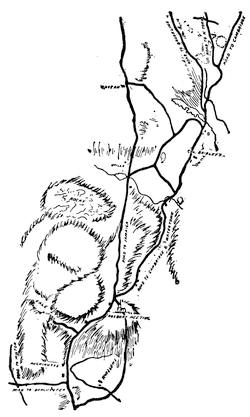
ROADS OF ROXBURY AND BEYOND.
Sketched from a MS. map in the library of Congress, which is apparently one of the maps made by Gage's secret parties of observation.
Early in March came the anniversary of the Boston massacre. Two days before, Judge Auchmuty, in Boston, wrote to Hutchinson: "I don't see any reason to expect peace and order until the fatal experiment of arms is tried.... Bloodshed and desolation seem inevitable."[350] While this tory was writing thus, the patriots, in a spirit that somewhat belied their professed wish to avoid a conflict, were arranging for a public commemoration of the massacre. It could have been omitted without any detriment to the cause, and to observe it could easily have begotten trouble amid the inflamed passions of both sides. "We may possibly be attacked in our trenches", said Sam. Adams. It little conduced to peace that Joseph Warren was selected to deliver the address, which, as the fifth came on Sunday, was delivered on Monday, the sixth. The concourse of people suggested to Warren to enter the Old South meeting-house, where the crowd was assembled, by a ladder put against a window in the rear of the pulpit. Forty British officers were present, and the moderator offered them front seats, and some of the officers placed themselves on the pulpit stairs. A contemporary story says that it was a set purpose of the officers to break up the meeting,[351] and that one of them took an egg in his pocket, to be thrown at the speaker for a signal. This man tripped as he entered the building, and the egg was broken before its time. Another officer, below the desk, held up some bullets in his open palm as Warren warmed in his eloquence. The speaker quietly dropped his handkerchief on the leaden menace, and went on. So the meeting came to an end, with no outbreak; though there was some hissing and pounding of canes when the vote of thanks was put. As the crowd came out of the meeting-house there was an apprehensive moment,[352] for the Forty-third Regiment chanced to be passing, with beating drums, and for an instant the outcome was uncertain.[353] Gage had suffered the commemoration to pass without recognition, but ten days later his officers made the event the subject of a provoking burlesque, when Dr. Thomas Bolton delivered from the balcony of the British Coffee House in King Street a mock oration in ridicule of Warren, Hancock, and Adams.[354] There was no knowing what purpose this ridicule might mask; and a committee of the patriots, mostly mechanics, were constantly following the progress of events, meeting secretly at the Green Dragon[355] for consultation, and setting watches at Charlestown, Cambridge, and Roxbury, to give warning if there were any signs that the royal troops were preparing to move from the town.
On the 22d March, 1775, the provincial congress assembled again at Concord, and set to work in organizing their army, and in devising an address to the Mohawks, with the purpose of securing them to the patriot side. They also prepared to use the Stockbridge Indians as mediators with their neighbors, who were already tampered with, as was believed or alleged, by emissaries from Canada. It was already known that the people of the New Hampshire Grants were preparing to seize Ticonderoga as soon as the war-cloud should burst.
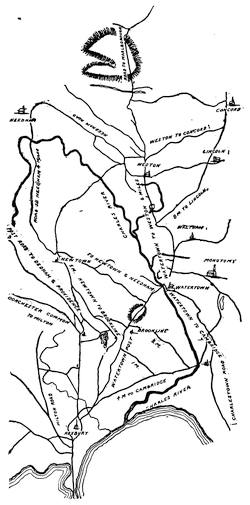
BETWEEN BOSTON AND MARLBOROUGH.
Sketched from a MS. map in the library of Congress, which is seemingly the original or copy of the map made by one of Gage's secret parties sent to observe the country.
News sped rapidly by relays of riders. It was not long after Patrick Henry had said in Virginia, "We must fight; an appeal to arms and to the God of hosts is all that is left for us",[356] before the words were familiar in Massachusetts, and John Adams, who knew, said that Virginia was planting wheat instead of tobacco. At Providence they were burning tea in the streets, and men went about erasing the advertisements of the obnoxious herb from the shop-windows. Everywhere they were quoting the incendiary speech of John Wilkes, the lord mayor of London, whose retorts upon the ministry were relished as they were read in the public prints. As if to test whether March should pass without bloodshed,[357] Gage on the 30th sent Earl Percy out of town with a brigade, in light marching order, and he went four miles, to Jamaica Plain, and returned. The minute-men gathered in the neighboring towns, but no encounter took place.[358]
So April came, with the rattle of the musket still unheard. On the second day two vessels arrived at Marblehead, bringing tidings that Parliament had pledged its support to the king and his ministers, and that more troops were coming. On the 8th a committee reported to the provincial congress on an armed alliance of the New England colonies, and messengers were sent to the adjacent governments.[359] Connecticut responded with equipping six regiments; New Hampshire organized her forces as a part "of the New England army", and Rhode Island voted to equip fifteen hundred men. In Virginia it looked for a while as if the appeal to arms would not be long delayed, for Dunmore fulminated against their convention; and he even threatened to turn the slaves against their masters, and he did seize the powder at Williamsburg, of which the province had small store at best. Calmer counsels prevailed, and the armed men who had gathered at Fredericksburg dispersed to reassemble at call.
The contest meanwhile had been precipitated in Massachusetts. The rumor had already gone to England that it was close at hand. Hutchinson, in London, on the 10th, when writing to his son in Boston, had said: "Before this reaches you it will be determined;" and while tidings of the actual conflict was on the way, Hutchinson learned in London that Pownall had been prepared by letters from Boston for something startling.[360] The circle of sympathizers with America were in this suspense while Franklin was on the ocean, hither bound, and, if we may believe Strahan, he had left England in a rancorous state of mind, causing men to wonder what he intended on arriving, whether to turn general and fight, or to bolster in other ways the spirits of the rebels.[361] When he arrived the fight had begun.
On the 15th of April the provincial congress had adjourned. On the 16th, Isaiah Thomas spirited his press out of Boston and took it to Worcester, where, in a little more than a fortnight, the Massachusetts Spy reappeared.[362] Families, impressed with the forebodings of the sky, were moving out of town. Samuel Adams and Hancock had been persuaded to retire to Lexington,[363] to be beyond the grasp of Gage, who was shortly expected to order the arrest of the patriots, for which he had had instructions since March 18th.[364] The Boston committee of observation was watchful. It had noticed that on the 14th the "Somerset" frigate had changed her moorings to a position intermediate between Boston and Charlestown, and on the 15th the transports were hauled near the men-of-war. Notice of these signs was sent to Hancock and Adams, and preparations were begun for removing a part of the stores at Concord. When, during the afternoon of the 18th, some of the precious cannon were trundled into Groton, her minute-men gathered for a night march to Concord. During that same day Gage sent out from Boston some officers to patrol the roads towards Concord, and intercept the patriot messengers, and to discover, if possible, the lurking-place of Adams and Hancock. In the evening it was observed in Boston that troops were marching across the Common to the inner bay. William Dawes was at once dispatched to Concord by way of Roxbury, for the patriot watch had not been without information before the troops actually moved. Gordon tells us that they got a warning from a "daughter of liberty unequally yoked in point of politics", and as Gage's wife was a daughter of Peter Kemble, of New Jersey, it has been surmised that the informer may have been one very near to headquarters.[365] Paul Revere immediately caused the preconcerted signal-light to be set in a church-tower at the north end of Boston, and crossing the river in a boat, he mounted a horse on the Charlestown side and started on his famous midnight ride. It was none too soon. At eleven o'clock eight hundred men, under Lieutenant-Colonel Smith, were passing over the back bay in boats to Lechmere Point. Here they landed at half past two in the morning, and the moon at this hour was well up. They marched quietly and rapidly, but not unobserved, and when they approached Lexington Green they found drawn up there a company of minute-men. Smith had become alarmed when, as he was advancing, he found the country aroused in every direction, and sent back for reinforcements. Earl Percy, with the succor, was by some stupidity[366] delayed, and did not get off from Boston till between nine and ten the next morning, and he then took the circuitous route by Roxbury and Cambridge.
The critical moment on Lexington Green had then long passed. Major Pitcairn, who commanded Smith's advance-guard, would not or could not prevent that fatal volley in the early morning light, by which several of the small body of provincials were killed before they broke, while, by a scattering return fire, one or two of the British were wounded.[367] Smith, without being aware that Hancock and Adams were at the moment within sound of his musketry, and just then being conducted farther from his reach, waited while his troops gave three cheers, and then resumed his march, passing on towards Concord. The provincials gathered their dead and wounded, and managed as the British passed on to pick up a few stragglers, the first prisoners of the war.[368]
On the redcoats went as the day broadened.[369] They followed the road much as it runs to-day, though in places steeps and impediments are now avoided by a better grade. Their march went by the spots which the genius of Hawthorne and Emerson have converted into shrines. In the centre of Concord they halted, while the gathering provincials, who had retired before them, watched the smoke of devastation. Smith had detailed two detachments to find and destroy stores. One of these, sent to Colonel Barrett's, beyond the North Bridge, had some success, and while it was absent the provincials, now increased in numbers from the neighboring towns, approached a guard which had been left at the bridge. Here the British fired at the Americans across the stream, and the volley being returned, a few were killed on both sides, before the British guard retreated upon the main body, whither they were soon followed by the other detachment which was out. Smith took two hours to gather wagons for his wounded and make preparations for his retreat, which had now become imperative, for the militia were seen swarming on the hills.[370] When Smith started he threw out a flanking party on his left, which followed a ridge running parallel to his march; but when the sloping of the land compelled the flankers to descend to the level of the road, the British lost the advantage which the ridge gave them, and the minute-men, who now began to strike the British line of march at every angle, waylaid them at cross-roads, and dropped an incessant fire upon them from copse, hill, and stone wall, until the retreating troops, impeded with their wounded, and leaving many of their dying and dead, huddled along the road like sheep beset by dogs. Just on the easterly outskirts of Lexington they met Percy, whose ranks opened and received the fugitives; and Stedman, the British historian who was with Percy, tells us how the weary men hung out their tongues as they cumbered the ground during their halt. It was near two o'clock, and Percy planted his cannon to keep his assailants at bay, while his troops, now about eighteen hundred in number, rested and refreshed themselves. Before this, his baggage train, which had been delayed in crossing the bridge from Brighton to Cambridge so as to fall far behind his hastening column, had been captured, with its guard, by a crowd of old men some distance below, at Menotomy.[371] When Percy limbered his pieces and his troops fell again into column, the hovering militia renewed the assault. As pursuer and pursued crossed West Cambridge plain the action was sharp. Percy did not dare attempt to turn towards the boats which Smith had left at Lechmere Point, and any intention he may have had of halting at Cambridge and fortifying was long vanished. So he pursued the road which led towards Charlestown Neck. Several hundred militiamen, who had come up from Essex County,[372] were nearly in time at Winter Hill to cut the British off in their precipitate retreat, and "God knows", said Washington, when he learned the facts, "it could not have been more so." Percy, however, slipped by, and as darkness was coming on, the fire of the pursuers began to slacken as they approached Bunker Hill. Here, with the royal ships covering their flanks, the British halted, and, facing about, formed a line and prepared to make a stand. General Heath, who during the latter part of the day had been on the ground, drew off his militia, and at the foot of Prospect Hill held the first council of war of the now actual hostilities. Warren, early in the day hastening from Boston across the river, had galloped towards the scene of conflict. When he encountered Percy's column on its way out, he seems to have evaded it and joined General Heath, then taking cross-roads to intercept the pursuing militia. Heath took the command of the provincials soon after Percy resumed his march. From this time Warren, as chairman of the committee in Boston, kept near Heath, for counsel if need be, and Heath says that on the West Cambridge plain a musket-ball struck a pin from Warren's earlock.
No one could tell what would happen next, after this suddenly improvised army had begun to rendezvous that night in Cambridge. As the straggling parties, in bivouac and in what shelter they could find, compared experiences and counted the missing, messengers were hurrying in every direction with the tidings of the war at last begun![373]
On the 20th of April there was much to do beside picking up the dead that may have been left over night along the road from Concord. The Committee of Safety[374] were summoning all the towns to send their armed men to Cambridge.[375] Warren was writing to Gage to beg better facilities for getting the women and children, with family effects, out of Boston.[376] These were busy days for that ardent patriot. The militia were beginning to pour in, and Warren must do the chief work in reducing the mob to order. Congress comes to Watertown, and Warren, in the absence of Hancock, must preside. He bids God-speed to Samuel Adams and John Hancock[377] as they start for the Continental Congress. He hears with a sinking heart of the vessel which arrived at Gloucester on the 26th, bringing the body of Josiah Quincy, so lately warm that, when the tidings reached Cambridge of his death, Warren supposed he had lived to get ashore.[378]
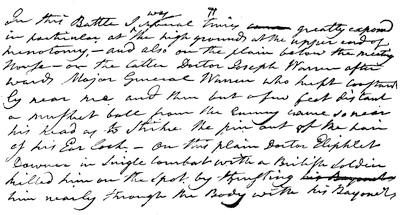
HEATH'S ACCOUNT OF THE FIGHT AT MENOTOMY.
From a slip of paper in the Heath Papers, vol. i. no. 71.
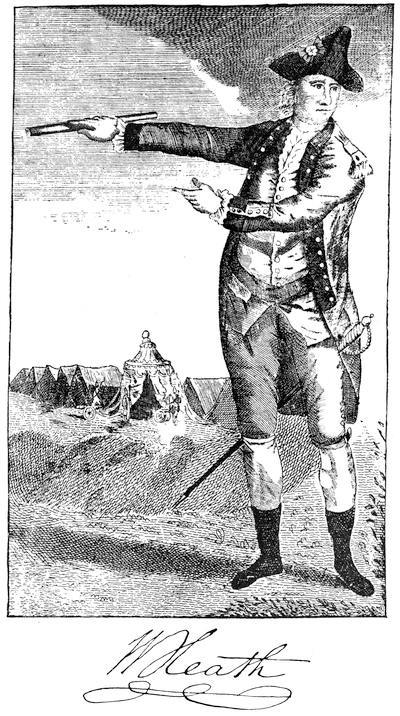
After a copperplate in An Impartial Hist. of the War in America, Boston, 1784, vol. iii. The background is much the same as that of a portrait of Washington in the same work, and the print, issued in Boston, where Heath was well known, shows what kind of effigies then passed current. A portrait of Heath by H. Williams has been engraved by J. R. Smith. (Catal. Cab. Mass. Hist. Soc., p. 46.) There is extant a likeness owned by Mrs. Gardner Brewer, of Boston. Cf. Mem. Hist. of Boston, iii. 183. Heath was born in Roxbury, March 2, 1737, and died Jan. 24, 1814. His service was constant during the war, though his deeds were not brilliant. He seems conspicuously to have acquired the regard of Washington; though Bancroft calls him vain, honest, and incompetent. His papers are in the Mass. Hist. Soc. Cabinet.
Another day Warren is busy carrying out the behests of the Committee of Safety respecting their scant artillery. At another time he is encouraging wagoners to go into Boston to bring out the friends of the cause and their property; but it was not so easy to get Gage's permission, and as the tories made a plea that these Boston patriots were necessary hostages, obstacles were thrown in the way.[379] There were rumors, too, of an intention of the royal troops once more to raid upon the country. Only two days after the 19th of April, Ipswich was wild with such rumors, and the alarm spread to the New Hampshire line[380] and beyond.[381]
The patriots at Cambridge were not pleased when they found that the Connecticut assembly had sent a committee to bear a letter from Governor Trumbull (April 28) and to confer with Gage.[382] There was a feeling that the time had passed for such things, and Warren wrote (May 2) a letter beseeching the sister colony to stand by Massachusetts, which elicited from Trumbull a response sufficiently assuring.[383]
Already there was a proposition warlike enough from a Connecticut captain who had just led his company to Cambridge, and was now urging the seizure of Ticonderoga and its stores. The proposition was timely. During the previous winter the patriots had learned that the British government was intending to separate the colonies by securing the line of the Hudson.[384] Accordingly the instigator of this counter-movement was ordered, May 3d, to carry it out, and Benedict Arnold makes his first appearance in American history. Meanwhile, however, acting upon hints which Arnold had already dropped before leaving Connecticut, or perhaps anticipating such hints, some gentlemen in that colony, joining with others of Pittsfield, in Massachusetts, had gone to Bennington, where, on the day before Arnold was commissioned, they had been joined by Col. Ethan Allen. Thus the plan which Arnold had at heart was likely to be carried out before he could arrive from Cambridge. A few days later the command of the force which had gathered naturally fell to Allen as having the largest personal following, and this following was loyal enough to their leader to threaten to abandon the enterprise if Arnold, who arrived very soon, should press his rights to the command. By a sort of compromise, Allen and Arnold now shared amicably the leadership. Less than a hundred men had reached the neighborhood of the fort on the morning of May 10, when, in the early dawn, the two leaders, overpowering the sentinels at the sally-port, reached the parade-ground with their men, and forced an immediate surrender from the commandant, still in his night-clothes. Fifty men and nearly two hundred cannon, and many military stores, were thus promptly and easily secured. More than a hundred other pieces were added, when, on the 12th, Colonel Seth Warner,[385] with a coöperating detachment, seized the post at Crown Point, and shortly afterwards Bernard Romans took possession of Fort George.[386]
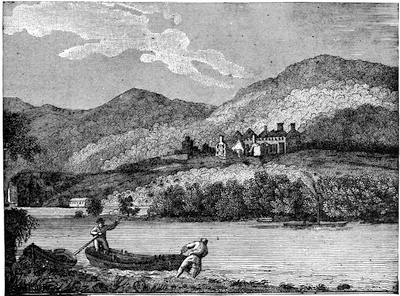
RUINS OF TICONDEROGA, 1818.
From a plate in the Analectic Magazine (Philadelphia, 1818). Cf. views in Lossing's Field-Book, and Harper's Monthly (vii. p. 170); Von Hellwald's America, pp. 134, 135.
On the 14th some of Arnold's belated men reached him with a captured schooner, which Arnold immediately put to use in conveying a force by which he surprised the fort at St. John's, on the Sorel, and then returned to Ticonderoga.[387]
Meanwhile the provincials had begun to use the spade in Cambridge, and here and there a breastwork appeared.[388] On the 5th of May the provincial congress pronounced Gage "an unnatural and inveterate enemy",[389] and issued a precept for a new congress to convene.
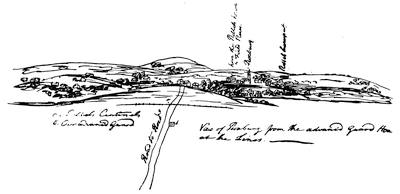
ROXBURY LINES.
Follows a contemporary pen-and-ink sketch, showing the American lines as seen from the British lines on Boston Neck. The original is in the library of Congress.
The military anxiety was increasing. Thomas had but 700 men at Roxbury, which he tried to magnify in the British eyes by marching them in and out of sight, so as to make the same men serve the appearance of many more. On the 8th of May there was an alarm that the royal troops were coming out, and the militia of the near towns were summoned.[390] To put on an air of confidence, a few days later (May 13), Putnam, from Cambridge, marched with 2,200 men into Charlestown and out again, without being molested, though part of the time within range of the enemy's guns. It was the military assertion of the idea, which the day before the Watertown congress had expressed, of governing themselves. "It is astonishing how they have duped the whole continent", wrote Gage to Dartmouth,[391] and perhaps he had not heard even then of the last victory of opinion down in Georgia, where parishes of New England descent were forcing issues with their neighbors.
The Committee of Safety now resolved to remove the live-stock from the islands in Boston Harbor; and Gage, on his part, determined on securing some hay on Grape Island, near Weymouth. These counter-forays led to fighting, and for some weeks the harbor was alive with skirmishing.[392] Meanwhile the Massachusetts congress had urged Connecticut to let Arnold bring some of the cannon captured on Lake Champlain to Cambridge,[393] and the day before the brush occurred at Grape Island they had delivered (May 20) a commission as commander-in-chief of the Massachusetts troops to Artemas Ward. In Boston the remaining loyalists were soon cheered by advices promising large reinforcements, which they now confidently began to expect,[394] and the feeling grew apace among the beleaguerers that a better organization and a closer dependence of the colonies among themselves were necessary to meet the impending dangers. Dr. Langdon, the president of Harvard College, in the election sermon[395] on the day when the new provincial congress met (May 31), had recognized the general obedience which was already paid to the advice of the Continental Congress. There were not a few who remembered how, twenty years before, the young Virginian, Colonel George Washington, had come to Boston, and who recalled the good impression he had made. They had heard lately of the active interest and sympathy with the patriots' cause which he was manifesting among his neighbors in that colony. On the 4th of May, Elbridge Gerry, with the approval of Warren, wrote to the Massachusetts delegates at Philadelphia, that they would "rejoice to see this way the beloved Colonel Washington" as generalissimo.[396] This was the feeling, while the army which lay about Boston was a mere inchoate mass, far from equal to the task which they had undertaken; but brave words did much; brave spirits did more; and John Adams was writing from Philadelphia that one "would burst to see whole companies of armed Quakers in that city, in uniforms, going through the manual."[397] The tories in Boston looked on with mingled fear and confidence. "We are daily threatened", wrote Chief-justice Oliver from Boston (June 10), "with an attack by fire-rafts, whale-boats, and what not."[398]
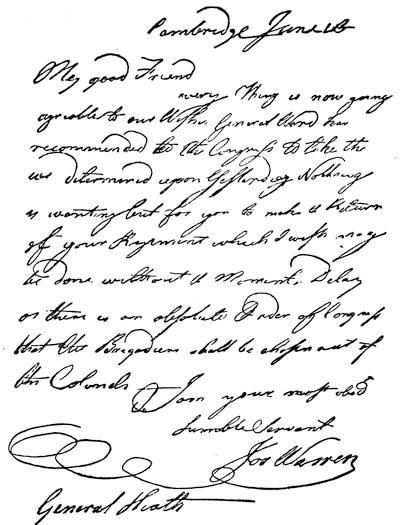
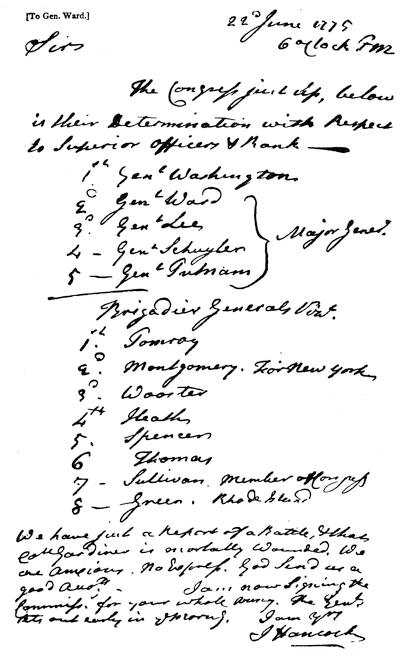
WARREN'S LAST NOTE.
The original is among the Heath Papers (Mass. Hist. Soc.), and is given in fac-simile in Frothingham's Warren, p. 506; and reduced (as above) in G. A. Coolidge's Brochure of Bunker Hill, p. 34.
One of the new British generals now lent his literary skill to his commanding general, for Burgoyne was a playwright and had an easy way of vaporing, which was quite apparent in Gage's proclamation of June 12,[399] to warn the rebellious and infatuated multitudes, and to hold out forgiveness to all but Samuel Adams and John Hancock.[400] The provincial congress, through Warren, prepared a counter-manifesto, but events were rushing too speedily to leave time for its publication. On the very day of issuing his proclamation Gage wrote to Dartmouth that he was intending to attack the rebels, "which every day becomes more necessary."[401]
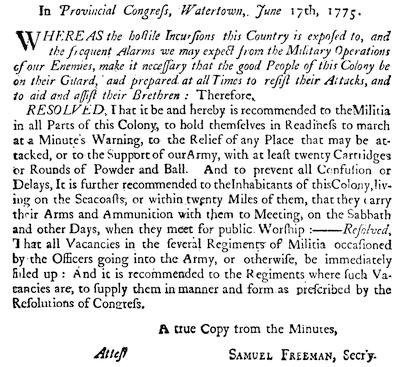
NOTICE TO THE MILITIA.
After an original in the volume of Proclamations in the library of the Mass. Hist. Society.
On the 14th Warren was made the second major-general of the Massachusetts forces, and his active spirit gave encouragement, since the inalertness of Ward was creating much concern. Early in the morning of the 17th Warren left Watertown, and the provincial congress convened without him, but they knew the emergency. A broadside exists of this day, in which they call upon the neighboring militia to hold themselves in readiness. In the anxious hours of this, St. Botolph's day,[402] with all eyes on Boston, the Continental Congress had chosen Washington to be their military chief,[403] and had adopted the forces which were about to show that Boston was not besieged idly. It took time then for Cambridge to know what was happening in Philadelphia; but the assembled legislators at Watertown might well hope for what had really happened, when, as the fateful day wore on, messengers arrived, declaring that the Continental funds were to be used to help supply this beggared army, and that all the aspirations of its provincial congress to set up a civil government of their own had met the approval of the continent.[404]
Now to look at the military situation. Already John Thomas, a physician of Kingston, had been made second in command under Ward; and Richard Gridley, an old Louisbourg artilleryman, had been made chief engineer. As yet the New England colonies were the only ones which had sent their armed men to the scene. The Massachusetts men had taken post mostly at Cambridge, near the college; and here, as the days went on, came also a Connecticut regiment under Israel Putnam, who had left his plough in its furrow. So, as June began, there had assembled on this side of Boston between seven and eight thousand men, eager, but poorly equipped, and with a small supply of powder. On the Roxbury side, fronting the British lines on Boston Neck, there were about four thousand Massachusetts men, under John Thomas, supported by a camp a little farther out, at Jamaica Plain, to which Joseph Spencer had come with another Connecticut regiment, and Nathanael Greene, with a body of Rhode Islanders. Thomas had some field-pieces and a few heavy cannon, and his force constituted the army's right wing. Its left wing was upon the Mystick at Medford, and near Charlestown Neck, and here were the New Hampshire men, and among their officers the old Indian fighter, John Stark, was conspicuous. Three companies of Massachusetts men constituted the extreme left at Chelsea. So, as the summer came on, perhaps about 16,000 men in all were encamped as a fragile army besieging Boston. General Ward exercised by sufferance a superior authority over all, though as yet no colony but New Hampshire had instructed its troops to yield him obedience. As Massachusetts claimed three quarters of the entire force thus drawn together, the assumption of chief command by her first officer was natural enough in a common cause.
The force which this sixteen thousand loosely organized men dared to hold imprisoned in Boston was a well-compacted army of somewhere from five to ten thousand men, for it is difficult amid conflicting reports to determine confidently a fixed number. On the 25th of May Gage had been joined by a reinforcement, accompanied by three other general officers,—Burgoyne, Clinton, and Howe.
The council of war at Cambridge was meanwhile directing new works to be constructed, strengthening and stretching their lines of circumvallation. Its opinions were divided on the question of occupying so exposed a position as the most prominent eminence on the peninsula of Charlestown, the defence of which might bring on a general engagement, which their stock of powder could not support. On the 13th of June the American commanders had secretly learned that Gage intended on the 18th to take possession of Dorchester Heights, the present South Boston. There was but one counter-move to make, and that was to seize in anticipation the summit of the ridgy height which began at Charlestown Neck and extended, in varying outline, to the seaward end of the peninsula,—an eminence known as Bunker Hill. On the 16th of June, a council of war, held in the house near Cambridge common, known then as the Hastings and later as the Holmes House,[405] decided, upon the recommendation of the Committee of Safety, to occupy Bunker Hill at once.
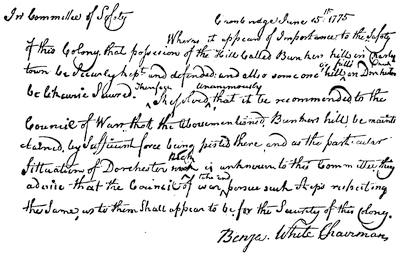
ORDER OF THE COMMITTEE OF SAFETY.
This has before appeared in G. A. Coolidge's Brochure of Bunker Hill, 1875.
That evening about 1,200 men, of whom 200 were from Connecticut under Thomas Knowlton, the whole being under the command of Colonel William Prescott, first listened to a prayer of the president of the college, and then marched, with their intrenching tools, in the darkness, to Charlestown Neck.
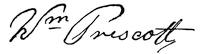
Here the purpose was for the first time disclosed to the men. They resumed their march, going up the slope of the hill before them, while Nutting's company and a few Connecticut men were sent along the shore opposite Boston, to patrol it. The highest summit of the hill was the one first reached; but, after a consultation, it was decided to proceed to a lower one, more nearly before Boston. Here Richard Gridley marked out a redoubt, and at midnight the men took their spades and began to throw up the breastworks. Putnam, who seems to have accompanied Prescott, now returned to Cambridge, and while the men worked busily, Prescott sent an additional patrol to the river, and twice went down himself, to be satisfied, as he heard the "All's well" of the watch on the men-of-war moored opposite, that no noise of the intrenching tools had reached the enemy. Soon after the first glimmer of dawn on the 17th, the sailors on the ships discovered the embankments, now about six feet high, when one of the vessels, the "Lively", at once opened fire upon them. This lasted only till Admiral Graves could send orders to cease, but was shortly renewed from the ships and from the batteries on Copp's Hill, in Boston, as soon as the British generals comprehended the situation. Prescott's men meanwhile kept at their work. One man was soon killed by a cannon-ball. The commander and others walked the parapet, encouraging their men, and Willard, one of the councillors who stood by Gage as they surveyed the hill through their glasses, recognized the Pepperell colonel, and told the British general what sort of man he had got to encounter. A promise had been given to Prescott that in the morning a relief and refreshments would be sent from Cambridge; but nothing came to the hungry men, as they still worked. Ward, who heard the firing, yielded to Putnam's persuasion to send reinforcement, only so far as to despatch a part of Stark's regiment, for he feared that Gage would seem to prepare to assault in Charlestown, while his intention might be to attack in Cambridge. Finally, about ten o'clock, Major John Brooks[406] reached headquarters with a request from Prescott for help and food. Richard Devens pressed Ward to comply, and at eleven the rest of the New Hampshire men were ordered to march.
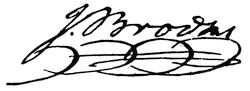
Meanwhile, as the tide rose, some floating batteries were sent up the stream to take the works in flank, and later, to rake the Neck. A few stray shots were returned from a single field-piece in the redoubt, one of whose balls passed over Burgoyne's head, as he tells us, while he was watching at Copp's Hill. Putnam came again from Cambridge, and induced Prescott to send off a large number of his men with the intrenching tools, and under Putnam's direction this detail soon began to use them in throwing up earthworks on the higher summit in the rear,—labor wasted, as it turned out.
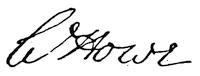
As the day wore on, Gage held a council of war, and it was determined not to land troops at the Neck and attack in rear, as Clinton urged, but to assault in front. This decision was long the ground of severe criticism upon Gage, and ruined his military reputation. The ships were put into better positions, and redoubled their fire. By noon the British troops in Boston were marching to the wharves, where they embarked in boats, and, under the command of General Howe, they rowed to Moulton's or Morton's Point, where the landing was quickly made.[407] Howe drew up his men on the rising ground which makes the least of the three heights of the peninsula, and anticipating sharp work, sent back the boats for more men.
Prescott observed all this from the hill, but looked longingly up the peninsula for his own reinforcements. A few wagons came, not with men, but with beer, though nothing adequate even of this. The feeling began to spread among the men on the hill that they had been treacherously left to their fate; but they got encouragement from a few brave souls who came straggling in from Cambridge. Pomeroy, the French war veteran, was one. James Otis, wreck as he was, came.[408] So did Warren, whose presence the men recognized by a cheer, and, major-general as he was, he came to fight under Colonel Prescott. Putnam, too, had again returned, and was seen riding about the field in a restless way, with a word of encouragement here and there, and pointing out to a few reinforcements now arriving where best to go.
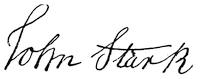
Prescott's eye, observing Howe's dispositions, saw he was aiming to advance along the Mystick and take the redoubt in reverse. So Knowlton, with two field-pieces and the Connecticut troops, were sent down the hill towards the Mystick, where they began to make a line of defence of a low stone wall, which was topped by a two-rail fence. Stark and Reed, with the New Hampshire regiments, diminished somewhat by details which Putnam had taken from them to help the work in the trenches on the higher hill, soon came up and ranged their men in a line with Knowlton. There was, however, an interval between this part of the field and the breastwork and redoubt, which offered a chance for the enemy to intervene and break the line. An attempt was made to prepare for such a contingency by grouping the few guns which they had at this point. New troops, in small numbers, continued to come up, and they were placed in position as best they could be to keep the line strong in all parts as it sloped away from the crowning redoubt towards either river.
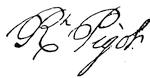
It was nearing three o'clock when the British boats returned from Boston; and when their troops landed Howe had about 3,000 men in array. He pushed his guns forward and got them in position to play upon the American field-pieces, and soon drove them away, while at the same time some skirmishing took place on the British flanks, whose main body was now advancing in a measured step in two columns: one led by Howe against the rail-fence, the other by Pigot against the redoubt. The assault was become one of infantry only, for the British guns were soon mired in some soft ground, and the balls in reserve had proved of an over-calibre.[409] Pigot's front got near the redoubt before the Americans poured in their fire, which was deadly enough to send the staggered column wildly back. At the same time, along the Mystick Howe's advance was met by the American field-pieces, some of which had been drawn to the rail-fence. Their musketry fire was reserved, as at the redoubt, and when it belched upon the deployed enemy it produced the same effect. So there was a recoil all along the British line. In the respite before they advanced again, Putnam tried to rally some troops in the rear, and to get others across the Neck, which the raking fire of the British vessels was now keeping pretty clear of passers.[410] But there was not time to do much, for Howe was soon again advancing, his artillery helping him more this time; and to add to the terror of the scene, he had sent word to Boston to set Charlestown on fire by shells, and the conflagration had now begun.[411] The smoke did not conceal the British advance,[412] and Prescott and Stark kept their men quiet till the enemy were near enough to make every shot tell. The result was as during the first attack. The royal troops struggled bravely; but all along the line they wavered, and then retreated more precipitately than before.
There was a longer interval before Howe again advanced, and Prescott used it in making such a disposition of his men as would be best in a hand-to-hand fight, for neither adequate reinforcements nor supplies had reached him, and his powder was nearly gone. There was a good deal of confusion and uncertainty in the rear, all along the road to Cambridge. Ward had ordered a plenty of troops forward, but few reached the peninsula at all, or in any shape for service. Putnam did what he could to bring order out of confusion; but his restless and brandishing method, and his eagerness to finish the works on Bunker Hill, were not conducive to such results as a quiet energy best produces. The brave men at the front must still do the work left for them, with such chance assistance as came.
Howe was rallying his men for a third assault. Major Small had landed 400 marines, to make up in part for the losses. Clinton had seen how confused the troops were as he looked across the river with his glass, and had hurried over from Boston to render Howe help as a volunteer aid. The British general determined now to concentrate his attack upon the works on the crown of the hill, making only a demonstration against the rail-fence. He brought his artillery to bear in a way that scoured the breastwork which flanked the redoubt, and then he attacked. His column reserved their fire and relied on the bayonet. They met the American fire bravely, but soon perceived that it slackened; and surmising that the American powder was failing, they took new courage. Those of the defenders who had ammunition mowed down the assailants as they mounted the breastworks, Major Pitcairn among them;[413] but as soon as Prescott saw the defence was hopeless, he ordered a retreat, and friend and foe mingled together as they surged out of the sally-port amid the clouds of dust which the trampling raised, for a scorching sun had baked the new-turned soil. It was now, while the confused mass of beings rocked along down the rear slope of the hill, that Warren fell, shot through the head. No one among the Americans knew certainly that he was dead, as they left him. The British stopped to form and deliver fire, and there was thus time for a gap to open between the pursuers and the pursued. The New Hampshire men and others at the rail-fence, seeing that the redoubt was lost, tenaciously faced the enemy long enough to prevent Prescott's men from being cut off, and then stubbornly fell back. Some fresh troops which had come up endeavored to check the British as they reached the slope which led to the intrenchments that Putnam had been so solicitous about; but the British wave had now acquired an impulse which carried it bravely up the hill; and Putnam, skirring about, was not able to make anybody stand to defend the unfinished works. So down the westerly slope of the higher summit to the Neck the provincials fled, and the British followed. The vessels poured in their fire anew as the huddled runaways crossed the low land, and not till they got beyond the Neck was there any effectual movement by fresh troops to cover the retreat. General Howe fired a few cannon shot after them, as he mustered his forces on the hill. It was now about five o'clock. There was time in the long summer's day to advance upon Cambridge, but Howe rejected Clinton's advice to that end, and began, with other troops which had been sent to him from Boston, to throw up breastworks on the inland crown of Bunker Hill. Thus spading for their defence, the British passed the night, while the Americans lay on their arms on Winter and Prospect hills, or straggled back to Cambridge. There was no disposition on either side to renew the fight.
Prescott did not conceal his indignation at not having been better supported, when he made his report at Ward's headquarters. He knew he had fought well; but neither he nor his contemporaries understood at the time how a physical defeat might be a moral victory. Not knowing this, there was little else than mortification over the result,—indeed, on both sides. A wild daring had brought the battle on, and something like bravado had led the British general into a foolhardy direct assault, while more skilful plans, availing of their ships, might have accomplished more without the heavy loss which they had endured.[414] The British folly was increased by the way in which they allowed the provincials to make the first great fight of the war a political force throughout the continent.
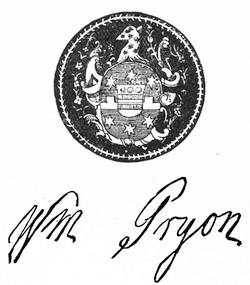
TRYON'S SEAL AND AUTOGRAPH.
From a plate in Valentine's N. Y. City Manual, 1851, p. 420.
The general opinion seems to be that the Americans had about 1,500 men engaged at one time, and that from three to four thousand at different times took some part in it.[415] The British had probably about the same numbers in all, but were in excess of the Americans at all times while engaged.[416] The conflict with small arms lasted about ninety minutes.
On the morning of the 18th of June (Sunday) the British renewed the cannonading along their lines, as if to cover some movement, but nothing came of it, and each side used the shovel busily on the intrenchments. A shower in the afternoon stopped the firing.
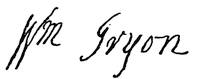
There was a dilemma in New York a few days later. Governor Tryon, who had been in England, was already in the harbor ready to land on his return, and Washington was approaching through Jersey on his way to Boston. It was determined by the city authorities to address and extend courtesies to both. The American general chanced to be ahead, and got the parade and fair words first. Tryon disembarked a few hours later, and received the same tributes.[417]
It was Sunday, June 25, when Washington reached New York. He found the town excited over the recent battle, the news of which he had met a few hours out of Philadelphia.[418]
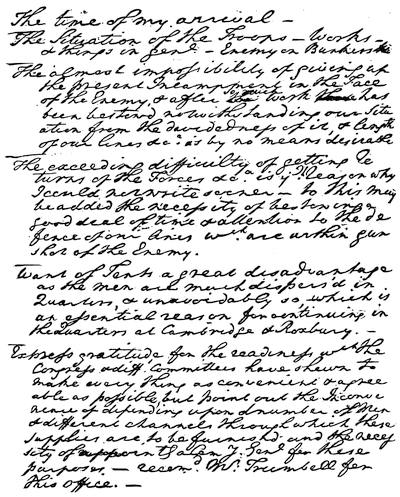
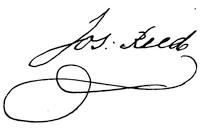
WASHINGTON'S HEADS OF LETTER, JULY 10, 1775.
This is about half of the whole as given in fac-simile in Wilkinson's Memoirs, i. p. 855. The original is now among the Reed-Washington letters in the Carter-Brown library. It was the basis of Washington's first formal official letter to the president of Congress, which, as written out by Joseph Reed, is given in Sparks' Washington, iii. p. 17. It shows the degree of attention which the general bestowed on his minutes for his secretary's use.
Washington, on his first arrival, had taken temporary quarters in the house of the president of the college, known now as the Wadsworth house (Mem. Hist. Boston, iii. 107; Gay's Pop. Hist. U. S., iii. 408), till the finest house in the town, one of a succession of mansions on the road to Watertown, was made ready for his use. These houses, which had all been deserted by their Tory owners, gave the name of Tory Row to this part of Cambridge. The one assigned to Washington's use was a Vassall house, later, however, known as the Craigie house, when it became the property of Andrew Craigie, from whose family it passed to the ownership of Longfellow, who died in it. Sparks lived in it when he edited Washington's Writings. It is familiar in engravings. Cf. Mem. Hist. Boston, iii. p. 113, with a note on various views of it; and for its associations, see Samuel Longfellow's Life of H. W. Longfellow; Irving's Washington, ii. p. 11; Greene's Hist. View of the Amer. Rev., p. 220; Manhattan Mag., i. 119; Mrs. Lamb's Homes of America; Gay's Pop. Hist. U. S., iii. 415. Among the other buildings of Revolutionary associations still standing in Cambridge are the Brattle house, the headquarters of Mifflin; the Vassall house, where Dr. Church was confined; the house where Jonathan Sewall lived, later occupied by General Riedesel; the Oliver house, now owned by James Russell Lowell; the "Bishop's Palace", where Burgoyne was quartered; and Christ Church, where Washington attended service (view in Mass. Mag., 1792, and compare Nicholas Hoppin's discourses, Nov. 22, 1857, and Oct. 15, 1861). For more of the historical associations of these Cambridge sites, see the Harvard Book; Drake's Landmarks of Middlesex; the Cambridge Centennial Memorial (1875); William J. Stillman's Poetic Localities of Cambridge (Boston, 1876); T.C. Amory's Old and New Cambridge; an illustrated paper in Harper's Monthly, Jan., 1876, another by Alexander Mackenzie, in the Atlantic Monthly, July, 1875; Mass. Hist. Soc. Proc., June, 1858, and Sept., 1872; and the book edited by Arthur Gilman, Theatrum Majorum, The Cambridge of 1776, which has an eclectic diary (by Mary W. Greely) of the siege, purporting to be that of one Dorothy Dudley.
Among the letters now passing through New York was one upon that battle, addressed to the President of Congress, which Washington took the liberty of opening for his own guidance. After instructing Schuyler, who was to be left in charge of the forces in New York, to keep watch upon Tryon[419] and Guy Johnson,[420] Washington the next day (26th) started for Cambridge. On the 2d of July Washington reached Watertown, and on the 3d, under a tree still standing,[421] he took command of the army, which thus passed, in effect, under Continental control, numbering at the time nearly 15,000 men fit for duty.[422] To brigade this army, rectify the circumvallating lines, watch the constant skirmishes, and assign the new bodies of troops arriving to places in the works, was the labor to which Washington devoted himself at once. On the 9th of July he held his first council of war,[423] and on the 10th he addressed his first letter to Congress, describing the condition of the siege as he had found it.
To guard against surprise, and replenish the magazines, required constant diligence, and the supply of powder never ceased to be a cause of anxiety in the one camp, while the diminishing stock of provisions produced almost as much concern in Boston. The beleaguered British, however, got some relief from the exodus of the Boston people, which the stress of want forced the royal commander to permit.[424] So the summer was made up of anxious moments. The independent husbandmen of New England made but intractable raw recruits, and Washington, who had expected to find discipline equal to that which the social distinctions of the South gave to the masses there, was disappointed, and did not wholly conceal his disgust.[425] He grew, however, to discern that campaigns could produce that discipline as well, if not better, than a life of civil subservience. Recruits came in from the South, and when some of the Northern officers saw the kind of men that Morgan and others brought as riflemen from Virginia, their comment was scarcely less austere. "The army would be as well off without them", said Thomas, who, next to Washington, was the best disciplinarian in the camp. Of the generals, Lee was, however, by much the most conspicuous. There was a glamour about the current rumors of his soldierly experience that obscured what might have been told of his questionable character.[426] His eccentricities were the camp talk, and rather served to magnify his presence, while it proved dangerous to perambulate the lines with him and his crowd of dogs, since the exhibition tempted the enemy to drop their shells in that spot.[427] Early in July a trumpeter approached the American lines bringing a letter from General Burgoyne to General Lee, and the camp straightway proceeded to invest the strange general with political importance. Burgoyne and Lee were old campaigners together, and Lee, before he left Philadelphia, had written a stirring letter to the British general on the bad prospects of the ministerial policy. The letter which now came was a reply, and proposed a conference on Boston Neck, to which Congress advised Lee not to accede, and the momentary ripple subsided.[428]
In August there was some correspondence with Gage respecting the treatment of prisoners, in which Washington appears to the better advantage.[429] The correspondence of the American general during the summer constantly dwells upon the scarcity of powder, though for prudence' sake he veils his expressions as much as he can. His own troops and even Congress had no conception of his want, and while Washington hardly dared fire a salute because of the powder it would take, Richard Henry Lee, from Philadelphia, was urging him to plant batteries at the mouth of Boston harbor, and keep the enemy's vessels from coming in and going out.[430] Governor Cooke, of Rhode Island, who was doing his best to get powder from Bermuda, was compelled to keep the secret too. Apparently Washington did not let his brigade commanders know the whole truth.[431] Under these circumstances Washington had no courage to attack, and Gage, on his part, was content to keep his men from deserting as best he could.
During September the threatening manœuvres of the British cruisers along the Connecticut coast[432] kept Governor Trumbull from sending what powder he had, and there was little hope, when Washington called a council of war on the 11th, that anything would come of it. There had been just then some internal manifestations not very reassuring.[433] A letter which Dr. Benjamin Church had tried to get to the British in Newport harbor had been intercepted, and its cypher interpreted. There was no expressed defection made clear by it, but suspicions were aroused, and Church, being arrested, was summoned before the congress at Watertown, where he made a speech protesting his innocence, but scarcely quieting the suspicions. He was put under control, and removed from the neighborhood of the army.[434]
There was scarce less gratification in the camp at Cambridge in getting rid of their doubtful associate than was experienced in Boston in getting a release from their sluggish general. The ministry had saved that soldier's pride as much as they could in desiring to have him nearer at hand for counsel;[435] and the sympathetic loyalists whom he had befriended paid him their compliments in an address. Gage finally, on October 10, issued his last order, turning over the command to Howe.[436]
In the middle of October, the burning of Falmouth, the modern Portland, in Maine, seemed to make it clear that the war was to be conducted ruthlessly on the British part. Captain Mowatt, with a small fleet, had entered the harbor and set the town on fire, and to those who communicated with him it was said that he announced his doings to be but the beginning of a course of such outrages. When the news reached Washington, he dispatched Sullivan to Portsmouth, with orders to resist as far as he could any similar demonstration there.[437] What a modern British historian[438] has called a "wanton and cruel deed" seems to have been but the hasty misjudgment of an inferior officer, without orders to warrant the act, and the ministry promptly disowned the responsibility.[439] During October, also, a committee of Congress,[440] visiting Washington's camp, could see for themselves the troubles of their heroic commander. They had not yet heard in Philadelphia the roar of hostile guns,—a sensation they might now experience. They could share Washington's perplexities as the new enlistments halted upon the expiration of the old,[441] and perhaps join in some of his kindly merriment when Phillis Wheatley, the negress, addressed his Excellency in no very bad verses.[442]
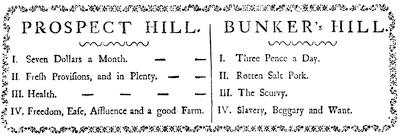
HANDBILL.[443]
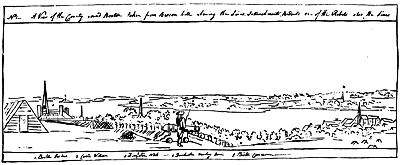
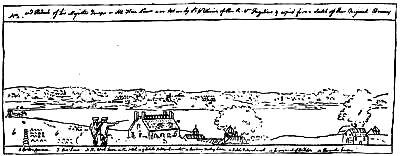
FROM BEACON HILL, 1775, No. 1. (Looking towards Dorchester Heights.)
Note.—This and the three companion sketches are drawn from a panoramic view in colors, now in the Cabinet of the Mass. Hist. Soc., of which a much reduced heliotype is given in the Mem. Hist. Boston, iii. 80. This view is a copy by Lieutenant Woodd of the Royal Welsh Fusiliers, from the original by Lieutenant Williams, of the same regiment, which is preserved in the King's Library (Brit. Museum). Cf. Mass. Hist. Soc. Proc., iv. 397, 424; Mem. Hist. Boston, iii. 80.
The foreground on the left is the summit of Beacon Hill, not far from the spot where the State House now stands, though at a level considerably higher than the present one. Two of the guns now standing on Cambridge Common were taken from the dock in Boston after the British evacuated it, and they resemble the cannon here sketched, and one of them may possibly be that identical gun. The spire at the left would seem to be that of the First Church, which stood on the present Washington Street nearly opposite the head of State Street. (Cf. view of it in Memorial History of Boston, ii. 219.) The spire next to the right must have been that of the Old South Church. That on the extreme right would seem to be the steeple of the New South (Church Green) in Summer Street, now disappeared.
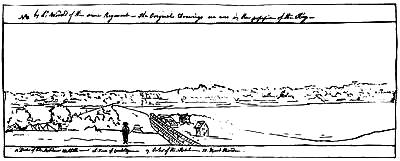
FROM BEACON HILL, 1775, No. 2. (Looking towards Roxbury.)
In No. 2 the Hancock House is in the foreground. The earliest sketch of this house is a very small one, making part of the Price-Faneuil View of Boston (1743), and its presence in which and other data led to the suspicion that this 1743 view was from an old plate, which had been originally cut twenty years earlier, and this was subsequently proven. Cf. Mass. Hist. Soc. Proc., xviii. 68; xxi. 249. The earliest enlarged view of the house is in the Mass. Mag., 1789. Cf. Mem. Hist. Bost., iii. 202. An oil painting, belonging to Mrs. F. E. Bacon, is on deposit in the halls of the Bostonian Society, where, also, are some interior views of the house.
The British encampments on Boston Common are indicated in the foreground at the left. The parallel lines (8) show the neck connecting Boston with Roxbury. The meeting-house (10) on the distant land is that of the First Religious Parish in Roxbury, on the site now occupied by the church near the Norfolk Home. The American fort just beyond (at 11) was on a rocky summit, where now the stand-pipe of the Cochituate Water Works is placed.
FROM BEACON HILL, 1775, No. 3. (Looking towards Brookline and the outlet of Charles River.)
No. 3 shows in the foreground the most westerly of the three summits of Beacon Hill (Louisbourg Square—though much lower, the hill having been cut down—represents its present site), and the rope walks. There is a similar water-color drawing among the Peter Force maps and views in the library of Congress.
The inward curve of the nearer shore on the right of the picture represents the area now including Cambridge Street and the territory north of it, below Blossom Street, covering the approaches to the bridge now leading to Cambridge, the oldest parts of which near the College are shown at 16; while at 17 we have the American encampments at Prospect Hill, the modern Somerville. The American works between the College and Charles River seem to be intended by 15. The mouth of the river is seemingly indicated by the point of land just below the number 14, which apparently stands for the Brookline fort and its connections, in the modern Longwood. Between the man in the foreground and the somewhat abrupt eminence beyond him, was a depression in the outline of the ridge, not far from the head of the present Anderson Street.
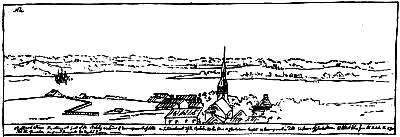
FROM BEACON HILL, 1775, No. 4. (Looking towards Charlestown.)
No. 4 has the Old West Church in the foreground, where Jonathan Mayhew preached. Its spire was subsequently taken down by the British to prevent its use as a signal station for the friends of the provincials. It stood till 1806, when the present edifice was built. (Drake's Landmarks, 374.)
This picture is substantially duplicated on another page, in the Rawdon view, sketched during the continuance of the battle of Bunker Hill. The Mount Pisca (Pisgah) at 19 the present Prospect Hill in Somerville. The lines of Winter Hill and Ploughed Hill would be in the direction of 20. At 27 is a glimpse of the Mystick River seen beyond Charlestown Neck, the armed British transport at 16 commanding the road over that neck. At 22 are the new works of the British, begun after the battle of Bunker Hill, and shown in the contemporary plan of the Charlestown peninsula, given on another page, while the British encampment is on the inner slope of the hill, at 23. Below, and along the shore (24, 24), are indicated the ruins of Charlestown, while the figures 25 mark the position of the redoubt which was defended by Colonel Prescott and his men. The house on the hither shore, below the transport, marks nearly the spot where the present bridge to East Cambridge begins. In the foreground on the extreme right are somewhat vague indications of the dam inclosing the mill-pond, in which the present Haymarket Square occupies a central position.
Perhaps they may have had the grim satisfaction of riding to distant parts of the lines in Thomas Hutchinson's coach, kept now for the general's use, if we may believe the refugee himself.[444]
A little later, Josiah Quincy, who from his house at Braintree could look out upon the harbor, had been urging Washington to block the channel, and thus imprison the British ships there at anchor, and prevent the coming of others. Washington appreciated the motives of that ardent patriot, but he would have liked better the cannon and powder that would have rendered the plan feasible.[445] At all events, the possible chances of the plan made not a very pleasant prospect for Howe, who had already set his mind—as, indeed, the ministry had already advised[446]—upon evacuating the town; but his ships were as yet not sufficient for the task, and hardly sufficient to protect his supply-boats from the improvised navy which Washington had been for some time commissioning.[447]
John Adams, in Philadelphia, was getting uneasy over the apparent inaction of Washington, and wrote in November (1775) to Mercy Warren that Mrs. Washington was going to Cambridge,[448] and he hoped she might prove to have ambition enough for her husband's glory to give occasion to the Lord to have mercy on the souls of Howe and Burgoyne![449]
The left wing of the beleaguering army was now pushed forward and occupied Cobble Hill, the site of the present McLean Asylum, and the two armies watched each other at closer quarters than before, the almost foolhardy Americans feeling increased confidence when the fortunate captain of an ordnance brig gave them a supply of munitions. In December, Massachusetts and New Hampshire[450] promptly supplied the loss of Connecticut and Rhode Island troops, who were not to be induced to prolong their enlistments. Washington was cheered with this alacrity of a portion, at least, of the New England yeomen, and he suffered as many as he could of those who had come hastily to the camp in the spring to go home on brief furloughs to make winter provision for their families. Before the year was out, Congress had authorized Washington to destroy Boston if he found it necessary. The British general was, on his part, organizing in that town a Royal Regiment of Highland Emigrants,[451] and other loyalist battalions, putting Ruggles, Forrest, and Gorham in command of them.[452]
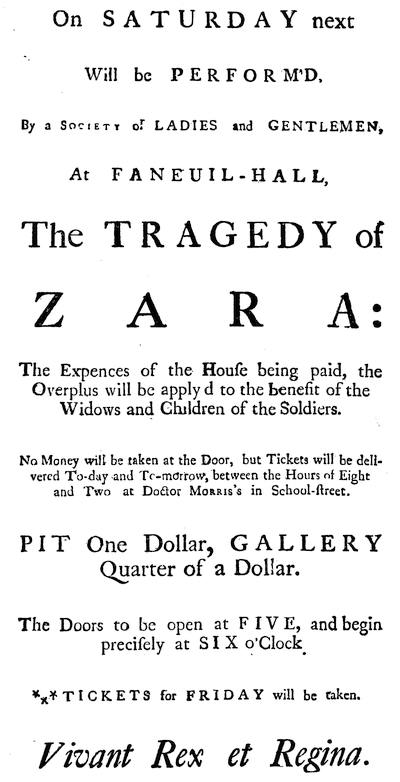
On the first of January, 1776, the federal flag, with its thirteen stripes and British Union,[453] was first raised over the American camp, and their council of war was inspirited to determine upon an attack, as soon as the chances of success seemed favorable; but the prudent ones trusted rather to Howe's evacuating through his straits for provisions, and held back from the final decision. It was not forgotten that 2,000 men were still without firelocks, and there was not much powder in the magazines. The total environing army scarce numbered ten thousand men fit for duty, and they were stretched out in a long circumvallation, while the enemy could mass at least half that number on any one point, and had a fleet to sustain them. Howe had not shown a much more active spirit than Gage had displayed, and there was a feeling in the British camp that he was too timid for the task,[454] and there could not have been much hopefulness in seeing so much better a general as Clinton sent off in January with several regiments, to join other forces and a fleet on the coast of North Carolina.[455] Washington meanwhile kept up a show of activity, and when, on the evening of January 8, he sent Knowlton on a marauding scout into Charlestown, there was a little flutter of excitement in Boston for fear it foreboded more serious work, and the British officers were hastily summoned to their posts from the play-house, where they were diverting themselves,[456]—the play on this particular occasion being something they had planned, and called The Boston Blockade.
As early as the middle of June, 1775, General Wooster, with some Connecticut troops, had by invitation of Congress marched to the neighborhood of New York, to be prepared for any demonstration from British ships which might attempt to land troops, for the British naval power was and continued to be supreme in the harbor till Washington occupied the city.
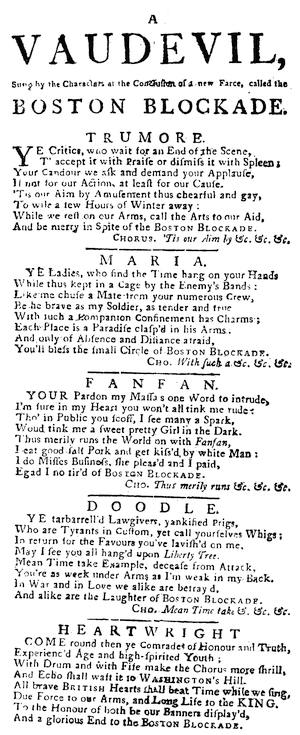
Note.—This broadside, and the opposite one, are given in fac-similes from copies in the Massachusetts Historical Society's library, and they pertain to theatrical performances given by the British officers in Boston during the siege.
Before Clinton had left Boston, Washington, under Lee's urgency, had decided to possess New York, and the plan, which was submitted to John Adams, as representing the Congress, met with that gentleman's approval.[457] Lee was accordingly sent into Connecticut to organize such a force as he could for advancing on that city.[458] He kept Washington informed of his success in these preliminaries, and finally reached New York himself on February 4,[459] and here he remained till it was ascertained that Clinton was proceeding to the South, where he was instructed to follow that general and confront him as best he could, as we shall presently see.[460]
The chief event of February, 1776, was the arrival of the cannon captured at Ticonderoga, and the placing them in the siege batteries along the American lines, for Washington had dispatched Knox to bring these much needed cannon to him. John Adams records meeting them on their way at Framingham, January 25;[461] and when the train of fifty pieces and other munitions reached the lines, there was something less of anxiety than there had been before.[462] The army, however, was still deficient in small arms, and Washington wrote urgently to the New York authorities for assistance of that kind.[463]
By the first of March powder had been obtained in considerable quantities, and Washington opened a bombardment from all parts of his lines, which was deemed necessary to conceal a projected movement. During the night of March 4-5, General Thomas, from the Roxbury lines,[464] with 2,500 men, took possession of Dorchester Heights.[465] It was moonlight, but the men worked on without discovery, and by morning had thrown up a cover. Both armies now laid plans for battle.
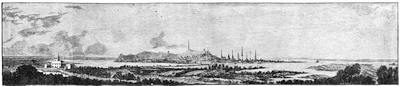
BOSTON.
After a photograph of a view in the British Museum. Cf. similar views in Moore's Diary of the Amer. Rev., i. 97; Mem. Hist. Boston, iii. p. 156; Lossing's Field-Book; Grant's British Battles, ii. 138. The house in the left foreground is the house built by Governor Shirley. It is still standing, but much changed. See a view of it in the frontispiece of Mem. Hist. Boston, vol. ii.
There is a view of the town and harbor in the Pennsylvania Mag., June, 1773; and others of a later date are in the Columbian Mag., Dec., 1787; Mass. Mag., June, 1791. Cf. Winsor's Readers' Handbook of the Amer. Rev., p. 66, for other views and descriptions.
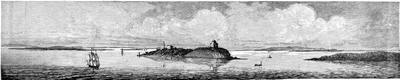
BOSTON CASTLE.
After a photograph of a view in the British Museum.
Howe determined to attack the Heights by a front and flank assault. Washington reinforced Thomas, and planned at the same time to move on Boston by boats across the back bay. The British dropped down on transports to the Castle, but a long storm delayed the projected movement. This so effectually gave the Americans time to increase their defences that the British general saw that to evacuate the town was the least of all likely evils. As he began to show signs of such a movement, the Americans began to speculate upon their significance. Heath, at least, was fearful that the appearances were only a cloak to cover an intention to land suddenly somewhere between Cambridge and Squantum.[466] But the genuineness of Howe's intention gradually became apparent, as, indeed, evacuation with him was a necessity, while Admiral Shuldam also saw that his fleet, too, was immediately imperilled from the newly raised works on Dorchester Heights. So Howe had scarce an alternative but to give a tacit consent to a plan of the selectmen of Boston for him to leave the town uninjured, if his troops were suffered to embark undisturbed. Washington entered upon no formal agreement to that end, but acquiesced silently as Howe had done.[467] There was still some cannonading as Washington pushed his batteries nearer Boston on the Dorchester side, at Nook's Hill, teaching Howe the necessity of increased expedition. By early light on the 17th of March it was discovered that Howe had begun to embark his troops, and by nine o'clock the last boat had pushed off, completing a roll, including seamen, fit for duty, of about 11,000 men, with about a thousand refugees.[468] The Continentals were alert, and their advanced guards promptly entered the British works on the several sides. The enemy's ships fell down the harbor unmolested; but that night they blew up Castle William, and the vessels gathered together in Nantasket Roads. Here they remained for ten days, causing Washington not a little anxiety; and he wrote to Quincy, at Braintree, to have all the roads from the landings patrolled, lest the British should send spies into the country.[469] On the 27th, all but a few armed vessels, intended to warn off belated succor,[470] had disappeared in the direction of Halifax.[471]
Ward was left with five regiments to hold the town and its neighborhood,[472] while Colonel Gridley, "whom I have been taught to view", said Washington, "as one of the greatest engineers of the age", was directed to fortify the sea approaches.[473]
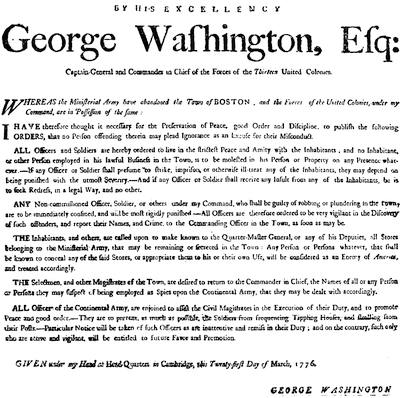
OCCUPATION OF BOSTON.
After an original in the collection of Proclamations in the library of the Mass. Hist. Society. Cf. Mem. Hist. Boston, iii. p. 181; Sparks's Washington, iii. 322; Niles's Principles and Acts (1876), p. 127. Curwen records, when the proclamation reached London, that its prohibition of plunder "was a source of comfort."
Washington gradually moved his remaining army to New York, not without apprehension at one time that he would have to direct them to Rhode Island, for a fog had befooled some people in Newport into sending him a message that the British fleet was in the offing there. He left Cambridge himself April 4th, not for Virginia, as some good people imagined he would do, out of loyalty to his province,[474] but to defend as he could the line of the Hudson, of which signs were already accumulating that it was the game for each side to secure. A few of the enemy's ships still hung about Nantasket Roads, and some desultory fighting occurred in the harbor.[475] The British, however, failed to prevent some important captures of munition vessels being made. It was not till June that General Lincoln, with a militia force, brought guns to bear upon the still lingering enemy, when they sailed away, and Boston was at last free of a hostile force.
It is now necessary to follow two other movements, which had been begun while the siege of Boston was in progress, the one to the north, and the other to the south.
The exploits of Allen and Arnold at Ticonderoga, already related, had invited further conquests; but the Continental Congress hesitated to take any steps which might seem to carry war across the line till the Canadians had the opportunity of casting in their lot with their neighbors. On the 1st of June, 1775, Congress had distinctly avowed this purpose of restraint; and they well needed to be cautious, for the Canadian French had not forgotten the bitter aspersions on their religion which Congress had, with little compunction, launched upon its professors, under the irritation of the Quebec Act. Still their rulers were aliens, and the traditional hatred of centuries between races is not easily kept in abeyance. Ethan Allen was more eager to avail himself of this than Congress was to have him; but the march of events converted the legislators, and the opportunity which Allen grieved to see lost was not so easily regained when Congress at last authorized the northern invasion. Arnold and Allen had each aimed to secure the command of such an expedition, the one by appealing to the Continental Congress, the other by representations to that of New York. Allen had also gone in person to Philadelphia, and he and his Green Mountain Boys were not without influence upon Congress, in their quaint and somewhat rough ways, as their exuberant patriotism later made the New York authorities forget their riotous opposition to the policy which that province had been endeavoring to enforce in the New Hampshire Grants. Connecticut had already sent forward troops to Ticonderoga to hold that post till Congress should decide upon some definite action; and at the end of June, 1775, orders reached Schuyler which he might readily interpret as authorizing him, if the Canadians did not object, to advance upon Canada.[476] He soon started to assume command, but speedily found matters unpromising. The Johnsons were arming the Indians up the Mohawk and beyond in a way that boded no good, and they had entered into compacts with the British commanders in Canada. Arnold had been at Ticonderoga, and had quarrelled with Hinman, the commander of the Connecticut troops. Schuyler heard much of the Green Mountain Boys, but he only knew them as the lawless people of the Grants, and soon learned that Allen and Warner had themselves set to quarrelling. Presently, however, Allen reported at Ticonderoga for special service, as he had been cast off by his own people. Another volunteer, Major John Brown, was sent by Schuyler into Canada for information. Schuyler's position was a trying one. He had few troops of his own province. The Connecticut troops were too lax in discipline to suit his ideas of military propriety, and his temperament had little to induce him to make concessions to the exigencies of the conditions.[477] With the best heart he could, he tried to organize his force for an advance, and assisted, in Indian conferences at Albany, to disarm, as far as he might, the Mohawks of their hostility.
In August the news from Canada began to be alarming. Richard Montgomery, an Irish officer who had some years before left the army to settle on the Hudson and marry, was now one of the new brigadiers. He urged Schuyler to advance and anticipate the movement now said to be intended by Carleton, the English general commanding in Canada. At this juncture Schuyler got word from Washington that a coöperating expedition would be dispatched by way of the Kennebec, which, if everything went well, might unite with Schuyler's before Quebec.
Montgomery had already started from Ticonderoga, and it was not till the foot of Lake Champlain had been reached that Schuyler overtook him, and, with an effective force of about 1,000 men, he now prepared, on the 6th of September, to advance upon St. Johns. The demonstration caused a little bloodshed, but, getting information which deceived him, he fell back to the Isle-aux-Noix, and prepared to hold it against a counter attack, and to prevent any vessel of the enemy penetrating to the lake. The outlook for a while was not auspicious. Malaria made sad inroads among the men, and of those who were left on duty, insubordination and lack of discipline, and perhaps a shade of treachery, impaired their efficiency. Schuyler was prostrate on his bed, and Montgomery was forced to unmilitary expedients because of the temper of his troops. Schuyler's disorder seeming to have permanently mastered him, he resigned the command to Montgomery and returned up the lake. He had, at least, the satisfaction of meeting reinforcements pushing down to the main body. Before these arrived Montgomery had begun the siege of St. Johns, and he was pressing it, when Ethan Allen, whom Montgomery was expecting to join him, met with Brown, and these two planned an attack on Montreal. It was attempted, but Brown and his men failed to coöperate, and Allen and those he had with him were finally captured.[478] When the Canadians heard that the redoubtable Green Mountain leader was in irons on board an English vessel bound for Halifax,[479] a great deal was done towards awakening them from that spell of neutrality upon which the American campaign so much depended for success.
So Montgomery continued to keep his lines about St. Johns with great discouragement. He met every embarrassment which a hastily improvised and undisciplined mass of men could impose upon a man who was of high spirit and knew what soldierly discipline ought to be. A gleam of hope at last came. He detached a party to attack Fort Chamblée, further down the Sorel, and it succeeded (October 18), and he was thus enabled to replenish his store of ammunition, which was by this time running low.[480] So Montgomery was enabled to press the siege of St. Johns with renewed vigor. When Wooster, the veteran Connecticut general, joined him with the troops of that colony, there was some apprehension that the younger Montgomery might find it difficult to maintain his higher rank against the rather too independent spirit of the old fighter.[481] No disturbance, however, occurred, and both worked seemingly in union of spirit. Every effort of Carleton to relieve the British commander at St. Johns failing, that officer surrendered the post, and, on November 3d, Montgomery took possession.
We may turn now to the expedition that Washington had promised to dispatch from Cambridge, and which had been thought of as early as May. Benedict Arnold had hurried from Crown Point to lay his grievances before the commander-in-chief. It seemed to Washington worth while to assuage his passions and to profit by his dashing valor, for he had by this time become convinced that Howe had no intention of venturing beyond his lines. So Arnold was commissioned Colonel, and given command of the new expedition, and the satisfied leader saw gathering about him various quick spirits, better recognized later. Such was Morgan, who led some Virginia riflemen, and Aaron Burr, who sprang to the occasion as a volunteer.[482] Washington provided Arnold with explicit instructions, and with an address to circulate among the Canadians.[483] About eleven hundred men proceeded from Cambridge to Newburyport, whence, by vessel and bateaux, they reached Fort Western (Augusta, Maine), towards the end of September. Here the expeditionary force plunged into the wilderness, up the Kennebec, environed with perils and the burdens of labor. Suffering and nerving against vexations and weariness that grew worse as they went on, they saw the sick and disheartened fall out, and found their rear companies deserting for want of food.[484] Those that were steadfast were forced to eat moccasins and anything. On they struggled to the ridge of land which marked the summit of the water-shed between the Atlantic and the St. Lawrence. Then began the descent of the Chaudière, perilous amid the rush of its waters, which overturned their boats, and sent much of what stores they had left on a headlong drive down the stream. At last the open country was reached, and Arnold stopped to refresh the survivors. He dispatched Burr to see if he could find Montgomery,[485] and, making the most of the friendly assistance of the neighboring inhabitants, Arnold advanced to Point Levi, and began to make preparations for crossing the St. Lawrence. The city of Quebec looked across the basin in amazement on a stout little army, of whose coming, however, they had had an intimation; while Arnold's men were hard at work making or finding canoes and scaling-ladders.
Meanwhile where was Montgomery, whom Burr, disguised as a priest, and speaking French or Latin as required, was seeking up the river? He had got possession of Montreal without a blow, and sending Colonel Easton down to the mouth of the Sorel, that officer intercepted the little flotilla with which Carleton was trying to reach Quebec, and captured all of the fugitives except Carleton himself, who escaped in a disguise by night. The news of Arnold, which Burr at last brought to Montgomery, made that general more anxious than ever to push on to Quebec, but the expiration of the enlistments of some of his men much perplexed him, and he was obliged to make many promises to hold his army together. Before Montgomery could reach him, Arnold had in the night taken about 550 men across the river, and ascending at Wolfe's Cove, he had paraded them before the walls and demanded a surrender. The garrison was small, and in part doubtful, and the inhabitants were more than doubtful, but the lieutenant-governor, Cramahé, with his stanchest troops, the Royal Scotch, overawed the rest, and kept the gates closed. The vaporing Arnold had been known in the past within the town as a horse-jockey, and his promise as a general, with his shivering crowd, did not greatly impress those whom he had somewhat farcically beleaguered. In a day or two Arnold became frightened and drew off his men, strengthened now a little by others who had crossed the river. Unmolested he went up the river, to keep within reach of Montgomery, perceiving as he went up the banks the succor for Quebec which Carleton, having picked up men here and there, was bringing down by water.
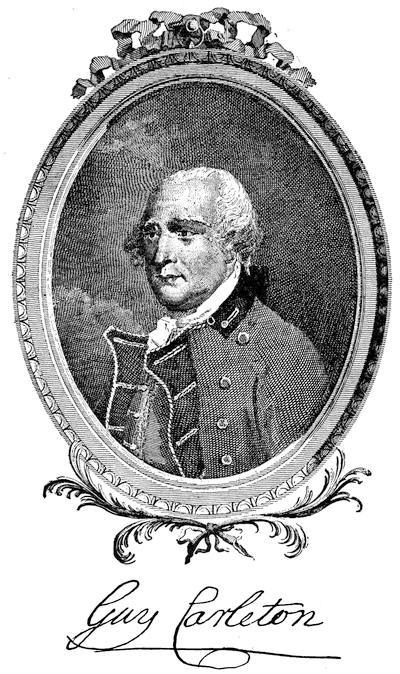
From the Political Mag., iii. 351. Cf. Jones's Campaign for the Conquest of Canada, p. 112; Mag. of Amer. Hist., June, 1883, p. 409; Moore's Diary of the Revolution, p. 454; B. Sulte's Hist. des Canadiens français (as Lord Dorchester, to which rank Carleton was subsequently raised).
By the 1st of December, Montgomery, with three armed schooners and only 300 men, reached Arnold at Point-aux-Trembles. The united forces now turned their faces towards Quebec, less than a thousand in all, with a body of two hundred Canadians, under Colonel James Livingston, acting in conjunction; and on the 5th were before the town. Carleton haughtily scorned all advances of Montgomery to communicate with him, and devoted himself to overawing the town, quite content that the rigors of winter should alone attack the invaders. While the Americans were making some show of planting siege-batteries, plans for assault were in reality maturing, and a stormy night was awaited to carry them out. It came on the night before the last day of the year. While two feints were to be made on the upper plain, the main assaults were to be along the banks of the St. Charles and the St. Lawrence, from opposite sides, with a view to joining and gaining the upper town from the lower. Montgomery led the attack beneath Cape Diamond on the St. Lawrence side, and while in advance with a small vanguard, and unsuspecting that his approach was discovered, he was opened upon with grape, and fell, with others about him.[486] His death was the end of the assault on that side. Arnold was at first successful in carrying the barriers opposed to him, but was soon severely wounded and taken to the rear. Morgan, who succeeded to the command, was pressing their advantage, when Carleton, relieved by Montgomery's failure, and by the discovery that the other attacks meant nothing, sent out a force, which so hemmed Morgan in, that, having already learned of Montgomery's failure, he found it prudent to surrender with the few hundred men still clinging to him. The Americans elsewhere in the field hastily withdrew to their camp, and Carleton was too suspicious of the townspeople to dare to take any further advantage of his success.
The command of the Americans now devolved on Lieutenant-Colonel Donald Campbell, who sent an express to Wooster at Montreal, urging him to come and take the control. That general thought it more prudent to hold Montreal as a base,[487] and remained where he was, while he forwarded the dismal news to his superior, Schuyler, at Albany, who had quite enough on his hands to overawe Sir John Johnson and the Tories up the Mohawk. The succession of Wooster to the command in Canada boded no good to the New York general, and led to such crimination and recrimination between the two that Congress, towards spring (1776), took steps to relieve Schuyler of the general charge of the campaign. Thomas, who had rendered himself conspicuous in driving the British from Boston, was made a major-general (March 6), and was ordered to take the active command in Canada. A New England general for troops in the main from those colonies seemed desirable, and Thomas was certainly the best of those furnished by Massachusetts during the early days of the war.