Chapter III · (continued 2)
Reading edition
The immediate effects of the Declaration in America are traced in Frothingham's Rise of the Republic, p. 548. "No one can read", says Wm. B. Reed in his Life of Joseph Reed (i. p. 195), "the private correspondence of the times without being struck with the slight impression made on either the army or the mass of the people by the Declaration of Independence."
The Declaration was, of course, at once commented on in the Gentleman's Magazine, in Almon's Remembrancer, and in the other periodical publications. Hutchinson's Strictures have been mentioned. The ministry seem to have been behind the Answer to the Declaration of the American Congress, referred to in a preceding page, which was ostensibly written by John Lind and privately printed in London in 1776, but was soon published without his name, appearing in five different editions during the year, and was the next year (1777) printed in French both in London and La Haye. In the earlier edition the outline of a counter declaration was included (Sabin, x. 41,281-82). Lord Geo. Germaine is also said to have had a hand in The Rights of Great Britain asserted against the claims of America, which passed through three editions at least, the last with additions, during 1776, beside being reprinted in Philadelphia (Hildeburn, no. 3,352). Sir John Dalrymple and James Macpherson are also thought to have some share in it.[711] Lord Camden's views are given in Campbell's Lives of the Chancellors (v. 301). It soon became apparent that the liberal party in England felt that the Declaration showed the Americans determined to act without their continued assistance (Smyth's Lectures, ii. 439). Bancroft (ix. ch. 3) traces the general effects in Europe.[712]
The appearance, Jan. 8, 1776, of the Common Sense, written by Thomas Paine, a stay-maker and sailor whom Franklin had accredited when he came over in the summer of 1774, had produced a sudden effect throughout the continent.[713]
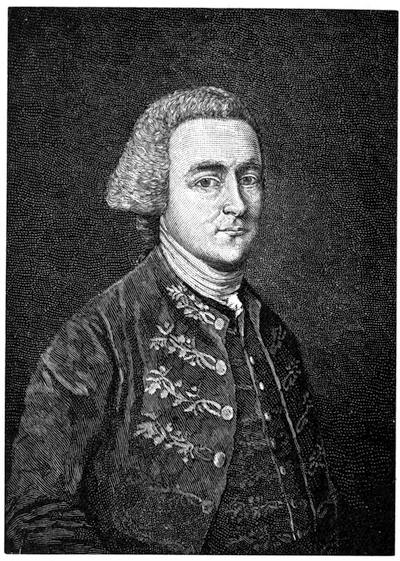
JOHN HANCOCK. (The Scott picture.)
Perkins (Life and Works of Copley, p. 70) notes three different likenesses of Hancock, painted by that artist. The first represents him sitting at a table, which bears an open book, upon which his left hand lies, while the right holds a pen. This picture, formerly in Faneuil Hall, is now in the Museum of Fine Arts in Boston. The Copley head has been engraved by I. B. Forrest and J. B. Longacre (Sanderson's Signers), and there is a woodcut in the Memorial Hist. of Boston, iv. p. 5, and another engraving of it in W. H. Bartlett's United States, p. 343. Cf. Gay's Pop. Hist. U. S., iii. 358. The German picture from the Geschichte der Kriege in und ausser Europa (Neunter Theil, Nürnberg, 1777), of which a fac-simile is given herewith, is evidently based on this picture, omitting the accessories. A similar picture, with supports of cannon at the lower angles, is in Hilliard d'Auberteuil's Essais, i. p. 152. It seems to have been the likeness known on the continent of Europe, and is perhaps the one referred to by John Adams, in writing to Spener, a Berlin bookseller, when he says, "The portrait of Mr. Hancock has some resemblance in the dress and figure, but none at all in the countenance" (Works, ix. 524). The immediate prototype of the German picture may have been a London engraving, described in Smith's British Mezzotint Portraits as being in an oval, with a short wig and tie at back, and professing to be painted by Littleford, and published Oct. 25, 1775, by C. Shepherd, which was one of a series of American portraits published in London from 1775 to 1778, of which some, says that authority, were reëngraved in Germany. The two other Copley pictures are described by Perkins as being owned by Hancock's descendants: one an oval, showing him dressed in blue coat laced with gold; the other a miniature on copper. There is in the Bostonian Society a photograph of a picture owned by C. L. Hancock. It will be remembered that Hancock's widow married Capt. James Scott; and it is perhaps one of these Copley pictures that is reproduced from an English print in J. C. Smith's British Mezzotint Portraits, p. 1321, and shown in the present engraving (the Scott picture), of which the original, an oval, bears this inscription: "The Honble John Hancock, Esqr, late Governor of Boston in North America, done from an original picture in the possession of Capt. James Scott. Published by John Scott, No. 4, Middle Row, Holborn. Copley pinxt. W. Smith, sculp." Smith also gives another print, which represents Hancock as standing, with the left hand in his pocket, the other holding a letter addressed to "Mons. Monsieur Israel Putnam, major general à Long Island." The face is much like the other.
The Copley head seems also to have been used in the sitting figure, which appeared in the Impartial History of the War in America (London, 1780, p. 207), of which a fac-simile is elsewhere given. The same picture was reëngraved in even poorer manner in the Boston edition of the book with the same title (1781, p. 346). Other contemporary engravings are found in the European Magazine (iv. p. 105); in the Royal American Magazine (March, 1774, reproduced in fac-simile in the Mem. Hist. Boston, iii. 46); and in Murray's Impartial History of the present War (1778, vol. i. p. 144). Cf. Drake's Tea Leaves, p. 286.
The character of Hancock had pettinesses that have served to lower his popular reputation, and this last is well reflected in the drawing of his traits in Wells's Sam. Adams (ii. 381). John Adams, whose robustness of character was quite at variance with that of his friend, was not blinded to sterling qualities in the rich man, who gave an adherence to a cause that few of his position in Massachusetts did (John Adams's Works, x. 259, 284). Adams's grandson speaks of the biography of Hancock in Sanderson's Signers as a curious specimen of unfavorable judgment in the guise of eulogy, and a sketch by this same grandson, C. F. Adams, is in the Penna. Mag. of Hist., p. 73, and a memoir by G. Mountfort in Hunt's American Merchants, vol. ii. The accounts in Loring's Hundred Boston Orators, p. 72, and by Gen. W. H. Sumner in the N. E. Hist. and Geneal. Reg., April, 1854 (viii. 187), are rambling antiquarian tales.
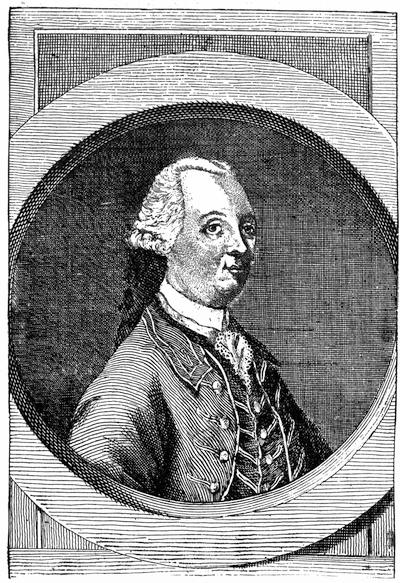
JOHN HANCOCK. (From the "Geschichte der Kriege.")
John Adams (Works, ii. 507; ix. 617) said of Common Sense that it embodied a "tolerable summary of the arguments for independence which he had been speaking in Congress for nine months", and which Mahon (vi. 96) has called "cogent arguments" "in clear, bold language;" but Adams deemed unwise some of its suggestions for the governments of the States, and to counteract their influence he published anonymously his Thoughts on Government (Philadelphia, 1776; Boston, 1776; often since, and also in Works, iv. 193; ix. 387, 398), which he says met the approval of no one of any consideration except Benjamin Rush. He added his name to the second edition, and records that it soon had due influence upon the Assemblies of the several States, when about this time they adopted their constitutions. Adams's views were first embodied in a letter to R. H. Lee, Nov. 15, 1775 (Works, iv. 185; Sparks's Washington, ii., App.). What seems an anonymous reply from a native of Virginia—that colony being then engaged in framing a constitution—was An address to the Convention of the Colony and Ancient Dominion of Virginia, which was an attempt to counteract the tendency to popular features in government, which Adams had inculcated. It is in Force, 4th ser., vi. 748, and was written by Carter Braxton (Hildeburn's Issues of the press in Pennsylvania, Philad., 1886, no. 3,340).
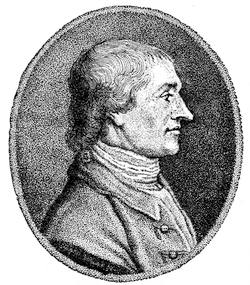
CHARLES THOMSON.
From Du Simitière's Thirteen Portraits (London, 1783). Cf. also Heads of illustrious Americans (London, 1783). There is a portrait in the gallery of the Penna. Hist. Society. Scharf and Westcott's Philadelphia (i. 274, 275) gives his likeness and a view of his house, and another picture of the house is in Brotherhead's Signers (1861, p. 113). Cf. Lossing's Field-Book, ii. 267, and Potter's Amer. Monthly, vi. 172, 264, vii. 161.
Adams also wrote an amplified statement of some of his views to John Penn, of North Carolina, which is given in John Taylor's Inquiry into the principles and policy of the Government of the United States (1814), and in Adams's Works, iv. 203.
The vote of Congress of May 15, 1776, had called upon the several colonies to provide for independent governments, and Jameson (Constitutional Conventions, N. Y., 1867, p. 112, etc.) summarizes the actions of the several States.[714] New Hampshire was the first to act, and Belknap in his New Hampshire, and the histories of the other States, tell the story of their procedures. South Carolina was the next, but Virginia was the earliest to form such a constitution that it could last for many years. On June 12, 1776, she adopted her famous Declaration of Rights, drawn by Geo. Mason,[715] and June 29th perfected her constitution.[716] For New Jersey, see L. Q. C. Elmer's Hist. of the Constitution adopted in 1776 and of the government under it (Newark, 1870, and in N. J. Hist. Soc. Proc., 2d ser., ii. 132), and the Journal and votes and Proceedings of the Convention of New Jersey (Burlington, 1776). For the movements in Pennsylvania, see Reed's Jos. Reed, i. ch. 7; the Proceedings relative to the calling of the Conventions of 1776 and 1790 (Harrisburg, 1825); Anna H. Wharton's "Thomas Wharton, first governor of Pennsylvania", in the Penna. Mag. of Hist., v. 426, vi. 91; and the biographies of the members of the convention in the Penna. Mag. of Hist., iii. and iv. The statements of the loyalist Jones in his New York during the Rev. (p. 321) are controverted by Johnston in his Observations (p. 41).
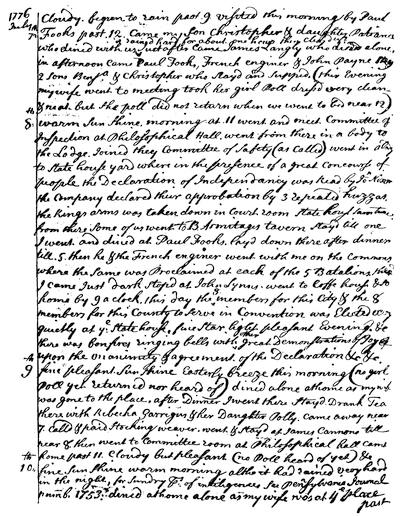
CHRISTOPHER MARSHALL'S DIARY.
A page from Christopher Marshall's diary, preserved in the Penna. Hist. Soc., giving his description of the public reading of the Declaration of Independence, in Philadelphia, on July 8th. Cf. Extracts from the diary of Christopher Marshall kept in Philadelphia and Lancaster during the American Revolution, 1774-1781, edited by Wm. Duane (Albany, 1877). On this reading, see Penna. Mag. of Hist., viii. 352, and W. Sargent's Loyal Verses of Stansbury and Odell, p. 116.
The English notion of the way in which the proclamation was made may be learned from Edward Bernard's contemporary folio Hist. of England (p. 689), where a large print represents an uncovered man on horseback reading a scroll to a crowd in the street, called "The manner in which the American Colonies declared themselves independent of the King of England throughout the different provinces on July 4, 1776." The reading took place in New York July 9th (Bancroft, ix. 36), and in Boston July 18th (Mem. Hist. Boston, iii. 183). Moore's Diary of the Rev., i. (1776), records from contemporary journals the way in which it was received in various places. A letter of Major F. Barber in the New Jersey Hist. Soc. Proc., v., shows how the reception of the news was observed at Fort Stanwix.
For the convention in New York, see Debates of the N. Y. Conventions (1821), App., p. 691; Flanders's Life of Jay, ch. 8; and Sparks's Gouverneur Morris.[717] For Georgia, see C. C. Jones's Georgia, ii. ch. 13. Jameson (p. 138) outlines the peculiar circumstances of the early constitutional history of Vermont. Massachusetts was the last (1780) of the original States to frame a constitution. (See John Adams's Works, iv. 213; ix. 618.) Adams drafted the constitution presented by the committee, which was printed as Report of a Constitution or form of government,[718] and is printed without embodying the Errata in John Adams's Works (iv. 219), which copies it from the Appendix of the Journal of the Convention (Boston, 1832), where it was also printed in that defective manner.[719]
John Adams, in his Defence of the Constitutions of Government of the United States of America (1787,—in Works, iv. 271), set forth the views which influenced largely the framers of many of the constitutions of the States. Connecticut and Rhode Island retained their original charters through the war.
This action of the States rendered easier a plan of confederation, which seems to have been proposed by Franklin as early as Aug. 21, 1775. On July 12, 1776, a plan in Dickinson's handwriting, based on Franklin's, was reported, and was finally adopted by Congress, Nov. 15, 1777 (Journals, ii. 330), which was ratified by all the States in 1778 except Delaware (1779) and Maryland (1781), at which last date it became obligatory on all.[720]
The reader needs to be cautioned against a publication which assumes to be an Oration delivered at the State House in Philadelphia Aug. 1, 1776, by Samuel Adams (Philadelphia, reprinted at London, 1776), and which was translated into French and German. It is reprinted in Wells, iii., App. There is no copy of the pretended Philadelphia original known, and the publication is a London forgery (Wells, ii. 439), discoverable, if for no other reason, from the fact that its writer was unaware that the Declaration of Independence had passed.