Chapter V
Reading edition
THE STRUGGLE FOR THE DELAWARE.—PHILADELPHIA UNDER HOWE AND UNDER ARNOLD.
BY FREDERICK D. STONE,
Librarian of the Historical Society of Pennsylvania.
"THESE are the times that try men's souls. The summer soldier and the sunshine patriot will in this crisis shrink from the service of his country, but he that stands it now deserves the love and thanks of man and woman."
So wrote Thomas Paine, December 19, 1776. The preceding month had been fraught with adversity. The loss of Fort Washington on the 16th of November had rendered Fort Lee useless, as with it alone the passage of the river could not be obstructed. Its evacuation was immediately ordered, and the ammunition and some of the guns were removed. Before all could be taken away, however, the fort became the object of the enemy's attention. On the night of the 19th, two columns under Cornwallis, composed of British and Germans, with a detachment from the fleet, in all about six thousand men, crossed the river and landed at Closter dock, seven miles above Fort Lee, then commanded by General Greene. The night was stormy, and the movement escaped the notice of Greene's sentries. By morning the sailors had dragged the artillery to the top of the Palisades, and everything was ready for an advance upon the fort. Greene was informed of the landing of Cornwallis, and immediately took steps to secure a retreat for his command, then numbering about three thousand men. Word was sent to Washington, who was at the village of Hackensack with the troops which he had brought with him from White Plains. In three quarters of an hour the commanding general was at Greene's side. Seeing that the fort was not tenable, he ordered a retreat. No time was to be lost; and leaving the tents standing, the kettles over the fires, and such stores as could not be removed, the troops were hurried towards the advancing enemy with such speed that they gained the road leading to the only bridge over the Hackensack before Cornwallis could intercept them.
The situation of the Americans was now more precarious than it had been at Fort Lee. They were in danger of being shut in between the Hackensack and Passaic rivers; they were in a perfectly flat country, without intrenching tools or camp equipage; their right flank could be turned and their line of retreat threatened if the British should land a force at the head of Newark Bay or at Amboy. Washington's forces were greatly reduced by reverses and by desertions. Nearly all that were left were militia of the flying camp, called out for an emergency, and impatient to return home, as their time of service had nearly expired. Small as his numbers were, Washington was obliged to post some at Amboy and others at Brunswick, to protect his flanks. As those remaining were insufficient to hinder the advance of the enemy in his front, he ordered Lee, whom he had left in command on the east of the Hudson, to cross that river and join him, and, with hardly three thousand men, Washington began his retreat through the Jerseys.
On the 21st he was at Aquacknoc Bridge on the Passaic, and by the 23d at Newark. On the 28th he left Newark, the advance-guard of the British entering the town as his rear-guard quitted it, and the next day he arrived at Brunswick. Here an attempt would have been made to prevent the enemy crossing the Raritan, but the stream was fordable in a number of places. As the British approached, the Jersey and Maryland brigades, whose terms of service expired that day, refused to stay an hour longer, and as the British crossed the river the line of march was again taken up for Trenton. This point was reached on the 2d of December, two brigades having been left at Princeton, under Stirling, to watch the enemy.
Having seen his stores and baggage safely over the Delaware, and being reinforced by about twelve hundred militia from the neighborhood of Philadelphia, Washington faced about on the 6th, with such men as were fit for service, and set out to join Stirling at Princeton.
It had not been the intention of Howe, when he ordered Cornwallis over the Hudson, to do more than take possession of and hold East Jersey, and Cornwallis's orders did not permit him to go beyond Brunswick. But the slight opposition which Washington was able to offer to the British advance excited in Howe the hopes of capturing Philadelphia, and he joined Cornwallis in person at Brunswick. After a short halt, he pushed on towards Stirling at Princeton, and before Washington could reach that general Stirling was in full retreat, to avoid being intercepted. A retrograde movement was ordered, and by the 8th the American army was on the west bank of the Delaware. The advance of Cornwallis's column reached the river before the rear-guard of the Americans had landed on the Pennsylvania side; but as Washington had secured all the boats for a considerable distance above and below Trenton, his position was comparatively a safe one. Here for a time he rested his men, and urged upon Congress the necessity of raising additional troops, and the importance of preparing for the defence of Philadelphia, as the military stores were in that city.
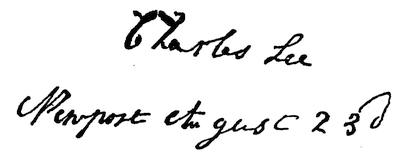
In his retreat through the Jerseys, Washington was greatly embarrassed by the conduct of General Charles Lee. The instructions he had given Lee on the 17th of November to join him may have been discretionary, but the language and frequency of his orders left no doubt of the expectations of the commander-in-chief. But Lee chose to read the orders in the light of his wishes. On the east of the Hudson he had an independent command, which he purposed to retain as long as he could. Schemes and suggestions that should have had no weight were allowed to delay his passage over the river until December 2d, and then his advance was slow and hesitating. The prospect of receiving reinforcements from the Northern army, which would make his command equal to that of Washington, strengthened his wish to act independently. He proposed, as soon as the troops from the north should join him, to attack the rear of the enemy. While this plan may not have been devoid of military judgment, it is doubtful if it would have had more than a temporary effect on Howe's movements, while it would have deprived Washington of the reinforcements he so greatly needed. Notwithstanding Washington's explicit directions to avoid the enemy in joining him, Lee hung so close to the enemy's flank as to leave a doubt of his real intentions, and on the morning of the 13th, just after having put on record that he believed Washington to be "damnably deficient", he was surprised and taken prisoner by Lieutenant-Colonel Harcourt, at White's tavern, near Baskingridge, three miles from his camp.
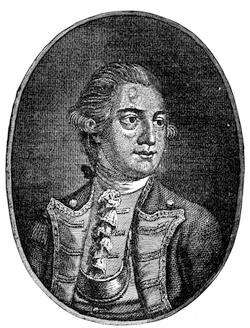
CHARLES LEE
From Murray's Impartial Hist. of the Present War, i. p. 478.
The estimation in which Lee was held gave an undue importance to his capture. The British thought that in it they had deprived their opponents of nearly all the military science they possessed, and they styled him the American Palladium. With the Americans he had many friends, who were flattered that a soldier of European distinction should have espoused their cause, and, dazzled with his success at Charleston, they rated him higher than Washington, and, unintentionally perhaps, weakened the confidence that should have been reposed in the commander-in-chief by his subordinates.
Having failed to overtake Washington in New Jersey, Howe turned northward to Coryell's Ferry, fifteen miles above Trenton, in hopes of finding boats to enable him to cross the Delaware; but in this he was disappointed. He then took post at Pennington with a portion of his force, while with the remainder he returned to Trenton, repaired the bridges below the town which the Americans had destroyed, and extended his line as far as Burlington.
So great was the terror spread through New Jersey as the British advanced, that many of her citizens took advantage of the amnesty which was offered by the Howes to all who would put themselves under their protection within sixty days from the 30th of November. Chief among these was Samuel Tucker, president of the Committee of Safety, who had held many positions of honor and trust. Nor was this defection confined to the east side of the Delaware. It was now that Joseph Galloway, and citizens of Philadelphia, like the Allens, who had supported the cause of the colonies until independence became the avowed object of the war, sought safety within the British lines. But the influence which their conduct might have exercised upon the people was neutralized by what was soon endured at the hands of the British and Hessian troops. Never before had any of the colonies been exposed to the unbridled impulses of a mercenary and licentious soldiery. Houses were plundered and their contents destroyed in mere wantonness, women were forced to submit to indignities, and all the horrors which usually attended the invasion of a European country by a foreign army in the eighteenth century were transferred to the soil of New Jersey.[887]
In Philadelphia the excitement was intense. On the 28th of November a meeting was held in the State House yard to consider the condition of affairs. It was addressed by Mifflin, who had been sent to the city to warn Congress of the danger which threatened the army. He spoke with animation, and endeavored to rouse the people to action. His efforts met with some success, and in a few days the troops that reinforced Washington prior to his retreat into Pennsylvania were in motion. On the 30th the Council of Safety advised the citizens to prepare, upon short notice, to remove their wives and children to places of safety. On December 2d, when it was known in the city that Howe's army was at Brunswick, crowds gathered at the Coffee House to learn the news. The stores and schools were closed, and all business was suspended. No one was allowed to cross the Delaware without a pass, while recruiting parties with drums beating paraded in the streets. The roads leading from the city were crowded with vehicles of every description, bearing the families of citizens and their effects to places of refuge.
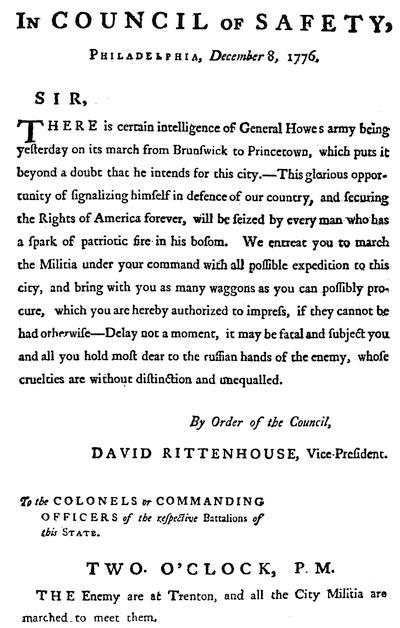
AN APPEAL.
Reduced from an original in the library of the Historical Society of Pennsylvania.
When these means of transportation failed, the water craft on the Delaware was pressed into service. Women with children in their arms were crowded in smoky cabins so low that they could not sit upright, while the younger girls were quartered on the decks, from whence they were driven by the snow and rain. But sadder sights presented themselves in the streets of the city. The sick of the army arrived daily. Many of the men had gone to the field clad only for a summer campaign. They had succumbed to exposure, and had reached Philadelphia in an almost naked condition. Measures were at once set on foot for their relief. Vacant houses were taken for their accommodation. The most seriously afflicted were sent to the hospitals, while committees of citizens went from door to door begging clothing for their use.
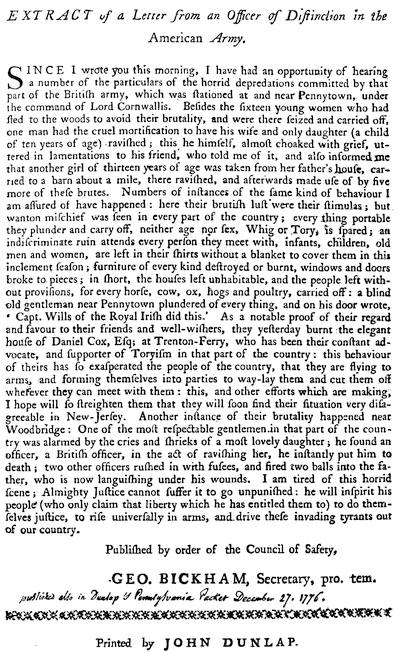
BROADSIDE.
Reduced from an original in the Historical Society of Pennsylvania.
Handbills were issued giving information of the advance of the enemy, and to awaken the indignation of the people printed sheets were circulated describing the insults to which the women of New Jersey had been subjected. Some of the citizens refused to take the Continental money, as it was rumored that Congress would soon disperse. On the 11th of December Congress requested Washington to contradict this rumor in general orders, and to assure the army that the delegates would remain in Philadelphia until it was certain the enemy would capture the city. It was well that Washington exercised his discretion in this matter, for the next day the crushing news was known throughout the city that he had been obliged to cross the Delaware. Congress at once adjourned to Baltimore, having first conferred on Washington "full power to order and direct all things relative to the department and to the operations of the war."
The state of political affairs in Pennsylvania was the chief cause of the inefficiency which exposed Philadelphia to the danger of capture and of the panic with which her citizens were seized. The old colonial charter had been abrogated, but the new constitution had not been put into effect, and the condition of society bordered upon anarchy.
For two weeks after Washington had retreated across the Delaware there seemed little chance of impeding the British advance. "Day by day the little handful was decreasing, from sickness and other causes." The services of all the regular troops in it, with the exception of those from Virginia and Maryland, expired on the first of the year, and the militia could not be depended upon. "They come", wrote Washington, "you cannot tell how, go you cannot tell when, and act you cannot tell where, consume your provisions, exhaust your stores, and leave you at last at a critical moment." "These", he said again to Congress, on the 20th of December, "are the men I am to depend upon ten days hence." On Congress he urged the importance of raising at once an army upon a more substantial basis, and impressed upon those around him the necessity of the utmost vigilance. But in the anguish of the moment he wrote to his brother: "If every nerve is not strained to recruit the new army with all possible expedition, I think the game is pretty nearly up.... I cannot entertain the idea that [our cause] will finally sink, though it may remain for some time under a cloud."
Each day brought new difficulties to be overcome. When it was learned that the fleet that had sailed from New York had appeared off New London, the march of a portion of Heath's troops, which had been ordered from Peekskill, was countermanded, and three regiments from Ticonderoga were directed to halt at Morristown, where about eight hundred militia had been collected, and General Maxwell was sent to command them. On the 20th, the troops under Gates and Sullivan joined Washington. The former had been sent by Schuyler. Sullivan's division was that which had been commanded by Lee up to the time of his capture. Washington had been led to believe that a portion of these troops had reënlisted, and he had been waiting until they should join him to strike a blow at Howe's forces. Only a small number of the men had done so, however, and he found that on the first of the year he would have but fifteen hundred men independent of the militia. It was evident, therefore, that the blow must be struck at once.
On the 14th of December the British troops went into winter-quarters. They were stationed at Brunswick, Princeton, Trenton, and Bordentown. Howe returned to his easy quarters in New York. Cornwallis obtained permission to visit England, and left Grant at Brunswick in command of New Jersey. The troops at Trenton were under the Hessian, Lieut.-Col. Rahl; those at Bordentown were commanded by his superior, Count Donop, who had some outposts as far south as Burlington and Mount Holly. Howe knew his line was too far extended, but he wished to cover the county of Monmouth, where there were indications of an outbreak on the part of some loyalists. The American army reached from Coryell's Ferry to Bristol. The crossings above Trenton were guarded by Stirling, Mercer, Stephen, and Fermoy. Ewing lay opposite Trenton. Dickinson with a few New Jersey troops was opposite Bordentown, and Cadwalader with the Pennsylvania militia was at Bristol.
Washington decided to attack the troops at Trenton. His men fit for duty did not exceed five thousand, and of these nearly two thousand were militia. The troops under Rahl consisted of three battalions of Hessians, having with them six field-pieces, fifty chasseurs, and twenty dragoons,—twelve hundred in all. Circumstances favored the plan which Washington now adopted. Colonel Griffin, with two companies of Virginians and some militia, had driven a party of Hessians, who had penetrated as far south as Moorestown and Haddonfield, back to Mount Holly, where they had been reinforced by Donop, who was thus too far removed from Trenton to support Rahl in case of an emergency. The success of Griffin made the militia at Bristol anxious for service, and it was decided by Cadwalader and Reed, who was with him, to gratify them by supporting Griffin. To this Washington assented, and at the same time confided to Reed and Cadwalader his contemplated movement against Trenton. On the morning of the 23d he wrote to them asking if the plan had been carried out, and informed them that one hour before day on the morning of the 26th was the time he had fixed upon for attacking Rahl. "For heaven's sake", he wrote, "keep this to yourselves as the discovery of it may prove fatal to us. Our numbers, sorry I am to say, being less than I had any conception of; but necessity, dire necessity, will, nay must justify an attack. Prepare and concert with Griffin; attack as many of their posts as you possibly can with a prospect of success; the more we can attack at the same instant the more confusion we shall spread, and the greater good will result from it."
Washington was informed that it was impracticable to act with Griffin; and Reed repaired to Philadelphia to urge Putnam to create a diversion by crossing the river at Cooper's Ferry. He found, however, that little could be expected from Putnam, and returned to Bristol on the 25th, where Cadwalader was preparing to carry out the part which Washington had assigned to him. It was the intention of Washington to cross the Delaware above Trenton with about one half of his command, and attack the enemy, while Ewing and Cadwalader should cross opposite Trenton and Bristol, and not only cut Rahl's line of retreat but prevent Donop from reinforcing him.
Notwithstanding the fact that no aid could be expected from Putnam, Washington determined to proceed, and urged Cadwalader to do all in his power to support him. The boats had been gathered at McKonkey's Ferry, nine miles above Trenton, and as the men marched to them the footprints they left in the snow were here and there tinged with blood from the feet of those who wore broken shoes. The boats were promptly manned by Glover's regiment from Marblehead, and at dark the crossing began. It was three o'clock before the artillery was landed, and four before the troops took up the line of march. The attack was to have been made about five, and against a more vigilant enemy this delay would have proved fatal. But Rahl was not vigilant. He despised his opponents, and refused to protect his position with redoubts as instructed by Donop. He had been informed of Washington's intended movement, but paid no attention to the report. It so happened that on the morning of the attack his outposts had been fired upon by a body of strolling militia, and this he supposed was the attack he was to look for. Washington had with him two thousand four hundred men. These he divided into two columns. One was commanded by Sullivan, and marched by the river road which entered the town on the northwest. The other, under Greene, took the Pennington road which approached the town from the north. The Americans advanced in a violent storm of snow and hail. Greene's command arrived at the outskirts of the town three minutes before Sullivan's. The attacks of both parties were almost simultaneously. Many of the guns were rendered useless by the storm, and the men were ordered to charge. Those who had bayonets fixed them and rushed upon the pickets, who retired. The Hessians were taken entirely by surprise. For a while Rahl was allowed to remain undisturbed in bed, but when matters grew serious he was aroused and hurriedly assumed command. Some of his half-formed regiments were advanced towards the Americans, but were driven back, throwing those in their rear into inextricable confusion. Two lines of retreat were open to Rahl. One lay over the bridge which crossed the Assanpink, south of the town; the other was the road to Brunswick. But Sullivan's attack was so spirited that the Hessians were driven past the road which led to the bridge, and as they attempted to escape towards Brunswick, Washington intercepted them with Hand's riflemen and held them in check. A battery under Captain Thomas Forrest created great havoc in their ranks, and two of their guns were turned against it. These were immediately charged by the Americans, who were led by Captain William Washington and Lieutenant James Monroe. Both were wounded, but the guns were captured. Rahl was mortally wounded in trying to rally his men, and shortly after he fell his command surrendered. All was over in three quarters of an hour. With the exception of the horse and a small number of the infantry which escaped over the Assanpink or to Brunswick, Rahl's entire force was either killed or captured. The prisoners numbered nine hundred and eighteen. The killed, Washington thought, did not exceed twenty or thirty. The Americans had two privates killed, one frozen to death, and two officers and four men wounded. As the enemy were supposed to be in force at Princeton and Bordentown, and the Americans were in no condition to withstand an attack, it was thought best not to risk the advantage which had been gained, and as soon as the men were rested the army, with its prisoners, returned to Pennsylvania.
Ewing and Cadwalader had been unable to carry out the parts assigned them, on account of the ice. The latter sent a portion of his infantry over the river, but recalled it when he found he could not land his artillery. With no definite news of Washington's success, Cadwalader recrossed on the morning of the 27th, supposing Washington to be at Trenton. He soon learned his mistake, but discovered that Donop had retreated towards Brunswick when he heard of the action at Trenton. Cadwalader then moved on to Burlington, and on the 29th marched to Crosswicks. The desperate condition of affairs previous to the battle had stimulated the people to extraordinary efforts, and the news of the victory raised their spirits in proportion to the depression they had so lately suffered. Ignorant of the victory Washington had achieved, Congress on the 27th vested him with powers that virtually constituted him a military dictator for the period of six months. To convince the people of the reality of the victory, the Hessians were marched through the streets of Philadelphia, and one of their standards was hung up in the chamber of Congress at Baltimore. Public rejoicings broke forth on every side. "The Lord of Hosts has heard the cry of the distressed, and sent an angel to their assistance", exclaimed Muhlenberg, the patriarch of the Lutherans. On the 27th and 28th of December, fifteen hundred militia under Mifflin followed Cadwalader into New Jersey, while the Jerseymen gathered at Morristown and other points. In the face of this feeling it was necessary that the offensive should be resumed, and on the 30th Washington occupied Trenton. The service of the New England troops expired on the first of the year; but through the efforts of Robert Morris money was raised to offer bounties, which, with appeals to their patriotism, induced them to remain six weeks longer with the army.
As soon as Cornwallis heard of the surprise at Trenton, he gave up his visit to England and hastily joined Grant at Brunswick. On the 30th, with 8,000 men, he marched towards Trenton, with the determination of driving Washington over the Delaware or capturing his entire force. Washington immediately ordered Cadwalader and Mifflin to Trenton, and sent forward a detachment under General Fermoy to retard the advance of Cornwallis. On the night of January the 1st this detachment was at Five Mile Run, between Trenton and Princeton. Early on the morning of the 2d Cornwallis set out from Princeton, where he had halted the night previous. The Americans retired before him, disputing every foot of ground. Hand's riflemen, Scott's Virginians, and Forrest's battery bore the brunt of the fighting. It was nearly noon by the time Shabbakong Creek was reached, and two hours passed before the British succeeded in crossing it. The main portion of the American army was strongly posted on the south side of the Assanpink, the banks being sufficiently high to enable the men in the rear to fire over the heads of those in front of them. As the British approached Trenton, troops were sent forward by Washington to support the Americans. A battery placed on a hill beyond Trenton held the British in check for a short time, but the Americans were soon driven into the town and across the bridge. The cannonading on both sides was heavy, but the British were unable to force their way across the stream, and as night approached Cornwallis, against the advice of his officers, withdrew his troops, determined to renew the conflict in the morning. "If ever there was a crisis in the affairs of the Revolution", wrote Wilkinson, "this was the moment. Thirty minutes would have sufficed to have brought the two armies into contact, and thirty minutes more would have decided the combat." Washington's position was indeed critical. It was hardly possible that with his raw levies he could continue to hold in check the well-disciplined troops of Cornwallis, which in the morning would be reinforced with troops he had left at Maidenhead and Princeton. The Delaware behind Washington was full of floating ice, and to cross it in that condition was impossible. If Cornwallis should force the Americans' position, the victory of the British would be decisive. Immediately after dark a council of war was held. It was then decided to turn the left flank of the enemy, strike a blow at Princeton, where the garrison was small, and march on Brunswick, the depository of the British stores. The sentries of both armies were posted along the banks of the Assanpink, and at some points were within one hundred and fifty yards of each other. Working parties were sent within hearing distance of the enemy to throw up intrenchments, the guards were doubled, and everything was done to indicate that Washington intended to defend his position to the last. But at midnight the fires were replenished and the troops silently withdrawn. Marching by the Quaker road, Washington turned the left flank of Cornwallis, and by daybreak reached a point directly south of Princeton. With the main body he moved directly on the town, and ordered a detachment under Mercer to march to the left and demolish the bridge over Stony Brook, thus destroying direct communication with Cornwallis. The garrison at Princeton consisted of the 17th, 40th, and 55th regiments and three companies of light horse. The 17th and 55th, with a few dragoons, started at sunrise on the morning of the 3d to join Cornwallis. The 17th, under Colonel Mawhood, had crossed the bridge over Stony Brook, that Mercer was to destroy, and was some distance beyond it, when Mawhood discovered Mercer on his flank and rear, moving north on the east side of the stream. He at once recrossed the bridge, and both parties endeavored to gain the high ground east of the stream. As the Americans had the shortest distance to march, they were successful, and with their rifles they poured a deadly fire into the 17th and 55th, as they advanced to drive them from their position. They had no bayonets, however, and were unable to stand the charge of the British. They fled through an orchard in their rear, leaving their commander mortally wounded on the ground. It was not until Mawhood emerged from the orchard that he was aware that the whole American army was within supporting distance of the troops he had just engaged. On hearing the firing on his left, Washington halted his column, and with the Pennsylvania militia moved to the support of Mercer. Encouraged by the irresolution of the militia, Mawhood charged them, but other regiments coming up and the militia gaining confidence, the British halted, and then fled, as the Americans in turn advanced against them. The 55th retreated to Princeton and joined the 40th. They made a mere show of defending the town, took refuge in the college building, deserted it, and were soon seen in full retreat across the Millstone towards Brunswick. Washington's troops had been under arms for over eighteen hours, and were too much fatigued to follow them. Having dispersed the 17th regiment, he destroyed the bridge over Stony Brook and Millstone as the head of Cornwallis's rear-guard came in sight. It was commanded by Leslie, who had marched from Maidenhead as soon as he heard the firing in his rear. Washington turned north at Kingston, and proceeded to Somerset Court-House, where he rested his men. Cornwallis was not aware that the Americans had been withdrawn from his front until he heard the sound of the guns at Princeton. Realizing at once that he had been outgeneralled, and that his stores were in danger, he ordered a retreat. Failing to reach Princeton in time to be of service, he continued his march to Brunswick, and made no attempt to follow Washington. The losses of the British in these engagements were severe; those on the 2d of January were never known. At Princeton, Washington estimated that one hundred men were left dead upon the field, and that the killed, wounded, and prisoners amounted to five hundred. Ensign Inman, of the 17th, wrote that of the two hundred and twenty-four rank and file of his regiment, which set out on the morning of the 3d, one hundred and one were either killed or wounded, and that he was the only officer of the right wing not injured. The Americans lost only twenty or thirty privates, but many officers. Bravely had they urged their men on in the thickest of the fight. That Washington escaped seemed a miracle to those who saw him lead the troops which drove Mawhood back. Hazlet, Morris, Neal, and Shippin fell upon the field. Mercer, mortally wounded, died upon the 12th, lamented by the whole country. From Somerset Court-House Washington marched to Morristown, where he went into winter-quarters. The British troops were soon all withdrawn to Amboy and Brunswick. In less than three weeks Washington had turned back the tide of adversity, and had compelled his opponents to evacuate West Jersey.
Washington remained at Morristown from the 7th of January until the 28th of May, during which time no military movement of importance took place. His men left for their homes as soon as their terms of service expired, and as few militia entered the camp to take their places, at times it seemed as if the army would be so reduced as to be unworthy of the name. It was not until late in the spring that the new levies reached headquarters. On the 28th of May the Americans marched to Middlebrook, and took position behind the Raritan. On the 13th of June Howe marched from Brunswick and extended his line to Somerset Court-House, and Arnold was sent to Trenton to take measures to prevent his crossing the Delaware. The militia turned out in a spirited manner, and Howe did not care to advance in the face of the opposition they could offer, with Washington on his flank. He endeavored to bring on a general engagement with the latter, but Washington refused to leave the strong position he occupied, and Howe retired to Amboy.
Early in April Howe had settled upon a campaign having for its object the capture of Philadelphia. He determined to embark his troops and transport them to the banks of the Delaware or Chesapeake, and march directly on the city. With the object of reaching the fleet he started to cross to Staten Island; but learning that Washington was at Quibbletown, he recalled his men and proceeded to Westfield, hoping to outflank him. But, as Washington retired, Howe was unsuccessful, and finally passed over to Staten Island, totally evacuating New Jersey.
For over six weeks Washington was ignorant of Howe's intentions. Supposing that he would endeavor to coöperate with Burgoyne, and would sail up the Hudson, Washington moved his army to Ramapo, in New York. On the 23d of July, after Howe's troops had been three weeks on the vessels, the fleet sailed, shaping its course southwesterly. Its departure was promptly reported to Congress. Signal fires were lighted along the Jersey coast as it was seen from time to time by those who were watching for it, and messengers carried inland the news of its progress. At last, on the 30th, it was spoken off the capes of Delaware, but Lord Howe deemed it too hazardous to sail up that river, and after consulting with his brother, the general, continued on his course southward. On the 15th of August he entered Chesapeake Bay, and on the 25th the troops were landed at Elk Ferry.
On the 24th of July Washington heard that the fleet had sailed southward, and in consequence marched his army from Ramapo to Coryell's Ferry. He continued his march to Philadelphia, when he learned that the fleet was off the capes of Delaware; but as it was soon lost sight of, he retraced his steps, and halted in Bucks County, Pennsylvania, twenty miles from Philadelphia. While there, Lafayette, De Kalb, and Pulaski joined the army.
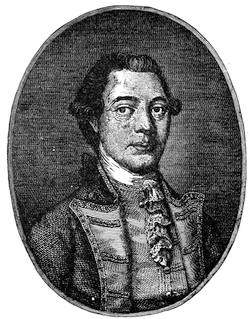
LORD HOWE.
From Murray's Impartial Hist. of the present War, ii. p. 96. Cf. cut in European Mag., ii. 432. There is a colossal statue of Howe, by Flaxman, in St. Paul's, London.
For a while everything was in suspense. Concluding at last that Howe had sailed for Charleston, Washington consulted with his officers, and decided to return to the Hudson, so that Burgoyne could be opposed or New York attacked, as circumstances should direct. He was just about to do this when word was brought that the fleet had entered Chesapeake Bay, and was at least two hundred miles from the capes. This news created great consternation in Philadelphia, but the excitement was not as great as it had been the previous winter, when Howe was at Trenton. Repeated alarms had made the people callous, and internal political differences continued to divide them. Besides this, the pacific influence which the presence of a large Quaker population exercised seemed to bear down all military efforts. Stirring appeals were made by the authorities, new bodies of militia were ordered to be raised, handbills calculated to arouse the people were issued, but all with unsatisfactory results. To impress the lukewarm with the strength of his forces, and to inspire hopes in the breasts of the patriotic, on the 24th of August Washington marched his army through the streets of Philadelphia. The men were poorly armed and clothed, and to give them some uniformity they wore sprigs of green in their hats.
The Americans halted south of Wilmington, and a picked corps under Maxwell was thrown to the front. The country below was patrolled by parties of Delaware militia under Rodney, and Washington reconnoitred it in person. The disembarkation of Howe's army on the 25th was watched by a few militia, who fled when a landing was effected. Howe's men were in good health, but hundreds of his horses had died on the voyage, and those that survived were little better than carrion. His advance, therefore, was slow. He moved in two columns, one on each side of Elk River. Several days were spent in collecting horses, and on the 3d of September the columns joined at Aitken's tavern. Here a severe skirmish took place with Maxwell's corps, which was driven back. Washington's force then lay behind Red Clay Creek, his left resting on Christiana Creek, and extending in the direction of Newport. On the 8th the British advanced as if to attack the American left, but by night Washington learned that the greater part of Howe's army was at Milltown, on his right. Fearing that Howe would push past him in that direction, cross the Brandywine, and gain the road to Philadelphia, Washington, on the evening of the 8th, quietly withdrew his troops from Red Clay Creek, and threw them in front of Howe, at Chad's Ford, on the Brandywine. A redoubt, commanded by Proctor, was thrown up on the east bank to protect the crossing. Wayne's division, formerly Lincoln's, was within supporting distance, and Greene's, still further to the rear, was to act as a reserve. The Pennsylvania militia, under Armstrong, formed the left wing. They were posted at the fords below Chad's, which were easily protected. The right wing was commanded by Sullivan. It was composed of his own division and those of Stirling and Stephen. Both Washington and Sullivan were unacquainted with the country to their right, and supposed that, when they guarded the fords three miles above where Sullivan was stationed, the enemy could not approach from that direction without their receiving timely notice.
The British marched from Milltown to Kennett Square. On the morning of the 11th, Knyphausen with 7,000 men took the direct road to Chad's Ford. He skirmished with Maxwell, who had crossed the stream to meet him, and drove him back over the Brandywine. At daybreak on the same day, another column, 7,000 strong, set out from Kennett Square. It was commanded by Cornwallis, and Howe accompanied it in person. It took a road leading north to a point above the forks of the Brandywine, turned to the east, crossed the west branch at Trimble's Ford and the east at Jeffrey's, and then moved south. The plan was that Knyphausen should engage the attention of the Americans in front until Cornwallis had gained a position to attack their right. In this Knyphausen was successful, his attempts to cross the Brandywine at Chad's Ford being only feints.
About noon Washington heard of Cornwallis's march. He promptly determined to cross the stream and engage Knyphausen, while Cornwallis was too far distant to reinforce him or threaten the American right. Wayne, Greene, and Sullivan's divisions were ordered to advance. Greene had gained the west bank when word was received from Sullivan that a Major Spear had assured him that there must be some mistake. He had that morning passed over the road Cornwallis was said to be on, and had seen nothing of him. Fearing that Cornwallis's march was only a feint, and that he had returned and rejoined Knyphausen, Washington ordered Greene back and sent scouts out for additional information. By two o'clock it was obtained. Cornwallis was discovered on the road to Dilworth, and would soon be in the rear of the Americans. Stirling and Stephen were deployed on the hill southwest of Birmingham Meeting-House, and Sullivan's division was ordered to join them. Before it could reach its position Cornwallis began the attack. As he attempted to turn the American right, Sullivan endeavored to move his three divisions to the east. His own division had been formed in line half a mile from those of Stirling and Stephen, and in closing the gap it fell into confusion and was routed. With the divisions of Stirling and Stephen, Sullivan made every effort to hold the position; but he was outnumbered, his left flank was uncovered, and his entire command was finally driven in confusion from the field. Sullivan, Stirling, and Conway had encouraged their men with exhibitions of personal bravery, and Lafayette, who acted as a volunteer, was wounded while endeavoring to rally some fugitives. When Washington heard the firing in the direction of Birmingham he rode thither with the utmost speed. Meeting the fugitives, he ordered Greene to support the right wing. The order was executed with wonderful promptness. Greene, throwing Weedon's brigade on the flank of the enemy and Muhlenberg's in their front, checked the pursuit. But the Americans were obliged to fall back until they came to a narrow defile, flanked on both sides by woods, from which the British could not drive them, and night ended the conflict. When Knyphausen learned that Cornwallis was engaged he pushed across the stream at Chad's Ford, but Wayne, Maxwell, and Proctor held him in check until they found that the right wing had been defeated, when they retired in good order, fighting as they fell back towards Chester. There at night the defeated army gathered, and Washington reported to Congress that, notwithstanding the misfortunes of the day, his troops were in good spirits.
The American loss was about one thousand, killed, wounded, and prisoners; that of the British, five hundred and seventy-nine. That the conduct of the Americans inspired their opponents with respect is shown by the language of Sir William Howe in summarizing the opposition he had met with up to this time. "They fought the king's army", he wrote, "on Long Island; they sustained the attack at Fort Washington; they stood the battle at Brandywine: and our loss upon those occasions, though by no means equal to theirs, was not inconsiderable."
The day after the battle Washington marched from Chester to Philadelphia. He rested his army two days at Germantown, and then recrossed the Schuylkill; public opinion demanding that another battle should be risked before the city should be given up. On the 16th the two armies met on the high ground south of Chester Valley and prepared for action. The skirmishing had actually begun, when a violent storm stopped the engagement by ruining the ammunition of both armies. Washington withdrew to the hills north of the valley, and finding it impossible to repair the damage done by the storm, retreated again over the Schuylkill, leaving Wayne behind him to watch the enemy and attack their rear should they attempt to follow. Wayne was to have been reinforced by detachments under Smallwood and Gist, which did not reach him. When the British moved nearer to the Lancaster road, Wayne took position in their rear. He supposed that they were ignorant of his presence, and wrote to Washington to that effect. But on the night of the 20th he was attacked by a strong detachment under Major-General Grey, and although he had taken measures to guard against a surprise, the onslaught was so sudden that his men, who were sleeping on their arms, were unable to make an effective resistance, and about one hundred and fifty were either killed or wounded by the bayonet.
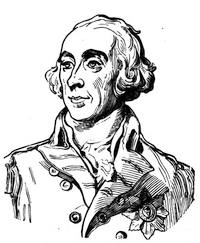
GENERAL GREY.
From Doyle's Official Baronage, ii. 76. There is a print in the European Mag., Oct., 1797, and in Murray's Impartial Hist., vol. ii. p. 433.
Howe on the 21st resumed his march towards Philadelphia. Finding that the Americans had thrown up intrenchments at Swedes Ford, he turned up the river as if to cross above. Washington feared that it was his intention to strike at Reading, where his stores were deposited, and to protect them marched in the same direction on the opposite side of the river. When he reached Potts Grove, now Pottstown, he discovered that Howe, by a retrograde movement on the night of the 22d, had crossed at Fatland and Gordon's fords, and was in full march for Philadelphia.
On the day of the battle of Brandywine the citizens of Philadelphia heard the sound of cannon in the west, and gathered in the streets to discuss and wonder what the future would bring forth. At night a messenger arrived with news of the disaster. Everything was in confusion, and when, on the morning of the 19th, about one o'clock, a letter was received from Colonel Hamilton stating that the British were marching on the city, the members of Congress were aroused from their beds, and departed in haste for Lancaster, where they had agreed to meet should their removal from Philadelphia become necessary.
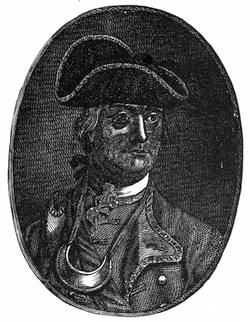
GENERAL HOWE.
From Murray's Impartial Hist. of the present War, i. 280.
"It was a beautiful still moonlight night, and the streets as full of men, women, and children as on a market day." The alarm was premature, but on the 25th Howe's army encamped at Germantown. Through Thomas Willing, a leading citizen of Philadelphia, the inhabitants were promised by Sir William Howe that if they should remain peaceably in their dwellings they would not be molested. The next morning, Cornwallis, with three thousand men, took possession of the city. The troops marched down Second Street to the music of "God save the King", and were greeted by some of the inhabitants with "acclamations of joy", but the people generally "appeared sad and serious." Howe immediately began to throw up a line of intrenchments north of the city, extending from the Delaware to the Schuylkill, and informed his brother, the admiral, who was in Delaware Bay, that the army was in possession of the city. The defences of the river prevented the fleet from approaching, and the day after the occupation an attempt was made by the American flotilla to cannonade the city. The smaller vessels were driven off before they had done serious damage, but the frigate "Delaware" ran aground and was captured.
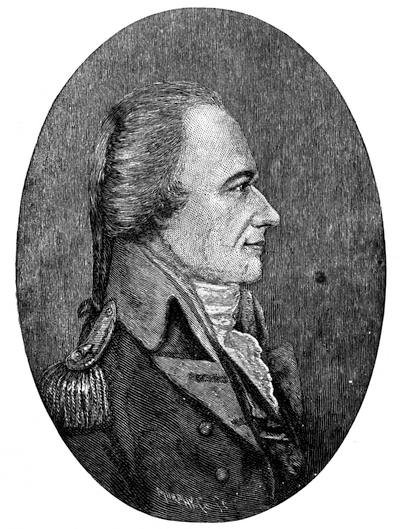
ALEXANDER HAMILTON.
After a crayon in the Hist. Soc. of Pennsylvania. There is a picture in Independence Hall. Ceracchi's bust is given in stipple in Delaplaine's Repository (1815).
For view of "The Grange", Hamilton's home, see Valentine's N. Y. Manual, 1858, p. 468; Mrs. Lamb's Homes of America; Lossing's Hudson, 275.—Ed.
The main portion of Howe's army remained at Germantown, a village of a single street, two miles in length, and five from the city. In the centre stood the market-house, and along the road which there crosses the main street Howe's army was encamped. The left under Knyphausen reached to the Schuylkill, the right under Grant and Mathews to the York road. At the upper end of the town stood the large stone mansion of Benjamin Chew, late chief justice of the province, and in a field opposite the 40th Regiment under Colonel Musgrave was encamped. The advance was a mile beyond at Mount Pleasant, where the second battalion of light infantry was stationed, with their pickets thrown out at Mount Airy still further on. After Howe crossed the Schuylkill, Washington marched to Pennybacker's Mills, and thence to Metutchen Hills, fifteen miles from Philadelphia. He had been reinforced by McDougall's brigade and other troops; and learning that Howe had detached a portion of his command to reduce the forts on the Delaware, he determined to attack him at Germantown. His plan was to engage the troops at Mount Pleasant with a portion of his army, while a large force under Greene should move down the Lime Kiln road, which enters the town from the east at the market-house, and attack Grant and Mathews. At the same time the Pennsylvania and Jersey militia were to make demonstrations on the enemy's left and right flanks respectively.
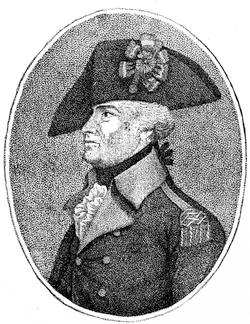
ANTHONY WAYNE.
From the New York Magazine, March, 1797, following a picture by Trumbull, now at New Haven. Other engravings are in the National Portrait Gallery (N. Y., 1834); Irving's Washington, quarto ed., vol. iii.; in Jones's Georgia, vol. ii., engraved by H. B. Hall; Lossing's Field-Book, ii. 177. It has been engraved by I. B. Forrest, J. F. E. Prud'homme, and others. A portrait by Henry Elonis is engraved by Geo. Grahame. A likeness, front face, without hat, is in the Mag. of Amer. History, Feb., 1886, and History of Chester County by Futhy and Cope. Cf. Penna. Archives, vol. x., and the sketch by J. W. De Peyster, and a new portrait in United Service, March, 1886, p. 304.
A view of Wayne's house is given in Egle's Pennsylvania, p. 540; Lossing's Field-Book, ii. 373; Harper's Mag., April, 1880.—Ed.
Washington moved from his quarters on the evening of October 3d. Sullivan commanded the troops that were to attack the enemy in front, and was followed by the reserve under Stirling, which Washington accompanied. Sullivan arrived at Chestnut Hill on the morning of the 4th at sunrise, and halted two hours to allow Greene to gain his ground, that the attacks might be made at the same time. Captain Allen McLane's company and a portion of Conway's brigade were then ordered to advance. They drove the guard at Mount Airy back on the light infantry, and held them in check while Sullivan formed his line. Wayne's division was on the east of the road, Sullivan's on the west. The whole under Sullivan then moved forward, driving the light infantry before them. A thick fog enveloped everything, and the men could not see forty yards in front of them. But Wayne's men dashed on, calling to each other to remember Paoli and crying for vengeance. The light infantry were reinforced by the 40th Regiment under Musgrave. Just then Howe rode up, calling out: "For shame, light infantry! I never saw you retreat before." But he found the attack was general, and rode back to the main line. Down the main street and past Chew's house Sullivan and Wayne pursued the flying troops. But here the rout of the British was checked by Agnew, who hastened forward with a portion of the left wing. As the reserve passed Chew's house they were fired upon by six companies of the 40th that had taken refuge there with their commander Musgrave. Stirling endeavored to dislodge them, but the effort was futile. Lieutenant-Colonel John Laurens and Major Louis Fleury daringly attempted to fire the house, but were unsuccessful. While this was going on, Greene made his attack on the right wing. His march had taken half an hour longer than anticipated, while he still met the enemy sooner than planned, as their first battalion of light infantry had been moved forward the night before on the Lime Kiln road. Greene attempted to advance in line of battle, but his line was thrown into confusion. He drove a portion of the troops back to the market-house, but when he encountered Grant he was obliged to retire, and a part of his command was captured. Woodford's brigade wandered so far from Greene's right as to reach the rear of Chew's house. It was then directly behind Wayne's division, and when the brigade fired on the house Wayne's men retired, as they supposed the enemy were in their rear. This uncovered Sullivan's flank, and he too was obliged to fall back. The British pursued until Whitemarsh was reached, where Wayne checked them with a battery posted on the hill, near the church. The Americans lost nearly eleven hundred killed, wounded, and prisoners; the British, five hundred and twenty-one. The American General Nash, of North Carolina, and the British General Agnew were mortally wounded. While the Americans were defeated in their object, the moral results of the battle were in their favor. It inspired them with confidence, and showed the world that though driven from the field of Brandywine they were still aggressive.
It was now evident to Howe that he must open communication with New York by water, or his army would be in a state of siege. His attention was therefore turned to the defences of the Delaware which were held by the Americans. The most formidable of these was Fort Mifflin, situated on an island in the river a short distance below the mouth of the Schuylkill. Opposite this, at Red Bank, on the Jersey shore, was Fort Mercer, while four or five miles below, at Billingsport, was another fortification. Opposite these points chevaux-de-frise were sunk in the channel, which were protected by the batteries and by a fleet of small vessels, known as the Pennsylvania navy, commanded by Commodore John Hazelwood. Besides these, there were several larger vessels which had been built by order of Congress.
On the 19th of October Howe withdrew his troops from Germantown and encamped them behind his lines of intrenchments on the north side of the city. Before this he had erected batteries to attack Fort Mifflin. He now sent a body of men, under Colonel Stirling, over the river from Chester to capture the fort at Billingsport. The garrison there was not sufficient for the defence of the fort, and as the British approached they evacuated the post. By the 21st Admiral Howe succeeded in passing the lower chevaux-de-frise, and his vessels sailed up the river to a point nearly opposite Fort Mifflin. On the same day three battalions of Hessians, with artillery, crossed into Jersey from Philadelphia to attack Fort Mercer. They arrived before the fort on the afternoon of the 22d. It was commanded by Colonel Christopher Greene, of Rhode Island, who had with him but six hundred men. The fortifications were unfinished, but a strong redoubt, with an abatis, had been constructed. Donop summoned the garrison to surrender, and upon receiving a refusal formed his regiments for the attack. They rushed upon the embankments and passed the abandoned lines with little opposition. But when they charged the redoubt, they were met with a fire that nearly filled the ditches with killed and wounded. Most of the men retired in confusion, and those who attempted to scale the works were beaten back in a hand-to-hand conflict. It was intended that the fleet should coöperate with Donop; that the "Vigilant", with sixteen 24-pounders, should pass to the west of Fort Mifflin, while other vessels should engage Hazelwood and prevent his offering assistance to Greene. The plan failed, however, at all points. The "Vigilant" could not sail up the west channel, and Hazelwood was more than a match for the vessels sent against him. He drove them back, while some of his boats sailed close to the shore and poured an effective fire into the flank of Donop's column. It was in vain that Donop and his officers re-formed the men and led them back to the attack. They were shot down in scores as they attempted to remove the abatis, and in three quarters of an hour from the time the engagement opened the men withdrew for the last time, leaving Donop behind them, mortally wounded. He died three days afterwards, "finishing", to use his own words, "a noble career early." His command had numbered about twenty-five hundred men, one sixth of whom were either killed or wounded. The Americans had but fourteen killed and twenty-three wounded. Two of the vessels which had been sent against Hazelwood, the "Augusta" and the "Merlin", ran aground, and were discovered in that position by the Americans on the 22d. They were at once attacked, and the magazine of the "Augusta" exploded with terrific force. She had been set on fire either by accident or by a shot from the American batteries, and blew up before all of her crew could be removed. It was found impossible to save the "Merlin", and she was fired by her officers and destroyed.
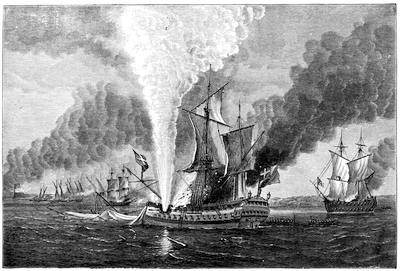
THE DESTRUCTION OF THE AUGUSTA.
After a painting in gallery of the Hist. Soc. of Pennsylvania, said to have been painted by a French officer. Cf. Wallace's Col. Wm. Bradford.
Taught caution by these reverses, Howe made no further effort to capture the forts until he had succeeded in erecting a number of batteries on the Pennsylvania shore within range of Fort Mifflin. On the 10th of November these were opened with serious result to the Americans. The reply from the fort was spirited, and the damage done to it in daytime was repaired during the night. On the first day, Colonel Samuel Smith, of Maryland, who commanded the garrison, was wounded, and was taken to Red Bank. The second in command, Lieutenant-Colonel Russell, was relieved, on account of ill-health, by Major Simeon Thayer, of Rhode Island, and the defence of the fort was continued. On the 15th the "Vigilant", carrying sixteen 24-pounders, and a hulk with three guns of the same capacity, succeeded in passing up the west channel and taking the fort in the rear, while other vessels engaged the fleet. The fort by this time was little more than a mass of ruins. The ammunition was nearly exhausted. Major Fleury, the engineer of the fort, and Major Talbot were wounded; nearly all the guns were dismounted, and whenever the men appeared on the platforms they were picked off by sharpshooters in the shrouds of the vessels. During the night of the 15th the garrison was removed to Red Bank, as preparations were being made to storm the place the next day, and on the morning of the 16th the British took possession of the place. The gallant defence of this fort by about three hundred men called forth commendations from all sides. Swords were voted to Hazelwood and Smith by Congress, while Fleury and Thayer were promoted. Fort Mercer was now the only water-defence held by the Americans. With the object of capturing it, on the 18th Cornwallis marched to Chester and crossed to Billingsport. Greene was sent to oppose him, and crossed the Delaware at Bristol; but before he could render any assistance to Varnum, who commanded the troops on the Jersey side of the river, that officer was obliged to retire before Cornwallis and abandon Fort Mercer, which the British now destroyed. Lafayette, who was with Greene, made a spirited attack on a body of Hessians encamped near Gloucester, for which he gained considerable credit. The majority of the small vessels of the Pennsylvania navy succeeded in passing up the river by the batteries that Howe had erected at Philadelphia, but the larger ones, together with nearly all those built by Congress, were destroyed.
A few days after the fall of Fort Mifflin the British transports made their way up to Philadelphia, and to some extent relieved the distress that the scarcity of provisions occasioned. About the end of October Washington removed his headquarters to Whitemarsh, and on November 24th reconnoitred the enemy's lines with a view to attack them. A majority of his officers, however, opposed the plan. It was soon evident that Sir William Howe was about to resume the offensive, and Greene was recalled from Jersey. On the evening of December 4th, Howe, with nearly all his army, marched out of Philadelphia with the avowed intention of driving Washington over the mountains. His advance-guard arrived at Chestnut Hill about daylight the next morning. General James Irvine with the Pennsylvania militia met them at the foot of the hill, and, after a sharp skirmish, the militia fled, leaving Irvine wounded in the hands of the British. When Howe arrived in front of Washington's lines he found them so strong that he did not dare to attack them, and after spending four days in endeavoring to gain a position that would compel Washington to attack him, he suddenly gave up the design and returned to the city.
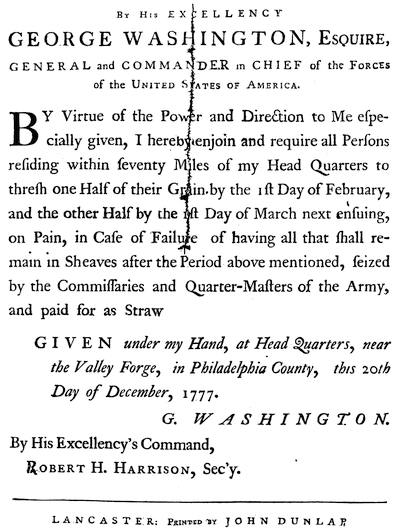
As the season was advancing, and the Americans were in no condition to keep the field, it was decided to go into winter-quarters at Valley Forge, on the west side of the Schuylkill, where the Valley Creek empties into the river. The surrounding hills were covered with woods and presented an inhospitable appearance. The choice was severely criticised, and De Kalb described it as a wilderness. But the position was central and easily defended. The army arrived there about the middle of December, and the erection of huts began. They were built of logs, and were fourteen by fifteen feet each. The windows were covered with oiled paper, and the openings between the logs were closed with clay. The huts were arranged in streets, giving the place the appearance of a city. It was the first of the year, however, before they were occupied, and previous to that the suffering of the army had become great. Although the weather was intensely cold the men were obliged to work at the buildings, with nothing to support life but flour mixed with water, which they baked into cakes at the open fires. "My brigade's out of provisions, nor can the commissary obtain any meat", wrote Huntington on the 22d of December. "Three days successively we have been destitute of bread", said Varnum the same day, "and two days we have been entirely without meat." Soap, vinegar, and other articles necessary for the health of the men were never furnished, and so imperfectly did the clothier-general perform his duties that many of the men were without shirts, and hundreds were confined to the hospitals and farm-houses for want of shoes. Blankets and proper coverings were so scarce that numbers, after toiling during the day, were obliged to sit by the fires all night to keep from freezing. By the 23d of December two thousand eight hundred and ninety-eight men were unfit for duty, because they were barefoot and otherwise naked. The horses died of starvation by hundreds, and the men were obliged to haul their own provisions and firewood. As straw could not be found to protect the men from the cold ground, sickness spread through their quarters with fearful rapidity. "The unfortunate soldiers", wrote Lafayette, in after-years, "were in want of everything; they had neither coats, hats, shirts, nor shoes; their feet and their legs froze till they became black, and it was often necessary to amputate them.... The army frequently remained whole days without provisions, and the patient endurance of both soldiers and officers was a miracle which each moment served to renew." At times, however, it seemed as if the forbearance of the men was exhausted, and that the war would end in mutiny. But the officers succeeded in allaying the feelings of discontent, and under the management of Greene, who assumed the duties of quarter-master-general on the 23d of March, a change for the better took place.
While the country around Valley Forge was so impoverished by the military operations of the previous summer as to make it impossible for it to support the army, the sufferings of the latter were chiefly owing to the inefficiency of Congress. That body met at Lancaster after leaving Philadelphia, and at once adjourned to York, where its sessions were continued. But it in no way equalled the congresses which had preceded it. "The Continental Congress and the currency", wrote Gouverneur Morris in 1778, "have greatly depreciated." Many of the members entertained the widespread fear of a standing army, and refused to follow the advice given by Washington for the relief of the men who defended them. Some of the delegates, indeed, did not hesitate to criticise the judgment of Washington, and question his abilities. The capture of Burgoyne gave them an opportunity of comparing the results of the Northern and Southern campaigns. In writing of Washington's army a member of Congress said to Gates: "We have had a noble army melted down by ill-judged marches, which disgrace their authors and directors, and which have occasioned the severest and most just sarcasm and contempt of our enemies. How much you are to be envied, my dear general! How different your conduct and your fortune! In short, this army will be totally lost unless you come down and collect the virtuous band, who wish to fight under your banner, and with their aid save the southern hemisphere. Congress must send for you." "I am weary", exclaimed John Adams, "with so much insipidity." "I am sick of Fabian systems in all quarters." It was a matter for thanksgiving, he thought, that the credit of defending the Delaware was "not immediately due to the commander-in-chief nor to Southern troops. If it had been, idolatry and adulation would have been unbounded." The prevalence of these sentiments made it easy for disappointed soldiers like Mifflin and Conway to spread dissensions which, if they had been allowed to grow, would have brought about the removal of Washington. Mifflin's eloquence and abilities as a politician far exceeded his merits in the field; and he was jealous of the preference shown by Washington for Greene and Knox. Conway aspired to a major-generalship, and was chagrined that Washington opposed him. If Washington had been removed and Lee or Gates appointed in his place, Mifflin and Conway would have been benefited by the change. The schemes of the last two were warmly supported by James Lovell and Dr. Benjamin Rush, and the most insidious measures were entered upon to undermine the reputation of Washington. Anonymous letters were circulated for this purpose, and the country was made to ring with the cry that, under a Gates, a Lee, or a Conway, the Southern army would be victorious. Through the influence of this faction, Gates was made president of the Board of War, of which Mifflin was a member, and authority which belonged to the commander-in-chief was vested in it. To separate Lafayette from Washington, and gain for themselves the influence of his name, the "Cabal", as it has been called, proposed an impracticable winter campaign against Canada, which Lafayette was to command, with Conway to assist him. But here the faction spent its strength. The friends of Washington had been put on their guard by the disclosure of a correspondence which showed the malignity of his enemies. Wilkinson, who was on Gates's staff, repeated, while his tongue was loosened with wine, an opinion expressed in a letter that Conway had written to Gates. Gates read it to his military family. "Heaven has been determined to save your country", it said, "or a weak general and bad counsellors would have ruined it." The words reached Washington, who enclosed them to Conway, simply informing him that he understood they formed a portion of a letter of his to Gates. It was in vain that the members of the Cabal attempted at first to carry the matter through with a high hand, then to deny that such a letter had ever been written, and finally to excuse themselves. Their ends were discovered and their power was gone. Lafayette would have nothing to do with the Canadian expedition unless De Kalb was made his second in command. He repaired to Albany only to find that no measures had been taken to carry out the promises made him, and as the friends of Washington were soon in the ascendency in Congress, Lafayette was recalled to Valley Forge.
Through the advice of a committee which Congress had sent to camp to inquire into the condition of the army, many defects and abuses were corrected, and its organization was improved. The new troops that had been called for came in slowly, but their effectiveness was increased through the exertion of Baron Steuben, who joined the army about the close of February. A pupil of Frederick the Great, and a distinguished officer in the Prussian service, he won the esteem of Congress by offering to serve as a volunteer. His experience and industry soon instilled a discipline into the army which it had never known, and in May he was made inspector-general, with the rank and pay of a major-general.
While the American army was suffering at Valley Forge the British were comfortably quartered in Philadelphia. When they first entered the city it presented a sorry appearance: 590 dwellings and 240 stores were unoccupied; the leaden spouts of many houses had been taken down to mould into bullets, and the bells of the churches and public buildings had been removed to places of safety. The male population between the ages of eighteen and sixty numbered but 5,335, and of these one fifth were Quakers. The feelings of the Quaker citizens had been greatly outraged by the arrest and banishment to the western part of Virginia of a number of their people. Sullivan had discovered on his march through New Jersey what he believed to be a treasonable correspondence on their part with the enemy, and he had forwarded the papers to Congress. The matter had been referred to the authorities of Pennsylvania, who found in the correspondence, and in an address issued by the Quaker meeting in December, the grounds for sending the Quaker leaders into exile. It was but natural that the families of these men should have looked upon the British as their deliverers from an outrageous tyranny. But they soon found to their sorrow that their opposition to war afforded them as little protection from one side as from the other. The property destroyed by the British was enormous, and a revulsion of feeling was the consequence. At one time seventeen handsome houses beyond the lines were set on fire to prevent their being occupied by the American pickets. Persons living in the neighborhood of the city were robbed by both parties, and their crops carried off or destroyed. The temptation to sell their produce for hard money induced some of the neighboring farmers to supply the enemy with luxuries, though they found access to the city hazardous. The Americans under Smallwood guarded the roads leading to Wilmington, while Generals Potter and Lacy scoured the country west and north of the city. Captains Allen McLane, Clark, and Lee watched the movements of the enemy and reported them to Washington, but they could not oppose the large forces that Howe frequently sent out to protect those who were willing to risk furnishing him with provisions.
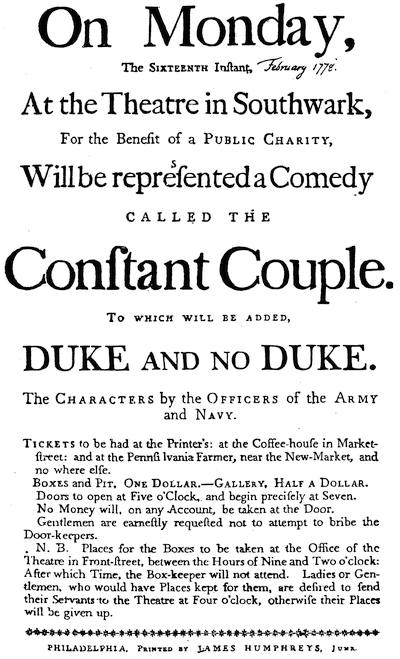
Note.—The play-bill on the opposite page is after a fac-simile given in Smith's Amer. Hist. and Lit. Curios., 2d series. A list of such bills printed in Philadelphia at this time is given in Hildeburn's Issues of the Press in Penna., ii. pp. 315, 316.
The desolation which surrounded the town was soon in striking contrast with the scenes within. The empty stores were occupied by itinerant traders from New York, who offered for sale articles of luxury that the war had driven from the American market. The officers of the army were quartered on the citizens, and after the campaign closed they gave themselves up to social enjoyments. Clubs met at the public-houses, and weekly balls were given at the City Tavern. As many of the officers were men of education and refinement, they were warmly welcomed in the families of leading citizens; but there was another class who did much to change the moral aspect of the city, when, by following the loose example of their commander, Sir William Howe, they shocked the staid citizens with their immorality. Cock-fighting and gambling were favorite amusements, and a faro-table kept by a foreigner proved the ruin of many young officers. The theatre on South Street was fitted up under directions of Captains André and De Lancey. Some of the scenes were painted by André. The profits of the performances were divided among the widows and orphans of the soldiers. As spring approached, horse-racing was added to the list of amusements. While citizens of wealth could take part in the gaieties which surrounded them, those in moderate circumstances suffered privations. Firewood was extremely scarce and provisions high. "Nothing but hard money will pass", wrote a resident to a relative outside of the lines. "There is plenty of goods, but little money among the tradespeople. The market is poor. I received the butter by J——; we are no longer accustomed to eat butter on our bread. I keep it to make water soup, which we have nearly every day." The army of occupation, on the other hand, was plentifully supplied with military stores after the defences on the Delaware were captured.
Martial law ruled supreme. The appointment of Joseph Galloway to be superintendent of police and the designation of magistrates under him were the only steps taken towards the revival of civil authority, and Galloway received his orders from headquarters.
The supineness of Howe robbed the British of all the benefits that might have resulted from the capture of Philadelphia. Attempts were made to raise regiments of loyalists, but so little support did the scheme receive that it was only partially successful. The "Pennsylvania Loyalists", of which William Allen, Jr., was colonel, and the "Queen's Rangers", commanded by Lieutenant-Colonel Simcoe, were the most efficient of these corps. No attempt was made to drive Washington's half-starved forces from their camp, although their condition was perfectly well known to Howe through the deserters that flocked to the city. The military movements of Howe while in Philadelphia were confined to foraging expeditions and attacks on isolated posts that could be surprised and broken up with little danger of loss. While these were successful, they gave to the war a predatory character that reflected little credit on British arms, and intensified the bitterness entertained for all representatives of royal authority.
The British government, dissatisfied with the results of Howe's campaigns, decided early in 1778 upon his recall. Sir Henry Clinton, his successor, arrived in Philadelphia the 8th of May, and on the 18th an entertainment was given by the officers of the army in honor of the retiring commander. The fête was styled the "Mischianza", and consisted of a regatta, a mock tournament, and a ball. But "Knights of the Burning Mountain" and of the "Blended Rose", with squires and ladies decked with spangles and ribbons, could not disguise the fact that the royal army had failed in accomplishing the task assigned to it, and the chagrin of its veterans was deepened by the frivolous scenes which marked the retirement of Sir William Howe.
The alliance with France made it necessary for the British to contract their operations, and Sir Henry Clinton brought with him orders to evacuate Philadelphia. His intention of doing so became known to Washington, and that his information might be more certain he ordered Lafayette, with a body of two thousand four hundred men, the flower of the army, to cross the Schuylkill and take a position near the city. This movement was made on the very day of the Mischianza, and on the morning of the 19th Howe learned that Lafayette was at Barren Hill, twelve miles distant. Clinton had not yet assumed command, and in the hope of closing his career in America by a brilliant stroke, Howe determined to make an effort to capture the young Frenchman and his detachment. So confident was he of doing this, that, before leaving the city, he invited his friends to meet Lafayette, whom he promised to bring with him on his return, while his brother, the admiral, prepared a vessel in which to take the distinguished captive to England. On the night of the 19th Grant, with five thousand men, marched by way of Frankford and Oxford, and by morning he had gained a point on the Swedes Ford road two miles in the rear of Lafayette. Another detachment, under Grey, was sent by way of Chestnut Hill to attack Lafayette's flank; while the main portion of the army, under Howe, took the Ridge road, to attack him in front. Lafayette's position was on high ground, and was naturally strong. Neither Grey nor Howe could approach him without his being aware of their advance. In his rear were two roads. One led along the riverside to Matson's Ford, three miles distant; the other along a ridge, a short distance from the river, to Swedes Ford, still higher up. The ground between the roads was heavily wooded. Had Grant, who held the Swedes Ford road, sent a portion of his force to Matson's Ford (which he could have done by a cross-road), Lafayette's only line of retreat would have been destroyed. But in place of doing this he marched down the Swedes Ford road to attack the American rear. Through the carelessness of his scouts, Lafayette was ignorant of Grant's position. He was preparing his force to receive Howe, when he heard of the column advancing from Chestnut Hill. He had just faced a portion of his troops in that direction when he learned that Grant was in his rear. Lafayette's danger was now apparent, but he was equal to the occasion. Without losing a moment, he sent troops through the woods, with orders to allow themselves to be seen at times by Grant, and lead him to suppose that they were the advance-guards of larger numbers. He also left a small body to engage the attention of Howe and Grey, and then silently marched his detachment along the river road, below Grant, to Matson's Ford. Grant was entirely deceived. He halted his men, reconnoitred the troops seen in the woods, and then pushed on to Barren Hill, where he met the other columns and discovered that Lafayette had escaped. The British pursued him to the ford, but by the time they reached it Lafayette had drawn up his force on the other side, and his rear-guard could be seen following him, dotting the river like the corks of a seine. Fearing that Lafayette had been reinforced by the entire American army, Howe made no attempt to follow him, but returned to the city, and on the 24th sailed for England.
The evacuation of Philadelphia was now only a question of time, and the news that it had been decided upon was appalling to the Tory citizens who had openly committed themselves to the royal side. In their despair they offered to raise three thousand men, if two thousand of the royal army could be left in addition, to protect the city. Howe had advised some of them to make terms with Congress, but those who had been most active in serving him decided to leave with the army. One hundred and eighty transports arrived in the Delaware, and such diligence was used in loading them that for days light carts drawn by soldiers, and every kind of carriage, from wagons to wheelbarrows, were constantly rolling between the houses and the river. As fast as the transports received their cargoes they dropped down the river. The defences were dismantled. On the 30th of May bodies of troops were thrown across the Delaware to protect the passage of the army. Everything was now ready for the departure of the British, but the final movement was delayed for a few days on account of the arrival of the commissioners appointed under the conciliatory bills of Parliament. At last, on the morning of June 18th, the men were withdrawn from the lines and marched below the city, where they were embarked upon boats and taken over to Gloucester. This was done so quietly that many of the citizens were not aware of the departure of the army until they noticed the absence of the redcoats in the streets. "They did not go away", wrote a resident, "they vanished."
By narrowly watching the movements of the enemy Washington was convinced that it was Clinton's intention to march the greater part of his army across Jersey. In this opinion he was opposed by the erratic Charles Lee, who had been exchanged, and had reached the camp. Lee could not believe that the British would give up Pennsylvania, and argued that it was more probable that they would strike at Lancaster, or possibly cross the lower Susquehanna and take up a position on its west bank. Before this, however, Washington had sent all of the Jersey troops into that State. He had put them under the command of Maxwell, with directions to coöperate with Dickinson, who commanded the militia, in opposing any attempt Clinton should make to cross the State. On the 18th of June George Roberts rode at full speed into camp at Valley Forge. He had been at the ferry over the Schuylkill at Market Street, and citizens on the Philadelphia side had shouted over the water that the British had gone. They had destroyed the bridge, so that he was unable to cross, but the intelligence could be relied upon. Shortly afterwards a letter was received from Captain Allen McLane confirming the news. He had ridden into the city from the north, and had picked up some stragglers.
Washington had everything in readiness to move the army at a moment's notice. Six brigades were immediately put in motion, and the remainder of the army followed the next day. Crossing the Schuylkill at Valley Forge, Washington marched directly for Coryell's Ferry on the Delaware, which he crossed on the 22d. He now sent a picked corps under Morgan to assist Maxwell. At Hopewell a council of war was held. Lee opposed any attack, and argued that, on military grounds, rather than delay the British, he would build a bridge of gold to facilitate their march. He so successfully urged his views that it was decided to move on a line parallel with the enemy, and send only a detachment of fifteen hundred men under Scott to aid Maxwell in annoying their flanks. Greene, Lafayette, and Wayne protested against the decision of the Council, and as their views agreed with Washington's, and were supported by Steuben and Du Portail, Washington determined to attack Clinton if an opportunity offered. For this purpose he moved his army to Kingston, whence he could strike at Clinton's line if he attempted to cross the Raritan. He also sent Wayne with a thousand men and Poor's detachment to join Scott and Maxwell. The command of this body belonged to Lee, but as he did not approve of the change in the plans, he declined it in favor of Lafayette. Subsequently, however, Lee claimed it, and to relieve Washington from an embarrassing position, and save Lee's feelings, Lafayette magnanimously yielded. The Jersey militia had turned out in a spirited manner, and under Dickinson and Forman were doing all in their power to retard Clinton's advance. They destroyed the bridges as they retired from Haddonfield to Mount Holly, and filled up the wells so that the enemy could not obtain water. The heat was intense and the British suffered severely. Clinton arrived at Crosswicks on the 23d, just in time to save a bridge over the creek at that place. There he learned that Washington was in Jersey, and would soon be on his flank if he continued to march in his present direction. Encumbered as he was with a baggage train twelve miles long, Clinton knew it would be impossible to protect it in crossing the Raritan. He determined, therefore, to march by the way of Freehold to the Neversink Hills, from which place he could embark his army for New York. Morgan and Maxwell hung on his rear from the time he left Crosswicks, and to protect his baggage Clinton sent it to the head of the column. As he approached Freehold, he knew from the frequency with which troops were seen on his left that he was in close proximity to the American army. He arrived at Freehold, where the court-house of Monmouth County is situated, on the morning of the 26th, and there encamped. The head of his column extended a mile and a half beyond the court-house on the road to Middletown. His left was on the road just marched over from Crosswicks to Freehold. The village was entered on the west by a road leading to Cranberry. It passed over low ground that was intersected by several swamps and ravines, which, with woods, completely covered the left of Clinton's line. The American army reached Cranberry, eight miles from Freehold, on the morning of the 26th. On account of a violent storm it was obliged to halt there, but the advance under Lee was within five miles of the enemy. When Washington heard of Clinton's position he ordered Lee to prepare a plan to attack him as soon as he resumed his march, unless it should prove that there were strong reasons for his not doing so. On the evening of the 27th Lee called his officers together only to tell them that no plan could be decided upon until the field was reached. At sunrise on the morning of the 28th, Knyphausen, with the baggage, began his march towards Middletown. At eight o'clock he was followed by the rest of the army. Scarcely had the rear-guard moved from its ground when it was fired upon by the militia under Dickinson. The militia were forced to retire, and as they did so were met by Lee's detachment as it advanced from Englishtown. On account of conflicting information the Americans halted for a short time, and then engaged the enemy and drove them towards their retreating columns. As matters were growing serious, Clinton reinforced his rear-guard, and the fighting promised to become general. But Lee had no faith in the ability of the Americans to cope with the British, and as the latter occupied strong ground he withdrew his men. From the time Clinton began his march across Jersey, Lee had contended that all the Americans could hope to do was to fall upon some isolated party of the enemy and either rout or capture it. To effect this he endeavored to draw the rear-guard of the British across the ravines intersecting the low ground west of Freehold, and while they were thus separated from the main body to defeat them. But his men could not understand his strategy. As they were withdrawn from one position after another they lost heart. It seemed to them that they were flying from a shadow, and so frequently were they ordered back that the retreat became rapid and confused. When Washington heard that Dickinson had engaged the enemy he again sent word to Lee to attack them also, unless there were powerful reasons for the contrary, and he would support him with the entire army. The day was excessively hot, and the men threw off their knapsacks that they might march more quickly. As they came to the church which stands between Englishtown and Freehold, stragglers were met who told them that Lee was retreating. Unwilling to believe the story, Washington spurred to the front to learn the truth. After passing the ravine which borders the low ground we have spoken of, on the west, he met Lee and his men in full retreat. A stormy scene ensued. Overwhelmed by the indignation which Washington manifested, Lee vainly endeavored to excuse his conduct. Little time, however, was lost in wasting words. Calling upon Colonels Stewart and Ramsey, who were near him with their regiments, to check the enemy, then but two hundred yards distant, Washington crossed the ravine in his rear, and formed his men as they came up on its western bank. Greene was placed on the right and Stirling on the left, while Wayne remained east of the ravine in front of Greene. In this position a severe engagement took place. Encouraged by the retreat of Lee, Clinton sent additional reinforcements to his rear, and vainly strove to drive Washington from his chosen ground. A battery under the Chevalier de Mauduit Duplessis, planted on an elevation on Greene's right, kept up an effective fire on the enemy's left, while Wayne repelled a desperate charge led by Lieutenant-Colonel Monckton, in which that officer fell at the head of his men. Night ended the conflict, and both parties slept on the ground which they had occupied. At midnight Clinton withdrew his troops, and, leaving his dead unburied, resumed his march to Middletown. He retired so silently that Poor, who lay close to his right, was not aware of the movement, and on the morning of the 29th the Americans found themselves alone on the field. By daybreak Clinton was on too strong ground to be attacked, and after resting his men a few days Washington marched to the North River, and Clinton embarked for New York.
The battle of Monmouth, as the conflict at Freehold was called, was the last general engagement fought on Northern soil. The Americans had 229 killed and wounded, the British over 400. Besides this, the latter lost many by desertion on their march, and numbers fell from the effects of the heat, which registered ninety-six degrees on the day of the battle.
Lee's conduct would probably have passed unnoticed had he not, in a letter to Washington, endeavored to defend himself, while he demanded the grounds which called forth the remarks addressed to him on the battlefield. The letter was written in a highly improper spirit, and the result was a court-martial, that found Lee guilty of disobedience of orders, misbehavior before the enemy, and disrespect of the commander-in-chief. For these reasons he was suspended from command for twelve months, and before he was again ordered to service he was dismissed from the army for having written an impertinent letter to Congress.
Before leaving Valley Forge, Washington directed General Arnold, who had not fully recovered from the wounds received at Saratoga, to proceed to Philadelphia and take military command of the city. The duties assigned him were of a delicate nature. Congress had ordered that when the Americans took possession of the city no goods should be sold or removed until their ownership had been decided upon by a properly constituted commission. The object of this was to secure for the army such goods as the British and Tories might have abandoned or parted with at nominal prices to their friends. In his instructions to Arnold, Washington had referred him to the resolutions of Congress for his guidance, and had urged him to take every step in his power to preserve tranquillity and give security to individuals of every class until the restoration of civil power. Arnold arrived on the morning of the 19th of June, and with the approbation of several of the principal citizens issued a proclamation that closed the stores and suspended business. It also commanded the citizens to make returns to the town major of goods in their possession, beyond those needed for family use, that the purchasing agents of the army might contract for those they required. The temptation to benefit himself by the power he now exercised was greater than Arnold could withstand, and three days after he issued his first proclamation he entered into an agreement with the clothier-general of the army and another individual, that all goods purchased for the public and found to be superfluous should be charged to them and sold for their joint account. It soon became noised about that Arnold was personally interested in the purchases ostensibly made for the government, and although the secret of the agreement was preserved until after his treason, the knowledge of his speculations in Montreal gave such a color of truth to the rumor that the community were greatly dissatisfied: besides, he took up his abode in a spacious mansion on Market Street, formerly the residence of Governor Penn, which Howe had just vacated, and entered upon a style of living far beyond his means.
When the exiled Whigs returned to their homes they found the city in a filthy condition, and its surroundings a scene of desolation. The houses in the built-up portions of the city were not much injured, but many of them had been stripped of their furniture, and the papers were filled with advertisements of missing articles which the owners hoped to recover. The Supreme Executive Council resumed its sessions in Philadelphia on the 26th of June. Its patriotic president, Thomas Wharton, Jr., had died at Lancaster the month previous, and it was presided over by the vice-president, George Bryan. The Congress assembled more slowly. On the 2d of July a few delegates gathered in the State House, and two days afterwards celebrated the anniversary of Independence at the City Tavern; but it was not until the 7th that a sufficient number were present to conduct business. On the 12th, Gérard, the French ambassador, arrived. Until a suitable residence could be found for him he was the guest of Arnold. Congress received and entertained him on the 6th of August. No opportunity was lost of honoring the new ally. On the birthday of Louis XVI. the president and members of Congress called upon his ambassador and offered their congratulations, and on the 25th were in turn entertained by Gérard.
In the midst of their rejoicings the Whigs did not forget the Tories, whom they looked upon as promoters of their sufferings. Many of them had been attainted of treason while the government was at Lancaster, but the most obnoxious had gone off with the British. Such as remained were summoned before the authorities, and so great was the clamor against them that several were executed for aiding the enemy. The new Constitution had been put into effect, but it was opposed by a number of conscientious Whigs, and its administration was largely in the hands of new men, who did not command universal respect. The depreciation of the currency had also a demoralizing effect. Speculation ran wild, and the greatest extravagance prevailed. The prices of all kinds of commodities rose to enormous figures, and the attempts of Congress to regulate them by law and fix the value of the currency only served to increase the evil. The community was soon divided into two classes. The Anti-Constitutionalists and the Tories formed one party; the supporters of the new government the other. The latter zealously advocated all the measures of Congress, and, classing their opponents under the one head of "Tories", accused them of being the authors of all the difficulties that embarrassed the government; it was through their efforts that traitors were allowed to go unpunished, and the necessaries of life locked up so that higher prices could be wrung from the people. "Party disputes and personal quarrels", wrote Washington from Philadelphia, in December, "are the great business of the day; whilst the momentous concerns of an empire, a great and accumulating debt, ruined finances, depreciated money, and want of credit ... are but secondary considerations." "Our money", he continued, "is now sinking fifty per cent. a day in this city; and yet an assembly, a concert, a dinner, or a supper, that will cost three or four hundred pounds, will not only take men off from acting in this business, but even from thinking of it."
It was in a community thus rent by faction and passion that Arnold commanded. The early restoration of civil power limited his authority, but his arrogance soon brought him in conflict with the new government. Unable to brook the restraint it put upon him, he joined its opponents, and was soon the centre of a gay and fashionable circle that gladly added so distinguished a soldier to their number. Arnold at that time was a widower, in his thirty-eighth year. He was of a susceptible nature, and before long fell in love with Miss Peggy Shippen, the daughter of Edward Shippen, a leading lawyer of character and position, whose political opinions caused him to be numbered among the disaffected. In this company the temptations to spend money were not easily resisted, and Arnold soon yielded to them. He gave elegant entertainments, and lived ostentatiously, if not extravagantly. He was soon involved in debt, and in the hopes of extracting himself entered into questionable speculations. His quarrel with the state authorities became more bitter, and in February, 1779, the Council published a series of charges which were referred to Congress. The committee who considered them failed to find Arnold guilty of any intentional wrong, and on the 19th of March he resigned the command of Philadelphia, and on the 8th of April was married to Miss Shippen. The Pennsylvania authorities were dissatisfied with the action of the committee of Congress, and succeeded in having the case reconsidered. After considerable delay, it was determined that the whole matter should be referred to a court-martial, to be appointed by the commander-in-chief. The court met in December, and the following month found Arnold guilty of two of the charges that had been preferred against him. The most serious one, that of speculating in goods bought for the public while the stores were closed, was not sustained for want of evidence, which was not discovered until after his treason. The acts he was found guilty of were indiscretions rather than crimes; and for these he was sentenced to be reprimanded by the commander-in-chief.