Chapter I · (continued 3)
Reading edition
For the local feeling in Philadelphia and among the members assembled there at the time, see John Adams's diary, Ward's diary,[281] and Christopher Marshall's diary.
The original edition of the Journal of the Proceedings of the Congress held in Philadelphia, Sept. 5, 1774 (Philad., 1774), bore the earliest device of the colonies, twelve hands grasping a column based on Magna Charta, surmounted by a liberty cap with the motto Hanc tuemur.[282]
What we know of the debates, apart from the proceedings, is chiefly derived from some brief notes by John Adams.[283]
The Congress put forth a Declaration of Rights, and a draft of it is preserved in a hand thought to be that of Major Sullivan, of New Hampshire. Wells (Sam. Adams, ii. 234) thinks that Samuel Adams had a hand in it, as it resembles the pamphlet issued by the Boston Committee of Correspondence in 1772. The original draft of it, with the final form, is given in the Works of John Adams,[284] who claimed the authorship of article iv.
The petition of Congress to the king was drafted by John Dickinson.[285] It was signed in duplicate, and both copies were successively sent to Franklin, one of which is in the Public Record Office, and the other, retained by Franklin, is among the Franklin MSS. in the library of the Department of State at Washington.[286]
The petition to the king was first printed in London by Becket in Authentic Papers from America, submitted to the dispassionate consideration of the public (London, 1775). This produced a card (Jan. 17, 1775) from Bollan, Franklin, and Arthur Lee, calling the copy of the petition "surreptitious as well as materially and grossly erroneous" (Sparks Catal., p. 84).
It is sometimes said that R. H. Lee, and sometimes that John Jay, wrote the "Address to the People of Great Britain" which the Congress adopted.[287] They also passed a "Memorial to the inhabitants of the colonies."[288]
On the 9th of September the people of Boston and the neighborhood met outside the limits of the town, and passed a paper, drawn up by Joseph Warren, more extreme and less dignified than was demanded, known as the "Suffolk Resolves",[289] and this was transmitted to the Congress, where, when the Resolves were read, as John Adams says, there were tears in the Quaker eyes. Jones[290] says that the loyalists had joined the Congress to help in claiming redress for grievances, but that the approval of these Resolves rendered their continuance with the Congress in its measures impossible. Hutchinson[291] says that when the Resolves were known in England, they were more alarming than anything which had yet been done.[292]
On Sept. 28th Joseph Galloway introduced his plan of adjustment, calling for a grand council to act in conjunction with Parliament in regulating the affairs of the colonies. The scheme was finally rejected by a vote of six colonies to five, after having allured many of the leading men to its support.[293]
The Congress, Oct. 20th, adopted the Articles of Association, pledging in due time the country to non-importation, non-exportation, and non-consumption, so as to sever completely all commercial relations with England.[294]
In the summer of 1774 the British Parliament had, after some opposition, passed what is known as the "Quebec Bill", restoring the old French law in the civil courts of Quebec, securing rights to the Catholic inhabitants, and extending the limits of that province south of Lake Erie as far as the Ohio.[295]
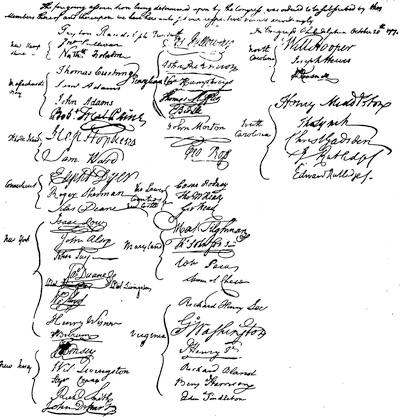
CONGRESS OF 1774.
The debates[296] in Parliament caused much diversity of opinion, and gave rise to a number of pamphlets.[297] The Congress of 1774 sought to counteract this action by an address to the inhabitants of Quebec, which was distributed both in English and French.[298]
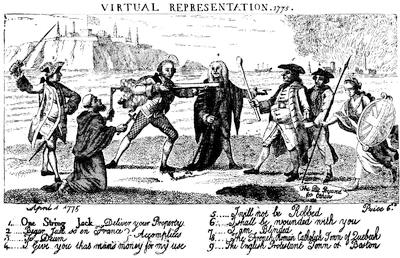
Pownall in London told Hutchinson that every step of the Congress was known to the ministry.[299] We know that Dartmouth, probably through Galloway, received accounts of the temper of the delegates,[300] and that Joseph Reed was in communication with Dartmouth at the time.[301]
The revolutionary measures advocated by the Congress were far from receiving general acceptance,[302] and in New York they elicited some sharp and vigorous controversial pamphlets.[303] It was the general opinion at the time that Samuel Seabury was the author of two of the ablest of these tracts, though the claims for their authorship are now divided between Seabury and Isaac Wilkins, while each may have assisted the other in a joint production[304] which rendered at this time the name of a "Westchester Farmer" famous.[305]
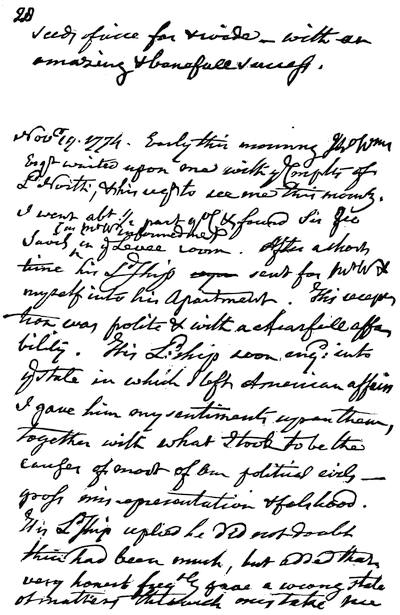
JOSIAH QUINCY'S DIARY.
This is reproduced from a page of the diary of Josiah Quincy, Jr., which was kept while he was in London in 1774. It is the beginning of his description of an interview with Lord North. The original diary is among the Quincy MSS. in the cabinet of the Mass. Hist. Society. Quincy had sailed from Salem Sept. 28, 1774, and was not averse to having the Tories think that he was going for his health; but Gage seemed to have had a suspicion that about this time somebody was going over with bad designs (P. O. Hutchinson, 296). We learn from the same source (p. 301) that North thought his interviewer was "a bad, insidious man, designing to be artful without abilities to conceal his design",—a view that Hutchinson no doubt had helped the minister to form. With Quincy's spirit, we can imagine how North's warning that there must be submission before reconciliation would be taken. There was some suspicion also that Quincy was making observations upon Franklin to discern how far that busy genius could be trusted. Franklin seems to have satisfied him, and on his homeward voyage Quincy dictated to a sailor the report to the patriots that he had every reason to fear he would not live to deliver in person, as indeed he did not. It is preserved, and printed in his Life, where will be found his journal kept in London. Joseph Reed's letters to him, while in London, are in The Life of Joseph Reed, i. 85, etc. Quincy made out lists in London of the friends and foes of America among the merchants. Cf. letter of William Lee, April 6, 1775, in Sparks MSS., xlix. vol. ii.
Another leading Tory writer at this time was Dr. Myles Cooper, the president of King's College, who was as sharply assailed for his Friendly Address[306] as the "Westchester Farmer" was.
Something of an official character belongs to A true state of the proceedings in the Parliament of Great Britain, and in ... Massachusetts Bay, relative to the giving and granting the money of the people of that province, and of all America, in the House of Commons, in which they are not represented (London, 1774), for Franklin is said to have furnished the material for it, and Arthur Lee to have drafted it.[307]
One of the most significant of the American tracts of 1774 was John Dickinson's Essay on the constitutional power of Great Britain over the colonies in America.[308]
The journals of the provincial congress of Massachusetts (1774-1775) are in the Mass. Archives (vol. cxl.), and have been printed as Journal of each Provincial Congress of Mass. 1774-75, and of the Com. of Safety, with an Appendix (Boston, 1838). The proceedings of the session of Nov. 10, 1774, were circulated in a broadside.
In England we have the debates of Parliament, such correspondence as is preserved, and the records of passing feeling, to help us understand the condition of public opinion.[309]
The Assembly of New York met in January, 1775. Dawson contends that the usual view of the loyal element controlling its action is not sustained by the facts, and that in reality neither patriot nor Tory was satisfied with its action.[310]
The feeling in Virginia is depicted in Giradin's continuation of Burk's Virginia (which was written under the cognizance of Jefferson), in Rives's Madison, and in Wirt's Patrick Henry.[311]
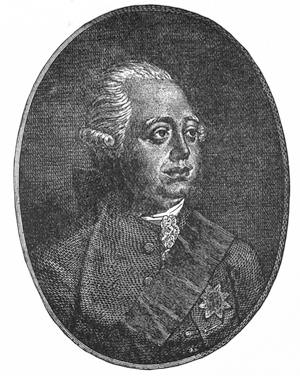
LORD NORTH.
From Murray's Impartial History of the Present War, i. 96. Cf. London Mag. (1779, p. 435) for another contemporary engraving.
The Congress of 1775 met in Philadelphia, May 10th. Quebec had been invited to send delegates.[312] Lieut.-Gov. Colden kept the majority of the New York Assembly from sending delegates.[313] John Hancock was chosen president, May 24th.[314]
The proceedings are given in the Journals of Congress.[315]
Perhaps the best expression of argumentative force on both sides was reached in the controversy waged by John Adams against Jonathan Sewall, as he always supposed, but in reality against Daniel Leonard, of Taunton, as it has since been made evident.[316]
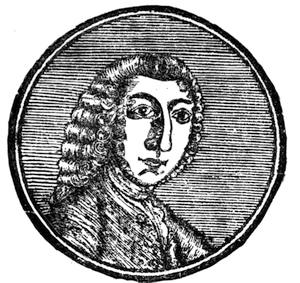
CHATHAM.
From the title of Bickerstaff's Boston Almanac for 1772,—the common popular picture of him. Cf. the head in Gentleman's Mag., March, 1770.
In 1768, Edmund Jennings of Virginia, being in London, and seeking, probably unsuccessfully, to get a portrait of Camden for some "gentlemen of Westmoreland County" who had subscribed for that purpose, contented himself with commissioning young "Peele, of Maryland", then in London, to make a picture of Chatham, following "an admirable bust by Wilton, much like him, though different from the common prints." Jennings presented it to R. H. Lee in a letter dated Nov. 15, 1768, and the Virginia Gazette of April 20, 1769, says it had just arrived. The picture was placed in Stratford Hall, Lee's house, but was transferred to the Court-House of Westmoreland in 1825, or thereabouts. In 1847 it was transferred to the State of Virginia, and placed in the chamber of the House of Delegates in Richmond, where it now is. It represents Chatham "in consular habit, speaking in defence of American liberty." Cf. Va. Hist. Reg., i. p. 68; Richmond Despatch, Sept. 26, 1886. There is an engraving of Hoare's portrait of Chatham, representing him sitting and holding a paper, given in fac-simile in Mag. of Amer. Hist., Feb., 1887. On the statue of Pitt at Charleston, S. C., see Mag. of Amer. History, viii. 214. For medals, see account by W. S. Appleton in Mass. Hist. Soc. Proc., xi. 299. D'Auberteuil, in his Essais, ii. 93, gives a curious picture of Pitt in Parliament on crutches, with more gout in his features than in his legs. Cf. Doyle's Official Baronage, i. 359.
One of the most powerful pleas for conciliation was made in Richard Price's Observations on the nature of civil liberty ... and the justice and policy of the war with America (London, 1776, in six editions, at least; Boston, 1776, etc.).[317]
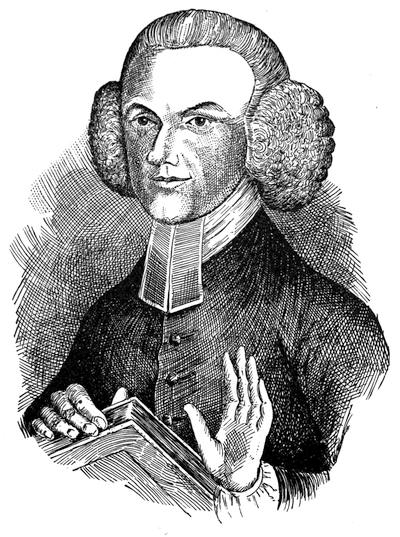
DR. PRICE.
From the London Magazine, May, 1776 (p. 227). "Published by R. Baldwin, June 1, 1776."
For the mutations and progress of opinion in England at this time we may follow Bancroft (orig. ed., vol. viii.) and Smyth (Lectures, nos. 31-33), and the latter compares the expressions of this progress as recorded in Ramsay and the Annual Register.[318]
For the aspects of political leadership in Parliament during 1775-76, and the struggles in debates, see the Parliamentary History and the Amer. Archives,[319] and we may offset among the general histories the Tory sympathies of Adolphus (England, ii. ch. 24) with the liberal tendencies of Massey (Hist. of England), but the lives of the principal leaders bring us a little nearer to the spirits of the hour.[320]