Chapter V · (continued 3)
Reading edition
There are other maps of the scene of the conspiracy and its attendant events in Sparks's Washington, vii. 216; Guizot's Atlas to his Washington; Irving's Washington, quarto ed., vol. iv.; Carrington's Battles, 512; Lossing's Field-Book, ii. 148; and Boynton's West Point, 104.
Not long after Arnold left the Robinson house, Washington arrived, and, learning that Arnold had gone to West Point, he passed over unsuspicious to that post, where he was surprised not to find Arnold.[984] While Washington was gone, Jameson's messenger with the captured papers and André's letter arrived, and Hamilton, left behind by Washington, opened them as his confidential aide.[985] As soon as Washington's boat approached on his return from West Point, Hamilton went towards the dock to meet his chief, whispered a word, and both later entered the house and were closeted. The plot was revealed. Hamilton was dispatched to Livingston to head off Arnold in his escape if possible, but on reaching that officer's post it was found that Arnold's boat had already passed. Before Hamilton was ready to set out on his return, a flag from the "Vulture" brought ashore a letter from Arnold, addressed to Washington, framed in lofty expressions of his own rectitude, and avowing the innocence of Smith, of his own wife, and his aides.[986] Before Hamilton's return, Washington had dined with his officers without revealing the secret, but he shortly took Knox and Lafayette into his confidence. There was naturally great uncertainty as respects the extent of the conspiracy, and of what preparations the enemy had made for an immediate onset. The anxiety of the moment was soon evinced by the great activity of aides and orderlies. Word was sent in every direction for arrangements to be made for any emergency.[987]
André was brought to West Point, and Smith was arrested and held for examination. Special precautions were taken to keep them apart and to prevent escape. André was then conveyed down the river, still under Tallmadge's care, to headquarters at Tappan, where he was closely guarded in an old stone house, still standing.[988]
A board of general officers was at once summoned to consider the case and recommend what action should be taken. The papers taken from André were laid before them.[989] André himself was brought into their presence, when he made a written statement, and answered questions. He acknowledged everything, but said nothing to implicate others. He affirmed that he did not consider himself under the protection of a flag when he landed from the "Vulture." The report of the board was that André was a spy, and merited the death of a spy. Washington ordered the execution, and sent a record of the proceedings to Congress and recommended its publication. Congress printed the record.[990]
Clinton was meanwhile informed of what had happened by the return of the "Vulture" to New York, and wrote to Washington that Arnold's flag and pass should save André from the character of a spy. Beverley Robinson wrote to a similar purport, and so did Arnold; but the latter added a threat of retaliation in case André was executed, which was not calculated to further the purpose of André's friends, and it is rather surprising they allowed the letter to proceed. Washington replied in effect that a flag must be used in good faith to preserve its character, and that the concealment of dress and papers was the action of a spy.
Gen. Robertson was sent by Clinton to make further representations, and Washington put off the execution till Greene could confer with that general at an outpost. A repetition of the arguments on the British side made no change in the aspects of the case; and when Robertson quoted Arnold as saying André was under a flag, Greene told him they believed André rather than Arnold. Robertson wrote again to Washington, who had now definitely fixed mid-day of Oct. 2d for the execution. Washington thought it also best to leave unanswered a note of André requesting to be shot rather than hanged. Further letters, amplifying the British arguments, were prepared,[991] but before they could be sent to Washington word came that the execution had taken place.
During his confinement in Tappan, and after he became aware of his fate, André conducted himself with a cheerful dignity that much endeared him to the gentlemen who came in contact with him. His servant had brought from New York fresh linen and his uniform, which André put on with evident satisfaction. He practised his ready skill in pen-and-ink drawing, and made several sketches, which he gave to his attendants as souvenirs.[992] As his hour approached, he said graciously to his escort, "I am ready", and went to the place appointed, surrounded by guards and through a large concourse of people. Of the general officers of the army at the post only the commander-in-chief and staff were absent; and as the sad procession passed headquarters the blinds were drawn, and no one was seen. When the gibbet came in sight, André shrank a moment, but instantly recovered, for he had nourished hopes that his request as to the manner of his death would not be denied. He bandaged his eyes himself; lifted the cloth a moment to say that he wished all to bear witness to the firmness with which he met his death; and when the cart was withdrawn died instantly.[993] When his uniform was removed and placed in his servant's hands, the coffin which contained the body was buried near the spot.
His remains were disinterred in 1821 and taken to England,[994] where they were deposited in Westminster Abbey, beside the monument which had been erected there to his memory shortly after his death.[995] Many years after the removal, a rude boulder,[996] on which a simple record was chiselled, was placed on the spot of his burial; but this had disappeared when a few years since a plain monument, with an inscription by Dean Stanley of the Abbey, was made to perpetuate the record of his grave.[997]
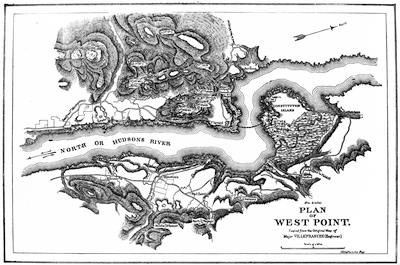
Note.—A reduced sketch is placed opposite from a plan by Villefranche, made in 1780, and given in fac-simile in Boynton's West Point, p. 86. He also (p. 79) gives Villefranche's plan (1780) of Fort Arnold, built 1778 on the eastern limits of West Point. On Villefranche see Ibid., p. 160. Boynton also gives a long folding panoramic view of West Point in 1780 from the eastern bank of the river, which shows the batteries and camps on both banks. Cf. illustrated paper, by Lossing, in Scribner's Mag., v. 4.
Arnold received the price of his desertion,[998] was made a general in the British service, and turned his sword, both in Connecticut and Virginia, against his countrymen. Afterwards he went to England, was treated with an enforced respect in some places, and scorned in others.[999] He lived for a while in New Brunswick, but he never escaped the torments which the presence of honorable men inflicted upon him. His descendants live to-day in England and in Canada, and some of them have attained high rank in the British army; and no one of them, as far as known, has disgraced the good name of the old Rhode Island family, whence Benedict Arnold descended.[1000]
The report of the court respecting André, with its appendix (already referred to), and the trial of Smith were the first public sifting of the evidence about the conspiracy. Smith was acquitted by the military tribunal,[1001] and was then turned over to the civil authorities for a further trial; but, succeeding in escaping in women's clothes, he reached New York, and England, where several years later he published a narrative, which it is not easy to reconcile with all his evidence in his trial,—the supposition[1002] being that he was addressing injured Americans in the one case and disappointed Britons in the other.[1003] Marbois, the secretary of the French legation at Philadelphia at the time, wrote a Complot d'Arnold et Clinton, which was not published till 1816 at Paris. Sparks says, that what came under Marbois' personal observation is valuable; but otherwise the book, as most students think, should be used with caution.[1004]
The earliest comprehensive treatment of the subject—and it has hardly been surpassed since—was in Sparks's Life and Treason of Arnold (Boston), and he gives the principal documentary evidence in his Washington, vol. vii. App.[1005]
The next special examination of the conspiracy was made in Winthrop Sargent's[1006] Life and Career of Major John André (Boston, 1861),—an excellent book.[1007]
In 1864 the story necessarily made a part of Edward C. Boynton's History of West Point, who pointed out the military advantage of the Highlands of the Hudson.[1008] Not long after this, Henry B. Dawson, then editing the Yonkers Gazette, printed in its columns sixty-eight contemporary documents or narratives, and these, subsequently printed from the same type in book-form, constitute no. 1 of Dawson's Gazette Series, under the title of Papers concerning the capture and detention of Major John André (1866). It is the most complete gathering of authentic material which has been made.
The volume (x.) of Bancroft which contains his account of the conspiracy appeared in 1875, and was constructed "by following only contemporary documents, which are abundant and of the surest character, and which, taken collectively, solve every question.... The reminiscences of men who wrote in later days are so mixed up with errors of memory and fable that they offer no sure foothold."[1009]
The Life of Arnold, by Isaac N. Arnold, of Chicago, and the Two Spies of Benson J. Lossing, are the last considerable examinations of the subject.[1010]
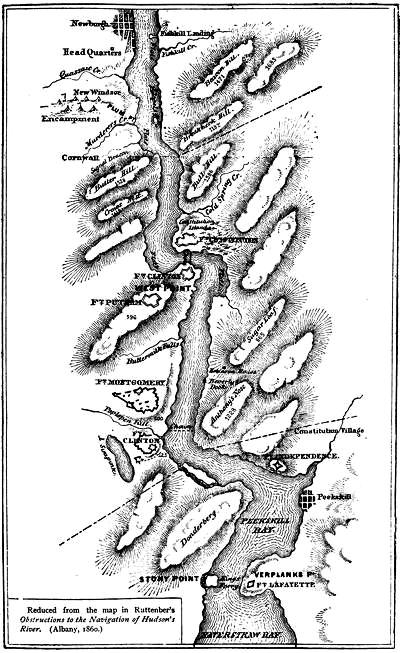
The story of the culmination and collapse of the conspiracy is easily told with the abundant testimony of those who were observers and actors,—much of the record being made at the time, though some of it, put upon paper at varying intervals later, may need to be scrutinized closely, particularly as regards André's demeanor from the moment of his arrest to his execution.[1011]
For the English side we must mainly depend on the letters and statements of Clinton, which are elaborate, and may well be supplemented by contemporary and later English historians.[1012]
As respects the justice of André's execution, the military authorities were disagreed on the two sides at the time, and for a while the alleged offence of Washington was considered in England a conspicuous blot upon his character; but Lord Mahon has been the only prominent instance of continued belief in this view among English writers, who have generally conceded the right of the Americans to count André a spy, however they might wish that Washington had been more clement. The attractive manners and brilliant mental habit of André have blinded even American writers to the atrocious nature of his mission, and to the sinister purpose which a man of sensibility and elevated character should never have grasped, even amid the license which a state of war gives. The power to face death with a calm and graceful courage may indeed be mated with the moral lightness that belongs to an intellectual popinjay and a debased intriguer.[1013]