Chapter IX · (continued 2)
Reading edition
How much the presence of Clark near the scene of action contributed to the demoralization of the Indian forces is not mentioned by any of the contemporary writers. It is known, however, that his name was a terror to the savage tribes; and Sinclair, in organizing his expedition, found this dread of Clark among the Sioux and other nations west of the Mississippi. He wrote to Captain Brehm, Haldimand's aide-de-camp, February 15, 1780, that there was nothing in Hamilton's disaster which ought to alarm the Sioux, and that "many of them never heard of it. The short-sighted harpies, which necessity has thrown into the service, dwell upon the stories they hear from fretful bands of Delawares, Mascoutins, and Kickapoos near where the event happened. Admit that the disaster has all the supposed consequent misfortunes, it is still more necessary for us to engage the Indians to take a part, which will at once declare their enmity to the party they are engaged to act against."[1561] "The party" Sinclair had in mind was evidently Clark himself; and with him the chief object of the expedition was to recapture the Illinois country.
The general scheme devised by Lord George Germain for the complete conquest of the West,—of bringing down a large party of northwestern Indians upon St. Louis and Ste. Geneviève; of sending an expedition from Detroit to invade Kentucky and keep Colonel Clark busy; of bringing up the Mississippi to Natchez, under General Campbell, a fleet and army, there to unite with the northern expeditions, and from thence to capture the Illinois country and all the Spanish settlements on the river—was an excellent one, and had every promise of success. St. Louis was in no condition to resist an assault, and rank cowardice marked the conduct of the governor and the few soldiers stationed at the post when the Indian raiders appeared.[1562] The Illinois country was very feebly garrisoned, and not a soldier or a shilling had ever been contributed by the Continental Congress for its conquest or defence. The scheme failed because of the promptness and exceptional activity of the Spaniards under Governor Galvez, and the watchfulness and energy of Colonel Clark. It was the last concerted effort of Great Britain to regain possession of the West; as the campaign of Clinton and Cornwallis, with its result one year later at Yorktown, was her expiring effort on the Atlantic coast.[1563] If the Western scheme had been successful, the country north of the Ohio River would have been a part of the province of Quebec, and might have remained Canadian territory to this day. In negotiating two and three years later the treaty of peace with Great Britain under such conditions, it is difficult to conceive what boundaries the United States could have secured. Spain therefore rendered an invaluable service to the United States by enabling George Rogers Clark to hold with his Virginia troops the country he had conquered from the British, until the treaty of peace confirmed to the nation the Mississippi River as its western boundary.
Notwithstanding this important service, there was nothing friendly and disinterested, at this time, in the relations of Spain to the United States. She was looking solely to her own interests, and refused to acknowledge the independence of the United States, or enter into a treaty of alliance except on the most degrading conditions. She must be allowed the exclusive right to navigate the Mississippi, the undisturbed possession of the Floridas and of the east bank of the Mississippi, which she had captured from the British. Spain asserted that the United States had no territorial rights west of the Alleghanies, and that their western boundaries were defined by the royal proclamation of October 7, 1763.[1564] The captures of Manchac, Baton Rouge, Natchez, and Mobile had awakened her military zeal, and nothing less than the possession of the entire Mississippi Valley would then satisfy her territorial ambition. French diplomacy favored some of these extraordinary claims of Spain.[1565]
For the purpose of strengthening the Spanish claim to territory east of the Mississippi, the governor of St. Louis, Don Francisco Cruvat, sent out on the 2d of January, 1781, an expedition to capture St. Joseph, an English fort situated near the present site of Niles, Michigan. Although two hundred and twenty leagues distant, this was the nearest post to St. Louis which raised the British flag. The expedition was in command of Captain Eugenio Pourré, and comprised sixty-five militiamen (of whom thirty were Spaniards) and sixty Indians. The journey, made in the depth of winter across a trackless country, each man on foot carrying his provisions and equipments, was a daring exploit, and it was successful in accomplishing its immediate purpose. They took the fort in the name of his most Catholic Majesty, made prisoners of the few English soldiers found in it, divided the provisions and stores among their own Indians and those living near, and returned to St. Louis early in March, with the English flag, which Captain Pourré delivered with due ceremony to Governor Cruvat.[1566] The treaty of peace, which it is not the purpose of this chapter to discuss, brought this and other shallow pretensions on the part of the Spaniards to territorial rights east of the Mississippi River to an end.[1567]

THE CLOSING SCENES OF THE WAR.
BY THE EDITOR.
The campaign of Yorktown over, Rochambeau made his headquarters at Williamsburg (Parton's Jefferson, ch. 29), while Washington, having dispatched two thousand men south under St. Clair (instructions in Sparks's Washington, viii. 198) to reinforce Greene, moved with the rest of the army, by land and water, to the neighborhood of the Hudson (Sparks's Washington, viii. 199, 200; Irving's Washington, iv. ch. 29, 30; Kapp's Steuben, ch. 23; Lossing's Field-Book, ii. ch. 5). Washington at once acted in conjunction with Congress to prevent the country lapsing into a neglect of the war establishment through over-confidence in the effects of the capture of Cornwallis. In April, 1782, Washington left Philadelphia and joined the army, establishing his headquarters at Newburgh, in a house which is still standing. (Views of it are in Mag. of Amer. Hist., 1883, p. 357 (taken in 1834); Irving's Washington, quarto ed., iv. 434; W. H. Bartlett's Hist. of U. S.; with a paper by C. D. Deshler on "A Glimpse of Seventy-Six", in Harper's Mag., xlix. 231; with Lossing's "Romance of the Hudson", in Ibid., liii. p. 32; also in his Field-Book, ii. 99, his Hudson, 199, and his Mary and Martha Washington, 215; Gay's Pop. Hist. of U. S., iv. 84.)
There are several special accounts of this latest camp of the army. (Cf. Asa Bird Gardiner on "The Last Cantonment of the Main Continental Army" Mag. Amer. Hist., 1883, vol. x. 355), which is accompanied by a plan of the camp near New Windsor. Simeon De Witt's maps of the locality and the camp are in the N. Y. Hist. Soc. library. De Witt was the geographer of the American army, succeeding Erskine, who had died in 1780. Various orderly-books of this time are in the American Antiquarian Society library. Other papers on the camp are in Mag. Amer. Hist., Jan., 1884, p. 81; by J. T. Headley in Harper's Mag., lxiv. 651, and Galaxy, xxii. 7. Cf. also Ruttenber's Newburgh (1859) and the account of the first annual meeting of the Hist. Soc. of Newburgh Bay and the Highlands, Feb. 22, 1884,—Newburgh, 1884.
Washington and Congress were soon perplexed with the case of Capt. Joshua Huddy, and with a project of retaliation for that officer's execution. Huddy, an officer of the New Jersey line, commanded a block-house at Tom's River, New Jersey, and was there captured with his men by a band of refugee loyalists (W. S. Stryker's Capture of the Block-House at Tom's River). Huddy was taken by Capt. Richard Lippincott, a New Jersey loyalist, to Sandy Hook, where he was hanged on the pretence that he had been engaged in causing the death of Philip White, a Tory, who had been killed while endeavoring to escape from his guard. Congress ordered retaliation, and a young British officer, then a prisoner, Capt. Charles Asgill, was drawn by lot to suffer death unless Clinton should surrender Lippincott. Clinton condemned the action of Lippincott, who was, however, acquitted on trial, on the ground that his action was in accordance with instructions from the board of Associated Loyalists (Jones's N. Y. during the Rev., vol. ii. note xxix. p. 481). The execution of Asgill was postponed by Washington in the hope of some compensating arrangement, and at the instance of Lady Asgill, the young man's mother, the French monarch interceded with such effect that Congress, in November, 1782, ordered Washington to set Asgill at liberty. (References: Sparks's Washington, i. 378; viii. 262, 265, 301-310, 336, 361; ix. 197; Sparks MSS., vols. lxxii., xlviii., lviii.; Niles's Principles and Acts 1876 ed.), p. 509; Remembrancer, xiv. 144, 155; xv. 127, 191; Political Mag., iii. 468, 472; Jones's N. Y. during the Rev., ii. 232, 483, and Johnston's Observations on Jones, 77; Thomas Paine's American Crisis, and a Letter to Sir Guy Carleton on the Murder of Captain Huddy, and the Intended Retaliation on Captain Asgill, of the Guards (London, 1788); Memoir of Gen. Samuel Graham, edited by his son, Col. J. J Graham (Edinburgh, privately printed, 1862,—extract in Hist. Mag., ix. 329). Washington caused all the papers on the subject to be printed in the Columbian Mag., Jan. and Feb., 1787. This young officer of twenty died as Gen. Sir Charles Asgill in July, 1823. Cf. Diplomatic Corresp., xi. 105, 128, 140; Irving's Washington, iv. ch. 29; Sparks's Corresp. of the Rev., iii.; Heath's Memoirs, 335; Sparks's Franklin, ix. 376; Hamilton's Republic, ii. 282. The English view is given in Adolphus's England, iii. ch. 46.
Early in May the news from England made it evident that the war was approaching an end, and the promised release from further campaigning left the public mind in a better condition to comprehend how weak a stay Congress had proved itself, and how insufficient was the power lodged in that body to compel the States to do any and all acts necessary for the common good. The natural distrust which was created of the form of government, whose success in carrying on the war had been largely fortuitous, was still more increased by the difficulties yet to be encountered in disbanding an army, in satisfying its well-earned demands, and in organizing a stable control for the future (Bancroft, final revision, vi. 59, etc.) It was not, then, surprising that notions of counteraction should in any minds take the form of a monarchical solution of the problem, and this sentiment found expression in a letter, written by Col. Nicola, of the army, to Washington, in which it was somewhat adroitly suggested that Washington should consent to be the head of a royal government. Washington met the suggestion with an indignant and stern reply, and we hear nothing more of the subject (Sparks, viii. 300, etc.; Irving, iv. 370).
Sir Guy Carleton was sent to relieve Sir Henry Clinton in New York, and he arrived early in May. His instructions (April 4, 1782,—Sparks MSS., lviii.; cf. Sparks's Washington, viii. 294-298) were to avoid hostilities except for defence. He failed to open communication with Congress to treat for peace (Madison's Debates, vol. i.; Rives's Madison, i. 331, 333). An account of the cantonments of the British about New York just before this (Feb., 1782) is in the Sparks MSS. (xlix. vol. iii.). Clinton's account of his being relieved is in Mahon, vii. App., p. xvii. It was not till August that Carleton's communications to Washington rendered it certain that the concession of independence was a preliminary of the negotiations then going on for peace. Active hostilities accordingly ceased on both sides, though a posture of caution and vigilance was still maintained by each commander. The French, who had remained in Virginia, now joined (September) the Americans on the Hudson. There is among the Rochambeau maps an excellent colored plan (no. 33), measuring twenty inches wide by thirty high, showing the country from White Plains north, and called Position des Armées Amer. et Française à King's Ferry, Peak's Hill, et Hunt's Taverne, 17 Sept. et 20 Oct., 1782. In October the French under the Baron de Viomenil marched to Boston and embarked, while Rochambeau and Chastellux sailed from Baltimore. On the final departure of the French see a paper by J. A. Stevens in the Mag. Amer. Hist., vii. p. 1. The report on their departure, made to Congress, is dated Jan. 1, 1783,—Secret Journals, iii. 267.
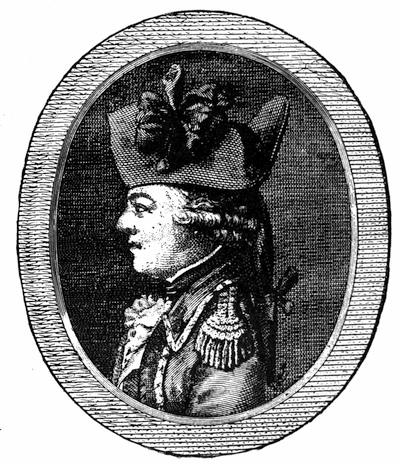
CAPTAIN ASGILL. (From Andrews's Hist. of the War, London, 1785, vol. iv. Cf. Harper's Cyclo. of U. S. Hist., ii. 653.)
In Dec., 1782, the army had set forth in representations to Congress the sufferings which it had experienced from the want of pay (Journals of Congress, iv. 206; Madison's Debates, etc., i. 256; Rives's Madison, i. 383; Morse's Hamilton, i. 114). Nothing satisfactory came of this appeal, and a movement of uncertain extent, but seemingly having the countenance of officers of high rank, was aimed at producing action on the part of the army, which might easily, if allowed to proceed, have passed beyond prudent control, till a claim for redress of grievances might instigate an act of mutiny. Its chief manifestations were in two successive anonymous addresses, circulated through the camp at Newburgh, which were written, as was later acknowledged, by Major John Armstrong, a member of Gen. Gates's staff. Washington interposed at a meeting of the officers (March 15, 1783), and by a timely address turned the current. The original autograph of his address belongs to the Mass. Hist. Society, and that body issued a fac-simile edition of it (Boston, 1876), with letters of Col. Pickering, Gov. John Brooks, Judge Dudley A. Tyng, and William A. Hayes, authenticating the document, and describing the scene when Washington read it. Copies of the addresses made by Armstrong himself are in the Sparks MSS., xlix. 1, 8, and they are given in Sparks's Washington, viii. 551; and in a Collection of papers, relative to half-pay and commutation of half-pay, granted by Congress to officers of the army. Compiled by the permission of General Washington from the original papers in his possession (Fishkill, 1783). Cf. Sabin, iv. 14, 379. Washington at a later day, Feb. 23, 1797, wrote to Armstrong, exonerating him from having intended any evil to the country (Sparks MSS., no. xxiv.). The genuineness of this letter having been assailed, Armstrong (Nov. 27, 1830) wrote a letter asserting its truth, and this autograph letter is in Harvard College library. More or less extended accounts of the incidents accompanying this attempt to organize a coercion of the civil by the military power will be found in the lives of Washington by Marshall (iv. 587); Sparks (viii. 369, 393); and Irving (iv. ch. 31); in Pickering's Pickering (i. ch. 29, 30, 31; including Montgar's, i. e. Armstrong's, letter in 1820); Drake's Knox, 77; Rives's Madison (i. 392); J. C. Hamilton's Republic (ii. 365, 385), and Alexander Hamilton (ii. 68); Morse's Hamilton, i. 119; Quincy's Shaw (p. 101); Hildreth's United States (iii. ch. 45); Dunlap's New York (ii. 230); Lossing's Field-Book (ii. 106, 315); Journals of Congress (iv. 213); Bancroft, final rev., vi. 71.
A letter from Lafayette, who had gone to France, shortly afterwards arrived, announcing the signing of the preliminary articles of peace; and the news being confirmed by a letter from Carleton, Washington, on April 19, the eighth anniversary of the day of Lexington, issued a proclamation announcing cessation of hostilities. Sparks's Washington (viii. 425; App. 13); Heath's Memoirs; Madison's Debates (i. 437); Diplom. Correspondence (ii. 319-329; x. 121; xi. 320); Secret Journals of Cong. (iii. 323, under date of April 11, 1783).
Knox had suggested (Drake's Knox), and in April, 1783, the Society of the Cincinnati had been formed from the officers of the army, with a plan of transmitting membership to descendants. It was intended as an organization to perpetuate a brotherhood formed in arms, and to offer an organization which might conveniently deliberate as occasion required upon the condition of the country. As a rule the principal civil leaders of the Revolution looked upon the combination with disapproval (Wells's Sam. Adams, iii. 202; Austin's Gerry, ch. 25; Sparks's Franklin, x. 58; Bigelow's Franklin, iii. 247; John Adams, Works, ix. 524, called it "the first step taken to deface our temple of liberty"), and even with dread, lest it might lend itself to the creation of castes and the furtherance of schemes against the liberties of the country. There was a widespread dissatisfaction among the people generally, not always temperately expressed, and years were required to remove the apprehension so incontinently formed. The society was organized in the Verplanck house (view in Appleton's Journal, xiv. 353); the fac-similes of the signatures to the original subscription are given in the Penna. Archives, vol. xi., and a representation of a certificate signed by Washington is in Lossing's Field-Book, ii. 128. The bibliography of the society and its branches, by States, is given by Lloyd P. Smith in the Bulletin of the Philadelphia Library, July, 1885. Particular reference may he made to the accounts and expositions given in the Penna. Hist. Soc. Memoirs (1858), vi. pp. 15-55, by Alexander Johnston; North Amer. Review, v. lxxvii. 267, by W. Sargent; St. Clair Papers, i. 590; Kapp's Steuben, ch. 26; E. M. Stone's Our French Allies, p. xix; Lossing's Field-Book, ii. 127; J. B. McMaster's People of the U. S., i. 167; R. C. Winthrop's Speeches, etc. (1852, etc.), P. 345; and the account of the centennial of the order in Mag. Amer. Hist., Sept., 1883, pp. 171, 235, 253.
On the 18th June, 1783, Washington from Newburgh, whither he had removed his headquarters from Verplanck's after the departure of the French, issued his last circular letter to the States (Sparks, viii. 439; Irving, iv. 394), full of counsel and warning.[1568]
The troops were in large part dismissed on furlough, and finally, Congress (Oct. 18) by proclamation, directed the disbandment of the army, to take effect Nov. 2 (Secret Journals, iii. 406). A small body was, however, still kept together under Knox, to await the definitive form of the treaty. Washington now occupied a brief space in making a journey with Gov. Clinton over the battlefields of Burgoyne's campaign. He then, at the request of Congress, proceeded to Princeton, and was domiciled for a while at Rocky Hill, in order to be at hand for conferences with that body. From this place, Nov. 2, 1783, he issued a farewell address to the army. (Sparks, viii. 491; Irving, iv. 402; Pickering's Pickering, i. 488.)
The last surviving pensioner of the Revolution is called one Lemuel Cook in the Amer. Hist. Record, ii. 357. In 1864, what purported to be the record of the latest survivors of the war appeared in Elias B. Hillard's Last Men of the Revolution (Hartford, 1864). An account of John Gray as the last soldier of the Revolution, by J. M. Dalzell, was printed at Washington in 1868. B. P. Poore's Descriptive Catal. of Gov't Publications will enable one to trace many of those soldiers whose claims came before Congress.
Carleton giving notice of his readiness to evacuate New York, Washington now returned to West Point, and prepared to enter the city with Gov. Clinton on the appointed day. The general and the governor entered the upper end of the town on Nov. 25, while the British embarked at the lower end. Valentine's N. Y. City Manual for 1861 gives various documentary records, some in fac-simile. On Dec. 1 there were fireworks, a broadside programme of which is in the cabinet of the Mass. Hist. Society. Trumbull painted a picture of the scene of the evacuation, which is given in the Mag. Amer. Hist., 1883, p. 387. The histories of New York city commemorate the event, and there are illustrated papers on it in Harper's Mag., Nov., 1883 (vol. lxvii. 609), and Manhattan Mag., Dec., 1883. Cf. Hist. Mag., xi. 42; Lieut.-Col. Smith's letter in N. Y. City during the Rev. (N. Y., 1861); Irving's Washington, iv. ch. 33; Jones's N. Y. during the Rev. (ii. 504). Some days after the British had gone, Washington met his principal officers (Dec. 4) in Fraunce's Tavern, and bade them farewell.
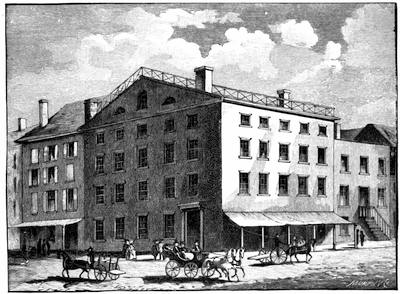
FRAUNCE'S TAVERN IN NEW YORK.
This building stood on the corner of Pearl and Broad streets, N. Y., and was occupied by Washington as headquarters when he entered the city after the British evacuated in 1783. The cut follows a view given in Valentine's N. Y. City Manual, 1854, p. 547, accompanied by a paper by W. J. Davis. Cf. Mag. of Amer. Hist., iii. 144, 151, 152; Lossing's Field-Book, ii. 839; Gay's Pict. Hist. U. S., iv. 90; Dawson's Westchester. The opening chapter of McMaster's History of the People of the United States, (N. Y., 1883) describes the appearance of New York city at this time, and indeed of the other principal American towns, and the habits of living through the country. An account of New York at this time is also in the Manhattan Mag., ii. 561.
Immediately leaving New York, Washington journeyed to Annapolis, where Congress was then assembled. Here, on Dec. 23, he met Congress in the State House (view in Columbian Mag., Jan., 1789; Lossing's Field-Book, ii. 402), where he resigned his commission in an address. (Sparks, viii. 504, and App., xiv.; Marshall, iv. 622. A fac-simile of the manuscript is given in the Mag. Amer. Hist., 1881, vol. vii. 106. Cf. Journals of Congress, iv. 318; Ridgeley's Hist. of Annapolis.) On Christmas Eve, Washington reached Mount Vernon, once more a private gentleman.
Congress on the 14th Jan., 1784, sitting at Philadelphia, finally ratified the definitive treaty of peace.