Chapter V · Magic Rites connected with the Several Departments of Nature (continued 2)
Reading edition
Accessories.—At her extreme left stood one of the circular brass trays with high sides which are called dulang by the Malays, containing the following objects:—
1. A small bowl of “parched rice” (b’ras bĕr’tih).
2. A small bowl of “saffron rice” (b’ras kunyit).
3. A small bowl of “washed rice” (b’ras basoh).
4. A small bowl of “oil of frankincense.”
5. A small bowl of “oil of Celebes” (minyak Bugis).
6. A small bowl of “incense” (kĕm’nyan).
7. A small bundle of incense (in addition to the bowl).
8. One of the hard jungle-nuts called buah k’ras (the candle-nut).
9. One of the shells called k’rang (a cockle shell).
10. A hen’s egg.
11. A stone (a small block of quartz).
12. A large iron nail.
Close to the dulang stood a cocoa-nut shell filled with the tĕpong tawar, which plays so prominent a part in Malay magic ceremonies, and a brush made up of the leaves of seven different plants, bound up as usual with a cord of kulit t’rap (the bark of the Wild Breadfruit), and ribu-ribu (a kind of small creeper). The plants which supplied the leaves of which the brush was composed, were as follows:—
1. Sapĕnoh. 2. Sapanggil. 3. Jĕnjuang (or lĕnjuang) merah (the Red Dracæna). 4. Gandarusa. 5. Pulut-pulut. 6. Sĕlaguri. 7. Sambau dara (a kind of grass).
But the most interesting object was a small oval-shaped basket bound with the ribu-ribu creeper, and about fourteen inches long, which was standing just in front of the three rice-baskets and close to the Pawang, and which, as I afterwards found out, was intended to serve as the cradle of the Rice-soul (or “Rice-baby”). I examined it, however, and found that as yet it only contained the following objects:—
1. A strip of white cloth (folded up and lying at the bottom of the basket).
2. Some parti-coloured thread (bĕnang panchawarna or pancharona).
3. A hen’s egg.
4. One of the hard jungle-nuts (candle-nuts) already referred to.
5. A cockle shell (k’rang).
6. A long iron nail.
7. Five cubits of red cloth by means of which the soul-basket was to be slung round the neck of its bearer. (The correcter custom would require an expensive cloth of the kind called jong sarat, or the “Loaded Junk,” according to my informant the Pawang.)
Three new Malay skirts or sarongs were added, (one to each basket), and everything being ready, the various receptacles described above were entrusted to five female bearers (Pĕnjawat), who descended from the house, with the Pawang at their head, and set out for the rice-field. Before they had gone many yards they were joined by the owner of the field, who walked in front of them bearing what was called the junjongan padi. This was the stem and leaves of a dark red kind of sugar-cane, which was used in substitution for the black or “raven” variety (tĕbu gagak) which, the Pawang explained, would have been used in preference if it had been obtainable. Meanwhile the procession passed on, and the Pawang repeated as we went the following prayer to the spirits:—
“In the name of God, the merciful, the compassionate,
Peace be with thee, O Prophet ’Tap, in whose charge is the Earth,
I know the origin of the Rice, S’ri Gading, Gĕmala Gading,
That (dwelleth at) the end of the clearing, and that (dwelleth at) the beginning (top) of the clearing;
That is scattered broadcast, that is cast headlong,
That is over-run (!) by the ants called Silambada.
Dang Salamat, who carriest the pole slung on thy back,
Gather together and press hitherwards your attendants.
May safety and our daily bread be granted us by God.”
On reaching the rice the procession filed through a lane already made in the rice, until the “mother-sheaf” was reached from which the Rice-soul was to be taken. But immediately on arriving at the spot, and before depositing the rice-baskets on the ground, the Pawang repeated these lines:—
“Herons from all this region,
Roost ye upon the shaft of my bow;
Retire ye, O Spectral Reapers,
That we may deposit our baskets upon the ground.”
Here the baskets were deposited, and the Pawang took up her station in front of the mother-sheaf, of which mention has just been made.
“Peace be with thee, O Prophet ’Tap!
Lo, I plant this Sugar-cane
For you to lean against,
Since I am about to take away this Soul of yours, S’ri Gading,
And carry it home to your palace,
Cluck, cluck, soul! cluck, cluck, soul! cluck, cluck, soul!”
Here the Pawang and Pĕnjawat (Female Bearer), together proceeded to plant the sugar-cane in the centre of the sheaf, and (pressing the sheaf more tightly round the sugar-cane) drew the waist of the sheaf together and belted it with some of the outer stems of the sheaf itself; then the Pawang applied the tĕpong tawar once more to the sheaf, and after fumigating it in the usual manner, ran her hands up it. Next she took in one hand (out of the brass tray) the stone and the egg, cockle-shell and candle-nut, and with the other planted the big iron nail in the centre of the sheaf close to the foot of the sugar-cane. Then she took in her left hand the cord of tree-bark, and after fumigating it, together with all the vessels of rice and oil, took up some of the rice and strewed it round about the sheaf, and then tossed the remainder thrice upwards, some of it falling upon the rest of the company and myself.
This done, she took the end of the cord in both hands, and encircling the sheaf with it near the ground, drew it slowly upward to the waist of the sheaf, and tied it there, after repeating what is called the “Ten Prayers” (doʿa sapuloh) without once taking breath:—
“The first, is God,
The second, is Muhammad,
The third, Holy Water of the five Hours of Prayer by Day and Night,
The fourth, is Pancha Indra,
The fifth, the Open Door of Daily Bread,
The sixth, the Seven Stories of the Palace-Tower,
The seventh, the Open Door of the Rice-sifting Platform,
The eighth, the Open Door of Paradise,
The ninth, is the Child in its Mother’s Womb,
The tenth, is the Child created by God, the reason of its creation being our Lord.
Grant this, Moses!
Grant this, Joseph!
Grant this, David!
Grant me, from God (the opening of) all the doors of my daily bread, on earth, and in heaven.”
“Chop the ‘tree’ Galenggang (a kind of shrub),
Chop it to pieces in front of the door:
Yonder comes One swinging (her) arms;
That (methinks) is a child of mine.”
To which the Pawang immediately replied:—
“Chop the young bamboo-shoots as fine as you can,
If you wish to stupefy the fish in the main stream.
In good sooth I have crossed the stream,
For great was my desire to come hither.”
And the bearer of the Rice-child added—doubtless on the Rice-child’s behalf:—
“This measure is not a measure filled with pepper,
But a measure filled with rice-husks.
My coming is not merely fortuitous,
But great (rather) was my desire, the wish of my heart.”
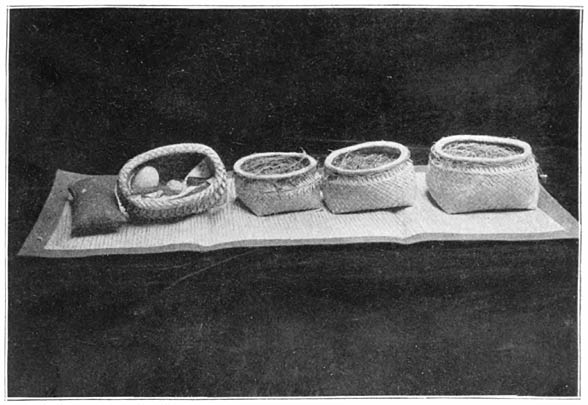
Plate 5.—Rice-Soul Baskets.
Model, showing the baskets used at the ceremony of bringing home the rice-soul. The oval-shaped basket on the left is that which contains the rice-soul, together with the egg, iron nail, and candle-nut, etc., used as charms to keep away evil spirits from the rice-soul or “rice-child.”
Page 244.
The following were the taboos imposed upon her:—
1. Money, rice, salt, oil, tame animals, etc., were forbidden to leave the house, though they might enter it without ill consequences.
2. Perfect quiet must be observed, as in the case of a new-born child.
3. Hair might not be cut.
4. The reapers, till the end of the reaping, were forbidden to let their shadows fall upon the rice. (Yang mĕnuwei sampei habis mĕnuwei, tiada buleh mĕnindeh bayang.)
5. The light placed near the head of the Rice-child’s bed might not be allowed to go out at night, whilst the hearth-fire might not be allowed to go out at all, night or day, for the whole three days.
The above taboos are in many respects identical with those which have to be observed for three days after the birth of a real child.
I may add that every day, when the reapers start their reaping, they have to repeat the following charm:—
“A swallow has fallen, striking the ground,
Striking the ground in the middle of our house-yard;
But ye, O Shadows and Spectral Reapers,
See that ye mingle not with us.”
When reaping, they must cover their heads and must face the sun, no matter what hour of the day it is, in order to prevent their own shadows from falling upon the rice in the basket at their side.
Drying the first of the padi.—Preparations being complete, the two baskets full of newly-cut rice were carried down the steps and out to an open part of the field, a little way from the house, and there spread on a mat in the sun to dry. To spread it properly is not an easy matter, the operator (who in this case was the owner), standing on the mat and spreading the grains with a long sweeping motion of the hand from one side of the mat to the other (the process being called di-kekar, di-kachau, or mĕmbalikkan jĕmoran). In the present case several objects were placed in the centre of the mat, consisting of—
1. A basket-work stand (one of those used for the cooking-pots, and called lĕkar jantan).
2. A bowl of water deposited upon this stand and intended “for the Rice-soul (sĕmangat padi) to drink when it becomes thirsty with the heat of the sun.”
3. A big iron nail.
4. A candle-nut (buah k’ras).
5. Six trodden-out rice “heads,” a couple of which tied in a slip knot (simpul pulih) are fastened to each corner of the matting.
Disposal of the empty rice-stalks from the three baskets.—The chaff thus obtained was deposited in a heap by the owner of the field in a place where three paths met, crowned with a wreath made of the empty rice-stalks, and covered by a big stone which was intended, I was told, to keep it from being blown away.
The sugar-cane was left to grow in the midst of the mother-sheaf, until the latter should be reaped by the wife of the owner; when this takes place, it is carried back to the house and used for next year’s reaping. Meanwhile the “heads” of the mother-sheaf are pounded, and the grain thus obtained is mixed with the grain obtained from the Rice-soul, and deposited in the rice-bin (kĕpok) together with a stone, a lump of rosin (damar), and a wreath composed of the empty rice-ears. I may add that I saw the articles which had been deposited in the previous year in the rice-bin of the Malay at whose house I witnessed the ceremony which I have just described.
I did not witness the preliminary search for the mother-sheaf (in which the Rice-soul was supposed to be contained), but it was described to me by the Pawang, and performed for my benefit by the people of the house. The Pawang’s description ran as follows: In order to confine the “Rĕngkesa” (a Spectral Reaper) to the boundaries, visit the four corners of the field, and at each corner tie a knot in a rice-leaf, and hold your breath while you repeat the following charm:—
“In the name of God, etc.,
A swallow has fallen striking the ground,
Striking the ground in the middle of our house-yard.
But ye, O Shadows and Spectral Reapers (Rĕngkesa),
Have your appointed place on the Boundaries (of this field).
By virtue of,” etc.
These noxious spirits being thus confined to the Four Corners, you may search in safety till you find one of the special varieties of rice-ear in which the Rice-soul resides.
There are several varieties, of which the best is called Tongkat Mandah; it may be described as an ordinary “rice-head” bending over to meet the tip of a second (adventitious) “rice-head,” but it is produced only by a freak of nature. There is some risk connected with this variety, however, for if the “Reception (Sambut) Ceremony” is not properly performed the owner will die. The second best is called “The Kite” (Lang). The third best is called “The Veiled Princess” (Pŭtri Bĕrtudong); in this case the sheath of the “head” is of unusual length, and overshadows the “head” itself. A fourth kind is called Padi Bĕrtel’kum, and is described as a “Female Rice” (padi bĕtina); like the “Veiled Princess,” it has an unusually well-developed sheath; whilst a fifth kind is the “Padi Mendhara”—a rice-plant whose leaves show white lines or markings.
The sheaf which is left standing after the taking home of the Rice-soul is called the Mother of the Rice-soul (Ibu Sĕmangat Padi), and treated as a newly-made mother; that is to say, young shoots of trees (putik-putik kayu) are taken, pounded together (di-tumbok), and scattered broadcast (di-tabor) every evening for three successive days.
When the three days are up you take cocoa-nut pulp (isi niyor) and what are called “goat flowers” (bunga kambing), mix them, and eat them with a little sugar, spitting some of the mixture out among the rice. [So, after a birth (as the Pawang informed me), the young shoots of the jack-fruit (kababal nangka), the rose-apple (jambu), and certain kinds of banana (such as pisang abu and pisang Bĕnggala), and the thin pulp of young cocoa-nuts (kĕlongkong niyor) are mixed with dried fish, salt, acid (asam), prawn-condiment (b’lachan), and similar ingredients, to form a species of salad (rojak). For three successive days this salad is administered to mother and child, the person who administers it saying, if the child be a girl, “Your mother is here, eat this salad,” and if the child be a boy, “Your father is here, eat this salad.”]
Invariably, too, when you enter the rice-clearing (mĕnĕmpoh ladang) you must kiss the rice-stalks (chium tangkei padi), saying, “Cluck, cluck, soul of my child!” (kur, sĕmangat anak aku!) just as if you were kissing an infant of your own.
4. MINERALS AND MINING CHARMS
In the Western States of the Peninsula by far the most important branch of industry has for many years been that of Tin-mining. Though something like 90 per cent of the labourers employed in the mines are Chinese, the ceremonies used at the opening of tin-mines are purely Malay in character.
The post of mining wizard, once a highly lucrative one, was in past days almost always filled by a Malay, though occasionally the services of a Jungle-man (Sakai) would be preferred. These mining wizards enjoyed in their palmy days an extraordinary reputation, some of them being credited with the power of bringing ore to a place where it was known that no ore existed; some, too, were believed to possess the power of sterilising such ore as existed, and of turning it into mere grains of sand.
The ore itself is regarded as endued not only with vitality, but also with the power of growth, ore of indifferent quality being regarded as too young (muda), but as likely to improve with age. Sometimes, again, it is described as resembling a buffalo, in which shape it is believed to make its way from place to place underground. This idea, however, is probably based upon traditions of a lode, though it is quite in keeping with Malay ideas about the spirits residing in other minerals, the Gold spirit being supposed to take the shape of a kijang or roe-deer (whence the tradition of a golden roe-deer being found at Raub in Pahang).
To commence with Mr. Hale’s account:—“The valley of the Kinta is, and has been for a very long time, essentially a mining country. There are in the district nearly five hundred registered mines, of which three are worked by European Companies, the rest being either private mines, i.e. mines claimed by Malays, which have been worked by them and their ancestors for an indefinite period, or new mines, in other words new concessions given indifferently on application to Malays and Chinese. There are about three hundred and fifty private Malay mines, and it is with these principally that the following paper will deal.
“So far, no lodes have been discovered in Kinta; it is, however, probable that, as the country is opened up and prospectors get up amongst the spurs of the main range, the sources of the stream tin will come to light.
“This stream tin has probably been worked for several centuries in Kinta; local tradition says that a very long time ago Siamese were the principal miners, and there is evidence that very extensive work has been done here by somebody at a time when the method was different from that which is commonly adopted by Kinta Malays at the present day. There are at least fifty deep well-like pits on the Lahat hill, averaging about eight feet in diameter and perhaps twenty feet deep.
“Further up country I have seen a large pit which the natives called a Siamese mine; this is about fifty feet in diameter and over twenty feet deep, and its age may be conjectured from the virgin forest in which it is situated. Besides these, at many places extensive workings are continually brought to light as the country is opened up, and these appear to have been left undisturbed for at least a hundred years. Further evidence of old work is furnished by slabs of tin of a shape unlike that which has been used in Perak in the memory of living persons; and only a few weeks ago two very perfect ‘curry stones’ of an unusual shape and particularly sharp grit were found at a depth of eight feet in natural drift. These may, perhaps, have been used to grind grain.
“So peculiarly is Kinta a mining district, that even the Sakais of the hills do a little mining to get some tin sand wherewith to buy the choppers and sarongs which the Malays sell to them at an exorbitant price.
“The following are some of the special terms alluded to:—
“Ber-olak dâpor, instead of kuching—cat. Cats are not allowed on mines, nor may the name be mentioned.
“A tiger of enormous size called Ber-olak is said to haunt Kinta. The legend about him is as follows:— A long time ago, in the pre-Muhammadan days, a man caught a tiger kitten and took it home; it grew up quite tame and lived with the man until he died, when it returned to the jungle and grew to an enormous size, nine cubits (hasta) long; it is still there, though nobody ever sees it; it does no harm, but sometimes very large tracks are seen, and men hear its roar, which is so loud that it can be heard from Chĕmor to Bâtu Gajah; when heard in the dry season, it is a sure prognostication of rain in fifteen days’ time.
“1. Raw cotton must not be brought on to a mine in any shape, either in its native state or as stuffing of bolsters or mattresses. The fine (hukum pawang) is $12.50; the ordinary pillow used by a miner is made of some soft wood.
“3. The gourd used as a water vessel by Malays, all descriptions of earthenware, glass, and all sorts of limes and lemons, and the outer husk of the cocoa-nut, are prohibited articles on mines. (Hukum pawang, $12.50.)
“Note.—All eating- and drinking-vessels should be made of cocoa-nut shell or of wood: the noise made by earthenware and glass is said to be offensive to the hantu. But in the case of a breach of this regulation the pawang would warn the offenders two or three times before he claimed the fine.
“4. Gambling and quarrelling are strictly forbidden on mines; the fine is claimed for the first offence. (Hukum pawang, $12.50.)
“5. Wooden aqueducts (palong) must be prepared in the jungle a long way from the mine. (Hukum pawang, $12.50.)
“The noise of the chopping is said to be offensive to the hantu.
“6. Any breach of the bahasa pantang is an offence. (Hukum pawang, $12.50.)
“7. Charcoal must not be allowed to fall into the races. (Hukum pawang, $12.50.)
“8. A miner must not wear and go to work on the mine in another man’s trousers. (Hukum pawang, one karong of tin sand.)
“Note.—This applies only to the sĕnar sĕluar basah, or working dress. It is also an offence to work in the garment called sarong.
“9. If the chupak (measure) of the mine is broken, it must be renewed within three days. (Hukum pawang, one bhara of tin.)
“10. No weapon may be brought within the four posts of the smelting-house which immediately surround the furnace. (Hukum pawang, $1.25.)
“11. Coats may not be worn within this space. (Hukum pawang, $1.25.)
“12. These posts may not be cut or hacked. (Hukum pawang, one slab of tin.)
“13. If a miner returns from work, bringing back with him some tin sand, and discovers that somebody has eaten the cold rice which he had left at home, he may claim from the delinquent one karong of tin sand. The pawang adjudicates in the matter.
“14. An earthenware pot (priok) which is broken must be replaced within three days. (Hukum pawang, one karong of tin sand.)
“15. No one may cross a race in which a miner is sluicing without going some distance above him, up stream; if he does he incurs a penalty of as much tin sand as the race contains at the moment, payable to the owner of the race. The pawang adjudicates.
“16. A kris, or spear, at a mine, if without a sheath, must be carefully wrapped in leaves, even the metal setting (simpei) must be hidden. Spears may only be carried at the “trail.” (Hukum pawang, uncertain.)
“17. On the death of any miner, each of his comrades on that mine pays to the pawang one chupak (penjuru) of tin sand.
“The Malay miner has peculiar ideas about tin and its properties; in the first instance, he believes that it is under the protection and command of certain spirits whom he considers it necessary to propitiate; next he considers that the tin itself is alive and has many of the properties of living matter, that of its own volition it can move from place to place, that it can reproduce itself, and that it has special likes—or perhaps affinities—for certain people and things, and vice versa. Hence it is advisable to treat tin-ore with a certain amount of respect, to consult its convenience, and what is, perhaps, more curious, to conduct the business of mining in such a way that the tin-ore may, as it were, be obtained without its own knowledge!”
Mr. Hale adds an interesting vocabulary of Malay mining terms from which the following words are extracted as being specially connected with the superstitions of the miners:—
Genggulang.—The platform or altar erected by the pawang at the opening of a mine. It should be built entirely of kayu sungkei. The wood is peeled, except the four branches which serve as posts; these are only peeled up to the twigs and leaves, which are left on, about 4 feet 6 inches from the ground. At 3 feet 3 inches from the ground a square platform of round peeled sticks, about 1 foot 3 inches each way, is arranged; one foot above the level of the platform a sort of railing is fixed round three sides of the square, and from the open side a ladder with four steps reaches down to the ground; the railing is carried down to the ground on each side of the ladder, and supports a fringe of cocoa-nut leaves (jari-lipan). The whole erection must be tied together with creepers; rattan must not be used.
Jampi.—The incantation of the pawang.
Pantang burok mata.—The period of mourning observed when a death occurs at a mine.
Perasap.—Half a cocoa-nut shell, a cup, or any other vessel, in which votive offerings of sweet-smelling woods and gums are burnt.
The following notes on tin-mining in Selangor were contributed to the Selangor Journal by Mr. J. C. Pasqual, a well-known local miner:—
“The term pawang is now used by the Chinese to indicate the ‘smelter’ (Chinese) of a mine (probably from the fact that this office was formerly the monopoly of the Malay pawang).
In a still later article, after briefly referring to the use of the bhasa pantang, or “Taboo Language,” by tin-miners in Selangor, Mr. Pasqual proceeds:—
“Quarrelling and fighting in the mine is strictly forbidden, as it has a tendency to drive away the ore.
“Bathing in the mine is not allowed.
“A man must not work in the mine with only his bathing-cloth around his body. He must wear trousers.
“If a man takes off his sun hat and puts it on the ground, he must turn it over and let it rest upon its crown.
“Limes cannot be brought into the mine. This superstition is peculiar to the Malay miner, who has a special dread of this fruit, which, in pantang language, he calls salah nama (lit. ‘wrong name’) instead of limau nipis.
“In looking at the check-roll it is forbidden to point at the names with the finger. No one may examine the check-roll at night with an open light, owing more probably to the fear of setting it on fire than to superstitious prejudices.
“It is considered unlucky for a man to fall off the mining ladder, for, whether he is hurt or not, he is likely to die within the year.
“An outbreak of fire in the mine is considered an omen of prosperity. Several mines have been known to double or treble their output of tin after the occurrence of a fire.
The remaining notes on mining ceremonies and charms were collected by me in Selangor. On reaching the tin-bearing stratum, the tin-ore is addressed by name:—
“Peace be with you, O Tin-Ore,
At the first it was dew that turned into water,
And water that turned into foam,
And foam that turned into rock,
And rock that turned into tin-ore;
Do you, O Tin-Ore, lying in a matrix of solid rock,
Come forth from this matrix of solid rock;
If you do not come forth
You shall be a rebel in the sight of God.
Ho, Tin-Ore, Sir ‘Floating Islet,’
‘Flotsam-at-sea,’ and ‘Flotsam-on-land,’
Or you shall be a rebel to God,” etc.
Sometimes each grain of ore appears to be considered as endowed with a separate entity or individuality. Thus we find in another invocation the following passage, where the wizard is addressing the grains of ore:—
“Do You (Grains of Ore) that are on the Hills descend to the Plains,
You that are at the Head-waters descend to Mid-stream,
You that are at the Estuary ascend to Mid-stream.
And assemble yourselves together in this spot.
Assemble yourselves together, ‘Rice-grains’ and ‘Spinach-seed,’
‘Tobacco-seed,’ ‘Millet,’ and ‘Wild Ginger-Seed,’
Assemble ye together in this spot.
I am desirous of excavating this spot,
And of making a mine here;
If ye do not assemble yourselves together
I shall curse you;
You shall be turned into dust, and turned into air,
And you shall also be turned into water.”
The separate personality of each individual grain is remarkably clear in the above passage. The names of the different kinds of seed are in allusion to the various shapes and sizes of the grains of ore.
Yet in the very same charm various kinds of lizards and centipedes are begged to “bring the tin-ore with them, some of them a grain or two, some of them a fistful or two, some of them a gallon or two, some of them a load or two,” and so on. No doubt the wizard was determined to allow the grains no loophole for escape.
The objects of the charms employed by the mining wizards are the following:—
(1) To clear the jungle of evil spirits (and propitiate the good ones?) before starting to fell, as is shown by the following passage:—
“O Grandfather King Solomon, Black King Solomon,
I desire to fell these woods,
But it is not I who am in charge of these woods,
It is Yellow King Solomon who is in charge of them,
And Red King Solomon who is in charge of them.
It is I who fell the jungle,
But only with the permission of those two persons.
Rise, rise, O Ye who watch it (the tin?),
[Here are] three ‘chews’ of betel for you, and three cigarettes,
O Maimurup, O Maimerah, O Gadek Hitam,
Si Gadek Hitam (Black Grannie) from Down-stream,
Si Gadek Kuning (Yellow Grannie) from Up-stream,
And Si Maimerah from Mid-stream.”]
(Here some lines follow which are as yet untranslatable.)
“Retire ye and avaunt from hence,
If ye retire not from hence,
As you stride, your leg shall break,
As you stretch your hand out, your hand shall be crippled,
As you open your eye (to look), your eyeball shall burst,
And your finger-nails with Heart of Brazilwood.
Moreover, your tongue shall be slit with a bamboo splinter,
Into the leaf (of the) Putajaya,
Upon the summit of the mountain of Ceylon.
I know the origin from which you spring,
From the Black Blood and the Red,
That was your origin.
We are two sons of one father, but with different inheritances;
In my charge is Gold and Tin-ore,
In yours are Rocks and Sand,
With chaff and bran.”
(2) To clear evil spirits away from the ground before commencing the work of excavation. The charm for this is given in the Appendix, but is little more than a list of names.
(3) To propitiate the local spirits and induce the tin-ore to show itself, when the tin-bearing stratum is reached, by means of the charm quoted above.
(4) To induce the spirits to partake of a banquet which is spread for them in a receptacle intended to be the model of a royal audience-chamber.
This, the “spirits’ audience-chamber” (as it is called), is usually from two to three feet square, and is filled with offerings similar in character to those usually deposited on the sacrificial tray (anchak), with the addition, however, of certain articles which are considered to be specially representative of the miners’ food. These articles are sugar-cane, plantains, yams, sweet potatoes, and fish, etc.; all of which should be placed together with the customary offerings in the “spirits’ audience-chamber.” Outside the “audience-hall,” at each of the two front corners, should be placed a red and a white flag and a wax taper; and at each of the two back corners should be placed a taper, making in all four flags and seven tapers.
A standard censer (pĕrasapan) must be erected in front of the “audience-chamber,” and a second small censer must also be obtained, so that burning incense may be “waved” to and fro underneath the floor of the audience-chamber in order to fumigate it before the offerings are deposited inside it.
During the fumigation a charm is recited, in which the assistance of the spirits of certain canonized Muhammadan worthies is invoked, concluding thus:—
“Peace be with you, O White Sheikh, wizard of the virgin jungle,
Wizards old, and wizards young,
Come hither and share the banquet I have prepared for you.
I crave pardon for all mistakes,
For all shortcomings I beg pardon in every particular.”
Then when the tapers are all lighted and the offerings ready, a further charm is recited, which begins as follows:—
“Ho, White Sheikh, king of the virgin jungle,
It is you to whom belong all people of the jungle and virgin forest,
Do you, whose back is turned towards heaven,
Give your orders to all the Elders of the earth and Princes who are here,
You who here hold the position of Indra,
Come hither and partake of my banquet.
I wish to ask for your assistance,
The chief taboos are the killing of any sort of living creature within the mine; to wear a sarong (Malay skirt); to bring into the mine the skin of any beast; and to wear shoes or use an umbrella within the mine. These are some of the perpetual taboos, but no doubt there are many others.
In the case of a sacrifice, however, the white buffalo may of course be killed, not within the mine itself, but still upon its brink; and when this is done, the head is buried, and small portions (which must be “representative” of every part of the carcase) should be taken and deposited in the “audience-chamber.”
Among the seven days’ taboos are mentioned the killing of any living timber (within the precincts of the mine?), lewdness, and the praising or admiring of the “grass seed” (puji buah rumput), which is the name by which the tin-ore must invariably be called within the precincts of the mine. This last taboo is due to the use of a special mining vocabulary to which the greatest attention was formerly paid, and which did not differ very greatly from that used in Perak.
Another account of the ceremony runs as follows; I give it word for word as I took it down from my Malay informant:—
In whose charge are caverns and hill-locked basins,
O Grandfather ‘Batin’ the Younger,
In whose charge are all these your civil and military companies,
May the Ore which is on the Hills descend to the Plain,
May that which is Up-stream descend to Mid-stream,
And that which is Down-stream ascend to Mid-stream,
Assemble you together, O Ores, in this spot;
It is not I who call you,
It is Grandfather Batin the Elder who calls you,
It is Batin the Younger who calls you,
It is the Elder Wizard who calls you,
It is the Younger Wizard who calls you,
Assemble yourselves together, Rubbish and Trash,
House-lizards, ‘Kalerik,’ Centipedes, and Millipedes,
And partake of my banquet.
Let whosoever comes bring me ore,
A fistful or two,
A gallon or two,
A basket or two,
Assemble yourselves together, Boiled Rice-seed,
Spinach-seed, Tobacco-seed, Millet-seed, Wild Ginger-seed,
Assemble yourselves together in this spot.
I wish to excavate this spot,
I wish to open a mine:
If you do not come, if you do not gather yourselves together,
I shall curse you;
You shall turn into dust, into air, and into water.
By virtue of the magic arts of my teacher be my petition granted.
It is not I who petition,
It is the Elder Wizard who petitions,
It is the Younger Wizard who petitions.
By the grace of ‘There is no god but God,’” etc.
The foregoing descriptions of mining ceremonies and charms refer to tin only, but in so far as general animistic ideas go, they might be equally well applied to other metals, such as silver and gold.
It has already been remarked that as the Tin spirit is believed to take the form of a buffalo, so the Gold spirit is said to take the form of a golden roe-deer (kijang). Of the ceremonies which the Malays believe to be essential for successful gold-mining, not much information has yet been published. In Denys’ Descriptive Dictionary, however, we read the following:—
Of Silver still less information has been collected than of gold. This, however, is but natural, as silver has not yet been found in payable quantities, whereas many gold mines exist. It is just possible, however, that silver may be worked by the Malays on a small scale in the Siamese-Malay States, as it would be difficult on any other hypothesis to account for the following invocation, which was given me by a Malay of Kelantan (’Che ʿAbas):—
“Peace be with you, O Child of the Solitary Jin Salaka (Silver),
I know your origin.
Your dwelling-place is the Yellow Cloud Rock;
The Place of your Penance the Sea of Balongan Darah;
The Place of your Penance is a Pond in every stream;
The Place of your Birth was the Bay where the Wind Dies;
Ho, Child of the Solitary Jin Salaka,
Come hither at this time, this very moment,
I wish to make you a propitiatory offering, to banquet you on arrack and toddy.
If you do not come hither at this very moment
You shall be a rebel unto God,
And a rebel unto God’s Prophet Solomon,
For I am God’s Prophet Solomon.”
It is possible that there may be, in the Malay mind at all events, some connection between the supernatural powers ascribed to this portion of the regalia and the more general use of iron as a charm against evil spirits. For the various forms of iron which play so conspicuous a part in Malay magic, from the long iron nail which equally protects the new-born infant and the Rice-Soul from the powers of evil, to the betel-nut scissors which are believed to scare the evil spirits from the dead, are alike called the representatives (symbols or emblems) of Iron (tanda bĕsi). So, too, is the blade of the wood-knife, or cutlass, which a jungle Malay will sometimes plant in the bed of a stream (with its edge towards the source) before he will venture to drink of the water. So, too, is the blade of the same knife, upon the side of which he will occasionally seat himself when he is eating alone in the forest; both of these precautions being taken, however, as I have more than once been told, not only to drive away evil spirits, but to “confirm” the speaker’s own soul (mĕnĕtapkan sĕmangat).
Even Stone appears to be regarded as distinctly connected with ideas of animism. Thus the stone deposited in the basket with the Rice-soul, the stone deposited in the child’s swinging cot by way of a substitute when the child is temporarily taken out of it, and above all the various concretions to be found from time to time both in the bodies of animals (“Bezoar” stones) and in the stems or fruit of trees (as tabasheer), are examples of this. Examples of tabasheer have already been quoted (under Vegetation Charms), but a few remarks about Bezoar stones may be of interest.
Before I leave this portion of the subject, I may mention that magic powers are very generally ascribed to the “celts” or “stone-age” implements which are frequently found in the Peninsula, and are called thunderbolts (batu halilintar). They are not unfrequently grated and mixed with water and drunk like the Bezoar stones, but usually they are kept merely as a touch-stone for gold.
(c) Water
1. PURIFICATION BY WATER
The following description (by Sir W. E. Maxwell) of the bathing ceremony, as practised by the Perak Malays, may be taken as typical of this subject:—
“Limes are used in Perak, as we use soap, when a Malay has resolved on having a really good “scrub.” They are cut in two and squeezed (ramas) in the hand. In Penang a root called sintok is usually preferred to limes. When the body is deemed sufficiently cleansed the performer, taking his stand facing the East, spits seven times, and then counts up seven aloud. After the word tujoh (seven) he throws away the remains of the limes or sintok to the West, saying aloud, Pergi-lah samua sial jambalang deripada badan aku ka pusat tasek Paujangi, ‘Misfortune and spirits of evil begone from my body to the whirlpool of the lake Paujangi!’ Then he throws (jurus) a few buckets of water over himself, and the operation is complete.
The ceremony just described is evidently a form of purification by water. Similar purificatory ceremonies form an integral part of Malay customs at birth, adolescence, marriage, sickness, death, and in fact at every critical period of the life of a Malay; but will be most conveniently discussed in detail under each of the particular headings referred to. The tĕpong tawar ceremony (for the details of which see Chapter III., and which is perhaps the commonest of all Malay magic rites) would also seem to have originated from ideas of ceremonial purification.
2. THE SEA, RIVERS, AND STREAMS
The Malays have been from time immemorial a sea-faring race, and are quite as superstitious in their ideas of the sea as sailors in other parts of the world.
This was intended to prevent the Water Spirit (Hantu Ayer) from settling on the mast. His appearance when he does settle is described as resembling the glow of fire flies or of phosphorescence in the sea—evidently a form of St. Elmo’s fire.
The ship being a living organism, one must, of course, when all is ready, persuade it to make a proper start. To effect this you go on board, and sitting down beside the well (petak ruang), burn incense and strew the sacrificial rice, and then tapping the inside of the keelson (jintekkan sĕrĕmpu) and the next plank above it (apit lĕmpong), beg them to adhere to each other during the voyage, e.g.:—
“Peace be with you, O ‘big Mĕdang’ and ‘low-growing Mĕdang!’
Be ye not parted brother from brother,
I desire you to speed me, to the utmost of your power,
To such and such a place;
If ye will not, ye shall be rebels against God,” etc.
I need hardly explain, perhaps, that “big mĕdang” and “low-growing mĕdang” are the names of two varieties of the same tree, which are supposed in the present instance to have furnished the timber from which these different parts were made.
Sometimes a talisman is manufactured by writing an Arabic text on a leaf which is then thrown into the sea.
So, too, it is not unusual to see rocks in mid-stream near the mouths of rivers adorned with a white cloth hanging from a long stick or pole, which marks them out as “sacred places,” and sometimes in rapids where navigation is difficult or dangerous, offerings are made to the River Spirits, as the following quotation will show:—
The importance of rivers in the Malay Peninsula, and for that matter, in Malayan countries generally, can hardly be overrated. It was by the rivers that Malay immigration, coming for the most part, if not entirely, from Sumatra, entered the interior of the Peninsula, and before the influx of Europeans had superseded them by roads and railways the rivers were the sole means of inland communication. All old Malay settlements are situated on the banks of rivers or streams, both on this account and because of the necessity of having a plentiful supply of water for the purpose of irrigating the rice-fields, which constitute the main source of livelihood for the inhabitants.
Accordingly the backbone, so to speak, of a Malay district is the river that runs through it, and from which in most cases the district takes its name; for here, as elsewhere, the river-names are generally older than the names of territorial divisions. They are often unintelligible and probably of pre-Malayan origin, but are sometimes derived from the Malay names of forest trees. As a rule every reach and point has a name known to the local Malays, even though the river may run through forest and swamp with only a few villages scattered at intervals of several miles along its banks.
Of river legends there are not a few. The following extract relates to one of the largest rivers of the Peninsula, the river Perak, which gives its name to the largest and most important of the Malay States of the West Coast. Perak means silver, though none is mined in the country; and the legend is a fair specimen of the sort of story which grows up round an attempt to account for an otherwise inexplicable name:—
3. REPTILES AND REPTILE CHARMS
The Crocodile
Of the origin of the Crocodile two conflicting stories, at least, are told. One of these was collected by Sir William Maxwell in Perak; the other was taken down by me from a Labu Malay in Selangor, but I have not met with it elsewhere; a parallel version of the story quoted by Maxwell being the commonest form of the legend in Selangor as well as Perak.
Sir William Maxwell’s account runs as follows:—
“In the case of the crocodile, we find an instance of a dangerous animal being regarded by Malays as possessed of mysterious powers, which distinguish him from most of the brute creation, and class him with the tiger and elephant. Just as in some parts of India sacred crocodiles are protected and fed in tanks set apart for them by Hindus, so in Malay rivers here and there particular crocodiles are considered kramat (sacred), and are safe from molestation. On a river in the interior of Malacca I have had my gun-barrels knocked up when taking aim at a crocodile, the Malay who did it immediately falling on his knees in the bottom of the boat and entreating forgiveness, on the ground that the individual reptile aimed at was kramat, and that the speaker’s family would not be safe if it were injured. The source of ideas like this lies far deeper in the Malay mind than his Muhammadanism; but the new creed has, in many instances, appropriated and accounted for them. The connection of the tiger with Ali, the uncle of the prophet, has already been explained. A grosser Muhammadan fable has been invented regarding the crocodile.
“This reptile, say the Pêrak Malays, was first created in the following manner:—
“There was once upon a time a woman called Putri Padang Gerinsing, whose petitions found great favour and acceptance with the Almighty.
“She it was who had the care of Siti Fatima, the daughter of the Prophet. One day she took some clay and fashioned it into the likeness of what is now the crocodile. The material on which she moulded the clay was a sheet of upih (the sheath of the betel-nut palm). This became the covering of the crocodile’s under-surface. When she attempted to make the mass breathe it broke in pieces. This happened twice. Now it chanced that the Tuan Putri had just been eating sugar-cane, so she arranged a number of sugar-cane joints to serve as a backbone, and the peelings of the rind she utilised as ribs. On its head she placed a sharp stone, and she made eyes out of bits of saffron (kuniet); the tail was made of the mid-rib and leaves of a betel-nut frond. She prayed to God Almighty that the creature might have life, and it at once commenced to breathe and move. For a long time it was a plaything of the Prophet’s daughter, Siti Fatima; but it at length became treacherous and faithless to Tuan Putri Padang Gerinsing, who had grown old and feeble. Then Fatima cursed it, saying, ‘Thou shalt be the crocodile of the sea, no enjoyment shall be thine, and thou shalt not know lust or desire.’ She then deprived it of its teeth and tongue, and drove nails into its jaws to close them. It is these nails which serve the crocodile as teeth to this day. Malay Pawangs in Pêrak observe the following methods of proceeding when it is desired to hook a crocodile:—To commence with, a white fowl must be slain in the orthodox way, by cutting its throat, and some of its blood must be rubbed on the line (usually formed of rattan) to which the fowl itself is attached as bait. The dying struggles of the fowl in the water are closely watched, and conclusions are drawn from them as to the probable behaviour of the crocodile when hooked. If the fowl goes to a considerable distance the crocodile will most likely endeavour to make off; but it will be otherwise if the fowl moves a little way only up and down or across the stream.
The rarer story, to which allusion has been made, was the following:—
The notes on crocodile folklore which will now be given were reprinted in the Selangor Journal from the “Perak Museum Notes” of Mr. Wray.
The following notes upon the same subject were collected by me in Selangor:—
The female crocodile commonly builds her nest, with or without the aid of the male, among the thorny clumps of lĕmpiei (or dĕmpiei) trees just above high-water mark, using the fallen leaves to form the nest, and breaking up the twigs with her mouth. The season for laying is said, in the north of the Peninsula, to coincide with the time “when the rice-stalks swell with the grain,” i.e. the end of the wet season.
The most prolific species of crocodile is reputed to be the buaya lubok, or Bight crocodile (also called buaya rawang, or Marsh crocodile), which lays as many as fifty or sixty eggs in a single nest. Other varieties, I may add, are the buaya tĕmbaga (Copper crocodile), the buaya katak (Dwarf crocodile), which is, as its name implies, “short and stout,” and the buaya hitam or bĕsi (Black or Iron crocodile), which is reported to attain a larger size than any other variety. This latter kind is often moss-grown, and is hence called buaya bĕrlumut (Mossy crocodile). The largest specimen of this variety of which I have had any reliable account is one which measured “four fathoms, less one hasta” (about 23 feet), and which was caught in the time of Sultan Mahmat at Sungei Sembilang, near Kuala Selangor, by one Nakhoda Kutib.
The buaya jolong-jolong, which has attracted attention owing to its reputed identification with the gavial of Indian waters, and which is therefore no true crocodile, is pointedly described by Malays as separating itself from the other species.
Finally, there is the buaya gulong tĕnun (the “Crocodile that Rolls up the Weft”?), which is not, however, the name of a separate variety, but is the name applied to the Young Person or New Woman of the world of crocodile-folk—the aggressive female who “snaps” at everything and everybody for the mere glory of the snap!
“After hatching,” says Mr. Wray, “the mother watches, and ... eats up all those which run away from the water, but should any escape her and get away on to the land they will turn into tigers.” There is perhaps more point in the Selangor tradition, according to which the little runaways turn, not into tigers, but into “iguanas” (Monitor lizards).
After the outbreak of ferocity (ganas) among the crocodiles in the Klang River last year, some account of the way in which the crocodile is here said to capture and destroy his human victims may prove of interest.
The first may be translated by “Exhaust your devices”; the second by “Yes or no”; and the third by “Tear the shroud,” the latter being a reference to the selvage which, among the Malays, is torn off the shroud and afterwards used for tying it up when the corpse has been wrapped in it.
If a man is caught by the “Exhausters of all Resources,” he has a fair chance of escape; if caught by the “Debateable” teeth his escape is decidedly problematical; but if caught by the “Tearers of the Shroud,” he is to all intents and purposes a dead man. Whenever it effects a capture the crocodile carries its victim at once below the surface, and either tries to smother him in the soft, thick mud of the mangrove swamp, or pushes him under a snag or projecting root, with the object of letting him drown, while it retires to watch him from a short distance. After what it considers a sufficient interval to effect its purpose, the crocodile seizes the body of the drowned man and rises to the surface, when it “calls upon the Sun, Moon, and Stars to bear witness” that it was not guilty of the homicide—
“Bukan aku mĕmbunoh angkau,
Ayer yang mĕmbunoh angkau.”
Which, being translated, means—
“It was not I who killed you,
After thrice repeating this strange performance, the crocodile again dives and proceeds to prepare the corpse for its prospective banquet. Embracing the corpse with its “arms,” and curving the tip of its powerful tail under its own belly (until the tail is nearly bent double), it contrives to break the backbone of the victim, and then picking up the body once more with its teeth, dashes it violently against a trunk or root in order to break the long bones of the limbs. When the bones are thus so broken as to offer no obstruction, it swallows the body whole—thus affording a remarkable parallel to the boa in its method of devouring its prey, and recalling Darwinian ideas of their cousin-hood. Miraculous escapes have, however, occasionally occurred. Thus Lebai ʿAli was caught by a crocodile at Batu Burok (Kuala Selangor), one evening as the tide was ebbing, and the crocodile, after smothering him effectually (as it thought) in the thick mud, retired to await the end. Insensibly, however, it floated farther and farther off with the falling tide, and Lebai ʿAli, seeing his opportunity, made a bold and successful dash for freedom.
A similar case was that of Si Ka’, who was pushed under a bamboo root on the river bank by the crocodile which caught him, and who, after waiting till his formidable enemy had floated a little farther off than usual, drew himself up by an overhanging stem and swarmed up it. At the same moment the crocodile made a rush, and actually caught him by the great toe, which latter, however, he willingly surrendered to his enemy as the price of his liberty.
A yet more marvellous escape, was that of the youth belonging to the Government launch at Klang, who escaped, it is related, by the time-honoured expedient of putting his thumbs into the crocodile’s eyes. In connection with this latter exploit, by the way, Malay authorities assert that the crocodile’s eyes protrude from their sockets on stalks (like those of a crab) so long as he stays under water, the stalks being “as long as the forefinger,” so that it is quite an easy matter to catch hold of these living “pegs.”
For the rest, crocodiles are said by the Malays to have a sort of false stomach divided into several pouches or sacs, one sac being for the stones which they swallow, and another for the clothes and accoutrements of their human victims, these pouches being in addition to their real stomach (in which the remains of monkeys, wild pig, mouse-deer, and other small animals are found), and, in the case of female specimens, the ovary. The second pair of eyes in the neck which, Mr. Wray says, they are supposed to use when below the surface, are in Selangor supposed to be used at night, whence they are called mata malam, or night-eyes, as opposed to their real eyes which they are supposed to use only by day.
As regards the stones, which crocodiles undoubtedly swallow, they are sometimes supposed to enable each male crocodile to keep an account of the number of rivers which it has entered, of the number of bights it has lived in, or even of the number of its human victims. The noise which crocodiles make when fighting resembles a loud roar or bellow, and the Malays apply the same word mĕnguak to the bellow of the crocodile as well as to that of the buffalo.
The wrath of the crocodile-folk is provoked by those who wish to shoot them, in various ways, of which, perhaps, the commonest is to dabble a sarong, or (as is said to be more effectual) a woman’s mosquito-curtain, in the water of the river where they live. So also to keep two sets of weights and measures (one for buying and another for selling, as is sometimes done by the Chinese), is said to be a certain means of provoking their indignation.
I shall now proceed to describe the methods and ceremonies used for the catching of crocodiles. The following is a description by Mr. J. H. M. Robson, of Selangor, of the most usual method, at all events in Selangor, but it would appear from remarks upon the subject in Dr. Denys’ work, that live as well as dead bait is commonly used:—
I will now proceed to describe the religious ceremonies which accompany this performance.
The following outline of the ceremonies used in catching a crocodile who is known to be a man-eater, was taken down by me from the mouth of a noted crocodile-wizard on the Langat river. First, you take strips of bark of a river-side bush or tree called baru-baru (which must be cut down at a single stroke), and fasten them together at each end only, so that they form a rope with divided (unravelled) strands. This will form that part of your tackle which corresponds to the gut (pĕrambut) of a fishing line, (i.e. the part just above the hook), and the advantage of it is that the loose strands get between the crocodile’s teeth, and prevent it from being bitten through as a rope would certainly be.
Next, you take a piece of the bottommost rung of a house-ladder (anak tangga bongsu), and sharpen it to a point at both ends, so as to form a cross-piece (palang) such as will be likely to stick in the crocodile’s throat. Having fastened one end of the “gut” round the middle of the cross-piece, and the other to your rattan line, the length of which may be from ten to fifteen fathoms or so, according to the depth of the river at the spot where the crocodile is supposed to lie, you must next cut down a young tree to serve as the pole (chanchang) to which the floating platform and bait may be subsequently attached. This pole may be of any kind of wood except bamboo; so when you have found a suitable tree, take hold of it with the left hand and chop at it thrice with the right, saying a charm as you do so—
“Peace be with you, O Prophet Tĕtap, in whose charge is the earth,
Peace be with you, O Prophet Noah, Planter of Trees,
I petition for this tree to serve as a mooring-post for my crocodile-trap;
If it is to kill him (the crocodile), do you fall supine,
These last two lines refer to the omens which are taken from the way the tree falls; the “supine” position being that of a crocodile which has “turned turtle,” whereas the prone position would be its natural attitude as it swims.
Then start making the floating platform or raft (rakit) by chopping a plantain stem (any kind will do) into three lengths (di-k’ratkan tiga), and then skewering these lengths together at their ends so as to form a triangle.
Into the apex of this triangle firmly plant the lower end of a strong and springy rod, making the upper end curve over slightly in a forward direction (di-pasang-nya kayu mĕlentor ka-atas) and securing it in its position by two lashings, which are carried down from its tip and fastened to the two front corners of the triangle. Then utter the charm and plant the pole by the river-side in the spot you have selected, holding your breath and making believe that you are King Solomon (di-sifatkan kita Raja Suleiman) as it sinks into the ground. The charm consists of these lines:—
“Peace be with you, O Prophet Khailir,
In whose charge is the water;
Peace be with you, O Prophet Tĕtap,
In whose charge is the earth;
Pardon, King of the Sea, Deity of Mid-currents,
I ask only for the ‘guilty’ (crocodiles),
The innocent do you assist me to let go,
And drive out only the guilty which devoured So-and-so.
If you do not do so, you shall die,” etc.
The charm to be recited (which makes allusion to the fable concerning the supposed origin of the crocodile) runs as follows:—
“Follow in procession, follow in succession,
The ‘Assembly-flower’ begins to unfold its petals;
Come in procession, come in succession,
King Solomon’s self comes to summon you.
Ho, Si Jambu Rakai, I know your origin;
Sugar-cane knots forty-four were your bones,
Of clay was formed your body;
Rootlets of the areca-palm were your arteries,
Liquid sugar made your blood,
A rotten mat your skin,
And a mid-rib of the thatch-palm your tail,
Prickles of the pandanus made your dorsal ridge,
If you splash with your tail it shall break in two,
If you strike downwards with your snout it shall break in two,
If you crunch with your teeth they shall all be broken.
Lo, Si Jambu Rakai, I bind (this fowl) with the sevenfold binding,
And enwrap it with the sevenfold wrapping
Which you shall never loosen or undo.
Turn it over in your mouth before you swallow it.
If you refuse to accept it,
Within two days or three
You shall be ... choked to death with blood,
Choked to death by Her Highness Princess Rundok, from Java.
But if you accept it,
A reach up-stream or a reach down-stream, there do you await me;
It is not my Word, it is King Solomon’s Word;
If you are carried down-stream see that you incline up-stream,
If you are carried up-stream see that you incline down-stream,
By virtue of the Saying of King Solomon, ‘There is no god but God,’” etc.
Then take a canoe paddle (to symbolise the crocodile’s tail) and some strong thread, fasten one end of the thread to the front of the floating platform, and the other end to the bow of your boat, back water till it grows taut, and strike the surface of the water thrice with the aforesaid “mock” crocodile’s tail. If the first time you strike it the sound is clearest (tĕrek bunyi) it is an omen that the crocodile will swallow the bait the first day; if the second time, it will be the second day when he does so; if the third time, it will be the third day. But every time you strike the water you must say to yourself, “From Fatimah was your origin” (Mani Fatimah asal’kau jadi), in order to make the crocodile bold. After striking the water you may go home and rest; but you must get up again in any case at about two in the afternoon (dlohor), and whatever happens you must remember never to pass underneath a low overhanging bough (because such a bough would resemble the bent rod of the floating platform), and never (for the time being) to eat your curry without starting by swallowing three lumps of rice successively. If you do this it will help the bait to slide more easily down the crocodile’s throat, and in the same way you must never, until the brute is safely landed, take any bones out of the meat in your curry—if you do, the wooden cross-piece is sure to get loose and work out of the fowl—so it is just as well to get somebody to take the bones out of your meat before you begin, otherwise you may at any moment be compelled to choose between swallowing a bone and losing all your labour.
I will pass on to the final capture. The crocodile has taken the bait, we will say, and with the last of the ebb, not unfrequently in a perilously rickety boat, you go out to look for the tell-tale end of the line that floats up among the forked roots of the mangrove trees. First you must go to the place where you left the floating platform; take hold of the pole to which it is moored and press it downwards into the river-bottom, saying (to the hooked crocodile) as you do so:—
“Do not run away,
Our agreement was a cape (further) up-stream,
(Here hold your breath and press upon the pole.) Then wait for the tide to turn, search for the end of the line (which, being of rattan, is sure to float) up and down the river banks, and when you find it take hold of the end and give it three tugs, repeating as you do so this “crippling charm”:—
“I know the origin from which you sprang,
From Fatimah did you take your origin.
Your bones (she made from) sugar-cane knots,
Your head from the cabbage of a cocoa-nut palm,
The skin of your breast from the leaf-case of a palm,
Your blood from saffron,
Your eyes from the star of the east,
Your teeth from the pointed suckers of the bĕrĕmbang tree,
Your tail from the sprouting of a thatch-palm.”
As you utter the last words give the end of the line three twists (pioh) and then clench the teeth upon it (katup di gigi) thrice, holding your breath as you do so; then jerk it (rentak) thrice and haul upon it (runtun); if you feel much resistance slack it off again and repeat the ceremony, using the “crippling charm” as before, “until you break all the bones in his body.” Besides this, in order to drive the “mischief” out of the crocodile, you may say:—
“Pardon, King of the Sea, God of Currents,
And strike the water and middle of the line with the end of the line itself.
Of the folklore which is concerned with other classes of “reptilia” that which deals with Snakes is the most important.
“The gall-bladder of the python, uler sawah, is in great request among native practitioners. This serpent is supposed to have two of these organs, one of which is called lampedu idup, or the live gall-bladder. It is believed that if a python is killed and this organ is cut out and kept, it will develop into a serpent of just twice the size of that from which it was taken. The natives positively assert that the python attains a length of sixty to seventy feet, and that it has been known to have killed and eaten a rhinoceros.
This batu ular is a prize for the possession of which snakes are not unfrequently believed to fight, and appears to correspond to the pearl for which in Chinese legendary lore the dragons of that country were believed to engage in mortal combat. A Malay remarked to me that it was always worth while if one came upon two snakes thus engaged to kill them both, as one of them was sure to possess this much-coveted stone, which is said to confer an almost certain victory upon its possessor.
Another species of “snake-stone,” which is said to be manufactured by Pawangs from gold, silver, amalgam (of silver and gold), tin, iron, and quicksilver, is called Buntat Raksa, and is said to be invaluable in case of snake-bite. It is believed that this stone will adhere to the wound, and will not fall off until it has sucked out all the poison. One of these stones, which was sold to me in Selangor for a dollar, was about an inch long and oval in shape; it was evidently made of some mixture of metals, and was perforated so as to enable it to be carried on a string.
The ular gantang is said to be a snake, though from the description given it would seem more likely to be some species of slow-worm or blind-worm. It is only a “few inches” long, and is “black,” and there is said to be little if any difference between its head and its tail. It is considered to be extremely lucky, and when a Malay meets it, he spreads out his head-cloth or turban on the ground, and allows it to enter, when he carries it home and keeps it.
“A horned toad, known as katak bertandok, but not the common one of that name (Megalophrys nasuta, Gunther), has a very bad reputation with the Malays. It is said to live in the jungle on the hills, and wherever it takes up its abode all the trees and plants around wither and die. So poisonous is it, that it is dangerous even to approach it, and to touch or be bitten by it is certain death.
“The bite of the common toad (Bufo melanostictus, Cantor) is also said to prove fatal. That toads have no teeth is an anatomical detail that does not seem to be thought worthy of being taken into account.
“The supposed venomous properties of this useful and harmless tribe have a world-wide range. In Shakespeare many allusions to it are made; one of them, which mentions the habit of hibernation possessed by those species which inhabit the colder parts of the earth, says—
‘In the poison’d entrails throw,
Toad, that under coldest stone
Days and nights hast thirty-one,
Swelter’d venom sleeping got,
Boil thou first i’ the charmed pot.’
“In another, reference is made to the toad-stone, which seems to be represented in Malayan tradition by the pearl carried in the bodies of the hamadryad, the cobra, and the bungarus, the three most deadly snakes of the Peninsula:—
‘Sweet are the uses of adversity,
Which, like the toad, ugly and venomous,
Wears yet a precious jewel in its head.’
It may not be out of place to give here a Malay tradition about a species of snail:—
4. FISHING CEREMONIES
Fish are in many cases credited by the Malay peasant with the same portentous ancestry as that which he attributes to some of the larger animals and birds.
Once upon a time there was a fishing-wizard (Pawang Pukat) who had encountered nothing but misfortune from first to last, and who at length determined to put forth all his skill in magic in one last desperate effort to repay the burden of debt which threatened to crush him. One day, therefore, having tried his luck for the last time, and still caught nothing, he requested his comrades to collect an immense quantity of mangrove leaves in their boat. Having carried these leaves out to the fishing-ground, he scattered them on the surface of the water, together with a few handfuls of parched and saffron-stained rice, repeating a series of most powerful spells as he did so. The next time they fished, the leaves had turned into fish of all shapes and sizes, and an immense haul of fish was the result. The wizard then gave directions for the payment in full of all his debts and the division of the balance among his children, and then without further warning plunged into the sea only to reappear as a porpoise.
The fish called kĕdĕra is supposed to change into a sea-bird.
I will now proceed to describe the ceremony which is supposed to secure an abundant catch of fish in the stakes.
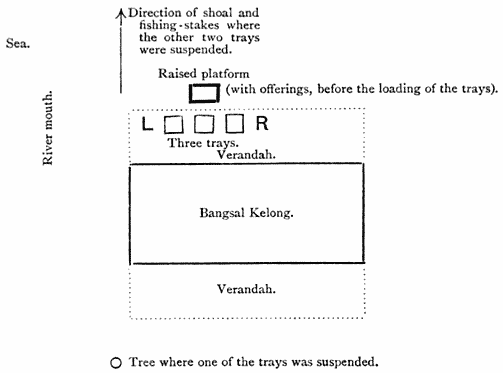
Fig. 1.—Ceremony of sacrificing at the fishing-stakes.
Shortly after our arrival the loading of the trays commenced. First Bilal Umat took a large bowl of parched rice, and poured it into the trays, until the bottom of each tray was filled with a layer of parched rice about an inch in depth.
Next he took a bowl of saffron-stained rice, and deposited about five portions of it in the centre and four corners of each tray; then he made a similar distribution of small portions of washed rice, of sweet potatoes (k’ledek), of yams (k’ladi), of tapioca (ubi kayu), of bananas (pisang), and betel-leaf (sirih)—there being two sets, one cooked and one uncooked, of each of these portions, except the last. Finally, he added one cigarette to each portion, the cigarette being intended for the spirits to smoke after their meal!
Other “perpetual taboos” (pantang salama-lama-nya) are to bathe without wearing a bathing-cloth (mandi tĕlanjang), to throw the wet bathing-cloth over the shoulder when returning to the house, and to rub one foot against the other (gosok satu kaki dĕngan lain). Sarongs, umbrellas, and shoes must never on any pretence be worn. I may add that the first pole planted is called Turus Tuah (tua?), and if the response of the spirits to the invocation be favourable, it is believed that it will enter the ground readily, as if pulled from below. The only seven-days’ taboo which I have heard mentioned (though, no doubt, there are many others) is the scrupulous observance of chastity.
A boat which possesses a knot in the centre of its keel, or to which the smell of fish long adheres (p’rahu pĕranyir, or pĕrhanyir), is supposed to bring good luck to the fishermen.
There is also a regular “taboo language” used by the fishermen, of which the following are examples:—
“Fish = daun kayu (tree-leaves) or sampah laut (jetsam).
Snake = akar hidup (living creeper).
Crocodile = batang kayu (tree-log).
Seaward compartment of the stakes (bunohan) = kurong.”
“Peace be with you, God’s Prophet, ’Tap!
Peace be with you, God’s Prophet, Khizr!
Peace be with you, God’s Prophet, Noah!
Peace be with you, god of the Back-water!
Peace be with you, god of the ‘Bajau’!
Peace be with you, god of Mid-currents!
Peace be with you, god of the Yellow Sunset-glow!
Peace be with you, Old Togok the Wizard!
Peace be with you, O Elder Wizard!
It is not I who make you this peace-offering,
It is Old Togok the Wizard who makes it.
It is the Elder Wizard who makes it,
By the order of Old Aur Gading (lit. ‘Ivory Bamboo’).
“Peace be with you, Eldest Wizard, First of Wizards, Allah,
And Musa, the Converser with Allah.
Sĕdang Bima, Sĕdang Buana,
Sĕdang Juara, and King of the Sea,
Come let us all together
Plant the pole of this jĕrmal.”
Even when fishing with rod and line, a sĕrapah (invocation) of some sort, such as the following, was generally used:—
“Ho, God of Mid-currents,
See that you do not agitate my hook!
If my hook is to the left,
Do you go to the right.
If my hook is to the right,
Do you go to the left.
If you approach this hook of mine
You shall be cursed by the Saying of God,” etc.
(Before casting the line, a chew of betel-leaf should be thrown into the water.)
Another very common rhyming charm would frequently be addressed to the fish:—
“Swallow (lit. receive) the gut of my line,
Be it broken sooner than torn from my hands,
If you tear it from my hands
Your eye shall be plucked out.”
(d) Fire
1. PRODUCTION OF FIRE
The foregoing description requires to be supplemented, for the method of procuring fire by circular friction is hardly (if at all) less common among the Malays than the method of cross friction. The former process takes the form of the well-known “fire-drill,” both the block and the upright stick being generally made of mahang wood. The upright stick is frequently worked by a species of “bow,” such as that used by carpenters, and is kept from jumping out of the socket in which it revolves by means of a cocoa-nut shell, which is pressed down from above. When cross friction is used, a long narrow slit is usually cut, following the grain, in the convex surface of the piece of bamboo, the dust which is rubbed away falling through it and gradually forming a little pile which presently ignites. It is hardly necessary to cut a notch for the cross-piece, as a groove is very quickly worn when the friction is started. A species of fire-syringe has also, I believe, been collected by Mr. L. Wray in Perak.
2. FIRE CHARMS
In procuring fire by circular or cross friction the performer will often say, by way of a charm—
To singe his mother-in-law’s feathers.”
There are still some traces of the influence of animistic ideas in that part of Malay folklore which is concerned with fire. If an inflammable object, such as wood, falls by accident into the fire, a stick must be used in extracting it, and the stick left, as a substitute, in its place.
The hearth-fire (api dapor) must never be stepped over (di-langkah-nya), nor must the rice-pot which stands upon it, as in the latter case the person who does so will be “cursed by the Rice.”
“Cluck, cluck, soul of my child!
Come and return home with me,
Our agreement has reached its term.
Let not the Heat afflict you,
Let not the Wind afflict you.
Let not Mosquitoes bite you,
Let not Sandflies or Midges bite you.”
1. A portion of parched rice.
2. A portion of sweet potatoes.
3. Two (cooked) bananas.
4. Two lĕpats (small cylindrical rice-bags).
5. Three (cooked) bananas.
6. Two kĕtupats (small diamond-shaped bags).
7. Three yams (k’ladi).
8. A portion of parched rice.
9. Three short lengths of the stem of the tapioca plant (ubi kayu).
10. Three sweet potatoes.
11. Four sweet potatoes.
12. A portion of uncooked liver (hati).
13. A portion of cooked meat.
14. Four sweet potatoes.
15. Three cooked bananas.
16. Three kĕtupats.
17. Three (green) bananas.
18. Three kĕtupats.
19. Three ,, ,, kĕtupats ,, .
20. Three green bananas.
21. Three ,, green ,, bananas. ,,
22. Three sweet potatoes.
23. Three yams.
24. Three lĕpats.
25. Three ,, ,, lĕpats ,, .
26. Two lĕpats.
27. Five kĕtupats.
28. Two yams.
29. Two sweet potatoes.
30. One cooked banana.
31. Three handfuls of white pulut rice.
32. Three handfuls of parched rice.