Chapter VI · Magic Rites as affecting the Life of Man
Reading edition
1. BIRTH-SPIRITS
We now come to the spirits which are believed to attack both women and children at childbirth.
These are four in number: the Bajang, which generally takes the form of a pole-cat (musang) and disturbs the household by mewing like a great cat; the Langsuir, which takes the form of an owl with long claws, which sits and hoots upon the roof-tree; the Pontianak or Mati-anak, which, as will be seen presently, is also a night-owl, and is supposed to be a child of the Langsuir, and the Pĕnanggalan, which is believed to resemble a trunkless human head with the sac of the stomach attached to it, and which flies about seeking for an opportunity of sucking the blood of infants.
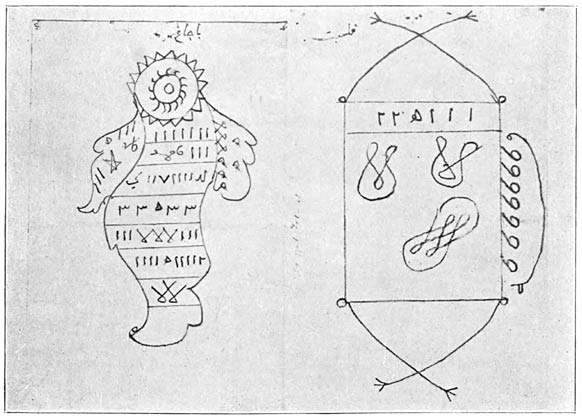
Plate 6.—Bajang and Pĕlĕsit Charms.
Diagrams in the author’s possession representing the Bajang and Pĕlĕsit (birth-spirits).
Page 321.
The following account of the Bajang is by Sir Frank Swettenham:—
“Some one in the village falls ill of a complaint the symptoms of which are unusual; there may be convulsions, unconsciousness, or delirium, possibly for some days together or with intervals between the attacks. The relatives will call in a native doctor, and at her (she is usually an ancient female) suggestion, or without it, an impression will arise that the patient is the victim of a bâjang. Such an impression quickly develops into certainty, and any trifle will suggest the owner of the evil spirit. One method of verifying this suspicion is to wait till the patient is in a state of delirium, and then to question him or her as to who is the author of the trouble. This should be done by some independent person of authority, who is supposed to be able to ascertain the truth.
“A further and convincing proof is then to call in a ‘Pawang’ skilled in dealing with wizards (in Malay countries they are usually men), and if he knows his business his power is such that he will place the sorcerer in one room, and, while he in another scrapes an iron vessel with a razor, the culprit’s hair will fall off as though the razor had been applied to his head instead of to the vessel! That is supposing he is the culprit; if not, of course he will pass through the ordeal without damage.
“I have been assured that the shaving process is so efficacious that, as the vessel represents the head of the person standing his trial, wherever it is scraped the wizard’s hair will fall off in a corresponding spot. It might be supposed that under these circumstances the accused is reasonably safe, but this test of guilt is not always employed. What more commonly happens is that when several cases of unexplained sickness have occurred in a village, with possibly one or two deaths, the people of the place lodge a formal complaint against the supposed author of these ills, and desire that he be punished.
“Before the advent of British influence it was the practice to kill the wizard or witch whose guilt had been established to Malay satisfaction, and such executions were carried out not many years ago.
“I remember a case in Perak less than ten years ago, when the people of an up-river village accused a man of keeping a bâjang, and the present Sultan, who was then the principal Malay judge in the State, told them he would severely punish the bâjang if they would produce it. They went away hardly satisfied, and shortly after made a united representation to the effect that if the person suspected were allowed to remain in their midst they would kill him. Before anything could be done they put him, his family, and effects on a raft and started them down the river. On their arrival at Kuala Kangsar the man was given an isolated hut to live in, but not long afterwards he disappeared.
The popular superstition about the Langsuir is thus described by Sir William Maxwell:—
The superstitions about the Langsuir, however, do not end here, for with regard to its origin the Selangor Malays tell the following story:—
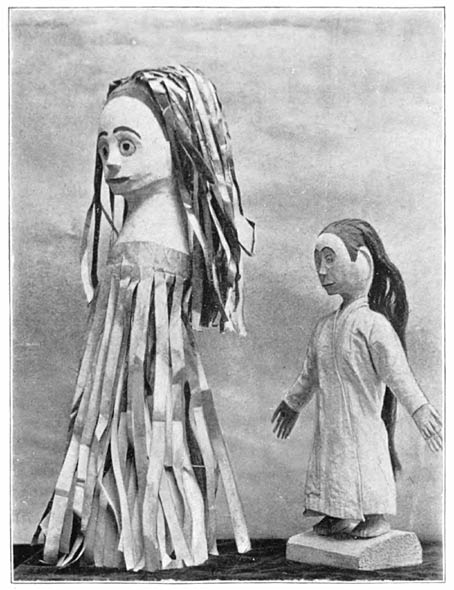
Plate 7.—Pĕnanggalan and langsuir.
Models of the Pĕnanggalan and Langsuir, the former being the head on the left. Note the length of the Langsuir’s nails.
Page 326.
In their wild state, a Malay once informed me, these woman-vampires are exceedingly fond of fish, and once and again may be seen “sitting in crowds on the fishing-stakes at the river mouth awaiting an opportunity to steal the fish.” However that may be, it seems curiously in keeping with the following charm for “laying” a Langsuir:—
“O ye mosquito-fry at the river’s mouth
When yet a great way off, ye are sharp of eye,
When near, ye are hard of heart.
When the rock in the ground opens of itself
Then (and then only) be emboldened the hearts of my foes and opponents!
When the corpse in the ground opens of itself
Then (and then only) be emboldened the hearts of my foes and opponents!
May your heart be softened when you behold me,
By grace of this prayer that I use, called Silam Bayu.”
The “mosquito-fry at the river’s mouth” in the first line is no doubt intended as an allusion to the Langsuir who frequent the fishing-stakes.
“O Pontianak the Stillborn,
May you be struck dead by the soil from the grave-mound.
Thus (we) cut the bamboo-joints, the long and the short,
To cook therein the liver of the Jin (Demon) Pontianak.
By the grace of ‘There is no god but God,’” etc.
To prevent a stillborn child from becoming a Pontianak the corpse is treated in the same way as that of the mother, i.e. a hen’s egg is put under each armpit, a needle in the palm of each hand, and (probably) glass beads or some simple equivalent in its mouth. The charm which is used on this occasion will be found in the Appendix.
The only two spirits of this class which now remain are the Polong and the Pĕlĕsit, and these, as I have said, partake to a great extent of the character of familiar spirits or bottle imps, and are by no means confined to a single “rôle” as the preceding ones have been.
Receipt for securing a Pĕlĕsit
2. BIRTH CEREMONIES
A big tray (talam) is now filled with a measure of uncooked husked rice (b’ras sa-gantang), and covered over with a small mat of screw-palm leaves (tikar mĕngkuang). This mat is in turn covered with from three to seven thicknesses of fine Malay sarongs (a sort of broad plaid worn as a skirt), and these latter again are surmounted by a second mat upon which the newly-born infant is to be deposited.
Next comes the ceremony of marking the forehead (chonting muka), which is supposed to keep the child from starting and straining itself (jangan tĕrkĕjut tĕrkĕkau), and from convulsions (sawan), and at the same time to preserve it from evil spirits. The following are the directions:—Take chips of wood from the thin end (kapala?) of the threshold, from the steps of the house-ladder, and from the house furniture, together with a coat (kesip) of garlic, a coat of an onion, assafœtida, a rattan cooking-pot stand, and fibre from the “monkey-face” of an unfertile cocoa-nut (tampo’ niyor jantan). Burn all these articles together, collect the ashes, and mix them by means of the fore-finger with a little “betel-water.”
In addition to the above, if the child is a girl, her eyebrows are shaved and a curve drawn in their place, extending from the root of the nose to the ear (di-pantiskan bĕntok taji dĕri muka sampei pĕlipis). The mixture used for marking these curves consists of manjakani mixed with milk from the mother’s breast.
Another most curious custom which recalls a parallel custom among North American Indians, is occasionally resorted to for the purpose of altering the shape of the child’s head. When it is considered too long (tĕrlampau panjang), a small tightly-fitting “yam leaf cap” (songko’ daun k’ladi), consisting of seven thicknesses of calladium (yam) leaves is used to compress it. This operation is supposed to shorten the child’s skull, and the person who fits it on to the child’s head uses the words—“Muhammad, short be your head” in the case of a boy, and “Fatimah, short be your head” in the case of a girl.
Now comes the ceremony of administering to the infant what is called the “mouth-opener” (lit. “mouth-splitter,” pĕmb’lah mulut); first, you take a green cocoa-nut (niyor sungkoran), split it in halves (di-b’lah niyor), put a “grain” of salt inside one-half of the shell (di-buboh garam sa-buku), and give it to the child to drink, counting up to seven, and putting it to the child’s mouth at the word seven (lĕtakkan di mulut-nya). Then repeat the ceremony, substituting asam (tamarinds?) for the salt. Finally, take a gold ring, and after rubbing it against the inside of the cocoa-nut (cholek di-dalam niyor), lay it upon the child’s lips, (lĕtakkan di bibir-nya), saying “Bismillah,” etc. Do the same with a silver and amalgam (gold and silver) ring respectively, and the ceremony will be at an end.
I may note, in passing, that it is in allusion to the above ceremony that you will sometimes hear old men say “It’s not the first time I tasted salt, I did so ever since I was first put into my swinging-cot” (aku makan garam dahulu, dĕripada tatkala naik buayan).
Sometimes a little “rock” sugar (gula batu) is added to make the “mouth-opener” more palatable.
From the time when the child is about twenty-four hours old until it is of the age of three months, it is fed with rice boiled in a pot on the fire, “broken” (di-lechek) by means of a short broad cocoa-nut shell spoon (pĕlechek), mixed with a little sugar and squeezed into small receptacles of woven cocoa-nut leaf (kĕtupat).
Later it is taught to feed at the breast (mĕnetek), which continues until it is weaned by the application of bitter aloes (jadam) to the mother’s breasts.
In the rice-jar (buyong b’ras) during this period, a stone, a big iron nail, and a “candle-nut” must be kept, and a spoon (sĕndok) must always be used for putting the rice into the pot before boiling it. Moreover, the mother, when eating or drinking, must always cross her left arm under her breasts (di-ampu susu-nya di lĕngan kiri) leaving the right arm free to bring the food to the mouth.
Once in every four hours the child should be bathed with cold water, in order that it may be kept “cool.” This custom, I was told, is diametrically opposite to that which obtains at Malacca, where the child is bathed as rarely as possible. The custom followed in Selangor is said to prevent the child from getting a sore mouth (guam).
For the first two months or so, whenever the child is bathed, it is rubbed over with a paste obtained by mixing powdered rice with the powder obtained from a red stone called batu kawi. This stone, which is said by some Malays to take its name from the Island of Langkawi, is thought to possess astringent (k’lat) qualities, and is used by Malay women to improve their skin. Before use the paste is fumigated with the smoke of burning eagle-wood, sandal-wood, and incense, after which the liquid, which is said to resemble red ink, is applied to the skin, and then washed off, no doubt, with lime-juice in the ordinary way.
In the cold water which is used for bathing the child are deposited a big iron nail (as a “symbol of iron”), “candle-nuts” and cockle-shells (kulit k’rang), to which some Malays add a kind of parasite called si bĕr’nas (i.e. Well-Filled Out, a word applied to children who are fat, instead of the word gĕmok, which is considered unlucky) and another parasite called sadingin or si dingin, the “Cold” one.
After bathing, the Bidan should perform the ceremony called sĕmbor sirih, which consists in the ejecting of betel-leaf (mixed with other ingredients) out of her mouth on to the pit of the child’s stomach, the ingredients being pounded leaves of the bunglei, chĕkor, and jĕrangau, and chips of brazil-wood, ebony, and sugar-palm twigs (sĕgar kabong); to these are sometimes added small portions of the “Rough” bamboo (buluh kasap), of the bĕmban balu, and of the leaf-cases of the areca-palm (either upih b’lah batang or upih sarong).
The child is generally named within the first week, but I have not yet heard of any special ceremony connected with the naming, though it is most probably considered as a religious act. The name is evidently considered of some importance, for if the child happens to get ill directly after the naming, it is sometimes re-adopted (temporarily) by a third party, who gives it a different name. When this happens a species of bracelets and anklets made of black cloth are put upon the child’s wrists and ankles, the ceremony being called tumpang sayang.
A few days later the child’s head is shaved, and his nails cut for the first time. For the former process a red lather is manufactured from fine rice-flour mixed with gambier, lime, and betel-leaf. Some people have the child’s head shaved clean, others leave the central lock (jambul). In either case the remains of the red lather, together with the clippings of hair (and nails?) are received in a rolled-up yam-leaf (daun k’ladi di-ponjut) or cocoa-nut (?), and carried away and deposited at the foot of a shady tree, such as a banana (or a pomegranate?).
The following description of birth-taboos in Pahang, taken from Mr. H. Clifford’s Studies in Brown Humanity, will give a good general idea of this part of the subject:—
“When Umat has placed the sîrih leaves he has done all he can for Sĕlĕma, and he resigns himself to endure the anxiety of the next few months with the patience of which he has so much command. The pantang bĕr-ânak, or birth-taboos, hem a husband in almost as rigidly as they do his wife, and Umat, who is as superstitious as are all the Malays of the lower classes, is filled with fear lest he should unwittingly transgress any law, the breach of which might cost Sĕlĕma her life. He no longer shaves his head periodically, as he loves to do, for a naked scalp is very cool and comfortable; he does not even cut his hair, and a thick black shock stands five inches high upon his head, and tumbles raggedly about his neck and ears. Sĕlĕma is his first wife, and never before has she borne children, wherefore no hair of her husband’s must be trimmed until her days are accomplished. Umat will not kill the fowls for the cook now, nor even drive a stray dog from the compound with violence, lest he should chance to maim it, for he must shed no blood, and must do no hurt to any living thing during all this time. One day he is sent on an errand up-river and is absent until the third day. On inquiry it appears that he passed the night in a friend’s house, and on the morrow found that the wife of his host was shortly expecting to become a mother. Therefore he had to remain at least two nights in the village. Why? Because if he failed to do so, Sĕlĕma would die. Why would she die? God alone knows, but such is the teaching of the men of old, the wise ones of ancient days. But Umat’s chief privation is that he is forbidden to sit in the doorway of his house. To understand what this means to a Malay, you must realise that the seat in the doorway, at the head of the stair-ladder that reaches to the ground, is to him much what the fireside is to the English peasant. It is here that he sits and looks out patiently at life, as the European gazes into the heart of the fire. It is here that his neighbours come to gossip with him, and it is in the doorway of his own or his friend’s house that the echo of the world is borne to his ears. But, while Sĕlĕma is ill, Umat may not block the doorway, or dreadful consequences will ensue, and though he appreciates this and makes the sacrifice readily for his wife’s sake, it takes much of the comfort out of his life.
The medicine (sambaran bara), used by the mother after her confinement, consists of the ashes of a burnt cocoa-nut shell pounded and mixed with a pinch of black pepper (lada hitam sa-jimput), a root of garlic (bawang puteh sa-labuh), and enough vinegar to make the mixture liquid. This potion is drunk for three consecutive mornings. A bandage is swathed about her waist, and she is treated with a cosmetic (bĕdak) manufactured from tĕmu kuning, which is pounded small (and mixed as before with garlic, black pepper, and vinegar), and applied every morning and evening for the first three days. During the next three days a new cosmetic (bĕdak kunyit t’rus) is applied, the ingredients being kunyit t’rus pounded and mixed in the same way as the cosmetic just described.
At the same time the patient is given a potion made from the ash of burnt durian skins (abu kulit durian), mixed as before with vinegar; the fruit-stalk, or “spire,” of a cocoa-nut palm (manggar niyor) being substituted if the durian skin is not obtainable.
A poultice (ubat pupok) is also applied to the patient’s forehead, after the early bathing, during the “forty-four days” of her retirement; it consists of leaves of the tahi babi, jintan hitam, and garlic, pounded and mixed as usual with vinegar.
On the forty-fourth day the raised platform or roasting-place (saleian) is taken down and the ceremony called Floor-washing (basoh lantei) takes place, the whole house being thoroughly washed and cleaned. The floor having been smeared with rice-cosmetic (bĕdak) (such as the Malays use for the bathing ceremony), it is well scratched by the claws of a fowl, which is caught (and washed) for the purpose, and then held over the floor and forced to do the scratching required of it. The cosmetic is then removed (di-langir) by means of lime-juice (again as in the bathing ceremony) and the hearth-fire is changed. The Bidan now receives her pay, usually getting in cash for the eldest child $4.40 (in some places $5.40), for the second, $3.40, the third, $2.40, and for the fourth, and all subsequent children, $1.40; unless she is hastily summoned (bidan tarek) and no engagement (mĕnĕmpah) has been made, in which case she may demand half a bhara ($11). Besides this somewhat meagre remuneration, however, she receives from the well-to-do (at the floor-washing ceremony) such presents as cast-off clothes (kain bĕkas tuboh), a bowl of saffron rice, a bowl of the rice-cosmetic and limes (bĕdak limau), and a platter of betel-leaf, with accessories (chĕrana sirih). Though the remuneration may appear small, it was, nevertheless, sure; as in former days an unwritten law allowed her to take the child and “cry it for sale” (di-jaja) round the country, should her fee remain unpaid.
Before concluding the present subject it will be necessary to describe certain specific injunctions and taboos which form an important part of the vast body of Malay customs which centre specially round the birth of children.
Before the child is born the father has to be more than usually circumspect with regard to what he does, as any untoward act on his part would assuredly have a prejudicial effect on the child, and cause a birth-mark or even actual deformity, any such affection being called kĕnan. In a case which came to my notice the son was born with only a thumb, forefinger, and little finger on the left hand, and a great toe on the left foot, the rest of the fingers and toes on the left side being wanting. This, I was told, was due to the fact that the father violated this taboo by going to the fishing-stakes one day and killing a crab by chopping at it with a cutlass.
In former days during this period it was “taboo” (pantang) for the father to cut the throat of a buffalo or even of a fowl; or, in fact, to take the life of any animal whatever—a trace no doubt of Indian influences. A Malay told me once that his son, soon after birth, was afflicted with a great obstruction of breathing, but that when the medicine-man (Pawang) declared (after “diagnosing” the case) that the child was suffering from a “fish-affection” (kĕnan ikan), he remembered that he had knocked on the head an extraordinary number of fish which he had caught on the very day that his son was born. He therefore, by the advice of the medicine-man, gave the child a potion made from pounded fish bones, and an immediate and permanent recovery was the result.
Such affections as those described are classified by the Malays according to the kind of influence which is supposed to have produced them. Thus the unoffending victim may be either fish-struck (kĕnan ikan), as described above, ape-struck (kĕnan b’rok), dog-struck (kĕnan anjing), crab-struck (kĕnan kĕtam), and so forth, it being maintained that in every case the child either displays some physical deformity, causing a resemblance to the animal by which it was affected, or else (and more commonly) unconsciously imitates its actions or its “voice.”
Another interesting custom was that the father was stringently forbidden to cut his hair until after the birth of the child.
“In selecting timber for the uprights of a Malay house care must be taken to reject any log which is indented by the pressure of any parasitic creeper which may have wound round it when it was a living tree. A log so marked, if used in building a house, will exercise an unfavourable influence in childbirth, protracting delivery and endangering the lives of mother and child. Many precautions must be taken to guard against evil influence of a similar kind, when one of the inmates of a house is expecting to become a mother. No one may ‘divide the house’ (bĕlah rumah), that is, go in at the front door and out at the back, or vice versâ, nor may any guest or stranger be entertained in the house for one night only; he must be detained for a second night to complete an even period. If an eclipse occurs, the woman on whose account these observances are necessary must be taken into the pĕnangga (kitchen), and placed beneath the shelf or platform (para) on which the domestic utensils are kept. A spoon is put into her hand. If these precautions are not taken, the child when born will be deformed.”
Sir W. E. Maxwell in the above is speaking of Perak Malays. The passage just quoted applies to a great extent to Selangor, but with a few discrepancies. Thus a house-post indented by a creeper is generally avoided in Selangor for a different reason, viz. that it is supposed to bring snakes into the house.
“Dividing the house,” however, is generally considered an important birth-taboo in Selangor, the threatened penalty for its non-observance being averted by compelling the guilty party to submit to the unpleasant ceremony called sĕmbor ayer, a member of the family being required to eject (sĕmbor) a mouthful of water upon the small of the culprit’s back.
In Selangor, again, a guest must stay three nights (not two) in the house, his departure on the first or second night being called “Insulting the Night” (mĕnjolok malam). To avert the evil consequences of such an act, fumigation (rabun-rabun) is resorted to, the “recipe” for it running as follows:—“Take assafœtida, sulphur, kunyit t’rus (an evil-smelling root), onion skins, dried areca-nut husk, lemon-grass leaves, and an old mat or cloth, burn them, and leave the ashes for about an hour at sunset on the floor of the passage in front of the door.” That a sensible and self-respecting “demon” should avoid a house where such an unconscionable odour is raised is not in the least surprising!
In the event of an eclipse the customs of the two sister States appear to be nearly identical; the only difference being that in Selangor the woman is placed in the doorway (in the moonlight as far as possible), and is furnished with the basket-work stand of a cooking pot, as well as a wooden rice-spoon, the former as a trap to catch any unwary demon who may be so foolish as to put his head “into the noose,” and the latter as a weapon of offence, it being supposed that “the rattan binding of the spoon (which must, of course, be of the orthodox Malay pattern) will unwind itself and entangle the assailant” in the case of any real danger. Finally, the Bidan must be present to “massage” the woman, and repeat the necessary charms.
From the following passage it would appear that the corresponding Pahang custom does not materially differ from that of Perak and Selangor:—
3. ADOLESCENCE
The following is a description of the rite of tonsure (bĕrchukor), at which I was present in person:—
“Some time ago (in 1897) I received, through one of my local Malay headmen, an invitation to attend a tonsure ceremony.
“I was now requested to open the proceedings, but at my express desire the Pĕnghulu (Malay headman) did so for me, first scattering several handfuls (of the different sorts of rice) over the bride, and then sprinkling the rice-paste upon the palm of her left hand, which was held out to receive it as described above. The sprinkling over, he took the scissors and with great deliberation severed the end of the first lock, which was made to fall with a little splash, and with the ring attached to it, into the cocoa-nut with the ‘dog-tooth’ border.
“Five other waris (Representatives) and myself followed suit, the seven tresses with the rings attached to them being all received in the cocoa-nut as described.
“A child of the age of about two or three years underwent the tonsure at the same time, each of the Representatives, after severing the bride’s lock, snipping off a portion of the child’s hair. The child was in arms and was not veiled, but wore a shoulder-cloth (bidak) thrown over his shoulder. At the conclusion of the ceremony we left the room, and the Korān-chanting was resumed and continued until the arrival of the bridegroom in procession (at about five P.M.), when the bride and bridegroom went through the ceremony of being ‘seated side by side’ (bĕrsanding), and the business of the day was concluded.
“The cocoa-nut containing the severed tresses and rings is carried to the foot of a barren fruit-tree (e.g. a pomegranate-tree), when the rings are extracted and the water (with the severed locks) poured out at the tree’s foot, the belief being that this proceeding will make the tree as luxuriant as the hair of the person shorn, a very clear example of ‘sympathetic magic.’ If the parents are poor, the cocoa-nut is generally turned upside down and left there; but if they are well-to-do, the locks are usually sent to Mecca in charge of a pilgrim, who casts them on his arrival into the well Zemzem.”
I will now describe the ceremony of filing or “sharpening” the teeth, from notes taken by myself during the actual ceremony (20th March, 1897).
Considerable interest attaches to the filing of the first tooth, on account of the omens which are taken from the position in which the crown happens to lie when it falls. If, when the tooth is filed through, the crown adheres to the file, it is taken as a sign that the patient will die at home; if it flies off and lies with its edge turned upwards, this means, on the contrary, that he will die abroad.
Whenever I made inquiries as to the reason of this strange custom, I was invariably told that it not only beautified but preserved the teeth from the action of decay, which the Malays believe to be set up by the presence of a minute maggot or worm (ulat), their most usual way of expressing the fact that they are suffering from toothache being to say that the tooth in question is being “eaten by a maggot” (di-makan ulat).
The “Batak” Malays (a Mid-Sumatran tribe, many of whom have settled in Kuala Langat) are said to chip the teeth of their children into the desired shape by the use of a small chisel, the operation causing such exquisite agony that the sufferer will not unfrequently leap to his feet with a shriek.
Even when the file is used, the work of an unskilful performer (who does not know how to destroy the “venom” of his instruments) will cause the sufferer’s face to be completely swollen up (bakup) for a long period subsequent to the operation. Yet young people of both sexes cheerfully submit to the risk of this discomfort, and the only remark made by the youth whom I saw undergoing it was that it “made his mouth feel uncomfortable” (jĕlejeh rasa mulut-nya).
4. Personal Ceremonies and Charms
Ceremonies and charms for protecting or rendering the person more attractive or formidable, form one of the largest, but not perhaps the most interesting or important division of the medicine-man’s repertory.
The following remarkable specimen of the charms belonging to the first of these classes was given me by ’Che ʿAbas of Klanang in Selangor, a Kelantan Malay:—
“If the corpse in the grave should speak,
And address people on earth,
May I be destroyed by any beast that has life,
But if the corpse in the grave do not speak,
And address people on earth,
May I not be destroyed by any beast that has life, or by any foe or peril, or by any son of the human race.
And if the chicken in the egg should crow,
And call to chickens on earth,
May I be destroyed by any beast that has life,
But if the chicken in the egg do not crow,”
(etc. etc., as before.)
As a general rule, however, this particular class of charms shows particularly strong traces of Arabic influence, most often, perhaps, taking the form of an injunction (addressed to Jins or Angels) to watch over the person of the petitioner.
The following is a specimen of an invocation for beautifying the person which is supposed to be used by children:—
“The light of four Suns, five Moons,
And the seven Stars be visible in my eye.
The brightness of a shooting star be upon my chin,
And that of the full moon be upon my brows.
May my lips be like unto a string of ants,
My teeth like to a herd of elephants,
My tongue like a breaking wave,
My voice like the voice of the Prophet David,
My countenance like the countenance of the Prophet Joseph,
My brightness like the brightness of the Prophet Muhammad,
By virtue of my using this charm that was coeval with my birth,
And by grace of ‘There is no god but God,’” etc.
The third class of invocations, for rendering the person formidable, belong rather to the chapter on war, under which heading they will be included.
5. BETROTHAL
The girl’s parents next call four or five witnesses (saksi) of either sex to “witness” the betrothal, and after preparing a meal (nasi dan kueh) for their expected guests, await the arrival of the youth’s “Representatives,” the youth himself remaining at home. One of the party carries a betel-leaf tray furnished with the usual betel-chewing appliances, together with half a bhara of dollars ($11) according to the stricter custom; although (failing the dollars), a ring or bracelet, or other jewellery of that value, may be substituted.
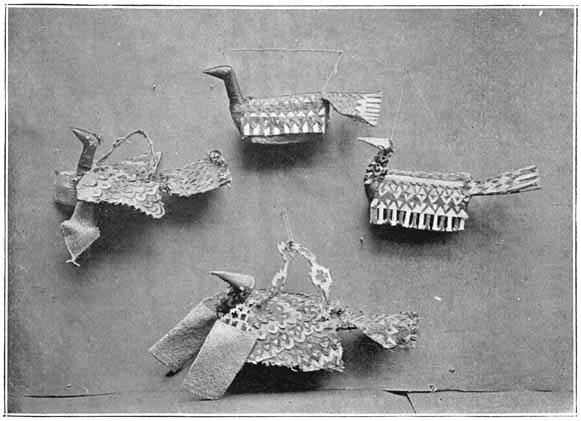
Plate 8.—Betrothal Gifts.
Bird-shaped receptacles, formerly used for containing rice for presentation purposes during betrothal, the bird at the bottom representing a peacock (mĕrak). Round its neck are hung two smaller receptacles also for rice.
Page 365.
Bearing these presents with them, the youth’s representatives proceed to the house of the girl’s parents, where they are invited to enter and partake of the betel-leaf provided for them. A meal is then served, Malay cakes (kueh-kueh) brought forward, and the company again partake of betel.
The two parties now sit down in a “family circle,” and one of the youth’s representatives pushes forward (di-sorongkan) the betel which they had brought with them, and offers it to the people of the house, saying, “This is a pledge of your daughter’s betrothal.” The girl’s father replies, “Be it so, I accept it,” or words to that effect, and inquires how long the engagement is to last, the answer being “six months” or “a year” as the case may be. Both parties then appeal to the witnesses to “hear what is said,” and the youth’s relatives return to their homes.
The marriage portion being fixed (in Selangor) by an almost universal custom at two bharas of dollars ($44), the amount is not usually mentioned at the betrothal, it being understood that the usual amount is intended. But if the girl’s parents should afterwards prove reluctant to proceed with the match, they forfeit twice the amount of the pledge-money which they have received; whereas if the youth refuses to proceed he merely forfeits the pledge-money ($11) already paid to the girl’s parents. Some families pay a marriage portion of $30 only, and others (such as the family of ’Toh Kaya Kĕchil of Klang) pay as much as $50, but exceptions are rare, $44 being now generally recognised as the customary wedding portion.
However, the girl’s family does not really receive anything like the full value of the $44, because if the $44 is paid in full the proposer has a right to demand a complete outfit (pĕrsalinan) of silk attire, to the value of about $20, so that the amount which actually changes hands is seldom more than about $24.
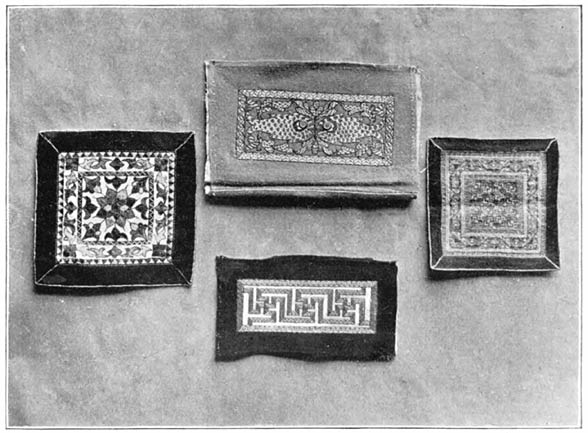
Plate 9.—Betrothal Gifts.
The two square cloths resembling “D’oyleys” represent two different patterns of the gĕdĕbong, a cloth (in three thicknesses and sizes) used for wrapping up the presentation betel-leaf during the period of betrothal.
Page 366.
The Malay fiancée, unlike her European sister, is at the utmost pains to keep out of her lover’s way, and to attain this object she is said to be “as watchful as a tiger.” No engagement-ring is used in this neighbourhood, no priest (or Lĕbai) is present at the engagement ceremony, nor is the girl asked for her consent. On the other hand, a regular system of exchanging presents, after the engagement, is said to have been formerly in vogue in Selangor, the man sending betel-leaf, fruit, and eggs to his fiancée from time to time in net-work receptacles, and the woman sending specially prepared rice, etc. in rush-work receptacles of various patterns. It is said, too, that the woman would occasionally carve a chain, consisting of three or four links, out of a single areca-nut, in which case the prospective bridegroom was supposed to redeem it by the payment of as many dollars as there were links. The betel-nut presented on these occasions would be wrapped up in a gradation of three beautifully worked cloths, not unlike “D’oyleys” in general appearance, whilst the actual engagement ceremony in former days is said to have received additional interest and formality from the recital of verses appropriate to the occasion by chosen representatives of each party. Specimens of the betrothal verses formerly used in Selangor will be found in the Appendix. The following is a translation:—
“Q. Small is my cottage, but it has five shelves
For roasting the kĕrisi fish;
Hearken, good people, whilst I inquire of you
A. Your fishing-line must be five fathoms long
If you would catch the tĕnggiri fish;
That is the price of our Diamond here.
Q. If there are no rĕngas trees growing on the Point,
One must go up-stream and cut down a screw-palm;
If one has not gold in one’s girdle,
One must make over one’s person to begin with.
A. If there are no rĕngas trees growing on the Point,
You must take banyan-wood for the sides of your trays;
If you have no gold in your girdle,
You need not hope to get Somebody’s daughter.
Q. Thousands are the supports required
Though it be thousands I would accept the debt
So I be betrothed to Somebody’s daughter.
A. My head-kerchief has fallen into the sea,
I stretch out my hand in token of acceptance,
Though I have naught wherewith to requite you.
Q. Oar-ring or no,
The lĕnggundi bush grows apace in the thatch channels.
Whether it is well to go slowly or no,
It is the favour you have shown me that subdues my heart.”
If, however, there is a hitch in the proceedings, and the parties commence to lose their temper, the stanzas may end very differently; for instance, the girl’s father or representative will say:—
“A. My lord has gone up-stream
If that is all, let it alone for the present;
If there is anything else you will always find me ready.
Q. ’Che Dol Amat’s mango-tree
When it fell rolled into the swamp.
If I cannot get what I want by peaceful means,
Look that you be not hit in the war of strategy.
Let us get saffron-rice and roast a fowl.
If I cannot get you to make acknowledgment,
Let Heaven reel and Earth be submerged.”
These last two lines constitute a direct challenge, and no more words need be wasted when once they have been uttered.
6. MARRIAGE
Both houses are decorated with vertically striped hangings (p’lang tabir) and ornamental ceiling-cloths (langit-langit), and mats, rugs, carpets, etc. are laid down. In the bridegroom’s house little is done beyond erecting a small platform or dais (pĕtărana) about six feet square, and raised about ten inches from the floor, upon which he is to don his wedding garments when he sets out to meet the bride. A similar platform (pĕtărana) is erected in the bride’s house, and a low dais called rambat in front of her door, at the outer corners of which are fixed two standard candlesticks (tiang rambat), which are sometimes as much as six feet high, and each of which carries three candles, one in the centre and one on each side, those at the side being supported by ornamental brackets (sulor bayong). The rambat may measure some 14 feet in length by 5 feet in width, and should be about 14 inches in height.
A dais (with two steps to it) is then built as follows, generally opposite the doorway, but standing a little way back from it, and facing the rambat, so as to leave a narrow passage (tela kĕchil) between the threshold and the dais, which latter is decked with scarlet, or at least scarlet-bordered cloth (kain bĕrumpok dĕngan săkalat). The lower step of the dais (ibu g’rei) is raised about 12 inches from the floor, and measures from 10 feet to 12 feet in length by 8 feet in width. The upper step (g’rei pĕnapah) is a little smaller, and is only raised about 10 inches above the lower one. The top of the dais is covered with a mattress, and both steps are decorated with expensive borders, which at the wedding of a Raja are made of embossed gold or silver, and may easily cost as much as $150 each, or even more. The mattress is covered in its turn with a quilt (lihap or pĕlampap), made of coloured silk stuffed with cotton; upon this quilt is laid a white cotton sheet, and the whole is surmounted by a row of colossal “pillows” (of the size of small packing-cases), surmounted by others of moderate size.
A mosquito-curtain is hung over all, and the completed couch is called pĕlamin. The head of the pĕlamin, it must be added, where the pillows are piled, is always on the left-hand side as you look towards it.
The number of the pillows used is of the highest importance, as indicating the rank of the contracting parties. The larger ones are about 5 feet in length and 2 feet in height by 1½ feet in width. They are covered with rich embroidery at the exposed end, and are arranged in a horizontal row (sa-tunda), with their sides just touching, in the front left-hand corner of the mosquito-curtain, so as to leave a clear passage of about 3 feet behind them (at the back of the curtain) by which the bride and bridegroom may escape to the pĕraduan after the ceremony. These big pillows are white, with the exception of the embroidered ends, unless they are intended for a Raja, when the royal colour (yellow) is of course substituted. The one nearest the centre of the couch is called bantal tumpu, and usually has a hexagonal or (in the case of a Raja) octagonal bolster deposited beside it.
The smaller pillows are red (occasionally purple, ungu, or orange, jingga), and are called the “embroidered pillows” (bantal bĕrtĕkat, or bantal p’rada). Occasionally a set of twelve small pillows is used (when they are called bantal dua-b’las, or the Twelve Pillows), but often there is only one of them to each “Big Pillow,” the set of twelve being said to be an innovation, probably introduced from Malacca. Sometimes, however, when many small pillows are piled upon each other, measures have to be taken to keep them from falling, in which case the space between the piles is said to be filled up with wool or cotton stuffing (pĕnyĕlat), the front being covered with embroidered cloth, the upper border of which is carried up diagonally from the top of one pile to the top of the next.
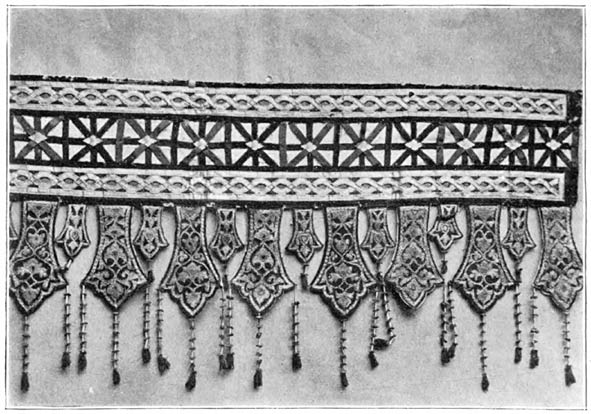
Plate 10.—Curtain Fringe.
Pattern of fringe used for the mosquito curtain at Malay wedding ceremonies, called daun budi, or the Bo-leaf fringe.
Page 372.
Above the clothes-rod, and between its suspending cords (tali pĕnggantong)—which, by the way, are also covered with scarlet cloth—an inner fringe of “Bo-leaves” (daun budi dalam) is sometimes added at the top of the curtain.
At the wedding of a Raja nothing else should be put inside the curtain, but at an ordinary wedding a few small articles of typical marriage furniture are usually added as follows:—
Near the door of the curtain is placed an earthenware water-jar, called gĕlok (gĕlok Kĕdah and gĕlok Perak are the usual “makes”); this jar stands upon a small brass or earthenware plate with high sides (bokor), and its mouth is covered with a brass or earthenware saucer (chepir), on which is laid the brass or earthenware bowl (pĕnchedok ayer or batil) which is used for scooping up water from the water-jar, and which, when it is in use, is temporarily replaced by an ornamental cap woven from strips of screw-palm leaves. A couple of candlesticks placed near the water-jar, a betel tray (tepah or puan), a basin (batil bĕsar) for washing off the lees of henna, and a “cuspadore” (kĕtor), all of which are placed inside the curtain, complete the preparations for this portion of the ceremony.
At a royal wedding, either the “Story of ’Che Mĕgat” (’Che Mĕgat Mantri), or a royal cock-fight (main dĕnok), or a performance by dancing girls or fencers (pĕdikir), may be substituted for these more devotional exercises.
These performances (whatever they may be) are kept up (with intervals for rest and refreshment) till four or five in the morning, when the guests disperse to their respective homes to sleep off the night’s fatigue.
Whilst the games are progressing (at about nine or ten P.M.) the first staining of the finger-nails of the bride and bridegroom is commenced, the ceremony on this occasion being conducted in the seclusion of the inner apartments, and hence called the “Stolen Henna-staining” (bĕrhinei churi). Leaves of henna are taken and pounded together with a small piece of charcoal, and the “mash” is applied to the finger-nails of both hands (with the exception of the middle or “Devil’s finger,” jari hantu). The centre of each palm is also touched with the dye, the area stained being as much as would be covered by a dollar. A line (of a finger’s breadth) is also said to be drawn along the inner side of the sole of each foot, from the great toe to the heel (hinei kaus).
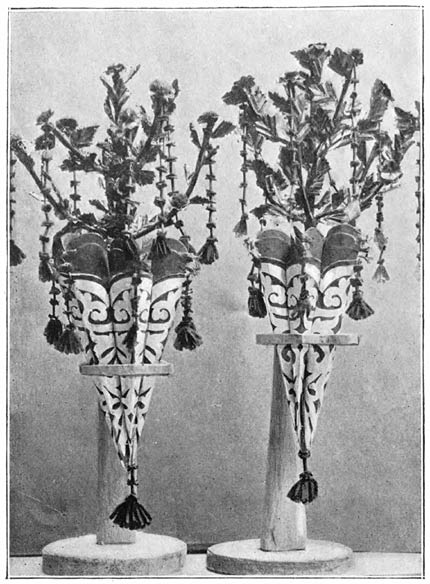
Plate 11.—Fig. 1. Bridal Bouquets.
Bridal bouquets of artificial flowers and betel-leaves carried by bride and bridegroom, that on the left being the bridegroom’s.
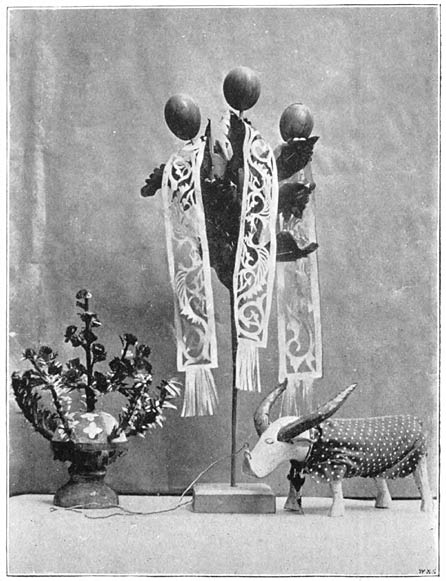
Fig. 2. The Henna Cake, etc.
Three models of wedding apparatus: the one on the left represents the “henna cake” used at the “henna dance” during the ceremony of staining the finger-nails. The second represents the bouquet of artificial flowers, with coloured eggs and streamers, which must be presented to each guest at a wedding. The model of the buffalo shows the way in which these animals are dressed for presentation to a Raja.
Page 375.
A couple of what we should call “pages,” of about ten years of age, are seated right and left of the bridegroom, and are called Pĕngapit.
The bride usually provides herself with one or more girl companions; but these are supposed to “hide themselves” when there is company, their place being taken by more staid duennas, who are called Tukang Andam (i.e. “coiffeurs”), and a personal attendant or nurse, called Ma’inang (Mak Inang), who appears to act as a sort of Mistress of the Ceremonies.
The second day is spent by the guests (as was said above) in sleeping off their night’s fatigue, and they do not reassemble till evening, at about five P.M.
When the last has arrived (at about seven P.M.) a meal is served, and at about half-past eight the games recommence; but after a round or so (zikir sa-jurus), say at about ten P.M., the bride at her house and bridegroom at his respectively make their first appearance in public, clad in their wedding garments, for the ceremony of staining the finger-nails, this time in public. When they are seated (between the two candlesticks, which are lighted to facilitate the operation) a tray is brought forward, furnished with the usual accessories of Malay magic, rice-paste (tĕpong tawar), washed rice, “saffron” rice, and parched rice, to which is added, in this instance, a sort of pudding of the pounded henna-leaves. A censer is next produced, and a brass tray with a foot to it (called sĕmb’rip) is loaded with nasi bĕrhinei (pulut or “glutinous” rice stained with saffron), in which are planted some ten to fifteen purple eggs (dyed with a mixture of brazil wood (sĕpang) and lime, and stuck upon ornamental sprays of bamboo decorated with coloured paper). The bride (or bridegroom) is then seated in a “begging” attitude, with the hands resting upon a cushion placed in the lap; the first of the guests then takes a pinch of incense from the tray and burns it in the brazier (tĕmpat bara); next he takes a pinch of parched rice, a pinch of newly-washed rice, and a pinch of saffron rice, and, squeezing them together in the right fist, fumigates them by holding them for a moment over the burning incense, and then throws them towards the sitter, first towards the right, then towards the left, and finally into the sitter’s lap.
A pinch of the henna is then taken and dabbed upon the centre of each palm, the hands of the sitter being turned over to enable this to be done.
The sitter then salutes the guest by raising his (or her) hands with the palms together before the breast in an attitude of prayer; the guest replies by a similar action, and the ceremony is at an end.
The same operation is performed by from five to seven, or even nine, relations (Orang Waris, lit. “Heirs,”) the last operator concluding with an Arabic prayer.
The step, which is a special one, is called the “Henna-dance Step” (Langkah tar’ hinei, i.e. tari hinei), and the tune is called the “Henna-staining tune” (Lagu bĕrhinei).
This ceremony over, the “henna-staining” rice (nasi bĕrhinei) is partaken of by those present, the remainder being distributed to the guests engaged in “main zikir.”
On the third night the same ceremonies are repeated without variation.
On the fourth morning, called the “Concluding Day” (Hari Langsong), everybody puts on his finest apparel and jewellery.
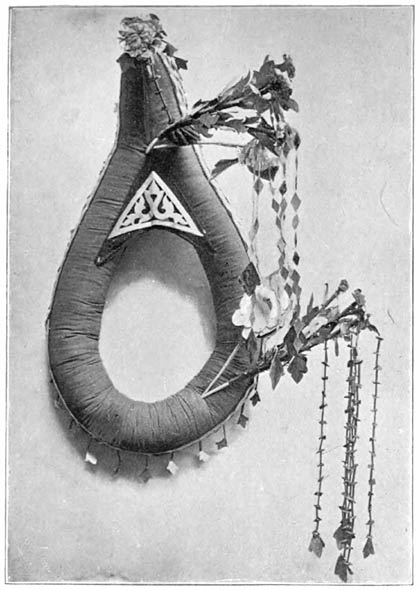
Plate 12.—Fig. 1. Bridegroom’s Head-dress.
Head-dress worn by the bridegroom at the ceremony of the hari langsong.
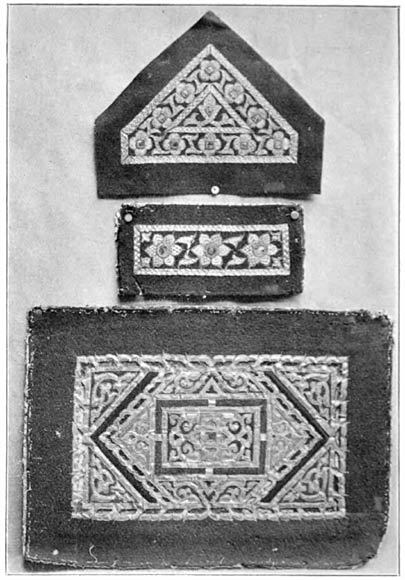
Fig. 2. Pillow-ends.
Patterns used for decorating the ends of the wedding pillows.
Page 378.
The groom, on the other hand, is clad in his best jacket and trousers, with the Malay skirt (sarong), fastened at the side, and girt above the knee (kain kĕmbang). His head is adorned with the sigar, a peculiar head-dress of red cloth arranged turbanwise, with a peak on the right-hand side, from which artificial flowers (gunjei) depend, and which preserves its shape through being stuffed with cotton-wool. Its border is decorated with tinsel, and it has a gold fringe (kida-kida). Besides this head-dress the bridegroom has a small bunch of artificial flowers (sunting-sunting) stuck behind each ear, whilst two similar bunches are stuck in the head-dress (one on the right and the other on the left).
The remainder of the company are of course merely dressed in their best clothes.
The sĕtakona is erected in front of the pĕlamin, on which the bride takes her seat at about 4 P.M. to await the coming of the bridegroom, the members of her own bridal party, including the Muhammadan priest or Imām, continuing the zikir maulud in the reception room at frequent intervals from 9 A.M. until the bridegroom’s arrival. The arrangements are completed by placing ready for the bridegroom the “Bridal Mat” (lapik nikah), which consists of a mat of screw-palm leaves (or in the case of a Raja, a small quilt, embroidered in the manner called jong sarat) five cubits of white cloth, which are rolled up and put on one side, and a tray of betel.
Returning to the bridegroom, holy water (ayer sĕmbahyang) is now fetched in a chĕrek (a kettle-shaped vessel) or bucket, for the bridegroom to wash his face and hands, and he then proceeds to put on his wedding garments, as described above, after which a scarf (salendang) is slung across his shoulder. The marriage procession (pĕrarakan) then sets out, the women heading it (pĕnganjor) and the men following, the bridegroom carried upon somebody’s shoulders (di-sompoh), and right and left the musicians beating drums, tabors, etc., whilst those who have any skill amuse the company with exhibitions of Malay fencing (main silat) and dancing, etc., to the accompaniment of the zikir intoned by their companions.
The arrival of the bridegroom at the bride’s house is the signal for a mimic conflict for the person of the bride, which is called mĕlawa, and is strangely reminiscent of similar customs which formerly obtained in Europe.
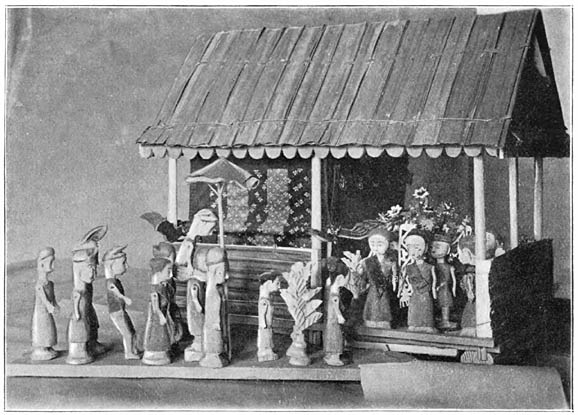
Plate 13.—Wedding Procession.
Model, showing a wedding procession arriving at the bride’s house, the bridegroom being carried on a man’s shoulders, and shaded by an umbrella.
Page 381.
On arriving at the door the musicians strike up their liveliest tune, and as the bridegroom is carried up the steps he has to force his way through an Amazonian force consisting of the ladies of the bride’s party, who assemble to repel the invader from the threshold. A well-directed fire is maintained by others, who pour upon the foe over the heads of the defenders repeated volleys of saffron rice (or, at a royal wedding, ambor-ambor—i.e. clippings from a thin sheet of silver or gold which are thrown among the crowd as largess).
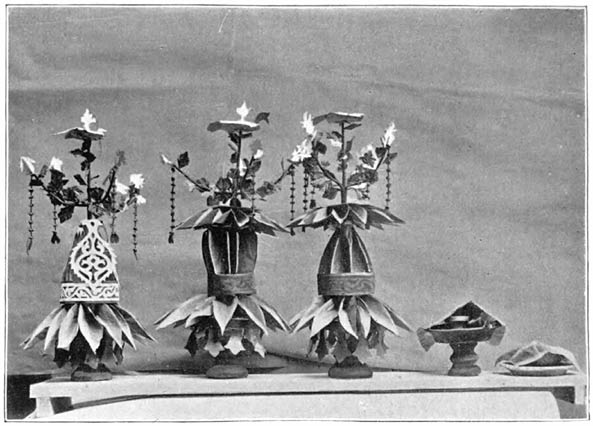
Plate 14.—Poko’ sirih.
Presentation “betel-leaf trees” (poko’ sirih), said to have been formerly carried in procession at weddings. These so-called “trees” are made of betel-leaves ingeniously arranged, and are called (from their patterns) sirih jantong (or “heart betel”); sirih gua (or “cave betel”); sirih palita (or “lamp betel”), the heart betel being on the left. The birds at the top of each “tree” are hornbills.
Page 382.
The seating having been accomplished, friends put in the right hands of bride and bridegroom respectively handfuls of rice taken from the nasi sĕtakona; with this the two feed each other simultaneously, each of them reaching out the hand containing the rice to the other’s mouth. (This part of the ceremony is often made the occasion for a race.)
The bridegroom is then carried off by his friends to the outer chamber, where he has to pay his respects (minta’ maʿaf, lit. “ask pardon”) to the company, after which he is carried back to his old post, the bride in the meantime having moved off a little in the mosquito curtain.
For three days lustrations are continued by the newly-married pair, but before they are completed, and as soon as possible after the wedding, friends and acquaintances once more put on their finery, and proceed to the house to pay their respects, to bathe, and to receive largess.
On the third day after the hari langsong there is a very curious ceremony called mandi tolak bala, or mandi ayer salamat (bathing for good luck).
On the night in question the relatives of the bridegroom assemble under cover of the darkness and make a bonfire under the house of the newly-married couple by collecting and burning rubbish; into the fire thus kindled they throw cocoa-nut husks and pepper, or anything likely to make it unpleasant for those within, and presently raise such a smoke that the bridegroom comes hastily down the steps, ostensibly to see what is the matter, but as soon as he makes his appearance, he is seized by his relatives and carried off bodily to his own parents’ house; these proceedings being known as the stealing of the bridegroom (churi pĕngantin). Next day there is a grand procession to escort him back to the house of his bride, which he reaches about one o’clock in the afternoon, the processionists carrying “Rice of the Presence” (nasi adap-adap) with the eggs stuck into it as on the last day of the wedding, two sorts of holy water in pitchers, called respectively ayer salamat (water of good luck), and ayer tolak bala (water to avert ill-luck), vases of flowers (gumba) containing blossom-spikes of the cocoa-nut and areca-nut palms, and young cocoa-nut leaves rudely plaited into the semblance of spikes of palm-blossom, k’risses, etc. etc., together with a large number of rude syringes manufactured from joints of bamboo, and called panah ayer, or “water-bows.”
A set of similar objects (including nasi adap-adap), is prepared by the relatives of the bride, and deposited upon the ground in the place selected for the bathing ceremony. A bench being added for the bride and bridegroom to sit upon, the ceremony commences with the customary rite of tĕpong tawar, after which the two kinds of holy water, ayer tolak bala and ayer salamat, are successively thrown over the pair.
Now, according to the proper custom, during the proceedings which follow, all the bride’s relatives should surround the bride’s seat, and the bridegroom’s relatives should stand at a distance; but, in order to save themselves from a wetting, the women of both parties now usually assemble round the bride and bridegroom, where they are protected by a sheet which is hung between them and the men; for all the young men now proceed to discharge their “water arrows,” and as they are stopped by the sheet they proceed to turn their syringes against each other, until all are thoroughly wetted.
Meanwhile a young cocoa-nut frond, twisted into a slip-knot with V-shaped ends (something like the “merry thought” of a fowl), is presented to the bride and bridegroom, each of whom takes hold of one end, and blowing on it (sĕmbor) thrice, pulls it till it comes undone, and the lĕpas-lĕpas rite is concluded. Finally, a girdle of thread is passed seven times over the heads and under the feet of the bride and bridegroom, when the bridegroom breaks through the thread and they are all free to return homewards. This latter ceremony is called ’lat-’lat. The guests then return to their homes, divest themselves of their wet garments, and put on their wedding attire. The bĕrsuap-suapan, or feeding ceremony, is then performed (both vessels of adap-adap rice being used), and then all parties disperse for the usual games. Seven days after the “Concluding Day” (Hari Langsong), the ceremony of Discarding the Earrings (i.e. subang, the emblems of virginity) is performed by the bride.
Raja Bôt of Selangor, who attaches great importance to the lustration ceremony, and says that it ought not to take place later than the seventh day (at a Raja’s wedding), thus describes the full ceremony as once arranged by himself:—A small bath-house was built at the top of a flight of seven steps, and water was pumped up to it through a pipe, whose upper end was made fast under the roof of the shed, and terminated in the head of a dragon (naga), from whose jaws the water spouted. The steps were completely lined with women, of whom there must have been an immense number (no men being allowed to be present), and the Raja and his bride bathed before them. A royal bath-house of this kind is called balei pancha pĕrsada, and should be used not only at “royal” weddings, but at coronations (waktu di-naubatkan); it is described in the following lines:—
“Naik balei pancha pĕrsada
Di-hadap uleh sagala Biduanda,
Dudok sĕmaiam dĕngan bĕrtakhta.
Mandi ayer yang kaluar di mulut Naga”—
which may be translated:—
“Ascend to the Royal Bath-House
In the presence of all your courtiers,
Take your seat in royal state,
And bathe in the water that flows from the Dragon’s Mouth.”
It must not be supposed that, with such a mass of detail, many things may not have been overlooked, but it may be remarked as some sort of a practical conclusion to this account, that the Malay wedding ceremony, even as carried out by the poorer classes, shows that the contracting parties are treated as royalty, that is to say, as sacred human beings, and if any further proof is required, in addition to the evidence which may be drawn from the general character of the ceremony, I may mention, firstly, the fact that the bride and bridegroom are actually called Raja Sari, (i.e. Raja sa-hari, the “sovereigns of a day”); and, secondly, that it is a polite fiction that no command of theirs, during their one day of sovereignty, may be disobeyed.
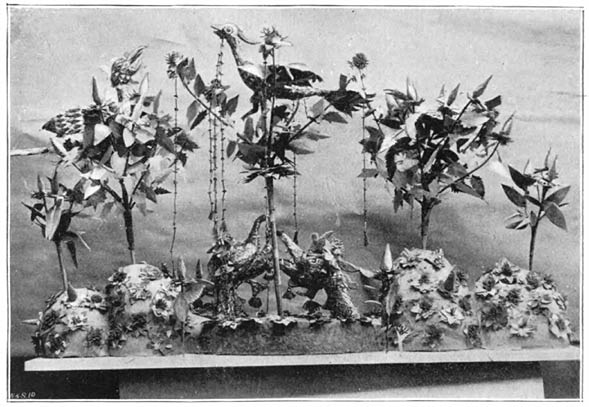
Plate 15.—Wedding Centrepiece, with Dragons etc.
Set piece used at a Malay wedding, and presented to the author afterwards. It represents two dragons issuing from caves in opposite hills into a lake, in which they are fighting. On the tree-tops are to be seen the fabulous birds the roc (garuda), the jintayu (a fabulous vulture), and the walimana (a harpy). Page 388.
I will now give accounts of two Malay weddings which took place at Klang: both accounts were composed by respectable Malays, the first one being translated by Mr. Douglas Campbell of Selangor, and the second by the present writer:—
“On Monday, the 1st of August, the house was prepared and the hangings and curtains put up, and on that evening the ceremony of dyeing the fingers of the bridegroom with henna was performed for the first time. Then there were readings from the Korān, with much beating of drums and kettledrums and Malay dances, and when this had gone on for some time, supper was served to all the men present in the balei, or separate hall, and to the women in the house adjoining. Supper over, readings from the Korān and beating of drums were continued till daylight.
“On Tuesday evening the dyeing of the fingers of the bridegroom was performed for the second time, as on the preceding evening.
“Supper was then served to all the guests present as before, the men having their meal in the balei and the women in the house adjoining, and singing and dancing was kept up until daylight.
“On Thursday afternoon the bride, dressed in her best, with her father and relations, received the Resident, who was accompanied by Mrs. Birch, the Senior District Officer and Mrs. Turney, Captain and Mrs. Syers, Mr. Edwards, and many other ladies and gentlemen. Cakes and preserves were served, of which the ladies and gentlemen present partook. Then the bridegroom arrived, seated in an open carriage with a groom’sman on each side of him, while one, carrying the Royal silk umbrella, kindly lent by H.H. the Sultan, went before him.
“The procession was headed by one of the Royal spears, and two more were carried before the bridegroom and two behind him, and so, accompanied by the Selangor Band, kindly lent by the Resident, and by a crowd of people singing and beating gongs and drums, he was conveyed to the bride’s house. His arrival was greeted with showers of rice, and he was seated, together with the bride, on the dais, where they, with the assistance of Mr. and Mrs. Birch, helped each other to partake of yellow rice.
“So the marriage was completed satisfactorily, and then, as it was evening, the Resident and Mrs. Birch, and the other ladies and gentlemen present, returned to Kuala Lumpur; the people who remained amusing themselves with dagger dances (main dabus).
“On Friday evening the bride and bridegroom left for Jugra in the Esmeralda, which had been lent by the Resident, to pay their respects to H.H. the Sultan, returning to Klang on Saturday.
“On the same afternoon the ceremony of the bath was performed, to the great satisfaction of every one present, and was kept up till six o’clock, by which time every one was wet through.
The following account was translated by the writer:—
“Preparations for the wedding of Inche Halimah, daughter of Sheikh ʿAbdul Mohit Baktal, and Said ʿAbdul Rahman Al Jafri, commenced on Monday, the 2nd of August 1895.
“The mosquito-curtain, tapestries and canopies were suspended, and decorations, including the marriage furniture (pĕti bĕtuah dan bangking), arranged. Moreover, the bridal couch was adorned with decorations of gold and mattresses raised one above the other, one with a facing of gold and the other with a facing of silver, and four pillows with gold facings, and five piled-up pillows with silver facings; and the kitchen apparatus was got ready, including ten pans and coppers of the largest size, and the sheds for those who were to cook rice and the meats eaten therewith. On this day, moreover, a buffalo was sent by Towkay Teck Chong, with the full accompaniments of music, and so forth.
“On Tuesday, the 3rd day of the month, took place the first Henna-staining, the bride being led forth by her Coiffeur and seated upon the marriage throne. And the bride seated herself against the large pillow, which is called ‘The Pillow against which One Rests,’ or bantal saraga. And towards evening all the relatives on the woman’s side sprinkled the tĕpong tawar (upon the forehead and hands of the bride), and after the Henna-staining, dishes of confectionery and preserved fruits were offered to all the guests who were present in the reception-room.
“And the Tuan Imām read the marriage service, Datoh Pĕnghulu Mohit giving his permission for Tuan Haji Mohamad Said Mufti to wed Inche Halimah to Said ʿAbdul Rahman Al Jafri, with a marriage portion of $100. And after the marriage rite Tuan Imām proceeded to read prayers for their welfare. And afterwards dishes of rice were brought, of which the guests present were invited to partake. And when all had eaten, the Coiffeur led forth the bride to the scaffolding for the ceremony called ‘Bathing in State.’ And upon that same evening took place the Great Henna-staining, and the guests assembled in exceeding great numbers, both men and women, and filled the house above and below to overflowing. And when the henna-staining was completed, all the men who were present chanted (bacha maulud) until daybreak.
“And upon the 7th day of the month, being Saturday, the bride being adorned, the bridegroom seated in a buggy was drawn in procession at about 5 o’clock from the house of his renowned Highness Tungku Dia-Uddin, accompanied by the Government Band and all kinds of music, to the house of the Datoh Pĕnghulu, where he was met and sprinkled with saffron-rice and rose-water. Afterwards, being seated on the marriage throne side by side, both husband and wife, they offered each other in turn the mouthfuls of saffron-rice which were presented by the ladies and gentlemen and His Highness Tungku Dia-Uddin.
The marriage customs hitherto described have been only such as are based on a peaceful understanding between the parents of the contracting parties. An account of Malay marriage customs would not, however, be complete without some mention of the customs which regulate, strange as it may seem, even the forcible abduction of a wife. Of these customs Sir W. E. Maxwell says:—
“The word panjat in Malay means literally ‘to climb,’ but it is used in Pêrak, and perhaps in other Malay States, to signify a forcible entry into a house for the purpose of securing as a wife a woman whom her relations have already refused to the intruder. This high-handed proceeding is recognised by Malay custom, and is regulated by certain well-known rules.
“Panjat is of two kinds—panjat angkara and panjat ’adat—entry by violence and entry by custom. In the first case, the man makes his way into the house armed with his kris, or other weapon, and entering the women’s apartment, or posting himself at the door, secures the person of his intended bride, or prevents her escape. He runs the risk of being killed on the spot by the girl’s relations, and his safety depends upon his reputation for courage and strength, and upon the number of his friends and the influence of his family. A wooer who adopts this violent method of compelling the assent of unwilling relations to his marriage to one of their kin must, say the Malays, have three qualifications—
“Ka-rapat-an baniak,
Wang-nia ber-lebih,
Jantan-nia ber-lebih,
‘A strong party to back him, plenty of money, and no lack of bravery.’
“Plenty of money is necessary, because, by accepted custom, if the relations yield and give their consent all the customary payments are doubled; the fine for the trespass, which would ordinarily be twenty-five dollars, becomes fifty dollars; the dower is likewise doubled, and the usual present of clothes (salin) must consist of two of each of the three garments (salendang, baju, kain), instead of one as usual. The fine for panjat angkara may be of any amount, according to the pleasure of the woman’s relations, and they fix it high or low according to the man’s position. I have heard of one case in Pêrak, where the fine was five hundred dollars, and another in which the suitor, to obtain his bride, had to pay one thousand seven hundred and fifty dollars, namely, one thousand two hundred and fifty dollars as a fine, and five hundred dollars for the marriage expenses. But in this case the girl was already betrothed to another, and one thousand dollars out of the fine went to the disappointed rival.
“Sometimes the relations hold out, or the man, for want of one of the three qualifications mentioned above, has to beat an ignominious retreat. In the reign of Sultan Ali, one Mat Taib, a budak raja, or personal attendant on the Sultan, asked for Wan Dêna, the daughter of the Bandahara of Kedah (she then being at Kota Lama in Pêrak) in marriage. Being refused he forced his way into the house, and seizing the girl by her long hair drew his kris, and defied everybody. No one dared to interfere by force, for the man, if attacked, would have driven his kris into the girl’s body. This state of things is said to have lasted three days and three nights, during which the man neither ate nor slept. Eventually he was drugged by an old woman from whom he accepted some food or water, and when he fell asleep the girl was released from his grasp and taken to the Sultan’s palace, where she was married off straightway to one Mat Arshad. Mat Taib had his revenge, for within a year he amoked at Bandar, where Mat Arshad lived, killing the latter and wounding Wan Dêna.
“Panjat ’adat is a less lawless proceeding. A man who is in love with a girl, the consent of whose parents or relations he cannot obtain, sends his kris to their house with a message to the effect that he is ready with the dower, presents, etc., doubled according to custom, and that he is ready to make good any demands they may make.
On the seventh day a similar feast (called kanduri mĕnujoh hari) is followed by the tahalil, which necessitates a further distribution of fees (sĕdĕkah tahalil); but in the case of poor people this second tahalil may be omitted, or the master of the house may say to the company, “I ask (to be let off) the praying fees” (Sahya minta’ sĕdĕkah tahalil), in which case the tahalil is free.
Yet another feast is held on the fourteenth day (kanduri dua kali tujoh hari), when the ceremonies are at end, except in the case of the richer classes who keep the kanduri ampat puloh hari, or forty days’ feast, and the kanduri mĕratus hari, or 100 days’ feast, whilst the anniversary is also kept as a holiday by all who wish to show respect for the deceased. This closes the usual funeral ceremonies, but a day is generally chosen at pleasure in the month of Ramthan or Maulud for the purpose of offering prayers and feasting the ancestors.
8. MEDICINE
“The successful practice of (Malay) medicine must be based on the fundamental principle of ‘preserving the balance of power’ among the four elements. This is chiefly to be effected by constant attention to, and moderation in, diet. To enforce these golden precepts, passages from the Korān are plentifully quoted against excess in eating or drinking. Air, they say, is the cause of heat and moisture, and earth of cold and dryness. They assimilate the constitution and passions of man to the twelve signs of the Zodiac, and the seven planets, etc.”
The foregoing quotation shows that the distinctive features of the Aristotelian hygienic theory, as borrowed by the Arabs, did eventually filter through (in some cases) until they reached the Malays. Such direct references, however, to Greek theories are of the rarest character, and can hardly be considered typical.
1. Propitiatory Ceremonies (limas, ambangan, etc.).
2. “Neutralisatory” Ceremonies for destroying the evil principle (tawar).
4. “Revivificatory” Ceremonies (for recalling a sick person’s soul, riang sĕmangat).
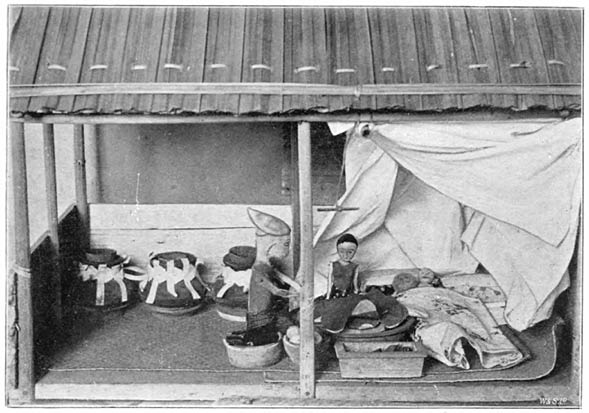
Plate 16.—Bomor at work.
Model, showing a medicine-man (bomor or pawang) at work, the patient lying in bed with his child at his side. The “three jars” (buyong tiga) used by the medicine-man are standing in a row at the side of the room. They are a little too large in proportion.
Page 410.
I shall take each of the types in order.
For the water-jar ceremony three jars (buyong) containing water are brought to the sick man’s room and decorated with the fringe or necklace of plaited cocoa-nut leaves, which is called “Centipedes’ Feet” (jari ’lipan). A fourth jar should contain a sort of bouquet of artificial flowers to serve as an attraction to the sick man’s soul (sĕmangat). You will also require a tray filled with the usual accessories of Malay magic ceremonies (incense, three sorts of rice, etc.), besides three wax tapers, one of which you will plant upon the brim of each of the three jars.
When all is ready, drop the incense upon the embers, and as the smoke rises repeat this charm:—
“If you are at one with me, rise towards me, O smoke;
If you are not at one with me, rise athwart me, O smoke,
As you say this, “catch” the first puff of smoke and inhale it (tangkap-lah puchok asap, chium), as it rises towards you. If the smell is pleasant (sĕdap) it is a good sign; if it has a scorched smell (hangit) it is bad; but if it smells offensive (busok) no medicine can save the patient.
Next, before you look into the jars, take handfuls of “parched,” “washed,” and “saffron” rice, and after fumigating them over the incense, strew them all round the row of jars, saying as you do so:—
Come, and let all of us here together
See (about the) medicine for (you) O souls of So-and-so.”
Here strew (tabor) the rice first to the right, then to the left, and then to the right again.
Before removing the calladium-leaves from the jar-mouths, repeat the following:—
“Peace be with you, Prophet ’Tap, in whose charge is the earth,
Suawam, in whose charge are the heavens,
Prophet Noah, in whose charge are the Trees,
Prophet Elias, Planter of Trees,
And Prophet Khailir (Khizr), in whose charge is the water,
I crave permission to see the remedies for So-and-so.”
Here remove the calladium-leaves from the jar-mouths, and taking one of the wax tapers, wave it in the smoke of the censer seven times towards the right, and say:—
“Peace be with you, O Tanju, I adopt you to be a guardian for my brother,
You who are sprung from the original elements,
From the former time unto the present,
You who sprang from the gum of the eyes of Muhammad,
I ask to see the disease of So-and-so.”
Here plant the taper firmly upon the edge of the jar, and “gaze” into the water “to see the signs” (ʿalamat-nya).
Thus if there is an oily scum on the water (ayer bĕrk’rak lĕmak) it is a bad sign; and to this may be added that if the calladium-leaf covering has acquired a faded look (layu) in the interim, it is a sign of severe sickness.
Fumigate the outside of the jars with the smoke of the incense (the medicine-man does this by “washing” his hands in the smoke and then rubbing over the outside of the jars as if he were “shampooing” them); and anoint them with “oil of Celebes” (minyak Bugis). Then take a “closed fistful” (sa-gĕnggam) of parched rice, and holding it over the smoke of the censer (ganggang di asap kĕm’nyan), repeat this charm:—
“Peace be with you, Mustia Kĕmbang,
I adopt you as a guardian for my brother,
If in truth you are sprung from the primordial elements,
From the former time unto the present,
I know the origin from which you sprang,
For you sprang from our Lady Eve (Siti Hawa),
You I order, your co-operation I invoke,
That whatsoever shape you assume
Within this your garden of splendour,
You break neither plighted faith nor solemn promise.”
Here throw the parched rice into the jars, and say:—
“Peace be unto you, O Prophet ’Tap, in whose charge is the Earth,
O Prophet Noah in whose charge are the Trees,
And Prophet Khailir in whose charge is the Water,
I crave this water (lit. ‘exudation’) as a boon,
For the healing of So-and-so.”
And observe these signs:—
1. If the water is perfectly still it is a bad sign.
2. If it is a little disturbed it is a good sign.
3. If the rice floats in a line across the sun’s path (bĕrator mĕlintang matahari) it is a fatal sign.
4. If you see a solitary grain travelling by itself (bĕrsiar) you may know the sickness to be caused by the making of an image (buatan orang).
5. If the parched rice travels towards the right of the jar the patient will recover quickly.
6. If it travels towards the left of the jar he will recover, but slowly.
7. If, however, it floats right underneath the candle it is generally a fatal sign.
Next, see what patterns are formed by the rice-grains as they lie on the water:—
1. If they take the shape either of a boat or a crocodile, this means that the spirit demands the launching of a spirit-boat (lanchang).
2. If they take a square shape, a tray of offerings (anchak) is demanded.
3. If they take the shape of a house, a ‘state-hall’ (balei) is demanded.
Now take all kinds of fragrant flowers and shred them (buat bunga rampai), add the shredded blossoms of four which are scentless (for instance, blossoms of the sĕlaguri, pulut-pulut, bali-adap, and kĕdudok), mix them and throw them into the jars, then plant in each jar the flower-spathe of an areca-palm (mayang pinang). Throw into each a “jar-stone” (i.e. a dollar), and the jars will be ready. You should then read the foregoing charms over each of them.
The extra jar which is filled with a sort of big nosegay (gumba) represents a pleasure-garden (taman bunga), and is intended to attract the soul (sĕmangat) of the sick man.
Now take parched rice and hold it over the incense (di-ganggang) saying:—
“Peace be with you, O Wheat,
You I wish to command, your co-operation I invoke
In ‘inspecting’ the sickness of So-and-so.
Break neither plighted faith nor solemn promise,
But inspect the sickness of this grandson of Adam,
This follower of the Prophet Muhammad, of the race of the sons of men, So-and-so;
If anything should supervene,
Do you ‘stir’ within this pure heart (of mine).”
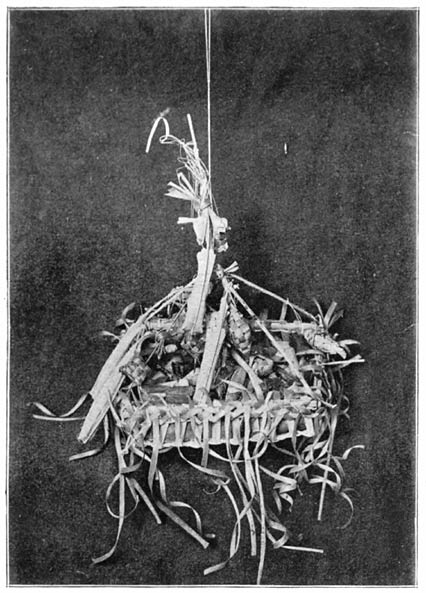
Plate 17.—Anchak.
Model of the sacrificial tray (anchak) used by the medicine-man, showing the kind of fringe round the tray called “centipedes’ feet,” and the rice receptacles of plaited palm-fronds (kĕtupat and lĕpat) which are attached to the “suspenders” of the tray.
Page 414.
Now scatter the parched rice upon the surface of the water in the jars, and watch for the signs:—
1. If the rice is lumped together (bulat or bĕrlubok) it is a good sign.
2. If it extends itself crosswise (panjang mĕlintang) it is a bad sign.
3. If it takes the shape of a spirit-boat (lanchang) you must make a spirit-boat; that is what is wanted.
4. If it keeps travelling either to the left or the right, it is a stream-spirit (anak sungei) which has affected the patient.
5. If it takes the shape of a crocodile, or anything of that sort, it is an earth-spirit (puaka) which has affected the patient.
The most popular method of propitiating evil spirits consists in the use of the sacrificial tray called Anchak.
I shall therefore, in the present place, merely describe the contents of a more or less typical tray, with the main points of the accompanying ritual.
The bottom of the tray having been lined with banana-leaf, and thickly strewn with parched rice, there are deposited in the tray itself five “chews” of betel-leaf, five native “cigarettes” (rokok), five wax tapers, five small water-receptacles or limas (made of banana-leaf and skewered together at each end), and five copper cents (or dollars). The articles just enumerated are divided into five portions, one of which is deposited in the centre of the tray, and the remainder in its four corners. Besides this there are to be deposited in the tray fourteen portions of meat (of fowl, goat, or buffalo, as the case may be), and fourteen portions of Malay “cakes,” care being taken in each case to see that there are seven portions of cooked and seven portions of uncooked food provided. The rattan “suspenders,” again, are hung with two sets of ornamental rice-receptacles made of plaited cocoa-nut leaf (fourteen of the long-shaped kind, or lĕpat, and fourteen of the diamond-shaped kind, or kĕtupat). Besides this, two sets of (cooked and uncooked) packets of rice (each stained a different colour) are sometimes deposited in the tray, the colours used being white, yellow, red, black, blue, green, and purple. The only other articles required for the tray are a couple of eggs, of which one must, of course, be cooked and the other raw.
Of the water-receptacles, those in alternate corners are filled with water and cane-juice, the central receptacle being filled with the blood of the fowl (or other animal slain for the sacrifice).
The kĕtupats are called—(1) S’ri nĕg’ri (seven-cornered), or the “luck of the country”; (2) Buah k’ras (six-cornered), or the “candle-nut”; (3) Bawang puteh (six-cornered), or “garlic”; (4) Ulu pĕngayoh (four-cornered), or the “paddle-handle”; (5) Pasar (five-cornered), or the “market”; (6) Bawang merah (six-cornered), or the “onion”; (7) Pasar Pahang (six-cornered), or the “Pahang market”; (8) Tĕlor, or the “hen’s egg.”
The lĕpats are called—(1) Lĕpat daun niyor (5–6 inches long and made of cocoa-nut leaves); (2) Lĕpat tilam (of plantain leaves); (3) Lĕpat daun palas (of palas leaves, three-sided).
Diminutive models of various objects (also made of cocoa-nut leaves) are often added, e.g. burong ponggok, the owl; kĕr’bau, the buffalo; rusa, the stag; tĕkukur, the ground-dove; kĕtam, the crab; and (but very rarely) kuda, the horse.
The things deposited in the tray are intended for the spirits (Hantus) themselves; the refuse on the ground beneath it for their slaves (hamba).
Of the food in the tray, the cooked food is for the king of the spirits (Raja Hantu), who is sometimes said to be the Wild Huntsman (Hantu Pĕmburu) and sometimes Batara Guru, and the uncooked for his following. But of the two eggs, the uncooked one is alleged to be for the Land-spirit (i.e. the Wild Huntsman), and the cooked for the Sea-spirit; this assertion, however, requires some further investigation before it can be unreservedly accepted.
The Wave-Offering
On one occasion, during my residence in the Kuala Langat district of Selangor, I had the good fortune to be present at the “waving” of a sacrificial tray (anchak) containing offerings to the spirits. The account of this ceremony, which I shall now give, is made up from notes taken during the actual performance. To commence:—The Pawang sat down with his back to the patient, facing a multitude of dishes which contained the various portions of cooked and uncooked food. The tray itself was suspended at a height of about three feet from the ground in the centre of the room, just in front of the Pawang’s head. Lighting a wax taper and removing the yam-leaf covering from the mouth of the jar containing “holy” water, the Pawang now “inspected” the water in the jar by gazing intently into its depths, and re-extinguished the taper. Then he fumigated his hands in the smoke of the censer, extended them for a brief interval over the “holy” water, took the censer in both hands, described three circles round the jar with it, set it down again, and stirred the water thrice with a small knife or dagger (k’ris), the blade of which he kept in the water while he muttered a charm to himself. Then he charmed the betel-stand and the first dish of cooked food, pushing the latter aside and covering it with a small dish-cover as he finished the charm. Next, at the hands of one of the company, he accepted, in two pieces, five cubits of yellow cloth (yellow being the royal colour), and a small vessel of “oil of Celebes,” with which, it may be added, he anointed the palms of both hands before he touched the cloth itself. Next, he fumigated the latter in the smoke of the censer, one end of the cloth being grasped firmly in the right hand, and the remainder of it being passed round the right wrist, and over and under the right arm, while the loose end trailed across his lap. Next, after repeating the usual charm, he breathed on one end of the cloth, passed the whole of the cloth through his fingers, fumigated it, and laid it aside; took an egg which was presented to him upon a tray, and deposited it exactly in the centre of a large dish of parched rice. Next, he pushed aside the jar of holy water, lowered the tray by means of the cord attached to it (which passed over a beam), and proceeded to supervise the preparation of the tray, which was being decorated with the “centipede” fringe by one of the company acting as an assistant. The fringe having been fitted by the latter to the edges of the tray, and the latter lined with three thicknesses of banana leaf, the Pawang described a circle round it thrice with the censer, and then deposited the censer upon the floor, exactly under the centre of the tray. Then anointing his hands again he passed them over both tray and fringe. A brief pause followed, and then the Pawang took the larger piece of yellow cloth and wrapped it like a royal robe around the shoulders of the patient as he sat up inside his mosquito curtain. Another brief pause, and the Pawang betook himself once more to the filling of the tray. Taking a large bowl of parched rice, he scooped up the rice in his hands, and let it run through his fingers into the tray, until there was a layer of parched rice in the latter of at least an inch in depth, and then deposited the egg, already alluded to, in the very centre of the parched rice. Next he took a comb of bananas (presented by one of the company), and cutting them off one by one deposited them in a dish, from which they were presently transferred to the tray. The Pawang now returned to the patient, and kneeling down in front of him, fumigated his hands in the smoke of the censer, and then, muttering a charm, wrapped the smaller piece of yellow cloth turban-wise round his own head, and slowly and carefully pushed the yellow-robed patient (who was still in a sitting posture) forward until he reached a spot which was exactly under the centre of the tray, and which faced, I was told, the “place of the Rising Sun.”
The long straw-coloured streamers of the tray-fringe dropped gracefully around the patient on every side, and had it not been for occasional bright glimpses of the yellow cloth he would have been almost invisible.
The censer, voluming upwards its ash-gray smoke, was now passed from hand to hand three times round the patient, and finally deposited on the floor at his feet.
But the list of creature comforts provided for the spirits comprised other things besides food. Five miniature water-buckets, each manufactured from a strip of banana leaf skewered together at each end with a bamboo pin, were now filled, the alternate corner ones with water and cane-juice (called “palm-toddy” in the Spirit Language), and the central one with the blood of the fowls killed for the sacrifice. They were then duly deposited in the tray by the Pawang. Five waxen tapers, to “light the spirits to their food,” were next “charmed” and lighted, and planted in the centre and four corners respectively.
Finally, no doubt for the spirits’ after-dinner enjoyment, five “chews” of betel-leaf and five native-made cigarettes (tobacco rolled in strips of palm-leaf), were charmed and actually lighted at a lamp, and deposited in the tray with the other offerings, and at the same time five 50 cent (silver) pieces of Straits money, called “tray-stones,” were added to the medley, evidently with the object of preventing the good temper of the spirits from being disturbed by “shortness of cash.”
The loading of the tray being now complete, the Pawang walked thrice round the patient (who was still overshadowed by the tray), and passed the censer round him thrice. Standing then with his face to the east, so as to look in the same direction as the patient, he grasped the “suspenders” of the tray with both hands at their converging point, and thrice muttered a charm, giving a downward tug to the cord of the tray at the end of each repetition. This done, he removed the yellow cloth from his head, and fastened it round the tray-cord at the point where the “suspenders” converged, and then “waved” the offering by causing the loaded tray with its flaring tapers to swing slowly backwards and forwards just over the patient’s head. Next, letting the tray slowly down and detaching it from the cord, at the converging point, he again “waved” it slowly to and fro amid the flaring of the tapers, seven times in succession, and held it out for the patient to spit into. When this was done he sallied out into the darkness of the night carrying the tray, and gaining the jungle, suspended it from a tree (of the kind called pĕtai bĕlalang) which had been selected that very day for the purpose. A white ant, immediately settling upon the offering, was hailed by the Malays present with great delight as a sign that the spirits had accepted the offering, whereupon we all returned to the house and the company broke up. The ceremony had commenced about 8 P.M., and lasted about an hour and a half, and the number of people present was fourteen, seven male and seven female, which was the number stipulated by the Pawang.
Another form of “propitiation” (buang-buangan limas) ceremony consists in loading a limas with the offerings. The limas is a receptacle of about a span (sa-jĕngkal) in length, made of banana-leaf folded together at the ends and skewered with a bamboo pin. Inside it are deposited the offerings, which consist of the following articles: a chupak (half cocoa-nutful) of “parched” rice, a set of three, five, or seven bananas, a “pinch” (sa-jĕmput) of “saffron” rice, a pinch of “washed” rice, a native cigarette (rokok), an egg, a wax taper, two “chews” of betel-leaf, and a betel-leaf twisted up into the shape of a spiral (pantat siput). One (at least) of the two “chews” of betel must be specially prepared, as it is to be left behind for the spirits to chew, whilst the other is taken back into the presence of the sick man, where the medicine-man chews it and ejects the chewed leaf (di-sĕmbor) upon the “small” of the sick man’s back. In the case of the “chew” which is left behind for the spirits, the ordinary portion of betel-nut must be replaced by nutmeg, the gambier by mace, and the lime by “oil of Celebes” (minyak Bugis).
When the ceremony of loading the limas is complete, it is carried down to the nearest river or sea, and there set adrift with the following words:—
“Peace be with you, Khailir (Khizr), Prophet of God and Lord of water,
Maduraya is the name of your sire,
Madaruti the name of your mother,
Si Kĕkas the name of their child;
Accept this present from your younger brother, Si Kĕkas,
Cause him no sickness or headache.
Here is his, your younger brother’s, present.”
Here the limas is set adrift, and the water underneath it scooped up and carried home, where it is used for bathing the sick man.
Another very simple form of “propitiation” is called ambang-ambangan, and is performed as follows:—
“Jĕmbalang Jĕmbali, Demon of the Earth,
Accept this portion as your payment
And restore So-and-So.
But if you do not restore him
I shall curse you with the saying,
‘There is no god but God,’” etc.
The above ceremony is generally used in the case of fever complaint.
Counter-charms for “neutralising” the active principle of poisons form, as a rule, one of the most important branches of the pharmacopœic system among the less civilised Malay tribes. A settled form of government and the softening of manners due to contact with European civilisation has, however, diminished the importance (I speak, of course, from the Malay point of view) of this branch of the subject in the Western Malay States of the Peninsula, where poisoning cases are very rarely heard of. Malay women have always possessed the reputation of being especially proficient in the use of poison; ground glass and the furry spicules obtained from the leaf-cases of some kinds of bamboo being their favourite weapons.
This idea (of using a charm to “neutralise” the active principle of poison) has been extended by Malay medicine-men to cover all cases where any evil principle (even, for instance, a familiar spirit) is believed to have entered the sick person’s system. All such charms are piously regarded by devout Muhammadans as gifts due to the mercy of God, who is believed to have sent them down to the Prophet Muhammad by the hand of his servant Gabriel. This doctrine we find clearly stated in the charms themselves, e.g. (somewhat tautologically):—
“Neutralising charms sprang from God,
Neutralising charms were created by God,
Neutralising charms were a boon from God,
Who commanded Prince Gabriel
To bring them unto Muhammad.”
Thus in one of the charms quoted in the Appendix we read:—
“The Upas loses its venom,
And Poison loses its venom,
And the Sea-Snake loses its venom,
And the poison-tree of Borneo loses its venom,
Everything that is venomous loses its venom,
By virtue of my use of the Prayer of the Magic Bezoar-Stone.”
The above charm terminates as follows:—
“Let this my prayer be sharp as steel,
Swift as lightning,
Fleet as the wind!
Grant this by virtue of my use of the prayer of Dato’ Malim Karimun,
Who has become a saint through religious penance
Performed at the headwaters of the river of Saïran in the interior of Egypt,
By the grace of,” etc.
I may add that when you are collecting the materials for a neutralising ceremony (tawar) the following formula should be used:—
“Not mine are these materials,
Not to me belongs this neutralising charm,
To Malim Saidi belongs this neutralising charm.
It is not I who apply it,
It is Malim Karimun who applies it.”
Badi
Hence the ceremony which purports to drive out this evil principle is of no small importance in Malay medicine. I may take this opportunity of pointing out that I have used the word “mischief” to translate it when dealing with the charms, as this is the nearest English equivalent which I have been able to find; indeed, it appears a very fairly exact equivalent when we remember its use in English in such phrases as “It’s got the mischief in it,” which is sometimes used even of inanimate objects.
There are a hundred and ninety of these mischiefs, according to some, according to others, a hundred and ninety-three. Their origin is very variously given. One authority says that the first badi sprang from three drops of Adam’s blood (which were spilt on the ground). Another (rather inconsistently) declares that the “mischief” (badi) residing in an iguana (biawak) was the origin of all subsequent “mischiefs,” yet adds later that the “Heart of Timber” was their origin, and yet again that the yellow glow at sunset (called Mambang Kuning or the “Yellow Deity”) was their origin. These two latter are, perhaps the most usual theories, but a third medicine-man declares that the first badi was the offspring of the Jin (“genie”) Ibn Ujan (Ibnu Jan?), who resides in the clouds (or caverns?) and hollows of the hills. Thus do Malay medicine-men disagree.