Chapter IV · The Malay Pantheon
Reading edition
(a) Gods
A careful investigation of the magic rites and charms used by a nation which has changed its religion will not unfrequently show, that what is generally called witchcraft is merely the débris of the older ritual, condemned by the priests of the newer faith, but yet stubbornly, though secretly, persisting, through the unconquerable religious conservatism of the mass of the people.
“The general principle stated by Logan in the passage just quoted receives remarkable illustration from a close investigation of the folk-lore and superstitious beliefs of the Malays. Two successive religious changes have taken place among them, and when we have succeeded in identifying the vestiges of Brahmanism which underlie the external forms of the faith of Muhammad, long established in all Malay kingdoms, we are only half-way through our task.”
The evidence of folk-lore, taken in conjunction with that supplied by charm-books and romances, goes to show that the greater gods of the Malay Pantheon, though modified in some respects by Malay ideas, were really borrowed Hindu divinities, and that only the lesser gods and spirits are native to the Malay religious system. It is true that some of these native gods can be with more or less distinctness identified with the great powers of nature: the King of the Winds (Raja Angin) for instance; “Mambang Tali Harus,” or the god of mid-currents (the Malay Neptune); the gods of thunder and lightning, of the celestial bodies, etc.; but none of them appear to have the status of the chief gods of the Hindu system, and both by land and water the terrible Shiva (“Batara Guru” or “Kala”) is supreme. Yet each department of nature, however small, has its own particular godling or spirit who requires propitiation, and influences for good or evil every human action. Only the moral element is wanting to the divine hegemony—the “cockeyed,” limping substitute which does duty for it reflecting only too truthfully the character of the people with whom it passes as divine.
Mr. Wilkinson, in the article from which we have already quoted, deals with another point of interest, the expression sang-yang, or batara, which is prefixed to guru. After pointing out that yang in this case is not the ordinary Malay pronoun (yang, who), but an old word meaning a “deity,” he remarks, that so far as he has been able to discover, it is only used of the greater Hindu divinities, and not of inferior deities or demi-gods. Thus we find it applied to Shiva and Vishnu, but never to the monkey-god Hanuman, or a deity of secondary importance like Dermadewa. Such inferior divinities have only the lesser honorific “sang” prefixed to their names, and in this respect fare no better than mere mortals (such as Sang Sapurba and Sang Ranjuna Tapa) and animals (such as, in fables, Sang Kanchil, Mr. Mousedeer; and Sang Tikus, Mr. Rat).
“Thus batara would seem to be limited in use to the actual names of Hindu deities as distinct from epithets describing those deities. “Batara Guru” would seem to be an exception—the only one—to this rule, and to point to the fact that the original meaning of guru had been lost sight of, and that the expression had come to be regarded only as a proper name.”
Occasionally, as is only to be expected, the Malays get mixed in their mythology, and of this Mr. Wilkinson gives two examples, one of the identification of Batara Guru (Shiva) with Brahma (Bĕrahmana), and another of the drawing of a distinction between “Guru” (Shiva) and “Mahadewa,” which latter is only another name for the same divinity.
Such slips are inevitable among an illiterate people, and should always be criticised by comparison with the original Hindu tenets, from which these ideas may be presumed to have proceeded.
Mr. Wilkinson quotes an extraordinary genealogy representing, inter alia, “Guru as the actual father of the Hindu Trinity,” and also of “Sambu” (whom he cannot identify), and “Sĕri, who is the Hindu Sri, the goddess of grain, and, therefore, a deity of immense importance to the old Javanese and Malays.”
It would be beyond the scope of this work to attempt the identification of Batara Guru (Shiva) with all the numerous manifestations and titles attributed to him by the Malays, but the special manifestation (of Shiva), which is called “Kala,” forms an integral part of the general conception, whether among the Malays or Hindus, and is, therefore, deserving of some attention.
Fishermen and seafarers, on the other hand, obtain many a favour from him, and even hope to make friends with him by means of simple sacrifices and charms.
The only other divinities (of the rank of “Mambangs”) which are of any importance are the “White divinity,” who dwells in the Sun, the “Black divinity,” who dwells in the Moon, and the “Yellow divinity,” who dwells in the Yellow Sunset-glow, which latter is always considered most dangerous to children.
When there is a decided glow at sunset, any one who sees it takes water into his mouth (di-kĕmam ayer) and dislodges it in the direction of the brightness, at the same time throwing ashes (di-sĕmbor dĕngan abu) saying:—
Mambang kuning, mambang k’labu,
Pantat kuning di-sĕmbor abu.
This is done “in order to put out the brightness,” the reason that it must be put out being that in the case of any one who is not very strong (lĕmah sĕmangat) it causes fever.
(b) Spirits, Demons, and Ghosts
The following is a description of this, the mightiest of the Genii:—
Peace be with you!
Ho, Black Genie with the Black Liver,
Black Heart and Black Lungs,
Black Spleen and tusk-like Teeth,
Scarlet Breast and body-hairs inverted,
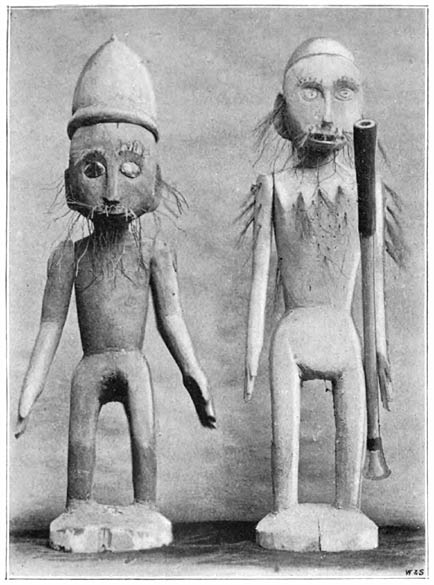
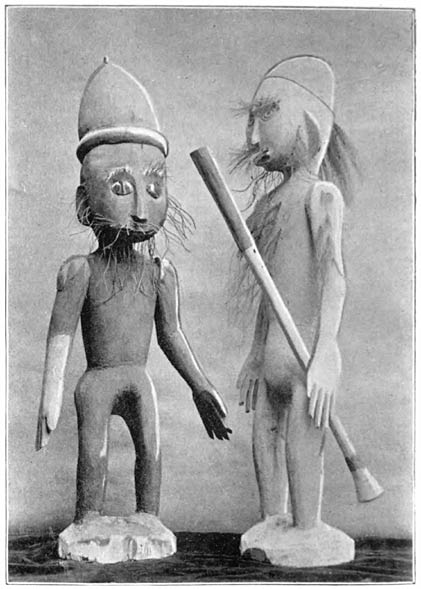
Plate 2.—Spirits.
Models of the White and Black Genii (Jin Puteh and Jin Hitam)
Page 94.
Altogether there are one hundred and ninety of these (Black?) Genii—more strictly, perhaps, one hundred and ninety-three, which coincides curiously with the number of “Mischiefs” (Badi), which reside in “all living things.” The resemblance, I may add, does not end here; for though the Genii may do good, and the “Badi” do not, both are considered able to do infinite harm to mortals, and both make choice of the same kind of dwelling-places, such as hollows in the hills, solitary patches of primeval forest, dead parasites on trees, etc. etc.
The theory already mentioned, viz. that the Black King of the Genii gradually came to be identified with Kala, and later came gradually to be established as a separate personality, appears to be the only one which will satisfactorily explain the relations subsisting between the Black and White Genii, who are on the one hand distinctly declared to be brothers, whilst the White Genie is in another passage declared to be Maharaja Dewa or Mahadewa, which latter is, as we have already seen, a special name of Shiva.
This White Genie is said to have sprung, by one account, from the blood-drops which fell on the ground when Habil and Kabil bit their thumbs; by another, from the irises of the snake Sakatimuna’s eyes (bĕnih mata Sakatimuna), and is sometimes confused with the White Divinity (’Toh Mambang Puteh), who lives in the sun.
On the whole, I may say that the White Genie is very seldom mentioned in comparison with the Black Genie, and that whereas absolutely no harm, so far as I can find out, is recorded of him, he is, on the other hand, appealed to for protection by his worshippers.
Besides these subdivisions, certain Genii are sometimes specifically connected with special objects or ideas. Thus there are the Genii of the royal musical instruments (Jin Nĕmfiri, or Lĕmpiri, Gĕndang, and Naubat), who are sometimes identified with the Genii of the State (Jin Karaja’an), and the Genii of the Royal Weapons (Jin Sĕmbuana), both of which classes of Genii are held able to strike men dead. The only other Genie that I would here specially mention is the Jin ʿAfrit (sometimes called Jin Rafrit), from whom the “White Man” (a designation which is often specially used in the Peninsula as a synonym for Englishman) is sometimes said to have sprung, but who belongs in Arabian mythology to a higher class than the mere Genii. Before leaving the subject of Genii, I must, however, point out the extremely common juxtaposition of the Arabic word “Jin” and the Malay “Jĕmbalang.” From the frequency with which this juxtaposition occurs, and from the fact that the two appear to be used largely as convertible terms, we might expect to find that Jin and Jĕmbalang were mere synonyms, both applicable to similar classes of spirits. The process is not quite complete, however, as although the expression Jĕmbalang Tunggal (the only Jĕmbalang), is found as well as Jin Tunggal, the higher honorific Sang Raja or Sa-Raja is never, so far as I am aware, prefixed to the word “Jĕmbalang,” though it is frequently prefixed to “Jin.” Of the other members of the Malay hierarchy who owe their introduction to Muhammadan influences, the only ones of importance are angels (Mala’ikat), prophets (Nabi), and headmen (Sheikh).
I will take them in this order.
Of the angels, unquestionably the most important are Azrael (ʿAzra’il or ʿIjrail), Michael (Mika’il), Israfel (Israfil, Ijrafil, or Serafil), and Gabriel (Jibra’il or ’Jabra’il, often corrupted into Raja Brahil). There can be no doubt that the foregoing are meant for the names of a group of four archangels, the name of Israfel corresponding to Abdiel, who generally occupies the fourth place in our own angelic hierarchy.
Their customary duties are apportioned among the four great angels as follows:—
Azrael is, as with us, the angel of death, who “carries off the lives of all creatures”; Israfel is “lord of all the different airs” in our body; Michael is the “giver of daily bread”; and Gabriel is a messenger or “bringer of news.”
Sometimes, again, a White Angel (Mala’ikat Puteh) is mentioned, e.g. as being in “charge of all things in the jungle,” but what his specific duties are in this connection does not transpire.
In an invocation addressed to the Sea-spirit, however, we find four more such angels mentioned, all of whom hold similar charges:—
Chitar Ali is the angel’s name, who is lord of the whirlpool;
Sabur Ali is the angel’s name, who is lord of the winds;
Sir Ali is the angel’s name, who is lord of the waters of the sea;
Putar Ali is the angel’s name, who is lord of the rainbow.
No doubt the names of many more of the subordinate angels might be collected, as we are repeatedly told that they are forty-four in number.
Of the prophets (Nabi) there are an indefinite number, the title being applied to many of the more prominent characters who figure in our own Old Testament (as well as in the Korān), but who would not by ourselves be considered to possess any special qualifications for prophetic office. Among the more famous of these I may mention (after Muhammad and his immediate compeers) the prophet Solomon (sometimes considered—no doubt owing to his unrivalled reputation for magical skill—as the king of the Genii, whose assistance the hunter or trapper is continually invoking); the prophet David, celebrated for the beauty of his voice; and the prophet Joseph, celebrated for the beauty of his countenance. Besides these (and others of the same type), there is a group of minor prophets whose assistance is continually invoked in charms; these are the prophet Tap (Tĕtap or Kĕtap?), “lord of the earth;” the prophet Khailir (Khaithir or Khizr), “lord of water;” the prophet Noah, “lord of trees;” and the prophet Elias, “planter of trees.”
Khizr is often confounded with Elias. He discovered and drank of the fountain of life (whence his connection with water), and will consequently not die till the last trump.
Next to the prophets comes the “Sultan” (Sultan), or “King” (Malik), both of which Arabic titles, however, are somewhat rarely used by Malay magicians. Still we find such expressions as Sa-Raja (Sang-Raja?) Malik (King of Kings) applied to Batara Guru.
Next to these royal honorifics comes the title of “Headman” or “Sheikh.”
Sometimes they are called “Sheikh ʿAlam” (or Si Putar ʿAlam), and are each said to reside “within a ring-fence of white iron.” Hence we obtain a perfectly intelligible meaning for the expression, “Ask pardon of the Four Corners of the World,” i.e. of the Sheikhs who reside therein, though the phrase sounds ridiculous enough without such explanation.
In the invocation addressed to the Sea-spirit we find the expression:—
“Jungle-chief of the World is the name of the Old Man of the Sea.”
There can, however, be little doubt that this “Old Man of the Sea” is a mere synonym for Batara Guru.
A set of expressions to which special reference should perhaps be made consists of the titles used by the wild jungle tribes (Sakais), the use of which is important as confirming the principle that the “Autochthones” are more influential with the spirits residing in their land than any later arrivals can be, whatever skill the latter may have acquired in the magic arts of the country from whence they came.
“Abdullah bin Abdul Kadir, Munshi, in his Autobiography, has an interesting passage on the beliefs of the Malays on the subject of spirits and demons, beliefs which are much more deeply-rooted than is generally supposed. He does not, however, differentiate between national customs and beliefs, and those which have come in with the Muhammadan religion. And indeed it is not easy to do so. Here, everything is classed under the generic term sheitan, which is Arabic, and we find the rakshasa of Hindu romances and the jin and ʿefrit of the Arabian Nights in the company of a lot of Indo-Chinese spirits and goblins, who have not come from the West like the others:—
To the foregoing the following list of spirits and ghosts may be added.
The Hantu Kubor (Grave Demons) are the spirits of the dead, who are believed to prey upon the living whenever they get an opportunity. With them may be classed the “Hantu orang mati di-bunoh,” or “spirits of murdered men.”
The Hantu Ayer and Hantu Laut are Water and Sea-spirits, and the Hantu Bandan is the Spirit of the Waterfall, which “may often be seen lying prone on the water, with head like an inverted copper (kawah),” where the water rushes down the fall between the rocks.
The Hantu B’rok is the Baboon Demon (the B’rok being what is generally called the “cocoa-nut monkey,” a sort of big baboon); it is sometimes supposed to take possession of dancers, and enable them, whilst unconscious, to perform wonderful climbing feats.
The following charm is recited in order to “neutralise” his evil influence:—
Peace be with you, grandson of the Spectre Huntsman,
Whose Dwelling-place is a solitary patch of primeval forest,
Whose Chair is the nook between the buttresses (of trees),
Whose Leaning-post the wild Areca-palm,
Whose Roof the (leaves of the) Tukas,
Whose Body-hairs are leaves of the Rĕsam,
Whose Mattress leaves of the Lerek,
Whose Swing the (tree) Mĕdang Jĕlawei,
And whose Swing-ropes are Malacca-cane-plants
The Gift of His Highness Sultan Bĕrumbongan,
Who dwelt at Pagar Ruyong,
In the House whose posts were heart of the Tree-nettle,
Whose threshold a stem of Spinach,
Strewn over with stems of the Purut-purut,
Whose Body-hairs were inverted,
And whose Breasts were four in number,
To whom belonged the Casting-net for Flies,
And whose drum was “headed” with the skins of lice.
Break not faith with me,
(Or) you shall be killed by the Impact of the Sanctity of the Four Corners of the World,
Killed by the Impact of the Forty-four Angels,
Killed by the Impact of the Pillar of the Kaʿbah,
Killed by the Thrust of the sacred Lump of Iron,
Killed by the Shaft of the Thunderbolt,
Killed by the Pounce of Twilight Lightning,
Killed by the Impact of the Thirty Sections of the Korān,
Killed by the Impact of the Saying, “There is no god but God,”
etc.
Giants are called Bota (Bhuta), Raksasa, and Gargasi (gasi-gasi or gĕgasi), or sometimes Hantu Tinggi (“Tall Demons”), the first two of these names being clearly derivable from a Sanskrit origin.
In addition to those enumerated we may add the various classes of “good people,” such as the Bidadari (or Bĕdiadari) or Pĕri (fairies and elves), which are of foreign origin, and the “Orang Bunyian,” a class of Malay spirits about whom very little seems known. The latter appear to be a race of good fairies, who are so simple-minded that they can be very easily cheated. Thus it is always said of them, that whenever they come into a hamlet, as they may occasionally do, to buy anything, they always pay without bargaining whatever price is asked, however exorbitant it may be. I have been told of their existence at Kapar village (near Klang in Selangor), at Jugra, where it was said they might formerly be heard paddling their boats upon the river when no boat was visible, and elsewhere.
Besides these there are several kinds of bloodsucking (vampire) demons, which are mostly Birth-spirits; and also certain incubi, such as the Hantu Kopek, which is the Malay equivalent of our own “night-mare.”