Chapter VI · Magic Rites as affecting the Life of Man (continued 3)
Reading edition
Main Sĕladang (Wild Bull game) is an excellent game for children with the shoeless feet of the East. A “wild bull” having been selected by repetition of the Ping hilang formula, went upon all fours, and entered into the following conversation between himself and one of the other players specially selected for the purpose. The latter opened negotiations with the clearly non-committal, if not very lucid remark, “Tam tam kul” to which the “Bull” replied, “Buat apa guna bakul” (What are you going to do with your basket?)
Boy: Mĕngisi arang. (To hold charcoal.)
Bull: Buat apa guna arang? (What will you do with the charcoal?)
Boy: Mĕnĕmpa (or masak) lĕmbing. (I shall forge a spear.)
Bull: Buat apa guna lĕmbing? (What use will you make of the spear?)
Boy: Mĕnikam sĕladang. (To stab a bull with.)
Bull (who is getting excited): Buat apa guna di-tikam? (What use will it be to stab him?)
Boy: Mĕngambil hati-nya. (To get his heart.)
Bull (who is now fairly savage): Buat apa guna hati-nya? (What use will you make of his heart?)
Boy: Buat santap Raja Muda. (Get the Crown Prince to partake (of it).)
The Bull at the end of this baiting was ready to “charge” anybody and everything, and did accordingly run at the rest of the players, kicking out with all his might at anybody who came near. As he had to move on all fours he could not go very fast, and the other players took advantage of this to bait him still further by slapping him on the back and jumping over him. Whenever they came near enough he lashed out with his heels, and when he succeeded in kicking another player below the knee, the latter became a Bull in his turn. Much agility is displayed in this game, which is thoroughly enjoyed by the players.
“Blind Man’s Buff” (Main China Buta, or “Blind Chinaman”) is played in exactly the same manner as our own Blind Man’s Buff; one of the party, with bandaged eyes, being required to catch any one who comes near him.
The first blind man—at the commencement of the game—is chosen as follows: the intending players sit down together in a close circle, each of them putting down the tips of their forefingers in the centre of the circle; then somebody who is not playing taps each of them on the head in turn, repeating at each tap a word of the following formula:—
1 2 3 4
ping hilang patah paku
plate (=piring?) disappear break nail
5 6 7 8
dalam biling chhari aku
within chamber (=bilek?) search for me
9 10 11 12
ping ’dah ’ning ’dah
got clear(?) got
13
hilang.
disappear.
Chan chan siku rembat is a game which I saw played in Selangor as follows:—
The intending players stood in a row, looking straight in front of them, but with their hands behind their backs, whilst another boy, who had a piece of wood in his hand, walked down the line touching their hands and counting as he went the words of the following refrain:—
1 2 3 4
chan chan siku rembat
5 6 7 8
buah lalu di- b’lakang
the fruit (or ball) is passing behind (you)
9 10 11 12
mata pĕjam tangan lihat
your eyes (are) closed (but your) hand sees!
13 14 15 16
siapa chĕpat dia mĕlompat
whoever (is) nimble (let) him take the leap.
The “fruit” (or piece of wood, as the case may be) was left in the palm of one of the boys, and as soon as the reciter came to the end of the rhyme the boy with the token had to jump out of the ranks before he was stopped by the boys on each side of him, each of whom suddenly stretched out his legs for the purpose of tripping up the runaway. When they touched him he lost his turn, but if he succeeded in getting clear without being touched he obtained the privilege of going to the other end of the ground and calling any boy he chose out of the ranks to carry him back again, at the invitation of the late spokesman. On his return he was stopped in front of the ranks with the challenge:—
Q. Datang dĕ’mana? (Whence do you come?)
A. Datang dĕ’ Bali. (I come from Bali.)
Q. Apa di-bawa? (What do you bring?)
A. Bawa kuali. (I bring a cooking-pot.)
Q. Siapa nakhoda? (Who is the master (of the vessel)?)
A. Nakhoda ’Che ʿAli. (’Che ʿAli is the master.)
Q. Mana sampan tunda? (Where is the boat you were towing?)
A. Putus tali. (Parted from the rope.)
Q. Mana pas? (Where is your pass?)
In reply to this last question the pass (i.e. the fruit or piece of wood) was shown and both boys rejoined the ranks, whereupon the game recommenced da capo.
Hantu Musang or “The Pole-cat Fiend,” is a game in which a boy sits down (between two others) with a cloth thrown over his head, the ends of which are twisted up (like rope ends) by the two boys on each side of him; the cloth fits his head like a cap, with a long end at the back and in front. First the boy in front pulls his end of the cloth and then the boy at the back pulls his end, thus causing the boy between them to rock to and fro. This treatment is continued for some time while they repeat the following rhyme:—
Chok gĕlechok ....
Gali-gali ubi. A-digging tapioca
Mana kayu bongkok Wherever (there is) knotted timber
Disitu musang jadi. There the pole-cat breeds.
Chang gulichang ....
Serak bunga lada Scatter (?) pepper-blossom.
Datang hantu musang The pole-cat fiend has arrived
Ayam sa’ekor t’ada. And not a fowl is left.
As soon as this rhyme is finished the two outside boys make off as fast as they can, pursued by the “pole-cat,” who is allowed to give a really good bite (in the arm) to the first person he overtakes.
Main Tunggul.—This game I saw played with four boys a side. A boy was selected to represent the tunggul or stump, and took up his position at a little distance (about half-way between the two parties as they stood facing each other a few yards apart). Up to the stump (tunggul) a boy from each of the sides alternately ran and whispered the name of a boy belonging to the opposite party. This whispering was continued until the names of the two boys selected happened to agree, the tunggul then making a gesture, at which the boys of one of the sides crossed over and carried back on their shoulders the boys belonging to the opposite side.
Kuching (the Cat Game) was a mere guessing game. The “guesser,” or witness (saksi), stood at a little distance with his face turned away whilst another boy was selected to play “puss,” and yet another boy was permitted to twitch him on the ear or wherever else he might prefer. Then the “witness” was told to turn round, and going up to the “cat” he made his guess.
Sorok-sorok is merely the Malay equivalent of our hide-and-seek, with the exception that whereas hide-and-seek may be played by day as well as by night, the game of sorok-sorok should properly be played at night alone.
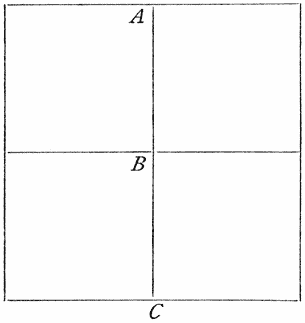
Fig. 4.—Main Galah Panjang.
Main Galah Panjang.—A square of ground is marked out into four quarters by a cross (as in the accompanying figure), and on it a game not unlike our own “Tom Tiddler’s Ground” is played (by three players on each side). The name means the “Long Pole” game.
Another child’s game is called Sanĕbang, and is played as follows:—
Two players sit down on the floor facing each other and chant the following rhyme, one of them lightly touching the other’s left arm in time to the music:—
The well-known game called Sapu-sapu ’Ringin I have seen played as follows:—
Two players sit down on the floor opposite each other, with their legs stretched out straight in front of them and their hands in their laps, and join in singing these lines:—
Sapu-sapu bĕringin, Brush, brush the banyan-tree,
Katimbun dayong-dayong, A pile of oars lies stacked;
Datang ’Che Aji Lĕbai Here comes ’Che Aji Lĕbai
Bawa buaya kudong. Bringing a maimed crocodile:
Kudong kaki, kudong tangan, Maimed in foot and maimed in hand,
Tiada buleh bĕrpulangan. It can’t go home again.
Here both players double up one leg under them as they sit; then they repeat the lines just quoted, doubling up the left leg at the end of the recital; then they close the fists and pile them one on each other, the lowest resting on one of the player’s knees, and say—
Here the lowest fist is flattened out. In the same way each of the four eggs (i.e. fists) is broken till the top is reached, when the four hands are moved up and down on the left knee of one of the players as the chant recommences—
P’ram p’ram pisang ... the plantain,
Masak sa-biji di-gonggong bari-bari The fruit-bat seizes a ripe one,
Bawa lari, And takes it away
Tĕrbang-lah dia! As off he flies!
Here both players raise their hands above their heads; then one player commences to rock to and fro (with arms now folded), the other holding him (or her) by the arms and crying—
Goyang-goyang Pah Ponggor Swing, swing, Father Ponggor;
Pah Ponggor mati akar! Father Ponggor, the climbing rattan is dead!
Si ʿAli ka padang Si ʿAli’s gone to the plain,
[Di-]tudongkan daun Sheltered by the leaves,
Sa-hari ta’ makan, With nothing to eat for a day,
Ta’ makan sa-tahun. Nothing to eat for a year.
Here they hook their little fingers together, and rock their bodies to and fro, singing—
Angkei-angkei p’riok ... the cooking-pot,
P’riok dĕri Jawa The cooking-pot from Java;
Datang ’Wa’ Si Bagok Here comes Uncle Bagok
Bawa kĕtam sa’ekor: Bringing a crab.
Chepong masok ayer, A dish (?) to put water in,
Chepong masok api, A dish (?) to put fire in,
O nenek, O nenek, O granny, O granny,
Rumah kita ’nak runtoh! Our house is tumbling down.
Reh! Reh! Rum! . . . . . .
Finally they sit still with hands clasped on knees, and sing—
Of minor children’s games the following may be mentioned:—
(2) Chimplek, which is a sort of “heads and tails” game; “heads” being called chaping, and “tails” sim.
(3) Porok, which consists in kicking (with the side of the foot) a small cocoa-nut shell, with the object of hitting a similar shell a few yards off.
This game appears to be identical with what is called main gayau in Selangor, in which, however, a fruit or seed called buah gandu is substituted for the cocoa-nut shell and propelled by the big toe of the player’s foot.
(4) Main sĕremban, which is played with cockle-shells by two girls at a time, each player taking twenty cockle-shells (kulit k’rang) into her lap. Each player in turn has to toss up one of the cockle-shells and catch, simultaneously snatching a fresh shell from the heap. If the girl who is playing fails in either task, she loses to her opponent.
10. THEATRICAL EXHIBITIONS
The Malay Drama, taking the word in its widest sense as comprising every kind of theatrical exhibition, includes performances of several different types, which derive their origin from various distinct sources. Most of them bear some traces of their foreign extraction, and though they have been much modified by the Malays, and are now quite “naturalised” in the Peninsula, it is pretty clear that the greater part have been borrowed from India, Siam, China, and possibly other countries. It is noteworthy that many, perhaps most, of the plots represented in these performances owe their origin to the old classical Indian Epics, and especially to the story of the Ramayana, which has been handed down traditionally, much modified by local colouring, in Java and Siam as well as in the Malay Peninsula.
It is not within the scope of this work to give anything like a full description of these different kinds of dramatic representations, but it is desirable to give some account of the ritual which accompanies them, and the ideas and superstitions which they seem to involve.
The most important of the ceremonies which relate to the Malay theatre is that of inaugurating or “opening” (as it is called) a site for the performance. The following is an account (by Mr. Hugh Clifford) of the performance of this ceremony:—
“When one of these companies arrives at a place where it intends to ‘open,’ it erects a small, square shed, open at all four sides, but carefully roofed in, and with a hand-rail running round it about two feet from the ground. This shed is called a Bangsal, and the space which its sides enclose is termed Panggong. Before the play begins, the ceremony called Bûka Panggong, which has for its object the invocation and propitiation of certain spirits, is gone through....
“The ceremony, which is a curious one, is performed in the following manner: The company having entered the shed and taken their seats, a brazier is placed in front of the Pâwang, or Medicine-Man, who is also the head of the theatrical troop. In this brazier precious woods and spices are burned, and while the incense ascends, the Pâwang intones the following incantation, the other members of the troop repeating each sentence in chorus as he concludes it.
“The Pâwang here scatters parched rice stained with saffron in every direction, and chants the following incantation the while: ʿPeace be unto thee! I am about to move from within this enclosure four paces in each direction of the four corners of the universe. O ye Holy Ones who are present in this place, within the space of these four paces towards the four extremities of the universe, be not startled nor deranged, do not remove to a distance, and be not angry or wrathful, for thy servant cometh not hither to vie with ye in wisdom within this thy territory and village. Your servant cometh to satisfy the desires of all the people who own this place, and your servant desires to abandon himself unto ye, his guardians, the Holy Ones of this place, and thus presuming he asks pardon of ye, and would commend to your care himself, and the actors and actresses, O Grandsires, ye Holy Ones of this place; and in like manner would he commend unto ye the musicians and the bridegrooms, the buffoons, both old and young; and he prays ye not to show envy towards them, nor yet to oppress them, nor do them any injury; suffer them not to be destroyed or injured; and he entreats thee, his Grandsires, and all your many imps, to refrain from striking against them as ye pass by them, neither to address them, nor to pinch or nip them, and let not your youths, O Grandsires, remove our means of livelihood; and your servant prays ye to refrain from destroying or damaging, injuring or hurting the whole company of the ma’iong, and suffer them to be cool and refreshed like unto the snake, the chinta-mâni.
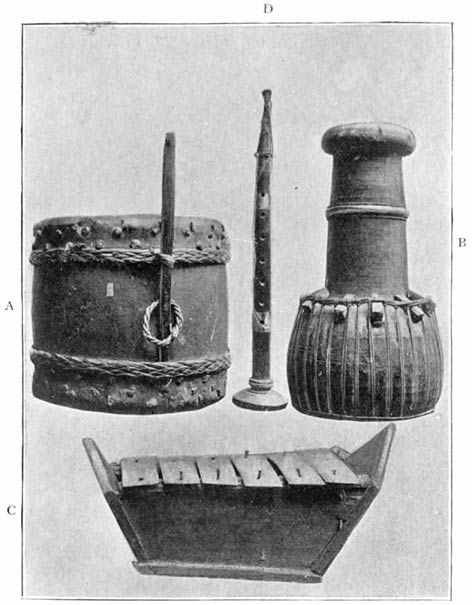
Plate 20.—Fig. 1. Musical Instruments.
A. Drum. B. Drum. C. Staccato instrument. D. Flute. All used by ’Che ʿAbas in the shadow-play (main wayang.)
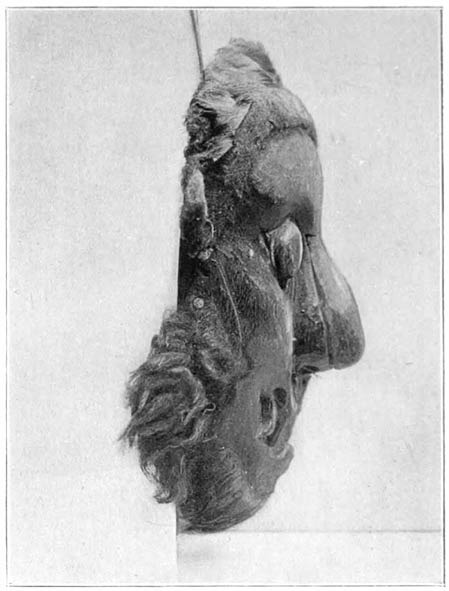
Fig. 2. Demon Mask.
Side view of mask, representing a forest demon, showing profile.
Page 508..
A similar ceremony was witnessed in 1897 by Mr. Everard Fielding and the present writer at the back of the Bungalow at Jugra (in Selangor). The object of the ceremony was to drive away evil spirits from the spot where the performance was to take place, and the performers were a little band of players from Penang who had settled in the neighbourhood and had planted their holdings with Liberian coffee.
The Pawang or magician in this instance was a Malay named ’Che Hussein, who acted as clown, and subsequently wrote out at my request rough transcripts of more than a dozen of the plays acted by his company.
A tray with the usual brazier of incense and small bowls of rice variously prepared was then brought in, and all the instruments, though not necessarily the players, being in their places, the ceremony commenced as follows:—
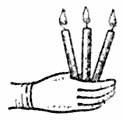
Fig. 5.—Tapers used in exorcising evil spirits.
First came the Lagu Pĕmanggil, or Invocation, a peculiar air performed on the instruments and accompanied by the Pawang. The latter heaped incense on a brazier in front of him, and “waved” in the incense first the fiddle (rĕbab) and then the masks, wooden daggers, and other “properties” of the company, until they were well fumigated. He next lighted three tapers, which he charmed and took between the closed palms of his hands (held in front of him), with the fingers straight and the thumbs crossed. He then proceeded to “wave” these tapers, pointing them first to the right, then in front of him, and finally to the left, and then distributed the tapers, putting the first on the rĕbab, and the second on the big gong, and the third on the edge of a brazen ring in front of the place where he is sitting. He now reached for the betel-leaf box (which should be close by), and dipping the tip of his finger into the moist lime which it contained, smeared the metal all round with it, and made the sign of the cross inside the ring. Next he shrouded his head with a black cloth, and taking a handful of rice in his closed fist held it in the incense, sprinkled some of it over the brazier and “charmed” it, holding it close to his mouth. Then he suddenly scattered it first to the right, then in front, and lastly to the left, the scattering being in each case accompanied by a single boom of the big gong.
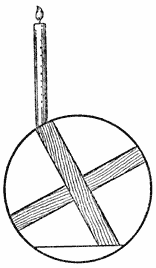
Fig. 6.—Taper fixed on brazen ring used in same ceremony.
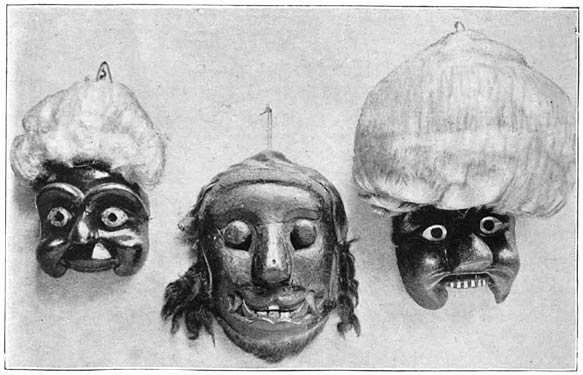
Plate 21.—Masks of Clowns and Demon.
Theatrical masks used by Malay strolling players. The two masks at each end are worn by the clowns (pran), and cover the upper jaw only, the eyes being mother-of-pearl with hollow pupils. The central mask represents a forest demon (hantu rimba).
Page 513.
The costumes of the performers in the various kinds of dramatic exhibitions vary, of course, with the subject-matter of the representation. The clown’s masks and the forest demon (hantu hutan), of which illustrations are given, will serve as specimens to indicate the nature of some of the accessories in use. A fairly full list of their Malay names will be found in the classification given below.
The Ma’yong is perhaps the most typical form of Malay theatrical representations, but another very characteristic performance is the Shadow-Play, properly termed Wayang, a name that has been loosely extended to cover theatrical exhibitions in general.
“The show is called Wayang Kulit, or leather puppets. It is exhibited in a rough shed, which has a flooring raised about three feet from the ground; the building is usually twenty feet square and enclosed on three sides, the front alone being open; across this opening a white sheet is stretched on which the shadows of the puppets are thrown and seen through by the audience; the latter sit or stand in the open air.
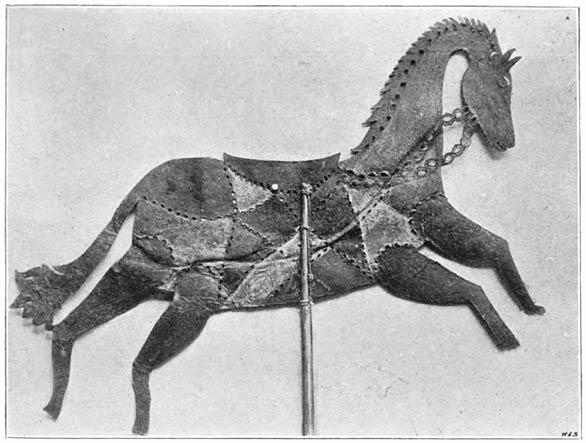
Plate 22.—Kuda Sĕmbrani.
Magic flying horse (kuda sĕmbrani) used in the shadow-play by ’Che ʿAbas. It is said to be able to swim through the water as well as to fly through the air.
Page 514.
“The show seems to be of Hindu origin, if we may judge from the strong resemblance the figures bear to the representations of gods and goddesses worshipped by the Hindus of India; it is probably obtained from Java.
“The figures are made of buffalo hide, and the arms alone are movable; they are moved by slips of wood attached to them, which are very clumsily contrived, and as their shadows are seen with the puppets the effect is very much destroyed. Various scenes of a domestic nature are exhibited, and they take the shape of a play, but with no definite plot running through or connecting the different scenes.
“The following is a specimen:—
“An old man appears weeping for a long-lost son, and moves to and fro for some time bewailing his loss; the showman speaks each figure’s part, and alters the tone of his voice to suit the age of the speaker; a second figure comes on, representing a young man armed with a kris, who endeavours to pick a quarrel with the first comer, and the conversation is witty and characteristic, eliciting roars of laughter from the lookers-on; a fight ensues, and the old man is wounded; he falls and cries out that were he a young man, or if his lost son were present, his adversary should not thus triumph over him. In his conversation he happens to mention his son’s name; the young man intimates that his name is the same, an explanation ensues, and it ends by the old man discovering in his late adversary his long-lost son. The old fellow weeps and laughs alternately, caresses his son frequently, and declares they shall never part again; the scene ends by the youth shedding tears over his late inhuman conduct, and he finally walks off with the old gentleman on his back.
“The conversation is carried on solely in the Malayan dialect. Warlike scenes please most: a warrior comes on the stage and challenges his invisible enemy to mortal combat; suddenly another figure comes on at the opposite side and a desperate fight ensues, which lasts for a very long time, and ends in one of the combatants being killed. Occasionally a battle in which ten or twelve figures join takes place, and for hours will the Malays look on at such scenes.
“The show concludes with an exhibition of various animals—deer, horses, tigers, crocodiles, etc., also birds and fishes. The figures are perforated to represent the eyes, shape of the dress, etc.
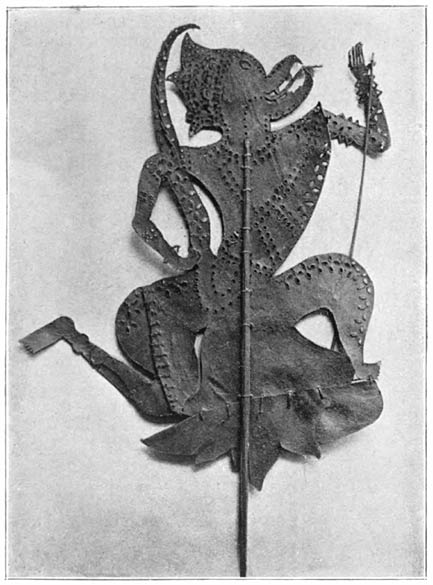
Plate 23.—Fig. 1. Hanuman.
Hanuman, the monkey-god, used by ’Che ʿAbas in the shadow-play of S’ri Rama (the Malay Ramayana).
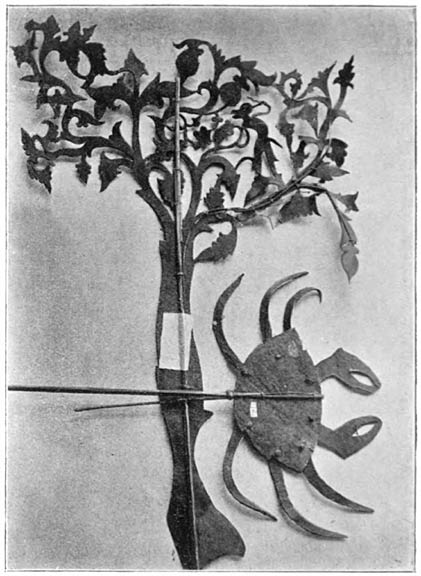
Fig. 2. Pauh Janggi and crab.
The Pauh Janggi or coco-de-mer, used by ’Che ʿAbas in the shadow-play. At the foot of it is seen the gigantic crab which is believed to be the cause of the tides.
Page 516.
The puppets for these shadow-plays are usually cut out of deer-skin (not buffalo hide) and it is worth remarking that they are all considered to be more or less animated; a stringent propitiatory ceremony has to be performed in their honour, incense being burnt and rice scattered about, just as in the Ma’yong ceremony already described.
The present writer, while in Selangor, bought from a Kelantan Malay named ’Che ʿAbas, a performer of shadow-plays, his entire stock-in-trade, including not only his musical instruments (amongst which were some curious drums called gĕdu and gĕdombak), but also his candle (with its shade), the rice used for the ceremony, and his entire stock of shadow-pictures, all of which are now in the Cambridge Museum.
The following classification of the more important kinds of theatrical performances, which was drawn up for the present writer by ’Che Hussein of Penang, the actor of whom mention has already been made, may be of interest, and will serve to indicate briefly their several characteristic features, though it does not profess to be absolutely exhaustive:—
Classification of Theatrical Performances known to Malays of the Peninsula
Name of Performance and Reputed Place of Origin Instruments. Dress. No. of Performers. Place of Performance, etc. Names of Stories Represented.
1 Lĕkun or Lakun (Kedah and Siam). Gĕndang bĕsar, gong, gambang dua-b’las, kromong (or mong-mong), anak ayam, breng-breng, sĕrunei, cherek. Head-dress: kĕchobong, chawat (sayap layang-lay-ang), sabok, bimpau, sap suang, g’lang, g’lang kana (= kena), changgei, saluar. 100 to 200 (in choruses) all females, except the musicians. Indoors, with proper scenery and dresses (masks). S’ri Rama, Dewa Matahari, Sendrong, Prak Jusin.
2 Mĕndura (Siam). Gĕdombak, gĕdu, sĕrunei, cherek, mong, breng-breng anak ayam; but not gĕndang, rĕbab, or gong. Same as in the Lĕkun. About 10 to 15 good performers; all male, including the Princess. Out doors; no scenery. S’ri Rama, Lak Kenawan, Timun Muda, Iprat, Prak Jusin, Pran Bun, Sendrong, Dewa Matahari.
3 Ma’yong (Siam). Rĕbab (yang bĕtuah), gĕndang (2), gong (2), gĕdombak (2), gĕdu-gĕdu (1), b’reng-b’reng (1); mong-mong (2), sĕrunei (1), anak ayam (2), cherek (10–20). Head-dress: tanjak (sapu tangan), g’rak gĕmpa, sabok, bimpau g’lang, changgei, saluar, sarong, baju, topeng (pran). 10 to 20 (15 is the average), both male and female. Out doors; no scenery, which is, however, described by the performers. Panggong and langit-langit are all that is required. Dewa Sri Rama, Dewa Muda, Dewa Pĕchi, Gambar Lilin, Batak Puteh, Siamang Gila, Raja Gondang, Gajah Dang Daru, Bijak Laksana, Raja Muda sama Puyuh, Pran Bun, Timun Muda, Lak Kenawan, Iprat, Putri Duab’las, Dewa Bisnu, Solong Sakti, Putri Bongsu, Mĕgat Gembang Sultan Kĕchil Bongsu diʿAlam, Bongsu Kĕchil S’riʿAlam, Bujang Lempawi.
4 Wayang Kun (Siam). Gong, gĕndang, kromong, anak ayam, b’reng-b’reng, gambang dua-b’las, sĕrunei; but not cherek or rĕbab. Different airs (lagu) from those used in the Lĕkun. Same as in the Lĕkun, except that the kĕchobong is not used, but a sort of ornamental sampul or songko’ with artificial flowers, g’rak gĕmpa. Females wear jambangan, a made-up head-dress, also sambok, sap suang, chawat, saluar; but not g’lang or changgei. 30 to 40, both male and female. Indoors; no scenery. Same as in the Lĕkun.
5 Mek Mulong (Siam?) Same as in the Ma’yong, but the rĕbana is used instead of the rĕbab, gĕndang, and b’reng-b’reng. Same as in the Ma’yong. 8 to 15, males and females. Out doors; a panggong, as in the Ma’yong. Malim Bongsu, Awang Salamat.
6 Bangsawan Parsi Indra Sabor (Persia?) Biola, kĕchapi, gĕndang (dul), gong, etc., as in the Mĕndu. Persian in character. 30 to 50, all males except 2 or 3 females. Indoors; sevenfold langit langit, and tabir; wires are used in some performances to enable performers impersonating Dewas, etc. to fly. Lela Majnun, Sap Jafri, Raja Gelepam, etc.
7 Mĕndu (Pontianak). Gĕndang (dul), gong, b’reng-b’reng, biola, kĕchapi, piano (or argin, i.e. concertina), sam dyen (Chinese), resembling the rĕbab; chên-chên (cymbals), and gĕndang singa. Same as in the Wayang China, i.e. Chinese in character: a baju tĕratei, a small jacket without sleeves; head-dress: mahkota (bulu kuang), beard and whiskers. Pahla-wans are distinguished by a koh sah (decoration on the fore-head); socks are worn. 20 to 50 Malays acting Malay stories, but in Chinese dress; both male and female. Indoors; the same rough scenery as in Chinese theatres; there are small theatres for the Mĕndu at Singapore, Penang, and Malacca. Saifu-’l-Yazan, Siti Zubeidah, Ken Tabohan, ʿAbdul Muluk, Bĕstamam, Mara Karma, Bidasari, Dewa Mĕndu di Negri Langkadura, etc., most, if not all, being war-like themes.
8 Wayang Makau (China). The same as in the Mĕndu. Chinese in character. 20 to 50, male and female. Indoors. Siti Zubeidah, and also Chinese subjects.
9 Wayang Kulit (Java) [but the stories are Javanese, Malay, Siamese and Chinese]. Various. According to the nationality represented. — Indoors. Chekil Wanam Pati, Jarang K’lena, Misa Perbu Jaya, Misa Kiamang, Lalat Hijau, Kalang Bongkang, Panji Samerang, K’ra Amas, Iran Kasuma, etc.
11. WAR AND WEAPONS
Such charms as might be used in time of war, or in case of danger from wild beasts or other enemies, are partly what may be called “defensive” and partly “offensive” in character.
The Malays who use them pray, on the one hand, for a supernatural appearance wherewith to scare their enemies and protect themselves, and on the other for supernatural powers to assist in the destruction of their foes.
Thus, one of their charms runs:—
“Let me face the Seven Suns,
But let not my enemies face me.
“Push and you die, step across and your leg shall break.
I apply the charm of the Line called the Swollen Corpse.”
According to another method of gaining martial vigour and immunity in fighting, you take a wick as long as the short span between your thumb and first finger (sa-jĕngkal tĕlunjok), and after passing it over your body upwards (di-naikkan) thrice, take it between your two hands and try and turn it round while you repeat the charm. The ceremony must take place at the time of full moon, and if you do not succeed in turning it the first time, you can try again at the next full moon, and so on up to three full moons. At night, if you succeed you will (according to the Malay account) see the vision of a man, a sign, it is to be supposed, that the charm has been effectual, and that the prayer has been heard.
The charm begins as follows:—
“In the name of God, the merciful, the compassionate!
May this nerve of stone pierce stone,
Pierce stone and split stone,
Pierce planks and go right through them,
Pierce water and dry it up,
Pierce the earth and make a hole in it,
Pierce the grass and wither it,
Pierce mountains and cause them to fall,
Pierce the heavens that they may fall,” etc.
The charm concludes with the following magnificent boast:—
“Of Iron am I, and of Copper is my frame,
And my name is ‘Tiger of God.’”
In a somewhat similar charm, a warrior prays that he may be
“Fenced with Hell-fire up to the eyes;”
and another expresses the wish that his enemies may be
“Ground to powder like tin-ore after washing.”
Dagger (k’ris) = pisau (lit. knife).
Bullet (pĕluru sĕnapang) = kumbang puteh (lit. white beetle).
Ball of swivel-gun (pĕluru lela) = kumbang hitam (lit. black beetle).
Stockade (kubu) = batang mĕlintang (lit. transverse trunk), or balei mĕlintang.
Cannon (mĕriam) = batang kabu-kabu (lit. cotton-tree trunk), or batang buloh (lit. trunk of bamboo).
Cannon-ball = buah niyor (lit. cocoa-nut).
Bullets are frequently, if not always, “charmed” before being used, and their efficacy is supposed to be increased thereby. The Orang Kaya Pahlawan, a chief of some local notoriety in recent times, claimed to be invulnerable (kĕbal) to the extent that nothing but a silver bullet would hurt him.
The following legendary tale illustrates a somewhat similar idea:—The assailant, one Magat Terawis, an unknown warrior who had joined the Sultan’s investing army, had four bullets, on each of which were inscribed the words: “This is the son of the concubine of the Raja of Pagar-ruyong; his name is Magat Terawis; wherever his bullet falls he will become a Chief.”
“Translation of Malayan MS. on Krises and Process of Damasking
“Fasl I.—On the Pamur, or Damasking of Krises
“If the damasking of a kris only reach within a finger’s breadth of the point, and if it reach the edge, it is inauspicious for combat. Should the damask not be even with the point, a stab made with such a kris would err; but if even, then the kris will never deviate, although its possessor lose strength to thrust; still, by the grace of God, it will hit the mark should he cast it at his adversary. If it be damasked on both sides, it is good; but not so should the damask be separated at intervals.
“If the damask on the point be that of Alif besar (a damask running in the shape of the Arabian letter Alif), the kris is good for combat; but it is not lucky to wear such a weapon while trading, nor one in which the damask runs from the pangkal (the stem which runs into the handle), to the tali.
“If it possess the Alif damask near the handle, the middle, and point, it is very auspicious for commercial transactions; men cannot resist the force of the possessor’s arguments; should it be worn whilst planting, the crop will be fruitful. The possessor will be irresistible in fight, nor can any person thwart his wishes.
“Fasl II.—On the Blade of the Kris
“If the blade of the kris be split in the direction of the tali tali (the silk and ratan appendage by which the kris is fastened in the girdle), you cannot return an adversary’s thrust with it. If the betala be cracked to the ikat tali (or bottom welt), it is not auspicious. Should the point of the kris be split, it is a sign that it requires blood; if this want be not gratified, the possessor becomes sick.
“Fasl III.—On the Badik, or Sendrik
“If the blade of the badik be damasked all over to its edge, it is lucky to wear while trading or dividing property. If the back bear the damask Alif, it is also good for trading with, or for combat, by God’s assistance. If the blade have the pamur gunong, or mountain damask, it softens the hearts of men, and is good for trading and warlike excursions. If the lines of damask be of equal breadth from the pangkal to the tali, and straight, it is auspicious.
“Should the belly of the blade be veined, it is lucky to trade, and good for making a stab with, as the possessor’s antagonist will not be able to return the thrust. If the damask be that called pamur kait (or the damask like a hook), it is auspicious.
“How to damask krises.—Place on the blade a mixture of boiled rice, sulphur, and salt beat together, first taking the precaution to cover the edges of the weapon with a thin coat of virgin wax. After this has remained on seven days, the damask will have risen to the surface; take the composition off, and immerse the blade in the water of a young cocoa-nut, or the juice of a pineapple, for seven days longer, and wash it well with the juice of a sour lemon. After the rust has been cleared away, rub it with warangan (arsenic) dissolved in lime juice; wash it well with spring water; dry, and anoint it with cocoa-nut oil.
“Fasl IV.—Measurement of Krises
“Measure the kris with a string below its aring (a jutting out of the blade near its bottom) to its point; cut the string and fold it trebly; cut off one of the trebles, and with the remaining two measure up the blade of the kris, then make a mark how far the string reaches. Measure the blade across at this mark, and find how many times its breadth is contained in two-thirds of its length; cut the string into as many pieces. These form the sloca, or measure, of which the kris consists. If none of the string remain over, the blade is perfect, if a minute portion remain, it is less perfect, but if half the breadth remain, or more, it is chelaka, unlucky.”
Newbold adds:—
Besides the mode above described, several other methods of measuring the k’ris are also in vogue. They differ in various matters of detail, and will be found in the Appendix.
The measurement of one-edged weapons is effected as follows:—
Measure the length of the weapon from hilt to point, and fold the string so measured in two. Measure off this half-length from the hilt and see how often the breadth of the blade is contained in the whole length of the string. Each time, however, that the edge is reached, the string must be marked or dented, and the long end wrapped round and round the blade, so that the measurement of each breadth is consecutive to the preceding breadth, the portion of the string which is stretched across the back of the blade not being counted.
This method is called ukor mata sa-b’lah, and is used by Sumatran Malays, especially in Menangkabau.
Spearheads can also be measured:—
Measure off the length of the spearhead and fold the string in two; see how often the breadth is contained in the half of the string; if the blade is a good one, it must be five and a half times (tĕngah anam). This is called ukor orang Perak or ukor tĕngah anam.
Another superstition connected with weapons is described as follows by Sir Frank Swettenham. It illustrates the magic powers attributed to the Pawang in so many departments of nature and life, but does not seem to have any special object or meaning.
“A great many Malays and one or two Europeans may be found who profess to have seen water drawn from a kris. The modus operandi is simple. The pâwang (I dare not call him conjurer) works with bare arms to show there is no deception. He takes the kris (yours, if you prefer it) from its wooden handle, and, holding the steel point downwards in his left hand, he recites a short incantation to the effect that he knows all about iron, and where it comes from, and that it must obey his orders. He then with the thumb and first two fingers of his right hand proceeds to gently squeeze the steel, moving his fingers up and down the blade. After a little while a few drops of water fall from the point of the kris, and these drops quickly develop into a stream that will fill a cup. The pâwang will then hand round the blade and tell you to bend it; this you will find no difficulty in doing, but by making two or three passes over the kris the pâwang can render it again so hard that it cannot be bent.
The subject of this section, more perhaps than any of the others, has lost its former importance, and become almost a matter of merely historical interest. In the Malay Peninsula, at least in the States which are under British protection, offensive weapons are seldom worn now-a-days except on State occasions and for purely ceremonial purposes; and warfare, it may be hoped, is now a thing of the past. In spite of the halo of romance thrown round it in native writings, Malay warfare (in modern times, at least) has never been anything but the barest and most bloodthirsty piracy by sea, and the merest “bushwhacking” and stockade-fighting on land; its final suppression, even if in some degree it should involve a slackening of fibre in the Malay character, is not a matter for regret. With it will disappear much of the curious lore that surrounded it, and indeed a good deal of it must have been lost already. Little has been said here of the methods of divination used in warfare which take up so much space in Malay treatises on the subject; success in war is held to depend on a great number of minute observances, and to be capable of being foretold by careful attention to omens and signs. But the divination applied in warfare does not seem to differ in principle from that which is used in all the other avocations of life, and a sufficient idea of its nature will be gathered from the account given in the next section.
12. DIVINATION AND THE BLACK ART
Omens and Dreams
The significance of ominous signs and dreams is a subject which possesses vast ramifications, extending so deeply into every department of the Malay national life, that it will be impossible to do it anything like full justice within the narrow limits of this book. My object will be merely to indicate the main lines on which these two important doctrines of the Malay natural religion appear to have been developed.
Among omens drawn from natural events are the following:—
“When a star is seen in apparent proximity to the moon, old people say there will be a wedding shortly....
“The entrance into a house of an animal which does not generally seek to share the abode of man is regarded by the Malays as ominous of misfortune. If a wild bird flies into a house it must be carefully caught and smeared with oil, and must then be released in the open air, a formula being recited in which it is bidden to fly away with all the ill-luck and misfortunes (sial jambalang) of the occupier. An iguana, a tortoise, and a snake, are perhaps the most dreaded of these unnatural visitors. They are sprinkled with ashes, if possible, to counteract their evil influence.
So, too, omens are taken either from the flight or cries of certain birds, such as the night-owl, the crow, some kinds of wild doves, and the bird called the “Rice’s Husband” (laki padi).
One form of this rite was taught by a Malay of Penang extraction, whose instructions, taken down by me at the time, ran as follows:—
Take a lemon (limau purut), a hen’s egg, a taper made of bees’-wax (lilin lĕbah), four bananas, four Malay (palm-leaf covered) cigarettes, four “chews” of betel-leaf, a handful of parched rice, washed rice, and rice stained with turmeric (saffron), one of the prickles or “thorns” (duri) of a thorn-backed mudfish, a needle with a torn eye (taken out of one of the sets of a “score” in which they are sold—jarum rabit dalam sĕkudi), and a couple of small whips, or rather birches, one of which must be composed of seven, and the other of twelve, leaf-ribs of the “green” cocoa-nut palm (niyor hijau).
Two of the bananas, two cigarettes, two chews of “betel,” half of each of the three kinds of rice, the egg, and the birch of seven twigs, must now be taken outside the house and set down under a tree selected for the purpose. When setting it down the egg must be cracked, the cigarettes lighted, and finally the taper also. On one occasion when I witnessed the performance, the taper, after being taken up between the outstretched fingers of my friend’s two hands, was waved slowly to and fro—first to the right and then to the left; finally it was set down on the ground and began to burn blue, the flame becoming more and more dim until it almost expired. On seeing this the medicine-man exclaimed, “He has promised” (dia mĕngaku), and led the way back to the house, where he proceeded to go through the remainder of the ceremony.
First, he deposited the brazier with incense upon the leaf of a banana-tree, then took the prickle of the fish and thrust it horizontally through the lower end of the lemon, leaving both ends exposed; then he thrust the needle through in a transverse direction, so as to form a cross, the ends of the needle being likewise exposed, and slipped the noosed end of a piece of silken thread of seven different colours over the points thus exposed.
Everything being ready, he now began to put questions to the lemon into which the spirit was supposed to have entered, rebuking it and threatening it with the birch whenever it failed to answer distinctly and to the point. The conversational powers of this spirit were extremely limited, being confined to two signs signifying “Yes” and “No.” The affirmative was indicated by a pendulum-like swaying of the lemon, which rocked to and fro with more or less vehemence according to the emphasis (as my friend informed me) with which the reply was to be delivered. Negation, on the other hand, was indicated by a complete cessation of motion on the part of the lemon.
When it is required to discover, for instance, the name of a thief, the names of all those who are at all likely to have committed the theft are written on scraps of paper and arranged in a circle round the brazier, when the lemon will at once swing in the direction of the name of the guilty party. The best night for the performance of this ceremony is a Tuesday.
Sir Frank Swettenham’s account of a similar ceremony of which he was an eye-witness will serve as a good illustration of the methods in use for this purpose:—
“It was my misfortune some years ago to be robbed of some valuable property, and several Malay friends strongly advised me to take the advice of an astrologer, or other learned person who (so they said) would be able to give the name of the thief, and probably recover most of the stolen things. I fear that I had no great faith in this method of detection, but I was anxious to see what could be done, for the East is a curious place, and no one with an inquiring mind can have lived in it long without seeing phenomena that are not always explained by modern text-books on Natural Philosophy.
“I was first introduced to an Arab of very remarkable appearance. He was about fifty years old, tall, with pleasant features and extraordinary gray-blue eyes, clear and far-seeing, a man of striking and impressive personality. I was travelling when I met him, and tried to persuade him to return with me, but that he said he could not do, though he promised to follow me by an early steamer. He said he would be able to tell me all about the robbery, who committed it, where the stolen property then was, and that all he would want was an empty house wherein he might fast in solitude for three days, without which preparation, he said, he would not be able to see what he sought. He told me that after his vigil, fast, and prayer, he would lay in his hand a small piece of paper on which there would be some writing; into this he would pour a little water, and in that extemporised mirror he would see a vision of the whole transaction. He declared that, after gazing intently into this divining-glass, the inquirer first recognised the figure of a little old man. That having duly saluted this Jin, it was necessary to ask him to conjure up the scene of the robbery, when all the details would be re-enacted in the liquid glass under the eyes of the gazer, who would there and then describe all that he saw. I had heard all this before, only it had been stated to me then that the medium through whose eyes the vision could alone be seen must be a young child of such tender years that it could have never told a lie! The Arab, however, professed himself not only able to conjure up the scene, but to let me see it for myself if I would follow his directions. Unfortunately, my gray-eyed friend failed to keep his promise, and I never met him again.
“A local Chief, however, declared his power to read the past by this method, if only he could find the truthful child. In this he appeared to succeed, but when, on the following day, he came to disclose to me the results of his skill, he said that a difficulty had arisen, because just when the child (a little boy) was beginning to relate what he saw he suddenly became unconscious, and it took the astrologer two hours to restore him to his normal state. All the mothers of tender-aged and possibly truthful children declined after this to lend their offspring for the ordeal.
“My friend was not, however, at the end of his resources, and, though only an amateur in divination, he undertook to try by other methods to find the culprit. For this purpose he asked me to give him the names of every one in the house at the time the robbery was committed. I did so, and the next day he gave me one of those names as that of the thief. I asked how he had arrived at this knowledge; he described the method, and consented to repeat the experiment in my presence. That afternoon I went with him to a small house belonging to his sister. Here I found the Chief, his sister, and two men whom I did not recognise. We all sat in a very small room, the Chief in the centre with a copy of the Korân on a reading-stand, near to him the two men opposite to each other, the sister against one wall, and I in a corner. A clean, new, unglazed earthenware bowl with a wide rim was produced. This was filled with water and a piece of fair white cotton cloth tied over the top, making a surface like that of a drum.
“I was asked to write the name of each person present in the house when the robbery was committed on a small piece of paper, and to fold each paper up so that all should be alike, and then to place one of the names on the cover of the vessel. I did so, and the proceedings began by the two men placing each the middle joint of the fore-finger of his right hand under the rim of the bowl on opposite sides, and so supporting it about six inches above the floor. The vessel being large and full of water was heavy, and the men supported the strain by resting their right elbows on their knees as they sat cross-legged on the floor and face to face. It was then that I selected one of the folded papers, and placed it on the cover of the vessel. The Chief read a page of the Korân, and as nothing happened he said that was not the name of the guilty person, and I changed the paper for another. This occurred four times, but at the fifth the reading had scarcely commenced when the bowl began to slowly turn round from left to right, the supporters letting their hands go round with it, until it twisted itself out of their fingers and fell on the floor with a considerable bang and a great spluttering of water through the thin cover. ‘That,’ said the Chief, ‘is the name of the thief.’
“It was the name of the person already mentioned by him.
“I did not, however, impart that piece of information to the company, but went on to the end of my papers, nothing more happening.
“I said I should like to try the test again, and as the Chief at once consented we began afresh, and this time I put the name of the suspected person on first, and once more the vessel turned round and twisted itself out of the hands of the holders till it fell on the floor, and I was surprised it did not break. After trying a few more I said I was satisfied, and the ordeal of the bowl was over. Then the Chief asked me whose name had been on the vessel when it moved, and I told him. It was a curious coincidence certainly. I wrote the names in English, which no one could read; moreover, I was so placed that no one could see what I wrote, and they none of them attempted to do so. Then the papers were folded up so as to be all exactly alike; they were shuffled together, and I did not know one from the other till I looked inside myself. Each time I went from my corner and placed a name on the vessel already held on the fingers of its supporters. No one except I touched the papers, and no one but the Chief ever spoke till the séance was over. I asked the men who held the bowl why they made it turn round at that particular moment, but they declared they had nothing to do with it, and that the vessel twisted itself off their fingers against their inclination.
“The name disclosed by this experiment was certainly that of the person whom there was most reason to suspect, but beyond that I learnt nothing.
“Another plan for surprising the secret of the suspected person is to get into the room where that person is sleeping, and after making certain passes to question the slumberer, when he may truthfully answer all the questions put to him. This is a favourite device of the suspicious husband.
A somewhat analogous practice is the ordeal by diving, described by the late Sir W. E. Maxwell as “a method of deciding a disputed point which was occasionally resorted to in Perak in former times. I got the following account of the manner of conducting the ordeal from a Malay chief who saw it carried out once at Tanjong Sanendang near Pasir Sala, in the reign of Sultan Abdullah Mohamed Shah, father of the present Raja Muda Yusuf:—
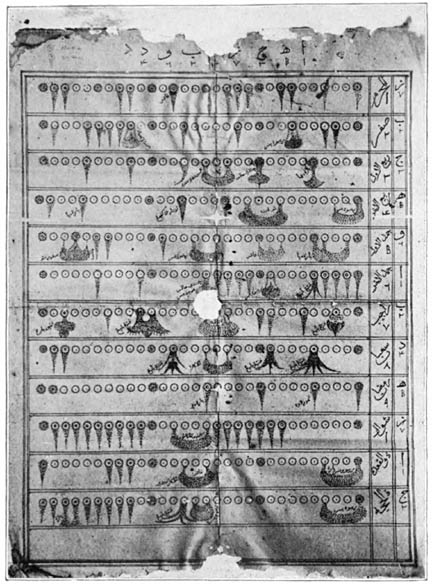
Plate 24.—Fig. 1. Weather Chart.
Weather chart used by Malays for foretelling the weather during a whole year.
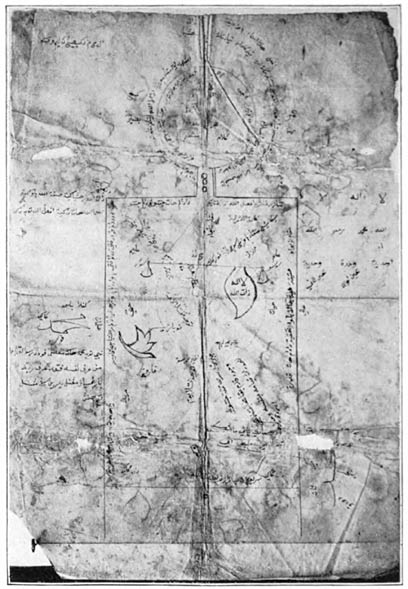
Fig. 2. Diagram.
A magic diagram in the author’s possession, which is intended to represent the various parts of the human anatomy, e.g. the heart and the lungs.
Page 544.
“The Perak Malays believe this to be an infallible test of the truth of a cause. The boy who holds the false declaration is half-drowned, they say, as soon as his head is under the water, whereas the champion of the truth is able to remain below until the bystanders drag the post out of the river with the boy still clinging to it. Such is the power of the truth backed by the sacred names and persons invoked!
“The loser is often fined in addition to suffering the loss of his stakes (one-half of which goes to the Raja). He also has to pay the customary fees, namely, $6.25 for the use of the balei, $12.50 to the krani, and $5 to each of the boys.
Morning. Forenoon. Noon. Afternoon. Evening.
(pagi) (tĕngah naik) (tĕngah hari) (tĕngah turun) (pĕtang)
(1st day) Maswara Kala S’ri Brahma Bisnu
(2nd day) Bisnu Maswara Kala S’ri Brahma
(3rd day) Brahma Bisnu Maswara Kala S’ri
(4th day) S’ri Brahma Bisnu Maswara Kala
(5th day) Kala S’ri Brahma Bisnu Maswara
The same mystic notions of colour and the like are attached to these divisions by the Malays as obtain in the case of the Javanese days of the week: thus Maheswara’s colour is yellow-white (puteh kuning): if you go out you will meet a man of yellow-white complexion, or wearing yellow-white clothes; it is a lucky time for asking a boon from a Raja, or for doing any kind of work; good news then received is true, bad news is false, and so on.
Another version of this system, known as the Five Moments (saʿat), is based on a somewhat similar diagram, but has orthodox Muhammadan names for its divisions, viz. Ahmad, Jibra’il (Gabriel), Ibrahim (Abraham), Yusuf (Joseph), and ʿAzra’il (Azrael).
Its diagram, as will be seen, is not quite the same as that of the Katika Lima, though the general scheme of the two systems corresponds closely.
So in Ahmad’s division if you lose a buffalo or a bullock, it has gone to the southward and will be recovered; good news then received is true, bad news is false; the time is auspicious for any kind of work, for going on a voyage, sailing, or planting, and very profitable for trading; it is a lucky time for going to war, but you must wear white clothes and face southwards by a little east, and pray to God Almighty. Jibra’il’s time is fairly lucky too, being good for planting and profitable for trading, and if gold or silver is lost then, it will be quickly found, but there may be some trouble in getting it back; a lost buffalo or bullock has gone southwards, but will be recovered after some slight trouble; if you go to war at this time you must wear green, but must not face towards the south. Ibrahim’s time is most unlucky, and going out then is sure to involve bloodshed or other misfortune; bad news is true, good is false; things lost then will not be recovered; going to war is ruinous, and if you do go, the only way of safety is to face to the north, but it is best to stay at home altogether at this time.
Another scheme (Katika Tujoh), based on the Seven Heavenly Bodies, divides each day into seven parts, each of which is distinguished by the Arabic name of one of the Heavenly Bodies.
The first day runs,—
Sun Venus Mercury Moon
Saturn Jupiter Mars
and the times are—early morning (pagi-pagi), morning (tĕngah naik), just before noon (hampir tĕngah hari), noon (tĕngah hari), afternoon (dlohr), late afternoon (ʿasr), and sunset (maghrib).
For the second day the series begins with the Moon, and goes on in the above order to Mercury; and for the third day it begins with Mars; so that each day of the week begins with its appropriate planet in the usual order, which is best seen in the French names Mardi, Mercredi, Jeudi, Vendredi, and the English Saturday, Sunday and Monday.
Each of the seven divisions has its lucky or unlucky characteristics, much as in the systems already described.
Besides these, each day of the week has its own appropriate occupations, according to another system, at times ascertained by measuring the length of one’s shadow. Further, it would appear that some days are unlucky altogether: one account gives seven unlucky days in every month; another asserts that Thursday is unlucky in the months Dhu-’l-hijjah, Muharram, and Safar; Tuesday in Rabiʿ-al-awal, Rabiʿ-al-akhir, and Jumada-’l-awal; Saturday in Jumada-’l-akhir, Rĕjab and Shaʿban; Sunday in Ramadhan, Shawal, and Dhu-’l-kaʿidah; a third specifies twelve other most inauspicious days in every year, viz. the 28th of Muharram, the 10th of Safar, the 14th of Rabiʿ-al-awal, and so on, while for greater convenience a calendar has been drawn up, which is far too long to be reproduced here, but which closely resembles the weather chart illustrated on another page, and gives the whole list of days of the Muhammadan year classified under the heads lucky (baik), somewhat unlucky, very unlucky, and neutral.
This form of divination is not quite so common as are those of the Five Ominous Times (5-square) and the Seven Heavenly Bodies (7-square), and I have not been able to find out much about the methods of working it, but a copy of one of the diagrams used for the purpose will be found on another page.
According to one view, which is perhaps the prevalent one, every man’s luck is determined by one or other of the zodiacal constellations, and in order to find out which one it is, the following direction is given:—
“Reckon the numerical equivalent of the person’s name and of the name of his mother by the values of the letters according to the system of the Abjad; add the two numerical equivalents together, and divide the total by twelve; if the remainder is 1, his sign is the Ram, if 2, the Bull, and so on.”
Having mentioned the divisions of the calendar which are chiefly used in divination, it seems desirable, for the sake of completeness, to allude briefly to those that remain.
This remark is still true, no doubt, of the up-country Malays on the West Coast, but in most districts, and to an extent commensurate with European influence, the solar year is now being gradually introduced.
The same remark applies to the method of reckoning months, a dual system being now in vogue in many places where there is most contact with Europeans. Regarding the native methods the following quotation is to the point:—
“There are three ways of reckoning the months. First, the Arabian, computing thirty days to the first month, and twenty-nine to the second month, and so on alternately to the end of the year.
“Second, the Persian mode, viz. thirty days to each month; and, thirdly, that of Rum, i.e. thirty-one days to the month. The first is in general use. Some few, with greater accuracy, calculate their year at 354 days eight hours, intercalating every three years twenty-four hours, or one day to make up the deficiency, and thirty-three days for the difference between the solar and lunar years.
“But the majority of the lower classes estimate their year by the fruit seasons and by their crops of rice only. Many, however, obstinately adhere to the lunar months, and plant their paddy at the annual return of the lunar month.”
“The Malay months have been divided into weeks of seven days, marked by the return of the Mohammedan Sabbath. Natives who have had intercourse with Europeans divide the day and night into twenty-four parts, but the majority measure the day by the sun’s apparent progress through the heavens, the crow of the cock, etc. The religious day commences at sunset, like that of the Arabs and Hebrews.”
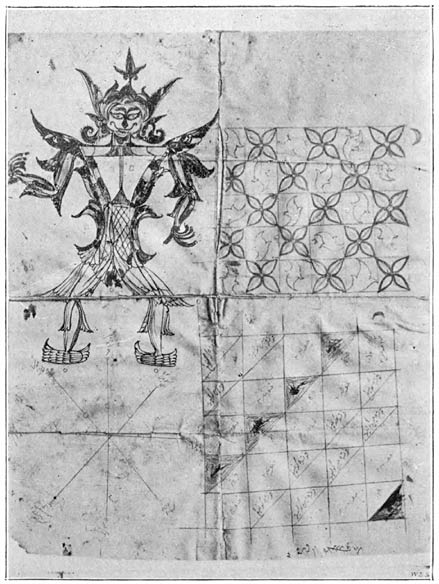
Plate 25.—Fig. 1. Diagrams.
Diagrams used for divinatory purposes—the two on the right being different kinds of “magic squares.” The left-hand top figure has small circles at different points of its anatomy, which are used as the means of divination. The left-hand figure at the bottom is used as a sort of compass—the diviner counting round it from point to point.
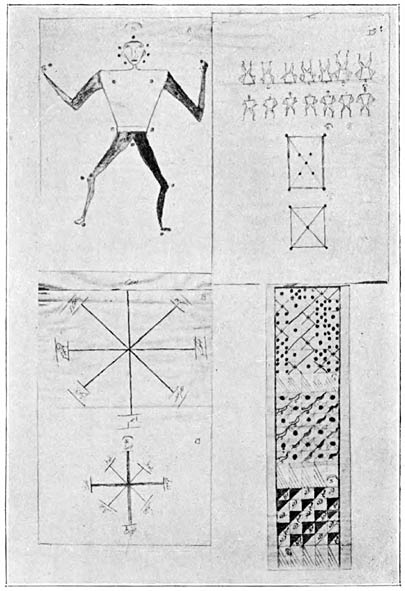
Fig. 2. Diagrams.
Other patterns of the preceding diagrams, together with two additional diagrams (those at the top on the right hand), the method of counting from point to point being that used in each case.
Page 555.
Most if not all these systems of reckoning seem to have been treated by the Malays from the astrological point of view as forming a basis for divination, and these crude notions of the lucky or unlucky nature of certain times and seasons are to some extent systematised by or in some degree mixed up with the idea of the mystic influence of numbers and geometrical figures.
Of the mystic figures used in divination, the first in importance is, no doubt, what has been called the “magic square,” a term applied to “a set of numbers arranged in a square in such a manner that the vertical, horizontal, and diagonal columns shall give the same sums.”
The ordinary form of magic square, which was formerly in use in Europe, is the following; it is occasionally found even among the Malays.
Magic Square of 3.
8 1 6
3 5 7
4 9 2
Magic Square of 5.
17 24 1 8 15
23 5 7 14 16
4 6 13 20 22
10 12 19 21 3
11 18 25 2 9
Magic Square of 7.
30 39 48 1 10 19 28
38 47 7 9 18 27 29
46 6 8 17 26 35 37
5 14 16 25 34 36 45
13 15 24 33 42 44 4
21 23 32 41 43 3 12
22 31 40 49 2 11 20
But the form of magic square generally used by the Malays is the same figure reversed.
6 1 8
7 5 3
2 9 4
Magic Square of 5.242
15 8 1 24 17
16 14 7 5 23
22 20 13 6 4
3 21 19 12 10
9 2 25 18 11
Magic Square of 7.242
28 19 10 1 48 39 30
29 27 18 9 7 47 38
37 35 26 17 8 6 46
45 36 34 25 16 14 5
4 44 42 33 24 15 13
12 3 43 41 32 23 21
20 11 2 49 40 31 22
Sometimes, again, the names of the five Hindu deities already mentioned will be found similarly arranged, in which case they appear to refer to the divisions of the day, described above under the name of Katika Lima. Besides this class of magic squares, however, there are other kinds which present irregularities, and are not so easily explainable. Some of these violate the fundamental rule of the magic square, which insists that each square shall have an equal number of small squares running each way, and that this number shall be an odd one.
Others exhibit the right number of small squares (3 × 3 or 5 × 5 or 7 × 7), but instead of a subdivision into sub-groups, have merely an arrangement of alternative emblems, such as a bud and a full-blown flower, or the like.
An analysis of the squares whose figures are given in the illustrations shows that the order of the colours, deities, and planets is by no means always the same.
Thus, in the matter of the order of the five colours, we have:—
In Plate 26, Fig. 1,
1–5 brown (? red).
6–10 yellow.
11–15 white.
16–20 black.
21–25 white.
and in another figure,
1–5 white.
6–10 black (red is substituted by mistake in No. 9).
11–15 red.
16–20 blue (17 is made black by mistake).
21–25 yellow.
And in the matter of the order of the Five Deities we find:—
And yet another 5-square containing the names of Deities (Pl. 26, Fig. 2) is composed as follows:—
1–5 Bisnu (Vishnu).
6–10 Brahma.
11–15 Maswara (Maheswara).
16–20 [a diagonal cross].
21–25 [a small circle].
From Pl. 26, Fig. 2, it would appear that this form of the 5-square is used to ascertain the best time of day to commence an operation, e.g. to start on a journey.
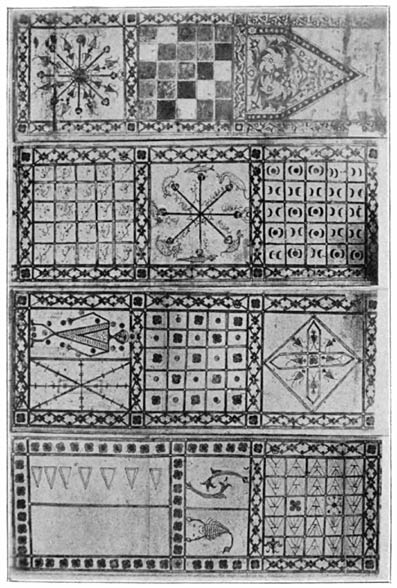
Plate 26.—Fig 1. Diagrams.
A set of diagrams corresponding to preceding, and used in the same manner, the whole forming an entire set of diagrams alleged to have been formerly used by Selangor pirates before setting out on a piratical excursion.
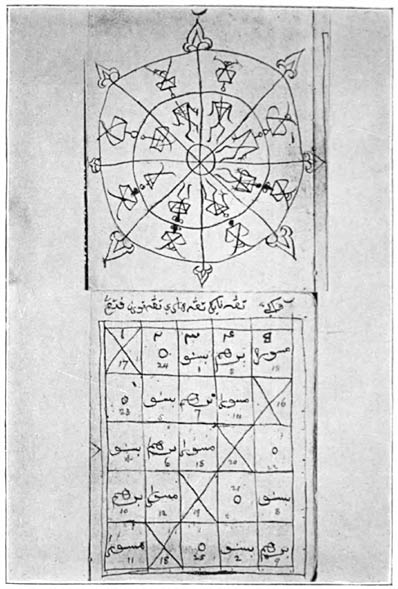
Fig. 2. Diagrams.
Varieties of the preceding, photographed from Malay charm-books in the author’s possession.
Page 558.
In a 7-square we find the following:—
This 7-square is based on a heptacle in which every alternate day is skipped, thus:—
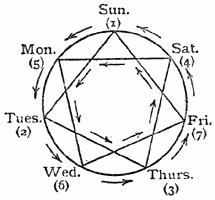
Fig. 7.—Heptacle on which the 7-square is based.
This form of square is evidently used to ascertain the best day of the week to commence any operation.
Next in importance to the methods of divination by the use of magic squares, come those which depend upon “aspect,” and involve the use of diagrams which I propose to call “aspect-compasses.” Of these the commonest form is a drawing, in which the places usually occupied by the points of the compass are occupied by the names of certain things (usually animals or birds) which are supposed to be naturally opposed to each other. Thus in one of these compass-like figures we find (vide Pl. 25, Fig. 2):—
The Bird [sic] (N.) opposed to the Fowl (S.)
The Crocodile (N.E.) opposed ,, to ,, the ,, Fish (S.W.)
The Rat (E.) opposed ,, to ,, the ,, Cat (W.)
The Tiger (S.E.) opposed ,, to ,, the ,, Stag (N.W.)
Another has:—
The Kite (N.) opposed to the Fowl (S.)
The Crocodile (N.E.) opposed ,, to ,, the ,, Fish (S.W.)
The Rat (E.) opposed ,, to ,, the ,, Cat (W.)
The Tiger (S.E.) opposed ,, to ,, the ,, Stag (N.W.)
And a third:—
The New Moon (N.) opposed to the Kite (S.)
The Cat (N.E.) opposed ,, to ,, the ,, Rat (S.W.)
The Crocodile (E.) opposed ,, to ,, the ,, Fish (W.)
The Stag (S.E.) opposed ,, to ,, the ,, Tiger (N.W.)
whilst a fourth has alternately cape and bay.
The way in which these figures were used for divination is very clearly shown by Pl. 25, Fig. 1, which is copied from a figure in one of my (Selangor) charm-books, which had the days of the month, from the 1st to the 30th, written round it in blue ink. Starting from the north aspect, you count round to the left until (allowing one day to each aspect) you arrive at the aspect corresponding to the number of the day of the month upon which you wish to start your journey. If it coincides with an aspect assigned to one of the weaker influences, it will be most imprudent to start on that day. Start on a day assigned to one of the stronger influences, and you will be all right. If the first aspect-compass which you consult is not accommodating enough for your requirements, go on consulting others until you find one which is satisfactory.
Other forms of the compass-figure are used for divining whether if he starts on a certain day the man will get the better of his enemy, or meet with a person (e.g. a slave or a thief) who has run away. In the former case a double circle of human figures is used, the figures of the inner circle representing the person who seeks the information, and those of the outer circle his enemy. The counting is carried out in precisely the same manner as before, and the headless figure in each case represents the man who will lose. In the case of a drawn battle neither party, of course, loses his head.
In the case of an absconder, a single circle of figures is used, the figures pointing towards the centre signifying that the absconding party will return or be caught, and those pointing away from the centre signifying the opposite. In one case (Pl. 25, Fig. 2) there are fourteen human figures arranged in two opposing rows of seven, every alternate figure being headless. In this case you start the counting at the right-hand figure of the bottom row, and count towards the left. Yet another form of divination in which the human figure is made use of, is shown in Pl. 25, Fig. 1; a number of small red circles (which should be alternately dark and light) are drawn at the salient points of the figure, and counted down to the left in order, beginning at the head. All I have yet been able to discover about the villainous-looking individual here portrayed is the fact that he is said to represent one “Unggas Tĕlang,” who was described to me as an “old war-chief” (hulubalang tua) of the Sea-gypsies (Orang Laut) and the Malay pirates.
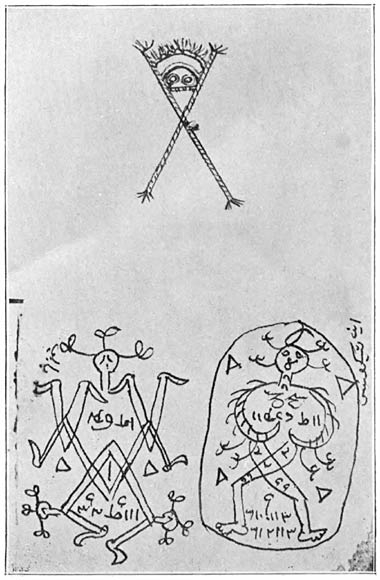
Plate 27.—Fig. 1. Diagrams.
Further varieties, photographed from Malay charm-books in the author’s possession, showing the gradual conventionalising of the human figure.
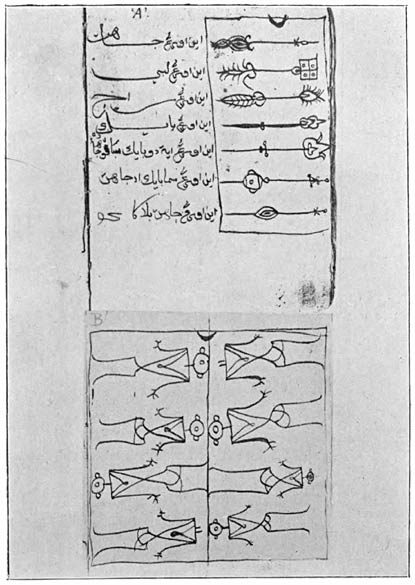
Fig. 2. Diagrams.
Further varieties of these Diagrams taken from a Malay charm-book in the author’s possession.
Page 561.
More important, perhaps, are the omens believed to be derived from dreams, of which there seem to be several different methods of interpretation. According to one system the initial letter of the thing dreamt of determines the luck: thus to dream of a thing beginning with T is very lucky indeed, to dream of a thing beginning with H means that a visitor from a distance is to be expected; N indicates sorrow, L is a hint to give alms to the poor and needy, and so forth. According to another system, a purely arbitrary meaning is put upon the subject-matter of the dream, or, at most, some slight analogy is the basis of the interpretation. Thus to dream of a gale of wind in the early morning is an omen of sorrow, to dream of hail means acquisition of property, to dream of bathing in a heavy shower of rain indicates escape from a very great danger, a dream about mosquitoes, flies, and the like, means that an enemy is coming to the village, to dream about eating jack-fruit (nangka) or plantain (pisang) is an indication of great trouble impending, and so on; an extract from a treatise on this subject is given in the Appendix, and it is impossible to dwell at greater length upon it here. Among Malay gamblers special importance is attached to dreams as an indication of luck in gambling (mimpi paksa or dapat paksa). If the gambler dreams of “sweeping out the gambling farm” (mĕnyapu pajak), i.e. “breaking the bank,” or of running amok in it (mĕngamok pajak), or of bailing out the ocean (mĕnimba lautan), or of the ocean running dry (lautan k’ring), or even of his breeding maggots on his person (badan bĕrulat), he is confident of great good fortune in the near future.
As a specimen of the importance traditionally ascribed to dreams, it seems worth while to give the following popular legend, which also illustrates the type of folk-tales in which hidden treasure plays a great part:—
“Che Puteh Jambai and his wife were very poor people, who lived many generations ago at Pulo Kambiri on the Perak river. They had so few clothes between them that when one went out the other had to stay at home. Nothing seemed to prosper with them, so leaving Pulo Kambiri, where their poverty made them ashamed to meet their neighbours, they moved up the river to the spot since called Jambai. Shortly after they had settled here Che Puteh was troubled by a portent which has disturbed the slumbers of many great men from the time of Pharaoh downwards. He dreamed a dream. And in his dream he was warned by a supernatural visitant to slay his wife, this being, he was assured, the only means by which he could hope to better his miserable condition.
“Sorely disturbed in mind, but never doubting that the proper course was to obey, Che Puteh confided to his wife the commands which he had received, and desired her to prepare for death. The unhappy lady acquiesced with that conjugal submissiveness which in Malay legends, as in the Arabian Nights, is so characteristic of the Oriental female when landed in some terrible predicament. But she craved and obtained permission to first go down to the river and wash herself with lime juice. So taking a handful of limes she went forth, and, standing on the rock called Batu Pembunoh, she proceeded to perform her ablutions after the Malay fashion. The prospect of approaching death, we may presume, unnerved her, for in dividing the limes with a knife she managed to cut her own hand and the blood dripped down on the rocks and into the river; as each drop was borne away by the current, a large jar immediately rose to the surface and floated, in defiance of all natural laws, up-stream to the spot whence the blood came. As each jar floated up Che Puteh’s wife tapped it with her knife and pulled it in to the edge of the rocks. On opening them she found them all full of gold. She then went in search of her husband and told him of the treasure of which she had suddenly become possessed. He spared her life, and they lived together in the enjoyment of great wealth and prosperity for many years. Their old age was clouded, it is believed, by the anxiety attending the possession of a beautiful daughter, who was born to them after they became rich. She grew up to the perfection of loveliness, and all the Rajas and Chiefs of the neighbouring countries were her suitors. The multitude of rival claims so bewildered the unhappy parents that, after concealing a great part of their riches in various places, they disappeared and have never since been seen. Their property was never found by their children, though, in obedience to instructions received in dreams, they braved sea-voyages and went to seek for it in the distant lands of Kachapuri and Jamulepor.
Charms, Talismans, and Witchcraft
Far more interesting is that form of the Black Art which attempts to “abduct,” or in some way “get at” another person’s soul, whether (as in the case of the ordinary love-charm), in order to influence it in the operator’s favour, or, on the other hand, with a view to doing the victim some harm, which may take the form of madness, disease, or even death.
The following is an instance of direct contact between the soul receptacle and its owner’s body—
“Take soil from the centre of the footprint (hati-hati tapak) of the person you wish to charm, and ‘treat it ceremonially’ (di-puja) for about three days.
“‘It is not earth that I switch,
But the heart of So-and-so.’
(Bukan-nya aku mĕnyembat tanah,
Aku mĕnyembat hati Si Anu).
“Then bury it in the middle of a path where your victim is sure to step over it (supaya buleh di-langkah-nya), and he will certainly become distraught. The only taboo in connection with it is that you should let no one share your sleeping-mat.” The soul-receptacle in this case is the lump of earth taken from the centre of the victim’s footprint. It is said to actually “become (the victim’s) soul,” but no doubt this is merely figurative, though it completely proves the identification of the soul with its receptacle in the Malay mind. The object of the birching is not self-evident, but may be intended to dispel evil influences, and so purify it for the incoming soul.
Another way of obtaining the required result is to scrape off some of the wood of the floor from the place where your intended victim has been sitting. Having secured this, take some of the soil from his or her footprint and mix them both together with wax from a deserted bees’ comb, moulding the figure into his or her likeness. Fumigate it with incense, and “beckon” to the soul by waving a cloth (lambei sĕmangat) every night for three nights successively, reciting this charm:—
“‘OM!’ shout it again and again!
Stupid and dazed
Be the heart of Somebody,
Thinking of me.
If you do not think of me,
The forty-four angels shall curse you.”
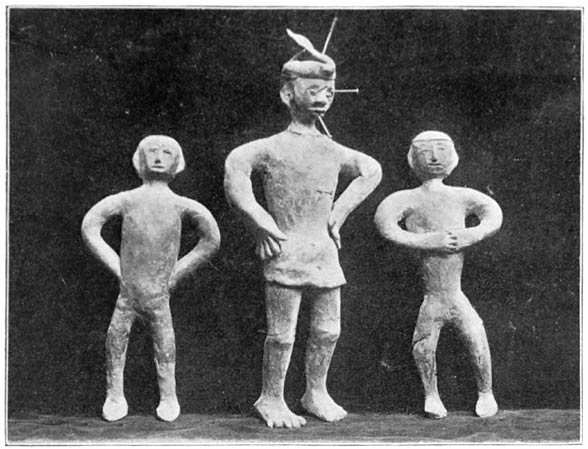
Plate 28.—Fig. 1. Wax Figures.
Specimens of the wax figures used for sticking pins into, vide the central figure.
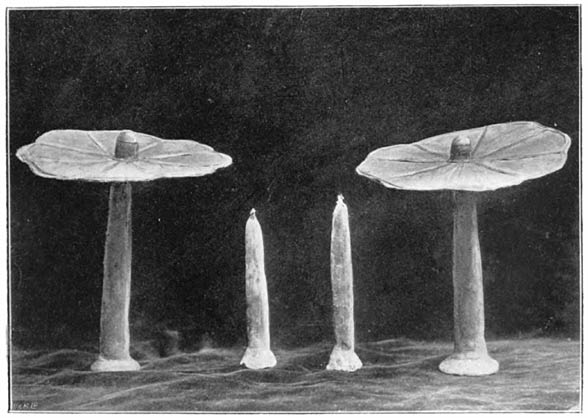
Fig. 2. Spirit Umbrellas and Tapers.
Two umbrellas (made of cloth coated with wax) and two nail-shaped tapers, used in the ceremony for charming the wax figures.
Page 570.
Another method is as follows:—
Take parings of nails, hair, eyebrows, saliva, etc. of your intended victim (sufficient to represent every part of his person), and make them up into his likeness with wax from a deserted bees’ comb. Scorch the figure slowly by holding it over a lamp every night for seven nights, and say:—
“It is not wax that I am scorching,
It is the liver, heart, and spleen of So-and-so that I scorch.”
After the seventh time burn the figure, and your victim will die.
“Peace be to you! Ho, Prophet ’Tap, in whose charge the earth is,
Lo, I am burying the corpse of Somebody,
I am bidden (to do so) by the Prophet Muhammad,
Because he (the corpse) was a rebel to God.
Do you assist in killing him or making him sick:
If you do not make him sick, if you do not kill him,
You shall be a rebel against God,
A rebel against Muhammad.
It is not I who am burying him,
It is Gabriel who is burying him.
Do you too grant my prayer and petition, this very day that has appeared,
Grant it by the grace of my petition within the fold of the Creed La ilaha,” etc.
There are, of course, many slight variations of the actual ceremony. Sometimes the wizard, during the insertion of the pins into the image, exclaims:—
But the liver, heart, and spleen of So-and-so.”
And then, after “waving” the figure in the smoke of the incense, and depositing it in the centre of a sacrificial tray (anchak), he invites the spirits to banquet upon his victim’s body:—
But on the liver, heart, and spleen of So-and-so.”
When the ceremony is over the image is buried in the usual way in front of the victim’s door-step.
Another method is described as follows:—
“Make the wax figure in the usual way and with the usual ingredients. At sundown take parched rice, with white, black, green, and yellow (saffron) rice, a “chew” of betel-leaf, a wax taper and an egg—this latter as the representative of a fowl (ʿisharat ayam). Burn incense, and recite this charm:—
“Peace be with you, O Earth Genie,
Bull-shaped Earth-spirit, Earth-demon, Bull-shaped World-spirit.
Come hither, come down, I pray you, and accept the banquet I offer.
I have a something that I want you for,
I want to give you an order,
I want to get you to aid me
And assist me in causing the sickness (as the case may be), of Somebody.


or madness
or death
If you do not accept the banquet I offer
You shall be a rebel to God,” etc.
This is a charm for sowing dissension between husband and wife (pĕmbĕnchi):—
“’Ndit marangan ’ndit!
Angkau Fatimah kambing,
Si Muhammad harimau Allah;
Kalau Fatimah tĕntangkan Muhammad,
Sapĕrti kambing tĕntang harimau.
Muhammad sabĕnar-bĕnar hulubalang,
Harimau Allah di-atas dunia.
Dĕngan bĕrkat” d. s. b.
Which, so far as it is intelligible, appears to mean:—
. . . . . . . . . .
“Thou, Fatimah, art a goat;
Muhammad is God’s tiger.
If Fatimah is face to face with Muhammad,
She will be as a goat facing a tiger.
Muhammad in very truth is the Chief,
The Tiger of God upon earth.
By the grace of,” etc.
The following is a clear example of soul abduction without contact:—
The simplest way, perhaps, of abducting another person’s soul is to go out, when the sun clears (matahari mĕncharak, at sunrise?), or when the newly-risen moon looks red, and standing with the big toe of the right foot resting on the big toe of the left, to make a trumpet of your right hand and recite the appropriate charm through this improvised speaking-trumpet thrice. At the end of each recital you blow through the hollowed fist. The charm runs as follows:—
“‘OM.’ I loose my shaft, I loose it and the moon clouds over,
I loose it, and the sun is extinguished,
I loose it, and the stars burn dim.
But it is not the sun, moon, and stars that I shoot at,
It is the stalk of the heart of that child of the congregation, So-and-so.
Cluck! cluck! soul of So-and-so, come and walk with me,
Come and sit with me,
Come and sleep and share my pillow.
Cluck! cluck! soul,” etc.
“Ho! Irupi, Shadowy One,
Let the Queen come to me.
Do you, if Somebody is awake,
Stir her and shake her, and make her rise,
And take her breath and her soul and bring them here,
And deposit them in my left side.
But if she sleep,
Do you take hold of the great toe of her right foot
Until you can make her get up,
And use your utmost endeavours to bring them to me.
If you do not, you shall be a rebel to God,” etc.
Another method of abducting another person’s soul is as follows:—
The following ceremony is one in which the soul of another person is abducted without any direct contact between the soul-receptacle, which in this case is a head-cloth, and the soul-owner. The directions are as follows:—
“Go out on the fourteenth night of the lunar month (full moon) and two successive nights; seat yourself on a male ant-hill (busut jantan) facing the moon, burn incense, and repeat the charm:—
“I bring you a (betel-) leaf to chew,
Dab the lime on to it, Prince Ferocious,
For Somebody, Prince Distraction’s daughter, to chew.
Somebody at sunrise be distraught for love of me,
Somebody at sunset be distraught for love of me.
As you remember your parents, remember me,
As you remember your house and house-ladder, remember me.
. . . . . . . . . . . . . . . . . . . . .
When thunder rumbles, remember me,
When wind whistles, remember me,
When the heavens rain, remember me,
When cocks crow, remember me,
When the dial-bird tells its tales, remember me,
When you look up at the sun, remember me,
When you look up at the moon, remember me,
For in that self-same moon I am there.
Cluck! cluck! soul of Somebody come hither to me,
I do not mean to let you have my soul,
Let your soul come hither to mine.”
Here wave the end of your head-cloth (puncha detar) in the direction of the moon seven times every night for three successive nights. Then take the turban (detar) home and place it under your pillow (for the three nights). If you want to use it by day, burn incense, and say:—
At sundown, when the sun is hovering on the brink of the horizon (matahari ayun tĕrmayun), chew betel, and spit out (sĕmborkan) the chewed leaf thrice. Then stand opposite the door, looking if possible towards the west, burn incense, and repeat this charm:—
“Nur Mani is your name,
Si Pancha Awalis my name;
By the grace of my using the prayer called ‘Kundang Maya Chinta Bĕrahi’
Concentrate your thoughts on me,
Be enamoured of me,
Be distraught for love of me,
Distraught both by day and by night,
Distraught seven times in the day,
And distraught seven times in the night.
Come back to your home,
Come back to your palace.”
Although this looks at first sight not unlike a love-charm, the last two lines show that it is really intended to induce a wandering soul (sĕmangat riang) to return to its owner. In fact, the wizard who gave me this charm told me that it was taboo to let any one pass during the whole evening, when this charm was used, between the light and the patient.
It seems possible, however, that it might be used on occasion, and mutatis mutandis, as a love charm as well.
The following ceremony is professedly a species of divination (tilek or pĕnilek), but as it is clearly only another form of soul-abduction I give it here. The instructions are as follows:—
“First take some wax from a deserted bees’ comb and make a wax taper out of it as well as you can; stick it upon the rim of a white cup, and repeat this charm, when you will be able to see the person you wish to affect in the taper’s flame (buleh di-tengo’ orang-nya didalam puchok api). The charm runs as follows:—
“I know the origin from which you sprang,
From the glitter of the White Blood.
Come down then to your mother,
Stemming both ebb and flood tides,
Cluck! cluck! souls of Somebody,
Come all of you together unto me.
Whither would ye go?
Come down to this house and house-ladder of yours.
This solitary taper is your house and house-ladder,
Since already the liver, stomach, heart, spleen, and great maw
Of all of you have been given into my care,
So much the more have the body and life
Of all of you been given into my care.
Grant this by the grace of my use
Of the prayer called divination by (secret) cognizance (tilek maʿrifat) of Somebody.
“Next you take a fathom’s length of thread, with seven strands, and seven colours running through the strands (bĕnang tujoh urat, tujoh warna mĕlintang bĕnang), and a pen made of a splinter of the sugar-palm (puchok kabong), and draw a portrait of the person you wish to charm (mĕnulis gambar orang itu). When the portrait is finished you suspend it from the end of a pole by means of the parti-coloured thread, and make fast the lower end of the pole to the branch of a tree, fixing it at an angle, so that the portrait may hang free and be blown to and fro without ceasing by every breath of wind. This will cause her heart to love you.”
The root-idea seems to be an all-pervading Animism, involving a certain common vital principle (sĕmangat) in Man and Nature, which, for want of a more suitable word, has been here called the Soul. The application of this general theory of the universe to the requirements of the individual man constitutes the Magic Art, which, as conceived by the Malays, may be said to consist of the methods by which this Soul, whether in gods, men, animals, vegetables, minerals, or what not, may be influenced, captured, subdued, or in some way made subject to the will of the magician.
It would, however, probably be a mistake to push this analysis too far; for side by side with the theory of a universe animated by souls, which by the use of the appropriate words and forms can be cajoled or threatened, there are the ideas of Luck and Ill-luck, and the notion, strong in Muhammadans all over the world, of a preordained course of events. Sometimes, presumably in extreme cases, there is no escape from this destiny: if a man is fated to die at a certain time, die he must, whatever he may do. But to a great extent ill-luck can be avoided if one knows how; though we cannot stop it, we need not expose ourselves to its influence. Thus a particular hour may be unlucky for the doing of a certain act; but if we know that it is so, we need not incur the danger.
There are, therefore, for a Malay three alternatives, it would seem: viz. Charms, for occasions where moral pressure can be brought to bear; Divination, to assist in detecting dangers which in the ordinary course must come but can be avoided; and, finally, Islām (Resignation), when he has to meet the inevitable, whether it be regarded as the course of Fate or the eternal purpose of God.
8 3 4
1 5 9
6 7 2
17 23 4 10 11
24 5 6 12 18
1 7 13 19 25
8 14 20 21 2
15 16 22 3 9
30 38 46 5 13 21 22
39 47 6 14 15 23 31
48 7 8 16 24 32 40
1 9 17 25 33 41 49
10 18 26 34 42 43 2
19 27 35 36 44 3 11
28 29 37 45 4 12 20