Chapter V · Magic Rites connected with the Several Departments of Nature
Reading edition
(a) Air
1. WIND AND WEATHER CHARMS
Not the least important attribute of the Malay magician in former days was his power of controlling the weather—a power of which Malay magic incantations still preserve remarkable traces.
Thus when the wind fails and the sails of a boat are flapping (kalau layer k’lepek-k’lepek), a Selangor magician would not unfrequently summon the wind in the following terms:—
“Come hither, Sir, come hither, my Lord,
Let down your locks so long and flowing.”
And if the wind is contrary he would say:—
“Veer round, Wind, a needle or twain (of the compass),
However heavy the merchandise that I carry unassisted,
Let me repair to Klang for the (morning) meal,
And Langat for the (evening) bathe.
Come hither, Sir, come hither, my Lord,
And let down your locks so long and flowing.”
Again, if the wind grew violent he would say:—
“Eggs of the House-lizard, Eggs of the Grass-lizard,
Make a trio with Eggs of the Tortoise.
I plant this pole thus in the mid-stream
(That) Wind and Tempest may come to naught.
Let the White (ones) turn into Chalk,
“The bird ‘Anggau-anggau’ flies
To perch on the house of Malim Palita.
May you die as you lean, may you die from a push,
On the other hand the recital of the following charm will, it is believed, effectually stop the heaviest downpour:—
That Rain and Tempest may come to naught.”
2. BIRDS AND BIRD CHARMS
The chief features of the Bird-lore of the Peninsular Malays, which, as will appear in the course of this chapter, is strongly tinged with animism, have been thus described by Sir William Maxwell:—
“There is an allusion to this bird in a common pantun—a kind of erotic stanza very popular among the Malays:—
“Chandrawasi burong sakti,
Sangat berkurong didalam awan.
Gonda gulana didalam hati,
“Nocturnal birds are generally considered ill-omened all over the world, and popular superstition among the Malays fosters a prejudice against one species of owl. If it happens to alight and hoot near a house, the inhabitants say significantly that there will soon be ‘tearing of cloth’ (koyah kapan) for a shroud. This does not apply to the small owl called punggok, which, as soon as the moon rises, may often be heard to emit a soft plaintive note. The note of the punggok is admired by the Malays, who suppose it to be sighing for the moon, and find in it an apt simile for a desponding lover.
“The baberek or birik-birik, another nocturnal bird, is a harbinger of misfortune. This bird is said to fly in flocks at night; it has a peculiar note, and a passing flock makes a good deal of noise. If these birds are heard passing, the Pêrak peasant brings out a sĕngkalan (a wooden platter on which spices are ground), and beats it with a knife, or other domestic utensil, calling out as he does so: “Nenek, bawa hati-nia” (“Great-grandfather, bring us their hearts”). This is an allusion to the belief that the bird baberek flies in the train of the Spectre Huntsman (hantu pemburu), who roams Malay forests with several ghostly dogs, and whose appearance is the forerunner of disease or death. “Bring us their hearts” is a mode of asking for some of his game, and it is hoped that the request will delude the hantu pemburu into the belief that the applicants are raʿiyat, or followers of his, and that he will, therefore, spare the household.
“The legend of the Spectre Huntsman is thus told by the Pêrak Malays:—
“In former days, at Katapang, in Sumatra, there lived a man whose wife, during her pregnancy, was seized with a violent longing for the meat of the pelandok (mouse-deer). But it was no ordinary pelandok that she wanted. She insisted that it should be a doe, big with male offspring, and she bade her husband go and seek in the jungle for what she wanted. The man took his weapons and dogs and started, but his quest was fruitless, for he had misunderstood his wife’s injunctions, and what he sought was a buck pelandok, big with male offspring, an unheard-of prodigy.
“Day and night he hunted, slaying innumerable mouse-deer, which he threw away on finding that they did not fulfil the conditions required.
“His wife, whom he left behind when he started on the fatal chase, was delivered in due time of two children—a boy and a girl. When they were old enough to play with other children, it chanced one day that the boy quarrelled with the child of a neighbour with whom he was playing. The latter reproached him with his father’s fate, of which the child had hitherto been ignorant, saying: ‘Thou art like thy father, who has become an evil spirit, ranging the forests day and night, and eating and drinking no man knows how. Get thee to thy father.’
“Then the boy ran crying to his mother and related what had been said to him. ‘Do not cry,’ said she, ‘it is true, alas! that thy father has become a spirit of evil.’ On this the boy cried all the more, and begged to be allowed to join his father. His mother yielded at last to his entreaties, and told him the name of his father and the names of the dogs. He might be known, she said, by his habit of gazing fixedly at the sky and by his four weapons—a blow-pipe (sumpitan), a spear, a kris, and a sword (klewang). ‘And,’ added she, ‘when thou hearest the hunt approaching, call upon him and the dogs by name, and repeat thy own name and mine, so that he may know thee.’
“The boy entered the forest, and, after he had walked some way, met an old man who asked him where he was going. ‘I go to join my father,’ said the lad. ‘If thou findest him,’ said the old man, ‘ask him where he has put my chisel which he has borrowed from me.’ This the boy promised to do, and continued his journey. After he had gone a long way he heard sounds like those made by people engaged in hunting. As they approached, he repeated the names which his mother had told him, and immediately found himself face to face with his father. The hunter demanded of him who he was, and the child repeated all that his mother had told him, not forgetting the message of the old man about the chisel. Then the hunter said: ‘Truly thou art my son. As for the chisel, it is true that when I started from home I was in the middle of shaping some bamboos to make steps for the house. I put the chisel inside one of the bamboos. Take it and return it to the owner. Return now and take care of thy mother and sister. As for him who reproached thee, hereafter we will repay him. I will eat his heart and drink his blood, so shall he be rewarded.’
“From that time forward the Spectre Huntsman has afflicted mankind, and many are those whom he has destroyed. Before dismissing his son, he desired him to warn all his kindred never to use bamboo for making steps for a house, and never to hang clothes to dry from poles stuck in between the joists supporting the floor, and thus jutting out at right angles with a house, ‘lest,’ said he, ‘I should strike against such poles as I walk along. Further,’ he continued, ‘when ye hear the note of the bird birik-birik at night, ye will know that I am walking near.’
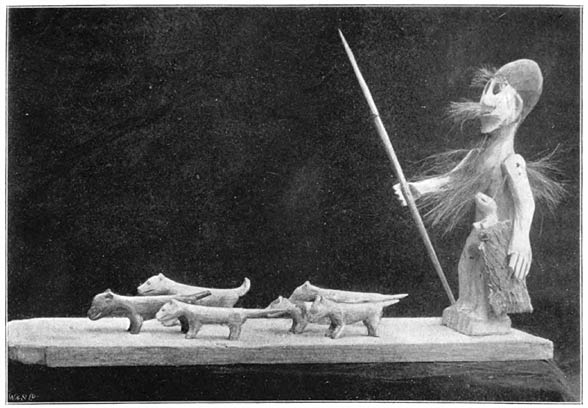
Plate 3.—The Spectre Huntsman.
The Spectre Huntsman (Wild Huntsman) of Malay legend—taken from a model made by a Selangor Malay. The model shows the Spectre Huntsman himself carrying his spear in the right hand, and one of his hounds, which is lame, in a wallet at his side. The remainder of his dogs (all differently coloured) precede him in his search for his quarry.
Page 116.
“The following may serve as a specimen:—
“Bi-smi-lláhi-r-rahmáni-r-rahim.
Es-salamu ʿaleykum Hei Si Jidi laki Mah Jadah.
Pergi buru ka-rimba Ranchah Mahang.
Katapang nama bukit-nia,
Si Langsat nama anjing-nia,
Si Kumbang nama anjing-nia,
Si Nibong nama anjing-nia,
Si Pintas nama anjing-nia,
Si Aru-Aru nama anjing-nia,
Timiang Balu nama sumpitan-nia,
Lankapuri nama lembing-nia,
Singha-buana nama mata-nia,
Pisau raut panjang ulu
Akan pemblah pinang berbulu.
Ini-lah pisau raut deripada Maharaja Guru,
Akan pemblah prut hantu pemburu.
Aku tahu asal angkau mula menjadi orang Katapang.
Pulang-lah angkau ka rimba Ranchah Mahang.
Jangan angkau meniakat-meniakit pada tuboh badan-ku.
In the name of God, the Compassionate, the Merciful,
Peace be on thee, O Si Jidi, husband of Mah Jadah.
Go thou and hunt in the forest of Ranchah Mahang.
Katapang is the name of thy hill,
Si Langsat is the name of thy dog,
Si Kumbang is the name of thy dog,
Si Nibong is the name of thy dog,
Si Pintas is the name of thy dog,
Si Aru-Aru is the name of thy dog,
Timiang Balu is the name of thy blow-pipe
Lankapuri is the name of thy spear,
Singha-buana is the name of its blade,
The peeling-knife with a long handle
Is to split in twain the fibrous betel-nut.
Here is a knife from Maharaja Guru,
To cleave the bowels of the Hunter-Spirit.
I know the origin from which thou springest,
O man of Katapang.
Get thee back to the forest of Ranchah Mahang.
Afflict not my body with pain or disease.
To the information contained in the foregoing passage I would add the following observations:—
Charms for neutralising the power of the Spectre Huntsman are by no means uncommon, and though they almost invariably differ in unimportant details, such as the names of his dogs and weapons, they still bear strong and unmistakable family likeness. Still there are some versions which contain important divergencies (two or three of these versions will be found in the Appendix), and it will only be after the diligent collation and compilation of a great many versions that the real germ or nucleus of the myth as known to the Malays will be clearly apparent.
One of the charms given in the Appendix evidently alludes to a different version of the story; the lines which contain the allusion being as follows:—
“I know your origin, O man of penance,
Whose dwelling was upon the hill of Mount Ophir,
[You sprang] from a son of the Prophet Joseph who was wroth with his mother,
Because she would eat the hearts of the birds of Paradise.”
“With a blind crow as his guide,
The giant demon, Si Adunada,
Carries (his weapons) slung over his shoulder with back bent double.
Salampuri is the name of his poniard (sĕkin),
Silambuara the name of his k’ris,
The insignia of the Demon Rama.”
That it is his weapons which the Spectre Huntsman’s son (Adunada) carries on his back appears from a passage below, which runs:—
“O Si Adunada, with the sword slung at your back,
Bent double you come from the lightwood swamps,
We did not guess that you were here.”
To return from the foregoing digression: there are many other curious legends connected with Birds. Thus, in 1882, Captain Kelham wrote as follows:—
“From Mr. W. E. Maxwell, H.M. Assistant Resident, of Lârut, I hear that the Malays have a strange legend connected with one of the large Hornbills; but which species I was not able to find out. It is as follows:—
The Burong tinggal anak (lit. “Good-bye, children” bird) is a small bird whose note is to be heard at the season when the young rice is sprouting (musim padi pĕchah anak). As soon as her young are hatched out this bird dies in the nest, repeating the words “Tinggal anak” (“Good-bye, children”), and the maggots which breed in her corpse afford an unnatural nourishment to her unsuspecting offspring.
Burong diam ’kau Tuah, or “Hold your peace, Tuah,” is the name of a small bird which is said to repeat the words—
“Diam ’kau, Tuah,
K’ris aku ada,”
or,
“Hold thy peace, Tuah,
My k’ris (dagger) is with me.”
The story runs that once upon a time there was a man who had a slave called Tuah, who answered him back, and with whom he accordingly found fault, using the words given above. In the transport of his rage he was turned into a bird.
The bird called Kuau in Perak (kuau is the name given in Malacca and Selangor to the argus pheasant, which in Perak is called kuang) is about the size of the mynah (gambala kĕrbau), and is said to have been metamorphosed from a woman, the reason of whose transformation is not known. It is said to be unknown on the right bank of the Perak River.
The “‘Kap-kap’ bird” is the name of a night-bird of evil omen, whose note heard at night prognosticates death.
The ’Toh katampi is larger than the Jampuk, another species of owl, which is popularly supposed to enter the fowl-house and there live on the intestines of fowls, which it extracts during life by means of a certain charm (ʿelmu pĕlali, a charm similar to those used by the Malays for filing teeth, etc.) which it uses in order to perform the operation painlessly.
The “Luck-bird” (Burong untong) is a very small white bird about the size of a canary. It builds a very small white nest, which if found and placed in a rice-bin possesses the valuable property of securing a good harvest to its owner. As, however, the nest is built on branches in places difficult of access it is but rarely found, and Malays will give $10 for a genuine specimen, while sellers are known to ask as much as $25.
The Ruwak-ruwak is a kind of Heron whose nest if discovered would give the possessor the power of becoming invisible (alimun). But as neither nest nor eggs can usually be found it is held to be childless. Yet, however, if it is possible to approach sufficiently near, when the bird is heard calling in the swamps, it may be seen dipping a twig or else its bent leg into the water, and accompanying its action with its call, as if it were bathing a child on its knee; hence the Malay who hears its note says mockingly, “the Ruwak-ruwak is bathing its young one.”
The bird called Pĕdrudang is a diver which has the power of remaining under water for a very long time. It is only to be found where the fish called kĕlĕsah exist in large quantities. The eggs of the kĕlĕsah are of great size, and the Malays say, therefore, that it cohabits with the pĕdrudang. These eggs are considered a delicacy by the Malays, who make them into a sort of custard pudding (s’ri-kaya).
“The Weaver-bird, which makes the long hanging bottle-shaped nests occasionally seen hanging from the branches of a low tree, is said to use a golden needle in the work; and it is affirmed that if the nest is carefully picked to pieces, without breaking any part of it, the needle will be found; but if it is pulled ruthlessly apart, or if even a single piece of the grass of which it is made is broken in unravelling it, the golden needle will disappear. The makers of these curious and beautiful nests are said to always choose trees that are infested with red ants or wasps, or which grow in impassable swamps.”
The Weaver-bird (Ploceus Baya, Blyth) is called (in Selangor) Burong Tĕmpua or Chiak Raya. It is said to use only the long jungle grass called lalang for making its nest, which latter is called buah rabun, and is used by the Malays for polishing sheaths and scabbards. When an infant keeps crying, one of the parents takes the weaver-bird’s nest, reduces it to ashes, and fumigates the child by thrice moving it round in a circle over the smoke. Whilst doing so, the parent either stands up with the right toe resting upon the toe of the left foot, or else squats upon the left heel, bending the right knee, and saying, ‘As the weaver-bird’s young in its nest, so rest and weep not’ (Bagimana anak tĕmpua dalam sarang-nya, bagitu-lah ’kau diam jangan mĕnangis). To the above I may add that besides the ordinary bottle-shaped nest, the weaver-birds also occasionally make a hood-shaped, or rather a helmet-shaped nest, which is alleged by the Malays to be the male bird’s ‘swing’ (buayan). This ‘swing’ resembles the upper half of an ordinary bottle-shaped nest, with a perch across it, which latter is also woven of grass. On the walls of the swing, just over each end of the perch, is a small daub of clay. The Malays allege that the male bird swings in it while the hen bird is sitting, and that the young too ‘take the air’ in it as soon as they are able to fly so far. Into the two daubs of mud over the perch the male bird (say the Malays) sticks fire-flies to give itself light at night.
“The Burong dĕmam, or ‘Fever bird,’ is so called from its loud, tremulous note, and the Malays say that the female bird calls in its fever-stricken voice to its mate to go and find food, because it has fever so badly that it cannot go itself. This bird is probably one of the large green barbets. The note is often heard, and doubtless the bird has been collected, but it is one thing shooting a bird and another identifying it as the producer of a certain note.
“Another bird, the White-breasted Water-hen, a frequenter of the edges of reedy pools and the marshy banks of streams, is reputed to build a nest on the ground which has the property of rendering any one invisible who puts it on his head. The prevailing idea among the Malays is that the proper and legitimate use to put it to is to steal money and other species of property.”
The next few notes on Malay bird-lore were collected by the writer in Selangor:—
The bird called “Barau-barau” is said to have once been a bidan (midwife) whose employers (anak bidan) refused to pay her for her services, and kept constantly putting her off. Her patience, however, had its limits, and one day, after experiencing the usual evasion, she broke out into a torrent of intemperate language, in the midst of which she was changed into a bird, whose querulous note may be recognised as the voice of the aged woman as she cries out for the payment of her just wages.
About the big Kingfisher (Pĕkaka) an amusing parallel to the fable of the Fox and the Crow is related. It is said that this kingfisher once caught a fish, and flew to a low branch just overhanging the water to devour it. The fish, seeking for a means to save his life, decided to try the effect of a speech, and accordingly addressed his captor in the following verses, judiciously designed to appeal at once to her vanity and compassion:—
“O Kingfisher! Kingfisher!
What a glistening, glittering beak!
Yet while you, Big Sister, are filling your maw,
Little Brother will lose his life.”
At this critical juncture the Kingfisher opens her beak to laugh, and the fish slips back into his native element and escapes!
Fowling Ceremonies
Ideas of sympathetic magic run very strongly through all ceremonies connected with the taking of wild birds, such for instance as jungle-fowl or pigeon.
The commonest method of snaring jungle-fowl is to take a line (called rachik), with a great number of fine nooses attached to it, and set it so as to form a complete circle, enclosing an open space in the forest. You must bring a decoy-bird with you, and the instructions which I collected say that you should on arriving enter the circle, holding the bird like a fighting cock, and repeat these lines:—
“Ho, Si Lanang, Si Tĕmpawi,
Come and let us play at cock-fighting
On the border-line between the primary and secondary forest-growth.
Your cock, Grandsire, is spurred with steel.
Mine is but spurred with bamboo.”
Here deposit the bird upon the ground. The challenge of the decoy-bird will then attract the jungle-fowl from all directions, and as they try to enter the circle (in order to reach the decoy), they will entangle themselves in the nooses.
As often as you succeed, however, in catching one, you must be careful to cast the “mischief” out of it, using the same form of words as is used to drive the “mischief” out of the carcase of the deer.
The method of catching wild pigeon is much more elaborate, and brings the animistic ideas of the Malays into strong relief, the “souls” of the wild pigeon being repeatedly referred to.
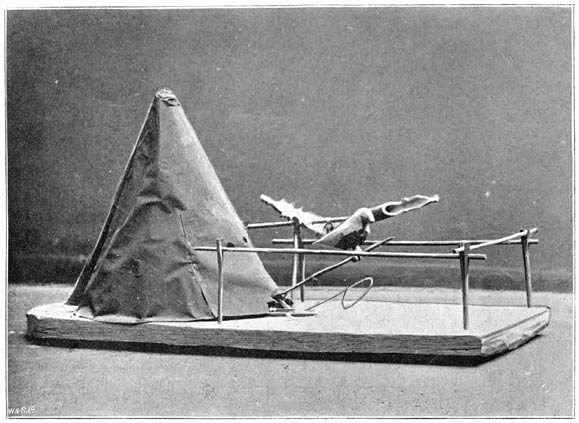
Plate 4.—Pigeon Decoy Hut.
Used in snaring wild pigeon.
Page 133.
The instructions proceed as follows:—
Before entering the hut the wizard must go through what is called the “Neutralising Rice-paste” (tĕpong tawar) ceremony, first in the centre of the enclosed space, and then in each corner successively, beating each of the forked sticks (uprights) at the corners with a bunch of leaves. He must then take the decoy-tube, and after reciting the appropriate charm, sound a long-drawn note in each corner successively, and then insert the mouth-end of it into the hut through a hole in the thatch, supporting the heavy outer end upon a forked upright stick. Then entering the hut, he slips the noose at the end of the decoy-bird’s rod on to the decoy-bird’s feet, and pushing the bird out through the front door of the hut, makes it flutter on to one of the horizontal rods, where it will sit, if well trained, and call its companions. After a time the decoy-bird’s challenge is met by first one and then many counter challenges, then the wild pigeon approach, there is a great fluttering of wings, and presently one of the first arrivals flies down and commences to walk round and round the hut. Then the wizard awaits his opportunity, and as the pigeon passes in front of the door he pushes out one of the rods with a noose at the end, slips the noose over the bird’s neck or feet, and drags it into the hut.
The hut must be used, if possible, before the leaves with which it is thatched have faded, as the wild pigeon are less likely to be suspicious of the hut when its thatch is green.
In the way just described any number of pigeon can be taken, a bag of twenty or thirty being a fair average for a day’s work under favourable conditions.
The “call” will occasionally, for some unexplained reason, attract to the spot wild animals such as deer (especially mouse-deer) and tigers. Is it not possible that the story of the lute of Orpheus may have had its origin in some old hunting custom of the kind?
The following are specimens of the charms used by the wizard:—
When you are about to start (to decoy pigeons) say—
“It is not I who am setting out,
Then sound the decoy-tube (buluh dĕkut) thrice loudly, and say—
“I pray that they (the pigeons) may come in procession, come in succession,
Now set out, and when you reach the conical hut (bumbun) say—
“My hut’s name is the Magic Prince,
My decoy’s name is Prince Distraction,
Distraught be ye, O Puding47 (pigeon),
Distraught be ye, O Sarap47 (pigeon),
Distraught (with desire) to enter our bundle.”
Or else when you first reach the hut, “take the (leaves of) the branch of a tree which is as high as your head, the leaves of the branch of a tree which is as high as your waist, the leaves of the branch of a tree which is as high as your knee, and the leaves of a tree which is only as high as your ankle-joint. Make them all into a bunch, and with them “flick” the outside of the hut, saying these lines—
“Dok Ding [stands for the] ‘Do’ding’ Pigeon,
Which makes three with the Madukara Pigeon,
The twig breaks, and the twig is pressed down,
And our immemorial customs are restored.”
When scattering the rice, say—
“Sift, sift the broken rice-ends,
Sift them over the rush-work rice-bag,
As one disappears another is invited,
Invited and brought down.
If you descend not, the Bear-cat (Binturong) shall devour you,
If you come not, wild beasts shall devour you,
And if you perch on a twig, you shall fall headlong,
If you perch on a bough, you shall be killed by a woodcutter,
If you perch on a leaf, you shall be bitten by the leaf-snake,
If you descend to the ground, you shall be bitten by a venomous serpent,
If you fly upwards, you shall be swooped upon by kites and eagles,
(That is) if you descend not.
Cluck, cluck! souls of Queen Kapor, of Princess Puding, and Handmaid Sarap.
Come down and assemble in King Solomon’s audience-hall,
And put on King Solomon’s breast-ornaments and armlets.”
When sprinkling the rice-paste (tĕpong tawar) on the uprights at each corner of the railed-off enclosure, say—
“Neutralising rice-paste, genuine rice-paste,
Add plumpness to plumpness,
Let pigeon come down to the weight of thousands of pounds,
And alight upon the Ivory Hall,
Which is carpeted with silver, and whose railings are of amalgam,
Unto the dishes of Her Highness Princess Lebar Nyiru (Broad-sieve).
Come in procession, come (in succession),
The ‘assembly-flower’ begins to unfold its petals,
Come down in procession, come down as stragglers,
King Solomon’s self has come to call you.
Sift, sift (the rice) over the rice-bag,
King Solomon’s self bids you haste.
Sift, sift the rice-ends,
Sift them over the rush-work bag.
As one disappears another is invited,
Is invited and escorted down.
Sift, sift the rice-ends,
Sift them over the salt-bag,
As one disappears another is invited,
And escorted inside (the hut).”
When you are sounding the call (mĕlaung), stand in the middle of the enclosure and say:—
“Cluck, cluck! soul of Princess Puding, of Queen Kapor, and Queen Sarap,
Enter ye into our Bundle,
And perch upon the Ivory Railing.
Come in procession, come in succession,
The assembly-flower unfolds its petals.
Come down in procession, come down in succession,
King Solomon’s self is come to call you.
If you do not come down, the Bear-cat shall eat you,
If you do not appear, wild beasts shall devour you,
If you perch upon a twig, you shall fall headlong
(All over) the seven valleys and seven knolls of rising ground.
If ye go to the hills, ye shall get no food;
If ye go to the forest-pools, ye shall get no drink.”
Or else the following:—
Cut it (through) and thrust it downwards.
Let those which are near be the first to arrive,
And those which are far off be sent for,
Let those which have eggs, leave their eggs,
And those which have young, desert their young,
Let those which are blind, come led by others,
And those which have broken limbs, come on crutches.
Come and assemble in King Solomon’s audience-hall.
Cluck, cluck! souls of Queen Kapor, Princess Puding, Handmaid Sarap,
Come down and assemble in King Solomon’s audience-hall,
When about to enter the hut say—
“[Hearken], O Hearts of Wild Doves,
Cut we the Rod of Invitation,
This hut is named the Magic Prince,
This tube is named Prince Distraction,
Distraught (be ye) by day, distraught by night,
Distraught (with longing) to assemble in King Solomon’s Hall,
When you have just entered, and before you seat yourself, say—
“Sift, sift the rice-ends,
Sift them over a rush-work rice-bag,” etc. (as before).
Put your lips to the decoy-tube, and sound the call, saying—
“Cut the mĕngkudu stem;
Cut it (through) and thrust it downwards,” etc. (as before).
(or else some longer version, such as one of those given in the Appendix). When the wild pigeon have arrived and have entered the enclosure or “Palace-yard,” wait till they are in a good position, and then push out one of the rods with the fine noose at the end, slip the noose over the bird’s neck, and drag it into the house, saying as you do so—
“Wak-wak [stands for] a heron on the kitchen shelf,
Covered over with the top of a cocoa-nut shell,
Do you move aside, Sir Bachelor, Master of the Ceremonies,
I wish to ensnare the necks of the race of wild doves.”
Now that you understand the process of decoying pigeon with a pigeon-call, I must explain something of the curious nomenclature used by the wizard; for during the ceremony you must never call a spade a spade. In the first place, the hut must not on any account be mentioned as such: it is to be called the Magic Prince—why so called, it is hard to say, but most likely the name is used in allusion to the wizard who is concealed inside it. The name given to the calling-tube itself is more appropriate, as it is called “Prince Distraction” (Raja Gila), this name of course being an allusion to the extraordinary fascination which it evidently exercises on the pigeon. Then the decoy (or rather, perhaps, the rod to which it is linked) is called Pŭtri Pĕmonggo’, or the Squatting Princess. Next to these come three Princesses which prove to be merely the representatives of three important species of wild pigeon. Their names, though variously given, are perhaps most commonly known as Princess “Kapor,” Princess “Sarap,” and Princess “Puding.”
Finally, even the rod used for ensnaring the pigeon has its own special name, Si Raja Nyila (Prince Invitation).
“King Solomon’s necklaces” and armlets are of course the nooses with which they are to be snared, and which will catch them either by the neck or by the leg.
The Princesses are invited to enter a gorgeous palace:—
“Come down, pigeons, in your myriads,
And perch upon the ‘Ivory Hall,’
(That is) carpeted with silver, and railed with amalgam,
The “dishes of Her Highness Princess Broad-sieve” cleverly suggest an abundance of provender such as is likely to appeal to a hungry bird!
In another version the three Princesses are invited to enter the “Palace Tower” called “Fatimah Passes” (Mahaligei Fatimah Lalu).
Moreover those who issue the invitation are no respecters of persons:—
“Let those which are near, arrive the first,
Let those which are far off be sent for,
Let those which have eggs, leave their eggs,
Those which have young, leave their young,
Those which are blind, be led by others,
Those which have broken limbs, come on crutches;
And a similar passage in another charm says—
“Let those which are near, arrive the first,
Let those which are far off be sent for,
Cluck! cluck! souls of the children of forest doves,
Come ye down and assemble together
In the fold of God and King Solomon.”
If blandishments fail, however, there is to be no doubt about the punishments in store for their wilful Highnesses: thus, a little later, we find the alternative, a thoroughgoing imprecation calculated to “convince” the most headstrong of birds:—
“I call you, I fetch you down,
If you come not down you shall be eaten by the Bear-cat,
You shall be choked to death with your own feathers,
You shall be choked to death with a bone in your throat.
If you perch on a creeper you shall be entangled by it,
If you settle on a leaf you shall be bitten by the ‘leaf snake,’
Come you down quickly to God’s fold and King Solomon’s.”
And an imprecation of similar import says—
“[If you do not come down, the Bear-cat shall eat you],
If you perch on a bough, you shall slip off it,
If you perch on a creeper, you shall slide off it,
If you perch upon a leafless stump, the stump shall fall;
If you settle on the ground, the ground-snake shall bite you,
If you soar up to heaven, the eagle shall swoop upon you.”
(b) Earth
1. BUILDING CEREMONIES AND CHARMS
The first operation in building is the selection of the site. This is determined by an elaborate code of rules which make the choice depend—firstly, upon the nature of the soil with respect to colour, taste, and smell; secondly, upon the formation of its surface; and, thirdly, upon its aspect:—
When you have found a site complying with more or less favourable conditions, in accordance with the code, you must next clear the ground of forest or undergrowth, lay down four sticks to form a rectangle in the centre thereof, and call upon the name of the lords of that spot (i.e. the presiding local deities or spirits). Now dig up the soil (enclosed by the four sticks), and taking a clod in your hand, call upon the lords of that spot as follows:—
Who dwell in the Four Corners of the World,
I crave this plot as a boon.”
(Here mention the purpose to which you wish to put it.)
“If it is good, show me a good omen,
Wrap the clod up in white cloth, and after fumigating it with incense, place it at night beneath your pillow, and when you retire to rest repeat the last two lines of the above charm as before and go to sleep. If your dream is good proceed with, if bad desist from, your operations. Supposing your dream to be “good,” you must (approximately) clear the site of the main building and peg out the four corners with dead sticks; then take a dead branch and heap it up lightly with earth (in the centre of the site?); set fire to it, and when the whole heap has been reduced to ashes, sweep it all up together and cover it over while you repeat the charm (which differs but little from that given above). Next morning uncover it early in the morning and God will show you the good and the bad.
[The best time of day for the operation to take place is said to be always seven o’clock in the morning. Hence there seems to be no need to consult a schedule to discover it, though some magicians may do so.]
[The account in the Appendix, of which the above is a résumé, omits to describe the sacrifice which has to be made before the erection of the centre-post, which has therefore been drawn from the instructions of other magicians.]
Another form of the above ceremony was described to me by a magician as follows:—
A magician gave me this specimen of a charm used at this ceremony (of erecting the centre-post):—
“Ho, Raja Guru, Maharaja Guru,
You are the sons of Batara Guru.
I know the origin from which you spring,
From the Flashing of Lightning’s spurs;
I know the origin from which you spring,
From the Brightening of Daybreak.
Ho, Spectre of the Earth, Brains of the Earth, Demon of the Earth,
Retire ye hence to the depths of the Ocean,
To the peace of the primeval forest.
Betwixt you and me
Division was made by Adam.”
Another rule of importance in house-building is that which regulates the length of the threshold, as to which the instructions are as follows:—
The names of the “eight beasts,” coupled with the events which they are supposed to foreshadow, are often commemorated in rhyming stanzas.
Here is a specimen:—
I.—The Dragon (naga).
“A dragon of bulk, a monster dragon,
Wherever you go you will be safe from stumbling-blocks,
And all who meet you will be your friends.”
II.—The Dairy-Cow (sapi).
“There is the smoke of a fire in the forest,
Where Inche ʿAli is burning lime;
They were milking the young dairy-cow,
And in the midst of the milking it sprawled and fell down dead.”
III.—The Lion (singa).
“A lion of courage, a lion of valour,
Is the lion gambolling at the end of the Point.
The luck of this house will be lasting,
Bringing you prosperity from year to year.”
IV.—The Dog (anjing).
“The wild dog, the jackal,
Barks at the deer from night to night;
Whatever you do will be a stumbling-block;
In this house men will stab one another.”
V.—The Draught-Cow (lĕmbu).
“The big cow from the middle of the clearing
Has gone to the Deep Forest to calve there.
Great good luck will be your portion.
Never will you cease to be prosperous.”
VI.—The Ass (kaldei).
“The ass within the Fort
Carries grass from morn to eve;
Whatever you pray for will not be granted,
Though big your capital, the half will be lost.”
VII.—The Elephant (gajah).
“The big riding elephant of the Sultan
Has its tusks covered with amalgam.
Good luck is your portion,
No harm or blemish will you suffer.”
VIII.—The Crow (gagak).
“A black crow soaring by night
Has perched on the house of the great Magic Prince;
Great indeed is the calamity which has happened:
Within the house its master lies dead.”
In close connection with the ceremonies for the selection of individual house sites are the forms by which the princes of Malay tradition selected sites for the towns which they founded. The following extract will perhaps convey some idea of their character:—
Even in the making of roads through the forest it would appear that sacrificial ceremonies are not invariably neglected. On one occasion I came upon a party of Malays in the Labu jungle who were engaged in making a bridle-track for the Selangor Government. A small bamboo censer, on which incense had been burning, had been erected in the middle of the trace; and I was informed that the necessary rites (for exorcising the demons from the trace) had just been successfully concluded.
2. BEASTS AND BEAST CHARMS
All wild animals, more especially the larger and more dangerous species, are credited in Malay folklore with human or (occasionally) superhuman powers.
In the pages which now follow I shall deal with the folklore which refers to the more important animals, first pointing out their anthropomorphic traits, then detailing some of the more important traditions about them, and finally, where possible, describing the methods of hunting them.
The Elephant
Of the Elephant we read:—
To the above evidence (which was collected by Sir W. E. Maxwell no doubt mainly in Perak) I would add that at Labu, in Selangor, I heard on more than one occasion a story in which the elephant-folk were described as possessing, on the borders of Siam, a city of their own, where they live in houses like human beings, and wear their natural human shape. This story, which was first told me by Ungku Said Kĕchil of Jĕlĕbu, was taken down by me at the time, and ran as follows:—
“A Malay named Laboh went out one day to his rice-field and found that elephants had been destroying his rice.
“He therefore planted caltrops of a cubit and a half in length in the tracks of the offenders. That night an elephant was wounded in the foot by one of the caltrops, and went off bellowing with pain.
“Day broke and Laboh set off on the track of the wounded elephant, but lost his way, and after three days and nights journeying, found himself on the borders of a new and strange country. Presently he encountered an old man, to whom he remarked ‘Hullo, grandfather, your country is extraordinarily quiet!’ The old man replied, ‘Yes, for all noise is forbidden, because the king’s daughter is ill.’ ‘What is the matter with her?’ asked Si Laboh. The old man replied that she had trodden upon a caltrop. Si Laboh then asked, ‘May I see if I can do anything to help her?’
“The old man then went and reported the matter to the king, who ordered Si Laboh to be brought into his presence.
“[Now the country which Si Laboh had reached was a fine open country on the borders of Siam. It is called ‘Pak Hĕnang,’ and its only inhabitants are the elephant-people who live there in human guise. And whoever trespasses over the boundaries of that country turns into an elephant.]
“Then Si Laboh saw that the king’s daughter, whose name was Princess Rimbut, was suffering from one of the caltrops which he himself had planted. He therefore extracted it from her foot, so that she recovered, and the king, in order to reward Si Laboh, gave him the Princess in marriage.
“On this they started, and at the end of the first day’s journey they halted and sat down to eat. But Si Laboh had forgotten the injunctions of his wife, and put young tree-shoots into the dish with his rice. Then his wife protested and said, ‘Did I not tell you not to put young tree-shoots into your food?’ But Si Laboh was obstinate, and merely replied, ‘What do I care?’ so that his wife was turned back into an elephant and ran off into the jungle. Then Si Laboh wept and followed her, but she refused to return as she had now become an elephant. Yet he followed her for a whole day, but she would not return to him, and he then returned homewards with his children.
“This is all that is known about the origin of elephants who are human beings.”
A Malay charm which was given me (at Labu) to serve as a protection against elephants (pĕndinding gajah) gives the actual name of the Elephant King—
“O Grandfather Moyang Kaban,
Destroy not your own grandchildren.”
A ghost elephant is very often thought to be the guardian spirit of some particular shrine—an idea that is common throughout the Peninsula.
Other general ideas about the elephant are as follows:—
The foregoing passage refers to Perak, but similar ideas are common in Selangor, and they occur no doubt, with local variations, in every one of the Malay States. Selangor Malays tell of the scaring of elephants by the process of drawing the slender stem of the bamboo down to the ground and cutting off the top of it, when it springs back to its place.
The following directions for hunting the elephant were given me by Lĕbai Jamal, a famous elephant hunter of Lingging, near the Sungei Ujong border:—
“When you first meet with the spoor of elephant or rhinoceros, observe whether the foot-hole contains any dead wood, (then) take the twig of dead wood, together with a ball of earth as big as a maize-cob taken from the same foot-hole (if there is only one of you, one ball will do, if there are three of you, three balls will be wanted, if seven, seven balls, but not more). Then roll up your ball of earth and the twig together in a tree-leaf, breathe upon it, and recite the charm (for blinding the elephant’s eyes), the purport of which is that if the quarry sees, its eyesight shall be destroyed, and if it looks, its eyesight shall be dimmed, by the help of God, the prophet, and the medicine-man, who taught the charm.
“When the animal is dead, beat it with an end of black cloth, repeating the charm for driving away the ‘mischief’ (badi) from the carcase, which charm runs as follows:—
“Badiyu, Mother of Mischief, Badi Panji, Blind Mother,
Three drops of Adam’s blood were the origin from which you sprang,
Mischief of Earth, return to Earth,
Mischief of Ant-heap, return to Ant-heap,
Mischief of Wood, return to Wood,
Mischief of Water, return to Water,
Mischief of Stone, return to Stone
And injure not my person.
By the virtue of my Teacher,
You may not injure the children of the race of Man.”
The perquisites of the Pawang (magician) are to be “a little black cloth and a little white cloth,” and the only special taboo mentioned by Lĕbai Jamal was “on no account to let the naked skin rub against the skin of the slain animal.”
Before leaving the subject of elephants, I may add that Raja Jaʿfar (of Beranang in Selangor) told me that Lĕbai Jamal, when charged by an elephant or rhinoceros, would draw upon the ground with his finger a line which the infuriated animal was never able to cross. This line, he said, was called the Baris Laksamana, or the “Admiral’s Line,” and the knowledge of how to draw it was naturally looked upon as a great acquisition.
The Tiger
But the anthropomorphic ideas of the Malays about the Tiger go yet farther than this. Far away in the jungle (as I have several times been told in Selangor) the tiger-folk (no less than the elephants) have a town of their own, where they live in houses, and act in every respect like human beings. In the town referred to their house-posts are made of the heart of the Tree-nettle (t’ras jĕlatang), and their roofs thatched with human hair—one informant added that men’s bones were their only rafters, and men’s skins their house walls—and there they live quietly enough until one of their periodical attacks of fierceness (mĕngganas) comes on and causes them to break bounds and range the forest for their chosen prey.
Various fables ascribe to the tiger a human origin. One of these, taken down by me word for word from a Selangor Malay, is intended to account for the tiger’s stripes. The gist of it ran as follows:—
Hence, too, he carries on his hide to this very day the mark of the stripes with which he was beaten at school.
The method of divination said to be practised by the tiger is as follows: The tiger lies down and gazes (bĕrtĕnung) at leaves which he takes between his paws, and whenever he sees the outline of a leaf take the shape of one of his intended victims, without the head, he knows it to be the sign that that victim has been “granted” to him, in accordance with the very terms of his master’s curse.
I once asked (at Labu) how it was known that the tiger used divination, and was told this story of a man who had seen it:—
“A certain Malay had been working, together with his newly-married wife, in the rice-fields at Labu, and on his stepping aside at noon into the cool of the forest, he saw a tiger lying down among the underwood apparently gazing at something between its paws. By creeping stealthily nearer he was able at length to discern the object at which the tiger was gazing, and it proved to be, to his intense horror, a leaf which presented the lineaments of his wife, lacking only the head. Hurrying back to the rice-field he at once warned the neighbours of what he had seen, and implored them to set his wife in their midst and escort her homeward. To this they consented, but yet, in spite of every precaution, the tiger broke through the midst of them and killed the woman before it could be driven off. The bereaved husband thereupon requested them to leave him alone with the body and depart, and when they had done so, he took the body in his arms, and so lay down embracing it, with a dagger in either hand. Before sunset the tiger returned to its kill, and leapt upon the corpse, whereupon the husband stabbed it to the heart, so that the points of the daggers met, and killed it on the spot.”
Of the strength of the Malay belief in were-tigers Mr. Clifford writes:—
Writing on the same theme, Sir Frank Swettenham says:—
“Another article of almost universal belief is that the people of a small State in Sumatra called Korinchi have the power of assuming at will the form of a tiger, and in that disguise they wreak vengeance on those they wish to injure. Not every Korinchi man can do this, but still the gift of this strange power of metamorphosis is pretty well confined to the people of the small Sumatran State. At night when respectable members of society should be in bed, the Korinchi man slips down from his hut, and, assuming the form of a tiger, goes about ‘seeking whom he may devour.’
“I have heard of four Korinchi men arriving in a district of Perak, and that night a number of fowls were taken by a tiger. The strangers left and went farther up country, and shortly after only three of them returned and stated that a tiger had just been killed, and they begged the local headman to bury it.
“On another occasion some Korinchi men appeared and sought hospitality in a Malay house, and there also the fowls disappeared in the night, and there were unmistakable traces of the visit of a tiger, but the next day one of the visitors fell sick, and shortly after vomited chicken-feathers.
There are many stories about ghost tigers (rimau kramat), which are generally supposed to have one foot a little smaller than the others (kaki tengkis). During my stay in the Langat district I was shown on more than one occasion the spoor of a ghost tiger. This happened once near Sepang village, on a wet and clayey bridle-track, where the unnatural smallness of one of the feet was very conspicuous. Such tigers are considered invulnerable, but harmless to man, and are looked upon generally as the guardian spirits of some sacred spot. One of these sacred spots was the shrine (kramat) of ’Toh Kamarong, about two miles north of Sepang village. This shrine, it was alleged, was guarded by a white ghost elephant and ghost tiger, who ranged the country round but never harmed anybody. One day, however, a Chinaman from the neighbouring pepper plantations offered at this shrine a piece of pork, which, however acceptable it might have been to a Chinese saint, so incensed the orthodox guardians of this Muhammadan shrine that one of them (the ghost tiger) fell upon the Chinaman and slew him before he could return to his house.
By far the most celebrated of these ghost tigers, however, were the guardians of the shrine at the foot of Jugra Hill, which were formerly the pets of the Princess of Malacca (Tuan Pŭtri Gunong Ledang). Local report says that this princess left her country when it was taken by the Portuguese, and established herself on Jugra Hill, a solitary hill on the southern portion of the Selangor coast, which is marked on old charts as the “False Parcelar” hill.
To the above story Mr. C. H. A. Turney (then Senior District Officer and stationed at Jugra) added the following:—
“The Princess and the stories about her and the tiger are well known, and the latter are related from mother to daughter in Langat.
“There are, however, they say, one or two omissions; instead of one tiger there were two, the real harimau kramat and an ambitious young tiger who would also follow the Princess in her round of visits. This brute came to an untimely and ignominious end (as he deserved to) at the hands of one Innes, who was disturbed whilst reading a newspaper, and this can be verified by Captain Syers.
I myself collected at the time the following extra details:—
Tigers are naturally too fierce to be tracked by the Malays, and are usually caught in specially constructed traps (pĕnjara rimau), or killed by a self-acting gun or spear-trap (b’lantek s’napang, b’lantek tĕrbang, b’lantek parap, etc.); but even in this case the Pawang explains to the tiger that it was not he but Muhammad who set the trap. There are, however, as might be expected, a great number of charms intended to protect the devotee in various ways from the tiger’s claws and teeth. Of these I will give one or two typical specimens.
Sometimes a charm is used to keep the tiger at a distance (pĕnjauh rimau):—
“Ho, Bĕrsĕnu! Ho, Bĕrkaih!
I know the origin from which you sprang;
(It was) Sheikh Abuniah Lahah Abu Kasap.
Your navel originated from the centre of your crown,
May you go wide (of me) as the Seven Tiers of Heaven,
May you go wide (of me) as the Seven Tiers of Earth;
If you do not go wide,
You shall be a rebel unto God,” etc.
Sometimes the desired effect is expected to be obtained by a charm for locking the tiger’s jaws:—
“Ho, Sir Cruncher! Ho, Sir Muncher!
Let the twig break under the weight of the wild goose.
Fast shut and locked be (your jaws), by virtue of ʿAli Mustapah,
OM. Thus I break (the tusks of) all beasts that are tusked,
The next specimen is described as a “charm for fascinating” (striking fear into) a “tiger and hardening one’s own heart”:—
“O Earth-Shaker, rumble and quake!
Let iron needles be my body-hairs,
Let copper needles be my body-hairs!
Let poisonous snakes be my beard,
A crocodile my tongue,
And a roaring tiger in the dimple of my chin.
Be my voice the trumpet of an elephant,
Yea, like unto the roar of the thunderbolt.
May your lips be fast closed and your teeth clenched;
And not till the Heavens and the Earth are moved
May your heart be moved
To be wroth with or to seek to destroy me.
By the virtue of ‘There is no god but God,’” etc.
To which may be added—
“Kun! Payah Kun!
Let (celestial) splendour reside in my person.
Whosoever talks of encountering me,
A cunning Lion shall be his opponent.
O all ye Things that have life
Endure not to confront my gaze!
It is I who shall confront the gaze of you,
By the virtue of ‘There is no god but God.’”
When tigers were wounded, it was said (in Selangor) that they would doctor themselves with ubat tasak, which is the name generally given to a sort of poultice used by those who have just undergone circumcision. And when a tiger was killed a sort of public reception was formerly always accorded to him on his return to the village.
Though I have not seen the actual reception (generally miscalled a “wake”), I once saw near Kajang in Selangor a tiger which had been prepared for the ceremony. The animal was propped up on all fours as if alive, and his mouth kept open by propping the roof with a stick. It was unfortunately impossible for me to wait for the ceremony, but from a description which I received afterwards, it was evidently regarded as a sort of “reception” given by the people of the village to a live and powerful war-chief or champion (hulubalang) who had come to pay them a visit, the dancing and fencing which takes place on such occasions being intended for his entertainment.
One of these ceremonies, which took place in Jugra in Selangor, was thus described:—
A Tiger’s Wake
I may add that both the claws and whiskers of tigers are greatly sought after as charms, and are almost invariably stolen from a tiger when one is killed by a European. I have also seen at Klang a charm written on tiger’s skin.
Hunting-Dogs
Hunting-dogs are spoken to continually as if they were human beings. Several examples of this occur in the deer charms.
Thus we find the following passage addressed to the dogs:—
“Let not go the scent,
Formidable were you from the first;
Hot-foot, hot-foot, do you pursue,
If you do not pursue hot-foot,
I will minimise my benediction (lit. my ‘Peace be with you’).
If it (the deer) be a buck, you shall have him for a brother;
If it be a doe, you shall have her for a wife.”
So too, again, after calling several dogs by name, the Pawang gets together the accessories (leaves of the tukas and lĕnjuang, a brush of leaves (sa-chĕrek) and a black cloth), and exclaims:—
“Bark, Sir Slender-foot; bark, Sir Brush-tail.”
The Pawang generally tries to deceive the deer as to his ownership of the hunting-dogs. Thus he will say:—
“It is not I whose dogs these are,
It is the magical deer Pawang whose dogs these are.”
Ugliness is by no means looked upon as a disadvantage, but rather the opposite. An ugly dog is apparently formidable. Thus we find a dog addressed as follows:—
“Let not go the scent (of the quarry)
Again, the description of the “good points” of some of these dogs which is given in the Appendix would, if ugliness and formidability are convertible terms, satisfy the most exacting whipper-in, the so-called good points being for the most part a mere list of deformities. These points, however, are merely the external sign of the Luck to which dogs, as well as human beings, are believed to be born. In a fine passage we are told:—
“From the seven Hills and the seven Valleys
Comes the intense barking of my Dogs.
My Dogs are Dogs of Luck,
Not Luck that is adventitious,
But Luck incarnate with their bodies.
Go tread upon the heaped and rotting leaves,
And never desert the scent.”
“If you bark your windpipe shall burst,
If you smack your lips your tongue shall be docked.
. . . . . . . . . . . . . . . . . . . . .
If you come nearer, you shall break your leg;
. . . . . . . . . . . . . . . . . . . . .
Return to the big virgin jungle,
Return to your caverns and hill-locked basins,
To the stream which has no head-waters,
To the pond which was never dug,
To the waters which bear no passengers,
To the fountain-head which is [never] dry.
If you do not return, you shall die,
Cursed by the First Pen (i.e. the Human Tongue),
Impaled by a palm thatch-needle,
Transfixed by a porcupine’s quill.”
Bears and Monkeys
Once upon a time her Highness the Princess Telan became the affianced bride of Si Malim Bongsu. After the betrothal Si Malim Bongsu sailed away and did not return when the period of the engagement, which was fixed at from three to four months, came to an end.
Then Si Malim Panjang, elder brother of Si Malim Bongsu, decided to take the place of his younger brother, and be married to the Princess Telan. The latter, however, repelled his advances, and he therefore attacked her savagely; but she turned herself into an ape (siamang) and escaped to the jungle, so that Si Malim Panjang desisted from pursuit. Then the ape climbed up into a pagar-anak tree which grew on the sea-shore, and leaned over the sea, and there she chanted these words:—
“O my dear Malim Bongsu,
You have broken your solemn promise and engagement,
And I have to take upon myself the form of an ape.”
Now Si Malim Bongsu was passing at the time, and on recognising the voice of the Princess Telan he took a blow-gun and shot her so that she fell into the sea. Then he took rose-water and sprinkled it over her, so that she resumed her natural shape, and they started to go home together. Still, however, Si Malim Bongsu would not wed her, but promised that he would do so when he came back from his next voyage, whereupon the Princess chanted these words:—
“If you do not return within three months
You will find me turned into an ape.”
The same course of events, however, happened as before. Malim Bongsu did not return at the time appointed; his elder brother, Malim Panjang once more attacked her, and, leaping towards an areca palm, she once more became an ape, whereupon she chanted as before:—
“O my dear Malim Bongsu,
You have broken your solemn promise and engagement,
And I am forced to become an ape.”
Again Malim Bongsu, as he passed by, heard and recognised her voice; but upon learning that he had been for the second time the cause of his Princess’s troubles, he exclaimed, “Better were it for me were I nothing but a big fish”; and leaping into the water he disappeared, and was changed into a big fish as he desired.
Now the Princess’s nurse (who was called “The Daughter of Sakembang China”) was at the same time transformed into a bear, and as they were bathing at the time when they were surprised, and had not time to wash off all the soap (rice-cosmetic), the white marks on the breast and brows of the bear and on the breast and brows of the ape (siamang) have remained unto this day.
Occasionally the opposite transformation is believed to take place, some species of the monkey tribe being supposed to turn into fish.
The Wild Pig and Other Animals
There are several superstitions about the Wild Boar which prove that it was not always regarded as an unclean animal.
Of these the following recipe, which was given me by a Jugra (Selangor) Malay, for turning brass into gold is the most remarkable:—
“Kill a wild pig and rip open its paunch. Sew up in this a quantity of old ‘scrap’ brass, pile timber over it, burn it, and then leave it alone until the grass has grown right over it. Then dig up the gold.” Again, certain wild boars are believed to carry on their tushes a talisman of extraordinary power, which is called rantei babi, or “Wild Boar’s Chain.” This chain consists, it is asserted, of three links of various metals (gold, silver, and amalgam), and is hung up on a shrub by the wild boar when he is enjoying his wallow, so that it is occasionally stolen by Malays who know his habits. I may add that, according to a Malay at Langat, the “were-tiger” (rimau jadi-jadian) occasionally appears in the shape of a wild boar escaping from a grave, in the centre of which may be afterwards seen the hole by which the animal has escaped.
So too on the Selangor coast a mollusc called siput tantarang or mĕntarang is believed to have sprung from a mouse; and many kinds of charms, generally addressed to the “Prophet Joseph” (Nabi Yusuf), are resorted to in order to drive away rats and mice from the rice-fields.
The following passage describes the general ideas about animal superstitions which prevail on the east coast of the Peninsula:—
3. VEGETATION CHARMS
The Vegetation Spirit of the Malays “follows in some vague and partial way,” to use Professor Tylor’s words, from the analogy of the Animal Spirit. It is difficult to say, without a more searching inquiry than I have yet had the opportunity of making, whether Malay magicians would maintain that all trees had souls (sĕmangat) or not. All that we can be certain of at present is that a good many trees are certainly supposed by them to have souls, such, for instance, as the Durian, the Cocoa-nut palm, and the trees which produce Eagle-wood (gharu), Gutta Percha, Camphor, and a good many others.
So, too, a boat with a large knot in the centre of the bottom is considered good for catching fish, and in strict conformity with this idea is the belief that the natural excrescences (or knobs) and deformities of trees are mere external evidences of an indwelling spirit. So, too, the fruit of the cocoa-nut palm, when the shell lacks the three “eyes” to which we are accustomed, is believed to serve in warfare as a most valuable protection (pĕlias) against the bullets of the enemy, and the same may be said in a minor degree of the joints of “solid” bamboo (buluh tumpat) which are occasionally found, whilst to a slightly different category belong the comparatively numerous examples of “Tabasheer” (mineral concretions in the wood of certain trees), which are so highly valued by the Malays for talismanic purposes. Such trees as the Mali mali, Rotan jĕr’nang (Dragon’s-blood rattan), Buluh kasap (rough bamboo), etc., are all said to supply instances of the concretions referred to, but the most famous of them all is without doubt the so-called “cocoa-nut pearl,” of which I quote the following account from Dr. Denys’s Descriptive Dictionary of British Malaya.
Cocoa-nut Pearls
The following remarks concerning these peculiar accretions are extracted from Nature:—
“During my recent travels,” Dr. Sidney Hickson writes to a scientific contemporary, “I was frequently asked by the Dutch planters and others if I had ever seen ‘a cocoa-nut stone.’ These stones are said to be rarely found (1 in 2000 or more) in the perisperm of the cocoa-nut, and when found are kept by the natives as a charm against disease and evil spirits. This story of the cocoa-nut stone was so constantly told me, and in every case without any variation in its details, that I made every effort before leaving to obtain some specimens, and eventually succeeded in obtaining two.
“One of these is nearly a perfect sphere, 14 mm. in diameter, and the other, rather smaller in size, is irregularly pear-shaped. In both specimens the surface is worn nearly smooth by friction. The spherical one I have had cut into two halves, but I can find no concentric or other markings on the polished cut surfaces.
“Dr. Kimmins has kindly submitted one-half to a careful chemical analysis, and finds that it consists of pure carbonate of lime without any trace of other salts or vegetable tissue.
On this letter Mr. Thiselton Dyer makes the following remarks:—“Dr. Hickson’s account of the calcareous concretions occasionally found in the central hollow (filled with fluid—the so-called ‘milk’) of the endosperm of the seed of the cocoa-nut is extremely interesting. It appears to me a phenomenon of the same order as tabasheer, to which I recently drew attention in Nature.
“The circumstances of the occurrence of these stones or ‘pearls’ are in many respects parallel to those which attend the formation of tabasheer. In both cases mineral matter in palpable masses is withdrawn from solution in considerable volumes of fluid contained in tolerably large cavities in living plants; and in both instances they are monocotyledons.
“In the case of the cocoa-nut pearls the material is calcium carbonate, and this is well known to concrete in a peculiar manner from solutions in which organic matter is also present.
The Durian
“Will you now bear fruit or not?
To this the tree (through the mouth of a man who had been stationed for the purpose in a Mangostin tree hard by) was supposed to make answer:—
“Yes, I will now bear fruit;
The Malacca Cane
No less distinct are the animistic ideas of the Malays relating to various species of the Malacca-cane plant. Mr. Wray of the Perak Museum writes as follows:—
In Selangor it is the stick-insect (kĕranting) which is believed to be the embodiment of the “Malacca-cane spirit” (Hantu Samambu), by which last name it is most commonly called. These stick-insects are believed by the Selangor Malays to produce the sounds to which Mr. Wray refers, and in order to account for their peculiar character a story is told, the main features of which are as follows:—
I have often from my boat, during dark nights on the Langat river, listened to the weird note which my Malays invariably ascribed to these insects, and which is not inaptly represented by one of the Malay names for them, viz. “bĕlum-bĕlam.” I have not yet, however, succeeded in identifying the real producer of the note, of which all I can say at present is, that although it may not be itself discoverable, the Malays look upon it as a certain guide to the localities where the Malacca-canes grow.
The Tualang or Sialang Tree
So too of the Tualang-tree Mr. Wray writes:—
There appears to be very little reason to doubt that the word Tualang (’Toh Alang or Sialang) is the name not of a particular species of tree, but rather the generic name of all trees in which wild bees have built their nests, so that in reality it simply means a “Bee-Tree.”
I have not yet succeeded in obtaining any of the Malay charms used by the collectors of these bees’ nests, except such as are used by Sakais under Malay influence on the Selangor coast, the Sakais being most usually the collectors. Some of these latter, however, were pure Malay charms, and may perhaps be considered, in the absence of charms collected from Malays, as evidence of at least secondary importance. One of these charms commences as follows:—
“Here is the Peeling-knife, the knife with the long handle,
And another, which is almost word for word the same, as follows:—
“Here is the Peeling-knife, the knife with the long handle,
Other haunted trees (pokok bĕrhantu) are the Jawi-jawi, the Jĕlotong, and Bĕrombong, of which the following tradition will perhaps suffice:—
The Lime-Tree
The Eagle-wood Tree
The following account of Eagle-wood and of the tree which produces it is quoted from the Journal of the Straits Asiatic Society:—
“This ‘Eagle-wood of commerce,’ under its more familiar name gharu, is one of the rarest and most valuable products of our Malayan jungles, and the following notes may be of interest. They are the result of inquiries amongst the Malays and Pawangs in Ulu Muar and Johol, and I am indebted to Mr. L. J. Cazalas for much assistance in obtaining the information contained in them.
“The gharu is found in pockets, and may sometimes be discovered by the veins which run to these pockets. In other trees the veins are absent, which renders the process of searching more difficult. The tree is generally cut down and left to rot, which exposes the gharu in about six months.
“Many tabak-trees do not contain gharu at all. To select the right trees is the special province of the Pawang or wise man. The tabak-trees are under the care of certain hantu or wood-spirits, and it would be hopeless for the uninitiated to attempt to find gharu; even the Pawang has to be very careful.
“The following is the process as far as I have been able to ascertain it:—
“On the outskirts of the forest the Pawang must burn incense, and repeat the following charm or formula:—
“He then proceeds to search for a likely tree, and upon finding one he again burns incense and repeats the spell as above. The tree having been cut down, the next thing is to separate the gharu from the sap-wood. The best way is to let the tree rot, but the Pawang is often “hard-up,” and does not mind wasting some of the gharu in his hurry to realise.
“The following are said to be the tests for finding gharu in a standing tree:—
1. The tree is full of knots. (Bĕrbungkol.)
2. The bark full of moss and fungus. (Bĕrtumuh bĕrchandawan.)
3. Heart-wood hollow. (Bĕrlobang.)
4. Bark peeling off. (Bĕrgugor kulit.)
5. A clear space underneath. (Mĕngelĕnggang.)
6. Stumps jutting out. (Bĕrchulak.)
7. Tree tapering. (Bĕrtirus.)
8. The falling of the leaves in old trees.
“There are great differences in the quality of gharu, and great care is taken in classifying them. It requires a skilled man to distinguish between some of the varieties.
“The names are as follow:—
2. Tandok.
4. Sikat.
6. Bulu Rusa.
7. Kemandangan.
8. Wangkang.
“The chandan (pada tiada champur) is oily, black, and glistening. It sinks in water.
“The tadak very closely resembles the chandan.
“Sikat (bertabun champur kubal dan tĕras), fibrous, with slight lustre, will just float in water. Black and white streaks.
“Sikat lampam—the same as sikat, only white streaks more prominent.
“Bulu Rusa will float in water, fibrous, generally of a yellow colour.
“Kemandangan floats in water, whitish, fibrous fragments small.
“Wangkang floats in water, fibrous blocks whitish in colour.
“The chandan tree differs from other gharu-trees in having a maximum diameter of about 1½ feet, and very soft sap-wood.
“O Grandsire Batara of the Earth, Earth-Genie, Earth-Spirit,
Idol of Iron, Son of Wani, Solitary Wani,
Son of Wayah, Bandan the Solitary,
I ask you to show me (an eagle-wood tree),
If you do not do so
You shall be a rebel against God,” etc.
The result of this invocation is, or should be, that the gharu-spirit appears to the wizard (generally, no doubt, in a dream), and informs him what kind of sacrifice he requires on this particular occasion. Whatever kind of sacrifice is asked for, must of course be given, with the exception of a human sacrifice which, as it is expressly stated, may be compounded by the sacrifice of a fowl.
When the tree has been felled you must be exceedingly careful to see that nobody passes between the end of the fallen trunk and the stump; whoever does so will surely be killed by the “eagle-wood spirit,” who is supposed to be extremely powerful and dangerous. I myself received a warning to this effect from some Labu Malays when I saw one of these trees felled. Malays maintain that men are frequently killed by this spirit (mati dĕ’ Hantu Gharu), but that they may be recalled to life if the following recipe is acted upon:—“Take two ‘cubits’ (?) of ‘Panchong leaves’ (daun panchong dua heta), flowers of the sunting mambang, and ‘bullock’s eye’ limes (limau mata kĕrbau), squeeze [the limes(?)] and rub them over the corpse, saying, ‘Sir Allah! Sir Mangga Tangan! God’s Essence is in your heart (lit. liver). God’s attributes are in your eyes. Go and entertain the male Borer-Bee that is in your heart and liver.’ The dead man will then revive and stand upon his feet.”
Camphor
“Amongst these superstitions the most important is the use of a special language, the subject of the present paper, which has been the means of preserving some remnants of the aboriginal dialects of this part of the Malay Peninsula. This language is called by the Orang Hulu “Pantang Kapur”; pantang means forbidden or tabooed, and in this case refers to the fact that in searching for the camphor the use of the ordinary Malay language is pantang, or forbidden. In addition to this there are restrictions as to food, etc.
“The Jakuns believe that there is a “bisan,” or spirit, which presides over the camphor-trees, and without propitiating this spirit it is impossible to obtain the camphor. This bisan makes at night a shrill noise, and when this sound is heard it is a sure sign that there are camphor-trees near at hand. (This bisan is really one of the Cicadas which are so numerous in the Malayan jungles.)
“When hunting for camphor the natives always throw a portion of their food out into the jungle before eating, as an offering to the bisan.
Gutta-percha
The trees from which Gutta-percha is taken are also supposed to be inhabited by a spirit; but this, the Gutta-spirit, being far less dangerous than the Eagle-wood spirit, fewer precautions are taken in dealing with it. In the invocation addressed to the Gutta-spirit, the petitioner asks for the boon of a drop of the spirit’s blood, which of course is an indirect way of asking for the tree’s sap.
Here is a specimen of the charms used by the gutta-collectors:—
“Ho, Prince S’ri Bali,
Prince S’ri Bandang,
I wish to crave the boon of a drop of blood;
May the yield be better than from this notch of mine.
(Here the speaker notches the tree.)
“If it be not better
The Cocoa-nut Palm
The following instructions to be followed by toddy-collectors (who tap the Cocoa-nut palm for its juice, which is boiled into sugar) were given me by a Kelantan Malay (’Che ʿAbas of Klanang):—
“When you are about to set foot against the base of the trunk (i.e. to start climbing) repeat these lines:—
“Peace be with you, O Abubakar!
Drowse not as you keep watch and ward in the heart of this tree (umbi).”
Here climb half-way up and say:—
“Peace be with you, Little Sister, Handmaiden Bidah,
Drowse not as you keep watch and ward in the middle of the trunk,
Come and accompany me on my way up this tree.”
Here climb up among the leaf-stalks, lay hold of the central shoot, give it three shakes, and say—
“Peace be with you, Little Sister, Youngest of the Princesses,
Drowse not as you keep watch and ward over the central shoot,
Do you accompany me on my way down this tree.”
Now commence by bending down one of the blossom-sheaths, lay hold of the central shoot, and thrice repeat the following lines:—
“Peace be with your Highnesses, Princesses of the Shorn Hair and (perpetual) Distillation,
Who are (seen) in the curve (lit. swell) and the ebbing away of the Blossom-sheath,
Of the Blossom-sheath Si Gĕdĕbeh Mayang,
Seven Princesses who are the Handmaidens of Si Mayang.”
(Here the speaker addresses the soul (or rather souls) of the tree.)
“Come hither, Little One, come hither,
Come hither, Tiny One, come hither,
Come hither, Bird, come hither,
Come hither, Filmy One, come hither.
Thus I bend your neck,
Thus I roll up your hair,
And here is an Ivory Toddy-knife to help the washing of your face.
Here is an Ivory Toddy-knife to cut you short,
And here is an Ivory Cup to hold under you,
And there is an Ivory Bath that waits below for you.
Clap your hands and splash in the Ivory Bath,
Rules for planting various Crops
The following rules have an evident bearing upon the subject of vegetable animism. They were collected at Langat, in Selangor:—
The time to plant Sugar-cane is at noon: this will make it sweeter, by drying up the juice and leaving the saccharine matter. If you plant it in the early morning its joints will be too long, if in the middle of the day they will be short.
Plant Maize with a full stomach, and let your dibble be thick, as this will swell the maize ear.
For Plantains (or Bananas) you must dig a big hole, and the evening is the time to plant them. The evening is the quicker, and if planted after the evening meal they fill out better.
Plant Sweet Potatoes on a starry night to ensure their filling out properly (by getting plenty of eyes?)
Plant Cucumbers and Gourds on a dark moonless night, to prevent them from being seen and devoured by fire-flies (api-api).
Plant Cocoa-nuts when the stomach is overburdened with food (kalau kita ’nak sangat berak); run quickly and throw the cocoa-nut into the hole prepared for it without straightening the arm; if you straighten it the fruit-stalk will break. Plant them in the evening, so that they may bear fruit while they are still near the ground. When you pick seed cocoa-nuts off the tree somebody should stand at the bottom of the tree and watch whether the “monkey-face” of each seed cocoa-nut, as it is thrown down, turns either towards himself or the base of the tree, or whether it looks away from both. In the former case the seed will be good, in the latter it is not worth planting.
Plant Rice in the early morning, about five, because that is the hour at which infants (the Rice Soul being considered as an infant) get up.
The Cultivation of Rice
“(1) A strong buffalo (to pull the plough).
(2) A plough with its appurtenances (to turn over the earth and the short weeds).
(3) A harrow with its appurtenances (to level and break up small the clods of earth left by the plough).
(4) A roller with its appurtenances (to knock down the long weeds, such as sedges, in fields that have lain fallow for a long while).
(5) A wood-cutter’s knife, to mend any of the implements that may get out of order at the time of ploughing.
(6) A hoe to repair the embankments and level the higher grounds.
(8) And a whip to urge the buffalo on if he is lazy.
“When the Maulud prayers are over, every man goes down to the rice-field, if possible on the same day or the next one, in order to begin ploughing the nursery plot, that is, the plot which is near his house or in which he has been in the habit of sowing the seed every year.
“But if a man has a great number of plots, he will begin by ploughing half of them, and then at the end of the month of Zilhijah he must diligently prepare the nursery plot so as to be ready in about ten days’ time.
Of Sowing
“4. Before sowing one must first of all lay out the grain, both the seed-grain and the ‘mother-seed,’ each separately, to dry. It must then be soaked in a vessel (a bucket or pot) for two days and two nights, after which it is taken out, strained and spread quite evenly on a mat with fresh leaves (areca-nut fronds are best), and every afternoon one must sprinkle water on it in order that the germ may quickly break through, which will happen probably in two days’ time or thereabouts.
“Three days after the seed is sown the young shoots begin to rise like needles, and at that time all the water should be drawn off the plot; after seven days they are likened to a sparrow’s tail, and about the tenth or fifteenth day they break out into blades. At that period the water is again let into the plot, little by little, in order that the stalks of the seedlings may grow thick.
“The seedlings have to remain in the nursery for at least forty or forty-four days from the time of sowing before they are sufficiently grown; it is best to let them remain till they are about seventy days old.
“6. While the seedlings are in the nursery the other plots are being ploughed, one after another; and this is called the first ploughing. Then the embankments are mended and re-formed with earth, so that the water in the field may not escape and leave it dry. After the embankments have been mended the harrowing begins: a start is made with the plot that was first ploughed (other than the nursery plot), for there the earth will have become soft, and the weeds being rotten after many days of soaking in the water will form a sort of manure. Each plot is so dealt with in its turn. Then all have to be ploughed once more (which is called the second ploughing) and harrowed again; for the first harrowing merely breaks up the clods of earth, and a second is required to reduce them to a fine state and to kill the weeds. Most people, having first used an iron harrow, use a wooden one for the second harrowing, in order that the earth may be broken up quite fine. Their rice is sure to thrive better than that of people who are less careful; for in rice-planting, as the saying goes, there is ‘the plighted hope of good that is to come,’ in the way of bodily sustenance I mean. So day by day the different plots are treated in the way that has been described in connection with the nursery plot in paragraph 5 above.
Of Planting
“Afterwards the seedlings are allowed to remain exposed to the air for about two nights, and then taken to the field to be planted. The bundles are broken up, and bunches of four or five plants together are planted at intervals of a span all over the different plots till all are filled up. If there are very many plots, ten or fifteen female labourers can be engaged to assist in planting, and likewise in pulling up the seedlings, at a wage of four cents for every hundred bundles.
Of the Rice after it has been Transplanted
“8. Ten days after the young rice has been transplanted it recovers its fresh green colour; in thirty days the young shoots come out; in the second month it increases more and more, and in the third it becomes even all over. After three months and a half its growth is stayed, and in the fourth month it is styled bunting kĕchil.
“At that stage the stalk has only five joints, and from that period it must be fumigated daily till the grain appears.
“About the time when the stalk has six joints it is called bunting bĕsar; in forty days more the grain is visible here and there, and twenty days later it spreads everywhere. At this time all the water in the field must be drawn off so that the grain may ripen quickly. After five or six days it ripens in patches, and a few days later the rice is altogether ripe.
“From the time of transplanting to the time when it is ripe is reckoned six months, not counting the days spent in ploughing and in growing it in the nursery, which may be a month or two, or even (if there are many plots) as much as three months to the end of the ploughing.
Of Reaping and taking the Soul of the Rice
“9. When one wishes to begin reaping the grain one must first have the Pawang’s permission, and burn benzoin supplied by him in the field.
“The following implements must be got ready, viz.:—
“(1) A small basket to hold the rice cut first, known as the ‘Soul of the Rice’ (sĕmangat padi).
(4) A small stem of bamboo, of the variety known as buloh kasap, with a flag attached, which is to be planted in the small basket as a sign of the ‘Soul of the Rice’ that has been cut first.
(5) A small white cloth to wrap up the ‘Soul of the Rice.’
(7) A brasier, in which to burn the incense provided by the Pawang.
“When the rice is ripe all over, one must first take the ‘Soul’ out of all the plots of one’s field. You choose the spot where the rice is best and where it is ‘female’ (that is to say, where the bunch of stalks is big) and where there are seven joints in the stalk. You begin with a bunch of this kind and clip seven stems to be the ‘soul of the rice’; and then you clip yet another handful to be the ‘mother-seed’ for the following year. The ‘Soul’ is wrapped in a white cloth tied with a cord of tĕrap bark, and made into the shape of a little child in swaddling clothes, and put into the small basket. The ‘mother-seed’ is put into another basket, and both are fumigated with benzoin, and then the two baskets are piled the one on the other and taken home, and put into the kĕpuk (the receptacle in which the rice is stored).
“10. One must wait three days (called the pantang tuai) before one may clip or cut any more of the rice. At first only one or two basketfuls of rice are cut; the rice is dried in the sun, winnowed in a winnowing basket, and cleaned in a fanning machine, pounded to free it from the husk, so that it becomes bĕras (husked rice), and then boiled so that it becomes nasi (cooked rice), and people are invited to feast on it.
“12. If the crop is a good one a gallon of seed will produce a hundredfold. Each plot in a field takes about a gallon of seed.
“13. When the rice has all been cut it is winnowed in order to get rid of the chaff, and then laid out in the sun till quite dry, so that it may not get mouldy if kept for a year.
“Then the wages of the labourers are taken out of it at the rate of two gallons out of every ten. When that is settled, if the rice is not to be sold, it is taken home and put into the rice-chest.
“Whenever you want to eat of it, you take out a basketful at a time and dry it in the sun. Then you turn it in the winnowing basket, and clean it in the fanning machine, pound it to convert it into bĕras, and put a sufficiency of it in a pot and wash it. Enough water is then poured over it to cover it, and it is put on the kitchen fire till it is boiled and becomes nasi, when it can be eaten.
I will now deal with the ceremonies indicated in the foregoing article from the ceremonial point of view exclusively.
The Sowing of the Rice-Seed
The ceremony to be observed at the sowing of the rice-seed was thus described to me by the Pawang who performed the reaping ceremony described below:—
“First arrange four poles upon the ground, so as to form a rectangular frame (galang dapor), in the middle of the clearing. Then plant in succession at the four corners—
“1. A young banana-tree.
2. A plant of lemon grass (sĕrai).
3. A stem of sugar-cane (of the kind called lanjong).
4. A plant of saffron (kunyit).
Perform the operation carefully, so that they are all likely to live.
“In the centre of the ground enclosed by the frame deposit a cocoa-nut shell full of water.
“Early next morning go out and observe the omens. If the frame has moved aside (bĕrkuak) ever so little, or if the water has been spilt, it is a bad omen. But if not, and if the water in the cocoa-nut shell has not been spilt, or if a black ant (sĕmut) or a white ant (anei-anei) is found in the water, it is a good sign.
“When good omens have been obtained, proceed by planting rice-seed in seven holes with a dibble of satambun wood, repeating the following charm:—
“In the name of God, etc.,
Peace be with you, Prophet ’Tap,
But within from six months to seven
I will come and receive it back,
Cluck, cluck, soul! cluck, cluck, soul! cluck, cluck, soul!”
The Planting out of the Young Rice
The following account (by Mr. C. O. Blagden) of the ceremony of planting out the young rice (from the rice-nursery) appeared in the Journal of the Straits Asiatic Society in 1896:—
“In agricultural operations the animistic ideas of the Malays are clearly apparent: thus, before the rice is cut a sort of ritual is performed which is known as puji padi, and which is regarded, apparently, as a kind of propitiatory service, a sort of apology to the padi (rice) for reaping it. The padi is usually sprinkled with tĕpong tawar (flour mixed with water) before the reaping is commenced, and the first lot cut is set apart for a ceremonial feast.
“Another occasional service of a peculiar character, which is not of very frequent occurrence, is the ceremony which would perhaps be best described as the propitiation of the earth-spirit. Some years ago I happened, by chance, to be present at a function of this kind, and as its details may be of some interest as illustrating the wide dispersion of certain points of ritual, I will end these notes by giving a full description of it as noted down at the time. It was in the month of October, and I happened to be out shooting snipe in the padi-fields of the village of Sĕbatu on a Sunday morning, when I was met by the Pĕnghulu, the headman of the village, who asked me to leave off shooting for an hour or so. As I was having fair sport, I naturally wanted to know the reason why, so he explained that the noise of gunshots would irritate the hantu, and render unavailing the propitiatory service which was then about to begin. Further inquiry elicited the statement that the hantu in question was the one who presided over rice-lands and agricultural operations, and as I was told that there would be no objection to my attending the ceremony, I went there and then to the spot to watch the proceedings. The place was a square patch of grass-lawn a few yards wide, which had evidently for years been left untouched by the plough, though surrounded by many acres of rice-fields. On this patch a small wooden altar had been built: it consisted simply of a small square platform of wood or bamboo raised about three or four feet above the ground, each corner being supported by a small sapling with the leaves and branches left on it and overshadowing the platform, the sides of which appeared to face accurately towards the four cardinal points. To the western side was attached a small bamboo ladder leading from the ground to the edge of the platform. At the four corners of the patch of grass were four larger saplings planted in the ground. On the branches of all these trees were hung a number of kĕtupats, which are small squarish bags plaited of strips of the leaves of the screw-pine (mĕngkuang) or some similar plant, like the material of which native bags and mats are made. A larger kĕtupat hung over the centre of the altar, and all of them were filled with a preparation of boiled rice. On the altar were piled up various cooked foods laid on plantain leaves, including the flesh of a goat cooked in the ordinary way, as well as rice and different kinds of condiments and sweetmeats. The Pawang was present as well as a number of the villagers, and soon after my arrival with the Pĕnghulu the ceremony began by some of the villagers producing out of a bag the skin of a black male goat with the head and horns attached and containing the entrails (the flesh having been cooked and laid on the altar previously). A large iron nail four or five inches long, and thick in proportion, was placed vertically in a hole about two feet deep which had been dug under the altar, and the remains of the goat were also buried in it, with the head turned towards the east, the hole being then closed and the turf replaced. Some of the goat’s blood, in two cocoa-nut shells (tĕmpurong), was placed on the ground near the south side and south-west corner of the altar close to the ladder.
“The Pawang, after assisting at these preliminaries, then took his stand at the west side of the altar, looking eastward: he covered his head, but not his face, with his sarong wrapped round it like a shawl, and proceeded to light a torch, the end of which was tipped with incense (kĕmĕnyan). With this he touched the bottom of the altar platform four times. He then took a cup of tĕpong tawar and dipped in it a small bundle of four kinds of leaves, with which he then sprinkled the north-west and south-east corners of the platform. He then coughed three times—whether this was part of the ritual, or a purely incidental occurrence, I am unable to say, as it was not practicable to stop the ceremony for the purpose of asking questions—and again applied the torch under the altar and sprinkled with tĕpong tawar all the corners of it, as well as the rungs of the ladder.
“At this stage of the proceedings four men stationed in the rice-field beyond the four corners of the patch of turf, each threw a kĕtupat diagonally across to one another, while the rest of the assembly, headed by the Pĕnghulu, chanted the kalimah, or Muhammadan creed, three times.
The Reaping Ceremony
On the 28th January 1897 I witnessed (at Chodoi, in the Kuala Langat district of Selangor) the ceremony of fetching home the Rice-soul.