Chapter VI · Magic Rites as affecting the Life of Man (continued 2)
Reading edition
I will now proceed to describe the ceremony of “casting out” these “mischiefs.”
The chief occasions on which this casting out takes place are, first, when somebody is ill, and his sickness is attributed to his accidental contact with (and consequent “possession by”) one of these mischiefs; and, secondly, when any wild animal or bird is killed. The ceremony of casting out the mischief from the carcases of big game will be found described under the heading of “Hunting Ceremonies.” I shall here confine myself to a brief description of the ceremony as conducted for the benefit of sick persons.
First make up a bunch of leaves (sa-chĕrek), consisting of the shrubs called pulut-pulut and sĕlaguri, with branches of the gandarusa and lĕnjuang merah (red dracæna), all of which are wrapped together in a leaf of the si-pulih, and tied round with a piece of tree-bark (kulit t’rap), or the akar gasing-gasing. With this leaf-brush you are to cast out the mischief. Then you grate on to a saucer small pieces of ebony wood, brazil wood, “laka” wood, sandalwood, and eagle-wood (lignaloes), mix them with water, putting in a few small pieces of scrap-iron, and rub the patient all over with the mixture.
As you do this, repeat the appropriate charm; then take the brush of leaves and stroke the patient all over downwards from head to foot, saying:—
“Peace be with you, Prophet Noah, to whom belong the trees,
And Prophet Elias who planted them.
I crave as a boon the leaves of these shrubs
To be a drug and a neutralising (power)
Within the body, frame, and person of So-and-So.
If you (addressing the leaves) refuse to enter (the body of So-and-So),
You shall be cursed with my ‘curse of the nine countries,’
By (the power of) the word ‘There is no god but God,’” etc.
This spear must afterwards be ransomed, (say) for forty cents; in default of which payment it is forfeited to the medicine-man.
The directions for another form of the ceremony just described (“casting out the mischief”), are as follows:—
“Peace be with you, O Lelang,
We have been brothers from the former time until now,
I am fain to order you to assist me in extracting everything that is poisonous
From the body and limbs of So-and-So.
Break not your solemn promise,
Break not your plighted faith,
And use not deceit or wiles,” etc.
Of course the luckless spirit is told that if he does not do exactly as he is bidden he must expect the curse to follow.
This charm must be repeated overnight, and early next morning three thicknesses of birah leaves must be laid down (for the patient to stand upon during the lustration). The seven sorts of limes are at the same time to be squeezed into a bowl and divided into three portions. These portions are to be used three times during the day, at sunrise, noon, and sundown respectively, partly for washing off the cosmetics (which are rubbed all over the body), and partly as a medicinal draught or potion.
In the morning the cosmetic must be white (bĕdak puteh lulut), at noon it must be red (bĕdak merah), and at sundown black (bĕdak hitam). The “trash” of the limes (after squeezing) is wrapped up in a birah leaf at evening, and either carried out to the sea (into which it is dropped), or deposited ashore at a safe distance from the house. The only special taboo mentioned for this ceremony is that the patient must not during its continuance meet anybody who has come from a distance.
Another very curious form of this ceremony of “casting out devils” was described to me by a Kelantan Malay. It is worked on the substitute or “scapegoat” principle (tukar ganti), and the idea is to make little dough images of all kinds of birds, beasts, fishes, and even inanimate objects (a few of the former being fowls, ducks, horses, apes, buffaloes, bullocks, wild cattle (sĕladang), deer, mouse-deer, and elephants, besides those enumerated in the charm itself, whilst exceptions are to be the “unlucky” animals (bĕnatang sial) such as cats, tigers, pigs, dogs, snakes, and iguanas). When made they are to be deposited together in a heap upon a sacrificial tray (anchak), together with betel-leaves, cigarettes, and tapers. One of the tapers is made to stand upon a silver dollar, with the end of a piece of particoloured thread inserted between the dollar and the foot of the taper; and the other end of this thread is given to the patient to hold whilst the necessary charm is being repeated.
Part of this charm is worth quoting, as it helps to explain the line of thought on which the medicine-man is working:—
“I have made a substitute for you,
And engage you for hire.
As for your wish to eat, I give you food,
As for your wish to drink, I give you drink.
Lo, I give you good measure whether of sharks,
Skates, lobsters, crabs, shell-fish (both of land and sea)—
Every kind of substitute I give you,
Good measure whether of flesh or of blood, both cooked and raw.
Accept, accept duly this banquet of mine.
It was good at the first: if it is not good now,
It is not I who give it.”
The explanation of this part of the ceremony is that the evil spirit, or “mischief,” is supposed to leave the body of the sick man, and to proceed (guided, of course, by the many-coloured thread which the patient holds in his hand) to enter into the choice collection of “scapegoats” lying in the tray. As soon as his devilship is got fairly into the tray, the medicine-man looses three slip-knots (lĕpas-lĕpas), and repeats a charm to induce the evil spirit to go, and throws away the untied knots outside the house.
The original “disease-boat” used in Selangor was a model of a special kind of Malay vessel called lanchang. This lanchang was a two-masted vessel with galleries (dandan) fore and aft, armed with cannon, and used by Malay Rajas on the Sumatran coast. This latter fact was, no doubt, one reason for its being selected as the type of boat most likely to prove acceptable to the spirits. To make it still further acceptable, however, the model was not unfrequently stained with turmeric or saffron, yellow being recognised as the royal colour among the Malays.
Occasionally, on the other hand, a mere raft (rakit) is set adrift, sometimes a small model of the balei (state-chamber), and sometimes only a set of the banana-leaf receptacles called limas.
“Peace be unto you, Devils of the sea, and Demons of the sea,
Neither on cape, nor bay, nor sandbank be ye stuck or stranded!
Do you assist in guarding this offering from his grandchildren,
And vex not this vessel.
I request you to escort it to the land of Celebes,
To its own place.
By the grace of,” etc.
This same charm is used mutatis mutandis for the Balei (Spirit-hall).
A common form of the “Lanchang” charm runs as follows:—
“Ho, elders of the upper reaches,
Elders of the lower reaches,
Elders of the dry land,
Elders of the river-flats,
Assemble ye, O people, Lords of hill and hill-foot,
Lords of cavern and hill-locked basin,
Lords of the deep primeval forest,
Lords of the river-bends,
Come on board this Lanchang, assembling in your multitudes,
So may ye depart with the ebbing stream,
Depart on the passing breeze,
Depart in the yawning earth,
Depart in the red-dyed earth.
Go ye to the ocean which has no wave,
And the plain where no green herb grows,
And never return hither.
But if ye return hither,
Ye shall be consumed by the curse.
At sea ye shall get no drink,
Ashore ye shall get no food,
But gape (in vain) about the world.
By the grace of,” etc.
Sometimes the crocodile-spirit is requested to act as the forwarding agent in the transaction; thus we find a short lanchang-charm running as follows:—
Receive this (lanchang) and forward it to the River-Bay,
It is So-and-So who presents it.
Sa-rĕkong is the name of the (spirit of the) Bay,
Sa-rĕking the name of the (spirit of the) Cape,
Si ʿAbas, their child, is the rocky islet;
I ask (you) to forward this present at once to the God of Mid-currents.”
A somewhat longer charm, which is given in the Appendix, commences by making an interesting point—
“Peace be with you! O crew newly come from your shipwrecked barque on the high seas,
Spurned by the billows, blown about by the gale;
Come on board (this lanchang) in turn and get you food.”
. . . . . . . . .
The speaker goes on to say that he recognises their right to levy toll all over the country, and has made this lanchang for them as a substitute (tukar ganti), implying, no doubt, in place of the one which they had lost. In any case, however, there can be little doubt that the “barque wrecked on the high seas” is the wasted body of the sick man, of which the spirits were so recently in possession, and in substitution for which they are offered the spirit-boat in question.
Tiger Spirit
I shall now proceed to describe the ceremony of invoking the Tiger Spirit for the purpose of obtaining his assistance in expelling a rival spirit of less power.
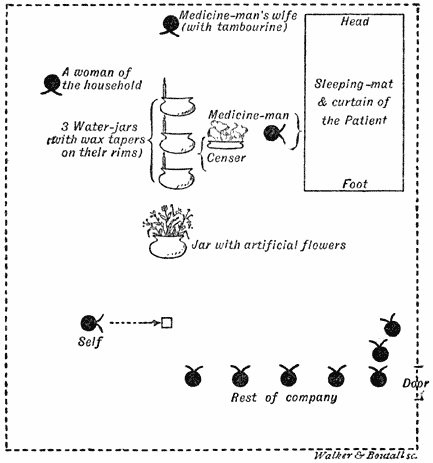
Fig. 2.—Ceremony of invoking the tiger spirit.
The accompanying diagram shows (approximately) the relative positions of all who were present. In one corner of the room was the patient’s bed (sleeping-mat) and mosquito curtain with a patchwork front, and in a line parallel to the bed stood the three jars of water, each decorated with the sort of fringe or collar of plaited cocoa-nut fronds called “centipedes’ feet” (jari ’lipan), and each, too, furnished with a fresh yam-leaf covering to its mouth. A little nearer to me than the three water-jars, but in the same line, stood a fairly big jar similarly decorated, but filled with a big bouquet of artificial “flowers” and ornaments instead of the water. These flowers were skilfully manufactured from plaited strips of palm-leaf, and in addition to mere “flowers” represented such objects as rings, cocoa-nuts, centipedes, doves, and the like, all of which were made of the plaited fronds referred to. This invention was intended (I was informed) to represent a pleasure-garden (taman bunga), and indeed was so called; it was (I believe) intended to attract the spirit whom it was the object of the ceremony to invoke. In front of the three jars stood, as a matter of course, a censer filled with burning embers, and a box containing the usual accessories for the chewing of betel. Everything being now ready, the medicine-man appeared and took his seat beside the censer, his wife, an aged woman, whose office was to chant the invocation, to her own accompaniment, taking her seat at the same time near the head of the patient’s sleeping-mat. Presently she struck up the invocation (lagu pĕmanggil), and we listened in rapt attention as the voice, at first weak and feeble with age, gathered strength and wailed ever higher and shriller up to the climax at the end of the chant. At the time it was hard to distinguish the words, but I learnt from her afterwards that this was what she sang:—
“Peace be unto you, Pĕnglima Lenggang Laut!
Of no ordinary beauty
Is the Vessel of Pĕnglima Lenggang Laut!
The Vessel that is called ‘The Yellow Spirit-boat,’
The Vessel that is overlaid with vermilion and ivory,
The Vessel that is gilded all over;
Whose Mast is named ‘Prince Mĕndela,’
Whose Shrouds are named ‘The Shrouds that are silvered,’
Whose Oars are named ‘The Feet of the Centipede‘
(And whose Oarsmen are twice seven in number).
Whose Side is named ‘Civet-cat Fencing,’
Whose Rudder is named ‘The Pendulous Bees’-nest,’
Whose Galleries are named ‘Struggling Pythons,’
Whose Pennon flaps against the deckhouse,
Whose Streamers sport in the wind,
And whose Standard waves so bravely.
Come hither, good sir; come hither, my master,
It is just the right moment to veer your vessel.
Master of the Anchor, heave up the anchor;
Master of the Foretop, spread the sails;
Master of the Helm, turn the helm;
Oarsmen, bend your oars;
Whither is our vessel yawing to?
The vessel whose starting-place is the Navel of the Seas,
And that yaws towards the Sea where the ‘Pauh Janggi’ grows,
Sporting among the surge and breakers,
Sporting among the surge and following the wave-ridges.
It were well to hasten, O Pĕnglima Lenggang Laut,
Be not careless or slothful,
Linger not by inlet or river-reach,
Dally not with mistress or courtesan,
But descend and enter into your embodiment.”
A number of rhymed stanzas follow which will be found in the Appendix.
Meanwhile the medicine-man was not backward in his preparations for the proper reception of the spirit. First he scattered incense on the embers and fumigated himself therewith, “shampooing” himself, so to speak, with his hands, and literally bathing in the cloud of incense which volumed up from the newly-replenished censer and hung like a dense gray mist over his head. Next he inhaled the incense through his nostrils, and announced in the accents of what is called the spirit-language (bhasa hantu) that he was going to “lie down.” This he accordingly did, reclining upon his back, and drawing the upper end of his long plaid sarong over his head so as to completely conceal his features. The invocation was not yet ended, and for some time we sat in the silence of expectation. At length, however, the moment of possession arrived, and with a violent convulsive movement, which was startling in its suddenness, the “Pawang” rolled over on to his face. Again a brief interval ensued, and a second but somewhat less violent spasm shook his frame, the spasm being strangely followed by a dry and ghostly cough. A moment later and the Pawang, still with shrouded head, was seated bolt upright facing the tambourine player. Then he fronted round, still in a sitting posture, until he faced the jars, and removed the yam-leaf covering from the mouth of each jar in turn.
Next he kindled a wax taper at the flame of a lamp placed for the purpose just behind the jars, and planted it firmly on the brim of the first jar by spilling a little wax upon the spot where it was to stand. Two similar tapers having been kindled and planted upon the brims of the second and third jars, he then partook of a “chew” of betel-leaf (which was presented to him by one of the women present), crooning the while to himself.
This refreshment concluded, he drew from his girdle a bezoar or talismanic stone (batu pĕnawar), and proceeded to rub it all over the patient’s neck and shoulders. Then, facing about, he put on a new white jacket and head-cloth which had been placed beside him for his use, and girding his plaid (sarong) about his waist, drew from its sheath a richly-wrought dagger (k’ris) which he fumigated in the smoke of the censer and returned to its scabbard.
He next took three silver 20-cent pieces of “Straits” coinage, to serve as batu buyong, or “jar-stones,” and after “charming” them dropped each of the three in turn into one of the water-jars, and “inspected” them intently as they lay at the bottom of the water, shading, at the same time, his eyes with his hand from the light of the tapers. He now charmed several handfuls of rice (“parched,” “washed,” and “saffron” rice), and after a further inspection declared, in shrill, unearthly accents, that each of the coins was lying exactly under its own respective taper, and that therefore his “child” (the sick man) was very dangerously ill, though he might yet possibly recover with the aid of the spirit. Next, scattering the rice round the row of jars (the track of the rice thus forming an ellipse), he broke off several small blossom-stalks from a sheaf of areca-palm blossom, and making them up with sprays of champaka into three separate bouquets, placed one of these improvised nosegays in each of the three jars of water. On the floor at the back of the row of jars he next deposited a piece of white cloth, five cubits in length, which he had just previously fumigated. Again drawing the dagger already referred to, the Pawang now successively plunged it up to the hilt into each of the three bouquets (in which hostile spirits might, I was told, possibly be lurking). Then seizing an unopened blossom-spathe of the areca-palm, he anointed the latter all over with “oil of Celebes,” extracted the sheaf of palm-blossom from its casing, fumigated it, and laid it gently across the patient’s breast. Rapidly working himself up into a state of intense excitement, and with gestures of the utmost vehemence, he now proceeded to “stroke” the patient with the sheaf of blossom rapidly downwards, in the direction of the feet, on reaching which he beat out the blossom against the floor. Then turning the patient over on to his face, and repeating the stroking process, he again beat out the blossom, and then sank back exhausted upon the floor, where he lay face downwards, with his head once more enveloped in the folds of the sarong.
A long interval now ensued, but at length, after many convulsive twitchings, the shrouded figure arose, amid the intense excitement of the entire company, and went upon its hands and feet. The Tiger Spirit had taken possession of the Pawang’s body, and presently a low, but startlingly life-like growl—the unmistakable growl of the dreaded “Lord of the Forest”—seemed to issue from somewhere under our feet, as the weird shrouded figure began scratching furiously at the mat upon which it had been quietly lying, and then, with occasional pauses for the emission of the growls, which had previously startled us, and the performance of wonderful cat-like leaps, rapidly licked up the handfuls of rice which had been thrown upon the floor in front of it. This part of the performance lasted, however, but a few minutes, and then the evident excitement of the onlookers was raised to fever pitch, as the bizarre, and, as it seemed to our fascinated senses, strangely brute-like form stooped suddenly forward, and slowly licked over, as a tigress would lick its cub, the all but naked body of the patient—a performance (to a European) of so powerfully nauseating a character that it can hardly be conceived that any human being could persist in it unless he was more or less unconscious of his actions. At all events, after his complete return to consciousness at the conclusion of the ceremony, even the Pawang experienced a severe attack of nausea, such as might well be supposed to be the result of his performance. Meanwhile, however, the ceremony continued. Reverting to a sitting posture (though still with shrouded head), the Pawang now leaned forward over the patient, and with the point of his dagger drew blood from his own arm; then rising to his feet he engaged in a fierce hand-to-hand combat with his invisible foe (the spirit whom he had been summoned to exorcise). At first his weapon was the dagger, but before long he discarded this, and laid about him stoutly enough with the sheaf of areca-palm blossom.
Presently, however, he quieted down somewhat, and commenced to “stroke” the sick man (as before) with the sheaf of palm-blossom, beating out the blossom upon the floor as usual at the end of the operation. Then sitting down again and crooning to himself, he partook of betel-leaf, faced round towards the patient and stooped over him, muttering as he did so, and passing his hands all over the prostrate form. Next he turned once more to the jars and again plunged his dagger into each of them in turn (to make sure that the evil spirit was not lurking in them), and then drawing his head-cloth over his head so as to completely hide his face, he once more took his seat beside the patient, stooping over him from time to time and crooning charms as he did so.
Finally he clapped his hands, removed his head-cloth, “stroked” the patient over and flicked him with the corners of it, and then shrouding himself once more in the sarong, lay down at full length in a state of complete exhaustion. A pause of about ten minutes’ duration now followed, and then with sundry convulsive twitchings the Pawang returned to consciousness and sat up, and the ceremony was over.
The following description of a ceremony similar to the one just described is taken from Malay Sketches:—
“The bĕr-hantu is, of course, a survival of præ-Islam darkness, and the priests abominate it, or say they do; but they have to be a little careful, because the highest society affects the practice of the Black Art.
“To return to the king’s house. In the middle of the floor was spread a puâdal, a small narrow mat, at one end of which was seated a middle-aged woman dressed like a man in a short-sleeved jacket, trousers, a sârong, and a scarf fastened tightly round her waist. At the other end of the mat was a large newly-lighted candle in a candlestick. Between the woman and the taper were two or three small vessels containing rice coloured with turmeric, parched padi, and perfumed water. An attendant sat near at hand.
“The woman in male attire was the Pâwang, the Raiser of Spirits, the Witch, not of Endor, but of as great repute in her own country and among her own people. In ordinary life she was an amusing lady named Raja Ngah, a scion of the reigning house on the female side, and a member of a family skilled in all matters pertaining to occultism. In a corner of the room were five or six girls holding native drums, instruments with a skin stretched over one side only, and this is beaten usually with the fingers. The leader of this orchestra was the daughter of Raja Ngah.
“Shortly after I sat down, the proceedings began by the Pâwang covering her head and face with a silken cloth, while the orchestra began to sing a weird melody in an unknown tongue. I was told it was the spirit language; the air was one specially pleasing to a particular Jin, or Spirit, and the invocation, after reciting his praises, besought him to come from the mountains or the sea, from underground or overhead, and relieve the torments of the King.
“As the song continued, accompanied by the rhythmical beating of the drums, the Pâwang sat with shrouded head in front of the lighted taper, holding in her right hand against her left breast a small sheaf of the grass called daun sambau, tied tightly together and cut square at top and bottom.
“This châdak she shook, together with her whole body, by a stiffening of the muscles, while all eyes were fixed upon the taper.
“At first the flame was steady, but by and by, as the singers screamed more loudly to attract the attention of the laggard Spirit, the wick began to quiver and flare up, and it was manifest to the initiated that the Jin was introducing himself into the candle. By some means the Pâwang, who was now supposed to be ‘possessed’ and no longer conscious of her actions, became aware of this, and she made obeisance to the taper, sprinkling the floor round it with saffron-coloured rice and perfumed water; then, rising to her feet and followed by the attendant, she performed the same ceremony before each male member of the reigning family present in the room, murmuring all the while a string of gibberish addressed to the Spirit. This done, she resumed her seat on the mat, and, after a brief pause, the minstrels struck up a different air, and, singing the praises of another Jin, called upon him to come and relieve the King’s distress.
“I ascertained that each Malay State has its own special Spirits, each district is equally well provided, and there are even some to spare for special individuals. In this particular State there are four principal Jin; they are the Jin ka-râja-an, the State Spirit—also called Junjong dŭnia udâra, Supporter of the Firmament; Mâia udâra, the Spirit of the Air; Mahkôta si-râja Jin, the Crown of Royal Spirits; and S’tan Ali.
“These four are known as Jin âruah, Exalted Spirits, and they are the guardians of the Sultan and the State. As one star exceeds another in glory, so one Jin surpasses another in renown, and I have named them in the order of their greatness. In their honour four white and crimson umbrellas were hung in the room, presumably for their use when they arrived from their distant homes. Only the Sultan of the State is entitled to traffic with these distinguished Spirits; when summoned they decline to move unless appealed to with their own special invocations, set to their own peculiar music, sung by at least four singers, and led by a Bĕduan (singer) of the royal family. The Jin ka-râja-an is entitled to have the royal drums played by the State drummers if his presence is required, but the other three have to be satisfied with the instruments I have described.
“There are common devils who look after common people; such as Hantu Songkei, Hantu Malâyu, and Hantu Blîan; the last the ‘Tiger Devil,’ but out of politeness he is called ‘Blîan,’ to save his feelings.
“Then there is Kĕmâla ajaib, the ‘Wonderful Jewel,’ Israng, Raja Ngah’s special familiar, and a host of others. Most hantu have their own special Pâwangs, and several of these were carrying on similar proceedings in adjoining buildings, in order that the sick monarch might reap all the benefits to be derived from a consultation of experts, and as one spirit after another notified his advent by the upstarting flame of the taper, it was impossible not to feel that one was getting into the very best society.

Fig. 3.—Sixteen-sided stand used at the invocation of spirits.
“Meanwhile a sixteen-sided stand, about six inches high and shaped like this diagram, had been placed on the floor near the Pâwang’s mat. The stand was decorated with yellow cloth; in its centre stood an enormous candle, while round it were gaily-decorated rice and toothsome delicacies specially prized by Jin. There was just room to sit on this stand, which is called Pĕtrâna panchalôgam (meaning a seat of this particular shape), and the Sultan, supported by many attendants, was brought out and sat upon it. A veil was placed on his head, the various vessels were put in his hands, he spread the rice round the taper, sprinkled the perfume, and having received into his hand an enormous châdak of grass, calmly awaited the coming of the Jin Ka-râja-an, while the minstrels shouted for him with all their might.
“The Sultan sat there for some time, occasionally giving a convulsive shudder, and when this taper had duly flared up, and all the rites had been performed, His Highness was conducted back again to his couch, and the Pâwang continued her ministrations alone.
“Whilst striding across the floor she suddenly fell down as though shot, and it was explained to me that Israng, the spirit by whom she was possessed, had seen a dish-cover, and that the sight always frightened him to such an extent that his Pâwang fell down. The cause of offence was removed, and the performance continued.
“There are other spirits who cannot bear the barking of a dog, the mewing of a cat, and so on.
“Just before dawn there was a sudden confusion within the curtains which hid the Sultan’s couch; they were thrown aside, and there lay the King, to all appearance in a swoon. The Jin Ka-râja-an had taken possession of the sick body, and the mind was no longer under its owner’s control.
“For a little while there was great excitement, and then the King recovered consciousness, was carried to a side verandah, and a quantity of cold water poured over him.
“So ended the séance.
“Shortly after, the Sultan, clothed and in his right mind, sent to say he would like to speak to me. He told me he took part in this ceremony to please his people, and because it was a very old custom, and he added, ‘I did not know you were there till just now; I could not see you because I was not myself and did not know what I was doing.’
The ceremony called Mĕngalin, or the “sucking charm” ceremony, is one which is very curious, and deserves to be described in some detail.
First of all you perform the ceremony called “Driving out the Mischief” (buang badi) from the sick man (vide supra) in or to drive away all evil spirits (mĕnolak sakalian chĕkĕdi atau hantu). Then wrap the patient up in a white or black cloth, and taking a ball of (kneaded) dough (tĕpong pĕngalin), eggs and saffron, repeat the suitable charm, and roll it all over the skin of the patient’s body in order to draw out all poisonous influences (mĕnchabut sagala bisa-bisa). Then if you find inside the ball of dough after opening it an infinitesimally small splinter of bone, or a few red hairs, you will know that these belong to the evil spirit who has been plaguing the patient. The charm to be used when rolling the ball of dough over the skin runs as follows:—
“Peace be unto you, O Shadowy Venom!
Venom be at ease no longer!
Venom find shelter no longer!
Venom take your ease no longer!
May you be blown upon, O Venom, by the passing breeze!
May you be blown upon, O Venom, by the yellow sunset-glow,
May the Pounce of this Lanthorn’s lightning kill you;
May the Pounce of this Twilight’s lanthorn kill you,
May the Shaft of the Thunderbolt kill you;
May the Fall of the heavy Rains kill you,
May the Inundation of Flood-waters kill you;
May you be towed till you are swamped by this my head-cloth,
May you be drowned in the swell of this my dough-boat.
By the grace of,” etc.
A second charm of great length follows, the object of which is to drive out the evil spirit in possession of the man.
An example of this form of cure as practised by Malay medicine-men is referred to by Mr. Clifford, who, in speaking of his punkah-puller, Umat, says:—
In the above connection I may remark that, whether from the working of their own imaginations or otherwise, those who were believed to be possessed by demons certainly suffered, and that severely. H.H. Raja Kahar, the son of H.H. the late Sultan of Selangor, was attacked by a familiar demon during my residence in the Langat District, and shortly afterwards commenced to pine away. He declared that the offending demon was sitting in his skull, at the back of his head, and that it dragged up and devoured everything that he swallowed. Hence he refused at length to eat any sort of solid food, and gradually wasted away until he became a mere skeleton, and went about imploring people to take a hatchet and split his skull open, in order to extract the demon which he believed it to contain. Gradually his strength failed, and at length I learned from H.H. the Sultan (then Raja Muda) that all the Malays in the neighbourhood had assembled to wail at his decease. As we strolled among the cocoa-nut palms and talked, I told him of the many miraculous cures which had attended cases of faith-healing in England, and suggested, not of course expecting to be taken seriously, that he should try the effect of such a cure upon his uncle, and “make believe” to extract some “mantises” from the back of his head. To my intense astonishment some days later, I learned that this idea had been carried out during my temporary absence from the district, and that the Muhammadan priest, after cupping him severely, had shown him seven large mantises which he pretended to have extracted from the back of his head. The experiment proved extraordinarily successful, and Raja Kahar recovered at all events for the time. He declared, however, that there were more of these mantises left, and eventually suffered a relapse and died during my absence in England on leave. For the time, however, the improvement was quite remarkable, and when Said Mashahor, the Pĕnghulu of Kerling, visited him a few days later, Raja Kahar, after an account of the cure from his own point of view, declared that nobody would now believe that he had been so ill, although “no fewer than seven large mantises” had been “extracted from his head.”
I now give a specimen of the ceremonies used for recalling a wandering soul by means of a dough figure or image (gambar tĕpong). It is not stated whether any of the usual accessories of these figures (hair and nails, etc.) are mixed with the dough, but an old and famous soul-doctor (’Che Amal, of Jugra) told me that the dough figure should be made, in strictness, from the ball of kneaded dough which is rolled all over the patient’s body by the medicine-man during the “sucking-charm” ceremony (mĕngalin). The directions for making it run as follows:—
Make an image of dough, in length about nine inches, and representing the opposite sex to that of the patient. Deposit it (on its back) upon five cubits of white cloth, which must be folded up small for the purpose, and then plant a miniature green umbrella (made of cloth coated thickly with wax, and standing from four to five inches in height) at the head of the image, and a small green clove-shaped taper (of about the same height) at its feet. Then burn incense; take three handfuls each of “parched,” “washed,” and “saffron” rice, and scatter them thrice round the figure, saying as you do so:—
“O Flying Paper,
Come and fly into this cup.
Pass by me like a shadow,
Drunken stars are on my left,
A full moon (lit. 14th day moon) is on my right,
And the Umbrella of Si Lanchang is opposite to me
Grant this by virtue of ‘There is no god but God,’” etc.
The statement that this dough image should represent the opposite sex to that of the patient should be received with caution, and requires further investigation to clear it up. My informant explained that the “Flying Paper” (krĕtas layang-layang) referred to the soul-cloth, and the “cup” to the image, but if this explanation is accepted, it is yet not unlikely that a real cup was used in the original charm. The “drunken stars” he explained as referring to the parched rice scattered on his left, and the full moon to the eyes of the image. Arguing from the analogy of other ceremonies conducted on the same lines, the wandering soul would be recalled and induced to enter the so-called cup (i.e. the dough image), and being transferred thence to the soul-cloth underneath it, would be passed on to the patient in the soul-cloth itself.
Another way to recall a soul (which was taught me by ’Che ʿAbas of Kelantan) is to take seven betel-leaves with meeting leaf-ribs (sirih bĕrtĕmu urat), and make them up into seven “chews” of betel. Then take a plateful of saffron-rice, parched rice, and washed rice, and seven pieces of parti-coloured thread (bĕnang pancharona tujoh urat) and an egg; deposit these at the feet of the sick man, giving him one end of the thread to hold, and fastening the other end to the egg.
The soul is then called upon to return to the house which it has deserted, is caught in a soul-cloth, and passed (it is thought) first of all into the egg, and thence back into the patient’s body by means of the thread which connects the egg with the patient. The charm runs as follows:—
“Peace be with you, O Breath!
Hither, Breath, come hither!
Hither, Soul, come hither!
Hither, Little One, come hither!
Hither, Filmy One, come hither!
Hither, I am sitting and praising you!
Hither, I am sitting and waving to you!
Come back to your house and house-ladder,
To your floor of which the planks have started,
To your thatch-roof ‘starred’ (with holes).
Do not bear grudges,
Do not bear malice,
Do not take it as a wrong,
Do not take it as a transgression.
Here I sit and praise you.
Here I sit and drag you (home),
Here I sit and shout for you,
Here I sit and wave to you,
Come at this very time, come at this very moment,” etc.
Another way of recalling the soul is as follows:—
Put some husked rice in a rice-bag (sumpit) with an egg, a nail, and a candle-nut; scatter it (kirei) thrice round the patient’s head, and deposit the bag behind his pillow (di kapala tidor), after repeating this charm:—
“Cluck, cluck, souls of So-and-so, all seven of you,
Return ye unto your own house and house-ladder!
Here are your parents come to summon you back,
Back to your own house and house-ladder, your own clearing and yard,
To the presence of your own parents, of your own family and relations,
Go not to and fro,
But return to your own home.”
When three days have expired, gather up the rice again and put it all back into the bag. If there is a grain over throw it to the fowls, but if the measure falls short repeat the ceremony.
“Cluck! cluck! soul of this sick man, So-and-so,
Return into the frame and body of So-and-so,
To your own house and house-ladder, to your own ground and yard,
To your own parents, to your own sheath.”
At the end of three days he measures the rice; if the amount has increased, it signifies that the soul has returned; if it is the same as before, it is still half out of the body; if less, the soul has escaped and has not yet returned. In this case the soul is expected to enter the rice and thus cause its displacement.
Stuck into the thatch-wall!
Sea-demons! Hamlet-demons!
Avaunt ye, begone from here,
And carry not off the soul of So-and-so,” etc.
In conclusion, I will give a quotation from Malay Sketches, which is perhaps as good an example as could be given of the way in which the Black Art and the medical performances that in their methods closely resemble it, are regarded by many respectable Malays:—
“One evening I was discussing these various superstitions with the Sultan of Perak, and I did not notice that the spiritual teacher of His Highness had entered and was waiting to lead the evening prayer. The guru, or teacher, no doubt heard the end of our conversation, and was duly scandalised, for the next day I received from him a letter, of which the following is the translation:—
“‘First praise to God, the Giver of all good, a Fountain of Compassion to His servants.
“‘From Haji Wan Muhammad, Teacher of His Highness the Sultan of Perak, to the Resident who administers the Government of Perak.
“‘The whole earth is in the hand of the Most High God, and He gives it as an inheritance to whom He will of His subjects. The true religion is also of God, and Heaven is the reward of those who fear the Most High. Salvation and peace are for those who follow the straight path, and only they will in the end arrive at real greatness. No Raja can do good, and none can be powerful, except by the help of God, the Most High, who is also Most Mighty.
“‘I make ten thousand salutations. I wish to inquire about the practice of bĕr-hantu, driving oneself mad and losing one’s reason, as has been the custom of Rajas and Chiefs in this State of Perak; is it right, according to your religion, Mr. Resident, or is it not? For that practice is a deadly sin to the Muhammadan Faith, because those who engage in it lose their reason and waste their substance for nothing; some of them cast it into the water, while others scatter it broadcast through the jungle. How is such conduct treated by your religion, Mr. Resident; is it right or wrong? I want you in your indulgence to give me an answer, for this practice is very hard on the poor. The Headmen collect from the rayats, and then they make elaborate preparations of food, killing a buffalo or fowls, and all this is thrown away as already stated. According to the Muhammadan religion such proceedings lead to destruction.
“‘I salute you many times; do not be angry, for I do not understand your customs, Mr. Resident.
9. DANCES, SPORTS, AND GAMES
Dance Ceremonies
The following passage is an account of a characteristic Malay dance, the Joget:—
“In one of the Malay States, however, Păhang, it has for years been the custom for the ruler and one or two of his near relatives to keep trained dancing girls, who perform what is called the ‘Jôget’—a real dance with an accompaniment of something like real music, though the orchestral instruments are very rude indeed.
“I had gone to Păhang on a political mission accompanied by a friend, and we were vainly courting sleep in a miserable lodging, when at 1 A.M. a message came from the Sultan inviting us to witness a jôget. We accepted with alacrity, and at once made our way to the astâna, a picturesque, well-built, and commodious house on the right bank of the Păhang river. A palisade enclosed the courtyard, and the front of the house was a very large hall, open on three sides, but covered by a lofty roof of fantastic design supported on pillars. The floor of this hall was approached by three wide steps continued round the three open sides, the fourth being closed by a wooden wall which entirely shut off the private apartments save for one central door over which hung a heavy curtain. The three steps were to provide sitting accommodation according to their rank for those admitted to the astâna. The middle of the floor on the night in question was covered by a large carpet, chairs were placed for us, and the rest of the guests sat on the steps of the dais.
“When we entered, we saw, seated on the carpet, four girls, two of them about eighteen and two about eleven years old, all attractive according to Malay ideas of beauty, and all gorgeously and picturesquely clothed. On their heads they each wore a large and curious but very pretty ornament of delicate workmanship—a sort of square flower garden where all the flowers were gold, trembling and glittering with every movement of the wearer. These ornaments were secured to the head by twisted cords of silver and gold. The girls’ hair, combed down in a fringe, was cut in a perfect oval round their foreheads and very becomingly dressed behind.
“The bodices of their dresses were made of tight-fitting silk, leaving the neck and arms bare, whilst a white band of fine cambric (about one and a half inches wide), passing round the neck, came down on the front of the bodice in the form of a V, and was there fastened by a golden flower. Round their waists were belts fastened with large and curiously-worked pinding or buckles of gold, so large that they reached quite across the waist. The rest of the costume consisted of a skirt of cloth of gold (not at all like the sârong), reaching to the ankles, while a scarf of the same material, fastened in its centre to the waist-buckle, hung down to the hem of the skirt.
“On our entrance the band struck up, and our special attention was called to the orchestra, as the instruments are seldom seen in the Malay Peninsula. There were two chief performers: one playing on a sort of harmonicon, the notes of which he struck with pieces of stick held in each hand. The other, with similar pieces of wood, played on inverted metal bowls. Both these performers seemed to have sufficiently hard work, but they played with the greatest spirit from 10 P.M. till 5 A.M.
“The harmonicon is called by Malays chĕlempong, and the inverted bowls, which give a pleasant and musical sound like the noise of rippling water, gambang. The other members of the orchestra consisted of a very small boy who played, with a very large and thick stick, on a gigantic gong, an old woman who beat a drum with two sticks, and several other boys who played on instruments like triangles called chânang. All these performers, we were told with much solemnity, were artists of the first order, masters and a mistress in their craft, and if vigour of execution counts for excellence they proved the justice of the praise.
“The Hall, of considerable size, capable of accommodating several hundreds of people, was only dimly lighted, but the fact that, while the audience was in semi-darkness, the light was concentrated on the performers added to the effect. Besides ourselves, I question whether there were more than twenty spectators, but sitting on the top of the dais, near to the dancers, it was hard to pierce the surrounding gloom. The orchestra was placed on the left of the entrance to the Hall, that is, rather to the side and rather in the background, a position evidently chosen with due regard to the feelings of the audience.
“From the elaborate and vehement execution of the players, and the want of regular time in the music, I judged, and rightly, that we had entered as the overture began. During its performance the dancers sat leaning forward, hiding their faces as I have described; but when it concluded and, without any break, the music changed into the regular rhythm for dancing, the four girls dropped their fans, raised their hands in the act of Sĕmbah or homage, and then began the dance by swaying their bodies and slowly waving their arms and hands in the most graceful movements making much and effective use all the while of the scarf hanging from their belts. Gradually raising themselves from a sitting to a kneeling posture, acting in perfect accord in every motion, then rising to their feet, they floated through a series of figures hardly to be exceeded in grace and difficulty, considering that the movements are essentially slow, the arms, hands, and body being the real performers, whilst the feet are scarcely noticed and for half the time not visible.
“They danced five or six dances, each lasting quite half an hour, with materially different figures and time in the music. All these dances, I was told, were symbolical: one of agriculture, with the tilling of the soil, the sowing of the seed, the reaping and winnowing of the grain, might easily have been guessed from the dancer’s movements. But those of the audience whom I was near enough to question were, Malay-like, unable to give me much information. Attendants stood or sat near the dancers, and from time to time, as the girls tossed one thing on the floor, handed them another. Sometimes it was a fan or a mirror they held, sometimes a flower or small vessel, but oftener their hands were empty, as it is in the management of the fingers that the chief art of Malay dancers consists.
“The last dance, symbolical of war, was perhaps the best, the music being much faster, almost inspiriting, and the movements of the dancers more free and even abandoned. For the latter half of the dance they each held a wand, to represent a sword, bound with three rings of burnished gold which glittered in the light like precious stones. This nautch, which began soberly like the others, grew to a wild revel until the dancers were, or pretended to be, possessed by the Spirit of Dancing, hantu mĕnâri as they called it, and leaving the Hall for a moment to smear their fingers and faces with a fragrant oil, they returned, and the two eldest, striking at each other with their wands, seemed inclined to turn the symbolical into a real battle. They were, however, after some trouble, caught by four or five women and carried forcibly out of the Hall, but not until their captors had been made to feel the weight of the magic wands. The two younger girls, who looked as if they too would like to be “possessed,” but did not know how to accomplish it, were easily caught and removed.
“The bands, whose strains had been increasing in wildness and in time, ceased playing on the removal of the dancers, and the nautch, which had begun at 10 P.M., was over.
“The Raja, who had only appeared at 4 A.M., told me that one of the elder girls, when she became “properly possessed,” lived for months on nothing but flowers, a pretty and poetic conceit.
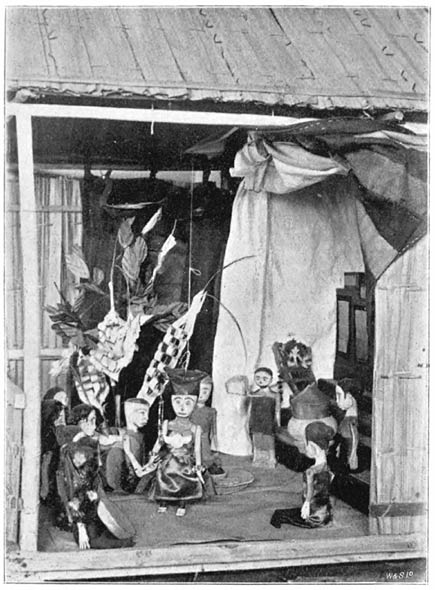
Plate 18.—Gambor.
Model, showing the performance of the kind of dance called gambor. The suspended figure in the centre is the performer, the musicians sitting on the left. Behind the musicians are to be seen some of the sprays of the bouquet of artificial flowers, etc., which is used to represent a pleasure garden (taman bunga) for the attraction of the dance-spirit. The bird at the top of it is a hornbill.
Page 464.
The religious origin of almost all Malay dances is still to be seen in the performance of such ritualistic observances as the burning of incense, the scattering of rice, and the invocation of the Dance-spirit according to certain set forms, the spirit being duly exorcised again (or “escorted homewards,” as it is called) at the end of the performance.
The dances which have best preserved the older ritual are precisely those which are the least often seen, such as the “Gambor Dance” (main gambor), the “Monkey Dance” (main b’rok), the “Palm-blossom Dance” (main mayang), and the “Fish-trap Dance” (main lukah). These I will take in the order mentioned.
The “Gambor Dance” (lit. Gambor Play) should be performed by girls just entering upon womanhood. The débutante is attired in an attractive coat and skirt (sarong), is girt about at the waist with a yellow (royal) sash, and is further provided with an elaborate head-dress, crescent-shaped pendants (dokoh) for the breast, and a fan. The only other “necessary” is the “Pleasure-garden” (taman bunga), which is represented by a large water-jar containing a bunch of long sprays, from the ends of which are made to depend artificial flowers, fruit, and birds, the whole being intended to attract the spirit (Hantu Gambor). In addition there is the usual circular tray, with its complement of sacrificial rice and incense. Everything being ready, the débutante lies down and is covered over with a sheet, and incense is burnt, the sacrificial rice sprinkled, and the invocation of the spirit is chanted by a woman to the accompaniment of the tambourines. Ere it has ended, if all goes well, the charm will have begun to work, the spirit descends, and the dance commences.
At the end of this dance, as has already been said, the spirit is exorcised, that is, he is “escorted back” to the seventh heaven from whence he came.
The invocations, which are used both at the commencement and the conclusion of the performance, consist of poems which belong unmistakably to the “Panji” cycle of stories; here and there they contain old words which are still used in Java.
The “Monkey Dance” is achieved by causing the “Monkey spirit” to enter into a girl of some ten years of age. She is first rocked to and fro in a Malay infant’s swinging-cot (buayan), and fed with areca-nut and salt (pinang garam). When she is sufficiently dizzy or “dazed” (mabok), an invocation addressed to the “Monkey spirit” is chanted (to tambourine accompaniments), and at its close the child commences to perform a dance, in the course of which she is said sometimes to achieve some extraordinary climbing feats which she could never have achieved unless “possessed.” When it is time for her to recover her senses she is called upon by name, and if that fails to recall her, is bathed all over with cocoa-nut milk (ayer niyor hijau).
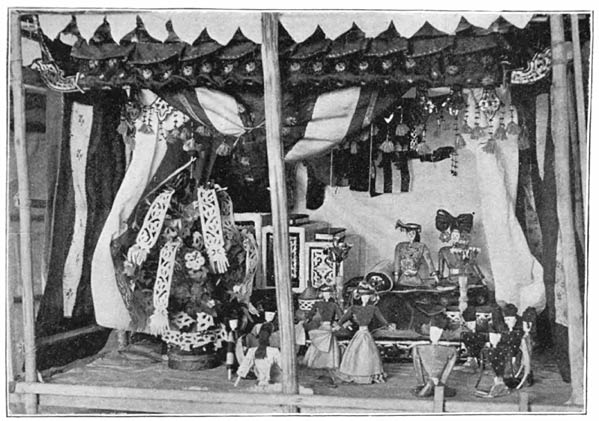
Plate 19.—Pĕdikir.
Model, showing the performance of pĕdikir (a kind of dance) before a newly-married couple. The performers are two girls, who carry fans and wear a peculiar head-dress towards the left of the picture are seated the musicians with tambourines (rĕbana), and on the right some spectators. The bride and bridegroom are seated on the dais, the latter towards the middle of the picture. Near him are seen the marriage-pillows (which are in correct proportion), and overhead the ornamental clothes-rod with clothes. The tree-like object on the left is the sĕtakona: it is the only object out of proportion, being too large. Rolled up in front are the striped hangings used at Malay weddings.
Page 466.
We now come to a class of dances in which certain inanimate objects, that are believed to be temporarily animated, are the performers, and which therefore closely correspond to the performances of our own spiritualists.
The Palm-blossom dance is a very curious exhibition, which I once saw performed in the Langat District of Selangor. Two freshly-gathered sheaves of areca-palm blossom (each several feet in length) were deposited upon a new mat, near a tray containing a censer and the three kinds of sacrificial rice.
The magician (’Che Ganti by name) commenced the performance by playing a prelude on his violin. Presently his wife (an aged Selangor woman) took some of the rice in her hand and commenced to chant the words of the invocation, she being almost immediately joined in the chant by a younger woman. Starting with the words, “Thus I brace up, I brace up the Palm-blossom” (’ku anggit mayang ’ku anggit), their voices rose higher and higher until the seventh stanza was reached, when the old woman covered the two sheaves of Palm-blossom with a Malay plaid skirt (sarong) and the usual “five cubits of white cloth” (folded double), both of which had of course first been fumigated. Then followed seven more stanzas (“Borrow the hammer, Borrow the anvil,” and its companion verses), and rice having been thrown over one of the sheaves of palm-blossom, its sheath was opened and the contents fumigated. Then the old woman took the newly-fumigated sheaf between her hands, and the chant recommenced with the third septet of stanzas (“Dig up, dig up, the wild ginger plant”), as the erect palm-blossom swayed from side to side in time to the music. Finally the fiddle stopped and tambourines were substituted, and at this point the sheaf of blossom commenced to jump about on its stalk, as if it were indeed possessed, and eventually dashed itself upon the ground. After one or two repetitions of this performance, other persons present were invited to try it, and did so with varying success, which depended, I was told, upon the impressionability of their souls, as the palm-blossom would not dance for anybody whose soul was not impressionable (lĕmah sĕmangat).
When the first blossom-sheaf had been destroyed by the rough treatment which it had to undergo, the second was duly fumigated and introduced to the company, and finally the performance was brought to a close by the chanting of the stanzas in which the spirit is requested to return to his own place. The two spoiled sheaves of blossom were then carried respectfully out of the house and laid on the ground beneath a banana-tree.
The Dancing Fish-trap (main lukah) is a spiritualistic performance, in which a fish-trap (lukah) is substituted for the sheaf of palm-blossom, and a different invocation is used. In other respects there is very little difference between the two. The fish-trap is dressed up much in the same way as a “scare-crow,” so as to present a rough and ready resemblance to the human figure, i.e. it is dressed in a woman’s coat and plaid skirt (sarong), both of which must, if possible, have been worn previously; a stick is run through it to serve as the arms of the figure, and a (sterile) cocoa-nut shell (tĕmpurong jantan) clapped on the top to serve as a head. The invocation is then chanted in the same manner and to the same accompaniment as that used for the “Palm-blossom.” At its conclusion the magician whispers, so to speak, into the fish-trap’s ear, bidding it “not to disgrace him,” but rise up and dance, and the fish-trap presently commences to rock to and fro, and to leap about in a manner which of course proves it to be “possessed” by the spirit. Two different specimens of the invocations used will be found in the Appendix.
Buffalo Fights and Cock Fights
“The bulls have been trained and medicined for months beforehand, with much careful tending, many strength-giving potions, and volumes of the old-world charms, which put valour and courage into a beast. They stand at each end of a piece of grassy lawn, with their knots of admirers around them, descanting on their various points, and with the proud trainer, who is at once keeper and medicine-man, holding them by the cord which is passed through their nose-rings. Until you have seen the water-buffalo stripped for the fight, it is impossible to conceive how handsome the ugly brute can look. One has been accustomed to see him with his neck bowed to the yoke he hates, and breaks whenever the opportunity offers; or else in the pâdi fields. In the former case he looks out of place,—an anachronism belonging to a prehistoric period, drawing a cart which seems also to date back to the days before the Deluge. In the fields the buffalo has usually a complete suit of grey mud, and during the quiet evening hour goggles at you through the clouds of flies which surround his flapping ears and brutal nose, the only parts that can be seen of him above the surface of the mud-hole or the running water of the river. In both cases he is unlovely, but in the bull-ring he has something magnificent about him. His black coat has a gloss upon it which would not disgrace a London carriage horse, and which shows him to be in tip-top condition. His neck seems thicker and more powerful than that of any other animal, and it glistens with the chili water, which has been poured over it in order to increase his excitement. His resolute shoulders, his straining quarters,—each vying with the other for the prize for strength,—and his great girth, give a look of astonishing vigour and vitality to the animal. It is the head of the buffalo, however, which it is best to look at on these occasions. Its great spread of horns is very imposing, and the eyes, which are usually sleepy, cynically contemptuous and indifferent, or sullenly cruel, are for once full of life, anger, passion, and excitement. He stands there quivering and stamping, blowing great clouds of smoke from his mouth and nose:—
“With his nostrils like pits full of blood to the brim,
And with circles of red for his eye-socket’s rim.
“The wild joy of battle is sending the blood boiling through the great arteries of the beast, and his accustomed lethargic existence is galvanised into a new fierce life. You can see that he is longing for the battle with an ardour that would have distanced that of a Quixote, and, for the first time, you begin to see something to admire even in the water-buffalo.
“A crowd of Râjas, Chiefs, and commoners are assembled, in their gaily-coloured garments, which always serve to give life and beauty to every Malay picture, with its setting of brilliant never-fading green. The women in their gaudy silks, and dainty veils, glance coquettishly from behind the fenced enclosure which has been prepared for their protection, and where they are quite safe from injury. The young Râjas stalk about, examine the bulls, and give loud and contradictory orders as to the manner in which the fight is to be conducted. The keepers, fortunately, are so deafened by the row which every one near them is making, that they are utterly incapable of following directions which they cannot hear. Malays love many people and many things, and one of the latter is the sound of their own voices. When they are excited—and in the bull-ring they are always wild with excitement—they wax very noisy indeed, and, as they all talk, and no one listens to what any one else is saying, the green sward on which the combat is to take place speedily becomes a pandemonium, compared with which the Tower of Babel was a quiet corner in Sleepy Hollow.
“At last the word to begin is given, and the keepers of the buffaloes let out the lines made fast to the bulls’ noses, and lead their charges to the centre of the green. The lines are crossed, and then gradually drawn taut, so that the bulls are soon facing one another. Then the knots are loosed, and the cords slip from the nose-rings. A dead silence falls upon the people, and for a moment the combatants eye one another. Then they rush together, forehead to forehead, with a mighty impact. A fresh roar rends the sky, the backers of each beast shrieking advice and encouragement to the bull which carries their money.
“After the first rush, the bulls no longer charge, but stand with interlaced horns, straining shoulders, and quivering quarters, bringing tremendous pressure to bear one upon the other, while each strives to get a grip with the point of its horns upon the neck, or cheeks, or face of its opponent. A buffalo’s horn is not sharp, but the weight of the animal is enormous, and you must remember that the horns are driven with the whole of the brute’s bulk for lever and sledgehammer. Such force as is exerted would be almost sufficient to push a crowbar through a stone wall, and, tough though they are, the hardest of old bull buffaloes is not proof against the terrible pressure brought to bear. The bulls show wonderful activity and skill in these fencing matches. Each beast gives way the instant that it is warned by the touch of the horn-tip that its opponent has found an opening, and woe betide the bull that puts its weight into a stab which the other has time to elude. In the flick of an eye—as the Malay phrase has it—advantage is taken of the blunder, and, before the bull has time to recover its lost balance, its opponent has found an opening, and has wedged its horn-point into the neck or cheek. When at last a firm grip has been won, and the horn has been driven into the yielding flesh, as far as the struggles of its opponent render possible, the stabber makes his great effort. Pulling his hind-legs well under him, and straightening his fore-legs to the utmost extent, till the skin is drawn taut over the projecting bosses of bone at the shoulders, and the knots of muscle stand out like cordage on a crate, he lifts his opponent. His head is skewed on one side, so that the horn on which his adversary is hooked is raised to the highest level possible, and his massive neck strains and quivers with the tremendous effort. If the stab is sufficiently low down, say in the neck or under the cheek-bone, the wounded bull is often lifted clean off his fore-feet, and hangs there helpless and motionless ‘while a man might count a score.’ The exertion of lifting, however, is too great to admit of its being continued for any length of time, and as soon as the wounded buffalo regains its power of motion—that is to say, as soon as its fore-feet are again on the ground—it speedily releases itself from its adversary’s horn. Then, since the latter is often spent by the extraordinary effort which has been made, it frequently happens that it is stabbed and lifted in its turn before balance has been completely recovered.
“Once, and only once, have I seen a bull succeed in throwing his opponent, after he had lifted it off its feet. The vanquished bull turned over on its back before it succeeded in regaining its feet, but the victor was itself too used up to more than make a ghost of a stab at the exposed stomach of its adversary. This throw is still spoken of in Pahang as the most marvellous example of skill and strength which has ever been called forth within living memory by any of these contests.
“As the stabs follow one another, to the sound of the clicking of the horns and the mighty blowing and snorting of the breathless bulls, lift succeeds lift with amazing rapidity. The green turf is stamped into mud by the great hoofs of the labouring brutes, and at length one bull owns himself to be beaten. Down goes his head—that sure sign of exhaustion—and in a moment he has turned round and is off on a bee-line, hotly pursued by the victor. The chase is never a long one, as the conqueror always abandons it at the end of a few hundred yards, but while it lasts it is fast and furious, and woe betide the man who finds himself in the way of either of the excited animals.
“Mr. Kipling has told us all about the Law of the Jungle—which after all is only the code of man, adapted to the use of the beasts by Mr. Rudyard Kipling—but those who know the ways of buffaloes are aware that they possess one very well-recognised law. This is, ‘Thou shalt not commit trespass.’ Every buffalo-bull has its own ground; and into this no other bull willingly comes. If he is brought there to do battle, he fights with very little heart, and is easily vanquished by an opponent of half his strength and bulk who happens to be fighting on his own land. When bulls are equally matched, they are taken to fight on neutral ground. When they are badly matched the land owned by the weaker is selected for the scene of the contest.
“In the Archipelago, and on the West Coast of the Peninsula, cock-fights are conducted in the manner known to the Malays as bĕr-tâji, the birds being armed with long artificial spurs, sharp as razors, and curved like a Malay woman’s eyebrow. These weapons make cruel wounds, and cause the death of one or other of the combatants almost before the sport has well begun. To the Malay of the East Coast this form of cock-fighting is regarded as stupid and unsportsmanlike, an opinion which I fully share. It is the marvellous pluck and endurance of the birds that lend an interest to a cock-fight—qualities which are in no way required if the birds are armed with weapons other than those with which they are furnished by nature.
“A cock-fight between two well-known birds is a serious affair in Pahang. The rival qualities of the combatants have furnished food for endless discussion for weeks, or even months, before, and every one of standing has visited and examined the cocks, and has made a book upon the event. On the day fixed for the fight a crowd collects before the palace, and some of the King’s youths set up the cock-pit, which is a ring, about three feet in diameter, enclosed by canvas walls, supported on stakes driven into the ground. Presently the Juâra, or cock-fighters, appear, each carrying his bird under his left arm. They enter the cock-pit, squat down, and begin pulling at, and shampooing the legs and wings of their birds, in the manner which Malays believe loosen the muscles, and get the reefs out of the cocks’ limbs. Then the word is given to start the fight, and the birds, released, fly straight at one another, striking with their spurs, and sending feathers flying in all directions. This lasts for perhaps three minutes, when the cocks begin to lose their wind, and the fight is carried on as much with their beaks as with their spurs. Each bird tries to get its head under its opponent’s wing, running forward to strike at the back of its antagonist’s head, as soon as its own emerges from under its temporary shelter. This is varied by an occasional blow with the spurs, and the Malays herald each stroke with loud cries of approval. Bâsah! Bâsah! ‘Thou hast wetted him! Thou hast drawn blood!’ Ah itu dia! ‘That is it! That is a good one!’ Ah sâkit-lah itu! ‘Ah, that was a nasty one!’ And the birds are exhorted to make fresh efforts, amid occasional burst of the shrill chorus of yells, called sôrak, their backers cheering them on, and crying to them by name.
“Presently time is called, the watch being a small section of cocoa-nut in which a hole has been bored, that is set floating on the surface of a jar of water, until it gradually becomes filled and sinks. At the word, each cock-fighter seizes his bird, drenches it with water, cleans out with a feather the phlegm which has collected in its throat, and shampoos its legs and body. Then, at the given word, the birds are again released, and they fly at one another with renewed energy. They lose their wind more speedily this time, and thereafter they pursue the tactics already described until time is again called. When some ten rounds have been fought, and both the birds are beginning to show signs of distress, the interest of the contest reaches its height, for the fight is at an end if either bird raises its back feathers in a peculiar manner, by which cocks declare themselves to be vanquished. Early in the tenth round the right eye-ball of one cock is broken, and, shortly after, the left eye is bunged up, so that for the time it is blind. Nevertheless, it refuses to throw up the sponge, and fights on gallantly to the end of the round, taking terrible punishment, and doing but little harm to its opponent. One cannot but be full of pity and admiration for the brave bird, which thus gives so marvellous an example of its pluck and endurance. At last time is called, and the cock-fighter who is in charge of the blinded bird, after examining it carefully, asks for a needle and thread, and the swollen lower lid of the still uninjured eye-ball is sewn to the piece of membrane on the bird’s cheek, and its sight is thus once more partially restored. Again time is called, and the birds resume their contest, the cock with the injured eye repaying its adversary so handsomely for the punishment which it had received in the previous round, that, before the cocoa-nut shell is half full of water, its opponent has surrendered, and has immediately been snatched up by the keeper in charge of it. The victorious bird, draggled and woebegone, with great patches of red flesh showing through its wet plumage, with the membrane of its face and its short gills and comb swollen and bloody, with one eye put out, and the other only kept open by the thread attached to its eyelid, yet makes shift to strut, with staggering gait, across the cock-pit, and to notify its victory by giving vent to a lamentable ghost of a crow. Then it is carried off followed by an admiring, gesticulating, vociferous crowd, to be elaborately tended and nursed, as befits so gallant a bird. The beauty of the sport is that either bird can stop fighting at any moment. They are never forced to continue the conflict if once they have declared themselves defeated, and the only real element of cruelty is thus removed. The birds in fighting follow the instinct which nature has implanted in them, and their marvellous courage and endurance surpass anything to be found in any other animals, human or otherwise, with which I am acquainted. Most birds fight more or less—from the little fierce quail to the sucking doves which ignorant Europeans, before their illusions have been dispelled by a sojourn in the East, are accustomed to regard as the emblems of peace and purity; but no bird, or beast, or fish, or human being fights so well, or takes such pleasure in the fierce joy of battle, as does a plucky, lanky, ugly, hard-bit old fighting-cock.
“The Malays regard these birds with immense respect, and value their fighting-cocks next to their children. A few years ago, a boy, who was in charge of a cock which belonged to a Râja of my acquaintance, accidentally pulled some feathers from the bird’s tail. ‘What did you do that for? Devil!’ cried the Râja.
“‘It was not done on purpose, Ungku!’ said the boy.
“‘Thou art marvellous clever at repartee!’ quoth the Prince, and, so saying, he lifted a billet of wood, which chanced to be lying near at hand, and smote the boy on the head so that he died.
“‘That will teach my people to have a care how they use my fighting-cocks!’ said the Râja; and that was his servant’s epitaph.
“‘It is a mere boyish prank,’ said the father of the young Râja, when the matter was reported to him, ‘and, moreover, it is well that he should slay one or two with his own hand, else how should men learn to fear him?’ And there the matter ended; but it should be borne in mind that the fighting-cock of a Malay Prince is not to be lightly trifled with.”
Of the form of cock-fighting practised on the West Coast of the Peninsula Newbold writes:—
“The following is a specimen from a Malay MS. on the subject, commencing with remarks on the various breeds of this noble bird:—
“The colour of the Biring is red with yellow feet and beak.
“The Jalak is white mixed with black, with yellow feet, and beak also yellow mixed with black.
“The Teddong has black eyes and legs, red and black plumage, and a black beak. It is named from a sort of serpent, whose bite is accounted mortal.
“The Chenantan has white feathers, feet, and beak.
“The Ijou has a greenish black beak, feathers black mixed with white, legs green.
“The Pilas has a black beak, red and black feathers, legs white mixed with black.
“The Bongkas has a yellow beak, white feathers and yellow feet.
“The Su has a white beak with white spots, plumage white and black, legs white with black spots.
“The Belurong has a white beak with red spots, plumage red, white feet.
“The Krabu has a red beak mixed with yellow, red feathers and yellow feet.
“There are two kinds of spurs: first, the Golok Golok, in the form of a straight knife known by this name and in use with the Malays; and, secondly, the Taji Benkok, or curved spur: the last is most in vogue.
“There are various modes of tying on the spur, viz. Salik, or below the natural spur; Kumbar, on a level with it; Panggong, above the spur; Sa ibu Tangan, a thumb’s breadth below the knee joint; Sa Kalinking, a little finger’s breadth; Andas Bulu, close to the feathers under the knee; Jankir, upon the little toe; Sauh wongkang, on the middle toe; Berchingkama, tying the three large toes together with the spur—this is the most advantageous; Golok, binding the little toe and the toe on the left with the spur; Golok di Battang, below the natural spur. It is necessary to observe that the Malays generally use one spur; though two spurs are sometimes given to match a weaker against a stronger bird.
“1. The winner takes the dead bird.
“2. If a drawn battle (Sri) each takes his own.
“3. No person but the holder shall interfere with the cocks after they have been once set to, even if one of them run away, except by the permission of the Juara, or setter-to. Should any person do so, and the cock eventually win the battle, the owners shall be entitled to half the stakes only.
“4. Should one of the cocks run away, and the wounded one pursue it, both birds shall be caught and held by their Juaras. Should the runaway cock refuse to peck at its adversary three times, the wings shall be twined over the back, and it shall be put on the ground for its adversary to peck at; should he too refuse, after it has been three times presented, it is a Sri, or drawn battle. The cock that pecks wins.
“5. The stakes on both sides must be forthcoming and deposited on the spot.
“6. A cock shall not be taken up unless the spur be broken, even by the Juaras.
“When a cock has won his disposition changes.
“A cock is called Cheyma when he chooses round grains of paddy, or fights with his shadow, or spurs or pecks at people.
“I once witnessed a grand contest between two Malayan States at the breaking up of the Ramazan fast. Most of the cock-fighters presented themselves at the Golongan or cock-pit with a game-cock under each arm. The birds were not trimmed as in England, but fought in full feather. The spurs used on this occasion were about two and a half inches long, in shape like the blade of a scythe, and were sharpened on the spot by means of a fine whetstone; large gashes were inflicted by these murderous instruments, and it rarely happened that both cocks survived the battle. Cocks of the same colour are seldom matched. The weight is adjusted by the setters-to passing them to and from each other’s hands as they sit facing each other in the Golongan. Should there be any difference, it is brought down to an equality by the spur being fixed so many scales higher on the leg of the heavier cock, or according to rules adverted to, as deemed fair by both parties. One spur only is used, and is generally fastened near the natural spur on the inside of the left leg. In adjusting these preliminaries the professional skill of the setters-to is called into action, and much time is taken up in grave deliberation, which often terminates in wrangling. The birds, after various methods of irritating them have been practised, are then set to. During the continuance of the battle, the excitement and interest taken by the Malays in the barbarous exhibition is vividly depicted in their animated looks and gestures—everything they possess in the world being often staked on the issue.
Games
“Gambling of various descriptions, both with dice and with cards, is much in vogue. These, as well as the poe-table, have been introduced by the Chinese, who are even greater adepts than the Malays in all that relates to this pernicious vice.
“The Malays are remarkably attached to singing reciprocal Pantuns, stanzas comprising four alternate rhyming lines, of which notice has been taken elsewhere. Poetical contests in the Bucolic style are often carried on to a great length by means of Pantuns. To music Malays are passionately devoted, particularly to that of the violin. They evince a good ear, and great readiness in committing to memory even European airs. A voyage or journey of any length is seldom undertaken by the better classes without a minstrel.
Of all minor games, top-spinning and kite-flying are perhaps the most popular. The kites are called layang-layang, which means a “swallow,” but are sometimes of great size, one which was brought to me at Langat measuring some six feet in height by about seven feet between the tips of the wings. The peculiarity of the Malay kite is that it presents a convex, instead of a concave, surface to the wind, and that no “tail” is required, the kite being steadied by means of a beak which projects forward at the top of the framework. They are also usually provided with a thin, horizontal slip of bamboo (dĕngong) stretched tightly behind the beak, and which hums loudly in the wind. They are of a great number of different but well-recognised patterns, such as the “Fighting Dragons” (Naga bĕrjuang), the Crescent (Sahari bulan), the Eagle (Rajawali), the Bird of Paradise (Chĕndrawasih), and so forth. A small kind of roughly-made kite is, as is well known, used at Singapore for fishing purposes, but I have never yet met with any instance of their being used ceremonially, though it is quite certain that grown-ups will fly them with quite as much zest as children.
Teetotums are also used, and I have seen in Selangor a species of bamboo humming-top, but was told that it was copied from a humming-top used by the Chinese.
1. Raja, the King.
2. Mĕntri (“Minister”), the Queen.
3. Têr or Tor, the Castle.
4. Gajah (“Elephant”), the Bishop.
5. Kuda (“Horse”), the Knight.
Main chongkak, again, is a game played with a board (papan chongkak) consisting of a boat-shaped block.
In the top of this block (where the boat’s deck would be) are sunk a double row of holes, the rows containing eight holes each, and two more holes are added, one at each end. Each of the eight holes (in both rows) is filled at starting with eight buah gorek (the buah gorek being the fruit of a common tree, also called kĕlichi in Malacca). There are usually two players who pick the buah gorek out of the holes in turn, and deposit them in the next hole according to certain fixed rules of numerical combination, a solitary buah gorek, wherever it is found, being put back and compelled to recommence its journey down the board.
A similar game is, I believe, known in many parts of the East, and was formerly much played even by Malay slaves, who used to make the double row of holes in the ground when no board was obtainable.
The Malay game of Draughts (main dam) is played, I believe, in exactly the same manner as the English game. Backgammon (main tabal), on the other hand, is played in two different ways.
The “Tiger” Game (main rimau), or “Tiger and Goat” Game (main rimau kambing), is a game which has a distinct resemblance to our own “fox and goose,” there being usually four tigers to a dozen of the goats.
Cards
“Cards are called Kĕrtas sakopong. The Malays are fond of card games, but few Europeans have taken the trouble to understand or describe them. The late Sir W. E. Maxwell contributed the following description of daun tiga ’lei to the Notes and Queries of the Journal of the Straits Asiatic Society. It refers to the game in question as played in Perak:—
“Hearts, Lĕkoh. King, Raja.
Diamonds, Retin. Queen, Bandahara
Clubs, Kalalawar. Knave, Pekah.
Spades, Sakopong. Ace, Sat.
To shuffle, Kiyat, mengiyat.
To deal, Membawa.
To cut, Kĕrat.
To sweep the board, make everyone pay, Mengĕlong.
“Three cards are dealt out to each player. The highest hand counting by pips is that which contains the greatest number of pips after the tens are deducted. Thus a knave, ten, and nine is a good hand.
“The best hand is three aces, Sat tiga.
“The next best is three court-cards, Kuda; naik kuda.
“The next is nine.
“The next is eight.
“All these four hands are known as tĕrus. A hand of three threes is really a good hand, being nine, but it is considered a propitiation of good luck to throw it down (without exposing it), and announce that one is buta, in the hopes of getting good luck afterwards.
“Each player makes two stakes—kapala and ekor. They may be of equal value, or the ekor may be of greater value than the kapala.
“The kapala must not be of greater value than the ekor; that is called tual ka ujong (tual = bĕrat).
“Or there may be a single stake only, which is called podul.
“Betting between players is called sorong, or tuwi, or sorong tuwi.
“A pool, tuwi tengah.
“The ekor stake is only paid to the dealer if he holds one of the hands called tĕrus, and if a smaller hand is held by a player, then the dealer takes both kapala and ekor (mengĕlong).
“A player who holds thirty exactly (except when he has three court-cards, kuda) is said to be out (buta).
“Any one except the player on the right of the dealer may cut. The player who cuts looks at the bottom card of those that he lifts, and if he thinks it is a lucky cut he accepts it and puts down the card he has lifted (pengĕrat).
“The dealer then puts the rest of the pack on top of the cut, and in his turn lifts a portion of the pack (pengangkat), and looks at the bottom card.
“There are all sorts of names for different cards and combinations of cards of various degrees of luck, and these are quoted by the cutter and dealer, each declaring his confidence in the luck coming to him by reason of the cutting or lifting of a particular card.
Five of clubs, Tiang ampat Penghulu chĕlong.

Chukup dengan gambala-nia.
Nine of diamonds, Bunga kachang raja budiman.
Ten of clubs, Gagak sa-kawan raja di-hilir.

Singgah makan pedindang masak.
Masak pun lalu muda pun lalu.
Ace of diamonds if cut, Buntut kris Raja Bandahara.
Do. if the hands of the dealer, Anak yatim jalan sa’orang.
Satu pun tidak marabahaya.
Two of diamonds, Semut ginting Che Amat pelak.
Two of hearts, Batang jamban.
Six is an unlucky card, Daun anam jahanam.
Nine of hearts, Hari panas kubang ber-ayer.
“A player does not hastily look at his three cards and learn his fate at once, but he prolongs the excitement by holding his cards tight together, and looking alternately at the outside ones, and last of all at the middle one, sliding out the latter between the two others little by little. Thus it is left uncertain for some time whether a card is an eight or a seven, a nine or a ten.
“A man to whom a court-card, an eight, and an ace is dealt (if the eight is in the middle), on finding that he has eleven by the two outside ones, says, for instance, Handak kaki tiga, and then commences to slide out the middle card, hoping that it is going to be an eight, or at all events a seven (three pips on each side). This particular hand is called lang siput, because it is certain to carry off something.
The following account of card games as played in Selangor was compiled some years ago by the writer. The names of the cards used in Selangor are these:—
Hearts, Lĕkok or Pangkah.
Diamonds, Rĕten (rĕtim), or Chiduk.
Clubs, K’lawer, or Kĕlalawer.
Spades, Dayong Kling, or Sakopong.
King, Raja.
Queen, Proh, or Nyonya.
Knave, Pekak, or Hamba.
Ace, Sat.
To shuffle, Banchoh, or Mĕnggaul.
To deal, Mĕmbagi.
To cut, K’rat.
To sweep the board, Mĕrĕlong, or Mĕngg’long.
To pay all round, Mĕndader chingkeh.
A picture or court card, Angkong, or Kuda.
A three, Jalor (e.g. two threes, dua jalor).
A card (ordinary), Daun.
A sequence, G’lik (Daun sa-g’lik).
The three most important card games are—(1) main sakopong, (2) main chabut, (3) main tiga ’lei, or pakau.
1. In the game called sakopong all cards from two to six are cast out, and five cards are dealt out to each of the players (who may be from two to four in number); a player leads (turunkan) the card, and the next player has either to follow suit (turunkan daun sagaji) or throw down a card, turning it over (susupkan). If the next player is able to follow suit, whoever plays the highest card of the suit wins. If each player wins a trick it is declared drawn (s’ri), and in this case all stakes are returned.
2. Main chabut is a species of vingt-et-un, and is played with either twenty-one or thirty-one points. If twenty-one points only is the game, court-cards are not counted; but if the game is thirty-one points they are also added in. Two cards are dealt by the dealer (pĕrdi) to each player, who draws (chabut) fresh cards from the bottom of the pack in his turn, and gets as near as possible to thirty-one. If he thinks he cannot safely draw another card (e.g. after twenty-six pips are in his hand) he “passes” (which is called b’lit kĕchil if he stops at twenty-six, twenty-seven, or twenty-eight, and b’lit bĕsar if he stops at twenty-nine or thirty).
If he obtains exactly thirty-one pips he is said to “enter the points” (masok mata); but no player can draw more than seven cards, and if he has, after drawing to the full limit, still failed to obtain as many pips as he wants, he is said to “enter the pack” (masok daun). I may add that the first two cards are called lunas or “keels,” and this may be of various kinds, e.g.:—
1. Lunas nikah, i.e. angkong dĕngan sat (a court-card and an ace).
2. Kachang di-rendang di-tugalkan, i.e. two aces; a very convenient hand, as the aces may be reckoned as either one or eleven, as occasion may require.
3. Lunas sa-glabat, or sagaji ampat-b’las, i.e. angkong dĕngan daun ampat (court-card and four).
4. Lunas dua jalor, two threes.
5. Ace and two, which is the best of all.
In playing chabut or “casting out,” the tens should be thrown away (di-buang daun puloh). When two players have the same number of pips—e.g. nine and nine or eight and eight—the coincidence is described in the words, Jumpa di jalan, di-adu, kalah, di-chabut, mati. To be “bluffed” is called kĕna ranjau (wounded by a caltrop).
And again, when a player has obtained, let us say, twenty-six pips with six cards, and so has only one more chance, and is afraid to risk it, his position is ridiculed in the phrase, Sa-nepak Ulu Klang, a jest of obviously local coinage.
The phrase Tĕngah tiang (half mast), again, is applied to twenty-five pips held irrespective of the number of cards; and if more than thirty-one are obtained, the player is said to be out (mati, or masok piring).
3. Daun tiga ’lei or Pakau is played here as follows:—
Three cards are dealt by the dealer to each player, and the winner is he who holds the greatest number of pips, with certain exceptions.
Daun t’rus The best hand is three aces (tiga sat).

The next is three threes (tiga jalor).
The next is three tens (tiga puloh).
The next is three court-cards (tiga angkong or tiga kuda).
Of other hands the best is a remainder of nine pips left after deducting ten from a hand of nineteen pips.
The next is a remainder of eight pips, and so on.
A hand of three threes, it will be observed, is the second best hand in Selangor, whereas in Perak, according to Sir W. E. Maxwell, it is thrown away as the worst.
The stakes, which are deposited in two heaps by each player, are here called kapala or “head,” and buntut (or ekor), the “tail,” respectively; the kapala being generally, though perhaps not always, greater than the ekor in Selangor, instead of the reverse. The latter can only be lost when a player sweeps the board. A single stake, again, is podul (or occasionally tual), but bĕrtuwi is applied to betting between players, and sorong or tokong means to put down a stake before your rival replies with a counter-stake (bĕrteban or topah). A player who holds thirty exactly is not out here—e.g., he may hold a court-card and two tens. To look at the bottom card is mĕnengo’ angkatan.
Sir W. E. Maxwell gives a number of names and phrases applied to particular cards and combinations of cards, to which I may add—
Two nines and a two—China Keh mĕngandar ayer.
An eight and an ace (making nine) with a court-card, or a ten and two nines—Sĕmbilang bĕrtĕlor.
Two court-cards and a nine—Parak hari ’nak siang.
The four of any suit—Tiang jamban Lĕbai ʿAli.
The explanation of handak kaki tiga, as applied to an eight, appears to be that the eight has three pips on each side. It is also called bĕrisi sa-b’lah. Minta’ pĕnoh (I ask for a full one) means I want a nine (?), and minta’ tombak (I ask for a lance), I want two pips (or three, as the case may be).
Children’s Games
I will now give some specimens of the games I have seen played by children:—
“Throwing the Flower across” (champak bunga sa-b’lah) is a game which I have seen thus played by boys.
A handkerchief was twisted up (like a rope) from corner to corner, folded in half, and then tied together at the ends.
Two couples stood facing one another at a few yards’ distance, and at a given signal one of the boys in each couple took his companion up on to his shoulders. The two who were mounted threw the handkerchief across to each other, and back again by turns. When the one failed to catch it, both riders dismounted and offered backs to their late “mounts,” who thus became riders, and threw the handkerchief in their turn. Each time, however, that a catch was made both parties crossed over. When three catches were made in unbroken succession (kĕlerik) the riders had the privilege of being carried across three times before recommencing play.
I should add that a coin was tossed up at the outset of the game to decide who were to start as the riders, and who were to be the ridden.
Main Sesel (or Kachau kueh) bears a strong family resemblance to our own “Hen and chickens.” When I witnessed it, a big boy played the “Paterfamilias” with a string of children at his back, each of whom was holding on to the one in front of him. Presently a “Cakeseller” presented himself, and the following conversation ensued:—
Paterfamilias: Ada kueh? (Have you any cake?)
Cakeseller: Ada. (I have.)
P.F.: Buleh aku b’li? (Can I buy some?)
C.: Buleh. (Yes.)
Here the Cakeseller hands a ball of earth to Paterfamilias, who passes it down the line of children to the youngest child at the end of the row. The conversation then recommenced—
Cakeseller: Aku minta’ duit. (I want my money.)
P.F.: Duit t’ada, anak kunchi tinggal di jamban. (I have got no money, I have mislaid the key.) Kalau mahu ambil budak, ambil yang di-b’lakang. (If you wish to take one of my children, take the last.)
Here a desperate effort was made by the poor Cakeseller to dodge past Paterfamilias and get at the boy, whom he eventually succeeded in carrying off.
Main Tul is a game somewhat resembling our own “Puss in the corner,” but with only one “home.” The “home” consisted of a stake planted upright, and the first “Puss” (orang tul) was selected by a species of divination depending upon repetition of the same formula as is used to select the blind man in Blind Man’s Buff (Main China Buta). There was (as I have said) only one home in this game, from which the players sallied forth to taunt the orang tul, and which they were obliged to touch in order to save themselves when closely pursued.